EP0077222B1 - Bypass control system - Google Patents
Bypass control system Download PDFInfo
- Publication number
- EP0077222B1 EP0077222B1 EP82400824A EP82400824A EP0077222B1 EP 0077222 B1 EP0077222 B1 EP 0077222B1 EP 82400824 A EP82400824 A EP 82400824A EP 82400824 A EP82400824 A EP 82400824A EP 0077222 B1 EP0077222 B1 EP 0077222B1
- Authority
- EP
- European Patent Office
- Prior art keywords
- flow path
- catalyst
- expander
- valve
- gas
- Prior art date
- Legal status (The legal status is an assumption and is not a legal conclusion. Google has not performed a legal analysis and makes no representation as to the accuracy of the status listed.)
- Expired
Links
- 239000007789 gas Substances 0.000 claims description 41
- 238000000034 method Methods 0.000 claims description 25
- 230000008569 process Effects 0.000 claims description 21
- 238000011084 recovery Methods 0.000 claims description 21
- 230000004044 response Effects 0.000 claims description 17
- 239000002918 waste heat Substances 0.000 claims description 16
- 239000012530 fluid Substances 0.000 claims description 14
- 239000000567 combustion gas Substances 0.000 claims description 6
- 230000003287 optical effect Effects 0.000 claims description 5
- 238000004891 communication Methods 0.000 claims description 4
- 238000009825 accumulation Methods 0.000 claims description 2
- 238000004523 catalytic cracking Methods 0.000 claims description 2
- 239000003054 catalyst Substances 0.000 description 98
- 238000004231 fluid catalytic cracking Methods 0.000 description 15
- 239000013618 particulate matter Substances 0.000 description 11
- 239000002245 particle Substances 0.000 description 6
- 230000001276 controlling effect Effects 0.000 description 5
- 238000001514 detection method Methods 0.000 description 5
- 238000010926 purge Methods 0.000 description 5
- 239000000571 coke Substances 0.000 description 4
- 238000002485 combustion reaction Methods 0.000 description 4
- 230000008859 change Effects 0.000 description 3
- 230000000694 effects Effects 0.000 description 3
- 238000011144 upstream manufacturing Methods 0.000 description 3
- UGFAIRIUMAVXCW-UHFFFAOYSA-N Carbon monoxide Chemical compound [O+]#[C-] UGFAIRIUMAVXCW-UHFFFAOYSA-N 0.000 description 2
- 230000001427 coherent effect Effects 0.000 description 2
- 238000010276 construction Methods 0.000 description 2
- 239000000835 fiber Substances 0.000 description 2
- 239000003546 flue gas Substances 0.000 description 2
- 229930195733 hydrocarbon Natural products 0.000 description 2
- 150000002430 hydrocarbons Chemical class 0.000 description 2
- 238000009434 installation Methods 0.000 description 2
- JTJMJGYZQZDUJJ-UHFFFAOYSA-N phencyclidine Chemical class C1CCCCN1C1(C=2C=CC=CC=2)CCCCC1 JTJMJGYZQZDUJJ-UHFFFAOYSA-N 0.000 description 2
- 238000010791 quenching Methods 0.000 description 2
- UPLPHRJJTCUQAY-WIRWPRASSA-N 2,3-thioepoxy madol Chemical compound C([C@@H]1CC2)[C@@H]3S[C@@H]3C[C@]1(C)[C@@H]1[C@@H]2[C@@H]2CC[C@](C)(O)[C@@]2(C)CC1 UPLPHRJJTCUQAY-WIRWPRASSA-N 0.000 description 1
- 244000186140 Asperula odorata Species 0.000 description 1
- 239000004215 Carbon black (E152) Substances 0.000 description 1
- 235000008526 Galium odoratum Nutrition 0.000 description 1
- VYPSYNLAJGMNEJ-UHFFFAOYSA-N Silicium dioxide Chemical compound O=[Si]=O VYPSYNLAJGMNEJ-UHFFFAOYSA-N 0.000 description 1
- 230000009471 action Effects 0.000 description 1
- PNEYBMLMFCGWSK-UHFFFAOYSA-N aluminium oxide Inorganic materials [O-2].[O-2].[O-2].[Al+3].[Al+3] PNEYBMLMFCGWSK-UHFFFAOYSA-N 0.000 description 1
- 230000000903 blocking effect Effects 0.000 description 1
- 239000003575 carbonaceous material Substances 0.000 description 1
- 230000003197 catalytic effect Effects 0.000 description 1
- 238000004140 cleaning Methods 0.000 description 1
- 238000005336 cracking Methods 0.000 description 1
- 230000001627 detrimental effect Effects 0.000 description 1
- 239000000428 dust Substances 0.000 description 1
- 230000003628 erosive effect Effects 0.000 description 1
- 239000007788 liquid Substances 0.000 description 1
- 230000007257 malfunction Effects 0.000 description 1
- 230000007246 mechanism Effects 0.000 description 1
- 230000004048 modification Effects 0.000 description 1
- 238000012986 modification Methods 0.000 description 1
- 239000003208 petroleum Substances 0.000 description 1
- 230000008929 regeneration Effects 0.000 description 1
- 238000011069 regeneration method Methods 0.000 description 1
- 230000001105 regulatory effect Effects 0.000 description 1
- 238000007789 sealing Methods 0.000 description 1
- 230000035945 sensitivity Effects 0.000 description 1
- 238000000926 separation method Methods 0.000 description 1
- 238000012163 sequencing technique Methods 0.000 description 1
- 239000011949 solid catalyst Substances 0.000 description 1
- 239000002912 waste gas Substances 0.000 description 1
- XLYOFNOQVPJJNP-UHFFFAOYSA-N water Substances O XLYOFNOQVPJJNP-UHFFFAOYSA-N 0.000 description 1
Images


Classifications
-
- C—CHEMISTRY; METALLURGY
- C10—PETROLEUM, GAS OR COKE INDUSTRIES; TECHNICAL GASES CONTAINING CARBON MONOXIDE; FUELS; LUBRICANTS; PEAT
- C10G—CRACKING HYDROCARBON OILS; PRODUCTION OF LIQUID HYDROCARBON MIXTURES, e.g. BY DESTRUCTIVE HYDROGENATION, OLIGOMERISATION, POLYMERISATION; RECOVERY OF HYDROCARBON OILS FROM OIL-SHALE, OIL-SAND, OR GASES; REFINING MIXTURES MAINLY CONSISTING OF HYDROCARBONS; REFORMING OF NAPHTHA; MINERAL WAXES
- C10G11/00—Catalytic cracking, in the absence of hydrogen, of hydrocarbon oils
- C10G11/14—Catalytic cracking, in the absence of hydrogen, of hydrocarbon oils with preheated moving solid catalysts
- C10G11/18—Catalytic cracking, in the absence of hydrogen, of hydrocarbon oils with preheated moving solid catalysts according to the "fluidised-bed" technique
- C10G11/187—Controlling or regulating
-
- B—PERFORMING OPERATIONS; TRANSPORTING
- B01—PHYSICAL OR CHEMICAL PROCESSES OR APPARATUS IN GENERAL
- B01J—CHEMICAL OR PHYSICAL PROCESSES, e.g. CATALYSIS OR COLLOID CHEMISTRY; THEIR RELEVANT APPARATUS
- B01J8/00—Chemical or physical processes in general, conducted in the presence of fluids and solid particles; Apparatus for such processes
- B01J8/005—Separating solid material from the gas/liquid stream
-
- Y—GENERAL TAGGING OF NEW TECHNOLOGICAL DEVELOPMENTS; GENERAL TAGGING OF CROSS-SECTIONAL TECHNOLOGIES SPANNING OVER SEVERAL SECTIONS OF THE IPC; TECHNICAL SUBJECTS COVERED BY FORMER USPC CROSS-REFERENCE ART COLLECTIONS [XRACs] AND DIGESTS
- Y10—TECHNICAL SUBJECTS COVERED BY FORMER USPC
- Y10S—TECHNICAL SUBJECTS COVERED BY FORMER USPC CROSS-REFERENCE ART COLLECTIONS [XRACs] AND DIGESTS
- Y10S208/00—Mineral oils: processes and products
- Y10S208/01—Automatic control
Definitions
- the preheated high molecular weight hydrocarbon liquids and vapors are contacted with hot, solid catalyst particles and maintained at an elevated temperature in a fluidized or dispersed state for a period of time sufficient to effect the desired degree of cracking to lower molecular weight hydrocarbons.
- some non-volatile carbonaceous material or "coke” is deposited on the catalytic particles which reduces the effectiveness of the catalyst. Regeneration of the catalyst is achieved by burning the coke deposits from the catalyst.
- the hot gases resulting from burning the coke are passed through at least one cyclone separation means to remove the entrained regenerated catalyst.
- the regenerated catalyst is returned to the process while the cleaned hot gases are, typically, passed through a power recovery system, in the manner taught by United States Patent No. 3,777,486.
- This patent teaches such a system having a by-pass control for protecting the power recovery expander (18), the system including a first fluid flow path (14) for supplying combustion gases to the expander as a motive fluid, the combustion gases typically containing large amounts of particulates.
- a first valve (20) is provided for controlling the flow of gas in the first fluid path, and, a second fluid path (38) is connected to the first fluid path for by-passing the expander, the second fluid path (38) having second valve means (40) for controlling the flow of gas in the second fluid path.
- process upsets A major problem experienced by users of power recovery equipment is process upsets. These process upsets may be the result of feedstock-to-catalyst pressure differentials, afterburn quench pressure build up, depressurization of the regenerator and other malfunctions which generally occur during the new FCC plant startups but can occur at other times as well.
- the only process upset which seems to be detrimental to the power recovery expander is a catalyst load dump which is caused by a rapid pressure drop in the regenerator.
- Some of the mechanisms which can cause this to happen are: (1) rapid opening of the bypass valve; (2) failure of the bypass valve control signal; (3) failure of signal lines to the bypass or throttle valve; (4) rapid opening of the throttle valve; (5) lack of sequencing communication between the throttle and bypass valves; and (6) backflow of feedstock into the regenerator causing rapid combustion and subsequent water quench.
- a dump occurs, the whole fluidized bed is generally lost because once the cyclone dip tubes are exposed, all the catalyst goes.
- the amount of catalyst dumped is a function of the regenerator size and may vary from 20 to over 100 tons during a 15 to 30 minute time period.
- the invention provides a method of protecting a power recovery expander in a catalytic cracking process of the type in which combustion gas from a reactor is fed to a power recovery expander, characterized by the steps of passing the gas from the reactor through a flow path that includes a vertically downward portion and a 90° bend and which has a by-pass line extending tangentially from approximately the midpoint of the 90° bend, sensing the concentration of particulates in the gas in said flow path, and, when the sensed concentration of particulates reaches a predetermined level, then creating a pressure drop in the by-pass line so that the particulates pass into the by-pass line due to the pressure drop and centrifugal force.
- the invention further provides a by-pass control system for carrying out the method of claim 1, and for protecting a power recovery expander, characterized by:
- a process upset catalyst load dump large concentrations of dumped catalyst are bypassed to prevent their passing through the expander.
- the dumped catalyst is bypassed to a place where it can be recovered.
- a tangential catalyst by- pass path is provided at the mid portion of a 90° bend in the expander feed line and forms a part of the catalyst bypass line.
- the catalyst bypass line contains catalyst recovery structure.
- a laser source directs a beam across the pipe carrying the combustion products from the regenerator and this beam is detected by a photo sensor.
- the intensity of the incident light sensed is a measure of the particulate density flowing through the pipe and a signal indicative thereof is supplied to the microprocessor controlling the FCC process.
- a signal indicative of a catalyst load dump acts as an override signal and causes the opening of a discharge valve on the lock hopper.
- the opening of the lock hopper discharge valve creates a pressure drop in the lock hopper and the catalyst bypass line. Since the catalyst bypass line is tangential with the mid point of a 90° bend, the catalyst passes into the catalyst bypass line and lock hopper where it is collected.
- the laser sensor signal furnished to the microprocessor causes the local hopper discharge valve to close thereby causing the gas stream to pass through the expander.
- the numeral 1 generally designates a PRIOR ART FCC unit with power recovery which is controlled by microprocesser or computer 10.
- the "coked" or spent catalyst is continuously supplied to the regenerator 14 by the reactor 12 via line 12a which contains valve 12b,
- the regenerator 14 the coke is burned off of the catalyst and the resultant combustion products together with entrained catalyst are directed to first and second stage regenerator cyclones 15 and 16, respectively, which generally remove the larger particles of catalyst from the gas stream.
- the regenerated catalyst is returned to the reactor 12 by the regenerator 14 via line 14a which contains valve 14b and which combines with feedstock supply line 11 to feed reactor 12.
- Feedstock supply line 11 contains valve 11a which is controlled in conjunction with valve 14b to balance the pressures of the lines 14a and 11 so that they can be combined and fed into the reactor 12.
- the flue gas passes from regenerator 14 via line 17 to a third stage separator 18 where smaller catalyst particles are removed and are sent as blow down to waste heat boiler 21 via lines 18a and 24a.
- the remaining entrained catalyst particles remain with the gas stream and pass through the line 19 to power recovery expander 24 or are bypassed via bypass line 20.
- the power recovery expander 24 is in a string that serially includes motor/generator 25, air compressor 26 and steam turbine 27. Typically, the expander 24 is used to drive compressor 26 to supply combustion air for the regenerator 14 via line 28.
- valve 22 Under normal operation, the throttle valve 22 is fully open and passing approximately 90% of the total flow from the third stage separator 18 through the expander 24. The remaining 10% is passed to the waste heat boiler 21 by bypass valve 23 which is open perhaps 15° for linear control purposes since both valves 22 and 23 are butterfly valves. Valves 22 and 23 are controlled by microprocesser 10 through hydraulic valve actuators 22b and 23b, respectively, and are under split range control so that when valve 22 begins to close, valve 23 begins to open thereby maintaining the pressure at the regenerator within ⁇ 0.14 kg/cm 2 . The microprocesser 10 control valves 22 and 23 in response to the pressure of regenerator 14 or the flue gas upstream of third stage separator 18 which is furnished via line 61. An overspeed of motor/generator 25 caused by an electrical load dump results in a speed signal which is furnished to microprocesser 10. Microprocesser 10 causes valve 22 to be closed and valve 23 opened, in response to an overspeed signal.
- the cyclones 15 and 16 and the third stage separator 18 become totally ineffective since they are designed to handle specific amounts of catalyst laden gas. As a result, blockages occur and large concentrations of large size particles pass through the third stage separator 18 into the expander 24 creating havoc. While most of the catalyst laden gas passes through bypass line 20 and on to the waste heat boiler and the atmosphere, the amount of catalyst reaching the expander 24 is sufficient to clog the expander and erode the blades. Since a catalyst dump is not sensed as such by the PRIOR ART system, it is treated as other process upsets by attempting pressure and temperature control, etc. and is not identified until after the fact when, typically, the expander is damaged.
- the regenerator system 1 of the Figure 1 system can be modified as shown in Figure 2 to retrofit the present invention into an existing FCC unit.
- all modified structure is numbered 100 higher than the corresponding structure of Figure 1 and all new structure is also in the 100 series.
- An optical sensor generally indicated by the numeral 130 is placed in line 19 which leads from third stage separator 18 to expander 24. If possible, lines 19 and 20 should join at a tee connection such that line 19 enters horizontally and exits vertically downward so that the bypass flow has a straight flow path for reasons discussed below.
- optical sensor 130 has flanges 31 and 32 for the removable attachment of sensor 130 to corresponding flanges 19a and 19b of line 19.
- Laser light source 34 is positioned upstream of expander 24 and is powered by power supply 36. Laser 34 transmits a coherent beam of light represented by arrows 38 normal to the flow path of the gas stream indicated by arrows 40.
- Sensor housing section 42 includes first and second elongated cylindrical members 44 and 45 which are diametrically located. Members 44 and 45 define respective orifices or apertures 46 and 47 in the interior surface of housing section 42.
- Laser 34 transmits a beam of light 38 that serially passes through laser window 34a, purge structure 50 which includes pressure maintaining orifice 51, member 44, aperture 46, across gas stream 40, through aperture 47, member 45, purge structure 52 which includes pressure maintaining orifice 53 and lens 54a reaching sensor element 54.
- Both laser window 34a and lens 54a are preferably quartz glass for heat resistance and are sealed to prevent air leakage.
- Figure 4 illustrates the sealing details of window 34a and lens 54a would be similarly sealed.
- Window 34a is of an infinite focal length whereas lens 54a focuses the beam 38 on sensor element 54.
- the sensor element 54 is preferably a fiber optic device that transmits the beam of light received from laser 34 to photo transducer 56 which in turn sends an electrical signal to microprocessor 110.
- Valve 60 controls the passage of a pressurized fluid, such as air, into purge structure 50 for pressurizing the chamber defined by member 44 to prevent particulate matter from entering into the chamber via aperture 46.
- a pressurized fluid such as air
- Orifice 51 acting in combination with the valve 60 maintains the desired positive pressure within the chamber defined by member 44.
- the purge air prevents the particulates from entering and settling out in the chamber defined by member 44 and from reaching window 34a even where laser window 34a is located below line 19, as illustrated.
- the purge air is used to prevent the window 34a from getting dirty rather than cleaning it after it gets dirty.
- orifice 53 acts in combination with valve 62 to maintain the desired pressure within the chamber defined by member 45 to prevent particulate matter from entering into the chamber via aperture 47.
- orifices 53 and 51 by defining part of the light path of beam 38, greatly reduce the effects of light scatter on sensor 54 by limiting the cross section of the beam 38 and blocking extraneous light. This is especially important if a light source other than a laser is used.
- laser 34 In operation, laser 34 generates a beam of light 38 which is transmitted normal to the flow path of the gas stream 40.
- the beam of light 38 strikes the particulate matter entrained in the gas stream the light is dispersed according to the density or concentration of the particulate matter within the gas stream. That is to say, if the gas stream is relatively free of particulate matter then there will be only minimal scattering of the beam of light and a relatively strong beam of light will pass through aperture 53 to sensor 54.
- the concentration of particulate matter is relatively high, then the beam of light transmitted through aperture 53 to sensor 54 will be relatively weak, or even totally blocked.
- a dense concentration of the particulate matter causes most, or all, of the light to be dispersed, and thus the light is prevented from passing along the light path defined by beam 38 and is unable to reach aperture 53 and sensor 54.
- the fiber optic sensor 54 transmits the incident light to photo transducer 56 with the magnitude varying directly with the intensity of the beam reaching sensor 54.
- the signal generated thereby will be relatively weak.
- the beam of light received by photo transducer 56 is relatively strong, then the signal generated thereby will be likewise of a relatively large magnitude.
- the intensity of the light beam varies with the concentration or density of the particulate matter entrained within the gas stream.
- the signal generated by photo transducer 56 is transmitted to microprocesser 110 for controlling valves 22, 23 and 111a upon the detection of a process upset load dump.
- valves 22 and 111a are closed and valve 23 is fully opened by microprocesser 110 in response to the signal from phototransducer 56 if the regenerator pressure signal supplied in line 61 also indicates a catalyst load dump. Because a catalyst load dump is associated with a pressure drop in the regenerator, the pressure, or preferably the rate of change in pressure in the regenerator as determined by a derivative pressure sensor or controller must be indicative of a catalyst load dump before the FCC system is shut down.
- valve 22 In response to a sensing of catalyst, and not a pressure drop, valve 22 will be rapidly closed to protect the expander and an alarm will be sounded for the operator(s) of the system to take corrective action, but the system will not be shut down. This is a fail safe response to protect the expander and would be the response to a laser failure, for example.
- the throttle valve 22 Upon the detection of a particulate matter concentration indicative of a process upset load dump and a regenerator pressure drop, the throttle valve 22 is caused to close quickly and bypass valve 23 is caused to open quickly. This is different than the normal operation of valves 22 and 23 and would be the case in the Figure 1 system.
- valve actuator 1116 to cause valve 111a in feed stock line 11 to be closed so as to prevent feed stock from entering the regenerator and burning. If for some reason the catalyst dump clears, valves 22, 23 and 111a would immediately be reset and normal operation could proceed.
- valve 22 is closed, all of the flow will pass through line 20. If lines 19 and 20 join in a tee, as noted above, the catalyst entrained gas will have a straight flow which will help carry the catalyst to the waste heat boiler.
- microprocesser 110 controls valves 22 and 23 in response a regenerator pressure signal received via line 61, as is conventional.
- Microprocesser 110 functions the same as the microprocesser 10 of the Figure 1 system except during a load dump.
- the structural differences of the Figure 2 system over the Figure 1 system is the modification of microprocesser 110 and feed stock valve 111a a and the addition of sensor 130.
- the control of valves 22, 23 and 111a is different only during a catalyst load dump or at least the sensing of one by the sensor 130.
- both the laser 34 and sensor element 54 which is optically connected to photo transducer 56, can be air purged without introducing large amounts of air into the gas stream and thereby creating the possibility of gas afterburn.
- the photo transducer 56 transmits a signal to microprocesser 210 which operates lock hopper discharge valve 266 through hydraulic valve actuator 266b and valve 22 through hydraulic valve actuator 22b in response to a signal from the photo transducer 56 indicating a catalyst load dump.
- the sensitivity of the photo transducer 56 can be adjusted to sense various types of disruptions to the laser beam . During normal operation the transducer 56 is unaffected by the amount of catalyst in line 19.
- hydraulic valve actuator 266b causes the lock hopper discharge valve 266 to open and valve actuator 22b causes valve 22 to close in response to signals from microprocesser 210 and an alarm signal will be given to notify the operator(s).
- the opening of discharge valve 266 creates a pressure drop in lock hopper 268 by providing fluid communication to the waste heat boiler or atmosphere.
- the large amount of catalyst moving down the vertical run of line 19 ahead of expander throttle valve 22 cannot conveniently negotiate a 90° turn 219 in pipe 19 as a result of the pressure drop and the centrifugal force experienced in the turn.
- bypass pipe 270 which forms a tangential flow path from approximately the mid point of the 90° turn 219 in pipe 19.
- the catalyst passes via bypass pipe 270 to lock hopper 268 where it is collected.
- the signal from transducer 56 to microprocesser 210 causes lock hopper discharge valve 266 to close and valve 22 to open causing the gas stream to pass through the expander 24 once again.
- Valve 266 will be opened and valve 22 closed unless a pressure signal furnished to microprocesser 210 via line 61 indicates the proper pressure conditions for a catalyst load dump.
- the pressure signal is indicative of rate of change of pressure.
- valves 23 and 111a are controlled in response to regenerator pressure conditions, as is conventional.
- valve 23 can be opened so that the expander will still be protected but only that portion of the catalyst passing through line 19 will be recovered, while the rest goes to the waste heat boiler 21.
- lines 19 and 20 preferably join in a tee connection as discussed above.
- the bypassed gas and catalyst passes into lock hopper 268 where the catalyst 272 settles out while the gas must pass through vortex tube or cyclone 274 before leaving lock hopper 268 to go to the waste heat boiler or atmospheric dump.
- Foot valve 274a provides a one way flow of gas through cyclone 274 to line 267. In this way catalyst is prevented from being discharged into the atmosphere directly or via the waste heat boiler.
- valve motor 282 which can be any suitable conventional piston, for example, acts through the linkage 286 of slide valve 284 to open the slide valve, the trapped catalyst 272 is dumped into dump cart 299. The dump cart 299 is then used to return the catalyst into the regenerator where it is reintroduced into the fluidized bed.
- low level sensor 278 When the level of catalyst 272 has been sufficiently lowered in the lock hopper 268, low level sensor 278 is actuated and supplies a signal to microprocesser210 which, in turn, causes valve 280 to open and causes valve motor 282 to close valve 284. Additionally, if a catalyst load dump is in progress, valve 23 will be closed. Valve 23 may be opened in response to a pressure buildup if the catalyst bypass leg 270 is unable to handle the full flow and will attempt to maintain regenerator pressure. It will be noted that in dumping the catalyst 272 from the lock hopper .
- the catalyst bypass function does not cease and catalyst still flowing in the line 19 will be carried by centrifugal force and vector velocity into the pipe 270 upstream of valve 280 since pipe 270 may be up to 6 meters long and over 1.2 meters in diameter.
- the lock hopper 268 is, preferably, large enough to accommodate all of the catalyst carried over without requiring dumping during a catalyst load dump.
- the embodiment of Figures 5 and 6 can be simplified by eliminating all of the structure downstream of the lock valve 280.
- the hydraulic valve actuator 280b causes the opening of lock valve 280 in response to a signal from microprocesser 310.
- valve 22 When the sensor 130 detects too much catalyst in the line 19, valve 22 will be closed and the valve 280 will be opened to prevent the catalyst from reaching the expander and an alarm signal will be given.
- a pressure signal supplied via line 61 confirms a catalyst load dump, valves 23 and 111a will be closed.
- Valve 280 will be closed and valve 22 will be opened when sensor 130 detects a permissible catalyst level again. If valves 23 and 111a were closed, they will be opened.
- This embodiment will lose the catalyst it will not pass through the stack. The risk of a localized clean up may be justified given the protection of the expander and the infrequency of a catalyst load dump.
- This embodiment can also be retrofit into the FCC system of Figure 1 at the bottom of the third stage separator or in a vertical leg of line 19 and/or 20.
- the present invention protects the power recovery expander of an FCC system by preventing a catalyst load dump from passing through the expander.
- the detection of a catalyst or particulate flow of a predetermined magnitude triggers the expander protection.
- the catalyst load dump is confirmed by the sensing of a pressure change in the regenerator, as through a derivative pressure sensor, further steps are taken to shut down the system.
- the expander protection can take the form of shutting off the flow to the expander or diverting the catalyst portion of the flow to the expander or diverting the catalyst portion of the flow by a combination of centrifugal force and vector velocity.
- the catalyst can be recovered totally, or in part.
- the system is fail safe in that a false detection as through sensor failure triggers the expander protection without shutting down the entire system.
- a suitable microprocesser which can be used for the various embodiments of the present invention is the model 43027 electronic governor manufactured by Woodward Governor Company of Fort Collins, Colorado. The logic of the device would be set for the various modes of operation. Suitable hydraulic actuators for operating the valves are manufactured by M.E.A. Company of Des Plaines, Illinois. Because of the size of the lines, the valves regulating flow in the various gas lines are generally butterfly valves.
Landscapes
- Chemical & Material Sciences (AREA)
- Organic Chemistry (AREA)
- Chemical Kinetics & Catalysis (AREA)
- Oil, Petroleum & Natural Gas (AREA)
- Engineering & Computer Science (AREA)
- General Chemical & Material Sciences (AREA)
- Production Of Liquid Hydrocarbon Mixture For Refining Petroleum (AREA)
- Incineration Of Waste (AREA)
- Chimneys And Flues (AREA)
Description
- In the fluid catalytic cracking (FCC) process for heavy petroleum fractions, the preheated high molecular weight hydrocarbon liquids and vapors are contacted with hot, solid catalyst particles and maintained at an elevated temperature in a fluidized or dispersed state for a period of time sufficient to effect the desired degree of cracking to lower molecular weight hydrocarbons. In the FCC process, some non-volatile carbonaceous material or "coke" is deposited on the catalytic particles which reduces the effectiveness of the catalyst. Regeneration of the catalyst is achieved by burning the coke deposits from the catalyst. The hot gases resulting from burning the coke are passed through at least one cyclone separation means to remove the entrained regenerated catalyst. The regenerated catalyst is returned to the process while the cleaned hot gases are, typically, passed through a power recovery system, in the manner taught by United States Patent No. 3,777,486. This patent teaches such a system having a by-pass control for protecting the power recovery expander (18), the system including a first fluid flow path (14) for supplying combustion gases to the expander as a motive fluid, the combustion gases typically containing large amounts of particulates. A first valve (20) is provided for controlling the flow of gas in the first fluid path, and, a second fluid path (38) is connected to the first fluid path for by-passing the expander, the second fluid path (38) having second valve means (40) for controlling the flow of gas in the second fluid path. After having passed through the expander (18) or through the by-pass line (22) the waste gases typically are passed to a waste heat boiler and then exhausted to atmosphere.
- A major problem experienced by users of power recovery equipment is process upsets. These process upsets may be the result of feedstock-to-catalyst pressure differentials, afterburn quench pressure build up, depressurization of the regenerator and other malfunctions which generally occur during the new FCC plant startups but can occur at other times as well.
- The only process upset which seems to be detrimental to the power recovery expander is a catalyst load dump which is caused by a rapid pressure drop in the regenerator. Some of the mechanisms which can cause this to happen are: (1) rapid opening of the bypass valve; (2) failure of the bypass valve control signal; (3) failure of signal lines to the bypass or throttle valve; (4) rapid opening of the throttle valve; (5) lack of sequencing communication between the throttle and bypass valves; and (6) backflow of feedstock into the regenerator causing rapid combustion and subsequent water quench. When a dump occurs, the whole fluidized bed is generally lost because once the cyclone dip tubes are exposed, all the catalyst goes. The amount of catalyst dumped is a function of the regenerator size and may vary from 20 to over 100 tons during a 15 to 30 minute time period. Not all of the catalyst goes through the expander, the majority of it goes through the bypass line into the waste heat boiler. When this happens, the catalyst goes out the stack of the waste heat boiler producing a large dust cloud which settles out over the area, much like volcanic ash. Settling out may take several days under proper atmospheric conditions. Since the catalyst is siliceous, such as silica-alumina, the catalyst passing through the expander results in severe erosion of a single stage expander and blockage of the second stage of a two-stage expander with the resultant wear down of the first stage rotor blades. Although the FCC process is under computer control, catalyst load dumps are not identified until after they have taken place and the expander is damaged.
- The invention provides a method of protecting a power recovery expander in a catalytic cracking process of the type in which combustion gas from a reactor is fed to a power recovery expander, characterized by the steps of passing the gas from the reactor through a flow path that includes a vertically downward portion and a 90° bend and which has a by-pass line extending tangentially from approximately the midpoint of the 90° bend, sensing the concentration of particulates in the gas in said flow path, and, when the sensed concentration of particulates reaches a predetermined level, then creating a pressure drop in the by-pass line so that the particulates pass into the by-pass line due to the pressure drop and centrifugal force.
- The invention further provides a by-pass control system for carrying out the method of claim 1, and for protecting a power recovery expander, characterized by:
- a first flow path serially including a vertically downwardly extending portion and a 90° bend for supplying combustion gas to said expander as a motive fluid;
- first valve means downstream of said 90° bend for controlling the flow of gas in said first flow path;
- a second flow path extending tangentially from approximately the midpoint of said 90° bend and being in fluid flow communication with said first flow path;
- said second flow path having a normally closed valve therein;
- means for determining the concentration of particulates in said gas in said first flow path and for generating a signal indicative thereof; and
- means for opening said normally closed valve in response to said signal when said signal represents a predetermined particulate level in said gas in said first flow path, whereby a pressure drop is created in said first flow path when said normally closed valve means is opened, and particulates are directed into the second flow path to prevent them from passing into said expander.
- During a process upset catalyst load dump, large concentrations of dumped catalyst are bypassed to prevent their passing through the expander. Preferably, the dumped catalyst is bypassed to a place where it can be recovered. However, in retrofit installations it may be necessary to just protect the expander and bypass the catalyst to the waste heat boiler. In the preferred embodiment, a tangential catalyst by- pass path is provided at the mid portion of a 90° bend in the expander feed line and forms a part of the catalyst bypass line. When a valve in the catalyst bypass line is opened in response to a catalyst load dump, the catalyst is caused to be bypassed to the catalyst bypass line. Preferably, the catalyst bypass line contains catalyst recovery structure.
- Basically, a laser source directs a beam across the pipe carrying the combustion products from the regenerator and this beam is detected by a photo sensor. The intensity of the incident light sensed is a measure of the particulate density flowing through the pipe and a signal indicative thereof is supplied to the microprocessor controlling the FCC process. A signal indicative of a catalyst load dump acts as an override signal and causes the opening of a discharge valve on the lock hopper. The opening of the lock hopper discharge valve creates a pressure drop in the lock hopper and the catalyst bypass line. Since the catalyst bypass line is tangential with the mid point of a 90° bend, the catalyst passes into the catalyst bypass line and lock hopper where it is collected. When process conditions are reestablished, the laser sensor signal furnished to the microprocessor causes the local hopper discharge valve to close thereby causing the gas stream to pass through the expander.
- This invention will now be described by way of example, with reference to the accompanying drawings in which:
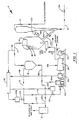
- Figure 1 is a schematic representation of a PRIOR ART FCC unit with power recovery;
- Figure 2 is a schematic representation of an FCC process retrofit to incorporate the present invention;
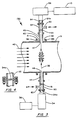
- Figure 3 is a schematic partially sectioned view of the optical sensor of the present invention;
- Figure 4 is an enlarged view of the seal structure for the laser window;
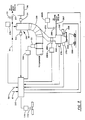
- Figure 5 is a schematic representation of an initial installation employing the present invention;
- Figure 6 is a more detailed representation of the catalyst bypass structure of the Figure 5 device; and
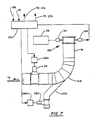
- Figure 7 is a schematic representation of a simplified embodiment.
- In Figure 1, the numeral 1 generally designates a PRIOR ART FCC unit with power recovery which is controlled by microprocesser or
computer 10. The "coked" or spent catalyst is continuously supplied to theregenerator 14 by thereactor 12 vialine 12a which containsvalve 12b, In theregenerator 14, the coke is burned off of the catalyst and the resultant combustion products together with entrained catalyst are directed to first and secondstage regenerator cyclones reactor 12 by theregenerator 14 vialine 14a which contains valve 14b and which combines with feedstock supply line 11 to feedreactor 12. Feedstock supply line 11 contains valve 11a which is controlled in conjunction with valve 14b to balance the pressures of thelines 14a and 11 so that they can be combined and fed into thereactor 12. The flue gas passes fromregenerator 14 vialine 17 to athird stage separator 18 where smaller catalyst particles are removed and are sent as blow down to wasteheat boiler 21 vialines line 19 to power recovery expander 24 or are bypassed viabypass line 20. The power recovery expander 24 is in a string that serially includes motor/generator 25,air compressor 26 andsteam turbine 27. Typically, theexpander 24 is used to drivecompressor 26 to supply combustion air for theregenerator 14 vialine 28. After passing through expander 24, the gas passes throughline 24a and recombines with the bypassed gas fromline 20 and the blow down fromline 18a and is directed to heat recovery, typically a CO orwaste heat boiler 21.Bypass line 20 together withvalves lines microprocesser 10, provide the necessary control for bringing the power recovery string on line, for maintaining the regenerator pressure and for unloading the power recovery train. - Under normal operation, the
throttle valve 22 is fully open and passing approximately 90% of the total flow from thethird stage separator 18 through theexpander 24. The remaining 10% is passed to thewaste heat boiler 21 bybypass valve 23 which is open perhaps 15° for linear control purposes since bothvalves Valves microprocesser 10 throughhydraulic valve actuators valve 22 begins to close,valve 23 begins to open thereby maintaining the pressure at the regenerator within ±0.14 kg/cm2. Themicroprocesser 10control valves regenerator 14 or the flue gas upstream ofthird stage separator 18 which is furnished vialine 61. An overspeed of motor/generator 25 caused by an electrical load dump results in a speed signal which is furnished tomicroprocesser 10.Microprocesser 10 causesvalve 22 to be closed andvalve 23 opened, in response to an overspeed signal. - During a major process upset, the
cyclones third stage separator 18 become totally ineffective since they are designed to handle specific amounts of catalyst laden gas. As a result, blockages occur and large concentrations of large size particles pass through thethird stage separator 18 into theexpander 24 creating havoc. While most of the catalyst laden gas passes throughbypass line 20 and on to the waste heat boiler and the atmosphere, the amount of catalyst reaching theexpander 24 is sufficient to clog the expander and erode the blades. Since a catalyst dump is not sensed as such by the PRIOR ART system, it is treated as other process upsets by attempting pressure and temperature control, etc. and is not identified until after the fact when, typically, the expander is damaged. - The regenerator system 1 of the Figure 1 system can be modified as shown in Figure 2 to retrofit the present invention into an existing FCC unit. In Figure 2 all modified structure is numbered 100 higher than the corresponding structure of Figure 1 and all new structure is also in the 100 series. An optical sensor generally indicated by the numeral 130 is placed in
line 19 which leads fromthird stage separator 18 toexpander 24. If possible,lines line 19 enters horizontally and exits vertically downward so that the bypass flow has a straight flow path for reasons discussed below. As best shown in Figure 3,optical sensor 130 hasflanges sensor 130 tocorresponding flanges 19a and 19b ofline 19. As noted above, the gas stream delivered topower recovery expander 24 as the motivating fluid has particulate matter entrained therein.Laser light source 34 is positioned upstream ofexpander 24 and is powered bypower supply 36.Laser 34 transmits a coherent beam of light represented byarrows 38 normal to the flow path of the gas stream indicated byarrows 40.Sensor housing section 42 includes first and second elongatedcylindrical members Members apertures housing section 42. -
Laser 34 transmits a beam of light 38 that serially passes through laser window 34a,purge structure 50 which includespressure maintaining orifice 51,member 44,aperture 46, acrossgas stream 40, throughaperture 47,member 45,purge structure 52 which includespressure maintaining orifice 53 andlens 54a reachingsensor element 54. Both laser window 34a andlens 54a are preferably quartz glass for heat resistance and are sealed to prevent air leakage. Figure 4 illustrates the sealing details of window 34a andlens 54a would be similarly sealed. Window 34a is of an infinite focal length whereaslens 54a focuses thebeam 38 onsensor element 54. Thesensor element 54 is preferably a fiber optic device that transmits the beam of light received fromlaser 34 tophoto transducer 56 which in turn sends an electrical signal tomicroprocessor 110.Valve 60 controls the passage of a pressurized fluid, such as air, intopurge structure 50 for pressurizing the chamber defined bymember 44 to prevent particulate matter from entering into the chamber viaaperture 46.Orifice 51 acting in combination with thevalve 60 maintains the desired positive pressure within the chamber defined bymember 44. It will be noted that the purge air prevents the particulates from entering and settling out in the chamber defined bymember 44 and from reaching window 34a even where laser window 34a is located belowline 19, as illustrated. Thus the purge air is used to prevent the window 34a from getting dirty rather than cleaning it after it gets dirty. - Similarly,
orifice 53 acts in combination withvalve 62 to maintain the desired pressure within the chamber defined bymember 45 to prevent particulate matter from entering into the chamber viaaperture 47. Additionally,orifices beam 38, greatly reduce the effects of light scatter onsensor 54 by limiting the cross section of thebeam 38 and blocking extraneous light. This is especially important if a light source other than a laser is used. - In operation,
laser 34 generates a beam of light 38 which is transmitted normal to the flow path of thegas stream 40. As the beam oflight 38 strikes the particulate matter entrained in the gas stream the light is dispersed according to the density or concentration of the particulate matter within the gas stream. That is to say, if the gas stream is relatively free of particulate matter then there will be only minimal scattering of the beam of light and a relatively strong beam of light will pass throughaperture 53 tosensor 54. On the other hand, if the concentration of particulate matter is relatively high, then the beam of light transmitted throughaperture 53 tosensor 54 will be relatively weak, or even totally blocked. A dense concentration of the particulate matter causes most, or all, of the light to be dispersed, and thus the light is prevented from passing along the light path defined bybeam 38 and is unable to reachaperture 53 andsensor 54. - The
fiber optic sensor 54 transmits the incident light tophoto transducer 56 with the magnitude varying directly with the intensity of thebeam reaching sensor 54. Thus, when a relatively weak beam of light is received byphoto transducer 56, the signal generated thereby will be relatively weak. Similarly, when the beam of light received byphoto transducer 56 is relatively strong, then the signal generated thereby will be likewise of a relatively large magnitude. As noted previously, the intensity of the light beam varies with the concentration or density of the particulate matter entrained within the gas stream. The signal generated byphoto transducer 56 is transmitted to microprocesser 110 for controllingvalves valves 22 and 111a are closed andvalve 23 is fully opened bymicroprocesser 110 in response to the signal fromphototransducer 56 if the regenerator pressure signal supplied inline 61 also indicates a catalyst load dump. Because a catalyst load dump is associated with a pressure drop in the regenerator, the pressure, or preferably the rate of change in pressure in the regenerator as determined by a derivative pressure sensor or controller must be indicative of a catalyst load dump before the FCC system is shut down. In response to a sensing of catalyst, and not a pressure drop,valve 22 will be rapidly closed to protect the expander and an alarm will be sounded for the operator(s) of the system to take corrective action, but the system will not be shut down. This is a fail safe response to protect the expander and would be the response to a laser failure, for example. Upon the detection of a particulate matter concentration indicative of a process upset load dump and a regenerator pressure drop, thethrottle valve 22 is caused to close quickly andbypass valve 23 is caused to open quickly. This is different than the normal operation ofvalves optical sensor 130 has sensed a load dump and a pressure drop has been indicated. Most likely, all of the catalyst will be dumped. Additionally, themicroprocesser 110 will send a signal to hydraulic valve actuator 1116 to cause valve 111a in feed stock line 11 to be closed so as to prevent feed stock from entering the regenerator and burning. If for some reason the catalyst dump clears,valves valve 22 is closed, all of the flow will pass throughline 20. Iflines - The result of the detection of the load dump is that all of the gas is bypassed and goes to the
waste heat boiler 21 rather than having some of the catalyst laden gas go through the expander which would be destroyed thereby. In this arrangement the expander is protected but the catalyst bypassed to the waste heat boiler is lost, just as it would be if the present invention was not retrofit into the system. During normal operating conditions,microprocesser 110controls valves line 61, as is conventional.Microprocesser 110 functions the same as themicroprocesser 10 of the Figure 1 system except during a load dump. Thus the structural differences of the Figure 2 system over the Figure 1 system is the modification ofmicroprocesser 110 and feed stock valve 111a a and the addition ofsensor 130. Functionally, the control ofvalves sensor 130. - Where the present invention is to be incorporated into the initial construction of an FCC system, a typical construction would be that illustrated in Figures 5 and 6. In Figures 5 and 6, all modified structure is numbered in the 200 series as is all new structure while all unmodified structure is numbered as in Figures 1-3 and is structurally the same.
Laser 34 is located outside of pipe orline 19 located in a vertical run ofline 19 to help keepmembers laser 34 traverses the diameter ofpipe 19 and impinges uponphoto transducer 56 which is also mounted onpipe 19 diametricallyopposite laser 34. Because the laser beam is coherent, both thelaser 34 andsensor element 54, which is optically connected tophoto transducer 56, can be air purged without introducing large amounts of air into the gas stream and thereby creating the possibility of gas afterburn. Thephoto transducer 56 transmits a signal tomicroprocesser 210 which operates lockhopper discharge valve 266 throughhydraulic valve actuator 266b andvalve 22 throughhydraulic valve actuator 22b in response to a signal from thephoto transducer 56 indicating a catalyst load dump. The sensitivity of thephoto transducer 56 can be adjusted to sense various types of disruptions to the laser beam . During normal operation thetransducer 56 is unaffected by the amount of catalyst inline 19. However, when large amounts of catalyst pass through the beam, such as are experienced during a catalyst load dump,hydraulic valve actuator 266b causes the lockhopper discharge valve 266 to open andvalve actuator 22b causesvalve 22 to close in response to signals frommicroprocesser 210 and an alarm signal will be given to notify the operator(s). The opening ofdischarge valve 266 creates a pressure drop inlock hopper 268 by providing fluid communication to the waste heat boiler or atmosphere. As a result of the pressure drop, the large amount of catalyst moving down the vertical run ofline 19 ahead ofexpander throttle valve 22 cannot conveniently negotiate a 90°turn 219 inpipe 19 as a result of the pressure drop and the centrifugal force experienced in the turn. So rather than passing on towardsvalve 22 andexpander 24, the catalyst is passed intobypass pipe 270 which forms a tangential flow path from approximately the mid point of the 90°turn 219 inpipe 19. The catalyst passes viabypass pipe 270 to lockhopper 268 where it is collected. When process conditions are reestablished, the signal fromtransducer 56 to microprocesser 210 causes lockhopper discharge valve 266 to close andvalve 22 to open causing the gas stream to pass through theexpander 24 once again.Valve 266 will be opened andvalve 22 closed unless a pressure signal furnished to microprocesser 210 vialine 61 indicates the proper pressure conditions for a catalyst load dump. Preferably, the pressure signal is indicative of rate of change of pressure. If the pressure signal is also indicative of a catalyst load dump,microprocesser 210 will also causevalves 23 and 111a to close. Whenvalve 22 is closed, motor/generator 25 will go into the motoring mode to maintain the string speed, as is conventional. During normal conditions,valves valve 23 can be opened so that the expander will still be protected but only that portion of the catalyst passing throughline 19 will be recovered, while the rest goes to thewaste heat boiler 21. In this alternative operation, lines 19 and 20 preferably join in a tee connection as discussed above. - As best shown in Figure 6, the bypassed gas and catalyst passes into
lock hopper 268 where thecatalyst 272 settles out while the gas must pass through vortex tube orcyclone 274 before leavinglock hopper 268 to go to the waste heat boiler or atmospheric dump. Foot valve 274a provides a one way flow of gas throughcyclone 274 toline 267. In this way catalyst is prevented from being discharged into the atmosphere directly or via the waste heat boiler. When thecatalyst 272 builds up to a certain level in thelock hopper 268,high level sensor 276 is actuated and supplies a signal tomicroprocesser 210 which in turn signalshydraulic valve actuator 280b to causelock valve 280 to close, actuates thevalve motor 282 ofslide valve 284 to openvalve 284 and, if a catalyst load dump is in progress, causesvalve 23 to open. Whenvalve motor 282, which can be any suitable conventional piston, for example, acts through thelinkage 286 ofslide valve 284 to open the slide valve, the trappedcatalyst 272 is dumped intodump cart 299. Thedump cart 299 is then used to return the catalyst into the regenerator where it is reintroduced into the fluidized bed. When the level ofcatalyst 272 has been sufficiently lowered in thelock hopper 268,low level sensor 278 is actuated and supplies a signal to microprocesser210 which, in turn, causesvalve 280 to open and causesvalve motor 282 to closevalve 284. Additionally, if a catalyst load dump is in progress,valve 23 will be closed.Valve 23 may be opened in response to a pressure buildup if thecatalyst bypass leg 270 is unable to handle the full flow and will attempt to maintain regenerator pressure. It will be noted that in dumping thecatalyst 272 from the lock hopper . 268 the catalyst bypass function does not cease and catalyst still flowing in theline 19 will be carried by centrifugal force and vector velocity into thepipe 270 upstream ofvalve 280 sincepipe 270 may be up to 6 meters long and over 1.2 meters in diameter. However, thelock hopper 268 is, preferably, large enough to accommodate all of the catalyst carried over without requiring dumping during a catalyst load dump. - In the normal operation of the FCC process, the embodiment of Figures 5 and 6 serves an additional function. With lock
hopper discharge valve 266 closed andlock valve 280 open, a vortex is established inbypass leg 270. Catalyst attempting to make the 90°bend 219 inpipe 19 becomes trapped in this vortex and descends very slowly into thelock hopper 268. In effect, a fourth stage separator is created by the bypass configuration of Figures 5 and 6. This means that less catalyst will pass through the blades of the expander during normal operation and this means a longer life for the blades. The catalyst accumulation as a result of the fourth stage separator, if in a sufficient amount, would actuatelevel sensor 276, as described above, so as to cause the trapped catalyst to be dumped. - If the fourth stage separator function and catalyst recovery are not desired or economically justified, the embodiment of Figures 5 and 6 can be simplified by eliminating all of the structure downstream of the
lock valve 280. Referring now to Figure 7, thehydraulic valve actuator 280b causes the opening oflock valve 280 in response to a signal frommicroprocesser 310. When thesensor 130 detects too much catalyst in theline 19,valve 22 will be closed and thevalve 280 will be opened to prevent the catalyst from reaching the expander and an alarm signal will be given. If a pressure signal supplied vialine 61 confirms a catalyst load dump,valves 23 and 111a will be closed.Valve 280 will be closed andvalve 22 will be opened whensensor 130 detects a permissible catalyst level again. Ifvalves 23 and 111a were closed, they will be opened. Although this embodiment will lose the catalyst it will not pass through the stack. The risk of a localized clean up may be justified given the protection of the expander and the infrequency of a catalyst load dump. This embodiment can also be retrofit into the FCC system of Figure 1 at the bottom of the third stage separator or in a vertical leg ofline 19 and/or 20. - In summary, the present invention protects the power recovery expander of an FCC system by preventing a catalyst load dump from passing through the expander. The detection of a catalyst or particulate flow of a predetermined magnitude triggers the expander protection. However, if the catalyst load dump is confirmed by the sensing of a pressure change in the regenerator, as through a derivative pressure sensor, further steps are taken to shut down the system. The expander protection can take the form of shutting off the flow to the expander or diverting the catalyst portion of the flow to the expander or diverting the catalyst portion of the flow by a combination of centrifugal force and vector velocity. The catalyst can be recovered totally, or in part. The system is fail safe in that a false detection as through sensor failure triggers the expander protection without shutting down the entire system.
- A suitable microprocesser which can be used for the various embodiments of the present invention is the model 43027 electronic governor manufactured by Woodward Governor Company of Fort Collins, Colorado. The logic of the device would be set for the various modes of operation. Suitable hydraulic actuators for operating the valves are manufactured by M.E.A. Company of Des Plaines, Illinois. Because of the size of the lines, the valves regulating flow in the various gas lines are generally butterfly valves.
Claims (5)
Applications Claiming Priority (2)
| Application Number | Priority Date | Filing Date | Title |
|---|---|---|---|
| US06/310,942 US4392345A (en) | 1981-10-13 | 1981-10-13 | Bypass control system |
| US310942 | 1989-02-16 |
Publications (3)
| Publication Number | Publication Date |
|---|---|
| EP0077222A2 EP0077222A2 (en) | 1983-04-20 |
| EP0077222A3 EP0077222A3 (en) | 1984-02-01 |
| EP0077222B1 true EP0077222B1 (en) | 1986-10-15 |
Family
ID=23204708
Family Applications (1)
| Application Number | Title | Priority Date | Filing Date |
|---|---|---|---|
| EP82400824A Expired EP0077222B1 (en) | 1981-10-13 | 1982-05-04 | Bypass control system |
Country Status (9)
| Country | Link |
|---|---|
| US (1) | US4392345A (en) |
| EP (1) | EP0077222B1 (en) |
| JP (1) | JPS5863784A (en) |
| BR (1) | BR8203098A (en) |
| CA (1) | CA1168171A (en) |
| DE (2) | DE77222T1 (en) |
| ES (2) | ES512186A0 (en) |
| MX (1) | MX164946B (en) |
| TR (1) | TR21344A (en) |
Families Citing this family (17)
| Publication number | Priority date | Publication date | Assignee | Title |
|---|---|---|---|---|
| US4532026A (en) * | 1982-07-06 | 1985-07-30 | Chevron Research Company | Method to improve circulation control in fluidized systems |
| US4925444A (en) * | 1987-08-07 | 1990-05-15 | Baxter Travenol Laboratories, Inc. | Closed multi-fluid delivery system and method |
| US5464528A (en) * | 1993-12-30 | 1995-11-07 | Mobil Oil Corporation | FCC process and apparatus with upset tolerant third stage separator |
| US5666801A (en) * | 1995-09-01 | 1997-09-16 | Rohrer; John W. | Combined cycle power plant with integrated CFB devolatilizer and CFB boiler |
| US6324895B1 (en) * | 1998-02-13 | 2001-12-04 | Mobil Oil Corporation | Process for determining the amount of erosive material entering a power recovery turbine |
| BRPI0519448A2 (en) * | 2005-01-18 | 2009-01-20 | Zhengcai Zhou | pre-mixed abrasive paste blasting device |
| US20060266048A1 (en) * | 2005-05-27 | 2006-11-30 | Bell Leonard E | Fluid catalytic cracking flue gas utility optimizing system and process |
| US7597797B2 (en) * | 2006-01-09 | 2009-10-06 | Alliance Process Partners, Llc | System and method for on-line spalling of a coker |
| US7802435B2 (en) * | 2006-12-21 | 2010-09-28 | Uop Llc | Cogeneration process for a regenerator in an FCC system |
| US7811446B2 (en) * | 2007-12-21 | 2010-10-12 | Uop Llc | Method of recovering energy from a fluid catalytic cracking unit for overall carbon dioxide reduction |
| US7935245B2 (en) * | 2007-12-21 | 2011-05-03 | Uop Llc | System and method of increasing synthesis gas yield in a fluid catalytic cracking unit |
| US20090277514A1 (en) * | 2008-05-09 | 2009-11-12 | D-Cok, Llc | System and method to control catalyst migration |
| FR3024205B1 (en) * | 2014-07-28 | 2017-02-03 | Total Raffinage Chimie | GUILLOTINE VALVE FOR FLOW CONTROL IN A FLUID CATALYTIC CRACKING UNIT |
| US9840413B2 (en) | 2015-05-18 | 2017-12-12 | Energyield Llc | Integrated reformer and syngas separator |
| US9843062B2 (en) | 2016-03-23 | 2017-12-12 | Energyield Llc | Vortex tube reformer for hydrogen production, separation, and integrated use |
| US10876426B2 (en) * | 2019-04-09 | 2020-12-29 | Pratt & Whitney Canada Corp. | Removable turbine gaspath sensor |
| CN114229249A (en) * | 2021-12-21 | 2022-03-25 | 内蒙古联晟新能源材料有限公司 | Oil control device for oil storage barrel |
Family Cites Families (14)
| Publication number | Priority date | Publication date | Assignee | Title |
|---|---|---|---|---|
| US3401124A (en) * | 1964-10-26 | 1968-09-10 | Exxon Research Engineering Co | Recovering energy from flue gas |
| DE1598138C3 (en) | 1966-09-24 | 1974-10-17 | Robert Bosch Gmbh, 7000 Stuttgart | Device for measuring the concentration of particles suspended in a flowing gas, in particular the soot content of the exhaust gases from internal combustion engines |
| GB1141125A (en) | 1967-03-10 | 1969-01-29 | Rolls Royce | A gas turbine engine installation |
| DE1598736A1 (en) | 1967-06-10 | 1971-04-01 | Linde Ag | Method and device for the automatic interruption of a gas flow when impurities occur |
| US3777486A (en) * | 1971-01-29 | 1973-12-11 | Carrier Corp | Apparatus for and a method of operating power recovery equipment |
| US3743430A (en) * | 1971-11-12 | 1973-07-03 | Shell Oil Co | Light transmission monitor |
| US3867640A (en) * | 1972-03-09 | 1975-02-18 | Levy Co Edward C | Dust sampling system |
| US3843268A (en) * | 1973-07-05 | 1974-10-22 | Beckman Instruments Inc | Sample container for laser light scattering photometers |
| US3873206A (en) * | 1973-10-03 | 1975-03-25 | Leeds & Northrup Co | Method for determining a specific characteristic of fluid suspended particles |
| US4071298A (en) * | 1974-06-27 | 1978-01-31 | Stanford Research Institute | Laser Raman/fluorescent device for analyzing airborne particles |
| JPS5212674A (en) * | 1975-07-19 | 1977-01-31 | Kawasaki Heavy Ind Ltd | Chemical reaction furnace system |
| CH592933A5 (en) * | 1976-04-05 | 1977-11-15 | Cerberus Ag | |
| CH627272A5 (en) | 1976-10-11 | 1981-12-31 | Gerhard Lauer | Device for determining the optical transparency of a flowing medium |
| US4137462A (en) * | 1977-10-31 | 1979-01-30 | Westinghouse Electric Corp. | Probe for measuring steam quality |
-
1981
- 1981-10-13 US US06/310,942 patent/US4392345A/en not_active Expired - Lifetime
-
1982
- 1982-05-03 CA CA000402184A patent/CA1168171A/en not_active Expired
- 1982-05-04 DE DE198282400824T patent/DE77222T1/en active Pending
- 1982-05-04 DE DE8282400824T patent/DE3273821D1/en not_active Expired
- 1982-05-04 EP EP82400824A patent/EP0077222B1/en not_active Expired
- 1982-05-14 ES ES512186A patent/ES512186A0/en active Granted
- 1982-05-27 BR BR8203098A patent/BR8203098A/en unknown
- 1982-07-09 JP JP57119681A patent/JPS5863784A/en active Granted
- 1982-07-22 MX MX193703A patent/MX164946B/en unknown
- 1982-10-08 TR TR21344A patent/TR21344A/en unknown
- 1982-10-25 ES ES516794A patent/ES516794A0/en active Granted
Also Published As
| Publication number | Publication date |
|---|---|
| TR21344A (en) | 1984-04-18 |
| JPS6228998B2 (en) | 1987-06-23 |
| DE3273821D1 (en) | 1986-11-20 |
| ES8308102A1 (en) | 1983-08-01 |
| DE77222T1 (en) | 1983-09-01 |
| BR8203098A (en) | 1983-05-17 |
| US4392345A (en) | 1983-07-12 |
| JPS5863784A (en) | 1983-04-15 |
| MX164946B (en) | 1992-10-08 |
| ES8401269A1 (en) | 1983-11-16 |
| ES512186A0 (en) | 1983-08-01 |
| ES516794A0 (en) | 1983-11-16 |
| EP0077222A3 (en) | 1984-02-01 |
| EP0077222A2 (en) | 1983-04-20 |
| CA1168171A (en) | 1984-05-29 |
Similar Documents
| Publication | Publication Date | Title |
|---|---|---|
| EP0077222B1 (en) | Bypass control system | |
| CN1524623B (en) | External Separators and Cyclone Separators for Fluid Catalytic Cracking Processes | |
| US6324895B1 (en) | Process for determining the amount of erosive material entering a power recovery turbine | |
| EP0314253B1 (en) | Method and apparatus for separating fine particulates from a mixture of fine particulates and gas | |
| DE69322417T2 (en) | Method of filtering exhaust gases from a boiler | |
| US4048927A (en) | Plant for burning waste | |
| CZ20014680A3 (en) | Process and apparatus for handling particulate material under high pressure | |
| US4523933A (en) | Apparatus for conveying particulate material | |
| JPH05501745A (en) | Method and apparatus for processing gas from a gasification or combustion plant | |
| US5148669A (en) | Detection of particulates in a hot gas flow | |
| SE459934B (en) | POWER PLANT WITH PREVENTION OF A BRAENLE IN A FLUIDIZED BED | |
| US3557725A (en) | Furnace emission control system | |
| Leith et al. | Cyclones | |
| Mai et al. | Coupled Pressure Pulse (CPP) Recleaning System for Ceramic Hot‐Gas Filters with an Integrated Safety Filter | |
| JPS596691B2 (en) | Foreign matter removal method | |
| JPH0473468B2 (en) | ||
| US20090277514A1 (en) | System and method to control catalyst migration | |
| WO1981002772A1 (en) | Fluidized bed volume reduction of diverse radwastes | |
| JPH05223238A (en) | Dust remover for boiler combustion gas and its operating method | |
| EP0107477B1 (en) | Method and apparatus for recovering oil from solid hydrocarbonaceous material | |
| JPS59189953A (en) | Method for preventing clogging of cyclone | |
| JPH0952059A (en) | Cyclone system | |
| EP0000238B1 (en) | A method of converting a sulphur-containing fuel to a substantially sulphur-free combustible gas | |
| Wilson et al. | Performance analysis of a screenless (counter-current) Granular Bed Filter on a subpilot-scale PFBC (pressurized fluidized-bed combustor), Volume 1 | |
| NL8100550A (en) | FLUIDA CLEANING APPARATUS WHICH IS SWITCHED BY A FLOWING MEDIUM. |
Legal Events
| Date | Code | Title | Description |
|---|---|---|---|
| PUAI | Public reference made under article 153(3) epc to a published international application that has entered the european phase |
Free format text: ORIGINAL CODE: 0009012 |
|
| AK | Designated contracting states |
Designated state(s): CH DE FR GB IT LI SE |
|
| ITCL | It: translation for ep claims filed |
Representative=s name: JACOBACCI CASETTA & PERANI S.P.A. |
|
| EL | Fr: translation of claims filed | ||
| DET | De: translation of patent claims | ||
| PUAL | Search report despatched |
Free format text: ORIGINAL CODE: 0009013 |
|
| 17P | Request for examination filed |
Effective date: 19831019 |
|
| AK | Designated contracting states |
Designated state(s): CH DE FR GB IT LI SE |
|
| RAP1 | Party data changed (applicant data changed or rights of an application transferred) |
Owner name: ELLIOTT TURBOMACHINERY COMPANY, INC. |
|
| GRAA | (expected) grant |
Free format text: ORIGINAL CODE: 0009210 |
|
| AK | Designated contracting states |
Kind code of ref document: B1 Designated state(s): CH DE FR GB IT LI SE |
|
| ITF | It: translation for a ep patent filed | ||
| REF | Corresponds to: |
Ref document number: 3273821 Country of ref document: DE Date of ref document: 19861120 |
|
| ET | Fr: translation filed | ||
| PLBE | No opposition filed within time limit |
Free format text: ORIGINAL CODE: 0009261 |
|
| STAA | Information on the status of an ep patent application or granted ep patent |
Free format text: STATUS: NO OPPOSITION FILED WITHIN TIME LIMIT |
|
| 26N | No opposition filed | ||
| PG25 | Lapsed in a contracting state [announced via postgrant information from national office to epo] |
Ref country code: GB Effective date: 19890504 |
|
| PG25 | Lapsed in a contracting state [announced via postgrant information from national office to epo] |
Ref country code: SE Effective date: 19890505 |
|
| PG25 | Lapsed in a contracting state [announced via postgrant information from national office to epo] |
Ref country code: LI Effective date: 19890531 Ref country code: CH Effective date: 19890531 |
|
| GBPC | Gb: european patent ceased through non-payment of renewal fee | ||
| PG25 | Lapsed in a contracting state [announced via postgrant information from national office to epo] |
Ref country code: FR Free format text: LAPSE BECAUSE OF NON-PAYMENT OF DUE FEES Effective date: 19900131 |
|
| REG | Reference to a national code |
Ref country code: CH Ref legal event code: PL |
|
| PG25 | Lapsed in a contracting state [announced via postgrant information from national office to epo] |
Ref country code: DE Effective date: 19900201 |
|
| REG | Reference to a national code |
Ref country code: FR Ref legal event code: ST |
|
| EUG | Se: european patent has lapsed |
Ref document number: 82400824.7 Effective date: 19891206 |