EP0077278A1 - Photosensitive composition and lithographic plate made therefrom - Google Patents
Photosensitive composition and lithographic plate made therefrom Download PDFInfo
- Publication number
- EP0077278A1 EP0077278A1 EP82420134A EP82420134A EP0077278A1 EP 0077278 A1 EP0077278 A1 EP 0077278A1 EP 82420134 A EP82420134 A EP 82420134A EP 82420134 A EP82420134 A EP 82420134A EP 0077278 A1 EP0077278 A1 EP 0077278A1
- Authority
- EP
- European Patent Office
- Prior art keywords
- resin
- photosensitive composition
- epoxy
- photosensitive
- plate
- Prior art date
- Legal status (The legal status is an assumption and is not a legal conclusion. Google has not performed a legal analysis and makes no representation as to the accuracy of the status listed.)
- Granted
Links
Classifications
-
- G—PHYSICS
- G03—PHOTOGRAPHY; CINEMATOGRAPHY; ANALOGOUS TECHNIQUES USING WAVES OTHER THAN OPTICAL WAVES; ELECTROGRAPHY; HOLOGRAPHY
- G03F—PHOTOMECHANICAL PRODUCTION OF TEXTURED OR PATTERNED SURFACES, e.g. FOR PRINTING, FOR PROCESSING OF SEMICONDUCTOR DEVICES; MATERIALS THEREFOR; ORIGINALS THEREFOR; APPARATUS SPECIALLY ADAPTED THEREFOR
- G03F7/00—Photomechanical, e.g. photolithographic, production of textured or patterned surfaces, e.g. printing surfaces; Materials therefor, e.g. comprising photoresists; Apparatus specially adapted therefor
- G03F7/004—Photosensitive materials
- G03F7/027—Non-macromolecular photopolymerisable compounds having carbon-to-carbon double bonds, e.g. ethylenic compounds
- G03F7/032—Non-macromolecular photopolymerisable compounds having carbon-to-carbon double bonds, e.g. ethylenic compounds with binders
Definitions
- the present invention relates to a new photosensitive composition intended, in particular, for the preparation of lithographic plates.
- the photosensitive materials currently used for such a use generally comprise solid resins serving as a binder for the photosensitive system composed of a monomer and a photosensitizer. They can include epoxy resins with various functions. These resins which constitute the binder of the photosensitive layer, are in the solid state when the plate is used. Crosslinking in the presence of the photosensitizer and of an appropriate monomer, renders the layer insoluble in its solvent at the selectively insolated places thanks to a light source and to the interposition of a plate carrying the image to be reproduced, on the ray path. actinics, between the source and the photosensitive layer.
- the surface of the non-insulated coating remains soluble and is removed by washing, using an appropriate solvent, leaving a hydrophilic surface appear while the remaining coating layer is encrophilic. It is thus possible to reproduce the image according to a well known process.
- Cross-linking of these solid resins requires exposure to actinic radiation for a period generally greater than one minute.
- a photosensitive composition has now been found requiring only very short-term sunstroke.
- the present invention therefore has for first object, a photosensitive composition, intended in particular for the preparation of lithographic plates, comprising a liquid epoxy-acrylate resin or viscous, a monomer taken from the group of acrylates and methacrylates of polyhydric alcohols or polyhydroxylated oligomers and at least a photosensitizer.
- the epoxy-acrylate resins capable of being used in the invention are liquid or viscous, that is to say that they generally have a viscosity at 60 ° C., between 40 and 80 poises.
- Their molecular weight is generally between 400 and 1000; advantageously less than 800 and preferably between 400 and 600; they have two terminal olefinic bonds and generally contain bisphenol A or F.
- At least two epoxy groups per mole of final resin were used during their preparation but are almost entirely open and esterified.
- the epoxy-acrylate resin used can be prepared itself by any known process.
- epoxy resins in particular liquid epoxy resins, can be modified by reacting them with acrylic or methacrylic acid or with an acrylic polymer or copolymer prepared beforehand and having reactive carboxylic groups.
- Such preparations are for example described in the work of M.W. RANNEY epoxy resin and products recent advances [Noyes data corporation 1977].
- liquid epoxy resins which can be used are themselves well known.
- Suitable epoxy resins are glycidyl ethers of bisphenol A as well as novolak epoxy resins phenol or cresol. Among the glycidic ethers of bisphenol A, mention will preferably be made diglycidic ethers.
- Such resins which are fluid at room temperature can be used alone or in mixtures, so as to optionally adjust their viscosity.
- the second element of the composition is a monomer taken from the group formed by polyol acrylates or methacrylates; it preferably contains from 2 to 10 carbon atoms per molecule and from 2 to 4, and more preferably, at least three acrylic radicals per molecule. Mention may in particular be made of pentaerythritol triacrylate and trimethacrylate, bis acrylate pentaerythritol, diethylene glycol dimethacrylate, 1-4 butanediol diacrylate, neopentyl glycol diacrylate, tripropylene glycol diacrylate, tetraethylene glycol diacrylate, trimethylol propane triacrylate and triacrylate triacrylate. These products are liquid at room temperature.
- the photosensitizers which can be used in the composition of the invention are the compounds miscible with the mixture of resin and monomer, capable of initiating the radical polymerization of the monomers mentioned above under the effect of radiation of length wave greater than 320 nm. These products are well known by specialists in the preparation of lithographic plates. Mention may be made of benzyldimethyl acetal sold in particular under the name "Irgacure 651" by Ciba-Geigy, benzoin and its methyl, ethyl, isopropyl or butyl ethers and the Mischler ketone. Of them or more compounds from each group of the composition can be introduced therein.
- the range of sensitivity to radiation is widened when a mixture, for example of "Irgacure G 51" on the one hand and of Mischler ketone or of ethyl benzoin ether d on the other hand, is present in the composition.
- a fourth group of products useful in the composition of the invention consists of thermal polymerization inhibitors, that is to say substances which prevent radical polymerization from occurring under the effect of an intake of calories , without however blocking the light-curing.
- thermal polymerization inhibitors that is to say substances which prevent radical polymerization from occurring under the effect of an intake of calories , without however blocking the light-curing.
- Dyes and various other additives may also be present in the composition.
- the weight ratio of the resin to the monomer is between 5 and 1
- the weight proportion of photosensitizer 1 1 relative to the liquid resin is between 15 and 35%.
- the proportion by weight of inhibitor relative to the resin is 0.5 to 1.5%.
- lithographic plate comprising the composition of the invention.
- This plate consists of a generally metallic support, which can be optionally anodized aluminum or copper-plated steel then chromed, coated on one of its faces.
- a well-known treatment, of mechanical, chemical or electrochemical abrasion was applied to the plate to give it a slight relief (grainy appearance).
- It is first coated preferably with sodium silicate, which can be fluosilicate in the case of aluminum, or silica in the form of sol in particular.
- a layer of water-soluble polymer such as polyacrylamide is preferably applied next.
- Another object of the present invention consists of a process for the preparation of a lithographic plate consisting in depositing on a metal plate a photosensitive layer ' of thickness between 0.5 and 2 ⁇ m and consisting of a photosensitive composition diluted in a relatively volatile polar solvent, the composition itself consisting of a liquid or viscous epoxy acrylate resin, a monomer taken from the group formed by acrylates or methacrylates of polyols or hydroxyl oligomers and, by at least one photosensitizer, then to dry the plate.
- the various constituents of the composition are obviously those which have been previously described.
- the support thus coated with the composition of the invention over a thickness of 0.5 to 2 ⁇ m corresponds to a deposit having a weight of the order of grams per m2.
- the composition is diluted in a relatively volatile polar solvent (Eb ⁇ 150 ° C), not reacting with the ingredients of the composition.
- a relatively volatile polar solvent Eb ⁇ 150 ° C
- Mention may be made, as solvent, of methyl, ethyl, propyl or butyl cellosolve, acetone, methyl ethyl or methyl isopropyl ketone, ethanol, isopropanol, n-butanol, dioxane, dimethylformamide.
- This coating is made according to well known techniques for example, on a spinner or by the technique called “curtain” in which the dilution of the composition in the solvent, is of the order of 2 to 5% by weight or “at soaked "; the dilution can then be lower, in the range of 25 to 30%.
- the plate is then dried at moderate temperature (of the order of 60 to 80 ° C.) then preferably coated with a layer of product forming a barrier against oxygen, for example polyvinyl alcohol .
- the plate of the invention thus produced therefore comprises a support, in particular grained aluminum, coated with a thin layer of silica or sodium silicate or of products resulting from the action of these bodies on their substrates and optionally of polyacrylamide then of the composition of the invention and preferably of a barrier layer with respect to oxygen.
- the plates according to the invention Given the light sensitivity of the plates according to the invention, they will be stored and handled at least in semi-darkness, or, preferably, in inactinic yellow light.
- the insolation of the plate is done in a traditional way, preferably in a vacuum frame, using an arc or preferably a halogen-doped mercury vapor lamp.
- the sunstroke may last only a few seconds in conventional equipment. It is therefore possible to carry out exposures by exposure or any other means requiring a speed several tens of times higher than conventional negative plates.
- Development does not require the use of organic solvents but simply a dilute alkaline aqueous solution, in particular sodium metasilicate, added with surfactant.
- the conventional developer of positive plates can therefore be used on this plate which can be treated in existing development material.
- composition of the invention can be used in various techniques for reproducing writings, drawings or objects and in general, in techniques where a selective insolubilization of the coating of a surface, under the effect of irradiation, is necessary.
- a photosensitive solution is prepared according to the following formula:
- This solution is coated, using a spinner at a rate of 50 rpm for 30 sec., On an aluminum plate grained in the usual way with pumice and treated for 30 sec., With a solution of sodium fluosilicate at 7 g / 1 supplemented with 10 g of acetic acid.
- the layer is dried in the spinner for 5 min at 40 ° C and then 5 minutes in an oven at 80 ° C.
- the layer weight deposited is 1 g / m2.
- the plate thus obtained is exposed through a negative mounting under an arc lamp of the NU ARC 2 KW type, 60 cm apart for 5 seconds.
- the plate is developed by eliminating parts which are not exposed with the developer "QM 805" (sold by the company Rhône-Poulenc Systèmes), which is an aqueous solution of sodium metasilicate and wetting agent. This operation is very fast. An excellent copy is obtained, with 7 to 8 ranges covered by the Stauffer range.
- the time required for sunshine for conventional analogous plates having a negative photosensitive layer is of the order of 100 seconds.
- a photosensitive solution is prepared according to Example 1, by replacing the "Ebecryl 600" resin with the “Ebecryl 860” resin from the same source (epoxy acrylate of soybean oil with molecular weight of the order of 1200).
- the support is coated under the same conditions as those described in Example 1.
- Example 1 is repeated, but using 3.5 g of epoxy resin and 0.5 g of triacrylate, ie a weight ratio of 7/1: after exposure to only 5 seconds, 4 to 6 ranges of the range from Stauffer are covered; to cover 7 to 8 ranges of this range, the exposure time should approach 20 seconds.
- Example 1 This layer is applied to the support described in Example 1 and under the same conditions. After exposure of the plate through a negative for 5 to 6 seconds, it is developed as in Example 1.
- a photosensitive solution is prepared according to the following formula:
- This layer is coated on the support described in Example 1 and under the same conditions.
- a protective overcoat is applied with a 3% polyvinyl alcohol solution according to the usual technique.
- the plate thus obtained is exposed through a negative mounting under an arc lamp of the NU ARC 2 KW type, for 2 to 3 sec.
- the plate supports very well an accelerated aging in the oven at 60 ° C for 48 hours, is inked very well and does not grease.
- a photosensitive solution is prepared under the same conditions as in Example 1, replacing the Mischler ketone with ethyl benzoin ether. After exposure through a negative for 5 to 6 sec., An excellent copy is obtained, with 6 to 7 ranges covered by the Stauffer range.
- a photosensitive solution is prepared according to the following formula:
- This solution is coated with a spinner at 50 rpm for 30 sec. on a copper-plated steel plate, chrome-plated, treated first with a solution of "LUDOX” marketed by the Company SEPPIC, at 2% in water then with a solution of polyacrylamide at 0.5% in water.
- a protective layer of 3% polyvinyl alcohol in water is applied according to the usual technique.
- the photosensitive layer is prepared under the same conditions as those of Example 7 by adding 0.12 g of the Zapon fiery red dye.
- This layer is applied on the same support and under the same conditions as those of Example 7. After exposure to a negative for 25 sec., An excellent copy is obtained with 7 covered areas of the Stauffer range.
Landscapes
- Physics & Mathematics (AREA)
- Spectroscopy & Molecular Physics (AREA)
- General Physics & Mathematics (AREA)
- Macromonomer-Based Addition Polymer (AREA)
- Photosensitive Polymer And Photoresist Processing (AREA)
- Epoxy Resins (AREA)
- Polymerisation Methods In General (AREA)
- Compositions Of Macromolecular Compounds (AREA)
- Compounds Of Alkaline-Earth Elements, Aluminum Or Rare-Earth Metals (AREA)
Abstract
Description
La présente invention concerne une nouvelle composition photosensible destinée, en particulier, à la préparation de plaques lithographiques.The present invention relates to a new photosensitive composition intended, in particular, for the preparation of lithographic plates.
Les matériaux photosensibles, employés actuellement pour un tel usage, comprennent en général des résines solides servant de liant au système photosensible composé d'un monomère et d'un photosensibilisateur. Ils peuvent comprendre des résines époxy avec diverses fonctions. Ces résines qui constituent le liant de la couche photosensible, sont à l'état solide lors de l'utilisation de la plaque. Une réticulation en présence du photosensibilisateur et d'un monomère approprié, rend la couche insoluble dans son solvant aux endroits insolés sélectivement grâce à une source lumineuse et à l'interposition d'un cliché portant l'image à reproduire, sur le trajet de rayons actiniques, entre la source et la couche photosensible. La surface du revêtement non insolé reste soluble et est éliminée par lavage, à l'aide d'un solvant approprié, laissant apparaitre une surface hydrophile alors que la couche de revêtement restante est encrophile. On peut ainsi reproduire l'image selon un procédé bien connu. La réticulation de ces résines solides exige une exposition aux radiations actiniques d'une durée généralement supérieure à la minute.The photosensitive materials currently used for such a use generally comprise solid resins serving as a binder for the photosensitive system composed of a monomer and a photosensitizer. They can include epoxy resins with various functions. These resins which constitute the binder of the photosensitive layer, are in the solid state when the plate is used. Crosslinking in the presence of the photosensitizer and of an appropriate monomer, renders the layer insoluble in its solvent at the selectively insolated places thanks to a light source and to the interposition of a plate carrying the image to be reproduced, on the ray path. actinics, between the source and the photosensitive layer. The surface of the non-insulated coating remains soluble and is removed by washing, using an appropriate solvent, leaving a hydrophilic surface appear while the remaining coating layer is encrophilic. It is thus possible to reproduce the image according to a well known process. Cross-linking of these solid resins requires exposure to actinic radiation for a period generally greater than one minute.
Ceci nécessite un matériel spécial avec une lampe de grande puissance et ne permettant que l'insolation par contact, et excluant donc la possibilité d'exposition par projection. Une composition à base d'époxy acrylate a été décrite dans la demande de brevet européen 0 030 213 ; le temps d'insolation nécessaire est abaissé mais est néanmoins au minimum de 25 secondes en employant une lampe très puissante.This requires special equipment with a high-power lamp and allowing only contact insolation, and therefore excluding the possibility of exposure by projection. An epoxy acrylate-based composition has been described in European patent application 0 030 213; the required exposure time is reduced but is nevertheless at least 25 seconds when using a very powerful lamp.
Il a maintenant été trouvé une composition photosensible ne nécessitant que des insolations de très courte durée.A photosensitive composition has now been found requiring only very short-term sunstroke.
La présente invention a donc pour premier objet, une composition photosensible, destinée en particulier à la préparation de plaques lithographiques, comprenant une résine époxy-acrylate liquide ou visqueuse, un monomère pris dans le groupe des acrylates et méthacrylates d'alcools polyhydroxylés ou d'oligomères polyhydroxylés et au moins, un photosensibilisateur.The present invention therefore has for first object, a photosensitive composition, intended in particular for the preparation of lithographic plates, comprising a liquid epoxy-acrylate resin or viscous, a monomer taken from the group of acrylates and methacrylates of polyhydric alcohols or polyhydroxylated oligomers and at least a photosensitizer.
Les résines époxy-acrylates susceptibles d'être mises en oeuvre dans l'invention sont liquides ou visqueuses, c'est-à-dire qu'elles ont généralement une viscosité à 60°C, comprise entre 40 et 80 poises. Leur poids moléculaire est généralement compris entre 400 et 1000 ; avantageusement inférieur à 800 et de préférence compris entre 400 et 600 ; elles présentent deux liaisons oléfiniques terminales et contiennent généralement du bisphénol A ou F. Au moins deux groupes époxides par mole de résine finale ont été mis en oeuvre lors de leur préparation mais sont en quasi totalité ouverts et estérifiés. Parmi ces résines, on peut citer les produits vendus par "Shell Chemical Corp." sous l'appellation "Epocryl 370" ou par "Union Chimique Belge" sous l'appellation "Ebecryl 600".The epoxy-acrylate resins capable of being used in the invention are liquid or viscous, that is to say that they generally have a viscosity at 60 ° C., between 40 and 80 poises. Their molecular weight is generally between 400 and 1000; advantageously less than 800 and preferably between 400 and 600; they have two terminal olefinic bonds and generally contain bisphenol A or F. At least two epoxy groups per mole of final resin were used during their preparation but are almost entirely open and esterified. Among these resins, mention may be made of the products sold by "Shell Chemical Corp." under the name "Epocryl 370" or by "Union Chimique Belge" under the name "Ebecryl 600".
La résine époxy-acrylate mise en oeuvre peut être préparée elle-même par tout procédé connu. Outre la copolymérisation de monomère acrylique et/ou époxyde on peut modifier des résines époxydes notamment les résines époxydes liquides en les faisant réagir avec l'acide acrylique ou méthacrylique ou encore avec un polymère ou un copolymère acrylique préparé préalablement et possédant des groupements carboxyliques réactifs. De telles préparations sont par exemple décrites dans l'ouvrage de M.W. RANNEY époxy resin and products récent advances [Noyes data corporation 1977].The epoxy-acrylate resin used can be prepared itself by any known process. In addition to the copolymerization of acrylic and / or epoxide monomers, epoxy resins, in particular liquid epoxy resins, can be modified by reacting them with acrylic or methacrylic acid or with an acrylic polymer or copolymer prepared beforehand and having reactive carboxylic groups. Such preparations are for example described in the work of M.W. RANNEY epoxy resin and products recent advances [Noyes data corporation 1977].
Les résines époxy liquides utilisables sont elles-mêmes bien connues.The liquid epoxy resins which can be used are themselves well known.
D'une façon générale, on en trouvera une description détaillée dans les pages 312 à 329 du premier volume supplémentaire de "ENCYCLOPEDIA OF CHEMICAL TECHNOLOGY" édité par KIRK and OTHMER et publié par INTERSCIENCE ENCYCLOPEDIA INC - New-York - 1975, ainsi qu'aux pages 340 à 528 du livre "EPOXYVERBINDUENGEN UND EPOXY HARZE" édité par PAQUIN et publié par SPRINGER-VERLAG - BERLIN - GOTTINGEN und HEIDELBERG - 1958. Les résines époxy convenant sont en particulier les éthers glycidiques du bisphénol A ainsi que les résines époxy novolaques phénol ou crésol. Parmi les éthers glycidiques du bisphénol A, on citera préférentiellement les éthers diglycidiques.In general, a detailed description can be found on pages 312 to 329 of the first additional volume of "ENCYCLOPEDIA OF CHEMICAL TECHNOLOGY" edited by KIRK and OTHMER and published by INTERSCIENCE ENCYCLOPEDIA INC - New-York - 1975, as well as pages 340 to 528 of the book "EPOXYVERBINDUENGEN UND EPOXY HARZE" edited by PAQUIN and published by SPRINGER-VERLAG - BERLIN - GOTTINGEN und HEIDELBERG - 1958. Suitable epoxy resins are glycidyl ethers of bisphenol A as well as novolak epoxy resins phenol or cresol. Among the glycidic ethers of bisphenol A, mention will preferably be made diglycidic ethers.
De telles résines fluides à température ambiante peuvent être utilisées seules ou en mélanges, de façon à ajuster éventuellement leur viscosité.Such resins which are fluid at room temperature can be used alone or in mixtures, so as to optionally adjust their viscosity.
Pour plus de détails concernant les caractéristiques et mode de préparation de telles résines époxy fluides, on pourra se reporter avantageusement au brevet US 3 794 576.For more details concerning the characteristics and method of preparation of such fluid epoxy resins, reference may advantageously be made to US Pat. No. 3,794,576.
A titre non limitatif, les résines époxy liquides couramment disponibles dans le commerce et qui conviennent dans le cadre de la présente invention sont :
- - dans les produits vendus par la Société CIBA GEIGY sous la marque ARALDITE, les références GY 255, GY 260, ainsi que les références EPN 1138 et EPN 1139,
- - dans les produits vendus par la Société SHELL, sous les marques EPIKOTE ou EPON, les références 827, 828, 834, etc...
- - in the products sold by the company CIBA GEIGY under the brand name ARALDITE, the references GY 255, GY 260, as well as the references EPN 1138 and EPN 1139,
- - in the products sold by the company SHELL, under the brands EPIKOTE or EPON, the references 827, 828, 834, etc ...
Le deuxième élément de la composition est un monomère pris dans le groupe formé par les acrylates ou méthacrylates de polyols ; il contient, de préférence, de 2 à 10 atomes de carbone par molécule et de 2 à 4, et plus préférentiellement, au moins trois radicaux acryliques par molécule, On peut citer notamment le triacrylate et le triméthacrylate de pentaérythritol, l'acrylate de bis pentaérythritol, le diméthacrylate de diéthylèneglycol, le diacrylate de 1-4 butanediol, le diacrylate de néopentylglycol, le diacrylate de tripropylèneglycol, le diacrylate de tétraéthylène-glycol, le triacrylate de triméthylol-propane et des triacrylates d'oligomères hydroxylés. Ces produits sont liquides à température ambiante.The second element of the composition is a monomer taken from the group formed by polyol acrylates or methacrylates; it preferably contains from 2 to 10 carbon atoms per molecule and from 2 to 4, and more preferably, at least three acrylic radicals per molecule. Mention may in particular be made of pentaerythritol triacrylate and trimethacrylate, bis acrylate pentaerythritol, diethylene glycol dimethacrylate, 1-4 butanediol diacrylate, neopentyl glycol diacrylate, tripropylene glycol diacrylate, tetraethylene glycol diacrylate, trimethylol propane triacrylate and triacrylate triacrylate. These products are liquid at room temperature.
Les photosensibilisateurs qui peuvent être mis en oeuvre dans la composition de l'invention, sont les composés miscibles au mélange de résine et monomère, susceptibles d'initier la polymérisation radicalaire des monomères mentionnés ci-dessus sous l'effet d'une radiation de longueur d'onde supérieure à 320 nm. Ces produits sont bien connus par les spécialistes de la préparation de plaques lithographiques. On peut citer le benzyldiméthyl-acétal vendu notamment sous le nom "d'Irgacure 651" par la Sté Ciba-Geigy, la benzoïne et ses éthers méthyliques, éthyliques, isopropyliques ou butyliques et la cétone de Mischler. Deux ou plusieurs composés de chaque groupe de la composition peuvent être introduits dans celle-ci. En particulier, en ce qui concerne les photosensibilisateurs, la plage de sensibilité aux radiations, est élargie lorsqu'un mélange, par exemple "d'Irgacure G 51" d'une part et de cétone de Mischler ou d'éther éthylique de benzoïne d'autre part, est présent dans la composition.The photosensitizers which can be used in the composition of the invention are the compounds miscible with the mixture of resin and monomer, capable of initiating the radical polymerization of the monomers mentioned above under the effect of radiation of length wave greater than 320 nm. These products are well known by specialists in the preparation of lithographic plates. Mention may be made of benzyldimethyl acetal sold in particular under the name "Irgacure 651" by Ciba-Geigy, benzoin and its methyl, ethyl, isopropyl or butyl ethers and the Mischler ketone. Of them or more compounds from each group of the composition can be introduced therein. In particular, with regard to photosensitizers, the range of sensitivity to radiation is widened when a mixture, for example of "Irgacure G 51" on the one hand and of Mischler ketone or of ethyl benzoin ether d on the other hand, is present in the composition.
Un quatrième groupe de produits utiles dans la composition de l'invention est constitué par-les inhibiteurs de polymérisation thermique, c'est-à-dire les substances qui empêchent la polymérisation radicalaire de se produire sous l'effet d'un apport de calories, sans bloquer cependant la photopolymérisation. Ces produits sont également bien connus des spécialistes ; on peut citer les phénols et polyphénpls, des éthers ou esters de phénols ou polyphénols, par exemple, les éthers méthylique, éthylique isopropylique et butylique de l'hydroquinone, le p-méthoxyphénol, le t- ou n-butylparacrésol.A fourth group of products useful in the composition of the invention consists of thermal polymerization inhibitors, that is to say substances which prevent radical polymerization from occurring under the effect of an intake of calories , without however blocking the light-curing. These products are also well known to specialists; mention may be made of phenols and polyphenols, ethers or esters of phenols or polyphenols, for example, the methyl, ethyl isopropyl and butyl ethers of hydroquinone, p-methoxyphenol, t- or n-butylparacresol.
Des colorants et différents autres additifs peuvent également être présents dans la composition.Dyes and various other additives may also be present in the composition.
Les produits à l'état liquide ou modérément visqueux, ou en suspension pour ceux présents en faible proportion, se mélangent facilement pour former une composition homogène. Ils sont mis en oeuvre et sont donc présents dans la composition, dans les proportions ou rapports suivants. Le rapport pondéral de la résine sur le monomère est compris entre 5 et 1, la proportion pondérale de photosensibilisateur 1 1 par rapport à la résine liquide est compris entre 15 et 35 %. La proportion pondérale d'inhibiteur par rapport à la résine est de 0,5 à 1,5 %.The products in the liquid or moderately viscous state, or in suspension for those present in small proportion, mix easily to form a homogeneous composition. They are used and are therefore present in the composition, in the following proportions or ratios. The weight ratio of the resin to the monomer is between 5 and 1 , the weight proportion of photosensitizer 1 1 relative to the liquid resin is between 15 and 35%. The proportion by weight of inhibitor relative to the resin is 0.5 to 1.5%.
Il est cependant possible d'obtenir certains résultats en opérant en dehors des limites indiquées ci-dessus, du rapport résine/monomère. On se heurte alors cependant, à diverses difficultés. Si ce rapport est trop faible, la couche reste trop poisseuse et est donc difficilement manipulable ; son stockage et son emballage sont difficiles. Si ce rapport est trop élevé, la couche présente une sensibilité plus faible, ce qui amoindrit son intérêt pratique. De même, si le pourcentage de photosensibilisateur est inférieur à 15 % par rapport à la résine, la sensibilité de la plaque est réduite. Il est par ailleurs inutile de dépasser la proportion de 30 % qui n'apporte aucun gain de sensibilité.It is however possible to obtain certain results by operating outside the limits indicated above, of the resin / monomer ratio. There are, however, various difficulties. If this ratio is too low, the layer remains too tacky and is therefore difficult to handle; its storage and packaging are difficult. If this ratio is too high, the layer has a lower sensitivity, which reduces its practical value. Similarly, if the percentage of photosensitizer is less than 15% per compared to the resin, the sensitivity of the plate is reduced. It is also unnecessary to exceed the proportion of 30% which does not bring any gain in sensitivity.
Un autre objet de l'invention est la plaque lithographique comprenant la composition de l'invention. Cette plaque est constituée d'un support généralement métallique, qui peut être de l'aluminium éventuellement anodisé ou de l'acier cuivré puis chromé, enduit sur une de ses faces. Un traitement bien connu, d'abrasion mécanique, chimique ou électrochimique a été appliqué à la plaque pour lui conférer un faible relief (aspect grainé). Elle est d'abord enduite de préférence, de silicate de soude, qui peut être du fluosilicate dans le cas de l'aluminium, ou de silice sous forme de sol notamment. Une couche de polymère hydrosoluble tel que le polyacrylamide est de préférence, appliquée ensuite.Another object of the invention is the lithographic plate comprising the composition of the invention. This plate consists of a generally metallic support, which can be optionally anodized aluminum or copper-plated steel then chromed, coated on one of its faces. A well-known treatment, of mechanical, chemical or electrochemical abrasion was applied to the plate to give it a slight relief (grainy appearance). It is first coated preferably with sodium silicate, which can be fluosilicate in the case of aluminum, or silica in the form of sol in particular. A layer of water-soluble polymer such as polyacrylamide is preferably applied next.
Un autre objet de la présente invention est constitué par un procédé de préparation d'une plaque lithographique consistant à déposer sur une plaque métallique une couche photosensible'd'épaisseur comprise entre 0,5 et 2 µm et constituée d'une composition photosensible diluée dans un solvant polaire relativement volatil, la composition étant elle-même constituée par une résine époxy acrylate liquide ou visqueuse, un monomère pris dans le groupe formé par les acrylates ou méthacrylates de polyols ou d'oligomères hydroxyles et, par au moins un photosensibilisateur, puis à sécher la plaque. Les divers constituants de la composition sont évidemment ceux qui ont été précédemment décrits.Another object of the present invention consists of a process for the preparation of a lithographic plate consisting in depositing on a metal plate a photosensitive layer ' of thickness between 0.5 and 2 μm and consisting of a photosensitive composition diluted in a relatively volatile polar solvent, the composition itself consisting of a liquid or viscous epoxy acrylate resin, a monomer taken from the group formed by acrylates or methacrylates of polyols or hydroxyl oligomers and, by at least one photosensitizer, then to dry the plate. The various constituents of the composition are obviously those which have been previously described.
Le support ainsi revêtu de la composition de l'invention sur une épaisseur de 0,5 à 2 µm correspond à un dépôt ayant un poids de l'ordre du gramme par m2. Pour ce faire, la composition est diluée dans un solvant polaire relativement volatil (Eb <150°C), ne réagissant pas avec les ingrédients de la composition. On peut citer comme solvant, le méthyl, éthyl, propyl- ou butyl-cellosolve, l'acétone, la méthyl-éthyl-ou méthyl-isopropyl-cétone, l'éthanol, l'isopropanol, le n-butanol, le dioxane, la diméthyl-formamide. Cette enduction est faite selon des techniques bien connues par exemple, sur une tournette ou par la technique dite "au rideau" dans lesquelles la dilution de la composition dans le solvant, est de l'ordre de 2 à 5 % en poids ou "au trempé" ; la dilution peut alors être plus faible, soit de l'ordre de 25 à 30 %.The support thus coated with the composition of the invention over a thickness of 0.5 to 2 μm corresponds to a deposit having a weight of the order of grams per m2. To do this, the composition is diluted in a relatively volatile polar solvent (Eb <150 ° C), not reacting with the ingredients of the composition. Mention may be made, as solvent, of methyl, ethyl, propyl or butyl cellosolve, acetone, methyl ethyl or methyl isopropyl ketone, ethanol, isopropanol, n-butanol, dioxane, dimethylformamide. This coating is made according to well known techniques for example, on a spinner or by the technique called "curtain" in which the dilution of the composition in the solvent, is of the order of 2 to 5% by weight or "at soaked "; the dilution can then be lower, in the range of 25 to 30%.
La plaque est ensuite séchée à température modérée (de l'ordre de 60 à 80°C) puis de préférence, enduite d'une couche de produit formant barrière vis-à-vis de l'oxygène, par exemple de l'alcool polyvinylique.The plate is then dried at moderate temperature (of the order of 60 to 80 ° C.) then preferably coated with a layer of product forming a barrier against oxygen, for example polyvinyl alcohol .
La plaque de l'invention ainsi réalisée comprend donc un support, notamment d'aluminium grainé, revêtu d'une mince couche de silice ou silicate de sodium ou de produits résultant de l'action de ces corps sur leurs substrats et éventuellement de polyacrylamide puis de la composition de l'invention et de préférence d'une couche barrière vis-à-vis de l'oxygène.The plate of the invention thus produced therefore comprises a support, in particular grained aluminum, coated with a thin layer of silica or sodium silicate or of products resulting from the action of these bodies on their substrates and optionally of polyacrylamide then of the composition of the invention and preferably of a barrier layer with respect to oxygen.
Etant donné la sensibilité à la lumière des plaques selon l'invention, celles-ci seront stockées et manipulées au moins dans la semi-obscurité, ou, de préférence, en lumière jaune inactinique.Given the light sensitivity of the plates according to the invention, they will be stored and handled at least in semi-darkness, or, preferably, in inactinic yellow light.
L'insolation de la plaque se fait de façon traditionnelle, de préférence dans un châssis à vide, à l'aide d'un arc ou de préférence d'une lampe à vapeur de mercure dopée halogène. L'insolation peut ne durer que quelques secondes dans un matériel classique. Il est donc possible de réaliser des expositions par exposition ou tout autre moyen exigeant une rapidité plusieurs dizaines de fois plus élevée que les plaques négatives classiques.The insolation of the plate is done in a traditional way, preferably in a vacuum frame, using an arc or preferably a halogen-doped mercury vapor lamp. The sunstroke may last only a few seconds in conventional equipment. It is therefore possible to carry out exposures by exposure or any other means requiring a speed several tens of times higher than conventional negative plates.
Le développement ne nécessite pas l'utilisation de solvants organiques mais simplement d'une solution aqueuse alcaline diluée, notamment de métasilicate de sodium, additionnée de produit tensio-actif. Le révélateur conventionnel des plaques positives est donc utilisable sur cette plaque qui peut être traitée dans un matériel de développement existant.Development does not require the use of organic solvents but simply a dilute alkaline aqueous solution, in particular sodium metasilicate, added with surfactant. The conventional developer of positive plates can therefore be used on this plate which can be treated in existing development material.
En dehors de la préparation de plaques lithographiques, la composition de l'invention est susceptible d'être utilisée dans différentes techniques de reproduction d'écritures, de dessins ou d'objets et de façon générale, dans les techniques où une insolubilisation sélective du revêtement d'une surface, sous l'effet d'une irradiation, est nécessaire.Apart from the preparation of lithographic plates, the composition of the invention can be used in various techniques for reproducing writings, drawings or objects and in general, in techniques where a selective insolubilization of the coating of a surface, under the effect of irradiation, is necessary.
Les exemples ci-dessous sont donnés aux seules fins d'illustration de l'invention et ne peuvent donc limiter la portée de la protection précisée dans les revendications.The examples below are given solely for the purpose of illustrating the invention and cannot therefore limit the scope of the protection specified in the claims.
On prépare une solution photosensible selon la formule suivante :

On enduit cette solution, à l'aide d'une tournette à raison de 50 t/mn pendant 30 sec., sur une plaque d'aluminium grainée de la façon habituelle avec la ponce et traitée pendant 30 sec., avec une solution de fluosilicate de sodium à 7 g/1 additionné de 10 g d'acide acétique.This solution is coated, using a spinner at a rate of 50 rpm for 30 sec., On an aluminum plate grained in the usual way with pumice and treated for 30 sec., With a solution of sodium fluosilicate at 7 g / 1 supplemented with 10 g of acetic acid.
On sèche la couche dans la tournette pendant 5 mn à 40°C puis 5 minutes en étuve à 80°C.The layer is dried in the spinner for 5 min at 40 ° C and then 5 minutes in an oven at 80 ° C.
Le poids de couche déposé est de 1 g/m2. On expose la plaque ainsi obtenue à travers un montage négatif sous une lampe à arc du type NU ARC 2 KW, distante de 60 cm pendant 5 secondes. On développe la plaque en éliminant des parties non insolées avec le révélateur "QM 805" (commercialisé par la Société Rhône-Poulenc Systèmes), qui est une solution aqueuse de métasilicate de sodium et de mouillant. Cette opération est très rapide. On obtient une excellente copie, avec 7 à 8 plages couvertes de la gamme Stauffer.The layer weight deposited is 1 g / m2. The plate thus obtained is exposed through a negative mounting under an arc lamp of the NU ARC 2 KW type, 60 cm apart for 5 seconds. The plate is developed by eliminating parts which are not exposed with the developer "QM 805" (sold by the company Rhône-Poulenc Systèmes), which is an aqueous solution of sodium metasilicate and wetting agent. This operation is very fast. An excellent copy is obtained, with 7 to 8 ranges covered by the Stauffer range.
Il est à noter que le temps nécessaire d'insolation pour des plaques analogues conventionnelles ayant une couche photosensible négative, est de l'ordre de 100 secondes.It should be noted that the time required for sunshine for conventional analogous plates having a negative photosensitive layer is of the order of 100 seconds.
On prépare une solution photosensible selon l'exemple 1, en remplaçant la résine "Ebecryl 600" par la résine "Ebecryl 860" de même provenance (époxy acrylate de l'huile de soja de poids moléculaire de l'ordre de 1200). On enduit le support dans les mêmes conditions que celles décrites dans l'exemple 1.A photosensitive solution is prepared according to Example 1, by replacing the "Ebecryl 600" resin with the "Ebecryl 860" resin from the same source (epoxy acrylate of soybean oil with molecular weight of the order of 1200). The support is coated under the same conditions as those described in Example 1.
Après insolation, on constate que la plaque n'est pas développable avec le même révélateur que dans l'exemple 1.After exposure, it can be seen that the plate cannot be developed with the same developer as in Example 1.
L'exemple 1 est reproduit, mais en mettant en oeuvre 3,5 g de résine époxy et 0,5 g de triacrylate soit un rapport pondéral de 7/1 : après une insolation de 5 secondes seulement, 4 à 6 plages de la gamme de Stauffer sont couvertes ; pour couvrir de 7 à 8 plages de cette gamme, le temps d'insolation devrait approcher 20 secondes.Example 1 is repeated, but using 3.5 g of epoxy resin and 0.5 g of triacrylate, ie a weight ratio of 7/1: after exposure to only 5 seconds, 4 to 6 ranges of the range from Stauffer are covered; to cover 7 to 8 ranges of this range, the exposure time should approach 20 seconds.
On prépare la solution suivante :The following solution is prepared:
- oligotriacrylate (appellation commerciale

On applique cette couche sur le support décrit dans l'exemple 1 et dans les mêmes conditions. Après exposition de la plaque à travers un négatif pendant 5 à 6 secondes, on développe celle-ci comme dans l'exemple 1.This layer is applied to the support described in Example 1 and under the same conditions. After exposure of the plate through a negative for 5 to 6 seconds, it is developed as in Example 1.
On obtient une excellente copie avec 6 à 7 plages couvertes de la gamme Stauffer.An excellent copy is obtained with 6 to 7 covered tracks from the Stauffer range.
On prépare la solution selon la formule suivante :

On procède de la même manière que dans l'exemple 1. Après développement, on obtient une plaque d'excellente qualité avec 5 à 6 plages couvertes de la gamme Stauffer.The procedure is the same as in Example 1. After development, an excellent quality plate is obtained with 5 to 6 covered areas of the Stauffer range.
On prépare une solution photosensible selon la formule suivante :

On enduit cette couche sur le support décrit dans l'exemple 1 et dans les mêmes conditions. On applique une surcouche de protection avec une solution d'alcool polyvinylique à 3 % selon la technique habituelle. La plaque ainsi obtenue est exposée à travers un montage négatif sous une lampe à arc du type NU ARC 2 KW, pendant 2 à 3 sec.This layer is coated on the support described in Example 1 and under the same conditions. A protective overcoat is applied with a 3% polyvinyl alcohol solution according to the usual technique. The plate thus obtained is exposed through a negative mounting under an arc lamp of the NU ARC 2 KW type, for 2 to 3 sec.
On obtient une excellente copie avec 8 à 9 plages couvertes de la gamme Stauffer.An excellent copy is obtained with 8 to 9 covered tracks from the Stauffer range.
Pour obtenir le même résultat avec les plaques habituellement utilisées dans l'imprimerie, il faudrait un temps d'insolation 50 fois plus long.To obtain the same result with the plates usually used in the printing industry, it would require an exposure time 50 times longer.
La plaque supporte très bien un vieillissement accéléré dans l'étuve à 60°C pendant 48 heures, s'encre très bien et ne graisse pas.The plate supports very well an accelerated aging in the oven at 60 ° C for 48 hours, is inked very well and does not grease.
On prépare dans les mêmes conditions que dans l'exemple 1 une solution photosensible, en remplaçant la cétone de Mischler par l'éther éthylique de benzoïne. Après exposition à travers un négatif pendant 5 à 6 sec., on obtient une excellente copie, avec 6 à 7 plages couvertes de la gamme Stauffer.A photosensitive solution is prepared under the same conditions as in Example 1, replacing the Mischler ketone with ethyl benzoin ether. After exposure through a negative for 5 to 6 sec., An excellent copy is obtained, with 6 to 7 ranges covered by the Stauffer range.
On prépare une solution photosensible selon la formule suivante :
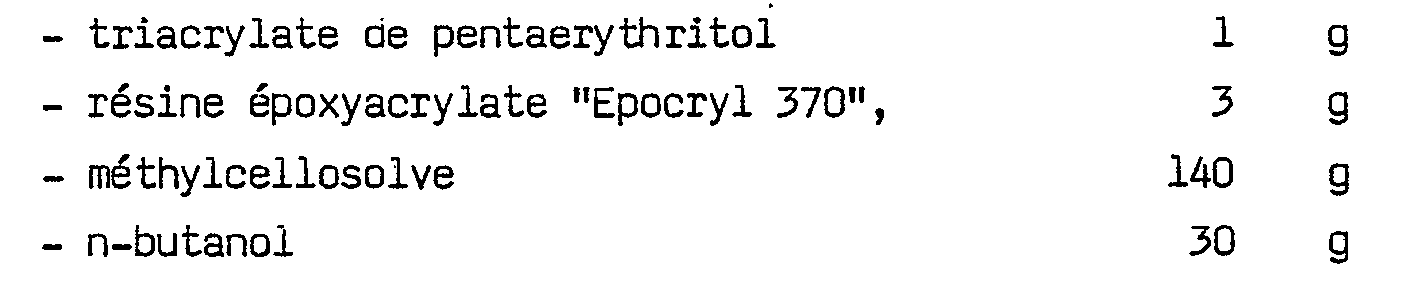

On procède comme dans l'exemple 4.We proceed as in Example 4.
Après exposition à travers un montage négatif pendant 7 à 8 sec., on obtient une excellente copie avec 6 à 7 plages couvertes de la gamme Stauffer.After exposure through a negative montage for 7 to 8 sec., An excellent copy is obtained with 6 to 7 covered tracks of the Stauffer range.
On prépare dans les mêmes conditions que celles de l'exemple 4, une solution photosensible à 3 % de solide.Is prepared under the same conditions as those of Example 4, a photosensitive solution at 3% solid.
On enduit cette solution à l'aide d'une tournette à 50 t/mn pendant 30 sec. sur une plaque d'acier cuivrée, chromée, traitée d'abord avec une solution de "LUDOX" commercialisée par la Société SEPPIC, à 2 % dans l'eau puis avec une solution de polyacrylamide à 0,5 % dans l'eau.This solution is coated with a spinner at 50 rpm for 30 sec. on a copper-plated steel plate, chrome-plated, treated first with a solution of "LUDOX" marketed by the Company SEPPIC, at 2% in water then with a solution of polyacrylamide at 0.5% in water.
Une couche protectrice d'alcool polyvinylique à 3 % dans l'eau est appliquée selon la technique habituelle.A protective layer of 3% polyvinyl alcohol in water is applied according to the usual technique.
Après exposition de la plaque à la lumière actinique pendant 2 sec. à travers un film négatif, on développe celle-ci avec le révélateur QM 805.After exposure of the plate to actinic light for 2 sec. through a negative film, this is developed with the developer QM 805.
On obtient une excellente copie avec 8 plaques couvertes de la gamme Stauffer.An excellent copy is obtained with 8 covered plates from the Stauffer range.
On prépare dans les mêmes conditions que celles de l'exemple 7 la couche photosensible en ajoutant 0,12 g du colorant rouge feu Zapon.The photosensitive layer is prepared under the same conditions as those of Example 7 by adding 0.12 g of the Zapon fiery red dye.
On applique cette couche sur le même support et dans les mêmes conditions que celles de l'exemple 7. Après insolation à travers un négatif pendant 25 sec., on obtient une excellente copie avec 7 plages couvertes de la gamme Stauffer.This layer is applied on the same support and under the same conditions as those of Example 7. After exposure to a negative for 25 sec., An excellent copy is obtained with 7 covered areas of the Stauffer range.
Claims (19)
Priority Applications (1)
| Application Number | Priority Date | Filing Date | Title |
|---|---|---|---|
| AT82420134T ATE27500T1 (en) | 1981-10-02 | 1982-09-28 | PHOTOSENSITIVE COMPOSITION AND LITHOGRAPHIC PLATE MANUFACTURED WITH THE ASSISTANCE OF THIS COMPOSITION. |
Applications Claiming Priority (2)
| Application Number | Priority Date | Filing Date | Title |
|---|---|---|---|
| FR8118583 | 1981-10-02 | ||
| FR8118583A FR2514159A1 (en) | 1981-10-02 | 1981-10-02 | PHOTOSENSITIVE COMPOSITION AND LITHOGRAPHIC PLATE REALIZED USING THE SAME |
Publications (2)
| Publication Number | Publication Date |
|---|---|
| EP0077278A1 true EP0077278A1 (en) | 1983-04-20 |
| EP0077278B1 EP0077278B1 (en) | 1987-05-27 |
Family
ID=9262684
Family Applications (1)
| Application Number | Title | Priority Date | Filing Date |
|---|---|---|---|
| EP82420134A Expired EP0077278B1 (en) | 1981-10-02 | 1982-09-28 | Photosensitive composition and lithographic plate made therefrom |
Country Status (7)
| Country | Link |
|---|---|
| EP (1) | EP0077278B1 (en) |
| JP (1) | JPS5872141A (en) |
| AT (1) | ATE27500T1 (en) |
| CA (1) | CA1177301A (en) |
| DE (1) | DE3276450D1 (en) |
| ES (1) | ES8400829A1 (en) |
| FR (1) | FR2514159A1 (en) |
Cited By (1)
| Publication number | Priority date | Publication date | Assignee | Title |
|---|---|---|---|---|
| FR2869321A1 (en) * | 2004-04-26 | 2005-10-28 | Soficor Mader Sa | VARNISH ANTI-GRAFFITI |
Families Citing this family (1)
| Publication number | Priority date | Publication date | Assignee | Title |
|---|---|---|---|---|
| JPS6261908A (en) * | 1985-09-11 | 1987-03-18 | G C Dental Ind Corp | Photopolymerizable composition for dental restoration |
Citations (4)
| Publication number | Priority date | Publication date | Assignee | Title |
|---|---|---|---|---|
| GB1148362A (en) * | 1966-06-27 | 1969-04-10 | Du Pont | Photosensitive element and process of using same |
| FR2196488A1 (en) * | 1972-08-18 | 1974-03-15 | Asahi Chemical Ind | |
| US3980483A (en) * | 1972-04-24 | 1976-09-14 | Nippon Oil Seal Industry Co., Ltd. | Photocurable composition |
| EP0030213A1 (en) * | 1979-11-29 | 1981-06-10 | Ciba-Geigy Ag | Photo-cross-linkable layer on printing surfaces and process for the manufacture of offset printing plates |
Family Cites Families (2)
| Publication number | Priority date | Publication date | Assignee | Title |
|---|---|---|---|---|
| JPS5640329B2 (en) * | 1972-04-24 | 1981-09-19 | ||
| DE3000326A1 (en) * | 1979-11-29 | 1981-06-11 | CIBA-GEIGY AG, 4002 Basel | Photosensitive compsn. for printing plates - developable with aq. liq., comprising an epoxy!-acrylate! resin and a photoinitiator |
-
1981
- 1981-10-02 FR FR8118583A patent/FR2514159A1/en active Pending
-
1982
- 1982-09-28 DE DE8282420134T patent/DE3276450D1/en not_active Expired
- 1982-09-28 EP EP82420134A patent/EP0077278B1/en not_active Expired
- 1982-09-28 AT AT82420134T patent/ATE27500T1/en not_active IP Right Cessation
- 1982-10-01 ES ES516140A patent/ES8400829A1/en not_active Expired
- 1982-10-01 JP JP57173114A patent/JPS5872141A/en active Pending
- 1982-10-01 CA CA000412661A patent/CA1177301A/en not_active Expired
Patent Citations (4)
| Publication number | Priority date | Publication date | Assignee | Title |
|---|---|---|---|---|
| GB1148362A (en) * | 1966-06-27 | 1969-04-10 | Du Pont | Photosensitive element and process of using same |
| US3980483A (en) * | 1972-04-24 | 1976-09-14 | Nippon Oil Seal Industry Co., Ltd. | Photocurable composition |
| FR2196488A1 (en) * | 1972-08-18 | 1974-03-15 | Asahi Chemical Ind | |
| EP0030213A1 (en) * | 1979-11-29 | 1981-06-10 | Ciba-Geigy Ag | Photo-cross-linkable layer on printing surfaces and process for the manufacture of offset printing plates |
Cited By (2)
| Publication number | Priority date | Publication date | Assignee | Title |
|---|---|---|---|---|
| FR2869321A1 (en) * | 2004-04-26 | 2005-10-28 | Soficor Mader Sa | VARNISH ANTI-GRAFFITI |
| EP1591500A3 (en) * | 2004-04-26 | 2005-12-07 | Soficor Mader | Anti-graffiti varnish |
Also Published As
| Publication number | Publication date |
|---|---|
| ES516140A0 (en) | 1983-11-01 |
| ATE27500T1 (en) | 1987-06-15 |
| ES8400829A1 (en) | 1983-11-01 |
| FR2514159A1 (en) | 1983-04-08 |
| JPS5872141A (en) | 1983-04-30 |
| DE3276450D1 (en) | 1987-07-02 |
| CA1177301A (en) | 1984-11-06 |
| EP0077278B1 (en) | 1987-05-27 |
Similar Documents
| Publication | Publication Date | Title |
|---|---|---|
| US4333998A (en) | Radiation-curable composition for restorative and/or protective treatment of photographic elements | |
| US4426431A (en) | Radiation-curable compositions for restorative and/or protective treatment of photographic elements | |
| US4092173A (en) | Photographic elements coated with protective overcoats | |
| US4171979A (en) | Method of treating scratched or abraded photographic elements with radiation-curable compositions comprising an acrylated urethane, an aliphatic ethylenically-unsaturated carboxylic acid and a multifunctional acrylate | |
| JP3839660B2 (en) | Hard coat agent composition and hard coat material | |
| EP0799257B1 (en) | Crosslinkable composition for coating substrates and coating method using the same | |
| EP0077278B1 (en) | Photosensitive composition and lithographic plate made therefrom | |
| US4469775A (en) | Multi-layer elements with polyvinyl alcohol overcoat suitable for the production of relief printing plates | |
| JPS645691B2 (en) | ||
| EP0017563B1 (en) | Object for the manufacture of visual aids comprising a photopolymerisable composition on a transparent carrier | |
| EP0035419B1 (en) | Photopolymerizable compositions containing a fluoroborate of paradiazodiphenyl amine and a liquid epoxy resin, and photosensitive materials containing them | |
| CA1288629C (en) | Photopolymerizable composition and photopolymerizable recording materialcontaining said composition | |
| FR2600434A1 (en) | Material for forming an image | |
| EP0018860B1 (en) | Water-developable photopolymerisable film-forming compositions and lithographic plate | |
| JPS58174939A (en) | Image forming material | |
| FR2825368A1 (en) | PRESSURE-SENSITIVE ADHESIVE SILICONE COMPOSITIONS, PREPARATION METHOD AND USES THEREOF | |
| EP0162633B1 (en) | Methods of preparing and applying subbing layers for optical data disks | |
| BE878716A (en) | PHOTOPOLYMERISABLE COMPOSITIONS AND PHOTOSENSITIVE ELEMENTS INCLUDING SUCH COMPOSITIONS | |
| JPS5911896B2 (en) | Gazokeiseihouhou | |
| BE684414A (en) | ||
| JPS60203937A (en) | Photosensitive paper for use in sunlight photography | |
| BE805339A (en) | Photopolymerisable laminate - of carrier substrate, photopolymerisable layer and a protective water-soluble polymer layer contg particles of insol. acrylic polymer | |
| FR2533227A1 (en) | COATING COMPOSITION IN THE FORM OF A PHOTOSENSITIVE LATEX AND PRINTING PLATE CONTAINING THE SAME | |
| JP2003140337A (en) | Color image forming material, method for manufacturing photosensitive liquid, photosensitive element and color filter by using the same, and color filter | |
| JPH05297590A (en) | Hardening-type resin composition |
Legal Events
| Date | Code | Title | Description |
|---|---|---|---|
| PUAI | Public reference made under article 153(3) epc to a published international application that has entered the european phase |
Free format text: ORIGINAL CODE: 0009012 |
|
| AK | Designated contracting states |
Designated state(s): AT BE CH DE FR GB IT LI LU NL SE |
|
| 17P | Request for examination filed |
Effective date: 19830506 |
|
| RAP1 | Party data changed (applicant data changed or rights of an application transferred) |
Owner name: RHONE-POULENC MULTI-TECHNIQUES |
|
| ITF | It: translation for a ep patent filed | ||
| GRAA | (expected) grant |
Free format text: ORIGINAL CODE: 0009210 |
|
| AK | Designated contracting states |
Kind code of ref document: B1 Designated state(s): AT BE CH DE FR GB IT LI LU NL SE |
|
| REF | Corresponds to: |
Ref document number: 27500 Country of ref document: AT Date of ref document: 19870615 Kind code of ref document: T |
|
| REF | Corresponds to: |
Ref document number: 3276450 Country of ref document: DE Date of ref document: 19870702 |
|
| PG25 | Lapsed in a contracting state [announced via postgrant information from national office to epo] |
Ref country code: AT Effective date: 19870928 |
|
| PG25 | Lapsed in a contracting state [announced via postgrant information from national office to epo] |
Ref country code: SE Effective date: 19870929 |
|
| PG25 | Lapsed in a contracting state [announced via postgrant information from national office to epo] |
Ref country code: LU Free format text: LAPSE BECAUSE OF NON-PAYMENT OF DUE FEES Effective date: 19870930 Ref country code: LI Effective date: 19870930 Ref country code: CH Effective date: 19870930 Ref country code: BE Effective date: 19870930 |
|
| BERE | Be: lapsed |
Owner name: RHONE-POULENC MULTI-TECHNIQUES Effective date: 19870930 |
|
| PG25 | Lapsed in a contracting state [announced via postgrant information from national office to epo] |
Ref country code: NL Effective date: 19880401 |
|
| PLBE | No opposition filed within time limit |
Free format text: ORIGINAL CODE: 0009261 |
|
| STAA | Information on the status of an ep patent application or granted ep patent |
Free format text: STATUS: NO OPPOSITION FILED WITHIN TIME LIMIT |
|
| NLV4 | Nl: lapsed or anulled due to non-payment of the annual fee | ||
| REG | Reference to a national code |
Ref country code: CH Ref legal event code: PL |
|
| 26N | No opposition filed | ||
| PG25 | Lapsed in a contracting state [announced via postgrant information from national office to epo] |
Ref country code: DE Effective date: 19880601 |
|
| GBPC | Gb: european patent ceased through non-payment of renewal fee | ||
| PG25 | Lapsed in a contracting state [announced via postgrant information from national office to epo] |
Ref country code: GB Free format text: LAPSE BECAUSE OF NON-PAYMENT OF DUE FEES Effective date: 19881121 |
|
| PGFP | Annual fee paid to national office [announced via postgrant information from national office to epo] |
Ref country code: FR Payment date: 19881219 Year of fee payment: 7 |
|
| PG25 | Lapsed in a contracting state [announced via postgrant information from national office to epo] |
Ref country code: FR Effective date: 19900531 |
|
| REG | Reference to a national code |
Ref country code: FR Ref legal event code: ST |
|
| EUG | Se: european patent has lapsed |
Ref document number: 82420134.7 Effective date: 19880907 |