EP0077422B1 - Bacterial strain for purifying hydrocarbons pollution, process for production thereof and purification process using said bacterial strain - Google Patents
Bacterial strain for purifying hydrocarbons pollution, process for production thereof and purification process using said bacterial strain Download PDFInfo
- Publication number
- EP0077422B1 EP0077422B1 EP19810304880 EP81304880A EP0077422B1 EP 0077422 B1 EP0077422 B1 EP 0077422B1 EP 19810304880 EP19810304880 EP 19810304880 EP 81304880 A EP81304880 A EP 81304880A EP 0077422 B1 EP0077422 B1 EP 0077422B1
- Authority
- EP
- European Patent Office
- Prior art keywords
- bacteria
- ppm
- petroleum
- brine
- strain
- Prior art date
- Legal status (The legal status is an assumption and is not a legal conclusion. Google has not performed a legal analysis and makes no representation as to the accuracy of the status listed.)
- Expired
Links
Images


Classifications
-
- C—CHEMISTRY; METALLURGY
- C09—DYES; PAINTS; POLISHES; NATURAL RESINS; ADHESIVES; COMPOSITIONS NOT OTHERWISE PROVIDED FOR; APPLICATIONS OF MATERIALS NOT OTHERWISE PROVIDED FOR
- C09K—MATERIALS FOR MISCELLANEOUS APPLICATIONS, NOT PROVIDED FOR ELSEWHERE
- C09K3/00—Materials not provided for elsewhere
- C09K3/32—Materials not provided for elsewhere for absorbing liquids to remove pollution, e.g. oil, gasoline, fat
-
- C—CHEMISTRY; METALLURGY
- C02—TREATMENT OF WATER, WASTE WATER, SEWAGE, OR SLUDGE
- C02F—TREATMENT OF WATER, WASTE WATER, SEWAGE, OR SLUDGE
- C02F3/00—Biological treatment of water, waste water, or sewage
- C02F3/34—Biological treatment of water, waste water, or sewage characterised by the microorganisms used
- C02F3/344—Biological treatment of water, waste water, or sewage characterised by the microorganisms used for digestion of mineral oil
-
- C—CHEMISTRY; METALLURGY
- C12—BIOCHEMISTRY; BEER; SPIRITS; WINE; VINEGAR; MICROBIOLOGY; ENZYMOLOGY; MUTATION OR GENETIC ENGINEERING
- C12N—MICROORGANISMS OR ENZYMES; COMPOSITIONS THEREOF; PROPAGATING, PRESERVING, OR MAINTAINING MICROORGANISMS; MUTATION OR GENETIC ENGINEERING; CULTURE MEDIA
- C12N1/00—Microorganisms; Compositions thereof; Processes of propagating, maintaining or preserving microorganisms or compositions thereof; Processes of preparing or isolating a composition containing a microorganism; Culture media therefor
- C12N1/26—Processes using, or culture media containing, hydrocarbons
-
- C—CHEMISTRY; METALLURGY
- C12—BIOCHEMISTRY; BEER; SPIRITS; WINE; VINEGAR; MICROBIOLOGY; ENZYMOLOGY; MUTATION OR GENETIC ENGINEERING
- C12N—MICROORGANISMS OR ENZYMES; COMPOSITIONS THEREOF; PROPAGATING, PRESERVING, OR MAINTAINING MICROORGANISMS; MUTATION OR GENETIC ENGINEERING; CULTURE MEDIA
- C12N1/00—Microorganisms; Compositions thereof; Processes of propagating, maintaining or preserving microorganisms or compositions thereof; Processes of preparing or isolating a composition containing a microorganism; Culture media therefor
- C12N1/36—Adaptation or attenuation of cells
Definitions
- the present invention relates to the utilization of Pseudomonas which rapidly carry out assimilation, growth and emulsification in an oligotrophic environment of brine and hydrocarbon and rapidly perishes after assimilation.
- the Pseudomonas used in the present invention has the characteristic that it multiplies in a short period to emulsify and assimilate hydrocarbons and rapidly perishes within the period required for multiplication thereof, which is opposed to common bacteriological expectations.
- microorganisms Pseudomonas have been deposited at the Fermentation Research Institute under Nr. FERM BP-63 and FERM BP-64.
- the present invention also relates to an agent comprising said bacteria which utilizes the characteristics of the bacteria and to a method of using the same.
- the multiplication rate thereof rapidly deteriorates in a short time in spite of bacteria cultured on the good nutrient, because petroleum is toxic thereto.
- the present invention relates to the development and practical application of bacteria which exhibit acceleration of growth when hydrocarbon, which should be toxic by nature in a culture medium therefor, is added thereto.
- Marine pollution due to hydrocarbons, especially petroleum products has been analyzed in detail with respect to the amount of petroleum introduced due to accidents, the direction of petroleum flow, the state of dispersion thereof, decomposition and scattering effects due to flowing petroleum on the sea, shoreline pollution and the like.
- microbial decomposition oil has also been reported. For example, one theory postulates that in the case of petroleum spread on the surface of the sea as a "membrane" 0.1-0.4 ⁇ thick, components which do not volatilize are attacked by various microbes within 1-2 weeks so that a considerable part of the petroleum is decomposed within 2-3 months. Further, it has been reported that the amount of decomposition due to other organisms or due to spontaneous oxidation is about 1/10 that due to microbes.
- the act is aware of processes for separating petroleum decomposing microbes or petroleum component decomposing microbes such can roughly be classified into two methods.
- One uses a culture medium composed of inorganic marine salts, NH 3 salts (or urea) and petroleum or petroleum components; the other uses a culture medium prepared by adding an eutrophic material such as a vitamin, Casamino acid or a yeast extract to the above described culture medium.
- an eutrophic material such as a vitamin, Casamino acid or a yeast extract
- the present invention provides an agent which comprises a strain of Pseudomonas incubated with a trophic culture medium which exhibits an acceleration of growth when a hydrocarbon(s) is/are added thereto, and provides a process for purifying a polluted area which comprises multiplying a strain of Pseudomonas incubated with a trophic culture medium which exhibits acceleration of growth when a hydrocarbon(s) is/are added thereto.
- OPI Japanese Patent Applications
- a unicellular microbe containing a first energy generating plasmid defining a decomposition path and a unicellular microbe containing at least one energy generating plasmid which cannot coexist with the first plasmid are selected as a donor microbe and a recipient microbe, respectively, and conjugation of the donor microbe and recipient microbe is effected.
- experimentation was carried out to develop a unicellular microbe having the ability of decomposing and assimilating hydrocarbon compounds, particularly to control organisms by utilizing genetics for marine petroleum pollution using single species of Pseudomonas.
- a single microbe capable of decomposing all linear aliphatic-, cycloaliphatic-, aromatic- and polynuclear aromatic hydrocarbons was obtained.
- microbe multiplying is carried out in the presence of an added nitrogen tophic source, i.e., in the presence of NH 3 in the former and NH z CONH z in the latter, whereby the crude petroleum or heavy oil is decomposed and assimilated in an eutrophic culture medium.
- these Applications use microbes which grow in an environment remarkably different from the sea pollution by petroleum.
- a culture medium which does not contain salts present in high amount in the sea (such as NaCI) but which contains 2.1 g/I of NH 3 and 10 mg/I of vitamin C is used.
- a culture medium containing 0.25 g/I of NH 2 CONH is used.
- These culture media are eutrophic culture media as opposed to sea polluted by petroleum which consists of petroleum and brine.
- the Pseudomonas according to the present invention has characteristics quite different from those of the microbes in the above described Applications. Specifically: 1) it assimilates hydrocarbons under oligotrophic conditions of only brine and hydrocarbons at a temperature varying over a wide range in a culture medium having an hydrocarbon content varying over a wide range, at a very good consumption rate; and 2) rapid multiplication and emulsification occur after inoculation of the bacteria and it rapidly perishes after conclusion of assimilation of crude petroleum. Particularly, the time from multiplication to deach is far less than reasonable expectation, i.e. the period required for multiplication is nearly equal to the period from conclusion of multiplication to death.
- the period required for multiplication is about 1.5 days
- the stationary period is about 0.5 days and the period therefrom to death is about 2.5 days in the case of a crude oil content of 30 ppm
- the period required for multiplication is about 2.5 days
- the stationary period is about 1 day and the period till death is about 4 days in the case of a crude oil content of 500 ppm.
- Figure 5 shows a curve of multiplication and death of bacteria of the present invention having an assimilating ability to 30 ppm of crude oil.
- Figure 6 shows the same of well known bacteria. As is apparent from the Figures, in the case of the bacteria of the present invention, time from multiplication to death is very short.
- the Pseudomonas according to the present invention is thus seen to be a bacteria which exhibits growth acceleration in the presence of hydrocarbons.
- Bacteria belonging to the genus Pseudomonas present used per this invention are widely diverse with no relationship to the classification of the bacteria as the growth acceleration ability of the present bacteria by petroleum hydrocarbon does not depend on the classification of the bacteria.
- the Pseudomonas of the present invention preferably include putida, aureofaciens, stutzeri, oleovorans, arctica, oceanica, calcis, rubescens, cichorii, propanica, elongata, mendocina, citronellolis, pictorum, marginata, facilis, saccharophila, obscura, aromatica, acidovorans, sessilis, rathonis, cruciviae, arvilla, palleronii, etc., most preferably F.R.I. (Deposition number Fermentation Research Institute) Nos. 5490 and 5491.
- the Pseudomonas according to the present invention has a growth stimulation angle of at least 1 °, preferably more than 1.5° and EP value of at least 0.1, preferably more than 0.3, as later defined.
- the temperature at which the bacteria is active ranges from -5°C to 50°C.
- the bacteria of the present invention has the ability to purify 0.1 ppm to 3,000 ppm, preferably 10 ppm to 2,000 ppm, of hydrocarbons.
- the hydrocarbons removed by the present bacteria include natural gas, petroleum, liquefied coal, hydrocarbons, contained therein, such as a paraffinic hydrocarbon, e.g. a pentane, a hexane, etc., a naphthenic hydrocarbon, e.g., a cyclopentane, a cycloheptane, etc., an aromatic hydrocarbon, e.g., a benzene, a toluene, a naphthalene, a tetrabutyl benzene, etc. and petroleum products, such as gasoline, kelosene, light-oil, heavy oil, etc.
- a paraffinic hydrocarbon e.g. a pentane, a hexane, etc.
- the pseudomonas according to the present invention can be obtained from Pseudomonas in the brine, preferably Pseudomonas separated from brine as is described in Japanese Patent Application (OPI) 142865/76.
- the process for producing the Pseudomonas of the present invention comprises;
- the above operation is repeated 25 to 85 times, preferably 35 to 75 times, until the whole culture medium comprising brine and hydrocarbons is emulsified within 15 hours after inoculation on the culture medium.
- the hydrocarbon(s) used as one component of the medium is preferably A-heavy oil, gasoline, light-oil, kerosene, crude oil of high quality having lower distillating temperature, etc.
- the petroleum hydrocarbon(s) used in step 3) is preferably one having a higher quality having lower distillating temperature such as light-oil, gasoline, A-heavy oil, etc., at initial subculturing steps and one of lower quality having higher distillating temperature, such as C-heavy oil, B-heavy oil, etc., at final subculturing steps.
- A-heavy oil, B-heavy oil and C-heavy oil has not more than 20 cm 2 /sec, 50 to 150 cm 2 /sec and 50 to 400 cm 2 /sec of kinematic viscosity, respectively.
- Other characteristics regarding A-, B- and C-heavy oil is described in the Japan Industrial Standard (JIS) K2205-1958.
- the brine used in the above steps is collected from brine near a fishing port, as an embodiment, from brine near Sakai fishing port in Osaka bay.
- the nitrogen compound(s) used in the step 1) includes compounds having NH 2 -, NH4 or NO 3 - , such as KNO 3 , NaNO 3 , NH 4 Cl, (NH 4 ) 2 HPO 4 , (NH 4 )H 2 PO 4 , (NH 4 ) 2 SO 4 , NH 2 CONH 2 , etc., and is added in an amount of 0.001 to 5 g, preferably 0.01 to 2 g per 1 of the brine.
- vitamins, starch such as starch from grain, e.g., corn, potato, wheat, etc. may be added to the medium in an amount of 1 % to 100%, preferably 1 % to 30% by weight of the amount of nitrogen compound(s).
- the vitamins used in step 2) and step 1) include those other than vitamin P, preferably folic acid, nicotinamide Vitamins B 1 , B 12 , B 6 and C, pantothenic acid, biotin, etc., and mixture thereof, more preferably Vitamin B s , folic acid nicotinamide, in an amount of more then 0.00005 mg, preferably 0.0005 mg to 100 mg, most preferably 0.001 mg to 5 mg per 1 I of the brine.
- the culturing temperature is -5°C to 50°C, preferably 10°C to 40°C, and cultivation is applied at an ambient pressure, in steps 1) to 3).
- step 4 bacteria are acclimatized to a higher concentration of hydrocarbons, that is, the bacteria obtained in step 3) are cultivated on a medium containing brine and higher concentration of hydrocarbons.
- the cultivation is repeated until the bacteria have a desired assimilating ability to a higher concentration of hydrocarbons, that is, until the whole culture medium is emulsified within 15 hours after inoculation on the medium.
- the cultivation is operated 70 to 100 times.
- step 5 bacteria are acclimatized to a wide range of temperature, that is, the bacteria obtained in step 3) are cultivated on a medium comprising brine and hydrocarbons under more higher or lower temperature and thus the cultivation is repeated so the bacteria exhibit an assimilating ability to a desired temperature ranged from low temperature to high temperature, -5°C to 50°C.
- the cultivation is repeated 70 to 100 times. When the whole culture medium is emulsified within 15 hours after inoculation, the acclimation is completed.
- the culturing temperature in step 4) is -5°C to 50°C, preferably 10°C to 40°C.
- cultivation is applied at an ambient pressure, and the medium used in steps 4) and 5) is the same as that used in the above step 3).
- step 5) may precede step 4) or vice versa.
- FRI Nos (Deposition number in Fermentation Research Institute) 2927 and 2928 were used as bacteria; they were inoculated on a culture medium having the following composition to effect cultivation.
- the bacteria obtained in step 1) were used; they were inoculated on a culture medium having the following composition to carry out cultivation.
- the bacteria obtained in the step 2) were inoculated on a medium of brine sol containing 1.5 wt.% of agar and a paper disc thereon which is permeated by 0.4 mg of crude petroleum per 1 cm 3 of paper disc. After cultivation, the bacteria are fished from the raised part of the colony and inoculated on a medium comprising brine and 30 ppm of hydrocarbons. The operations were repeated 55 times. Thus, bacteria having the ability of complete assimulation of 30 ppm petroleum within only 1.5 days were obtained. Specifically, these bacteria show high activity in the presence of crude petroleum but they undergo autolysis to rapidly perish if the crude petroleum is absent.
- Acclimation of the bacteria obtained in step 3 was repeated till the bacteria had the highest assimilation ability with respect to a crude petroleum concentration ranging from an amount solubility in the sea (30 ppm) to an amount floating on the surface of the sea (1500 ppm).
- the bacteria were inoculated at a low concentration (30 ppm) of crude petroleum, emulsification of the petroleum resulted after 4-5 hours. After confirmation of complete emulsification of petroleum by the bacteria, the concentration of the crude petroleum was gradually increased. Bacteria which multiplified well in desired crude petroleum concentrations, 30 ppm, 100 ppm, 300 ppm, 500 ppm and 1000 ppm were obtained.
- the confirmation that the above acclimated bacteria were obtained is carried out by a recognition of complete emulsification within 15 hours after inoculation under each 30 ppm, 100 ppm, 300 ppm, 500 ppm and 1000 ppm of hydrocarbons in brine.
- the resultant bacteria were then subjected to acclimation so they would be effective at high temperature (for example 37°C) and at low temperature (about 8°C) by 25 repeated operations at a temperature higher than or lower than their optimum multiplication temperature (18-30°C) so as to not deteriorate the functions of multiplication, emulsification and assimilation of the bacteria.
- the bacteria were acclimated till this activity at high temperature (37°) was 115 and at a low temperature (8°C) was 50 based on this activity at this optimum multiplication temperature being 100.
- bacteria capable of complete assimilation of 30 ppm of the crude petroleum within 1.5 days at optimum temperature and a high temperature and 3 days at a low temperature could be obtained.
- the bacteria or a bacterial preparation derived from the bacteria of the present invention is used in the presence of the brine.
- the amount of brine is 100 to 1,000,000 parts by weight per 1 part by weight of the petroleum to be removed, and the amount of the bacteria is 1/1,000 to 1/5,000,000 parts by weight per 1 part by weight of brine.
- the removal ratio of petroleum is at least 70%, and is generally more than 90%.
- the bacteria rapidly perish suitable temperatures for purification are -5°C to 50°C.
- the bacterial preparation can be obtained by a process which comprises subjecting a medium containing bacteria thus obtained to centrifugal separation at 5000x g to 1200x g to form a mixture of the bacteria and a hydrocarbon emulsion, mixing a coating agent with the mixture thus obtained and drying, preferably drying by vacuum lyophilization.
- the dried material thus obtained may be affected by inert atmosphere, such as an atmosphere without O2, an atmosphere with CO 2 , N 2 , helium, neon, etc.
- the coating agent used in the present invention includes starch, sulfur-containing amino acids such as cystein, crude oil, glutamic acid, vitamins, A-heavy oil, B-heavy oil, C-heavy oil, etc.
- the starch, vitamins, and A-, B- and C-heavy oil are those defined previously.
- the amount of the coating agent used is 1 to 500 wt%, preferably 10 to 100 wt% to the weight of the bacteria.
- the preparation is preferably preserved under refrigerated conditions to increase the preservation period, preferably 0°C to 10°C. Further, it is more preferable for preservation of the preparation to produce the bacterial preparation under the condition wherein 0 2 is excluded, to lower the moisture content in the preparation by drying and/or to coat the preparation by coating agent.
- the resultant bacteria have the novel characteristics that bacteria assimilate hydrocarbons in the sea in the presence of hydrocarbons without adding any other materials and show a hydrocarbon removal ratio of 99.5% or higher, but such bacteria rapidly die when the petroleum is gone.
- the resultant bacteria have remarkably high practical value for removing polluting hydrocarbons from the viewpoint of safety, since this assimilation ability rapidly deteriorates in an environment where petroleum is not existent and the same change into this original bacterial form or they rapidly die in the presence of only brine.
- Figure 1 shows one characteristic of the bacteria according to the present invention, from which it can be understood that the characteristic of the bacteria according to the present invention is remarkably different from that of known bacteria.
- growth curve (A) of the bacteria of the invention in a culture medium containing 30 ppm of crude petroleum to brine shows a rapid ascent and a rapid descent
- growth curves (a)-(d) of the microbes described in Japanese Patent Application (OPI) 61376/74 are as shown in the drawing.
- OPI Japanese Patent Application
- the bacteria of the present invention a cell yield of 35 hundred million is shown even in the case of adding only 500 ppm of petroleum, and the time of reaching such a cell yield is very short, i.e., at resembles.
- the growth environment in the above Patent Application is eutrophic, whereas that in the present invention is oligotrophic and consists only of the brine and crude petroleum.
- the rapid ascent in the growth curve of the bacteria according to the present invention is due to the growth acceleration effect of the petroleum on the bacteria, a characteristic not shown in perior microbes.
- the Stephenson Whetham, culture medium (hereafter referred to as S-W culture medium) has the following composition: KH 2 p o 4 1 g; MgS0 4 . 7H20 0.7 g; NaCl 1 g; (NH 4 ) 2 HP0 4 4 g; glucose 5 g and FeS0 4 . 7H 2 0 0.03 g; per 1 liter of water (compositions of culture media are per 1 liter of water, hereafter).
- One generation means a period from fishing, when strains show the maximum growth speed, to inoculation and culturing on a new-culturing medium.
- the (S-W) culture medium was used in the above described procedures. However, in the case of using a more eutrophic culture medium comprising peptone or a meat extract, the results obtained were not essentially different from those obtained in case of using the (S-W) culture medium, and growth acceleration was observed after 120 minutes from the addition of the oil.
- the 500 ppm and 30 ppm acclimation bacteria died after 3 days when they were introduced into the brine or fresh water. The effect was noted that the life span of the bacteria gradually extended with lowering degrees of growth acceleration.
- the emulsification ability of the bacteria gradually deteriorates with increasing number of generations, in addition, the bacteria is of the wide range from the case that generation of the emulsification phenomena is shown in the early stage to the case that it is shown in a delayed stage. Further, and more importantly, it was found that even the bacteria of the 12th-14th generation (which were not subject to growth acceleration by addition of crude petroleum) slightly cause emulsification after 48 hours from inoculation of the bacteria. This fact is an important key for solving the relation between the growth acceleration and the emulsification.
- the residual amount of crude petroleum after 168 hours is only 1 ppm (1/500 of the original value) in the case of the strain of the 1st generation, only 2 ppm (1/250 of the original volume) in case of the strain of the 4th generation, 5 ppm (1/100 of the original value) in case of the strain of the 6th generation, 25 ppm (1/50 of the original value) in the case of the strain of the 8th generation, and 50 ppm (1/10 of the original value) in the strain of the 10th generation (which shows the minimum growth acceleration).
- the removal ratio gradually deteriorates, the petroleum residual amount decreases by one order, compared with the original amount.
- the petroleum residual amount became less than 2 ppm in the case of even the strain of the 6th generation which showed a slight growth acceleration, and, on the other hand, the petroleum residual amount was about 198 ppm in the case of strains which were no longer show growth acceleration and have only emulsifying ability, for example, the strain of the 12th generation.
- growth acceleration bacteria according to the present invention show a remarkably excellent petroleum removal ability as compared with bacteria which show only emulsifying ability, i.e., it can be understood that the growth acceleration bacteria according to the present invention show remarkably good results in hydrocarbon consumption as compared with mere emulsification bacteria and that they are further different from conventional assimilation bacteria.
- ⁇ is expressed by the following formula. where t 1 and t 2 are time; and n 1 and n 2 are the number of bacterial cells at the time of t 1 and t 2 , respectively. Larger ⁇ values show higher growth rates, and lower ⁇ values show slower growth rates.
- the growth angle can be calculated on the basis of the following.
- the strains used in this invention are selected on the basis of the angle (growth angle) formed between the growth curve of a strain which is cultured on the Stephanson Wetham medium and the growth curve of the strain which is cultured on the Stephanson Wetham medium added a petroleum hydrocarbon. The procedure of calculation is described below with reference to Figure 4.
- AB represents the growth line of a bacterial strain in its logarithmic growth period in a Stephanson Wetham culture medium not containing petroleum hydrocarbon. After the addition of the petroleum hydrocarbon, stimulation of growth begins to appear at point 0, and a line OC is drawn.
- the point formed by the intersection of a tangential line EF having the highest gradient (the line showing the maximumum ⁇ value, i.e., the specific growth speed) with a line OB is supposed to be a point F, and the line extending from the point F and being parallel to the axis of abscissas is supposed to be a line FG.
- a perpendicular line is drawn from the point E to a line FG, and a point at which the perpendicular line intersects with a line AB is supposed to be a point H.
- the number of strains/cc at point E is log n 2 ; the number of strains at H is log n, and the number of strains in point F is log no.
- the angle formed by the intersection of the growth curve in a basic medium [S-W] with the growth curve which results from the addition of the petroleum hydrocarbon can be calculated in regard to strains of the same species which differ from each other in purifying power.
- EP-value represents a hydrocarbon purifying ability and is obtained by the following formula. wherein 0 represents a growth stimulation angle and ⁇ represents a specific growth speed.
- bacteria having 0.1 or more, preferably 0.3 or more of EP-value are used to remove hydrocarbons.
- a culture medium comprising 0.5 g of crude petroleum comprising Khafuji crude petroleum and 1000 ml of brine collected from brine near Akashi City were poured into a water tank (90 cmx50 cmx40 cm).
- the resultant cultured solution was cooled to about 10°C and subjected to centrifugal separation (10,000xg) to obtain 60 g of a mixture of bacteria and a crude petroleum emulsion used to form Preparations (A)-(D) below.
- Preparation B 0.44 g of starch (potato), 0.001 g of crude petroleum were added to 10 g of the above described mixture and well mixed. The resultant mixture was dried in a vacuum (-750--760 mmHg) to an 8 wt% water contact. 2.9 g of the resultant dry material was put in a glass bottle and the bottle was filled with an inert gas such as CO 2 or N 2 . The effective preservation period of the resultant agent was more than 20 days at room temperature and more than 3 months in a refrigerator at 5-8°C.
- Preparation B 0.44 g of starch, 0.001 g of crude petroleum and 0.11 g of cystine were added to 10 g of the above described mixture and well mixed. 3.01 g of the agent having an 8 wt% water content was produced in the same manner as for Agent A and enclosed in a glass bottle with N 2 gas. The effective preservation period of the resultant agent was more than 20 days at a room temperature and more than 3 months at 5-8°C.
- Agent C 0.4 g of starch of potato was added to 10 g of the above described mixture and well mixed. The resultant mixture was dried in a vacuum (-750 to -760 mmHg) to obtain 2.5 g of agent. The resultant agent was effective for long periods of time when stored at room temperature.
- Agent D 0.1 g of cystine and 0.001 g of crude petroleum were added to 10 g of the above described mixture and well mixed. The resultant mixture was dried in a vacuum to obtain 2.1 g of agent. The resultant agent was effective for long periods of time when storage at room temperature.
- 9 mg of the cultivating solution consisted of 3 mg of 500 ppm acclimation bacteria, 3 mg of 100 ppm acclimation bacteria and 3 mg of 30 ppm acclimation bacteria. 24 hours after the beginning of the run, aeration was carried out at a rate of 2 liters/minute.
- the crude petroleum assimilation bacteria in the brine had an initial cell count of 1 x 10 6 /cc, which increased to 5 ⁇ 10 8 after 24 hours and 3.5x10 9 after 48 hours.
- the cell counts gradually decreased thereafter to become 2.5 ⁇ 10 9 after 72 hours, 3 ⁇ 10 8 after 96 hours, 6 ⁇ 10 7 after 120 hours and 1 ⁇ 10' after 144 hours.
- the bacteria then showed a tendency to die and the cell count became 2x 155 after 168 hours. After 192 hours, living cells were not observed.
- the tank had a good appearance, i.e., the same as before pollution. Further, the brine was clean and did not differ from common brine, except it was very slightly cloudy.
- the assimilation bacteria had an initial cell count of 3 ⁇ 10 5 , which increased to 4 ⁇ 10 8 after 24 hours and 1.2 ⁇ 10 9 after 48 hours. The cell counts decreased thereafter to 5 ⁇ 10 8 after 72 hours and 2 ⁇ 10 7 after 96 hours. Thereafter the bacteria rapidly died and the cell count became only 3 x 10⁵ after 120 hours. After 144 hours, all bacteria were dead.
- a process for treating oil by adding bacteria which have been subjected to growth acceleration by oil to an activated sludge namely, by producing an enriched activated sludge
- an activated sludge namely, by producing an enriched activated sludge
- the following is an example of applying the bacteria according to the present invention to an activated sludge.
- the crude petroleum mixture comprising Khafji crude oil and Egyptian heavy oil (1:1) was applied to the wall and the bottom of a drum having a volume of 50 liters. After standing for 3 days, the adhered oil was separated as much as possible using the pressure of the brine.
- the Egyptian heavy oil has a following physical properties; specific gravity; 0.884, pour point: less than -35°C, sulfur content; 2.7 wt%, carbon residue: 8.0 wt%, and nitrogen content 0.22 wt%. After materials and components floating on the surface-which had separated from the walls-were removed by suction, a cultivating liquid of the bacteria (FRI No.
- FRI Nos. 5490 and 5491 in the present invention are deposition numbers of bacteria prepared from FRI Nos. 2927 and 2928 by an incubating method described in this specification.
- the biological properties of these bacteria of the present invention in the case of incubation on a conventional culture medium are not different from those of FRI Nos. 2927 and 2928, but a colony after incubation for 48 hours on a culture medium consisting of 0.5 g of crude petroleum, 1 liter of the brine and agar is white and opaque and has a diameter of 1.5 mm.
Landscapes
- Chemical & Material Sciences (AREA)
- Life Sciences & Earth Sciences (AREA)
- Engineering & Computer Science (AREA)
- Health & Medical Sciences (AREA)
- Organic Chemistry (AREA)
- Bioinformatics & Cheminformatics (AREA)
- Zoology (AREA)
- Wood Science & Technology (AREA)
- Microbiology (AREA)
- Biotechnology (AREA)
- Genetics & Genomics (AREA)
- Oil, Petroleum & Natural Gas (AREA)
- Biomedical Technology (AREA)
- General Engineering & Computer Science (AREA)
- Tropical Medicine & Parasitology (AREA)
- Medicinal Chemistry (AREA)
- Virology (AREA)
- General Health & Medical Sciences (AREA)
- Environmental & Geological Engineering (AREA)
- Biochemistry (AREA)
- Materials Engineering (AREA)
- Public Health (AREA)
- Cell Biology (AREA)
- Biodiversity & Conservation Biology (AREA)
- Hydrology & Water Resources (AREA)
- Water Supply & Treatment (AREA)
- Micro-Organisms Or Cultivation Processes Thereof (AREA)
- Purification Treatments By Anaerobic Or Anaerobic And Aerobic Bacteria Or Animals (AREA)
Description
- The present invention relates to the utilization of Pseudomonas which rapidly carry out assimilation, growth and emulsification in an oligotrophic environment of brine and hydrocarbon and rapidly perishes after assimilation. The Pseudomonas used in the present invention has the characteristic that it multiplies in a short period to emulsify and assimilate hydrocarbons and rapidly perishes within the period required for multiplication thereof, which is opposed to common bacteriological expectations.
- The microorganisms Pseudomonas have been deposited at the Fermentation Research Institute under Nr. FERM BP-63 and FERM BP-64.
- The present invention also relates to an agent comprising said bacteria which utilizes the characteristics of the bacteria and to a method of using the same.
- Well known bacteria rapidly multiply with good nutrition in an acceptable environment, particularly, in the logarithmic phase.
- Typically, when petroleum is added during the bacterial logarithmic growth phase, the multiplication rate thereof rapidly deteriorates in a short time in spite of bacteria cultured on the good nutrient, because petroleum is toxic thereto. The present invention, however, relates to the development and practical application of bacteria which exhibit acceleration of growth when hydrocarbon, which should be toxic by nature in a culture medium therefor, is added thereto.
- Marine pollution due to hydrocarbons, especially petroleum products has been analyzed in detail with respect to the amount of petroleum introduced due to accidents, the direction of petroleum flow, the state of dispersion thereof, decomposition and scattering effects due to flowing petroleum on the sea, shoreline pollution and the like.
- Further, microbial decomposition oil has also been reported. For example, one theory postulates that in the case of petroleum spread on the surface of the sea as a "membrane" 0.1-0.4 µ thick, components which do not volatilize are attacked by various microbes within 1-2 weeks so that a considerable part of the petroleum is decomposed within 2-3 months. Further, it has been reported that the amount of decomposition due to other organisms or due to spontaneous oxidation is about 1/10 that due to microbes.
- At present, there is a rapid growth of knowledge concerning petroleum and its effects on the marine environment and organisms having a relationship therewith one detailed report is""Collective investigation for environmental influence concerning matter of oil flowing in Mizushima" issued by the Environment Agency of Japan on March 12, 1977. Per this report, oil introduced into the sea seems to be substantially decomposed or dispersed after 1 year. However, per oil pollution investigations by the International Oceanography Committee (IOC) of the United Nations Educational, Scientific, and Cultural Organization (UNESCO) and the World Meterological Organization (WMO) during 1975-1979, it appears that marine oil pollution results in serious problems which cannot be reconciled with the theory that almost all oils are assimilated by microbes without the passage of long periods of time. In fact, it was recently reported that many oil tankers had serious problems arising from washing the holds of supertankers and throwing sludges away and others relating to oil tankers, which created an abrupt realization of this type of problem with those concerned with marine pollution and, led to a discussion of such problems by governmental bodies. Further, the fact that treatment of oils having a low concentration drifted near to shore is very difficult to carry out has become an issue.
- The act is aware of processes for separating petroleum decomposing microbes or petroleum component decomposing microbes such can roughly be classified into two methods. One uses a culture medium composed of inorganic marine salts, NH3 salts (or urea) and petroleum or petroleum components; the other uses a culture medium prepared by adding an eutrophic material such as a vitamin, Casamino acid or a yeast extract to the above described culture medium. It is known that in the case of multiplying oxidative microbes complex having activity in a high nutrition condition such as in the latter method the culture medium becomes cloudy by shaking cultivation at 20°C for 10 days.
- After extensive studies regarding marine petroleum pollution, the present inventors completed the present invention.
- Specifically, the present invention provides an agent which comprises a strain of Pseudomonas incubated with a trophic culture medium which exhibits an acceleration of growth when a hydrocarbon(s) is/are added thereto, and provides a process for purifying a polluted area which comprises multiplying a strain of Pseudomonas incubated with a trophic culture medium which exhibits acceleration of growth when a hydrocarbon(s) is/are added thereto.
- Figure 1 is a growth curve of the strain according to the present invention.
- Figures 2 and 3 are graphs which show illustrate the properties of the strain according to this invention concerning growth acceleration, emulsification and assimilation.
- Figure 4 is a graph schematically illustrating growth stimulation angle (0).
- Figure 5 is a curve to show multiplication and death of the strain according to the present invention.
- Figure 6 is a curve to show multiplication and death of the well known strains.
- It is known from Japanese Patent Applications (OPI) 61376/74 and 142865/76 that one can purify brine polluted with petroleum with utilizing bacteria which decompose and assimilate petroleum hydrocarbons. (The term OPI as used herein refers to a "published unexamined Japanese Patent application", hereafter the same).
- In the former Application a unicellular microbe containing a first energy generating plasmid defining a decomposition path and a unicellular microbe containing at least one energy generating plasmid which cannot coexist with the first plasmid are selected as a donor microbe and a recipient microbe, respectively, and conjugation of the donor microbe and recipient microbe is effected. In order to stabilize the resultant unstable supermicrobe and obtain a new microbe having desired characteristics, experimentation was carried out to develop a unicellular microbe having the ability of decomposing and assimilating hydrocarbon compounds, particularly to control organisms by utilizing genetics for marine petroleum pollution using single species of Pseudomonas. Thus, a single microbe capable of decomposing all linear aliphatic-, cycloaliphatic-, aromatic- and polynuclear aromatic hydrocarbons was obtained.
- In distinction, the latter Application was based on the discovery that 1000 ppm of heavy oil components could be removed within 5 days, to the stage that heavy oil components remain as only a trace upon thin layer chromatography, by multiplying a single microbe in a culture medium composed of inorganic materials and heavy oil components.
- However, in both of these Applications the microbe multiplying is carried out in the presence of an added nitrogen tophic source, i.e., in the presence of NH3 in the former and NHzCONHz in the latter, whereby the crude petroleum or heavy oil is decomposed and assimilated in an eutrophic culture medium. It can be seen that these Applications use microbes which grow in an environment remarkably different from the sea pollution by petroleum. In the former, a culture medium which does not contain salts present in high amount in the sea (such as NaCI) but which contains 2.1 g/I of NH3 and 10 mg/I of vitamin C is used. In the latter, a culture medium containing 0.25 g/I of NH2CONH, is used. These culture media are eutrophic culture media as opposed to sea polluted by petroleum which consists of petroleum and brine.
- The Pseudomonas according to the present invention has characteristics quite different from those of the microbes in the above described Applications. Specifically: 1) it assimilates hydrocarbons under oligotrophic conditions of only brine and hydrocarbons at a temperature varying over a wide range in a culture medium having an hydrocarbon content varying over a wide range, at a very good consumption rate; and 2) rapid multiplication and emulsification occur after inoculation of the bacteria and it rapidly perishes after conclusion of assimilation of crude petroleum. Particularly, the time from multiplication to deach is far less than reasonable expectation, i.e. the period required for multiplication is nearly equal to the period from conclusion of multiplication to death. Speaking more specifically, the period required for multiplication is about 1.5 days, the stationary period is about 0.5 days and the period therefrom to death is about 2.5 days in the case of a crude oil content of 30 ppm; and the period required for multiplication is about 2.5 days, the stationary period is about 1 day and the period till death is about 4 days in the case of a crude oil content of 500 ppm. Figure 5 shows a curve of multiplication and death of bacteria of the present invention having an assimilating ability to 30 ppm of crude oil. Figure 6 shows the same of well known bacteria. As is apparent from the Figures, in the case of the bacteria of the present invention, time from multiplication to death is very short.
- The Pseudomonas according to the present invention is thus seen to be a bacteria which exhibits growth acceleration in the presence of hydrocarbons.
- Bacteria belonging to the genus Pseudomonas present used per this invention are widely diverse with no relationship to the classification of the bacteria as the growth acceleration ability of the present bacteria by petroleum hydrocarbon does not depend on the classification of the bacteria. However, the Pseudomonas of the present invention preferably include putida, aureofaciens, stutzeri, oleovorans, arctica, oceanica, calcis, rubescens, cichorii, propanica, elongata, mendocina, citronellolis, pictorum, marginata, facilis, saccharophila, obscura, aromatica, acidovorans, sessilis, rathonis, cruciviae, arvilla, palleronii, etc., most preferably F.R.I. (Deposition number Fermentation Research Institute) Nos. 5490 and 5491.
- The Pseudomonas according to the present invention has a growth stimulation angle of at least 1 °, preferably more than 1.5° and EP value of at least 0.1, preferably more than 0.3, as later defined.
- One primary characteristic of the bacteria used herein lies in the fact that the bacteria perishes rapidly when the amount of hydrocarbon is less than 0.1 ppm. Thus, the microbe does not increase nor remain after completion of purification of hydrocarbon pollution. The temperature at which the bacteria is active ranges from -5°C to 50°C.
- The bacteria of the present invention has the ability to purify 0.1 ppm to 3,000 ppm, preferably 10 ppm to 2,000 ppm, of hydrocarbons. The hydrocarbons removed by the present bacteria include natural gas, petroleum, liquefied coal, hydrocarbons, contained therein, such as a paraffinic hydrocarbon, e.g. a pentane, a hexane, etc., a naphthenic hydrocarbon, e.g., a cyclopentane, a cycloheptane, etc., an aromatic hydrocarbon, e.g., a benzene, a toluene, a naphthalene, a tetrabutyl benzene, etc. and petroleum products, such as gasoline, kelosene, light-oil, heavy oil, etc.
- The pseudomonas according to the present invention can be obtained from Pseudomonas in the brine, preferably Pseudomonas separated from brine as is described in Japanese Patent Application (OPI) 142865/76.
- The process for producing the Pseudomonas of the present invention comprises;
- 1) Culturing the Pseudomonas in the brine, preferably Pseudomonas obtained from the brine according to the procedures of the above Patent Application (OPI) 142865/76, on a medium comprising brine, one or more hydrocarbons and a trophic source containing at least one nitrogen compound. The medium comprises 0.1 g to 10 g of hydrocarbon and 0.01 g to 1 g of nitrogen compound per 1,000 ml of brine, when the culture medium becomes faintly opaque, a small quantity of the culture medium is inoculated on an above described medium comprising brine, hydrocarbons and a trophic source. The operation is repeated 20 to 60 times, preferably 30 to 50 times, but the addition amount of the trophic source is gradually reduced whereby the bacteria become capable of growing and multiplying without the trophic source. The time when the bacteria became capable of growing and multiplying without the trophic is determined based on an appearance of a faint cloudiness. When the culture medium becomes cloudy within 15 hours after addition of the picked up medium containing bacteria without the trophic source the cultivation of step 1) is completed.
- 2) Culturing the bacteria obtained in above step 1) on a medium comprising brine, one or more hydrocarbons and vitamins. The medium comprises 0.001 g to 0.1 g of vitamine and 0.001 g to 10 g preferably 0.01 g to 2.0 g of hydrocarbon per 1,000 ml of brine. The same operations as is described in step 1) are repeated except for using vitamins instead of the trophic source. The above operation is repeated 40 to 100 times, preferably 50 to 90 times.
- 3) Culturing the bacteria obtained in above step 2) on a medium of brine sol containing of agar and a paper disc thereon, which is permeated by 0.15 mg to 0.6 mg of hydrocarbons per 1 cm3 of paper disc. After cultivation, the bacteria are fished from the most outside of the colony a from the raised part of the colony, and cultivated on a medium comprising brine and 0.001 g to 10 g preferably 0.01 g to 2.0 g of hydrocarbons per 1,000 ml of brine. During cultivation, radiation may be applied in an amount of 1 to 3 mr/sec., 1 to 20 hours.
- The above operation is repeated 25 to 85 times, preferably 35 to 75 times, until the whole culture medium comprising brine and hydrocarbons is emulsified within 15 hours after inoculation on the culture medium.
- In above steps 1) and 2), the hydrocarbon(s) used as one component of the medium is preferably A-heavy oil, gasoline, light-oil, kerosene, crude oil of high quality having lower distillating temperature, etc. The petroleum hydrocarbon(s) used in step 3) is preferably one having a higher quality having lower distillating temperature such as light-oil, gasoline, A-heavy oil, etc., at initial subculturing steps and one of lower quality having higher distillating temperature, such as C-heavy oil, B-heavy oil, etc., at final subculturing steps. A-heavy oil, B-heavy oil and C-heavy oil has not more than 20 cm2/sec, 50 to 150 cm2/sec and 50 to 400 cm2/sec of kinematic viscosity, respectively. Other characteristics regarding A-, B- and C-heavy oil is described in the Japan Industrial Standard (JIS) K2205-1958.
- The brine used in the above steps is collected from brine near a fishing port, as an embodiment, from brine near Sakai fishing port in Osaka bay.
- The nitrogen compound(s) used in the step 1) includes compounds having NH2-, NH4 or NO3 -, such as KNO3, NaNO3, NH4Cl, (NH4)2HPO4, (NH4)H2PO4, (NH4)2SO4, NH2CONH2, etc., and is added in an amount of 0.001 to 5 g, preferably 0.01 to 2 g per 1 of the brine.
- In step 1), vitamins, starch such as starch from grain, e.g., corn, potato, wheat, etc. may be added to the medium in an amount of 1 % to 100%, preferably 1 % to 30% by weight of the amount of nitrogen compound(s).
- The vitamins used in step 2) and step 1) include those other than vitamin P, preferably folic acid, nicotinamide Vitamins B1, B12, B6 and C, pantothenic acid, biotin, etc., and mixture thereof, more preferably Vitamin Bs, folic acid nicotinamide, in an amount of more then 0.00005 mg, preferably 0.0005 mg to 100 mg, most preferably 0.001 mg to 5 mg per 1 I of the brine.
- The culturing temperature is -5°C to 50°C, preferably 10°C to 40°C, and cultivation is applied at an ambient pressure, in steps 1) to 3).
- In addition to the above steps 1) to 3), steps 4) and 5) hereinafter described may also follow. In step 4), bacteria are acclimatized to a higher concentration of hydrocarbons, that is, the bacteria obtained in step 3) are cultivated on a medium containing brine and higher concentration of hydrocarbons. Thus, the cultivation is repeated until the bacteria have a desired assimilating ability to a higher concentration of hydrocarbons, that is, until the whole culture medium is emulsified within 15 hours after inoculation on the medium. Generally, the cultivation is operated 70 to 100 times.
- In step 5), bacteria are acclimatized to a wide range of temperature, that is, the bacteria obtained in step 3) are cultivated on a medium comprising brine and hydrocarbons under more higher or lower temperature and thus the cultivation is repeated so the bacteria exhibit an assimilating ability to a desired temperature ranged from low temperature to high temperature, -5°C to 50°C. The cultivation is repeated 70 to 100 times. When the whole culture medium is emulsified within 15 hours after inoculation, the acclimation is completed.
- The culturing temperature in step 4) is -5°C to 50°C, preferably 10°C to 40°C. In steps 4) and 5), cultivation is applied at an ambient pressure, and the medium used in steps 4) and 5) is the same as that used in the above step 3). In order, step 5) may precede step 4) or vice versa.
- FRI Nos (Deposition number in Fermentation Research Institute) 2927 and 2928 were used as bacteria; they were inoculated on a culture medium having the following composition to effect cultivation.
-

- When the culture medium became opaque, a part of the culture medium was inoculated on a new medium containing the same components as described above. The operation was repeated 30 times wherein addition of the (NH4)ZSOQ was gradually reduced, whereby the bacteria became capable of growing and multiplying with only the brine and A-heavy oil, i.e., without adding any trophic material(s).
- The bacteria obtained in step 1) were used; they were inoculated on a culture medium having the following composition to carry out cultivation.
-

- When cultivation was carried out at 21 °C on the above described culture medium, bacteria which caused cloudiness were obtained after 10-15 days. The cloudy medium was inoculated on a new culture medium containing the same components as above described. Thus, the operation was repeated 70 times while gradually decreasing the Vitamin content, whereby bacteria having sufficiently multiplying with the medium containing only the brine and crude petroleum were obtained (residual amount of
petroleum 4 ppm). - The bacteria obtained in the step 2) were inoculated on a medium of brine sol containing 1.5 wt.% of agar and a paper disc thereon which is permeated by 0.4 mg of crude petroleum per 1 cm3 of paper disc. After cultivation, the bacteria are fished from the raised part of the colony and inoculated on a medium comprising brine and 30 ppm of hydrocarbons. The operations were repeated 55 times. Thus, bacteria having the ability of complete assimulation of 30 ppm petroleum within only 1.5 days were obtained. Specifically, these bacteria show high activity in the presence of crude petroleum but they undergo autolysis to rapidly perish if the crude petroleum is absent. Further, these bacteria perished within nearly the same period as this multiplication period under oligotropic conditions in the presence of only brine and crude petroleum. This phenomenon was discovered by the present inventors and was not suspected by the prior art, though it was known in the art that bacterial death is caused by bacteriolysis by bacteriophage or antibiotics.
- Acclimation of the bacteria obtained in step 3) was repeated till the bacteria had the highest assimilation ability with respect to a crude petroleum concentration ranging from an amount solubility in the sea (30 ppm) to an amount floating on the surface of the sea (1500 ppm). First, the bacteria were inoculated at a low concentration (30 ppm) of crude petroleum, emulsification of the petroleum resulted after 4-5 hours. After confirmation of complete emulsification of petroleum by the bacteria, the concentration of the crude petroleum was gradually increased. Bacteria which multiplified well in desired crude petroleum concentrations, 30 ppm, 100 ppm, 300 ppm, 500 ppm and 1000 ppm were obtained. The confirmation that the above acclimated bacteria were obtained is carried out by a recognition of complete emulsification within 15 hours after inoculation under each 30 ppm, 100 ppm, 300 ppm, 500 ppm and 1000 ppm of hydrocarbons in brine. When the resultant bacteria were used, complete assimilation could be obtained within 1.5 days in case of a crude petroleum concentration of 30 ppm using bacteria assimilated by 30 ppm petroleum, i.e., 30 ppm acclimation bacteria, 2 days in the case of 300 ppm using 300 ppm acclimation bacteria, 2.5 days in case of 500 ppm using 500 ppm acclimation bacteria and about 3 days in the case of 1000 ppm, using 100 ppm of acclimation bacteria.
- The resultant bacteria were then subjected to acclimation so they would be effective at high temperature (for example 37°C) and at low temperature (about 8°C) by 25 repeated operations at a temperature higher than or lower than their optimum multiplication temperature (18-30°C) so as to not deteriorate the functions of multiplication, emulsification and assimilation of the bacteria. Thus, the bacteria were acclimated till this activity at high temperature (37°) was 115 and at a low temperature (8°C) was 50 based on this activity at this optimum multiplication temperature being 100. For example, bacteria capable of complete assimilation of 30 ppm of the crude petroleum within 1.5 days at optimum temperature and a high temperature and 3 days at a low temperature could be obtained.
- In removing petroleum pollution, the bacteria or a bacterial preparation derived from the bacteria of the present invention is used in the presence of the brine. The amount of brine is 100 to 1,000,000 parts by weight per 1 part by weight of the petroleum to be removed, and the amount of the bacteria is 1/1,000 to 1/5,000,000 parts by weight per 1 part by weight of brine.
- In the purifying process of the present invention, the removal ratio of petroleum is at least 70%, and is generally more than 90%. After purification, the bacteria rapidly perish suitable temperatures for purification are -5°C to 50°C.
- The bacterial preparation can be obtained by a process which comprises subjecting a medium containing bacteria thus obtained to centrifugal separation at 5000x g to 1200x g to form a mixture of the bacteria and a hydrocarbon emulsion, mixing a coating agent with the mixture thus obtained and drying, preferably drying by vacuum lyophilization. The dried material thus obtained may be affected by inert atmosphere, such as an atmosphere without O2, an atmosphere with CO2, N2, helium, neon, etc. The coating agent used in the present invention includes starch, sulfur-containing amino acids such as cystein, crude oil, glutamic acid, vitamins, A-heavy oil, B-heavy oil, C-heavy oil, etc. The starch, vitamins, and A-, B- and C-heavy oil are those defined previously. The amount of the coating agent used is 1 to 500 wt%, preferably 10 to 100 wt% to the weight of the bacteria.
- The preparation is preferably preserved under refrigerated conditions to increase the preservation period, preferably 0°C to 10°C. Further, it is more preferable for preservation of the preparation to produce the bacterial preparation under the condition wherein 02 is excluded, to lower the moisture content in the preparation by drying and/or to coat the preparation by coating agent.
- The resultant bacteria have the novel characteristics that bacteria assimilate hydrocarbons in the sea in the presence of hydrocarbons without adding any other materials and show a hydrocarbon removal ratio of 99.5% or higher, but such bacteria rapidly die when the petroleum is gone.
- The resultant bacteria have remarkably high practical value for removing polluting hydrocarbons from the viewpoint of safety, since this assimilation ability rapidly deteriorates in an environment where petroleum is not existent and the same change into this original bacterial form or they rapidly die in the presence of only brine.
- Furthermore, it was confirmed that the living bacteria and cultivation supernatant of the bacteria are safe, by carrying out prescribed tests regarding there acute, subacute and chronic properties. Further, no abnormality was observed when food containing the living bacteria was orally administered to mice and a large amount of bacteria was applied to the eyes of mice.
- Figure 1 shows one characteristic of the bacteria according to the present invention, from which it can be understood that the characteristic of the bacteria according to the present invention is remarkably different from that of known bacteria. Namely, growth curve (A) of the bacteria of the invention in a culture medium containing 30 ppm of crude petroleum to brine shows a rapid ascent and a rapid descent, while growth curves (a)-(d) of the microbes described in Japanese Patent Application (OPI) 61376/74 are as shown in the drawing. With microbes as described in the above Patent Application, the viable cell count is still 109 in the case of adding 50,000 ppm of petroleum. This means that the microbes reach a stationary phase by passing through a logarithmic phase. In distinction, with the bacteria of the present invention a cell yield of 35 hundred million is shown even in the case of adding only 500 ppm of petroleum, and the time of reaching such a cell yield is very short, i.e., at resembles. The growth multiplication rate in the case of incubating colon bacteria having a high growth rate in an eutrophic culture medium. Further, the growth environment in the above Patent Application is eutrophic, whereas that in the present invention is oligotrophic and consists only of the brine and crude petroleum. Thus, the rapid ascent in the growth curve of the bacteria according to the present invention is due to the growth acceleration effect of the petroleum on the bacteria, a characteristic not shown in perior microbes.
- The most important characteristic of the bacteria according to the present invention will now be illustrated in greater detail.
- When the bacteria grown by the above described six steps are subjected to repeated operation on a Stephenson Whetham culture medium having the later described composition, 1) the degree of growth acceleration upon addition of crude petroleum, 2) emulsification ability and 3) assimilation ability deteriorate with increased numbers of operating generations. On the basis of this phenomenon, it is seen what characteristics of the bacteria are closely related to rapid multiplication and rapid death under the oligotrophic conditions which are characteristics required for removing polluting petroleum or nearly complete consumption, thereof.
- The Stephenson Whetham, culture medium (hereafter referred to as S-W culture medium) has the following composition: KH2 po4 1 g; MgS04. 7H20 0.7 g; NaCl 1 g; (NH4)2HP04 4 g; glucose 5 g and FeS04.
7H 20 0.03 g; per 1 liter of water (compositions of culture media are per 1 liter of water, hereafter). - (1) Retrogression of growth acceleration with increased operating generations in (S-W) culture medium.
- Strains each having a different operating generation were incubated on the (S-W) culture medium and the degree of growth acceleration of these strains was observed by measuring turbidity of the culture medium containing strains was when added 10 ppm, 30 ppm, 100 ppm, 300 ppm and 500 ppm of crude petroleum in the logarithmic growth phase thereof. Turbidities as the results of measurement as shown in Table 1. In the measurement, petroleum was extracted with hexane and turbidity is measured with UV (460 nm).
- One generation means a period from fishing, when strains show the maximum growth speed, to inoculation and culturing on a new-culturing medium.


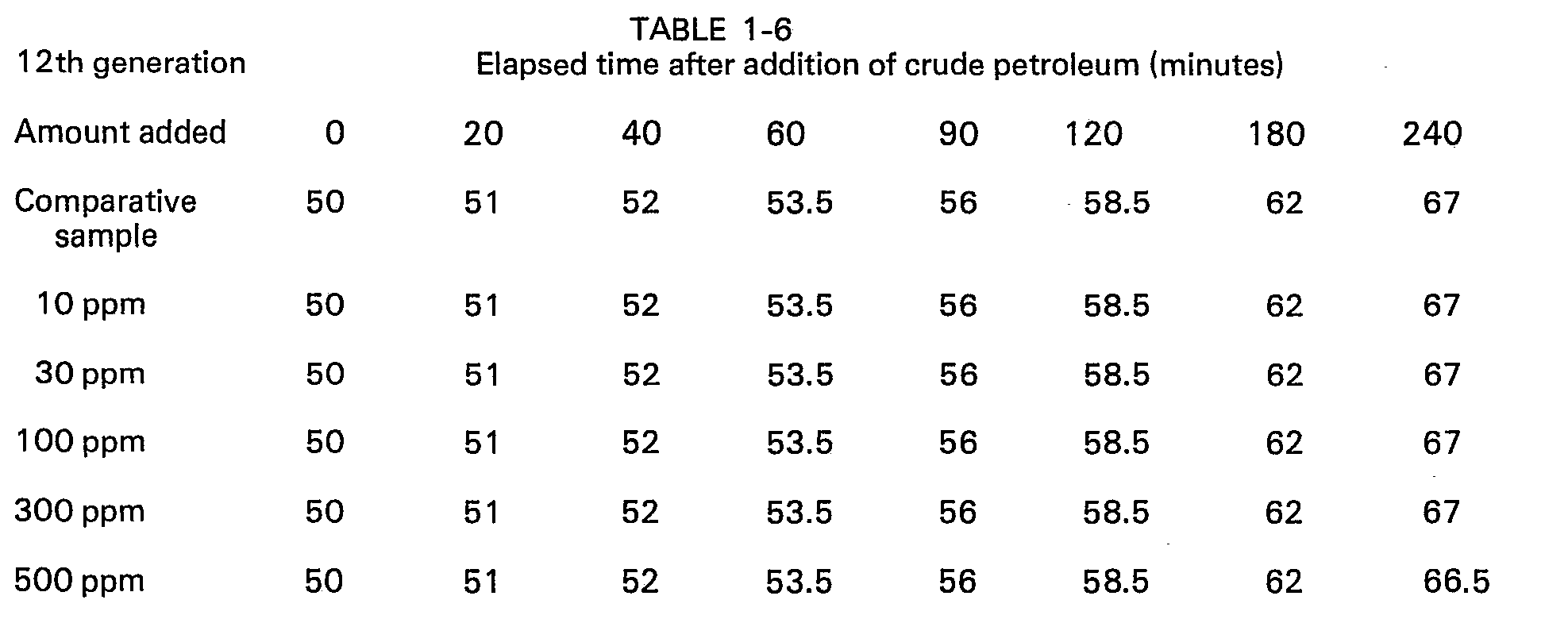
- It can be understood from the Table 1 that:
- 1) Strains of the 1 st generation operating on the (S-W) culture medium-which are hardly weakened-are undergo high growth acceleration 120 minutes from the addition of the crude petroleum and the degree of growth acceleration increases with increasing amounts of petroleum added (cases of adding more than 100 ppm show the same results as that in case of adding 100 ppm). (Refer to numerical values underlined in the Tables.)
- 2) Strains of the 4th generation operating on the (S-W) culture medium which are somewhat weakened are subject to growth acceleration 180 minutes from petroleum addition. In the cases of adding 30 ppm, 100 ppm, 300 ppm and 500 ppm of petroleum they were subject to growth acceleration after 120 minutes, but the degree of growth acceleration increased with the increase of the amount added.
- 3) Strains of the 6th generation operating on the (S-W) culture medium which were weakened were not subject to growth acceleration in case of the amount of petroleum added being 10 ppm. When the amount added was 30 ppm, 100 ppm, 300 ppm or 500 ppm, they were subjected to growth acceleration for the first time after 180 minutes.
- 4) Strains of the 8th generation operating on the (S-W) culture medium were not subject to growth acceleration in case of adding 10 ppm or 30 ppm of petroleum, they were subject to slight growth acceleration after 180 minutes in the case of adding 100 ppm, 300 ppm or 500 ppm of petroleum.
- 5) Strains of the 10th generation operating on the (S-W) culture medium were subject to growth acceleration only in the case when the amount of petroleum added was 300 ppm; growth acceleration slightly appeared after 180 minutes.
- 6) Strains of the 12th generation operating on the (S-W) culture medium were not subjected to growth acceleration in any case; a slight tendency of growth restraint was observed in case of adding 500 ppm petroleum.
- 7) Strains of the 14th-18th generation showed results similar to the strains of the 12th generation, i.e. they were not subject to growth acceleration in any case. Strains of the 13th and 14th generations were subject to growth restraint in case of adding 500 ppm of crude petroleum and those of the 15th, 16th, 17th and 18th generations were subject to growth restraint in case of adding 300 ppm and 500 ppm petroleum.
- Further, the growth acceleration of the bacteria of this invention is clarified by calculation of number of strains in the following Table 2, but the case of strains of the 1 st generation is described in detail in this specification.

- As can be understood from Table 2, the same results as those (Tables 1-1 to 1-6) obtained by measurement by means of a nephelometer were obtained, namely, growth acceleration was observed 120 minutes from the addition of the crude petroleum. After 24 minutes, it was 12% higher in the case of adding 10 ppm, 20% higher in the case of adding 30 ppm and 25% higher in the case of adding 100 ppm, 300 ppm or 500 ppm, as compared to the Comparative example.
- . The same procedure as in the case of the 500 ppm acclimation bacteria was carried out but the amounts of crude petroleum added in the logarithmic phase were 10 ppm, 30 ppm, 100 ppm and 300 ppm. The results are shown in Table 3.


- As will be obvious from Table 3, the degree of growth acceleration was similar to the case of the 500 ppm acclimation strain, even though the amount of crude petroleum was small.
- When strains of the 14th-18th generations were used, they were not subject to growth acceleration; likewise in the case of the strain of the 12th generation, and multiplication was restrained by the addition of 300 ppm as compared with the comparative sample.
- The (S-W) culture medium was used in the above described procedures. However, in the case of using a more eutrophic culture medium comprising peptone or a meat extract, the results obtained were not essentially different from those obtained in case of using the (S-W) culture medium, and growth acceleration was observed after 120 minutes from the addition of the oil.
- Further, concerning the death of the bacteria having a high degree of growth acceleration of the present invention, the 500 ppm and 30 ppm acclimation bacteria died after 3 days when they were introduced into the brine or fresh water. The effect was noted that the life span of the bacteria gradually extended with lowering degrees of growth acceleration.
- (2) Change of emulsification capability depending on the operating generation in the (S-W) culture medium.
-

- As will be obvious from above Table 4, the emulsification ability of the bacteria gradually deteriorates with increasing number of generations, in addition, the bacteria is of the wide range from the case that generation of the emulsification phenomena is shown in the early stage to the case that it is shown in a delayed stage. Further, and more importantly, it was found that even the bacteria of the 12th-14th generation (which were not subject to growth acceleration by addition of crude petroleum) slightly cause emulsification after 48 hours from inoculation of the bacteria. This fact is an important key for solving the relation between the growth acceleration and the emulsification.
-

- As will be obvious from Table 5, results similar to those in the case of using 500 ppm of acclimation bacteria are obtained. It will be understood that emulsification is caused by the addition of the crude petroleum even if the bacteria are not subject to growth stimulation.
- (3) Degree of crude petroleum removability depending on operating generation in (S-W) culture medium.
-
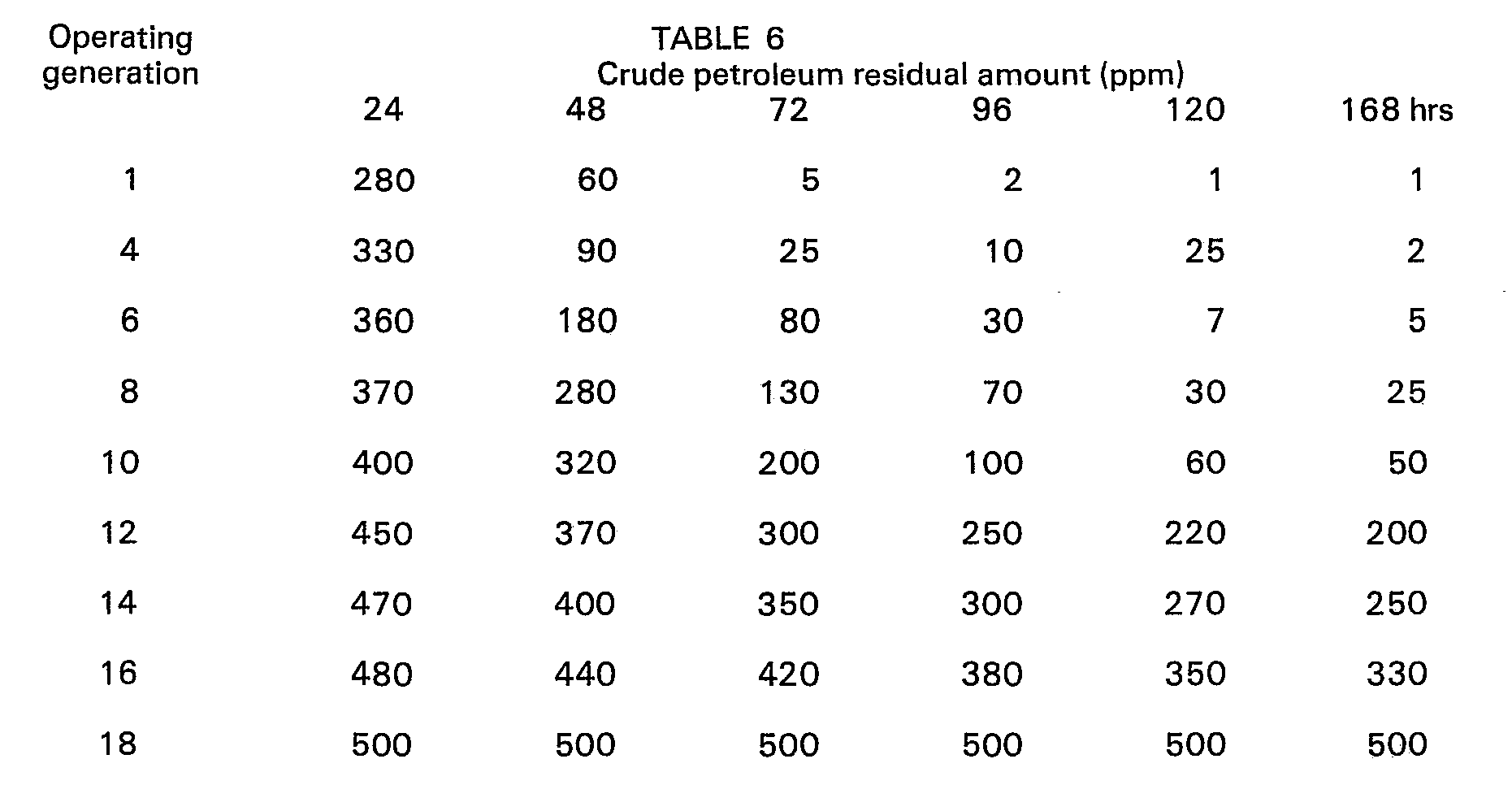
- As will be obvious from Table 6, when 500 ppm of crude petroleum are added, the residual amount of crude petroleum after 168 hours is only 1 ppm (1/500 of the original value) in the case of the strain of the 1st generation, only 2 ppm (1/250 of the original volume) in case of the strain of the 4th generation, 5 ppm (1/100 of the original value) in case of the strain of the 6th generation, 25 ppm (1/50 of the original value) in the case of the strain of the 8th generation, and 50 ppm (1/10 of the original value) in the strain of the 10th generation (which shows the minimum growth acceleration). Though the removal ratio gradually deteriorates, the petroleum residual amount decreases by one order, compared with the original amount.
- In destination, in the case of the strain of the 125h generation-which does not show growth acceleration any longer-the removal ability rapidly deteriorated and was only 1/2.5 the original value. Thus, the bacteria cannot be used as a petroleum removing agent.
- In the case of the strain of the 14th generation, 250 ppm remained (1/2 of the original volume). In the case of the strain of the 16th generation-which lost its emulsifying ability-the removal ratio deteriorated and 300 ppm remained (2/3 of the original value). In the case of the strain of the 18th generation, the strain did not grow in the culture medium (brine+crude petroleum 500 ppm) and the petroleum removal ratio was 0.
- Further, when the cultivation was continued for 240 hours, the petroleum residual amount became less than 2 ppm in the case of even the strain of the 6th generation which showed a slight growth acceleration, and, on the other hand, the petroleum residual amount was about 198 ppm in the case of strains which were no longer show growth acceleration and have only emulsifying ability, for example, the strain of the 12th generation. This means that growth acceleration bacteria according to the present invention show a remarkably excellent petroleum removal ability as compared with bacteria which show only emulsifying ability, i.e., it can be understood that the growth acceleration bacteria according to the present invention show remarkably good results in hydrocarbon consumption as compared with mere emulsification bacteria and that they are further different from conventional assimilation bacteria.
-

- As will be obvious from Table 7, removal of crude petroleum gradually deteriorates with an increase in the number the generation involved in the case of adding 30 ppm of crude petroleum similar to the case of adding 500 ppm of crude petroleum. Further the degree of consumption remarkably deteriorates in the case of using strains which were not subject growth acceleration by the additon of the crude petroleum. Namely, when cultivation is continued for 240 hours, the crude petroleum residual amount becomes lower than 0.8 ppm even in the case of the strain of the 6th generation which shows the lowest degree of growth acceleration, and in the case of the strains which were no longer subject to growth acceleration, the crude petroleum residual amount is still 10 ppm in the case of the strain of the 12th generation. Thus, growth acceleration bacteria and emulsification bacteria which do not show growth acceleration are very different each other from the viewpoint of petroleum consumption, and the growth acceleration bacteria of the present invention are further different from mere assimilation bacteria.
- (4) Interrelationship between growth acceleration, emulsification and crude petroleum consumption.
- The results of the above procedures (1)-(3) are summarized below.
-

-


- The results of Tables 8 and 9 are presented in Figures 2 and 3 as graphs.
- The above described results were obtained using FRI No. 5490, but the interrelationship between growth acceleration by crude petroleum, emulsification and assimilation are essentially similar in the case of using FRI No. 5491 and other bacteria. This fact was confirmed not only by testing of deterioration in the ability of high-powered growth acceleration bacteria but also that of increase in the ability of bacteria produced by induction.
- The results shown in these Tables and in the drawings relates various characteristics required for purification of petroleum pollution by microbes.
- In order to determine the
angle 0, it is first necessary to obtain a µ value. The specific growth speed µ is expressed by the following formula.
- The growth angle can be calculated on the basis of the following.
- The strains used in this invention are selected on the basis of the angle (growth angle) formed between the growth curve of a strain which is cultured on the Stephanson Wetham medium and the growth curve of the strain which is cultured on the Stephanson Wetham medium added a petroleum hydrocarbon. The procedure of calculation is described below with reference to Figure 4.
- In Figure 4, AB represents the growth line of a bacterial strain in its logarithmic growth period in a Stephanson Wetham culture medium not containing petroleum hydrocarbon. After the addition of the petroleum hydrocarbon, stimulation of growth begins to appear at
point 0, and a line OC is drawn. The point formed by the intersection of a tangential line EF having the highest gradient (the line showing the maximumum µ value, i.e., the specific growth speed) with a line OB is supposed to be a point F, and the line extending from the point F and being parallel to the axis of abscissas is supposed to be a line FG. Further, a perpendicular line is drawn from the point E to a line FG, and a point at which the perpendicular line intersects with a line AB is supposed to be a point H. The number of strains/cc at point E is log n2; the number of strains at H is log n, and the number of strains in point F is log no. Furthermore, <BFG=α<BFE=θ. - If the interval between I1, I2 of the logarithmic values (1, 2, 3, 4 ... 8, 9, 10) of the number of strains is made equal to the interval between t1, t2 of the time (hours), a and β can be calculated using the following equations.


- If the maximum µ value is substituted in the above equation, the angle formed by the intersection of the growth curve in a basic medium [S-W] with the growth curve which results from the addition of the petroleum hydrocarbon can be calculated in regard to strains of the same species which differ from each other in purifying power.
- As a result of investigation for 0 and µ value, the inventor has found an index to know an ability to remove hydrocarbons EP-value in relation to 0 and µ value.
- EP-value represents a hydrocarbon purifying ability and is obtained by the following formula.

- In the following Table, a relation between EP-value and an amount of remaining crude oil is shown using various bacteria in the case of purification of 500 ppm crude oil in brine.

- The table 12 shows that, for example, an amount of crude oil reduced to 0.7 ppm after 7 days (168 hours) using bacteria having 0.7 of EP-value (0=31, y=0.4).
- As is shown in the following Table 13 to 16, it becomes apparent that bacteria having the same EP value values show the same amount of remaining crude oil, even if the bacteria have different 0 and µ value each other. The used polluted brine contains 500 ppm of crude oil.


- In the present invention, bacteria having 0.1 or more, preferably 0.3 or more of EP-value are used to remove hydrocarbons.
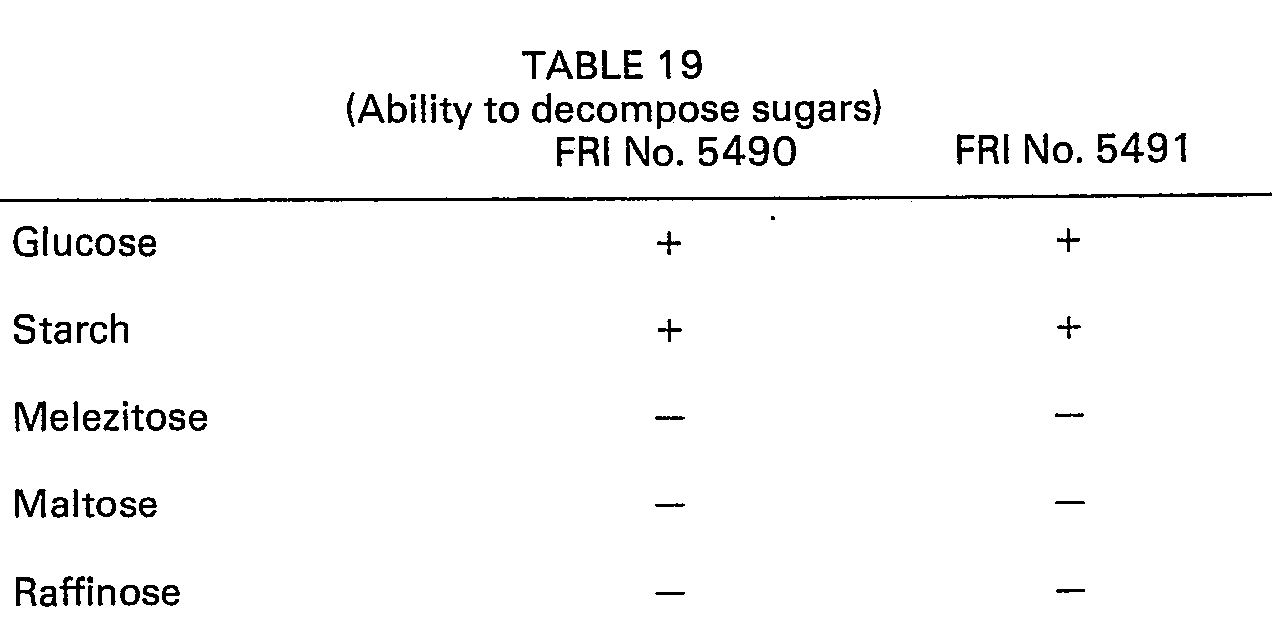
- Microscopic observation and morphological characteristics of the present bacteria FRI No. 5490 and No. 5491 are shown in the following Tables 15 to 17.



- As the results of the experiments about prior art microbes assimilation of petroleum is known, but studies concerning emulsification have been barely carried out. Accordingly, the existence and phenomena of growth acceleration bacteria are unexpected from prior art knowledge.
- 50 litres of a culture medium comprising 0.5 g of crude petroleum comprising Khafuji crude petroleum and 1000 ml of brine collected from brine near Akashi City were poured into a water tank (90 cmx50 cmx40 cm). 20 ml of a bacteria solution acclimated by 500 ppm of crude petroleum obtained according to the present invention was inoculated on the above described culture medium and incubated at 18°C for 42 hours. The resultant cultured solution was cooled to about 10°C and subjected to centrifugal separation (10,000xg) to obtain 60 g of a mixture of bacteria and a crude petroleum emulsion used to form Preparations (A)-(D) below. (Preparation B) 0.44 g of starch (potato), 0.001 g of crude petroleum were added to 10 g of the above described mixture and well mixed. The resultant mixture was dried in a vacuum (-750--760 mmHg) to an 8 wt% water contact. 2.9 g of the resultant dry material was put in a glass bottle and the bottle was filled with an inert gas such as CO2 or N2. The effective preservation period of the resultant agent was more than 20 days at room temperature and more than 3 months in a refrigerator at 5-8°C.
- (Preparation B) 0.44 g of starch, 0.001 g of crude petroleum and 0.11 g of cystine were added to 10 g of the above described mixture and well mixed. 3.01 g of the agent having an 8 wt% water content was produced in the same manner as for Agent A and enclosed in a glass bottle with N2 gas. The effective preservation period of the resultant agent was more than 20 days at a room temperature and more than 3 months at 5-8°C.
- (Agent C) 0.4 g of starch of potato was added to 10 g of the above described mixture and well mixed. The resultant mixture was dried in a vacuum (-750 to -760 mmHg) to obtain 2.5 g of agent. The resultant agent was effective for long periods of time when stored at room temperature.
- (Agent D) 0.1 g of cystine and 0.001 g of crude petroleum were added to 10 g of the above described mixture and well mixed. The resultant mixture was dried in a vacuum to obtain 2.1 g of agent. The resultant agent was effective for long periods of time when storage at room temperature.
- 12.5 -ml of crude petroleum was added dropwise to an acrylic resin tank having a volume of about 33 liters (length 26 cm; width 45 cm;
depth 30 cm). After the crude petroleum was sufficiently applied to the bottom and the sides of the tank, 27 liters of brine were charged thereto. The amount of crude petroleum in the brine in this case was 500 ppm. The temperature of the brine was controlled at 180°C and the system was aerated using an appropriate apparatus provided on the tank as later described. A cultivating solution of the crude petroleum assimilation bacteria (FRI No. 5490) according to the present invention (incubated on a culture medium comprising brine and crude petroleum for 48 hours at 18°C) was added in an amount of 9 mg (1/3000 the volume of the brine). 9 mg of the cultivating solution consisted of 3 mg of 500 ppm acclimation bacteria, 3 mg of 100 ppm acclimation bacteria and 3 mg of 30 ppm acclimation bacteria. 24 hours after the beginning of the run, aeration was carried out at a rate of 2 liters/minute. - From the beginning of the run the brine was periodically examined and the emulsification state of the brine in the water tank and the state of crude petroleum adhesion on the surface of the walls of the tank were observed with the naked eye. The crude petroleum content (measured by UV) and cell counts per 1 cc were also measured The results are shown in Table 10.

- As is obvious from Table 10, emulsification began 4 hours after the addition of the bacteria and rapidly increased by 7 hours, becoming remarkably high after 48-72 hours and gradually deteriorating thereafter while transparency rapidly increased after 144 hours and the system became nearly transparent after 192 hours.
- On the other hand, crude petroleum thickly adhered to the walls gradually decreased after about 24 hours and the adhered crude petroleum was hardly observed after 96 hours. Further, the crude petroleum content in the brine rapidly decreased to 180 ppm after 24 hours, 30 ppm after 48 hours and 0.5 ppm after 72 hours, and gradually decreased to 0.3 ppm after 96 hours and 0.2 ppm after 120 hours. After 120 hours, the same results were shown (removal ratio: 99.96%).
- The crude petroleum assimilation bacteria in the brine had an initial cell count of 1 x 10⁶/cc, which increased to 5×10⁸ after 24 hours and 3.5x10⁹ after 48 hours. The cell counts gradually decreased thereafter to become 2.5×10⁹ after 72 hours, 3×10⁸ after 96 hours, 6×10⁷ after 120 hours and 1×10' after 144 hours. The bacteria then showed a tendency to die and the cell count became 2x 155 after 168 hours. After 192 hours, living cells were not observed.
- At elapsed time of 192 hours (8 days) from the beginning of the run, the tank had a good appearance, i.e., the same as before pollution. Further, the brine was clean and did not differ from common brine, except it was very slightly cloudy.
- The same procedure was carried out except that the crude petroleum content was 30 ppm and
crude petroleum 30 ppm acclimation bacteria were used. Results of are shown in Table 11.
- As will be obvious from Table 11, emulsification began after 4 hours of the run and gradually increased with the passage of time. It became remarkable after 36-48 hours, whereafter it deteriorated and the sense of transparency rapidly appeared after about 96 hours. After 144 hours, the system became nearly transparent.
- On the other hand, the crude petroleum content of the brine rapidly decreased to become 3 ppm-1/10 of the original value-after 24 hours and 0.3 ppm-1/1 00 of the original value-after 48 hours. It gradually decreased to become 0.2 ppm after 72 hours and 0.15 ppm after 96 hours. After 96 hours, the same results were shown (removal ratio: 99.5%).
- Further, the assimilation bacteria had an initial cell count of 3×10⁵, which increased to 4×10⁸ after 24 hours and 1.2×10⁹ after 48 hours. The cell counts decreased thereafter to 5×10⁸ after 72 hours and 2×10⁷ after 96 hours. Thereafter the bacteria rapidly died and the cell count became only 3 x 10⁵ after 120 hours. After 144 hours, all bacteria were dead.
- At an elapsed time of 144 hours (6 days) from the beginning of the fun, the tank had a good appearance and the brine in the tank was clean.
- Further, in an examination regarding the reactivity of bacteria showed growth acceleration by crude petroleum with respect to each component in the crude petroleum, rapid growth acceleration was shown for light oil when the degree of acclimation was very small, but acclimation was difficult for B-heavy oil and more difficult for C-heavy oil. However, by continuing processing similar to the above described five steps, assimilation, emulsification and growth acceleration appeared in a manner similar to the case of using crude petroleum. When growth acceleration appeared, the acclimation for B-heavy oil and C-heavy oil was more easily carried out than in the case of crude petroleum. Further, the fact that consumption of B- and C-heavy oil was well carried out and the amount of residual components was very small meant that almost all components were taken by the bacteria. Hitherto, the term "petroleum protein" has been used by choice. In this case, bacteria which were subjected to growth acceleration by the used petroleum components have not been known. Further, the yield is of course better in case of the growth acceleration bacteria.
- In addition, a process for treating oil by adding bacteria which have been subjected to growth acceleration by oil to an activated sludge, namely, by producing an enriched activated sludge, is an example of the application of bacteria according to the present invention, by which good water can be effectively discharged when tanks on the shore are cleaned. The following is an example of applying the bacteria according to the present invention to an activated sludge.
-
- (1) Cultivating liquid containing bacteria of the present invention acclimated by 500 ppm, 100 ppm or 30 ppm of crude petroleum, in amount of 1:1:1, which were subjected to growth acceleration by the crude petroleum, were charged into an activated sludge in an amount of 1/10 by the volume of the activated sludge used in Example 3. Petroleum containing waste liquor was flowed into the sludge and the flow rate gradually increased, an initial flowing rate being 3 cc/minute and the final flowing rate being 10 cc/minute. The enriched activated sludge had a
processing capability 70 times that of activated sludge containing no bacterium. Further, it had aprocessing ability 15 times that of activated sludge to which known petroleum assimilation bacteria were added. The activated sludge was obtained according to the procedures described in, for example, U.K. Patent No. 1,277,632. - (2) Since the adaptability of protozoa in the activated sludge is remarkably inferior to that of bacteria, it is sometimes preferred to initially process only with the bacteria when petroleum containing waste liquor having a large load variation is processed. Thus, growth acceleration bacteria subject to group acceleration by 500 ppm, 100 ppm or 30 ppm of crude petroleum were incubated in a tank having a volume of 30 liters to have a cell count of 1 09/ml. To the cultivated material, crude petroleum containing waste liquor was added in an amount of 10 ml/minute. The resultant waste liquor mixture containing the bacteria was flowed into the protozoa inhabiting tank to carry out purification. The crude petroleum content detected in the processed liquid was less than 1/250 of the original volume.
- The crude petroleum mixture comprising Khafji crude oil and Iranian heavy oil (1:1) was applied to the wall and the bottom of a drum having a volume of 50 liters. After standing for 3 days, the adhered oil was separated as much as possible using the pressure of the brine. The Iranian heavy oil has a following physical properties; specific gravity; 0.884, pour point: less than -35°C, sulfur content; 2.7 wt%, carbon residue: 8.0 wt%, and nitrogen content 0.22 wt%. After materials and components floating on the surface-which had separated from the walls-were removed by suction, a cultivating liquid of the bacteria (FRI No. 5490) according to the present invention incubated in a culture medium composed of brine+crude petroleum for 48 hours at 18°C) was added in an amount of 1/3000 based on the weight of the brine. After 120 hours from the addition of the bacteria, the walls and the bottom of the drum were clean.
- FRI Nos. 5490 and 5491 in the present invention are deposition numbers of bacteria prepared from FRI Nos. 2927 and 2928 by an incubating method described in this specification. The biological properties of these bacteria of the present invention in the case of incubation on a conventional culture medium are not different from those of FRI Nos. 2927 and 2928, but a colony after incubation for 48 hours on a culture medium consisting of 0.5 g of crude petroleum, 1 liter of the brine and agar is white and opaque and has a diameter of 1.5 mm.
- While the invention has been described in detail and with reference to specific embodiments thereof, it will be apparent to one skilled in the art that various changes and modifications can be made therein without departing from the spirit and scope thereof.
Claims (9)
Priority Applications (2)
| Application Number | Priority Date | Filing Date | Title |
|---|---|---|---|
| DE8181304880T DE3166350D1 (en) | 1981-10-20 | 1981-10-20 | Bacterial strain for purifying hydrocarbons pollution, process for production thereof and purification process using said bacterial strain |
| EP19810304880 EP0077422B1 (en) | 1981-10-20 | 1981-10-20 | Bacterial strain for purifying hydrocarbons pollution, process for production thereof and purification process using said bacterial strain |
Applications Claiming Priority (1)
| Application Number | Priority Date | Filing Date | Title |
|---|---|---|---|
| EP19810304880 EP0077422B1 (en) | 1981-10-20 | 1981-10-20 | Bacterial strain for purifying hydrocarbons pollution, process for production thereof and purification process using said bacterial strain |
Publications (2)
| Publication Number | Publication Date |
|---|---|
| EP0077422A1 EP0077422A1 (en) | 1983-04-27 |
| EP0077422B1 true EP0077422B1 (en) | 1984-09-26 |
Family
ID=8188435
Family Applications (1)
| Application Number | Title | Priority Date | Filing Date |
|---|---|---|---|
| EP19810304880 Expired EP0077422B1 (en) | 1981-10-20 | 1981-10-20 | Bacterial strain for purifying hydrocarbons pollution, process for production thereof and purification process using said bacterial strain |
Country Status (2)
| Country | Link |
|---|---|
| EP (1) | EP0077422B1 (en) |
| DE (1) | DE3166350D1 (en) |
Cited By (1)
| Publication number | Priority date | Publication date | Assignee | Title |
|---|---|---|---|---|
| LT3112B (en) | 1992-10-15 | 1994-12-27 | Saulius Grigiskis | Method of decontaminating a hydrocarbon polluted enviroment |
Families Citing this family (5)
| Publication number | Priority date | Publication date | Assignee | Title |
|---|---|---|---|---|
| JP2562139B2 (en) * | 1987-03-30 | 1996-12-11 | 新技術事業団 | Microbial culture method |
| BE1012218A3 (en) * | 1998-10-02 | 2000-07-04 | Hydro Top Rech & Dev | Additives for biological water treatment |
| CA2299854A1 (en) | 1999-03-29 | 2000-09-29 | Technology Licensing Organization, Inc. | Method of degrading heavy oil using bacteria mixtures |
| EP1132462A1 (en) * | 2000-03-09 | 2001-09-12 | Technology Licensing Organization Inc. | Bacteria strains having heavy oil degrading ability, mixtures thereof and nurturing composition therefore |
| CN110373357B (en) * | 2019-07-31 | 2022-07-22 | 东华大学 | Pseudomonas putida and application thereof |
Family Cites Families (1)
| Publication number | Priority date | Publication date | Assignee | Title |
|---|---|---|---|---|
| US3152983A (en) * | 1961-12-12 | 1964-10-13 | Socony Mobil Oil Co Inc | Microbial disposal of oily wastes |
-
1981
- 1981-10-20 EP EP19810304880 patent/EP0077422B1/en not_active Expired
- 1981-10-20 DE DE8181304880T patent/DE3166350D1/en not_active Expired
Cited By (1)
| Publication number | Priority date | Publication date | Assignee | Title |
|---|---|---|---|---|
| LT3112B (en) | 1992-10-15 | 1994-12-27 | Saulius Grigiskis | Method of decontaminating a hydrocarbon polluted enviroment |
Also Published As
| Publication number | Publication date |
|---|---|
| EP0077422A1 (en) | 1983-04-27 |
| DE3166350D1 (en) | 1984-10-31 |
Similar Documents
| Publication | Publication Date | Title |
|---|---|---|
| US4521515A (en) | Bacterial strain for purifying hydrocarbons pollution and purification process | |
| Debroy et al. | Role of biofilms in the degradation of microplastics in aquatic environments | |
| Veldkamp et al. | Mixed culture studies with the chemostat | |
| Pommepuy et al. | Enteric bacteria survival factors | |
| ZoBell | Microbial modification of crude oil in the sea | |
| Bento et al. | Biodeterioration of stored diesel oil: studies in Brazil | |
| Çetin et al. | Decolorization of reactive dyes by mixed cultures isolated from textile effluent under anaerobic conditions | |
| Rozen et al. | Survival of enteric bacteria in seawater | |
| Delille et al. | Seasonal variation of bacteria in sea ice contaminated by diesel fuel and dispersed crude oil | |
| Salehi et al. | Treatment of normal hydrocarbons contaminated water by combined microalgae–Photocatalytic nanoparticles system | |
| US5496723A (en) | Strains of Acinetobacter species (bicoccum), Arthrobacter species, and Rhodococcus species, and a method for biological purification from oil spills and pollutions, using said strains | |
| RU2093478C1 (en) | Method of water and soil treatment from oil, petroleum products and polymeric additions in drilling fluid | |
| EP0077422B1 (en) | Bacterial strain for purifying hydrocarbons pollution, process for production thereof and purification process using said bacterial strain | |
| Abe et al. | Removal of inorganic nitrogen sources from water by the algal biofilm of the aerial microalga Trentepohlia aurea | |
| Gerchakov et al. | Succession of periphytic microorganisms on metal and glass surfaces in natural seawater | |
| Walker et al. | Microbial ecology of petroleum utilization in Chesapeake Bay | |
| RU2107722C1 (en) | Acinetobacter calcoaceticus, pseudomonas fluorescens, alcaligenes faecalis bacteria strains consorcium for destroying oil and petroleum products | |
| 東原孝規 et al. | An MPN method for the enumeration of marine hydrocarbon degrading bacteria. | |
| RU2142997C1 (en) | Strain arthrobacter sp for degradation of crude oil and petroleum products | |
| Ismail et al. | Biosurfactant production by bacteria isolated from hydrocarbon-impacted soil | |
| Kuiper et al. | Influences of bag dimensions on the development of enclosed plankton communities during POSER | |
| Walker et al. | Effects of petroleum on estuarine bacteria | |
| RU2114174C1 (en) | Consortium of yeast candida maltosa for biodegradation of petroleum pollution | |
| CA1175371A (en) | Bacterial strain for purifying hydrocarbons pollution and purification process | |
| Talib et al. | Decolorization and degradation of azo dyes in textile wastewater effluent by Aspergillus niger and Aspergillus ochraceous |
Legal Events
| Date | Code | Title | Description |
|---|---|---|---|
| PUAI | Public reference made under article 153(3) epc to a published international application that has entered the european phase |
Free format text: ORIGINAL CODE: 0009012 |
|
| AK | Designated contracting states |
Designated state(s): DE FR GB IT NL |
|
| 17P | Request for examination filed |
Effective date: 19830316 |
|
| ITF | It: translation for a ep patent filed | ||
| GRAA | (expected) grant |
Free format text: ORIGINAL CODE: 0009210 |
|
| AK | Designated contracting states |
Designated state(s): DE FR GB IT NL |
|
| REF | Corresponds to: |
Ref document number: 3166350 Country of ref document: DE Date of ref document: 19841031 |
|
| ET | Fr: translation filed | ||
| PLBE | No opposition filed within time limit |
Free format text: ORIGINAL CODE: 0009261 |
|
| STAA | Information on the status of an ep patent application or granted ep patent |
Free format text: STATUS: NO OPPOSITION FILED WITHIN TIME LIMIT |
|
| 26N | No opposition filed | ||
| ITTA | It: last paid annual fee | ||
| PGFP | Annual fee paid to national office [announced via postgrant information from national office to epo] |
Ref country code: FR Payment date: 19921005 Year of fee payment: 12 |
|
| PGFP | Annual fee paid to national office [announced via postgrant information from national office to epo] |
Ref country code: NL Payment date: 19921031 Year of fee payment: 12 |
|
| PGFP | Annual fee paid to national office [announced via postgrant information from national office to epo] |
Ref country code: DE Payment date: 19921110 Year of fee payment: 12 |
|
| PG25 | Lapsed in a contracting state [announced via postgrant information from national office to epo] |
Ref country code: NL Effective date: 19940501 |
|
| NLV4 | Nl: lapsed or anulled due to non-payment of the annual fee | ||
| PG25 | Lapsed in a contracting state [announced via postgrant information from national office to epo] |
Ref country code: FR Effective date: 19940630 |
|
| PG25 | Lapsed in a contracting state [announced via postgrant information from national office to epo] |
Ref country code: DE Effective date: 19940701 |
|
| REG | Reference to a national code |
Ref country code: FR Ref legal event code: ST |
|
| PGFP | Annual fee paid to national office [announced via postgrant information from national office to epo] |
Ref country code: GB Payment date: 19941011 Year of fee payment: 14 |
|
| PG25 | Lapsed in a contracting state [announced via postgrant information from national office to epo] |
Ref country code: GB Effective date: 19951020 |
|
| GBPC | Gb: european patent ceased through non-payment of renewal fee |
Effective date: 19951020 |