EP0077485A1 - Matière luminescente inorganique - Google Patents
Matière luminescente inorganique Download PDFInfo
- Publication number
- EP0077485A1 EP0077485A1 EP82109128A EP82109128A EP0077485A1 EP 0077485 A1 EP0077485 A1 EP 0077485A1 EP 82109128 A EP82109128 A EP 82109128A EP 82109128 A EP82109128 A EP 82109128A EP 0077485 A1 EP0077485 A1 EP 0077485A1
- Authority
- EP
- European Patent Office
- Prior art keywords
- activators
- phosphor according
- energy
- host lattice
- activator
- Prior art date
- Legal status (The legal status is an assumption and is not a legal conclusion. Google has not performed a legal analysis and makes no representation as to the accuracy of the status listed.)
- Granted
Links
Images
Classifications
-
- C—CHEMISTRY; METALLURGY
- C09—DYES; PAINTS; POLISHES; NATURAL RESINS; ADHESIVES; COMPOSITIONS NOT OTHERWISE PROVIDED FOR; APPLICATIONS OF MATERIALS NOT OTHERWISE PROVIDED FOR
- C09K—MATERIALS FOR MISCELLANEOUS APPLICATIONS, NOT PROVIDED FOR ELSEWHERE
- C09K11/00—Luminescent materials, e.g. electroluminescent or chemiluminescent
- C09K11/08—Luminescent materials, e.g. electroluminescent or chemiluminescent containing inorganic luminescent materials
- C09K11/77—Luminescent materials, e.g. electroluminescent or chemiluminescent containing inorganic luminescent materials containing rare earth metals
- C09K11/7783—Luminescent materials, e.g. electroluminescent or chemiluminescent containing inorganic luminescent materials containing rare earth metals containing two or more rare earth metals one of which being europium
-
- C—CHEMISTRY; METALLURGY
- C09—DYES; PAINTS; POLISHES; NATURAL RESINS; ADHESIVES; COMPOSITIONS NOT OTHERWISE PROVIDED FOR; APPLICATIONS OF MATERIALS NOT OTHERWISE PROVIDED FOR
- C09K—MATERIALS FOR MISCELLANEOUS APPLICATIONS, NOT PROVIDED FOR ELSEWHERE
- C09K11/00—Luminescent materials, e.g. electroluminescent or chemiluminescent
- C09K11/08—Luminescent materials, e.g. electroluminescent or chemiluminescent containing inorganic luminescent materials
- C09K11/77—Luminescent materials, e.g. electroluminescent or chemiluminescent containing inorganic luminescent materials containing rare earth metals
- C09K11/7766—Luminescent materials, e.g. electroluminescent or chemiluminescent containing inorganic luminescent materials containing rare earth metals containing two or more rare earth metals
Definitions
- the invention relates to an inorganic phosphor, consisting of a solid with an activator contained therein, which emits visible light when excited with high-energy radiation.
- Such inorganic phosphors which contain an activator and which emit light or cause luminescence by excitation with high-energy radiation, for example corpuscular radiation (electrons, ⁇ -particles, protons, mesons) or UV radiation known and form the basis for the practical application of such phosphors in lighting technology and in the reproduction of electronic signals.
- high-energy radiation for example corpuscular radiation (electrons, ⁇ -particles, protons, mesons) or UV radiation
- These are solid bodies with certain grids, in which the activators are installed in the form of foreign metal cations and which emit visible light through excitation with, for example, cathode rays.
- activators are known per se, including the method of how this installation is carried out.
- Such known phosphors consist for example of zinc sulfide and the activator of copper cations. When excited with high-energy radiation, these phosphors glow intensely green. These phosphors are used for, for example, light signs and the like.
- These solids are exclusively synthetically produced solids, whereby the light emission comes from the foreign ions, the activators.
- the color of the light depends on both the activator used and the host lattice, i.e. the lattice of the solid.
- the metal ions of the transition elements and increasingly the ions of the trivalent seltepene earth are also suitable.
- the first commercial rare earth phosphor was yttrium orthovanadate (YV0 4 : Euj) doped with trivalent europium. This phosphor is used in television picture tubes and contributed to the rapid spread of color television.
- the phosphors are mainly used in the coating of cathode ray tubes of all kinds, e.g. B. television tubes, viewers, computer terminals, oscillographs and fluorescent tubes use.
- Visual tubes for example, are preferably arranged side by side, since the color generation in the television picture, which works on the principle of additive color composition, takes place through the three primary colors green, red and blue.
- the corresponding single-color phosphors are therefore to be applied in separate work steps in a line or dot-shaped grid.
- the local arrangement above one another also takes place in the case of phosphors, one then speaks of the so-called onion skin type, wherein a single-color phosphor is covered by a layer of a second phosphor.
- a phosphor can not only shine in two colors, but also in three or even four colors.
- a host lattice or a solid body is used, in which two different activators are installed, which depending on the excitation energy (V A (1)) or (V A (2)) mainly the spectrum of one or the other activator emit.
- an activator combination of T b 3+ and E u 3+ is used to generate green or red light.
- the excitation energy changes continuously from V A (1) to V A (2), the light emitted by this two-color phosphor covers all colors from green to yellow and orange to red.
- numerous intermediate tones are available in addition to the actual emission colors red and green.
- two-color phosphors can be obtained which emit the typical colors of the individual activators in the same way depending on the excitation energy used.
- Kombina cations with particularly effective emission are the cations D y 3+ / E u 3+ (with yellow or red emission) and Er 3+ / Eu 3+ or Tb 3+ / Eu 3+ (with green or red emission) .
- the quality of the color separation can be influenced by the type and nature of the host grid. It has been shown that a double-activated connection can only emit two colors if there are separate ways for the individual activators to absorb and transmit the excitation energy.
- the luminescence mechanism of a two-color phosphor is shown in the attached figure.
- the grating In order to absorb the excitation energy, the grating must have two different excited states (energy levels of individual grating components or charge transfer terms). When excited with energy V A (1), the energy is first taken up by the lattice of the solid into the corresponding energy level and then transferred into a term of the same energy of the activator (1). After the interposition of several radiationless processes, the activator (1) returns to its basic state, emitting its light.
- a particularly good color separation ie a particularly pure color of the respective light of the activator (1) or (2) is only obtained if the corresponding excitation and energy transfer processes run independently of one another. This is always the case with a sufficiently large energy difference between V A (1) and V A (2). Since the position of V A (1) with respect to YA (2) can vary from host lattice to host lattice, the choice of host lattice is of crucial importance. The position of the excited lattice terms can be shifted relative to one another by varying a host lattice component. Depending on the relative position of the ER targeted VA (1) to V A (2) the color separation is better or worse.
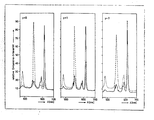
- the strongest Tb 3+ band ( ⁇ 540 nm) is only about as intense as the strongest line ( ⁇ 615 nm) of the same time with excited Eu 3+ , so that a mixture of both natural colors, namely yellow light, is emitted.
- the third excitation path can be created, for example, in that the host lattice provides a third excited term and absorbs the excitation energy B A (3) and transfers it to a suitable third activator (3).
- the activator (3) can then return to the basic state after a few radiation-free processes with emission (3).
- tri-color phosphors for the three primary colors red, green and blue, since they could be used in all areas working on the principle of additive color composition and the manufacturing process z. B. of television picture tubes could significantly facilitate.
- the additional paths (4) to (n) required to excite the activators (4) to (n) must be created by expanding the energy transfer scheme as shown in the figure.
- host grids are required to accommodate the corresponding number enable on separate paths for the activators (1), (2), (3) ... (n).
- hexagonal oxygen perovskites with octahedral cation vacancies which have the composition A 4 (B, M) 3 ehlO 12 , are suitable as the host lattice or solid for multicolor-emitting phosphors.
- Other host grids are, for example, oxygen perovskites from the MR 1-x ⁇ x O 3 series or Scheelite or grenades.
Landscapes
- Chemical & Material Sciences (AREA)
- Inorganic Chemistry (AREA)
- Engineering & Computer Science (AREA)
- Materials Engineering (AREA)
- Organic Chemistry (AREA)
- Luminescent Compositions (AREA)
- Formation Of Various Coating Films On Cathode Ray Tubes And Lamps (AREA)
Priority Applications (1)
| Application Number | Priority Date | Filing Date | Title |
|---|---|---|---|
| AT82109128T ATE18427T1 (de) | 1981-10-21 | 1982-10-02 | Anorganischer leuchtstoff. |
Applications Claiming Priority (2)
| Application Number | Priority Date | Filing Date | Title |
|---|---|---|---|
| DE19813141747 DE3141747A1 (de) | 1981-10-21 | 1981-10-21 | Anorganischer leuchtstoff |
| DE3141747 | 1981-10-21 |
Publications (2)
| Publication Number | Publication Date |
|---|---|
| EP0077485A1 true EP0077485A1 (fr) | 1983-04-27 |
| EP0077485B1 EP0077485B1 (fr) | 1986-03-05 |
Family
ID=6144558
Family Applications (1)
| Application Number | Title | Priority Date | Filing Date |
|---|---|---|---|
| EP82109128A Expired EP0077485B1 (fr) | 1981-10-21 | 1982-10-02 | Matière luminescente inorganique |
Country Status (4)
| Country | Link |
|---|---|
| EP (1) | EP0077485B1 (fr) |
| JP (1) | JPS5880376A (fr) |
| AT (1) | ATE18427T1 (fr) |
| DE (1) | DE3141747A1 (fr) |
Citations (1)
| Publication number | Priority date | Publication date | Assignee | Title |
|---|---|---|---|---|
| GB1208565A (en) * | 1966-10-10 | 1970-10-14 | Johnson Matthey Co Ltd | Improvements in and relating to phosphors |
-
1981
- 1981-10-21 DE DE19813141747 patent/DE3141747A1/de not_active Withdrawn
-
1982
- 1982-10-02 AT AT82109128T patent/ATE18427T1/de not_active IP Right Cessation
- 1982-10-02 EP EP82109128A patent/EP0077485B1/fr not_active Expired
- 1982-10-20 JP JP57183035A patent/JPS5880376A/ja active Pending
Patent Citations (1)
| Publication number | Priority date | Publication date | Assignee | Title |
|---|---|---|---|---|
| GB1208565A (en) * | 1966-10-10 | 1970-10-14 | Johnson Matthey Co Ltd | Improvements in and relating to phosphors |
Non-Patent Citations (3)
| Title |
|---|
| CHEMICAL ABSTRACTS, Band 89, Nr. 10, 4. September 1978, Seite 521, Nr. 83192a, Columbus, Ohio, USA * |
| CHEMICAL ABSTRACTS, Band 93, Nr. 8, 25. August 1980, Seite 93, Spalte 1, Nr. 85917x, Columbus, Ohio, USA * |
| DERWENT JAPANESE PATENTS REPORT, Band U, Nr. 40, Teil L, 6. November 1973, Ref. 59956u, Derwent Publications Ltd., London, G.B. * |
Also Published As
| Publication number | Publication date |
|---|---|
| EP0077485B1 (fr) | 1986-03-05 |
| ATE18427T1 (de) | 1986-03-15 |
| JPS5880376A (ja) | 1983-05-14 |
| DE3141747A1 (de) | 1983-05-05 |
Similar Documents
| Publication | Publication Date | Title |
|---|---|---|
| DE19521119C2 (de) | Langsam abklingende phosphoreszierende Stoffe | |
| EP1078972B1 (fr) | lampe fluorescente utilisée à des fins d'éclairage | |
| DE2442167C2 (de) | Bildwiedergabe-Vorrichtung | |
| EP0149148B1 (fr) | Ecran d'enregistrement pour image radiographique | |
| DE2018354C3 (de) | Elektrolumineszente Einrichtung | |
| DE1208334B (de) | Fernsehbildroehre zur Wiedergabe von Farbfernsehbildern nach dem Landschen Binaerfarbenverfahren | |
| DE2614444C2 (de) | Erdalkalialuminat-Leuchtstoff und dessen Verwendung | |
| DE2712596A1 (de) | Kathodolumineszente teilchen fuer elektronenstrahlroehren sowie verfahren zur herstellung dieser teilchen | |
| DE1514332B2 (de) | Bildwiedergabeeinrichtung mit einer bildroehre deren leucht schirm wenigstens zwei leichtstoffe aufweist | |
| DE10238316A1 (de) | Verfahren zum Herstellen einer Weißlichtquelle | |
| DE10300622A1 (de) | Fluoreszenzpulver zum Herstellen von Weiß-Licht-Emittierenden-Dioden großer Helligkeit | |
| DE2450153C3 (de) | Leuchtstoffschicht | |
| EP0077485B1 (fr) | Matière luminescente inorganique | |
| DE2265403C2 (de) | Leuchtschirm einer Kathodenstrahlröhre für Lichtpunktabtastgeräte | |
| DE1512397B2 (de) | Leuchtschirm fuer farbbild wiedergaberoehren | |
| EP0213502B1 (fr) | Matière fluorescente et procédé pour sa préparation | |
| DE3105296C2 (fr) | ||
| DE1592924C (de) | Zinksulfid Leuchtstoff und Verfahren zu dessen Herstellung | |
| DE2138846C3 (de) | Farbbildwiedergaberöhre | |
| DE1467484A1 (de) | Leuchtstoff und Verfahren zu seiner Herstellung | |
| DE1614228C3 (de) | Rot aufleuchtender Leuchtstoff, Verfahren zu dessen Herstellung und dessen Verwendung | |
| DE1592910C (de) | Verfahren zum Herstellen eines aus Erdalkalihalogenphosphat bestehenden, mit einwertigem Kupfer und dreiwertigem Terbium aktivierten Leuchtstoffs | |
| DE941508C (de) | Dreifarbenleuchtschirm fuer Kathodenstrahlroehren | |
| DE1514332C (de) | Bildwiedergabeeinrichtung mit einer Bildröhre, deren Leuchtschirm wenigstens zwei Leuchtstoffe aufweist | |
| DE2138846B2 (de) | Farbbildwiedergaberöhre |
Legal Events
| Date | Code | Title | Description |
|---|---|---|---|
| PUAI | Public reference made under article 153(3) epc to a published international application that has entered the european phase |
Free format text: ORIGINAL CODE: 0009012 |
|
| AK | Designated contracting states |
Designated state(s): AT BE CH FR GB IT LI NL SE |
|
| 17P | Request for examination filed |
Effective date: 19831006 |
|
| GRAA | (expected) grant |
Free format text: ORIGINAL CODE: 0009210 |
|
| AK | Designated contracting states |
Kind code of ref document: B1 Designated state(s): AT BE CH FR GB IT LI NL SE |
|
| PG25 | Lapsed in a contracting state [announced via postgrant information from national office to epo] |
Ref country code: NL Effective date: 19860305 Ref country code: IT Free format text: LAPSE BECAUSE OF FAILURE TO SUBMIT A TRANSLATION OF THE DESCRIPTION OR TO PAY THE FEE WITHIN THE PRESCRIBED TIME-LIMIT;WARNING: LAPSES OF ITALIAN PATENTS WITH EFFECTIVE DATE BEFORE 2007 MAY HAVE OCCURRED AT ANY TIME BEFORE 2007. THE CORRECT EFFECTIVE DATE MAY BE DIFFERENT FROM THE ONE RECORDED. Effective date: 19860305 Ref country code: BE Effective date: 19860305 |
|
| REF | Corresponds to: |
Ref document number: 18427 Country of ref document: AT Date of ref document: 19860315 Kind code of ref document: T |
|
| PG25 | Lapsed in a contracting state [announced via postgrant information from national office to epo] |
Ref country code: SE Effective date: 19860331 |
|
| ET | Fr: translation filed | ||
| NLV1 | Nl: lapsed or annulled due to failure to fulfill the requirements of art. 29p and 29m of the patents act | ||
| PGFP | Annual fee paid to national office [announced via postgrant information from national office to epo] |
Ref country code: AT Payment date: 19861031 Year of fee payment: 5 |
|
| PLBI | Opposition filed |
Free format text: ORIGINAL CODE: 0009260 |
|
| 26 | Opposition filed |
Opponent name: GAO GESELLSCHAFT FUER AUTOMATION UND ORGANISATION Effective date: 19861205 |
|
| PLAB | Opposition data, opponent's data or that of the opponent's representative modified |
Free format text: ORIGINAL CODE: 0009299OPPO |
|
| R26 | Opposition filed (corrected) |
Opponent name: GAO GESELLSCHAFT FUER AUTOMATION UND ORGANISATION Effective date: 19861205 |
|
| RDAG | Patent revoked |
Free format text: ORIGINAL CODE: 0009271 |
|
| STAA | Information on the status of an ep patent application or granted ep patent |
Free format text: STATUS: PATENT REVOKED |
|
| GBPR | Gb: patent revoked under art. 102 of the ep convention designating the uk as contracting state | ||
| 27W | Patent revoked |
Effective date: 19881231 |
|
| GBPR | Gb: patent revoked under art. 102 of the ep convention designating the uk as contracting state | ||
| REG | Reference to a national code |
Ref country code: CH Ref legal event code: PL |