EP0077707B1 - Appareillage d'identification d'objets - Google Patents
Appareillage d'identification d'objets Download PDFInfo
- Publication number
- EP0077707B1 EP0077707B1 EP82401822A EP82401822A EP0077707B1 EP 0077707 B1 EP0077707 B1 EP 0077707B1 EP 82401822 A EP82401822 A EP 82401822A EP 82401822 A EP82401822 A EP 82401822A EP 0077707 B1 EP0077707 B1 EP 0077707B1
- Authority
- EP
- European Patent Office
- Prior art keywords
- informations
- contact
- intelligible
- label
- semiconductor circuit
- Prior art date
- Legal status (The legal status is an assumption and is not a legal conclusion. Google has not performed a legal analysis and makes no representation as to the accuracy of the status listed.)
- Expired
Links
Images
Classifications
-
- A—HUMAN NECESSITIES
- A01—AGRICULTURE; FORESTRY; ANIMAL HUSBANDRY; HUNTING; TRAPPING; FISHING
- A01K—ANIMAL HUSBANDRY; AVICULTURE; APICULTURE; PISCICULTURE; FISHING; REARING OR BREEDING ANIMALS, NOT OTHERWISE PROVIDED FOR; NEW BREEDS OF ANIMALS
- A01K11/00—Marking of animals
- A01K11/001—Ear-tags
- A01K11/004—Ear-tags with electronic identification means, e.g. transponders
-
- A—HUMAN NECESSITIES
- A01—AGRICULTURE; FORESTRY; ANIMAL HUSBANDRY; HUNTING; TRAPPING; FISHING
- A01K—ANIMAL HUSBANDRY; AVICULTURE; APICULTURE; PISCICULTURE; FISHING; REARING OR BREEDING ANIMALS, NOT OTHERWISE PROVIDED FOR; NEW BREEDS OF ANIMALS
- A01K11/00—Marking of animals
- A01K11/006—Automatic identification systems for animals, e.g. electronic devices, transponders for animals
-
- G—PHYSICS
- G06—COMPUTING OR CALCULATING; COUNTING
- G06K—GRAPHICAL DATA READING; PRESENTATION OF DATA; RECORD CARRIERS; HANDLING RECORD CARRIERS
- G06K19/00—Record carriers for use with machines and with at least a part designed to carry digital markings
- G06K19/06—Record carriers for use with machines and with at least a part designed to carry digital markings characterised by the kind of the digital marking, e.g. shape, nature, code
- G06K19/067—Record carriers with conductive marks, printed circuits or semiconductor circuit elements, e.g. credit or identity cards also with resonating or responding marks without active components
- G06K19/07—Record carriers with conductive marks, printed circuits or semiconductor circuit elements, e.g. credit or identity cards also with resonating or responding marks without active components with integrated circuit chips
- G06K19/077—Constructional details, e.g. mounting of circuits in the carrier
- G06K19/07749—Constructional details, e.g. mounting of circuits in the carrier the record carrier being capable of non-contact communication, e.g. constructional details of the antenna of a non-contact smart card
- G06K19/07758—Constructional details, e.g. mounting of circuits in the carrier the record carrier being capable of non-contact communication, e.g. constructional details of the antenna of a non-contact smart card arrangements for adhering the record carrier to further objects or living beings, functioning as an identification tag
-
- G—PHYSICS
- G06—COMPUTING OR CALCULATING; COUNTING
- G06K—GRAPHICAL DATA READING; PRESENTATION OF DATA; RECORD CARRIERS; HANDLING RECORD CARRIERS
- G06K7/00—Methods or arrangements for sensing record carriers, e.g. for reading patterns
- G06K7/0013—Methods or arrangements for sensing record carriers, e.g. for reading patterns by galvanic contacts, e.g. card connectors for ISO-7816 compliant smart cards or memory cards, e.g. SD card readers
- G06K7/0021—Methods or arrangements for sensing record carriers, e.g. for reading patterns by galvanic contacts, e.g. card connectors for ISO-7816 compliant smart cards or memory cards, e.g. SD card readers for reading/sensing record carriers having surface contacts
-
- G—PHYSICS
- G09—EDUCATION; CRYPTOGRAPHY; DISPLAY; ADVERTISING; SEALS
- G09F—DISPLAYING; ADVERTISING; SIGNS; LABELS OR NAME-PLATES; SEALS
- G09F3/00—Labels, tag tickets, or similar identification or indication means; Seals; Postage or like stamps
- G09F3/08—Fastening or securing by means not forming part of the material of the label itself
- G09F3/18—Casings, frames or enclosures for labels
- G09F3/20—Casings, frames or enclosures for labels for adjustable, removable, or interchangeable labels
- G09F3/202—Casings, frames or enclosures for labels for adjustable, removable, or interchangeable labels for labels being formed by a combination of interchangeable elements, e.g. price labels
Definitions
- the present invention relates to a label for identifying an object, in particular an ear button for marking livestock, of the type comprising an information support element and means for attaching this element to the object to be identify, the support element presenting an information zone intended to receive data in clear on the object as well as a zone carrying information not intelligible directly by unauthorized persons.
- labels of this kind are already known whose area carrying unintelligible information is adapted to receive data in various forms.
- some labels have a specially profiled edge with notches of different depths to which a particular value is assigned.
- Such a label is prepared and read using special equipment available to authorized persons who, when it comes to the identification of livestock may be the veterinary services, for example.
- Other labels are provided with holes arranged in a given network in the manner of punched cards.
- Still other labels include magnetic tracks on which the information is recorded.
- a system for the remote recognition of a mobile carrying a coded answering device is known, this mobile being a cow in a particular case described by way of example.
- This system comprises a fixed station emitting coded electromagnetic radiation by a self. This radiation can only be detected by the answering device worn by the animal if it is close enough to the transmitting station, whereby the cow number is recognized. This can trigger a predetermined action such as ordering a feeder into which is then poured a ration of food adapted to the physiological conditions of the animal in question.
- the communication between the answering device and the sending station therefore essentially aims at transmitting a number or an order, while the data of the entire livestock are contained in the central station.
- the object of the invention is to remedy these drawbacks and to provide a label allowing the rapid recording and restitution of all kinds of information concerning the object to be identified and in particular in the case of animals to considerably increase the quantity of information that can be associated with each animal.
- the subject of the invention is an apparatus for identifying objects, in particular animals on the ground, comprising an identification label, in particular an ear button for marking livestock, of the type comprising a support element. information and means for attaching this element to the animal to be identified, the support element having an information zone intended to receive data in clear on the animal as well as a zone carrying information which cannot be directly understood by unauthorized persons, a device for using in clear form information which is not directly intelligible and which is carried by the label by means of a recording means, a device for communication between the label d identification and the device for using directly non-intelligible information, said support element comprising means for receiving and guiding a contact member carried by the communication device , the apparatus further comprising means for aligning the contact member with the area carrying information which is not directly intelligible, characterized in that the communication device is portable, in that the area carrying information is not intelligible directly by unauthorized persons has a cavity formed in the information carrier element in which is disposed said recording means which consists of electronic means
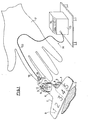
- Fig. 1 schematically shows a first embodiment of the invention in which a label 1 which is in fact an ear button, is more specifically intended for the identification of an animal.
- the ear button shown by way of example is that described in French patent application No. 80 16 663 filed on July 29, 1980 in the name of governmental specimen Rockall France SA It will therefore not be described in detail as regards is parties not directly concerned by the invention.
- This ear button comprises a plate 2 provided with a lug 3 with which the male element 4 of a fixing device has come, comprising moreover a female element 5 which has come in one piece with the lug 6 of a second ear button plate 7.
- This second plate has a clear identification zone 8 in which is written a number for example, identifying the object for the user or more precisely the animal for the breeder.
- the label has another identification zone 9 which is not intelligible directly to the user.
- the female element 5 of the label fixing device is in the form of a hollow cylindrical lug closed at its free end by a relatively thick bottom 10.
- the latter can be an integrated circuit and its electronic function can be that of a permanent or random access memory or else of a complete microprocessor. It is provided with contact pads 13 for the transfer of data signals.
- the following type can be used for the integrated circuit 12: Programmable memory with fuses deposited on a substrate, manufactured for example by the company SOREP, 35220 CHATEAUBOURG.
- FIG. 1 gives a schematic representation.
- This apparatus comprises an information use device 15 preferably produced in the form of a mobile unit and provided with a display screen 16 on which the information normally not accessible by the user can be displayed.
- an information use device 15 preferably produced in the form of a mobile unit and provided with a display screen 16 on which the information normally not accessible by the user can be displayed.
- any other information processing device could be suitable.
- a data entry keyboard (not shown) can also be provided.
- This user device 15 can be connected to the integrated circuit 12 of the label by communication means which, in the present embodiment comprise a glove 17, the index finger 18 of which is provided at its free end with a contact member 19 connected by a cable 20 to the information processing device 15.
- communication means which, in the present embodiment comprise a glove 17, the index finger 18 of which is provided at its free end with a contact member 19 connected by a cable 20 to the information processing device 15.
- the contact member 19 comprises contact pads 21, the number and arrangement of which correspond to those of the semiconductor circuit 12. Its dimensions are adapted to those of the cavity 11 so that they can easily be inserted therein and positioned for carrying out the communication between the integrated circuit 12 and the device for using the information 15.
- this contact member may itself be provided with an electronic circuit (amplifier, impedance adapter, registers, etc.) to facilitate data transfer. It should be noted that the circulation of data can be ensured in both directions between the integrated circuit 12 and the device for using the information 15.
- the data can be introduced into the integrated circuit 12 or be extracted therefrom by application of the contact member 19 on the integrated circuit 12. It will be appreciated that this operation poses no problem since it suffices to pinch the lug 5 between the thumb and index finger using the glove 17.
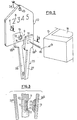
- Figs. 2 and 3 show another embodiment of the invention in which the label is a simple plate 22 provided with a hole 23 for the passage of a link 24.
- This label which can therefore easily be attached to any object presents an identification area in clear 8 and an identification area 9 with information that cannot be directly understood.
- this second zone 9 is provided a cavity 11 in which the integrated circuit 12 is arranged.
- the communication means comprise a tool in the form of a clamp 25 at the ends of the branches 26 and 27 from which lugs 28a and 28b are provided.
- the tab 28b carries the contact member 19 on its inner face.
- the invention provides an object identification label making it possible, by the storage capacity of the integrated circuit 12, to store a large amount of information relating to this object, while allowing, by the associated apparatus, a clear formatting, com mode of information not intelligible from the label only when it is needed. This is particularly suitable for the identification of livestock where, only the veterinary services having such an apparatus, fraud is practically impossible.
- the semiconductor memory makes it possible to store and update all the events occurring during the life of the animal such as the conditions of birth, the veterinary treatments undergone, the history, etc. All this information can easily be placed in a central file using the equipment described above.
Landscapes
- Engineering & Computer Science (AREA)
- Life Sciences & Earth Sciences (AREA)
- Environmental Sciences (AREA)
- General Physics & Mathematics (AREA)
- Physics & Mathematics (AREA)
- Theoretical Computer Science (AREA)
- Zoology (AREA)
- Microelectronics & Electronic Packaging (AREA)
- Birds (AREA)
- Computer Hardware Design (AREA)
- Animal Husbandry (AREA)
- Biodiversity & Conservation Biology (AREA)
- Computer Vision & Pattern Recognition (AREA)
- Artificial Intelligence (AREA)
- Storage Device Security (AREA)
- Credit Cards Or The Like (AREA)
- Labeling Devices (AREA)
- Near-Field Transmission Systems (AREA)
Description
- La présente invention est relative à une étiquette d'identification d'un objet, notamment à un bouton d'oreille pour marquer le bétail, du type comprenant un élément de support d'information et des moyens pour attacher cet élément à l'objet à identifier, l'élément support présentant une zone d'information destinée à recevoir des données en clair sur l'objet ainsi qu'une zone porteuse d'informations non intelligibles directement par des personnes non autorisées.
- D'après le FR-A-2 438 420, on connaît déjà des étiquettes de ce genre dont la zone porteuse d'informations inintelligibles est adaptée pour recevoir des données se présentant sous diverses formes. Par exemple, certaines étiquettes ont un bord spécialement profilé par des encoches de différentes profondeurs auxquelles une valeur particulière est affectée. Une telle étiquette est préparée et lue à l'aide d'appareillages spéciaux à la disposition des personnes autorisées qui, lorsqu'il s'agit de l'identification du bétail peuvent être les services vétérinaires, par exemple. D'autres étiquettes sont pourvues de trous disposés selon un réseau donné à la manière des cartes perforées. D'autres étiquettes encore comportent des pistes magnétiques sur lesquelles les informations sont enregistrées.
- Ces étiquettes antérieures ont l'inconvénient d'être limitées en ce qui concerne la quantité d'informations que l'on peut y enregistrer et les possibilités de traitement des informations recueillies. Or, en particulier dans le cas du bétail, il est souhaitable souvent de connaître facilement et rapidement un grand nombre de données concernant un animal, telles que par exemple, son âge, son origine, sa race, ses antécédents vétérinaires, les médicaments administrés, le régime alimentaire auquel il est soumis, etc.
- On connaît également d'après le document US-A-3 788 278, un appareil et un procédé d'identification d'une étiquette comportant une zone porteuse d'informations codées, fixées sur le dos d'un animal. Ce procédé et ce dispositif nécessitent d'amener l'animal à un poste fixe et de le maintenir en position pour une identification automatique et sont limités à des animaux à peau dure (cuirs), c'est-à-dire aux bovidés, en raison de la nature de l'étiquette. Ce document conduit à la réalisation d'un dispositif complexe encombrant et rigide, totalement dépendant du comportement de l'animal. En effet, le maintien de la tête de lecture avec la zone porteuse d'informations codées nécessite un contact durable pendant un mouvement relatif de ces deux éléments ne permettant pas d'imaginer son utilisation sur le terrain. Un tel principe entraîne également une limitation des possibilités de communication (lecture et écriture) qui limite les informations codées, au poids ou à des mesures de l'animal.
- Par ailleurs, on connaît d'après la demande de brevet européen EP-A-0011810 un système de reconnaissance à distance d'un mobile porteur d'un dispositif répondeur codé, ce mobile étant une vache dans un cas particulier décrit à titre d'exemple. Ce système comporte un poste fixe émettant par une self un rayonnement électromagnétique codé. Ce rayonnement ne peut être détecté par le dispositif répondeur porté par l'animal que si celui-ci se rapproche suffisamment du poste émetteur, moyennant quoi le numéro de la vache est reconnu. Ceci peut déclencher une action prédéterminée telle que la commande d'une mangeoire dans laquelle est alors déversée une ration de nourriture adaptée aux conditions physiologiques de l'animal en question.
- Dans ce cas, la communication entre dispositif répondeur et poste émetteur a donc essentiellement pour but de transmettre un numéro ou une commande, tandis que les données de l'ensemble du cheptel sont contenues dans le poste central.
- Par conséquent, les données relatives à un individu particulier du cheptel ne se trouvent pas contenues dans le collier de l'animal. Ceci présente, outre la faible quantité d'informations que l'on peut affecter individuellement à chaque animal, un inconvénient majeur qui consiste en ce que les données ne peuvent être prélevées que si l'animal se trouve près du poste émetteur, c'est-à-dire le plus souvent dans l'étable de l'éleveur. Or, il est fréquent que les animaux doivent être transférés d'un endroit à un autre, par exemple.
- L'invention a pour but de remédier à ces inconvénients et de fournir une étiquette permettant l'enregistrement et la restitution rapides de toutes sortes d'informations concernant l'objet à identifier et notamment dans le cas des animaux d'augmenter considérablement la quantité d'informations pouvant être associée à chaque animal.
- A cet effet, l'invention a pour objet un appareillage pour l'identification d'objets notamment d'animaux sur le terrain, comportant une étiquette d'identification notamment un bouton d'oreille pour marquer le bétail, du type comprenant un élément support d'informations et des moyens pour attacher cet élément à l'animal à identifier, l'élément support présentant une zone d'informations destinée à recevoir des données en clair sur l'animal ainsi qu'une zone porteuse d'informations non intelligibles directement par des personnes non autorisées, un dispositif d'utilisation sous une forme en clair des informations non intelligibles directement et qui sont portées par l'étiquette à l'aide d'un moyen d'enregistrement, un dispositif de communication entre l'étiquette d'identification et le dispositif d'utilisation des informations non intelligibles directement, ledit élément support comprenant des moyens de réception et de guidage d'un organe de contact porté par le dispositif de communication, l'appareillage comportant en outre des moyens d'alignement de l'organe de contact avec la zone porteuse d'informations non intelligibles directement, caractérisé en ce que le dispositif de communication est portatif, en ce que la zone porteuse d'informations non intelligibles directement par des personnes non autorisées comporte une cavité formée dans l'élément support d'informations dans laquelle est disposé ledit moyen d'enregistrement qui est constitué de moyens électroniques sous forme d'un circuit se- mi-conducteur permettant la mémorisation et la lecture des informations non intelligibles directement relatives à l'animal, et en ce que lesdits moyens de réception et de guidage de l'organe de contact et lesdits moyens d'alignement sont constitués par la cavité elle-même qui est dimensionnée en conséquence.
- Grâce à cet appareillage, on obtient une souplesse considérable dans les possibilités d'identification, en faisant usage des techniques modernes de traitement de l'information, notamment par ordinateur.
- L'invention sera mieux comprise à l'aide de la description qui va suivre, donnée uniquement à titre d'exemple et faite en se référant aux dessins annexés, sur lesquels:
- - la Fig. 1 est une vue en perspective schématique d'une étiquette suivant l'invention et de l'appareillage permettant de l'utiliser;
- - la Fig. 2 montre également en perspective schématique, un autre mode de réalisation de l'invention; et
- - la Fig. 3 est une vue en coupe partielle, prise selon la ligne 3-3 de la Fig. 2.
- La Fig. 1 montre schématiquement un premier mode de réalisation de l'invention dans lequel une étiquette 1 qui est en fait un bouton d'oreille, est plus spécialement destiné à l'identification d'un animal. Le bouton d'oreille représenté à titre d'exemple est celui décrit dans la demande de brevet français n° 80 16 663 déposée le 29 Juillet 1980 au nom de la Société Nouvelle Rockall France S.A. Il ne sera donc pas décrit en détail pour ce qui est des parties non directement concernées par l'invention.
- Ce bouton d'oreille comporte une plaquette 2 munie d'une patte 3 avec laquelle est venu de matière l'élément mâle 4 d'un dispositif de fixation comprenant par ailleurs un élément femelle 5 venu de matière avec la patte 6 d'une seconde plaquette 7 du bouton d'oreille. Cette seconde plaquette présente une zone 8 d'identification en clair dans laquelle est inscrit un numéro par exemple, identifiant l'objet pour l'utilisateur ou plus précisément l'animal pour l'éleveur. Lorsque le bouton d'oreille est mis en place, une partie de l'oreille de l'animal est serrée entre les plaquettes 2 et 7.
- L'étiquette présente une autre zone 9 d'identification non intelligible directement pour l'utilisateur. Comme on peut le constater, l'élément femelle 5 du dispositif de fixation de l'étiquette se présente sous la forme d'un ergot cylindrique creux fermé à son extrémité libre par un fond 10 relativement épais. Dans ce fond est ménagée une cavité 11 de forme rectangulaire et destinée à constituer un logement pour un circuit semi-conducteur 12. Ce dernier peut être un circuit intégré et sa fonction électronique peut être celle d'une mémoire permanente ou à accès aléatoire ou encore d'un microprocesseur complet. Il est pourvu de plots de contact 13 pour le transfert des signaux de données. A titre indicatif, on peut utiliser pour le circuit intégré 12, le type suivant: Mémoire programmable à fusibles déposée sur un substrat, fabriquée par exemple par la Société SOREP, 35220 CHATEAUBOURG.
- L'étiquette ou bouton d'oreille que l'on vient de décrire est avantageusement utilisé avec un appareillage 14 dont la Fig. 1 donne une représentation schématique. Cet appareillage comporte un dispositif d'utilisation de l'information 15 réalisé de préférence sous la forme d'une unité mobile et pourvue d'un écran d'affichage 16 sur lequel les informations normalement non accessibles par l'utilisateur peuvent être affichées. Naturellement, tout autre dispositif de traitement d'informations pourrait convenir. Un clavier d'introduction de données (non représenté) peut également être prévu.
- Ce dispositif d'utilisation 15 peut être relié au circuit intégré 12 de l'étiquette par des moyens de communication qui, dans le présent mode de réalisation comportent un gant 17 dont le doigt d'index 18 est pourvu à son extrémité libre d'un organe de contact 19 branché par un câble 20 au dispositif de traitement de l'information 15.
- L'organe de contact 19 comporte des plots de contact 21 dont le nombre et la disposition correspondent à ceux du circuit semi-conducteur 12. Ses dimensions sont adaptées à celles de la cavité 11 pour qu'ils puissent facilement y être introduits et positionnés pour la réalisation de la communication entre le circuit intégré 12 et le dispositif d'utilisation de l'information 15. En outre, cet organe de contact peut lui-même être pourvu d'un circuit électronique (amplificateur, adapteur d'impédance, registres, etc.) pour faciliter le transfert des données. Il est à noter que la circulation des données peut être assurée dans les deux sens entre le circuit intégré 12 et le dispositif d'utilisation de l'information 15.
- Les données peuvent être introduites dans le circuit intégré 12 ou en être extraites par application de l'organe de contact 19 sur le circuit intégré 12. On conçoit que cette opération ne pose aucun problème puisqu'il suffit de pincer l'ergot 5 entre le pouce et l'index à l'aide du gant 17.
- Les Fig. 2 et 3 montrent un autre mode de réalisation de l'invention dans lequel l'étiquette est une simple plaquette 22 munie d'un trou 23 pour le passage d'un lien 24. Cette étiquette qui peut donc facilement être attachée à un objet quelconque présente une zone d'identification en clair 8 et une zone d'identification 9 avec des informations non intelligibles directement. Dans cette deuxième zone 9 est ménagée une cavité 11 dans laquelle est disposé le circuit intégré 12.
- Dans ce cas, les moyens de communication comprennent un outil en forme de pince 25 aux extrémités des branches 26 et 27 de laquelle sont prévue des pattes 28a et 28b. La patte 28b porte l'organe de contact 19 sur sa face intérieure.
- On voit donc que l'invention fournit une étiquette d'identification d'objets permettant, par la capacité de mémorisation du circuit intégré 12, de mémoriser une grande quantité d'informations relatives à cet objet, tout en permettant par l'appareillage associé une mise sous forme claire, commode de l'information non intelligible de l'étiquette seulement au moment où on en a besoin. Ceci est particulièrement adapté pour l'identification du bétail où, seuls les services vétérinaires disposant d'un tel appareillage, les fraudes sont pratiquement impossibles. Par ailleurs, la mémoire semi-conductrice permet de stocker et de mettre à jour tous les événements survenant au cours de la vie de l'animal tels que les conditions de naissance, les traitements vétérinaires subis, les antécédents, etc. Toutes ces informations peuvent facilement être mises sur fichier central à l'aide de l'appareillage décrit ci-dessus.
Claims (6)
Applications Claiming Priority (2)
| Application Number | Priority Date | Filing Date | Title |
|---|---|---|---|
| FR8118862 | 1981-10-07 | ||
| FR8118862A FR2514179A1 (fr) | 1981-10-07 | 1981-10-07 | Etiquette d'identification d'objets et appareillage pour son utilisation |
Publications (2)
| Publication Number | Publication Date |
|---|---|
| EP0077707A1 EP0077707A1 (fr) | 1983-04-27 |
| EP0077707B1 true EP0077707B1 (fr) | 1987-05-13 |
Family
ID=9262823
Family Applications (1)
| Application Number | Title | Priority Date | Filing Date |
|---|---|---|---|
| EP82401822A Expired EP0077707B1 (fr) | 1981-10-07 | 1982-10-05 | Appareillage d'identification d'objets |
Country Status (10)
| Country | Link |
|---|---|
| US (1) | US4535557A (fr) |
| EP (1) | EP0077707B1 (fr) |
| AU (1) | AU550963B2 (fr) |
| CA (1) | CA1206753A (fr) |
| DE (1) | DE3276293D1 (fr) |
| ES (1) | ES516737A0 (fr) |
| FR (1) | FR2514179A1 (fr) |
| IE (1) | IE53359B1 (fr) |
| NZ (1) | NZ202101A (fr) |
| ZA (1) | ZA827292B (fr) |
Families Citing this family (27)
| Publication number | Priority date | Publication date | Assignee | Title |
|---|---|---|---|---|
| FR2552588B1 (fr) * | 1983-09-23 | 1985-12-06 | Alain Sa | Dispositif de connexion electrique automatique pour le branchement rapide et fugitif de circuits electroniques |
| NZ210422A (en) * | 1984-12-04 | 1988-09-29 | Rockall France Sa Ste Nle | Plunger depressed contacts connect with concentric conductive rings |
| US4763928A (en) * | 1985-09-23 | 1988-08-16 | Equipment Identification Systems, Inc. | Method and apparatus for theft identification of equipment |
| US4742215A (en) * | 1986-05-07 | 1988-05-03 | Personal Computer Card Corporation | IC card system |
| US4975647A (en) * | 1987-06-01 | 1990-12-04 | Nova Biomedical Corporation | Controlling machine operation with respect to consumable accessory units |
| US4785563A (en) * | 1987-07-27 | 1988-11-22 | Otto Friedman | Animal tag microfiche indentification system |
| FR2620546B1 (fr) * | 1987-09-11 | 1991-11-15 | Hadjadj Jacques | Procede de gestion d'informations relatives a un label de qualite d'une piece de viande d'un animal, et dispositif pour la mise en oeuvre de ce procede |
| DK0407853T3 (da) * | 1989-07-11 | 1995-03-27 | Caisley Gmbh | Øremærke til dyr |
| GB8915879D0 (en) * | 1989-07-11 | 1989-08-31 | Caisley Gmbh | Ear tag |
| NL9000263A (nl) * | 1990-02-02 | 1991-09-02 | Thermopatch Bv | Werkwijze voor het tijdelijk merken van textiel met behulp van chips en chip ten gebruike bij de werkwijze. |
| NZ233489A (en) * | 1990-04-30 | 1995-03-28 | Dairying Research Corp Ltd Sub | Identifying tag attached to article: reading circuit completed through ground |
| FR2669140B1 (fr) * | 1990-11-12 | 1993-02-19 | Alliaume Pierre | Etiquette d'identification d'un animal notamment d'un bovin. |
| US5607187A (en) * | 1991-10-09 | 1997-03-04 | Kiwisoft Programs Limited | Method of identifying a plurality of labels having data fields within a machine readable border |
| NZ240172A (en) * | 1991-10-09 | 1996-05-28 | Kiwisoft Programs Ltd | Computerised detection and identification of multiple labels in a field of view |
| ES2070038B1 (es) * | 1992-09-22 | 1997-04-16 | Tribo Miguel Utge | Sistema de identificacion, manejo, control y gestion de datos para una explotacion ganadera. |
| US6019394A (en) * | 1994-04-28 | 2000-02-01 | Ncr Corporation | Multiple function interactive product label |
| GB9422082D0 (en) * | 1994-11-02 | 1994-12-21 | Zeneca Ltd | Reservoirs and delivery devices |
| FR2761790B1 (fr) * | 1997-04-02 | 1999-05-28 | Gerard Michot | Dispositif pour lire une puce electronique d'identification implantee sous la peau d'un animal |
| US6297727B1 (en) | 1997-05-05 | 2001-10-02 | George N. Nelson, Jr. | Transponder identification and record assembly |
| US6109529A (en) * | 1997-05-06 | 2000-08-29 | Nelson, Jr.; George N. | Bar code identification and record assembly |
| FR2768836B1 (fr) * | 1997-06-11 | 2000-06-16 | Reydet Finance | Dispositif d'identification et procede de fabrication du dispositif associe |
| FR2774194A1 (fr) * | 1998-01-27 | 1999-07-30 | Scm Schneider Microsysteme Mic | Dispositif de liaison entre au moins une carte a puce, un lecteur et l'hote |
| US6698119B2 (en) | 2001-01-11 | 2004-03-02 | Farnam Companies, Inc. | Decorated ear tags for domestic animals and method of making same |
| ES2178964B1 (es) * | 2001-04-24 | 2004-04-01 | Signe, S.A. | Crotal perfeccionado. |
| FR2857031A1 (fr) * | 2003-02-11 | 2005-01-07 | Patrick Chanudet | Dispositif d'identification d'objets divers |
| DE102005018402B4 (de) * | 2005-04-20 | 2009-10-01 | Gea Westfaliasurge Gmbh | Diagnoseverfahren sowie Diagnoseeinrichtung für ein Tieridentifikationssystem, insbesondere ein Tieridentifikationssystem einer Melkanlage und Melkanlage mit einem Tieridentifikationssystem |
| USD1025802S1 (en) * | 2020-11-17 | 2024-05-07 | Allflex Uk Group Ltd | UHF RFID tag |
Citations (1)
| Publication number | Priority date | Publication date | Assignee | Title |
|---|---|---|---|---|
| US3788278A (en) * | 1972-08-10 | 1974-01-29 | Miller H Res Corp | Animal marking apparatus and method |
Family Cites Families (9)
| Publication number | Priority date | Publication date | Assignee | Title |
|---|---|---|---|---|
| US3621206A (en) * | 1969-08-21 | 1971-11-16 | Pitney Bowes Inc | Label-aligning system |
| US3952438A (en) * | 1971-07-06 | 1976-04-27 | Herman Miller, Inc. | Animal marking apparatus |
| US3786391A (en) * | 1972-07-11 | 1974-01-15 | W Mathauser | Magnetic self-aligning electrical connector |
| IE42176B1 (en) * | 1974-11-19 | 1980-06-18 | Dalton Rototag Ltd | Improvements in or relating to eartags |
| US4004133A (en) * | 1974-12-30 | 1977-01-18 | Rca Corporation | Credit card containing electronic circuit |
| FR2438420A1 (fr) * | 1978-10-12 | 1980-05-09 | Porcher Alain | Procede d'identification d'animaux ou d'objets et moyens pour sa mise en oeuvre |
| FR2442452A1 (fr) * | 1978-11-27 | 1980-06-20 | Alsthom Cgee | Dispositif de reconnaissance a distance d'un mobile porteur d'un dispositif repondeur code |
| DE2920012C2 (de) * | 1979-05-17 | 1988-09-29 | GAO Gesellschaft für Automation und Organisation mbH, 8000 München | Ausweiskarte mit IC-Baustein und Verfahren zur Herstellung einer derartigen Ausweiskarte |
| US4288856A (en) * | 1979-12-14 | 1981-09-08 | Linseth Gerald S | Livestock feedlot management method and apparatus |
-
1981
- 1981-10-07 FR FR8118862A patent/FR2514179A1/fr active Granted
-
1982
- 1982-02-23 US US06/351,366 patent/US4535557A/en not_active Expired - Fee Related
- 1982-10-05 DE DE8282401822T patent/DE3276293D1/de not_active Expired
- 1982-10-05 EP EP82401822A patent/EP0077707B1/fr not_active Expired
- 1982-10-05 IE IE2403/82A patent/IE53359B1/en not_active IP Right Cessation
- 1982-10-05 ES ES516737A patent/ES516737A0/es active Granted
- 1982-10-05 AU AU89122/82A patent/AU550963B2/en not_active Ceased
- 1982-10-05 ZA ZA827292A patent/ZA827292B/xx unknown
- 1982-10-06 NZ NZ202101A patent/NZ202101A/en unknown
- 1982-10-06 CA CA000412910A patent/CA1206753A/fr not_active Expired
Patent Citations (1)
| Publication number | Priority date | Publication date | Assignee | Title |
|---|---|---|---|---|
| US3788278A (en) * | 1972-08-10 | 1974-01-29 | Miller H Res Corp | Animal marking apparatus and method |
Also Published As
| Publication number | Publication date |
|---|---|
| FR2514179B1 (fr) | 1984-10-12 |
| US4535557A (en) | 1985-08-20 |
| ZA827292B (en) | 1983-08-31 |
| AU550963B2 (en) | 1986-04-10 |
| FR2514179A1 (fr) | 1983-04-08 |
| IE822403L (en) | 1983-04-07 |
| NZ202101A (en) | 1985-08-16 |
| CA1206753A (fr) | 1986-07-02 |
| ES8307402A1 (es) | 1983-07-01 |
| DE3276293D1 (en) | 1987-06-19 |
| IE53359B1 (en) | 1988-10-26 |
| EP0077707A1 (fr) | 1983-04-27 |
| ES516737A0 (es) | 1983-07-01 |
| AU8912282A (en) | 1983-04-14 |
Similar Documents
| Publication | Publication Date | Title |
|---|---|---|
| EP0077707A1 (fr) | Appareillage d'identification d'objets | |
| US5036610A (en) | Pet locator system and method | |
| US5878116A (en) | Method of locating a lost pet, person or object | |
| FR3095056A1 (fr) | Affichage sur un écran de smartphone d’un motif de positionnement d’une carte sans contact pour améliorer la communication en champ proche | |
| FR2685785A1 (fr) | Dispositif et procede d'identification d'une personne ou d'un objet. | |
| FR2600804A1 (fr) | Etui support de carte d'identification | |
| EP1736950A4 (fr) | Dispositif de traçage de carte, dispositif de navigation, méthode de mise à jour de fichier, programme de mise à jour de fichier et support d'enregistrement d'information sur lequel le programme de mise à jour de fichier est enregistré | |
| EP3729383B1 (fr) | Agrégateur de dispositifs d'identification | |
| EP0010486B1 (fr) | Etiquette d'identification pour oreilles d'animaux | |
| NO20005086D0 (no) | FremgangsmÕte for Õ lagre en identifikasjon pÕ en registreringsbærer, anordning og registreringsbærer | |
| FR2836251B1 (fr) | Dispositif et procede de securisation de donnees sensibles, notamment entre deux parties via un organisme tiers | |
| EP1181660A1 (fr) | Dispositif evolutif d'identification et tra abilite du sejour d'un malade dans un etablissement de soins | |
| EP1588609A2 (fr) | Procédé et set pour l'identification d'animaux | |
| CN109566463B (zh) | 一种具有防伪溯源的鸡牌及防伪方法 | |
| FR2771199A1 (fr) | Carte portable et systeme d'exploitation d'une telle carte | |
| KR100964292B1 (ko) | 동물용 이표 | |
| FR2713371A1 (fr) | Installation de gestion de données pour identifier des enfants perdus. | |
| FR2823898A1 (fr) | Griffe tissee d'identification puce integree de tracabilite avec interrogation a distance pour vetements ou analogues | |
| WO2001099058A1 (fr) | Etiquette electronique et systeme d'assistance a l'archivage d'articles utilisant de telles etiquettes | |
| FR2669140A1 (fr) | Etiquette d'identification d'un animal notamment d'un bovin. | |
| JP2021000025A (ja) | 動物用個体識別部材、動物情報管理システム、及び、動物情報管理方法 | |
| KR200367056Y1 (ko) | 바코드가 부착된 사용자 인식장치 | |
| JPWO2020044867A1 (ja) | 動物用個体識別部材、及び、動物情報管理システム | |
| EP1246138A1 (fr) | Dispositif pour l'identification et la prise de rang de personnes dans une file d'attente | |
| FR2857031A1 (fr) | Dispositif d'identification d'objets divers |
Legal Events
| Date | Code | Title | Description |
|---|---|---|---|
| PUAI | Public reference made under article 153(3) epc to a published international application that has entered the european phase |
Free format text: ORIGINAL CODE: 0009012 |
|
| AK | Designated contracting states |
Designated state(s): BE CH DE GB IT LI LU NL |
|
| 17P | Request for examination filed |
Effective date: 19831027 |
|
| ITF | It: translation for a ep patent filed | ||
| GRAA | (expected) grant |
Free format text: ORIGINAL CODE: 0009210 |
|
| AK | Designated contracting states |
Kind code of ref document: B1 Designated state(s): BE CH DE GB IT LI LU NL |
|
| REF | Corresponds to: |
Ref document number: 3276293 Country of ref document: DE Date of ref document: 19870619 |
|
| PLBE | No opposition filed within time limit |
Free format text: ORIGINAL CODE: 0009261 |
|
| STAA | Information on the status of an ep patent application or granted ep patent |
Free format text: STATUS: NO OPPOSITION FILED WITHIN TIME LIMIT |
|
| 26N | No opposition filed | ||
| ITTA | It: last paid annual fee | ||
| PGFP | Annual fee paid to national office [announced via postgrant information from national office to epo] |
Ref country code: GB Payment date: 19921005 Year of fee payment: 11 |
|
| PGFP | Annual fee paid to national office [announced via postgrant information from national office to epo] |
Ref country code: CH Payment date: 19921026 Year of fee payment: 11 |
|
| PGFP | Annual fee paid to national office [announced via postgrant information from national office to epo] |
Ref country code: BE Payment date: 19921028 Year of fee payment: 11 |
|
| PGFP | Annual fee paid to national office [announced via postgrant information from national office to epo] |
Ref country code: NL Payment date: 19921031 Year of fee payment: 11 |
|
| PGFP | Annual fee paid to national office [announced via postgrant information from national office to epo] |
Ref country code: LU Payment date: 19921103 Year of fee payment: 11 |
|
| EPTA | Lu: last paid annual fee | ||
| PG25 | Lapsed in a contracting state [announced via postgrant information from national office to epo] |
Ref country code: LU Free format text: LAPSE BECAUSE OF NON-PAYMENT OF DUE FEES Effective date: 19931005 Ref country code: GB Effective date: 19931005 |
|
| PG25 | Lapsed in a contracting state [announced via postgrant information from national office to epo] |
Ref country code: LI Effective date: 19931031 Ref country code: CH Effective date: 19931031 Ref country code: BE Effective date: 19931031 |
|
| PGFP | Annual fee paid to national office [announced via postgrant information from national office to epo] |
Ref country code: DE Payment date: 19940428 Year of fee payment: 12 |
|
| BERE | Be: lapsed |
Owner name: SOC. NOUVELLE ROCKALL FRANCE S.A. Effective date: 19931031 |
|
| PG25 | Lapsed in a contracting state [announced via postgrant information from national office to epo] |
Ref country code: NL Effective date: 19940501 |
|
| GBPC | Gb: european patent ceased through non-payment of renewal fee |
Effective date: 19931005 |
|
| NLV4 | Nl: lapsed or anulled due to non-payment of the annual fee | ||
| REG | Reference to a national code |
Ref country code: CH Ref legal event code: PL |
|
| PG25 | Lapsed in a contracting state [announced via postgrant information from national office to epo] |
Ref country code: DE Effective date: 19950701 |