EP0077896B1 - Theophylline derivatives, antibodies and their preparation from theophylline immunogens, as well as an immuno assay method and reagent means for determining theophylline - Google Patents
Theophylline derivatives, antibodies and their preparation from theophylline immunogens, as well as an immuno assay method and reagent means for determining theophylline Download PDFInfo
- Publication number
- EP0077896B1 EP0077896B1 EP82107414A EP82107414A EP0077896B1 EP 0077896 B1 EP0077896 B1 EP 0077896B1 EP 82107414 A EP82107414 A EP 82107414A EP 82107414 A EP82107414 A EP 82107414A EP 0077896 B1 EP0077896 B1 EP 0077896B1
- Authority
- EP
- European Patent Office
- Prior art keywords
- theophylline
- derivatives
- antibodies
- reagent
- immunogen
- Prior art date
- Legal status (The legal status is an assumption and is not a legal conclusion. Google has not performed a legal analysis and makes no representation as to the accuracy of the status listed.)
- Expired
Links
Classifications
-
- C—CHEMISTRY; METALLURGY
- C07—ORGANIC CHEMISTRY
- C07D—HETEROCYCLIC COMPOUNDS
- C07D473/00—Heterocyclic compounds containing purine ring systems
- C07D473/02—Heterocyclic compounds containing purine ring systems with oxygen, sulphur, or nitrogen atoms directly attached in positions 2 and 6
- C07D473/04—Heterocyclic compounds containing purine ring systems with oxygen, sulphur, or nitrogen atoms directly attached in positions 2 and 6 two oxygen atoms
- C07D473/06—Heterocyclic compounds containing purine ring systems with oxygen, sulphur, or nitrogen atoms directly attached in positions 2 and 6 two oxygen atoms with radicals containing only hydrogen and carbon atoms, attached in position 1 or 3
- C07D473/08—Heterocyclic compounds containing purine ring systems with oxygen, sulphur, or nitrogen atoms directly attached in positions 2 and 6 two oxygen atoms with radicals containing only hydrogen and carbon atoms, attached in position 1 or 3 with methyl radicals in positions 1 and 3, e.g. theophylline
-
- C—CHEMISTRY; METALLURGY
- C07—ORGANIC CHEMISTRY
- C07K—PEPTIDES
- C07K16/00—Immunoglobulins [IG], e.g. monoclonal or polyclonal antibodies
-
- C—CHEMISTRY; METALLURGY
- C07—ORGANIC CHEMISTRY
- C07K—PEPTIDES
- C07K16/00—Immunoglobulins [IG], e.g. monoclonal or polyclonal antibodies
- C07K16/18—Immunoglobulins [IG], e.g. monoclonal or polyclonal antibodies against material from animals or humans
-
- G—PHYSICS
- G01—MEASURING; TESTING
- G01N—INVESTIGATING OR ANALYSING MATERIALS BY DETERMINING THEIR CHEMICAL OR PHYSICAL PROPERTIES
- G01N33/00—Investigating or analysing materials by specific methods not covered by groups G01N1/00 - G01N31/00
- G01N33/48—Biological material, e.g. blood, urine; Haemocytometers
- G01N33/50—Chemical analysis of biological material, e.g. blood, urine; Testing involving biospecific ligand binding methods; Immunological testing
- G01N33/94—Chemical analysis of biological material, e.g. blood, urine; Testing involving biospecific ligand binding methods; Immunological testing involving narcotics or drugs or pharmaceuticals, neurotransmitters or associated receptors
-
- A—HUMAN NECESSITIES
- A61—MEDICAL OR VETERINARY SCIENCE; HYGIENE
- A61K—PREPARATIONS FOR MEDICAL, DENTAL OR TOILETRY PURPOSES
- A61K39/00—Medicinal preparations containing antigens or antibodies
- A61K2039/60—Medicinal preparations containing antigens or antibodies characteristics by the carrier linked to the antigen
- A61K2039/6031—Proteins
-
- A—HUMAN NECESSITIES
- A61—MEDICAL OR VETERINARY SCIENCE; HYGIENE
- A61K—PREPARATIONS FOR MEDICAL, DENTAL OR TOILETRY PURPOSES
- A61K39/00—Medicinal preparations containing antigens or antibodies
- A61K2039/60—Medicinal preparations containing antigens or antibodies characteristics by the carrier linked to the antigen
- A61K2039/6087—Polysaccharides; Lipopolysaccharides [LPS]
-
- Y—GENERAL TAGGING OF NEW TECHNOLOGICAL DEVELOPMENTS; GENERAL TAGGING OF CROSS-SECTIONAL TECHNOLOGIES SPANNING OVER SEVERAL SECTIONS OF THE IPC; TECHNICAL SUBJECTS COVERED BY FORMER USPC CROSS-REFERENCE ART COLLECTIONS [XRACs] AND DIGESTS
- Y10—TECHNICAL SUBJECTS COVERED BY FORMER USPC
- Y10S—TECHNICAL SUBJECTS COVERED BY FORMER USPC CROSS-REFERENCE ART COLLECTIONS [XRACs] AND DIGESTS
- Y10S435/00—Chemistry: molecular biology and microbiology
- Y10S435/961—Chemistry: molecular biology and microbiology including a step of forming, releasing, or exposing the antigen or forming the hapten-immunogenic carrier complex or the antigen per se
Definitions
- This invention relates to novel theophylline derivatives pertaining to immunoassays for determining theophylline in liquid media such as biological fluids.
- Such derivatives include theophylline immunogens used to stimulate production of antibodies to theophylline in host animals by conventional techniques.
- Theophylline [1,3-dimethylxanthine, cf. The Merck Index, 9th ed., p. 1196 (1976)] is a drug of great value in the management of asthmatic patients.
- the drug is used prophylactically, as an adjunct in the treatment of prolonged asthmatic attacks and in the management of status asthmaticus [Goodman and Gilman, The Pharmacological Basis of Therapeutics, 5th ed., MacMillan (New York 1975) p. 375].
- proper dosage administration is critical. Frequent testing of serum or plasma concentrations assists in maintaining therapeutic levels and avoiding toxic levels.
- the determination of theophylline by immunoassay is well known.
- Commercial test kits are available for measuring serum and plasma theophylline levels by radioimmunoassay, enzyme immunoassay, and substrate-labeled fluorescent immunoassay.
- Radioimmunoassays for determining theophylline are described by Cook etal, Res. Commun. Chem. Path. Pharm. 13:497 (1976), Nishikawa et al, Chem. Pharm. Bull. 27:893 (1979), and DE-A-2,901,281.
- Reagents for use in an enzyme immunoassay for determining theophylline are described in US-A-4,230,805.
- SFIA substrate-labeled fluorescent immunoassay
- Theophylline immunogens have been prepared by coupling the drug at various positions on its ring structure to conventional immunogenic carrier materials. Immunogens prepared by derivatization of theophylline at its 8-position are described by Cook et al and Li et al, supra, and in US-A-4,279,992. Derivatization at the 7-position is known from Nishakawa et al supra, and DE-A-2,901,218. US-A-4,230,805 describes the coupling of theophylline at its 3-position.
- the present invention relates to the 9-theophylline immunogens which are used to prepare antibodies to theophylline which have advantageous cross-reactivity characteristics.
- the theophylline antibodies of the present invention cross-react insignificantly with the major theophylline analogs and metabolites present in biological fluids, namely, caffeine (1,3,7-trimethylxanthine), 3-methylxanthine, 1,7-dimethylxanthine, 3,7-dimethylxanthine, and theobromine.
- the present theophylline antibodies possess an unexpectedly extremely low cross-reactivity for the most troublesome potential interferant in biological fluids, caffeine, compared to the antibodies obtained from the known, closely analogous, 7- theophylline and 8-theophylline immunogens, supra.
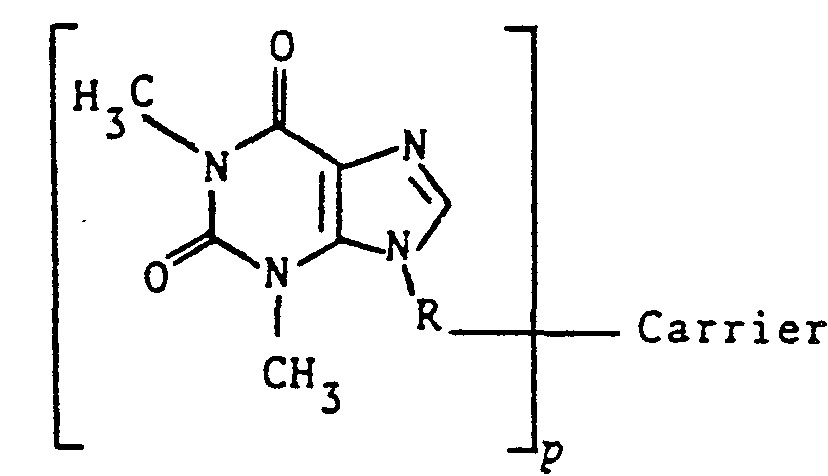
- the present invention refers to 9-Theophylline immunogens of the general formula: wherein R is.a coupling group known in the art which provides a covalent bond between theophylin and the carrier, Carrier is a conventional immunogenic carrier material, and p is the number of theophylline moieties conjugated to the carrier.
- the number p is sometimes referred to as the epitopic density of the immunogen and will be from 1 to 50, more normally from 1 to 25.
- Optimal epitopic densities considering the ease and reproducibility of synthesis of the immunogen and antibody response, fall between 2 and 20, more usually between 5 and 15.
- the immunogenic carrier material can be selected from any of those conventionally known.
- the carrier will be a protein or polypeptide, although other material such as carbohydrates, polysaccharides, lipopolysaccharides or nucleic acids of sufficient size and immunogenicity can likewise be used.
- immunogenic proteins and polypeptides will have molecular weights between 5,000 and 10,000,000, preferably greater than 15,000, and more usually greater than 50,000.
- proteins taken from one animal species will be immunogenic when introduced into the blood stream of another species.
- Particularly useful proteins are albumins, globulins, enzymes, hemocyanins, glutelins, proteins having significant nonproteinaceous constituents, e.g., glycoproteins.
- albumins and globulins of molecular weight between 30,000 and 200,000 are particularly preferred.
- Further reference for the state-of-the-art concerning conventional immunogenic carrier materials and techniques for coupling haptens thereto may be had to the following: Parker, Radioimmunoassay of Biologically Active Compounds, Prentice-Hall (Englewood Cliffs, New Jersey USA, 1976); Butler, J. lmmunol. Meth. 7:1-24 (1975); Weinryb and Shroff, Drug Metab. Rev. 10:271-283 (1975); Broughton and Strong, Clin. Chem. 22:726-732 (1976); and Playfair et al, Br. Med. Bull. 30:24-31 (1974).
- 9-theophylline derivatives are couplable to immunogenic carrier materials according to well known techniques.
- 9-carboxylated theophylline derivatives can be coupled to immunogenic carriers having amino groups by standard peptide bond-forming reactions such as described in Peptides, ed. Goodman and Meienhofer, John Wiley & Sons (New York 1977) p. 6 et seq.
- 9-Thiolated theophylline derivatives can be attached to carriers having thiol groups by_the disulfide interchange reaction [Martin et ⁇ al, Biochem. 20:4229 (1981)].
- a third group can be introduced into one of the reactants and a maleimido group into the other and the two coupled together in a manner similar to that described by Liu et al, Biochem. 18:690 (1979).
- 9-Aminated theophylline derivatives can be coupled to carriers having carboxyl groups by amide bond-forming reactions such as those involving carbodiimides [Aherne et al, Brit. J. Clin. Pharm. 3:561 (1976)], mixed anhydrides [Erlanger et al, Methods in Immunology and Immunochemistry, ed. Williams and Chase, Academic Press (New York 1967) p.
- amino theophylline derivatives can be coupled to carriers having amino groups using conventional bifunctional reagents such as bis-isocyanates, bis-imidoesters, and glutaraldehyde [lmmunochem. 6:53 (1969)]. See also Kopple, supra, and Lowe and Dean, Affinity Chromatography, John Wiley & Sons (New York 1974). A multitude of other coupling techniques are available to those of ordinary skill in the art for joining the various 9-theophylline derivatives of the present invention with conventional immunogenic carrier materials.
- the amide coupling group may be oriented in either of the two possible ways, with the nitrogen atom in the amide group being from carrier amino groups and the carbon atom being from an appropriate theophylline derivative (e.g., a carboxylic acid): with p then representing the average number of coupled amino groups in the carrier (and preferably is as defined above), or with the nitrogen atom being from an appropriate theophylline derivative (e.g., an amino derivative) and the carbon atom being from carrier carboxyl groups: with p then representing the average number of coupled carboxyl groups in the carrier (and preferably is again as defined above).
- an appropriate theophylline derivative e.g., a carboxylic acid
- Preparation of specific antibodies using the present immunogen conjugates may follow any conventional technique. Numerous texts are available describing the fundamental aspects of inducing antibody formation, for example reference may be made to Parker, Radioimmunoassay of Biologically Active Compounds, Prentice-Hall (Englewood Cliffs, New Jersey USA, 1976).
- a host animal such as a rabbit, goat, mouse, guinea pig, or horse is injected at one or more of a variety of sites with the immunogen conjugate, normally in mixture with an adjuvant. Further injections are made at the same site or different sites at regular or irregular intervals thereafter with bleedings being taken to assess antibody titer until it is determined that optimal titer has been reached.
- the host animal is bled to yield a suitable volume of specific antiserum. Where desirable, purification steps may be taken to remove undesired material such as nonspecific antibodies before the antiserum is considered suitable for use in performing actual assays.
- the antibodies can also be obtained by somatic cell hydridization techniques, such antibodies being commonly referred to as monoclonal antibodies. Reviews of such monoclonal antibody techniques are found in Lymphocyte Hybridomas, ed. Melchers et al, Springer-Verlag (New York 1978), Nature 266:495 (1977), and Science 208:692 (1980).
- 2,6-Dioxopurines can exist in two isomeric forms which are known by the trivial names xanthines [3,7-dihydro-1H-purine-2,6-dione (1)] and iso-xanthines [3,9-dihydro-1H-purine-2,6-dione (2)] and are numbered as shown in formula 1.
- the 9-substituted theophylline derivatives and conjugates of the present invention are in fact 9-substituted iso-xanthines.
- Direct alkylation of 1,3-dimethylxanthine [theophylline, (3)] primarily yields W-derivatives, with only small amounts of the N 9- derivatives being formed [Lister, Purines, Wiley, Interscience (New York 1971) pp.223-228].
- 9-substituted derivatives are usually prepared by a variation of the Traube synthesis by attaching the desired substituent to the nitrogen atom destined to occupy the 9-position [Hurst, An Introduction to the Chemistry and Biochemistry of the Pyrimidines, Purines, and Pteridines, John Wiley & Sons (New York 1980) p. 66].
- 9-(2-hydroxyethyl)theophylline (7) is prepared by reacting 6-chloro-1,3-dimethyluracil (4) with 2-aminoethanol to give the uracil (5). This is nitrosated and reduced to give the diamino uracil (6), which upon treatment with formic acid yields the 9-substituted theophylline derivative (7). See Rybar et al, Collect. Czech. Chem. Commun. 37:3936 (1972).
- 9-Methylxanthine has been prepared by a similar method which uses sodium thiosulfate as the reducing agent rather than catalytic reduction [Fleiderer and Nubel, Justus Liebig's Annalen 631:168 (1960)].
- 9-functionalized theophylline derivatives (16) where Z is a reactive group for coupling to the immunogenic carrier material or an appropriate labeling residue e.g., Z can be amino, carboxyl, hydroxyl, mercapto, or maleimido
- Z can be amino, carboxyl, hydroxyl, mercapto, or maleimido
- 2-aminoethanol can be replaced by the general reagent H 2 N-R-Z provided R is stable to treatment with formic acid and Z is compatible with a primary amino group.
- the dialkylsulfate is replaced by the general reagent (Z-R) 2 SO 4 provided R and Z are not reactive with the organic sulfate.
- alkylenes comprising from 1 to as many as 15, more usually 10 or-less, and normally less than 6, carbon atoms (e.g., methylene, ethylene, n-propylene, iso-propylene, n-butylene, and so forth).
- alkylenes can contain other substituent groups such as cyano, amino (including substituted amino), acylamino, halogen, thiol, hydroxyl, carbonyl groups, carboxyl (including substituted carboxyls such as esters, amides, and substituted amides).
- the linking group R can also contain or consist of substituted or unsubstituted aryl, aralkyl, or heteroaryl groups (e.g., phenylene, phenethylene, and so forth). Additionally, such linkages can contain one or more heteroatoms selected from nitrogen, sulfur and oxygen in the form of ether, ester, amido, amino, thio ether, amidino, sulfone, or sulfoxide. Also, such linkages can include unsaturated groupings such as olefinic or acetylenic bonds, imino, or oximino groups.
- R will be a chain, usually an aliphatic group, comprising between 1 and 20 atoms, more usually between 1 and 10, excluding hydrogen, of which between 0 and 5 are heteroatoms selected from nitrogen, oxygen, and sulfur.
- R is +CH2 with n being an integer from 1 through 10 and wherein Z is amino or carboxyl. Therefore, the choice of linking group R is not critical to the present invention and may be selected by one of ordinary skill taking normal precautions to assure that stable compounds are produced.
- terminal functional group Z can vary widely, although amino, carboxyl, thiol, mercapto, hydroxyl, and maleimido will be preferred. Examples of synthetic routes available to obtain 9-theophylline derivatives having such preferred terminal functional groups follow:
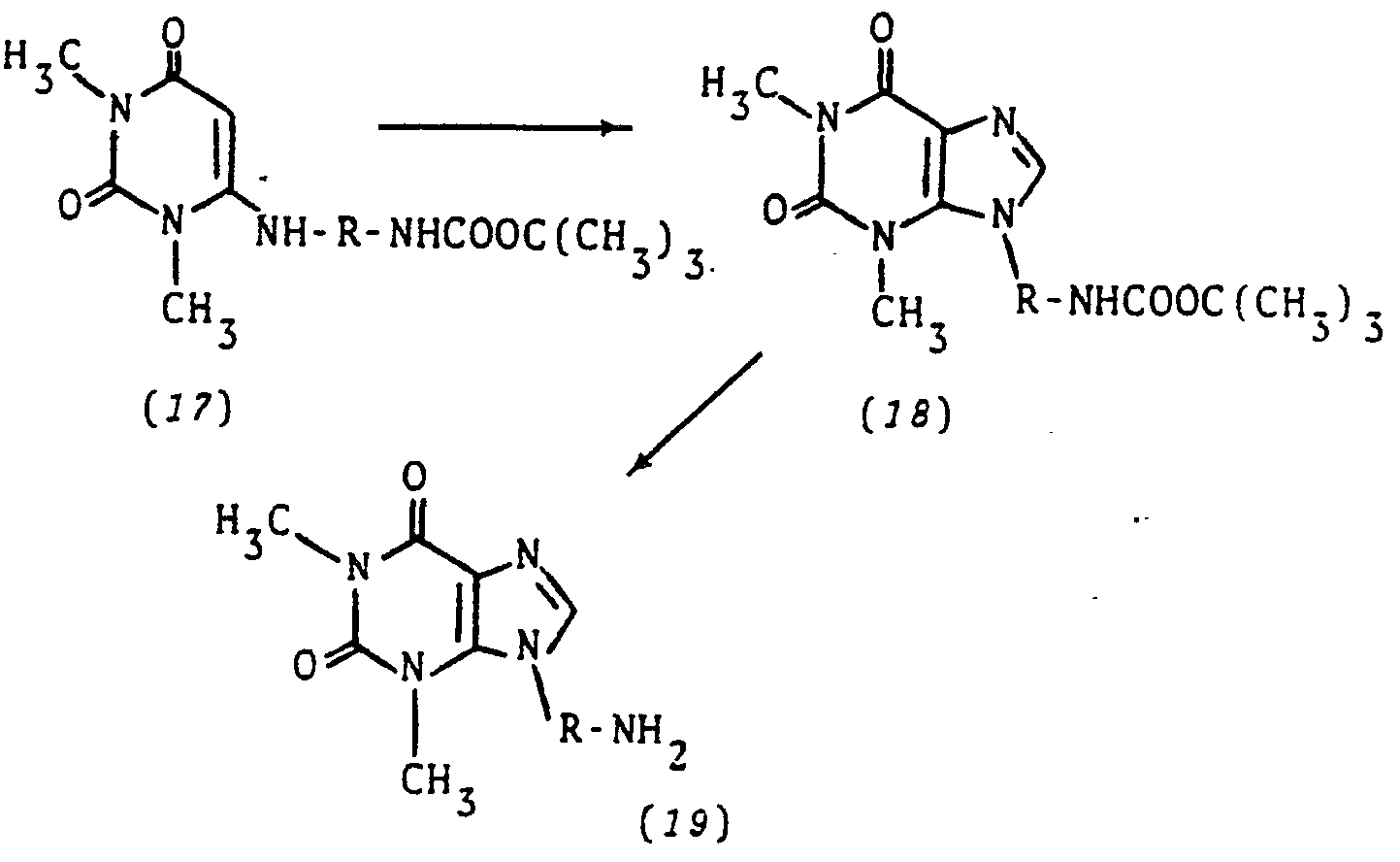
- 6-chloro-1,3-dimethyluracil (4) is reacted with a di-amino compound having one amino function suitably protected, such as with a tert-butyloxycarbonyl group: NH z -R-NHCOOC(CH 3 ) 3 [Stahl etal, J. Org. Chem. 43:2285 (1978)].
- the product (17) is nitrosated, reduced, and cyclized to the protected 9-substituted theophylline (18), which in turn is de-protected with acid to give the primary amino compound (19).
- 6-chloro-1,3-dimethyluracil (4) is reacted with a reagent of the general formula NH 2 R-COOH to produce (20) which is converted to the 9-carboxy-modified theophylline derivative, (21) by the previously described reactions.
- the antibodies prepared from the 9-theophylline immunogens of the present invention can be used in any immunoassay method, and the corresponding reagent means, for determining theophylline, including agglutination techniques, radioimmunoassays; heterogeneous enzyme immunoassays (cf. US ⁇ A ⁇ 3,654,090), heterogeneous fluorescent immunoassays (cf. US-A-4,201,763; US-A-4,171,311; US-A-4,133,639 and US-A-3,992,631), and homogeneous (separation-less) immunoassays.
- the lattermost are particularly preferred and include such techniques as fluorescence quenching or enhancement (cf.
- the 9-theophylline derivatives of the present invention can be used to prepare the labeled conjugates needed to perform the various immunoassays described above.
- Appropriate derivatives can be radio-labeled or labeled with fluorescent moieties in accordance with standard methods.
- the appropriate labeling moiety for the preferred homogeneous techniques e.g., an enzyme substrate, a prosthetic group, an enzyme modulator, or an enzyme (which is a protein and cap be coupled similarly to the immunogenic carrier as described above) can be coupled to the 9-theophylline derivatives to yield labeled conjugates.
- Particularly preferred labeled conjugates are the following (3-galactosyl-umbelliferone-theophylline and FAD-theophylline conjugates.
- the former has the formula wherein -(CO) ⁇ GU is and n is an integer from 1 through 10.
- Such conjugates are prepared by standard peptide condensations of (3-galactosyl-umbelliferone carboxylic acid (US-A-4,226,978) with the appropriate 9-(aminoalkyl)theophylline.
- the FAD-labeled conjugate has the formula wherein FAD is flavin adenine dinucleotide or a derivative thereof, Y is an amide group, and n is an integer from 1 through 16.
- the amide group may be oriented in either of the two available ways and preferably is oriented with the nitrogen being from an amino group in the FAD moiety.
- the reagent means of the present invention comprises all of the essential chemical elements required to conduct a desired theophylline immunoassay method encompassed by the present invention.
- the reagent means is presented in a commercially packaged form, as a composition or admixture where the compatability of the reagents will allow, in a test device configuration, or as a test kit, i.e., a packaged combination of one or more containers holding the necessary reagents. Included in the reagent means are the reagents appropriate for the binding reaction system desired, e.g., an antibody and labeled conjugate of the present invention.
- the reagent means can include other materials as are known in the art and which may be desirable from a commercial and user standpoint, such as buffers, diluents, standards, and so forth.
- a test kit for the homogeneous competitive binding immunoassay of the present invention comprising (a) a theophylline antibody of the present invention, and (b) a labeled theophylline conjugate which has a detectable property which is altered when bound with the antibody.
- test device comprising a reagent composition including a theophylline antibody of the present invention and a labeled theophylline conjugate which has a detectable property which is altered when bound with the antibody, and a solid carrier member incorporated with the reagent composition.
- a test device comprising a reagent composition including a theophylline antibody of the present invention and a labeled theophylline conjugate which has a detectable property which is altered when bound with the antibody, and a solid carrier member incorporated with the reagent composition.
- the exemplified method can be modified to yield any desired 9-(w-carboxyalkyl)theophylline by substitution of the appropriate w-aminoalkanoic acid for 6-aminocaproic acid in the preparation of compound (//).
- the corresponding 9-(w-aminoalkyl)theophylline can be prepared by using an appropriate mono-N-blocked a,w-diaminoalkane in place of 6-aminocaproic acid and then deblocking by conventional methods.
- Bovine serum albumin 200 mg; 3.0 ⁇ mol was dissolved in 4 ml of distilled water and 150 ⁇ l (microliters) of 1 N sodium hydroxide was then added to the protein solution. While vortex mixing (that is agitation of the solution by a vibrating apparatus), 3 ml of spectro-grade anhydrous dioxane was slowly added to the alkaline protein solution. The BSA solution was then placed in an ice bath. 16.8 mg (milligrams) (57.3 pmole) of 9-(5-carboxyentyl)-1 ,3-dimethylxanthine (Part A above) was suspended in 2 ml of dioxane.
- the suspension was cooled in an ice-water bath, making sure that the dioxane did not freeze. 15 ⁇ l of tri-N-butylamine was added and after mixing, 10 ⁇ l of ethyl chloroformate was also added to the cold suspension. A small magnetic bar was placed into the test tube, and the suspension was stirred in an ice-water bath using a magnetic stirrer. After 20 minutes, the activated theophylline derivative suspension was slowly added to the cold BSA solution with mixing with a magnetic stirring bar in an ice-water bath. The reaction mixture was then stirred overnight at 4°C.
- the reaction mixture was brought to room temperature and chromatographed with 50 mM (millimolar) Tris buffer [tris-(hydroxymethyl)aminomethane, Calbiochem-Behring, La Jolla, California, USA], pH 8.2, through a 2.8 x 52 cm column of Sephadex G-25 (fine) (Pharmacia Fube Chemicals, Piscataway, New Jersey USA) which had been equilibrated with the same buffer. Fractions of 3 ml were collected, and the absorbance at 280 nm (nanometers) monitored. The theophylline-BSA conjugate eluted in the void volume, and these fractions (30-45) were pooled. The total volume of this theophylline-BSA immunogen was measured (47 ml). The unreacted drug eluted in fractions 80 to 110.
- the cooling bath was removed and the reaction allowed to warm to room temperature and stir for a total of 4 hours.
- the precipitated dicyclohexyl urea was removed by filtration.
- the filtrate, now containing the activated ester was combined with 602 mg of the dihydrochloride salt of 9-(5-aminopentyl)-1,3-dimethylxanthine and 300 mg of triethylamine.
- the reaction was diluted with 100 ml of dimethylformamide, 20 g of silica gel and 168 mg of sodium bicarbonate added, and the dimethylformaide removed under high vacuum.
- the impregnated silica gel was placed atop a column of 200 g of silica gel made up in chloroform. The column was eluted with a gradient of 1060 ml chloroform to 2 liters of methanol; 20 ml fractions were collected.
- the xanthine AMP conjugate (842 mg, 1 mmol) was dried by repeated evaporation (6 x 25 ml) from dry dimethylformamide in vacuo.
- the dry material was dissolved in 5 ml of dry dimethylformamide and stirred under argon while 811 mg (5 mmol) of 1,1'-carbonyl dimidazole was added [Hoard and Ott, J. Amer. Chem. Soc. 87:1785(1965)].
- the solution was stirred for 4 hours at 25°C and then 1 ml of absolute methanol was added. After 5 minutes the solution was evaporated under high vacuum, 10 ml of dry dimethylformamide added, and the process repeated.
- the resulting oil was dissolved in 5 ml of dry dimethylformamide and added to a dimethylsulfoxide (DMSO) solution of tri-n-octylamine.
- DMSO dimethylsulfoxide
- the resulting mixture was evaporated under high vacuum, 10 ml of dry DMSO added, and the process repeated.
- the residual oil was taken up in 10 ml of dry DMSO and combined with the previously prepared solution. This combined solution was stirred for 24 hours, then diluted to 2 liters with distilled water and applied to a column of DEAE cellulose (5 x 60 cm, bicarbonate form).
- the column was washed with 6 liters of water and then eluted with a linear gradient of 6 liters of water to 6 liters of 0.6 M aqueous ammonium acetate solution, pH 5.6. At the end of the gradient, elution was continued with 0.6 M ammonium acetate. Twenty two ml fractions were collected.
- SFIA substrate-labeled fluorescent immunoassay
- the data indicate a significant decrease in cross-reactivity with the compounds caffeine, 1,3-dimethyl uric acid, 1,7-dimethylxanthine, etc., by moving from the 8-position to the 9-position in preparing the theophylline immunogen.
- PLIA prosthetic group-labeled immunoassay
- ReagentA 0.1 M sodium phosphate buffer (pH 7.0), 1.05% bovine serum albumin, 0.105 M glucose, 63 ⁇ g/ml peroxidase, 2.1 mM sodium 3,5-dichloro-2-hydroxybenzene sulfonate, in water.
- Reagent B-1 1 ⁇ M FAD-theophylline conjugate (Example 1, Part D) in 50 mM sodium phosphate buffer (pH 7.0).
- Reagent D ⁇ theophylline (40 ⁇ g/ml) in pooled human serum Reagent D ⁇ theophylline (40 ⁇ g/ml) in pooled human serum.
- Reagent B Into separate corners of a series of reaction cuvettes were dispensed 10 ⁇ l of Reagent B, 100 pl of Reagent C, varying volumes of Reagent D (as set out in the results table below) and 25 pl of Reagent E. Reagent A (1.9 ml) was then added to each cuvette with rapid mixing followed by a 5 minute incubation at
- an assay was provided for determining theophylline using the reagents of the present invention.
Landscapes
- Chemical & Material Sciences (AREA)
- Health & Medical Sciences (AREA)
- Organic Chemistry (AREA)
- Life Sciences & Earth Sciences (AREA)
- Molecular Biology (AREA)
- Engineering & Computer Science (AREA)
- Immunology (AREA)
- General Health & Medical Sciences (AREA)
- Medicinal Chemistry (AREA)
- Biochemistry (AREA)
- Biophysics (AREA)
- Genetics & Genomics (AREA)
- Proteomics, Peptides & Aminoacids (AREA)
- Hematology (AREA)
- Urology & Nephrology (AREA)
- Biomedical Technology (AREA)
- Pharmacology & Pharmacy (AREA)
- Analytical Chemistry (AREA)
- Biotechnology (AREA)
- Microbiology (AREA)
- Bioinformatics & Cheminformatics (AREA)
- Food Science & Technology (AREA)
- Physics & Mathematics (AREA)
- Cell Biology (AREA)
- General Physics & Mathematics (AREA)
- Pathology (AREA)
- Pharmaceuticals Containing Other Organic And Inorganic Compounds (AREA)
- Peptides Or Proteins (AREA)
- Saccharide Compounds (AREA)
- Medicines Containing Antibodies Or Antigens For Use As Internal Diagnostic Agents (AREA)
Description
- This invention relates to novel theophylline derivatives pertaining to immunoassays for determining theophylline in liquid media such as biological fluids. Such derivatives include theophylline immunogens used to stimulate production of antibodies to theophylline in host animals by conventional techniques.
- Theophylline [1,3-dimethylxanthine, cf. The Merck Index, 9th ed., p. 1196 (1976)] is a drug of great value in the management of asthmatic patients. The drug is used prophylactically, as an adjunct in the treatment of prolonged asthmatic attacks and in the management of status asthmaticus [Goodman and Gilman, The Pharmacological Basis of Therapeutics, 5th ed., MacMillan (New York 1975) p. 375]. However, because of its potential toxicity, proper dosage administration is critical. Frequent testing of serum or plasma concentrations assists in maintaining therapeutic levels and avoiding toxic levels.
- The determination of theophylline by immunoassay is well known. Commercial test kits are available for measuring serum and plasma theophylline levels by radioimmunoassay, enzyme immunoassay, and substrate-labeled fluorescent immunoassay. Radioimmunoassays for determining theophylline are described by Cook etal, Res. Commun. Chem. Path. Pharm. 13:497 (1976), Nishikawa et al, Chem. Pharm. Bull. 27:893 (1979), and DE-A-2,901,281. Reagents for use in an enzyme immunoassay for determining theophylline are described in US-A-4,230,805. The determination of theophylline by substrate-labeled fluorescent immunoassay (SLFIA) is described in US-A-No. 4,279,992. See also GB-A-1,552,607 and Li et al, Clin. Chem. 27:22 (1981).
- Theophylline immunogens have been prepared by coupling the drug at various positions on its ring structure to conventional immunogenic carrier materials. Immunogens prepared by derivatization of theophylline at its 8-position are described by Cook et al and Li et al, supra, and in US-A-4,279,992. Derivatization at the 7-position is known from Nishakawa et al supra, and DE-A-2,901,218. US-A-4,230,805 describes the coupling of theophylline at its 3-position.
- In GB-A-1.110.734 and DK-A-113 922 there are described 9-substituted theophylline derivatives for pharmaceutical purpose.
- The state-of-the-art of preparing antibodies to haptens such as drugs is represented by Weinryb et al, Drug Metabolism Reviews 10:271 (1979); Playfair et al, Br. Med. Bull. 30:24 (1974); Broughton et al, Clin. Chem. 22:726 (1976); and Butler, J. Immunol. Meth. 7:1 (1975). The preparation of 9-xanthine derivatives are described by Lister, Purines, Wiley, Interscience (New York 1971) pp. 223-228; Hurst, An Introduction to the Chemistry and Biochemistry of the Pyrimidines, Purines, and Pteridines, John Wiley & Sons (New York 1980) p. 66; Rybar et al, Collect. Czech. Chem. Commun. 37:3936 (1972); Fleiderer and Nubel, Justus Liebig's Annalen 631:168 (1960); von Schuk, DE-C-1,113,696 (Chem. Abst. 56P:12910e); and Blicke and Schaff, J. Amer. Chem. Soc. 78:5857 (1956).
- In J. of Immunoassay Vol. 1 (3), 309-322 (1980) Singh et al. described antibodies raised against an 8- theophylin immunogen. At page 320 of this article it is reported that antibodies raised with 7-theophylin derivatives as those described by Nishikawa et al. (see above) show a serious cross reactivity (200%) with caffeine.
- The present invention relates to the 9-theophylline immunogens which are used to prepare antibodies to theophylline which have advantageous cross-reactivity characteristics. The theophylline antibodies of the present invention cross-react insignificantly with the major theophylline analogs and metabolites present in biological fluids, namely, caffeine (1,3,7-trimethylxanthine), 3-methylxanthine, 1,7-dimethylxanthine, 3,7-dimethylxanthine, and theobromine. In particular, the present theophylline antibodies possess an unexpectedly extremely low cross-reactivity for the most troublesome potential interferant in biological fluids, caffeine, compared to the antibodies obtained from the known, closely analogous, 7- theophylline and 8-theophylline immunogens, supra.
- The present invention, refers to 9-Theophylline immunogens of the general formula:
- The immunogenic carrier material can be selected from any of those conventionally known. In most cases, the carrier will be a protein or polypeptide, although other material such as carbohydrates, polysaccharides, lipopolysaccharides or nucleic acids of sufficient size and immunogenicity can likewise be used. For the most part, immunogenic proteins and polypeptides will have molecular weights between 5,000 and 10,000,000, preferably greater than 15,000, and more usually greater than 50,000. Generally, proteins taken from one animal species will be immunogenic when introduced into the blood stream of another species. Particularly useful proteins are albumins, globulins, enzymes, hemocyanins, glutelins, proteins having significant nonproteinaceous constituents, e.g., glycoproteins. The albumins and globulins of molecular weight between 30,000 and 200,000 are particularly preferred. Further reference for the state-of-the-art concerning conventional immunogenic carrier materials and techniques for coupling haptens thereto may be had to the following: Parker, Radioimmunoassay of Biologically Active Compounds, Prentice-Hall (Englewood Cliffs, New Jersey USA, 1976); Butler, J. lmmunol. Meth. 7:1-24 (1975); Weinryb and Shroff, Drug Metab. Rev. 10:271-283 (1975); Broughton and Strong, Clin. Chem. 22:726-732 (1976); and Playfair et al, Br. Med. Bull. 30:24-31 (1974).
- Appropriate 9-theophylline derivatives are couplable to immunogenic carrier materials according to well known techniques. For example, 9-carboxylated theophylline derivatives can be coupled to immunogenic carriers having amino groups by standard peptide bond-forming reactions such as described in Peptides, ed. Goodman and Meienhofer, John Wiley & Sons (New York 1977) p. 6 et seq. 9-Thiolated theophylline derivatives can be attached to carriers having thiol groups by_the disulfide interchange reaction [Martin et^al, Biochem. 20:4229 (1981)]. Alternatively, a third group can be introduced into one of the reactants and a maleimido group into the other and the two coupled together in a manner similar to that described by Liu et al, Biochem. 18:690 (1979). 9-Aminated theophylline derivatives can be coupled to carriers having carboxyl groups by amide bond-forming reactions such as those involving carbodiimides [Aherne et al, Brit. J. Clin. Pharm. 3:561 (1976)], mixed anhydrides [Erlanger et al, Methods in Immunology and Immunochemistry, ed. Williams and Chase, Academic Press (New York 1967) p. 149], and the acid azide and active ester reactions [Kopple, Peptides and Amino Acids, W. A. Benjamin (New York 1966). See also Clin. Chem. 22:726 (1976). Similarly, the amino theophylline derivatives can be coupled to carriers having amino groups using conventional bifunctional reagents such as bis-isocyanates, bis-imidoesters, and glutaraldehyde [lmmunochem. 6:53 (1969)]. See also Kopple, supra, and Lowe and Dean, Affinity Chromatography, John Wiley & Sons (New York 1974). A multitude of other coupling techniques are available to those of ordinary skill in the art for joining the various 9-theophylline derivatives of the present invention with conventional immunogenic carrier materials.
- Particularly preferred are the theophylline immunogens of the formula


- Preparation of specific antibodies using the present immunogen conjugates may follow any conventional technique. Numerous texts are available describing the fundamental aspects of inducing antibody formation, for example reference may be made to Parker, Radioimmunoassay of Biologically Active Compounds, Prentice-Hall (Englewood Cliffs, New Jersey USA, 1976). In the usual case, a host animal such as a rabbit, goat, mouse, guinea pig, or horse is injected at one or more of a variety of sites with the immunogen conjugate, normally in mixture with an adjuvant. Further injections are made at the same site or different sites at regular or irregular intervals thereafter with bleedings being taken to assess antibody titer until it is determined that optimal titer has been reached. The host animal is bled to yield a suitable volume of specific antiserum. Where desirable, purification steps may be taken to remove undesired material such as nonspecific antibodies before the antiserum is considered suitable for use in performing actual assays.
- The antibodies can also be obtained by somatic cell hydridization techniques, such antibodies being commonly referred to as monoclonal antibodies. Reviews of such monoclonal antibody techniques are found in Lymphocyte Hybridomas, ed. Melchers et al, Springer-Verlag (New York 1978), Nature 266:495 (1977), and Science 208:692 (1980).
- A wide variety of synthetic routes are available to one skilled in the art for derivatizing theophylline at its 9-position and coupling the derivative to the carrier. Following are descriptions of some such synthetic routes.
- 2,6-Dioxopurines can exist in two isomeric forms which are known by the trivial names xanthines [3,7-dihydro-1H-purine-2,6-dione (1)] and iso-xanthines [3,9-dihydro-1H-purine-2,6-dione (2)] and are numbered as shown in formula 1.

- According to this trivial nomenclature, the 9-substituted theophylline derivatives and conjugates of the present invention are in fact 9-substituted iso-xanthines. Direct alkylation of 1,3-dimethylxanthine [theophylline, (3)]

- For example, with reference to Diagram A, 9-(2-hydroxyethyl)theophylline (7) is prepared by reacting 6-chloro-1,3-dimethyluracil (4) with 2-aminoethanol to give the uracil (5). This is nitrosated and reduced to give the diamino uracil (6), which upon treatment with formic acid yields the 9-substituted theophylline derivative (7). See Rybar et al, Collect. Czech. Chem. Commun. 37:3936 (1972).
-

- 9-Methylxanthine has been prepared by a similar method which uses sodium thiosulfate as the reducing agent rather than catalytic reduction [Fleiderer and Nubel, Justus Liebig's Annalen 631:168 (1960)].
- Another approach (Diagram B) involves benzylation of 1,3-dimethylxanthine (8) at the 7-position to yield product (9) which is then alkylated with dialkylsulfate (R1 = alkyl) to yield the ionic intermediate (10). Catalytic removal of the benzyl group leads to 9-alkyl theophylline (11). See von Schuk, German Pat. No. 1,113,696 (Chem. Abst. 56P:12910e).
-

- Still another approach (Diagram C) involves reaction of 5,6-diaminouracil (12) with an alkyl isothiocyanate (R2 = alkyl) to yield the thiourea (13). This is cyclized to the 8-mercapto derivative (14) which is then desulfurized with Raney nickel to give 9-alkylated theophyllines (15). See Blicke and Schaff, J. Amer. Chem. Soc. 78:5857 (1956).
-


- Based on the above-described synthetic routes, it is clear that 9-functionalized theophylline derivatives (16)

- For example, in the method of Diagram A, 2-aminoethanol can be replaced by the general reagent H2N-R-Z provided R is stable to treatment with formic acid and Z is compatible with a primary amino group. In the method of Diagram B, the dialkylsulfate is replaced by the general reagent (Z-R)2 SO4 provided R and Z are not reactive with the organic sulfate. Likewise, in the method of Diagram C, the alkyl isothiocyanate is replaced by the general reagent Z-R-N=C=S, provided R and Z are not reactive with the isothiocyanate group. Thus, one skilled in the art has a wide variety of linking groups R that can be introduced to the derivatives of the present invention. Exemplary of such choices are linear and branched alkylenes comprising from 1 to as many as 15, more usually 10 or-less, and normally less than 6, carbon atoms (e.g., methylene, ethylene, n-propylene, iso-propylene, n-butylene, and so forth). In addition, such alkylenes can contain other substituent groups such as cyano, amino (including substituted amino), acylamino, halogen, thiol, hydroxyl, carbonyl groups, carboxyl (including substituted carboxyls such as esters, amides, and substituted amides). The linking group R can also contain or consist of substituted or unsubstituted aryl, aralkyl, or heteroaryl groups (e.g., phenylene, phenethylene, and so forth). Additionally, such linkages can contain one or more heteroatoms selected from nitrogen, sulfur and oxygen in the form of ether, ester, amido, amino, thio ether, amidino, sulfone, or sulfoxide. Also, such linkages can include unsaturated groupings such as olefinic or acetylenic bonds, imino, or oximino groups. Preferably R will be a chain, usually an aliphatic group, comprising between 1 and 20 atoms, more usually between 1 and 10, excluding hydrogen, of which between 0 and 5 are heteroatoms selected from nitrogen, oxygen, and sulfur. Particularly preferred are the derivatives wherein R is +CH2 with n being an integer from 1 through 10 and wherein Z is amino or carboxyl. Therefore, the choice of linking group R is not critical to the present invention and may be selected by one of ordinary skill taking normal precautions to assure that stable compounds are produced.
- Similarly, the terminal functional group Z can vary widely, although amino, carboxyl, thiol, mercapto, hydroxyl, and maleimido will be preferred. Examples of synthetic routes available to obtain 9-theophylline derivatives having such preferred terminal functional groups follow:
- Following the procedure of Diagram A, 6-chloro-1,3-dimethyluracil (4) is reacted with a di-amino compound having one amino function suitably protected, such as with a tert-butyloxycarbonyl group: NHz-R-NHCOOC(CH3)3 [Stahl etal, J. Org. Chem. 43:2285 (1978)]. The product (17) is nitrosated, reduced, and cyclized to the protected 9-substituted theophylline (18), which in turn is de-protected with acid to give the primary amino compound (19).
- Following the procedure of Diagram A, 6-chloro-1,3-dimethyluracil (4) is reacted with a reagent of the general formula NH2R-COOH to produce (20) which is converted to the 9-carboxy-modified theophylline derivative, (21) by the previously described reactions.

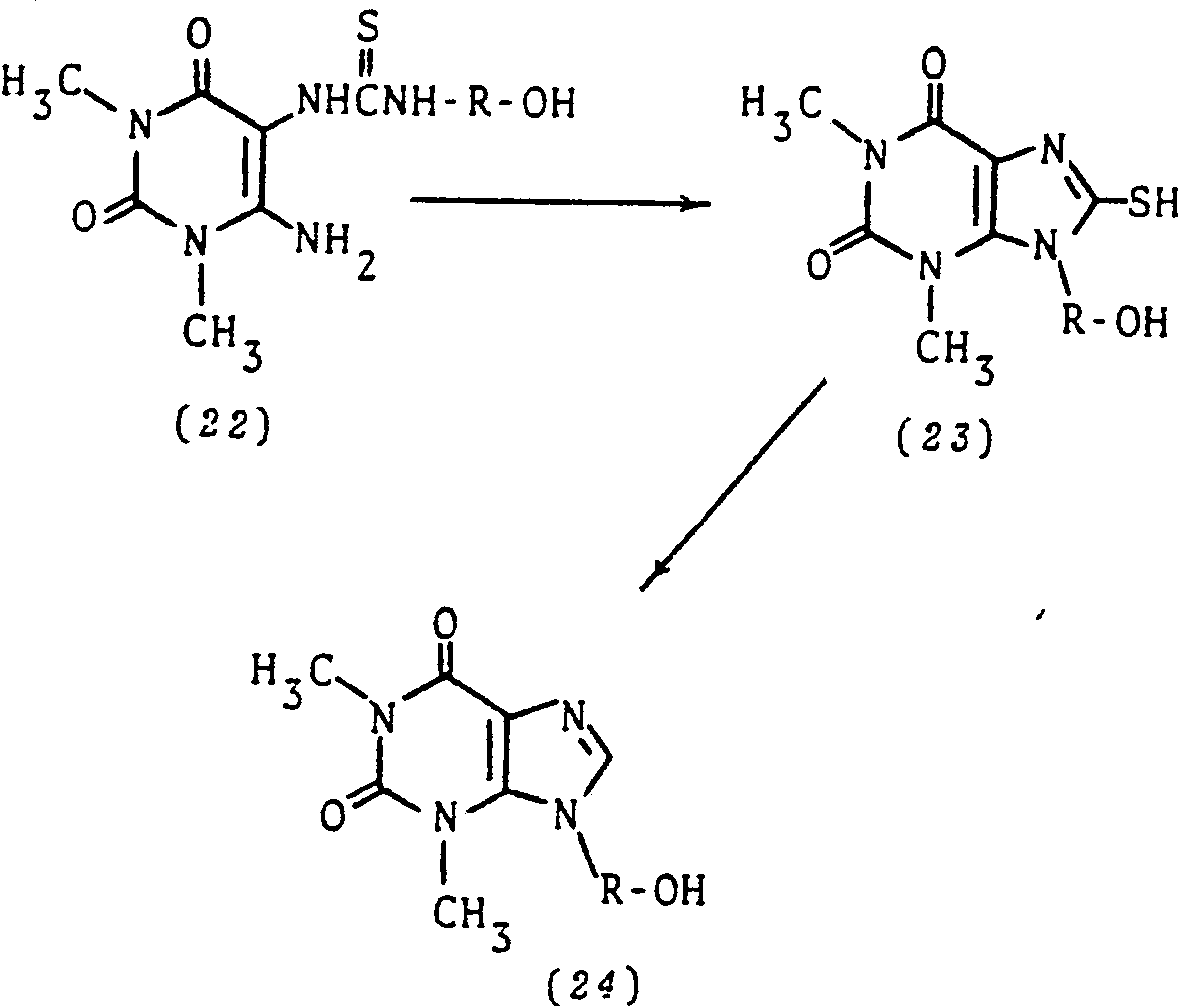
- Following the procedure of Diagram C, amino alcohols NH2-R-OH are reacted with carbon disulfide to give S=C=N-R-OH and these in turn are reacted with 5,6-diamino-1,3-dimethyluracil (12) to give the thioureas (22). Cyclization of (22) leads to (23) which is then desulfurized to the alcohol derivatives (24). Compounds (24) can also be prepared by the route outlined in Diagram A using NHZ-R-OH in the reaction with 6-chloro-1,3-dimethyluracil.
- These compounds are prepared by the synthetic route outlined in Diagram A using NHZ-R-SH as the starting material in a manner analogous to the preparation of carboxy-modified theophyllines. Sodium thiosulfate can be used as the reducing agent in the reduction step.
- These compounds are prepared from the corresponding amino derivatives (19) by reaction with maleic anhydride to give intermediate (25) followed by cyclization to (26).

- The antibodies prepared from the 9-theophylline immunogens of the present invention can be used in any immunoassay method, and the corresponding reagent means, for determining theophylline, including agglutination techniques, radioimmunoassays; heterogeneous enzyme immunoassays (cf. US―A―3,654,090), heterogeneous fluorescent immunoassays (cf. US-A-4,201,763; US-A-4,171,311; US-A-4,133,639 and US-A-3,992,631), and homogeneous (separation-less) immunoassays. The lattermost are particularly preferred and include such techniques as fluorescence quenching or enhancement (cf. US-A-4,160,016), fluorescence polarization (cf. J. Exp. Med. 122:1029 (1965), enzyme substrate-labeled immunoassay (cf. US-A-4,279,992 and GB-A-1,552,609), prosthetic group-labeled immunoassay (cf. US-A-4,238,565), enzyme modulator-labeled immunoassay, e.g., using inhibitor labels (US-A-4,134,792 and US-A-4,273,866), enzyme-labeled immunoassay (cf. US-A-3,817,837), energy transfer immunoassay (cf. US-A-3,996,345), chemically-excited fluorescence immunoassay (cf. US-A-4,238,195) and double antibody steric hindrance immunoassay (cf. US-A-3,935,074 and 3,998,943).
- Moreover, the 9-theophylline derivatives of the present invention can be used to prepare the labeled conjugates needed to perform the various immunoassays described above. Appropriate derivatives can be radio-labeled or labeled with fluorescent moieties in accordance with standard methods. Likewise the appropriate labeling moiety for the preferred homogeneous techniques, e.g., an enzyme substrate, a prosthetic group, an enzyme modulator, or an enzyme (which is a protein and cap be coupled similarly to the immunogenic carrier as described above) can be coupled to the 9-theophylline derivatives to yield labeled conjugates.
- Particularly preferred labeled conjugates are the following (3-galactosyl-umbelliferone-theophylline and FAD-theophylline conjugates. The former has the formula


- The FAD-labeled conjugate has the formula


- The reagent means of the present invention comprises all of the essential chemical elements required to conduct a desired theophylline immunoassay method encompassed by the present invention. The reagent means is presented in a commercially packaged form, as a composition or admixture where the compatability of the reagents will allow, in a test device configuration, or as a test kit, i.e., a packaged combination of one or more containers holding the necessary reagents. Included in the reagent means are the reagents appropriate for the binding reaction system desired, e.g., an antibody and labeled conjugate of the present invention. Of course, the reagent means can include other materials as are known in the art and which may be desirable from a commercial and user standpoint, such as buffers, diluents, standards, and so forth. Particularly preferred is a test kit for the homogeneous competitive binding immunoassay of the present invention comprising (a) a theophylline antibody of the present invention, and (b) a labeled theophylline conjugate which has a detectable property which is altered when bound with the antibody. Also preferred is a test device comprising a reagent composition including a theophylline antibody of the present invention and a labeled theophylline conjugate which has a detectable property which is altered when bound with the antibody, and a solid carrier member incorporated with the reagent composition. The various forms of such test device are described in US-A-202,578, filed October 30, 1980. The specific label used in the preferred test kit and test device will depend on the technique followed, as described hereinabove.
- The present invention will now be illustrated, by the following examples:
- 9-(ω-Carboxyaikyt)theophyt)ine derivatives are prepared according to the following synthetic scheme (n = 1-10) which is specifically exemplified below for n = 5.

- A mixture of 25 g (grams) (0.143 mol) of 6-chloro-1,3-dimethyluracil (I) (Aldrich Chemical Co., Milwaukee, WI) and 18.73 g (0.143 mol) of 6-aminocaproic acid in 100 ml (milliliters) of absolute ethanol containing 14 g (0.143 mol) of triethylamine was refluxed for 16 hours. It was cooled, evaporated under reduced pressure, and the crystalline residue recrystallized twice from H20 to give 22 g (56% yield) of the uracil derivative (//) as fine white crystals, mp 191°C.
- Analysis:

- Fifteen grams (0.056 mol) of the carboxypentyl uracil (//) was suspended in 100 ml of H20 and stirred at a temperature of 50-55°C. To this was added 7.14 g (0.084 mol) of sodium nitrite dissolved in 50 ml of H20. After one hour the reaction was cooled to 0°C, and a yellow solid removed by filtration which amounted to 11 g when dry, mp 246-248°C. The color suggests it to be the oxime tautomer (///).
- Analvsis:

- A mixture of 15.8 g (0.05 mol) of the oxime (///), 200 ml of methanol, and 100 mg of platinum oxide was shaken under 4.05 x 10⁵ Pascal (= 4 atmospheres) H2 for 15 minutes at room temperature. The catalyst was removed by filtration and the filtrate concentrated under reduced pressure (35°C) to give a red oil. Methyl formate (200 ml) was added and the resulting mixture refluxed under argon for 20 hours. It was then cooled in an ice bath and the white solid collected by filtration. Recrystallization from methanol gave 9.82 g (63% yield) of the formamido uracil (IV) as white crystals, mp 152-153°C.
- Analysis:

- 9.3 Grams (0.03 mol) of the formamido derivative (IV) was suspended in 500 ml of o-dichlorobenzene and stirred at reflux under an inert atmosphere for 4 hours. It was cooled and the solvent removed on a rotary evaporator attached to a vacuum pump. The crystalline residue was partitioned between 200 ml of ether and 100 ml of 5% aqueous sodium bicarbonate solution. The aqueous phase was separated, washed with 100 ml of ether, and acidified to pH 3.2 with 5 N HCI. The precipitate was recrystallized first from aqueous methanol, then from absolute ethanol to give 5.8 g (66% yield) of the xanthine (V) as fine white crystals mp 177°C.
- Analvsis:

- The exemplified method can be modified to yield any desired 9-(w-carboxyalkyl)theophylline by substitution of the appropriate w-aminoalkanoic acid for 6-aminocaproic acid in the preparation of compound (//). The corresponding 9-(w-aminoalkyl)theophylline can be prepared by using an appropriate mono-N-blocked a,w-diaminoalkane in place of 6-aminocaproic acid and then deblocking by conventional methods.
- Bovine serum albumin (200 mg; 3.0 µmol) was dissolved in 4 ml of distilled water and 150 µl (microliters) of 1 N sodium hydroxide was then added to the protein solution. While vortex mixing (that is agitation of the solution by a vibrating apparatus), 3 ml of spectro-grade anhydrous dioxane was slowly added to the alkaline protein solution. The BSA solution was then placed in an ice bath. 16.8 mg (milligrams) (57.3 pmole) of 9-(5-carboxyentyl)-1 ,3-dimethylxanthine (Part A above) was suspended in 2 ml of dioxane. The suspension was cooled in an ice-water bath, making sure that the dioxane did not freeze. 15 µl of tri-N-butylamine was added and after mixing, 10 µl of ethyl chloroformate was also added to the cold suspension. A small magnetic bar was placed into the test tube, and the suspension was stirred in an ice-water bath using a magnetic stirrer. After 20 minutes, the activated theophylline derivative suspension was slowly added to the cold BSA solution with mixing with a magnetic stirring bar in an ice-water bath. The reaction mixture was then stirred overnight at 4°C.
- The reaction mixture was brought to room temperature and chromatographed with 50 mM (millimolar) Tris buffer [tris-(hydroxymethyl)aminomethane, Calbiochem-Behring, La Jolla, California, USA], pH 8.2, through a 2.8 x 52 cm column of Sephadex G-25 (fine) (Pharmacia Fube Chemicals, Piscataway, New Jersey USA) which had been equilibrated with the same buffer. Fractions of 3 ml were collected, and the absorbance at 280 nm (nanometers) monitored. The theophylline-BSA conjugate eluted in the void volume, and these fractions (30-45) were pooled. The total volume of this theophylline-BSA immunogen was measured (47 ml). The unreacted drug eluted in fractions 80 to 110.
- A solution of 4.41 g (15 mmol) of 9-(5-carboxypentyl)-1,3-dimethyl-xanthine (V) in 100 ml of dry dimethylformamide was concentrated to 50 ml on a rotary evaporator to remove residual water. It was cooled to -5°C in a methanol-ice bath and combined with 1.7 g (2.34 ml, 15 mmol) of triethylamine followed by 2.05 g (15 mmol) of isobutyl chloroformate. The reaction was stirred 30 minutes at -5°C, then allowed to warm to room temperature and stirred for one additional hour. It was again cooled to -5°C and the precipitate of triethylamine hydrochloride removed by filtration. To the cold filtrate was added 2.52 g (45 mmol) of sodium azide dissolved in 20 ml of water. After stirring for 12 hours at 5°C, the reaction was diluted to 250 ml with water and extracted with 1 liter of ethyl acetate followed by 500 ml of ethyl acetate. The organic extracts were combined, dried over anhydrous magnesium sulfate, filtered, and concentrated to 250 ml on a rotary evaporator. Crystallization began to occur as the volume was reduced. Heptane (500 ml) was added to complete crystallization. After cooling for 2 hours, filtration gave 3.1 g of the intermediate 9-(5-azidocarbonylpentyl)-1,3-dimethylxanthine as fine white needles, m.p. 86°C (eff.). This substance was not further characterized but was suspended in 150 ml of dry toluene and heated to reflux for 10 minutes while stirring under argon. The clear solution was cooled and evaporated to give an oily residue. To this was added 100 ml of 1 N hydrochloric acid and this evaporated to dryness on the rotary evaporator. This left a semi-crystalline residue which was dissolved in 200 ml of hot 2-propanol containing a little methanol, filtered, and cooled in the refrigerator overnight. This deposited 2.6 g (47% yield) of the methanolate of the dihydrochloride salt of 9-(5-aminopentyl)-1,3-diniethylxanthine as fine white crystals, mp 133-136°C.
- Analysis:

- A solution of 736 mg (2 mmol) of 7-p-galactosylcoumarin-3-carboxylic acid (U.S. Pat. No. 4,226,978) and 2.30 mg (2 mmol) of N-hydroxysuccinimide in 100ml of dry dimethylformamide was concentrated to 50 ml on a rotary evaporator attached to a vacuum pump to remove last traces of water. Fifty ml of dry dimethylformamide were added and the process was repeated. The solution was then cooled to -5°C in a methanol ice bath, and, while stirring under argon, 412 mg (2 mmol) of dicyclohexyldicarbodiimide was added. The cooling bath was removed and the reaction allowed to warm to room temperature and stir for a total of 4 hours. The precipitated dicyclohexyl urea was removed by filtration. The filtrate, now containing the activated ester, was combined with 602 mg of the dihydrochloride salt of 9-(5-aminopentyl)-1,3-dimethylxanthine and 300 mg of triethylamine. After 4 hours stirring at room temperature, the reaction was diluted with 100 ml of dimethylformamide, 20 g of silica gel and 168 mg of sodium bicarbonate added, and the dimethylformaide removed under high vacuum. The impregnated silica gel was placed atop a column of 200 g of silica gel made up in chloroform. The column was eluted with a gradient of 1060 ml chloroform to 2 liters of methanol; 20 ml fractions were collected.
- Fractions 88 to 108 were pooled and evaporated. The solid residue was recrystallized from methanol to give 710 mg (55% yield) of the β-galactosyl-umbelliferone-theophylline conjugate as fine white crystals, mp 168-169°C.
- Analvsis:

- A solution of 736 mg (2.5 mmol) of 9-(5-carboxypentyl)-1,3-dimethylxanthine (V) in 5 ml of dry dimethylformamide was stirred under argon at -5°C. To this was added 0.35 ml (2.5 mmol) of isobutyl chloroformate. After 20 minutes at this temperature, the white precipitate of triethylammonium chloride was filtered out. The cold filtrate, now containing the mixed anhydride, was added dropwise with stirring for 30 minutes to a 0°C solution of 1.12 g (2.5 mmol) of N6-(6-aminohexyl)-AMP [Mosbach, Methods in .Enzymology 34:230 (1974)] in 20 ml of water adjusted to pH 10 with sodium hydroxide. After 1 hour the cold solution was diluted to 2 liters with distilled water and applied to a column of DEAE cellulose (5 x 100 cm, bicarbonate form). The column was washed with 2 liters of water, then eluted with a linear gradient of 8 liters of water to 8 liters of 0.5 M aqueous triethylammonium bicarbonate. Twenty ml fractions were collected.
- Fractions 370 to 415 were combined and evaporated. The residue.was taken up in 50 ml of distilled water, filtered, and the filtrate lyophilized to give 1.17 g (48% yield) of Ns-{6-[6-(1,3-dimethylxanthyl-9] hexanamido]hexyl}adenosine monophosphate as a glassy, white solid.
- Analysis:

- 'H NMR Spectrum (D20): 68.54 (s, 1H) and 68.14 (s, 1H), adenine aromatic protons; 57.65 (s, 1H), xanthine aromatic proton.
- The xanthine AMP conjugate (842 mg, 1 mmol) was dried by repeated evaporation (6 x 25 ml) from dry dimethylformamide in vacuo. The dry material was dissolved in 5 ml of dry dimethylformamide and stirred under argon while 811 mg (5 mmol) of 1,1'-carbonyl dimidazole was added [Hoard and Ott, J. Amer. Chem. Soc. 87:1785(1965)]. The solution was stirred for 4 hours at 25°C and then 1 ml of absolute methanol was added. After 5 minutes the solution was evaporated under high vacuum, 10 ml of dry dimethylformamide added, and the process repeated. The resulting oil was dissolved in 5 ml of dry dimethylformamide and added to a dimethylsulfoxide (DMSO) solution of tri-n-octylamine. The resulting mixture was evaporated under high vacuum, 10 ml of dry DMSO added, and the process repeated. The residual oil was taken up in 10 ml of dry DMSO and combined with the previously prepared solution. This combined solution was stirred for 24 hours, then diluted to 2 liters with distilled water and applied to a column of DEAE cellulose (5 x 60 cm, bicarbonate form). The column was washed with 6 liters of water and then eluted with a linear gradient of 6 liters of water to 6 liters of 0.6 M aqueous ammonium acetate solution, pH 5.6. At the end of the gradient, elution was continued with 0.6 M ammonium acetate. Twenty two ml fractions were collected.
- Fractions 555 to 665 were combined and evaporated in vacuo to 80 ml volume. This was partially desalted on a Bio Gel P2 column (5 x 120 cm) eluting with water. Desalting was completed by 3 dilutions with water and ultrafiltration through an Amicon UM-05 membrane, and a final chromatography on P2 (5 x 120 cm) eluting with water. This gave 242 micromoles of the desired FAD-theophylline conjugate.
- Analysis:
- UV Spectrum (H20, pH 5.3): λmax 266, 375, 453 nm.
- 1H NMR Spectrum (D20): 58.28; 7.83 (2 1 H singlet, adenine ring protons); 7.54 (1 H singlet, theophylline ring proton); 7.51 (2 H singlet, isoalloxazine ring protons); 5.86 (1 H doublet, J=3.2 Hz, anomeric H); 3.53 and 3.14 (N-methyls); 2.34 and 2.26 (C-methyls).
- A substrate-labeled fluorescent immunoassay (SLFIA) for theophylline was established as follows: A. Reagents
- 1. Antibody/Enzyme Reagent - 50 mM Bicine buffer [N,N-bis-(2-hydroxyethyl)cycline, Calbiochem-Behring Corp., La Jolla, California USA], pH 8:5, containing 100 Units/liter β-galactosidase, sufficient antiserum raised against the 9-theophylline immunogen (Example 1, Part B) to decrease fluorescence to 5% of that in the absence of antiserum, and 15.4 mM sodium azide.
- 2. Conjugate Reagent - 5 mM formate buffer, pH 3.5, containing 0.83 pM (micromolar) βGU- theophylline (Example 1, Part C) and 15.4 βM sodium azide.
- 3. Theophylline Standards - USP-NF Reference Standard theophylline added to normal human serum; diluted 51-fold with 50 mM Bicine buffer, pH 8.5, containing 15.4 pM sodium azide.
- To 3 ml volumes of the Antibody/Enzyme Reagent in cuvettes were added 100 µl (microliters) of the diluted Theophylline Standards. Then to begin the reaction, 100 p of the Conjugate Reagent was added to each cuvette with mixing. After 20 minutes the fluorescence intensity was measured in each cuvette (excitation 400 nm, emission 450 nm).
- Performance of the assay yielded the following results:

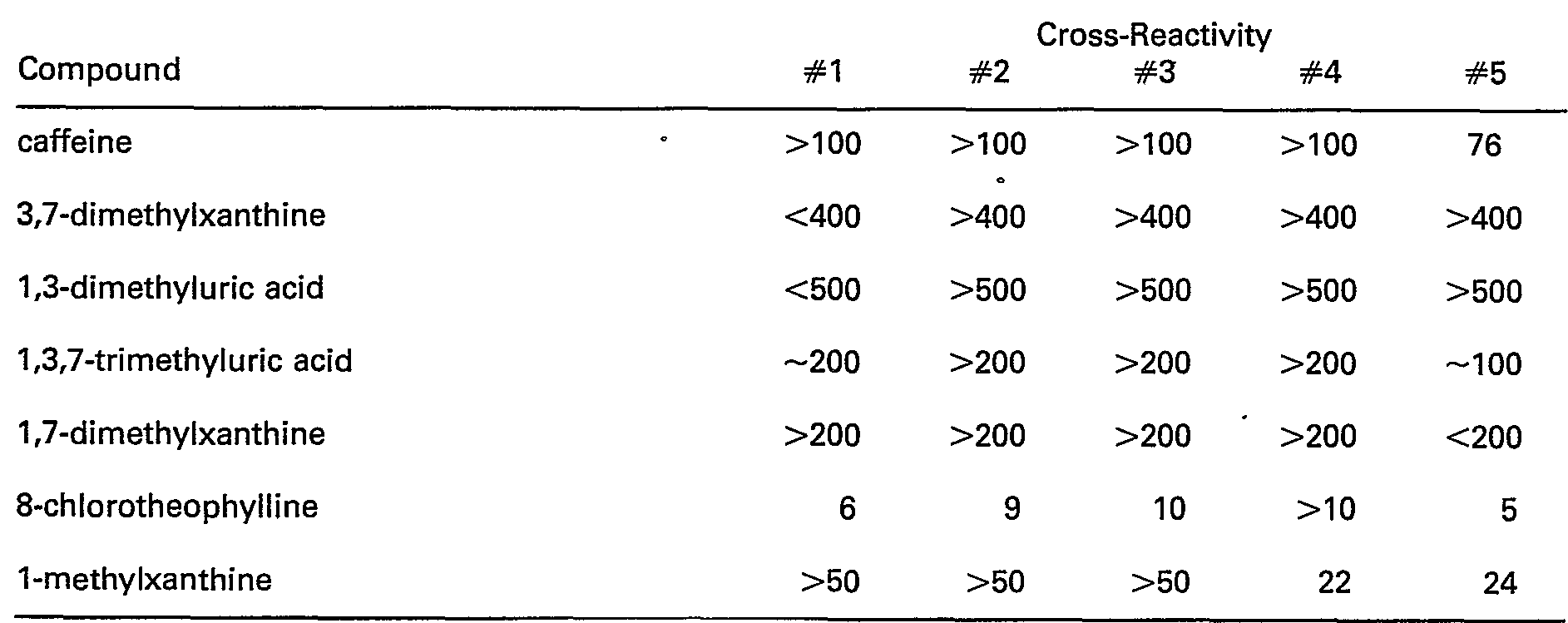
- Further cross-reactivity studies were performed to compare the 9-theophylline antiserum of the present invention to 8-theophylline antiserum (U.S. Pat. no. 4,279,992). The results were as follows:

- The data indicate a significant decrease in cross-reactivity with the compounds caffeine, 1,3-dimethyl uric acid, 1,7-dimethylxanthine, etc., by moving from the 8-position to the 9-position in preparing the theophylline immunogen.
- A prosthetic group-labeled immunoassay (PGLIA) for theophylline was established as follows:
- ReagentA-0.1 M sodium phosphate buffer (pH 7.0), 1.05% bovine serum albumin, 0.105 M glucose, 63 µg/ml peroxidase, 2.1 mM sodium 3,5-dichloro-2-hydroxybenzene sulfonate, in water.
- Reagent B-1 1 µM FAD-theophylline conjugate (Example 1, Part D) in 50 mM sodium phosphate buffer (pH 7.0).
- Reagent C - 4 µM apoglucose oxidaxe, 8 mM 4-aminoantipyrine, 30% glycerol, in 0.1 M phosphate buffer (pH 7.0).
- Reagent D―theophylline (40 µg/ml) in pooled human serum.
- Reagent E―Antiserum to theophylline diluted 10-fold in 0.1 M sodium phosphate buffer (pH 7.0).
- Into separate corners of a series of reaction cuvettes were dispensed 10 µl of Reagent B, 100 pl of Reagent C, varying volumes of Reagent D (as set out in the results table below) and 25 pl of Reagent E. Reagent A (1.9 ml) was then added to each cuvette with rapid mixing followed by a 5 minute incubation at
- 25°C. The absorbance at 520 nm was then measured for each cuvette.
- The results were as follows (averages of duplicate runs):

- Thus, an assay was provided for determining theophylline using the reagents of the present invention.
Claims (7)


Applications Claiming Priority (2)
| Application Number | Priority Date | Filing Date | Title |
|---|---|---|---|
| US06/296,817 US4533493A (en) | 1981-08-27 | 1981-08-27 | Theophylline immunogens, antibodies, labeled conjugates, and related derivatives |
| US296817 | 1999-04-22 |
Publications (2)
| Publication Number | Publication Date |
|---|---|
| EP0077896A1 EP0077896A1 (en) | 1983-05-04 |
| EP0077896B1 true EP0077896B1 (en) | 1989-01-25 |
Family
ID=23143694
Family Applications (1)
| Application Number | Title | Priority Date | Filing Date |
|---|---|---|---|
| EP82107414A Expired EP0077896B1 (en) | 1981-08-27 | 1982-08-16 | Theophylline derivatives, antibodies and their preparation from theophylline immunogens, as well as an immuno assay method and reagent means for determining theophylline |
Country Status (5)
| Country | Link |
|---|---|
| US (1) | US4533493A (en) |
| EP (1) | EP0077896B1 (en) |
| JP (1) | JPS5846072A (en) |
| CA (1) | CA1210757A (en) |
| DE (1) | DE3279393D1 (en) |
Cited By (2)
| Publication number | Priority date | Publication date | Assignee | Title |
|---|---|---|---|---|
| DE3620653A1 (en) * | 1986-06-20 | 1987-12-23 | Boehringer Mannheim Gmbh | METHOD FOR PRODUCING AN IMMUNREACTIVE SUPPORT MATERIAL FOR HETEROGENEOUS IMMUNOLOGICAL ANALYSIS |
| CN103242446A (en) * | 2012-07-25 | 2013-08-14 | 苏州博源医疗科技有限公司 | Theophylline immunogen and preparation method and application thereof |
Families Citing this family (22)
| Publication number | Priority date | Publication date | Assignee | Title |
|---|---|---|---|---|
| US4524025A (en) * | 1982-06-30 | 1985-06-18 | E. I. Du Pont De Nemours And Company | Hybridoma cell lines and monoclonal antibodies to theophylline |
| US4486344A (en) * | 1983-03-28 | 1984-12-04 | Miles Laboratories, Inc. | Urea-linked immunogens, antibodies, and preparative method |
| JPS63190380A (en) * | 1987-02-02 | 1988-08-05 | Matsushita Electronics Corp | Manufacture of semiconductor device |
| DE3725554A1 (en) * | 1987-08-01 | 1989-02-09 | Hoechst Ag | PHARMACEUTICAL COMBINATION PREPARATION AND ITS MANUFACTURE AND USE |
| JPH02145596A (en) * | 1988-11-29 | 1990-06-05 | Mect Corp | Sialic acid derivative having active ester group |
| US5100805A (en) * | 1989-01-26 | 1992-03-31 | Seradyn, Inc. | Quantitative immunoassay system and method for agglutination assays |
| WO1991010907A1 (en) * | 1990-01-22 | 1991-07-25 | Synbiotics Corporation | Pharmacologically active compound screening antibodies and hierarchical cluster analysis |
| US5512433A (en) * | 1990-11-08 | 1996-04-30 | Vysis, Inc. | Methods and compounds for labeling DNA with xanthine and lower alkyl substituted xanthine derivatives and reagents for the in situ detection of chromosomes |
| US5710009A (en) * | 1994-02-17 | 1998-01-20 | Serex, Inc. | Receptor:release ligand (reland) complexes and release assays using said reland and methods and kits based thereon |
| ATE492565T1 (en) * | 2002-01-31 | 2011-01-15 | Randox Lab Ltd | IMMUNOGENICS, ANTIBODIES AND CONJUGATES FOR KETAMINE AND ITS METABOLITES |
| US8603805B2 (en) | 2005-04-22 | 2013-12-10 | Hyclone Laboratories, Inc. | Gas spargers and related container systems |
| JP4057046B2 (en) * | 2006-02-23 | 2008-03-05 | 独立行政法人科学技術振興機構 | Hapten compounds and antibodies |
| EP2576806B1 (en) | 2010-05-26 | 2017-03-08 | The Board of Trustees of the University of Illionis | Personal glucose meters for detection and quantification of a broad range of analytes |
| WO2012142029A2 (en) | 2011-04-10 | 2012-10-18 | Florida A&M University | Serms for the treatment of estrogen receptor-mediated disorders |
| DK2869837T3 (en) * | 2012-07-04 | 2016-09-26 | Hoffmann La Roche | Anti-theophylline antibodies and methods of use |
| RU2684595C2 (en) | 2012-07-04 | 2019-04-09 | Ф.Хоффманн-Ля Рош Аг | Kovalent-related conjuates of antigen-antibody |
| EP2870180B1 (en) | 2012-07-04 | 2024-08-28 | F. Hoffmann-La Roche AG | Anti-biotin antibodies and methods of use |
| BR112016014945A2 (en) | 2014-01-03 | 2018-01-23 | F. Hoffmann-La Roche Ag | conjugate, pharmaceutical formulation and use |
| EP3089758B1 (en) | 2014-01-03 | 2021-01-27 | F.Hoffmann-La Roche Ag | Covalently linked helicar-anti-helicar antibody conjugates and uses thereof |
| CN105899540B (en) | 2014-01-03 | 2020-02-07 | 豪夫迈·罗氏有限公司 | Bispecific anti-hapten/anti-blood-brain barrier receptor antibodies, complexes thereof and their use as blood-brain barrier shuttles |
| CN108794620A (en) * | 2017-05-04 | 2018-11-13 | 南开大学 | Conjugate of theophylline and the preparation method and application thereof |
| CN110174363A (en) * | 2019-01-09 | 2019-08-27 | 北京九强生物技术股份有限公司 | Glucose-6-phosphate dehydrogenase mutant and its purposes in preparation detection reagent |
Citations (3)
| Publication number | Priority date | Publication date | Assignee | Title |
|---|---|---|---|---|
| DE1113696B (en) * | 1959-08-21 | 1961-09-14 | Albert Ag Chem Werke | Process for the preparation of 1,3-disubstituted or 1,3,8-trisubstituted 9-methylisoxanthines |
| US4230805A (en) * | 1977-04-15 | 1980-10-28 | Syva Company | Theophylline antigens and antibodies |
| US4279992A (en) * | 1978-03-13 | 1981-07-21 | Miles Laboratories, Inc. | Specific binding assay employing an enzyme-cleavable substrate as label |
Family Cites Families (3)
| Publication number | Priority date | Publication date | Assignee | Title |
|---|---|---|---|---|
| GB1110734A (en) * | 1966-11-10 | 1968-04-24 | Interpharm G M B H & Co K G | 9-substituted isotheophyllines |
| DE2901218A1 (en) * | 1979-01-13 | 1980-07-17 | Byk Gulden Lomberg Chem Fab | THEOPHYLLIN |
| US4460772A (en) * | 1981-08-27 | 1984-07-17 | Miles Laboratories, Inc. | 6-[N-(ω-Carboxyalkyl)amino]-1,3-dimethyl-5-formamidouracils |
-
1981
- 1981-08-27 US US06/296,817 patent/US4533493A/en not_active Expired - Fee Related
-
1982
- 1982-06-29 CA CA000406303A patent/CA1210757A/en not_active Expired
- 1982-08-16 DE DE8282107414T patent/DE3279393D1/en not_active Expired
- 1982-08-16 EP EP82107414A patent/EP0077896B1/en not_active Expired
- 1982-08-26 JP JP57146984A patent/JPS5846072A/en active Granted
Patent Citations (3)
| Publication number | Priority date | Publication date | Assignee | Title |
|---|---|---|---|---|
| DE1113696B (en) * | 1959-08-21 | 1961-09-14 | Albert Ag Chem Werke | Process for the preparation of 1,3-disubstituted or 1,3,8-trisubstituted 9-methylisoxanthines |
| US4230805A (en) * | 1977-04-15 | 1980-10-28 | Syva Company | Theophylline antigens and antibodies |
| US4279992A (en) * | 1978-03-13 | 1981-07-21 | Miles Laboratories, Inc. | Specific binding assay employing an enzyme-cleavable substrate as label |
Cited By (2)
| Publication number | Priority date | Publication date | Assignee | Title |
|---|---|---|---|---|
| DE3620653A1 (en) * | 1986-06-20 | 1987-12-23 | Boehringer Mannheim Gmbh | METHOD FOR PRODUCING AN IMMUNREACTIVE SUPPORT MATERIAL FOR HETEROGENEOUS IMMUNOLOGICAL ANALYSIS |
| CN103242446A (en) * | 2012-07-25 | 2013-08-14 | 苏州博源医疗科技有限公司 | Theophylline immunogen and preparation method and application thereof |
Also Published As
| Publication number | Publication date |
|---|---|
| DE3279393D1 (en) | 1989-03-02 |
| JPH0231825B2 (en) | 1990-07-17 |
| JPS5846072A (en) | 1983-03-17 |
| EP0077896A1 (en) | 1983-05-04 |
| CA1210757A (en) | 1986-09-02 |
| US4533493A (en) | 1985-08-06 |
Similar Documents
| Publication | Publication Date | Title |
|---|---|---|
| EP0077896B1 (en) | Theophylline derivatives, antibodies and their preparation from theophylline immunogens, as well as an immuno assay method and reagent means for determining theophylline | |
| US4469797A (en) | Digoxigenin immunogens, antibodies, labeled conjugates, and related derivatives | |
| EP0108399B1 (en) | Substituted carboxyfluoresceins | |
| US4510251A (en) | Fluorescent polarization assay for ligands using aminomethylfluorescein derivatives as tracers | |
| US3935074A (en) | Antibody steric hindrance immunoassay with two antibodies | |
| CA1210758A (en) | N-aminoalkyl iodothyronine derivatives, immunogens, and antibodies | |
| EP0107134B1 (en) | Tricyclic antidepressant drug immunogens, antibodies, labeled conjugates, and related derivatives | |
| CA1341463C (en) | Cyclosporin a derivatives modified at position 1 and fluorescence polarization assay for cyclosporin a and metabolites | |
| US5239057A (en) | Fluorescence polarization assay for cyclosporin a and metabolites and related immunogens and antibodies | |
| US4760142A (en) | Divalent hapten derivatives | |
| US4213893A (en) | Flavin adenine dinucleotide-labeled conjugates for use in specific binding assays | |
| US5427960A (en) | Fluorescence polarization assay for cyclosporin A and metabolites and related immunogens and antibodies | |
| EP0876385B1 (en) | Topiramate immunoassay, as well as analogs and antibodies | |
| US4036823A (en) | Barbituric acid antigenic conjugates, their preparation, antibodies and use | |
| US4614823A (en) | Aminomethylfluorescein derivatives | |
| US4608336A (en) | #3B theophylline immunoassay employing 9-theophylline reagents | |
| US4259232A (en) | Flavin adenine dinucleotide-labeled protein and polypeptide conjugates | |
| US4486344A (en) | Urea-linked immunogens, antibodies, and preparative method | |
| US4255566A (en) | Flavin adenine dinucleotide derivatives and labeled conjugates prepared therefrom | |
| US4460772A (en) | 6-[N-(ω-Carboxyalkyl)amino]-1,3-dimethyl-5-formamidouracils | |
| JPH01112156A (en) | Determination of theophylline and kit therefor | |
| CA1128883A (en) | Flavin adenine dinucleotide - labeled conjugates for use in specific binding assays | |
| EP0108403A2 (en) | Substituted carboxyfluoresceins | |
| EP0095665B1 (en) | Labelled conjugates of ethosuximide, ethosuximide immunogens, antibodies thereto, immunoassay method employing the antibodies and reagent means, test kit and test device for the immunoassay method | |
| US4647668A (en) | Disopyramide phenyl derivatives and labeled conjugates |
Legal Events
| Date | Code | Title | Description |
|---|---|---|---|
| PUAI | Public reference made under article 153(3) epc to a published international application that has entered the european phase |
Free format text: ORIGINAL CODE: 0009012 |
|
| 17P | Request for examination filed |
Effective date: 19820816 |
|
| AK | Designated contracting states |
Designated state(s): DE FR GB |
|
| RAP1 | Party data changed (applicant data changed or rights of an application transferred) |
Owner name: MILES INC. |
|
| GRAA | (expected) grant |
Free format text: ORIGINAL CODE: 0009210 |
|
| AK | Designated contracting states |
Kind code of ref document: B1 Designated state(s): DE FR GB |
|
| REF | Corresponds to: |
Ref document number: 3279393 Country of ref document: DE Date of ref document: 19890302 |
|
| ET | Fr: translation filed | ||
| PLBE | No opposition filed within time limit |
Free format text: ORIGINAL CODE: 0009261 |
|
| STAA | Information on the status of an ep patent application or granted ep patent |
Free format text: STATUS: NO OPPOSITION FILED WITHIN TIME LIMIT |
|
| 26N | No opposition filed | ||
| PGFP | Annual fee paid to national office [announced via postgrant information from national office to epo] |
Ref country code: DE Payment date: 19920715 Year of fee payment: 11 |
|
| PGFP | Annual fee paid to national office [announced via postgrant information from national office to epo] |
Ref country code: FR Payment date: 19920730 Year of fee payment: 11 |
|
| PGFP | Annual fee paid to national office [announced via postgrant information from national office to epo] |
Ref country code: GB Payment date: 19920807 Year of fee payment: 11 |
|
| PG25 | Lapsed in a contracting state [announced via postgrant information from national office to epo] |
Ref country code: GB Effective date: 19930816 |
|
| GBPC | Gb: european patent ceased through non-payment of renewal fee |
Effective date: 19930816 |
|
| PG25 | Lapsed in a contracting state [announced via postgrant information from national office to epo] |
Ref country code: FR Effective date: 19940429 |
|
| PG25 | Lapsed in a contracting state [announced via postgrant information from national office to epo] |
Ref country code: DE Effective date: 19940503 |
|
| REG | Reference to a national code |
Ref country code: FR Ref legal event code: ST |