EP0077983B1 - Triazine derivatives, processes for preparation thereof and pharmaceutical compositions comprising the same - Google Patents
Triazine derivatives, processes for preparation thereof and pharmaceutical compositions comprising the same Download PDFInfo
- Publication number
- EP0077983B1 EP0077983B1 EP82109529A EP82109529A EP0077983B1 EP 0077983 B1 EP0077983 B1 EP 0077983B1 EP 82109529 A EP82109529 A EP 82109529A EP 82109529 A EP82109529 A EP 82109529A EP 0077983 B1 EP0077983 B1 EP 0077983B1
- Authority
- EP
- European Patent Office
- Prior art keywords
- methyl
- alkyl
- compound according
- triazine
- phenyl
- Prior art date
- Legal status (The legal status is an assumption and is not a legal conclusion. Google has not performed a legal analysis and makes no representation as to the accuracy of the status listed.)
- Expired
Links
- 0 CC(C)C(C)N* Chemical compound CC(C)C(C)N* 0.000 description 5
Classifications
-
- C—CHEMISTRY; METALLURGY
- C07—ORGANIC CHEMISTRY
- C07D—HETEROCYCLIC COMPOUNDS
- C07D215/00—Heterocyclic compounds containing quinoline or hydrogenated quinoline ring systems
- C07D215/02—Heterocyclic compounds containing quinoline or hydrogenated quinoline ring systems having no bond between the ring nitrogen atom and a non-ring member or having only hydrogen atoms or carbon atoms directly attached to the ring nitrogen atom
- C07D215/16—Heterocyclic compounds containing quinoline or hydrogenated quinoline ring systems having no bond between the ring nitrogen atom and a non-ring member or having only hydrogen atoms or carbon atoms directly attached to the ring nitrogen atom with hetero atoms or with carbon atoms having three bonds to hetero atoms with at the most one bond to halogen, e.g. ester or nitrile radicals, directly attached to ring carbon atoms
- C07D215/20—Oxygen atoms
- C07D215/22—Oxygen atoms attached in position 2 or 4
- C07D215/227—Oxygen atoms attached in position 2 or 4 only one oxygen atom which is attached in position 2
-
- A—HUMAN NECESSITIES
- A61—MEDICAL OR VETERINARY SCIENCE; HYGIENE
- A61P—SPECIFIC THERAPEUTIC ACTIVITY OF CHEMICAL COMPOUNDS OR MEDICINAL PREPARATIONS
- A61P7/00—Drugs for disorders of the blood or the extracellular fluid
- A61P7/02—Antithrombotic agents; Anticoagulants; Platelet aggregation inhibitors
-
- A—HUMAN NECESSITIES
- A61—MEDICAL OR VETERINARY SCIENCE; HYGIENE
- A61P—SPECIFIC THERAPEUTIC ACTIVITY OF CHEMICAL COMPOUNDS OR MEDICINAL PREPARATIONS
- A61P9/00—Drugs for disorders of the cardiovascular system
- A61P9/12—Antihypertensives
-
- C—CHEMISTRY; METALLURGY
- C07—ORGANIC CHEMISTRY
- C07D—HETEROCYCLIC COMPOUNDS
- C07D223/00—Heterocyclic compounds containing seven-membered rings having one nitrogen atom as the only ring hetero atom
- C07D223/14—Heterocyclic compounds containing seven-membered rings having one nitrogen atom as the only ring hetero atom condensed with carbocyclic rings or ring systems
- C07D223/16—Benzazepines; Hydrogenated benzazepines
-
- C—CHEMISTRY; METALLURGY
- C07—ORGANIC CHEMISTRY
- C07D—HETEROCYCLIC COMPOUNDS
- C07D253/00—Heterocyclic compounds containing six-membered rings having three nitrogen atoms as the only ring hetero atoms, not provided for by group C07D251/00
- C07D253/02—Heterocyclic compounds containing six-membered rings having three nitrogen atoms as the only ring hetero atoms, not provided for by group C07D251/00 not condensed with other rings
- C07D253/06—1,2,4-Triazines
-
- C—CHEMISTRY; METALLURGY
- C07—ORGANIC CHEMISTRY
- C07D—HETEROCYCLIC COMPOUNDS
- C07D253/00—Heterocyclic compounds containing six-membered rings having three nitrogen atoms as the only ring hetero atoms, not provided for by group C07D251/00
- C07D253/02—Heterocyclic compounds containing six-membered rings having three nitrogen atoms as the only ring hetero atoms, not provided for by group C07D251/00 not condensed with other rings
- C07D253/06—1,2,4-Triazines
- C07D253/065—1,2,4-Triazines having three double bonds between ring members or between ring members and non-ring members
- C07D253/07—1,2,4-Triazines having three double bonds between ring members or between ring members and non-ring members with hetero atoms, or with carbon atoms having three bonds to hetero atoms with at the most one bond to halogen, e.g. ester or nitrile radicals, directly attached to ring carbon atoms
-
- C—CHEMISTRY; METALLURGY
- C07—ORGANIC CHEMISTRY
- C07D—HETEROCYCLIC COMPOUNDS
- C07D333/00—Heterocyclic compounds containing five-membered rings having one sulfur atom as the only ring hetero atom
- C07D333/02—Heterocyclic compounds containing five-membered rings having one sulfur atom as the only ring hetero atom not condensed with other rings
- C07D333/04—Heterocyclic compounds containing five-membered rings having one sulfur atom as the only ring hetero atom not condensed with other rings not substituted on the ring sulphur atom
- C07D333/06—Heterocyclic compounds containing five-membered rings having one sulfur atom as the only ring hetero atom not condensed with other rings not substituted on the ring sulphur atom with only hydrogen atoms, hydrocarbon or substituted hydrocarbon radicals, directly attached to the ring carbon atoms
- C07D333/22—Radicals substituted by doubly bound hetero atoms, or by two hetero atoms other than halogen singly bound to the same carbon atom
-
- C—CHEMISTRY; METALLURGY
- C07—ORGANIC CHEMISTRY
- C07D—HETEROCYCLIC COMPOUNDS
- C07D401/00—Heterocyclic compounds containing two or more hetero rings, having nitrogen atoms as the only ring hetero atoms, at least one ring being a six-membered ring with only one nitrogen atom
- C07D401/02—Heterocyclic compounds containing two or more hetero rings, having nitrogen atoms as the only ring hetero atoms, at least one ring being a six-membered ring with only one nitrogen atom containing two hetero rings
- C07D401/04—Heterocyclic compounds containing two or more hetero rings, having nitrogen atoms as the only ring hetero atoms, at least one ring being a six-membered ring with only one nitrogen atom containing two hetero rings directly linked by a ring-member-to-ring-member bond
-
- C—CHEMISTRY; METALLURGY
- C07—ORGANIC CHEMISTRY
- C07D—HETEROCYCLIC COMPOUNDS
- C07D403/00—Heterocyclic compounds containing two or more hetero rings, having nitrogen atoms as the only ring hetero atoms, not provided for by group C07D401/00
- C07D403/02—Heterocyclic compounds containing two or more hetero rings, having nitrogen atoms as the only ring hetero atoms, not provided for by group C07D401/00 containing two hetero rings
- C07D403/04—Heterocyclic compounds containing two or more hetero rings, having nitrogen atoms as the only ring hetero atoms, not provided for by group C07D401/00 containing two hetero rings directly linked by a ring-member-to-ring-member bond
-
- C—CHEMISTRY; METALLURGY
- C07—ORGANIC CHEMISTRY
- C07D—HETEROCYCLIC COMPOUNDS
- C07D403/00—Heterocyclic compounds containing two or more hetero rings, having nitrogen atoms as the only ring hetero atoms, not provided for by group C07D401/00
- C07D403/02—Heterocyclic compounds containing two or more hetero rings, having nitrogen atoms as the only ring hetero atoms, not provided for by group C07D401/00 containing two hetero rings
- C07D403/12—Heterocyclic compounds containing two or more hetero rings, having nitrogen atoms as the only ring hetero atoms, not provided for by group C07D401/00 containing two hetero rings linked by a chain containing hetero atoms as chain links
-
- C—CHEMISTRY; METALLURGY
- C07—ORGANIC CHEMISTRY
- C07D—HETEROCYCLIC COMPOUNDS
- C07D405/00—Heterocyclic compounds containing both one or more hetero rings having oxygen atoms as the only ring hetero atoms, and one or more rings having nitrogen as the only ring hetero atom
- C07D405/02—Heterocyclic compounds containing both one or more hetero rings having oxygen atoms as the only ring hetero atoms, and one or more rings having nitrogen as the only ring hetero atom containing two hetero rings
- C07D405/12—Heterocyclic compounds containing both one or more hetero rings having oxygen atoms as the only ring hetero atoms, and one or more rings having nitrogen as the only ring hetero atom containing two hetero rings linked by a chain containing hetero atoms as chain links
Definitions
- the present invention relates to novel triazine derivatives and pharmaceutically aceptable salt thereof. More particularly, it relates to novel, pharmaceutically acceptable salt thereof. More particularly, it relates to novel, partially hydrogenated triazine derivatives and pharmaceutically acceptable salts thereof which have antihypertensive activity and inhibitory activity on platelet aggregation, to processes for preparation thereof, to pharmaceutical composition comprising the same, and to a method of using the same therapeutically in the treatment of hypertension and thrombosis in human being and animals.
- one object of this invention is to provide novel, partially hydrogenated traizine derivatives and pharmaceutically acceptable salts thereof, which are useful as an antihypertensive agent and antithrombotic agent.
- Another object of this invention is to provide processes for preparation of said triazine derivatives and pharmaceutically acceptable salts thereof.
- a further object of this invention is to provide pharmaceutical compositions comprising, as an active ingredient, said triazine derivative or its pharmaceutically acceptable salt.
- Still further object of this invention is to provide said triazine derivatives or their pharmaceutically acceptable salts for use as active substance treating hypertension and thrombosis in human being and animals.
- The-object compounds (I) as defined above can be more particularly represented by the following formulae. wherein R', R 2 , X and Y are each as defined above.
- Suitable "2-oxo-1,2,3,4-tetrahydroquinolyl optionally substituted with C l - 6 alkyl, C l - 6 alkoxy or halogen" is 2-oxo-l,2,3,4-tetrahydroquinolyl, 3-oxo-l,2,3,4-tetrahydroquinolyl, 4-oxo-1,2,3,4-tetrahydro-' quinolyl, 1-methyl-2-oxo-1,2,3,4-tetrahydroquinolyl, 5-methoxy-2-oxo-1,2,3,4-tetrahydroquinolyl, 1-butyl-2-oxo-1,2,3,4-tetrahydroquinolyl and 6-chloro-2-oxo-1,2,3,4-tetrahydroquinolyl.
- C 1-6 alkyl is straight or branched lower alkyl such as methyl, ethyl, propyl, isopropyl, butyl, isobutyl, sec-butyl, tert-butyl, pentyl and hexyl, and preferably the one having 1 to 4 carbon atoms.
- Suitable "C 1-6 alkoxy” is methoxy, ethoxy, propoxy, isopropoxy, butoxy, sec-butoxy, tert-butoxy, isobutoxy, pentyloxy and hexyloxy, and more preferably methoxy or ethoxy.
- halogen is chlorine, bromine, iodine or fluorine.
- Suitable "carbamoyl substituted with C l - 6 alkyl” is methylcarbamoyl, ethylcarbamoyl, propylcarbamoyl, isopropylcarbamoyl, butylcarbamoyl, pentylcarbamoyl, and hexylcarbamoyl.
- Suitable "halo-phenyl” is phenyl substituted with one or more halogen atom(s) such as fluorine, chlorine, bromine and iodine.
- Suitable "C 1-6 alkylidene” is methylene, ethylidene, propylidene, isopropylidene, butylidene, isobutylidene, 3-methylbutylidene, pentylidene, and hexylidene, and more preferably the one having 1 to 3 carbon atom(s).
- Suitable "hydroxy(C 1-6 )alkyl” is 1-hydroxyethyl, 2-hydroxyethyl, 1-hydroxypropyl, 2-hydroxypropyl, 3-hydroxypropyl, 1-hydroxyisopropyl, 2-hydroxyisopropyl, 1-hydroxybutyl, 2-hydroxybutyl, 3-hydroxybutyl, 4-hydroxybutyl, 1-hydroxyisobutyl, 2-hydroxyisobutyl, 3-hydroxyisobutyl, 5-hydroxypentyl and 6-hydroxyhexyl, and more preferably the one having 1 to 3 carbon atom(s).
- C 1-6 alkylamino(C 1-6 )alkyl is mono- or di- C 1-6 alkylamino(C 1-6 )alkyl, such as methylaminomethyl, 1-methylaminoethyl, 2-methylaminoethyl, 3-methylaminopropyl, 4-methylaminobutyl, 6-methylaminohexyl, ethylaminomethyl, 2-ethylaminoethyl, 3-ethylaminopropyl, 4-ethylaminobutyl, 5-ethyi- aminopentyl, 6-ethylaminohexyl, propylaminomethyl, 2-propylaminoethyl, 3-propylaminopropyl, 4-propylaminobutyl, 6-propylaminohexyl, isopropylaminomethyl, 2-isopropylaminoethyl, 3-isopropylaminopropyl, 4-iso
- acyl is C 1-6 alkanoyl (e.g., formyl, acetyl, propionyl, butyryl, isobutyryl, valeryl, isovaleryl, pivaloyl), and more preferably the one having 1 to 5 carbon atom(s); carbamoyl) C 1-6 alkoxycarbonyl (e.g., methoxycarbonyl, ethoxycarbonyl, propoxycarbonyl, 1-cyclopropylethoxycarbonyl, isopropoxycarbonyl, butoxycarbonyl, t-butoxycarbonyl, pentyloxycarbonyl, t-pentyloxycarbonyl, hexyloxycarbonyl); and benzoyl.
- carbamoyl C 1-6 alkoxycarbonyl (e.g., methoxycarbonyl, ethoxycarbonyl, propoxycarbonyl, 1-cyclopropylethoxycarbonyl, isopropoxycarbonyl, butoxycarbon
- the acyl group as stated above may have 1 to 3 suitable substituent(s) such as hydroxy, amino, C 1-6 alkyl (e.g., methyl, ethyl, propyl, isopropyl, butyl), phenyl and C 1-6 alkoxycarbonylamino (e.g. methoxy- carbonylamino, ethoxycarbonylamino, propoxycarbonylamino).
- suitable substituent(s) such as hydroxy, amino, C 1-6 alkyl (e.g., methyl, ethyl, propyl, isopropyl, butyl), phenyl and C 1-6 alkoxycarbonylamino (e.g. methoxy- carbonylamino, ethoxycarbonylamino, propoxycarbonylamino).
- N-containing heterocyclic group for Y is pyrazolyl, piperidino, piperazinyl, morpholino, imidazolinyl. These N-containing heterocyclic groups may be substituted with C 1-6 alkyl, hydroxy(C 1-6 )alkyl or furoyl as exemplified before.
- C 1-6 alkylthio is methylthio, ethylthio, propylthio, isopropylthio, butylthio, isobutylthio, t-butylthio, pentylthio and hexylthio, and preferably the one having 1 to 3 carbon atoms.
- C 1-6 alkylthio substituted with C 1-6 alkoxycarbonyl(C 1-6 )alkanoyl is C 1-6 alkylthio substituted with C l - 6 alkoxycarbonyl(C 1-6 )alkanoyl.
- Suitable pharmaceutically acceptable salts of the object compounds (1) are conventional non-toxic salts and may include an acid addition salt such as an inorganic acid addition salt (e.g., chloride, bromide, sulfate, phosphate), an organic acid addition salt (e.g., oxalate, maleate, lactate, tartarate, fumarate, methanesulfonate; benzenesulfonate, toluenesulfonate) or a salt with an amino acid (e.g., arginine aspartic acid, glutamic acid), a salt with a base such as alkali metal salt (e.g., sodium salt, potassium salt).
- an acid addition salt such as an inorganic acid addition salt (e.g., chloride, bromide, sulfate, phosphate), an organic acid addition salt (e.g., oxalate, maleate, lactate, tartarate, fumarate, methanesulfonate; benzen
- the object compound (I) of the present invention can be prepared by the following processes. wherein
- C 1-6 alkylthio optionally substituted with carboxy is aforementioned C 1-6 alkylthio, carboxymethylthio, 2-carboxyethylthio, 3-carboxypropylthio, and 2-carboxypropylthio.
- Suitable "C 1-6 alkoxythiocarbonyl” is methoxythiocarbonyl, ethoxythiocarbonyl and propoxythio- carbonyl.
- the compound (ld) and its salt can be prepared by reducing a compound (II) or its salt.
- the starting compound (II) includes both of known and new ones, and the new compound can be prepared according to the method described in the Examples.
- the reduction can be carried out by a conventional method, for example, by using a reducing agent such as lithium borohydride, potassium borohydride, sodium cyanoborohydride or lithium aluminium hydride; by chemical reduction using metal (e.g., zinc, iron, copper) and acid (e.g., hydrochloric acid, sulfuric acid), or metal (e.g., sodium, lithium, zinc) and base (e.g., ammonia, sodium hydroxide) or by catalytic reduction.
- the catalytic reduction is usually carried out in the presence of a conventional catalyst, such as Raney nickel, palladium, platinum rhodium, copper, preferably at ambient temperature under atmospheric pressure and in a conventional solvent.
- the reduction using a reducing agent is usually carried out in a conventional solvent, preferably a polar solvent, such as water, tetrahydrofuran, methanol or ethanol, under cooling or at ambient temperature and optionally in the presence of a base, such as sodium hydroxide, sodium carbonate, potassium carbonate or sodium bicarbonate.
- a polar solvent such as water, tetrahydrofuran, methanol or ethanol
- a base such as sodium hydroxide, sodium carbonate, potassium carbonate or sodium bicarbonate.
- the partial structure of the starting compound (II) is the double bond is hydrogenated by reduction to give a corresponding 4,5-dihydro-1,2,4-triazin-3(2H)-one (or thione) of the formula: and in case that the partial structure of the starting compound (II) is a double bond is hydrogenated by reduction to give a corresponding 2,5-dihydro-1,2,4-triazine compound of the formula: and further in case that the partial structure of the starting compound (II) is the reduction is usually conducted after treating a starting compound (II) with a base such as alkali metal hydroxide (e.g., sodium hydroxide, potassium hydroxide) to give a corresponding 4,5-dihydro-1,2,4-triazin-3(2H)-one of the formula:
- a base such as alkali metal hydroxide (e.g., sodium hydroxide, potassium hydroxide)
- the object compound (Ij) and its salt can be prepared by cyclization of a compound (IV).
- the cyclization is usually carried out under warming or heating, in a solvent such as alcohol (e.g., methanol, ethanol, propanol, butanol). This reaction can be carried out in the presence or absence of hydrazine hydrate.
- a solvent such as alcohol (e.g., methanol, ethanol, propanol, butanol).
- the object compounds (I) obtained in the above Processes can be isolated and purified in a conventional manner, for example, extraction, precipitation, fractional chromatography, fractional crystallization, recrystallization.
- the object compounds (I) thus prepared can be trnsformed into a pharmaceutically acceptable salt by a conventional method, if desired.
- optical resolution can optionally be conducted by conventional method.
- antihypertensive test data and inhibitory activity test data on platelet aggregation show that the compound (I) of the present invention exhibit a long lasting antihypertensive activity and inhibitory activity on platelet aggregation, and are useful as antihypertensive agents for treating hypertension and also as antithrombotic agents for treating thrombosis in animals and human being.
- test compounds were administered intraperitonealy or orally. Blood pressure was measured at the femoral artery by means of a pressure transducer and recorded as electrically integrated values of mean arterial pressure.
- Platelet rich plasma which contains 6.5-7.5 x 10 8 platelet/ml was prepared from rabbit blood.
- PRP Platelet rich plasma
- 5 ⁇ l of calcium chloride (1 mM) and 50 ⁇ l of pH 7.4 Tris-acetate solution (5 mM) containing 120 mM NaCI and test compound were added successively, and then stirred for 2 min. at 37°C.
- 5 ⁇ l of adenosine diphosphate (ADP) (2.5 ⁇ M) or collagen (2.5 ⁇ g/ml) was added as an aggregation inducer. Aggregation was measured by using an aggregometer (NKK HEMA TRACER 1). ID 50 was shown in Table 2.
- the object compounds (I) of the present invention are useful for antihypertensive medicines and antithrombotic medicines.
- the effective ingredient may usually be administered with a dose of 0.01 mg/kg to 500 mg/kg, 1 to 4 times a day in a preparations such astablet, granule, powder, capsule, syrup, injection, suppository and the like.
- a preparations such astablet, granule, powder, capsule, syrup, injection, suppository and the like.
- the above dosage may be increased or decreased according to the age, weight or conditions of the patient or the administering method.
- the pharmaceutical preparation may be prepared in a conventional manner.
- the purification was conducted with column chromatography on silica gel (50 g) using a mixture of ethyl acetate and methylamine (40% in methanol) (10:1), and then on neutral alumina (120 g) using a mixture of benzene, chloroform, and methanol (10:5:1) as an eluent.
- the resultant residue was dissolved in methanol (50 ml), and a soluton of sodium hydroxide (0.8 g) in water (10 mi) was added thereto under ice cooling. After stirring for 0.5 hours, the solution was evaporated under reduced pressure and the residue was dissolved in water. To the solution was added dry ice and then the solution was concentrated under reduced pressure. The resultant precipitates were collected by filtration, washed with cold water and dried. On the other hand, the filtrate was salted out and extracted with ethyl acetate. The extract was dried over magnesium sulfate and evaporated to give a solid residue.
- the reaction mixture was washed with water, dried over magnesium sulfate, and evaporated under reduced pressure.
- the residue was dissolved in ethanol (50 ml) and a solution of sodium hydroxide (1.6 g) in water (10 ml) was added dropwise to the solution with stirring under ice cooling in 5 minutes. After stirring for 30 minutes at room temperature, the solution was evaporated, and the residue was dissolved in a small amount of water.
- the solution was salted out and extracted with ethyl acetate. The extract was washed with a saturated aqueous solution of sodium chloride, dried over magnesium sulfate, and evaporated.
- the organic layer was separated, washed successively with a saturated aqueous solution of sodium bicarbonate, water, 5% hydrochloric acid, and water, dried over magnesium sulfate, and evaporated under reduced pressure to give an oil containing the object compound.
- the above obtained product was purified by column chromatography on silica gel (200 g) using a mixture of diisopropyl ether and chloroform (1:4) as an eluent to give an oil of 2-ethoxycarbonylaminopropiophenone (10.48 g).
- Triethylamine (4.33 g) was added dropwise to a stirred solution of 2-amino-4'-methoxypropiophenone hydrochloride (4.57 g) in chloroform (50 ml) under ice cooling and then ethyl chloroformate (2.33 g) was added dropwise to the solution. After stirring for 1.5 hours, the solution was washed successively with water, 1N hydrochloric acid and brine, dried over sodium sulfate and concentrated to dryness. To the residue was added a mixture of hydrazine hydrate (11 g) and n-butanol (50 ml), and the mixture was refluxed for 91 hours.
- Triethylamine (1 ml) was added to a solution of 2-aminopropiophenone hydrochloride (0.93 g) and dimethyl cyanodithioimidocarbonate (0.73 g) in methanol (3 ml), and the mixture was refluxed for 15 minutes and evaporated under reduced pressure. The residue was dissolved in chloroform and the solution was washed with water, dried over sodium sulfate and concentrated under reduced pressure. The residue was dissolved in a small amount of ethyl acetate and diluted with diisopropyl ether. The resultant precipitates were collected by filtration, washed with diisopropyl ether and dried to give 2-(3-cyano-2-methyl-1-isothioureido)propiophenone (0.99 g).
- reaction mixture was treated with 10% hydrochloric acid to decompose excess sodium borohydride and concentrated to a small volume.
- the resulting precipitates were collected by filtration, washed with water, and recrystallized from ethanol to give 5-methyl-6-(1-methyl-2-oxo-1,2,3,4-tetrahydroquinolin-6-yl)-4,5-dihydro-1,2,4-triazin-3(2H)-one. m.p. 240 to 242.5°C.
- the second fraction gave the (-) isomer, namely, (-)-2,4-bis(R- ⁇ -methylbenzylcarbamoyl)-5-methyl-6-(1-methyl-2-oxo-1,2,3,4-tetrahydroquinolin-6-yl)-4,5-dihydro-1,2,4-triazin-3(2H)-one (0.188 g) by treating with a same manner as above.
- IR (Nacl, film): 3300, 1735 (shoulder), 1725, 1705, 1670.
- (+)-5-Methyl-6-(1-methyl-2-oxo-1,2,3,4-tetrahydroquinolin-6-yl)-4,5-dihydro-1,2,4-triazin-3(2H)-one (81 mg) was obtained from (+)-2,4-bis(R- ⁇ -methylbenzylcarbamoyl)-5-methyl-6-(1-methyl-2-oxo-1,2,3,4-tetrahydroquinolin-6-yl)-4,5-dihydro-1,2,4-triazin-3(2H)-one (211 mg) according to a similar manner to that of Example 62.
Landscapes
- Organic Chemistry (AREA)
- Chemical & Material Sciences (AREA)
- Health & Medical Sciences (AREA)
- Pharmacology & Pharmacy (AREA)
- Bioinformatics & Cheminformatics (AREA)
- Veterinary Medicine (AREA)
- Chemical Kinetics & Catalysis (AREA)
- General Chemical & Material Sciences (AREA)
- Medicinal Chemistry (AREA)
- Nuclear Medicine, Radiotherapy & Molecular Imaging (AREA)
- Engineering & Computer Science (AREA)
- Life Sciences & Earth Sciences (AREA)
- Public Health (AREA)
- Animal Behavior & Ethology (AREA)
- General Health & Medical Sciences (AREA)
- Heart & Thoracic Surgery (AREA)
- Cardiology (AREA)
- Diabetes (AREA)
- Hematology (AREA)
- Pharmaceuticals Containing Other Organic And Inorganic Compounds (AREA)
- Plural Heterocyclic Compounds (AREA)
Description
- The present invention relates to novel triazine derivatives and pharmaceutically aceptable salt thereof. More particularly, it relates to novel, pharmaceutically acceptable salt thereof. More particularly, it relates to novel, partially hydrogenated triazine derivatives and pharmaceutically acceptable salts thereof which have antihypertensive activity and inhibitory activity on platelet aggregation, to processes for preparation thereof, to pharmaceutical composition comprising the same, and to a method of using the same therapeutically in the treatment of hypertension and thrombosis in human being and animals.
- Accordingly, one object of this invention is to provide novel, partially hydrogenated traizine derivatives and pharmaceutically acceptable salts thereof, which are useful as an antihypertensive agent and antithrombotic agent.
- Another object of this invention is to provide processes for preparation of said triazine derivatives and pharmaceutically acceptable salts thereof.
- A further object of this invention is to provide pharmaceutical compositions comprising, as an active ingredient, said triazine derivative or its pharmaceutically acceptable salt.
- Still further object of this invention is to provide said triazine derivatives or their pharmaceutically acceptable salts for use as active substance treating hypertension and thrombosis in human being and animals.
- With regard to the state of the art in this filed, for example, Chem. Ber. Vol. 109(1976) pp. 154-167; Comptes Rendus Acad. Sc. Vol. 270(1970) pp. 1042-4; Chem. Abs. Vol. 76(1972) abs. No. 3422 g; EP-A-00 52 442, a prior application disclose several 1,2,4-triazine compounds. It has now been found that certain 5-methyl-1,2,4-triazine compounds have strong antihypertensive activity and inhibitory activity on platelet aggregation.
- The object compounds of the present invention can be represented by the following formula (I).

- R' is phenyl, pyridyl, thienyl, 2-oxo-1,2,3,4-tetrahydroquinolyl optionally substituted with C1-6-alkyl, Ci-6 alkoxy or halogen;
- R2 is hydrogen or C1-6 alkyl; and
- Z is a group selected from

- X is 0 or S, and
- Y is
- a) amino or hydrazino optionally substituted with cyano, halo-phenyl, C1-6 alkyl, C1-6 alkylidene, hydroxy(C1-6)alkyl, C1-6 alkylamino(C1-6)alkyl, acyl selected from benzoyl, C1-6 alkoxycarbonyl, C1-6 alkanoyl optionally substituted with hydroxy, amino or Cl-6 alkoxycarbonylamino and carbamoyl optionally substituted with C1-6 alkyl or phenyl, piperidino or imidazolinyl;
- b) N-containing heterocyclic group selected from imidazolinyl, piperidino, morpholino, piperazinyl and pyrazolyl each optionally substituted with C1-6 alkyl, hydroxy(C1-6)alkyl or furoyl, or
- c) C1-6 alkylthio optionally substituted with C1-6 alkoxycarbonyl(C1-6)alkanoyl.
- The-object compounds (I) as defined above can be more particularly represented by the following formulae.

- With regard to the object compound (I), it should be understood that the compounds (I)-include all of the possible optical and/or geometrical isomers due to the asymmetric carbon atoms and/or double bond in their molecule.
- Suitable illustrations and examples of the above definitions are explained in the following.
- Suitable "2-oxo-1,2,3,4-tetrahydroquinolyl optionally substituted with Cl-6 alkyl, Cl-6 alkoxy or halogen", is 2-oxo-l,2,3,4-tetrahydroquinolyl, 3-oxo-l,2,3,4-tetrahydroquinolyl, 4-oxo-1,2,3,4-tetrahydro-' quinolyl, 1-methyl-2-oxo-1,2,3,4-tetrahydroquinolyl, 5-methoxy-2-oxo-1,2,3,4-tetrahydroquinolyl, 1-butyl-2-oxo-1,2,3,4-tetrahydroquinolyl and 6-chloro-2-oxo-1,2,3,4-tetrahydroquinolyl.
- Suitable "C1-6 alkyl" is straight or branched lower alkyl such as methyl, ethyl, propyl, isopropyl, butyl, isobutyl, sec-butyl, tert-butyl, pentyl and hexyl, and preferably the one having 1 to 4 carbon atoms.
- Suitable "C1-6 alkoxy" is methoxy, ethoxy, propoxy, isopropoxy, butoxy, sec-butoxy, tert-butoxy, isobutoxy, pentyloxy and hexyloxy, and more preferably methoxy or ethoxy.
- Suitable "halogen" is chlorine, bromine, iodine or fluorine.
- Suitable "carbamoyl substituted with Cl-6 alkyl" is methylcarbamoyl, ethylcarbamoyl, propylcarbamoyl, isopropylcarbamoyl, butylcarbamoyl, pentylcarbamoyl, and hexylcarbamoyl.
- Suitable "halo-phenyl" is phenyl substituted with one or more halogen atom(s) such as fluorine, chlorine, bromine and iodine.
- Suitable "C1-6 alkylidene" is methylene, ethylidene, propylidene, isopropylidene, butylidene, isobutylidene, 3-methylbutylidene, pentylidene, and hexylidene, and more preferably the one having 1 to 3 carbon atom(s).
- Suitable "hydroxy(C1-6)alkyl" is 1-hydroxyethyl, 2-hydroxyethyl, 1-hydroxypropyl, 2-hydroxypropyl, 3-hydroxypropyl, 1-hydroxyisopropyl, 2-hydroxyisopropyl, 1-hydroxybutyl, 2-hydroxybutyl, 3-hydroxybutyl, 4-hydroxybutyl, 1-hydroxyisobutyl, 2-hydroxyisobutyl, 3-hydroxyisobutyl, 5-hydroxypentyl and 6-hydroxyhexyl, and more preferably the one having 1 to 3 carbon atom(s).
- Suitable "C1-6 alkylamino(C1-6)alkyl" is mono- or di- C1-6 alkylamino(C1-6)alkyl, such as methylaminomethyl, 1-methylaminoethyl, 2-methylaminoethyl, 3-methylaminopropyl, 4-methylaminobutyl, 6-methylaminohexyl, ethylaminomethyl, 2-ethylaminoethyl, 3-ethylaminopropyl, 4-ethylaminobutyl, 5-ethyi- aminopentyl, 6-ethylaminohexyl, propylaminomethyl, 2-propylaminoethyl, 3-propylaminopropyl, 4-propylaminobutyl, 6-propylaminohexyl, isopropylaminomethyl, 2-isopropylaminoethyl, 3-isopropylaminopropyl, 4-isopropylaminobutyl, N,N-dimethylaminomethyl, 2-N,N-dimethylaminoethyl, 3-N,N-dimethylaminopropyl, 3-N,N-dimethylaminobutyl, N,N-dimethylaminopentyl, N,N-dimethylaminohexyl, N,N-diethylaminomethyl, N,N-diethylaminoethyl, N,N-diethylaminopropyl, N,N-diethylaminobutyl, N,N-diethylaminopentyl, and N,N-diethylaminohexyl.
- Suitable "acyl" is C1-6 alkanoyl (e.g., formyl, acetyl, propionyl, butyryl, isobutyryl, valeryl, isovaleryl, pivaloyl), and more preferably the one having 1 to 5 carbon atom(s); carbamoyl) C1-6 alkoxycarbonyl (e.g., methoxycarbonyl, ethoxycarbonyl, propoxycarbonyl, 1-cyclopropylethoxycarbonyl, isopropoxycarbonyl, butoxycarbonyl, t-butoxycarbonyl, pentyloxycarbonyl, t-pentyloxycarbonyl, hexyloxycarbonyl); and benzoyl.
- The acyl group as stated above may have 1 to 3 suitable substituent(s) such as hydroxy, amino, C1-6 alkyl (e.g., methyl, ethyl, propyl, isopropyl, butyl), phenyl and C1-6 alkoxycarbonylamino (e.g. methoxy- carbonylamino, ethoxycarbonylamino, propoxycarbonylamino).
- Suitable "N-containing heterocyclic group" for Y is pyrazolyl, piperidino, piperazinyl, morpholino, imidazolinyl. These N-containing heterocyclic groups may be substituted with C1-6 alkyl, hydroxy(C1-6)alkyl or furoyl as exemplified before.
- Suitable "C1-6 alkylthio" is methylthio, ethylthio, propylthio, isopropylthio, butylthio, isobutylthio, t-butylthio, pentylthio and hexylthio, and preferably the one having 1 to 3 carbon atoms.
- Suitable "C1-6 alkylthio substituted with C1-6 alkoxycarbonyl(C1-6)alkanoyl" is C1-6 alkylthio substituted with Cl-6 alkoxycarbonyl(C1-6)alkanoyl.
- Suitable pharmaceutically acceptable salts of the object compounds (1) are conventional non-toxic salts and may include an acid addition salt such as an inorganic acid addition salt (e.g., chloride, bromide, sulfate, phosphate), an organic acid addition salt (e.g., oxalate, maleate, lactate, tartarate, fumarate, methanesulfonate; benzenesulfonate, toluenesulfonate) or a salt with an amino acid (e.g., arginine aspartic acid, glutamic acid), a salt with a base such as alkali metal salt (e.g., sodium salt, potassium salt).
- The object compound (I) of the present invention can be prepared by the following processes.


- R' and R2 are each as defined above,
- Za is a group selected from

- Za' is a group selected from

- Ra is carboxy, thiocarboxy, or a salt thereof; C1-6 alkoxycarbonyl; C1-6 alkoxythiocarbonyl; or cyano.
- Among the above definitions, suitable "C1-6 alkylthio optionally substituted with carboxy" is aforementioned C1-6 alkylthio, carboxymethylthio, 2-carboxyethylthio, 3-carboxypropylthio, and 2-carboxypropylthio.
- Suitable "C1-6 alkoxythiocarbonyl" is methoxythiocarbonyl, ethoxythiocarbonyl and propoxythio- carbonyl.
- The aforementioned processes are explained in detail in the following.
- The compound (ld) and its salt can be prepared by reducing a compound (II) or its salt. The starting compound (II) includes both of known and new ones, and the new compound can be prepared according to the method described in the Examples.
- The reduction can be carried out by a conventional method, for example, by using a reducing agent such as lithium borohydride, potassium borohydride, sodium cyanoborohydride or lithium aluminium hydride; by chemical reduction using metal (e.g., zinc, iron, copper) and acid (e.g., hydrochloric acid, sulfuric acid), or metal (e.g., sodium, lithium, zinc) and base (e.g., ammonia, sodium hydroxide) or by catalytic reduction. The catalytic reduction is usually carried out in the presence of a conventional catalyst, such as Raney nickel, palladium, platinum rhodium, copper, preferably at ambient temperature under atmospheric pressure and in a conventional solvent. The reduction using a reducing agent is usually carried out in a conventional solvent, preferably a polar solvent, such as water, tetrahydrofuran, methanol or ethanol, under cooling or at ambient temperature and optionally in the presence of a base, such as sodium hydroxide, sodium carbonate, potassium carbonate or sodium bicarbonate.
- In case that the partial structure of the starting compound (II) is


- The object compound (Ij) and its salt can be prepared by cyclization of a compound (IV).
- The cyclization is usually carried out under warming or heating, in a solvent such as alcohol (e.g., methanol, ethanol, propanol, butanol). This reaction can be carried out in the presence or absence of hydrazine hydrate.
- The object compounds (I) obtained in the above Processes, can be isolated and purified in a conventional manner, for example, extraction, precipitation, fractional chromatography, fractional crystallization, recrystallization.
- The object compounds (I) thus prepared can be trnsformed into a pharmaceutically acceptable salt by a conventional method, if desired.
- In case that the object compound (I) is a mixture of the optical isomers, optical resolution can optionally be conducted by conventional method.
- The following antihypertensive test data and inhibitory activity test data on platelet aggregation show that the compound (I) of the present invention exhibit a long lasting antihypertensive activity and inhibitory activity on platelet aggregation, and are useful as antihypertensive agents for treating hypertension and also as antithrombotic agents for treating thrombosis in animals and human being.
- Five-week old male Wister rats were uninephrectomized under anesthesia. Deoxycorticosterone acetate (DOCA) (30 mg/kg), suspended in peanut oil, was injected subcutaneously twice a week and 1% saline was substituted for the drinking water. Animals with mean blood pressure 150-200 mmHg were used for experiment between 5 and 7 weeks after surgery.
- The test compounds were administered intraperitonealy or orally. Blood pressure was measured at the femoral artery by means of a pressure transducer and recorded as electrically integrated values of mean arterial pressure.
- Mean ratios of maximum decrease of blood pressure (mmHg) were shown in the following table.

- Furthermore, the above mentioned antihypertensive activity of these compounds were observed to continue more than 6 hours.
- Platelet rich plasma (PRP) which contains 6.5-7.5 x 10⁸ platelet/ml was prepared from rabbit blood. To the 200 µl of PRP, 5 µl of calcium chloride (1 mM) and 50 µl of pH 7.4 Tris-acetate solution (5 mM) containing 120 mM NaCI and test compound were added successively, and then stirred for 2 min. at 37°C. To the solution 5 µl of adenosine diphosphate (ADP) (2.5 µM) or collagen (2.5 µg/ml) was added as an aggregation inducer. Aggregation was measured by using an aggregometer (NKK HEMA TRACER 1). ID50 was shown in Table 2.
-
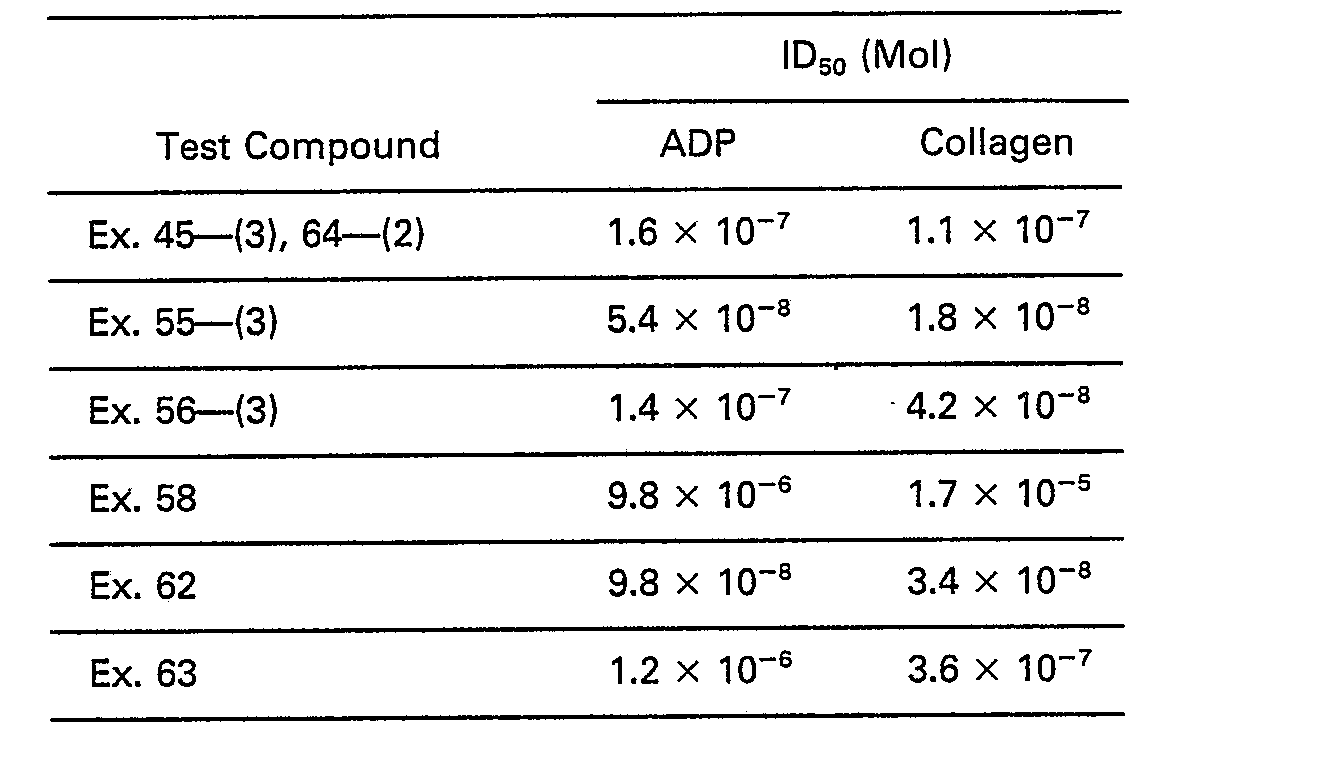
- As being apparent from the above test results, the object compounds (I) of the present invention are useful for antihypertensive medicines and antithrombotic medicines.
- The effective ingredient may usually be administered with a dose of 0.01 mg/kg to 500 mg/kg, 1 to 4 times a day in a preparations such astablet, granule, powder, capsule, syrup, injection, suppository and the like. However, the above dosage may be increased or decreased according to the age, weight or conditions of the patient or the administering method.
- The pharmaceutical preparation may be prepared in a conventional manner.
- The following examples are given only for the purpose of illustrating the present invention in more detail.
- (1) A mixture of 5-methyl-3-methylthio-6-phenyl-1,2,4-triazine (2.17 g) and N,N-diethylethylenediamine (2.99 g) was heated at 150°C to 160°C for 17 hours. The reaction mixture was dissolved in ethyl acetate, washed with water and brine, and then dried over sodium sulfate, which was treated with silica gel and filtered by suction.
- The filtrate was evaporated to dryness and the resulting residue was crystallized with diisopropyl ether under ice cooling. The resultant crystals were collected by filtration, washed with diisopropyl ether and dried to give 3-(2-diethylaminoethylamino)-5-methyl-6-phenyl-1,2,4-triazine (1.83 g).
- NMR (CDCl3, δ): 1.04 (6H, t, J=7Hz), 2.41 (3H, s), 2.57 (4H, q, J=7Hz), 2.70 (2H, t, J=5.8Hz), 3.58 (2H, q, J=8Hz), 5.91 (1H, b. s), 7.46 (5H, m)
- (2) Sodium borohydride (2.13 g) was added portionwise to a stirred solution of the above obtained 3-(2-diethylaminoethylamino)-5-methyl-6-phenyl-1,2,4-triazine (3.14 g) in methanol (15 ml) at room temperature. The reaction mixture was filtered by suction, and the filtrate was concentrated under reduced pressure. The residue was subjected to column chromatography on silica gel (50 g) using a mixture of benzene and methylamine (40% in methanol) (100:1) as an eluent. The eluate was concentrated, and the residue was dissolved in benzene. The solution was extracted with 1N hydrochloric acid and then, made alkaline with an aqueous solution of sodium carbonate. The mixture was extracted with diethyl ether. The extract was washed with water, dried over sodium sulfate, and evaporated to give an oil of 3-(2-diethyl- aminoethylamino)-5-methyl-6-phenyl-2,5-dihydro-1,2,4-triazine (0.69 g).
- NMR (CDCl3, δ): 1.04 (6H, t, J=7.1Hz), 1.25 (3H, d, J=5.8Hz), 2.5-2.7 (2H, m), 2.55 (4H, q, J=7.1Hz), 3.17~3.4 (2H, m), 4.68 (lH. a. J=5.8Hz), 6.6 (1H, m), 7.25-7.5 (3H, m), 7.46-7.9 (2H, m)

- (1) 3-[4-(2-Hydroxyethyl)-1-piperazinyl]-5-methyl-6-phenyl-1,2,4-triazine (2.11 g) was obtained by reacting 1-(2-hydroxyethyl)piperazine (2.8 g) with 5-methyl-3-methylthio-6-phenyl-1,2,4-triazine (2.17 g) in a similar manner to that of Example 1―(1). (crystallized from diethyl ether)
- NMR (CDCI3, δ): 2.45 (3H, s), 2.63 (6H, t, J=5.4Hz), 3.70 (2H, t, J=5.4Hz), 4.00 (4H, t, J=5.4Hz), 7.47 (5H, m)
- (2) Sodium borohydride (2.72 g) was added portionwise to a stirred solution of 3-[4-(2-hydroxyethyl)-1-piperazinyll-5-methyl-6-phenyl-1,2,4-triazine (3.6 g) in methanol (15 ml) at room temperature. The reaction mixture was filtered by suction and the filtrate was evaporated. The resultant residue was extracted with ethyl acetate after addition of water, and the extract was washed with brine, dried over sodium sulfate and concentrated to a small volume. The resultant precipitates were collected by filtration, washed with diisopropyl ether and recrystallized from a mixture of ethyl acetate and diisopropyl ether to give 3-[4-(2-hydroxyethyl)-1-piperazinyl]-5-methyl-6-phenyl-2,5-dihydro-1,2,4-triazine (2.28 g), mp 103-105°C.
- NMR (CDCI3, δ): 1.25 (3H, d, J=6.8Hz), 2.45-2.75 (6H, m), 3.36 (4H, t, J=5Hz), 3.68 (2H, t, J=5.3Hz), 4.81 (1 H, q, J=6.8Hz), 7.35-7.62 (3H, m), 7.73-7.98 (2H, m)

- (1) A mixture of 5-methyl-3-methylthio-6-phenyl-1,2,4-triazine (4.15 g) and p-chloroaniline (4.22 g) was heated at 150° to 160°C for 18 hours.
- After cooling, the resulting solid was washed successively with ethyl acetate, chloroform and methanol, and then dried to give 3-(4-chloroanilino)-5-methyl-6-phenyl-1,2,4-triazine (4.26 g).
- NMR (DMSO-ds, δ): 2.49 (3H, s), 7.39 (2H, d, J=9Hz), 7.61 (5H, m), 7.93 (2H, d, J=9Hz), 10.25 (1H, b, s)
- (2) 3-(4-Chloroanilino)-5-methyl-6-phenyl-2,5-dihydro-1,2,4-triazine (3.60 g) was obtained by reacting sodium borohydride (4.3 g) with 3-(4-chloroanilino)-5-methyl-6-phenyl-1,2,4-triazine (4.25 g) in a similar manner to that of Example 2-(2).
- mp 178.5-180°C (recrystallized from a mixture of ethanol and water)
- NMR (DMSO-ds, δ): 1.19 (3H, d, J=7Hz), 4.70 (1 H, q, J=7Hz), 7.15-7.69 (7H, m), 7.69-7.93 (2H, m), 8.74 (2H, m)
- (1) A mixture of 5-methyl-3-methylthio-6-phenyl-1,2,4-triazine (9 g) and N-(2-furoyl)piperazine (10 g) was heated at 150 to 160°C for 89 hours with stirring. The reaction mixture was dissolved in benzene (300 ml) and subjected to chromatography on silica gel (300 g) using a mixture of benzene and ethyl acetate (3:2) as an eluent. The eluate was concentrated to dryness and the resulting solid was recrystallized from a mixture of chloroform and diisopropyl ether to give crystals of 3-[4-(2-furoyl)-1-piperazinyl]-5-methyl-6-phenyl-1,2,4-triazine (4.20 g), mp 141.5-142.5°C.
- NMR (CDCI3, δ): 2.50 (3H, s), 4.05 (8H, s), 6.55 (1H, d, d, J=2, 3.5Hz), 7.14 (1H, d, J=3.5Hz), 7.57-7.78 (6H, m)

- (2) 3-[4-[2-Furoyl)-1-piperazinyl]-5-methyl-6-phenyl-2,5-dihydro-1,2,4-triazine was obtained by reacting sodium borohydride (3.81 g) with 3-[4-(2-furoyl)-1-piperazinyl]-5-methyl-6-phenyl-1,2,4-triazine (3.47 g) in a similar manner to that of Example 2-(2). The above obtained crude product was chromatographed on basic alumina (140 g) using a mixture of chloroform and methanol (20:1) as an eluent. The eluate was concentrated to a small volume and resulting precipitates were filtered off by suction. The filtrate was purified by column chromatography on silica gel (100 g) with methanol and then on neutral alumina with ethyl acetate as an eluent to give an oil of the object compound (2.2 g).
- NMR (CDCl3, 6): 1.24 (3H, d, J=6.7Hz), 3.25-3.54 (4H, m), 3.67-4.0 (4H, m), 4.76 (lH, q, J=6.7Hz), 6.48 (1H, d, d, J=1.8, 3.4Hz), 7.04 (1H, d, J=3.4Hz), 7.3-7.55 (4H, m), 7.65-7.9 (2H, m)
- (1) 5-Methyl-3-(4-methyl-1-piperazinyl)-6-phenyl-1,2,4-triazine (3.9 g) was obtained by reacting N-methylpiperazine (8.17 g) with 5-methyl-3-methylthio-6-phenyl-1,2,4-triazine (5.37 g) in a similar manner to that of Example 1-(1).
- NMR (CDCl3, δ): 2.36 (3H, s), 2.45 (3H, s), 2.53 (4H, br. t, J=5Hz), 4.01 (4H, br. t, J=5Hz), 7.52 (5H, m)
- (2) 5-Methyl-3-(4-methyl-1-piperazinyl)-6-phenyl-2,5-dihydro-1,2,4-triazine (1.31 g) was obtained by reacting sodium borohydride (2.43 g) and 5-methyl-3-(4-methyl-1-piperazinyl)-6-phenyl-1,2,4-triazine (4.12 g) in a similar manner to that of Example 2-(2).
- mp 124-125°C (crystallized from ethyl acetate)
- NMR (CDCI3, δ): 1.21 (3H, d, J=6.9Hz), 2.27 (3H, s), 2.41 (4H, t, J=4.9Hz), 3.33 (4H, t, J=4.9Hz), 4.75 (1 H, g. J=6.9Hz), 7.25-7.53 (3H, m), 7.6-7.9 (2H, m), 8.26 (1H, m)

- (1) A mixture of 5-methyl-3-methylthio-6-phenyl-1,2,4-trazine (3 g) and ethanolamine (3 g) was heated at 150 to 160°C for 5.25 hours. The reaction mixture was dissolved in ethyl acetate, washed with water and brine, dried over sodium sulfate and concentrated under reduced pressure. The residue was crystallized from a small amount of diethyl ether and then diisopropyl ether was added with diisopropyl ether and dried to give 3-(2-hydroxyethylamino)-5-methyl-6-phenyl-1,2,4-triazine (2.82 g).
- NMR (CDCI3, δ): 2.44 (3H, s), 3.5-4.05 (4H, m), 4.35 (1H, br. m), 7.49 (6H, m)
- (2) 3-(2-Hydroxyethylamino)-5-methyl-6-phenyl-2,5-dihydro-1,2,4-triazine (1.40 g) was obtained by reacting sodium borohydride (1.8 g) with 3-(2-hydroxyethylamino)-5-methyl-6-phenyl-1,2,4-triazine (2.75 g) in a similar manner to that of Example 2-(2).
- m.p. 138~139°C [recrystallized from ethanol and water (1:3)].
- NMR (DMSO-ds, δ): 1.0;4 (3H, d, J=7Hz), 3.04-3.36 (2H, m), 3.38~3.70 (2H, m), 4.57 (1 H, q, J=7Hz), 5.6 (2H, m), 7.30-7.53 (3H, m), 7.64-7.85 (2H, m)

- (1) 3-N,N-Bis(2-hydroxyethyl)amino-5-methyl-6-phenyl-1,2,4-triazine (4.13 g) was obtained by reacting N,N-bis(2-hydroxyethyl)amine (6.63 g) with 5-methyl-3-methylthio-6-phenyl-1,2,4-triazine (6.8 g) in a similar manner to that of Example 1―(1). The purification was conducted with column chromatography on silica gel (85 g) using a mixture of benzene and ethyl acetate as an eluent.
- NMR (CDCI3, δ): 2.41 (3H, s), 3.93 (8H, s), 4.33 (2H, b.s.), 7.46 (5H, m)
- (2) 3-[N,N-Bis(2-hydroxyethyl)amino)-5-methyl-6-phenyl-2,5-dihydro-1,2,4-triazine (0.85 g) was obtained by reacting sodium borohydride (2.78 g) with 3-[N,N-bis(2-hydroxyethyl)amino]-5-methyl-6-phenyl-1,2,4-triazine (4 g) in a similar manner to that of Example 2-(2). The purification was conducted with column chromatography on silica gel (50 g) using a mixture of ethyl acetate and methylamine (40% in methanol) (10:1), and then on neutral alumina (120 g) using a mixture of benzene, chloroform, and methanol (10:5:1) as an eluent.
- NMR (CDCI3, δ): 1.18 (3H, d, J=6.9Hz), 2.97~3.9 (8H, m), 4.63 (1H, q, J=6.9Hz), 6.83 (3H, s), 7.27-7.51 (3H, m), 7.61-7.85 (2H, m)
- (1) 5-Methyl-3-morpholino-6-phenyl-1,2,4-triazine (2.40 g) was obtained by reacting N-aminomorpholine (3 g) with 5-methyl-3-methylthio-6-phenyl-1,2,4-triazine (3.1 g) in a similar manner to that of Example 1-(1).
- NMR (CDCI3, δ): 2.46 (3H, s), 3.90 (8H, m), 7.54 (5H, m)
- (2) 5-Methyl-3-morpholino-6-phenyl-1,2,4-triazine (2.32 g) was dissolved in ethanol (40 ml) containing anhydrous hydrogen chloride and hydrogenated over 10% palladium on carbon (0.33 g) under an atmospheric pressure at room temperature. After the theoretical amount of hydrogen gas was absorbed, the catalyst was filtered off, and the filtrate was evaporated under reduced pressure. The residual solid was recrystallized from ethanol to give crystals of 5-methyl-3-morpholino-6-phenyl-2,5-dihydro-1,2,4-triazine hydrochloride, mp 213-215.5°C.
- NMR (DMSO-d6, δ): 1.27 (3H, d, J=6.9Hz), 3.70 (8H, m), 4.92 (1H, q, J=6.9Hz), 7.44-7.7 (3H, m), 7.8-8.03 (2H, m) 11.5 (2H, br. m)

- (1) A mixture of 5-methyl-3-methylthio-6-phenyl-1,2,4-triazine (20 g) and methylhydrazine (15.3 g) in ethanol (30 ml) was heated under reflux for 66 hours. After cooling, the reaction mixture was concentrated under reduced pressure and the residue was dissolved in chloroform. The solution was washed with water and brine successively, dried over sodium sulfate, and then evaporated. The residue was crystallized with diethyl ether, washed with diethyl ether, and dried to give 5-methyl-3-(1-methylhydrazino)-6-phenyl-1,2,4-triazine (13.91 g).
- NMR (CDCI3, δ): 2.47 (3H, s), 3.47 (3H, s), 4.59 (2H, b.s.), 7.50 (5H, m)
- (2) 5-Methyl-3-(1-methylhydrazino)-6-phenyl-1,2,4-triazine (2.9 g) was dissolved in ethanol (50 ml) containing anhydrous hydrogen chloride and hydrogenated over 5% palladium on carbon (0.33 g) under atmospheric pressure at room temperature. After the theoretical amount of hydrogen gas was absorbed, the catalyst was filtered off, and the filtrate was concentrated under reduced pressure. The residue was neutralized with an aqueous solution of sodium carbonate and extracted with ethyl acetate. The extract was dried over sodium sulfate and concentrated under reduced pressure. The residual solid was recrystallized from ethanol to give colorless crystals of 5-methyl-3-(1-methylhydrazino)-6-phenyl-2,5-dihydro-1,2,4-triazine, mp 139.5-141°C.
- NMR (CDCI3, 6): 1.23 (3H, d, J=6.8Hz), 3.17 (3H, s), 3.64 (2H, br. m), 4.75 (1H, q, J=6.8Hz), 7.28-7.53 (3H, m), 7.65-7.9 (2H, m), 9.0 (1H, br. m)

- (1) 5-Methyl-6-phenyl-3-piperidino-1,2,4-triazine (1.52 g) was obtained by reacting N-aminopiperidine (3 g) with 5-methyl-3-methylthio-6-phenyl-1,2,4-triazine (3 g) in a similar manner to that of Example 1―(1). The purification was conducted with column chromatography on silica gel (100 g) using a mixture of benzene and ethyl acetate (20:1) as an eluent.
- NMR (CDCI3, 6): 1.71 (6H, m), 2.43 (3H, s), 3.92 (4H, m), 7.47 (5H, m)
- (2) 5-Methyl-6-phenyt-3-piperidino-2,5-dihydro-1,2,4-triazine (0.79 g) was obtained by reduction of the corresponding triazine compound (1.52 g) with 10% palladium on carbon (0.3 g) in a similar manner to that of Example 9-(2).
- mp 131~132°C (recrystallized from benzene)
- NMR (CDCI3, δ): 1.22 (3H, d, J=7Hz), 1.59 (6H, m), 3.26 (4H, m), 4.69 (1 H, q, J=7Hz), 7.2-7.5 (3H, m), 7.6-7.85 (2H, m)

- (1) m-Chloroperbenzoic acid (20 g) was added to a stirred solution of 5-methyl-3-methylthio-6-phenyl-1,2,4-triazine (20 g) in chloroform (600 ml) under ice cooling, and the mixture was stirred for 30 minutes at room temperature. The reaction mixture was washed with a saturated aqueous solution of sodium bicarbonate, dried over sodium sulfate, and then concentrated. The resulting residue was crystallized with diethyl ether, and the crystals were collected by filtration, washed with diethyl ether and dried to give 5-methyl-3-methylsulfinyl-6-phenyl-1,2,4-triazine (19.0 g).
- NMR (CDCI3, 6): 2.79 (3H, s), 3.13 (3H, s), 7.65 (5H, m)
- (2) 5-Methyl-3-methylsulfonyl-6-phenyl-1,2,4-triazine (9.27 g) was obtained by reacting m-chloroperbenzoic acid (9.6 g) and 5-methyl-3-methylsulfinyl-6-phenyl-1,2,4-triazine (10 g) in a similar manner to that of Example 11-(1).
- NMR (CDCI3, 6): 2.77 (3H, s), 3.51 (3H, s), 7.64 (5H, m)
- (3) n-Butyllithium (25 g/250 ml solution in hexane) (28.5 ml) was added dropwise to a stirred solution of N-aminopiperidine (4.12 g) in tetrahydrofurane (40 ml) at -78°C and the stirring was continued for 2 hours at room temperature.
- A solution of 5-methyl-3-methylsulfonyl-6-phenyl-1,2,4-triazine (5 g) in tetrahydrofuran (100 ml) was added dropwise to the above obtained solution at -78°C in 70 minutes with stirring and the stirring was continued for 30 minutes at the same temperature. The reaction mixture was washed with water and brine, and then extracted with ethyl acetate. The extract was washed with brine, dried over sodium sulfate and evaporated. The resulting residue was dissolved in chloroform and extracted with an aqueous solution of 6N-hydrochloric acid. The extract was made alkaline with an aqueous solution of potassium carbonate and extracted with ethyl acetate. The extract was washed with water, dried over sodium sulfate, and evaporated. Thus obtained crude product (3.82 g) was purified by chromatography on silica gel (100 g) using a mixture of benzene and ethyl acetate (2: 1) as an eluant and recrystallized from diisopropyl ether to give crystals of 5-methyl-6-phenyl-3-piperidinoamino-1,2,4-triazine (2.25 g).
- NMR (CDCI3, δ): 1.34-2.06 (6H, m), 2.49 (3H, s), 2.94 (4H, br.t., J=5.1 Hz), 6.32 (1 H, b.s.), 7.53 (5H, m)
- (4) 5-Methyl-6-phenyl-3-piperidinoamino-1,2,4-triazine (2.25 g) was dissolved in ethanol (50 ml) containing anhydrous hydrogen chloride and hydrogenated over 5% palladium on carbon (0.38 g) under atmospheric pressure at room temperature. After the theoretical amount of hydrogen gas was absorbed, the catalyst was filtered off, and the filtrate was concentrated under reduced pressure. The residue was neutralized with an aqueous solution of sodium carbonate and extracted with ethyl acetate. The extract was dried over sodium sulfate, concentrated under reduced pressure and the residual solid was recrystallized from ethanol to give colorless crystals of 5-methyl-6-phenyl-3-piperidinoamino-2,5-dihydro-l,2,4-triazine (1.46 g), mp 188.5-189.5°C.
- NMR (CDCI3, δ): 1.28 (3H, d, J=6.5Hz), 1.40-1.94 (6H, m), 2.70 (4H, br.t, J=5Hz), 4.66 (1H, q, J=6.5Hz), 7.30-7.56 (3H. m). 7.57-7.90 (2H. m)

- Sodium borohydride (3.4 g) was added portionwise to a stirred solution of 5-methyl-3-methylthio-6-phenyl-1,2,4-triazine (10 g) in tetrahydrofuran (25 ml). To the reaction mixture was added ethyl acetate, and the mixture was washed successively with 1 N-hydrochloric acid, water and brine, dried over sodium sulfate, and concentrated to dryness. The residual solid was recrystallized from a mixture of ethanol and water to give 5-methyl-3-methylthio-6-phenyl-2,5-dihydro-1,2,4-triazine (3.46 g), m.p. 159―160°c.
- NMR (CDCl3, δ): 1.27 (3H, d, J=7Hz), 2.50 (3H, s), 4.92 (1 H, q, J=7Hz), 7.26-7.53 (3H, m), 7.64-7.84 (2H, m)

- (1) A solution of 5-methyl-3-methylthio-6-phenyl-1,2,4-triazine (7 g) and hydrazine hydrate (5 ml) in ethanol (15 ml) was heated under reflux for 8 hours. The reaction mixture was evaporated and the resultant residue was washed with water, dried and recrystallized from a mixture of ethanol and water (5: 3) to give crystals of 3-hydrazino-5-methyl-6-phenyl-1,2,4-triazine (3.76 g), m.p. 136.5-137.5°C.

- (2) A mixture of 3-hydrazino-5-methyl-6-phenyl-1,2,4-triazine (6.6 g), triethylamine (5.4 g), 2-t-butoxy- carbonyloxyimino-2-phenylacetonitrile (9.76 g) in tetrahydrofuran (60 ml) was heated at 63°C for 5.5 hours with stirring and then allowed to stand at room temperature for 61 hours. The mixture was treated with diisopropyl ether (40 ml), and the resultant precipitates were collected by filtration, washed successively with diisopropyl ether, methanol and diisopropyl ether, and dried to give 3-(2-t-butoxycarbonylhydrazino)-5-methyl-6-phenyl-1,2,4-triazine (8.92 g).
- NMR (DMSO-ds, δ): 1.48 (9H, s), 2.43 (3H, s), 7.56 (5H, m), 9.04 (1H, b.s.), 9.36 (1H, b.s.).
- (3) 3-(2-t-Butoxycarbonylhydrazino)-5-methyl-6-phenyl-2,5-dihydro-1,2,4-triazine (8.09 g) was obtained by reduction of the corresponding triazine compound (8.92 g) in a similar manner to that of Example 2-(2). (recrystallized from methanol).
- NMR (DMSO-d6, δ): 1.17 (3H, d, J=6.7Hz), 1.42 (9H, s), 4.54 (1H, q, J=6.7Hz), 7.36 (3, m), 7.67 (2H, m), 8.2 (3H, m).
- (4) 3-(2-t-Butoxycarbonylhydrazino)-5-methyl-6-phenyl-2,5-dihydro-1,2,4-triazine (5.27 g) was dissolved in a saturated methanolic solution of hydrogen chloride (40 ml), and the solution was allowed to stand at room temperature for 3.5 hours. The reaction mixture was evaporated under reduced pressure and the residual solid was recrystallized from ethanol to give colorless crystals of 3-hydrazino-5-methyl-6-phenyl-2,5-dihydro-1,2,4-triazine hydrochloride (3.99 g), m.p. 214-215°C.
- NMR (DMSO-ds, 6): 1.28 (3H, d, J=7.9Hz), 4.6 (2H, m), 4.93 (1 H, q, J=7.9Hz), 7.4-7.67 (3H, m), 7.7-8.03 (2H, m), 9.6 (2H, m), 11.96 (1 H, m).

- (1) A solution of ethyl chloroformate (1.98 g) in methylene chloride (5 ml) was added dropwise to a stirred solution of 3-hydrazino-5-methyl-6-phenyl-1,2,4-triazine (3.68 g) in methylene chloride (40 ml) under ice cooling in 15 minutes, and the reaction mixture was treated with a solution of triethylamine (1.8 g) in methylene chloride (10 ml) under ice cooling. The reaction mixture was concentrated under reduced pressure. The residue was extracted with ethyl acetate after addition of water. The extract was washed with 5% hydrochloric acid and water, dried over magnesium sulfate, concentrated under reduced pressure, and the residue was pulverized with diisopropyl ether. The resulting precipitates were collected by filtration, washed with water and dried to give 3-(2-ethoxycarbonylhydrazino)-5-methyl-6-phenyl-1,2,4-triazine (3.23 g).
- NMR (CDCI3, δ): 1.30 (3H, t, J=7.1Hz), 2.50 (3H, s), 4.26 (2H, q, J=7.1Hz), 7.03 (1H, m), 7.54 (5H, s).
- (2) 3-(2-Ethoxycarbonylhydrazino)-5-methyl-6-phenyl-2,5-dihydro-1,2,4-triazine (1.02 g) was obtained by reacting sodium borohydride (0.47 g) with 3-(2-ethoxycarbonylhydrazino)-5-methyl-6-phenyl-1,2,4-triazine (1.93 g) in a similar manner to that of Example 2-(2). m.p. 186.5-187°C (decomp.) (recrystallized from ethanol).
- NMR (DMSO-ds, δ): 1.17 (3H, d, J=6.9Hz), 1.18 (3H, t, J=7Hz), 4.05 (2H, q, J=7Hz), 4.55 (1 H, q, J=6.9Hz), 7.31-7.53 (3H, m), 7.61-7.85 (2H, m), 8.6 (2H, br.m).

- (1) Acetic anhydride (1.6 g) was added dropwise to a stirred solution of 3-hydrazino-5-methyl-6-phenyl-1,2,4-triazine (3 g) in methylene chloride (30 ml) under ice cooling and then the stirring was continued for 15 minutes. The solution was washed with water, dried over sodium sulfate and concentrated under reduced pressure. The residue was crystallized from a mixture of methylene chloride and diisopropyl ether to give 3-(2-acetylhydrazino)-5-methyl-6-phenyl-1,2,4-triazine (3.37 g).
- NMR (CDCI3, δ): 2.14 (3H, s), 2.48 (3H, s), 7.52 (5H, s), 7.94 (1H, b.s.), 9.20 (1H, b.s.).
- (2) Sodium borohydride (1.11 g) was added to a stirred solution of 3-(2-acetylhydrazino)-5-methyl-6-phenyl-1,2,4-triazine (3.29 g) in methanol (30 ml) at room temperature and then the stirring was continued for 1 hour. The precipitates were collected by filtration, washed successively with water, methanol, and diisopropyl ether, and then recrystallized from a mixture of methanol and water to give colorless crystals of 3-(2-acetylhydrazino)-5-methyl-6-phenyl-2,5-dihydro-1,2,4-triazine (1.39 g), m.p. 204.5°C-205°C (decomp.).
- NMR (DMSO-ds, δ): 1.17 (3H, d, J=6.7Hz), 1.84 (3H, s), 4.56 (1H, q, J=6.7Hz), 7.34-7.56 (3H, m), 7.63-7.87 (2H, m).

- (1) Formic acid (5 ml) was added dropwise to acetic anhydride (10 ml) with stirring under ice cooling, and stirred at 50°C for 15 minutes. To the solution was added 3-hydrazino-5-methyl-6-phenyl-1,2,4-triazine (5 g) with stirring under ice cooling, and the stirring was continued for 50 minutes under ice cooling. The reaction mixture was poured into ice water, and the resultant precipitates were collected by filtration and washed with water. The above obtained solid was dissolved in methanol (100 ml), the solution was treated with 28% ammonium hydroxide (14 drops) and evaporated to give white powder of 3-(2-formylhydrazino)-5-methyl-6-phenyl-1,2,4-triazine (4.505 g).
- IR (Nujol®): 3220, 1685 cm-'
- NMR (DMSO-ds, 5): 2.42 (3H, s), 7.4-7.6 (5H, m), 8.18 (1H, s), 9.5 (1H, b.s.), 10.1 (1H, b.s.).
- (2) A solution of 3-(2-formylhydrazino)-5-methyl-6-phenyl-l,2,4-triazine (2.71 g) in acetic acid (60 ml) was hydrogenated over 5% palladium on carbon (2 g) under atmospheric pressure at room temperature. After the theoretical amount of hydrogen gas was absorbed, the catalyst was filtered off, washed with methanol, and the filtrate was evaporated. The residue was dissolved in water, and the solution was washed with chloroform, neutralized with an aqueous solution of sodium carbonate, and extracted with chloroform. The extract was washed with water, dried over magnesium sulfate, and concentrated under reduced pressure. The resultant residue was recrystallized from methanol to give colorless crystals of 3-(2- formylhydrazino)-5-methyl-6-phenyl-2,5-dihydro-1,2,4-triazine (0.59 g), m.p. 216~219°C (decomp.).
- NMR (DMSO-ds, 6): 1.18 (3H, d, J=6.7Hz), 3.33 (1H, br.m), 4.58 (1H, q, J=6.7Hz), 7.35-7.6 (3H, m), 7.6-7.83 (2H, m), 7.87 (1H, s), 9.40 (2H, br.m).

- (1) A solution of ethyl chloroformate (1.628 g) in methylene chloride (6 ml) was added dropwise to a stirred solution of acetoxyacetic acid (1.77 g) and triethylamine (1.515 g) in methylene chloride (30 ml) under ice cooling in 3 minutes, and the stirring was continued for 10 minutes under ice cooling. To the mixture was added quickly a solution of 3-hydrazino-5-methyl-6-phenyl-1,2,4-triazine (2.01 g) in chloroform (28 ml) with stirring under ice cooling, and then the stirring was continued for 20 minutes. The solution was washed with water, dried over sodium sulfate, and concentrated. The resultant residue was dissolved in methanol (50 ml), and a soluton of sodium hydroxide (0.8 g) in water (10 mi) was added thereto under ice cooling. After stirring for 0.5 hours, the solution was evaporated under reduced pressure and the residue was dissolved in water. To the solution was added dry ice and then the solution was concentrated under reduced pressure. The resultant precipitates were collected by filtration, washed with cold water and dried. On the other hand, the filtrate was salted out and extracted with ethyl acetate. The extract was dried over magnesium sulfate and evaporated to give a solid residue. The residue was combined with the substance obtained above, and recrystallized from a mixture of ethyl acetate and ethanol to give colorless crystals of 3-(2-hydroxyacetylhydrazino)-5-methyl-6-phenyl-1,2,4-triazine (1.852 g).
- IR (Nujol®): 3200, 3100 (shoulder), 3050 (shoulder), 1675 cm-1
- NMR (DMSO-ds): 2.41 (3H, s), 4.04 (2H, d, J=6Hz), 5.53 (1H, t, J=6Hz), 7.4-7.7 (5H, m), 9.4 (1H, b.s.), 9.86 (1H, b.s.).
- (2) Sodium borohydride (0.494 g) was added portionwise to a stirred solution of 3-(2-hydroxyacetyl- hydrazino)-5-methyl-6-phenyl-1,2,4-triazine (1.684 g) in methanol (30 ml) under ice cooling in 10 minutes and the stirring was continued for 1.5 hours at the same temperature. The reaction mixture was evaporated and the residue was dissolved in water. The solution was passed through a column of DIAION HP-20® (Trademark, manufactured by Mitsubishi Chemical Industries Ltd.) (80 ml) and eluted with water and then with methanol. The methanol eluate was evaporated under reduced pressure and the residual solid was recrystallized from methanol to give colorless crystals of 3-(2-hydroxyacetylhydrazino)-5-methyl-6-phenyl-2,5-dihydro-1,2,4-triazine (0.644 g), m.p. 167-168°C (decomp.).
- IR (Nujol®): 3200, 1640 cm-'
- NMR (DMSO-ds, 6): 1.20 (3H, d, J=6.5Hz), 3.92 (2H, s), 4.59 (1H, q, J=6.5Hz), 7.3-7.6 (3H, m), 7.6-7.9 (2H, m).

- (1) A solution of n-valeryl chloride (1.93 g) in methylene chloride (3 ml) was added dropwise to a stirred solution of 3-hydrazino-5-methyl-6-phenyl-1,2,4-triazine (3.224 g) and triethylamine (1.784 g) in methylene chloride (40 ml) under ice cooling, and the stirring was continued for 30 minutes. The reaction mixture was evaporated and the resultant residue was extracted with ethyl acetate after addition of water. The extract was washed successively with 5% hydrochloric acid, water, a saturated aqueous solution of sodium bicarbonate and water, dried over magnesium sulfate, and then concentrated to a small volume under reduced pressure. The resultant residue was crystallized from diethyl ether, collected by filtration, washed with diethyl ether and dried to give 5-methyl-6-phenyl-3-(2-valerylhydrazino)-1,2,4-triazine (3.406 g).
- IR (Nujol®): 3250, 3200 (shoulder), 1650 cm-'
- NMR (DMSO-ds, δ): 0.89 (3H, t, J=6Hz), 1.5 (4H, broad m), 2.2 (2H, 6, J=6Hz), 2.38 (3H, s), 7.35-7.73 (5H, m), 9.26 (1 H, s), 9.78 (1H, s).
- (2) 5-Methyl-6-phenyl-3-(2-valerylhydrazino)-2,5-dihydro-1,2,4-triazine (1.176 g) was obtained by reduction of the corresponding triazine compound (2.714 g) with 10% palladium on carbon (0.5 g) in a similar manner to that of Example 11-(4). m.p. 178-179°C (recrystallized from isopropyl alcohol).
- IR (Nujol®): 3230, 3050, 1625, 1610 cm-1
- NMR (DMSO-d6; 6): 0.88 (3H, t, J=7Hz), Ca 1.0-1.72 (4H, m), 1.17 (3H, d, J=6.5Hz), 2.11 (2H, t, J=7Hz), 4.54 q, (1 H, J=6.5Hz), 7.12-7.52 (3H, m), 7.52-7.78 (2H, m), Ca 8.4 (2H, b.s.).
- (1) A solution of ethyl chloroformate (3.689 g) in methylene chloride (10 ml) was added dropwise to a stirred solution of N-ethoxycarbonylglycine (4.998 g) and triethylamine (3.434 g) in methylene chloride (60 ml) under cooling in 5 minutes, and the stirring was continued for 5 minutes under cooling. To the solution of the mixed anhydride was added a solution of 3-hydrazino-5-methyl-6-phenyl-1,2,4-triazine (3.417 g) in chloroform (40 ml) and reacted in a similar manner to that of Example 17-(1). The reaction mixture was washed with water, dried over magnesium sulfate, and evaporated under reduced pressure. The residue was dissolved in ethanol (50 ml) and a solution of sodium hydroxide (1.6 g) in water (10 ml) was added dropwise to the solution with stirring under ice cooling in 5 minutes. After stirring for 30 minutes at room temperature, the solution was evaporated, and the residue was dissolved in a small amount of water. The solution was salted out and extracted with ethyl acetate. The extract was washed with a saturated aqueous solution of sodium chloride, dried over magnesium sulfate, and evaporated. The residue was dissolved in chloroform containing a small amount of ethanol and the solution was chromatographed on silica gel (50 g). The eluent with a mixture of chloroform and ethanol (30:1) gave a colorless solid of 3-[2-(N-ethoxycarbonylglycyl)hydrazino]-5-methyl-6-phenyl-1,2,4-triazine (1.872 g).
- NMR (DMSO-ds, δ): 1.17 (3H, t, J=7Hz), 2.41 (3H, s), 3.76 (2H, d, J=6Hz), 4.03 (2H, q, J=7Hz), 7.2-7.8 (6H, m), 9.43 (1H, b.s.), 10.02 (1H, b.s.).
- (2) A solution of 3-[2-(N-ethoxycarbonylglycyl)hydrazino]-5-methyl-6-phenyl-1,2,4-triazine (1.815 g) in ethanol (32 ml) containing anhydrous hydrogen chloride was shaken with 5% palladium on carbon (0.4 g) under atmosphere of hydrogen gas at room temperature. After the theoretical amount of hydrogen gas was absorbed, the catalyst was filtered off, and the filtrate was evaporated. The residue was dissolved in water and made alkaline with an aqueous solution of sodium bicarbonate under ice cooling. The resulting precipitates were collected by filtration, washed with water, dried, and recrystallized from ethanol to give colorless crystals of 3-[2-(N-ethoxycarbonylglycyl)hydrazino]-5-methyl-6-phenyl-2,5-dihydro-1,2,4-triazine (1.198 g), m.p. 144.5-145.5°C.
- IR (Nujol®): 3600, 3400, 3220, 1710, 1665, 1625, 1610 cm-1
- NMR (DMSO-ds, δ): 1.17 (3H, t, J=7Hz), 1.18 (3H, d, J=6.5Hz), Ca 3.3 (1 H, b.s.), 3.64 (2H, d, J=6Hz), 4.01 (2H, q, J=7Hz), 4.54 (lH, q, J=6.5Hz), 7.3-7.53 (3H, m), 7.53-7.8 (2H, m), Ca 7.1 (1 H, b.s.), Ca 9.0 (2H, b.s.).

- (1) The reaction of ethyl chloroformate (2.441 g) with N-t-butoxycarbonylglycine (3.938 g) in methylene chloride under ice cooling gave a solution comprising the mixed acid anhydride, which was reacted with 3- hydrazino-5-methyl-6-phenyl-1,2,4-triazine (3.015 g) in a similar manner to that of Example 17-(1 ) to give 3-[2-(N-t-butoxycarbonylglycyl)hydrazino]-5-methyl-6-phenyl-l,2,4-triazine (4.068 g). The purification was conducted with column chromatography on silica gel (80 g) using a mixture of methylene chloride and methanol (30:1) as an eluent.
- NMR (CDCI3, δ): 1.45 (9H, s), 2.43 (3H, s), 4.03 (2H, d, J=6Hz), 5.79 (1 H, t, J=6Hz), 7.4-7.6 (5H, m), 8.0 (1H, b.s.), 9.45 (1H, b.s.).
- ' (2) Sodium borohydride (0.494 g) was reacted with 3-[2-(N-t-butoxycarbonylglycyl)hydrazino]-5-methyl-6-phenyl-1,2,4-triazine (3.58 g) in a similar manner to that of Example 2-(2) to give a solution containing the corresponding 2,5-dihydro-1,2,4-triazine compound. The reaction mixture was concentrated under reduced pressure after addition of dry ice. The residue was dissolved in chloroform. The solution was washed with a saturated aqueous solution of sodium chloride, dried over magnesium sulfate and evaporated. The resultant oily residue (3.71 g) was dissolved in ethanol (30 ml). To the solution was added a saturated ethanolic solution of hydrogen chloride (30 ml) under ice cooling, and then the stirring was continued for 2.5 hours at the same temperature. The reaction mixture was evaporated. The resultant solid was recrystallized from 10% hydrochloric acid to give colorless crystals of 3-(2-glycylhdrazino)-5-methyl-6 phenyl-2,5-dihydro-1,2,4-triazine dihydrochloride (2.054 g), m.p. 251-253°C (decomp.).
- IR (Nujol®): 2800-3200 (broad), 1650 cm-1
- NMR (D20, δ): 1.37 (3H, d, J=6.5Hz), 4.21 (2H, s), 4.91 (1 H, q, J=6.5Hz), 7.4-7.8 (5H, m).

- (1) 3-(2-Benzoylhydrazino)-5-methyl-6-phenyl-1,2,4-triazine (3.58 g) was obtained by reacting benzoyl chloride (1.17 g) with 3-hydrazino-5-methyl-6-phenyl-1,2,4-triazine (2.45 g) in the presence of triethylamine (1.23 g) in a similar manner to that of Example 14-(1). This substance was crystallized with diisopropyl ether.
- NMR (DMSO-ds, δ): 2.45 (3H, s), 7.61 (8H, m), 8.06 (2H, m), 9.66 (1H, s), 10.69 (1H, s).
- (2) Sodium borohydride (1.98 g) and 3-(2-benzoylhydrazino)-5-methyl-6-phenyl-1,2,4-triazine (3.45 g) was reacted in a similar manner to that of Example 2-(2). The reaction mixture was diluted with diisopropyl ether and the resultant precipitates were collected, washed successively with water, methanol and diisopropyl ether, and recrystallized from a mixture of ethanol, chloroform and water to give colorless crystals of 3-(2-benzoylhydrazino)-5-methyl-6-phenyl-2,5-dihydro-1,2,4-triazine (1.76 g), m.p. 217.5-218°C (decomp.).
- NMR (DMSO-ds, δ): 1.23 (3H, d, J=6.5Hz), 4.63 (1 H, q, J=6.5Hz), 7.33-7.62 (6H, m), 7.67-8.06 (4H, m).

- (1) A solution of methyl isocyanate (0.92 g) in methylene chloride (3 ml) was added dropwise to a stirred solution of 3-hydrazino-5-methyl-6-phenyl-1,2,4-triazine (3 g) in methylene chloride (20 ml) at room temperature. The reaction mixture was diluted with diisopropyl ether (30 ml). The resultant precipitates were collected by filtration to give a solid of 5-methyl-3-(4-methylsemicarbazido)-6-phenyl-1,2,4-triazine (3.8 g).
- NMR (DMSO-ds, δ): 2.43 (3H, s), 2.62 (3H, d, J=5Hz), 6.46 (1H; br.q.; J=5Hz), 7.6 (5H, m), 8.06 (1H, s), 9.24 (1 H, s).
- (2) 5-Methyl-3-(4-methylsemicarbazido)-6-phenyl-1,2,4-triazine (3.8 g) was reacted with sodium borohydride (1.5 g) in methanol. The precipitates in the reaction mixture were collected by filtration, washed with water and with methanol, and then dissolved in dimethyl sulfoxide. To the solution was added water. The resultant precipitates were collected by filtration, washed with water and ethanol, and then dried to give pale yellow powder of 5-methyl-3-(4-methylsemicarbazido)-6-phenyl-2,5-dihydro-1,2,4-triazine (2.48 g), m.p. 214°C (decomp.).
- NMR (DMSO-ds, δ): 1.18 (3H, d, J=6.8Hz), 2.65 (3H, d, J=4.5Hz), 4.57 (1 H, q, J=6.8Hz), 6.01 (1 H, br.d., J=4.5Hz), 7.48 (3H, m), 7.7 (2H, m), 9.1 (2H, m).

- (1) 5-Methyl-6-phenyl-3-(4-phenylsemicarbazido)-1,2,4-triazine (2.88 g) was obtained by reacting phenyl isocyanate (1.13 g) with 3-hydrazino-5-methyl-6-phenyl-1,2,4-triazine (1.87 g) in a similar manner to that of Example 22-(1).
- NMR (DMSO-ds, δ): 2.45 (3H, s), 6.95-7.80 (10H, m), 8.34 (1H, s), 8.87 (1H, s), 9.37 (1H, s).
- (2) 5-Methyl-6-phenyl-3-(4-phenylsemicarbazido)-2,5-dihydro-1,2,4-triazine (1.63 g) was obtained by reduction of the corresponding triazine compound (2.86 g) in a similar manner to that of Example 2-(2). m.p. 175°C (decomp.) (recrystallized from a mixture of ethanol and diisopropyl ether).
- NMR (DMSO-ds, δ): 1.21 (3H, d, J=6.3Hz), 4.58 (1H, q, J=6.3Hz), 6.8-7.56 (8H, m), 7.57-7.78 (2H, m), 7.8-8.4 (2H, b.s.), 9.2 (1H, b.s.).

- (1) C.hydrochloric acid (1 drop) was added to a stirred solution of 3-hydrazino-5-methyl-6-phenyl-1,2,4-triazine (4.12 g) and propionaldehyde (4 ml) in methanol (15 ml) at room temperature, and the stirring was continued for 5 minutes. The reaction mixture was evaporated and the resultant residue was triturated with diethyl ether. The precipitates were collected by filtration to give 5-methyl-6-phenyl-3-(2-propylidenehydrazino)-1,2,4-triazine (3.89 g).
- NMR (CDCI3, δ): 1.33 (3H, t, J=7.3Hz), 2.40 (2H, m), 2.57 (3H, s), 7.50 (6H, m), 11.4 (1H, b.s.).
- (2) 5-Methyl-6-phenyl-3-(2-propylidenehydrazino)-2,5-dihydro-1,2,4-triazine (1.98 g) was obtained by reduction of the corresponding triazine compound (2.85 g) in a similar manner to that of Example 11-(4). m.p. 171-173°C (recrystallized from ethanol).
- NMR (CDCI3, δ): 1.12 (3H, t, J=6.8Hz), 1.36 (3H, d, J=8.8Hz), 2.32 (2H, d, q; J=6.0, 6.8Hz), 4.60 (1H, q, J=8.8Hz), 6.60 (1H, br.m), 7.24-7.44 (3H, m), 7.52-7.87 (3H, m), 9.64 (1H, br.m).

- (1) A mixture of 4'-chloro-2-hydroxyiminopropiophenone (252.3 g), thiosemicarbazide (151.3 g), methanol (650 ml) water (300 ml), and acetic acid (9 ml) was refluxed for 31 hours with stirring. After cooling, the resulting precipitates were collected by filtration, washed successively with methanol, water and methanol, and then dried to give 4'-chloro-2-hydroxyiminopropiophenone thiosemicarbazone (298.88 g).
- NMR (DMSO-ds, δ): 2.16 (3H, s), 7.26 (2H, d, J=8.3Hz), 7.60; (2H, d, J=8.3Hz), 8.30 (1H, b.s.), 8.62 (1H, b.s.), 8.78 (1H, s), 11.77 (1 H, s).
- (2) A mixture of 4'-chloro-2-hydroxyiminopropiophenone thiosemicarbazone (113.21 g), potassium carbonate (128.71 g) and water (990 ml) was refluxed for 25 hours with stirring, and the reaction mixture was treated with activated charcoal and filtered by suction. To the filtrate was added dropwise methyl iodide (76 g) with stirring, and the stirring was continued for 15 minutes at room temperature. The resulting solid was collected by filtration, washed with water and dissolved in chloroform. The solution was treated with silica gel and filtered, and the filtrate was evaporated under reduced pressure. The residue was washed with diisopropyl ether and dried to give a solid of 6-(4-chlorophenyl)-5-methyl-3-methylthio-1,2,4-triazine (61.1 g).
- NMR (CDCI3, δ): 2.56 (3H, s), 2.73 (3H, s), 7.56 (4H, s).
- (3) A solution of 6-(4-chlorophenyl)-5-methyl-3-methylthio-1,2,4-triazine (32.4 g) and hydrazine hydrate (40.8 g) in ethanol (110 ml) was heated for 2 hours. After cooling, the precipitates were collected by filtration, washed with ethanol, dried and recrystallized from ethanol to give 6-(4-chlorophenyl)-3- hydrazino-5-methyl-1,2,4-triazine (4.54 g).
- NMR (DMSO-ds, δ): 2.37 (3H, s), 4.38 (2H, m), 7.57 (4H, s), 8.66 (1H, m).
- (4) 6-(4-Chlorophenyl)-3-hydrazino-5-methyl-1,2,4-triazine (4.36 g) was dissolved in ethanol (70 ml) containing anhydrous hydrogen chloride, and then hydrogenated over 5% palladium on carbon (0.73 g) under atmospheric pressure at room temperature. After the theoretical amount of hydropgen gas was absorbed, the catalyst was filtered off. The filtrate was evaporated under reduced pressure to give a residual solid, which was recrystallized from diluted hydrochloric acid to give colorless crystals of 6-(4-chlorophenyl)-3-hydrazino-5-methyl-2,5-dihydro-1,2,4-triazine hydrochloride (2.04 g), m.p. 207-208°C.
- NMR (DMSO-ds, δ): 1.26 (3H, d, J=7Hz), 4.88 (1H, q, J=7Hz), 7.52 (2H, d, J=9Hz), 7.83 (2H, d, J=9Hz), 9.7 (1H, b.s.), 10.9 (lH, b.s.).

- (1) A mixture of 6-(4-chlorophenyl)-3-hydrazino-5-methyl-1,2,4-triazine (7 g), 2-iodomethylthio-2-imidazoline (8.11 g) and n-butanol (50 ml) was refluxed for 3 hours with stirring. After cooling, the mixture was evaporated under reduced pressure and the residue was dissolved in 1 N hydrochloric acid. The solution was washed with ethyl acetate and made alkaline with an aqueous solution of potassium carbonate. The resultant precipitates were collected by filtration, washed with water, dried and recrystallized from methanol and then from ethanol to give dark red crystals of 6-(4-chlorophenyl)-3-[2-(2-imidazolin-2-yl)hydrazino]-5-methyl-1,2,4-triazine (1.53 g), m.p. 230-231°C (decomp.).
- NMR (DMSO-ds, δ): 2.32 (3H, s), 3.34 (4H, s), 7.58 (4H, s)

- (2) 6-(4-Chlorophenyl)-3-[2-(2-imidazolin-2-yl)hydrazino]-5-methyl-2,5-dihydro-1,2,4-triazine dihydrochloride (2.18 g) was obtained by reduction of the corresonding triazine compound (2.53 g) in a similar manner to that of Example 25-(4). m.p. 263-267°C (decomp.) (recrystallized from ethanol).
- NMR (DMSO-d6, δ): 1.32 (3H, d, J=6.7Hz), 3.68 (4H, s), 4.98 (1 H, q, J=6.7Hz), 7.52 (2H, d, J=8.7Hz), 7.87 (2H, d. J=8.7Hz). 9.04 (2H, br.m.), 11.0 (3H, br.m.).

- (1) 2-Hydroxyimino-4'-methoxypropiophenone thiosemicarbazone (80.31 g) was obtained by reacting 2-hydroxyimino-4'-methoxypropiophenone (92 g) with thiosemicarbazide (50 g) in a similar manner to that of Example 25-(1).
- NMR (DMSO-ds, δ): 2.15 (3H, s), 3.80 (3H, s), 7.10 (4H, m), 8.06 (1 H, b.s.), 8.42 (1 H, b.s.), 8.57 (1H, b.s.), 11.66 (1H, s).
- (2) A mixture of 2-hydroxyimino-4'-methoxypropiophenone thiosemicarbazone (5.32 g), potassium carbonate (6.35 g) and water (50 ml) was treated in a similar manner to that of Example 25-(2), and then treated with activated charcoal. To the filtrate was added methyl iodide (6 g), and the mixture was stirred for 30 minutes at room temperature. The reaction mixture was extracted with ethyl acetate. The extract was washed with water, dried over sodium sulfate, treated with silica gel, and filtered. The filtrate. was concentrated to dryness to give a residue, which was crystallized from diisopropyl ether. The resultant crystals were collected by filtration, washed with diisopropyl ether and dried to give 6-(4-methoxyphenyl)-5-methyl-3-methylthio-1,2,4-triazine (2.42 g).
- NMR (CDCI3, 6): 2.53 (3H, s), 2.67 (3H, s), 3.84 (3H, s), 6.96 (2H, d, J=9Hz), 7.53 (2H, d, J=9Hz).
- (3) 3-Hydrazino-6-(4-methoxyphenyl)-5-methyl-1,2,4-triazine (5.65 g) was obtained by reacting hydrazine hydrate (8.5 g) with 6-(4-methoxyphenyl)-5-methyl-3-methylthio-1,2,4-triazine (7.1 g) in a similar manner to that of Example 25-(3).
- NMR (DMSO-ds, δ): 2.40 (3H, s), 3.84 (3H, s), 4.29 (2H, b.s.), 7.03 (2H, d, J=8.6Hz), 7.53 (2H, d, J=8.6Hz), 8.47 (1H, b.s.)
- (4) 3-Hydrazino-6-(4-methoxyphenyl)-5-methyl-2,5-dihydro-1,2,4-triazine hydrochloride (2.38 g) was obtained by reduction of the corresponding triazine compound (3.0 g) in a similar manner to that of Example 25-(4). m.p. 112.5-115°C (recrystallized from water).
- NMR (DMSO-ds, δ): 1.27 (3H, d, J=6.7Hz), 3.86 (3H, s), 4.91 (1 H, q, J=6.7Hz), 7.05 (2H, d, J=8.3Hz), 7.80 (2H, d, J=8.3Hz), 11.85 (1H, br.m.).
- (1) A mixture of 5-methyl-3-methylthio-6-phenyl-1,2,4-triazine (2.17 g) and potassium hydroxide (1.04 g) in water (3 ml) was heated at 50° to 53°C for 45 minutes. After addition of methanol (4.5 ml), the mixture was heated at 60°C for 3 hours. The reaction mixture was treated with activated charcoal after addition of water, and filtered by suction. The filtrate was concentrated to dryness and the residual solid was recrystallized from methanol to give crystals of potassium salt of 5-methyl-6-phenyl-1,2,4-triazine-3(2H)-one (2.22 g). A mixture of the above obtained potassium salt compound (6 g), n-butyl chloride (4.04 g) and potassium iodide (6.64 g) in methanol (60 ml) was refluxed for 7 hours. The reaction mixture was evaporated, and the residue was extracted with chloroform after addition of water. The extract was chromatographed on silica gel (30 g) using successively a mixture of diisopropyl ether and benzene (1:20), diisopropyl ether and chloroform as eluents. The eluates were combined, concentrated to dryness, and recrystallized from diisopropyl ether to give crystals of 2-n-butyl-5-methyl-6-phenyl-1,2,4-triazin-3(2H)-one (1.13 g).
- NMR (CDCI3, δ): 0.75-2.20 (7H, m), 2.47 (3H, s), 4.21 (2H, t, J=7.3Hz), 7.50 (5H, s).
- (2) 2-n-Butyl-5-methyl-6-phenyl-4,5-dihydro-1,2,4-triazin-3(2H)-one (0.69 g) was obtained by reacting sodium borohydride (0.54 g) with the above obtained triazine compound (0.91 g) in a similar manner to that of Example 2-(2). m.p. 90-91.5°C (recrystallized from diethyl ether).
- NMR (CDCI3, δ): 1.80-2.05 (10H, m), 3.67-4.03 (2H, m), 4.68 (1H; d, q; J=3.3, 6.7Hz), 6.37 (1H, br.m), 7.30-7.53 (3H, m), 7.60-7.85 (2H, m).

- (1) Potassium salt of 5-methyl-6-phenyl-1,2,4-triazin-3(2H)-one (20 g) was dissolved in methanol (200 ml). Methyl iodide (37.8 g) was added thereto, and the solution was refluxed for 2.5 hours, and evaporated under reduced pressure. The resultant residue was washed with water and dissolved in chloroform. The solution was washed with water, dried over magnesium sulfate and concentrated to dryness. The residue was washed with ethyl acetate and dried to give 2,5-dimethyl-6-phenyl-1,2,4-triazin-3(2H)-one (12.11 g).
- NMR (CDCI3, 6): 2.48 (3H, s), 3.86 (3H, s), 7.50 (5H, s).
- (2) 2,5-Dimethyl-6-phenyl-4,5-dihydro-1,2,4-triazin-3(2H)-one (2.31 g) was obtained by reacting sodium borohydride (0.72 g) with 2,5-dimethyl-6-phenyl-1,2,4-triazin-3(2H)-one (3.88 g) in a similar manner to that of Example 2-(2). m.p. 99.5-101°C (recrystallized from diisopropyl ether).
- NMR (CDCI3, δ): 1.37 (3H, d, J=6.7Hz), 3.46 (3H, s), 4.72 (1H, d, q; J=3.5, 6.7Hz), 7.02 (1H, b.s.), 7.26-7.55 (3H, m), 7.63-7.86 (2H, m).

- (1) A mixture of 4'-bromo-2-hydroxyiminopropiophenone (31 g), thiosemicarbazide (15.13 g), methanol (67 ml), water (31 ml) and acetic acid (1.1 ml) was refluxed for 31 hours with stirring. After cooling, the resultant precipitates were collected by filtration, washed successively with methanol, water and methanol, and then dried to give a solid of 4'-bromo-2-hydroxyiminopropiophenone thiosemicarbazone (isomeric mixture, 37.88 g).
- NMR (DMSO-d6, δ): 1.92 (Ca. 0.85H, s), 2.15 (Ca. 2.15H, s), 7.12 (2H, d, J=8Hz), 7.62 (2H, d, J=8Hz), 7.5-8.6 (2H, complex), 8.69 (Ca. 0.72H, s), 10.74 (Ca. 0.28H, s), 11.53 (Ca. 0.72H, s), 12.03 (Ca. 0.28H, s).
- (2) A mixture of 4'-bromo-2-hydroxyiminopropiophenone thiosemicarbazone (37.73 g) and potassium carbonate (36.89 g) in water (296 ml) was refluxed for 1 day with stirring. After cooling, the mixture was filtered by suction and then methyl iodide (22.1 g) was added dropwise to the filtrate at room temperature with stirring. After 15 minutes, the precipitates were collected by filtration, washed with water, dried and recrystallized from ethanol to give 6-(4-bromopohenyl)-5-methyl-3-methylthio-1,2,4-triazine (18.3 g).
- NMR (DMSO-ds, δ): 2.5 (3H, s), 2.66 (3H, s), 7.67 (2H, d, J=8Hz), 7.77 (2H, d, J=8Hz).
- (3) A mixture of 6-(4-bromophenyl)-5-methyl-3-methylthio-1,2,4-triazine (4.94 g), 20% aqueous solution of potassium hydroxide (10.8 ml), water (20 ml) and methanol (61 ml) was heated at 60°C for 4 hours with stirring. The reaction mixture was evaporated, and the residue was dissolved in methanol (100 ml). To the solution was added portionwise sodium borohydride (0.946 g) with stirring under ice cooling. After stirring for 2.5 hours at room temperature, the mixture was treated with 10% hydrochloric acid to decompose excess sodium borohydride and concentrated to a small volume. The resultant precipitates were collected by filtration, washed with water and dried to give 6-(4-bromophenyl)-5-methyl-4,5-dihydro-1,2,4-triazin-3(2H)-one (4.46 g).
- NMR (DMSO-ds, δ): 1.18 (3H, d, J=6.8Hz), 4.61 (1H; d, q; J=3.4, 6.8Hz), 7.41 (1H, br.s.), 7.60 (4H, m), 10.0 (1H, br.s).
- (1) 2'-Chloro-2-hydroxyiminopropiophenone thiosemicarbazone (24.59 g) was obtained by reacting 2'-chloro-2-hydroxyiminopropiophenone (23.24 g) with thiosemicarbazide (13.93 g), in methanol (57 ml), water (26 ml) and acetic acid (1 ml) in a similar manner to that of Example 32-(1).
- NMR (DMSO-ds, δ): 2.17 (3H, s), 7.16-7.59 (4H, m), 8.08 (1H, b.s.), 8.58 (2H, b.s.), 11.79 (1H, s).
- (2) A mixture of 2'-chloro-2-hydroxyiminopropiophenone thiosemicarbazone (21.25 g) and potassium carbonate (23.87 g) in water (200 ml) was refluxed for 23.5 hours with stirring. After cooling, the mixture was filtered by suction and then methyl iodide (14.5 g) was added to the filtrate at room temperature with stirring. After 15 minutes, the separated oily layer was extracted with ethyl acetate, and the extract was washed with water, dried over magnesium sulfate, and evaporated under reduced pressure to give dark- brown oil of 6-(2-chlorophenyl)-5-methyl-3-methylthio-1,2,4-triazine (14.52 g).
- NMR (DMSO-ds, δ): 2.3 (3H, s), 2.66 (3H, s), 7.53 (4H, m).
- (3) 6-(2-Chlorophenyl)-5-methyl-4,5-dihydro-1,2,4-triazin-3(2H)-one (0.73 g) was obtained from 6-(2-chlorophenyl)-5-methyl-3-methylthio-1,2,4-triazine (1.52 g) in a similar manner to that of Example 32-(3), and recrystallized from ethanol.
- NMR (DMSO-ds, δ): 1.08 (3H, d,J=6.5Hz), 4.38 (1H; d, q; J=2, 6.5Hz), 7.2-7.6 (5H, m), 9.89 (1H, b.s.).
- (1) A mixture of 2-hydroxyiminopropiophenone (150 g) and thiosemicarbazide (90 g) in acetic acid (500 ml) was heated at 60°C for 60 hours with stirring. After cooling, water was added ot the reaction mixture. The resultant precipitates were collected by filtration, washed successively with water, methanol and diisopropyl ether, and dried to give 2-hydroxyiminopropiophenone thiosemicarbazone (188.2 g).
- NMR (DMSO-ds, 6): 2.17 (3H, s), 7.15-7.40 (2H, m), 7.40-7.70 (3H, m), 8.16 (1 H, b.s.), 8.37 (1 H, s), 8.66 (1H, b.s.), 11.68 (1H, s).
- (2) A mixture of 2-hydroxyiminopropiophenone thiosemicarbazone (42 g) and sodium hydroxide (14 g) in water (150 ml) was refluxed for 5 hours under nitrogen atmosphere. The reaction mixture was treated with activated charcoal and filtered by suction. The filtrate was acidified with diluted hydrochloric acid, and the resultant precipitates were collected by filtration, washed with water and dried. The above obtained crude product (6.59 g) was dissolved in methanol (150 ml), and the solution was filtered by suction. The filtrate was concentrated under reduced pressure, and the residue was crystallized from diisopropyl ether, collected by filtration, washed with a mixture of methanol and diisopropyl ether, and dried to give 5-methyl-6-phenyl-1,2,4-triazine-3(2H)-thione which have methanol of crystallization.
- NMR (CDCI3, δ): 1.64 (3H, s), 3.31 (3H, s), 7.34-7.56 (3H, m), 7.56-8.00 (3H, m), 9.83 (1H, b.s.).
- (3) Sodium borohydride (0.71 g) and 5-methyl-6-phenyl-1,2,4-triazine-3(2H)-thione which have methanol of crystallization (4.03 g) were reacted in tetrahydrofuran according to a similar manner to that of Example 2-(2). The reaction mixture was treated with a mixture of 1 N-hydrochloric acid and water, and then extracted with ethyl acetate. The extract was washed successively with 1 N hydrochloric acid, brine, an aqueous solution of sodium carbonate and brine, dried over magnesium sulfate and concentrated to dryness. The resultant solid was washed with diisopropyl ether and recrystallized from ethanol to give 5-methyl-6-phenyl-4,5-dihydro-1,2,4-triazine-3(2H)-thione (1.48 g), m.p. 213-214.5°C.
- NMR (DMSO-ds, δ): 1.19 (3H, d, J=6.5Hz), 4.64 (1H; d, q) J=3.6, 6.5Hz), 7.38-7.60 (3H, m), 7.60-7.92 (2H, m), 9.20 (1 H, b.s.), 11.43 (1 H, b.s.).

- (4) Methyl 5-bromo-4-oxopentanoate (1.29 g) was added to a solution of 5-methyl-6-phenyl-4,5-dihydro-1,2,4-triazine-3(2H)-thione (1.26 g) and sodium methoxide (0.4 g) in methanol (18 ml), and stirring was continued for 1 hour at room temperature. The solution was evaporated under reduced pressure and the residue was chromatographed on silica gel (50 g). The eluate with a mixture of benzene and ethyl acetate (4:1) was evaporated to dryness and the residual solid was recrystallized from a mixture of ethyl acetate and diisopropyl ether to give crystals of 3-(4-methoxycarbonyl-2-oxobutylthio)-5-methyl-6-phenyl-2,5-dihydro-1,2,4-triazine (0.75 g), m.p. 128.5 to 129.5°C.
- NMR (CDCI3, 6): 1.27 (3H, d, J=7Hz), 2.56 (4H, m), 3.23, 3.50 (2H, ABq, J=12.5Hz), 3.73 (3H, s), 4.85 (1H, q, J=7Hz), 7.3-7.6 (3H, m), 7.73-7.93 (2H, m).

- (1) A solution of triethylamine (15 g) in chloroform (15 ml) was added dropwise to a stirred mixture of 2-aminopropiophenone hydrochloride (12 g) and chloroform (65 ml) at ice bath temperature in 10 minutes. To the stirred mixture was added dropwise a solution of ethyl chloroformate (8 g) in chloroform (20 ml) under the same conditions and then stirring was continued for 4 hours at ice bath temperature. The solution was evaporated under reduced pressure and the residue was dissolved in a mixture of ethyl acetate and water. The organic layer was separated, washed successively with a saturated aqueous solution of sodium bicarbonate, water, 5% hydrochloric acid, and water, dried over magnesium sulfate, and evaporated under reduced pressure to give an oil containing the object compound. The above obtained product was purified by column chromatography on silica gel (200 g) using a mixture of diisopropyl ether and chloroform (1:4) as an eluent to give an oil of 2-ethoxycarbonylaminopropiophenone (10.48 g).
- NMR (CDCI3, 6): 1.26 (3H, t, J=7.2Hz), 1.45 (3H, d, J=7.2Hz), 4.16 (2H, q, J=7.2Hz), 5.36 (lH, quintet, J=7.2Hz), 5.83 (1H, br, d., J=7.2Hz), 7.6 (3H, m), 8.03 (2H, m).
- (2) A mixture of 2-ethoxycarbonylaminopropiophenone (5 g) and hydrazine hydrate (3.5 g) in n-butanol (40 ml) was refluxed for 4 hours. The reaction mixture was evaporated, and the residue was chromatographed on silica gel (400 g) using a mixture of chloroform and methanol (100:1) as an eluent. The first fraction was evaporated to give 2-ethoxycarbonylaminopropiophenone hydrazone (4.5 g).
- NMR (CDCl3, 6): 1.24 (3H, d, J=7.1Hz), 1.24 (3H, t, J=7.1Hz), 4.11 (2H, q, J=7.1Hz), 4.55 (1H, quintet, J=7.1Hz), 5.20 (2H, br.m.), 5.77 (1H, br.d, J=7.1Hz), 7.4-7.6 (5H, m).
- On the other hand, the second fraction was concentrated to dryness to give 5-methyl-6-phenyl-4,5-dihydro-1,2,4-triazin-3(2H)-one (0.22 g).
- NMR (DMSO-ds, δ): 1.21 (3H, d, J=6.4Hz), 4.68 (1H; d, q, J=3.3, 6.4Hz), 7.3-7.6 (4H, m), 7.6-7.9 (2H, m), 10.07 (1H, b.s.).
- (3) A mixture of 2-ethoxycarbonylaminopropiophenone hydrazone (4.05 g) and hydrazine hydrate (7.27 g) in n-butanol (48 ml) was refluxed for 72 hours and evaporated under reduced pressure. The residue was dissolved in chloroform, washed with water, dried over sodium sulfate and concentrated to dryness. The residual solid was washed with diisopropyl ether, dissolved in ethyl acetate and concentrated to dryness. The resulting solid was recrystallized from a mixture of benzene and ethanol to give 5-methyl-6-phenyl-4,5-dihydro-1,2,4-triazin-3(2H)-one (0.72 g), m.p. 213.5-214°C. The NMR data of this compound was identical to that of (2).

- (1) 4'-Bromo-2-ethoxycarbonylaminopropiophenone (4.49 g) was obtained from 4'-bromo-2-aminopropiophenone hydrochloride (8.76 g) in a similar manner to that of Example 33-(1). m.p. 103~104.5°C. (crystallized from diisopropyl ether).
- NMR (CDCI3, δ): 1.23 (3H, t, J=7.1Hz), 1.38 (3H, d, J=7.3Hz), 4.11 (2H, q, J=7.1Hz), 5.24 (1H, quintet, J=7.3Hz), 5.67 (1H, br.d., J=7.3Hz), 7.59 (2H, d, J=9Hz), 7.84 (2H, d, J=9Hz).
- (2) A mixture of 4'-bromo-2-ethoxycarbonylaminopropiophenone (4.49 g), hydrazine hydrate (8 g) and n-butanol (50 ml) was refluxed under heating for 68 hours. The solution was evaporated to dryness, and the resultant residue was dissolved in a mixture of chloroform and methanol. The solution was washed with water and the washings were extracted with chloroform. The combined organic layer was dried over magnesium sulfate and evaporated to dryness. The resultant residue was washed with diisopropyl ether and recrystallized from ethanol to give colorless crystals of 6-(4-bromophenyl)-5-methyl-4,5-dihydro-1,2,4-triazin-3-(2H)-one (1.68 g), m.p. 213.5-215°C.
- NMR (DMSO-ds, δ): 1.18 (3H, d, J=6.8Hz), 4.61 (1H; d, q; J=3.4, 6.8Hz), 7.41 (1H, br.s.), 7.60 (4H, m), 10.0 (1 H, br.s.).

- Triethylamine (4.33 g) was added dropwise to a stirred solution of 2-amino-4'-methoxypropiophenone hydrochloride (4.57 g) in chloroform (50 ml) under ice cooling and then ethyl chloroformate (2.33 g) was added dropwise to the solution. After stirring for 1.5 hours, the solution was washed successively with water, 1N hydrochloric acid and brine, dried over sodium sulfate and concentrated to dryness. To the residue was added a mixture of hydrazine hydrate (11 g) and n-butanol (50 ml), and the mixture was refluxed for 91 hours. After cooling, the mixture was evaporated and the residue was dissolved in chloroform. The solution was washed with water and brine, dried over sodium sulfate and concentrated to dryness. The residual solid was washed with diisopropyl ether, dried and recrystallized from ethanol to give 6-(4-methoxyphenyl)-5-methyl-4,5-dihydro-1,2,4-triazin-3(2H)-one (2.68 g), m.p. 216.5-218°C.
- NMR (DMSO-d6, δ): 1.21 (3H, d, J=7Hz), 3.80 (3H, s), 4.64 (1 H; d, q; J=3.3, 7Hz), 7.01 (2H, d, J=9Hz), 7.44 (1H, b.s.), 7.74 (2H, d, J=9Hz), 10.66 (1H, b.s.).

- (1) 4'-Chloro-2-ethoxycarbonylaminopropiophenone (4.3 g) was obtained from 2-amino-4'-chloro- propiophenone hydrochloride (9.07 g) in a similar manner to that of Example 33-(1). m.p. 94-96°C (crystallized from diisopropyl ether).
- NMR (CDCI3, δ): 1.23 (3H, t, J=7.2Hz), 1.40 (3H, d, J=7.2Hz), 4.12 (2H, q, J=7.2Hz), 5.25 (1H, quintet, J=7.2Hz), 5.68 (1H, br.d., J=7.2Hz), 7.45 (2H, d, J=8.8Hz), 7.93 (2H, d, J=8.8Hz).
- (2) 6-(4-Chlorophenyl)-5-methyl-4,5-dihydro-1,2,4-triazin-3(2H)-one (3.01 g) was obtained by reacting 4'-chloro-2-ethoxycarbonylaminopropiophenone (5.42 g) with hydrazine hydrate (11 g) in n-butanol (65 ml) in a similar manner to that of Example 34-(2). m.p. 221-222°C (recrystallized from ethanol).
- NMR (DMSO-ds, δ): 1.18 (3H, d, J=6.5Hz), 4.64 (1H; d, q; J=3.2, 6.5Hz), 7.43 (2H, d, J=8.9Hz), 7.5 (1H, b.s.), 7.74 (2H, d, J=8.9Hz), 10.04 (1H, b.s.).

- (1) 2-Ethoxycarbonylamino-4'-methylpropiophenone (8.64 g) was obtained from 2-amino-4'-methylpropiophenone hydrochloride (7.83 g) in a similar manner to that of Example 33-(1). m.p. 79-81°C (crystallized from diisopropyl ether).
- NMR (CDCI3, δ): 1.24 (3H, t, J=7.2Hz), 1.40 (3H, d, J=7.2Hz), 2.41 (3H, s), 4.13 (2H, q, J=7.2Hz), 5.29 (1 H, quintet, J=7.2Hz), 5.70 (1H, b.s.), 7.30 (2H, d, J=8.1Hz), 7.90 (2H, d, J=8.1Hz).
- (2) 5-Methyl-6-(4-tolyl)-4,5-dihydro-1,2,4-triazin-3(2H)-one (4.22 g) was obtained by reacting 2- ethoxycarbonylamino-4'-methylpropiophenone (7.96 g) with hydrazine hydrate (16.9 g) in a similar manner to that of Example 37-(2). m.p. 245.5-246.5°C (recrystallized from ethanol).
- NMR (DMSO-d6, δ): 1.19 (3H, d, J=6.7Hz), 2.32 (3H, s), 4.61 (1H; d, q; J=1.6, 6.7Hz), 7.18 (2H, d, J=8.2Hz). 7.3 (1H. br.s.). 7.59 (2H, d. J=8.2Hz), 9.88 (1H, br.s.).

- (1) Triethylamine (1 ml) was added to a solution of 2-aminopropiophenone hydrochloride (0.93 g) and dimethyl cyanodithioimidocarbonate (0.73 g) in methanol (3 ml), and the mixture was refluxed for 15 minutes and evaporated under reduced pressure. The residue was dissolved in chloroform and the solution was washed with water, dried over sodium sulfate and concentrated under reduced pressure. The residue was dissolved in a small amount of ethyl acetate and diluted with diisopropyl ether. The resultant precipitates were collected by filtration, washed with diisopropyl ether and dried to give 2-(3-cyano-2-methyl-1-isothioureido)propiophenone (0.99 g).
- NMR (CDCI3, δ): 1.55 (3H, d, J=7Hz), 2.67 (3H, s), 5.57 (1H, q, J=7Hz), 7.15 (1H, b.s.), 7.66 (3H, m), 8.0 (2H, m).
- (2) Hydrazine hydrate (4.55 g) was added to a solution of 2-(3-cyano-2-methyl-1-isothioureido)propiophenone (5.43 g) in methanol (20 ml), and the mixture was allowed to stand at room temperature for 1 hour. After addition of catalytic amount of sodium methoxide to the solution, the mixture was allowed to stand at room temperature for 2 hours with occasional shaking. The resultant precipitates were collected, washed successively with methanol, water and methanol and dried. Thus obtained product was dissolved in dimethylformamide (25 ml), the solution was filtered by suction and then water (25 ml) was added thereto little by little. After cooling, the resultant precipitates were collected by filtration, washed successively with ethanol, water and ethanol, and dried to give 3-cyanoamino-5-methyl-6-phenyl-2,5-dihydro-1,2,4-triazine (2.37 g), m.p. 244.5~245°C (decomp.).
- NMR (DMSO-ds, δ): 1.27 (3H, d, J=6.8Hz), 4.75 (1 H, q, J=6.8Hz), 7.40-7.67 (3H, m), 7.67-7.90 (2H, m), 9.0 (1H, b.s.), 11.0 (1H, b.s.).

- (1) A solution of triethylamine (5.455 g) in chloroform (5 ml) was added dropwise to a stirred solution of 2-amino-1-(2-thienyl)-1-propanone hydrochloride (2.585 g) in chloroform (26 ml) under ice cooling in 5 minutes. To the mixture was added dropwise a solution of ethyl chloroformate (2.929 g) in chloroform (7 ml), and the stirring was continued for 2 hours under the same conditions. The reaction mixture was evaporated, and the residue was dissolved in a mixture of ethyl acetate and water. The organic layer was separated, washed successively with a saturated aqueous solution of sodium bicarbonate, water, 5% hydrochloric acid and water, dried over magnesium sulfate and evaporated to give an oil of 2-(2-ethoxy- carbonylaminopropionyl)thiophene (2.752 g).
- NMR (CDCl3, δ): 1.25 (3H, t, J=7Hz), 1.48 (3H, d, J=7Hz), 4.14 (2H, q, J=7Hz), 5.16 (1 H, quintet, J=7Hz), Ca. 5.6 (1H, b.s.), 7.1-7.3 (1H, m), 7.6-7.9 (2H, m).
- (2) 5-Methyl-6-(2-thienyl)-4,5-dihydro-1,2,4-triazin-3(2H)-one (0.83 g) was obtained by reacting 2-(2- ethoxycarbonylaminopropionyl)thiophene (2.724 g) with hydrazine hydrate (6 g) in a similar manner to that of Example 34-(2). m.p. 213-214.5°C (decomp.) (recrystallized from ethanol).
- IR (Nujol®): 3200, 3100 (shoulder), 3070, 1690, 1665 cm-1
- NMR (DMSO-d6, δ): 1.27 (3H, d, J=6Hz), 4.58 (1H; octet; J=4, 6Hz), 7.0-7.12 (1 H, m), 7.32-7.6 (3H, m), 9.92 (1 H, b.s.).

- (1) 6-(4-Bromophenyl)-5-methyl-3-(1-methylhydrazino)-1,2,4-triazine (3.85 g) was obtained from 5-methyl-3-methylthio-6-(4-bromophenyl)-1,2,4-triazine (4.7 g) according to similar manner to that of Example 13-(1).
- NMR (DMSO-ds, δ): 2.37 (3H, s), 3.3 (3H, s), 5.02 (2H, s), 7.48 (2H, d, J=8Hz), 7.63 (2H, d, J=8Hz).
- (2) 6-(4-Bromophenyl)-5-methyl-3-(1-methylhydrazino)-2,5-dihydro-1,2,4-triazine (1.77 g) was obtained from the above obtained compound (3.85 g) according to similar manner to that of Example 11-(4). m.p. 144.5 to 146.5°C (from benzene).
- NMR (CDCI3, δ): 1.18 (3H, d, J=6Hz), 3.17 (3H, s), 3.63 (2H, b.s.), 4.66 (lH, q, J=6Hz), 7.54 (4H, m), 9.23 (1 H, b.s.).

- (1) 6-(4-Bromophenyl)-3-hydrazino-5-methyl-1,2,4-triazine (3.13 g) was obtained from 6-(4-bromophenyl)-5-methyl-3-methylthio-1,2,4-triazine (4g) according to similar manner to that of Example 25-(3).
- NMR (DMSO-d6, δ): 2.37 (3H, s), 4.38 (2H, b.s.), 7.54 (2H, d, J=8.5Hz), 7.71 (2H, d, J=8.5Hz), 8.68 (1H, b.s.).
- (2) 6-(4-Bromophenyl)-3-hydrazino-5-methyl-2,5-dihydro-1,2,4-triazine hydrochloride (1.65 g) was obtained from the above obtained compound (3.07 g) according to similar manner to that of Example 25-(4). m.p. 207 to 209°C (from ethanol).
- NMR (DMSO-ds, δ): 1.26 (3H, d, J=6.9Hz), 3.31 (2H, b.s.), 4.85 (1 H, q, J=6.9Hz), 7.68 (4H, b.s.), 8.1-10.0 (2H, b.s.), 10.2-12.2 (1H, b.s.).

- (1) 3-(2-t-Butoxycarbonylhydrazino)-6-(4-chlorophenyl)-5-methyl-1,2,4-triazine (19.38 g) was obtained from 6-(4-chlorophenyl)-3-hydrazino-5-methyl-1,2,4-triazine (16.23 g) according to similar manner to that of Example 13-(2).
- NMR (DMSO-ds, δ): 1.41 (9H, s), 2.37 (3H, s), 7.57 (4H, m), 8.95 (1H, b.s.), 9.30 (1H, b.s.).
- (2) 3-(2-t-Butoxycarbonylhydrazino)-6-(4-chlorophenyl)-5-methyl-2,5-dihydro-1,2,4-triazine (3.61 g) was obtained from the above obtained compound (19.38 g) according to similar manner to that of Example 2-(2). m.p. 213.5°C (decomp.) (recrystallized from a mixture of ethanol and chloroform).
- NMR (DMSO-d6, δ): 1.13 (3H, d, J=7Hz), 1.41 (9H, s), 4.52 (1 H, q, J=7Hz), 7.43 (2H, d, J=9Hz), 7.73 (2H, d, J=9Hz).

- (1) 3-(2-Acetylhydrazino)-6-(4-chlorophenyl)-5-methyl-1,2,4-triazine (3.15 g) was obtained from 6-(4-chlorophenyl)-3-hydrazino-5-methyl-1,2,4-triazine (3 g) according to similar manner to that of Example 15-(1).
- NMR (DMSO-d6, δ): 1.92 (3H, s), 2.38 (3H, s), 7.55 (4H, m), 9.31 (1H, b.s.), 9.85 (1H, b.s.).
- (2) 3-(2-Acetylhydrazino)-6-(4-chlorophenyl)-5-methyl-2,5-dihydro-1,2,4-triazine (2.04 g) was obtained from the above obtained compound (3.11 g) according to similar manner to that of Example 15-(2). m.p. 208°C (decomp.).
- NMR (DMSO-d6, δ): 1.35 (3H, d, J=6.5Hz), 1.81 (3H, s), 3.3 (2H, b.s.), 4.52 (1 H, q, J=6.5Hz), 7.42 (2H, d, J=9Hz), 7.73 (2H, d, J=9Hz), 9.0 (1H, b.s.).

- (1) A solution of acetylacetone (2.415 g) in methanol (10 ml) was added to a mixture of 6-(4-chlorophenyl)-3-hydrazino-5-methyl-1,2,4-triazine (4.946 g) and acetic acid (3 drops) in methanol (20 ml), and the solution was refluxed for 2 hours with stirring and allowed to stand at room temperature. The resultant crystals were collected by filtration, washed with cold methanol, and dried to give 6-(4-chlorophenyl)-3-(3,5-dimethylpyrazol-1-yl)-5-methyl-1,2,4-triazine (5.354 g), m.p. 151 to 152.5°C.
- IR (Nujol®): 1596, 1576, 1525 cm-1
- NMR (DMSO-d6, δ): 2.23 (3H. s), 2.58 16H. s). 6.21 (1H. s), 7.57 (2H, d. J=8Hz), 7_77 (2H, d, J=8Hz).

- (2) Crude 6-(4-chlorophenyl)-3-(3,5-dimethylpyrazol-1-yl)-5-methyl-2,5-dihydro-1,2,4-triazine hydrochloride (2.27 g) was obtained from the above compound (2.396 g) according to similar manner to that of Example 2-(2). The oily crude product was crystallized from a mixture of ethanol and 10% hydrochloric acid to give white crystals of the object compound.
- NMR (DMSO-d6, 5): 1.46 (3H, d, J=7Hz), 2.32 (3H, s), 2.72 (3H, s), 5.31 (1H, q, J=7Hz), 6.47 (1H, s), 7.67 (2H, d, J=8.5Hz), 8.07 (2H, d, J=8.5Hz).
- (1) 6-(2-hydroxyimino-1-thiosemicarbazonopropyl)-1-methyl-2-oxo-1,2,3,4-tetrahydroquinoline (0.34 g) was obtained from 6-(2-hydroxyiminopropionyl)-1-methyl-2-oxo-1,2,3,4-tetrahydroquinoline (1 g) according to similar manner to that of Example 25-(1).
- NMR (DMSO-d6, δ): 2.14 (3H, s), 2.4-3.1 (4H, m), 3.25 (3H, s), 7.0-7.3 (3H, m), 8.07 (1H, b.s.), 8.47 (1H, s), 8.5 (1H, b.s.), 11.68 (1H, s).
- (2) 5-Methyl-6-(1-methyl-2-oxo-1,2,3,4-tetrahydroquinolin-6-yl)-3-methylthio-1,2,4-triazine (26.05 g) was obtained from the above compound (56.53 g) according to similar manner to that of Example 25-(2).
- NMR (CDCI3, δ): 2.58 (3H, s), 2.69 (3H, s), Ca. 2.5-3.2 (4H, m), 3.4 (3H, s), 7.1 (1 H, d, J=9Hz), 7.4-7.68 (2H, m).
- (3) Potassium salt of 5-methyl-6-(1-methyl-2-oxo-1,2,3,4-tetrahydroquinolin-6-yl)-1,2,4-triazin-3(2H)-one was obtained from the above compound (6 g) in a similar manner to that of Example 28-(1). Thus obtained potassium salt compound was dissolved in water (30 ml), and DIAION HP-208 (Trademark, manufactured by Mitsubishi Chemical Ind. Ltd.) (20 ml) was added thereto. After stirring for 1.5 hours at room temperature, the mixture was filtered by suction and washed with water. The filtrate was concentrated to half volume under reduced pressure and sodium borohydride (3.168 g) was added portionwise to the stirred solution after addition of methanol (55 ml). After the reduction was finished, the reaction mixture was treated with 10% hydrochloric acid to decompose excess sodium borohydride and concentrated to a small volume. The resulting precipitates were collected by filtration, washed with water, and recrystallized from ethanol to give 5-methyl-6-(1-methyl-2-oxo-1,2,3,4-tetrahydroquinolin-6-yl)-4,5-dihydro-1,2,4-triazin-3(2H)-one. m.p. 240 to 242.5°C.
- NMR (CDCI3, δ): 1.41 (3H, d, J=6.9Hz), 2.46-3.15 (4H, m), 3.34 (3H, s), 4.70 (1 H; d, q; J=3.2, 6.9Hz), 6.79 (1H, b.s.), 6.95 (1H, d, J=9.5Hz), 7.51 (1H; d,d; J=2.5, 9.5Hz), 7.56 (1H, d, J=2.5Hz), 8.65 (1H, d, J=3.2Hz).

- (1) 2-(2-Hydroxyiminopropionyl)pyridine thiosemicarbazone (58.3 g) was obtained from 2-(2-hydroxyiminopropionyl) pyridine (43.2 g) according to similar manner to that of Example 25-(1).
- s). NMR (DMSO-ds, δ): 2.23 (3H, s), 7.3-7.7 (2H, m), 7.8-8.2 (2H, m), 8.5-8.8 (2H, m), 11.5 (1 H, s), 11.6 (1 H,
- (2) Crude 5-methyl-3-methylthio-6-(2-pyridyl)-1,2,4-triazine was obtained from the above compound (57.64 g) according to similar manner to that of Example 25-(2). The crude product was purified by column chromatography on silica gel (700 g) with a mixture of benzene and ethyl acetate (10:1) as an eluent to give yellow crystals (33.09 g) of the object compound.
- NMR (CDCI3, δ): 2.67 (3H, s), 2.76 (3H, s), 7.16-7.46 (1H, m), 7.63-8.23 (2H, m), 8.56-8.74 (1H, m).
- (3) A solution of the potassium salt of 5-methyl-6-(2-pyridyl)-1,2,4-triazin-3(2H)-one in aqueous methanol was obtained from the above compound (5.09 g) according to similar manner to that of Example 30-(3). Thus obtained solution was diluted with water (65 ml) and treated with sodium borohydride (0.78 g) with stirring under ice cooling. After stirring for 1.5 hours, the solution was evaporated under reduced pressure and the residue was dissolved in diluted hydrochloric acid. The solution was washed with ethyl acetate, concentrated under reduced pressure, and the residue was made alkaline with an aqeuous solution of potassium carbonate. The resulting precipitates were collected by filtration, washed with water, and recrystallized from ethanol to give crystals of 5-methyl-6-(2-pyridyl)-4,5-dihydro-1,2,4-triazin-3(2H)-one (2.1 g). m.p. 212 to 213.5°C.
- NMR (DMSO-d6, δ): 1.21 (3H, d, J=6.7Hz), 4.86 (1 H; d, q; J=3, 6.7Hz), 7.2-7.53 (2H, m), 7.62-8.05 (2H, m), 8.54 (1H, broad d, J=5Hz), 10.12 (1H, b.s.).

- (1) 5-Methyl-3-(1-methylhydrazino)-6-(2-pyridyl)-1,2,4-triazine (4.3 g) was obtained from the object compound of Example 46-(2) (5 g) according to similar manner to that of Example 13-(1).
- NMR (DMSO-d6, δ): 2.57 (3H, s), 3.34 (3H, s), 5.1 (2H, b.s.), 7.25-7.58 (1H, m), 7.8-8.06 (2H, m), 8.53-8.73 (1H, m).
- (2) 5-Methyl-3-(1-methylhydrazino)-6-(2-pyridyl)-2,5-dihydro-1,2,4-triazine (1.26 g) was obtained from the above compound (3.36 g) according to similar manner to that of Example 2-(2). m.p. 152 to 154°C (from benzene).
- NMR (CDCI3, δ): 1.25 (3H, d, J=6.7Hz), 3.17 (3H, s), 5.08 (1H, q, J=6.7Hz), 7.04-7.35 (1H, m), 7.63 (1H, m), 7.99 (1 H, m), 8.54 (1 H, m).

- (1) 3-Hydrazino-5-methyl-6-(2-pyridyl)-1,2,4-triazine (3.8 g) was obtained from the object compound of Example 46-(2) (5 g) according to similar manner to that of Example 13-(1).
- NMR (DMSO-ds, δ): 2.58 (3H, s), 4.45 (2H, b.s.), 7.36-7.56 (1 H, m), 7.8-8.1 (2H, m), 8.6-8.9 (1 H, m), 8.8 (1H, b.s.).
- (2) 3-(2-t-Butoxycarbonylhydrazino)-5-methyl-6-(2-pyridyl)-1,2,4-triazine (5 g) was obtained from the above compound (4.3 g) according to similar manner to that of Example 13-(2).
- NMR (CDCI3, δ): 1.49 (9H, s), 2.71 (3H, s), 6.99 (1 H, b.s.), 7.47-7.24 (2H, m), 7.7-7.9 (1 H, m), 8.0-8.1 (1H, m), 8.6-8.7 (lH, m).
- (3) 3-(2-t-Butoxycarbonylhydrazino)-5-methyl-6-(2-pyridyl)-2,5-dihydro-1,2,4-triazine (4.35 g) was obtained from the above compound (5.4 g) according to similar manner to that of Example 2-(2). m.p. 197°C (decomp.) (from methanol).
- NMR (DMSO-d6, δ): 1.16 (3H, d, J=6.5Hz), 1.40 (9H, s), 4.81 (1H, q, J=6.5Hz), 7.2-7.4 (1H, m), 7.7-8.0 (2H, m), 8.4-8.6 (1 H, m).

- (1) 3'-Chloro-2-hydroxyiminopropiophenone thiosemicarbazone (51.6 g) was obtained from 3'-chloro-2-hydroxyiminopropiophenone (58.36 g) according to similar manner to that of Example 25-(1).
- NMR (DMSO-ds, δ): 2.17 (3H, s), 7.1-7.6 (4H, m), 8.02 (1 H, b.s.), 8.54 (1 H, b.s.), 8.79 (1 H, s), 11.68 (1 H, s).
- (2) Crude 6-(3-chlorophenyl)-5-methyl-3-methylthio-1,2,4-triazine was obtained from the above compound (51.27 g) according to similar manner to that of Example 31-(2). Thus obtained crude product was purified by column chromatography on silica gel (900 g) with benzene as an eluent to give an oil (25.89 g) of the object compound.
- NMR (CDCI3, δ): 2.51 (3H, s), 2.66 (3H, s), 7.2-7.6 (4H, m).
- (3) Potassium salt of 6-(3'-chlorophenyl)-5-methyl-1,2,4-triazin-3(2H)-one was obtained from the above compound (5.05 g) according to similar manner to that of Example 30-(3). The potassium salt was dissolved in water (210 ml), and DIAION HP-20® (Trademark, manufactured by Mitsubishi Chemical Industries Ltd.) (20 ml) was added to the solution. After stirring for 1.5 hours at room temperature, the mixture was filtered by suction and washed with water. The filtrate was concentrated to half volume under reduced pressure and sodium borohydride (1.324 g) was added portionwise to the stirred solution after addition of methanol (55 ml). After the reduction was finished, the mixture was treated with 10% hydrochloric acid to decompose excess sodium borohydride and concentrated to a small volume. The resulting precipitates were collected by filtration, washed with water, and recrystallized from ethanol to give white crystals of 6-(3-chlorophenyl)-5-methyl-4,5-dihydro-1,2,4-triazin-3(2H)-one (1.98 g). m.p. 206.5 to 208°C.
- IR (Nujol®): 3210, 3090, 1695 cm-1
- NMR (DMSO-ds, δ): 1.22 (3H, d, J=6.8Hz), 4.68 (1H, d, q; J=3.2, 6.8Hz), 7.3-7.8 (5H, m), 10.12 (1 H, b.s.).

- (1) 6-(3-Chlorophenyl)-5-methyl-3-(1-methylhydrazino)-1,2,4-triazine (5.0 g) was obtained from the object compound of Example 49-(2) (7.31 g) according to similar manner to that of Example 9-(1).
- NMR (DMSO-ds, δ): 2.42 (3H, s), 3.36 (3H, s), 5.09 (2H, b.s.), 7.5-7.76 (4H, m).
- (2) 6-(3-Chlorophenyl)-5-methyl-3-(1-methylhydrazino)-2,5-dihydro-1,2,4-triazine (1.74 g) was obtained from the above compound (5 g) according to similar manner to that of Example 11-(4). m.p. 115 to 117°C (from benzene).
- NMR (CDCI3, δ): 1.21 (3H, d, J=7Hz), 3.15 (3H, s), 3.63 (2H, b.s.), 4.65 (1 H, q, J=7Hz), 7.2-7.8 (4H, m), 9.0 (1H, b.s.).

- (1) 6-(3-Chlorophenyl)-3-hydrazino-5-methyl-1;2,4-triazine (3.65 g) was obtained from the object compound of Example 49-(2) (6.34 g) according to similar manner to that of Example 13-(1).
- NMR (DMSO-ds, δ): 2.37 (3H, s), 4.4 (2H, b.s.), 7.48-7.75 (4H, m), 8.67 (1H, b.s.).
- (2) 6-(3-Chlorophenyl)-3-hydrazino-5-methyl-2,5-dihydro-1,2,4-triazine hydrochloride (1.84 g) was obtained from the above compound (3.63 g) according to similar manner to that of Example 25-(4). m.p. 207 to 208.5°C (from a mixture of ethanol, diisopropylether, and tetrahydrofuran).
- NMR (DMSO-ds, δ): 1.26 (3H, d, J=6.5Hz), 3.5 (2H, b.s.), 4.92 (1H, q, J=6.5Hz), 7.43-7.95 (4H, m), 9.7 (1H, b.s.), 11.8 (1H, b.s

- (1) 4'-Methyl-2-hydroxyiminopropiophenone thiosemicarbazone (3.28 g) was obtained by reacting 4'-methyl-2-hydroxyiminopropiophenone (2.66 g) with thiosemicarbazide (1.78 g) according to a similar manner to that of Example 32-(1).
- IR (Nujol®): 3420, 3330, 3250, 3150, 1600, 1490, 1460 cm-1
- (2) 5-Methyl-6-(p-tolyl)-1,2,4-triazine-3(2H)-thione (3.71 g) was obtained by treating the above compound (5 g) with potassium carbonate (6.1 g) in water (44 ml) according to a similar manner to that of Example 32-(2).
- IR (Nujol®): 3150 (shoulder), 3110, 1660 (broad), 1625 cm-'
- (3) 4,5-Dihydro-5-methyl-6-(p-tolyl)-1,2,4-triazine-3(2H)-thione (1.32 g) was obtained by treating the above compound (3 g) with sodium borohydride (0.5 g) according to a similar manner to that of Example 32-(3).
- NMR (DMSO-d6, δ): 1.20 (3H, d, J=8Hz), 2.35 (3H, s), 4.65 (1H, m), 7.31 (2H, d, J=8Hz), 7.72 (2H, d, J=8Hz), 9.24 (1H, m), 11.37 (1H, s).
- m.p. 278-284°C (dec.).

- (1) 6-(4-Chlorophenyl)-5-methyl-1,2,4-triazine-3(2H)-thione (2.6 g) was obtained by treating 4'-chloro-2-hydroxyiminopropiophenone thiosemicarbazone (4 g) with potassium carbonate (4.5 g) in water (33 ml) according to similar manner to that of Example 32-(2).
- IR (Nujol®): 3150, 1560, 1460, 1375, 1245 cm-1.
- (2) 6-(4-Chlorophenyl)-4,5-dihydro-5-methyl-1,2,4-triazine-3(2H)-thione (1.12 g) was obtained by treating the above obtained compound (2.5 g) with sodium borohydride (0.4 g) in methanol (125 ml) according to a similar manner to that of Example 32-(3). mp 254~260°C (dec.) [recrystallized from a mixture of chloroform and ethanol (1:1)].
- NMR (DMSO-d6, δ): 1.20 (3H, d, J=6.5Hz), 4.65 (1H, m), 7.49 (2H, d, J=9Hz), 7.80 (2H, d, J=9Hz), 9.28 (1 H, m), 11.36 (1 H, m,).

- (1) 6-(4-Methoxyphenyl)-5-methyl-1,2,4-triazine-3(2H)-thione (3.97 g) was obtained by treating 2-hydroxyimino-4'-methoxypropiophenone thiosemicarbazone (5.32 g) with potassium carbonate (6.1 g) in water (44 ml) according to a similar manner to that of Example 32-(2).
- IR (Nujol®): 3150, 1605, 1510, 1455 cm-'.
- (2) 4,5-Dihydro-6-(4-methoxyphenyl)-5-methyl-1,2,4-triazine-3(2H)-thione (1.5 g) was obtained by treating the above compound (3.85 g) with sodium borohydride (0.63 g) according to a similar manner to that of Example 32-(3). mp 232-235°C (dec.) (recrystallized from a mixture of dimethylformamide and ethanol).
- NMR (DMSO-d6, δ): 1.22 (3H, d, J=7Hz), 3.78 (3H, s), 4.60 (1H, m), 6.95 (2H, d, J=8.5Hz), 7.68 (2H, d, J=8.5Hz), 9.10 (lH, m), 11.20 (1H, s).

- (1) 6-(2-hydroxyimino-1-thiosemicarbazonopropyl)-2-oxo-1,2,3,4-tetrahydroquinoline (8.02 g) was obtained from 6-(2-hydroxyiminopropionyl)-2-oxo-1,2,3,4-tetrahydroquinoline (7.91 g) according to a similar manner to that of Example 30-(1).
- NMR (DMSO-ds, δ): 2.1-3.1 (4H, m), 7.0-7.8 (3H, m), 10.23 (1H, b.s.),

- (2) 5-Methyl-3-methylthio-6-(2-oxo-1,2,3,4-tetrahydroquinolin-6-yl)-1,2,4-triazine (6.15 g) was obtained from the above compound (7.91 g) according to a similar manner to that of Example 30-(2).
- NMR (DMSO-ds, δ): 2.3-3.1 (4H, m), 2.53 (3H, s), 2.63 (3H, s), 7.0 (1H, d, J=8Hz), 7.38-7.61 (2H, m), 10.26 (1H, b.s.).
- (3) 5-Methyl-6-(2-oxo-1,2,3,4-tetrahydroquinolin-6-yl)-4,5-dihydro-1,2,4-triazin-3(2H)-one (2.1 g). was obtained from the above compound (6 g) according to a similar manner to that of Example 30-(3). mp > 300°C (recrystallized from acetic acid).
- NMR (DMSO-ds, δ): 1.19 (3H, d, J=7Hz), Ca. 2.6 (2H, t, J=7Hz), 2.92 (2H, t, J=7Hz), 4.62 (1H; d, q; J=4, 7Hz), 6.89 (1H. d. J=8Hz), 7.3~7.7 (3H, ml 9.92 (1H, b.s.), 10.21 (1H, b.s.).

- (1) 1-Butyl-6-(2-hydroxyimino-1-thiosemicarbazonopropyl)-2-oxo-1,2,3,4-tetrahydroquinoline (8.54 g) was obtained from 1-butyl-6-(2-hydroxyiminopropionyl)-2-oxo-1,2,3,4-tetrahydroquinoline (8.61 g) according to a similar manner to that of Example 30-(1).
- NMR (DMSO-ds, 5): 0.90 (3H, t, J=6Hz), 1.46 (4H, b.s.), Ca. 2.5-3.1 (4H, m), 3.92 (2H, b.s.), 7.1-7.8 (3H, m),

- (2) 6-(1-Butyl-2-oxo-1,2,3,4-tetrahydroquinolin-6-yl)-5-methyl-3-methylthio-1,2,4-triazine (4.16 g) was obtained from the above compound (8.30 g) according to a similar manner to that of Example 30-(2).
- NMR (DMSO-d6, δ): 0.92 (3H, t, J=6Hz), Ca. 1.2-1.7 (4H, m), Ca. 2.5-2.8 (2H, m), 2.55 (3H, s), 2.65 (3H, s), 2.8-3.1 (2H, m), 3.95 (2H, t, J=6.5Hz), 7.25 (1H, d, J=9Hz), 7.5-7.73 (2H, m).
- (3) 6-(1-Butyl-2-oxo-1,2,3,4-tetrahydroquinolin-6-yl)-5-methyl-4,5-dihydro-1,2,4-triazin-3(2H)-one (2.32 g) was obtained from the above compound (4 g) according to a similar manner to that of Example 30-(3). m.p. 132-134°C (recrystallized from 50% aqueous ethanol).
- NMR (DMSO-ds, δ): 0.92 (3H, t, J=7.2Hz), 1.29 (3H, d, J=7.2Hz), Ca. 1.2-1.8 (4H, m), Ca. 2.4-2.8 (2H, m), 2.8-3.1 (2H, m), 4.77 (1H; d, q; J=3.2, 7.2Hz), 3.8-4.1 (2H, m), 7.25 (1H, d, J=10Hz), 7.5-7.8 (3H, m), 10.15 (1H, b.s.).
- (1) 6-(4-Chorophenyl)-3-hydrazino-5-methyl-2,5-dihydro-1,2,4-triazine hydrochloride (5.96 g) was obtained from 3-(2-t-butoxycarbonylhydrazino)-5-methyl-6-(4-chlorophenyl)-2,5-dihydro-1,2,4-triazine (14.1 g) according to a similar manner to that of Example 13-(4). This compound was confirmed to be identical with the object compound of Example 25-(4) by physical data. mp 206~208°C.
- 2,5-Dimethyl-6-(1-methyl-2-oxo-1,2,3,4-tetrahydroquinolin-6-yl)-4,5-dihydro-1,2,4-triazin-3(2H)-one (0.42 g) was obtained from 5-methyl-3-methylthio-6-(1-methyl-2-oxo-1,2,3,4-tetrahydroquinolin-6-yl)-1,2,4-triazine (2.38 g) according to a similar manner to that of Example 28-(1) and 28-(2) except the alkylation was conducted by methyl iodide. m.p. 196-198°C (crystallized from acetone).
- NMR (DMSO-ds, δ): 1.17 (3H, d, J=6.8Hz), Ca. 2.4-3.1 (4H, m), 3.23 (6H, s), 4.61 (1H; d, q; J=4, 6.8Hz), 7.02 (1 H. d. J=9.2Hz). 7.3-7.7 (3H. m).

- 3-(2-t-Butoxycarbonylhydrazino)-5-methyl-6-(1-methyl-2-oxo-1,2,3,4-tetrahydroquinolin-6-yl)-2,5-dihydro-1,2,4-triazine (4.72 g) was obtained from 3-(2-t-butoxycarbonylhydrazino)-5-methyl-6-(1-methyl-2-oxo-1,2,3,4-tetrahydroquinolin-6-yl)-1,2,4-triazine (6.77 g) according to a similar manner to that of Example 2-(2). mp 196.5°C (dec.) (recrystallized from methanol).
- NMR (DMSO-d6, δ): 1.15 (3H, d, J=6.5Hz), 1.40 (9H, s), 2.37-3.10 (4H, m), 3.24 (3H, s), 4.53 (1H, q, J=6.5Hz), 7.06 (1H, d, J=9Hz), 7.4-7.7 (2H, m), 8.2 (2H, b.s.).

- A mixture of 5-methyl-6-(1-methyl-2-oxo-1,2,3,4-tetrahydroquinolin-6-yl)-4,5-dihydro-1,2,4-triazin-3(2H)-one (81.6 mg), methyl isocyanate (0.5 ml) and triethylamine (1 ml) in methylene chloride (10 ml) was stirred for 18 hours at ambient temperature and evaporated under reduced pressure. The residue was chromatographed on silica gel (5 g) and the eluates with chloroform was evaporated to give 2,4-bis(methylcarbamoyl)-5-methyl-6-(1-methyl-2-oxo-1,2,3,4-tetrahydroquinolin-6-yl)-4,5-dihydro-1,2,4-triazin-13(2H)-one (71 mg).
- NMR (DMSO-ds, δ): 1.31 (3H, d, J=7Hz), Ca. 2.5 to 3.0 (4H, m), 2.78 (6H, d, J=5Hz), 3.28 (3H, s), 5.82 (1 H, q, J=7Hz), 7.18 (1H, d, J=8Hz), 7.7-7.95 (2H, m), 8.16 (1H, q, J=5Hz), 8.52 (1H, q, J=5Hz).
- A mixture of 5-methyl-6-(1-methyl-2-oxo-1,2,3,4-tetrahydroquinolin-6-yl)-4,5-dihydro-1,2,4-triazin-3(2H)-one (1.088 g). R-a-methylbenzyl isocyanate (2 ml) amd triethylamine (4 ml) in methylene chloride (100 ml) was stirred at room temperature for 87 hours and evaporated under reduced pressure. The residue was dissolved in a small volume of chloroform and purified by column chromatography on silica gel (20 g) with chloroform and then a mixture of chloroform and methanol (50:1 to 10: 1) as an eluent to give an oil of a diastereomeric mixture of the object compound (1.16 g).
- The separation of the above isomers was conducted by preparative high performance liquid chromatography (Waters Prep-LC500®, silica gel column, solvent: 7.5% tetrahydrofuran in methylene chloride, flow late: 150 ml/min., UV detector λ = 254 nm).
- The first fraction was evaporated under reduced pressure and further purified by preparative silica gel thin layer chromatography (solvent; a mixture of chloroform and methanol=50:1) to give (+)-2,4-bis(R-a-methylbenzylcarbamoyl)-5-methyl-6-(1-methyl-2-oxo-1,2,3,4-tetrahydroquinolin-6-yl)-4,5-dihydro-1,2,4-triazin-3(2H)-one (0.231 g).
- [α]D = +164.9° (C 1.0, CHCI3).
- NMR (CHCl3, δ): 1.34 (3H, d, J=7Hz), 1.52 (3H, d, J=7Hz), 1.63 (3H, d, J=7Hz), 2.5-3.1 (4H, m), 3.36 (3H, s), 4.89-5.33 (2H, m), 5.98 (1 H, q, J=7Hz), 7.02 (1 H, d, J=9Hz), 7.25-7.54 (10H, b.s.), 7.6-7.9 (2H, m), 8.09 (1 H, d, J=8Hz), 9.1 (1 H, d, J=8Hz).
- The second fraction gave the (-) isomer, namely, (-)-2,4-bis(R-α-methylbenzylcarbamoyl)-5-methyl-6-(1-methyl-2-oxo-1,2,3,4-tetrahydroquinolin-6-yl)-4,5-dihydro-1,2,4-triazin-3(2H)-one (0.188 g) by treating with a same manner as above.
- [α]D = -110.1° (C 1.0, CHCI3)
- NMR (CHCI3, δ): 1.39 (3H, d, J=7Hz), 1.57 (3H, d, J=7Hz), 1.64 (3H, d, J=7Hz), Ca. 2.5-3.1 (4H, m), 3.36 (3H, s), 4.89-5.35 (2H, m), 5.89 (1 H, q, J=7Hz), 6.97 (1 H, d, J=9Hz), 7.23-7.53 (10H, m), 7.54-7.83 (2H, m), 8.07 (1H, d, J=7Hz), 9.07 (1H, d, J=7Hz).
- IR (Nacl, film): 3300, 1735 (shoulder), 1725, 1705, 1670.
- (-)-2,4-Bis(R-α-methylbenzylcarbamoyl)-5-methyl-6-(1-methyl-2-oxo-1,2,3,4-tetrahydroquinolin-6-yl)-4,5-dihydro-1,2,4-triazin-3(2H)-one (168 mg) was heated at 220°C for 20 minutes under argon atmosphere. After cooling, the resultant product was dissolved in chloroform and chromatographed on silica gel (5 g). The eluates with a mixture of chloroform and methanol (50:1 to 20:1) were evaporated and the residue was triturated with diethyl ether to give crystals of (-)-5-methy)-6-(1-methyl-2-oxo-1,2,3,4-tetrahydroquinolin-6-yl)-4,5-dihydro-l,2,4-triazin-3(2H)-one (66 mg).
-
- Mass: m/e 272 (M+)
- [a]D = -280.3° (C 1.0, CH30H)
- NMR (CD30D, δ): 1.34 (3H, d, J=7Hz), 2.46-3.23 (4H, m), 4.73 (1 H, q, J=7Hz), 4.75 (3H, s), 7.15 (1H, d, J=9Hz), 7.56-7.79 (2H, m).
- (+)-5-Methyl-6-(1-methyl-2-oxo-1,2,3,4-tetrahydroquinolin-6-yl)-4,5-dihydro-1,2,4-triazin-3(2H)-one (81 mg) was obtained from (+)-2,4-bis(R-α-methylbenzylcarbamoyl)-5-methyl-6-(1-methyl-2-oxo-1,2,3,4-tetrahydroquinolin-6-yl)-4,5-dihydro-1,2,4-triazin-3(2H)-one (211 mg) according to a similar manner to that of Example 62.
- mass: m/e 272 (M+).
- [α]D = +283.6° (C 1.0, CH3OH).
- NMR (CD3OD, δ): 1.33 (3H, d, J=7Hz), 2.45-3.16 (4H, m), 4.72 (1H, q, J=7Hz), 4.75 (3H, s), 7.13 (1H, d, J=9Hz), 7.53-7.78 (2H, m).
- (1) 3-Carboxymethylthio-5-methyl-6-(1-methyl-2-oxo-1,2,3,4-tetrahydroquinolin-6-yl)-1,2,4-triazine (4.76 g) was obtained by reacting 6-(2-hydroxyimino-1-thiosemicarbazonopropyl)-1-methyl-2-oxo-1,2,3,4-tetrahydroquinoline (5.65 g) with potassium carbonate and then reacting with sodium chloroacetate (3.09 g) instead of methyl iodide according to a similar manner to that of Example 30-(2).
- IR (Nujol®): 3050 (broad), 1740, 1645 cm-1.
- NMR (DMSO-ds, δ): 2.53 (3H, s), Ca. 2.5-2.79 (2H, m), 2.83-3.1 (2H, m), 3.31 (3H, s), 4.11 (2H, s), 7.26 (1H, d, J=8Hz), 7.59 (1H, d, J=2Hz), 7.64 (1H; d, d; J=2, 8Hz).
- (2) 5-Methyl-6-(1-methyl-2-oxo-1,2,3,4-tetrahydroquinolin-6-yl)-4,5-dihydro-1,2,4-triazin-3(2H)-one (0.31 g) was obtained by treating the above compound (0.7 g) with potassium hydroxide and then sodium borohydride according to a similar manner to that of Example 30-(3). This compound was confirmed identical with the object compound of Example 49-(3) by the physical data. mp 242-243°C.
- NMR (DMSO-d6, δ): 1.43 (3H, d, J=6Hz), 2.4-3.1 (4H, m), 3.23 (3H, s), 4.63 (1H; d, q; J=3Hz, 6Hz), 7.06 (1H, d, J=9.5Hz).
Claims (33)


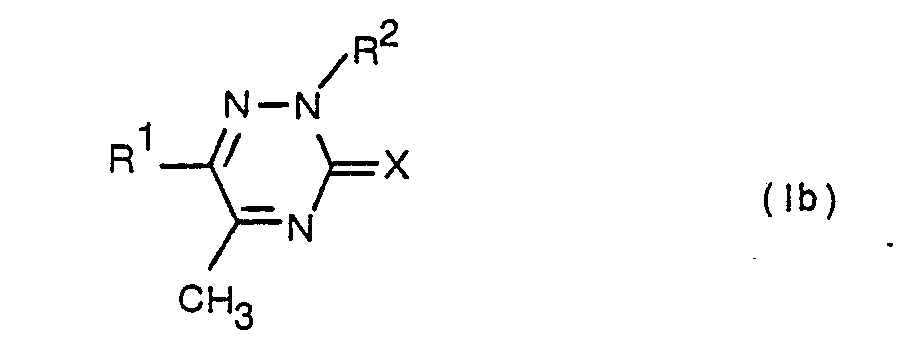


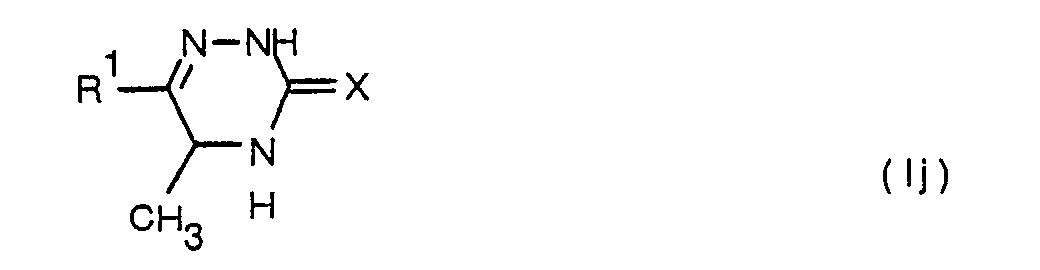
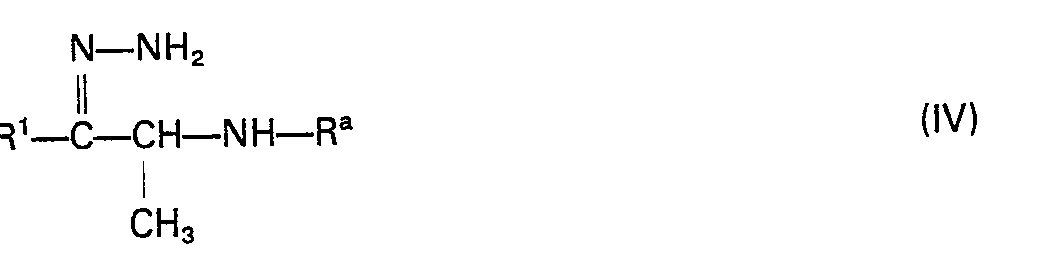
Applications Claiming Priority (4)
| Application Number | Priority Date | Filing Date | Title |
|---|---|---|---|
| GB8131900 | 1981-10-22 | ||
| GB8131900 | 1981-10-22 | ||
| GB8224151 | 1982-08-23 | ||
| GB8224151 | 1982-08-23 |
Publications (2)
| Publication Number | Publication Date |
|---|---|
| EP0077983A1 EP0077983A1 (en) | 1983-05-04 |
| EP0077983B1 true EP0077983B1 (en) | 1987-04-29 |
Family
ID=26281042
Family Applications (1)
| Application Number | Title | Priority Date | Filing Date |
|---|---|---|---|
| EP82109529A Expired EP0077983B1 (en) | 1981-10-22 | 1982-10-15 | Triazine derivatives, processes for preparation thereof and pharmaceutical compositions comprising the same |
Country Status (11)
| Country | Link |
|---|---|
| US (1) | US4616014A (en) |
| EP (1) | EP0077983B1 (en) |
| JP (1) | JPS5899468A (en) |
| AU (1) | AU8926982A (en) |
| DE (1) | DE3276164D1 (en) |
| DK (1) | DK453882A (en) |
| ES (3) | ES8401042A1 (en) |
| FI (1) | FI823544A7 (en) |
| GR (1) | GR76714B (en) |
| NO (1) | NO823506L (en) |
| OA (1) | OA07236A (en) |
Families Citing this family (18)
| Publication number | Priority date | Publication date | Assignee | Title |
|---|---|---|---|---|
| CA1199027A (en) * | 1981-11-12 | 1986-01-07 | Stuart D. Mills | Heterocyclic derivatives of pyridazinone, thiadiazinone, oxadiazinone and triazinone |
| US4581356A (en) * | 1983-03-22 | 1986-04-08 | Fujisawa Pharmaceutical Co., Ltd. | Triazine derivatives, and pharmaceutical compositions comprising the same |
| JPS59196874A (en) * | 1983-04-22 | 1984-11-08 | Fujisawa Pharmaceut Co Ltd | Triazine derivative, its preparation, and drug composition containing it |
| GB8328757D0 (en) * | 1983-10-27 | 1983-11-30 | Wellcome Found | Chemical compounds |
| GB8612796D0 (en) * | 1986-05-27 | 1986-07-02 | Fbc Ltd | Fungicides |
| US4970210A (en) * | 1987-07-17 | 1990-11-13 | Abbott Laboratories | Triazinone lipoxygenase compounds |
| CN1038249C (en) * | 1991-08-28 | 1998-05-06 | 罗姆和哈斯公司 | Fungicidal compositions containing dihydropyridazinones and related compounds |
| IT1318392B1 (en) * | 2000-03-15 | 2003-08-25 | Getters Spa | HYDROGEN GETTER COMPOSITION. |
| KR100840883B1 (en) | 2000-10-27 | 2008-06-24 | 다우 아그로사이언시즈 엘엘씨 | Substituted 4,5-dihydro-1,2,4-triazin-3-ones and 1,2,4-triazin-3-ones, fungicidal and pesticidal compositions comprising them, and fungi using such compositions And insect control method |
| EP1340743A4 (en) | 2000-11-09 | 2007-04-25 | Mitsui Chemicals Inc | Optically active amine derivative and method of synthesis |
| US20030236259A1 (en) * | 2002-02-05 | 2003-12-25 | Rolf Hohlweg | Novel aryl- and heteroarylpiperazines |
| CA2490470A1 (en) * | 2002-07-02 | 2004-01-15 | Schering Corporation | Pyrazole urea neuropeptide y y5 receptor antagonists |
| US7323455B2 (en) * | 2004-03-24 | 2008-01-29 | Wyeth | 7-aryl 1,5-dihydro-4,1-benzoxazepin-2(3H)-one derivatives and their use as progesterone receptor modulators |
| RU2442775C2 (en) * | 2005-07-04 | 2012-02-20 | Хай Пойнт Фармасьютикалс, ЛЛС | Histamine nz-receptor antagonists |
| EP2386554A1 (en) * | 2005-07-04 | 2011-11-16 | High Point Pharmaceuticals, LLC | Compounds active at the histamine H3 receptor |
| JP2009537596A (en) * | 2006-05-23 | 2009-10-29 | ハイ ポイント ファーマシューティカルズ,リミティド ライアビリティ カンパニー | 6- (4-Cyclopropylpiperidin-1-yl) -2'-methyl- [3,4 ']-bipyridine and its pharmaceutical use |
| EP2079732B9 (en) * | 2006-05-29 | 2012-03-21 | High Point Pharmaceuticals, LLC | 3- (1, 3-benz0di0x0l-5-yl) -6- (4-cyclopropylpiperazin-1-yl) -pyridazine, its salts and solvates and its use as histamine h3 receptor antagonist |
| EP2014656A3 (en) * | 2007-06-11 | 2011-08-24 | High Point Pharmaceuticals, LLC | New heteocyclic h3 antagonists |
Family Cites Families (5)
| Publication number | Priority date | Publication date | Assignee | Title |
|---|---|---|---|---|
| US4157392A (en) * | 1977-05-17 | 1979-06-05 | Diamond Shamrock Corporation | Pharmacologically active substituted 1,2,4-triazines |
| GB1604085A (en) * | 1977-05-17 | 1981-12-02 | Diamond Shamrock Corp | Pharmaceutical preparations containing 1,2,4-triazine derivatives |
| EP0052442B1 (en) * | 1980-11-14 | 1985-09-11 | Imperial Chemical Industries Plc | Heterocyclic compounds |
| US4495185A (en) * | 1981-11-12 | 1985-01-22 | Imperial Chemical Industries, Plc | 1,2,4-Triazin-3(2H) ones |
| US4581356A (en) * | 1983-03-22 | 1986-04-08 | Fujisawa Pharmaceutical Co., Ltd. | Triazine derivatives, and pharmaceutical compositions comprising the same |
-
1982
- 1982-10-08 US US06/433,513 patent/US4616014A/en not_active Expired - Fee Related
- 1982-10-11 AU AU89269/82A patent/AU8926982A/en not_active Abandoned
- 1982-10-11 GR GR69503A patent/GR76714B/el unknown
- 1982-10-13 DK DK453882A patent/DK453882A/en not_active Application Discontinuation
- 1982-10-15 EP EP82109529A patent/EP0077983B1/en not_active Expired
- 1982-10-15 DE DE8282109529T patent/DE3276164D1/en not_active Expired
- 1982-10-18 FI FI823544A patent/FI823544A7/en not_active Application Discontinuation
- 1982-10-21 NO NO823506A patent/NO823506L/en unknown
- 1982-10-21 ES ES516724A patent/ES8401042A1/en not_active Expired
- 1982-10-22 JP JP57186641A patent/JPS5899468A/en active Pending
- 1982-10-22 OA OA57828A patent/OA07236A/en unknown
-
1983
- 1983-06-15 ES ES523300A patent/ES523300A0/en active Granted
- 1983-06-15 ES ES523299A patent/ES8601934A1/en not_active Expired
Non-Patent Citations (4)
| Title |
|---|
| CHEMICAL ABSTRACTS, vol.76, 1972, p. 317, abstract 34221g, COLUMBUS, Ohio (US); A.MUSTAFA et al.: "Behavior of some derivatives of 1,2,4-triazine toward organomagnesium halides" * |
| CHEMISCHE BERICHTE, vol.109, 1976, Weinheim (DE); J.C.JOCHIMS et al.: "2-keto-isothiocyanate", pp. 154-167 * |
| COMPTES RENDUS HEBDOMADAIRES DES SEANCES DE L'ACADEMIE DES SCIENCES, Serie C, vol.270, 1970, GAUTHIER-VILLARS (FR); N.VINOT et al.: "Etude de l'action du chlorhydrate de semicarbazide sur les x-dicétones", pp. 1042-4 * |
| JOURNAL OF HETEROCYCLIS CHEMISTRY, vol.18, May 1981, Hetero Corp., COLUMBUS, Ohio (US); Y.NAKAYAMA et al.: "1,2,4-triazines. 1. A convenient synthesis of 4,5-dihydro-1,2,4-triazin-3-(2H)one and its 6-substituted derivatives", pp. 631-2 * |
Also Published As
| Publication number | Publication date |
|---|---|
| ES523299A0 (en) | 1985-04-16 |
| DK453882A (en) | 1983-04-23 |
| ES516724A0 (en) | 1983-11-16 |
| NO823506L (en) | 1983-04-25 |
| ES8401042A1 (en) | 1983-11-16 |
| FI823544A0 (en) | 1982-10-18 |
| OA07236A (en) | 1984-04-30 |
| JPS5899468A (en) | 1983-06-13 |
| ES8500247A1 (en) | 1984-10-01 |
| EP0077983A1 (en) | 1983-05-04 |
| ES8601934A1 (en) | 1985-04-16 |
| AU8926982A (en) | 1983-04-28 |
| GR76714B (en) | 1984-08-29 |
| DE3276164D1 (en) | 1987-06-04 |
| FI823544L (en) | 1983-04-23 |
| ES523300A0 (en) | 1984-10-01 |
| US4616014A (en) | 1986-10-07 |
| FI823544A7 (en) | 1983-04-23 |
Similar Documents
| Publication | Publication Date | Title |
|---|---|---|
| EP0383449B1 (en) | Pyridazinone derivatives and processes for preparing the same | |
| AU593278B2 (en) | Pharmaceutically active 2-thiomethyl-substituted-1,4- dihydropyridines | |
| US5977118A (en) | 6-substituted pyrazolo[3,4-d]pyrimidin-4-ones and compositions and methods of use thereof | |
| RU2007403C1 (en) | Method of producing pyrazole-puridine derivative or its salt | |
| KR100626605B1 (en) | Novel pyridazine derivatives and medicines using the same | |
| US4616014A (en) | Triazine derivatives, and pharmaceutical compositions comprising the same | |
| HU206709B (en) | Process for producing new 3-/4-/1-substituted-4-piperazinyl/-butyl/-4-thiazolidinone derivatives and pharmaceutical compositions containing them | |
| US4613603A (en) | Compounds with a nitrogen-containing heterocyclic nucleus, and drugs in which they are present | |
| CA2407231A1 (en) | Cyclic compounds | |
| CA2471348A1 (en) | Quinazolinone derivative | |
| GB1588166A (en) | Nitrogen-containing heterocyclic compounds | |
| EP0164204A1 (en) | Novel pharmaceutically useful pyrimidines | |
| US5840895A (en) | Triazole intermediates for tricyclic benzazepine and benzothiazepine derivatives | |
| JPH01249769A (en) | Psychotropic heterobicycloalkyl piperadine derivative | |
| EP0132375B1 (en) | Dihydropyridine anti-ischaemic and antihypertensive agents | |
| US4581356A (en) | Triazine derivatives, and pharmaceutical compositions comprising the same | |
| KR0164599B1 (en) | Pyridazine Derivatives Method of Preparation and Pharmaceutical Composition Containing the Same | |
| NZ206614A (en) | Dihydropyridine derivatives and pharmaceutical compositions | |
| KR960000358B1 (en) | Novel aminoalkylthio derivatives of triazolopyridine or triazoloquinoline, their process for their preparation, and drugs, useful especially as analgesics, in which they are present | |
| UA54449C2 (en) | 3-substituted pyrido[4,3':4,5]thieno-[2,3-d]pyrimidine derivatives, preparation and use thereof | |
| EP0208518B1 (en) | 6-phenyl-pyridazinyl compounds | |
| CA1271751A (en) | Dihydroimidazo[1,2-a]pyrimidine derivatives | |
| CS274405B2 (en) | Method of 4-cyanopyridazines preparation | |
| US4820703A (en) | PAF-antagonistic thienotriazolodiazepine compounds and pharmaceutical uses thereof | |
| US4247551A (en) | N-Pyrrolyl-pyridazineamines and their use as antihypertensive agents |
Legal Events
| Date | Code | Title | Description |
|---|---|---|---|
| PUAI | Public reference made under article 153(3) epc to a published international application that has entered the european phase |
Free format text: ORIGINAL CODE: 0009012 |
|
| AK | Designated contracting states |
Designated state(s): AT BE CH DE FR GB IT LI LU NL SE |
|
| 17P | Request for examination filed |
Effective date: 19831021 |
|
| GRAA | (expected) grant |
Free format text: ORIGINAL CODE: 0009210 |
|
| AK | Designated contracting states |
Kind code of ref document: B1 Designated state(s): BE CH DE FR GB IT LI LU NL SE |
|
| PG25 | Lapsed in a contracting state [announced via postgrant information from national office to epo] |
Ref country code: NL Effective date: 19870429 Ref country code: LI Effective date: 19870429 Ref country code: CH Effective date: 19870429 Ref country code: BE Effective date: 19870429 |
|
| PG25 | Lapsed in a contracting state [announced via postgrant information from national office to epo] |
Ref country code: SE Effective date: 19870430 |
|
| REF | Corresponds to: |
Ref document number: 3276164 Country of ref document: DE Date of ref document: 19870604 |
|
| ET | Fr: translation filed | ||
| ITF | It: translation for a ep patent filed | ||
| REG | Reference to a national code |
Ref country code: CH Ref legal event code: PL |
|
| NLV1 | Nl: lapsed or annulled due to failure to fulfill the requirements of art. 29p and 29m of the patents act | ||
| PG25 | Lapsed in a contracting state [announced via postgrant information from national office to epo] |
Ref country code: LU Free format text: LAPSE BECAUSE OF NON-PAYMENT OF DUE FEES Effective date: 19871031 |
|
| PLBE | No opposition filed within time limit |
Free format text: ORIGINAL CODE: 0009261 |
|
| STAA | Information on the status of an ep patent application or granted ep patent |
Free format text: STATUS: NO OPPOSITION FILED WITHIN TIME LIMIT |
|
| 26N | No opposition filed | ||
| PG25 | Lapsed in a contracting state [announced via postgrant information from national office to epo] |
Ref country code: GB Effective date: 19891015 |
|
| GBPC | Gb: european patent ceased through non-payment of renewal fee | ||
| PG25 | Lapsed in a contracting state [announced via postgrant information from national office to epo] |
Ref country code: FR Effective date: 19900629 |
|
| PG25 | Lapsed in a contracting state [announced via postgrant information from national office to epo] |
Ref country code: DE Effective date: 19900703 |
|
| REG | Reference to a national code |
Ref country code: FR Ref legal event code: ST |