EP0078488A2 - Procédé de fabrication d'un diélectrique en verre trempé pour isolateur électrique et isolateur en résultant - Google Patents
Procédé de fabrication d'un diélectrique en verre trempé pour isolateur électrique et isolateur en résultant Download PDFInfo
- Publication number
- EP0078488A2 EP0078488A2 EP82109874A EP82109874A EP0078488A2 EP 0078488 A2 EP0078488 A2 EP 0078488A2 EP 82109874 A EP82109874 A EP 82109874A EP 82109874 A EP82109874 A EP 82109874A EP 0078488 A2 EP0078488 A2 EP 0078488A2
- Authority
- EP
- European Patent Office
- Prior art keywords
- mpa
- dielectric
- temperature
- quenching
- isolator
- Prior art date
- Legal status (The legal status is an assumption and is not a legal conclusion. Google has not performed a legal analysis and makes no representation as to the accuracy of the status listed.)
- Granted
Links
Images
Classifications
-
- C—CHEMISTRY; METALLURGY
- C03—GLASS; MINERAL OR SLAG WOOL
- C03C—CHEMICAL COMPOSITION OF GLASSES, GLAZES OR VITREOUS ENAMELS; SURFACE TREATMENT OF GLASS; SURFACE TREATMENT OF FIBRES OR FILAMENTS MADE FROM GLASS, MINERALS OR SLAGS; JOINING GLASS TO GLASS OR OTHER MATERIALS
- C03C21/00—Treatment of glass, not in the form of fibres or filaments, by diffusing ions or metals in the surface
-
- Y—GENERAL TAGGING OF NEW TECHNOLOGICAL DEVELOPMENTS; GENERAL TAGGING OF CROSS-SECTIONAL TECHNOLOGIES SPANNING OVER SEVERAL SECTIONS OF THE IPC; TECHNICAL SUBJECTS COVERED BY FORMER USPC CROSS-REFERENCE ART COLLECTIONS [XRACs] AND DIGESTS
- Y10—TECHNICAL SUBJECTS COVERED BY FORMER USPC
- Y10T—TECHNICAL SUBJECTS COVERED BY FORMER US CLASSIFICATION
- Y10T428/00—Stock material or miscellaneous articles
- Y10T428/31—Surface property or characteristic of web, sheet or block
- Y10T428/315—Surface modified glass [e.g., tempered, strengthened, etc.]
Definitions
- the present invention relates to a method for manufacturing a tempered glass dielectric for an electrical insulator and a resulting insulator.
- the glass dielectrics undergo a thermal toughening treatment such that they present significant compressive stresses on the surface, and internally significant extension stresses.
- the result for the dielectric is a much improved mechanical resistance compared to that of annealed glass and in particular excellent tensile strength.
- the existence of significant internal stresses leads to an almost total fragmentation of the dielectric; this does not significantly or dangerously affect the residual mechanical resistance of the insulator, but reduces its creepage distance to the distance in the air between the electrodes.
- the object of the present invention is to produce an insulator dielectric capable of better withstanding impacts, while retaining its tensile strength.
- the present invention relates to a process for manufacturing a dielectric in tempered glass for an electrical insulator, characterized in that said dielectric is first subjected to thermal quenching imparting to it external compressive stresses whose maximum values are between 200 MPa and 400 MPa, and that it undergoes secondly, at least partially, a chemical quenching under conditions of duration and temperature such that they cause a relaxation of said external compressive stresses of between 50% and 80%.
- the temperature is of the order of that of the deformation of the glass and the chemical toughening treatment under such conditions leads to a depth of diffusion by ion exchange of a few tens of micrometers.
- a solution based on alkaline salts is applied to the thermally quenched dielectric at room temperature, it is dried and heated for a few hours, the temperature being between 300 ° C. and 500 ° C.
- Sample A was thermally quenched by blowing pressurized air; curve A indicates the distribution of extension and compression stresses in dielectric A.
- Sample B has been chemically quenched under the following conditions; the annealed sample was immersed in a solution at room temperature and having the composition below:
- This solution wets the glass very well and the dielectric is completely covered with a liquid film whose viscosity can be controlled.
- a drying operation is carried out followed by a heat treatment for 8 hours at a temperature of 450 ° C.
- thermal and chemical quenching conditions are not limited to the example described.
- the thermal tempering conditions may vary depending on the composition of the glass, the temperature and the humidity of the blowing air.
- the solution used for chemical quenching can be chosen from the following compositions (percentages given by weight):
- the starch can be replaced by any equivalent binder, of the emulsifiable adhesive type.
- Heating can last a few hours and the temperature can be between 300 ° C and 500 ° C.
- the dielectric C ′ obtained has mechanical characteristics of the same type as those of the dielectric C.
- the insulator can undergo the entire treatment according to the invention; according to another variant, only the parts liable to receive violent shocks are subjected to double quenching.
Landscapes
- Chemical & Material Sciences (AREA)
- Materials Engineering (AREA)
- Engineering & Computer Science (AREA)
- Chemical Kinetics & Catalysis (AREA)
- General Chemical & Material Sciences (AREA)
- Geochemistry & Mineralogy (AREA)
- Life Sciences & Earth Sciences (AREA)
- Organic Chemistry (AREA)
- Glass Compositions (AREA)
- Inorganic Insulating Materials (AREA)
- Organic Insulating Materials (AREA)
- Insulating Bodies (AREA)
- Insulators (AREA)
- Re-Forming, After-Treatment, Cutting And Transporting Of Glass Products (AREA)
- Insulation, Fastening Of Motor, Generator Windings (AREA)
Abstract
Description
- La présente invention concerne un procédé de fabrication d'un diélectrique en verre trempé pour isolateur électrique et un isolateur en résultant.
- Selon le procédé habituellement utilisé, les diélectriques en verre subissent un traitement de trempe thermique tel qu'ils présentent en surface d'importantes contraintes de compression, et intérieurement d'importantes contraintes d'extension. Il en résulte pour le diélectrique une résistance mécanique très améliorée par rapport à celle du verre recuit et en particulier une excellente résistance à la traction. Toutefois on constate que, dans certaines circonstances, par exemple en cas de choc violent, l'existence des contraintes internes importantes entraîne une fragmentation quasiment totale du diélectrique ; ceci n'affecte pas notablement ni dangereusement la résistance mécanique résiduelle de l'isolateur, mais réduit sa ligne de fuite à la distance dans l'air entre les électrodes.
- La présente invention a pour but de réaliser un diélectrique d'isolateur susceptible de mieux résister aux chocs, tout en conservant sa résistance à la traction.
- La présente invention a pour objet un procédé de fabrication d'un diélectrique en verre trempé pour isolateur électrique, caractérisé par le fait que ledit diélectrique subit en premier lieu une trempe thermique lui imprimant des contraintes externes de compression dont les valeurs maximales sont comprises entre 200 MPa et 400 MPa, et qu'il subit en second lieu, au moins partiellement, une trempe chimique dans des conditions de durée et de température telles qu'elles entraînent un relâchement desdites contraintes externes de compression compris entre 50% et 80%. La température est de l'ordre de celle de la déformation du verre et le traitement de trempe chimique dans de telles conditions conduit à une profondeur de diffusion par échange ionique de quelques dizaines de micromètres.
- Il faut remarquer que le procédé précédent s'applique à un diélectrique d'isolateur en verre présentant une épaisseur de l'ordre de 10 mm. Il ne peut être appliqué à des pièces de verre minces qui ne pourraient tolérer des contraintes de trempe thermique aussi importantes, ni des conditions analogues de trempe chimique, notamment en ce qui concerne la température de traitement : la profondeur de diffusion par échange ionique serait donc tout à fait insuffisante.
- Selon un mode de réalisation particulièrement avantageux, on applique sur le diélectrique trempé thermiquement une solution à base de sels alcalins à température ambiante, on le sèche et on le chauffe pendant quelques heures, la température étant comprise entre 300°C et 500°C.
- D'autres procédés possibles de trempe chimique seront explicités ci-dessous.
- La présente invention a également pour objet un isolateur électrique dont le diélectrique a été obtenu par le procédé précité. Ce diélectrique est caractérisé par le fait que ses zones ayant subi respectivement les deux types de trempe présentent :
- - de très importantes contraintes de compression en surface, supérieures ou égales à celles d'un isolateur n'ayant subi qu'une trempe thermique et encore importantes sur une épaisseur pouvant être supérieure à 1 mm ;
- - au-delà de l'épaisseur précédente, des contraintes d'extension sensiblement inférieures à celles d'un isolateur n'ayant subi qu'une trempe thermique.
- Il en résulte pour les zones de l'isolateur traitées conformément à l'invention à la fois une conservation de la résistance à la traction et une amélioration de la résistance aux chocs.
- D'autres caractéristiques et avantages de l'invention apparaîtront au cours de la description suivante d'exemples de mise en oeuvre du procédé appliqué à une lame d'un verre sodocalcique dont l'épaisseur e est en moyenne de 10 mm.
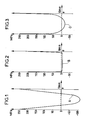
- Les figures 1, 2, 3 annexées montrent respectivement les courbes de répartition des contraintes (en Mega Pascal) dans trois échantillons A, B, C :
- - l'échantillon A a subi une trempe thermique conformément à l'art antérieur,
- - l'échantillon B a subi une trempe chimique,
- - l'échantillon C a subi une trempe thermique comme l'échantillon A, suivie d'une trempe chimique comme l'échantillon B.
- L'échantillon A a subi une trempe thermique par soufflage d'air sous pression ; la courbe A indique la répartition des contraintes d'extension et de compression dans le diélectrique A.
- L'échantillon B a subi une trempe chimique dans les conditions suivantes ; on a plongé l'échantillon recuit dans une solution à la température ambiante et présentant la composition ci-dessous :

- Cette solution mouille très bien le verre et le diélectrique est complètement recouvert d'un film liquide dont on peut contrôler la viscosité. On effectue une opération de séchage puis un traitement thermique pendant 8 heures à la température de 450°C.
- On voit sur la courbe B de la figure 2 la répartition des contraintes d'extension et de compression dans le diélectrique B.
- L'échantillon C a subi un traitement thermique analogue au traitement subi par A, puis un traitement chimique analogue au traitement subi par B. On obtient, comme l'indique la courbe C, une répartition de contraintes particulièrement intéressante, qui diffère sensiblement de la somme algébrique des contraintes A et B et qui confère à l'échantillon C les propriétés mécaniques recherchées : d'une part les contraintes internes d'extension sont assez faibles pour éviter une fragmentation en cas de choc violent, d'autre part les contraintes externes de compression sont assez fortes et profondes pour que la pièce résiste bien aux efforts de traction.
- Bien entendu les conditions de trempe thermique et chimique ne sont pas limitées à l'exemple décrit.
- Les conditions de trempe thermique peuvent varier suivant la composition du verre, la température et l'hygrométrie de l'air de soufflage.
- La solution utilisée pour la trempe chimique peut être choisie parmi les compositions suivantes (pourcentages donnés en poids) :

- L'amidon peut être remplacé par tout liant équivalent, du type colle émulsifiable.
- Le chauffage peut durer quelques heures et la température peut être comprise entre 300°C et 500°C.
- On obtient en modifiant donc les conditions opératoires trois types diélectriques A', B', C' dont les caractéristiques mécaniques sont consignées dans le tableau 1 ci-dessous :

- Remarquons que le procédé de trempe chimique mis en oeuvre dans le cadre de l'invention est un procédé industriel présentant les avantages suivants :
- - utilisation de faibles quantités de sels alcalins et de liant organique puisque le produit de départ est une solution,
- - très bonne adhérence du film après séchage, ce qui permet une manipulation aisée des pièces traitées,
- - les profondeurs de diffusion ionique dans le verre sont comparables à celles obtenues par les autres procédés connus de trempe chimique par exemple :
- - pulvérisation d'un mélange de sels en poudre porté ensuite à une température suffisante pour faire fondre une partie de la poudre,
- - pulvérisation d'une solution chaude et saturée en réactif sur le diélectrique froid.
- Quels que soient les détails de mise en oeuvre du procédé selon l'invention, le diélectrique C' obtenu à des caractéristiques mécaniques du même type que celles du diélectrique C.
- Selon un perfectionnement du procédé on peut encore renforcer les échanges ioniques de la trempe chimique en appliquant pendant le traitement un champ électrique aux zones traitées.
- Enfin, comme on l'a dit plus haut l'isolateur peut subir dans son entier le traitement selon l'invention ; selon une autre variante seules les parties susceptibles de recevoir des chocs violents sont soumis à la double trempe.
Claims (6)


Priority Applications (1)
| Application Number | Priority Date | Filing Date | Title |
|---|---|---|---|
| AT82109874T ATE19389T1 (de) | 1981-10-29 | 1982-10-26 | Verfahren zur herstellung eines in gehaertetem glas dielektrischen materials fuer elektrischen isolator und erhaltener isolator. |
Applications Claiming Priority (2)
| Application Number | Priority Date | Filing Date | Title |
|---|---|---|---|
| FR8120297 | 1981-10-29 | ||
| FR8120297A FR2515635B1 (fr) | 1981-10-29 | 1981-10-29 | Procede de fabrication d'un dielectrique en verre trempe pour isolateur electrique et isolateur en resultant |
Publications (3)
| Publication Number | Publication Date |
|---|---|
| EP0078488A2 true EP0078488A2 (fr) | 1983-05-11 |
| EP0078488A3 EP0078488A3 (en) | 1983-07-06 |
| EP0078488B1 EP0078488B1 (fr) | 1986-04-23 |
Family
ID=9263520
Family Applications (1)
| Application Number | Title | Priority Date | Filing Date |
|---|---|---|---|
| EP82109874A Expired EP0078488B1 (fr) | 1981-10-29 | 1982-10-26 | Procédé de fabrication d'un diélectrique en verre trempé pour isolateur électrique et isolateur en résultant |
Country Status (12)
| Country | Link |
|---|---|
| US (1) | US4471024A (fr) |
| EP (1) | EP0078488B1 (fr) |
| JP (1) | JPS5893102A (fr) |
| AT (1) | ATE19389T1 (fr) |
| AU (1) | AU550077B2 (fr) |
| BR (1) | BR8206273A (fr) |
| CA (1) | CA1176468A (fr) |
| DE (1) | DE3270788D1 (fr) |
| FR (1) | FR2515635B1 (fr) |
| MX (1) | MX158519A (fr) |
| NO (1) | NO153606C (fr) |
| ZA (1) | ZA827890B (fr) |
Families Citing this family (29)
| Publication number | Priority date | Publication date | Assignee | Title |
|---|---|---|---|---|
| FR2563365B1 (fr) * | 1984-04-20 | 1986-12-05 | Ceraver | Dielectrique en verre pour isolateur electrique |
| FR2704852B1 (fr) * | 1993-05-06 | 1995-07-07 | Saint Gobain Vitrage Int | Procédé de renforcement d'objets en verre. |
| US8959953B2 (en) * | 2005-09-12 | 2015-02-24 | Saxon Glass Technologies, Inc. | Method for making strengthened glass |
| WO2010005578A1 (fr) * | 2008-07-11 | 2010-01-14 | Corning Incorporated | Verre avec une surface de compression pour des applications de consommateur |
| FR2964655B1 (fr) * | 2010-09-13 | 2017-05-19 | Saint Gobain | Feuille de verre |
| CN103086590B (zh) * | 2011-11-02 | 2015-10-21 | 富泰华工业(深圳)有限公司 | 雾面玻璃制造方法 |
| US9359251B2 (en) | 2012-02-29 | 2016-06-07 | Corning Incorporated | Ion exchanged glasses via non-error function compressive stress profiles |
| KR101395054B1 (ko) * | 2012-08-08 | 2014-05-14 | 삼성코닝정밀소재 주식회사 | 강화유리 커팅 방법 및 강화유리 커팅용 스테이지 |
| US11079309B2 (en) | 2013-07-26 | 2021-08-03 | Corning Incorporated | Strengthened glass articles having improved survivability |
| US10118858B2 (en) | 2014-02-24 | 2018-11-06 | Corning Incorporated | Strengthened glass with deep depth of compression |
| TWI852054B (zh) | 2014-06-19 | 2024-08-11 | 美商康寧公司 | 無易碎應力分布曲線的玻璃 |
| US11097974B2 (en) | 2014-07-31 | 2021-08-24 | Corning Incorporated | Thermally strengthened consumer electronic glass and related systems and methods |
| US10611664B2 (en) | 2014-07-31 | 2020-04-07 | Corning Incorporated | Thermally strengthened architectural glass and related systems and methods |
| US20160031752A1 (en) | 2014-07-31 | 2016-02-04 | Corning Incorporated | Glass or glass-ceramic for windows, countertops, and other applications |
| KR102584492B1 (ko) | 2014-10-08 | 2023-10-04 | 코닝 인코포레이티드 | 금속 산화물 농도 구배를 포함한 유리 및 유리 세라믹 |
| US10150698B2 (en) | 2014-10-31 | 2018-12-11 | Corning Incorporated | Strengthened glass with ultra deep depth of compression |
| EP4011843A3 (fr) | 2014-11-04 | 2022-06-29 | Corning Incorporated | Profils de contraintes profondes non-fragiles et procédés de fabrication |
| US11613103B2 (en) | 2015-07-21 | 2023-03-28 | Corning Incorporated | Glass articles exhibiting improved fracture performance |
| US10579106B2 (en) | 2015-07-21 | 2020-03-03 | Corning Incorporated | Glass articles exhibiting improved fracture performance |
| US12338159B2 (en) | 2015-07-30 | 2025-06-24 | Corning Incorporated | Thermally strengthened consumer electronic glass and related systems and methods |
| DK3386930T3 (da) | 2015-12-11 | 2021-07-26 | Corning Inc | Fusionsformbare, glasbaserede artikler indbefattende en metaloxidkoncentrationsgradient |
| KR102492060B1 (ko) | 2016-01-12 | 2023-01-26 | 코닝 인코포레이티드 | 얇은, 열적 및 화학적으로 강화된 유리-계 제품 |
| US11795102B2 (en) | 2016-01-26 | 2023-10-24 | Corning Incorporated | Non-contact coated glass and related coating system and method |
| EP3904302A1 (fr) | 2016-04-08 | 2021-11-03 | Corning Incorporated | Articles à base de verre comprenant un gradient de concentration d'oxyde métallique |
| KR102962602B1 (ko) | 2016-04-08 | 2026-05-08 | 코닝 인코포레이티드 | 두 영역을 포함하는 응력 프로파일을 포함하는 유리-계 물품, 및 제조 방법 |
| WO2019040818A2 (fr) | 2017-08-24 | 2019-02-28 | Corning Incorporated | Verres présentant des capacités de trempe améliorées |
| TWI785156B (zh) | 2017-11-30 | 2022-12-01 | 美商康寧公司 | 具有高熱膨脹係數及對於熱回火之優先破裂行為的非離子交換玻璃 |
| KR20210154825A (ko) | 2019-04-23 | 2021-12-21 | 코닝 인코포레이티드 | 확정 응력 프로파일을 갖는 유리 라미네이트 및 그 제조방법 |
| CN116811379B (zh) | 2019-08-06 | 2026-01-02 | 康宁股份有限公司 | 具有用于阻止裂纹的埋入式应力尖峰的玻璃层压体及其制造方法 |
Family Cites Families (11)
| Publication number | Priority date | Publication date | Assignee | Title |
|---|---|---|---|---|
| NL46152C (fr) * | 1936-01-31 | |||
| US2198734A (en) * | 1936-01-31 | 1940-04-30 | Corning Glass Works | Insulator |
| NL298724A (fr) * | 1962-10-04 | |||
| FR1411300A (fr) * | 1963-09-09 | 1965-09-17 | Corning Glass Works | Article en verre présentant une résistance à la rupture accrue et son procédé de traitement |
| NL6500068A (fr) * | 1965-01-06 | 1966-07-07 | ||
| GB1157898A (en) * | 1965-12-07 | 1969-07-09 | Ford Motor Co | Method of making Tempered Glass Articles, particularly Windshields for Motor Vehicles |
| US3498773A (en) * | 1966-02-23 | 1970-03-03 | Owens Illinois Inc | Method of strengthening glass by ion exchange |
| US3445316A (en) * | 1966-04-14 | 1969-05-20 | Corning Glass Works | Method of differential chemical tempering glass and article |
| US3607172A (en) * | 1968-11-01 | 1971-09-21 | Brockway Glass Co Inc | Tripotassium phosphate treatment for strengthening glass |
| US3751238A (en) * | 1970-02-25 | 1973-08-07 | Corning Glass Works | Method of chemically strengthening a silicate article containing soda |
| US3790260A (en) * | 1972-01-03 | 1974-02-05 | Corning Glass Works | High strength ophthalmic lens |
-
1981
- 1981-10-29 FR FR8120297A patent/FR2515635B1/fr not_active Expired
-
1982
- 1982-10-26 AT AT82109874T patent/ATE19389T1/de not_active IP Right Cessation
- 1982-10-26 EP EP82109874A patent/EP0078488B1/fr not_active Expired
- 1982-10-26 DE DE8282109874T patent/DE3270788D1/de not_active Expired
- 1982-10-26 NO NO823549A patent/NO153606C/no unknown
- 1982-10-27 JP JP57188895A patent/JPS5893102A/ja active Granted
- 1982-10-27 US US06/436,919 patent/US4471024A/en not_active Expired - Lifetime
- 1982-10-27 BR BR8206273A patent/BR8206273A/pt not_active IP Right Cessation
- 1982-10-28 CA CA000414411A patent/CA1176468A/fr not_active Expired
- 1982-10-28 MX MX194975A patent/MX158519A/es unknown
- 1982-10-28 ZA ZA827890A patent/ZA827890B/xx unknown
- 1982-10-28 AU AU89870/82A patent/AU550077B2/en not_active Ceased
Also Published As
| Publication number | Publication date |
|---|---|
| BR8206273A (pt) | 1983-09-20 |
| US4471024A (en) | 1984-09-11 |
| NO823549L (no) | 1983-05-02 |
| ATE19389T1 (de) | 1986-05-15 |
| DE3270788D1 (en) | 1986-05-28 |
| AU8987082A (en) | 1983-05-05 |
| FR2515635B1 (fr) | 1986-03-14 |
| NO153606C (no) | 1986-04-23 |
| ZA827890B (en) | 1983-08-31 |
| CA1176468A (fr) | 1984-10-23 |
| EP0078488B1 (fr) | 1986-04-23 |
| FR2515635A1 (fr) | 1983-05-06 |
| NO153606B (no) | 1986-01-13 |
| MX158519A (es) | 1989-02-09 |
| JPH0349161B2 (fr) | 1991-07-26 |
| EP0078488A3 (en) | 1983-07-06 |
| AU550077B2 (en) | 1986-02-27 |
| JPS5893102A (ja) | 1983-06-02 |
Similar Documents
| Publication | Publication Date | Title |
|---|---|---|
| EP0078488B1 (fr) | Procédé de fabrication d'un diélectrique en verre trempé pour isolateur électrique et isolateur en résultant | |
| EP1680373B1 (fr) | Vitre trempee pour isolation thermique | |
| Vancoille et al. | Mechanical properties of heat treated and worn PVD TiN,(Ti, Al) N,(Ti, Nb) N and Ti (C, N) coatings as measured by nanoindentation | |
| WO2001038249A1 (fr) | Procede de traitement de substrats en verre et substrats en verre pour la realisation d'ecrans de visualisation | |
| KR920000526B1 (ko) | 지르칼로이(zircaloy) 2 또는 지르칼로이 4로 된 스트립 및 그 제조방법 | |
| CN115502391A (zh) | 一种表面陶瓷硬化粉末高速钢的制备方法 | |
| CN112159089A (zh) | 一种镀膜玻璃的钢化处理方法 | |
| Tokaji et al. | The effect of gas nitriding on fatigue behaviour in pure titanium | |
| US2969590A (en) | Production of composite aluminous metal articles | |
| EP0078487A2 (fr) | Procédé de fabrication d'un diélectrique en verre pour isolateur électrique et diélectrique en résultant | |
| CN111139387B (zh) | 一种力学性能优良的钒合金材料及其制备方法 | |
| JP3869172B2 (ja) | 脆性材の表面強靭化方法 | |
| KR20050047698A (ko) | 유리를 이용한 산화물 세라믹스의 표면개질 방법 및표면개질된 산화물 세라믹스 | |
| CN117187621B (zh) | 一种高强度宽幅钛带及其制备方法 | |
| Gu et al. | Enhancing flexural strength of ceramics by quenching | |
| JPS6191083A (ja) | アルミナセラミツクスの強化方法 | |
| CN116731542B (zh) | 一种涂层组合物、涂层及其制备方法与包含涂层的制品 | |
| CN118880235A (zh) | 一种用于石墨模具的氮化硼陶瓷镀层制备方法 | |
| JP2023070051A (ja) | Fe-Ni系合金熱間圧延用素材 | |
| GB724214A (en) | Improvements in or relating to the production of composite material for the manufacture of plain bearings | |
| CN119549542A (zh) | 一种铜钛复合带的制备方法及铜钛复合带 | |
| FR2653137A1 (fr) | Procede de traitement de surface de produits siderurgiques par action d'un plasma. | |
| JPH0610079A (ja) | ガラス成型金型用合金 | |
| JP3877531B2 (ja) | 耐加熱変色性に優れた洋白 | |
| CN119430976A (zh) | 基于钛酸钾晶须的陶瓷材料及其制备工艺 |
Legal Events
| Date | Code | Title | Description |
|---|---|---|---|
| PUAI | Public reference made under article 153(3) epc to a published international application that has entered the european phase |
Free format text: ORIGINAL CODE: 0009012 |
|
| PUAL | Search report despatched |
Free format text: ORIGINAL CODE: 0009013 |
|
| AK | Designated contracting states |
Designated state(s): AT BE CH DE FR GB IT LI LU NL SE |
|
| AK | Designated contracting states |
Designated state(s): AT BE CH DE FR GB IT LI LU NL SE |
|
| 17P | Request for examination filed |
Effective date: 19831222 |
|
| GRAA | (expected) grant |
Free format text: ORIGINAL CODE: 0009210 |
|
| AK | Designated contracting states |
Kind code of ref document: B1 Designated state(s): AT BE CH DE FR GB IT LI LU NL SE |
|
| REF | Corresponds to: |
Ref document number: 19389 Country of ref document: AT Date of ref document: 19860515 Kind code of ref document: T |
|
| RIN1 | Information on inventor provided before grant (corrected) |
Inventor name: CORNEBOIS, MICHEL Inventor name: SAISSE, HENRI Inventor name: PARENT, JEAN-PAUL Inventor name: PARGAMIN, LAURENT |
|
| REF | Corresponds to: |
Ref document number: 3270788 Country of ref document: DE Date of ref document: 19860528 |
|
| ITF | It: translation for a ep patent filed | ||
| PLBE | No opposition filed within time limit |
Free format text: ORIGINAL CODE: 0009261 |
|
| STAA | Information on the status of an ep patent application or granted ep patent |
Free format text: STATUS: NO OPPOSITION FILED WITHIN TIME LIMIT |
|
| 26N | No opposition filed | ||
| PGFP | Annual fee paid to national office [announced via postgrant information from national office to epo] |
Ref country code: SE Payment date: 19930922 Year of fee payment: 12 Ref country code: DE Payment date: 19930922 Year of fee payment: 12 Ref country code: CH Payment date: 19930922 Year of fee payment: 12 |
|
| PGFP | Annual fee paid to national office [announced via postgrant information from national office to epo] |
Ref country code: LU Payment date: 19931015 Year of fee payment: 12 |
|
| PGFP | Annual fee paid to national office [announced via postgrant information from national office to epo] |
Ref country code: BE Payment date: 19931022 Year of fee payment: 12 |
|
| ITTA | It: last paid annual fee | ||
| PGFP | Annual fee paid to national office [announced via postgrant information from national office to epo] |
Ref country code: NL Payment date: 19931031 Year of fee payment: 12 Ref country code: AT Payment date: 19931031 Year of fee payment: 12 |
|
| EPTA | Lu: last paid annual fee | ||
| PG25 | Lapsed in a contracting state [announced via postgrant information from national office to epo] |
Ref country code: LU Free format text: LAPSE BECAUSE OF NON-PAYMENT OF DUE FEES Effective date: 19941026 Ref country code: AT Effective date: 19941026 |
|
| PG25 | Lapsed in a contracting state [announced via postgrant information from national office to epo] |
Ref country code: SE Effective date: 19941027 |
|
| PG25 | Lapsed in a contracting state [announced via postgrant information from national office to epo] |
Ref country code: LI Effective date: 19941031 Ref country code: CH Effective date: 19941031 Ref country code: BE Effective date: 19941031 |
|
| EAL | Se: european patent in force in sweden |
Ref document number: 82109874.6 |
|
| BERE | Be: lapsed |
Owner name: CERAVER Effective date: 19941031 |
|
| PG25 | Lapsed in a contracting state [announced via postgrant information from national office to epo] |
Ref country code: NL Effective date: 19950501 |
|
| NLV4 | Nl: lapsed or anulled due to non-payment of the annual fee | ||
| REG | Reference to a national code |
Ref country code: CH Ref legal event code: PL |
|
| PG25 | Lapsed in a contracting state [announced via postgrant information from national office to epo] |
Ref country code: DE Effective date: 19950701 |
|
| EUG | Se: european patent has lapsed |
Ref document number: 82109874.6 |
|
| PGFP | Annual fee paid to national office [announced via postgrant information from national office to epo] |
Ref country code: GB Payment date: 19960809 Year of fee payment: 15 |
|
| PG25 | Lapsed in a contracting state [announced via postgrant information from national office to epo] |
Ref country code: GB Free format text: LAPSE BECAUSE OF NON-PAYMENT OF DUE FEES Effective date: 19971026 |
|
| GBPC | Gb: european patent ceased through non-payment of renewal fee |
Effective date: 19971026 |
|
| PGFP | Annual fee paid to national office [announced via postgrant information from national office to epo] |
Ref country code: FR Payment date: 19981023 Year of fee payment: 17 |
|
| PG25 | Lapsed in a contracting state [announced via postgrant information from national office to epo] |
Ref country code: FR Free format text: LAPSE BECAUSE OF NON-PAYMENT OF DUE FEES Effective date: 20000630 |
|
| REG | Reference to a national code |
Ref country code: FR Ref legal event code: ST |