EP0079512B1 - Procédé pour la préparation de polyamines à partir de dérivés d'urée N-monoaryle-N',N'-dialkylique et leur utilisation pour la formation de polyuréthannes - Google Patents
Procédé pour la préparation de polyamines à partir de dérivés d'urée N-monoaryle-N',N'-dialkylique et leur utilisation pour la formation de polyuréthannes Download PDFInfo
- Publication number
- EP0079512B1 EP0079512B1 EP82110066A EP82110066A EP0079512B1 EP 0079512 B1 EP0079512 B1 EP 0079512B1 EP 82110066 A EP82110066 A EP 82110066A EP 82110066 A EP82110066 A EP 82110066A EP 0079512 B1 EP0079512 B1 EP 0079512B1
- Authority
- EP
- European Patent Office
- Prior art keywords
- nco
- groups
- urea
- compound
- molecular weight
- Prior art date
- Legal status (The legal status is an assumption and is not a legal conclusion. Google has not performed a legal analysis and makes no representation as to the accuracy of the status listed.)
- Expired
Links
- 238000000034 method Methods 0.000 title claims description 47
- 230000008569 process Effects 0.000 title claims description 36
- 229920000768 polyamine Polymers 0.000 title claims description 27
- 238000002360 preparation method Methods 0.000 title claims description 17
- 239000004814 polyurethane Substances 0.000 title claims description 10
- 229920002635 polyurethane Polymers 0.000 title claims description 10
- 150000003672 ureas Chemical class 0.000 title description 12
- 230000015572 biosynthetic process Effects 0.000 title description 6
- 150000001875 compounds Chemical class 0.000 claims description 77
- XSQUKJJJFZCRTK-UHFFFAOYSA-N Urea Chemical compound NC(N)=O XSQUKJJJFZCRTK-UHFFFAOYSA-N 0.000 claims description 72
- 150000003335 secondary amines Chemical class 0.000 claims description 40
- XLYOFNOQVPJJNP-UHFFFAOYSA-N water Substances O XLYOFNOQVPJJNP-UHFFFAOYSA-N 0.000 claims description 40
- 238000006243 chemical reaction Methods 0.000 claims description 36
- 239000002904 solvent Substances 0.000 claims description 36
- 239000004202 carbamide Substances 0.000 claims description 34
- -1 NCO compound Chemical class 0.000 claims description 30
- 239000002585 base Substances 0.000 claims description 30
- 229920001228 polyisocyanate Polymers 0.000 claims description 30
- 239000005056 polyisocyanate Substances 0.000 claims description 30
- 239000000203 mixture Substances 0.000 claims description 24
- 125000003118 aryl group Chemical group 0.000 claims description 21
- 230000007062 hydrolysis Effects 0.000 claims description 21
- 238000006460 hydrolysis reaction Methods 0.000 claims description 21
- JOYRKODLDBILNP-UHFFFAOYSA-N Ethyl urethane Chemical compound CCOC(N)=O JOYRKODLDBILNP-UHFFFAOYSA-N 0.000 claims description 20
- 125000002887 hydroxy group Chemical group [H]O* 0.000 claims description 19
- ROSDSFDQCJNGOL-UHFFFAOYSA-N Dimethylamine Chemical compound CNC ROSDSFDQCJNGOL-UHFFFAOYSA-N 0.000 claims description 16
- ZFSLODLOARCGLH-UHFFFAOYSA-N isocyanuric acid Chemical compound OC1=NC(O)=NC(O)=N1 ZFSLODLOARCGLH-UHFFFAOYSA-N 0.000 claims description 15
- 239000011541 reaction mixture Substances 0.000 claims description 14
- 125000001033 ether group Chemical group 0.000 claims description 13
- 229920000570 polyether Polymers 0.000 claims description 12
- OHJMTUPIZMNBFR-UHFFFAOYSA-N biuret Chemical compound NC(=O)NC(N)=O OHJMTUPIZMNBFR-UHFFFAOYSA-N 0.000 claims description 11
- HPNMFZURTQLUMO-UHFFFAOYSA-N diethylamine Chemical compound CCNCC HPNMFZURTQLUMO-UHFFFAOYSA-N 0.000 claims description 11
- 239000012948 isocyanate Substances 0.000 claims description 11
- AVWRKZWQTYIKIY-UHFFFAOYSA-N urea-1-carboxylic acid Chemical compound NC(=O)NC(O)=O AVWRKZWQTYIKIY-UHFFFAOYSA-N 0.000 claims description 9
- 125000004432 carbon atom Chemical group C* 0.000 claims description 8
- 229920005862 polyol Polymers 0.000 claims description 8
- 150000003077 polyols Chemical class 0.000 claims description 8
- 239000007795 chemical reaction product Substances 0.000 claims description 7
- 239000012442 inert solvent Substances 0.000 claims description 7
- IQPQWNKOIGAROB-UHFFFAOYSA-N isocyanate group Chemical group [N-]=C=O IQPQWNKOIGAROB-UHFFFAOYSA-N 0.000 claims description 7
- 150000002513 isocyanates Chemical class 0.000 claims description 7
- 239000004721 Polyphenylene oxide Substances 0.000 claims description 6
- 125000001931 aliphatic group Chemical group 0.000 claims description 5
- 150000004982 aromatic amines Chemical class 0.000 claims description 5
- 229920003023 plastic Polymers 0.000 claims description 5
- 239000004033 plastic Substances 0.000 claims description 5
- 150000008044 alkali metal hydroxides Chemical class 0.000 claims description 4
- 229930195734 saturated hydrocarbon Natural products 0.000 claims description 4
- 239000000654 additive Substances 0.000 claims description 3
- 230000001413 cellular effect Effects 0.000 claims description 3
- 125000000623 heterocyclic group Chemical group 0.000 claims description 3
- 101000623895 Bos taurus Mucin-15 Proteins 0.000 claims description 2
- 229920005830 Polyurethane Foam Polymers 0.000 claims description 2
- 125000004122 cyclic group Chemical group 0.000 claims description 2
- 239000011496 polyurethane foam Substances 0.000 claims description 2
- 125000001495 ethyl group Chemical group [H]C([H])([H])C([H])([H])* 0.000 claims 1
- 238000010438 heat treatment Methods 0.000 claims 1
- 125000000959 isobutyl group Chemical group [H]C([H])([H])C([H])(C([H])([H])[H])C([H])([H])* 0.000 claims 1
- 125000001449 isopropyl group Chemical group [H]C([H])([H])C([H])(*)C([H])([H])[H] 0.000 claims 1
- 125000002496 methyl group Chemical group [H]C([H])([H])* 0.000 claims 1
- 125000004108 n-butyl group Chemical group [H]C([H])([H])C([H])([H])C([H])([H])C([H])([H])* 0.000 claims 1
- 125000004123 n-propyl group Chemical group [H]C([H])([H])C([H])([H])C([H])([H])* 0.000 claims 1
- 235000013877 carbamide Nutrition 0.000 description 33
- 150000001412 amines Chemical class 0.000 description 21
- HEMHJVSKTPXQMS-UHFFFAOYSA-M sodium hydroxide Inorganic materials [OH-].[Na+] HEMHJVSKTPXQMS-UHFFFAOYSA-M 0.000 description 19
- YXFVVABEGXRONW-UHFFFAOYSA-N Toluene Chemical compound CC1=CC=CC=C1 YXFVVABEGXRONW-UHFFFAOYSA-N 0.000 description 18
- KWYUFKZDYYNOTN-UHFFFAOYSA-M Potassium hydroxide Chemical compound [OH-].[K+] KWYUFKZDYYNOTN-UHFFFAOYSA-M 0.000 description 16
- WYURNTSHIVDZCO-UHFFFAOYSA-N Tetrahydrofuran Chemical compound C1CCOC1 WYURNTSHIVDZCO-UHFFFAOYSA-N 0.000 description 15
- 239000000243 solution Substances 0.000 description 15
- 238000004519 manufacturing process Methods 0.000 description 13
- YMWUJEATGCHHMB-UHFFFAOYSA-N Dichloromethane Chemical compound ClCCl YMWUJEATGCHHMB-UHFFFAOYSA-N 0.000 description 12
- LYCAIKOWRPUZTN-UHFFFAOYSA-N Ethylene glycol Chemical compound OCCO LYCAIKOWRPUZTN-UHFFFAOYSA-N 0.000 description 8
- 238000004821 distillation Methods 0.000 description 8
- RTZKZFJDLAIYFH-UHFFFAOYSA-N ether Substances CCOCC RTZKZFJDLAIYFH-UHFFFAOYSA-N 0.000 description 8
- 125000001302 tertiary amino group Chemical group 0.000 description 8
- RYHBNJHYFVUHQT-UHFFFAOYSA-N 1,4-Dioxane Chemical compound C1COCCO1 RYHBNJHYFVUHQT-UHFFFAOYSA-N 0.000 description 7
- 125000003277 amino group Chemical group 0.000 description 7
- 239000007788 liquid Substances 0.000 description 7
- 239000000047 product Substances 0.000 description 7
- YLQBMQCUIZJEEH-UHFFFAOYSA-N tetrahydrofuran Natural products C=1C=COC=1 YLQBMQCUIZJEEH-UHFFFAOYSA-N 0.000 description 7
- PEDCQBHIVMGVHV-UHFFFAOYSA-N Glycerine Chemical compound OCC(O)CO PEDCQBHIVMGVHV-UHFFFAOYSA-N 0.000 description 6
- 125000005588 carbonic acid salt group Chemical group 0.000 description 6
- JQVDAXLFBXTEQA-UHFFFAOYSA-N dibutylamine Chemical compound CCCCNCCCC JQVDAXLFBXTEQA-UHFFFAOYSA-N 0.000 description 6
- 125000004435 hydrogen atom Chemical group [H]* 0.000 description 6
- XTHFKEDIFFGKHM-UHFFFAOYSA-N Dimethoxyethane Chemical compound COCCOC XTHFKEDIFFGKHM-UHFFFAOYSA-N 0.000 description 5
- 239000000470 constituent Substances 0.000 description 5
- DVKJHBMWWAPEIU-UHFFFAOYSA-N toluene 2,4-diisocyanate Chemical compound CC1=CC=C(N=C=O)C=C1N=C=O DVKJHBMWWAPEIU-UHFFFAOYSA-N 0.000 description 5
- NFDXQGNDWIPXQL-UHFFFAOYSA-N 1-cyclooctyldiazocane Chemical compound C1CCCCCCC1N1NCCCCCC1 NFDXQGNDWIPXQL-UHFFFAOYSA-N 0.000 description 4
- HZAXFHJVJLSVMW-UHFFFAOYSA-N 2-Aminoethan-1-ol Chemical compound NCCO HZAXFHJVJLSVMW-UHFFFAOYSA-N 0.000 description 4
- QGZKDVFQNNGYKY-UHFFFAOYSA-N Ammonia Chemical compound N QGZKDVFQNNGYKY-UHFFFAOYSA-N 0.000 description 4
- IJGRMHOSHXDMSA-UHFFFAOYSA-N Atomic nitrogen Chemical compound N#N IJGRMHOSHXDMSA-UHFFFAOYSA-N 0.000 description 4
- CURLTUGMZLYLDI-UHFFFAOYSA-N Carbon dioxide Chemical compound O=C=O CURLTUGMZLYLDI-UHFFFAOYSA-N 0.000 description 4
- OAKJQQAXSVQMHS-UHFFFAOYSA-N Hydrazine Chemical compound NN OAKJQQAXSVQMHS-UHFFFAOYSA-N 0.000 description 4
- 239000002253 acid Substances 0.000 description 4
- 239000003054 catalyst Substances 0.000 description 4
- 239000012973 diazabicyclooctane Substances 0.000 description 4
- SBZXBUIDTXKZTM-UHFFFAOYSA-N diglyme Chemical compound COCCOCCOC SBZXBUIDTXKZTM-UHFFFAOYSA-N 0.000 description 4
- 229910052757 nitrogen Inorganic materials 0.000 description 4
- 125000002924 primary amino group Chemical group [H]N([H])* 0.000 description 4
- 239000000376 reactant Substances 0.000 description 4
- 238000010992 reflux Methods 0.000 description 4
- 239000007787 solid Substances 0.000 description 4
- WEVYAHXRMPXWCK-UHFFFAOYSA-N Acetonitrile Chemical compound CC#N WEVYAHXRMPXWCK-UHFFFAOYSA-N 0.000 description 3
- UHOVQNZJYSORNB-UHFFFAOYSA-N Benzene Chemical compound C1=CC=CC=C1 UHOVQNZJYSORNB-UHFFFAOYSA-N 0.000 description 3
- 239000004970 Chain extender Substances 0.000 description 3
- LFQSCWFLJHTTHZ-UHFFFAOYSA-N Ethanol Chemical compound CCO LFQSCWFLJHTTHZ-UHFFFAOYSA-N 0.000 description 3
- OKKJLVBELUTLKV-UHFFFAOYSA-N Methanol Chemical compound OC OKKJLVBELUTLKV-UHFFFAOYSA-N 0.000 description 3
- ZMANZCXQSJIPKH-UHFFFAOYSA-N Triethylamine Chemical compound CCN(CC)CC ZMANZCXQSJIPKH-UHFFFAOYSA-N 0.000 description 3
- ZJCCRDAZUWHFQH-UHFFFAOYSA-N Trimethylolpropane Chemical compound CCC(CO)(CO)CO ZJCCRDAZUWHFQH-UHFFFAOYSA-N 0.000 description 3
- 150000004984 aromatic diamines Chemical class 0.000 description 3
- 230000008901 benefit Effects 0.000 description 3
- 238000009835 boiling Methods 0.000 description 3
- 230000003197 catalytic effect Effects 0.000 description 3
- 238000009833 condensation Methods 0.000 description 3
- 150000004985 diamines Chemical class 0.000 description 3
- WEHWNAOGRSTTBQ-UHFFFAOYSA-N dipropylamine Chemical compound CCCNCCC WEHWNAOGRSTTBQ-UHFFFAOYSA-N 0.000 description 3
- 150000002334 glycols Chemical class 0.000 description 3
- 229910052500 inorganic mineral Inorganic materials 0.000 description 3
- 239000011707 mineral Substances 0.000 description 3
- 235000010755 mineral Nutrition 0.000 description 3
- VLKZOEOYAKHREP-UHFFFAOYSA-N n-Hexane Chemical compound CCCCCC VLKZOEOYAKHREP-UHFFFAOYSA-N 0.000 description 3
- 229920000642 polymer Polymers 0.000 description 3
- 229920001451 polypropylene glycol Polymers 0.000 description 3
- 230000009467 reduction Effects 0.000 description 3
- 238000003756 stirring Methods 0.000 description 3
- 125000003396 thiol group Chemical group [H]S* 0.000 description 3
- RUELTTOHQODFPA-UHFFFAOYSA-N toluene 2,6-diisocyanate Chemical compound CC1=C(N=C=O)C=CC=C1N=C=O RUELTTOHQODFPA-UHFFFAOYSA-N 0.000 description 3
- 238000010626 work up procedure Methods 0.000 description 3
- RXYPXQSKLGGKOL-UHFFFAOYSA-N 1,4-dimethylpiperazine Chemical compound CN1CCN(C)CC1 RXYPXQSKLGGKOL-UHFFFAOYSA-N 0.000 description 2
- OISVCGZHLKNMSJ-UHFFFAOYSA-N 2,6-dimethylpyridine Chemical compound CC1=CC=CC(C)=N1 OISVCGZHLKNMSJ-UHFFFAOYSA-N 0.000 description 2
- NJBCRXCAPCODGX-UHFFFAOYSA-N 2-methyl-n-(2-methylpropyl)propan-1-amine Chemical compound CC(C)CNCC(C)C NJBCRXCAPCODGX-UHFFFAOYSA-N 0.000 description 2
- RNLHGQLZWXBQNY-UHFFFAOYSA-N 3-(aminomethyl)-3,5,5-trimethylcyclohexan-1-amine Chemical compound CC1(C)CC(N)CC(C)(CN)C1 RNLHGQLZWXBQNY-UHFFFAOYSA-N 0.000 description 2
- PAYRUJLWNCNPSJ-UHFFFAOYSA-N Aniline Chemical compound NC1=CC=CC=C1 PAYRUJLWNCNPSJ-UHFFFAOYSA-N 0.000 description 2
- XDTMQSROBMDMFD-UHFFFAOYSA-N Cyclohexane Chemical compound C1CCCCC1 XDTMQSROBMDMFD-UHFFFAOYSA-N 0.000 description 2
- FBPFZTCFMRRESA-FSIIMWSLSA-N D-Glucitol Natural products OC[C@H](O)[C@H](O)[C@@H](O)[C@H](O)CO FBPFZTCFMRRESA-FSIIMWSLSA-N 0.000 description 2
- FBPFZTCFMRRESA-JGWLITMVSA-N D-glucitol Chemical compound OC[C@H](O)[C@@H](O)[C@H](O)[C@H](O)CO FBPFZTCFMRRESA-JGWLITMVSA-N 0.000 description 2
- IAYPIBMASNFSPL-UHFFFAOYSA-N Ethylene oxide Chemical compound C1CO1 IAYPIBMASNFSPL-UHFFFAOYSA-N 0.000 description 2
- PIICEJLVQHRZGT-UHFFFAOYSA-N Ethylenediamine Chemical compound NCCN PIICEJLVQHRZGT-UHFFFAOYSA-N 0.000 description 2
- DGAQECJNVWCQMB-PUAWFVPOSA-M Ilexoside XXIX Chemical compound C[C@@H]1CC[C@@]2(CC[C@@]3(C(=CC[C@H]4[C@]3(CC[C@@H]5[C@@]4(CC[C@@H](C5(C)C)OS(=O)(=O)[O-])C)C)[C@@H]2[C@]1(C)O)C)C(=O)O[C@H]6[C@@H]([C@H]([C@@H]([C@H](O6)CO)O)O)O.[Na+] DGAQECJNVWCQMB-PUAWFVPOSA-M 0.000 description 2
- JLTDJTHDQAWBAV-UHFFFAOYSA-N N,N-dimethylaniline Chemical compound CN(C)C1=CC=CC=C1 JLTDJTHDQAWBAV-UHFFFAOYSA-N 0.000 description 2
- GOOHAUXETOMSMM-UHFFFAOYSA-N Propylene oxide Chemical compound CC1CO1 GOOHAUXETOMSMM-UHFFFAOYSA-N 0.000 description 2
- JUJWROOIHBZHMG-UHFFFAOYSA-N Pyridine Chemical compound C1=CC=NC=C1 JUJWROOIHBZHMG-UHFFFAOYSA-N 0.000 description 2
- CDBYLPFSWZWCQE-UHFFFAOYSA-L Sodium Carbonate Chemical compound [Na+].[Na+].[O-]C([O-])=O CDBYLPFSWZWCQE-UHFFFAOYSA-L 0.000 description 2
- 150000001298 alcohols Chemical class 0.000 description 2
- 150000001340 alkali metals Chemical class 0.000 description 2
- 229910001860 alkaline earth metal hydroxide Inorganic materials 0.000 description 2
- 229910021529 ammonia Inorganic materials 0.000 description 2
- IISBACLAFKSPIT-UHFFFAOYSA-N bisphenol A Chemical compound C=1C=C(O)C=CC=1C(C)(C)C1=CC=C(O)C=C1 IISBACLAFKSPIT-UHFFFAOYSA-N 0.000 description 2
- 150000004657 carbamic acid derivatives Chemical class 0.000 description 2
- 239000001569 carbon dioxide Substances 0.000 description 2
- 229910002092 carbon dioxide Inorganic materials 0.000 description 2
- 150000005323 carbonate salts Chemical class 0.000 description 2
- BVKZGUZCCUSVTD-UHFFFAOYSA-N carbonic acid Chemical class OC(O)=O BVKZGUZCCUSVTD-UHFFFAOYSA-N 0.000 description 2
- 150000008280 chlorinated hydrocarbons Chemical class 0.000 description 2
- 238000003776 cleavage reaction Methods 0.000 description 2
- 230000005494 condensation Effects 0.000 description 2
- 238000001816 cooling Methods 0.000 description 2
- 239000013078 crystal Substances 0.000 description 2
- UAOMVDZJSHZZME-UHFFFAOYSA-N diisopropylamine Chemical compound CC(C)NC(C)C UAOMVDZJSHZZME-UHFFFAOYSA-N 0.000 description 2
- 238000001914 filtration Methods 0.000 description 2
- DYDNPESBYVVLBO-UHFFFAOYSA-N formanilide Chemical compound O=CNC1=CC=CC=C1 DYDNPESBYVVLBO-UHFFFAOYSA-N 0.000 description 2
- 238000004817 gas chromatography Methods 0.000 description 2
- RRAMGCGOFNQTLD-UHFFFAOYSA-N hexamethylene diisocyanate Chemical compound O=C=NCCCCCCN=C=O RRAMGCGOFNQTLD-UHFFFAOYSA-N 0.000 description 2
- NAQMVNRVTILPCV-UHFFFAOYSA-N hexane-1,6-diamine Chemical compound NCCCCCCN NAQMVNRVTILPCV-UHFFFAOYSA-N 0.000 description 2
- 229930195733 hydrocarbon Natural products 0.000 description 2
- 150000002430 hydrocarbons Chemical class 0.000 description 2
- 238000002347 injection Methods 0.000 description 2
- 239000007924 injection Substances 0.000 description 2
- 150000002500 ions Chemical class 0.000 description 2
- 238000002844 melting Methods 0.000 description 2
- CKFGINPQOCXMAZ-UHFFFAOYSA-N methanediol Chemical compound OCO CKFGINPQOCXMAZ-UHFFFAOYSA-N 0.000 description 2
- BDAGIHXWWSANSR-UHFFFAOYSA-N methanoic acid Natural products OC=O BDAGIHXWWSANSR-UHFFFAOYSA-N 0.000 description 2
- UAEPNZWRGJTJPN-UHFFFAOYSA-N methylcyclohexane Chemical compound CC1CCCCC1 UAEPNZWRGJTJPN-UHFFFAOYSA-N 0.000 description 2
- 230000004048 modification Effects 0.000 description 2
- 238000012986 modification Methods 0.000 description 2
- OBYVIBDTOCAXSN-UHFFFAOYSA-N n-butan-2-ylbutan-2-amine Chemical compound CCC(C)NC(C)CC OBYVIBDTOCAXSN-UHFFFAOYSA-N 0.000 description 2
- GVWISOJSERXQBM-UHFFFAOYSA-N n-methylpropan-1-amine Chemical compound CCCNC GVWISOJSERXQBM-UHFFFAOYSA-N 0.000 description 2
- 150000007530 organic bases Chemical class 0.000 description 2
- 150000002924 oxiranes Chemical class 0.000 description 2
- 229920001568 phenolic resin Polymers 0.000 description 2
- 229920001521 polyalkylene glycol ether Polymers 0.000 description 2
- 229920006295 polythiol Polymers 0.000 description 2
- 150000003141 primary amines Chemical class 0.000 description 2
- 238000009419 refurbishment Methods 0.000 description 2
- 230000007017 scission Effects 0.000 description 2
- 150000005619 secondary aliphatic amines Chemical class 0.000 description 2
- 125000000467 secondary amino group Chemical group [H]N([*:1])[*:2] 0.000 description 2
- 150000003384 small molecules Chemical class 0.000 description 2
- 239000000600 sorbitol Substances 0.000 description 2
- 238000006467 substitution reaction Methods 0.000 description 2
- 150000005622 tetraalkylammonium hydroxides Chemical class 0.000 description 2
- VZGDMQKNWNREIO-UHFFFAOYSA-N tetrachloromethane Chemical compound ClC(Cl)(Cl)Cl VZGDMQKNWNREIO-UHFFFAOYSA-N 0.000 description 2
- 150000003568 thioethers Chemical class 0.000 description 2
- ZWVMLYRJXORSEP-UHFFFAOYSA-N 1,2,6-Hexanetriol Chemical compound OCCCCC(O)CO ZWVMLYRJXORSEP-UHFFFAOYSA-N 0.000 description 1
- PCHXZXKMYCGVFA-UHFFFAOYSA-N 1,3-diazetidine-2,4-dione Chemical compound O=C1NC(=O)N1 PCHXZXKMYCGVFA-UHFFFAOYSA-N 0.000 description 1
- ALQLPWJFHRMHIU-UHFFFAOYSA-N 1,4-diisocyanatobenzene Chemical compound O=C=NC1=CC=C(N=C=O)C=C1 ALQLPWJFHRMHIU-UHFFFAOYSA-N 0.000 description 1
- OSOKCJGGSKFIED-UHFFFAOYSA-N 1-[2-(dimethylamino)propoxy]-n,n-dimethylpropan-2-amine Chemical compound CN(C)C(C)COCC(C)N(C)C OSOKCJGGSKFIED-UHFFFAOYSA-N 0.000 description 1
- LFSYUSUFCBOHGU-UHFFFAOYSA-N 1-isocyanato-2-[(4-isocyanatophenyl)methyl]benzene Chemical compound C1=CC(N=C=O)=CC=C1CC1=CC=CC=C1N=C=O LFSYUSUFCBOHGU-UHFFFAOYSA-N 0.000 description 1
- QKKSKKMOIOGASY-UHFFFAOYSA-N 2,3-dibromobut-1-ene-1,1-diol Chemical compound CC(Br)C(Br)=C(O)O QKKSKKMOIOGASY-UHFFFAOYSA-N 0.000 description 1
- VOZKAJLKRJDJLL-UHFFFAOYSA-N 2,4-diaminotoluene Chemical compound CC1=CC=C(N)C=C1N VOZKAJLKRJDJLL-UHFFFAOYSA-N 0.000 description 1
- ZUNMZYACEKOSPI-UHFFFAOYSA-N 2-(dihydroxymethyl)benzene-1,4-diol Chemical compound OC(O)C1=CC(O)=CC=C1O ZUNMZYACEKOSPI-UHFFFAOYSA-N 0.000 description 1
- XNWFRZJHXBZDAG-UHFFFAOYSA-N 2-METHOXYETHANOL Chemical compound COCCO XNWFRZJHXBZDAG-UHFFFAOYSA-N 0.000 description 1
- LCZVSXRMYJUNFX-UHFFFAOYSA-N 2-[2-(2-hydroxypropoxy)propoxy]propan-1-ol Chemical compound CC(O)COC(C)COC(C)CO LCZVSXRMYJUNFX-UHFFFAOYSA-N 0.000 description 1
- IIFFFBSAXDNJHX-UHFFFAOYSA-N 2-methyl-n,n-bis(2-methylpropyl)propan-1-amine Chemical compound CC(C)CN(CC(C)C)CC(C)C IIFFFBSAXDNJHX-UHFFFAOYSA-N 0.000 description 1
- QWGRWMMWNDWRQN-UHFFFAOYSA-N 2-methylpropane-1,3-diol Chemical compound OCC(C)CO QWGRWMMWNDWRQN-UHFFFAOYSA-N 0.000 description 1
- BSKHPKMHTQYZBB-UHFFFAOYSA-N 2-methylpyridine Chemical compound CC1=CC=CC=N1 BSKHPKMHTQYZBB-UHFFFAOYSA-N 0.000 description 1
- WADSJYLPJPTMLN-UHFFFAOYSA-N 3-(cycloundecen-1-yl)-1,2-diazacycloundec-2-ene Chemical compound C1CCCCCCCCC=C1C1=NNCCCCCCCC1 WADSJYLPJPTMLN-UHFFFAOYSA-N 0.000 description 1
- SPVVMXMTSODFPU-UHFFFAOYSA-N 3-methyl-n-(3-methylbutyl)butan-1-amine Chemical compound CC(C)CCNCCC(C)C SPVVMXMTSODFPU-UHFFFAOYSA-N 0.000 description 1
- YBRVSVVVWCFQMG-UHFFFAOYSA-N 4,4'-diaminodiphenylmethane Chemical compound C1=CC(N)=CC=C1CC1=CC=C(N)C=C1 YBRVSVVVWCFQMG-UHFFFAOYSA-N 0.000 description 1
- IBOFVQJTBBUKMU-UHFFFAOYSA-N 4,4'-methylene-bis-(2-chloroaniline) Chemical compound C1=C(Cl)C(N)=CC=C1CC1=CC=C(N)C(Cl)=C1 IBOFVQJTBBUKMU-UHFFFAOYSA-N 0.000 description 1
- OSWFIVFLDKOXQC-UHFFFAOYSA-N 4-(3-methoxyphenyl)aniline Chemical compound COC1=CC=CC(C=2C=CC(N)=CC=2)=C1 OSWFIVFLDKOXQC-UHFFFAOYSA-N 0.000 description 1
- MERLDGDYUMSLAY-UHFFFAOYSA-N 4-[(4-aminophenyl)disulfanyl]aniline Chemical compound C1=CC(N)=CC=C1SSC1=CC=C(N)C=C1 MERLDGDYUMSLAY-UHFFFAOYSA-N 0.000 description 1
- CEZWFBJCEWZGHX-UHFFFAOYSA-N 4-isocyanato-n-(oxomethylidene)benzenesulfonamide Chemical class O=C=NC1=CC=C(S(=O)(=O)N=C=O)C=C1 CEZWFBJCEWZGHX-UHFFFAOYSA-N 0.000 description 1
- NLHHRLWOUZZQLW-UHFFFAOYSA-N Acrylonitrile Chemical compound C=CC#N NLHHRLWOUZZQLW-UHFFFAOYSA-N 0.000 description 1
- BVKZGUZCCUSVTD-UHFFFAOYSA-M Bicarbonate Chemical compound OC([O-])=O BVKZGUZCCUSVTD-UHFFFAOYSA-M 0.000 description 1
- SAIKULLUBZKPDA-UHFFFAOYSA-N Bis(2-ethylhexyl) amine Chemical compound CCCCC(CC)CNCC(CC)CCCC SAIKULLUBZKPDA-UHFFFAOYSA-N 0.000 description 1
- HEDRZPFGACZZDS-UHFFFAOYSA-N Chloroform Chemical compound ClC(Cl)Cl HEDRZPFGACZZDS-UHFFFAOYSA-N 0.000 description 1
- 229940126062 Compound A Drugs 0.000 description 1
- FBPFZTCFMRRESA-KVTDHHQDSA-N D-Mannitol Chemical compound OC[C@@H](O)[C@@H](O)[C@H](O)[C@H](O)CO FBPFZTCFMRRESA-KVTDHHQDSA-N 0.000 description 1
- BRLQWZUYTZBJKN-UHFFFAOYSA-N Epichlorohydrin Chemical compound ClCC1CO1 BRLQWZUYTZBJKN-UHFFFAOYSA-N 0.000 description 1
- NLDMNSXOCDLTTB-UHFFFAOYSA-N Heterophylliin A Natural products O1C2COC(=O)C3=CC(O)=C(O)C(O)=C3C3=C(O)C(O)=C(O)C=C3C(=O)OC2C(OC(=O)C=2C=C(O)C(O)=C(O)C=2)C(O)C1OC(=O)C1=CC(O)=C(O)C(O)=C1 NLDMNSXOCDLTTB-UHFFFAOYSA-N 0.000 description 1
- 238000004566 IR spectroscopy Methods 0.000 description 1
- OWIKHYCFFJSOEH-UHFFFAOYSA-N Isocyanic acid Chemical compound N=C=O OWIKHYCFFJSOEH-UHFFFAOYSA-N 0.000 description 1
- KFZMGEQAYNKOFK-UHFFFAOYSA-N Isopropanol Chemical compound CC(C)O KFZMGEQAYNKOFK-UHFFFAOYSA-N 0.000 description 1
- 229930195725 Mannitol Natural products 0.000 description 1
- KWYHDKDOAIKMQN-UHFFFAOYSA-N N,N,N',N'-tetramethylethylenediamine Chemical compound CN(C)CCN(C)C KWYHDKDOAIKMQN-UHFFFAOYSA-N 0.000 description 1
- 150000007945 N-acyl ureas Chemical class 0.000 description 1
- QVHMSMOUDQXMRS-UHFFFAOYSA-N PPG n4 Chemical compound CC(O)COC(C)COC(C)COC(C)CO QVHMSMOUDQXMRS-UHFFFAOYSA-N 0.000 description 1
- RMUCZJUITONUFY-UHFFFAOYSA-N Phenelzine Chemical compound NNCCC1=CC=CC=C1 RMUCZJUITONUFY-UHFFFAOYSA-N 0.000 description 1
- 229920003171 Poly (ethylene oxide) Polymers 0.000 description 1
- 239000005062 Polybutadiene Chemical group 0.000 description 1
- 239000004698 Polyethylene Substances 0.000 description 1
- 239000004743 Polypropylene Substances 0.000 description 1
- 229920002396 Polyurea Polymers 0.000 description 1
- WUGQZFFCHPXWKQ-UHFFFAOYSA-N Propanolamine Chemical compound NCCCO WUGQZFFCHPXWKQ-UHFFFAOYSA-N 0.000 description 1
- AWMVMTVKBNGEAK-UHFFFAOYSA-N Styrene oxide Chemical compound C1OC1C1=CC=CC=C1 AWMVMTVKBNGEAK-UHFFFAOYSA-N 0.000 description 1
- CZMRCDWAGMRECN-UGDNZRGBSA-N Sucrose Chemical compound O[C@H]1[C@H](O)[C@@H](CO)O[C@@]1(CO)O[C@@H]1[C@H](O)[C@@H](O)[C@H](O)[C@@H](CO)O1 CZMRCDWAGMRECN-UGDNZRGBSA-N 0.000 description 1
- 229930006000 Sucrose Natural products 0.000 description 1
- NINIDFKCEFEMDL-UHFFFAOYSA-N Sulfur Chemical compound [S] NINIDFKCEFEMDL-UHFFFAOYSA-N 0.000 description 1
- UWHCKJMYHZGTIT-UHFFFAOYSA-N Tetraethylene glycol, Natural products OCCOCCOCCOCCO UWHCKJMYHZGTIT-UHFFFAOYSA-N 0.000 description 1
- XSTXAVWGXDQKEL-UHFFFAOYSA-N Trichloroethylene Chemical compound ClC=C(Cl)Cl XSTXAVWGXDQKEL-UHFFFAOYSA-N 0.000 description 1
- GSEJCLTVZPLZKY-UHFFFAOYSA-N Triethanolamine Chemical compound OCCN(CCO)CCO GSEJCLTVZPLZKY-UHFFFAOYSA-N 0.000 description 1
- 229920001807 Urea-formaldehyde Polymers 0.000 description 1
- ISKQADXMHQSTHK-UHFFFAOYSA-N [4-(aminomethyl)phenyl]methanamine Chemical compound NCC1=CC=C(CN)C=C1 ISKQADXMHQSTHK-UHFFFAOYSA-N 0.000 description 1
- YIMQCDZDWXUDCA-UHFFFAOYSA-N [4-(hydroxymethyl)cyclohexyl]methanol Chemical compound OCC1CCC(CO)CC1 YIMQCDZDWXUDCA-UHFFFAOYSA-N 0.000 description 1
- DHKHKXVYLBGOIT-UHFFFAOYSA-N acetaldehyde Diethyl Acetal Natural products CCOC(C)OCC DHKHKXVYLBGOIT-UHFFFAOYSA-N 0.000 description 1
- 150000001241 acetals Chemical group 0.000 description 1
- 238000005903 acid hydrolysis reaction Methods 0.000 description 1
- 230000002378 acidificating effect Effects 0.000 description 1
- 150000007513 acids Chemical class 0.000 description 1
- 150000004705 aldimines Chemical class 0.000 description 1
- 239000003513 alkali Substances 0.000 description 1
- 229910052783 alkali metal Inorganic materials 0.000 description 1
- 229910000288 alkali metal carbonate Inorganic materials 0.000 description 1
- 150000008041 alkali metal carbonates Chemical class 0.000 description 1
- 229910000272 alkali metal oxide Inorganic materials 0.000 description 1
- 229910000287 alkaline earth metal oxide Inorganic materials 0.000 description 1
- 150000001336 alkenes Chemical class 0.000 description 1
- 125000000217 alkyl group Chemical group 0.000 description 1
- 125000004414 alkyl thio group Chemical group 0.000 description 1
- 125000002947 alkylene group Chemical group 0.000 description 1
- 125000003368 amide group Chemical group 0.000 description 1
- 150000001408 amides Chemical class 0.000 description 1
- 150000001409 amidines Chemical class 0.000 description 1
- XLJMAIOERFSOGZ-UHFFFAOYSA-N anhydrous cyanic acid Natural products OC#N XLJMAIOERFSOGZ-UHFFFAOYSA-N 0.000 description 1
- 150000001450 anions Chemical class 0.000 description 1
- 150000001718 carbodiimides Chemical class 0.000 description 1
- 150000007942 carboxylates Chemical group 0.000 description 1
- 239000004359 castor oil Substances 0.000 description 1
- 235000019438 castor oil Nutrition 0.000 description 1
- 238000009903 catalytic hydrogenation reaction Methods 0.000 description 1
- 229960001701 chloroform Drugs 0.000 description 1
- 239000003426 co-catalyst Substances 0.000 description 1
- 239000007859 condensation product Substances 0.000 description 1
- 238000010276 construction Methods 0.000 description 1
- 239000006184 cosolvent Substances 0.000 description 1
- 230000008878 coupling Effects 0.000 description 1
- 238000010168 coupling process Methods 0.000 description 1
- 238000005859 coupling reaction Methods 0.000 description 1
- 239000003431 cross linking reagent Substances 0.000 description 1
- 238000000354 decomposition reaction Methods 0.000 description 1
- 125000000664 diazo group Chemical group [N-]=[N+]=[*] 0.000 description 1
- ZBCBWPMODOFKDW-UHFFFAOYSA-N diethanolamine Chemical compound OCCNCCO ZBCBWPMODOFKDW-UHFFFAOYSA-N 0.000 description 1
- MTHSVFCYNBDYFN-UHFFFAOYSA-N diethylene glycol Chemical compound OCCOCCO MTHSVFCYNBDYFN-UHFFFAOYSA-N 0.000 description 1
- 125000005442 diisocyanate group Chemical group 0.000 description 1
- 239000003085 diluting agent Substances 0.000 description 1
- 125000000118 dimethyl group Chemical group [H]C([H])([H])* 0.000 description 1
- HPYNZHMRTTWQTB-UHFFFAOYSA-N dimethylpyridine Natural products CC1=CC=CN=C1C HPYNZHMRTTWQTB-UHFFFAOYSA-N 0.000 description 1
- 150000002009 diols Chemical class 0.000 description 1
- 230000008034 disappearance Effects 0.000 description 1
- 238000002845 discoloration Methods 0.000 description 1
- QFTYSVGGYOXFRQ-UHFFFAOYSA-N dodecane-1,12-diamine Chemical compound NCCCCCCCCCCCCN QFTYSVGGYOXFRQ-UHFFFAOYSA-N 0.000 description 1
- 239000000975 dye Substances 0.000 description 1
- 230000000694 effects Effects 0.000 description 1
- 230000008030 elimination Effects 0.000 description 1
- 238000003379 elimination reaction Methods 0.000 description 1
- 239000003995 emulsifying agent Substances 0.000 description 1
- 150000002081 enamines Chemical class 0.000 description 1
- 238000005516 engineering process Methods 0.000 description 1
- 239000003822 epoxy resin Substances 0.000 description 1
- 125000004185 ester group Chemical group 0.000 description 1
- 238000010931 ester hydrolysis Methods 0.000 description 1
- 238000006266 etherification reaction Methods 0.000 description 1
- 239000002360 explosive Substances 0.000 description 1
- 239000000706 filtrate Substances 0.000 description 1
- 235000019253 formic acid Nutrition 0.000 description 1
- 238000004508 fractional distillation Methods 0.000 description 1
- ZEMPKEQAKRGZGQ-XOQCFJPHSA-N glycerol triricinoleate Natural products CCCCCC[C@@H](O)CC=CCCCCCCCC(=O)OC[C@@H](COC(=O)CCCCCCCC=CC[C@@H](O)CCCCCC)OC(=O)CCCCCCCC=CC[C@H](O)CCCCCC ZEMPKEQAKRGZGQ-XOQCFJPHSA-N 0.000 description 1
- 125000001072 heteroaryl group Chemical group 0.000 description 1
- XXMIOPMDWAUFGU-UHFFFAOYSA-N hexane-1,6-diol Chemical compound OCCCCCCO XXMIOPMDWAUFGU-UHFFFAOYSA-N 0.000 description 1
- 150000002429 hydrazines Chemical class 0.000 description 1
- WGCNASOHLSPBMP-UHFFFAOYSA-N hydroxyacetaldehyde Natural products OCC=O WGCNASOHLSPBMP-UHFFFAOYSA-N 0.000 description 1
- 150000003949 imides Chemical class 0.000 description 1
- 238000011065 in-situ storage Methods 0.000 description 1
- 238000009776 industrial production Methods 0.000 description 1
- 238000002329 infrared spectrum Methods 0.000 description 1
- 150000002484 inorganic compounds Chemical class 0.000 description 1
- 229910001853 inorganic hydroxide Inorganic materials 0.000 description 1
- 229910010272 inorganic material Inorganic materials 0.000 description 1
- VYFOAVADNIHPTR-UHFFFAOYSA-N isatoic anhydride Chemical compound NC1=CC=CC=C1CO VYFOAVADNIHPTR-UHFFFAOYSA-N 0.000 description 1
- 150000004658 ketimines Chemical class 0.000 description 1
- 150000002605 large molecules Chemical class 0.000 description 1
- 239000000594 mannitol Substances 0.000 description 1
- 235000010355 mannitol Nutrition 0.000 description 1
- 239000000155 melt Substances 0.000 description 1
- 150000002736 metal compounds Chemical class 0.000 description 1
- 238000010327 methods by industry Methods 0.000 description 1
- CRVGTESFCCXCTH-UHFFFAOYSA-N methyl diethanolamine Chemical compound OCCN(C)CCO CRVGTESFCCXCTH-UHFFFAOYSA-N 0.000 description 1
- HAMGRBXTJNITHG-UHFFFAOYSA-N methyl isocyanate Chemical compound CN=C=O HAMGRBXTJNITHG-UHFFFAOYSA-N 0.000 description 1
- GYNNXHKOJHMOHS-UHFFFAOYSA-N methyl-cycloheptane Natural products CC1CCCCCC1 GYNNXHKOJHMOHS-UHFFFAOYSA-N 0.000 description 1
- HDZGCSFEDULWCS-UHFFFAOYSA-N monomethylhydrazine Chemical compound CNN HDZGCSFEDULWCS-UHFFFAOYSA-N 0.000 description 1
- KMBPCQSCMCEPMU-UHFFFAOYSA-N n'-(3-aminopropyl)-n'-methylpropane-1,3-diamine Chemical compound NCCCN(C)CCCN KMBPCQSCMCEPMU-UHFFFAOYSA-N 0.000 description 1
- LNOPIUAQISRISI-UHFFFAOYSA-N n'-hydroxy-2-propan-2-ylsulfonylethanimidamide Chemical compound CC(C)S(=O)(=O)CC(N)=NO LNOPIUAQISRISI-UHFFFAOYSA-N 0.000 description 1
- HVOYZOQVDYHUPF-UHFFFAOYSA-N n,n',n'-trimethylethane-1,2-diamine Chemical compound CNCCN(C)C HVOYZOQVDYHUPF-UHFFFAOYSA-N 0.000 description 1
- CZPRYVBLOUZRGD-UHFFFAOYSA-N n,n'-dimethylbutane-1,4-diamine Chemical group CNCCCCNC CZPRYVBLOUZRGD-UHFFFAOYSA-N 0.000 description 1
- KVKFRMCSXWQSNT-UHFFFAOYSA-N n,n'-dimethylethane-1,2-diamine Chemical group CNCCNC KVKFRMCSXWQSNT-UHFFFAOYSA-N 0.000 description 1
- MDKQJOKKKZNQDG-UHFFFAOYSA-N n,n'-dimethylhexane-1,6-diamine Chemical group CNCCCCCCNC MDKQJOKKKZNQDG-UHFFFAOYSA-N 0.000 description 1
- JDEJGVSZUIJWBM-UHFFFAOYSA-N n,n,2-trimethylaniline Chemical compound CN(C)C1=CC=CC=C1C JDEJGVSZUIJWBM-UHFFFAOYSA-N 0.000 description 1
- TXXWBTOATXBWDR-UHFFFAOYSA-N n,n,n',n'-tetramethylhexane-1,6-diamine Chemical compound CN(C)CCCCCCN(C)C TXXWBTOATXBWDR-UHFFFAOYSA-N 0.000 description 1
- XFLSMWXCZBIXLV-UHFFFAOYSA-N n,n-dimethyl-2-(4-methylpiperazin-1-yl)ethanamine Chemical compound CN(C)CCN1CCN(C)CC1 XFLSMWXCZBIXLV-UHFFFAOYSA-N 0.000 description 1
- JONZUVQOOJCVFT-UHFFFAOYSA-N n,n-dipropylcyclohexanamine Chemical compound CCCN(CCC)C1CCCCC1 JONZUVQOOJCVFT-UHFFFAOYSA-N 0.000 description 1
- CLJIEKFWMSEDOJ-UHFFFAOYSA-N n-ethylethanamine;urea Chemical class NC(N)=O.CCNCC CLJIEKFWMSEDOJ-UHFFFAOYSA-N 0.000 description 1
- MFHKEJIIHDNPQE-UHFFFAOYSA-N n-nonylnonan-1-amine Chemical compound CCCCCCCCCNCCCCCCCCC MFHKEJIIHDNPQE-UHFFFAOYSA-N 0.000 description 1
- SLCVBVWXLSEKPL-UHFFFAOYSA-N neopentyl glycol Chemical compound OCC(C)(C)CO SLCVBVWXLSEKPL-UHFFFAOYSA-N 0.000 description 1
- 229940117969 neopentyl glycol Drugs 0.000 description 1
- LYGJENNIWJXYER-UHFFFAOYSA-N nitromethane Chemical compound C[N+]([O-])=O LYGJENNIWJXYER-UHFFFAOYSA-N 0.000 description 1
- 239000003921 oil Substances 0.000 description 1
- 150000007524 organic acids Chemical class 0.000 description 1
- 235000005985 organic acids Nutrition 0.000 description 1
- 150000002894 organic compounds Chemical class 0.000 description 1
- 239000003960 organic solvent Substances 0.000 description 1
- WXZMFSXDPGVJKK-UHFFFAOYSA-N pentaerythritol Chemical compound OCC(CO)(CO)CO WXZMFSXDPGVJKK-UHFFFAOYSA-N 0.000 description 1
- 239000005011 phenolic resin Substances 0.000 description 1
- DGTNSSLYPYDJGL-UHFFFAOYSA-N phenyl isocyanate Chemical compound O=C=NC1=CC=CC=C1 DGTNSSLYPYDJGL-UHFFFAOYSA-N 0.000 description 1
- 229920001515 polyalkylene glycol Polymers 0.000 description 1
- 229920002857 polybutadiene Chemical group 0.000 description 1
- 229920001748 polybutylene Polymers 0.000 description 1
- 229920000647 polyepoxide Polymers 0.000 description 1
- 229920000573 polyethylene Polymers 0.000 description 1
- 239000004848 polyfunctional curative Substances 0.000 description 1
- 230000000379 polymerizing effect Effects 0.000 description 1
- 229920006324 polyoxymethylene Polymers 0.000 description 1
- 229920001155 polypropylene Polymers 0.000 description 1
- 229920003226 polyurethane urea Polymers 0.000 description 1
- 229910052700 potassium Inorganic materials 0.000 description 1
- 150000003142 primary aromatic amines Chemical class 0.000 description 1
- QQONPFPTGQHPMA-UHFFFAOYSA-N propylene Natural products CC=C QQONPFPTGQHPMA-UHFFFAOYSA-N 0.000 description 1
- 125000004805 propylene group Chemical group [H]C([H])([H])C([H])([*:1])C([H])([H])[*:2] 0.000 description 1
- KIDHWZJUCRJVML-UHFFFAOYSA-N putrescine Chemical compound NCCCCN KIDHWZJUCRJVML-UHFFFAOYSA-N 0.000 description 1
- UMJSCPRVCHMLSP-UHFFFAOYSA-N pyridine Natural products COC1=CC=CN=C1 UMJSCPRVCHMLSP-UHFFFAOYSA-N 0.000 description 1
- 230000035484 reaction time Effects 0.000 description 1
- 230000009257 reactivity Effects 0.000 description 1
- 238000007142 ring opening reaction Methods 0.000 description 1
- 150000003839 salts Chemical class 0.000 description 1
- 238000000926 separation method Methods 0.000 description 1
- 229910052708 sodium Inorganic materials 0.000 description 1
- 239000011734 sodium Substances 0.000 description 1
- UIIMBOGNXHQVGW-UHFFFAOYSA-M sodium bicarbonate Substances [Na+].OC([O-])=O UIIMBOGNXHQVGW-UHFFFAOYSA-M 0.000 description 1
- 229910000030 sodium bicarbonate Inorganic materials 0.000 description 1
- 235000017557 sodium bicarbonate Nutrition 0.000 description 1
- 229910000029 sodium carbonate Inorganic materials 0.000 description 1
- 239000011877 solvent mixture Substances 0.000 description 1
- 235000010356 sorbitol Nutrition 0.000 description 1
- 239000007858 starting material Substances 0.000 description 1
- 238000003860 storage Methods 0.000 description 1
- 239000000126 substance Substances 0.000 description 1
- 239000005720 sucrose Substances 0.000 description 1
- 150000005846 sugar alcohols Polymers 0.000 description 1
- BDHFUVZGWQCTTF-UHFFFAOYSA-M sulfonate Chemical compound [O-]S(=O)=O BDHFUVZGWQCTTF-UHFFFAOYSA-M 0.000 description 1
- 229910052717 sulfur Inorganic materials 0.000 description 1
- 239000011593 sulfur Substances 0.000 description 1
- 239000000725 suspension Substances 0.000 description 1
- 238000003786 synthesis reaction Methods 0.000 description 1
- 150000003512 tertiary amines Chemical class 0.000 description 1
- YODZTKMDCQEPHD-UHFFFAOYSA-N thiodiglycol Chemical compound OCCSCCO YODZTKMDCQEPHD-UHFFFAOYSA-N 0.000 description 1
- 229950006389 thiodiglycol Drugs 0.000 description 1
- 238000004448 titration Methods 0.000 description 1
- 125000005270 trialkylamine group Chemical group 0.000 description 1
- 229940086542 triethylamine Drugs 0.000 description 1
- ZIBGPFATKBEMQZ-UHFFFAOYSA-N triethylene glycol Chemical compound OCCOCCOCCO ZIBGPFATKBEMQZ-UHFFFAOYSA-N 0.000 description 1
- IMNIMPAHZVJRPE-UHFFFAOYSA-N triethylenediamine Chemical compound C1CN2CCN1CC2 IMNIMPAHZVJRPE-UHFFFAOYSA-N 0.000 description 1
- QXJQHYBHAIHNGG-UHFFFAOYSA-N trimethylolethane Chemical compound OCC(C)(CO)CO QXJQHYBHAIHNGG-UHFFFAOYSA-N 0.000 description 1
- YFTHZRPMJXBUME-UHFFFAOYSA-N tripropylamine Chemical compound CCCN(CCC)CCC YFTHZRPMJXBUME-UHFFFAOYSA-N 0.000 description 1
- 150000003673 urethanes Chemical class 0.000 description 1
Classifications
-
- C—CHEMISTRY; METALLURGY
- C08—ORGANIC MACROMOLECULAR COMPOUNDS; THEIR PREPARATION OR CHEMICAL WORKING-UP; COMPOSITIONS BASED THEREON
- C08G—MACROMOLECULAR COMPOUNDS OBTAINED OTHERWISE THAN BY REACTIONS ONLY INVOLVING UNSATURATED CARBON-TO-CARBON BONDS
- C08G18/00—Polymeric products of isocyanates or isothiocyanates
- C08G18/06—Polymeric products of isocyanates or isothiocyanates with compounds having active hydrogen
- C08G18/83—Chemically modified polymers
-
- C—CHEMISTRY; METALLURGY
- C07—ORGANIC CHEMISTRY
- C07C—ACYCLIC OR CARBOCYCLIC COMPOUNDS
- C07C273/00—Preparation of urea or its derivatives, i.e. compounds containing any of the groups, the nitrogen atoms not being part of nitro or nitroso groups
- C07C273/18—Preparation of urea or its derivatives, i.e. compounds containing any of the groups, the nitrogen atoms not being part of nitro or nitroso groups of substituted ureas
- C07C273/1854—Preparation of urea or its derivatives, i.e. compounds containing any of the groups, the nitrogen atoms not being part of nitro or nitroso groups of substituted ureas by reactions not involving the formation of the N-C(O)-N- moiety
-
- C—CHEMISTRY; METALLURGY
- C08—ORGANIC MACROMOLECULAR COMPOUNDS; THEIR PREPARATION OR CHEMICAL WORKING-UP; COMPOSITIONS BASED THEREON
- C08G—MACROMOLECULAR COMPOUNDS OBTAINED OTHERWISE THAN BY REACTIONS ONLY INVOLVING UNSATURATED CARBON-TO-CARBON BONDS
- C08G18/00—Polymeric products of isocyanates or isothiocyanates
- C08G18/06—Polymeric products of isocyanates or isothiocyanates with compounds having active hydrogen
- C08G18/08—Processes
- C08G18/10—Prepolymer processes involving reaction of isocyanates or isothiocyanates with compounds having active hydrogen in a first reaction step
-
- C—CHEMISTRY; METALLURGY
- C08—ORGANIC MACROMOLECULAR COMPOUNDS; THEIR PREPARATION OR CHEMICAL WORKING-UP; COMPOSITIONS BASED THEREON
- C08G—MACROMOLECULAR COMPOUNDS OBTAINED OTHERWISE THAN BY REACTIONS ONLY INVOLVING UNSATURATED CARBON-TO-CARBON BONDS
- C08G18/00—Polymeric products of isocyanates or isothiocyanates
- C08G18/06—Polymeric products of isocyanates or isothiocyanates with compounds having active hydrogen
- C08G18/28—Polymeric products of isocyanates or isothiocyanates with compounds having active hydrogen characterised by the compounds used containing active hydrogen
- C08G18/30—Low-molecular-weight compounds
- C08G18/38—Low-molecular-weight compounds having heteroatoms other than oxygen
- C08G18/3819—Low-molecular-weight compounds having heteroatoms other than oxygen having nitrogen
-
- C—CHEMISTRY; METALLURGY
- C08—ORGANIC MACROMOLECULAR COMPOUNDS; THEIR PREPARATION OR CHEMICAL WORKING-UP; COMPOSITIONS BASED THEREON
- C08G—MACROMOLECULAR COMPOUNDS OBTAINED OTHERWISE THAN BY REACTIONS ONLY INVOLVING UNSATURATED CARBON-TO-CARBON BONDS
- C08G18/00—Polymeric products of isocyanates or isothiocyanates
- C08G18/06—Polymeric products of isocyanates or isothiocyanates with compounds having active hydrogen
- C08G18/28—Polymeric products of isocyanates or isothiocyanates with compounds having active hydrogen characterised by the compounds used containing active hydrogen
- C08G18/40—High-molecular-weight compounds
- C08G18/48—Polyethers
- C08G18/50—Polyethers having heteroatoms other than oxygen
- C08G18/5021—Polyethers having heteroatoms other than oxygen having nitrogen
- C08G18/5036—Polyethers having heteroatoms other than oxygen having nitrogen containing -N-C=O groups
Definitions
- the invention relates to an improved process for the preparation of aromatic polyamines which contain urethane and / or biuret and / or urea and / or isocyanurate groups and preferably also ether groups by hydrolysis of M-monoaryl-N ', N ' - dialkylurea compounds (1-aryl-3,3-dialkylureas).
- the ureas are obtained by reaction of secondary aliphatic, cycloaliphatic or saturated heterocyclic amines with terminal 2- to 4-valent NCO compounds having isocyanate groups bonded to aromatic radicals and have the general formula on, where R 1 , R 2 (cyclo) alkyl radicals or together form a ring and A represent a 2- to 4-valent radical which is bonded to the ureas with aromatic groups.
- the hydrolysis is carried out in the presence of water and up to 2 equivalents of a base having hydroxide ions and / or up to 2 equivalents of a compound containing tertiary amino groups, optionally in the presence of solvents.
- the use of the polyamines obtained in this way for the construction of polyurethanes is claimed.
- aromatic isocyanates can be converted into aromatic amines by basic hydrolysis.
- H. John, J. Prakt. Chemistry 130, 314f. (1931) and H. John, J. Prakt. Chemistry, 130, 323f. (1931) for two specific heterocyclic isocyanic acid ester hydrolysis conditions are, however, completely unsuitable for the conversion of NCO prepolymers into the corresponding polyamines.
- DE-B 1 270046 describes a process for the preparation of defined primary aromatic amines containing polyalkylene glycol ether segments, in which reaction products of aromatic di- or triisocyanates with polyalkylene glycol ethers and / or polyalkylene glycol thioethers, preferably those with molecular weights between 400 and 4000, reacted with secondary or tertiary carbinols and then (if appropriate in the presence of acidic catalysts) subjected to thermal cleavage in an inert solvent.
- the disadvantage here is that combustible, volatile alkenes are formed in the course of the thermal cleavage of the urethanes, which are explosive when mixed with air, so that appropriate precautionary measures must be taken.
- NCO prepolymers containing urethane groups are converted with formic acid into the N-formyl derivatives, which are saponified to give terminal aromatic amines.
- the reaction of NCO prepolymers with sulfamic acid according to DE-B 1 555907 also leads to compounds with terminal amino groups.
- high molecular weight, aliphatic, secondary and primary amino groups containing pre-adducts according to DE-B 1 215373 are obtained by reacting higher molecular weight hydroxyl compounds with ammonia in the presence of catalysts under pressure at high temperatures or according to US Pat. No. 3,044,989 by reacting higher molecular weight polyhydroxyl compounds with acrylonitrile subsequent catalytic hydrogenation.
- NCO prepolymers with hydroxyl-containing enamines, aldimines or ketimines and subsequent hydrolysis compounds having terminal amino groups and urethane groups having higher molecular weight are obtained according to DE-A2546536 and US Pat. No. 3,865,791.
- the main disadvantage is that hydrolysis releases e.g. aromatic amine with e.g. reacts with the ketimine-NCO adduct to form urea and that in most cases the hydrolysis is very slow.
- a further synthetic possibility for aromatic polyamines containing urethane and ether groups is the ring opening which occurs in the reaction of isatoic anhydride and diols uben.
- Such polyamines are described, for example, in US Pat. No. 4,180,644, DE-A 2 619 840, 2648774, 2648825 and 2019432.
- a disadvantage for many purposes is the low reactivity of the aromatic ester amines obtained in this way.
- the reaction of nitroaryl isocyanates with polyols with subsequent reduction to the amines is also known (US Pat. No. 2,888,439).
- the main disadvantage here is the high cost of the reduction step.
- N ', N'-dialkylurea derivatives are, to a certain extent, storage-stable derivatives of the NCO pre-adducts, which in many cases are not stable in storage, and can therefore be converted into the desired polyamines at any time after their preparation.
- the invention thus relates to a process for the preparation of urethane and / or urea and / or biuret and / or allophanate and / or isocyanurate and preferably also aromatic polyamines containing ether groups, characterized in that a compound of the general formula
- A is an n-valent radical, such as that obtained by removing n isocyanate groups from a urethane and / or urea and / or biuret and / or allophanate and / or isocyanurate as well as especially also ether groups-containing NCO compound with aromatically bound NCO groups, preferably an NCO prepolymer based on aromatic polyisocyanates, are formed
- R 1 and R 2 independently of one another denote a linear or branched or cyclic saturated hydrocarbon radical containing 1 to 10 carbon atoms or together a ring with 4 to 6 ring C atoms form and n is an integer from 2 to 4, is subjected to a basic hydrolysis with elimination of carbon dioxide.
- the present invention furthermore relates to a process for the preparation of urethane and / or urea and / or biuret and / or allophanate and / or isocyanurate and (preferably also) aromatic polyamines containing ether groups, characterized in that a compound of general formula in which A is a radical as it is obtained by removing n isocyanate groups from a urethane and / or urea and / or biuret and / or allophanate and / or isocyanurate and preferably ether groups-containing NCO compound with NCO- bonded to aromatic radicals. Groups arises, and
- NCO compounds A (NCO) n which can be used in the process according to the invention are prepared in a manner known per se by reacting water and / or high and / or low molecular weight compounds containing hydroxyl and / or amino and / or thiol groups (molecular weight: 60 -12,000) with an excess of polyisocyanate.
- aromatic and heteroaromatic polyisocyanates are suitable as polyisocyanates, for example 1,3- and 1,4-phenylene diisocyanate, 2,4- and 2,6-tolylene diisocyanate, and any mixtures of these isomers, diphenylmethane-2,4 ' - and / or -4,4'-diisocyanate, including its alkyl and chlorine-substituted derivatives and naphthylene-1,5-diisocyanate.
- aromatic polyisocyanates are, for example: triphenylmethane-4,4 ', 4 "-triisocyanate, polyphenyl-polymethylene polyisocyanates as obtained by aniline-formaldehyde condensation and subsequent phosgenation and described, for example, in British Patents 874430 and 848671, m- and p-Isocyanatophenylsulfonyl-isocyanates according to US Pat. No. 3,454,606, perchlorinated aryl polyisocyanates as described, for example, in DE-A-1 157 601 (US Pat. No.
- polyisocyanates containing isocyanurate groups as described, for example, in US Pat PS 3 001 973, in DE-PS 1 022789, 1 222067 and 1 027394 and in DE-PS 1 929034 and 2004048 are described, polyisocyanates containing urethane groups, such as those described in BE-PS 752 261 or in the US -PSen 3 394164 and 3 644457 are described, polyisocyanates containing acylated urea groups according to DE-PS 1 230778 and polyisocyanates prepared by telomerization reactions, as described, for example, in US Pat. No. 3,654 96 are described, also uretdione polyisocyanates or isocyanurate polyisocyanates.
- Suitable starting polyisocyanates are also the sulfur-containing aromatic polyisocyanates obtainable according to DE-A2922966.
- distillation residues obtained in the industrial production of isocyanate and containing isocyanate groups optionally dissolved in one or more of the aforementioned polyisocyanates. It is also possible to use any mixtures of the aforementioned polyisocyanates.
- the technically easily accessible polyisocyanates e.g. 2,4- and 2,6-tolylene diisocyanate as well as any mixtures of these isomers (“TDI”), polyphenyl-polymethylene polyisocyanates, such as those produced by aniline-formaldehyde condensation and subsequent phosgenation. (“Raw MDI”), and in particular urethane groups, isocyanurate groups or urea groups containing polyisocyanates (“modified polyisocyanates”), in particular those modified polyisocyanates derived from 2,4- and / or 2,6-tolylene diisocyanate or from 4.4 Derive 'and / or 2,4'-diphenylmethane diisocyanate.
- Raw MDI polyphenyl-polymethylene polyisocyanates
- NCO prepolymer preference is given to using compounds having a molecular weight of 400 to 12000, in particular 400 to 6000, which have at least 2, preferably 2 to 4, in particular 2 or 3, hydroxyl, amino and / or thiol groups (preferred Hydroxyl groups) and free of easily hydrolyzable groups such as Are ester groups.
- compounds having a molecular weight of 400 to 12000, in particular 400 to 6000 which have at least 2, preferably 2 to 4, in particular 2 or 3, hydroxyl, amino and / or thiol groups (preferred Hydroxyl groups) and free of easily hydrolyzable groups such as Are ester groups.
- the polyacetals, polythioethers and in particular polyethers customary in polyurethane chemistry are suitable.
- the polyethers which are suitable according to the invention and have at least 2, usually 2 to 8, preferably 2 to 4, hydroxyl groups are those of the type known per se and are obtained, for example, by polymerizing epoxides such as ethylene oxide, propylene oxide, butylene oxide, tetrahydrofuran, styrene oxide or epichlorohydrin with itself, for example in the presence of Lewis catalysts such as BF 3 , or by addition of these epoxides, preferably of ethylene oxide and propylene oxide, if appropriate in a mixture or in succession, to starting components with reactive hydrogen atoms such as water, alcohols, ammonia or amines, for example ethylene glycol, Propylene glycol- (1,3) or - (1,2), trimethylolpropane, glycerol, sorbitol, 4,4'-dihydroxy-diphenylpropane, aniline, ethanolamine or ethylenediamine.
- epoxides such as
- Sucrose polyethers as described, for example, in DE-B 1 176358 and 1 064938, and polyethers started on formite or formose (DE-A2639083 and 2737951) are also suitable according to the invention.
- those polyethers are preferred which predominantly (up to 90% by weight, based on all the OH groups present in the polyether) have primary OH groups.
- Polyhydroxyl compounds already containing urethane or urea groups and also modified natural polyols can also be used.
- add-on products Alkylene oxides on phenol-formaldehyde resins or also on urea-formaldehyde resins can be used according to the invention.
- polyhydroxyl compounds mentioned can be modified in a variety of ways before they are used: for example, according to DE-A2210839 (US Pat. No. 3,849,515) and 2,544,195, a mixture of different polyhydroxyl compounds can be condensed to a higher molecular weight polyol by etherification in the presence of a strong acid different segments connected via ether bridges. It is also possible, e.g. according to DE-A 2 559 372 to introduce amide groups into the polyhydroxyl compounds.
- the starting components also include relatively low molecular weight compounds with at least 2 isocyanate-reactive hydrogen atoms and a molecular weight of 18 to 399, preferably 60 to 399.
- this is understood to mean water and / or hydroxyl groups and / or amino groups and / or thiol groups, preferably compounds containing hydroxyl groups, such as are known per se as chain extenders or crosslinking agents from polyurethane chemistry.
- These compounds generally have 2 to 8, preferably 2 to 4, hydrogen atoms which are reactive toward isocyanates.
- mixtures of different compounds with at least 2 isocyanate-reactive hydrogen atoms with a molecular weight of 18 to 399 can be used.
- Examples of such compounds are: water, ethylene glycol, propanediol- (1,2) and - (1,3), butanediol- (1,4) and - (2,3), pentanediol- (1,5), Hexanediol- (1,6), octanediol- (1,8), neopentylglycol, 1,4-bishydroxymethylcyclohexane, 2-methyl-1,3-propanediol, dibromobutenediol (US-PS3723392), dianhydromannite and dianhydrosorbitol, glycerol, trimethylolpropane , Hexanetriol (1,2,6), trimethylolethane, pentaerythritol, quinite, mannitol and sorbitol, castor oil, di-, tri- and tetraethylene glycol, di-, tri- and tetra-propylene glycol, dibuty
- Aliphatic diamines suitable according to the invention are, for example, ethylenediamine, 1,4-tetramethylene diamine, 1,6-hexamethylene diamine, 1,12-dodecamethylene diamine and mixtures thereof, 1-amino-3,3,5-trimethyl-5-aminomethylcyclohexane ("isophorone diamine” ), 2,4- and 2,6-hexahydrotoluenediamine and their mixtures, perhydro-2,4'- and -4,4'-diaminodiphenylmethane, p-xylylenediamine, bis- (3-aminopropyl) methylamine, diaminoperhydroanthrazenes (DE- A 2 638 731) and cycloaliphatic triamines according to DE-A2614244. Hydrazine and substituted hydrazines, e.g. Methylhydrazine are suitable according to the invention.
- aromatic diamines are the diamines according to DE-A1770525 and 1809172 (US Pat. Nos. 3654364 and 3736295), 2-halogeno-1,3-phenylenediamines optionally substituted in the 5-position (DE-A 2 001 772, 2 025 896 and 2,065,869), 3,3'-dichloro-4,4'-diamino-diphenylmethane, toluenediamine, 4,4'-diaminodiphenylmethane, 4,4'-diaminodiphenyl disulfide (DE-A2404976), diaminodiphenyldithioether (DE-A2509404), Aromatic diamines (DE-A 2 638 760) substituted by alkylthio groups, aromatic diamines (DE-A 2 720 166) containing sulfonate or carboxylate groups and the high-melting diamines listed in DE-A 2 635 400. Examples of
- the prepolymers containing free isocyanate groups are prepared in a manner known per se by reacting the reactants in the melt or in solution.
- the equivalent ratio of NCO groups to active hydrogen atoms is in any case greater than 1, and should generally be between 1.5: 1 and 2.8: 1.
- the pre-adducts generally have an oily to waxy consistency. If the NCO / OH ratio is more than 2, essentially non-extended pre-adducts are obtained, while NCO / OH ratios of less than 2 result in an increase in the average molecular weight of the pre-adducts.
- NCO prepolymers contain further groups, for example carbodiimide, acylurea or uretonimine groups, these may also optionally be present in the products according to the invention.
- Prepolymers which consist of higher molecular weight polyether glycols, optionally with the use of chain extenders of the type described above, and aliphatic and / or aromatic diisocyanates in an equivalent ratio of 1: 1.5 to 1: 2.0, in particular approximately 1: 2, have been obtained.
- Secondary amines b) of the general formula suitable for the process according to the invention are, for example, dimethylamine, diethylamine, di-i-propylamine, diisobutylamine, di-n-propylamine, di-n-butylamine, di-sec.-butylamine, di-iso-amylamine, din-octylamine, di-2-ethylhexylamine, di -n-nonylamine.
- secondary amines with different substitution e.g. Methylpropylamine or compounds which have a secondary and a tertiary amino group in the same molecule, e.g. Have trimethylethylenediamine.
- Suitable bases c) having hydroxide ions are organic and inorganic compounds containing or forming hydroxide ions.
- the organic bases are the tetraalkylammonium hydroxides and trialkylammonium hydroxide residues fixed on an insoluble polymer skeleton, but preference is given to the inorganic alkali and alkaline earth metal hydroxides and alkaline earth oxides, and also alkali metal carbonates and alkali metal hydrogen carbonates.
- Sodium and potassium hydroxide are particularly preferred.
- a large number of different compounds are suitable as compounds d) having tert-amino groups, for example simple trialkylamines with the same or different substitution such as tri-ethylamine, tri-i-propylamine, tri-iso-butylamine, cyclohexyl-di-i-propylamine.
- Peralkylated polyamines such as e.g. Tetramethylethylenediamine, tetramethylbutylenetriamine, tetramethylhexylenediamine, permethyldiethylenetriamine, permethyldipropylenetriamine, permethyltriethylenetetramine, 1,4-dimethylpiperazine, 1-methyl-4- (2-dimethylaminoethyl) piperazine, N- (2-dimethylaminoethylaminoethyl bis) ether, bis (2-dimethylaminopropyl) ether and diazabicyclooctane.
- Aromatic and heteroaromatic amines such as e.g. N, N-dimethylaniline, N, N-dimethyl-o-toluidine or pyridine, picoline, lutidine or amidines such as diazabicycloundecene.
- the corresponding urea is prepared by adding a secondary amine, as exemplified above, to an NCO compound.
- the NCO compound can be present as a solution in or as a mixture with an NCO-inert solvent.
- suitable solvents are e.g. Dichloromethane, trichloromethane, carbon tetrachloride, 1.1.1-trichloroethane, cyclohexane, methylcyclohexane, hexane, diethyl ether, benzene, toluene etc., but preferably water-miscible solvents such as dimethoxyethane, tetrahydrofuran, dioxane.
- the secondary amine which is preferably added at about room temperature, is added either in pure form or as a mixture and / or as a solution in a suitable solvent. As such, water is preferred.
- the reaction leading to ureas takes place with the release of heat. External cooling ensures that the temperature does not exceed approx. 60 to 70 ° C.
- the preferred urea compounds, which are preferably used in the process according to the invention, are resin-like to liquid compounds which are soluble in organic solvents.
- water is added, provided that the addition of the amine to the NCO compound has not been carried out in an aqueous mixture / solution.
- the amount of water depends on the amount of urea groups present. At least 1 mole of water is used per mole of urea group, e.g. A 1.1 to 100-fold excess is preferred.
- stoichiometric amounts (based on the amount of urea groups used) of base are preferably used in the case of compounds containing tertiary amino groups.
- a small excess of the base can be used for safety, a larger excess has no advantages.
- the hydrolysis is carried out at an internal temperature of about 40 to 100.degree. C., preferably 80 to 100.degree. C., and is generally used when stoichiometric amounts of base are used. after 15 minutes to 6 hours, usually 30 minutes to 2 hours, ended.
- the reaction mixture is generally worked up in such a way that distillation, preferably under reduced pressure, e.g. 13 to 900 hPa, is carried out, the secondary amine, water and / or any tert-amine which may be present in the hydrolysis are distilled off and are preferably prepared for further use.
- the workup is complete.
- the end of the reaction or the complete conversion of the urea groups into amine units can e.g. on the amount of sec. Amine, the amount of carbon dioxide escaping or the disappearance of the urea band in the IR spectrum.
- the urea to be hydrolyzed is generated in situ.
- aromatic isocyanates generally react faster with secondary amines at 20 to 100 ° C. than with water to form ureas or hydroxide groups to form carbamates.
- a sufficient amount of secondary amine can be ensured that 1. a stoichiometric amount of secondary amine has been introduced or that 2. urea formation takes place under conditions such that hydrolysis of this urea compound is released as soon as possible with release of the secondary amine, which in turn is used for renewed urea formation further isocyanates is used.
- the NCO prepolymer is generally used without a solvent.
- Lowering the viscosity also uses solutions of NCO prepolymers in NCO-inert solvents, which are preferably also water-miscible.
- Suitable solvents in this sense are e.g. Dimethoxyethane, diethylene glycol dimethyl ether, dioxane or tetrahydrofuran, less suitable solvents in this sense are e.g. Hydrocarbons, chlorinated hydrocarbons and lower aromatics, chlorinated and nitrated aromatics.
- the NCO prepolymers are preferably used as solutions in the abovementioned solvents if the NCO prepolymers are solid or infusible in the range from 20 to 80 ° C., meltable or viscous.
- liquid, pure, undissolved NCO prepolymers are used in the process according to the invention, they advantageously have a temperature of 20 to 80 ° C., preferably 40 to 70 ° C. If the NCO prepolymers are used in dissolved form, the preferred temperature is 20 to 40 ° C., but at most the temperature corresponding to the boiling point of the solvent in question. If the NCO prepolymers are used as solutions, for example: 1 to 400 parts of NCO prepolymer can be used per 100 parts of solvent.
- the NCO compounds are mixed with a basic medium heated to 0 to 60 ° C.
- This basic medium contains:
- organic bases which may be mentioned are the tetraalkylammonium hydroxides and basic ion exchangers containing trialkylammonium hydroxide residues fixed on an insoluble polymer skeleton, but preference is given to the inorganic alkali metal and alkaline earth metal hydroxides, and sodium and potassium hydroxide are particularly preferred.
- the bases possessing OHo groups are used in amounts such that 0 to 2 OH ⁇ - based on an NCO group (based on a 1-aryl-3,3-dialkyl-urea group formed in the course of the reaction with the secondary amine) Groups come, preferably 0.1 to 1.8, particularly preferably 1.00 to 1.5.
- OH groups o- possessing bases used in such an amount that come to a NCO group from 0.1 to 0.99 OHO groups a further t-amine group-containing compound is co-used.
- the use of the bases in an OH O : NCO ratio of 0.1 to 0.99 is less preferred overall, since urea hydrolysis then takes place very slowly, in particular in the lower base concentration range, and a filtration step is necessary anyway.
- Preferred to use a quantity of 1-aryl-3,3-dialkyl groups is equivalent or slightly excess amount of OH o- group-containing bases.
- the basic medium may further contain compounds having tertiary amino groups. They can having bases can be used alternatively to the o- OH groups, but they can be used with those in any mixture thereof. The same quantitative ranges are preferred as when using bases containing OHG ions, the quantitative data relating to the amount of the t-amino groups. Suitable compounds containing t-amino groups have already been listed.
- the compounds having t-amino groups can be added in pure (liquid or solid) or dissolved form.
- the preferred solvent is water, and solvents can also be used which do not react with NCO groups or with secondary amines and are water-soluble. Suitable solvents in this sense (apart from water) are, for example, dioxane, tetrahydrofuran, ethanediol-1,2-dimethyl ether, 3-oxapentane-1,5-diol-dimethyl ether (diglyme).
- 0.5 to 100 parts of a solvent can be used for 1 part of a compound having t-amino groups.
- OHG groups possessing bases over the use is preferred of t-amino-containing compounds and with respect to the use of mixtures of t-compounds containing amino groups and OH groups o- possessing bases.
- Secondary amines which are particularly suitable for the process according to the invention according to this process variant are relatively volatile amines such as dimethylamine, diethylamine, di-n-propylamine, diethylamine, di-n-propylamine, di-i-propylamine, di-n-butylamine, di-i -butylamine and di-sec-butylamine, very particularly suitable and preferred is dimethylamine.
- another solvent which is preferably miscible with water, can be added before the addition of the NCO prepolymer or at any point in the reaction, e.g. Dioxane, tetrahydrofuran and dimethoxyethane.
- a solvent e.g. Dioxane, tetrahydrofuran and dimethoxyethane.
- 10 to 1000 parts of cosolvent can be used per 100 parts of water.
- the NCO prepolymers are slowly combined with the basic medium in the process according to the invention. This can be done using a dropping funnel or e.g. mechanical injection with a nozzle or e.g. done by countercurrent injection.
- the duration of the combination with the NCO prepolymer depends on the heat of the reaction, whereby cooling must ensure that the temperature in the reaction vessel does not exceed the temperature limits mentioned above. This is particularly important in the case of trifunctional and higher-functional NCO prepolymers and in the case of a non-continuous procedure.
- solvent can be added, although this is generally not necessary.
- solvents listed above e.g. water-soluble alcohols such as methanol, ethanol, i-propanol, glycol monomethyl ether, further e.g. Acetonitrile, nitromethane can be used, water-immiscible solvents such as ether, cyclohexane, toluene etc. are less suitable.
- the resulting suspension and / or solution of the urea is then brought to a temperature at which reflux occurs, for example 80 to 100 ° C.
- the reaction mixture is refluxed for 3 h to 10 d, preferably 6 h to 2 d, and freed of all volatile constituents by fractional distillation.
- the secondary amine and / or the compound having tertiary amino groups can be obtained from the distillate by methods known per se. This distillation can be carried out at normal pressure or can also be carried out under reduced pressure, for example 13 to 910 hPa.
- an oil pump vacuum (0.13 to 7 hPa) is expediently applied again at an elevated temperature (80 to 100 ° C.).
- any precipitated e.g. Carbonic acid salts, filtered off or suctioned off. This is preferably done with an optionally heatable suction filter.
- the urea reaction mixture is preferably operated in such a way that it is not heated to reflux, but rather the volatile constituents, in particular the secondary amine which is split off, are distilled off during the reaction.
- the progress of the reaction can also be monitored on the amount of secondary amine collected.
- This variation is particularly suitable in the presence of the dimethyl and diethylamine-urea compounds. Under other sec-amine-urea components it may be necessary to during the reaction, solvents (water) are added to ensure the stirrability.
- solvents water
- This variant is also particularly suitable if only nonvolatile alkali metal hydroxides are used as bases, while compounds containing t-amino groups may be used. to be distilled off.
- This variant is preferably carried out at 80 to 100 ° C and without using a vacuum. After distilling off the secondary amine at atmospheric pressure, the other volatile components at atmospheric pressure or reduced pressure, e.g. 13.3 to 933 hPa and then e.g. 0.13 to 13 hPa and temperatures of 40 to 100 ° C distilled off.
- the carbonate salt is then filtered off from the still warm (40 to 100 ° C.) distillation residue or suctioned off with a (preferably heated) pressure filter.
- the product viscosity is very high, it may be necessary to dilute the carbonic acid salt with an inert solvent such as dichloromethane or toluene before vacuuming. This solvent is removed by distillation after suction.
- an inert solvent such as dichloromethane or toluene
- the NCO prepolymer is generally used without a solvent.
- Lowering the viscosity also uses solutions of NCO prepolymers in NCO-inert solvents, which are preferably also water-miscible.
- Suitable solvents in this sense are e.g. Dimethoxyethane, diethylene glycol dimethyl ether, dioxane or tetrahydrofuran, less suitable solvents in this sense are e.g. Hydrocarbons, chlorinated hydrocarbons and lower aromatics, chlorinated and nitrated aromatics.
- the NCO prepolymers are preferably used as solutions in the abovementioned solvents if the NCO prepolymers are solid or infusible in the range from 20 to 80 ° C., meltable or viscous.
- liquid, pure, undissolved NCO prepolymers are used in the process according to the invention, they advantageously have a temperature of 20 to 80 ° C., preferably 40 to 70 ° C. If the NCO prepolymers are used in dissolved form, the preferred temperature is 20 to 40 ° C., but at most the temperature corresponding to the boiling point of the solvent in question. If the NCO prepolymers are used as solutions, e.g. 1 to 400 parts of NCO prepolymer are used for 100 parts of solvent.
- the NCO compounds are mixed with a medium which is hot at 60 to 100 ° C., preferably 80 to 100 ° C., and which is kept under reflux.
- This basic medium contains:
- dimethylamine and diethylamine are less preferred here.
- the secondary amines which are preferably not particularly volatile, are used here in such amounts that an NCO group from the NCO compound encounters 0.05 to 0.99, preferably 0.3 to 0.6 sec. Amino groups.
- a preferably water-miscible, NCO-non-reactive solvent such as e.g. Dioxane, tetrahydrofuran and dimethoxyethane are added.
- a further solvent or solvent mixture can be added to 100 parts of water.
- the reaction is generally carried out as follows take that the water, bases and secondary amine-containing reaction space to 20 to 100 ° C, preferably 80 to 100 ° C, particularly preferably 100 ° C, heated and kept at this temperature during the entire reaction period.
- This reaction mixture is now combined with an amount of the NCO compound such that after the NCO groups have reacted with all the secondary amine molecules, no free NCO groups are present.
- the urea groups formed were split again by the temperatures and the base present in the reaction space. This produces the desired aromatic amine and the original secondary amine, which can react again with other NCO compounds.
- the base-containing mixture is combined with the NCO component to the extent that secondary amine is split off from the urea and is available as a reactant.
- the required reaction time depends on the concentration of the secondary amine, the reaction temperature and the ability of the secondary amine to be split off from the urea. In general, 2 h to 2 d, preferably 6 h to 18 h, are required for the complete reaction.
- the secondary amine and the solvent and water are e.g. 100 ° C / 13.3 to 900 hPa and 100 ° C / 0.13 to 13 hPa are distilled off and any carbonic acid salt is filtered off.
- a thinner such as dichloromethane or toluene. If this is not done, the carbonic acid salt is sucked off or filtered off from 60 to 100 ° C. warm product.
- the filtering is preferably carried out with a veritable pressure filter.
- the polyamines obtained according to the invention are medium-viscosity to high-melting products. They have a total nitrogen content of approximately 38% to 0.5%, preferably 20% to 0.8% and particularly preferably 4.3% to 1.2%.
- Their primary nitrogen content is 19% to 0.25%, preferably 10% to 0.4%, particularly preferably 2.15% to 0.6%.
- the polyamines obtained according to the invention are preferably used as reactants for polyisocyanates in the production of optionally cellular polyurethane plastics, where appropriate also with other low molecular weight (molecular weight: 32 to 399) and / or higher molecular weight (molecular weight: 400 to approx. 12000)
- suitable starting components for the production of polyurethane plastics are described above in connection with the prepolymer production or also in DE-A 2302564, DE-A 2432764 (US Pat. No.
- polyamines produced according to the invention are e.g. Coupling components for diazo dyes, hardeners for epoxy and phenolic resins and all other known reactions of amines such as amide or imide formation etc.
- Each 100 g of the urea compounds prepared from tolylene diisocyanate or hexane-1,6-diisocyanate and various amines are heated to 100 ° C. for 3 hours with 20 g sodium hydroxide and 40 g water. Any distillate was examined by titrimetry or gas chromatography for the content of cleaved amine.
- the above reaction mixture was divided into three equal parts and worked up using different methods.
- the mixture After stirring for 10 minutes, the mixture is diluted with 72 ml of 45% sodium hydroxide solution and heated to 100 ° C. for 6.5 hours without distilling off volatile components.
- the resulting mass, permeated by crystals, is mixed with 500 ml of toluene and the crystals are removed by suction (sodium carbonate or hydrogen carbonate).
- the toluene filtrate is freed of all volatile compounds at 100 ° C / 18 hPa and then 100 ° C / 1.33 hPa.
- NCO prepolymer 1000 g of an NCO prepolymer (NCO content 1.93%), which was prepared from toluene-2,4-diisocyanate and a polypropylene oxide / polyethylene oxide block copolyether triol started on trimethylolpropane and having an average molecular weight of 6000 in an NCO: OH ratio of 2, are initially charged :1.
- the corresponding liquid urea is prepared within 30 minutes using 40.99 g of 50.5% aqueous dimethylamine solution (contains 0.46 mol of dimethylamine).
- reaction mixture After stirring for 15 minutes, the above reaction mixture is mixed with 40.9 ml of 45% sodium hydroxide solution and heated to 100 ° C. for 3 hours. Dimethylamine escapes in gaseous form. The resulting product mixture is freed from water at 100 ° C./18 hPa and 100 ° C./1.33 hPa and the carbonate salt is separated off from the oily liquid cooled to 80 ° C. using a pressure filter.
Landscapes
- Chemical & Material Sciences (AREA)
- Organic Chemistry (AREA)
- Chemical Kinetics & Catalysis (AREA)
- Health & Medical Sciences (AREA)
- Medicinal Chemistry (AREA)
- Polymers & Plastics (AREA)
- General Chemical & Material Sciences (AREA)
- Polyurethanes Or Polyureas (AREA)
- Organic Low-Molecular-Weight Compounds And Preparation Thereof (AREA)
Claims (11)

A représente un radical du type obtenu par élimination de n groupes isocyanate d'un composé de NCO comportant des groupes NCO liés directement à des radicaux aromatiques, ce composé contenant des groupes uréthane et/ou urée et/ou biuret et/ou isocyanurate, ainsi que, en particulier, également des groupes éther,
R1 et R2 représentent chacun indépendamment l'un de l'autre un radical d'hydrocarbure saturé linéaire, ramifié ou cyclique contenant 1 à 10 atomes de carbone ou, ensemble, ils forment un noyau contenant 4 à 6 atomes de carbone cycliques, et

A représente un radical du type obtenu par élimination de n groupes isocyanate d'un composé comportant des groupes NCO à liaison aromatique et contenant des groupes uréthane et/ou urée et/ou biuret et/ou allophanate et/ou isocyanurate, ainsi que des groupes éther, et n est un nombre entier de 2 à 4, éventuellement en solution dans un solvant inerte vis-à-vis des groupes NCO, à chaud, avec un mélange comprenant:


A, R1, R2 et n ont les significations définies ci-dessus, on utilise un produit réactionnel d'une amine secondaire de formule générale:
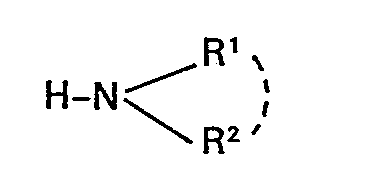
R1 et R2 ont les significations définies ci-dessus, et d'un composé comportant des groupes NCO à liaison aromatique et répondant à la formule générale:

A et n ont les significations définies ci-dessus.
Applications Claiming Priority (2)
| Application Number | Priority Date | Filing Date | Title |
|---|---|---|---|
| DE19813144874 DE3144874A1 (de) | 1981-11-12 | 1981-11-12 | Verfahren zur herstellung von polyaminen aus n-monoaryl-n', n'-dialkylharnstoff-verbindungen und ihre verwendung zum aufbau von polyurethanen |
| DE3144874 | 1981-11-12 |
Publications (3)
| Publication Number | Publication Date |
|---|---|
| EP0079512A2 EP0079512A2 (fr) | 1983-05-25 |
| EP0079512A3 EP0079512A3 (en) | 1984-11-14 |
| EP0079512B1 true EP0079512B1 (fr) | 1986-04-23 |
Family
ID=6146177
Family Applications (1)
| Application Number | Title | Priority Date | Filing Date |
|---|---|---|---|
| EP82110066A Expired EP0079512B1 (fr) | 1981-11-12 | 1982-11-02 | Procédé pour la préparation de polyamines à partir de dérivés d'urée N-monoaryle-N',N'-dialkylique et leur utilisation pour la formation de polyuréthannes |
Country Status (4)
| Country | Link |
|---|---|
| US (1) | US4472568A (fr) |
| EP (1) | EP0079512B1 (fr) |
| JP (1) | JPS5890542A (fr) |
| DE (2) | DE3144874A1 (fr) |
Families Citing this family (11)
| Publication number | Priority date | Publication date | Assignee | Title |
|---|---|---|---|---|
| JPS61120539U (fr) * | 1985-01-16 | 1986-07-30 | ||
| DE3626661A1 (de) * | 1986-08-07 | 1988-02-11 | Bayer Ag | Urethan- und/oder harnstoffgruppen-haltige polyaminohydroxyl-verbindungen, ein verfahren zu ihrer herstellung und ihre verwendung zur herstellung von polyharnstoffurethanen |
| US4845133A (en) * | 1987-04-07 | 1989-07-04 | The Dow Chemical Company | Flexible polyurea or polyurea-polyurethane foams prepared from high equivalent weight amine-terminated compounds |
| US5248755A (en) * | 1989-07-28 | 1993-09-28 | Chemie Linz Gesellschaft M.B.H. | Process for the preparation of asymmetrically substituted ureas, carbamates or thiocarbamates |
| DE19751463B4 (de) * | 1997-11-20 | 2004-05-27 | Eads Deutschland Gmbh | Härter für ein Reaktivharz auf Metalloberflächen und deren Verwendung |
| US6582771B1 (en) | 2002-05-03 | 2003-06-24 | Bayer Corporation | Method for producing a polyurethane/geofabric composite |
| US20050131136A1 (en) | 2003-12-16 | 2005-06-16 | Rosthauser James W. | Soft polyurethaneurea spray elastomers with improved abrasion resistance |
| US20050158131A1 (en) * | 2004-01-20 | 2005-07-21 | Markusch Peter H. | Geotextile/polyurethane composites based on blocked isocyanate compositions |
| CN101518729B (zh) * | 2008-02-26 | 2013-04-24 | 拜耳材料科技(中国)有限公司 | 用于氨基甲酸烷基酯合成的催化剂及其制备方法和用途 |
| US8450529B2 (en) * | 2008-10-02 | 2013-05-28 | Covidien Lp | Branched polyamines and formulations thereof for use in medical devices |
| JP7745070B1 (ja) * | 2024-07-31 | 2025-09-26 | サカタインクス株式会社 | ポリウレタンウレア樹脂溶液の製造方法、軟包装用ラミネート用印刷インキ組成物の製造方法 |
Family Cites Families (20)
| Publication number | Priority date | Publication date | Assignee | Title |
|---|---|---|---|---|
| US2888439A (en) * | 1957-08-16 | 1959-05-26 | Du Pont | Polyurethane diamines |
| US3044989A (en) * | 1958-08-05 | 1962-07-17 | Du Pont | Segmented copolymers |
| DE1155907B (de) * | 1960-07-09 | 1963-10-17 | Bayer Ag | Verfahren zur Herstellung von gegebenenfalls harzartigen Polyaminen |
| DE1215373B (de) * | 1962-07-12 | 1966-04-28 | Bayer Ag | Verfahren zur Herstellung von linearen oder verzweigten Polypropylenglykolaethern mit Aminogruppen |
| DE1495763C3 (de) * | 1963-12-05 | 1975-05-07 | Bayer Ag, 5090 Leverkusen | Verfahren zur Herstellung von vernetzten Polyurethan-Elastomeren |
| DE1270046B (de) * | 1965-01-22 | 1968-06-12 | Bayer Ag | Verfahren zur Herstellung von Polyalkylenglykolaether enthaltenden primaeren aromatischen Aminen |
| GB1125836A (en) * | 1965-09-17 | 1968-09-05 | Gen Mills Inc | New derivatives of polyamines and isocyanates |
| DE1694152C3 (de) * | 1967-05-12 | 1979-09-13 | Bayer Ag, 5090 Leverkusen | Verfahren zur Herstellung von mikroporösen Flächengebilden |
| DE2019432C3 (de) * | 1970-04-22 | 1982-05-06 | Bayer Ag, 5090 Leverkusen | Verfahren zur Herstellung von endständige Aminogruppen aufweisenden organischen Verbindungen und deren Verwendung zur Herstellung von Kunststoffen |
| DE2116882C3 (de) * | 1971-04-06 | 1985-05-15 | Schering AG, 1000 Berlin und 4709 Bergkamen | Enaminverbindungen und deren Herstellung |
| BE828152A (fr) * | 1974-04-22 | 1975-10-21 | Catalyseurs de polymerisation a activites elevees | |
| DE2546536A1 (de) * | 1975-10-17 | 1977-04-28 | Bayer Ag | Hochmolekulare polyamine und verfahren zu ihrer herstellung |
| US4129741A (en) * | 1975-10-27 | 1978-12-12 | Lim-Holding, S.A. | Novel polyethers having terminal amino groups, a process for their production and their application |
| DD127235A5 (fr) * | 1975-10-27 | 1977-09-14 | ||
| DE2619840A1 (de) * | 1976-05-05 | 1977-11-24 | Bayer Ag | Amino- und hydroxyl- bzw. mercaptogruppenhaltige polymere und ihre verwendung zur herstellung von polyurethankunststoffen |
| DE2803103A1 (de) * | 1978-01-25 | 1979-07-26 | Bayer Ag | Verfahren zur herstellung von biuret- und/oder harnstoffgruppen aufweisenden organischen polyisocyanaten |
| US4180644A (en) * | 1978-07-31 | 1979-12-25 | Texaco Development Corp. | Polyurethane chain-extenders |
| DE2948419C2 (de) * | 1979-12-01 | 1985-02-07 | Bayer Ag, 5090 Leverkusen | Verfahren zur Herstellung von Polyaminen und deren Verwendung in einem Verfahren zur Herstellung von Polyurethankunststoffen |
| DE3039600A1 (de) * | 1980-10-21 | 1982-05-19 | Bayer Ag, 5090 Leverkusen | Polyamine, verfahren zur herstellung von polyaminen und deren verwendung zur herstellung von polyurethankunststoffen |
| DE3112118A1 (de) * | 1981-03-27 | 1982-10-07 | Bayer Ag, 5090 Leverkusen | Polymerisathaltige polyetherpolyamine, verfahren zur herstellung dieser polyamine und deren verwendung als aufbaukomponente zur herstellung von polyurethanen |
-
1981
- 1981-11-12 DE DE19813144874 patent/DE3144874A1/de not_active Withdrawn
-
1982
- 1982-10-28 US US06/437,398 patent/US4472568A/en not_active Expired - Fee Related
- 1982-11-02 DE DE8282110066T patent/DE3270789D1/de not_active Expired
- 1982-11-02 EP EP82110066A patent/EP0079512B1/fr not_active Expired
- 1982-11-12 JP JP57197848A patent/JPS5890542A/ja active Pending
Also Published As
| Publication number | Publication date |
|---|---|
| DE3144874A1 (de) | 1983-05-19 |
| US4472568A (en) | 1984-09-18 |
| EP0079512A3 (en) | 1984-11-14 |
| JPS5890542A (ja) | 1983-05-30 |
| EP0079512A2 (fr) | 1983-05-25 |
| DE3270789D1 (en) | 1986-05-28 |
Similar Documents
| Publication | Publication Date | Title |
|---|---|---|
| EP0050275B1 (fr) | Préparation de polyamines | |
| DE2948419C2 (de) | Verfahren zur Herstellung von Polyaminen und deren Verwendung in einem Verfahren zur Herstellung von Polyurethankunststoffen | |
| EP0071834B1 (fr) | Procédé de préparation de polyamines et leur utilisation pour la préparation de polyuréthanes | |
| EP0097290B1 (fr) | Procédé en une seule étape pour la préparation de polyamines à partir de prépolymères du type NCO, polyamines et l'utilisation de ces dernières pour la production de polyuréthannes | |
| DE1174759B (de) | Verfahren zur Herstellung von Polyisocyanaten mit Biuretstruktur | |
| EP0097298B1 (fr) | Polyamines, procédé pour la préparation de polyamines et leur utilisation pour la préparation de polyuréthanes | |
| EP0097299B1 (fr) | Polyamines, procédé pour la préparation de polyamines et leur utilisation pour la préparation de polyuréthanes | |
| EP0099537B1 (fr) | Procédé en une étape pour la fabrication de polyamines à partir de prépolymères à groupements NCO | |
| EP0079512A2 (fr) | Procédé pour la préparation de polyamines à partir de dérivés d'urée N-monoaryle-N',N'-dialkylique et leur utilisation pour la formation de polyuréthannes | |
| EP0071139B1 (fr) | Procédé simplifié de préparation de polyamines par hydrolyse alcaline de composés contenant des groupes NCO et application de ces polyamines pour la préparation de polyuréthanes | |
| EP0219035A2 (fr) | Procédé pour la préparation de polyamines et leur utilisation pour la préparation de polyuréthanes | |
| EP0113020B1 (fr) | Composants de réaction contenant des groupes amino, procédé de leur préparation et leur utilisation | |
| EP0079536B1 (fr) | Procédé pour la préparation de polyamines modifiées | |
| EP0097869B1 (fr) | Composés contenant des groupes amines primaires aromatiques, des groupes uréthanes et des groupes polyesters, procédé pour leur fabrication et leur application comme matières premières de polyuréthanes | |
| EP0217247B1 (fr) | Procédé pour la préparation de polyamines, polyamines et leur utilisation pour la préparation de polyuréthanes | |
| EP0113027B1 (fr) | Procédé pour la préparation de polyamines | |
| EP0255677B1 (fr) | Procédé de fabrication de compositions à fonctions polyamino et hydroxy contenant des groupes uréthane et/ou urée et leur application à la fabrication de polyurée-uréthanes | |
| DE3710426A1 (de) | Verfahren zur herstellung von polyaminen und deren verwendung zur herstellung von polyurethanen | |
| DD259870A5 (de) | Polyamine, verfahren zu ihrer herstellung aus nco-prepolymeren und ihre verwendung bei der herstellung von polyurethanen | |
| DD258615A5 (de) | Verfahren zur herstellung von polyaminen | |
| EP0285948A1 (fr) | Procédé pour la préparation de polyamines et leur utilisation pour la préparation de polyuréthanes | |
| EP0351640A1 (fr) | Oligo- et polyuréthanes N,N-disubstitués, leur préparation et leur utilisation pour la préparation de matières plastiques | |
| EP0353572A2 (fr) | Polyisocyanates contenant des groupes urée modifiés avec des composants à longues chaînes | |
| EP0071138A2 (fr) | Amines primaires, aromatiques et aliphatiques, contenant du soufre; procédé de préparation et utilisation dans la fabriacation de polyuréthanes |
Legal Events
| Date | Code | Title | Description |
|---|---|---|---|
| PUAI | Public reference made under article 153(3) epc to a published international application that has entered the european phase |
Free format text: ORIGINAL CODE: 0009012 |
|
| 17P | Request for examination filed |
Effective date: 19821102 |
|
| AK | Designated contracting states |
Designated state(s): BE DE FR GB IT NL |
|
| PUAL | Search report despatched |
Free format text: ORIGINAL CODE: 0009013 |
|
| AK | Designated contracting states |
Designated state(s): BE DE FR GB IT NL |
|
| GRAA | (expected) grant |
Free format text: ORIGINAL CODE: 0009210 |
|
| AK | Designated contracting states |
Kind code of ref document: B1 Designated state(s): BE DE FR GB IT NL |
|
| ITF | It: translation for a ep patent filed | ||
| ET | Fr: translation filed | ||
| REF | Corresponds to: |
Ref document number: 3270789 Country of ref document: DE Date of ref document: 19860528 |
|
| PLBE | No opposition filed within time limit |
Free format text: ORIGINAL CODE: 0009261 |
|
| STAA | Information on the status of an ep patent application or granted ep patent |
Free format text: STATUS: NO OPPOSITION FILED WITHIN TIME LIMIT |
|
| 26N | No opposition filed | ||
| PGFP | Annual fee paid to national office [announced via postgrant information from national office to epo] |
Ref country code: GB Payment date: 19931025 Year of fee payment: 12 |
|
| PGFP | Annual fee paid to national office [announced via postgrant information from national office to epo] |
Ref country code: FR Payment date: 19931117 Year of fee payment: 12 Ref country code: BE Payment date: 19931117 Year of fee payment: 12 |
|
| ITTA | It: last paid annual fee | ||
| PGFP | Annual fee paid to national office [announced via postgrant information from national office to epo] |
Ref country code: NL Payment date: 19931130 Year of fee payment: 12 |
|
| PG25 | Lapsed in a contracting state [announced via postgrant information from national office to epo] |
Ref country code: GB Effective date: 19941102 |
|
| PG25 | Lapsed in a contracting state [announced via postgrant information from national office to epo] |
Ref country code: BE Effective date: 19941130 |
|
| BERE | Be: lapsed |
Owner name: BAYER A.G. Effective date: 19941130 |
|
| PG25 | Lapsed in a contracting state [announced via postgrant information from national office to epo] |
Ref country code: NL Effective date: 19950601 |
|
| GBPC | Gb: european patent ceased through non-payment of renewal fee |
Effective date: 19941102 |
|
| NLV4 | Nl: lapsed or anulled due to non-payment of the annual fee | ||
| PG25 | Lapsed in a contracting state [announced via postgrant information from national office to epo] |
Ref country code: FR Effective date: 19950731 |
|
| REG | Reference to a national code |
Ref country code: FR Ref legal event code: ST |
|
| PGFP | Annual fee paid to national office [announced via postgrant information from national office to epo] |
Ref country code: DE Payment date: 19951012 Year of fee payment: 14 |
|
| PG25 | Lapsed in a contracting state [announced via postgrant information from national office to epo] |
Ref country code: DE Effective date: 19970801 |