EP0080036A2 - Nichtringförmiger Rückstandsauslass für Zyklonabscheider - Google Patents
Nichtringförmiger Rückstandsauslass für Zyklonabscheider Download PDFInfo
- Publication number
- EP0080036A2 EP0080036A2 EP82108633A EP82108633A EP0080036A2 EP 0080036 A2 EP0080036 A2 EP 0080036A2 EP 82108633 A EP82108633 A EP 82108633A EP 82108633 A EP82108633 A EP 82108633A EP 0080036 A2 EP0080036 A2 EP 0080036A2
- Authority
- EP
- European Patent Office
- Prior art keywords
- outlet
- section
- cross
- tip
- rejects
- Prior art date
- Legal status (The legal status is an assumption and is not a legal conclusion. Google has not performed a legal analysis and makes no representation as to the accuracy of the status listed.)
- Withdrawn
Links
Images

Classifications
-
- B—PERFORMING OPERATIONS; TRANSPORTING
- B04—CENTRIFUGAL APPARATUS OR MACHINES FOR CARRYING-OUT PHYSICAL OR CHEMICAL PROCESSES
- B04C—APPARATUS USING FREE VORTEX FLOW, e.g. CYCLONES
- B04C5/00—Apparatus in which the axial direction of the vortex is reversed
- B04C5/14—Construction of the underflow ducting; Apex constructions; Discharge arrangements ; discharge through sidewall provided with a few slits or perforations
-
- D—TEXTILES; PAPER
- D21—PAPER-MAKING; PRODUCTION OF CELLULOSE
- D21D—TREATMENT OF THE MATERIALS BEFORE PASSING TO THE PAPER-MAKING MACHINE
- D21D5/00—Purification of the pulp suspension by mechanical means; Apparatus therefor
- D21D5/18—Purification of the pulp suspension by mechanical means; Apparatus therefor with the aid of centrifugal force
- D21D5/24—Purification of the pulp suspension by mechanical means; Apparatus therefor with the aid of centrifugal force in cyclones
Definitions
- the present invention relates to apparatus for separating suspensions of solid particles in fluids, including both gases and liquids, into light and heavy fractions, and in particular to the separation of undesired particles from paper pulp slurries.
- Vortex or cyclone cleaners for separating sand, grit, bark particles, and shives from cellulose fibers in a paper pulp slurry.
- such cleaners include an elongated chamber of circular cross-section, either cylindrically shaped or somewhat tapered.
- the pulp slurry to be cleaned is introduced under pressure into one end of the chamber through a restricted tangential inlet so that a high velocity vortex is developed along the length of the chamber.
- the vortex is typically of a velocity high enough to form a centrally-located axial gas core.in the chamber.
- the end of the chamber opposite the inlet is tapered and forms a relatively small diameter apex discharge outlet for the denser and larger particle rejects portion of the pulp slurry.
- Acceptable fibers which are of a relatively lower density and are located near the inner portion of the vortex, reverse their direction of flow adjacent the tapered end of the chamber and flow upwardly to be withdrawn through an axial outlet at the larger diameter end of the chamber.
- a cyclone separator system includes several stages coupled in series, with each stage including several separators connected in parallel, having common inlet and outlet chambers.
- the second stage treats the rejects of the first
- the third stage treats the rejects of the second, and so on, in an effort to minimize the amount of discarded good fibers while concentrating the impurities.
- Such a system is utilized to separate the original highly diluted pulp suspension into a usable paper making fiber portion (a lower density accepts portion) and a thickened large and denser impurities portion (rejects).
- An increase in the rejects flow from a cyclone separator system can result in the more complete removal of contaminants and impurities from the pulp suspension.
- increased rejects flows result in greater power requirements for the system to handle and transport greater volumes of material.
- increased rejects flows increase the amount of good fiber which is discarded from the system.
- a cyclone separator having a separation chamber, a first end thereof having a generally circular cross-section with a tangential inlet and a central outlet and the opposite end thereof tapering toward an outlet of smaller flow area then the chamber in which the internal wall defining the outlet is of a noncircular cross-section.
- the internal wall of the device gradually transforms from a circular cross-section into a rejects discharge outlet which is noncircular in cross-section. It has been discovered that by varying the shape of the rejects outlet of a cyclone separator, the rejects rate, the thickening factor, and the feed pressure to the device can also be varied while maintaining substantially the same cleaning efficiency without plugging problems.
- the modified rejects outlet of the present invention may be incorporated or formed as an integral part of a conventional cyclone separation device or may be fabricated as a replaceable tip. Additionally, the present invention may be utilized in both single separator devices as well as in clusters of such devices.
- the modified rejects outlet of the present invention may also be used in conjunction with reverse centrifugal cleaning devices such as the device taught in Seifert et al, U.S. Patent No. 4,155,839.
- the present invention may also be utilized in the separation of solids from gases.
- the cleaning efficiency of cyclone separators using the present invention is substantially unaffected by the noncircular rejects outlets. This provides flexibility in the design of such cyclone separator systems to achieve one or more of the above operational advantages at no sacrifice in cleaning efficiency.
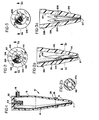
- the apparatus includes a hollow cyclone member 10 forming a separation chamber having a cylindrical portion 12, a tapering portion 14, and a hollow apex cone or tip portion 16 which has an outlet port 17.
- the cylindrical and tapering portions of the cyclone body may be formed of a polymeric resin material such as polypropylene, polystyrene, nylon, or the like.
- the apex tip portion 16 is preferably formed of a ceramic material which resists abrasion, although it may also be formed as a unitary structure with the cyclone body out of the same material as the body is formed.
- the cylindrical portion 12 of the cyclone has a tangentially extending slot-like inlet 18 through which a fluid suspension of material, such as paper stock, will enter the apparatus.
- the end of cylindrical portion 12 of the cyclone body is provided with a closure cover 20 which may be fabricated of the same polymeric resin material as other portions of cyclone member 10. Closure cover 20 and the end of cylindrical portion 12 may be threaded for sealing engagement. Closure cover 20 is also provided with a centrally located vortex finder or overflow nozzle tube 22 through which the accepts portion of the suspension flows and which extends inwardly into the center of cylindrical portion 12.
- Cyclone member 10 includes an apex tip portion 16 which is preferably formed of an abrasion resistant cast ceramic material.
- the tapering tip portion 16 forms an extension of tapering portion 14, and can be formed with an outwardly projecting threaded portion 26 as an original part thereof for receiving an annular internally threaded coupling nut 28 to seal tip portion 16 to tapering portion 14.
- the threaded portion may be cemented in place on the tip portion 16 in a known manner.
- Figs. 2, 2a and 2b illustrate an embodiment of the invention in which apex tip portion l16 has an outlet port 117 having a square cross-section.
- apex tip l16 is designed to be a replaceable element which can be joined to a cyclone separator body using threads 126.
- the inner wall 101 of the hollow tapering body portion of apex tip 116 gradually transforms from circular to square cross-section a portion of the distance along the length of the tip.
- Tapering wall portions 102, 104, 106, and 108 which together form a tapered passageway having a square cross-section, may be integrally molded into apex tip 116 during its fabrication (as illustrated) or may be secured in position after formation of the apex tip by suitable means.
- inner wall 101 will have differing angles of taper. That is, as the cross-section of the separator is gradually transformed from circular to noncircular, certain wall portions will form lesser angles with the longitudinal axis of separator than other wall portions. For example, as illustrated in Figs. 2, 2a, and 2b, tapering wall portions 102, 104, 106, 108 will form lesser angles with the longitudinal axis of the separator than the wall portions 103, 105, 107 and 109 which are located between the tapering wall portions.
- apex tip portion 216 has an outlet portion 217 having a triangular cross-section.
- Tip 216 is designed to be joined to a cyclone body using threads 226.
- Inner wall 201 of tip 216 changes from a circular to a triangular cross-section a portion of the distance along the length of the tip.
- Tapering wall portions 202, 204, and 206 are provided which together form a tapering passageway having a triangular cross-section.
- FIG. 4 and 4a illustrates the use.of an oblong or elliptical outlet port 317 in apex tip 316.
- the elliptically-shaped outlet results from the formation of the end of tip 316 at an angle a from the axis normal to the long axis of the tip.
- the angle a may be varied from 1 0 to 89 0 to vary the extent that outlet portion 317 deviates from a circular cross-section.
- the tip 316 may be formed with an elliptically-shaped outlet having an end normal to the long axis of the tip.
- tip 316 may include threads 326 to secure it to a cyclone body.
- FIG. 5 and 5a illustrates the use of a polygonal or saw-toothed shaped outlet portion 417 in an apex tip 416 designed to be joined to a cyclone body using threads 426.
- Inner wall 401 of tip 416 changes from a circular to a polygonal cross-section a portion of the distance along the length of the tip.
- Tapering wall portions 402, 403, 404, 405, 406, 407, 408, 409, 410, 411, 412, 413, 414, 415, 419 and 420 together form a tapering passageway having a polygonal cross-section and giving a saw-toothed effect to the outlet 417.
- Runs 1-4 reject flow was controlled by a reject valve present in the cyclone separator device. Runs 5-8 were performed with the reject valve wide open to eliminate any possibility of plugging of the valve. An arrangement to provide free discharge was set up so that the rejects from the device discharged into an open pipe located approximately 8 feet (2.44 cm) above the device. This arrangement provided approximately 3.5 psi (0.235 bar) back pressure on the reject stock. The pressure drop measured through the device was 20 psi (1.34 bar) for all runs.
- Runs 3 and 7 performed with square tip B resulted in significantly lower reject rates and thickening factors than the standard circular tip (Runs 1 and 5) or tip A (Runs 2 and 6).
- Example 2 The same arrangement as in Example 1 was used to test the tips except that the feedstock utilized was a mixture of Kraft corrugated furnish, clippings, and pieces. The results are reported in Table II below. Again, the pressure drop through the device was measured to be 20 psi (1.34 bar) for all runs.
- Example 1 Further test runs were made using the feedstock of Example 1 at a higher consistency (i.e., approximately 1.0%). The results are reported in Table III below. The pressure drop measured through the device was 20 psi (1.34 bar), for all runs.
- the rejects rate, thickening factor, and feed pressure to the device can also be varied to yield improved performance of the device while maintaining substantially the same cleaning efficiency and without plugging problems.
- a lower rejects rate can be obtained using the same open area for a square tip versus prior art circular tips. If plugging is a problem, larger open area square tips can be used at substantially the same reject rates as prior art circular tips.
- Other modifications of tip geometry will be readily apparent to the skilled practitioner to achieve optimum performance under varying conditions of feed, pressure, consistency, and the like.
Landscapes
- Engineering & Computer Science (AREA)
- Mechanical Engineering (AREA)
- Cyclones (AREA)
- Paper (AREA)
Applications Claiming Priority (2)
| Application Number | Priority Date | Filing Date | Title |
|---|---|---|---|
| US32283181A | 1981-11-19 | 1981-11-19 | |
| US322831 | 1994-10-18 |
Publications (2)
| Publication Number | Publication Date |
|---|---|
| EP0080036A2 true EP0080036A2 (de) | 1983-06-01 |
| EP0080036A3 EP0080036A3 (de) | 1985-05-22 |
Family
ID=23256626
Family Applications (1)
| Application Number | Title | Priority Date | Filing Date |
|---|---|---|---|
| EP82108633A Withdrawn EP0080036A3 (de) | 1981-11-19 | 1982-09-18 | Nichtringförmiger Rückstandsauslass für Zyklonabscheider |
Country Status (6)
| Country | Link |
|---|---|
| EP (1) | EP0080036A3 (de) |
| JP (1) | JPS5889958A (de) |
| BR (1) | BR8206317A (de) |
| CA (1) | CA1203779A (de) |
| ES (1) | ES517475A0 (de) |
| FI (1) | FI69410C (de) |
Cited By (1)
| Publication number | Priority date | Publication date | Assignee | Title |
|---|---|---|---|---|
| CN114985127A (zh) * | 2022-07-15 | 2022-09-02 | 中国空气动力研究与发展中心低速空气动力研究所 | 一种改变射流形状的方法 |
Families Citing this family (2)
| Publication number | Priority date | Publication date | Assignee | Title |
|---|---|---|---|---|
| CA1231320A (en) * | 1984-06-04 | 1988-01-12 | Elp Products Ltd. | Self-sealing unplugging-probe admitting grommet for hydrocyclone reject outlets |
| DE202006003421U1 (de) * | 2006-03-04 | 2006-05-04 | Voith Paper Patent Gmbh | Vorrichtung zum Austragen von Schwerteilen aus einem Apparat zur Behandlung einer Faserstoffsuspension, insbesondere aus einem zum Reinigen einer Faserstoffsuspension betreibbaren Hydrozyklon |
Family Cites Families (11)
| Publication number | Priority date | Publication date | Assignee | Title |
|---|---|---|---|---|
| US441140A (en) * | 1890-11-25 | culver | ||
| US479231A (en) * | 1892-07-19 | Pieter van gelder | ||
| FR341369A (fr) * | 1904-03-01 | 1904-08-06 | Thomas Edward Wilson Clyma | Perfectionnements aux appareils du type dit "cyclone", destinés à séparer les poussières, déchets, copeaux, etc., d'avec l'air |
| CA964616A (en) * | 1973-07-20 | 1975-03-18 | Elast-O-Cor Products And Engineering Limited | Compound hydrocyclone having grooved under flow wall (s) |
| JPS5242442U (de) * | 1975-09-19 | 1977-03-25 | ||
| SE412529B (sv) * | 1977-03-07 | 1980-03-10 | Celleco Ab | Anordning vid en hydrocyklonseparator for att minska risken for forlust av lett fraktion och igensettning av den tunga fraktionens utloppsoppning |
| US4163726A (en) * | 1977-04-29 | 1979-08-07 | Hughart Robert P | Valve assembly for cyclones or other abrasive applications |
| SU709181A1 (ru) * | 1977-12-19 | 1980-01-15 | Киргизский сельскохозяйственный институт им.К.И.Скрябина | Гидроциклон |
| US4203834A (en) * | 1978-01-23 | 1980-05-20 | Krebs Engineers | Hydrocyclone underflow density control |
| FI58954C (fi) * | 1979-08-20 | 1981-05-11 | Enso Gutzeit Oy | Hydrocyklon |
| DE2942099C2 (de) * | 1979-10-18 | 1984-10-04 | Schauenburg Maschinen- und Anlagen-Bau GmbH, 4330 Mülheim | Hydrozyklon für die Fraktionierung von suspendierten Feststoffen |
-
1982
- 1982-08-24 CA CA000409983A patent/CA1203779A/en not_active Expired
- 1982-09-18 EP EP82108633A patent/EP0080036A3/de not_active Withdrawn
- 1982-10-18 JP JP18266982A patent/JPS5889958A/ja active Granted
- 1982-10-29 BR BR8206317A patent/BR8206317A/pt unknown
- 1982-11-18 FI FI823961A patent/FI69410C/fi not_active IP Right Cessation
- 1982-11-18 ES ES517475A patent/ES517475A0/es active Granted
Cited By (2)
| Publication number | Priority date | Publication date | Assignee | Title |
|---|---|---|---|---|
| CN114985127A (zh) * | 2022-07-15 | 2022-09-02 | 中国空气动力研究与发展中心低速空气动力研究所 | 一种改变射流形状的方法 |
| CN114985127B (zh) * | 2022-07-15 | 2022-11-01 | 中国空气动力研究与发展中心低速空气动力研究所 | 一种改变射流形状的方法 |
Also Published As
| Publication number | Publication date |
|---|---|
| FI69410B (fi) | 1985-10-31 |
| JPS5889958A (ja) | 1983-05-28 |
| JPH0322220B2 (de) | 1991-03-26 |
| CA1203779A (en) | 1986-04-29 |
| ES8400256A1 (es) | 1983-11-01 |
| EP0080036A3 (de) | 1985-05-22 |
| ES517475A0 (es) | 1983-11-01 |
| FI823961A0 (fi) | 1982-11-18 |
| BR8206317A (pt) | 1983-09-20 |
| FI823961L (fi) | 1983-05-20 |
| FI69410C (fi) | 1986-02-10 |
Similar Documents
| Publication | Publication Date | Title |
|---|---|---|
| EP0493950B1 (de) | Zentrifugalreiniger | |
| US7404492B2 (en) | Separation of fibre pulp suspensions containing relatively heavy contaminants | |
| EP0017481B1 (de) | Selbstschliessendes Ventil um die Beseitigung einer Verstopfung in einem Zentrifugalreiniger zu erleichtern | |
| CA1288731C (en) | Fiber recovery elutriating hydrocyclone | |
| EP0668796B1 (de) | Einstellbarer hydrozyklon | |
| GB2056325A (en) | Hydrocyclone | |
| US3433362A (en) | Cyclone purifier | |
| JPH0330420B2 (de) | ||
| JPS6136988B2 (de) | ||
| US6109451A (en) | Through-flow hydrocyclone and three-way cleaner | |
| US4510056A (en) | Hydrocyclone separator | |
| JPS6318447Y2 (de) | ||
| US4451358A (en) | Noncircular rejects outlet for cyclone separator | |
| CN109963656A (zh) | 水力旋流器装置 | |
| EP0928223B1 (de) | Durchflussreiniger mit verbessertem einlassbereich | |
| US3612276A (en) | Vortex-type separator apparatus | |
| CA2120436A1 (en) | Flotation system | |
| EP0080036A2 (de) | Nichtringförmiger Rückstandsauslass für Zyklonabscheider | |
| US3543932A (en) | Vortex chamber reject control | |
| US4564443A (en) | Reverse centrifugal cleaning of paper making stock | |
| US2878934A (en) | Method and apparatus separating dirt from aqueous suspensions of pulp fibres | |
| CA1159404A (en) | Vortex separator with central tengential heavies outlet and upper-most lights outlets | |
| CZ285066B6 (cs) | Způsob a zařízení k oddělování alespoň jedné látky z kapalného nebo plynného média | |
| US5938926A (en) | Extended dwell reverse hydrocyclone cleaner | |
| US4392950A (en) | Centrifugal type cleaner |
Legal Events
| Date | Code | Title | Description |
|---|---|---|---|
| PUAI | Public reference made under article 153(3) epc to a published international application that has entered the european phase |
Free format text: ORIGINAL CODE: 0009012 |
|
| AK | Designated contracting states |
Designated state(s): DE FR GB SE |
|
| 17P | Request for examination filed |
Effective date: 19830823 |
|
| PUAL | Search report despatched |
Free format text: ORIGINAL CODE: 0009013 |
|
| AK | Designated contracting states |
Designated state(s): DE FR GB SE |
|
| 17Q | First examination report despatched |
Effective date: 19860505 |
|
| STAA | Information on the status of an ep patent application or granted ep patent |
Free format text: STATUS: THE APPLICATION IS DEEMED TO BE WITHDRAWN |
|
| 18D | Application deemed to be withdrawn |
Effective date: 19861115 |
|
| RIN1 | Information on inventor provided before grant (corrected) |
Inventor name: CHUPKA, DAVID E. |