EP0080452A1 - Heat stabilized polymers - Google Patents
Heat stabilized polymers Download PDFInfo
- Publication number
- EP0080452A1 EP0080452A1 EP82870069A EP82870069A EP0080452A1 EP 0080452 A1 EP0080452 A1 EP 0080452A1 EP 82870069 A EP82870069 A EP 82870069A EP 82870069 A EP82870069 A EP 82870069A EP 0080452 A1 EP0080452 A1 EP 0080452A1
- Authority
- EP
- European Patent Office
- Prior art keywords
- weight
- polymer
- acid
- acrylonitrile
- anhydride
- Prior art date
- Legal status (The legal status is an assumption and is not a legal conclusion. Google has not performed a legal analysis and makes no representation as to the accuracy of the status listed.)
- Withdrawn
Links
Classifications
-
- C—CHEMISTRY; METALLURGY
- C08—ORGANIC MACROMOLECULAR COMPOUNDS; THEIR PREPARATION OR CHEMICAL WORKING-UP; COMPOSITIONS BASED THEREON
- C08K—Use of inorganic or non-macromolecular organic substances as compounding ingredients
- C08K3/00—Use of inorganic substances as compounding ingredients
- C08K3/30—Sulfur-, selenium- or tellurium-containing compounds
Definitions
- This invention relates to polymers and polyblends, comprising, as polymerized components, an unsaturated dicarboxylic acid anhydride and an unsaturated nitrile. More specifically, it relates to such polymers and polyblends that have been stabilized against certain effects of high temperatures.
- the effect increases in significance with the amounts of the components and generally above about 15% of each component in a polymer composition is enough to generate the effect to a noticeable extent if the temperature is sufficiently elevated, that is above about 265 o C .
- the present invention provides a means of reducing the significance of the crosslinking effect thus permitting the use of a wider range of molding and extrusion conditions with such polymers.
- crosslinking effect referred to above has been identified, for example, in USP 4,223,096 which describes the preparation of rubber modified terpolymers of styrene, maleic anhydride and acrylonitrile.
- the crosslinking tendency is controlled by the use of chain transfer agents such that up to about 20% acrylonitrile can be incorporated in a polymer containing from 15% to 33% of maleic anhydride before the crosslinking tendency renders the polymer non-thermoformable.
- the present invention provides a means of controlling this tendency and makes it possible either to extend the composition range so as to achieve even more advantageous properties, or to broaden the range of permissible processing conditions for the polymers.
- the present invention provides a polymer composition with a reduced tendency to generate crosslinks comprising polymer units derived from an unsaturated nitrile and an unsaturated dicarboxylic acid anhydride, which composition comprises an effective amount between from 0.001 to 0 ⁇ .0 ⁇ 0 ⁇ 5 mole of a sulfur acid per 100 gm of the polymer.
- the polymeric composition can be provided by a single polymer or it may be a blend of polymers.
- the polymeric composition can be, for example, a styrene maleic anhydride/acrylonitrile terpolymer (or its rubber-madified equivalent) or a blend of a styrene/maleic anhydride copolymer (or its rubber-modified equivalent) with a styrene/acrylonitrile copolymer or an acrylonitrile/butadiene/styrene (ABS) copolymer or a nitrile rubber.
- ABS acrylonitrile/butadiene/styrene
- the crosslinking effect begins even where the proportions of the nitrile and anhydride components are quite low but as might be expected, the significance of the effect increases proportionately with the amounts.
- the present invention has particular utility when the proportions of the nitrile and anhydride components are each above about 5% by weight of the composition weight.
- the process of the invention is particularly useful when the proportion of anhydride in the composition is between about 5 and 30% and the nitrile proportion is between about 5 and 20% of the total polymer composition.
- sulfur acid is herein used to indicate a compound containing sulfur that yields a hydrogen ion when dissolved in water.
- the term "acid” therefore indicates a conventional Bronsted acid and the acid selected is preferably an organic acid though inorganic sulfur acids such as sulfuric acid may be used.
- Aliphatic sulfonic acids such as methane sulfonic acid and halogen substituted alkyl sulfonic acids can be used but the preferred organic sulfur acids are aromatic acids such as benzene sulfonic acid, dodecyl benzene sulfonic acid, toluene sulphonic acid, xylene sulfonic acid and naphthalene sulphonic acid. Excellent results have been obtained using para-toluene sulphonic acid.
- the amount added can be from about 0.001 up to 0.005 mole acid per 100 gm of the polymer composition weight. With some acids, however, increasing the amount added leads to an increase in the degree of crosslinking probably by a different mechanism to that initially suppressed by the use of the acid. Thus, with above about .005 mole per 100 gm of polymer of toluene sulfonic acid the crosslinking effect seems to increase in significance and the optimum level appears to lie in the range from about 0.002 to 0.004 mole per 10 ⁇ 0 ⁇ gm of polymer. The optimum effective range will differ with each additive, but in practice, the best properties are obtained within the above-stated range for all sulfur acids.
- the acid can be added in any convenient manner but it is found that, when the anhydride-containing component and the nitrile containing component are in different polymers, there is advantage in blending a portion of the acid with each polymer component before they are blended together or alternatively with the nitrile containing component alone. The reason for this effect is not known for certain but it may simply be a reflection of the better dispersion of the additive thereby obtained.
- a number of sulfur acids were blended with a polyblend comprising 37% by weiqht of a styrene/maleic anhydride/methyl methacrylate terpolymer comprising about 25.5% by weight of maleic anhydride and 63% of ASS (SAN-grafted polybutadiene particles dispersed in a matrix of an SAN copolymer) comprising about 13.7% by weight of acrylonitrile.
- ASS SAN-grafted polybutadiene particles dispersed in a matrix of an SAN copolymer
- the terpolymer and a first ABS component were blended together with a plasticizer (where one was used), and with the acid. This was then blended with a further ABS component to give the above blend.
- the blend was dried at 80°C. in a circulating air oven and extruded in a one inch Killion extruder using a two stage screw with vent or compounded in a Banbury mixer. Blending temperatures of about 200°C. were used.
- Pellets of the blend were vacuum dried 16 hours at 80°C. and molded in a one ounce Arburg molding machine using 800 psi pressure. Izod bars (1.27 cm x 1.27 cm x 12.7 cm) were molded directly from the Arburg at a stock temperature of 260°C., and also after "Dwell Times" (i.e. length of time in Arburg at stock temperature) of 5, 10 and 15 minutes. At each time, three bars were molded and inspected closely to determine the extent of any blistering (indicating decomposition) that had occurred. The bars were then ground in a Thomas mill. The ground bars were vacuum dried 16 hours and used to measure apparent viscosity at 100 sec -1 at 246 0 C using a Monsanto Automatic Capillary Rheometer.
- This Example illustrates the use of sulfuric acid to control crosslinking in the above composition.
- a comparative run (no acid) and runs incorporating 0.125% and 0.25% of sulfuric acid were performed.
- the acid was incorporated as a 98% solution.
- the results are shown in Table 1 below.
- the sulfuric acid is not very effective at a level of 0.125% (.0013 mole/100 gm polymer) but at 0.25% (.0026 mole/100 gm polymer) the crosslinking as evidenced by the increase in apparent viscosity has been significantly reduced.
- evolution of gas as evidenced by the blistering of the bar has likewise been delayed by the presence of the acid.
- Example 2 uses the same formulation as Example 1 except that 0.79% (.0024 mole/100 gm polymer) of dodecyl benzene sulfonic acid was blended into the formulation. The results are set forth in Table 2 below.
- dodecyl benzene sulfonic acid significantly reduces the crosslinking and also appears to moderate the severity of blistering even at 0.79% addition.
- Example 3 illustrates the use of para-toluene sulfonic acid monohydrate to achieve the stabilization of a polyblend similar to that used in Example 1 except that 50% of the polyblend weight is provided by each of the terpolymer and the ABS. The results are set forth in Table 3 below.
- Example 4 describes the results obtained using para-toluene sulfonic acid monohydrate in the formulation used in Examples 1 and 2.
- the ABS and the sulfonic acid additive (0.265,'0.371, 0.477, 0.583% by weight) were blended together in a Banbury mixer and this blend was extruded with the terpolymer.
- the results obtained are set forth in Table 4 below.
- crosslinking problem and blistering are significantly controlled at para toluene sulfonic acid monohydrate levels between 0.265 and 0.583%.
- the polymer composition whose processability is improved by the use of the sulfur acid compounds can be single polymers such as terpolymer of styrene, maleic anhydride and acrylonitrile or a rubber-modified version of such a polymer as described, for example, in U. S. P. 4,262,096.
- Preferred terpolymers of this type comprise from 15 to 30% by weight of maleic anhydride and from 5 to 20% by weight of acrylonitrile.
- Particularly advantageous terpolymers contain from 10 to 30% by weight of a rubber having a glass transition temperature below 0°C. and preferably below -30°C.
- Suitable rubbers include polybutadiene, a rubbery copolymer of styrene or acrylonitrile and butadiene, polyisoprene, polychloroprene, EPDM rubbers, ethylene/vinyl acetate rubbers, acrylate rubbers and polypentenamer.
- the polymer composition can comprise an anhydride-containing polymer such as a styrene/maleic anhydride copolymer preferably one confining at least 10% by weight, and more preferably at least 20% by weight such as from 20 to 35% by weight of maeic anhydride, or a terpolymer with part of the styrene replaced by a nonnitrile copolymerizable monomer such as an acrylate or methacrylate ester so as to provide from 2 to 20% of the copolymer weight.
- the anhydride-containing polymer can, of course, be rubber-modified.
- the nitrile-containing component of such a polymer composition can be provided by polymers such as styrene/acrylonitrile comprising from 20 to 70% by weight of acrylonitrile and acrylonitrile/butadiene/styrene (ABS) wherein the acrylonitrile content is preferably at least 8% and more preferably at least 15% of the ABS polymer weight.
- ABS acrylonitrile/butadiene/styrene
- the polymer composition can contain other conventional additives such as antioxidants, plasticizers, chain-transfer agents, flame retardants, flow aids, pigments, antistatic additives, fibrous or particulate fillers and the like, to improve specific aspects of their physical or chemical properties. It is intended that all such and related modifications be considered within the purview of the invention.
Landscapes
- Chemical & Material Sciences (AREA)
- Health & Medical Sciences (AREA)
- Chemical Kinetics & Catalysis (AREA)
- Medicinal Chemistry (AREA)
- Polymers & Plastics (AREA)
- Organic Chemistry (AREA)
- Compositions Of Macromolecular Compounds (AREA)
Abstract
The tendency to crosslink of polymer compositions comprising polymer units derived from acrylonitrile and maleic anhydride is controlled by the use of a sulfur acid.
Description
- This invention relates to polymers and polyblends, comprising, as polymerized components, an unsaturated dicarboxylic acid anhydride and an unsaturated nitrile. More specifically, it relates to such polymers and polyblends that have been stabilized against certain effects of high temperatures.
- It has been found that when maleic anhydride and acrylonitrile are present in the same polymeric environment, there is an apparent tendency for a reaction to occur that results in crosslinking and sometimes the evolution of carbon dioxide and/or water. This reaction occurs at elevated temperatures of the kind that can be reached during extrusion and molding operations. It would appear that the crosslinking occurs whether the acrylonitrile and maleic anhydride components are in the same or different polymer molecules.
- The effect increases in significance with the amounts of the components and generally above about 15% of each component in a polymer composition is enough to generate the effect to a noticeable extent if the temperature is sufficiently elevated, that is above about 265o C.
- While it is usually possible to extrude and mold at lower temperatures where no problem is encountered, it is desirable to provide accommodation for the wide variation of conditions that occur as a matter of course in a commercial operation. The present invention provides a means of reducing the significance of the crosslinking effect thus permitting the use of a wider range of molding and extrusion conditions with such polymers.
- The crosslinking effect referred to above has been identified, for example, in USP 4,223,096 which describes the preparation of rubber modified terpolymers of styrene, maleic anhydride and acrylonitrile. In that patent, the crosslinking tendency is controlled by the use of chain transfer agents such that up to about 20% acrylonitrile can be incorporated in a polymer containing from 15% to 33% of maleic anhydride before the crosslinking tendency renders the polymer non-thermoformable.
- Other polymers in which such a tendency might be encountered in at least part of the ranges described include those described in USP 3,642,949, 4.141,934, 4,167,543, 4,197,263, 4,197,376 and 4,205,160.
- The present invention provides a means of controlling this tendency and makes it possible either to extend the composition range so as to achieve even more advantageous properties, or to broaden the range of permissible processing conditions for the polymers.
- The present invention provides a polymer composition with a reduced tendency to generate crosslinks comprising polymer units derived from an unsaturated nitrile and an unsaturated dicarboxylic acid anhydride, which composition comprises an effective amount between from 0.001 to 0̸.0̸0̸5 mole of a sulfur acid per 100 gm of the polymer.
- The polymeric composition can be provided by a single polymer or it may be a blend of polymers. Thus, the polymeric composition can be, for example, a styrene maleic anhydride/acrylonitrile terpolymer (or its rubber-madified equivalent) or a blend of a styrene/maleic anhydride copolymer (or its rubber-modified equivalent) with a styrene/acrylonitrile copolymer or an acrylonitrile/butadiene/styrene (ABS) copolymer or a nitrile rubber.
- In general, the crosslinking effect begins even where the proportions of the nitrile and anhydride components are quite low but as might be expected, the significance of the effect increases proportionately with the amounts. Thus, the present invention has particular utility when the proportions of the nitrile and anhydride components are each above about 5% by weight of the composition weight. The process of the invention is particularly useful when the proportion of anhydride in the composition is between about 5 and 30% and the nitrile proportion is between about 5 and 20% of the total polymer composition.
- The term sulfur acid is herein used to indicate a compound containing sulfur that yields a hydrogen ion when dissolved in water. The term "acid" therefore indicates a conventional Bronsted acid and the acid selected is preferably an organic acid though inorganic sulfur acids such as sulfuric acid may be used. Aliphatic sulfonic acids such as methane sulfonic acid and halogen substituted alkyl sulfonic acids can be used but the preferred organic sulfur acids are aromatic acids such as benzene sulfonic acid, dodecyl benzene sulfonic acid, toluene sulphonic acid, xylene sulfonic acid and naphthalene sulphonic acid. Excellent results have been obtained using para-toluene sulphonic acid.
- The amount added can be from about 0.001 up to 0.005 mole acid per 100 gm of the polymer composition weight. With some acids, however, increasing the amount added leads to an increase in the degree of crosslinking probably by a different mechanism to that initially suppressed by the use of the acid. Thus, with above about .005 mole per 100 gm of polymer of toluene sulfonic acid the crosslinking effect seems to increase in significance and the optimum level appears to lie in the range from about 0.002 to 0.004 mole per 10̸0̸ gm of polymer. The optimum effective range will differ with each additive, but in practice, the best properties are obtained within the above-stated range for all sulfur acids.
- The acid can be added in any convenient manner but it is found that, when the anhydride-containing component and the nitrile containing component are in different polymers, there is advantage in blending a portion of the acid with each polymer component before they are blended together or alternatively with the nitrile containing component alone. The reason for this effect is not known for certain but it may simply be a reflection of the better dispersion of the additive thereby obtained.
- To illustrate the invention further a number of sulfur acids were blended with a polyblend comprising 37% by weiqht of a styrene/maleic anhydride/methyl methacrylate terpolymer comprising about 25.5% by weight of maleic anhydride and 63% of ASS (SAN-grafted polybutadiene particles dispersed in a matrix of an SAN copolymer) comprising about 13.7% by weight of acrylonitrile.
- Except where otherwise indicated the terpolymer and a first ABS component were blended together with a plasticizer (where one was used), and with the acid. This was then blended with a further ABS component to give the above blend. The blend was dried at 80°C. in a circulating air oven and extruded in a one inch Killion extruder using a two stage screw with vent or compounded in a Banbury mixer. Blending temperatures of about 200°C. were used.
- Pellets of the blend were vacuum dried 16 hours at 80°C. and molded in a one ounce Arburg molding machine using 800 psi pressure. Izod bars (1.27 cm x 1.27 cm x 12.7 cm) were molded directly from the Arburg at a stock temperature of 260°C., and also after "Dwell Times" (i.e. length of time in Arburg at stock temperature) of 5, 10 and 15 minutes. At each time, three bars were molded and inspected closely to determine the extent of any blistering (indicating decomposition) that had occurred. The bars were then ground in a Thomas mill. The ground bars were vacuum dried 16 hours and used to measure apparent viscosity at 100 sec-1 at 2460C using a Monsanto Automatic Capillary Rheometer. (Both the rheometer and the method for obtaining apparent viscosity are described in the Instruction Manual for Model 3501-H Automatic Capillary Rheometer designed and developed by Dr. Samuel Steingiser, Monsanto Research Corporation, Dayton, Ohio, April 1972 Edition.) The change in apparent viscosity gives an excellent indication of the changes that occur after exposure to the elevated temperature for prolonged periods. A higher viscosity indicates an increase in molecular weight due to crosslinking.
- This Example illustrates the use of sulfuric acid to control crosslinking in the above composition. A comparative run (no acid) and runs incorporating 0.125% and 0.25% of sulfuric acid were performed. The acid was incorporated as a 98% solution. The results are shown in Table 1 below.

- As can be seen the sulfuric acid is not very effective at a level of 0.125% (.0013 mole/100 gm polymer) but at 0.25% (.0026 mole/100 gm polymer) the crosslinking as evidenced by the increase in apparent viscosity has been significantly reduced. In addition, it would appear that evolution of gas as evidenced by the blistering of the bar has likewise been delayed by the presence of the acid.
- This Example uses the same formulation as Example 1 except that 0.79% (.0024 mole/100 gm polymer) of dodecyl benzene sulfonic acid was blended into the formulation. The results are set forth in Table 2 below.

- As will be appreciated from the above the dodecyl benzene sulfonic acid significantly reduces the crosslinking and also appears to moderate the severity of blistering even at 0.79% addition.
- This Example illustrates the use of para-toluene sulfonic acid monohydrate to achieve the stabilization of a polyblend similar to that used in Example 1 except that 50% of the polyblend weight is provided by each of the terpolymer and the ABS. The results are set forth in Table 3 below.
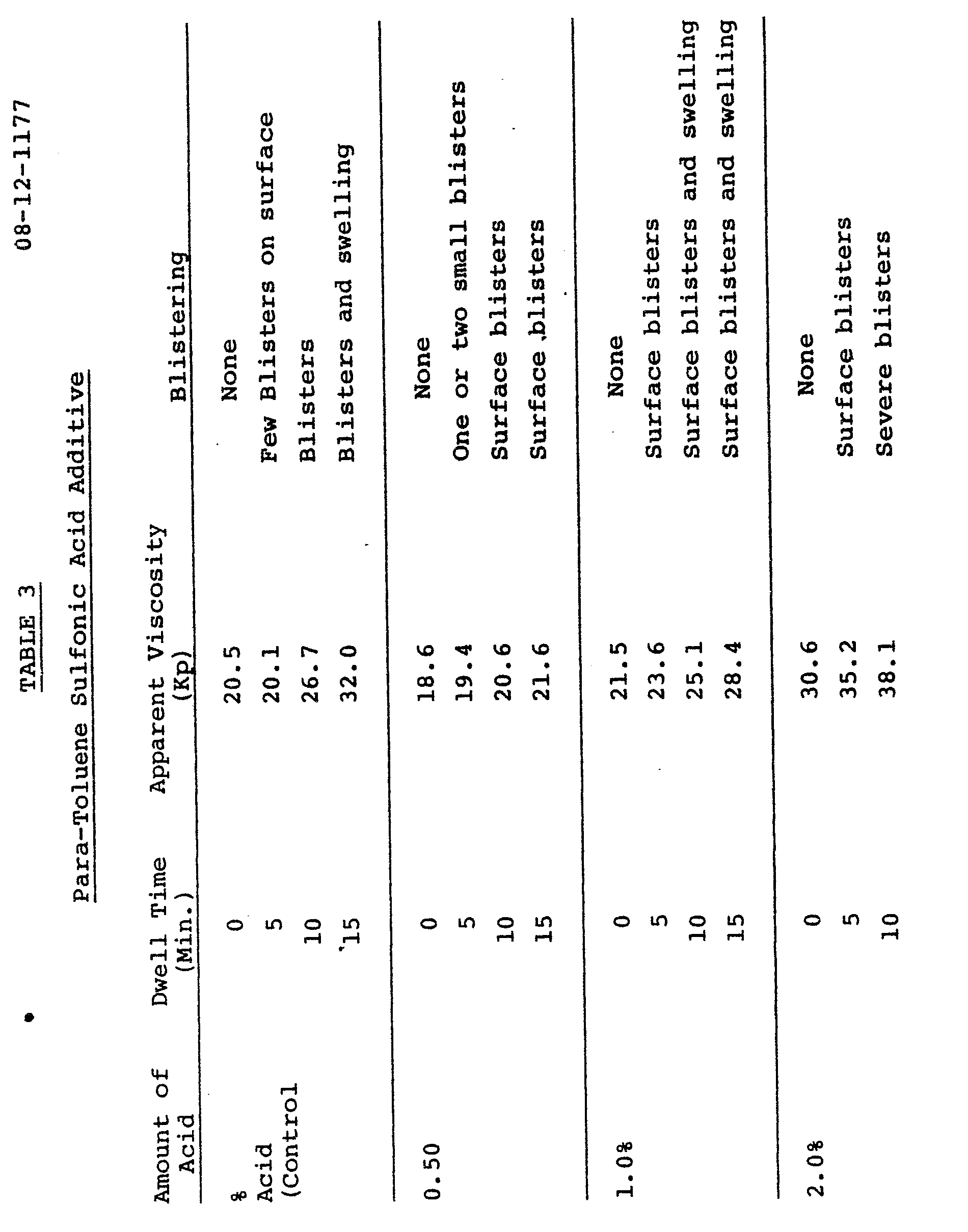
- This set of runs illustrates the danger of incor- porting an excessive amount of the acid. Here, for example, at 1% and 2% of the acid (.005 and .011 mole/100 gm polymer respectively) the effect was significantly detrimental whereas at 0.5% (0.003 mole/100 gm polymer), the acid was effective to control crosslinking and blistering.
- The following Example describes the results obtained using para-toluene sulfonic acid monohydrate in the formulation used in Examples 1 and 2. The ABS and the sulfonic acid additive (0.265,'0.371, 0.477, 0.583% by weight) were blended together in a Banbury mixer and this blend was extruded with the terpolymer. The results obtained are set forth in Table 4 below.

- Clearly, the crosslinking problem and blistering are significantly controlled at para toluene sulfonic acid monohydrate levels between 0.265 and 0.583%.
- From the above Examples it will be seen that a wide range of sulfur acids is effective in controlling crosslinking and delaying the onset of blistering normally encountered in thermoforming a polyblend comprising units derived from an unsaturated anhydride monomer and an unsaturated nitrile monomer.
- The polymer composition whose processability is improved by the use of the sulfur acid compounds can be single polymers such as terpolymer of styrene, maleic anhydride and acrylonitrile or a rubber-modified version of such a polymer as described, for example, in U. S. P. 4,262,096. Preferred terpolymers of this type comprise from 15 to 30% by weight of maleic anhydride and from 5 to 20% by weight of acrylonitrile. Particularly advantageous terpolymers contain from 10 to 30% by weight of a rubber having a glass transition temperature below 0°C. and preferably below -30°C. Suitable rubbers include polybutadiene, a rubbery copolymer of styrene or acrylonitrile and butadiene, polyisoprene, polychloroprene, EPDM rubbers, ethylene/vinyl acetate rubbers, acrylate rubbers and polypentenamer.
- Alternatively, and often preferably some or all of the unsaturated nitrile can be provided by a different polymer from that providing the unsaturated dicarboxylic acid anhydride. Thus, the polymer composition can comprise an anhydride-containing polymer such as a styrene/maleic anhydride copolymer preferably one confining at least 10% by weight, and more preferably at least 20% by weight such as from 20 to 35% by weight of maeic anhydride, or a terpolymer with part of the styrene replaced by a nonnitrile copolymerizable monomer such as an acrylate or methacrylate ester so as to provide from 2 to 20% of the copolymer weight. The anhydride-containing polymer can, of course, be rubber-modified.
- The nitrile-containing component of such a polymer composition can be provided by polymers such as styrene/acrylonitrile comprising from 20 to 70% by weight of acrylonitrile and acrylonitrile/butadiene/styrene (ABS) wherein the acrylonitrile content is preferably at least 8% and more preferably at least 15% of the ABS polymer weight.
- The above exemplification is in terms of maleic anhydride and acrylonitrile but it is understood that some or all of these monomers can be replaced by their well known homologues such as (respectively) itaconic anhydride, aconitic anhydride and citraconic anhydride and methacrylonitrile.
- In addition to the sulfur acid the polymer composition can contain other conventional additives such as antioxidants, plasticizers, chain-transfer agents, flame retardants, flow aids, pigments, antistatic additives, fibrous or particulate fillers and the like, to improve specific aspects of their physical or chemical properties. It is intended that all such and related modifications be considered within the purview of the invention.
Claims (8)
1. A polymeric composition having a reduced tendency to generate crosslinks during fabrication, which composition comprises polymer units derived from an unsaturated nitrile and from an unsaturated dicarboxylic acid anhydride and which also comprises an effective amount from about 0.001 to 0.005 mole per 100 gm of polymer, of a sulfur acid.
2. A polymeric composition according to Claim 1, which comprises at least 5% by weight of polymer units derived from each of the anhydride and the nitrile.
3. A polymeric composition according to Claim 1 or Claim 2,in which the sulfur acid is an organic sulfonic acid.
4. A polymeric composition according to Claim 1 or Claim 2,in which the sulfur acid is an aromatic sulfonic acid.
5. A polymeric composition according to Claim 1 or Claim 2, in which the sulfur acid is para-toluene sulfonic acid and is present in an amount of from 0.002 to 0.004 mole per 100 gm of polymer.
6. A polymeric composition according to any of Claims 1 to 5,in which the polymer units derived from the unsaturated nitrile and the anhydride are present in the same polymer.
7. A polymeric composition according to any of Claims 1 to 5, in which the polymeric component comprises a terpolymer of styrene, acrylonitrile and maleic anhydride containing from 5 to 20% by weight of acrylonitrile and from 15 to 30% by weight of maleic anhydride.
8. A polymeric composition according to any of Claims 1 to 5 in which the polymeric component comprises a copolymer having from 50 to 83% by weight of styrene, from 10 to 35% by weight of maleic anhydride and from 2 to 20% by weight of methyl methacrylate and a copolymer of styrene and acrylonitrile containing from 20 to 70% of acrylonitrile, the relative proportions of the component polymers being selected to provide at least 5% based on the composition weight of each of the maleic anhydride and the acrylonitrile.
Applications Claiming Priority (2)
| Application Number | Priority Date | Filing Date | Title |
|---|---|---|---|
| US06/324,900 US4397975A (en) | 1981-11-25 | 1981-11-25 | Heat stabilized polymers |
| US324900 | 1981-11-25 |
Publications (1)
| Publication Number | Publication Date |
|---|---|
| EP0080452A1 true EP0080452A1 (en) | 1983-06-01 |
Family
ID=23265591
Family Applications (1)
| Application Number | Title | Priority Date | Filing Date |
|---|---|---|---|
| EP82870069A Withdrawn EP0080452A1 (en) | 1981-11-25 | 1982-11-23 | Heat stabilized polymers |
Country Status (5)
| Country | Link |
|---|---|
| US (1) | US4397975A (en) |
| EP (1) | EP0080452A1 (en) |
| JP (1) | JPS5893747A (en) |
| AU (1) | AU9084182A (en) |
| CA (1) | CA1185038A (en) |
Families Citing this family (3)
| Publication number | Priority date | Publication date | Assignee | Title |
|---|---|---|---|---|
| IN166663B (en) * | 1985-11-25 | 1990-06-30 | Goodyear Tire & Rubber | |
| US5132364A (en) * | 1990-04-04 | 1992-07-21 | General Electric Company | Stabilization of polymers containing an unsaturated dicarboxylic acid anhydride as a component |
| EP2692519A1 (en) | 2012-08-02 | 2014-02-05 | Basf Se | Thermoforming resistant and stable extrusion foam made of styrol copolymers |
Citations (1)
| Publication number | Priority date | Publication date | Assignee | Title |
|---|---|---|---|---|
| US3402014A (en) * | 1962-11-19 | 1968-09-17 | Monsanto Co | Preparation of dyeable acrylic fibers and filaments |
Family Cites Families (4)
| Publication number | Priority date | Publication date | Assignee | Title |
|---|---|---|---|---|
| GB1044975A (en) * | 1963-05-20 | 1966-10-05 | Ici Ltd | Stabilising copolymers of maleic anhydride and olefines |
| US3794616A (en) * | 1971-03-29 | 1974-02-26 | Dow Chemical Co | Heat stabilized compositions |
| US4223096A (en) * | 1977-12-27 | 1980-09-16 | Monsanto Company | Rubber-modified terpolymer with improved molding characteristics |
| US4305869A (en) * | 1978-07-24 | 1981-12-15 | Monsanto Company | Terpolymers with improved heat distortion resistance |
-
1981
- 1981-11-25 US US06/324,900 patent/US4397975A/en not_active Expired - Fee Related
-
1982
- 1982-11-23 EP EP82870069A patent/EP0080452A1/en not_active Withdrawn
- 1982-11-24 CA CA000416230A patent/CA1185038A/en not_active Expired
- 1982-11-24 JP JP57204718A patent/JPS5893747A/en active Pending
- 1982-11-24 AU AU90841/82A patent/AU9084182A/en not_active Abandoned
Patent Citations (1)
| Publication number | Priority date | Publication date | Assignee | Title |
|---|---|---|---|---|
| US3402014A (en) * | 1962-11-19 | 1968-09-17 | Monsanto Co | Preparation of dyeable acrylic fibers and filaments |
Also Published As
| Publication number | Publication date |
|---|---|
| AU9084182A (en) | 1983-06-02 |
| JPS5893747A (en) | 1983-06-03 |
| US4397975A (en) | 1983-08-09 |
| CA1185038A (en) | 1985-04-02 |
Similar Documents
| Publication | Publication Date | Title |
|---|---|---|
| US4579906A (en) | ABS moulding materials with improved burning properties and process for their production | |
| US4197379A (en) | Elastoplastic compositions of rubber and polyamide | |
| CN118440421A (en) | Antistatic wear-resistant plastic master batch and preparation process thereof | |
| US4376846A (en) | Rubbery polymer blends with anilino phenyl units | |
| JP2950966B2 (en) | Polymer additives | |
| US4397975A (en) | Heat stabilized polymers | |
| US4387191A (en) | Heat stabilized polymers | |
| EP0082833B1 (en) | Heat stabilized polymers | |
| US5162406A (en) | Polymer stabilizing compositions | |
| EP0264101B1 (en) | Heat stable thermoplastic resin composition | |
| JPH03134027A (en) | Peroxide masterbatch using polycaprolactone as carrier | |
| JPH04145144A (en) | Rubber composition | |
| EP0076594B1 (en) | Nitrile-dicarboxylic acid anhydride polymers heat stabilised with boron compounds | |
| CA1157983A (en) | Abs moulding compounds having improved surface | |
| US3160680A (en) | Poly-alpha-olefin resin composition for coating copper wire and the like | |
| CA1036741A (en) | Abs/vinyl acetate polymer blends | |
| BRPI0712238A2 (en) | use of a silicon-containing compound as a corrosion inhibitor in a polyolefin composition comprising a brominated acid | |
| US3484402A (en) | Stable high melt flow polypropylene containing triazine compound and fatty acid salt | |
| EP0061160B1 (en) | Stabilized nitrile polymer | |
| US3929710A (en) | Polymer compositions | |
| CA2044176A1 (en) | Aromatic triester plasticized copolymers of acrylonitrile and styrene | |
| US4046735A (en) | Stabilizers of nitrile polymers using triazine derivatives | |
| EP0863944B1 (en) | Polyphenylene oxide resin compositions | |
| US5194497A (en) | Alloys of thermoplastic polymers containing oxetanyl groups | |
| US3444126A (en) | Monovinylidene aromatic hydrocarbon-unsaturated nitrile copolymers stabilized with hydrocarbons |
Legal Events
| Date | Code | Title | Description |
|---|---|---|---|
| PUAI | Public reference made under article 153(3) epc to a published international application that has entered the european phase |
Free format text: ORIGINAL CODE: 0009012 |
|
| AK | Designated contracting states |
Designated state(s): BE DE FR GB |
|
| 17P | Request for examination filed |
Effective date: 19830715 |
|
| STAA | Information on the status of an ep patent application or granted ep patent |
Free format text: STATUS: THE APPLICATION IS DEEMED TO BE WITHDRAWN |
|
| 18D | Application deemed to be withdrawn |
Effective date: 19841220 |
|
| RIN1 | Information on inventor provided before grant (corrected) |
Inventor name: HARRIS, ALVA FRANCIS |