EP0080792B1 - Bicyclette pliable - Google Patents
Bicyclette pliable Download PDFInfo
- Publication number
- EP0080792B1 EP0080792B1 EP82304265A EP82304265A EP0080792B1 EP 0080792 B1 EP0080792 B1 EP 0080792B1 EP 82304265 A EP82304265 A EP 82304265A EP 82304265 A EP82304265 A EP 82304265A EP 0080792 B1 EP0080792 B1 EP 0080792B1
- Authority
- EP
- European Patent Office
- Prior art keywords
- bicycle
- frame
- seat
- members
- tube
- Prior art date
- Legal status (The legal status is an assumption and is not a legal conclusion. Google has not performed a legal analysis and makes no representation as to the accuracy of the status listed.)
- Expired
Links
Images

Classifications
-
- B—PERFORMING OPERATIONS; TRANSPORTING
- B62—LAND VEHICLES FOR TRAVELLING OTHERWISE THAN ON RAILS
- B62K—CYCLES; CYCLE FRAMES; CYCLE STEERING DEVICES; RIDER-OPERATED TERMINAL CONTROLS SPECIALLY ADAPTED FOR CYCLES; CYCLE AXLE SUSPENSIONS; CYCLE SIDECARS, FORECARS, OR THE LIKE
- B62K15/00—Collapsible or foldable cycles
- B62K15/006—Collapsible or foldable cycles the frame being foldable
Definitions
- This invention relates to a collapsible bicycle.
- this invention relatesto a bicycle having separate rigid main and rear frames joined together by concentric members forming the seat tube and foldable thereabout.
- the collapsible bicycle includes a rigid main frame while having a collapsible rear frame which is hinged and foldable about a pin located at the pedal housing.
- the rear frame is not a rigid member but rather, a series of segments having pivoting portions to allow the rear frame elements to collapse into a storage position over the rigid main frame. Again, should the pin come loose, the bike would collapse.
- the bicycle should be not only compact in size but easily handled in terms not having projecting parts, and shielding the gear mechanism.
- one wheel of the folded bicycle such as the rear wheel should provide rolling support so that the "package" can be moved without lifting. Accordingly, there still exists in this technology a need for a foldable bicycle, one using standard components, one satisfying existing safety requirements needed for commercial manufacturing, yet achieving the necessary performance characteristics attained in conventional lightweight 10-speed bicycles.
- a foldable bicycle is described in FR-A-1543669 but primarily this design is intended for a children's bicycle.
- the "" present invention relates to a foldable bicycle comprising a rigid front frame having a first hollow member for accommodating a seat post, a rigid rear complete frame having a second hollow member for accommodating the seat post, the first and second hollow members being concentric with each other, whereby the front and rear frames are foldable about the hollow members and means for securing the first and second hollow members into a rigid orientation.
- the front frame is complete and closed and is larger than the complete rear frame
- the first member is concentrically mounted inside the second member and extends, in both directions, beyond the second member whereby the rear frame is superimposed to substantially lie within a projection of the front frame when the bicycle is in its folded configuration and the rear frame is provided with a pedal housing, the pedal housing being mounted on the second member in an offset position with respect to the longitudinal axis thereof.
- a bicycle in accordance with the present invention can thus be made up of two interlocking frames, one formed by top, down, head and seat tubes and the other formed by seat and chain stays and the seat tube.
- Each of the frames is complete and structurally integral.
- the seat tube is made up of two full length concentric posts and a third post with a saddle can slide into the other two.
- the front frame can be folded geometrically around the rear frame to achieve a compact folded assembly.
- the pedal housing may be mounted to a bracket almost in the traditional position at the intersection of the chain stays, seat and down tubes but slightly to one side. It is offset just enough to permit a solid front frame seat tube to bypass the solid pedal bracket shaft.
- a bar attached to the seat tube preferably extends below the center of the pedal housing and provides a folding pivot point and at the same time affords protection for the chain wheel during the folding process.
- standard derailleur mechanisms and control levers can be utilized.
- a modification in the position of the control lever is accomplished to enhance foldability by relocating the control lever to the top tube and having the cable run back along the top tube to the seat post and then down the seat stay on the derailleur side. Since normally two control levers are utilized, one cable will cross over at the seat post and will be retained by a guide at that point to insure that the cable remains in place when the bicycle is folded.
- the folding process is achieved expeditiously without the requirement of having to utilize a large number of tools or to materially disassemble the bicycle. Rather, such traditional steps of removal of the front wheel, moving the seat post and handlebar stem, if necessary, downward are accomplished with the release of only a bolt lever necessary to fold the frames.
- the approximate size of the bicycle is determined by the wheel size in the height direction and by the wheel size plus the wheel chain projection in the length direction. In such a folded position, the bicycle can easily fit into the trunk space in small size cars, conforms to airplane travel requirements, may be carried aboard elevators, and generally carried in one hand as is a suitcase. The bicycle may also be rolled along on one wheel as a suitcase on wheels.
- a second important advantage of the bicycle in its folded position is that it can be carried in a traditional backpack manner.
- the front frame acts as a frame in a backpack, with the length being scaled identically to that of an adult.
- the frame in the folded position is configured to be symmetrically balanced around the center of the back-pack person.
- Standard accessories to achieve backpack portability of the folded bicycle in accordance with the present invention are used, such as padded shoulder straps, a back band, hip belt and eyelets to attach peripheral equipment.
- Figure 2 shows the fundamental rigid frame configurations used in accordance with the present invention.
- a complete closed front frame 10 and a separate complete closed rear frame 12.
- the front frame 10 is made larger than the rear frame 12.
- the frames 10, 12 have seat tubes 20, 30 which are concentric ( Figures 1 and 3) to interlock the two frames together.
- the seat tube 20 is placed concentrically inside the seat tube 30 so that rotation between the front and rear frames 10, 12 about the axis of the tubes 20, 30 can take place during the folding operation.
- the front frame 10 comprises a head tube 14, a top tube 16, a down tube 18, and the seat tube 20. These elements are constructed utilizing conventional bicycle technology by welding tubular elements to form a rigid construction.
- the rear frame 12 comprises a pair of seat stays 22, 24 and a pair of chain stays 26, 28 welded to the seat tube 30.
- a pedal housing 32 is fixed to the seat tube 30 in a position offset from its axis.
- an additional bracket member 34 (Fig 1.) can be used to hold the pedal housing 32.
- the pedal housing 32 and this bracket member 34 are then welded to the seat tube 30 to provide an integral rigid assembly.
- the figures show the pedal housing 32 forward of the seat tube 30, but it is understood that it may be placed behind the seat tube 30 with a similar bracket 34.
- the tube 20 is placed inside the tube 30 and the components 16, 18 are then welded to the tube 20 which projects beyond the ends of the tube 30.
- the concentric seat tubes 20, 30 are held in a rigid position utilizing quick release binder bolts and alignment pins or the like positioned on the upper and lower portions of the seat tubes 20, 30. It is understood that a third concentric tube, namely, the seat post will be mounted inside the two seat tubes 20, 30.
- the bicycle is configured to fold in only one direction from the straight position, metal blocks, not shown, being set on the alignment pins.
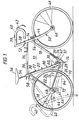
- Figure 1 shows the complete bicycle assembly which, apart from the two interlocked frames 20, 30, utilizes completely standard components.
- the head tube 14 of the front frame 10 houses a concentric internal handle bar stem 38.
- the stem 38 is locked in position by a binder bolt 39.
- the bolt 39 when released allows the handle bars to be rotated for storage or adjustment.
- Conventional lightweight bicycles utilize handle bar members 40 having attached brake handles 42. It is understood, that although not shown in Figure 1, the brake handles 42 will have associated therewith operative cabling and brake members disposed relative to the front and rear wheel frames.
- the handle bar stem 38 fits concentrically in the head tube 14 having a pair of forks 44 to mount a conventional full size front wheel 46. Attachment of the front wheel 46 to the forks 44 is by any conventional quick release mechanism associated with the wheel axle 48. Accordingly, the steering mechanism of the bicycle in accordance with the present invention comprising the head tube 14, the concentric handle bar stem 38, handle bars 40, forks 44, front wheel 46, and front wheel axle 48 are all standard items in lightweight full size bicycle design. In that sense, it is recognized that the handle bar stem 38 is movable within the head tube 14 so that handle bar adjustment upward or downward may be effectuated. This would be necessary only in a small size 20-inch (50.8 cm) wheel model.
- Figure 1 also shows three sets of optional accessory components to the front frame section which are utilizable in a backpack configuration. Specifically, attachment points 80 and 36, are shown, it being recognized that they would not be used on a foldable bicycle in accordance with this invention that was not designed for backpack usage. These members will be discussed in conjunction with the folding of the bicycle in accordance with Figure 3.
- a seat post 54 forms an element of the bicycle seat post assembly with the seat 56 attached thereto in a conventional manner.
- the drive train mechanism of the bicycle in accordance with this invention utilizes standard components found in full sized ten-speed bicycles. That is, a large drive sprocket assembly 60 with typically concentric sprocket gears of different diameter is mounted on a pedal shaft 62 with pedals, not shown, extending outwardly therefrom. A drive chain 64 is threaded through a derailleur mechanism 66 and drives a gear cluster 68 in a usual manner. Accordingly, in all respects, the drive mechanism of the embodiment shown in Figure 1 corresponds to conventionally used components in standard bicycle assemblies. It is also noted that during the folding of the bicycle, none of the gear mechanisms are in any way affected by that operation. The mechanisms are also shielded when the bicycle is folded, protecting them and minimizing the transfer of lubricants.
- the gear change to operate the derailleur 66 is moved from the down tube 18 to - the top tube 16.
- two such gear levers . are used for a 10-speed bicycle with each lever straddling the top tube 16.
- the control cables run rearward along the top tube 16 then down the seat stays on the derailleur side 22 until they reach the derailleur mechanism.
- One of the control cables will cross over at this point to be on the same side of the bicycle as the derailleur mechanism 66.
- a rear wheel 70 is attached to the dropouts 72 associated with the inner section of the seat stays 22, 24 and the chain stays 26, 28.
- the mounting of the rear wheel 70 is done in a manner conventional in such lightweight bicycle construction. Accordingly, with the exception of the novel configurations of the front and rear frame members 10 and 12 and the positioning of the pedal housing, the bicycle in accordance with the invention utilizes standard components.
- the first step is the removal of the front wheel utilizing the quick release mechanism associated with the dropouts at the front wheel axle 48.
- the bicycle is then set down to rest on the down tube 18 pivot folding point 74 with the back wheel 70 and the front fork arms 44 positioned slightly above the ground.
- the seat tube folding alignment pins are moved.
- the alignment pins 77 are shown schematically in Figure 1 as sliding bolts attached to the seat tube 30. They slide down and up respectively holding the down and top tubes to the seat tube 30.
- the seat tube folding binder bolt 58 is removed by releasing an appropriate lever.
- the binder bolt is the second safety device insuring that the bicycle frames will not move relative to each other when the bicycle is in an open position. Release of the seat post binder bolt allows the seat stem 54 to be pushed down into the top tube. The frames 10, 12 can then be folded together to achieve a collapsed state with the rear frame 12 superimposed to substantially lie within a projection of the front frame 10.
- a front wheel carrying bracket (not shown) associated with the rear wheel hub would be pulled out and the front wheel, previously removed, is secured using the front wheel quick release levers, not shown.
- the handle bars are then turned toward the folded position of the bike until they are perpendicular to the axis of the bike in the riding position so that a head-set locking pin will drop into place. It is recognized, then, that the total lateral area of the folded bicycle is determined approximately by the wheel size in the height direction and by the wheel size plus the large sprocket 60 projection in the length direction. Hence, for a standard 27-inch (68.58 cms) wheel, the dimensions of the folded bicycle are approximately 27 inches (68.58 cms) high by 32 inches (81.28 cm) long.
- the embodiment of Figure 1 is also applicable to so called "mini bikes".
- the folded size would be approximately 20 inches (50.8 cms) high by 28 inches (71.12 cms) long or, generally, the size of a large suitcase.
- the only changes necessary to convert this embodiment to "mini bike” size would be first the curving of the down tube to provide a 14 inch (35.56 cms) wide front frame near the seat tu be. In order for the back packing it is curved around the front wheel to join the head set only 7 inches (17.78 cms) wide at that point.
- FIG. 3 An important aspect of the folded condition of this bicycle is its utilization in a backpack mode.
- the bicycle in accordance with the present invention is engineered to be scaled to an adult in the folded position to allow it to be carried on the person's back.
- the frame also has additional elements needed to mount camping gear and bags.
- the length of the top frame 16 corresponds to the approximate distance from shoulder height to the waist of an adult person.
- the rear frame members are disposed outward and are symmetrically balanced about the center of the packer.
- the mounting of the front wheel 46 is also symmetrically positioned relative to the backpack position.
- the handle bars 40 adjusted by release of bolt 39 extend backward away from the hip.
- the three basic body attachment accessories of a backpack must be incorporated onto the bike frame.
- Second is the backband 76 which holds the metal frame off the back and is attached to each side of the frame.
- Shoulder straps 78 extend from the seat tube 30 positioned in a symmetrical relationship spaced from the ends thereof and attached by eyelets 80 on the strip and are coupled, one to the handle bar stem 38 by means of an eyelet 82 and a second shoulder strap, not shown, coupled to the back of fork arm 44.
- symmetrical shoulder straps are provided to allow the folded bicycle to be carried by the backpacker.
- the shoulder straps have a padded area 84 that would be approximately 12 inches (30.48 cms) long and coupled with extending straps and buckles to the seat tube when the bike is being driven. They would then be wrapped around in any conventional manner. It is understood that while eye hooks or the like may be used to attach the straps to the bicycle frame, any conventional mode of attachment may be used.
- the backband strip 76 is positioned on the bicycle between the accessory attachment members 36 on the top and down tube which act as the sides of the backpack frame. Hence, when the bicycle is positioned on the back, the strip 76 allows a stand off distance to be maintained between the carriers' shoulder blades and the frames.
- a hip belt 86 is positioned in a looping manner between the tapered portions 50 and 52 and attached therewith by eyelets.
- the belt is approximately 4 inches (10.16 cms) wide and fixes to an additional point in the center on the back of the brake pivot bolt 54.
- the curved stays 50 and 52 extending in conjunction with the hip belt are wrapped around the waist of the user and transfer the backpack weight closer to the center of the user.
- a conventional buckle 88 or the like is used to secure the hip belt in place.
- a full size lightweight bicycle is defined that meets existing safety criteria.
- the bicycle comprises in its basic form rigid frames which are interconnected in a concentric manner.
- the bicycle components comprising the drive system, brakes, wheel, handle bars, seat assembly and the like are all conventional components.
- the bicycle in the folded condition offers unique portability and backpacking capability. Being capable of utilizing full size 27-inch (68.58 cms) wheels, performance comparable to existing lightweight bicycles is assured. Moreover, because the requirement for additional frame members is minimized, the overall weight of the bicycle remains commensurate with that of traditional rigid designs.
Landscapes
- Engineering & Computer Science (AREA)
- Mechanical Engineering (AREA)
- Motorcycle And Bicycle Frame (AREA)
Claims (4)
Applications Claiming Priority (2)
| Application Number | Priority Date | Filing Date | Title |
|---|---|---|---|
| US06/298,145 US4448437A (en) | 1981-08-31 | 1981-08-31 | Foldable bicycle |
| US298145 | 1981-08-31 |
Publications (2)
| Publication Number | Publication Date |
|---|---|
| EP0080792A1 EP0080792A1 (fr) | 1983-06-08 |
| EP0080792B1 true EP0080792B1 (fr) | 1990-02-07 |
Family
ID=23149247
Family Applications (1)
| Application Number | Title | Priority Date | Filing Date |
|---|---|---|---|
| EP82304265A Expired EP0080792B1 (fr) | 1981-08-31 | 1982-08-12 | Bicyclette pliable |
Country Status (3)
| Country | Link |
|---|---|
| US (1) | US4448437A (fr) |
| EP (1) | EP0080792B1 (fr) |
| JP (1) | JPS5847684A (fr) |
Families Citing this family (26)
| Publication number | Priority date | Publication date | Assignee | Title |
|---|---|---|---|---|
| US4900047A (en) * | 1988-10-28 | 1990-02-13 | Harry Montague | Foldable bicycle |
| US5135246A (en) * | 1989-01-13 | 1992-08-04 | Harry Montague | Foldable tandem bicycle |
| US4995626A (en) * | 1989-01-13 | 1991-02-26 | Montague Harry D | Foldable tandem bicycle |
| DE4207771C2 (de) * | 1992-03-11 | 1996-05-15 | Robert W P Chen | Faltbares Fahrrad |
| US5312311A (en) * | 1992-10-05 | 1994-05-17 | Pearson William G | Exercise bicycle |
| CA2093992A1 (fr) * | 1993-04-14 | 1994-10-15 | Mark J. Lumbard | Voiturette de golf portative et appareil de transport |
| US5419573A (en) * | 1994-04-08 | 1995-05-30 | Kao; Fu-Hsiung | Folding bicycle |
| USD368679S (en) | 1995-02-10 | 1996-04-09 | Huffy Corporation | Bicycle frame |
| USD372212S (en) | 1995-02-10 | 1996-07-30 | Huffy Corporation | Bicycle |
| DE19508047A1 (de) * | 1995-03-07 | 1996-09-12 | Alexander Strebelow | Antriebsloses Radfahrzeug zum Abfahren an Hängen |
| US6135478A (en) * | 1996-04-08 | 2000-10-24 | Montague; Harry D. | Foldable bicycle frame |
| EP0891278A4 (fr) | 1996-04-08 | 1999-12-08 | Harry D Montague | Cadre de bicyclette pliable |
| AT406250B (de) * | 1996-08-14 | 2000-03-27 | Koppensteiner Christian Dipl I | Fahrrad |
| US5975551A (en) | 1997-07-18 | 1999-11-02 | Montague Corporation | Folding frame bicycle |
| AU5295298A (en) * | 1998-02-06 | 1999-08-26 | Pacific 21 Pty Ltd | Folding bicycle frame |
| JP3370630B2 (ja) * | 1999-12-20 | 2003-01-27 | 克一 村山 | 折りたたみ式自転車 |
| US6595536B1 (en) | 1999-12-29 | 2003-07-22 | Timothy R. Tucker | Collapsible vehicle |
| FR2818611B1 (fr) * | 2000-12-27 | 2003-04-04 | Henri Bigot | Bicyclette pliable |
| GB2400086A (en) * | 2003-03-31 | 2004-10-06 | Karbon Kinetics Ltd | Trailable folding bicycle |
| US20050109804A1 (en) * | 2003-11-21 | 2005-05-26 | Larsen Jeffrey A. | Backpack for carrying a bicycle |
| DE102004045971B4 (de) * | 2004-09-22 | 2008-06-19 | Christian Schmautz | Roller mit mindestens einer seitlich ausklappbaren Trittflächeneinheit |
| KR200464303Y1 (ko) | 2010-12-23 | 2012-12-24 | 박기덕 | 스트랩을 가진 접이식 자전거 |
| US8757651B1 (en) | 2013-03-14 | 2014-06-24 | Patrick A. Walker | Collapsible motorized two-wheeled cycle system |
| HU230674B1 (hu) | 2015-04-09 | 2017-08-28 | Ferenc Molnar | Több tengely mentén összecsukható kerékpár |
| US9834275B2 (en) | 2015-07-22 | 2017-12-05 | Montague Corporation | Non-overlapping frame folding bike |
| DE202017100591U1 (de) * | 2017-02-03 | 2017-04-24 | AFR Engineering GmbH | Rucksacktragesystem zum freihändigen Rückentransport eines Fahrrades |
Family Cites Families (14)
| Publication number | Priority date | Publication date | Assignee | Title |
|---|---|---|---|---|
| FR1543669A (fr) * | 1900-01-01 | Cadre repliable en deux parties tournantes pour bicyclettes hommes, enfants, ou similaires | ||
| US607325A (en) * | 1898-07-12 | Separable frame for bicycles | ||
| US378253A (en) * | 1888-02-21 | Velocipede | ||
| US413415A (en) * | 1889-10-22 | Thomas o brien | ||
| US640680A (en) * | 1898-03-31 | 1900-01-02 | Roscoe Allen Merrow | Bicycle. |
| GB189826352A (en) * | 1898-12-13 | 1899-11-04 | Mose Max Tuerkheimer | An Improved Folding Bicycle. |
| US2602677A (en) * | 1948-08-05 | 1952-07-08 | Frances L Connolly | Adjustable pedal crank hub for bicycle frames |
| FR84291E (fr) * | 1963-09-04 | 1965-01-08 | Cadre de bicyclette extra léger monté en éléments boulonnés | |
| FR1443948A (fr) * | 1965-03-24 | 1966-07-01 | Bicyclette pliante perfectionnée | |
| US3710883A (en) * | 1971-10-22 | 1973-01-16 | P Rizzo | Folding motorcycle or the like |
| US4002351A (en) * | 1972-03-17 | 1977-01-11 | Zuck Daniel R | Folding bicycle |
| US4022485A (en) * | 1976-04-05 | 1977-05-10 | Cox Elward Leroy | Collapsible bicycle |
| US4067589A (en) * | 1976-05-21 | 1978-01-10 | Hon David T | Foldable bicycle |
| US4165093A (en) * | 1977-03-21 | 1979-08-21 | General Motors Corporation | Occupant propelled cambering vehicle |
-
1981
- 1981-08-31 US US06/298,145 patent/US4448437A/en not_active Expired - Lifetime
-
1982
- 1982-08-12 EP EP82304265A patent/EP0080792B1/fr not_active Expired
- 1982-08-30 JP JP57150624A patent/JPS5847684A/ja active Granted
Also Published As
| Publication number | Publication date |
|---|---|
| US4448437A (en) | 1984-05-15 |
| EP0080792A1 (fr) | 1983-06-08 |
| JPH036034B2 (fr) | 1991-01-29 |
| JPS5847684A (ja) | 1983-03-19 |
Similar Documents
| Publication | Publication Date | Title |
|---|---|---|
| EP0080792B1 (fr) | Bicyclette pliable | |
| EP0378362B1 (fr) | Tandem pliant | |
| US8720927B2 (en) | Collapsible recumbent tricycle | |
| KR100646019B1 (ko) | 접철식 자전거 | |
| US8348294B1 (en) | Drive-and-chassis mechanisms used in the design of compact, carry-on vehicles | |
| EP0996564B1 (fr) | Cadre pliant de bicyclette | |
| US10202163B2 (en) | Collapsible electric vehicle | |
| US9061726B2 (en) | Vehicle having a chassis that converts to a protective carrying case | |
| US4900047A (en) | Foldable bicycle | |
| US8714576B2 (en) | Drive-and-steering mechanisms used in the design of compact, carry-on vehicles | |
| US20040239070A1 (en) | Stretching bicycle | |
| US5135246A (en) | Foldable tandem bicycle | |
| CN1143788C (zh) | 结合有幼儿载具的伞车结构 | |
| US11407469B2 (en) | Collapsible bicycle frame | |
| RU226830U1 (ru) | Складной велосипед | |
| SI21365A (sl) | Sklopljivo kolo |
Legal Events
| Date | Code | Title | Description |
|---|---|---|---|
| PUAI | Public reference made under article 153(3) epc to a published international application that has entered the european phase |
Free format text: ORIGINAL CODE: 0009012 |
|
| AK | Designated contracting states |
Designated state(s): FR GB IT |
|
| 17P | Request for examination filed |
Effective date: 19831126 |
|
| GRAA | (expected) grant |
Free format text: ORIGINAL CODE: 0009210 |
|
| AK | Designated contracting states |
Kind code of ref document: B1 Designated state(s): FR GB IT |
|
| ITF | It: translation for a ep patent filed | ||
| ET | Fr: translation filed | ||
| PLBE | No opposition filed within time limit |
Free format text: ORIGINAL CODE: 0009261 |
|
| STAA | Information on the status of an ep patent application or granted ep patent |
Free format text: STATUS: NO OPPOSITION FILED WITHIN TIME LIMIT |
|
| 26N | No opposition filed | ||
| ITTA | It: last paid annual fee | ||
| PGFP | Annual fee paid to national office [announced via postgrant information from national office to epo] |
Ref country code: FR Payment date: 19990719 Year of fee payment: 18 |
|
| PGFP | Annual fee paid to national office [announced via postgrant information from national office to epo] |
Ref country code: GB Payment date: 19990721 Year of fee payment: 18 |
|
| PG25 | Lapsed in a contracting state [announced via postgrant information from national office to epo] |
Ref country code: GB Free format text: LAPSE BECAUSE OF NON-PAYMENT OF DUE FEES Effective date: 20000812 |
|
| GBPC | Gb: european patent ceased through non-payment of renewal fee |
Effective date: 20000812 |
|
| PG25 | Lapsed in a contracting state [announced via postgrant information from national office to epo] |
Ref country code: FR Free format text: LAPSE BECAUSE OF NON-PAYMENT OF DUE FEES Effective date: 20010430 |
|
| REG | Reference to a national code |
Ref country code: FR Ref legal event code: ST |
|
| APAH | Appeal reference modified |
Free format text: ORIGINAL CODE: EPIDOSCREFNO |