EP0081157A1 - Verfahren zur Herstellung von Nitroarylcarbonsäure-nitroarylamiden - Google Patents
Verfahren zur Herstellung von Nitroarylcarbonsäure-nitroarylamiden Download PDFInfo
- Publication number
- EP0081157A1 EP0081157A1 EP82110924A EP82110924A EP0081157A1 EP 0081157 A1 EP0081157 A1 EP 0081157A1 EP 82110924 A EP82110924 A EP 82110924A EP 82110924 A EP82110924 A EP 82110924A EP 0081157 A1 EP0081157 A1 EP 0081157A1
- Authority
- EP
- European Patent Office
- Prior art keywords
- independently
- alkyl
- acid
- formula
- solvent
- Prior art date
- Legal status (The legal status is an assumption and is not a legal conclusion. Google has not performed a legal analysis and makes no representation as to the accuracy of the status listed.)
- Granted
Links
- 238000000034 method Methods 0.000 title claims abstract description 27
- 238000002360 preparation method Methods 0.000 title claims abstract description 9
- XHXFXVLFKHQFAL-UHFFFAOYSA-N phosphoryl trichloride Chemical compound ClP(Cl)(Cl)=O XHXFXVLFKHQFAL-UHFFFAOYSA-N 0.000 claims abstract description 36
- 150000003512 tertiary amines Chemical class 0.000 claims abstract description 29
- 125000000217 alkyl group Chemical group 0.000 claims abstract description 28
- 239000002253 acid Substances 0.000 claims abstract description 27
- 229910052736 halogen Inorganic materials 0.000 claims abstract description 18
- 150000002367 halogens Chemical class 0.000 claims abstract description 18
- 239000002904 solvent Substances 0.000 claims abstract description 17
- 125000000449 nitro group Chemical group [O-][N+](*)=O 0.000 claims abstract description 12
- 229910052739 hydrogen Inorganic materials 0.000 claims abstract description 11
- 239000001257 hydrogen Substances 0.000 claims abstract description 11
- 239000012442 inert solvent Substances 0.000 claims abstract description 8
- 150000007513 acids Chemical class 0.000 claims abstract description 7
- 125000003545 alkoxy group Chemical group 0.000 claims abstract description 7
- 125000002947 alkylene group Chemical group 0.000 claims abstract description 6
- 125000003710 aryl alkyl group Chemical group 0.000 claims abstract description 6
- 125000003107 substituted aryl group Chemical group 0.000 claims abstract description 6
- 125000004414 alkyl thio group Chemical group 0.000 claims abstract description 5
- 125000000753 cycloalkyl group Chemical group 0.000 claims abstract description 5
- 125000005842 heteroatom Chemical group 0.000 claims abstract description 4
- 125000004435 hydrogen atom Chemical group [H]* 0.000 claims abstract 5
- XLYOFNOQVPJJNP-UHFFFAOYSA-N water Substances O XLYOFNOQVPJJNP-UHFFFAOYSA-N 0.000 claims description 19
- -1 nitroaryl carboxylic acid Chemical class 0.000 claims description 16
- 239000011541 reaction mixture Substances 0.000 claims description 12
- 125000003118 aryl group Chemical group 0.000 claims description 10
- 125000002496 methyl group Chemical group [H]C([H])([H])* 0.000 claims description 6
- 125000001997 phenyl group Chemical group [H]C1=C([H])C([H])=C(*)C([H])=C1[H] 0.000 claims description 6
- 125000001495 ethyl group Chemical group [H]C([H])([H])C([H])([H])* 0.000 claims description 4
- 239000011877 solvent mixture Substances 0.000 claims description 4
- 238000010626 work up procedure Methods 0.000 claims description 4
- 238000001914 filtration Methods 0.000 claims description 3
- 125000001424 substituent group Chemical group 0.000 claims description 3
- 239000008346 aqueous phase Substances 0.000 claims description 2
- 239000007787 solid Substances 0.000 claims 1
- HEMHJVSKTPXQMS-UHFFFAOYSA-M Sodium hydroxide Chemical compound [OH-].[Na+] HEMHJVSKTPXQMS-UHFFFAOYSA-M 0.000 description 20
- ZMXDDKWLCZADIW-UHFFFAOYSA-N N,N-Dimethylformamide Chemical compound CN(C)C=O ZMXDDKWLCZADIW-UHFFFAOYSA-N 0.000 description 12
- JLTDJTHDQAWBAV-UHFFFAOYSA-N N,N-dimethylaniline Chemical compound CN(C)C1=CC=CC=C1 JLTDJTHDQAWBAV-UHFFFAOYSA-N 0.000 description 12
- YXFVVABEGXRONW-UHFFFAOYSA-N Toluene Chemical compound CC1=CC=CC=C1 YXFVVABEGXRONW-UHFFFAOYSA-N 0.000 description 12
- ZMANZCXQSJIPKH-UHFFFAOYSA-N Triethylamine Chemical compound CCN(CC)CC ZMANZCXQSJIPKH-UHFFFAOYSA-N 0.000 description 12
- 239000000203 mixture Substances 0.000 description 10
- OTLNPYWUJOZPPA-UHFFFAOYSA-N 4-nitrobenzoic acid Chemical compound OC(=O)C1=CC=C([N+]([O-])=O)C=C1 OTLNPYWUJOZPPA-UHFFFAOYSA-N 0.000 description 8
- TYMLOMAKGOJONV-UHFFFAOYSA-N 4-nitroaniline Chemical compound NC1=CC=C([N+]([O-])=O)C=C1 TYMLOMAKGOJONV-UHFFFAOYSA-N 0.000 description 7
- VEXZGXHMUGYJMC-UHFFFAOYSA-N Hydrochloric acid Chemical compound Cl VEXZGXHMUGYJMC-UHFFFAOYSA-N 0.000 description 7
- 239000000243 solution Substances 0.000 description 7
- NOMOTPVSNBNBSG-UHFFFAOYSA-N 4-nitro-n-(4-nitrophenyl)benzamide Chemical compound C1=CC([N+](=O)[O-])=CC=C1NC(=O)C1=CC=C([N+]([O-])=O)C=C1 NOMOTPVSNBNBSG-UHFFFAOYSA-N 0.000 description 6
- MVPPADPHJFYWMZ-UHFFFAOYSA-N chlorobenzene Chemical compound ClC1=CC=CC=C1 MVPPADPHJFYWMZ-UHFFFAOYSA-N 0.000 description 6
- 150000002431 hydrogen Chemical class 0.000 description 6
- 238000004519 manufacturing process Methods 0.000 description 6
- UFHFLCQGNIYNRP-UHFFFAOYSA-N Hydrogen Chemical compound [H][H] UFHFLCQGNIYNRP-UHFFFAOYSA-N 0.000 description 5
- 238000009835 boiling Methods 0.000 description 5
- 150000008280 chlorinated hydrocarbons Chemical class 0.000 description 5
- 229930195733 hydrocarbon Natural products 0.000 description 5
- 150000002430 hydrocarbons Chemical class 0.000 description 5
- 239000012074 organic phase Substances 0.000 description 5
- 238000010992 reflux Methods 0.000 description 5
- 150000001408 amides Chemical class 0.000 description 4
- 125000004432 carbon atom Chemical group C* 0.000 description 4
- 238000006243 chemical reaction Methods 0.000 description 4
- FAIAAWCVCHQXDN-UHFFFAOYSA-N phosphorus trichloride Chemical compound ClP(Cl)Cl FAIAAWCVCHQXDN-UHFFFAOYSA-N 0.000 description 4
- 238000003756 stirring Methods 0.000 description 4
- WKBOTKDWSSQWDR-UHFFFAOYSA-N Bromine atom Chemical compound [Br] WKBOTKDWSSQWDR-UHFFFAOYSA-N 0.000 description 3
- ZAMOUSCENKQFHK-UHFFFAOYSA-N Chlorine atom Chemical compound [Cl] ZAMOUSCENKQFHK-UHFFFAOYSA-N 0.000 description 3
- OKKJLVBELUTLKV-UHFFFAOYSA-N Methanol Chemical compound OC OKKJLVBELUTLKV-UHFFFAOYSA-N 0.000 description 3
- RWRDLPDLKQPQOW-UHFFFAOYSA-N Pyrrolidine Chemical compound C1CCNC1 RWRDLPDLKQPQOW-UHFFFAOYSA-N 0.000 description 3
- GDTBXPJZTBHREO-UHFFFAOYSA-N bromine Substances BrBr GDTBXPJZTBHREO-UHFFFAOYSA-N 0.000 description 3
- 229910052794 bromium Inorganic materials 0.000 description 3
- 239000007795 chemical reaction product Substances 0.000 description 3
- 239000000460 chlorine Substances 0.000 description 3
- 229910052801 chlorine Inorganic materials 0.000 description 3
- 238000009833 condensation Methods 0.000 description 3
- 230000005494 condensation Effects 0.000 description 3
- 229910052731 fluorine Inorganic materials 0.000 description 3
- 239000011737 fluorine Substances 0.000 description 3
- 239000003960 organic solvent Substances 0.000 description 3
- 239000000047 product Substances 0.000 description 3
- WKEDVNSFRWHDNR-UHFFFAOYSA-N salicylanilide Chemical compound OC1=CC=CC=C1C(=O)NC1=CC=CC=C1 WKEDVNSFRWHDNR-UHFFFAOYSA-N 0.000 description 3
- 229950000975 salicylanilide Drugs 0.000 description 3
- 239000000725 suspension Substances 0.000 description 3
- PAMIQIKDUOTOBW-UHFFFAOYSA-N 1-methylpiperidine Chemical compound CN1CCCCC1 PAMIQIKDUOTOBW-UHFFFAOYSA-N 0.000 description 2
- PAYRUJLWNCNPSJ-UHFFFAOYSA-N Aniline Chemical compound NC1=CC=CC=C1 PAYRUJLWNCNPSJ-UHFFFAOYSA-N 0.000 description 2
- YIIMEMSDCNDGTB-UHFFFAOYSA-N Dimethylcarbamoyl chloride Chemical compound CN(C)C(Cl)=O YIIMEMSDCNDGTB-UHFFFAOYSA-N 0.000 description 2
- YNQLUTRBYVCPMQ-UHFFFAOYSA-N Ethylbenzene Chemical compound CCC1=CC=CC=C1 YNQLUTRBYVCPMQ-UHFFFAOYSA-N 0.000 description 2
- PXGOKWXKJXAPGV-UHFFFAOYSA-N Fluorine Chemical compound FF PXGOKWXKJXAPGV-UHFFFAOYSA-N 0.000 description 2
- YNAVUWVOSKDBBP-UHFFFAOYSA-N Morpholine Chemical compound C1COCCN1 YNAVUWVOSKDBBP-UHFFFAOYSA-N 0.000 description 2
- GLUUGHFHXGJENI-UHFFFAOYSA-N Piperazine Chemical compound C1CNCCN1 GLUUGHFHXGJENI-UHFFFAOYSA-N 0.000 description 2
- NQRYJNQNLNOLGT-UHFFFAOYSA-N Piperidine Chemical compound C1CCNCC1 NQRYJNQNLNOLGT-UHFFFAOYSA-N 0.000 description 2
- NINIDFKCEFEMDL-UHFFFAOYSA-N Sulfur Chemical compound [S] NINIDFKCEFEMDL-UHFFFAOYSA-N 0.000 description 2
- QVGXLLKOCUKJST-UHFFFAOYSA-N atomic oxygen Chemical compound [O] QVGXLLKOCUKJST-UHFFFAOYSA-N 0.000 description 2
- 125000001797 benzyl group Chemical group [H]C1=C([H])C([H])=C(C([H])=C1[H])C([H])([H])* 0.000 description 2
- 230000015572 biosynthetic process Effects 0.000 description 2
- QARVLSVVCXYDNA-UHFFFAOYSA-N bromobenzene Chemical compound BrC1=CC=CC=C1 QARVLSVVCXYDNA-UHFFFAOYSA-N 0.000 description 2
- BVKZGUZCCUSVTD-UHFFFAOYSA-N carbonic acid Chemical compound OC(O)=O BVKZGUZCCUSVTD-UHFFFAOYSA-N 0.000 description 2
- 150000001805 chlorine compounds Chemical class 0.000 description 2
- 238000001816 cooling Methods 0.000 description 2
- GGSUCNLOZRCGPQ-UHFFFAOYSA-N diethylaniline Chemical compound CCN(CC)C1=CC=CC=C1 GGSUCNLOZRCGPQ-UHFFFAOYSA-N 0.000 description 2
- 238000004821 distillation Methods 0.000 description 2
- 239000012065 filter cake Substances 0.000 description 2
- 239000000706 filtrate Substances 0.000 description 2
- 125000000623 heterocyclic group Chemical class 0.000 description 2
- 125000002887 hydroxy group Chemical group [H]O* 0.000 description 2
- 229910052760 oxygen Inorganic materials 0.000 description 2
- 239000001301 oxygen Substances 0.000 description 2
- 150000003254 radicals Chemical class 0.000 description 2
- 230000035484 reaction time Effects 0.000 description 2
- YGSDEFSMJLZEOE-UHFFFAOYSA-N salicylic acid Chemical compound OC(=O)C1=CC=CC=C1O YGSDEFSMJLZEOE-UHFFFAOYSA-N 0.000 description 2
- 239000007858 starting material Substances 0.000 description 2
- 238000001256 steam distillation Methods 0.000 description 2
- 239000000758 substrate Substances 0.000 description 2
- 229910052717 sulfur Inorganic materials 0.000 description 2
- 239000011593 sulfur Substances 0.000 description 2
- GETQZCLCWQTVFV-UHFFFAOYSA-N trimethylamine Chemical compound CN(C)C GETQZCLCWQTVFV-UHFFFAOYSA-N 0.000 description 2
- DNIAPMSPPWPWGF-GSVOUGTGSA-N (R)-(-)-Propylene glycol Chemical compound C[C@@H](O)CO DNIAPMSPPWPWGF-GSVOUGTGSA-N 0.000 description 1
- RELMFMZEBKVZJC-UHFFFAOYSA-N 1,2,3-trichlorobenzene Chemical class ClC1=CC=CC(Cl)=C1Cl RELMFMZEBKVZJC-UHFFFAOYSA-N 0.000 description 1
- WQONPSCCEXUXTQ-UHFFFAOYSA-N 1,2-dibromobenzene Chemical class BrC1=CC=CC=C1Br WQONPSCCEXUXTQ-UHFFFAOYSA-N 0.000 description 1
- OGYGFUAIIOPWQD-UHFFFAOYSA-N 1,3-thiazolidine Chemical compound C1CSCN1 OGYGFUAIIOPWQD-UHFFFAOYSA-N 0.000 description 1
- ONQBOTKLCMXPOF-UHFFFAOYSA-N 1-ethylpyrrolidine Chemical compound CCN1CCCC1 ONQBOTKLCMXPOF-UHFFFAOYSA-N 0.000 description 1
- AVFZOVWCLRSYKC-UHFFFAOYSA-N 1-methylpyrrolidine Chemical compound CN1CCCC1 AVFZOVWCLRSYKC-UHFFFAOYSA-N 0.000 description 1
- DJRFJAVPROZZFL-UHFFFAOYSA-N 1975-52-6 Chemical compound CC1=CC=C([N+]([O-])=O)C=C1C(O)=O DJRFJAVPROZZFL-UHFFFAOYSA-N 0.000 description 1
- NGNBDVOYPDDBFK-UHFFFAOYSA-N 2-[2,4-di(pentan-2-yl)phenoxy]acetyl chloride Chemical compound CCCC(C)C1=CC=C(OCC(Cl)=O)C(C(C)CCC)=C1 NGNBDVOYPDDBFK-UHFFFAOYSA-N 0.000 description 1
- BAAUCXCLMDAZEL-UHFFFAOYSA-N 2-bromo-5-nitroaniline Chemical compound NC1=CC([N+]([O-])=O)=CC=C1Br BAAUCXCLMDAZEL-UHFFFAOYSA-N 0.000 description 1
- UVFWYVCDRKRAJH-UHFFFAOYSA-N 2-bromo-5-nitrobenzoic acid Chemical compound OC(=O)C1=CC([N+]([O-])=O)=CC=C1Br UVFWYVCDRKRAJH-UHFFFAOYSA-N 0.000 description 1
- JYHOMEFOTKWQPN-UHFFFAOYSA-N 2-chloro-6-nitrobenzoic acid Chemical compound OC(=O)C1=C(Cl)C=CC=C1[N+]([O-])=O JYHOMEFOTKWQPN-UHFFFAOYSA-N 0.000 description 1
- ICXSHFWYCHJILC-UHFFFAOYSA-N 2-fluoro-5-nitrobenzoic acid Chemical compound OC(=O)C1=CC([N+]([O-])=O)=CC=C1F ICXSHFWYCHJILC-UHFFFAOYSA-N 0.000 description 1
- KPJXEWJRJKEOCD-UHFFFAOYSA-N 2-methoxy-4-nitrobenzoic acid Chemical compound COC1=CC([N+]([O-])=O)=CC=C1C(O)=O KPJXEWJRJKEOCD-UHFFFAOYSA-N 0.000 description 1
- CVZUPRDSNNBZLH-UHFFFAOYSA-N 2-methoxy-5-nitrobenzoic acid Chemical compound COC1=CC=C([N+]([O-])=O)C=C1C(O)=O CVZUPRDSNNBZLH-UHFFFAOYSA-N 0.000 description 1
- XTTIQGSLJBWVIV-UHFFFAOYSA-N 2-methyl-4-nitroaniline Chemical group CC1=CC([N+]([O-])=O)=CC=C1N XTTIQGSLJBWVIV-UHFFFAOYSA-N 0.000 description 1
- XXXOBNJIIZQSPT-UHFFFAOYSA-N 2-methyl-4-nitrobenzoic acid Chemical group CC1=CC([N+]([O-])=O)=CC=C1C(O)=O XXXOBNJIIZQSPT-UHFFFAOYSA-N 0.000 description 1
- GTJOHISYCKPIMT-UHFFFAOYSA-N 2-methylundecane Chemical compound CCCCCCCCCC(C)C GTJOHISYCKPIMT-UHFFFAOYSA-N 0.000 description 1
- DLURHXYXQYMPLT-UHFFFAOYSA-N 2-nitro-p-toluidine Chemical compound CC1=CC=C(N)C([N+]([O-])=O)=C1 DLURHXYXQYMPLT-UHFFFAOYSA-N 0.000 description 1
- DPJCXCZTLWNFOH-UHFFFAOYSA-N 2-nitroaniline Chemical compound NC1=CC=CC=C1[N+]([O-])=O DPJCXCZTLWNFOH-UHFFFAOYSA-N 0.000 description 1
- SLAMLWHELXOEJZ-UHFFFAOYSA-N 2-nitrobenzoic acid Chemical compound OC(=O)C1=CC=CC=C1[N+]([O-])=O SLAMLWHELXOEJZ-UHFFFAOYSA-N 0.000 description 1
- ZKUYSJHXBFFGPU-UHFFFAOYSA-N 2516-95-2 Chemical compound OC(=O)C1=CC(Cl)=CC=C1[N+]([O-])=O ZKUYSJHXBFFGPU-UHFFFAOYSA-N 0.000 description 1
- QUEKGYQTRJVEQC-UHFFFAOYSA-N 2516-96-3 Chemical compound OC(=O)C1=CC([N+]([O-])=O)=CC=C1Cl QUEKGYQTRJVEQC-UHFFFAOYSA-N 0.000 description 1
- MPBZUKLDHPOCLS-UHFFFAOYSA-N 3,5-dinitroaniline Chemical compound NC1=CC([N+]([O-])=O)=CC([N+]([O-])=O)=C1 MPBZUKLDHPOCLS-UHFFFAOYSA-N 0.000 description 1
- VYWYYJYRVSBHJQ-UHFFFAOYSA-N 3,5-dinitrobenzoic acid Chemical compound OC(=O)C1=CC([N+]([O-])=O)=CC([N+]([O-])=O)=C1 VYWYYJYRVSBHJQ-UHFFFAOYSA-N 0.000 description 1
- TZPGGFYKIOBMCN-UHFFFAOYSA-N 3-chloro-4-nitrobenzoic acid Chemical compound OC(=O)C1=CC=C([N+]([O-])=O)C(Cl)=C1 TZPGGFYKIOBMCN-UHFFFAOYSA-N 0.000 description 1
- JFGQHAHJWJBOPD-UHFFFAOYSA-N 3-hydroxy-n-phenylnaphthalene-2-carboxamide Chemical compound OC1=CC2=CC=CC=C2C=C1C(=O)NC1=CC=CC=C1 JFGQHAHJWJBOPD-UHFFFAOYSA-N 0.000 description 1
- XPAYEWBTLKOEDA-UHFFFAOYSA-N 3-methyl-4-nitroaniline Chemical compound CC1=CC(N)=CC=C1[N+]([O-])=O XPAYEWBTLKOEDA-UHFFFAOYSA-N 0.000 description 1
- XDTTUTIFWDAMIX-UHFFFAOYSA-N 3-methyl-4-nitrobenzoic acid Chemical compound CC1=CC(C(O)=O)=CC=C1[N+]([O-])=O XDTTUTIFWDAMIX-UHFFFAOYSA-N 0.000 description 1
- DZIJEXQVMORGQX-UHFFFAOYSA-N 3-methyl-5-nitroaniline Chemical compound CC1=CC(N)=CC([N+]([O-])=O)=C1 DZIJEXQVMORGQX-UHFFFAOYSA-N 0.000 description 1
- XJCVRTZCHMZPBD-UHFFFAOYSA-N 3-nitroaniline Chemical compound NC1=CC=CC([N+]([O-])=O)=C1 XJCVRTZCHMZPBD-UHFFFAOYSA-N 0.000 description 1
- AFPHTEQTJZKQAQ-UHFFFAOYSA-N 3-nitrobenzoic acid Chemical compound OC(=O)C1=CC=CC([N+]([O-])=O)=C1 AFPHTEQTJZKQAQ-UHFFFAOYSA-N 0.000 description 1
- GDIIPKWHAQGCJF-UHFFFAOYSA-N 4-Amino-2-nitrotoluene Chemical compound CC1=CC=C(N)C=C1[N+]([O-])=O GDIIPKWHAQGCJF-UHFFFAOYSA-N 0.000 description 1
- XPAQFJJCWGSXGJ-UHFFFAOYSA-N 4-amino-n-(4-aminophenyl)benzamide Chemical compound C1=CC(N)=CC=C1NC(=O)C1=CC=C(N)C=C1 XPAQFJJCWGSXGJ-UHFFFAOYSA-N 0.000 description 1
- JAHIPDTWWVYVRV-UHFFFAOYSA-N 4-chloro-2-nitrobenzoic acid Chemical compound OC(=O)C1=CC=C(Cl)C=C1[N+]([O-])=O JAHIPDTWWVYVRV-UHFFFAOYSA-N 0.000 description 1
- IONGEXNDPXANJD-UHFFFAOYSA-N 4-chloro-n,n-dimethylaniline Chemical compound CN(C)C1=CC=C(Cl)C=C1 IONGEXNDPXANJD-UHFFFAOYSA-N 0.000 description 1
- HVCNXQOWACZAFN-UHFFFAOYSA-N 4-ethylmorpholine Chemical compound CCN1CCOCC1 HVCNXQOWACZAFN-UHFFFAOYSA-N 0.000 description 1
- IIAKWFQNRUWEME-UHFFFAOYSA-N 4-methoxy-1-nitrocyclohexa-2,4-dien-1-amine Chemical class COC1=CCC(N)([N+]([O-])=O)C=C1 IIAKWFQNRUWEME-UHFFFAOYSA-N 0.000 description 1
- ZTKDMNHEQMILPE-UHFFFAOYSA-N 4-methoxy-n,n-dimethylaniline Chemical compound COC1=CC=C(N(C)C)C=C1 ZTKDMNHEQMILPE-UHFFFAOYSA-N 0.000 description 1
- LZBOEAUDEFYCDQ-UHFFFAOYSA-N 4-nitro-n-(3-nitrophenyl)benzamide Chemical compound C1=CC([N+](=O)[O-])=CC=C1C(=O)NC1=CC=CC([N+]([O-])=O)=C1 LZBOEAUDEFYCDQ-UHFFFAOYSA-N 0.000 description 1
- GMSYODOBBOEWCM-UHFFFAOYSA-N 40751-88-0 Chemical compound COC1=C(C(O)=O)C=CC=C1[N+]([O-])=O GMSYODOBBOEWCM-UHFFFAOYSA-N 0.000 description 1
- VCHSXYHBMFKRBK-UHFFFAOYSA-N 4771-47-5 Chemical compound OC(=O)C1=CC=CC(Cl)=C1[N+]([O-])=O VCHSXYHBMFKRBK-UHFFFAOYSA-N 0.000 description 1
- CVICEEPAFUYBJG-UHFFFAOYSA-N 5-chloro-2,2-difluoro-1,3-benzodioxole Chemical group C1=C(Cl)C=C2OC(F)(F)OC2=C1 CVICEEPAFUYBJG-UHFFFAOYSA-N 0.000 description 1
- IGDYNWKWXUCIJB-UHFFFAOYSA-N 5-methyl-2-nitroaniline Chemical compound CC1=CC=C([N+]([O-])=O)C(N)=C1 IGDYNWKWXUCIJB-UHFFFAOYSA-N 0.000 description 1
- DSBIJCMXAIKKKI-UHFFFAOYSA-N 5-nitro-o-toluidine Chemical compound CC1=CC=C([N+]([O-])=O)C=C1N DSBIJCMXAIKKKI-UHFFFAOYSA-N 0.000 description 1
- QAYNSPOKTRVZRC-UHFFFAOYSA-N 99-60-5 Chemical group OC(=O)C1=CC=C([N+]([O-])=O)C=C1Cl QAYNSPOKTRVZRC-UHFFFAOYSA-N 0.000 description 1
- 239000004215 Carbon black (E152) Substances 0.000 description 1
- SNRUBQQJIBEYMU-UHFFFAOYSA-N Dodecane Natural products CCCCCCCCCCCC SNRUBQQJIBEYMU-UHFFFAOYSA-N 0.000 description 1
- 101100520660 Drosophila melanogaster Poc1 gene Proteins 0.000 description 1
- WRYCSMQKUKOKBP-UHFFFAOYSA-N Imidazolidine Chemical compound C1CNCN1 WRYCSMQKUKOKBP-UHFFFAOYSA-N 0.000 description 1
- SGVYKUFIHHTIFL-UHFFFAOYSA-N Isobutylhexyl Natural products CCCCCCCC(C)C SGVYKUFIHHTIFL-UHFFFAOYSA-N 0.000 description 1
- DJEQZVQFEPKLOY-UHFFFAOYSA-N N,N-dimethylbutylamine Chemical compound CCCCN(C)C DJEQZVQFEPKLOY-UHFFFAOYSA-N 0.000 description 1
- SVYKKECYCPFKGB-UHFFFAOYSA-N N,N-dimethylcyclohexylamine Chemical compound CN(C)C1CCCCC1 SVYKKECYCPFKGB-UHFFFAOYSA-N 0.000 description 1
- HTLZVHNRZJPSMI-UHFFFAOYSA-N N-ethylpiperidine Chemical compound CCN1CCCCC1 HTLZVHNRZJPSMI-UHFFFAOYSA-N 0.000 description 1
- AHVYPIQETPWLSZ-UHFFFAOYSA-N N-methyl-pyrrolidine Natural products CN1CC=CC1 AHVYPIQETPWLSZ-UHFFFAOYSA-N 0.000 description 1
- CTQNGGLPUBDAKN-UHFFFAOYSA-N O-Xylene Chemical compound CC1=CC=CC=C1C CTQNGGLPUBDAKN-UHFFFAOYSA-N 0.000 description 1
- WYNCHZVNFNFDNH-UHFFFAOYSA-N Oxazolidine Chemical compound C1COCN1 WYNCHZVNFNFDNH-UHFFFAOYSA-N 0.000 description 1
- 101100520662 Saccharomyces cerevisiae (strain ATCC 204508 / S288c) PBA1 gene Proteins 0.000 description 1
- 125000001931 aliphatic group Chemical group 0.000 description 1
- 150000001338 aliphatic hydrocarbons Chemical class 0.000 description 1
- 150000008044 alkali metal hydroxides Chemical class 0.000 description 1
- 150000001412 amines Chemical class 0.000 description 1
- 150000003931 anilides Chemical class 0.000 description 1
- 125000005428 anthryl group Chemical group [H]C1=C([H])C([H])=C2C([H])=C3C(*)=C([H])C([H])=C([H])C3=C([H])C2=C1[H] 0.000 description 1
- 150000004982 aromatic amines Chemical class 0.000 description 1
- 150000004945 aromatic hydrocarbons Chemical class 0.000 description 1
- 239000000987 azo dye Substances 0.000 description 1
- 235000010290 biphenyl Nutrition 0.000 description 1
- 239000004305 biphenyl Substances 0.000 description 1
- 125000006267 biphenyl group Chemical group 0.000 description 1
- 244000309464 bull Species 0.000 description 1
- 125000000484 butyl group Chemical group [H]C([*])([H])C([H])([H])C([H])([H])C([H])([H])[H] 0.000 description 1
- 239000006227 byproduct Substances 0.000 description 1
- 230000000711 cancerogenic effect Effects 0.000 description 1
- 150000004649 carbonic acid derivatives Chemical class 0.000 description 1
- 125000003178 carboxy group Chemical group [H]OC(*)=O 0.000 description 1
- 150000001732 carboxylic acid derivatives Chemical class 0.000 description 1
- 231100000315 carcinogenic Toxicity 0.000 description 1
- 239000002738 chelating agent Substances 0.000 description 1
- 239000003795 chemical substances by application Substances 0.000 description 1
- 239000012320 chlorinating reagent Substances 0.000 description 1
- 238000004140 cleaning Methods 0.000 description 1
- 230000000052 comparative effect Effects 0.000 description 1
- 239000012043 crude product Substances 0.000 description 1
- 239000013078 crystal Substances 0.000 description 1
- 125000001995 cyclobutyl group Chemical group [H]C1([H])C([H])([H])C([H])(*)C1([H])[H] 0.000 description 1
- 125000000582 cycloheptyl group Chemical group [H]C1([H])C([H])([H])C([H])([H])C([H])([H])C([H])(*)C([H])([H])C1([H])[H] 0.000 description 1
- 125000000113 cyclohexyl group Chemical group [H]C1([H])C([H])([H])C([H])([H])C([H])(*)C([H])([H])C1([H])[H] 0.000 description 1
- 125000000640 cyclooctyl group Chemical group [H]C1([H])C([H])([H])C([H])([H])C([H])([H])C([H])(*)C([H])([H])C([H])([H])C1([H])[H] 0.000 description 1
- 125000001511 cyclopentyl group Chemical group [H]C1([H])C([H])([H])C([H])([H])C([H])(*)C1([H])[H] 0.000 description 1
- 125000002704 decyl group Chemical group [H]C([H])([H])C([H])([H])C([H])([H])C([H])([H])C([H])([H])C([H])([H])C([H])([H])C([H])([H])C([H])([H])C([H])([H])* 0.000 description 1
- 125000000664 diazo group Chemical group [N-]=[N+]=[*] 0.000 description 1
- 150000004816 dichlorobenzenes Chemical class 0.000 description 1
- 238000010790 dilution Methods 0.000 description 1
- 239000012895 dilution Substances 0.000 description 1
- VFFDVELHRCMPLY-UHFFFAOYSA-N dimethyldodecyl amine Natural products CC(C)CCCCCCCCCCCN VFFDVELHRCMPLY-UHFFFAOYSA-N 0.000 description 1
- 238000009826 distribution Methods 0.000 description 1
- 125000003438 dodecyl group Chemical group [H]C([H])([H])C([H])([H])C([H])([H])C([H])([H])C([H])([H])C([H])([H])C([H])([H])C([H])([H])C([H])([H])C([H])([H])C([H])([H])C([H])([H])* 0.000 description 1
- 238000001035 drying Methods 0.000 description 1
- 239000000975 dye Substances 0.000 description 1
- 150000008282 halocarbons Chemical class 0.000 description 1
- 239000004009 herbicide Substances 0.000 description 1
- 125000004836 hexamethylene group Chemical group [H]C([H])([*:2])C([H])([H])C([H])([H])C([H])([H])C([H])([H])C([H])([H])[*:1] 0.000 description 1
- 125000004051 hexyl group Chemical group [H]C([H])([H])C([H])([H])C([H])([H])C([H])([H])C([H])([H])C([H])([H])* 0.000 description 1
- 239000012456 homogeneous solution Substances 0.000 description 1
- DKAGJZJALZXOOV-UHFFFAOYSA-N hydrate;hydrochloride Chemical compound O.Cl DKAGJZJALZXOOV-UHFFFAOYSA-N 0.000 description 1
- 239000000543 intermediate Substances 0.000 description 1
- PNDPGZBMCMUPRI-UHFFFAOYSA-N iodine Chemical compound II PNDPGZBMCMUPRI-UHFFFAOYSA-N 0.000 description 1
- 125000002510 isobutoxy group Chemical group [H]C([H])([H])C([H])(C([H])([H])[H])C([H])([H])O* 0.000 description 1
- 125000000959 isobutyl group Chemical group [H]C([H])([H])C([H])(C([H])([H])[H])C([H])([H])* 0.000 description 1
- VKPSKYDESGTTFR-UHFFFAOYSA-N isododecane Natural products CC(C)(C)CC(C)CC(C)(C)C VKPSKYDESGTTFR-UHFFFAOYSA-N 0.000 description 1
- 125000004491 isohexyl group Chemical group C(CCC(C)C)* 0.000 description 1
- 125000001449 isopropyl group Chemical group [H]C([H])([H])C([H])(*)C([H])([H])[H] 0.000 description 1
- AUHZEENZYGFFBQ-UHFFFAOYSA-N mesitylene Substances CC1=CC(C)=CC(C)=C1 AUHZEENZYGFFBQ-UHFFFAOYSA-N 0.000 description 1
- 125000001827 mesitylenyl group Chemical group [H]C1=C(C(*)=C(C([H])=C1C([H])([H])[H])C([H])([H])[H])C([H])([H])[H] 0.000 description 1
- CWOMTHDOJCARBY-UHFFFAOYSA-N n,n,3-trimethylaniline Chemical compound CN(C)C1=CC=CC(C)=C1 CWOMTHDOJCARBY-UHFFFAOYSA-N 0.000 description 1
- FZPXKEPZZOEPGX-UHFFFAOYSA-N n,n-dibutylaniline Chemical compound CCCCN(CCCC)C1=CC=CC=C1 FZPXKEPZZOEPGX-UHFFFAOYSA-N 0.000 description 1
- ORSUTASIQKBEFU-UHFFFAOYSA-N n,n-diethylbutan-1-amine Chemical compound CCCCN(CC)CC ORSUTASIQKBEFU-UHFFFAOYSA-N 0.000 description 1
- CIXSDMKDSYXUMJ-UHFFFAOYSA-N n,n-diethylcyclohexanamine Chemical compound CCN(CC)C1CCCCC1 CIXSDMKDSYXUMJ-UHFFFAOYSA-N 0.000 description 1
- YWWNNLPSZSEZNZ-UHFFFAOYSA-N n,n-dimethyldecan-1-amine Chemical compound CCCCCCCCCCN(C)C YWWNNLPSZSEZNZ-UHFFFAOYSA-N 0.000 description 1
- YWFWDNVOPHGWMX-UHFFFAOYSA-N n,n-dimethyldodecan-1-amine Chemical compound CCCCCCCCCCCCN(C)C YWFWDNVOPHGWMX-UHFFFAOYSA-N 0.000 description 1
- UQKAOOAFEFCDGT-UHFFFAOYSA-N n,n-dimethyloctan-1-amine Chemical compound CCCCCCCCN(C)C UQKAOOAFEFCDGT-UHFFFAOYSA-N 0.000 description 1
- MMFBQHXDINNBMW-UHFFFAOYSA-N n,n-dipropylaniline Chemical compound CCCN(CCC)C1=CC=CC=C1 MMFBQHXDINNBMW-UHFFFAOYSA-N 0.000 description 1
- SXTHRSDWIHDTCU-UHFFFAOYSA-N n-(2-chloro-5-nitrophenyl)-4-nitrobenzamide Chemical compound C1=CC([N+](=O)[O-])=CC=C1C(=O)NC1=CC([N+]([O-])=O)=CC=C1Cl SXTHRSDWIHDTCU-UHFFFAOYSA-N 0.000 description 1
- ITMSSZATZARZCA-UHFFFAOYSA-N n-ethyl-n-phenylaniline Chemical compound C=1C=CC=CC=1N(CC)C1=CC=CC=C1 ITMSSZATZARZCA-UHFFFAOYSA-N 0.000 description 1
- DYFFAVRFJWYYQO-UHFFFAOYSA-N n-methyl-n-phenylaniline Chemical group C=1C=CC=CC=1N(C)C1=CC=CC=C1 DYFFAVRFJWYYQO-UHFFFAOYSA-N 0.000 description 1
- 125000001624 naphthyl group Chemical group 0.000 description 1
- 125000004998 naphthylethyl group Chemical group C1(=CC=CC2=CC=CC=C12)CC* 0.000 description 1
- 125000004923 naphthylmethyl group Chemical group C1(=CC=CC2=CC=CC=C12)C* 0.000 description 1
- 238000006386 neutralization reaction Methods 0.000 description 1
- 125000004999 nitroaryl group Chemical group 0.000 description 1
- 229910052757 nitrogen Inorganic materials 0.000 description 1
- IJGRMHOSHXDMSA-UHFFFAOYSA-N nitrogen Substances N#N IJGRMHOSHXDMSA-UHFFFAOYSA-N 0.000 description 1
- 125000004433 nitrogen atom Chemical group N* 0.000 description 1
- QJGQUHMNIGDVPM-UHFFFAOYSA-N nitrogen group Chemical group [N] QJGQUHMNIGDVPM-UHFFFAOYSA-N 0.000 description 1
- 125000002347 octyl group Chemical group [H]C([*])([H])C([H])([H])C([H])([H])C([H])([H])C([H])([H])C([H])([H])C([H])([H])C([H])([H])[H] 0.000 description 1
- 239000012044 organic layer Substances 0.000 description 1
- FJKROLUGYXJWQN-UHFFFAOYSA-N papa-hydroxy-benzoic acid Natural products OC(=O)C1=CC=C(O)C=C1 FJKROLUGYXJWQN-UHFFFAOYSA-N 0.000 description 1
- 239000012188 paraffin wax Substances 0.000 description 1
- 239000012071 phase Substances 0.000 description 1
- ZUOUZKKEUPVFJK-UHFFFAOYSA-N phenylbenzene Natural products C1=CC=CC=C1C1=CC=CC=C1 ZUOUZKKEUPVFJK-UHFFFAOYSA-N 0.000 description 1
- 239000000049 pigment Substances 0.000 description 1
- 229920003225 polyurethane elastomer Polymers 0.000 description 1
- 239000002244 precipitate Substances 0.000 description 1
- 125000001436 propyl group Chemical group [H]C([*])([H])C([H])([H])C([H])([H])[H] 0.000 description 1
- USPWKWBDZOARPV-UHFFFAOYSA-N pyrazolidine Chemical compound C1CNNC1 USPWKWBDZOARPV-UHFFFAOYSA-N 0.000 description 1
- 239000012429 reaction media Substances 0.000 description 1
- XMVJITFPVVRMHC-UHFFFAOYSA-N roxarsone Chemical group OC1=CC=C([As](O)(O)=O)C=C1[N+]([O-])=O XMVJITFPVVRMHC-UHFFFAOYSA-N 0.000 description 1
- 229960004889 salicylic acid Drugs 0.000 description 1
- 238000000926 separation method Methods 0.000 description 1
- 150000003463 sulfur Chemical class 0.000 description 1
- BRNULMACUQOKMR-UHFFFAOYSA-N thiomorpholine Chemical compound C1CSCCN1 BRNULMACUQOKMR-UHFFFAOYSA-N 0.000 description 1
- IMFACGCPASFAPR-UHFFFAOYSA-N tributylamine Chemical compound CCCCN(CCCC)CCCC IMFACGCPASFAPR-UHFFFAOYSA-N 0.000 description 1
- YFTHZRPMJXBUME-UHFFFAOYSA-N tripropylamine Chemical compound CCCN(CCC)CCC YFTHZRPMJXBUME-UHFFFAOYSA-N 0.000 description 1
- 239000008096 xylene Substances 0.000 description 1
Classifications
-
- C—CHEMISTRY; METALLURGY
- C07—ORGANIC CHEMISTRY
- C07C—ACYCLIC OR CARBOCYCLIC COMPOUNDS
- C07C231/00—Preparation of carboxylic acid amides
- C07C231/02—Preparation of carboxylic acid amides from carboxylic acids or from esters, anhydrides, or halides thereof by reaction with ammonia or amines
Definitions
- the present invention relates to a process for the preparation of nitroarylcarboxylic acid nitroarylamides from nitroarylcarboxylic acids and nitroarylamines.
- the direct condensation of the underlying arylcarboxylic acid with the arylamine is also known in the event that the aryl nucleus carrying the carboxyl group is additionally substituted with a hydroxyl group, in particular with an ortho-terminated hydroxyl group.
- the preparation of salicylanilide from salicylic acid and aniline in inert hydrocarbon or chlorinated hydrocarbon solvents, in the temperature range from 75 to 180 ° C. in the presence of PC1 3, is known from US Pat. No. 3,221,052. After cooling the
- the reaction mixture is mixed with a solution of alkali metal hydroxides or carbonates.
- the separated organic layer which contains the desired salicylanilide is then separated, for example by steam distillation, into the inert organic solvent and the desired salicylanilide.
- the purity of an aromatic hydroxycarboxylic acid arylamide prepared in this way is often not sufficient for many further processes, for example for the production of azo pigments.
- the variants of the latter method are carried out in suspension because of the poor solubility of nitroaryl compounds.
- high dilutions and extended reaction times are required, which results in a poor space / time yield.
- the purity of the end products can be influenced by inclusions in starting components.
- the formation of the strongly carcinogenic dimethyl carbamoyl chloride (DIMCA) as a by-product can be expected.
- alkyl which may be mentioned are a straight-chain or branched aliphatic radical having 1 to 12, preferably 1 to 8, particularly preferably 1 to 4, such as methyl, ethyl, propyl, isopropyl, butyl, isobutyl, hexyl, isohexyl, octyl, decyl or dodecyl.
- Alkyl with 1 to 4, very particularly preferably 1 to 2, carbon atoms is understood here as lower alkyl.
- Halogen is, for example, fluorine, chlorine, bromine or iodine, preferably fluorine, chlorine or bromine, particularly preferably chlorine or bromine.
- alkoxy are the radical of an aliphatic alcohol having 1 to 4, preferably 1 to 2, carbon atoms, such as methoxy, ethoxy, propoxy, isopropyloxy, butoxy or isobutyloxy.
- alkylthio is a sulfur analog of the alkoxy groups mentioned, in which only the oxygen is replaced by sulfur.
- Phenyl, naphthyl, diphenyl or anthryl, preferably phenyl, may be mentioned as aryl.
- aralkyl which may be mentioned are groups which contain one of the aryl groups mentioned, preferably the phenyl group, and an aliphatic part having 1 to 4, preferably 1 to 2, carbon atoms, such as benzyl, ⁇ -phenylethyl, ⁇ -phenylethyl, Naphthylmethyl, naphthylethyl, anthrylmethyl, anthrylethyl, preferably benzyl.
- the lower alkyl groups, halogen or alkoxy mentioned, for example are suitable for this purpose.
- cycloalkyl examples include those with 4 to 8, preferably with 5 to 6, ring carbon atoms, which may optionally be substituted with lower alkyl or halogen, such as cyclobutyl, cyclopentyl, methylcyclopentyl, ethylcyclopentyl, cyclohexyl, methyl cyclohexyl, ethyl cyclohexyl, cycloheptyl, cyclooctyl.
- R 10 and R 11 together form an alkylene chain
- 4 to 6 chain links should be mentioned, such as tetramethylene, pentamethylene or hexamethylene, which in turn can be substituted by lower alkyl or halogen.
- N atom that carries the alkylene chain formed from R 10 and R 11 one arrives in the series of heterocyclic systems such as pyrrolidine or piperidine.
- the alkylene chain can also be replaced by heteroatoms such as Nitrogen, oxygen or sulfur must be interrupted, so that heterocyclic systems such as pyrazolidine, imidazolidine, oxazolidine, thiazolidine, piperazine, morpholine or thiomorpholine are obtained in an analogous manner.
- nitroarylcarboxylic acids are: 2-nitro-, 3-nitro- and 4-nitrobenzoic acid, 4-chloro-2-nitrobenzoic acid, 3-chloro-2-nitrobenzoic acid, 6-chloro-2-nitrobenzoic acid, 5-chloro-2- nitrobenzoic acid, 2-chloro, 4-chloro, 5-chloro and 6-chloro-3-nitrobenzoic acid, 2-chloro and 3-chloro-4-nitrobenzoic acid, 2,4-dinitro- and 3,5-dinitrobenzoic acid , 3-methyl, 4-methyl, 5-methyl and 6-methyl-3-nitrobenzoic acid, 2-methyl and 3-methyl-4-nitrobenzoic acid, 6-fluoro-3-nitrobenzoic acid, 6-bromo-3 -nitrobenzoic acid, 2-methoxy-4-nitrobenzoic acid, 2-methoxy-3-nitrobenzoic acid, 2-methoxy-5-nitrobenzoic acid.
- nitroarylamines are: 2-nitraniline, 3-nitraniline, 4-nitraniline, 5-chloro-2-nitraniline, 2-chloro-4-nitraniline, 6-chloro-3-nitraniline, 6-nitro-m-toluidine, 4-chloro and 6-chloro-2-nitraniline, 2-chloro, 4-chloro and 5-chloro-m-nitraniline, 3-chloro-4-nitraniline, 3-nitro, 4-nitro and 5 -Nitro-o-toluidine, 2-nitro-, 4-nitro- and 5-nitro-m-toluidine, 2- and 3-nitro-p-toluidine, 2,4- and 3,5-dinitroaniline, 2-fluorine -5-nitroaniline, 2-bromo-5-nitroaniline, the isomeric o-, m- and p-nitroanisidines.
- nitroarylcarboxylic acid preferably 0.7 to 2 moles, particularly preferably about 1 mole, are used per mole of nitroarylamine.
- the process according to the invention is carried out in the presence of 0.33 to 2 mol of phosphorus oxychloride, preferably 0.4 to 1.5 mol, particularly preferably 0.5 to 1 mol, per mol of nitroarylcarboxylic acid.
- the reaction takes place at 50 to 200 ° C, preferably at 80 to 170 ° C, particularly preferably at 100 to 150 ° C.
- aliphatic or aromatic hydrocarbons or halogenated hydrocarbons can be used as inert solvents.
- inert solvents are preferably chosen whose boiling points are within the temperature range specified above. The following may be mentioned as examples: higher-boiling paraffin fractions, isododecane, toluene, xylene, ethylbenzene, mesitylene, chlorobenzene, the isomeric dichlorobenzenes or the isomeric trichlorobenzenes, bromobenzene, dibromobenzenes.
- Inert solvents of the type mentioned can be used individually or as a mixture.
- the inert solvents for the process according to the invention also include tertiary amines of the abovementioned. Formula (IV).
- tertiary amines are mentioned in a special way, since according to the invention the solvent mixture to be used at least a small part of such tertiary amines in addition to the above. Contains hydrocarbons or chlorinated hydrocarbons, but can also consist entirely of one or more such tertiary amines.
- tertiary amines are: N, N-dimethylaniline, N, N-diethylaniline, N, N-di-n-propylaniline, N, N-dibutylaniline, 3-methyl-N, N-dimethylaniline, 4-methoxy -N, N-dimethylaniline, trimethylamine, triethylamine, tri-n-propylamine, tributylamine, dimethylbutylamine, diethylbutylamine, dimethyloctylamine, dimethyldecylamine, dimethyldodecylamine, dimethylcyclohexylamine, diethylcyclohexylamine, dicyclohexylethylamine -Methyl-morpholine, N-methyl-pyrrolidine, N-methyl-piperidine, N-ethyl-pyrrolidine, N-ethyl-piperidine, N-ethylmorpholine, N-methyl-methyl
- tertiary amines preference is given to those whose boiling points are within the abovementioned. Temperature range. This makes it possible, for example when using a simple reflux condenser, to carry out the method according to the invention at normal pressure. In addition, however, when using a higher pressure, it is possible to carry out the process according to the invention with the aid of the lower-boiling aliphatic tertiary amines.
- the proportion of the tertiary amine (s) in the total weight of all solvents is 1 to 100% by weight, preferably 2 to 100% by weight, particularly preferably 4 to 100% by weight.
- a proportion of 4 to 100% by weight of tertiary amines a proportion of 4 to 50% by weight is very particularly preferred, and in a very particularly advantageous manner that of 5 to Called 10 wt .-%.
- larger amounts of the abovementioned hydrocarbons or chlorinated hydrocarbons are used as additional solvents. This can be advantageous for cost reasons.
- the proportion of 4 to 100% by weight of tertiary amines in the total solvent is, in a further particularly preferred manner, a proportion of 50 to 100% of tertiary amine, in a very particularly advantageous manner a 100% proportion of tertiary amine or the mixture called several tertiary amines.
- This variant can be more expensive because of the generally higher price of the amines compared to the inert hydrocarbons or chlorinated hydrocarbons, but it has the advantage that even when using smaller amounts of solvent and thus higher substrate concentrations, a homogeneous solution with the associated advantages of better stirring ability and the better control of the T empera- structure exists.
- With a 100% proportion of tertiary amines or 100% of only one tertiary amine there are further advantages in the need to purify or recover this tertiary amine.
- the total amount of solvent consisting of one or more tertiary amines and optionally the inert hydrocarbons or chlorinated hydrocarbons mentioned, is generally 0.3 to 2 1, preferably 0.4 to 1 1, particularly preferably 0.5 to 0.8 1 per Moles of nitroaryl carboxylic acid.
- the process according to the invention is generally carried out as follows:
- the nitroarylcarboxylic acid and the nitroarylamine are initially taken together in the solvent, heated to 50 to 120 ° C. and the phosphorus oxychloride is added dropwise at 50 to 120 ° C. After the addition is complete, the mixture is stirred at a temperature up to 200 ° C. After the reaction mixture has cooled, it is mixed with aqueous sodium hydroxide solution until neutralization, a pH of about 4 to 11, preferably 7 to 9, being reached, for example.
- the desired nitroarylcarboxylic acid nitroarylamide precipitates out, is then filtered off, centrifuged off or decanted off and washed with hot water and / or dilute hydrochloric acid.
- the resulting filtrate can then be separated into an aqueous and an organic phase.
- the organic phase can be freed from most of the water in a known manner, for example by brief distillation.
- the process according to the invention is particularly simple in the event that the tertiary amine used is one having at least one aromatic group.
- the separation into the organic and aqueous phases is particularly pronounced.
- This organic phase which also contains essentially all of the tertiary amine used according to the invention, can be used again in the process without further workup. It is advantageous to reinstall a sol Chen water-free organic solvent containing the tertiary amine or, when the water-moist 100% tertiary amine is reinserted, largely free of water by briefly distilling this reaction medium before adding the phosphorus oxychloride.
- water-moist solvent can also be extended to the use of a water-moist nitrcaryl carboxylic acid or a water-moist nitroarylamine.
- Such water-moist feed products can, for example, be used directly as water-moist filter cakes from their previous manufacture. In all these cases, the water will be largely removed by briefly distilling it.
- an addition of phosphorus oxychloride can advantageously be used in addition to the minimum amount of 0.33 mol of phosphorus oxychloride per mole of nitroaryl carboxylic acid. Such a small additional use of phosphorus oxychloride is far outweighed by the distribution of the better handling of water-moist starting materials and solvents.
- the process according to the invention enables the production of the nitroarylcarboxylic acid nitroarylamides to be carried out in one step and thus avoids the detour via the thermally less stable nitroaroyl chlorides. Furthermore, the use of dimethylformamide, which is questionable in terms of occupational hygiene, is avoided.
- the reaction batches can be avoided at higher concentrations, with sufficient stirrability of the reaction mixture of tar formation and extended reaction times and achieving high space / time yields.
- the solvent is worked up and recovered without complex steam distillation. The desired nitroarylcarboxylic acid nitroarylamides continue to be obtained in high yield and high purity without complex cleaning operations.
- nitroarylcarboxylic acid nitroarylamides are used as herbicides (BE 672 361) and represent important intermediates in the production of the corresponding aminoarylcarboxylic acid aminoarylamides by reduction, for example with catalytically excited hydrogen, which in turn are valuable diazo components for dyes.
- the use of 4,4'-diamino-benzanilide for the production of azo dyes according to DE-AS 11 53 125 may be mentioned.
- Aminoarylcarboxylic acid aminoarylamides are furthermore starting materials for the production of polyurethane elastomers (US Pat. No. 3,926,922).
- a suspension of 552.4 parts of p-nitraniline and 668.4 parts of p-nitrobenzoic acid in 2000 parts of chlorobenzene and 180 parts of N, N-dimethylaniline is heated to 100-110 ° C. and at this temperature 306.8 parts of phosphorus oxychloride in one hour dripped.
- the reaction mixture is then heated to boiling and kept under reflux for about 3 hours, with stirring, until the evolution of HCl has ended.
- the mixture is cooled to 100 ° C., mixed with 800 parts of water and brought to pH 8 to 9 with an internal flask temperature of 50 ° C. with approx. 300 parts of 50% sodium hydroxide solution.
- the product is filtered off, washed with hot water, dilute hydrochloric acid and again with hot water and dried. 1120 parts of 4,4'-dinitrobenzanilide (98.5% strength, yield 96% of the theoretical yield) are obtained, mp 272-274 ° C.
- Example 3 (comparative example JP 72-35 900)
Landscapes
- Chemical & Material Sciences (AREA)
- Organic Chemistry (AREA)
- Chemical Kinetics & Catalysis (AREA)
- Organic Low-Molecular-Weight Compounds And Preparation Thereof (AREA)
- Low-Molecular Organic Synthesis Reactions Using Catalysts (AREA)
Abstract
Description
- Die vorliegende Erfindung betrifft ein Verfahren zur Herstellung von Nitroarylcarbonsäure-nitroarylamiden aus Nitroarylcarbonsäuren und Nitroarylaminen.
- Es ist bereits bekannt, Nitroarylcarbonsäure-nitroarylamide durch Reaktion von Nitroaroylchloriden mit Nitroarylaminen herzustellen (US 3 926 922; BE 672 361; Bull. Soc. Chim. France 1960, 1956). Diese Verfahren sind zweistufig und erfordern primär die getrennte Herstellung des Säurechlorids aus der zugrundeliegenden Nitroarylcarbonsäure und einem Chlorierungsmittel.
- Die direkte Kondensation der zugrundeliegenden Arylcarbonsäure mit dem Arylamin ist weiterhin für den Fall bekannt, daß der die Carboxylgruppe tragende Arylkern zusätzlich mit einer Hydroxygruppe, insbesondere mit einer ortho-ständigen Hydroxygruppe, substituiert ist. So ist aus US 3 221 052 die Herstellung von Salicylanilid aus Salicylsäure und Anilin in inerten Kohlenwasserstoff- oder Chlorkohlenwasserstoff-Lösungsmitteln, im Temperaturbereich von 75 bis 180°C in Gegenwart von PC13 bekannt. Nach Abkühlung des
- Reaktionsgemisches wird dieses mit einer Lösung von Alkalimetallhydroxiden oder -carbonaten versetzt. Die abgetrennte organische Schicht, die das gewünschte Salicylanilid enthält, wird sodann, beispielsweise durch Wasserdampfdestillation, in das inerte organische Lösungsmittel und das gewünschte Salicylanilid getrennt. Die Reinheit eines so hergestellten aromatischen Hydroxycarbonsäure-arylamids ist für viele Weiterverarbeitungen, beispielsweise zur Herstellung von Azopigmenten, vielfach nicht ausreichend. Zur Verbesserung des Reinheitsgrades wird daher beispielsweise in DE-AS 24 05 986 vorgeschlagen, das Reaktionsgemisch aus der Herstellung solcher aromatischer Hydroxycarbonsäure-arylamide oder das Reaktionsprodukt selbst mit einer Aminopolycarbonsäure als Chelatbildner zu behandeln. Für den Fall, daß diese Behandlung auf das Reaktionsgemisch angewandt wird, wird das inerte organische Lösungsmittel ebenfalls mit Wasserdampf aus dem Reaktionsgemisch abdestilliert.
- Es ist ferner bekannt, bei der Herstellung von 2-Hydrcxy-3-naphthoesäure-anilid die Kristallgröße dadurch zu erhöhen und damit die Filtration zu verbessern, daß der Reaktionsmischung ein Dialkylarylamin zugesetzt wird (Japanische Patentanmeldung 55-120547).
- Die Kondensation einer Nitroarylcarbonsäure mit einem Nitrcarylamin in einem inerten Lösungsmittel mit Phosphortrichlorid wird in der japanischen Patentanmel- dung 72-35900 für den Fall als erfolgreich beschrieben, daß dem Reaktionsgemisch Säureamide, beispielsweise Dimethylformamid zugesetzt werden. Setzt man anstelle von Dimethylformamid Triethylamin zum Reaktionsgemisch, so sinkt die Ausbeute drastisch auf unter 50 %. Ohne jeden Zusatz werden Nitroarylcarbonsäure- nitroary.lamide nur in Ausbeuten von etwa 10 bis 20 % erhalten, wobei die Reaktion in einigen Fällen, wie dem 4,4'-Dinitrobenzanilid, zu teerigen Massen führt.
- Die Varianten des zuletzt genannten Verfahrens werden wegen der schlechten Löslichkeit von Nitroarylverbindungen in Suspension durchgeführt. Hierbei sind, um eine bessere Rührbarkeit des Gemisches zu erreichen, hohe Verdünnungen und verlängerte Reaktionszeiten erforderlich, woraus eine schlechte Raum/Zeit-Ausbeute resultiert. Weiterhin kann beim Arbeiten in Suspensionen die Reinheit der Endprodukte durch Einschlüsse an Ausgangskomponenten beeinflußt werden. Beim Arbeiten mit der Kombination Dimethylformamid/Phosphortrichlorid ist schließlich mit der Bildung des stark karcinogenen Dimethylcarbamoylchlorids (DIMCA) als Nebenprodukt zu rechnen.
- Es wurde nun ein Verfahren zur Herstellung von Nitroarylcarbonsäure-Nitroarylamiden der Formel

- R1 bis R8 unabhängig voneinander Wasserstoff, Alkyl, Halogen, Alkoxy oder Alkylthio sein können und R1 und R5 zusätzlich und ebenfalls unabhängig voneinander Nitro bedeuten können,
- in einem inerten Lösungsmittel bei erhöhter Temperatur gefunden, das dadurch gekennzeichnet ist, daß man Nitroarylcarbonsäuren der Formel

- R bis R4 die angegebene Bedeutung haben,
- mit Nitroarylaminen der Formel

- R5 bis R8 die angegebene Bedeutung haben,
- in Gegenwart von Phosphoroxichlorid und bei einem Anteil von 1 bis 100 Gew.-% an tertiären Aminen der Formel

- R 9 Alkyl, Cycloalkyl, gegebenenfalls substituiertes Aryl oder gegebenenfalls substituiertes Aralkyl und
- R 10 und R 11 unabhängig voneinander niedriges Alkyl oder gegebenenfalls substituiertes Aryl bedeuten, wobei weiterhin R10 und R11 gemeinsam eine gegebenenfalls durch Heteroatome unterbrochene Alkylenkette darstellen können,
- Als Alkyl sei beispielsweise ein geradkettiger oder verzweigter aliphatischer Rest mit 1 bis 12, bevorzugt 1 bis 8, besonders bevorzugt 1 bis 4 C-Atomen genannt, wie Methyl, Ethyl, Propyl, Isopropyl, Butyl, Isobutyl, Hexyl, Isohexyl, Octyl, Decyl oder Dodecyl. Alkyl mit 1 bis 4, ganz besonders bevorzugt 1 bis 2 Kohlenstoffatomen, wird hierbei als niederes Alkyl verstanden.
- Als Halogen sei beispielsweise Fluor, Chlor, Brom oder Jod, bevorzugt Fluor, Chlor oder Brom, besonders bevorzugt Chlor oder Brom, genannt.
- Als Alkoxy sei beispielsweise der Rest eines aliphatischen Alkohols mit 1 bis 4, bevorzugt 1 bis 2 C-Atomen genannt, wie Methoxy, Ethoxy, Propoxy, Isopropyloxy, Butoxy oder Isobutyloxy.
- Als Alkylthio sei ein Schwefelanalogon der genannten Alkoxygruppen genannt, in dem also lediglich der Sauerstoff gegen Schwefel ausgetauscht ist.
- Als Aryl sei beispielsweise Phenyl, Naphthyl, Diphenyl oder Anthryl, bevorzugt Phenyl, genannt.
- Als Aralkyl seien beispielsweise Gruppen genannt, die eine der genannten Arylgruppen, bevorzugt die Phenylgruppe, und einen aliphatischen Teil mit 1 bis 4, bevorzugt 1 bis 2 C-Atomen enthalten, wie Benzyl, α-Phenyl-ethyl, β-Phenyl-ethyl, Naphthylmethyl, Naphthylethyl, Anthrylmethyl, Anthrylethyl, bevorzugt Benzyl. Für den Fall, daß eine Aryl- oder Aralkylgruppe substituiert ist, kommen hierfür beispielsweise die genannten niederen Alkylgruppen, Halogen oder Alkoxy in Frage.
- Als Cycloalkyl sei beispielsweise solches mit 4 bis 8, bevorzugt mit 5 bis 6 Ring-C-Atomen genannt, das gegebenenfalls mit niederem Alkyl oder Halogen substituiert sein kann, wie Cyclobutyl, Cyclopentyl, Methyl-cyclopentyl, Ethyl-cyclopentyl, Cyclohexyl, Methyl-cyclohexyl, Ethyl-cyclohexyl, Cycloheptyl, Cyclooctyl.
- Für den Fall, daß R10 und R11 gemeinsam eine Alkylenkette bilden, sei eine solche mit 4 bis 6 Kettengliedern erwähnt, wie Tetramethylen, Pentamethylen oder Hexamethylen, die ihrerseits durch niederes Alkyl oder Halogen substituiert sein kann. Gemeinsam mit dem N-Atom, das die aus R10 und R11 gemeinsam gebildete Alkylenkette trägt, gelangt man so in die Reihe heterocyclischer Systeme, wie Pyrrolidin oder Piperidin. Die Alkylenkette kann weiterhin durch Heteroatome, wie Stickstoff, Sauerstoff oder Schwefel unterbrochen sein, wodurch man in analoger Weise zu heterocyclischen Systemen, wie Pyrazolidin, Imidazolidin, Oxazolidin, Thiazolidin, Piperazin, Morpholin oder Thiomorpholin, gelangt.
- Als Nitroarylcarbonsäuren seien beispielsweise genannt: 2-Nitro-, 3-Nitro- und 4-Nitrobenzoesäure, 4-Chlor-2-nitrobenzoesäure, 3-Chlor-2-nitrobenzoesäure, 6-Chlor-2-nitrobenzoesäure, 5-Chlor-2-nitrobenzoesäure, 2-Chlor-, 4-Chlor-, 5-Chlor- und 6-Chlor-3-nitrobenzoesäure, 2-Chlor- und 3-Chlor-4-nitrobenzoesäure, 2,4-Dinitro-und 3,5-Dinitrobenzoesäure, 3-Methyl-, 4-Methyl-, 5-Methyl- und 6-Methyl-3-nitrobenzoesäure, 2-Methyl-und 3-Methyl-4-nitrobenzoesäure, 6-Fluor-3-nitrobenzoesäure, 6-Brom-3-nitrobenzoesäure, 2-Methoxy-4-nitrobenzoesäure, 2-Methoxy-3-nitrobenzoesäure, 2-Methoxy-5-nitrobenzoesäure.
- Als Nitroarylcarbonsäuren seien bevorzugt solche der Formel

- R 12 und R 13 unabhängig voneinander Wasserstoff, Alkyl oder Halogen bedeuten, wobei einer der Reste R12 und R 13 zusätzlich Nitro bedeuten kann.
- Als Nitroarylcarbonsäuren seien besonders bevorzugt solche der Formel

- R14 Wasserstoff, Alkyl, Halogen oder Nitro bedeutet.
- Als Nitroarylamine seien beispielsweise genannt: 2-Nitranilin, 3-Nitranilin, 4-Nitranilin, 5-Chlor-2- nitranilin, 2-Chlor-4-nitranilin, 6-Chlor-3-nitranilin, 6-Nitro-m-toluidin, 4-Chlor- und 6-Chlor-2-nitranilin, 2-Chlor-, 4-Chlor- und 5-Chlor-m-nitranilin, 3-Chlor-4-nitranilin, 3-Nitro-, 4-Nitro- und 5-Nitro-o-toluidin, 2-Nitro-, 4-Nitro- und 5-Nitro-m-toluidin, 2- und 3-Nitro-p-toluidin, 2,4- und 3,5-Dinitroanilin, 2-Fluor-5-nitroanilin, 2-Brom-5-nitroanilin, die isomeren o-, m- und p-Nitroanisidine.
- Als Nitroarylamine seien bevorzugt solche der Formel
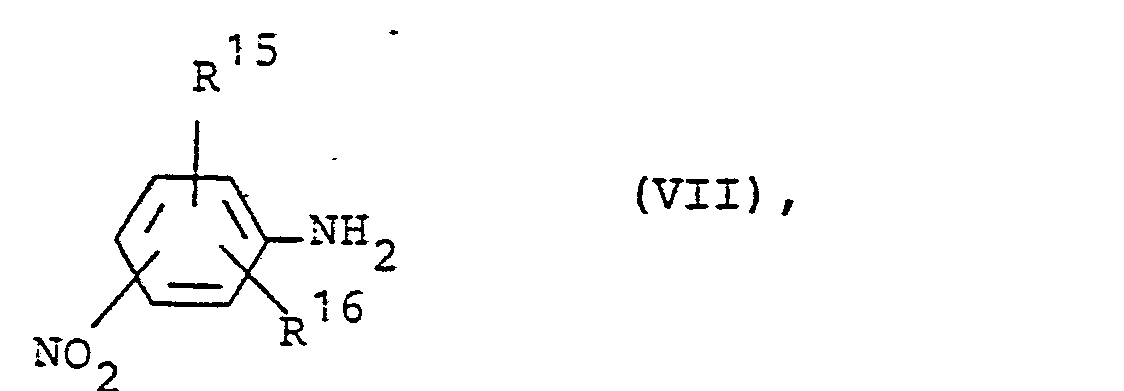
- R 15 und R 16 unabhängig voneinander Wasserstoff, Alkyl oder Halogen bedeuten, wobei einer der Substituenten R 15 oder R16 zusätzlich Nitro bedeuten kann.
- Als Nitroarylamine seien besonders bevorzugt solche der Formel

- R 17 Wasserstoff, Alkyl, Halogen oder Nitro sein kann.
- Erfindungsgemäß werden 0,5 bis 5 Mol Nitroarylcarbonsäure, bevorzugt 0,7 bis 2 Mol, besonders bevorzugz etwa 1 Mol pro Mol Nitroarylamin eingesetzt.
- Das erfindungsgemäße Verfahren wird in Gegenwart von 0,33 bis 2 Mol Phosphoroxichlorid, bevorzugt 0,4 bis 1,5 Mol, besonders bevorzugt 0,5 bis 1 Mol pro Mol Nitroarylcarbonsäure durchgeführt.
- Die Umsetzung erfolgt bei 50 bis 200°C, bevorzugt bei 80 bis 170°C, besonders bevorzugt bei 100 bis 150°C.
- Als inerte Lösungsmittel können beispielsweise aliphatische oder aromatische Kohlenwasserstoffe oder Halogenkohlenwasserstoffe eingesetzt werden. Bevorzugt wählt man solche inerten Lösungsmittel, deren Siedepunkte innerhalb des oben angegebenen Temperaturbereiches liegen. Als solche seien beispielsweise genannt: Höhersiedende Paraffinfraktionen, Isododecan, Toluol, Xylol, Ethylbenzol, Mesitylen, Chlorbenzol, die isomeren Dichlorbenzole oder die isomeren Trichlorbenzole, Brombenzol, Dibrombenzole. Inerte Lösungsmittel von der genannten Art können einzeln oder als Gemisch eingesetzt werden.
- Zu den inerten Lösungsmitteln für das erfindungsgemäße Verfahren zählen weiterhin tertiäre Amine der o.g. Formel (IV). Solche tertiären Amine werden in besonderer Weise genannt, da erfindungsgemäß das einzusetzende Lösungsmittelgemisch mindestens einen kleinen Teil solcher tertiären Amine neben den o.g. Kohlenwasserstoffen oder Chlorkohlenwasserstoffen enthält, aber auch vollständig aus einem oder mehreren solcher tertiären Amine bestehen kann. Als Beispiele für solche tertiären Amine seien genannt: N,N-Dimethylanilin, N,N-Diethylanilin, N,N-Di-n-propylanilin, N,N-Dibutylanilin, 3-Methyl-N,N-dimethylanilin, 4-Methoxy-N,N-dimethylanilin, Trimethylamin, Triethylamin, Tri-n-propylamin, Tributylamin, Dimethyl-butylamin, Diethyl-butylamin, Dimethyl-octylamin, Dimethyldecylamin, Dimethyl-dodecylamin, Dimethyl-cyclohexylamin, Diethyl-cyclohexylamin, Dicyclohexyl-ethylamin, N-Methyl-morpholin, N-Methyl-pyrrolidin, N-Methyl-piperidin, N-Ethyl-pyrrolidin, N-Ethyl-piperidin, N-Ethylmorpholin, N-Methyl- und N-Ethyl-diphenylamin, 2-Chlor-, 3-Chlor- und 4-Chlor-N,N-dimethylanilin.
- Unter den genannten tertiären Aminen werden solche bevorzugt eingesetzt, deren Siedepunkte innerhalb des o.g. Temperaturbereiches liegen. Dadurch ist, beispielsweise bei Anwendung eines einfachen Rückflußkühlers, eine Durchführung des erfindungsgemäßen Verfahrens bei Normaldruck möglich. Darüber hinaus ist es jedoch bei Anwendung eines höheren Druckes möglich, das erfindungsgemäße Verfahren auch mit Hilfe der niedriger siedenden aliphatischen tertiären Amine durchzuführen.
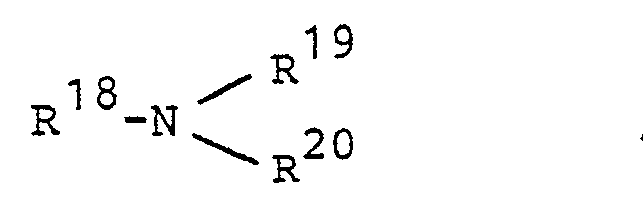
- Als tertiäre Amine werden bevorzugt solche der Formel

- R18 für gegebenenfalls substituiertes Phenyl und
- R19 und R20 unabhängig voneinander für Methyl oder und unabhängig voneinander für Methyl oder Ethyl stehen.
- Von den genannten tertiären Aminen kann sowohl eines als auch ein Gemisch von mehreren eingesetzt werden.
- Erfindungsgemäß beträgt der Anteil des oder der tertiären Amine am Gesamtgewicht aller Lösungsmittel 1 bis 100 Gew.-%, bevorzugt 2 bis 100 Gew.-%, besonders bevorzugt 4 bis 100 Gew.-%. Unter dem Anteil von 4 bis 100 Gew.-% an tertiären Aminen sei ganz besonders bevorzugt ein Anteil von 4 bis 50 Gew.-% und in ganz besonders vorteilhafter Weise ein solcher von 5 bis 10 Gew.-% genannt. Bei dieser Variante finden größere Mengen der o.g. Kohlenwasserstoffe oder Chlorkohlenwasserstoffe als ergänzende Lösungsmittel Verwendung. Dies kann aus Kostengründen vorteilhaft sein.
- Unter dem Anteil von 4 bis 100 Gew.-% an tertiären Aminen am Gesamtlösungsmittel sei in weiterer ganz besonders bevorzugter Weise ein Anteil von 50 bis 100 % an tertiärem Amin, in ganz besonders vorteilhafter Weise ein 100 %iger Anteil an tertiärem Amin oder am Gemisch mehrerer tertiärer Amine genannt. Diese Variante kann wegen des allgemein höheren Preises der Amine gegenüber den inerten Kohlenwasserstoffen oder Chlorkohlenwasserstoffen kostenaufwendiger sein, bringt aber dadurch einen Vorteil, daß auch bei der Anwendung kleinerer Lösungsmittelmengen und damit höherer Substratkonzentrationen bis zum Ende der Umsetzung eine homogene Lösung mit den dabei verbundenen Vorteilen der besseren Rührfähigkeit und der besseren Beherrschung der Tempera- tur vorliegt. Bei einem 100 %igen Anteil von tertiären Aminen oder 100 % nur eines tertiären Amins ergeben sich weiterhin Vorteile bei einer gegebenenfalls nötigen Reinigung oder Wiedergewinnung dieses tertiären Amins.
- Die Gesamtmenge an Lösungsmittel, bestehend aus einem oder mehreren tertiären Aminen und gegebenenfalls den genannten inerten Kohlenwasserstoffen oder Chlorkohlenwasserstoffen, beträgt im allgemeinen 0,3 bis 2 1, bevorzugt 0,4 bis 1 1, besonders bevorzugt 0,5 bis 0,8 1 pro Mol Nitroarylcarbonsäure.
- Das erfindungsgemäße Verfahren wird im allgemeinen wie folgt durchgeführt: Die Nitroarylcarbonsäure und das Nitroarylamin werden zusammen im Lösungsmittel vorgelegt, auf 50 bis 120°C erhitzt und das Phosphoroxidchlorid bei 50 bis 120°C zugetropft. Nach vollständiger Zugabe wird bei einer Temperatur bis zu 200°C nachgerührt. Nach dem Abkühlen der Reaktionsmischung wird diese mit wäßriger Natronlauge bis zur Neutralisation versetzt, wobei beispielsweise ein pH-Wert von etwa 4 bis 11, bevorzugt 7 bis 9, erreicht wird. Hierbei fällt das gewünschte Nitroarylcarbonsäure-nitroarylamid aus, wird anschließend abfiltriert, abzentrifugiert oder abdekantiert und mit heißem Wasser und/oder verdünnter Salzsäure nachgewaschen.
- Das anfallende Filtrat läßt sich sodann in eine wäßrige und eine organische Phase trennen. Die organische Phase kann in bekannter Weise, beispielsweise durch kurzes Andestillieren, vom größten Teil des Wassers befreit werden.
- In besonders einfacher Weise gestaltet sich das erfindungsgemäße Verfahren für den Fall, daß als tertiäres Amin ein solches mit mindestens einer aromatischen Gruppe eingesetzt wird. Hierbei ist die Trennung in die organische und in die wäßrige Phase besonders stark ausgeprägt. Diese organische Phase, die auch im wesentlichen alles erfindungsgemäß eingesetzte tertiäre Amin enthält, kann ohne weitere Aufarbeitung wieder in das Verfahren eingesetzt werden. Vorteilhaft wird man bei dem Wiedereinsetzen eines solchen wasserfeuchten organischen, das tertiäre Amin enthaltenden Lösungsmittels bzw. beim Wiedereinsetzen des wasserfeuchten 100 %igen tertiären Amins vor dem Zusatz des Phosphoroxichlorids durch kurzes Andestillieren dieses Reaktionsmedium vom Wasser weitgehend befreien. Diesen Vorteil des Einsatzes von wasserfeuchtem Lösungsmittel kann man weiterhin auch ausdehnen auf den Einsatz einer wasserfeuchten Nitrcarylcarbonsäure bzw. eines wasserfeuchten Nitroarylamins. Solche wasserfeuchten Einsatzprodukte können beispielsweise als wasserfeuchter Filterkuchen von ihrer vorangegangenen Herstellung unmittelbar eingesetzt werden. In all diesen genannten Fällen wird man das Wasser durch kurzes Andestillieren weitgehend entfernen. Um den störenden Einfluß des danach verbliebenen restlichen Wassers auszuschalten, kann man vorteilhafterweise über die Mindestmenge von 0,33 Mol Phosphoroxichlorid pro Mol Nitroarylcarbonsäure hinaus einen Zuschlag an Phosphoroxichlorid einsetzen. Ein solcher geringer zusätzlicher Einsatz von Phosphoroxichlorid wird durch die Verteile der besseren Handhabung wasserfeuchter Ausgangsstoffe und Lösungsmittel weit aufgewogen.
- Das erfindungsgemäße Verfahren ermöglicht eine einstufige Durchführung der Herstellung der Nitroarylcarbonsäure-nitroarylamide und vermeidet so den Umweg über die thermisch wenig stabilen Nitroaroylchloride. Weiterhin wird der Einsatz des arbeitshygienisch bedenklichen Dimethylformamids vermieden. Die Reaktionsansätze können bei höheren Konzentrationen, ausreichender Rührbarkeit der Reaktionsmischung, bei Vermeidung von Teerbildung und verlängerten Reaktionszeiten und bei Erzielung hoher Raum/Zeit-Ausbeuten durchgeführt werden. Die Aufarbeitung und Rückgewinnung des Lösungsmittels erfolgt ohne aufwendige Wasserdampfdestillation. Die gewünschten Nitroarylcarbonsäure-nitroarylamide fallen weiterhin ohne aufwendige Reinigungsoperationen in hoher Ausbeute und hoher Reinheit an.
- Es ist überraschend, daß die durch Nitrogruppen substituierten Substrate, die nach den üblichen Direktkondensationen nicht oder nur in sehr geringen Ausbeuten zu den Amiden umgesetzt werden können, in glatter Reaktion zu hohen Ausbeuten bei hoher Reinheit die Amide ergeben. Dies ist umso erstaunlicher, als bekannt ist, daß Phosphoroxichlorid als Kondensationsmittel weniger reaktiv ist als Phosphortrichlorid.
- Die Nitroarylcarbonsäure-nitroarylamide finden Verwendung als Herbizide (BE 672 361) und stellen wichtige Zwischenstufen bei der Produktion der korrespondierenden Aminoarylcarbonsäure-aminoarylamide durch Reduktion, beispielsweise mit katalytisch angeregtem Wasserstoff, dar, die ihrerseits wertvolle Diazokomponenten für Farbstoffe darstellen. Hier sei beispielsweise die Verwendung des 4,4'-Diamino-benzanilids zur Herstellung von Azofarbstoffen nach DE-AS 11 53 125 genannt. Aminoarylcarbonsäure-aminoarylamide sind weiterhin Ausgangsstoffe zur Herstellung von Polyurethan-Elastomeren (US 3 926 922).
- Eine Suspension von 552,4 Teilen p-Nitranilin und 668,4 Teilen p-Nitrobenzoesäure in 2000 Teilen Chlorbenzol und 180 Teilen N,N-Dimethylanilin wird auf 100 - 110°C erhitzt und bei dieser Temperatur 306,8 Teile Phosphoroxichlorid in einer Stunde zugetropft. Dann wird die Reaktionsmischung zum Sieden erhitzt und ca. 3 Stunden unter Rühren unter Rückfluß gehalten, bis die HCl-Entwicklung beendet ist.
- Die Mischung wird auf 100°C abgekühlt, mit 800 Teilen Wasser versetzt und bei einer Kolbeninnentemperatur von 50°C mit ca. 300 Teilen 50 %iger Natronlauge auf pH 8 bis 9 gebracht. Das Produkt wird abfiltriert, mit heißem Wasser, verdünnter Salzsäure und wieder mit heißem Wasser gewaschen und getrocknet. Man erhält 1120 Teile 4,4'-Dinitrobenzanilid (98,5 %ig, Ausbeute 96 % der theoretischen Ausbeut) F. 272-274°C.
- Das Filtrat aus dem obigen Ansatz wird in seine Phasen getrennt und der organischen Phase soviel eines eines Chlorbenzol/N,N-Dimethylanilin-Gemisches (92:8) zugeschlagen, daß der Verlust durch die Aufarbeitung ausgeglichen wird (ca. 200 Teile). Nach Zugabe von 552,4 Teilen p-Nitroanilin und 668,4 Teilen p-Nitrobenzoesäure werden durch leichtes Andestillieren am Wasserabscheider Wasserreste azeotrop entfernt, bei 100-110°C 306,8 Teile POC13 innerhalb einer Stunde zugegeben und weiter, wie oben beschrieben, verfahren. Man erhält 1127 Teile 4,4'-Dinitrobenzanilid (98,3 %ig, Ausbeute 96,4 % der theoretischen Ausbeute).
- Eine weitere Wiederverwendung des Lösungsmittelgemisches führt zu 1134 Teilen Anilid (Gehalt: 97,7 %, Ausbeute 96 % der theoretischen Ausbeute).
- 138,1 Teile p-Nitranilin und 167,1 Teile p-Nitrobenzoesäure werden in 436 Teilen Toluol und 50,6 Teilen Triethylamin suspendiert, auf 80°C erhitzt und während 30 Minuten mit 76,7 Teilen Phosphoroxichlorid versetzt. Dann wird noch 3 Stunden unter Rückfluß erhitzt, mit 250 Teilen Wasser und ca. 75 Teilen 50 %iger Natronlauge auf pH 8-9 gestellt und das Produkt abgesaugt, mit heißem Wasser, verdünnter Salzsäure und wieder mit heißem Wasser gewaschen und getrocknet. Ausbeute 267 Teile 4,4'-Dinitrobenzanilid (99 %ig, Ausbeute 92 % der theoretischen Ausbeute).
- 138,1 Teile p-Nitranilin, 167,1 Teile p-Nitrobenzoesäure, 872 Teile Toluol (1 1) und 50,6 Teile Triethylamin werden auf 80°C erwärmt und in 30 Minuten mit 84 Teilen Phosphortrichlorid versetzt. Es bildete sich eine schwer rührbare, klumpige Masse. Dann wurde 3 Stunden unter Rückfluß erhitzt, auf 80°C abgekühlt und mit 250 Teilen Wasser und 75 Teilen 50 %ige Natronlauge auf pH 8-9 gestellt. Filtration der Reaktionsmischung und Behandlung des Rohproduktes mit verdünnter Salzsäure und heißem Wasser auf der Nutsche sowie anschließendes Trocknen führt zu 232 Teilen rohem 4,4'-Dinitrobenzanilid (Gehalt 66,6 %, Ausbeute 53,8 % der theoretischen Ausbeute).
- 167,2 Teile p-Nitrobenzoesäure und 138,1 Teile p-Nitranilin werden in 600 Teilen N,N-Dimethylanilin gelöst, auf 80°C erhitzt und die Lösung innerhalb von 15 Minuten mit 76,7 Teilen Phosphoroxichlorid bei 80-100°C versetzt. Dann wird 3 Stunden bei 120°C nachgerührt, auf Raumtemperatur abgekühlt und mit ca. 300 Teilen einer 25 %igen Natronlauge vorsichtig auf pH 8-9 gestellt. Das Reaktionsprodukt wird abfiltriert, mit verdünnter Salzsäure und Wasser gewaschen und getrocknet. Ausbeute: 261 Teile 4,4'-Dinitrobenzanilid (99 %ig), entsprechend 90 % der theoretischen Ausbeute.
- 167,2 Teile p-Nitrobenzoesäure und 138,1 Teile 3-Nitroanilin werden in 700 Teilen Toluol und 50 Teilen N,N-Dimethylanilin suspendiert und auf 80°C erhitzt. Bei dieser Temperatur werden 76,7 Teile Phosphoroxichlorid in 15 Minuten zugetropft und anschließend 3 Stunden unter Rückfluß erhitzt. Nach dem Abkühlen auf Raumtemperatur wird mit 300 Teilen 25 %iger wäßriger Natronlauge auf pH 8-9 gestellt, filtriert und der Filterkuchen mit verdünnter Salzsäure, Wasser und schließlich Methanol gewaschen. Ausbeute: 253 Teile 4,3'-Dinitrobenzanilid (88 % der theoretischen Ausbeute). F. 226-228°C.
- 41,8 Teile 4-Nitrobenzoesäure und 43,1 Teile 6-Chlor-3- nitranilin werden in 150 Teilen N,N-Dimethylanilin gelöst und bei 80-100°C mit 25,3 Teilen Phosphoroxichlorid versetzt. Zweistündiges Nachrühren bei 140°C, gefolgt von der üblichen Aufarbeitung, liefert 78 Teile (97 % der theoretischen Ausbeute) 3',4-Dinitro-6'-chlorbenzanilid F. 228-231°C.
am Gesamtgewicht der Lösungsmittel umsetzt.
Claims (10)


eingesetzt wird.
Applications Claiming Priority (2)
| Application Number | Priority Date | Filing Date | Title |
|---|---|---|---|
| DE19813148696 DE3148696A1 (de) | 1981-12-09 | 1981-12-09 | Verfahren zur herstellung von nitroarylcarbonsaeure-nitroarylamiden |
| DE3148696 | 1981-12-09 |
Publications (2)
| Publication Number | Publication Date |
|---|---|
| EP0081157A1 true EP0081157A1 (de) | 1983-06-15 |
| EP0081157B1 EP0081157B1 (de) | 1985-01-02 |
Family
ID=6148246
Family Applications (1)
| Application Number | Title | Priority Date | Filing Date |
|---|---|---|---|
| EP82110924A Expired EP0081157B1 (de) | 1981-12-09 | 1982-11-26 | Verfahren zur Herstellung von Nitroarylcarbonsäure-nitroarylamiden |
Country Status (4)
| Country | Link |
|---|---|
| EP (1) | EP0081157B1 (de) |
| JP (1) | JPS58105950A (de) |
| BR (1) | BR8207125A (de) |
| DE (2) | DE3148696A1 (de) |
Citations (2)
| Publication number | Priority date | Publication date | Assignee | Title |
|---|---|---|---|---|
| FR2113418A5 (de) * | 1970-11-02 | 1972-06-23 | Stauffer Chemical Co | |
| FR2192819A1 (de) * | 1972-07-19 | 1974-02-15 | Renfag Sa |
Family Cites Families (1)
| Publication number | Priority date | Publication date | Assignee | Title |
|---|---|---|---|---|
| JPS5528909A (en) * | 1978-08-21 | 1980-02-29 | Kumiai Chem Ind Co Ltd | 2-substituted benzanilide derivative and antimicrophyte for agriculture and horticulture containing it as effective component |
-
1981
- 1981-12-09 DE DE19813148696 patent/DE3148696A1/de not_active Withdrawn
-
1982
- 1982-11-26 DE DE8282110924T patent/DE3261782D1/de not_active Expired
- 1982-11-26 EP EP82110924A patent/EP0081157B1/de not_active Expired
- 1982-12-06 JP JP57212841A patent/JPS58105950A/ja active Granted
- 1982-12-08 BR BR8207125A patent/BR8207125A/pt unknown
Patent Citations (2)
| Publication number | Priority date | Publication date | Assignee | Title |
|---|---|---|---|---|
| FR2113418A5 (de) * | 1970-11-02 | 1972-06-23 | Stauffer Chemical Co | |
| FR2192819A1 (de) * | 1972-07-19 | 1974-02-15 | Renfag Sa |
Non-Patent Citations (1)
| Title |
|---|
| CHEMICAL ABSTRACTS, Band 91, Nr. 1, 2. Juli 1979, Seite 469, Nr. 5008x, Columbus, Ohio, USA * |
Also Published As
| Publication number | Publication date |
|---|---|
| JPH0246025B2 (de) | 1990-10-12 |
| BR8207125A (pt) | 1983-10-11 |
| EP0081157B1 (de) | 1985-01-02 |
| JPS58105950A (ja) | 1983-06-24 |
| DE3261782D1 (en) | 1985-02-14 |
| DE3148696A1 (de) | 1983-07-21 |
Similar Documents
| Publication | Publication Date | Title |
|---|---|---|
| EP0014409B1 (de) | Verfahren zur Herstellung von Alpha-Hydroxycarbonsäureamiden | |
| DE2503187A1 (de) | Verfahren zur herstellung durch chlor meta-substituierte aniline | |
| DE2632402A1 (de) | Verfahren zur herstellung von heterocyclischer verbindungen | |
| EP0380712B1 (de) | Verfahren zur Herstellung von 2,6-Dichlordiphenylaminessigsäurederivaten | |
| EP0083442A2 (de) | Verfahren zur Herstellung von 2,4,6-Trichloranilin | |
| EP0081157B1 (de) | Verfahren zur Herstellung von Nitroarylcarbonsäure-nitroarylamiden | |
| EP0057861B1 (de) | Verfahren zur Herstellung von Nitroanilinen | |
| DE1176660B (de) | Verfahren zur Herstellung von triaryl-substituierten Imidazolinonen-4(5) | |
| US1646785A (en) | Aryl esters of nitro amino benzene sulphonic acids | |
| DE69407783T2 (de) | Verfahren zur herstellung von p-alkyl- und p-arylsulfonylbenzoesäure-derivate | |
| DE3504073C2 (de) | ||
| DE2521649C2 (de) | 3-Amino-4-carbalkoxybenzoesäure- 4'-phenoxyanilide, Verfahren zu ihrer Herstellung und ihre Verwendung | |
| DE2800111A1 (de) | Verfahren zur herstellung von aminophenylharnstoffen und aminocarbanylaten | |
| US1936721A (en) | Manufacture of ortho-nitro-phenyl-sulphones | |
| DE2460909C2 (de) | Verfahren zur Herstellung von alpha- Oxothiodimethylamiden | |
| EP0046859B1 (de) | Verfahren zur Herstellung von 1-Brom-3,5-dichlorbenzol | |
| EP0031089B1 (de) | Verfahren zur Herstellung von N,N'-Diarylalkylendiaminen oder N,N',N"-Triaryldialkylen-triaminen | |
| DE2742174A1 (de) | Verfahren zur herstellung von aminen | |
| EP0310944B1 (de) | Bis-oxethylsulfonylmethyl-aniline und Verfahren zu ihrer Herstellung | |
| EP0041170B1 (de) | 3-Nitro-pivaloyl-acetanilide, Verfahren zu ihrer Herstellung und ihre Verwendung | |
| EP0012982B1 (de) | N-Nitroaryl-N'-halogensulfonylharnstoffe, Verfahren zu ihrer Herstellung und ihre Verwendung zur Herstellung von Nitroarylharnstoffen | |
| DE923192C (de) | Verfahren zur Herstellung von N-Aryl-pseudothiohydantoinen | |
| AT268323B (de) | Verfahren zur Herstellung von neuen 3,1-Benzothiazin-Derivaten und ihren Salzen | |
| DE2035657B2 (de) | 27.03.70 Japan 26217-70 Verfahren zur Herstellung von 4-Halogen-5-sulfamoylanthranilsäureaniliden | |
| AT323123B (de) | Verfahren zur herstellung von n,n-disubstituierten charbonsäureamiden |
Legal Events
| Date | Code | Title | Description |
|---|---|---|---|
| PUAI | Public reference made under article 153(3) epc to a published international application that has entered the european phase |
Free format text: ORIGINAL CODE: 0009012 |
|
| 17P | Request for examination filed |
Effective date: 19821126 |
|
| AK | Designated contracting states |
Designated state(s): CH DE FR GB IT LI |
|
| ITF | It: translation for a ep patent filed | ||
| GRAA | (expected) grant |
Free format text: ORIGINAL CODE: 0009210 |
|
| AK | Designated contracting states |
Designated state(s): CH DE FR GB IT LI |
|
| REF | Corresponds to: |
Ref document number: 3261782 Country of ref document: DE Date of ref document: 19850214 |
|
| ET | Fr: translation filed | ||
| PLBE | No opposition filed within time limit |
Free format text: ORIGINAL CODE: 0009261 |
|
| STAA | Information on the status of an ep patent application or granted ep patent |
Free format text: STATUS: NO OPPOSITION FILED WITHIN TIME LIMIT |
|
| 26N | No opposition filed | ||
| ITTA | It: last paid annual fee | ||
| PGFP | Annual fee paid to national office [announced via postgrant information from national office to epo] |
Ref country code: FR Payment date: 19931022 Year of fee payment: 12 |
|
| PGFP | Annual fee paid to national office [announced via postgrant information from national office to epo] |
Ref country code: CH Payment date: 19931130 Year of fee payment: 12 |
|
| PGFP | Annual fee paid to national office [announced via postgrant information from national office to epo] |
Ref country code: DE Payment date: 19941013 Year of fee payment: 13 |
|
| PG25 | Lapsed in a contracting state [announced via postgrant information from national office to epo] |
Ref country code: LI Effective date: 19941130 Ref country code: CH Effective date: 19941130 |
|
| PG25 | Lapsed in a contracting state [announced via postgrant information from national office to epo] |
Ref country code: FR Effective date: 19950731 |
|
| REG | Reference to a national code |
Ref country code: CH Ref legal event code: PL |
|
| REG | Reference to a national code |
Ref country code: FR Ref legal event code: ST |
|
| PGFP | Annual fee paid to national office [announced via postgrant information from national office to epo] |
Ref country code: GB Payment date: 19951121 Year of fee payment: 14 |
|
| PG25 | Lapsed in a contracting state [announced via postgrant information from national office to epo] |
Ref country code: DE Effective date: 19960903 |
|
| PG25 | Lapsed in a contracting state [announced via postgrant information from national office to epo] |
Ref country code: GB Effective date: 19961126 |
|
| GBPC | Gb: european patent ceased through non-payment of renewal fee |
Effective date: 19961126 |