EP0081432A1 - Alliages à base de fer pour éléments de construction soudés et utilisations de ces alliages - Google Patents
Alliages à base de fer pour éléments de construction soudés et utilisations de ces alliages Download PDFInfo
- Publication number
- EP0081432A1 EP0081432A1 EP82402208A EP82402208A EP0081432A1 EP 0081432 A1 EP0081432 A1 EP 0081432A1 EP 82402208 A EP82402208 A EP 82402208A EP 82402208 A EP82402208 A EP 82402208A EP 0081432 A1 EP0081432 A1 EP 0081432A1
- Authority
- EP
- European Patent Office
- Prior art keywords
- alloys
- manganese
- iron
- titanium
- contain
- Prior art date
- Legal status (The legal status is an assumption and is not a legal conclusion. Google has not performed a legal analysis and makes no representation as to the accuracy of the status listed.)
- Granted
Links
- 229910045601 alloy Inorganic materials 0.000 title claims abstract description 37
- 239000000956 alloy Substances 0.000 title claims abstract description 37
- XEEYBQQBJWHFJM-UHFFFAOYSA-N Iron Chemical compound [Fe] XEEYBQQBJWHFJM-UHFFFAOYSA-N 0.000 title claims abstract description 21
- 229910052742 iron Inorganic materials 0.000 title claims abstract description 11
- RTAQQCXQSZGOHL-UHFFFAOYSA-N Titanium Chemical compound [Ti] RTAQQCXQSZGOHL-UHFFFAOYSA-N 0.000 claims abstract description 17
- PWHULOQIROXLJO-UHFFFAOYSA-N Manganese Chemical compound [Mn] PWHULOQIROXLJO-UHFFFAOYSA-N 0.000 claims abstract description 16
- 239000010936 titanium Substances 0.000 claims abstract description 16
- 229910052719 titanium Inorganic materials 0.000 claims abstract description 16
- 239000011572 manganese Substances 0.000 claims abstract description 15
- 229910052748 manganese Inorganic materials 0.000 claims abstract description 15
- PXHVJJICTQNCMI-UHFFFAOYSA-N Nickel Chemical compound [Ni] PXHVJJICTQNCMI-UHFFFAOYSA-N 0.000 claims abstract description 14
- NINIDFKCEFEMDL-UHFFFAOYSA-N Sulfur Chemical compound [S] NINIDFKCEFEMDL-UHFFFAOYSA-N 0.000 claims abstract description 9
- 229910052717 sulfur Inorganic materials 0.000 claims abstract description 9
- 239000011593 sulfur Substances 0.000 claims abstract description 9
- 238000010276 construction Methods 0.000 claims abstract description 8
- 229910052759 nickel Inorganic materials 0.000 claims abstract description 7
- OKTJSMMVPCPJKN-UHFFFAOYSA-N Carbon Chemical compound [C] OKTJSMMVPCPJKN-UHFFFAOYSA-N 0.000 claims abstract description 5
- OAICVXFJPJFONN-UHFFFAOYSA-N Phosphorus Chemical compound [P] OAICVXFJPJFONN-UHFFFAOYSA-N 0.000 claims abstract description 5
- 229910052799 carbon Inorganic materials 0.000 claims abstract description 5
- 229910052698 phosphorus Inorganic materials 0.000 claims abstract description 5
- 239000011574 phosphorus Substances 0.000 claims abstract description 5
- 229910052710 silicon Inorganic materials 0.000 claims abstract description 5
- 239000010703 silicon Substances 0.000 claims abstract description 5
- 239000010941 cobalt Substances 0.000 claims abstract description 4
- 229910017052 cobalt Inorganic materials 0.000 claims abstract description 4
- GUTLYIVDDKVIGB-UHFFFAOYSA-N cobalt atom Chemical compound [Co] GUTLYIVDDKVIGB-UHFFFAOYSA-N 0.000 claims abstract description 4
- WPBNNNQJVZRUHP-UHFFFAOYSA-L manganese(2+);methyl n-[[2-(methoxycarbonylcarbamothioylamino)phenyl]carbamothioyl]carbamate;n-[2-(sulfidocarbothioylamino)ethyl]carbamodithioate Chemical compound [Mn+2].[S-]C(=S)NCCNC([S-])=S.COC(=O)NC(=S)NC1=CC=CC=C1NC(=S)NC(=O)OC WPBNNNQJVZRUHP-UHFFFAOYSA-L 0.000 claims abstract description 4
- 239000012535 impurity Substances 0.000 claims abstract description 3
- 238000004519 manufacturing process Methods 0.000 claims description 3
- 239000011324 bead Substances 0.000 description 7
- 229910052751 metal Inorganic materials 0.000 description 6
- 239000002184 metal Substances 0.000 description 6
- 238000007711 solidification Methods 0.000 description 6
- 230000008023 solidification Effects 0.000 description 6
- 239000000203 mixture Substances 0.000 description 4
- 239000000945 filler Substances 0.000 description 3
- 238000003466 welding Methods 0.000 description 3
- 229910001030 Iron–nickel alloy Inorganic materials 0.000 description 2
- 239000010953 base metal Substances 0.000 description 2
- 229910001374 Invar Inorganic materials 0.000 description 1
- 230000002238 attenuated effect Effects 0.000 description 1
- 230000008602 contraction Effects 0.000 description 1
- 238000005336 cracking Methods 0.000 description 1
- 230000007547 defect Effects 0.000 description 1
- 210000001787 dendrite Anatomy 0.000 description 1
- 230000000694 effects Effects 0.000 description 1
- 230000004927 fusion Effects 0.000 description 1
- 239000007788 liquid Substances 0.000 description 1
- 238000000034 method Methods 0.000 description 1
- 238000011084 recovery Methods 0.000 description 1
- 239000007787 solid Substances 0.000 description 1
- 238000003860 storage Methods 0.000 description 1
- 238000009864 tensile test Methods 0.000 description 1
Images

Classifications
-
- C—CHEMISTRY; METALLURGY
- C22—METALLURGY; FERROUS OR NON-FERROUS ALLOYS; TREATMENT OF ALLOYS OR NON-FERROUS METALS
- C22C—ALLOYS
- C22C38/00—Ferrous alloys, e.g. steel alloys
- C22C38/08—Ferrous alloys, e.g. steel alloys containing nickel
-
- C—CHEMISTRY; METALLURGY
- C22—METALLURGY; FERROUS OR NON-FERROUS ALLOYS; TREATMENT OF ALLOYS OR NON-FERROUS METALS
- C22C—ALLOYS
- C22C38/00—Ferrous alloys, e.g. steel alloys
- C22C38/10—Ferrous alloys, e.g. steel alloys containing cobalt
- C22C38/105—Ferrous alloys, e.g. steel alloys containing cobalt containing Co and Ni
-
- Y—GENERAL TAGGING OF NEW TECHNOLOGICAL DEVELOPMENTS; GENERAL TAGGING OF CROSS-SECTIONAL TECHNOLOGIES SPANNING OVER SEVERAL SECTIONS OF THE IPC; TECHNICAL SUBJECTS COVERED BY FORMER USPC CROSS-REFERENCE ART COLLECTIONS [XRACs] AND DIGESTS
- Y10—TECHNICAL SUBJECTS COVERED BY FORMER USPC
- Y10T—TECHNICAL SUBJECTS COVERED BY FORMER US CLASSIFICATION
- Y10T428/00—Stock material or miscellaneous articles
- Y10T428/12—All metal or with adjacent metals
- Y10T428/12493—Composite; i.e., plural, adjacent, spatially distinct metal components [e.g., layers, joint, etc.]
- Y10T428/12639—Adjacent, identical composition, components
- Y10T428/12646—Group VIII or IB metal-base
-
- Y—GENERAL TAGGING OF NEW TECHNOLOGICAL DEVELOPMENTS; GENERAL TAGGING OF CROSS-SECTIONAL TECHNOLOGIES SPANNING OVER SEVERAL SECTIONS OF THE IPC; TECHNICAL SUBJECTS COVERED BY FORMER USPC CROSS-REFERENCE ART COLLECTIONS [XRACs] AND DIGESTS
- Y10—TECHNICAL SUBJECTS COVERED BY FORMER USPC
- Y10T—TECHNICAL SUBJECTS COVERED BY FORMER US CLASSIFICATION
- Y10T428/00—Stock material or miscellaneous articles
- Y10T428/12—All metal or with adjacent metals
- Y10T428/12493—Composite; i.e., plural, adjacent, spatially distinct metal components [e.g., layers, joint, etc.]
- Y10T428/12639—Adjacent, identical composition, components
- Y10T428/12646—Group VIII or IB metal-base
- Y10T428/12653—Fe, containing 0.01-1.7% carbon [i.e., steel]
Definitions
- the present invention relates to iron-based alloys with a low coefficient of expansion and which can be welded and to the applications of these alloys to welded construction elements working under cryogenic conditions, in particular to storage and transport tanks and transport conduits. liquefied gas.
- the phenomenon known as "solidification crack” is due to the fact that interdendritic films are still liquid and therefore incapable of withstanding a tensile force at a temperature where the dendrites already formed constitute a continuous solid structure capable of transmitting the forces. due to thermal contraction.
- the ductility hole corresponds to a minimum of ductility in the temperature range from 700 to 1000 ° C.
- a filler metal is known for welding the above alloys in which manganese and titanium have been added to the base metal of the above type.
- a typical composition of this filler metal comprises 36% nickel, 0.1% silicon, 0.1% carbon, less than 0.01% sulfur, less than 0.01% phosphorus, 3% manganese and 1% titanium, iron forming the balance.
- the addition of manganese and titanium has the disadvantage of increasing the coefficient of expansion of the alloy which cannot therefore be used as a base metal for the manufacture of construction elements in the cryogenic field.
- the use of this filler metal as a weld does not solve all the difficulties. In the case of crossed beads and if the stresses are high enough, cracking of the first bead occurs in the area affected by the second bead, not in the molten area but just at the limit of the latter in the metal of based.
- French patent 7,129,341 has proposed, for building elements in the cryogenic field, iron-nickel alloys loaded with manganese and having a limited sulfur content. These alloys contain by weight 36 to 36.5% of nickel, 0 to 0.25% of silicon, 0 to 0.04% of carbon, 0 to 0.012% of sulfur, 0 to 0.012% of phosphorus and 0.20 to 0.40% manganese. Due to the limitation of the sulfur content and the presence of manganese, construction elements made with these alloys can be welded without great difficulty. However, it is found that the metal of the molten zone of a weld bead produced with this alloy is unable to simultaneously resist a temperature of the order of 700 to 1000 ° C. and a tensile stress when these conditions are met. during a local recovery of a weld bead or a crossing of weld beads. This phenomenon is due to the drop in ductility observed in the temperature range given above.
- the present invention aims to provide alloys based on iron for the building elements welded working under cryogenic conditions, not having a "ductility" hole marked nor any unacceptable tendency to "crack” solidification. These allasses have an average coefficient of expansion between -180 ° and 0 ° C lower or close to 2.10 -6 / ° C and the present invention relates to applications requiring the above properties.
- the iron-based alloys for building elements working at cryogenic temperatures in accordance with the invention contain by weight carbon 35 to 39% of nickel, 0 to 20% of cobalt, 0 to 0.25% of silicon, 0 to 0 , 04% from / 0 to 0.004% sulfur, 0 to 0.008% phosphorus, manganese, the rest being formed by iron and by impurities and they are characterized by the fact that they contain 0.2 to 1, 5% manganese and 0.2% to 0.5% titanium.
- the alloys contain 0.3 to 1% of manganese.
- these alloys are used in the manufacture of construction elements having welded crossings.
- the alloys according to the invention are / iron based and contain 35 to 39% of nickel. They have an austenitic structure. They can contain 0 to 20% cobalt.
- the table gives two alloy compositions in accordance with the invention. These compositions are given by weight.
- the alloys contain manganese and titanium.
- the combination of manganese addition and titanium addition is essential. Indeed the addition of manganese alone, even at the 3% level, has no effect on the "ductility hole".
- the manganese content is between 0.2 and 1.5%. Preferably it should not exceed 1% so that the average coefficient of expansion between -180 ° and 0 ° is low ( Figure 3). Preferably the content is between 0.3% and 1%.
- the minimum titanium content is also critical from the point of view of weldability. Indeed, tests show that the alloys according to the in- v ention do not exhibit cracks in welds crossings while alloys such as A in the present alloy and that occasionally free alloys titanium have systematically.
- the titanium content should not exceed 0.5% to avoid increasing the average coefficient of expansion and to avoid aggravating the tendency to crack solidification.
- the sulfur content is between 0 and 0.004%.
- the graph in FIG. 2 shows that in the field of alloys according to the invention, the lowering of the sulfur content from 0.011% ("notes” circled) to 0.004% ("notes” underlined) causes the "note” to drop by 50 points to bring it well below 140 which is a "grade” for which there are no difficulties in TIG welding.
- the applications of the alloys according to the invention are those where these a -bondings provide an average coefficient of expansion of less than 2.5 ⁇ 10 -6 ° C. under cryogenic conditions and a ductility hole sufficiently attenuated to allow welds in particular. weld crossings.
- the alloys according to the invention are suitable for welded construction elements working under cryogenic conditions and having weld crossings produced with metal fusion in the welding zones of said elements.
- FIG. 4 shows a cryogenic duct in which the annular bead 1 cuts the longitudinal cords 2 and 3.
- the alloys according to the invention are specially adapted to such parts having welded crossings.
Landscapes
- Chemical & Material Sciences (AREA)
- Engineering & Computer Science (AREA)
- Materials Engineering (AREA)
- Mechanical Engineering (AREA)
- Metallurgy (AREA)
- Organic Chemistry (AREA)
- Arc Welding In General (AREA)
- Heat Treatment Of Articles (AREA)
- Electroplating And Plating Baths Therefor (AREA)
- Resistance Welding (AREA)
Abstract
Description
- La présente invention se rapporte à des alliages à base fer à faible coefficient de dilatation et soudables et aux applications de ces alliages à des éléments de construction soudés travaillant dans des conditions cryogéniques en particulier aux cuves de stockage et de transport et aux conduits de transport de gaz liquéfié.
- La soudabilité des alliages fer-nickel présentant 35 à 50 % de nickel, parmi lesquels l'alliage connu sous la marque "INVAR'; est limitée par deux phénomènes distincts : la tendance à la "crique de solidification" et le "trou de ductilité". Le phénomène dit de "crique de solidification" est dû au fait que des films interdendritiques sont encore liquides et donc incapables de résister à un effort de traction à une température où les dendrites déjà formées constituent un édifice solide continu capable de transmettre les efforts dûs à la contraction thermique. Le trou de ductilité correspond à un minimum de ductilité dans l'intervalle de températures allant de 700 à 1000°C.
- On connait un métal d'apport destiné au soudage des alliages ci-dessus dans lequel on a ajouté du manganèse et du titane au métal de base du type ci-dessus. Une composition type de ce métal d'apport comporte 36 % de nickel, 0,1 % de silicium, 0,1 % de carbone, moins de 0,01 % de soufre, moins de 0,01 % de phosphore, 3% de manganèse et 1% de titane,le fer formant le solde. L'addition de manganèse et de titane présente l'inconvénient d'élever le coefficient de dilatation de l'alliage qui ne peut pas de ce fait être utilisé comme métal de base pour la fabrication d'éléments de construction dans le domaine cryogénique. Par ailleurs l'utilisation de ce métal d'apport comme soudure ne résoud pas toutes les difficultés. Dans le cas de cordons croisés et si les contraintes sont assez élevées, il se produit des fissurations du premier cordon dans la zone affectée par le second cordon, non pas dans la zone fondue mais juste à la limite de celle-ci dans le métal de base.
- On a proposé,dans le brevet français 7 129 341, pour des éléments de construction dans le domaine cryogénique, des alliages fer-nickel chargés en manganèse et présentant une teneur limitée en soufre. Ces alliages comportent en poids 36 à 36,5 % de nickel, 0 à 0,25 % de silicium, 0 à 0,04 % de carbone, 0 à 0,012 % de soufre, 0 à 0,012 % de phosphore et 0,20 à 0,40 % de manganèse. A cause de la limitation de la teneur en soufre et de la présence de manganèse, les éléments de construction réalisés avec ces alliages peuvent être soudés sans grosses difficultés. On constate néanmoins que le métal de la zone fondue d'un cordon de soudure réalisé avec cet alliage est incapable de résister simultanément à une température de l'ordre de 700 à 1000°C et à une contrainte de traction alors que ces conditions se rencontrent lors d'une reprise locale d'un cordon de soudure ou d'un croisement de cordons de soudure. Ce phénomène est du à la chute de la ductilité que l'on observe dans la plage de températures donnée ci-dessus.
- La présente invention a pour but de fournir des alliages à base'fer destinés à des éléments de construction soudés travaillant dans des conditions cryogéniques, ne présentant pas un "trou de ductilité" marqué, ni de tendance inacceptable à la "crique" de solidification. Ces allasses présentent un coefficient moyen de dilatation entre -180° et 0°C inférieur ou voisin de 2.10 -6/°C et la présente invention est relative à des applications exigeant les propriétés ci-dessus.
- Les alliages à base de fer pour éléments de construction travaillant à des températures cryogéniques conformes à l'invention contiennent en poids carbone 35 à 39 % de nickel, 0 à 20 % de cobalt, 0 à 0,25% de silicium, 0 à 0,04 %de/ 0 à 0,004 % de souffre, 0 à 0,008 % de phosphore, du manganèse, le reste étant formé par du fer et par des impuretés et ils sont caractérisés par le fait qu'ils contiennent 0,2 à 1,5 % de manganèse et 0,2 % à 0,5 % de titane.
- Selon une caractéristique, les alliages contiennent 0,3 à 1 % de manganèse.
- Selon une autre caractéristique de l'invention, ces alliages sont utilisés à la fabrication d'éléments de construction présentant des croisements de soudure.
- L'invention va maintenant être décrite avec plus de détails en se référant à des modes de réalisation donnés à titre d'exemples. Cette description nullement limitative fait référence aux dessins annexés dans lesquels :
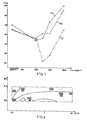
- La figure 1 est un graphique donnant la striction à rupture mesurée par essai de traction rapide sur des échantillons forgés et traités une heure à 1100°C, en fonction de la température t.
- La figure 2 donne pour différentes teneurs en manganèse et en titane conformes à l'invention, une note définie selon la méthode Gueussier-Castro, de la tendance au défaut dit de la "crique" de solidification", cette tendance étant d'autant plus forte que la note est plus élevée.
- La figure 3 est un graphique donnant le coefficient moyen de dilatation entre -180° et 0°C d'alliages conformes à l'invention.
- La figure 4 représente un exemple d'élément de construction pour lequel les alliages conformes à l'invention sont spécialement adaptés.
- Les alliages selon l'invention sont/base fer et contiennent 35 à 39 % de nickel. Ils ont une structure austénitique. Ils peuvent contenir 0 à 20 % de cobalt.
- A titre d'exemple, le tableau donne deux compositions d'alliages conformes à l'invention. Ces compositions sont données en poids.

- Les alliages contiennent du manganèse et du titane. La combinaison de l'addition en manganèse et de l'addition en titane est essentielle. En effet l'addition de manganèse seul, même au niveau de 3 %, est sans effet sur le "trou de ductilité". La teneur en manganèse est comprise entre 0,2 et 1,5 %. De préférence elle ne doit pas dépasser 1 % pour que le coefficient moyen de dilatation entre -180° et 0° soit faible (figure 3). De préférence la teneur est comprise entre 0,3 % et 1 %.
- La teneur minimum en titane, égale à 0,2 %, est critique en ce qui concerne le "trou de ductilité". En effet celui-ci n'est pas supprimé de façon reproductible lorsque la teneur en titane est inférieure à la limite mentionnée. Ainsi la courbe de striction à la rupture (figure 1) de l'alliage A dont la composition pondérale est donnée dans le tableau II montre que le "trou de ductilité" existe lorsque la teneur en titane est inférieure à 0,2 %.

- Au contraire les courbes de striction à rupture des alliages Ml et M2 (figure 1) montrent que le "trou de ductilité" est effacé dans les alliages conformes à l'invention contenant plus de 0,2 % de titane.
- La teneur minimum en titane est par ailleurs critique du point de vue de la soudabilité. En effet les essais montrent que les alliages selon l'in- vention ne présentent pas de criques aux croisements de soudures alors que des alliages tels que l'alliage A en présentent occasionnellement et que des alliages sans titane en présentent systématiquement.
- La teneur en titane ne doit pas dépasser 0,5 % pour éviter d'augmenter le coefficient moyen de dilatation et pour éviter d'aggraver la tendance à la crique de solidification.
- La teneur en soufre est comprise entre 0 et 0,004 %. Le graphique de la figure 2 montre que dans le domaine des alliages selon l'invention, l'abaissement de la teneur en soufre de 0,011 % ("notes" cerclées) à 0,004 % ("notes" soulignées) fait chuter la "note" de 50 points pour l'amener largement au-dessous de 140 qui est une "note" pour laquelle on ne rencontre pas de difficultés en soudage TIG.
- Les applications des alliages selon l'invention sont celles où ces al-liages apportent un coefficient moyen de dilatation inférieur à 2,5 x 10⁻⁶°C dans les conditions cryogéniques et un trou de ductilité suffisamment atténué pour permettre des soudures en particulier des croisements de soudures. Les alliages selon l'invention sont adaptés à des éléments de construction soudés travaillant dans des conditions cryogéniques et présentant des croisements de soudure réalisés avec fusion de métal dans les zones de soudage desdits éléments. La figure 4 montre un conduit cryogénique dans lequel le cordon annulaire 1 coupe les cordons longitudinaux 2 et 3. Les alliages selon l'invention sont spécialement adaptés à de telles pièces présentant des croisements de soudure.
- Il est bien entendu que l'on peut sans sortir du cadre de l'invention imaginer des variantes et perfectionnements de détails et de même envisager l'emploi de moyens équivalents.
Claims (3)
- soudés 1.- Alliages à base de fer pour éléments de construction/travaillant à des températures cryogéniques, contenant en poids 35 à 39 % de nickel, 0 à 20 % de cobalt, 0 à 0,25 % de silicium, 0 à 0,0 4 % de carbone, 0 à 0,004 % de soufre, 0 à 0,008 % de phosphore, du manganèse, le reste étant formé de fer et d'impuretés, caractériséspar le fait qu'ils contiennent 0,2 à 1,5 % de manganèse et 0,2 à 0,5 % de titane.
- 2.- Alliages selon la revendication 1 caractérisés par le fait qu'ils contiennent 0,3 à 1 % de manganèse.
- 3.- Applications des alliages selon l'une quelconque des revendications précédentes caractérisées par le fait que ces alliages sont utilisés à la fabrication d'éléments de construction présentant des croisements de soudure et nécessitant un coefficient moyen de dilatation inférieur à 2,5 x 10⁻⁶/°C.
Priority Applications (1)
| Application Number | Priority Date | Filing Date | Title |
|---|---|---|---|
| AT82402208T ATE12792T1 (de) | 1981-12-04 | 1982-12-03 | Legierungen auf eisenbasis fuer geschweisste bauteile und verwendung dieser legierungen. |
Applications Claiming Priority (2)
| Application Number | Priority Date | Filing Date | Title |
|---|---|---|---|
| FR8122756 | 1981-12-04 | ||
| FR8122756A FR2517701B1 (fr) | 1981-12-04 | 1981-12-04 | Alliages a base de fer pour elements de construction soudes et applications de ces alliages |
Publications (2)
| Publication Number | Publication Date |
|---|---|
| EP0081432A1 true EP0081432A1 (fr) | 1983-06-15 |
| EP0081432B1 EP0081432B1 (fr) | 1985-04-17 |
Family
ID=9264699
Family Applications (1)
| Application Number | Title | Priority Date | Filing Date |
|---|---|---|---|
| EP82402208A Expired EP0081432B1 (fr) | 1981-12-04 | 1982-12-03 | Alliages à base de fer pour éléments de construction soudés et utilisations de ces alliages |
Country Status (6)
| Country | Link |
|---|---|
| US (1) | US4525431A (fr) |
| EP (1) | EP0081432B1 (fr) |
| JP (1) | JPS58104156A (fr) |
| AT (1) | ATE12792T1 (fr) |
| DE (1) | DE3263172D1 (fr) |
| FR (1) | FR2517701B1 (fr) |
Cited By (1)
| Publication number | Priority date | Publication date | Assignee | Title |
|---|---|---|---|---|
| WO2015107393A1 (fr) * | 2014-01-17 | 2015-07-23 | Aperam | Procede de fabrication d'une bande d' epaisseur variable et bande associee |
Families Citing this family (2)
| Publication number | Priority date | Publication date | Assignee | Title |
|---|---|---|---|---|
| US20080277398A1 (en) * | 2007-05-09 | 2008-11-13 | Conocophillips Company | Seam-welded 36% ni-fe alloy structures and methods of making and using same |
| CN112795850B (zh) * | 2020-12-28 | 2022-03-15 | 华东交通大学 | 一种核壳式TiB2-Fe64Ni36因瓦基复合材料 |
Citations (7)
| Publication number | Priority date | Publication date | Assignee | Title |
|---|---|---|---|---|
| FR493854A (fr) * | 1918-05-22 | 1919-08-23 | Commentry De | Alliage conservant une haute résistance et une absence absolue de fragilité aux plus basses températures industriellement réalisables |
| FR563419A (fr) * | 1923-03-08 | 1923-12-05 | Commentry Fourchambault Et Dec | Ferro alliage à variation positive très élevée des modules d'élasticité en fonction de la température, et doué, dans'un état physique convenable, d'une haute limite élastique |
| DE556372C (de) * | 1929-12-28 | 1932-08-06 | Heraeus Vacuumschmelze Akt Ges | Eisen-Nickel-Titan-Legierungen als Werkstoff mit moeglichst niedrigem Ausdehnungskoeffizienten |
| US2730443A (en) * | 1951-11-10 | 1956-01-10 | Carpenter Steel Co | Glass sealing alloy |
| FR1493034A (fr) * | 1966-07-12 | 1967-08-25 | Soc Metallurgique Imphy | Procédé d'amélioration de l'aptitude au soudage d'alliages fer-nickel à haute teneur en nickel et alliages obtenus par ce procédé |
| US3514284A (en) * | 1966-06-08 | 1970-05-26 | Int Nickel Co | Age hardenable nickel-iron alloy for cryogenic service |
| FR2148954A5 (en) * | 1971-08-11 | 1973-03-23 | Creusot Loire | Cryogenic nickel contg steel - retains austenitic structure after deformation at low temps |
Family Cites Families (3)
| Publication number | Priority date | Publication date | Assignee | Title |
|---|---|---|---|---|
| US3184577A (en) * | 1963-01-18 | 1965-05-18 | Int Nickel Co | Welding material for producing welds with low coefficient of expansion |
| US3971677A (en) * | 1974-09-20 | 1976-07-27 | The International Nickel Company, Inc. | Low expansion alloys |
| JPS5726144A (en) * | 1980-07-18 | 1982-02-12 | Daido Steel Co Ltd | High strength and low thermal expansion alloy |
-
1981
- 1981-12-04 FR FR8122756A patent/FR2517701B1/fr not_active Expired
-
1982
- 1982-11-30 US US06/445,636 patent/US4525431A/en not_active Expired - Lifetime
- 1982-12-03 EP EP82402208A patent/EP0081432B1/fr not_active Expired
- 1982-12-03 AT AT82402208T patent/ATE12792T1/de not_active IP Right Cessation
- 1982-12-03 JP JP57212605A patent/JPS58104156A/ja active Pending
- 1982-12-03 DE DE8282402208T patent/DE3263172D1/de not_active Expired
Patent Citations (7)
| Publication number | Priority date | Publication date | Assignee | Title |
|---|---|---|---|---|
| FR493854A (fr) * | 1918-05-22 | 1919-08-23 | Commentry De | Alliage conservant une haute résistance et une absence absolue de fragilité aux plus basses températures industriellement réalisables |
| FR563419A (fr) * | 1923-03-08 | 1923-12-05 | Commentry Fourchambault Et Dec | Ferro alliage à variation positive très élevée des modules d'élasticité en fonction de la température, et doué, dans'un état physique convenable, d'une haute limite élastique |
| DE556372C (de) * | 1929-12-28 | 1932-08-06 | Heraeus Vacuumschmelze Akt Ges | Eisen-Nickel-Titan-Legierungen als Werkstoff mit moeglichst niedrigem Ausdehnungskoeffizienten |
| US2730443A (en) * | 1951-11-10 | 1956-01-10 | Carpenter Steel Co | Glass sealing alloy |
| US3514284A (en) * | 1966-06-08 | 1970-05-26 | Int Nickel Co | Age hardenable nickel-iron alloy for cryogenic service |
| FR1493034A (fr) * | 1966-07-12 | 1967-08-25 | Soc Metallurgique Imphy | Procédé d'amélioration de l'aptitude au soudage d'alliages fer-nickel à haute teneur en nickel et alliages obtenus par ce procédé |
| FR2148954A5 (en) * | 1971-08-11 | 1973-03-23 | Creusot Loire | Cryogenic nickel contg steel - retains austenitic structure after deformation at low temps |
Cited By (3)
| Publication number | Priority date | Publication date | Assignee | Title |
|---|---|---|---|---|
| WO2015107393A1 (fr) * | 2014-01-17 | 2015-07-23 | Aperam | Procede de fabrication d'une bande d' epaisseur variable et bande associee |
| CN106170567A (zh) * | 2014-01-17 | 2016-11-30 | 艾普伦 | 具有厚度变化的带材的制造方法以及相应的带材 |
| US10526680B2 (en) | 2014-01-17 | 2020-01-07 | Aperam | Method for manufacturing a strip having a variable thickness and associated strip |
Also Published As
| Publication number | Publication date |
|---|---|
| FR2517701A1 (fr) | 1983-06-10 |
| DE3263172D1 (en) | 1985-05-23 |
| US4525431A (en) | 1985-06-25 |
| EP0081432B1 (fr) | 1985-04-17 |
| ATE12792T1 (de) | 1985-05-15 |
| FR2517701B1 (fr) | 1988-06-10 |
| JPS58104156A (ja) | 1983-06-21 |
Similar Documents
| Publication | Publication Date | Title |
|---|---|---|
| Moore et al. | Factors influencing the hydrogen cracking sensitivity of pipeline steels | |
| EP1107846B1 (fr) | Alliage de soudage nickel-chrome-fer | |
| US11161195B2 (en) | Ni-based alloy wire for submerged arc welding and method of manufacturing welding joint | |
| FR2962673A1 (fr) | Procede de soudage hybride arc/laser de pieces en acier aluminise avec fil a elements gamagenes | |
| FR2564962A1 (fr) | Materiau de construction a ailettes pour echangeur de chaleur a ailettes en plaques fonctionnant a tres haute pression | |
| EP0974678A1 (fr) | Procédé et acier pour la fabrication d'une enceinte chaudronnée, travaillant en présence d'hydrogène sulfuré | |
| Zhou et al. | Hot cracking in tungsten inert gas welding of magnesium alloy AZ91D | |
| FR2535996A1 (fr) | Nouvelle electrode de soudure pour aciers au chrome | |
| EP0081432B1 (fr) | Alliages à base de fer pour éléments de construction soudés et utilisations de ces alliages | |
| EP0567365B1 (fr) | Acier inoxydable austénitique à haute usinabilité et à déformation à froid améliorée | |
| CN100436908C (zh) | 复合管 | |
| EP1040890A1 (fr) | Materiau en poudre pour le recouvrement de plasma en poudre et metal de recouvrement du plasma en poudre | |
| US6730876B2 (en) | Highly ductile reduced imperfection weld for ductile iron and method for producing same | |
| EP2951328A1 (fr) | Fil de soudure pour alliage fe-36ni | |
| CH619491A5 (fr) | ||
| FR2638173A1 (fr) | Alliage de zirconium a utiliser dans des grilles d'espacement pour gaines de combustible de reacteurs nucleaires | |
| EP1778432B1 (fr) | Fil fourre de soudage sans laitier et a forte teneur en silicium pour soudage des aciers ferritiques | |
| WO2022090781A1 (fr) | Alliage a base de nickel pour la fabrication de tubes de pipeline | |
| WO2003104563A1 (fr) | Soudage sans apport de matiere d'un element d'appareil de voie et un toncon de rail | |
| May | Failure analysis of a crude oil storage tank | |
| FR2520384A1 (fr) | Alliage fe-ni a 36 % de ni ameliore | |
| FR3096593A1 (fr) | Matériau de soudage en alliage à base de nickel, matériau de soudage pour réacteur nucléaire, appareil à énergie nucléaire et structure à énergie nucléaire, et procédé de réparation d’appareil à énergie nucléaire et de structure à énergie nucléaire | |
| FR2542235A1 (fr) | Procede et dispositif pour le soudage sous gaz protecteur d'elements de construction en acier cr-ni fortement allie | |
| JP3819101B2 (ja) | 球状黒鉛鋳鉄と軟鋼との溶接接合用溶接材料及び球状黒鉛鋳鉄の溶接補修用溶接材料 | |
| Yoon | Effect of the Mg content on the solidification cracking susceptibility of the Al-Mg alloy laser welds |
Legal Events
| Date | Code | Title | Description |
|---|---|---|---|
| PUAI | Public reference made under article 153(3) epc to a published international application that has entered the european phase |
Free format text: ORIGINAL CODE: 0009012 |
|
| AK | Designated contracting states |
Designated state(s): AT BE CH DE FR GB IT LI LU NL SE |
|
| 17P | Request for examination filed |
Effective date: 19830809 |
|
| ITF | It: translation for a ep patent filed | ||
| GRAA | (expected) grant |
Free format text: ORIGINAL CODE: 0009210 |
|
| AK | Designated contracting states |
Designated state(s): AT BE CH DE FR GB IT LI LU NL SE |
|
| REF | Corresponds to: |
Ref document number: 12792 Country of ref document: AT Date of ref document: 19850515 Kind code of ref document: T |
|
| REF | Corresponds to: |
Ref document number: 3263172 Country of ref document: DE Date of ref document: 19850523 |
|
| PLBE | No opposition filed within time limit |
Free format text: ORIGINAL CODE: 0009261 |
|
| STAA | Information on the status of an ep patent application or granted ep patent |
Free format text: STATUS: NO OPPOSITION FILED WITHIN TIME LIMIT |
|
| 26N | No opposition filed | ||
| ITTA | It: last paid annual fee | ||
| EPTA | Lu: last paid annual fee | ||
| EAL | Se: european patent in force in sweden |
Ref document number: 82402208.1 |
|
| PGFP | Annual fee paid to national office [announced via postgrant information from national office to epo] |
Ref country code: FR Payment date: 20011127 Year of fee payment: 20 |
|
| PGFP | Annual fee paid to national office [announced via postgrant information from national office to epo] |
Ref country code: GB Payment date: 20011205 Year of fee payment: 20 |
|
| PGFP | Annual fee paid to national office [announced via postgrant information from national office to epo] |
Ref country code: SE Payment date: 20011206 Year of fee payment: 20 |
|
| PGFP | Annual fee paid to national office [announced via postgrant information from national office to epo] |
Ref country code: LU Payment date: 20011207 Year of fee payment: 20 |
|
| PGFP | Annual fee paid to national office [announced via postgrant information from national office to epo] |
Ref country code: AT Payment date: 20011211 Year of fee payment: 20 |
|
| PGFP | Annual fee paid to national office [announced via postgrant information from national office to epo] |
Ref country code: CH Payment date: 20011214 Year of fee payment: 20 |
|
| PGFP | Annual fee paid to national office [announced via postgrant information from national office to epo] |
Ref country code: DE Payment date: 20011217 Year of fee payment: 20 |
|
| PGFP | Annual fee paid to national office [announced via postgrant information from national office to epo] |
Ref country code: NL Payment date: 20011231 Year of fee payment: 20 |
|
| REG | Reference to a national code |
Ref country code: GB Ref legal event code: IF02 |
|
| PGFP | Annual fee paid to national office [announced via postgrant information from national office to epo] |
Ref country code: BE Payment date: 20020213 Year of fee payment: 20 |
|
| PG25 | Lapsed in a contracting state [announced via postgrant information from national office to epo] |
Ref country code: LI Free format text: LAPSE BECAUSE OF EXPIRATION OF PROTECTION Effective date: 20021202 Ref country code: GB Free format text: LAPSE BECAUSE OF EXPIRATION OF PROTECTION Effective date: 20021202 Ref country code: CH Free format text: LAPSE BECAUSE OF EXPIRATION OF PROTECTION Effective date: 20021202 |
|
| PG25 | Lapsed in a contracting state [announced via postgrant information from national office to epo] |
Ref country code: NL Free format text: LAPSE BECAUSE OF EXPIRATION OF PROTECTION Effective date: 20021203 Ref country code: LU Free format text: LAPSE BECAUSE OF EXPIRATION OF PROTECTION Effective date: 20021203 Ref country code: AT Free format text: LAPSE BECAUSE OF EXPIRATION OF PROTECTION Effective date: 20021203 |
|
| REG | Reference to a national code |
Ref country code: GB Ref legal event code: PE20 Effective date: 20021202 |
|
| BE20 | Be: patent expired |
Owner name: *IMPHY S.A. Effective date: 20021203 |
|
| REG | Reference to a national code |
Ref country code: CH Ref legal event code: PL |
|
| NLV7 | Nl: ceased due to reaching the maximum lifetime of a patent | ||
| EUG | Se: european patent has lapsed |