EP0081820A2 - Un commutateur d'arbitrage pour un réseau concurrent de processeurs - Google Patents
Un commutateur d'arbitrage pour un réseau concurrent de processeurs Download PDFInfo
- Publication number
- EP0081820A2 EP0081820A2 EP82111435A EP82111435A EP0081820A2 EP 0081820 A2 EP0081820 A2 EP 0081820A2 EP 82111435 A EP82111435 A EP 82111435A EP 82111435 A EP82111435 A EP 82111435A EP 0081820 A2 EP0081820 A2 EP 0081820A2
- Authority
- EP
- European Patent Office
- Prior art keywords
- input ports
- clear
- circuit means
- data signals
- signal
- Prior art date
- Legal status (The legal status is an assumption and is not a legal conclusion. Google has not performed a legal analysis and makes no representation as to the accuracy of the status listed.)
- Ceased
Links
Images


Classifications
-
- G—PHYSICS
- G06—COMPUTING OR CALCULATING; COUNTING
- G06F—ELECTRIC DIGITAL DATA PROCESSING
- G06F15/00—Digital computers in general; Data processing equipment in general
- G06F15/16—Combinations of two or more digital computers each having at least an arithmetic unit, a program unit and a register, e.g. for a simultaneous processing of several programs
- G06F15/163—Interprocessor communication
- G06F15/173—Interprocessor communication using an interconnection network, e.g. matrix, shuffle, pyramid, star, snowflake
- G06F15/17356—Indirect interconnection networks
- G06F15/17368—Indirect interconnection networks non hierarchical topologies
- G06F15/17375—One dimensional, e.g. linear array, ring
-
- B—PERFORMING OPERATIONS; TRANSPORTING
- B61—RAILWAYS
- B61B—RAILWAY SYSTEMS; EQUIPMENT THEREFOR NOT OTHERWISE PROVIDED FOR
- B61B12/00—Component parts, details or accessories not provided for in groups B61B7/00 - B61B11/00
-
- B—PERFORMING OPERATIONS; TRANSPORTING
- B61—RAILWAYS
- B61B—RAILWAY SYSTEMS; EQUIPMENT THEREFOR NOT OTHERWISE PROVIDED FOR
- B61B12/00—Component parts, details or accessories not provided for in groups B61B7/00 - B61B11/00
- B61B12/007—Cable tensioning devices
-
- G—PHYSICS
- G06—COMPUTING OR CALCULATING; COUNTING
- G06F—ELECTRIC DIGITAL DATA PROCESSING
- G06F13/00—Interconnection of, or transfer of information or other signals between, memories, input/output devices or central processing units
- G06F13/14—Handling requests for interconnection or transfer
-
- G—PHYSICS
- G06—COMPUTING OR CALCULATING; COUNTING
- G06F—ELECTRIC DIGITAL DATA PROCESSING
- G06F13/00—Interconnection of, or transfer of information or other signals between, memories, input/output devices or central processing units
- G06F13/38—Information transfer, e.g. on bus
- G06F13/40—Bus structure
- G06F13/4004—Coupling between buses
- G06F13/4022—Coupling between buses using switching circuits, e.g. switching matrix, connection or expansion network
-
- G—PHYSICS
- G06—COMPUTING OR CALCULATING; COUNTING
- G06F—ELECTRIC DIGITAL DATA PROCESSING
- G06F15/00—Digital computers in general; Data processing equipment in general
- G06F15/76—Architectures of general purpose stored program computers
- G06F15/80—Architectures of general purpose stored program computers comprising an array of processing units with common control, e.g. single instruction multiple data processors
Definitions
- This invention relates to an arbiter switch for an asynchronous network of concurrent processors and more particularly to such a switch which is adapted to be cleared when it is part of the node in the network that has become clogged by a message passing through the network.
- Arbiter switches and selector switches are employed in the formation of networks for asynchronous transmission from one source node to one of a number of destinations in the network.
- An arbiter switch is a switch which receives such asynchronous transmission from one of two different input ports and transfers that message in an asynchronous manner to its output port.
- Such an arbiter switch is disclosed in detail in the Clark U.S. Patent No. 4,251,879 which is assigned to the assignee of the present invention.
- a selector switch is a switch which receives a message on its input port and transmits it to one of two output ports .according to the first bit in the serial transmission to be received. Such a selector switch is disclosed in the Clark U.S. Patent No.
- one node when it is desired for one node to transmit a message to another node, it begins its transmission which establishes a path between respective nodes, which path becomes dedicated to that transmission until an end-of-message signal is received by the destination and an acknowledge end-of-message signal is transmitted back through the various switches of the network forming the path to the source.
- This causes a delay in freeing the network for the establishment of different transmission paths due to the time that it takes for the end-of-message signal to reach the destination and the acknowledge end-of-message signal to be transmitted back to the source.
- an object of the present invention to provide an improved arbiter switch for an asynchronous network of concurrent processors.
- the present invention is directed toward an arbiter switch to receive a transmission from one of two input ports and to transmit that message to its output port.
- the arbiter switch also is adapted to receive a clear signal from either of the input ports which resets the switch to its idle state and transmits that clear signal on to the output port.
- a feature then of the present invention resides in an arbiter switch which is adapted to be set to its idle state by a clear signal received from one of two input ports and to transmit that clear signal on to the output port.
- FIG. 1 A concurrent network of processors, or more particularly processor and storage modules, is illustrated in Figure 1 wherein the respective processor storage modules 10 are coupled together by a nearest neighbor switching network that is formed of hexagonal configurations 11 of speed independent arbiter and selector switches.
- a nearest neighbor switching network that is formed of hexagonal configurations 11 of speed independent arbiter and selector switches.
- three hexagonal configurations 11 are required for coupling the corresponding processor storage module 10 to the network.
- FIG 2 A more detailed illustration of a respective hexagonal configuration is illustrated in Figure 2 where three arbiter switches 12 and three selector switches 13 are employed.
- Such a hexagonal configuration receives transmission from three different sources and provides transmission to three different destinations and it is for this reason that the configurations are illustrated in Figure 1 by triangular symbols 11 and that three such configurations are required to couple each processor storage module to its four nearest neighbors in a rectangular matrix-type of network.
- each of the processor storage modules of Figure 1 is provided with a corresponding communication's interface lOa which includes a parallel-to-serial buffer register since the data transfer between the processor and the memory of the respective modules would normally be in a parallel manner.
- FIG 3A The format of such message transmission is illustrated in Figure 3A and begins with (from right to left) the routing field which is then followed by a destination name, source name, data being transmitted, an error-checking field, and an end-of-message signal.
- the interface between the respective switches is illustrated in Figure 3B, it being understood that two such interfaces are required for transmissions in opposite directions.
- Each interface includes a data group of signal lines and a clear group of signal lines.
- the data group is made up of three signal lines in the forward direction, "T" (true), “F” (false), and “E” (end) to signal the end-of-message.
- the data group also includes a "VEFT” (vacant end, false, true) to acknowledge the transmission of each of the data characters, which acknowledgment is required between the respective switches to accommodate asynchronous transmission.
- the clear group of signal lines employs a forward signal “C” (clear) and a reverse signal “VC” (vacant clear).
- C forward signal
- VC reverse signal
- the clear group of signals is employed for clearing or resetting one or more transmission paths in the event that the transmission path becomes locked in or "stuck” due to any malfunction which prevents the completion of the message transmission. It will be appreciated that without the "clear” feature, any purely asynchronous system can become “stuck” as the system cannot distinguish between an event that has not yet occurred (but eventually will) and one that will never occur. Thus, whenever a transmitting processor determines that a desired transmission path has become “stuck”, that processor will issue a clear signal to clear a path through the network. Any messages that may be corrupted by the clear will eventually be retransmitted by their sender.
- the arbiter of the present invention makes wide use of consensus gates or C-elements which in essence are memory devices with two or more inputs and one output such that the C-element retains its previous state as long as its inputs do not agree with each other, but tends toward the state of the inputs whenever they contain identical values. That is to say, such a C-element is a latch type device which retains its previous state until such time as all of its inputs have changed to the same state.
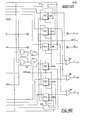
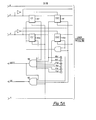
- the arbiter switch of the present invention is illustrated in Figures 4A and 4B and will now be described. It is to be remembered that the arbiter switch receives signals from two different inputs and routes them to a single output. In the present invention, the arbiter switch reacts to a change in signal levels as distinct from the actual voltage levels themselves. That is to say, the input ports have edge detection capability.
- input consensus gates 20 and 20a are consensus gates that respond to signal changes on input lines FO, TO, and Tl, Fl respectively by way of OR gates 21 and 21a.
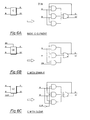
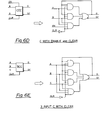
- the specific circuitry of consensus gates 20 and 20a is illustrated in Figure 6A.
- the inverted outputs of the respective input circuits 20 and 20a are supplied along with the corresponding input signals to consensus gates 22 and 22a respectively where the edge detection is performed.
- the actual circuitry of consensus gates 22 and 22a is illustrated in Figure 6E.
- Arbitration circuitry 23 receives the output signals of the respective edge detectors 22 and 22a and generates one of two output signals indicating which of edge detectors 22 and 22a was the first to detect a signal change on its corresponding input line. The output of arbitration circuitry 23 then chooses the appropriate input port for the transfer of that signal through the arbiter to the output port.
- the respective C-gates 24 and 24a are to receive and store either a true or false signal TO or F 0 (or T 1 or F 1 ) respectively.
- the actual circuitry of these C-gates is illustrated in Figure 6D.
- the C-gates 25 and 25a are for receiving the corresponding end-of-message signals E 0 or E 1 respectively.
- the actual circuitry for these C-gates is illustrated in Figure 6E.
- the corresponding signal selected for transmission to the next node is then supplied thereto by way of OR gates 26.
- the clear circuitry 28 of the arbiter receives a clear signal CO or Cl from one of two input ports which sets the clear input C-gates 29 or 29a respectively and transfers that signal to the clear enable C-gates 30 and 30a.
- the output signals from either one of these C-gates then resets the circuitry by way of OR gate 31 and the clear receipt acknowledgment is sent back by the inverted output of one of the respective consensus gates 29 or 29a.
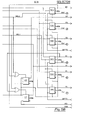
- the selector switch of the present invention is illustrated in detail in Figures 5A and 5B. It will be remembered that the selector switch receives a message on its single input port and routes that message to one of two output ports according to the first bit in the serial transmission of the message, which bit is discarded at the time of selection.
- the first incoming bit of the message is received by either consensus gate 40 or 40a depending upon whether it is a true or false signal.
- the corresponding gate generates an acknowledge signal which is transmitted back to the sender by way of AND gate 46 and also sets the corresponding consensus enable gate 41 or 41a which selects the appropriate output port for transmission of the remaining portion of the routing field and the message.
- This first bit has now been discarded.
- Detailed schematics of C-gates 40 and 40a are illustrated in Figure 6A and detailed schematic diagrams of C-gates 41 and 41a are illustrated in Figure 6D.
- the two output ports are shown in Figure 5B and are respectively either C-gates 42a, 42b and 42c, or 43a, 43b and 43c.
- Schematic diagrams of gates 42a and 43a are illustrated in Figure 6E while the schematic diagrams of C-gates 42b and 42c and 43b and 43c are illustrated in Figure 6D.
- the selector switch When the CLEAR signal of the present invention is received by the selector switch, it serves to clear all the gates of Figure 5A and also to set C-gates 44a or 44b for the selected output port. This serves to transmit that clear signal on to that one of the output ports which has been selected so as to pass the clear signal on to the next switch in the transmission path.
- An arbiter switch and a selector switch have been described from which an asynchronous network of concurrent processors can be formed where the arbiter switch receives a message from one of two input ports and transmits it to its output port while the selector switch receives a message from one input port and transmits it to one of two output ports in accordance with the first bit in the serial message.
- a path through the network which has been established can be cleared should it become apparent that that particular path has become locked in due to a malfunction of a component in one of the nodes or switches in the network.
Landscapes
- Engineering & Computer Science (AREA)
- Theoretical Computer Science (AREA)
- Physics & Mathematics (AREA)
- Computer Hardware Design (AREA)
- General Engineering & Computer Science (AREA)
- General Physics & Mathematics (AREA)
- Mathematical Physics (AREA)
- Transportation (AREA)
- Mechanical Engineering (AREA)
- Software Systems (AREA)
- Computing Systems (AREA)
- Multi Processors (AREA)
- Data Exchanges In Wide-Area Networks (AREA)
- Electric Cable Installation (AREA)
Applications Claiming Priority (2)
| Application Number | Priority Date | Filing Date | Title |
|---|---|---|---|
| US329424 | 1981-12-10 | ||
| US06/329,424 US4488151A (en) | 1981-12-10 | 1981-12-10 | Arbiter switch for a concurrent network of processors |
Publications (2)
| Publication Number | Publication Date |
|---|---|
| EP0081820A2 true EP0081820A2 (fr) | 1983-06-22 |
| EP0081820A3 EP0081820A3 (fr) | 1986-01-15 |
Family
ID=23285323
Family Applications (1)
| Application Number | Title | Priority Date | Filing Date |
|---|---|---|---|
| EP82111435A Ceased EP0081820A3 (fr) | 1981-12-10 | 1982-12-09 | Un commutateur d'arbitrage pour un réseau concurrent de processeurs |
Country Status (4)
| Country | Link |
|---|---|
| US (1) | US4488151A (fr) |
| EP (1) | EP0081820A3 (fr) |
| JP (2) | JPS58500198A (fr) |
| WO (1) | WO1983002182A1 (fr) |
Cited By (3)
| Publication number | Priority date | Publication date | Assignee | Title |
|---|---|---|---|---|
| FR2583943A1 (fr) * | 1985-06-20 | 1986-12-26 | Trouvin Cabinet Sa | Reseau de transmission d'information entre materiels informatiques |
| AU630647B2 (en) * | 1988-12-30 | 1992-11-05 | Societe Anonyme Dite Alcatel Cit | Method for unblocking a multibus multiprocessor system |
| WO2005001236A1 (fr) * | 2003-06-27 | 2005-01-06 | Atlas Copco Rock Drills Ab | Dispositif de forage de roc |
Families Citing this family (11)
| Publication number | Priority date | Publication date | Assignee | Title |
|---|---|---|---|---|
| JPS60237743A (ja) * | 1984-05-11 | 1985-11-26 | Nec Corp | 大容量デ−タ交換機 |
| ATE41249T1 (de) * | 1984-09-05 | 1989-03-15 | Siemens Ag | Anordnung zur prioritaetsvergabe. |
| US4701756A (en) * | 1985-09-10 | 1987-10-20 | Burr William E | Fault-tolerant hierarchical network |
| GB8528892D0 (en) * | 1985-11-23 | 1986-01-02 | Int Computers Ltd | Multi-node data processing system |
| US5222085A (en) * | 1987-10-15 | 1993-06-22 | Peter Newman | Self-routing switching element and fast packet switch |
| US5245603A (en) * | 1987-10-15 | 1993-09-14 | Network Equipment Technologies, Inc. | High-speed determining unit for prioritizing and arbitrating among competing input signals |
| US5367518A (en) * | 1987-10-15 | 1994-11-22 | Network Equipment Technologies, Inc. | Self-routing switching element and fast packet switch |
| GB8724208D0 (en) * | 1987-10-15 | 1987-11-18 | Newman P | Self-routing switching element |
| FI84114C (fi) * | 1988-02-17 | 1991-10-10 | Valtion Teknillinen | Inkopplingssystem. |
| US5396491A (en) * | 1988-10-14 | 1995-03-07 | Network Equipment Technologies, Inc. | Self-routing switching element and fast packet switch |
| US6128647A (en) * | 1996-04-05 | 2000-10-03 | Haury; Harry R. | Self configuring peer to peer inter process messaging system |
Family Cites Families (15)
| Publication number | Priority date | Publication date | Assignee | Title |
|---|---|---|---|---|
| US3460098A (en) * | 1967-03-15 | 1969-08-05 | Sperry Rand Corp | Non-synchronous design for digital device control |
| US3967072A (en) * | 1972-12-11 | 1976-06-29 | Bell Telephone Laboratories, Incorporated | Time division network connection auditing arrangement |
| GB1441452A (en) * | 1973-04-19 | 1976-06-30 | Plessey Co Ltd | Digital switching networks |
| FR2432804A1 (fr) * | 1978-08-03 | 1980-02-29 | Trt Telecom Radio Electr | Commutateur de donnees a haute vitesse |
| US4251879A (en) * | 1979-05-02 | 1981-02-17 | Burroughs Corporation | Speed independent arbiter switch for digital communication networks |
| US4307446A (en) * | 1979-05-02 | 1981-12-22 | Burroughs Corporation | Digital communication networks employing speed independent switches |
| US4287592A (en) * | 1979-05-23 | 1981-09-01 | Burroughs Corporation | Method and apparatus for interfacing stations in a multiloop communications system |
| US4292623A (en) * | 1979-06-29 | 1981-09-29 | International Business Machines Corporation | Port logic for a communication bus system |
| US4262357A (en) * | 1979-07-09 | 1981-04-14 | Burroughs Corporation | Data processing system incorporating arbiters and selectors to allocate transmissions by multiple devices on a bus |
| US4347498A (en) * | 1979-11-21 | 1982-08-31 | International Business Machines Corporation | Method and means for demand accessing and broadcast transmission among ports in a distributed star network |
| US4307378A (en) * | 1979-12-18 | 1981-12-22 | Burroughs Corporation | Four-wire speed independent selector switch for digital communication networks |
| US4314233A (en) * | 1979-12-18 | 1982-02-02 | Burroughs Corporation | Four-wire speed independent arbiter switch for digital communication networks |
| US4342995A (en) * | 1980-09-15 | 1982-08-03 | Burroughs Corporation | Data network employing a single transmission bus for overlapping data transmission and acknowledgment signals |
| US4390981A (en) * | 1980-12-29 | 1983-06-28 | Syscom, Inc. | Microprocessor controlled message handling system |
| US4332027A (en) * | 1981-10-01 | 1982-05-25 | Burroughs Corporation | Local area contention network data communication system |
-
1981
- 1981-12-10 US US06/329,424 patent/US4488151A/en not_active Expired - Lifetime
-
1982
- 1982-01-27 JP JP57500412A patent/JPS58500198A/ja active Granted
- 1982-12-06 WO PCT/US1982/001707 patent/WO1983002182A1/fr not_active Ceased
- 1982-12-06 JP JP83500412A patent/JPS58502073A/ja active Pending
- 1982-12-09 EP EP82111435A patent/EP0081820A3/fr not_active Ceased
Cited By (3)
| Publication number | Priority date | Publication date | Assignee | Title |
|---|---|---|---|---|
| FR2583943A1 (fr) * | 1985-06-20 | 1986-12-26 | Trouvin Cabinet Sa | Reseau de transmission d'information entre materiels informatiques |
| AU630647B2 (en) * | 1988-12-30 | 1992-11-05 | Societe Anonyme Dite Alcatel Cit | Method for unblocking a multibus multiprocessor system |
| WO2005001236A1 (fr) * | 2003-06-27 | 2005-01-06 | Atlas Copco Rock Drills Ab | Dispositif de forage de roc |
Also Published As
| Publication number | Publication date |
|---|---|
| EP0081820A3 (fr) | 1986-01-15 |
| WO1983002182A1 (fr) | 1983-06-23 |
| US4488151A (en) | 1984-12-11 |
| JPS58500198A (ja) | 1983-02-10 |
| JPS58502073A (ja) | 1983-12-01 |
| JPS63036024B2 (fr) | 1988-07-18 |
Similar Documents
| Publication | Publication Date | Title |
|---|---|---|
| US4498133A (en) | Selector switch for a concurrent network of processors | |
| US4482996A (en) | Five port module as a node in an asynchronous speed independent network of concurrent processors | |
| US4488151A (en) | Arbiter switch for a concurrent network of processors | |
| EP0018755B1 (fr) | Réseaux de communication digitale, utilisant des commutateurs indépendants de la vitesse | |
| US6314487B1 (en) | Adaptive routing controller of a crossbar core module used in a crossbar routing switch | |
| US4965788A (en) | Self-routing switch element for an asynchronous time switch | |
| US4933933A (en) | Torus routing chip | |
| EP0104801B1 (fr) | Commutateur d'arbitrage à quatre voies, pour module à cinq portes, utilisé comme noeud dans un réseau, indépendant de la vitesse asynchrone, de processeurs concurrents | |
| US5654695A (en) | Multi-function network | |
| US5367518A (en) | Self-routing switching element and fast packet switch | |
| EP0018756B1 (fr) | Interrupteur d'arbitrage indépendant de la vitesse pour réseaux de communication digitaux | |
| US4984237A (en) | Multistage network with distributed pipelined control | |
| JPS62144439A (ja) | 非閉塞自己ル−ト決め交換網 | |
| JPS6184943A (ja) | 自己ルーテイングパケツトおよび回線交換方式 | |
| US4314233A (en) | Four-wire speed independent arbiter switch for digital communication networks | |
| EP0109850B1 (fr) | Commutateur de sélection indépendant de la vitesse, utilisant un code M parmi N | |
| US4276611A (en) | Device for the control of data flows | |
| US4481623A (en) | Speed independent arbiter switch employing M-out-of-N codes | |
| US4484325A (en) | Four way selector switch for a five port module as a node asynchronous speed independent network of concurrent processors | |
| US4307378A (en) | Four-wire speed independent selector switch for digital communication networks | |
| EP0787327B1 (fr) | Systeme de traitement de donnees comportant un pipeline commande de maniere asynchrone | |
| EP0370510B1 (fr) | Central numérique à large bande | |
| JPH0414164A (ja) | コンピュータネットワークシステム | |
| JPH0253983B2 (fr) | ||
| JPH05242000A (ja) | 多段ネットワークシステム |
Legal Events
| Date | Code | Title | Description |
|---|---|---|---|
| PUAI | Public reference made under article 153(3) epc to a published international application that has entered the european phase |
Free format text: ORIGINAL CODE: 0009012 |
|
| AK | Designated contracting states |
Designated state(s): BE DE FR GB IT NL SE |
|
| PUAL | Search report despatched |
Free format text: ORIGINAL CODE: 0009013 |
|
| AK | Designated contracting states |
Designated state(s): BE DE FR GB IT NL SE |
|
| 17P | Request for examination filed |
Effective date: 19860129 |
|
| RAP1 | Party data changed (applicant data changed or rights of an application transferred) |
Owner name: BURROUGHS CORPORATION (A DELAWARE CORPORATION) |
|
| 17Q | First examination report despatched |
Effective date: 19870506 |
|
| STAA | Information on the status of an ep patent application or granted ep patent |
Free format text: STATUS: THE APPLICATION HAS BEEN REFUSED |
|
| 18R | Application refused |
Effective date: 19880415 |
|
| RIN1 | Information on inventor provided before grant (corrected) |
Inventor name: WILSON, JESSE RUDOLPH Inventor name: BOLTON, BRENT CECIL Inventor name: LOGSDON, GARY LEE Inventor name: HAGENMAIER, CARD FREDRICK, JR. |