EP0082486A2 - Verfahren zur kinetischen Prozesskontrolle von enzymatischen Stoffumsetzungen und Vorrichtung - Google Patents
Verfahren zur kinetischen Prozesskontrolle von enzymatischen Stoffumsetzungen und Vorrichtung Download PDFInfo
- Publication number
- EP0082486A2 EP0082486A2 EP82111674A EP82111674A EP0082486A2 EP 0082486 A2 EP0082486 A2 EP 0082486A2 EP 82111674 A EP82111674 A EP 82111674A EP 82111674 A EP82111674 A EP 82111674A EP 0082486 A2 EP0082486 A2 EP 0082486A2
- Authority
- EP
- European Patent Office
- Prior art keywords
- ultrafiltration
- substrate
- reaction
- enzyme
- cell
- Prior art date
- Legal status (The legal status is an assumption and is not a legal conclusion. Google has not performed a legal analysis and makes no representation as to the accuracy of the status listed.)
- Granted
Links
Images


Classifications
-
- C—CHEMISTRY; METALLURGY
- C12—BIOCHEMISTRY; BEER; SPIRITS; WINE; VINEGAR; MICROBIOLOGY; ENZYMOLOGY; MUTATION OR GENETIC ENGINEERING
- C12Q—MEASURING OR TESTING PROCESSES INVOLVING ENZYMES, NUCLEIC ACIDS OR MICROORGANISMS; COMPOSITIONS OR TEST PAPERS THEREFOR; PROCESSES OF PREPARING SUCH COMPOSITIONS; CONDITION-RESPONSIVE CONTROL IN MICROBIOLOGICAL OR ENZYMOLOGICAL PROCESSES
- C12Q1/00—Measuring or testing processes involving enzymes, nucleic acids or microorganisms; Compositions therefor; Processes of preparing such compositions
-
- C—CHEMISTRY; METALLURGY
- C12—BIOCHEMISTRY; BEER; SPIRITS; WINE; VINEGAR; MICROBIOLOGY; ENZYMOLOGY; MUTATION OR GENETIC ENGINEERING
- C12M—APPARATUS FOR ENZYMOLOGY OR MICROBIOLOGY; APPARATUS FOR CULTURING MICROORGANISMS FOR PRODUCING BIOMASS, FOR GROWING CELLS OR FOR OBTAINING FERMENTATION OR METABOLIC PRODUCTS, i.e. BIOREACTORS OR FERMENTERS
- C12M21/00—Bioreactors or fermenters specially adapted for specific uses
- C12M21/18—Apparatus specially designed for the use of free, immobilized or carrier-bound enzymes
-
- C—CHEMISTRY; METALLURGY
- C12—BIOCHEMISTRY; BEER; SPIRITS; WINE; VINEGAR; MICROBIOLOGY; ENZYMOLOGY; MUTATION OR GENETIC ENGINEERING
- C12M—APPARATUS FOR ENZYMOLOGY OR MICROBIOLOGY; APPARATUS FOR CULTURING MICROORGANISMS FOR PRODUCING BIOMASS, FOR GROWING CELLS OR FOR OBTAINING FERMENTATION OR METABOLIC PRODUCTS, i.e. BIOREACTORS OR FERMENTERS
- C12M29/00—Means for introduction, extraction or recirculation of materials, e.g. pumps
- C12M29/04—Filters; Permeable or porous membranes or plates, e.g. dialysis
-
- C—CHEMISTRY; METALLURGY
- C12—BIOCHEMISTRY; BEER; SPIRITS; WINE; VINEGAR; MICROBIOLOGY; ENZYMOLOGY; MUTATION OR GENETIC ENGINEERING
- C12M—APPARATUS FOR ENZYMOLOGY OR MICROBIOLOGY; APPARATUS FOR CULTURING MICROORGANISMS FOR PRODUCING BIOMASS, FOR GROWING CELLS OR FOR OBTAINING FERMENTATION OR METABOLIC PRODUCTS, i.e. BIOREACTORS OR FERMENTERS
- C12M41/00—Means for regulation, monitoring, measurement or control, e.g. flow regulation
- C12M41/30—Means for regulation, monitoring, measurement or control, e.g. flow regulation of concentration
- C12M41/32—Means for regulation, monitoring, measurement or control, e.g. flow regulation of concentration of substances in solution
Definitions
- the present invention relates to a novel process for r direct measurement of the kinetics of enzymatic degradation of. high polymer substrates.
- the new method which has all the advantages of direct kinetic analysis methods, can be carried out with high-molecular substrates.
- a classification of the size of the dissolved substrates and degradation products by ultrafiltration allows the degradation of the high molecular weight substrates to be monitored directly and continuously. It is essential for the direct measurement of the reaction rate of an enzymatic hydrolysis that the membrane used does not noticeably influence the course of the change in concentration over time. This condition is met if ultrafiltration membranes are used whose time constant (flux, pressure loss) is as short as possible than the presumed reaction rate of the enzymatic conversion.
- the process according to the invention can be automated very well, the advantage being that the outlay on equipment is less, because reaction, incubation, separation of the cleavage products take place continuously in a single apparatus (UF reactor or measuring cell) and the reaction can be followed directly .
- the simple structure and a possible continuous operational management make it possible to use this method for process analysis, e.g. to be used on fermenters or reactors. Control, control and evaluation via a computer unit (microprocessor, process computer) is expedient. Process control of fermentations or of enzymatic material conversions (starch degradation, protein hydrolysis, etc.) for determining the enzymatic activities are particularly suitable as an application area.
- the method can also be used in the laboratory, in particular for process analysis in the processing of hydrolases. The new process enables fully continuous automatic operation and process control.
- Membranes made of polysulfones (polyelectrolyte complexes) or made of polyamide are preferred, which are particularly characterized by high flux rates, low non-specific adsorption and a small time constant. Examples include the membranes from the company Amicon Corp., types of the PM, XM, YM series with different exclusion limits (5,000, 10,000, 30,000 daltons) or the company Millipore of the type PTGC or from Berghof the type BM.
- All small commercially available ultrafiltration cells or dialysis cells are basically suitable as measuring cells according to the invention.
- the spiral ultrafiltration cell type CEC-1 from Amicon Corp. has proven itself, for example. This cell is characterized by a low dead volume and a reduction in deposits on the filter due to current conduction.
- Further examples of suitable measuring cells are magnetic core stirred mini reactors and other systems used as flat membranes. The dimensions of the cells are essentially determined by the ratio of the dead volume (retentate volume) to the effective membrane area (V t / F m ). A ratio V t / F m ⁇ 1 is most favorable.
- the new method is for determining the reactivity of all types of hydrolases, such as proteases, peptidases, glycosidascn, phosphatases, lipases or nucleases and for natural or chemically modified, high-molecular substrates such as Pro teins, polysaccharides or nucleic acids can be used.
- hydrolases such as proteases, peptidases, glycosidascn, phosphatases, lipases or nucleases and for natural or chemically modified, high-molecular substrates such as Pro teins, polysaccharides or nucleic acids can be used.
- the use for low molecular weight compounds such as peptides, oligomeric sugars, disaccharides, nucleotides or esters is also possible.
- RO membranes Treverse osmosis
- ED electrodialysis
- FIG. 1 a measuring arrangement for carrying out the new method is shown in FIG. 1.
- the pump (1) is connected to the reaction mixture (5) and the UF cell (2).
- (6), (7) + (8) are devices for controlling or regulating flow, pressure and temperature.
- the UF cell (2) is connected to the detector (3) and the latter to the recorder (4).
- the process can be carried out batchwise - in the case of automated operation, cyclically - or continuously, i.e. either the substrate or the enzyme are continuously pumped through the cell and the enzyme or substrate is added in pulses, respectively. both are added and mixed continuously.
- Detection can be performed against a reference cell, e.g. with an enzyme or substrate standard. Alternatively, detection in the retentate stream is also possible.
- the signal value curve detected by the detector is recorded by a recorder.
- the evaluation is carried out in such a way that a tangent to the curve of the measurement curve at the points of the max. Change over time is created.
- the slope of this tangent ( ⁇ S / min.) Is a measure of the reaction rate.
- S corresponds e.g. in the case of photometric measurement of the absorbance E, in the case of refractometric measurement the light refraction angle ⁇ .
- enzyme activity is determined using calibration curves.
- the calibration can be carried out against both the product and the substrate. In the simplest case, calibration against a defined enzyme standard is possible.
- Measurement set-up standard batch operation, detection in the UF (see Fig. 1) measurement solution: 0.70 mTU / ml fermenter sample (70 h)
- the entire system was rinsed with buffer until a constant value was established on the photometer.
- 2.3 ml of protease buffer (pH 3.5) and 0.2 ml of enzyme solution were then pipetted into the temperature-controlled reaction mixture and mixed. This mixture was for about 5 min. rumbled through the reactor (UF cell), and a signal value corresponding to the zero value was set on the photometer. If this signal value was constant, 1 ml of standard casein solution was pipetted into the reaction template. This started the reaction. After a dead time of approx. 1 min. was the reaction on the connected recorder as a change the absorbance over time ⁇ E / min. to observe. After the test was completed, the system was backwashed with buffer. This approach was carried out with two different measuring cells for comparison purposes.
- Calibration line (Fig. 3): From reference measurement with the calibration substance AP-114, acidic protease (standardized enzyme) and casein solution as substrate.
- Measurement set-up batch cycle operation, detection in the UF at 280 nm.
- Measurement setup batch cycle operation, detection in the UF with a polarimeter at 578 nm Hg.
- Measuring solution enzyme sample from ABM-Chemicals (Pulluzyme), approx. 18 U / ml.
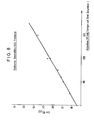
- Figure 6 shows the concentration dependency of pullulanase in the UF test, measured with polarimeter Hg 578.
- amyloplucosidase glucoamylase
- Measuring arrangement batch cycle operation, detection in ultrafiltrate by former detection (Nelson-Somogy).
- the plant was 10 min. rinsed with buffer solution. 1.5 ml of 1% starch solution were added to 3.0 ml of buffer solution (Na acetate, pH 4.8) and the mixture was stirred for 5 min. pumped in circulation, then a sample of 0.1 ml was taken from the ultrafiltrate stream (blank value). Then an amount of enzyme of 0.1-0.6 ml was added and 10 min. Take a 0.1 ml sample every two minutes. The samples were tested for glucose together with the 0-sample using the Nelson-Somogy method.
- Calibration factor from calibration curve with glucose (Nelson-Somogy test) at 546 nm.
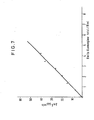
- FIG. 7 shows the concentration dependence of amyloglucosidase (chemical detection). Measured values:
- Measuring solution fermenter sample from Henkel (concentrate), various concentrations.
- casein blue solution (12 mg / ml) were added to 2.5 ml of buffer solution and left for approx. 5 - 10 min. pumped in a circuit through the measuring arrangement until a constant value has been set on the photometer. Then the reaction was started with 1 ml of enzyme solution. After a short dead time, the course of the reaction on the continuous increase in the photometer signal could be followed on the connected recorder.
- the evaluation was carried out analogously to Examples 1 and 2, by applying a tangent to the curve in the range of the max. Pitch.
- the value found for ⁇ E / min. represents a measure of the enzyme concentration.
Landscapes
- Chemical & Material Sciences (AREA)
- Life Sciences & Earth Sciences (AREA)
- Health & Medical Sciences (AREA)
- Organic Chemistry (AREA)
- Engineering & Computer Science (AREA)
- Zoology (AREA)
- Wood Science & Technology (AREA)
- Bioinformatics & Cheminformatics (AREA)
- Genetics & Genomics (AREA)
- Microbiology (AREA)
- Biotechnology (AREA)
- Biochemistry (AREA)
- General Engineering & Computer Science (AREA)
- General Health & Medical Sciences (AREA)
- Sustainable Development (AREA)
- Biomedical Technology (AREA)
- Proteomics, Peptides & Aminoacids (AREA)
- Molecular Biology (AREA)
- Analytical Chemistry (AREA)
- Immunology (AREA)
- Biophysics (AREA)
- Physics & Mathematics (AREA)
- Preparation Of Compounds By Using Micro-Organisms (AREA)
- Measuring Or Testing Involving Enzymes Or Micro-Organisms (AREA)
- Micro-Organisms Or Cultivation Processes Thereof (AREA)
- Meat, Egg Or Seafood Products (AREA)
- Medicines Containing Plant Substances (AREA)
- Enzymes And Modification Thereof (AREA)
- Apparatus Associated With Microorganisms And Enzymes (AREA)
- Physical Or Chemical Processes And Apparatus (AREA)
Abstract
Description
- Die vorliegende Erfindung betrifft ein neues Verfahren zurdirekten Messung der Kinetik des enzymatischen Abbaues von. hochpolymeren Substraten.
- Bisher wurden für die Bestimmung von Enzym-Aktivitäten zur Kontrolle von Reaktionsabläufen sog. Endpunktsmethoden, z.B. Automat. Anal. Chem. Technicon Symp., 1967, Vol 1, S. 587 ff oder Analyt. Biochem. 23 (1968), S. 466 ff beschrieben. Bei diesen Verfahren werden die im Hydrolysereaktionsansatz gespaltenen Produkte von den nicht-umgesetzten Substraten durch nach Größe klassierende Methoden, wie Filtration, Zentrifugation oder Dialyse abgetrennt und anschließend die Konzentration der .Spaltprodukte, z.B. photocolorimetrisch bestimmt. Diese sog. Endpunktmethoden haben den Nachteil, daß sie eine direkte Verfolgung der Reaktion nicht ermöglichen. Weitere Nachweismethoden für den Abbau von hochpolymeren Substraten beruhen darauf, daß die bei fortschreitender Reaktion eintretende Verringerung der Viskosität oder Veränderung der Lichtstreuung gemessen wird. (Vgl. Anal. Biochem., 90 (1978) S. 192 ff; Unters. Forsch., 162 (1976), S. 31 ff.). .Diese Verfahren sind jedoch meist nicht allgemein auf Enzymklassen anwendbar, sondern müssen je nach Enzymart von Fall zu Fall adapticrt werqcn, da beispielsweise bekannte Substrate unter den Meßbedingungen nicht löslich sind oder die Reaktionsgeschwindigkeit oft erheblich reduziert wird. Häufig ist die Nachweisgrenze gering. Die in der Literatur beschriebenen Verfahren sind sehr zeit- und personalaufwendig, da sie im allgemeinen mehrere verschiedene Arbeitsschritte (Inkubation, Neutralisation, Fällung, Filtration, Zentrifugation, Dialyse, Anfärbung, Detektion und Auswertung) erfordern, welche zumeist nacheinander erfolgen müssen. Diese Verfahren sind zwar prinzipiell automatisierbar, aber aufgrund der Verknüpfung verschiedener hcterogener Arbeitsschritte erfordern die Meßgeräte einen sehr komplizierten Aufbau.
- Diese Nachteile der bekannten Meßmethoden von Enzymaktivitäten sollen durch das erfindungsgemäße Verfahren vermieden werden.
- Gegenstand der Erfindung ist ein Verfahren zur kinetischen Prozeßkontrolle von enzymatischen Stoffumsetzungen, welches dadurch gekennzeichnet ist, daß man die Reaktionsmischung, welche das zu hydrolysierende, makromolekulare Substrat und die hydrolytischen Enzyme enthält, durch eine Ultrafiltrationsmembran in 2 Volumenströme aufteilt und anschließend die Konzentrationsänderung an hydrolytischen Enzymen im Ultrafiltrationsstrom oder Retentat mißt. Die bei den herkömmlichen Verfahren erforderlichen verschiedenen Reaktionsschritte, wie
- 1. Inkubation des Enzyms mit dem Substrat für eine vorgegebene Zeit.
- 2. Abstoppen der Reaktion
- 3. Abtrennung der Reaktionsprodukte durch z.B. Fällung mit anschließender Filtration oder Zentrifugation bzw. über Dialysemembranen.
- 4. Färbereaktion (chem. Umsetzung der Spaltprodukte);
- 5. Messung (z.B.photometrisch)
- 6. Auswertung (Differenzwertbestimmung, Eichung, Berechnung)
- fallen bei diesem neuen Verfahren praktisch zeitlich zusammen, so daß das Verfahren mit einem erheblichen Zeitgewinn durchführbar ist. Das neue Verfahren, das alle Vorteile von direkten kinetischen Analysenmethoden aufweist, kann mit hochmolekularen Substraten durchgeführt werden. Eine Größenklassierung der gelösten Substrate und Abbauprodukte durch Ultrafiltration erlaubt es, den Abbau der hochmolekularen Substrate direkt und kontinuierlich zu verfolgen. Es ist wesent- .lich für die direkte Messung der Reaktionsgeschwindigkeit einer enzymatischen Hydrolyse, daß die verwendete Membran den zeitlichen Verlauf der Konzentrationsver- änderung nicht merklich beeinflußt. Diese Bedingung ist erfüllt, wenn man Ultrafiltrationsmembrane einsetzt, deren Zeitkonstante (Flux, Druckverlust) möglichst kleiner ist als die vermutliche Reaktionsgeschwindigkeit des enzymatischen Umsatzes.
- Das erfindungsgemäße Verfahren ist sehr gut automatisierbar, wobei der Vorteil darin liegt, daß der apparative Aufwand geringer ist, weil Reaktion, Inkubation , Trennung der Spaltprodukte in einem einzigen Apparat (UF-Reaktor oder -Messzelle) kontinuierlich ablaufen und die Reaktion direkt verfolgt werden kann. Der einfache Aufbau und eine mögliche kontinuierliche Betriebsführung erlauben es, dieses Verfahren zur Prozeßanalyse, z.B. an Fermentern oder Reaktoren einzusetzen. Eine Kontrolle, Steuerung und Auswertung über eine Rechnereinheit (Mikroprozessor, Prozeßrechner) ist zweckmässig. Als Anwendungsgebiet kommen vor allem die Prozeßkontrolle von Fermentationen oder von enzymatischen Stoffumsetzungen (Stärkeabbau, Proteinhydrolyse etc.) zur Bestimmung der enzymatischen Aktivitäten in Frage. Weiterhin ist das Verfahren im Labor, insbesondere für die Prozeßanalytik bei der Aufarbeitung von Hydrolasen einsetzbar. Das neue Verfahren ermöglicht eine vollkontinuierliche automatische Betriebs- bzw. Prozeßkontrolle.
- Für das neue Verfahren sind handelsübliche Membranen geeignet.
- Sie sollen eine optimale Trennung von Produkt und Substrat gewährleisten und hohe Standzeiten haben. Sie müssen gegen den Angriff von Enzymen und Reagenzien inert sein, möglichst geringe Adsorptionseigenschaften und ausreichende Druckfestigkeit (ca.ΔP 1 bar) haben.
- Sie sollen geringen Druckverluste und eine kleine Zeitkonstante haben.
- Bevorzugt werden Membranen aus Polysulfonen (Polyelektrolytkomplexe) oder aus Polyamid, welche sich besonders durch hohe Fluxraten, geringe unspezifische Adsorption und kleine Zeitkonstante auszeichnen. Beispielhaft dafür seien genannt die Membranender Firma Amicon Corp., Typen der PM, XM, YM-Reihe mit verschiedenen Ausschlußgrenzen (5.000, 10.000, 30.000 dalton) oder der Firma Millipore der Type PTGC oder von Berghof die Type BM.
- Als Meßzellen eignen sich erfindungsgemäß grundsätzlich alle im Handel befindlichen kleinen Ultrafiltrationszellen oder Dialysezellen. Gut bewährt hat sich z.B. die Spiralultrafiltrationszelle, Typ CEC-1 der Firma Amicon Corp. Diese Zelle zeichnet sich durch ein geringes Totvolumen und durch eine Verminderung von Abscheidungen auf dem Filter durch Stromführung aus. Weitere Beispiele für geeignete Meßzellen sind Magnetkerngerührte Mini-Reaktoren und andere als Flachmembranen verwendete Systeme. Die Abmessungen der Zellen werden im wesentlichen durch das Verhältnis des Totvolumens (Retentatvolumen) zu wirksamer Membranfläche (Vt/Fm) bestimmt. Am günstigsten ist ein Verhältnis Vt/Fm ≤ 1.
- Das neue Verfahren ist für die Bestimmung der Reaktivität aller Arten von Hydrolasen, wie Proteasen, Peptidasen, Glycosidascn, Phospatasen, Lipasen oder Nucleasen und für natürliche oder chemisch modifizierte, hochmolekulare Substrate wie Proteine, Polysaccharide oder Nucleinsäuren einsetzbar. Grundsätzlich ist auch der Einsatz für niedermolekulare Verbindungen, wie Peptide, oligomere Zucker, Disaccharide, Nucleotide oder Ester möglich. Bei Einsatz von niedermolekularen Substraten werden bevorzugt RO-Membranen (RO = Treverse osmosis) oder ED-Membranen (ED = electrodialysis) verwendet.
- Zur Erläuterung der Erfindung ist eine Meßanordnung zur Durchführung des neuen Verfahrens in Figur 1 dargestellt. In dieser Meßanordnung ist die Pumpe (1) mit dem Reaktionsansatz (5) und der UF-Zelle (2) verbunden. (6),(7)+(8) sind Vorrichtungen zur Kontrolle bzw. Regelung von Durchfluß, Druck und Temperatur. Die UF-Zelle (2) ist mit dem Detektor (3) verbunden und letzterer mit dem Schreiber (4).
- Das Verfahren kann sowohl batchweise - bei automatisiertem Betrieb taktweise - erfolgen, als auch kontinuierlich, d.h. entweder das Substrat oder das Enzym werden fortlaufend durch die Zelle gepumpt und Enzym bzw. Substrat pulsweise zugegeben, resp. beide werden kontinuierlich zugegeben und gemischt. Bei der Detektion kann gegen eine Referenzzelle gemessen werden, z.B. mit einem Enzym- oder Substratstandard. Alternativ ist auch die Detektion im Retentatstrom möglich. Der vom Detektor erfaßte Signalwert-Verlauf wird per Schreiber aufgezeichnet. Die Auswertung erfolgt in der Weise, daß eine Tangente an die Kurve des Meßverlaufs im Punkte der max. Änderung über der Zeit angelegt wird. Die Steigung dieser Tangente (Δ S/min.) ist ein Maß für die Reaktionsgeschwindigkeit.
- Die Ermittlung der Steigung kann z.B. mit einem Rechner erfolgen. Die Enzymaktivität errechnet sich nach folgender allgemeiner Formel: Enzymaktivität
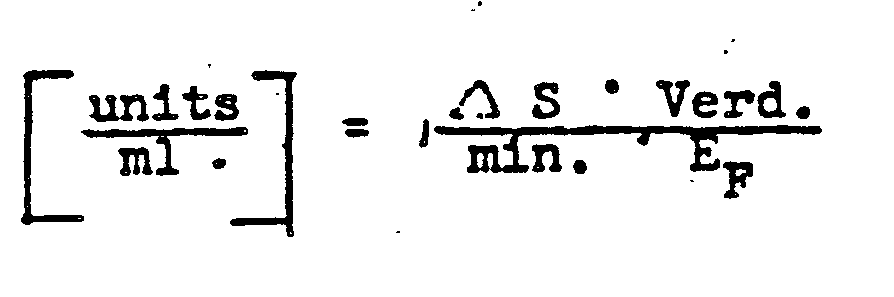
- Verd. = Verdünnungsfaktor
- EF = Eichfaktor
- ΔS = Signalwert
- S entspricht z.B. bei photometrischer Messung der Extinktion E, bei refraktometrischer Messung dem Lichtbrechungswinkel α.
- In der Praxis erfolgt die Ermittlung der Enzymaktivität mittels Eichkurven.
- Die Eichung kann sowohl gegen das Produkt als auch gegen das Substrat vorgenommen werden. Im einfachsten Falle ist eine Eichung gegen einen definierten Enzymstandard möglich.
- Bestimmung einer sauren Protease (SP-1 Fa. Henkel):

- Meßanordnung: Standard-Batchbetrieb, Detektion im UF (vgl. Fig. 1) Meßlösung: 0.70 mTU/ml Fermenterprobe (70 h)
- Zuerst wurde die gesamte Anlage mit Puffer gespült, bis ein konstanter Wert am Photometer sich eingestellt hat. In die temperierte Reaktionsvorlage wurden dann 2.3 ml Protease Puffer (pH 3.5) und 0.2 ml Enzylmlösung ein- pipettiert und gemischt. Diese Mischung wurde für ca. 5 min. durch den Reaktor (UF-Zelle) gerumpt, dabei stellte sich am Photometer ein dem Nullwert entspre- chender Signalwert ein. Wenn dieser Signalwert konstant war, wurde in die Reaktionsvorlage 1 ml Standardcaseinlösung dazupipettiert. Damit wurde die Reaktion ge- startet. Nach einer Totzeit von ca. 1 min. war die Reak- tion auf dem angeschlossenen Schreiber als Veränderung der Extinktion über der Zeit Δ E/min. zu beobachten. Nach Abschluß des Tests wurde die Anlage mit Puffer wieder rückgespült. Dieser Ansatz wurde mit zwei verschiedenen Meßzellen zu Vergleichszwecken durchgeführt.
- .Aus dem Signalwertverlauf (Figur 2) wurde ΔE/min. graphisch ermittelt und aus einer Eichkurve der zugehörige Wert für die Enzymkonzentration entnommen, bzw. aus der Steigung der Eichgeraden im linearen Arbeitsbereich (Figur 3) berechnet.
- Eichgerade (Fig. 3): Aus Referenzmessung mit der Eichsubstanz AP-114, saure Protease (standartisiertes Enzym) und Caseinlösung als Substrat.
- Meßanordnung wie in Fig. 1
- Die Eichkurven für die Meßzellen 1 und 2 werden parallel aufgenommen., und zwar exakt unter den beschriebenen Bedingungen und nach der gleichen Prozedur, wie oben beschrieben.


-

- Betriebsbedingungen:




- Bestimmung von Pullulanase
- Betriebsbedingungen:

- Meßanordnung: Batch-Kreislaufbetrieb, Detektion im UF mit einem Polarimeter bei 578 nm Hg.
- Meßlösung: Enzymprobe der Fa. ABM-Chemicals (Pulluzyme), ca. 18 U/ml.
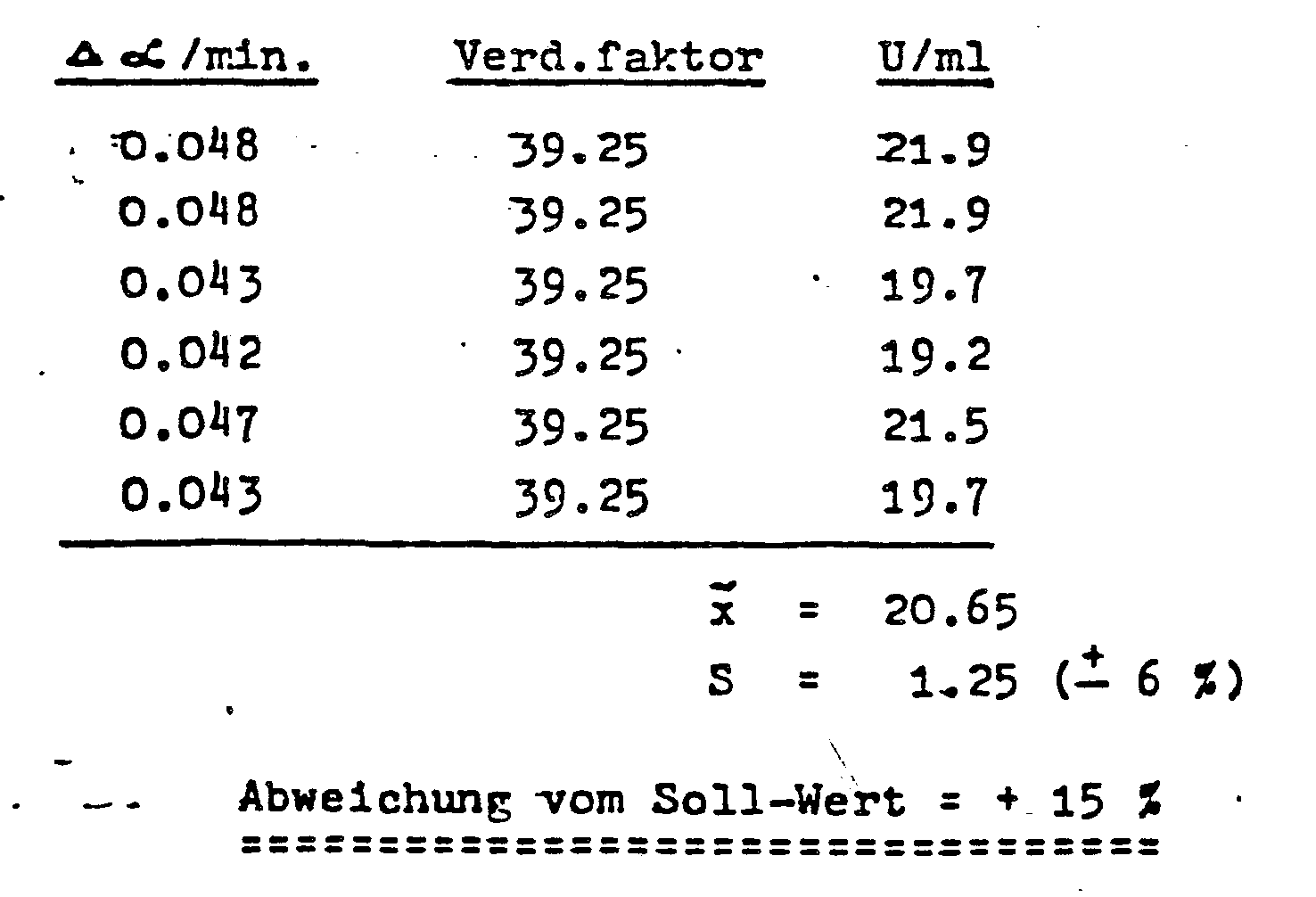
- Zuerst wurde die Anlage mit Puffer gespült, bis sich am Polarimeter ein konstanter Wert eingestellt hat. Dieser Wert wurde zu Null gesetzt. In die temperierte Reaktionsvorlage wurden 5 ml Citratpuffer (pH 5.0) und 0.6 ml Pullulanlsg. (2 %ig) gegeben und für ca. 5 min. im Kreislauf über die Membran gepumpt. Die Anzeige des Polarimeters wurde erneut zu Null gesetzt. Dann wurde mit 0.4 ml Enzymlösung die Reaktion gestartet. Der Reaktionsverlauf wurde am Polarimeter bzw. auf dem angeschlossenen Schreiber beobachtet. Die Änderung der opt. Drehung über der Zeit t (min) stellt das Maß für die Reaktionsgeschwindigkeit dar (Δ αHg575/min~ U/ml Pullulanase).
- Aus dem Sigmalwertverlauf wurde Δα/min. durch Anlegen einer Geraden im Bereich der max. Steigung wie üblich graphisch ermittelt.
-

- Eichfaktor: 0.0857 aus Eichkurve Maltotriose im Polarimeter bei Hg 578 nm (35°C) (Fig. 5)

- Bestimmung von Amyloplucosidase (Glucoamylase) Betriebsbedingungen:

- Meßanordnung: Batch-Kreislaufbetrieb, Detektion im Ultrafiltrat durch ehem. Nachweis (Nelson-Somogy).
- Meßlösung: Amyloglucosidase (Merck, Darmstadt), ca. 7.0 U/ml.
- Die Anlage wurde 10 min. mit Pufferlösung vorgespült. Zu 3.0 ml Pufferlösung .(Na-Acetat, pH 4.8) wurden 1.5 ml 1 %ige Stärkelösung zugesetzt und für 5 min. im Kreislaufbetrieb umgepumpt, danach wurde aus dem Ultrafiltratstrom eine Probe von 0.1 ml entnommen (Blindwert). Dann wurde eine Enzymmenge von 0.1 - 0.6 ml zugesetzt und unter fortlaufendem Umpumpen 10 min. lang alle zwei Minuten eine Probe von 0.1 ml entnommen. Die Proben wurden zusammen mit der 0-Probe nach der Methode von Nelson-Somogy auf Glucose getestet.
- Durch Auftragen der gefundenen Konzentrationen an Glucose über der Zeit' t in Minuten bekommt man eine Gerade, deren Steigung der Enzymkonzentration entspricht. Mit Glucose als Eichsubstanz wurde eine entsprechende Eichkurve erstellt.
- Berechnung:

- Eichfaktor: .

- Figur 7 zeigt die Konzentratlonsabhängigkeit von Amyloglucosidase (chem. Nachweis). Meßwerte:
-

- Bestimmung einer alkalischen Protease (Fa. Henkel) mit einem synthetischen Substrat
-

- Meßanordnung: Batch-Kreislaufbetrieb Detektion im Ultrafiltrat bei 660 nm
- Meßlösung: Fermenterprobe der Fa. Henkel (Konzentrat), verschiedene Konzentrationen.
- Zu 2.5 ml Pufferlösung wurden 1.5 ml Casein-blau-Lösung (12 mg/ml) in die Reaktionsvorlage gegeben und für ca. 5 - 10 min. im Kreislauf durch die Meßanordnung gepumpt, bis sich ein konstanter Wert am Photometer eingestellt hat. Dann wurde die Reaktion mit 1 ml Enzymlösung gestartet. Nach einer kurzen Totzeit war am angeschlossenen Schreiber der Reaktionsverlauf am kontinuierlichen Anstieg des Photometersignals zu verfolgen.
- Die Auswertung erfolgte analog zu Beispiel 1 und 2, durch Anlegen einer Tangente an die Kurve im Bereich der max. Steigung. Der so gefundene Wert für ΔE/min. stellt ein Maß für die Enzynkonzentration dar.
- Berechnung:

- Eichung: Unter den gleichen Bedingungen wie oben beschrieben wird eine Eichkurve mit einem Standardenzym (Maxatase, Fa. Henkel) aufgenommen. Die Steigung zur Ermittlung des Eichfaktors ist der Figur 8 zu entnehmen.
-

Claims (5)
Priority Applications (1)
| Application Number | Priority Date | Filing Date | Title |
|---|---|---|---|
| AT82111674T ATE21263T1 (de) | 1981-12-18 | 1982-12-16 | Verfahren zur kinetischen prozesskontrolle von enzymatischen stoffumsetzungen und vorrichtung. |
Applications Claiming Priority (2)
| Application Number | Priority Date | Filing Date | Title |
|---|---|---|---|
| DE19813150112 DE3150112A1 (de) | 1981-12-18 | 1981-12-18 | Verfahren zur kinetischen prozesskontrolle von enzymatischen stoffumsetzungen und vorrichtung |
| DE3150112 | 1981-12-18 |
Publications (3)
| Publication Number | Publication Date |
|---|---|
| EP0082486A2 true EP0082486A2 (de) | 1983-06-29 |
| EP0082486A3 EP0082486A3 (en) | 1983-08-17 |
| EP0082486B1 EP0082486B1 (de) | 1986-08-06 |
Family
ID=6149035
Family Applications (1)
| Application Number | Title | Priority Date | Filing Date |
|---|---|---|---|
| EP82111674A Expired EP0082486B1 (de) | 1981-12-18 | 1982-12-16 | Verfahren zur kinetischen Prozesskontrolle von enzymatischen Stoffumsetzungen und Vorrichtung |
Country Status (5)
| Country | Link |
|---|---|
| EP (1) | EP0082486B1 (de) |
| JP (1) | JPS58116699A (de) |
| AT (1) | ATE21263T1 (de) |
| DE (2) | DE3150112A1 (de) |
| DK (1) | DK559482A (de) |
Cited By (2)
| Publication number | Priority date | Publication date | Assignee | Title |
|---|---|---|---|---|
| FR2583060A1 (fr) * | 1985-06-06 | 1986-12-12 | Inst Francais Du Petrole | Production de butanol et d'acetone par fermentation avec recyclage de la biomasse par ultrafiltration |
| CN120325203A (zh) * | 2025-03-17 | 2025-07-18 | 深圳知本康业有限公司 | 物理与生物双切割一步法的反应釜参数自适应调节方法 |
Families Citing this family (1)
| Publication number | Priority date | Publication date | Assignee | Title |
|---|---|---|---|---|
| DE19545018A1 (de) * | 1995-12-02 | 1997-06-05 | Marcel Kastler | Computergesteuertes Polarimeter zur Drehwinkelbeobachtung von Reaktionen unter konstanten Versuchsbedingungen |
Family Cites Families (3)
| Publication number | Priority date | Publication date | Assignee | Title |
|---|---|---|---|---|
| FR2033404A1 (en) * | 1969-02-27 | 1970-12-04 | Kyowa Hakko Kogyo Kk | Enzymic reactions apparatus and procedure |
| DE2434672A1 (de) * | 1973-07-26 | 1975-04-30 | Kreidl Chemico Physical Kg | Verfahren und vorrichtung zur herstellung von enzymatischen umsetzungsprodukten niedermolekularer stoffe, insbesondere zur konzentrationsbestimmung niedermolekularer biologischer stoffe durch enzymatische umsetzung |
| FR2470799A1 (fr) * | 1979-12-03 | 1981-06-12 | Tech Realisa Indles Cales Et | Procede electrochimique de transformation d'un substrat oxydable ou reductible au moyen d'une enzyme oxydo-reductase et applications a des mesures de concentration ou a la production d'une forme oxydee ou reduite d'un substrat et dispositifs de mise en oeuvre desdites applications |
-
1981
- 1981-12-18 DE DE19813150112 patent/DE3150112A1/de not_active Withdrawn
-
1982
- 1982-12-14 JP JP57217913A patent/JPS58116699A/ja active Pending
- 1982-12-16 AT AT82111674T patent/ATE21263T1/de not_active IP Right Cessation
- 1982-12-16 EP EP82111674A patent/EP0082486B1/de not_active Expired
- 1982-12-16 DE DE8282111674T patent/DE3272489D1/de not_active Expired
- 1982-12-17 DK DK559482A patent/DK559482A/da not_active Application Discontinuation
Cited By (2)
| Publication number | Priority date | Publication date | Assignee | Title |
|---|---|---|---|---|
| FR2583060A1 (fr) * | 1985-06-06 | 1986-12-12 | Inst Francais Du Petrole | Production de butanol et d'acetone par fermentation avec recyclage de la biomasse par ultrafiltration |
| CN120325203A (zh) * | 2025-03-17 | 2025-07-18 | 深圳知本康业有限公司 | 物理与生物双切割一步法的反应釜参数自适应调节方法 |
Also Published As
| Publication number | Publication date |
|---|---|
| EP0082486A3 (en) | 1983-08-17 |
| JPS58116699A (ja) | 1983-07-11 |
| ATE21263T1 (de) | 1986-08-15 |
| EP0082486B1 (de) | 1986-08-06 |
| DK559482A (da) | 1983-06-19 |
| DE3150112A1 (de) | 1983-06-30 |
| DE3272489D1 (en) | 1986-09-11 |
Similar Documents
| Publication | Publication Date | Title |
|---|---|---|
| DE3021259C2 (de) | Mit Amidopyrin verbessertes Trinder-Reagens und Verfahren zur quantitativen Bestimmung von Wasserstoffperoxid bei der enzymatischen Oxidation von Stoffwechselprodukten mit diesem Reagens | |
| DE2142915C3 (de) | Verfahren zur quantitativen Analyse einer Probe und Vorrichtung zur Durchführung des Verfahrens | |
| EP0035211B1 (de) | Verfahren und Reagens zur Bestimmung der beta-Lipoproteine (LDL) | |
| DE2455970A1 (de) | Verfahren und vorrichtung zur analyse von harnstoff | |
| Kroner et al. | On-line measurement of extracellular enzymes during fermentation by using membrane techniques | |
| DE2262781B2 (de) | Verfahren zur bestimmung von anorganischem phosphat in koerperfluessigkeiten | |
| EP0082486B1 (de) | Verfahren zur kinetischen Prozesskontrolle von enzymatischen Stoffumsetzungen und Vorrichtung | |
| DE69926173T2 (de) | Methode zur Messung der in enzymatischen Reaktionen beteiligten Substanzen | |
| DE3780938T2 (de) | Reagens zur bestimmung von chloridionen. | |
| DE1773537C3 (de) | Methode zur quantitativen Bestimmung von anorganischem Phosphat | |
| DE2256331C3 (de) | Verfahren zur quantitativen kolorimetrischen Harnsäurebestimmung | |
| DE69330604T2 (de) | Verfahren und system zur molekularbiologischen diagnose | |
| DE3686071T2 (de) | Polarisierter fluoreszenztest von makromolekularen hydrolasen. | |
| DE9013193U1 (de) | Fließinjektionsanalyse-System | |
| CN220455302U (zh) | 一种组合式cod水质在线分析仪 | |
| Niehoff et al. | The use of an automatic on-line system for monitoring penicillin cultivation in a bubble-colum loop reactor | |
| DE3889402T2 (de) | Simultanbestimmung von Calcium und Phosphor. | |
| DE3927856A1 (de) | Verfahren zur prozessfuehrung mindestens eines bioreaktors fuer pflanzliche zellkulturen | |
| DE68919426T2 (de) | Enzymelektrode zur Messung von Malto-Oligosacchariden und Messapparat dafür. | |
| DE19605753C2 (de) | Verfahren und Vorrichtung zur Detektion von stoffwechselaktiven, unlädierten, ungestressten Mikroorganismen - quantitativ und qualitativ im "Sub-ppb-Bereich" innerhalb von Minuten | |
| DE3152458C2 (de) | ||
| DE3417360C2 (de) | ||
| DE19917955C2 (de) | Verfahren und Vorrichtung zur Kurzzeitbestimmung des biologischen Sauerstoffbedarfs | |
| WO1998050774A1 (de) | Vorrichtung zur bestimmung von biomolekülen und gelösten stoffen in flüssigkeiten | |
| EP0044388A2 (de) | Verfahren zur Bestimmung von einem oder mehreren Parametern in Proben |
Legal Events
| Date | Code | Title | Description |
|---|---|---|---|
| PUAI | Public reference made under article 153(3) epc to a published international application that has entered the european phase |
Free format text: ORIGINAL CODE: 0009012 |
|
| PUAL | Search report despatched |
Free format text: ORIGINAL CODE: 0009013 |
|
| AK | Designated contracting states |
Designated state(s): AT CH DE FR GB IT LI NL |
|
| AK | Designated contracting states |
Designated state(s): AT CH DE FR GB IT LI NL |
|
| 17P | Request for examination filed |
Effective date: 19831102 |
|
| ITF | It: translation for a ep patent filed | ||
| GRAA | (expected) grant |
Free format text: ORIGINAL CODE: 0009210 |
|
| AK | Designated contracting states |
Kind code of ref document: B1 Designated state(s): AT CH DE FR GB IT LI NL |
|
| REF | Corresponds to: |
Ref document number: 21263 Country of ref document: AT Date of ref document: 19860815 Kind code of ref document: T |
|
| REF | Corresponds to: |
Ref document number: 3272489 Country of ref document: DE Date of ref document: 19860911 |
|
| ET | Fr: translation filed | ||
| PLBE | No opposition filed within time limit |
Free format text: ORIGINAL CODE: 0009261 |
|
| STAA | Information on the status of an ep patent application or granted ep patent |
Free format text: STATUS: NO OPPOSITION FILED WITHIN TIME LIMIT |
|
| 26N | No opposition filed | ||
| PGFP | Annual fee paid to national office [announced via postgrant information from national office to epo] |
Ref country code: GB Payment date: 19901114 Year of fee payment: 9 |
|
| PGFP | Annual fee paid to national office [announced via postgrant information from national office to epo] |
Ref country code: DE Payment date: 19901224 Year of fee payment: 9 |
|
| PGFP | Annual fee paid to national office [announced via postgrant information from national office to epo] |
Ref country code: NL Payment date: 19901231 Year of fee payment: 9 |
|
| PGFP | Annual fee paid to national office [announced via postgrant information from national office to epo] |
Ref country code: CH Payment date: 19911024 Year of fee payment: 10 |
|
| PGFP | Annual fee paid to national office [announced via postgrant information from national office to epo] |
Ref country code: FR Payment date: 19911031 Year of fee payment: 10 |
|
| PGFP | Annual fee paid to national office [announced via postgrant information from national office to epo] |
Ref country code: AT Payment date: 19911125 Year of fee payment: 10 |
|
| PG25 | Lapsed in a contracting state [announced via postgrant information from national office to epo] |
Ref country code: GB Effective date: 19911216 |
|
| ITTA | It: last paid annual fee | ||
| PG25 | Lapsed in a contracting state [announced via postgrant information from national office to epo] |
Ref country code: NL Effective date: 19920701 |
|
| GBPC | Gb: european patent ceased through non-payment of renewal fee | ||
| NLV4 | Nl: lapsed or anulled due to non-payment of the annual fee | ||
| PG25 | Lapsed in a contracting state [announced via postgrant information from national office to epo] |
Ref country code: DE Effective date: 19920901 |
|
| PG25 | Lapsed in a contracting state [announced via postgrant information from national office to epo] |
Ref country code: AT Effective date: 19921216 |
|
| PG25 | Lapsed in a contracting state [announced via postgrant information from national office to epo] |
Ref country code: LI Effective date: 19921231 Ref country code: CH Effective date: 19921231 |
|
| PG25 | Lapsed in a contracting state [announced via postgrant information from national office to epo] |
Ref country code: FR Effective date: 19930831 |
|
| REG | Reference to a national code |
Ref country code: CH Ref legal event code: PL |
|
| REG | Reference to a national code |
Ref country code: FR Ref legal event code: ST |