EP0083044A2 - Entschäumerzubereitungen - Google Patents
Entschäumerzubereitungen Download PDFInfo
- Publication number
- EP0083044A2 EP0083044A2 EP82111768A EP82111768A EP0083044A2 EP 0083044 A2 EP0083044 A2 EP 0083044A2 EP 82111768 A EP82111768 A EP 82111768A EP 82111768 A EP82111768 A EP 82111768A EP 0083044 A2 EP0083044 A2 EP 0083044A2
- Authority
- EP
- European Patent Office
- Prior art keywords
- polyalkylene oxide
- defoamer
- emulsion
- mixture
- vinyl
- Prior art date
- Legal status (The legal status is an assumption and is not a legal conclusion. Google has not performed a legal analysis and makes no representation as to the accuracy of the status listed.)
- Granted
Links
Classifications
-
- B—PERFORMING OPERATIONS; TRANSPORTING
- B01—PHYSICAL OR CHEMICAL PROCESSES OR APPARATUS IN GENERAL
- B01D—SEPARATION
- B01D19/00—Degasification of liquids
- B01D19/02—Foam dispersion or prevention
- B01D19/04—Foam dispersion or prevention by addition of chemical substances
-
- B—PERFORMING OPERATIONS; TRANSPORTING
- B01—PHYSICAL OR CHEMICAL PROCESSES OR APPARATUS IN GENERAL
- B01D—SEPARATION
- B01D19/00—Degasification of liquids
- B01D19/02—Foam dispersion or prevention
- B01D19/04—Foam dispersion or prevention by addition of chemical substances
- B01D19/0404—Foam dispersion or prevention by addition of chemical substances characterised by the nature of the chemical substance
Definitions
- the invention relates to defoamer preparations for aqueous systems which tend to foam, in particular defoamers and antifoams which prevent or reduce undesirable foam formation even in small amounts.
- textile finishing processes take place at the textile fiber / aqueous liquor interface. It is understandable from this that textile auxiliaries are surface-active substances which develop their effect at phase interfaces.
- a defoamer should be sparingly soluble in water, even in small concentrations the P hare limit stop, on the other hand, the aqueous emulsions prepared from the defoamer must have sufficient stability.
- polyether siloxane defoamers The behavior of polyether siloxane defoamers is somewhat temperature-dependent, i.e. at low temperatures, the defoaming effectiveness of these defoamers is relatively lower than at higher temperatures.
- the object of the present invention was therefore to produce defoamer substances which do not have the disadvantages shown and which are accessible via simple chemical synthesis steps.
- the object of the invention is achieved in that by radical polymerization of mixtures of organopolysiloxanes, water-soluble polymers as in for example, polyalkylene oxides or polyalkylene oxide derivatives and vinyl monomers, preferably vinyl acetate, forms novel graft copolymers which are characterized in that they contain, via polymerized units from the vinyl monomers used, cross-bridged graft polymers of organopolysiloxane and the polyalkylene oxide or polyalkylene oxide derivative used.
- graft polymers produced in this way are soluble or dispersible in water: if the silicone content is high, these polymers can be easily emulsified in water using relatively little emulsifier additives.
- objects of the invention defoamer containing Copfropfpolymerisatdispersionen, which are characterized in that they contain polydiorganosiloxanes P olyalkylenoxide or Polyalkylenoxidabkömmlinge and in the presence of mixtures of these components polymerized units of vinyl monomers and linked via Vinylpolymerisat Portugaln organopolysiloxane and polyalkylene oxide or Polyalkylenoxidabkömmling components.
- the invention further relates to defoamer preparations consisting of: the sum of components I to III and III 1 to III 3 is always 100%.
- the invention furthermore relates to defoamer preparations comprising top graft polymer dispersions composed of:
- the defoamer preparations according to the invention preferably contain top graft polymer dispersions consisting of. out
- the top graft polymer dispersions are prepared in such a way that mixtures of wherein the sum of components I to IV is always 100%, are subjected to a polymerization reaction at temperatures between room temperature and 250 ° C.
- top graft polymer dispersions are prepared in such a way that mixtures of one or more organopolysiloxanes, polyalkylene oxide or polyalkylene oxide combiners and one or more vinyl monomers, preferably vinyl acetate, are brought to a reaction temperature which triggers the polymerization in the presence of radical formers.
- the polymerization can be continuous or discounted. nuclear process.
- organopolysiloxane components in addition to methyl groups, up to 50 mol% of ethyl, vinyl, phenyl can be present in the organopolysiloxane components, but methyl-substituted organopolysiloxanes are preferably used. Furthermore, by hydroxyl group-terminated organopolysiloxanes can be used.
- the polyalkylene oxides or polyalkylene oxide derivatives used for the head graft polymerization generally have hydroxyl groups, preferably 1 to 8 hydroxyl groups, and are e.g. by polymerizing epoxides such as ethylene oxide, propylene oxide, butylene oxide or retrahydrofuran with themselves, e.g. in the presence of polymerization catalysts or by addition of these epoxides, optionally in a mixture or in succession, to starting components with reactive hydrogen atoms such as water, alcohols, phenol or phenol derivatives, amines or amides. Ethylene oxide or ethylene oxide and propylene oxide (as genetic or in succession) is preferably used.
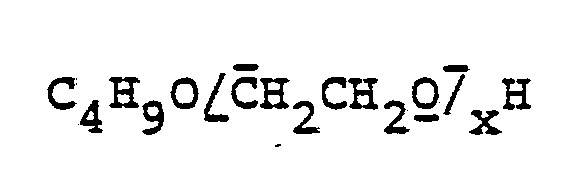
- polyalkylene oxide derivatives are polyglycols which are prepared by polymerizing ethylene oxide with butanol or butylglycol as the starter molecule and which have the general formula: own, or branched polyglycols, formed by the polymerization of ethylene oxide and propylene oxide in a mixture or in succession, started on trimethylolpropane, with the formula:
- the radical polymerization of the vinyl monomers can be started in a manner known per se with the aid of radical formers, UV rays, alpha, beta or gamma rays or thermally without further additives.
- the radiation-initiated polymerization is preferably carried out in the presence of sensitizers, cf. e.g. Jenkins, A. Ledwith, Reactivity, Mechanism and Structure in Polymer Chemistry, John Wiley & Son, London, New York, 1974, p. 465.
- radical formers are used in amounts between 0.001 to 2, preferably 0.02 to 0.8 wt .-% based on the total mixture of organopolysiloxane, polyester and vinyl monomers used.
- Azo initiators such as azo-bis-isobutyronitrile (AIBN), azo esters, azo-imino esters or azo-N-alkyl amides, peroxides such as di-tert.-butyl peroxide, dicumyl peroxide, di-benzoyl peroxide, peresters such as amyl perpivalate may be mentioned as examples of radical formers , tert-butyl perpivalate, tert-butyl peroctoate, t-butyl perbenzoate, tert-butyl perneodecanoate, percarbonates such as cyclohexyl percarbonate or bisisopropyl percarbonate or hydroperoxides such as cumyl hydroperoxide, tert-butyl hydroperoxide.
- AIBN azo-bis-isobutyronitrile
- azo esters such as di-tert.-butyl peroxide, dicumyl per
- Suitable initiators are also benzpinacol, benzpinacol derivatives or other thermally labile, highly substituted ethane derivatives.
- the polymerization can also be started with the help of redox systems at temperatures lower than the purely thermal decomposition temperatures of the radical formers.
- peroxides and amines such as e.g. Benzoyl peroxide and triethylamine, trialkylboron compounds and oxygen, hydroperoxides and sulfinic acids, formaldehyde or aldoses or combinations with low-quality transition metal salts and sulfur dioxide / peroxide redox systems.
- the polymerization reaction can be continuous or dis continuously, without pressure or at reaction pressures of up to 300 bar, preferably up to 15 bar, at reaction temperatures between -20 ° C. and + 250 ° C., preferably 70 to 190 ° C.
- the polymerization can also be carried out in the presence of solvents or diluents, water, alcohols such as methanol, ethanol, tert-butanol, aliphatic or aromatic hydrocarbons, halogenated hydrocarbons such as chlorobenzene or fluorinated compounds, ethers such as dioxane or Tetrahydrofuran, esters such as ethyl acetate, but the polymerization is preferably carried out without solvent.
- the polymerization reaction can be carried out in the presence of molecular weight regulators.
- molecular weight regulators such as n- or tert-dodecyl mercaptan, thioglycol, thioglycerol or thioacetic acid esters may be mentioned as regulators, furthermore sulfur-free molecular weight regulators such as hydrocarbons; paraffin fractions such as e.g. Petroleum ether, light or mineral spirits, alpha-olefins, e.g. Propylene, isobutylene, butene-1, furthermore ketones such as e.g. Acetone, methyl ethyl ketone or cyclohexanone, also aldehydes such as e.g.
- Formaldehyde, acetaldehyde, propionaldehyde, isobutyraldehyde or allyl compounds such as e.g. Allyl alcohol, allyl acetate, isobutene diacetate or allyl carbonates.
- telogens are halogenated hydrocarbons such as methylene chloride, tetrachloroethane, dibromoethane, etc.
- the viscosities of the dispersions can be controlled with the aid of such regulators.
- the conversion of the monomers used is determined by the chosen polymerization process and the reaction conditions. In the batchwise polymerization mode, the highest possible conversions are aimed at, so that at least 80% of the monomers used, but preferably more than 90%, are converted.
- the residual monomers are removed by known methods by distillation at normal pressure or under reduced pressure. The residual monomer contents which were effectively found in the dispersions after working up are negligibly low, they are generally below 1000 ppm, preferably below 100 ppm.
- the graft copolymers according to the invention are stable and, depending on the composition, medium to highly viscous, white liquids.
- the graft polymers according to the invention can be emulsified in water without additional auxiliaries or can be converted into aqueous emulsions by simple measures with the aid of emulsifiers.
- silica is added to the graft copolymer with a BET surface area of 50 to 400 m 2 / g. Generally, from 0.5 to 15 weight percent of the silica, based on the graft copolymer, may be present. An amount of silicon dioxide of 5 to 10% by weight, based on the graft copolymer, is preferred.
- Such silica can be any a precipitated or gas phase product as is well known and commercially available.
- the defoamer is expediently prepared by combining the above-mentioned silicon dioxide with the graft copolymer, by subjecting the mixture of the two components to the action of high shear forces. After some stirring, the temperature of the mixture is preferably raised to 100 to 150 ° C. for 1 to 3 hours in order to facilitate the dispersion of the silicon dioxide in the graft copolymer.
- the resulting mixture can be passed through a homogenizer to reduce the particle size of the silica filler dispersed in the graft copolymer and to aid in the dispersion of the filler in the polymer liquid.
- the mixture is cooled to room temperature with stirring and can be used as an antifoam.
- emulsifiers are conventional emulsifiers such as polyoxyethylene sorbitan monostearate, sorbitan monostearate, polyoxyethylene stearate and mixtures thereof. If the antifoam comes into contact with food, then a mixture of sorbitan monostearate and polyoxyethylene stearate is preferred as the emulsifier.
- other conventional ingredients can also be added to emulsify the anti-foaming agent of the present invention.
- sorbic acid can be added to the composition as a bactericide in a concentration of '0.01 to 0.1 wt .-%.
- the emulsifying agent is preferably dissolved in water, the diorganopolysiloxane, together with the silicone resin, is dispersed in the solution of the emulsifying agent in water, then a silazane-treated silica filler is added to the emulsion Dispersed mixed and the resulting mixture ground.
- a silazane-treated silica filler is added to the emulsion Dispersed mixed and the resulting mixture ground.
- a general method of making the emulsion is to add the emulsifiers, such as sorbitan monostearate and oxyethylene stearate, to water and to heat them Mix at temperatures from 60 to 100 ° C with stirring with high shear.
- the desired amount of the antifoam agent according to the invention which was obtained by incorporating the silicon dioxide filler into the graft copolymer according to the invention with high shear with high shear, can then be added to this mixture.
- any method of mixing the ingredients can be used to obtain a sufficiently stable emulsion in a short time.
- the emulsion formed it should be noted that if the emulsion is too stable, difficulties will arise in dispersing the emulsion in the foamed system, resulting in that it will not be as effective. On the other hand, if the emulsion is too unstable, it will only have a short shelf life. Emulsions with a shelf life of 6 months to one year are preferred.
- the siloxanes listed in the examples are identified as follows:
- the polyalkylene oxide derivatives listed in the examples have the following characteristics:
- Example 1 The mixture is then stirred at 110 ° C. for 1 hour and the volatile constituents are then distilled off in vacuo.
- the vinyl acetate conversion is 94.5% in Example 1 and 92.8% in Example 2. After cooling to room temperature, the products are solid.
- polysiloxane No. 1 225 g each of polyalkylene oxide B and C are heated to 110 ° C. in a 2 l stirred kettle.
- a solution of 300 g of vinyl acetate, 150 g of polysiloxane No. 1 and 1.7 g of tert-butyl perpivalate is then added at an internal temperature of 110 ° C. over the course of 2 hours.
- the mixture is then stirred for 1 hour and the volatile constituents are stripped off in vacuo.
- the vinyl acetate conversion is 91% and the viscosity of the dispersion cooled to room temperature is measured at 46500 mPas.
- 300 g of polysiloxane No. 2 and 300 g of polyalkylene oxide D are heated to 110 ° C. in a 2 1 stirred kettle under nitrogen.
- a solution of 200 g of vinyl acetate, 100 g of polysiloxane 2 and 1.2 g of tert-butyl perpivalate is then added over the course of 2 hours and the mixture is stirred at 110 ° C. for 2 hours.
- the volatile components are distilled off in vacuo.
- the vinyl acetate conversion is 93.6%.
- the reaction product is solid at room temperature.
- polysiloxane A polysiloxane A
- 6000 g of polyethylene oxide Molgevicht 6000
- the kettle is evacuated and flushed with nitrogen.
- the mixture is then heated to 110 ° C. and a solution of 9240 g of vinyl acetate and 67.5 g of tert-butyl perpivalate is added over the course of 3 hours.
- the volatile components are removed by distillation.
- the product has a viscosity of 22 Pas at 25 ° C and contains 32.4% polymerized units made of vinyl acetate, 22.7% units made of polyethylene oxide and 44.9% polysiloxane.
- a prior art defoamer emulsion is prepared as follows.
- a defoamer compound is obtained by intensively mixing 92% by weight of a polydimethylsiloxane with a viscosity of 1400 mPas at 25 ° C. and 6% by weight of a silicon dioxide produced by flame hydrolysis with a BET surface area of 380 m 2 / g and 2% by weight of a short-chain dimethylpolysiloxane terminated by hydroxyl groups.
- 35% by weight of defoamer compound are placed in a flask and heated to 80 ° C.
- This example demonstrates the difference in properties of a pure mixture of the constituents contained in the top graft polymer in the same percentage composition according to Example 6.
- 449 g of polysiloxane A, 227 g of polyethylene oxide (molecular weight 6000), 324 g of polyvinyl acetate (molecular weight approx. 2200) are mixed and stirred while stirring Heated to 120 ° C for 2 hours.
- the mixture according to Example 7 was mixed with a hydrophobized silicon dioxide and the mixture obtained was then converted into an aqueous emulsion according to Example 9.
- the foam height is assessed immediately after the end of the blow time and the disintegration time of the foam until the 100 ml mark is reached (height of the liquid level). The values obtained are compared.
- the water dilutability of the defoamer preparations is checked by a 10 wt .-% aqueous dilution the defoamer preparations are made.
- Water and defoamer are mixed by briefly stirring in a beaker.
- a finely divided emulsion must form which shows no greasy, lumpy deposits after standing for 20 minutes. Any creaming that may occur should be redistributable by shaking.
Landscapes
- Chemical & Material Sciences (AREA)
- Health & Medical Sciences (AREA)
- Toxicology (AREA)
- Dispersion Chemistry (AREA)
- Chemical Kinetics & Catalysis (AREA)
- Silicon Polymers (AREA)
- Compositions Of Macromolecular Compounds (AREA)
- Vaporization, Distillation, Condensation, Sublimation, And Cold Traps (AREA)
- Graft Or Block Polymers (AREA)
Abstract
Description
- Die Erfindung betrifft Entschäumerzubereitungen für wäßrige Systeme, die zum Schäumen neigen, insbesondere Entschäumer und Antischaummittel, die bereits in geringen Mengen unerwünschte Schaumbildung verhindern oder reduzieren.
- Die meisten Prozesse der Textilveredlung vollziehen sich an der Grenzfläche Textilfaser/wäßrige Flotte. Daraus ist verständlich, daß Textilhilfsmittel grenzflächenaktive Stoffe sind, die ihre Wirkung an Phasengrenzflächen entfalten.
- Eine in der Textilveredlungspraxis unerwünschte Nebenwirkung der grenzflächenaktiven Textilhilfsmittel und eine auch beim Waschprozeß nur eingeschränkt geschätzte Eigenschaft ist die Schaumbildung. Zur Bekämpfung dieser störenden Begleiterscheinung ist es notwendig, schaumzerstörende Substanzen der Flotte zuzusetzen.
- Die an die Eigenschaften eines Entschäumers zu stellenden Forderungen sind folgende: Sie sollen in Wasser schwer löslich sein, um sich auch in kleinen Konzentrationen an der Phasengrenze aufzuhalten, andererseits müssen die aus dem Entschäumer hergestellten wäßrigen Emulsionen eine ausreichende Stabilität besitzen.
- Maßgebend für die Wirksamkeit ist die Emulsionsstabilität. Erfahrungsgemäß haben sehr stabile Emulsionen nur eine geringe Entschäumerwirkung, während relativ instabil emulgierte Siliconentschäumer ausgezeichnete Effekte liefern. Die erwähnten Probleme treffen nicht nur für Verfahren und Prozesse in der Textilindustrie zu, sondern auch für sehr viele andere technische Vorgänge wie beispielsweise in der Leimindustrie, der Papierindustrie, bei der Kunststoff-Verarbeitung und in der Petrochemie.
- Für viele der geschilderten Prozesse gibt es eine ganze Reihe den speziellen Problemen angepaßte Entschäumertypen, insbesondere auch auf Siliconbasis.
- Als technisches Problem bleibt jedoch in der überwiegenden Zahl der Fälle das Problem der Entschäumerstabilität bestehen.
- Es ist aus diesem Grunde wiederholt versucht worden, Silicone durch chemische Modifikation hydrophiler zu machen und dadurch die Möglichkeit-zu erhalten, daraus stabilere Emulsionen herzustellen.
- Entschäumer auf Basis von Polyether-Siloxan-Copolymeren erfüllen die Forderung nach verbesserter Emulsionsstabilität. Dieser Vorzug ist jedoch mit gewissen Nachteilen verbunden.
- Auch die Synthese von Copolymeren der Silicone mit anderen wasserlöslich machenden organischen Polymeren verläuft in der Regel über mehrere Syntheseschritte, gewöhnlich unter Verwendung von Lösungsmitteln und Hilfsbasen, die nach erfolgter Umsetzung aus dem Reaktionsgut abgetrennt werden müssen.
- Die Bildung wasserlöslicher oder wasserdispergierbarer Polymerkörper ist mithin nur über aufwendige und oft mit Ausbeuteverlusten verbundene Synthesen möglich.
- Ihre Wirksamkeit ist in der Regel geringer als die reiner Polysiloxan-Entschäumer, was die Wirtschaftlichkeit weiter verringert.
- Das Wirkungsverhalten von Polyether-Siloxanentschäumern ist in gewissem Grade temperaturabhängig, d.h. bei niedrigen Temperaturen ist die entschäumende Wirksamkeit dieser Entschäumer relativ geringer als bei höheren Temperaturen.
- Aufgabe der vorliegenden Erfindung war es daher, Entschäumersubstanzen herzustellen, die die aufgezeigten Nachteile nicht besitzen und die über einfache chemische Syntheseschritte zugänglich sind.
- Die erfindungsgemäße Aufgabe wird dadurch gelöst, daß man durch radikalische Polymerisation von Mischungen aus Organopolysiloxanen, wasserlöslichen Polymeren wie beispielsweise Polyalkylenoxiden oder Polyalkylenoxid-Abkömmlingen und Vinylmonomeren, vorzugsweise Vinylacetat, neuartige Pfropfcopolymere bildet, die dadurch gekennzeichnet sind, daß sie über polymerisierte Einheiten aus den eingesetzten Vinylmonomeren querverbrückte Pfropfpolymere aus Organopolysiloxan und dem eingesetzten Polyalkylenoxid oder Polyalkylenoxidabkömmling enthalten.
- Solchermaßen hergestellte Pfropfpolymere sind, je nach Zusammensetzung, in Wasser löslich oder dispergierbar: bei hohem Silicongehalt lassen sich diese Polymeren durch relativ wenig Emulgatorzusätze leicht in Wasser emulgieren.
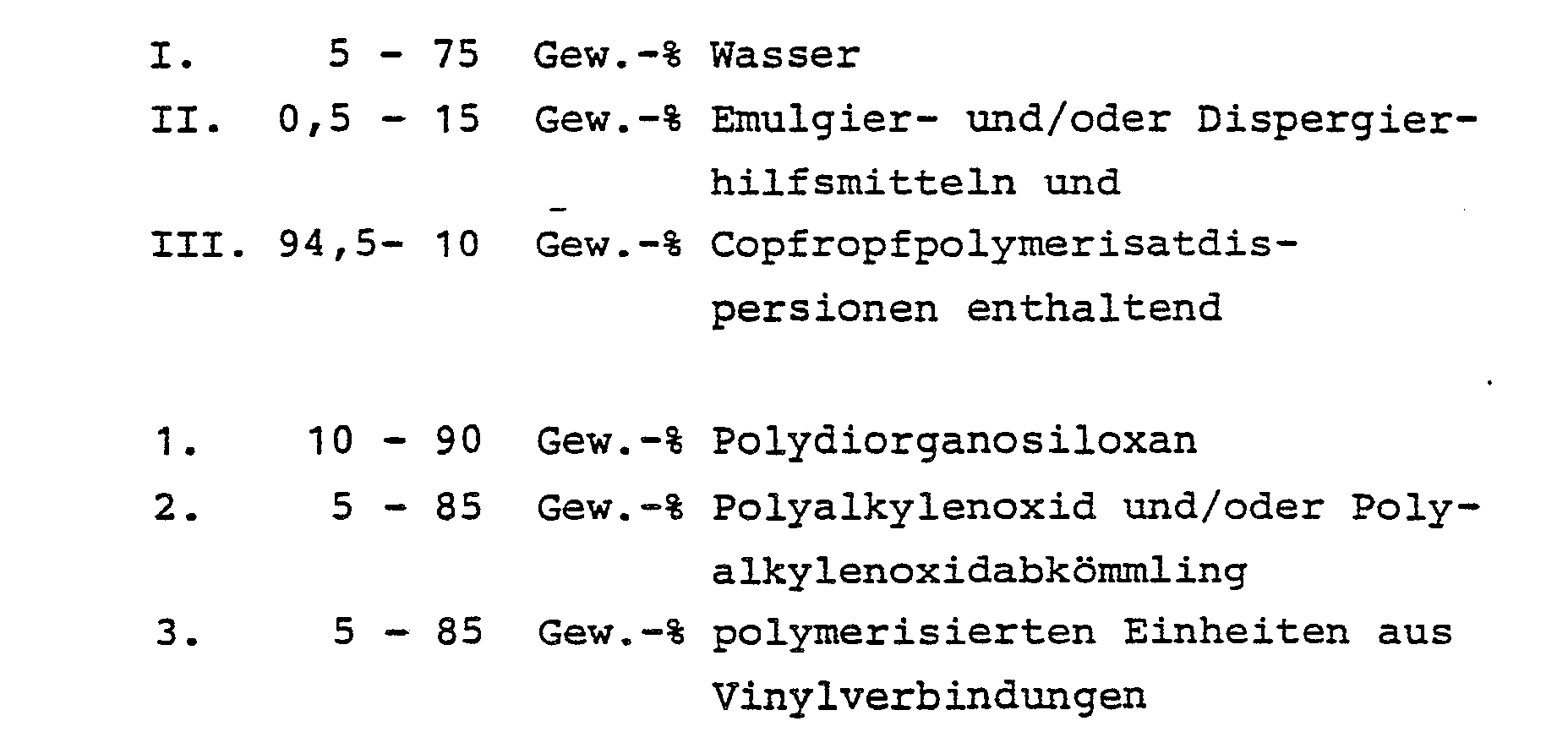
- Somit sind Gegenstände der Erfindung Entschäumerzubereitungen, enthaltend Copfropfpolymerisatdispersionen, welche dadurch gekennzeichnet sind, daß sie Polydiorganosiloxane, Polyalkylenoxide oder Polyalkylenoxidabkömmlinge und in Gegenwart von Mischungen dieser Komponenten polymerisierte Einheiten aus Vinylmonomeren und über Vinylpolymerisatbrücken verknüpfte Organopolysiloxan- und Polyalkylenoxid-oder Polyalkylenoxidabkömmling-Komponenten enthalten.
- Gegenstand der Erfindung sind ferner Entschäumerzubereitungen, bestehend aus:


- Ferner sind Gegenstand der Erfindung Entschäumerzubereitungen enthaltend Copfropfpolymerisatdispersionen aus:


- Ferner ist Gegenstand der Erfindung ein Verfahren zur Herstellung von Entschäumerzubereitungen, welches dadurch gekennzeichnet, daß

- Die Herstellung der Copfropfpolymerisatdispersionen geschieht in der Weise, daß Mischungen aus einem oder mehreren Organopolysiloxanen, Polyalkylenoxid oder Polyalkylenoxidabkämmlingen und einem oder mehrerer Vinylmonomerer, vorzugsweise Vinylacetat, in Gegenwart von Radikalbildnern auf eine, die Polymerisation auslösende Reaktionstemperatur gebracht werden. Die Polymerisation kann nach kontinuierlichem oder diskonti. nuierlichem Verfahren durchgeführt werden.
- Die verwendeten Organopolysiloxane sind im wesentlichem linear und können durch die folgenden Formeln dargestellt werden:


- Neben Methylgruppen können bis 50 Mol-% Ethyl, Vinyl, Phenyl in den Organopolysiloxankomponenten enthalten sein, bevorzugt werden aber methylsubstituierte Organopolysiloxane eingesetzt. Ferner können durch Hydroxylgruppen terminierte Organopolysiloxane verwendet werden.
- 3ie für die Copfropfpolymerisation eingesetzten Polyalkylenoxide oder Polyalkylenoxidabkömmlinge weisen in der Regel Hydroxylgruppen, vorzugsweise 1 bis 8 Hydroxylgruppen auf und werden z.B. durch Polymerisation von Epoxiden wie Ethylenoxid, Propylenoxid, Butylenoxid oder retrahydrofuran mit sich selbst, z.B. in Gegenwart von Polymerisationskatalysatoren oder durch Anlagerung dieser Epoxide gegebenenfalls im Gemisch oder nacheinander, an Startkomponenten mit reaktionsfähigen Wasserstoffatomen wie Wasser, Alkohole, Phenol oder Phenolabkömm-Linge, Amine oder Amide hergestellt. Vorzugsweise wird Ethylenoxid oder Ethylenoxid und Propylenoxid (als Genisch oder nacheinander) eingesetzt.
- Beispiele für Polyalkylenoxidabkömmlinge sind Polyglycole, die durch Polymerisation von Ethylenoxid mit Butanol oder Butylglycol als Startermolekül hergestellt werden und die die allgemeine Formel:

- oder auf Alkylphenol gestartete, lineare Polyglycole, entstanden durch Polymerisation von Ethylenoxid, mit der Formel:

- Als Vinylmonomere seien beispielhaft aufgeführt:
- Olefine wie Ethylen, Propylen, Isobutylen, Vinylester aliphatischer oder aromatischer Carbonsäuren, vorzugsweise Vinylacetat, Vinylpropionat, α,β-ungesättigte Mono-oder Dicarbonsäure und ihre Derivate, erwähnt seien (Meth) acrylsäure, Methyl(meth)acrylat, Ethyl(meth)-acrylat, Propyl- bzw. isopropyl(meth)acrylat, n-Butyl-, iso- oder tert.-Butyl(meth)acrylat, 2-Ethylhexyl(meth)-acrylat, (Meth)-Acrylamid, N-Alkyl-substituierte (Meth)-acrylamidderivate, (Meth)Acrylnitril, Maleinsäureanhydrid, Maleinsäureamid, N-Alkyl-Maleinimide, Maleinsäurehalb- oder -diester, Vinylaromaten wie Styrol, alpha-Methylstyrol, 4-Chlor-styrol, Vinylchlorid, Vinylidenchlorid, Vinylidenfluorid, Tetrafluorethylen, Vinylether wie Ethylvinylether oder n-Butylvinylether; aus der Reihe der Allylverbindungen seien angeführt Allylalkohol, Allylacetat, Isobutendiacetat, 2-Methylenpropandiol-1,3, Allylethylcarbonat, Allylphenylcarbonat. Falls die Vernetzung oder Erhöhung der Molekulargewichte der Vinylharzphase gewünscht wird, können Divinylverbindungen oder Diallylverbindungen eingesetzt werden. Erwähnt seien Divinylbenzol, (Meth)Acrylsäureester mehrwertiger Alkohole wie z.B. Ethylenglykoldimethacrylat, Diethylenglykoldiacrylat und Isivinylether. Vorzugsweise wird Vinylacetat verwendet.
- Die radikalische Polymerisation der Vinylmonomeren kann in an und für sich bekannter Weise mit Hilfe von Radikalbildnern, UV-Strahlen, alpha-, beta- oder gamma-Strahlen oder thermisch ohne weitere Zusätze gestartet werden. Die strahlungsinitiierte Polymerisation wird vorzugsweise in Gegenwart von Sensibilisatoren durchgeführt, vgl. z.B. Jenkins, A. Ledwith, Reactivity, Mechanism and Structure in Polymer Chemistry, John Wiley & Son, London, New York, 1974, S. 465.
- Um die radikalische Polymerisation der Vinylmonomeren zu starten, werden Radikalbildner in Mengen zwischen 0,001 bis 2, vorzugsweise 0,02 bis 0,8 Gew.-% bezogen auf die Gesamtmischung aus Organopolysiloxan, Polyester und Vinylmonomere eingesetzt. Als Radikalbildner seien beispielhaft aufgeführt Azo-Initiatoren wie Azo-bis-isobuttersäurenitril (AIBN), Azoester, Azo-Iminoester oder Azo-N-Alkylamide, Peroxide wie di-tert.-Butylperoxid, Di-cumylperoxid, Di-benzoylperoxid, Perester wie Amylperpivalat, tert.-Butylperpivalat, tert.-Butylperoctoat, t-Butylperbenzoat, tert.-Butylperneodecanoat, Percarbonate wie Cyclohexylpercarbonat oder Bisisopropylpercarbonat oder Hydroperoxide wie z.B. Cumylhydroperoxid, tert.-Butylhydroperoxid.
- Geeignete Initiatoren sind ferner Benzpinakol, Benzpinakolderivate oder andere thermisch labile hochsubstituierte Ethanderivate.
- Die Polymerisation kann ferner mit Hilfe von Redoxsystemen bei tieferen Temperaturen als den rein thermischen Zerfalltemperaturen der Radikalbildner entspricht, gestartet werden.
- Als Redox-Initiatoren seien beispielhaft erwähnt Kombinationen aus Peroxiden und Aminen, wie z.B. Benzoylperoxid und Triethylamin, Trialkylborverbindungen und Sauerstoff, Hydroperoxide und Sulfinsäuren, Formaldehyd oder Aldosen oder Kombinationen mit niederwertigen übergangsmetallsalzen und Schwefeldioxid/Peroxid-Redoxsysteme.
- Die Polymerisationsreaktion kann kontinuierlich oder diskontinuierlich, drucklos oder bei Reaktionsdrucken bis z.B. 300 bar, vorzugsweise bis 15 bar, bei Reaktionstemperaturen zwischen -20°C und +250°C, vorzugsweise 70 bis 190°C, durchgeführt werden. Falls gewünscht, kann die Polymerisation auch in Gegenwart von Lösungsmitteln oder Verdünnungsmitteln durchgeführt werden, genannt seien Wasser, Alkohole, wie Methanol, Ethanol, tert.-Butanol, aliphatische oder aromatische Kohlenwasserstoffe, Halogen-Kohlenwasserstoffe wie Chlorbenzol oder fluorierte Verbindungen, Ether wie Dioxan oder Tetrahydrofuran, Ester wie z.B. Essigsäureethylester, vorzugsweise wird die Polymerisation aber lösungsmittelfrei durchgeführt.
- Falls gewünscht, kann die Polymerisationsreaktion in Gegenwart von Molekulargewichtsreglern durchgeführt werden. Als Regler seien aufgeführt Mercaptane wie n- oder tert.-Dodecylmercaptan, Thioglykol, Thioglycerin oder Thioessigsäureester, ferner schwefelfreie Molekulargewichtsregler wie Kohlenwasserstoffe; beispielhaft seien genannt Paraffinfraktionen wie z.B. Petrolether, Leicht-oder Waschbenzin, alpha-Olefine, wie z.B. Propylen, Isobutylen, Buten-1, ferner Ketone wie z.B. Aceton, Methylethylketon oder Cyclohexanon, ferner Aldehyde wie z.B. Formaldehyd, Acetaldehyd, Propionaldehyd, Isobutyraldehyd oder Allylverbindungen, wie z.B. Allylalkohol, Allylacetat, Isobutendiacetat oder Allylcarbonate. Als Telogene kommen ferner in Frage Halogenkohlenwasserstoffe wie Methylenchlorid, Tetrachlorethan, Dibromethan usw. Wie zu erwarten, lassen sich mit Hilfe derartiger Regler die Viskositäten der Dispersionen steuern.
- Die Umsetzung der eingesetzten Monomeren wird vom gewählten Polymerisationsverfahren und den Reaktionsbedingungen bestimmt. Bei der diskontinuierlichen Polymerisationsweise werden möglichst hohe Umsätze angestrebt, so daß mindestens 80 % der eingesetzten Monomeren, vorzugsweise aber mehr als 90 % umgesetzt werden. Die Entfernung der Restmonomeren erfolgt nach bekannten Verfahren destillativ bei Normaldruck oder unter vermindertem Druck. Die nach der Aufarbeitung in den Dispersionen noch effektiv gefundenen Restmonomergehalte sind vernachlässigbar gering, sie liegen im allgemeinen unter 1000 ppm, vorzugsweise unter 100 ppm.
- Die erfindungsgemäßen Pfropfcopolymere sind stabile und je nach Zusammensetzung mittel- bis hochviskose, weiße Flüssigkeiten.
- In Abhängigkeit von ihrem Gehalt an Siliconkomponente sind die erfindungsgemäßen Pfropfpolymere in Wasser ohne zusätzliche Hilfsmittel emulgierbar oder durch einfache Maßnahmen mit Hilfe von Emulgatoren in wäßrige Emulsionen überführbar.
- Zur Steigerung der entschäumenden Wirksamkeit-wird dem Pfropfcopolymer Siliciumdioxid mit einer BET-Oberfläche von 50 bis 400 m2/g zugesetzt. Allgemein können von 0,5 bis 15 Gew.-% des Siliciumdioxids, bezogen auf das Pfropfcopolymer, vorhanden sein. Bevorzugt ist eine Siliciumdioxidmenge von 5 bis 10 Gew.-%, bezogen auf das Pfropfcopolymer. Ein solches Siliciumdioxid kann irgendein gefälltes oder in der Gasphase hergestelltes Produkt sein, wie sie allgemein bekannt und im Handel erhältlich sind.
- Die Herstellung des Entschäumers erfolgt zweckmäßigerweise durch Zusammengeben des oben erwähnten Siliciumdioxids mit dem Pfropfcopolymer, indem man die Mischung beider Komponenten der Einwirkung hoher Scherkräfte unterwirft. Dabei wird nach einigem Rühren vorzugsweise die Temperatur der Mischung für 1 bis 3 Stunden auf 100 bis 150°C erhöht, um die Dispersion des Siliciumdioxids im Pfropfcopolymer zu erleichtern. Die erhaltene Mischung kann man durch einen Homogenisator schicken, um die Teilchengröße des in dem Pfropfcopolymer dispergierten Siliciumdioxid-Füllstoffes zu vermindern und die Dispersion des Füllstoffes in der Polymerflüssigkeit zu unterstützen.
- Nach dem Einmischen des Siliciumdioxids während vorzugsweise 2 bis 6 Stunden und den oben genannten Temperaturen wird die Mischung auf Raumtemperatur unter Rühren abgekühlt und kann als Schaumverhütungsmittel eingesetzt werden.
- Es ist aber auch möglich, das Mittel in-Form einer Emulsion zuzubereiten, insbesondere in Form einer öl-in-Wasser-Emulsion. Der Einsatz solcher Emulsionen gestattet die leichtere Dispergierung des Schaumverhütungsmittels der vorliegenden Erfindung in wäßrigen Schaumsystemen.
- Als Emulsionsmittel können in dem geschäumten System, zu dem das Schaumverhütungsmittel hinzugegeben werden soll, einsetzbare Emulsionsmittel verwendet werden. Solche Emulsionsmittel sind konventionelle Emulsionsmittel, wie Polyoxyethylensorbitanmonostearat, Sorbitanmonostearat, Polyoxyethylenstearat sowie deren Mischungen. Kommt das Schaumverhütungsmittel in Berührung mit Nahrungsmitteln, dann ist eine Mischung aus Sorbitanmonostearat und Polyoxyethylenstearat als Emulsionsmittel bevorzugt. Es können jedoch auch andere übliche Ingredienzien hinzugegeben werden, um das Schaumverhütungsmittel nach der vorliegenden Erfindung zu emulgieren. So kann z.B. Sorbinsäure in einer Konzentration von'0,01 bis 0,1 Gew.-% von der Zusammensetzung als Bakterizid hinzugegeben werden.
- Bei der Herstellung der Emulsion und wie in der US-PS 4 005 044 offenbart, wird das Emulsionsmittel vorzugsweise in Wasser gelöst, das Diorganopolysiloxan zusammen mit dem Siliconharz in der Lösung des Emulsionsmittels in Wasser dispergiert, dann ein Silazan-behandelter Siliciumdioxyd-Füllstoff in die Dispersion eingemischt und das erhaltene Gemisch gemahlen. Obwohl ein solches Vorgehen bevorzugt ist, da es die Dispersion des Füllstoffes unter rascher Bildung einer stabilen Emulsion beschleunigt, ist die vorliegende Erfindung nicht auf ein solches Mischverfahren beschränkt. Das genannte Verfahren nach der US-PS 4 005 044 ist einfach als das bevorzugte Verfahren zum Herstellen der Emulsion angegeben.
- Ein allgemeines Verfahren zum Herstellen der Emulsion besteht in der Zugabe der Emulsionsmittel, wie Sorbitanmonostearat und Oxyethylenstearat zu Wasser und Erhitzen der Mischung auf Temperaturen von 60 bis 100°C unter Rühren mit hoher Scherwirkung. Zu dieser Mischung kann man dann die gewünschte Menge des erfindungsgemäßen Schaumverhütungsmittels hinzugegeben, das erhalten wurde durch Einarbeiten des Siliciumdioxyd-Füllstoffes unter Rühren mit hoher Scherwirküng in das erfindungsgemäße Pfropfcopolymer.
- Nachdem das Schaumverhütungsmittel bei einer Temperatur von 40 bis 100°C hinzugegeben worden ist, setzt man das Vermischen für eine Zeit von 1 bis 5 Stunden fort, bis die Mischung gleichmäßig ist. Dann kann man weiteres Wasser hinzugeben, um die Emulsion bis zu dem gewünschten Grade zu verdünnen, während man weiter auf eine Temperatur von 40 bis 100°C erhitzt und das Rühren mit hoher Scherwirkung fortsetzt. Dann kühlt man das Ganze etwas ab und behandelt es für eine Dauer von 1 bis 4 Stunden in einer Koloidmühle, bis die Emulsion gleichförmig ist. Man erhält dabei eine stabile Emulsion und diese kann als Schaumverhütungsmittel mit guter Dispergierbarkeit eingesetzt werden. Dieses in den Beispielen benutzte Verfahren ist hier nur als beispielhaft angegeben. Ungeachtet, welches Verfahren verwendet wird, sollte es den jeweiligen Erfordernissen der spezifischen Anwendung angepaßt sein.
- Allgemein kann irgendein Verfahren zum Vermischen der Bestandteile benutzt werden, mit dem man eine ausreichend stabile Emulsion innerhalb kurzer Zeit erhält.
- Es ist mit Bezug auf die gebildete Emulsion darauf hinzuweisen, daß bei einer zu stabilen Emulsion Schwierigkeiten bei der Dispergierung der Emulsion in dem geschäumten System auftreten werden, was dazu führt, daß sie nicht so wirksam sein wird. Ist die Emulsion dagegen zu instabil, dann hat sie nur eine kurze Lagerbeständigkeit. Bevorzugt sind Emulsionen mit einer Lagerbeständigkeit von 6 Monaten bis zu einem Jahr.
- Die im folgenden angegebenen Beispiele sollen die Erfindung erläutern, ohne sie in irgendeiner Hinsicht zu beschränken.
- Herstellung der Ausgangssubstanzen:
- Die Herstellung der Polydiorganosiloxane erfolgt in an sich bekannter Weise (vgl. W. Noll, "Chemie und Technologie der Silicone", Verlag Chemie, Weinheim/Bergstraße, 2. Auflage, 1968, Kap. 5, S. 162 ff.)
- Die in den Beispielen aufgeführten Siloxane sind wie folgt gekennzeichnet:


- In einem 6 1-Rührkessel werden unter Stickstoff 1000 g Polyalkylenoxid A und 1600 g Polysiloxan Nr. 2 vorgelegt. Man erwärmt unter Rühren auf 110°C und gibt sodann die Lösung innerhalb von 2 Std. bei 110°C Innentemperatur hinzu:
- Lösung
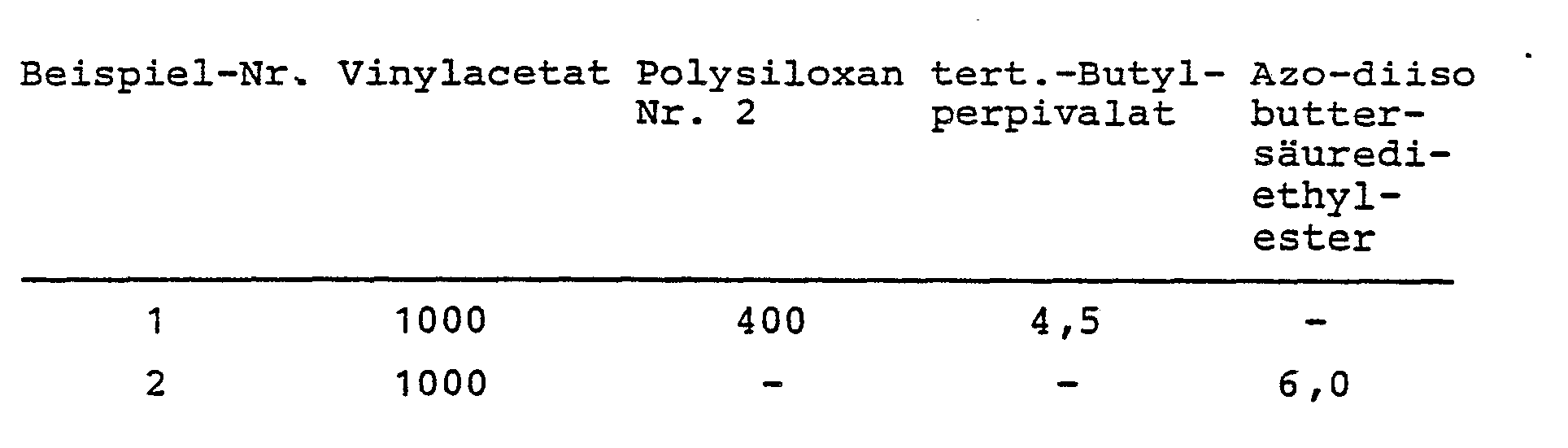
- Anschließend wird 1 Std. bei 110°C nachgerührt und die flüchtigen Anteile sodann im Vakuum abdestilliert. Der Vinylacetatumsatz beträgt bei Beispiel 1: 94,5 % und bei Beispiel 2: 92,8 %. Nach dem Abkühlen auf Raumtemperatur sind die Produkte fest.
- In einem 6 1-Rührkessel werden unter Stickstoff 1000 g Polyalkylenoxid A, 1600 g Polysiloxan Nr. 1 auf 110°C unter Rühren erwärmt. Dann wird innerhalb von 2 Std. eine Lösung aus 1000 g Vinylacetat, 400 g Polysiloxan Nr. 1 und 4,5 g tert.-Butylperpivalat hinzugegeben und die Innentemperatur konstant bei 110°C gehalten. Anschließend wird 1 Std. bei 110°C nachgerührt und sodann die flüchtigen Anteile in Vakuum abgezogen. Der Vinylacetatumsatz beträgt 92,1 %. Nach dem Abkühlen auf Raumtemperatur hat die Dispersion eine Viskosität von 8000 mPas.
- In einem 2 1-Rührkessel werden unter Stickstoff 450 g Polysiloxan Nr. 1, je 225 g Polyalkylenoxid B und C auf 110°C erwärmt. Dann wird bei einer Innentemperatur von 110°C eine Lösung aus 300 g Vinylacetat, 150 g Polysiloxan Nr. 1 und 1,7 g tert.-Butylperpivalat innerhalb von 2 Std. hinzugegeben. Anschließend wird 1 Std. nachgerührt und die flüchtigen Anteile im Vakuum abgezogen. Der Vinylacetatumsatz beträgt 91 % und die Viskosität der auf RaumTemperatur abgekühlten Dispersion wird mit 46500 mPas gemessen.
- In einem 2 1-Rührkessel werden unter Stickstoff 300 g Polysiloxan Nr. 2 und 300 g Polyalkylenoxid D auf 110°C erwärmt. Dann wird eine Lösung aus 200 g Vinylacetat, 100 g Polysiloxan 2 und 1,2 g tert.-Butylperpivalat innerhalb von 2 Std. hinzugegeben und 2 Std. bei 110°C nachgerührt. Die flüchtigen Anteile werden im Vakuum abdestilliert. Der Vinylacetatumsatz beträgt 93,6 %. Das Reaktionsprodukt ist bei Raumtemperatur fest.
- In einem 40 1-Rührkessel werden 11880 g Polydimethylsiloxan (Polysiloxan A) und 6000 g Polyethylenoxid (Molgevicht 6000) vorgelegt. Der Kessel wird evakuiert und mit stickstoff gespült. Dann wird auf 110°C aufgeheizt und eiie Lösung aus 9240 g Vinylacetat und 67,5 g tert.-Butyl- perpivalat innerhalb von 3 Stunden hinzugegeben. Nach zweistündigem Nachrühren bei 110°C werden die flüchtigen An- teile destillativ entfernt. Das Produkt weist bei 25°C eiie Viskosität von 22 Pas auf und enthält 32,4 % polymeri- sierte Einheiten aus Vinylacetat, 22,7 % Einheiten aus Polyethylenoxid und 44,9 % Polysiloxananteil.
- In einem Mischrührwerk werden 1,88 kg eines Pfropfcopolyners des Beispiels 6 mit einer Viskosität von 22 Pas und 0,12 kg pyrogen in der Gasphase erzeugtes, hydrophobiertes Siliciumdioxid mit einer BET-Oberfläche von 200 m2/g in- nerhalb von 30 Minuten miteinander vermischt. Es wird eine weiche Paste erhalten, die auch nach Lagerung von mehr als 4 Wochen keine Veränderung zeigt.
- In einer Topfmühle von 4 1 Inhalt werden 1,8 kg eines Pfropfcopolymers des Beispiels 3 mit einer Viskosität von 8000 mPas mit 0,2 kg einer gefällten, hydrophobierten Kieselsäure mit einer BET-Oberfläche von 120 m2/kg während 2 Stunden miteinander vermahlen und anschließend unter Anlegen eines Vakuums von 53 mbar auf 120°C erwärmt. Nach Abkühlen auf Raumtemperatur wird eine Flüssigkeit erhalten, die auch nach Lagerung von mehr als 4 Wochen keine Veränderung zeigt.
- Zu 35,0 kg einer Etschäumungsmittelzubereitung gemäß Beispiel 7 werden 2 kg eines Sorbitantrioleates gegeben und eingemischt. Dann werden nach und nach innerhalb 30 Minuten 63,0 kg entionisiertes Wasser unter Rühren zugesetzt und die erhaltene Emulsion eine weitere Stunde nach Zugabe des Wassers gerührt. Anschließend wird einmal bei einem Druck von 200 bar mittels einer Hochdruckhomogenisiermaschine homogenisiert. Man erhält eine weiße, niedrigviskose Emulsion.
- Zu 40,0 kg einer Entschäumungsmittelzubereitung gemäß Beispiel 8 werden 1 kq eines Sorbitantrioleates und 1 kg eines Oleyl-50-ethoxylates zugesetzt. Die Mischung wird unter Rühren auf 70°C erwärmt und anschließend werden 58,0 kg entionisiertes Wasser von Raumtemperatur innerhalb 45 Minuten unter-Rühren zugegeben. Die erhaltene Emulsion wird nach Zugabe des Wassers für eine weitere Stunde gerührt und anschließend mittels einer Hochdruckhomogenisiermaschine bei einem Druck von 200 bar in einem Druchgang homogenisiert. Man erhält eine mittelviskose Emulsion.
- Zu Vergleichszwecken wird eine Entschäumeremulsion nach dem Stande der Technik wie folgt hergestellt. Ein Entschäumercompound wird durch intensives Mischen von 92 Gew.-% eines Polydimethylsiloxans der Viskosität 1400 mPas bei 25°C und 6 Gew.-% eines durch Flammenhydrolyse erzeugten Silciumdioxides mit einer BET-Oberfläche von 380 m2/g sowie 2 Gew.-% eines kurzkettigen durch Hydroxylgruppen terminierten Dimethylpolysiloxans hergestellt. 35 Gew.-% Entschäumercompound werden in einem Kolben vorgelegt und auf 80°C erwärmt. Dazu werden 4,5 Gew.-% eines mit 20 Mol Ethylenoxid umgesetzten Oleylalkohols und 5,5 Gew.-% eines mit 6 Mol Ethylenoxid umgesetzten p-iso-Nonylphenols gegeben. Zu dieser Mischung gibt man 55 Gew.-% Wasser im Verlaufe von 60 Minuten und rührt weitere 15 Minuten nach. Schließlich wird die erhaltene Emulsion 2 mal bei 200 bar mittels einer Hochdruckhomogenisiermaschine homogenisiert.
- Dieses Beispiel belegt den Eigenschaftsunterschied einer reinen Mischung der im Copfropfpolymerisat enthaltenen Bestandteile in gleicher prozentualer Zusammensetzung gemäß Beispiel 6. Hierzu werden 449 g Polysiloxan A, 227 g Polyethylenoxid (Molgewicht 6000), 324 g Polyvinylacetat (Molgewicht ca. 2200) gemischt und unter Rühren während 2 Stunden auf 120°C erhitzt. Nach Abkühlen der Mischung wurde das Gemisch gemäß Beispiel 7 mit einem hydrophobierten Siliciumdioxid gemischt und das erhaltene Gemisch anschließend gemäß Beispiel 9 in eine wäßrige Emulsion überführt.
- Die nach den oben beschriebenen Entschäumerzubereitungen lassen sich auf folgende Weise prüfen:
- Die schaumhemmende Wirkung der Entschäumerzubereitungen läßt sich auf folgende Weise prüfen:
- Man stellt sich eine Tensidlösung eines handelsüblichen Alkylsulfonates her, die 5 g/1 Alkylsulfonat enthält. 0,1 ml einer 10 Gew.-%igen Entschäumerverdünnung (0,00288 g Silicon/100 ml Alkylsulfonatlösung) bzw. 0,5 und 0,25 ml einer 1 Gew.-%igen Entschäumerverdünnung (0,0014 g bzw. 0,00072 g Silicon/100 ml Alkylsulfonatlösung) werden in ein handelsübliches graduiertes Schaummeßgefäß (nach Schlachter-Dirkes) pipettiert und mit 100 ml Alkylsulfonatlösung, die 5 g/1 Alkylsulfonat enthält, aufgefüllt. Innerhalb von 35 Sekunden wird die vorgelegte Lösung 50 mal mit einem pneumatisch angetriebenen Schlaggerät geschlagen. Der auf einem Metallstab von 12 mm Durchmesser aufgeschraubte Stempel-des Schlaggerätes besteht aus Silicongummi eines Durchmessers von 42 mm und einer Dicke von 3 mm. In äquidistanten Abständen befinden sich 10 Löcher von 5 mm Durchmesser.
- Bewertet wird die Schaumhöhe sofort nach Beendigung der Schlagzeit sowie die Zerfallzeit des Schaumes bis zum Erreichen der 100 ml-Marke (Höhe des Flüssigkeitsniveaus). Die erhaltenen Werte werden verglichen.
- Die Wasserverdünnbarkeit der Entschäumerzubereitungen wird geprüft, indem eine 10 Gew.-%ige wäßrige Verdünnung

- Die Ergebnisse der Prüfung sind in Tabelle 1 wiedergegeben:
Claims (3)

Applications Claiming Priority (2)
| Application Number | Priority Date | Filing Date | Title |
|---|---|---|---|
| DE19813151957 DE3151957A1 (de) | 1981-12-30 | 1981-12-30 | Entschaeumerzubereitungen |
| DE3151957 | 1981-12-30 |
Publications (3)
| Publication Number | Publication Date |
|---|---|
| EP0083044A2 true EP0083044A2 (de) | 1983-07-06 |
| EP0083044A3 EP0083044A3 (en) | 1984-12-12 |
| EP0083044B1 EP0083044B1 (de) | 1987-09-16 |
Family
ID=6150038
Family Applications (1)
| Application Number | Title | Priority Date | Filing Date |
|---|---|---|---|
| EP82111768A Expired EP0083044B1 (de) | 1981-12-30 | 1982-12-18 | Entschäumerzubereitungen |
Country Status (5)
| Country | Link |
|---|---|
| US (1) | US4468491A (de) |
| EP (1) | EP0083044B1 (de) |
| JP (1) | JPS58119301A (de) |
| BR (1) | BR8207572A (de) |
| DE (2) | DE3151957A1 (de) |
Families Citing this family (15)
| Publication number | Priority date | Publication date | Assignee | Title |
|---|---|---|---|---|
| US4691039A (en) * | 1985-11-15 | 1987-09-01 | Minnesota Mining And Manufacturing Company | Ethoxylated siloxane surfactants and hydrophilic silicones prepared therewith |
| US4657959A (en) * | 1985-11-15 | 1987-04-14 | Minnesota Mining And Manufacturing Company | Hydrophilic silicones |
| US4752633A (en) * | 1985-11-15 | 1988-06-21 | Minnesota Mining And Manufacturing Co. | Ethoxylated siloxane surfactants and hydrophilic silicones prepared therewith |
| JPS63185411A (ja) * | 1986-12-30 | 1988-08-01 | ユニオン・カーバイド・コーポレーシヨン | シリコーン消泡剤 |
| US5055229A (en) * | 1986-12-30 | 1991-10-08 | Union Carbide Chemicals And Plastics Technology Corporation | Silicone antifoams |
| JP2865466B2 (ja) * | 1990-12-27 | 1999-03-08 | 信越化学工業株式会社 | 泡抑制剤組成物 |
| GB9322810D0 (en) * | 1993-11-05 | 1993-12-22 | Ici Plc | Moulded composites |
| JPH1060280A (ja) * | 1996-08-14 | 1998-03-03 | Japan Synthetic Rubber Co Ltd | 水系分散体 |
| DE102004044253A1 (de) * | 2004-09-14 | 2006-03-16 | Goldschmidt Gmbh | Wasserunlösliche gepfropfte Polysiloxan-Copolymerisate und deren Verwendung zur Entschäumung und Entlüftung nichtwässriger Öle |
| US20110306728A1 (en) * | 2010-06-11 | 2011-12-15 | Bayer Materialscience Ag | Polymer polyols prepared from nitrile-free azo-initiators |
| CN102160939B (zh) * | 2011-03-02 | 2013-08-14 | 江苏斯德瑞克化工有限公司 | 自乳化的分子级消泡剂及其制备方法 |
| CN104130879B (zh) * | 2014-08-08 | 2017-02-15 | 江苏四新科技应用研究所股份有限公司 | 一种用于液体洗涤剂的消泡剂 |
| WO2021126195A1 (en) * | 2019-12-19 | 2021-06-24 | Wacker Chemie Ag | Antifoam compositions comprising branched siloxanes |
| CN115283143A (zh) * | 2022-08-09 | 2022-11-04 | 东北大学 | 用于胺类浮选捕收剂的消泡剂及其制法和使法 |
| CN117467243B (zh) * | 2023-12-05 | 2024-04-09 | 昆山兴凯半导体材料有限公司 | 一种高导热、高绝缘性的环氧组合物及其应用 |
Family Cites Families (12)
| Publication number | Priority date | Publication date | Assignee | Title |
|---|---|---|---|---|
| BE544303A (de) * | 1955-01-18 | 1900-01-01 | ||
| GB1104153A (en) * | 1964-12-29 | 1968-02-21 | Ici Ltd | New polymers |
| US3793223A (en) * | 1969-06-27 | 1974-02-19 | Diamond Shamrock Corp | Defoamer compositions containing organic particles |
| FR2313440A1 (fr) * | 1975-06-06 | 1976-12-31 | Rhone Poulenc Ind | Dispersions homogenes de compositions diorganopolysiloxaniques dans des huiles minerales |
| JPS5334854A (en) * | 1976-09-14 | 1978-03-31 | Toray Silicone Co Ltd | Self-emulsifiable silicone composition |
| US4172101A (en) * | 1978-04-14 | 1979-10-23 | Sws Silicones Corporation | Modified organopolysiloxane compositions |
| DE2947964A1 (de) * | 1979-11-28 | 1981-06-19 | Bayer Ag, 5090 Leverkusen | Pfropfpolymerisat-dispersionen |
| DE2947963A1 (de) * | 1979-11-28 | 1981-06-19 | Bayer Ag, 5090 Leverkusen | Propfpolymerisat-dispersionen |
| JPS56139108A (en) * | 1980-03-31 | 1981-10-30 | Shin Etsu Chem Co Ltd | Self-emulsifying type defoaming agent |
| DE3105499A1 (de) * | 1981-02-14 | 1982-09-02 | Bayer Ag, 5090 Leverkusen | Stabile, organische mehrkomponentendispersionen |
| CH651581A5 (de) * | 1981-03-10 | 1985-09-30 | Ciba Geigy Ag | Waessrige zusammensetzungen enthaltend polymere auf acrylsaeurebasis, sowie verfahren zu deren herstellung. |
| DE3151924A1 (de) * | 1981-12-30 | 1983-07-07 | Bayer Ag, 5090 Leverkusen | Waessrige polysiloxanzubereitungen |
-
1981
- 1981-12-30 DE DE19813151957 patent/DE3151957A1/de not_active Withdrawn
-
1982
- 1982-12-10 US US06/448,589 patent/US4468491A/en not_active Expired - Fee Related
- 1982-12-18 EP EP82111768A patent/EP0083044B1/de not_active Expired
- 1982-12-18 DE DE8282111768T patent/DE3277292D1/de not_active Expired
- 1982-12-24 JP JP57226463A patent/JPS58119301A/ja active Pending
- 1982-12-29 BR BR8207572A patent/BR8207572A/pt not_active IP Right Cessation
Also Published As
| Publication number | Publication date |
|---|---|
| JPS58119301A (ja) | 1983-07-15 |
| EP0083044A3 (en) | 1984-12-12 |
| BR8207572A (pt) | 1983-10-25 |
| DE3277292D1 (en) | 1987-10-22 |
| US4468491A (en) | 1984-08-28 |
| EP0083044B1 (de) | 1987-09-16 |
| DE3151957A1 (de) | 1983-07-07 |
Similar Documents
| Publication | Publication Date | Title |
|---|---|---|
| EP0083044B1 (de) | Entschäumerzubereitungen | |
| EP0713504B1 (de) | Reaktionsprodukte aus olefinisch ungesättigten carbonsäuren und polyetherolen sowie ihre verwendung als demulgatoren für rohölemulsionen | |
| DE3151924A1 (de) | Waessrige polysiloxanzubereitungen | |
| CN104053723B (zh) | 用于冻融稳定乳液聚合物的新型反应性表面活性剂以及包含其的涂料 | |
| DE69501872T2 (de) | Wässrige fluorpolymeremulsion und verfahren zu dessen herstellung | |
| EP0156155B1 (de) | Wässrige Dispersionen von Pfropfpolymerisaten oder -copolymerisaten, ein Verfahren zu ihrer Herstellung und ihre Verwendung als Hydrophobierungs- und Oleophobierungsmittel für Textilien | |
| DE1240286B (de) | Verfahren zur kontinuierlichen Emulsions-polymerisation olefinisch ungesaettigter Verbindungen | |
| EP0565825A1 (de) | Verfahren zur Herstellung von wässrigen Polymerdispersionen | |
| DE1745246A1 (de) | Verfahren zur Dispersionspolymerisation von Tetrafluoraethylen | |
| DE3787268T2 (de) | Silikon-Antischaummittel. | |
| DE68911703T2 (de) | Emulsionen mit hohem Gehalt an Polysiloxanen. | |
| EP0157138A1 (de) | Verfahren zur Herstellung von Hydrophobier- und Oleophobiermittel | |
| EP0084321A2 (de) | Vernetzbare Pfropfpolymerisat-Dispersionen aus Hydrogensiloxan-Gruppen und Si-Vinyl-Gruppen enthaltenden Organopolysiloxanen | |
| DE60015285T2 (de) | Verfahren zur Herstellung von Vinylacetat-Ethylen-Copolymer Emulsionen stabilisiert mit einer Polyethylenglykol-Polyvinylacetat- Mischung | |
| EP0195328B1 (de) | Aminobernsteinsäurederivate und ihre Verwendung als Emulgatoren für Polymerdispersionen | |
| EP0036136B1 (de) | Verfahren zur Herstellung von Copolymerisaten von Styrol und/oder dessen Derivaten | |
| DE3319782A1 (de) | Verwendung der umsetzungsprodukte von ethylenoxid mit aliphatischen vicinalen diolen als emulgatoren fuer die emulsionspolymerisation | |
| DE69413753T2 (de) | Ein modifizierter Polyvinylalkohol und ein Verfahren zur Modifikation von Polyvinylalkohol durch radikalisches Pfropfen im festen Zustand | |
| DE1495707B2 (de) | Verfahren zur herstellung stabiler emulsionen von copoly merisaten des aethylens | |
| DE2554082C2 (de) | Verfahren zur Herstellung von stabilen Wasser-in-Öl-Dispersionen von Acrylamidpolymerisaten | |
| DE3701579C2 (de) | ||
| EP0108884B1 (de) | Verfahren zur Herstellung von verpastbaren Polymeren des Vinylchlorids | |
| EP0209774B1 (de) | Verfahren zur Herstellung von verpastbaren Vinylchlorid-Polymerisaten | |
| DE69206197T2 (de) | Polymer Dispersionen von Vinylpivalat, Vinylacetat und Alkylen. | |
| EP0224099B1 (de) | Perfluoralkylgruppen enthaltende Verbindungen, deren Herstellung und Verwendung als Entschäumungsmittel für wässrige Polymerdispersionen |
Legal Events
| Date | Code | Title | Description |
|---|---|---|---|
| PUAI | Public reference made under article 153(3) epc to a published international application that has entered the european phase |
Free format text: ORIGINAL CODE: 0009012 |
|
| 17P | Request for examination filed |
Effective date: 19821218 |
|
| AK | Designated contracting states |
Designated state(s): BE DE FR GB IT NL |
|
| PUAL | Search report despatched |
Free format text: ORIGINAL CODE: 0009013 |
|
| AK | Designated contracting states |
Designated state(s): BE DE FR GB IT NL |
|
| GRAA | (expected) grant |
Free format text: ORIGINAL CODE: 0009210 |
|
| ITF | It: translation for a ep patent filed | ||
| AK | Designated contracting states |
Kind code of ref document: B1 Designated state(s): BE DE FR GB IT NL |
|
| REF | Corresponds to: |
Ref document number: 3277292 Country of ref document: DE Date of ref document: 19871022 |
|
| ET | Fr: translation filed | ||
| GBT | Gb: translation of ep patent filed (gb section 77(6)(a)/1977) | ||
| PLBE | No opposition filed within time limit |
Free format text: ORIGINAL CODE: 0009261 |
|
| STAA | Information on the status of an ep patent application or granted ep patent |
Free format text: STATUS: NO OPPOSITION FILED WITHIN TIME LIMIT |
|
| 26N | No opposition filed | ||
| PGFP | Annual fee paid to national office [announced via postgrant information from national office to epo] |
Ref country code: BE Payment date: 19931222 Year of fee payment: 12 |
|
| ITTA | It: last paid annual fee | ||
| PG25 | Lapsed in a contracting state [announced via postgrant information from national office to epo] |
Ref country code: BE Effective date: 19941231 |
|
| BERE | Be: lapsed |
Owner name: BAYER A.G. Effective date: 19941231 |
|
| PGFP | Annual fee paid to national office [announced via postgrant information from national office to epo] |
Ref country code: DE Payment date: 19951114 Year of fee payment: 14 |
|
| PGFP | Annual fee paid to national office [announced via postgrant information from national office to epo] |
Ref country code: GB Payment date: 19951211 Year of fee payment: 14 |
|
| PGFP | Annual fee paid to national office [announced via postgrant information from national office to epo] |
Ref country code: FR Payment date: 19951221 Year of fee payment: 14 |
|
| PGFP | Annual fee paid to national office [announced via postgrant information from national office to epo] |
Ref country code: NL Payment date: 19951230 Year of fee payment: 14 |
|
| PG25 | Lapsed in a contracting state [announced via postgrant information from national office to epo] |
Ref country code: GB Effective date: 19961218 |
|
| PG25 | Lapsed in a contracting state [announced via postgrant information from national office to epo] |
Ref country code: NL Effective date: 19970701 |
|
| GBPC | Gb: european patent ceased through non-payment of renewal fee |
Effective date: 19961218 |
|
| PG25 | Lapsed in a contracting state [announced via postgrant information from national office to epo] |
Ref country code: FR Effective date: 19970829 |
|
| NLV4 | Nl: lapsed or anulled due to non-payment of the annual fee |
Effective date: 19970701 |
|
| PG25 | Lapsed in a contracting state [announced via postgrant information from national office to epo] |
Ref country code: DE Effective date: 19970902 |
|
| REG | Reference to a national code |
Ref country code: FR Ref legal event code: ST |