EP0083428B1 - Verfahren zur Herstellung von in 1-Stellung unsubstituierten, durch araliphatische Reste substituierten beta-Naphtholen - Google Patents
Verfahren zur Herstellung von in 1-Stellung unsubstituierten, durch araliphatische Reste substituierten beta-Naphtholen Download PDFInfo
- Publication number
- EP0083428B1 EP0083428B1 EP82111521A EP82111521A EP0083428B1 EP 0083428 B1 EP0083428 B1 EP 0083428B1 EP 82111521 A EP82111521 A EP 82111521A EP 82111521 A EP82111521 A EP 82111521A EP 0083428 B1 EP0083428 B1 EP 0083428B1
- Authority
- EP
- European Patent Office
- Prior art keywords
- naphthols
- radicals
- naphthol
- substituted
- grams
- Prior art date
- Legal status (The legal status is an assumption and is not a legal conclusion. Google has not performed a legal analysis and makes no representation as to the accuracy of the status listed.)
- Expired
Links
- 150000004786 2-naphthols Chemical class 0.000 title claims description 13
- 238000000034 method Methods 0.000 title claims description 11
- 238000006243 chemical reaction Methods 0.000 claims description 18
- 150000004780 naphthols Chemical class 0.000 claims description 11
- 125000004432 carbon atom Chemical group C* 0.000 claims description 10
- 150000003440 styrenes Chemical class 0.000 claims description 10
- 239000002253 acid Substances 0.000 claims description 9
- 125000004435 hydrogen atom Chemical group [H]* 0.000 claims description 9
- 150000007513 acids Chemical class 0.000 claims description 6
- 125000003118 aryl group Chemical group 0.000 claims description 6
- 238000002360 preparation method Methods 0.000 claims description 5
- 239000003960 organic solvent Substances 0.000 claims description 3
- 125000001931 aliphatic group Chemical group 0.000 claims description 2
- 229910052739 hydrogen Inorganic materials 0.000 claims 4
- 239000001257 hydrogen Substances 0.000 claims 4
- 125000000217 alkyl group Chemical group 0.000 claims 3
- UFHFLCQGNIYNRP-UHFFFAOYSA-N Hydrogen Chemical compound [H][H] UFHFLCQGNIYNRP-UHFFFAOYSA-N 0.000 claims 2
- 150000002431 hydrogen Chemical class 0.000 claims 1
- PPBRXRYQALVLMV-UHFFFAOYSA-N Styrene Chemical compound C=CC1=CC=CC=C1 PPBRXRYQALVLMV-UHFFFAOYSA-N 0.000 description 48
- JWAZRIHNYRIHIV-UHFFFAOYSA-N 2-naphthol Chemical compound C1=CC=CC2=CC(O)=CC=C21 JWAZRIHNYRIHIV-UHFFFAOYSA-N 0.000 description 32
- 239000000203 mixture Substances 0.000 description 19
- 239000007858 starting material Substances 0.000 description 14
- -1 aliphatic sulfonic acids Chemical class 0.000 description 11
- 239000002904 solvent Substances 0.000 description 11
- QAOWNCQODCNURD-UHFFFAOYSA-N Sulfuric acid Chemical compound OS(O)(=O)=O QAOWNCQODCNURD-UHFFFAOYSA-N 0.000 description 10
- MUBZPKHOEPUJKR-UHFFFAOYSA-N Oxalic acid Chemical compound OC(=O)C(O)=O MUBZPKHOEPUJKR-UHFFFAOYSA-N 0.000 description 9
- 230000000052 comparative effect Effects 0.000 description 9
- YXFVVABEGXRONW-UHFFFAOYSA-N Toluene Chemical compound CC1=CC=CC=C1 YXFVVABEGXRONW-UHFFFAOYSA-N 0.000 description 7
- 239000003054 catalyst Substances 0.000 description 7
- ARNKHYQYAZLEEP-UHFFFAOYSA-N 1-naphthalen-1-yloxynaphthalene Chemical compound C1=CC=C2C(OC=3C4=CC=CC=C4C=CC=3)=CC=CC2=C1 ARNKHYQYAZLEEP-UHFFFAOYSA-N 0.000 description 6
- IJGRMHOSHXDMSA-UHFFFAOYSA-N Atomic nitrogen Chemical compound N#N IJGRMHOSHXDMSA-UHFFFAOYSA-N 0.000 description 6
- 229950011260 betanaphthol Drugs 0.000 description 6
- 239000007795 chemical reaction product Substances 0.000 description 6
- 239000011541 reaction mixture Substances 0.000 description 6
- KJCVRFUGPWSIIH-UHFFFAOYSA-N 1-naphthol Chemical compound C1=CC=C2C(O)=CC=CC2=C1 KJCVRFUGPWSIIH-UHFFFAOYSA-N 0.000 description 5
- SQFYKMZKJJPSJW-UHFFFAOYSA-N 6-(1-phenylethyl)naphthalen-2-ol Chemical compound C=1C=C2C=C(O)C=CC2=CC=1C(C)C1=CC=CC=C1 SQFYKMZKJJPSJW-UHFFFAOYSA-N 0.000 description 5
- 238000005804 alkylation reaction Methods 0.000 description 5
- YNQLUTRBYVCPMQ-UHFFFAOYSA-N Ethylbenzene Chemical compound CCC1=CC=CC=C1 YNQLUTRBYVCPMQ-UHFFFAOYSA-N 0.000 description 4
- 230000029936 alkylation Effects 0.000 description 4
- 125000003710 aryl alkyl group Chemical group 0.000 description 4
- 238000009835 boiling Methods 0.000 description 4
- MVPPADPHJFYWMZ-UHFFFAOYSA-N chlorobenzene Chemical compound ClC1=CC=CC=C1 MVPPADPHJFYWMZ-UHFFFAOYSA-N 0.000 description 4
- NNBZCPXTIHJBJL-UHFFFAOYSA-N decalin Chemical compound C1CCCC2CCCCC21 NNBZCPXTIHJBJL-UHFFFAOYSA-N 0.000 description 4
- KJIFKLIQANRMOU-UHFFFAOYSA-N oxidanium;4-methylbenzenesulfonate Chemical compound O.CC1=CC=C(S(O)(=O)=O)C=C1 KJIFKLIQANRMOU-UHFFFAOYSA-N 0.000 description 4
- 150000003460 sulfonic acids Chemical class 0.000 description 4
- RFFLAFLAYFXFSW-UHFFFAOYSA-N 1,2-dichlorobenzene Chemical compound ClC1=CC=CC=C1Cl RFFLAFLAYFXFSW-UHFFFAOYSA-N 0.000 description 3
- UHOVQNZJYSORNB-UHFFFAOYSA-N Benzene Chemical compound C1=CC=CC=C1 UHOVQNZJYSORNB-UHFFFAOYSA-N 0.000 description 3
- LSNNMFCWUKXFEE-UHFFFAOYSA-M Bisulfite Chemical compound OS([O-])=O LSNNMFCWUKXFEE-UHFFFAOYSA-M 0.000 description 3
- 230000015572 biosynthetic process Effects 0.000 description 3
- 238000004587 chromatography analysis Methods 0.000 description 3
- 150000002170 ethers Chemical class 0.000 description 3
- 125000001495 ethyl group Chemical group [H]C([H])([H])C([H])([H])* 0.000 description 3
- 239000007789 gas Substances 0.000 description 3
- 125000001449 isopropyl group Chemical group [H]C([H])([H])C([H])(*)C([H])([H])[H] 0.000 description 3
- 125000002496 methyl group Chemical group [H]C([H])([H])* 0.000 description 3
- 229910052757 nitrogen Inorganic materials 0.000 description 3
- 235000006408 oxalic acid Nutrition 0.000 description 3
- QPFMBZIOSGYJDE-UHFFFAOYSA-N 1,1,2,2-tetrachloroethane Chemical compound ClC(Cl)C(Cl)Cl QPFMBZIOSGYJDE-UHFFFAOYSA-N 0.000 description 2
- OCJBOOLMMGQPQU-UHFFFAOYSA-N 1,4-dichlorobenzene Chemical compound ClC1=CC=C(Cl)C=C1 OCJBOOLMMGQPQU-UHFFFAOYSA-N 0.000 description 2
- HDOHXQUNCRCUIP-UHFFFAOYSA-N 1-(1-phenylethyl)naphthalen-2-ol Chemical compound OC=1C=CC2=CC=CC=C2C=1C(C)C1=CC=CC=C1 HDOHXQUNCRCUIP-UHFFFAOYSA-N 0.000 description 2
- UFWIBTONFRDIAS-UHFFFAOYSA-N Naphthalene Chemical compound C1=CC=CC2=CC=CC=C21 UFWIBTONFRDIAS-UHFFFAOYSA-N 0.000 description 2
- NBIIXXVUZAFLBC-UHFFFAOYSA-N Phosphoric acid Chemical compound OP(O)(O)=O NBIIXXVUZAFLBC-UHFFFAOYSA-N 0.000 description 2
- ATUOYWHBWRKTHZ-UHFFFAOYSA-N Propane Chemical compound CCC ATUOYWHBWRKTHZ-UHFFFAOYSA-N 0.000 description 2
- 150000001338 aliphatic hydrocarbons Chemical class 0.000 description 2
- 150000004945 aromatic hydrocarbons Chemical class 0.000 description 2
- 229920001429 chelating resin Polymers 0.000 description 2
- 238000004040 coloring Methods 0.000 description 2
- 229940117389 dichlorobenzene Drugs 0.000 description 2
- 238000004821 distillation Methods 0.000 description 2
- 239000000975 dye Substances 0.000 description 2
- 125000000959 isobutyl group Chemical group [H]C([H])([H])C([H])(C([H])([H])[H])C([H])([H])* 0.000 description 2
- 238000004519 manufacturing process Methods 0.000 description 2
- VNWKTOKETHGBQD-UHFFFAOYSA-N methane Chemical compound C VNWKTOKETHGBQD-UHFFFAOYSA-N 0.000 description 2
- 125000004108 n-butyl group Chemical group [H]C([H])([H])C([H])([H])C([H])([H])C([H])([H])* 0.000 description 2
- 125000004123 n-propyl group Chemical group [H]C([H])([H])C([H])([H])C([H])([H])* 0.000 description 2
- 229920000642 polymer Polymers 0.000 description 2
- 238000006116 polymerization reaction Methods 0.000 description 2
- 238000003756 stirring Methods 0.000 description 2
- PXXNTAGJWPJAGM-UHFFFAOYSA-N vertaline Natural products C1C2C=3C=C(OC)C(OC)=CC=3OC(C=C3)=CC=C3CCC(=O)OC1CC1N2CCCC1 PXXNTAGJWPJAGM-UHFFFAOYSA-N 0.000 description 2
- PAAZPARNPHGIKF-UHFFFAOYSA-N 1,2-dibromoethane Chemical compound BrCCBr PAAZPARNPHGIKF-UHFFFAOYSA-N 0.000 description 1
- NNWJFULRFAMHFR-UHFFFAOYSA-N 1,3-bis(1-phenylethyl)naphthalen-2-ol Chemical class C=1C2=CC=CC=C2C(C(C)C=2C=CC=CC=2)=C(O)C=1C(C)C1=CC=CC=C1 NNWJFULRFAMHFR-UHFFFAOYSA-N 0.000 description 1
- MANKGOJTHUPLEV-UHFFFAOYSA-N 1-butan-2-ylnaphthalen-2-ol Chemical compound C1=CC=C2C(C(C)CC)=C(O)C=CC2=C1 MANKGOJTHUPLEV-UHFFFAOYSA-N 0.000 description 1
- 150000004782 1-naphthols Chemical class 0.000 description 1
- MUJZEKMLRKEURB-UHFFFAOYSA-N 4-butyl-3-methylnaphthalen-2-ol Chemical compound C1=CC=C2C(CCCC)=C(C)C(O)=CC2=C1 MUJZEKMLRKEURB-UHFFFAOYSA-N 0.000 description 1
- WFXJQUSHOQQALO-UHFFFAOYSA-N 4-ethyl-8-methylnaphthalen-2-ol Chemical compound C1=CC=C2C(CC)=CC(O)=CC2=C1C WFXJQUSHOQQALO-UHFFFAOYSA-N 0.000 description 1
- WKBOTKDWSSQWDR-UHFFFAOYSA-N Bromine atom Chemical compound [Br] WKBOTKDWSSQWDR-UHFFFAOYSA-N 0.000 description 1
- 239000001293 FEMA 3089 Substances 0.000 description 1
- URLKBWYHVLBVBO-UHFFFAOYSA-N Para-Xylene Chemical compound CC1=CC=C(C)C=C1 URLKBWYHVLBVBO-UHFFFAOYSA-N 0.000 description 1
- 150000001298 alcohols Chemical class 0.000 description 1
- 150000001336 alkenes Chemical class 0.000 description 1
- XYLMUPLGERFSHI-UHFFFAOYSA-N alpha-Methylstyrene Chemical compound CC(=C)C1=CC=CC=C1 XYLMUPLGERFSHI-UHFFFAOYSA-N 0.000 description 1
- 229910000147 aluminium phosphate Inorganic materials 0.000 description 1
- SRSXLGNVWSONIS-UHFFFAOYSA-N benzenesulfonic acid Chemical compound OS(=O)(=O)C1=CC=CC=C1 SRSXLGNVWSONIS-UHFFFAOYSA-N 0.000 description 1
- 229940092714 benzenesulfonic acid Drugs 0.000 description 1
- 235000010290 biphenyl Nutrition 0.000 description 1
- 239000004305 biphenyl Substances 0.000 description 1
- 125000006267 biphenyl group Chemical group 0.000 description 1
- GDTBXPJZTBHREO-UHFFFAOYSA-N bromine Substances BrBr GDTBXPJZTBHREO-UHFFFAOYSA-N 0.000 description 1
- 229910052794 bromium Inorganic materials 0.000 description 1
- 239000001273 butane Substances 0.000 description 1
- 125000000484 butyl group Chemical group [H]C([*])([H])C([H])([H])C([H])([H])C([H])([H])[H] 0.000 description 1
- 239000006227 byproduct Substances 0.000 description 1
- 150000001735 carboxylic acids Chemical class 0.000 description 1
- 150000001768 cations Chemical class 0.000 description 1
- 150000008280 chlorinated hydrocarbons Chemical class 0.000 description 1
- 150000001875 compounds Chemical group 0.000 description 1
- 238000005260 corrosion Methods 0.000 description 1
- 230000007797 corrosion Effects 0.000 description 1
- 239000000645 desinfectant Substances 0.000 description 1
- 239000002270 dispersing agent Substances 0.000 description 1
- 239000003814 drug Substances 0.000 description 1
- 239000003995 emulsifying agent Substances 0.000 description 1
- CCIVGXIOQKPBKL-UHFFFAOYSA-M ethanesulfonate Chemical compound CCS([O-])(=O)=O CCIVGXIOQKPBKL-UHFFFAOYSA-M 0.000 description 1
- 150000008282 halocarbons Chemical class 0.000 description 1
- 238000010438 heat treatment Methods 0.000 description 1
- 239000003112 inhibitor Substances 0.000 description 1
- 239000007788 liquid Substances 0.000 description 1
- 239000002480 mineral oil Substances 0.000 description 1
- 235000010446 mineral oil Nutrition 0.000 description 1
- 150000007522 mineralic acids Chemical class 0.000 description 1
- IJDNQMDRQITEOD-UHFFFAOYSA-N n-butane Chemical compound CCCC IJDNQMDRQITEOD-UHFFFAOYSA-N 0.000 description 1
- OFBQJSOFQDEBGM-UHFFFAOYSA-N n-pentane Natural products CCCCC OFBQJSOFQDEBGM-UHFFFAOYSA-N 0.000 description 1
- 239000003921 oil Substances 0.000 description 1
- 239000002674 ointment Substances 0.000 description 1
- 239000000575 pesticide Substances 0.000 description 1
- 150000002989 phenols Chemical class 0.000 description 1
- ZUOUZKKEUPVFJK-UHFFFAOYSA-N phenylbenzene Natural products C1=CC=CC=C1C1=CC=CC=C1 ZUOUZKKEUPVFJK-UHFFFAOYSA-N 0.000 description 1
- 239000004014 plasticizer Substances 0.000 description 1
- 239000000047 product Substances 0.000 description 1
- 239000001294 propane Substances 0.000 description 1
- 125000001436 propyl group Chemical group [H]C([*])([H])C([H])([H])C([H])([H])[H] 0.000 description 1
- 239000011814 protection agent Substances 0.000 description 1
- 239000000376 reactant Substances 0.000 description 1
- 238000010992 reflux Methods 0.000 description 1
- 239000011877 solvent mixture Substances 0.000 description 1
- 239000003381 stabilizer Substances 0.000 description 1
- 238000006467 substitution reaction Methods 0.000 description 1
- 239000008096 xylene Substances 0.000 description 1
- 150000003738 xylenes Chemical class 0.000 description 1
Classifications
-
- C—CHEMISTRY; METALLURGY
- C07—ORGANIC CHEMISTRY
- C07C—ACYCLIC OR CARBOCYCLIC COMPOUNDS
- C07C37/00—Preparation of compounds having hydroxy or O-metal groups bound to a carbon atom of a six-membered aromatic ring
- C07C37/11—Preparation of compounds having hydroxy or O-metal groups bound to a carbon atom of a six-membered aromatic ring by reactions increasing the number of carbon atoms
- C07C37/14—Preparation of compounds having hydroxy or O-metal groups bound to a carbon atom of a six-membered aromatic ring by reactions increasing the number of carbon atoms by addition reactions, i.e. reactions involving at least one carbon-to-carbon unsaturated bond
Definitions
- the invention relates to a process for the preparation of / 1-naphthols which are unsubstituted in the 1-position and substituted by araliphatic radicals by reacting ⁇ -naphthols with styrenes in the presence of organic solvents which are inert under the reaction conditions and have a boiling point above 130 ° C. and in the presence of aromatic or aliphatic sulfonic acids.
- GB-PS 1 111 751 describes the aralkylation of naphthols with styrene in the presence of oxalic acid.
- Example 5 shows that mainly 1- ( ⁇ -phenylethyl) -naphthol-2 is formed in the presence of oxalic acid.
- DE-OS 2950290 shows a process for the preparation of 1- (aralkyl) -2-naphthols by reacting 2-naphthols with styrenes in the presence of a carboxylic acid
- Comparative Example 2 shows that the reaction with sulfuric acid as a catalyst at 120 ° C in the absence of solvents only leads to unsatisfactory amounts of 6- ( ⁇ -phenylethyl) -2-naphthol (21%), which also contain a further 21% of the compound substituted in the 3-position.
- the disruptive dinaphthyl ether occurs in a relatively large amount (6%).
- certain amounts of naphtholsulfonic acids can always be observed in all of these sulfuric acid reactions.
- Comparative example 3 shows how sensitively the reaction reacts to any change in the components, because with phosphoric acid as catalyst a proportion of 1-compound occurs again, which is far higher than the 6 proportion, as end product.
- GB-PS 731 270 describes the alkylation of phenols and naphthols in the presence of cation exchangers. Regarding a reaction of ⁇ -naphthol with styrene, however, there is no further information in either the general part or the experimental part. If an appropriate reaction is carried out in the presence of 9 Amberlite IR 120 (see Example 1 of British Patent 731 270), a mixture of 14% ⁇ -naphthol, 63% 1- (1'-phenylethyl) -2- is obtained.
- naphthol 10% 6- (1'-phenylethyl) -2-naphthol, 3% 3- and 8- (1'-phenylethylnaphthol) and 9% double and higher alkylated naphthols (see example 6).
- the process according to the invention surprisingly provides 6- (aralkyl) -2-naphthols and 3-, 8-, 3.6-, 6.8-, 3.8-, 3 in a simple and economical way , 6,8-substituted 2-naphthols in better space-time yield and purity.
- 6- (aralkyl) -2-naphthols and 3-, 8-, 3.6-, 6.8-, 3.8-, 3 in a simple and economical way , 6,8-substituted 2-naphthols in better space-time yield and purity.
- the number of aralkyl groups III introduced strongly depends on the reactant ratio and the degree of substitution of the naphthol 11 used.
- the aralkylation takes place mainly in the C-6, C-3 and C-8 position, preferably in the C-6 position.
- the starting materials are used in a stoichiometric ratio or in excess, preferably in a ratio of 0.1 to 5, advantageously from 0.5 to 2 moles of starting material 111 per mole of naphthol 11, advantageously in the case of the preparation of naphthols 0, which are mainly aralkylated simply.
- starting material III 1 to 2, in particular 0.2 to 0.5 mol of starting material III per mole of starting material II, in the case of naphthols 1.5 to 3, in particular 2 to 2.5 moles of starting material 111 per mole of starting material II, which are aralkylated twice in large proportion triple aralkylated naphthols 2.5 to 4, in particular 3 to 3.5 moles of starting material III per mole of starting material II.
- Preferred starting materials II, 111 and accordingly preferred end products I are those in the formulas within the scope of the definition given in the patent claim
- the individual radicals R 1 can be the same or different and 1 to 3 radicals R 'each the rest mean, the remaining radicals R 1 each represent a hydrogen atom or an alkyl radical having 1 to 4 carbon atoms
- R 2 denotes a hydrogen atom or an alkyl radical having 1 to 4 carbon atoms
- the radicals R 3 can be identical or different and in the positions where in of formula 1 to 3 radicals R 'the rest mean, in each case the corresponding radical R 3 denotes a hydrogen atom
- the other radicals R 3 correspond to the radical R 1 in the respective position of the formula 1, a hydrogen atom or Alkyl radical of R 1 with 1 to 4 carbon atoms.
- naphthols come e.g. B. as starting materials II into consideration: methyl, ethyl, n-propyl, isopropyl, n-butyl, isobutyl, sec-butyl- ⁇ -naphthol, the alkyl substituent being in 3-, 4-, 5 -, 6-, 7- or 8-position sits; in the 3,4-, 4,5-, 4,6-, 6,7-position by methyl, ethyl, n-propyl, isopropyl, n-butyl, isobutyl, sec.-butyl groups disubstituted ⁇ -naphthol; corresponding ⁇ -naphthols with 2 aforementioned, but different radicals, e.g. B. 4-ethyl-8-methyl-2-naphthol, 3-methyl-4-butyl-2-naphthol; preferably ⁇ -naphthol.
- styrenes are used as starting materials III: styrene; styrenes substituted in the o-, m- or p-position by the methyl, ethyl, propyl, isopropyl or butyl group.
- the reaction is carried out at a temperature of 100 to 180 ° C, preferably 130 to 150 ° C, with negative pressure, positive pressure or depressurized, discontinuously or continuously.
- Solvents which are inert under the reaction conditions and have a boiling point above 130.degree. C., advantageously from 131 to 300.degree. C., advantageously 150 to 250.degree.
- halogenated hydrocarbons especially fluorinated, bromine or chlorinated hydrocarbons, e.g. B. 1,2-dibromoethane, 1,1,2,2-tetrachloroethane; aromatic hydrocarbons, e.g. B.
- Chlorobenzene, dichlorobenzene, decalin, white spirit, the solvent mixtures of aliphatic or aromatic hydrocarbons which are commercially available under the names O Shellsol F and Shellsol AB are preferred.
- the solvent is expediently used in an amount of 10 to 1000 percent by weight, preferably 50 to 200 percent by weight, based on styrene 111.
- Suitable sulfonic acids are aromatic and aliphatic, advantageously alkylsulfonic acid having 1 to 8, in particular 1 to 4, carbon atoms, or an alkylphenylsulfonic acid each having 7 to 12 carbon atoms or benzenesulfonic acid.
- the sulfonic acid is preferably used in a ratio of 0.01 to 1, in particular 0.05 to 0.5 equivalents of sulfonic acid per mole of starting material II.
- sulfonic acids are suitable: benzene, p-toluene, ethylbenzene, propane, butane, 2,5-dimethylbenzene, methane, ethanesulfonic acid.
- the reaction can be carried out as follows: A mixture of starting material II and III, sulfonic acid and solvent is kept at the reaction temperature for 1 to 10 hours. It is advisable to add styrene or a mixture of styrene and part of the solvent to a mixture of ⁇ -naphthol and solvent at the reaction temperature with stirring. Then the end product from the reaction mixture in a conventional manner, for. B. isolated by distillation.
- the (aralkyl) -2-naphthols 1 which can be prepared by the process of the invention are valuable starting materials for the production of dyes, pesticides, pharmaceuticals, ointments, emulsifiers, dispersants, stabilizers, hydraulic liquids, plasticizers, corrosion inhibitors, disinfectants, crop protection agents. They are used, for example, in the production of dyes for mineral oil coloring, heating oil, wax and fat coloring (DE-OS 2 852 863). With regard to the use, reference is also made to the aforementioned publications.
- the reaction mixture (196 grams) contained 3% ⁇ -naphthol, 40% 6- ( ⁇ -phenylethyl) - ⁇ -naphthol, 7% of a mixture of 3- and 8- ( ⁇ -phenytethyl) - ⁇ -naphthols , 39% of a mixture of 3,6-, 3,8- and 6,8-di- (a-penylethyl) -, 8-naphthols and 10% 3,6,8-tri- ( ⁇ -phenylethyl) - ⁇ -naphthol. Dinaphthyl ether and styrene oligomers were not found in significant quantities.
- a mixture of 100 grams of ⁇ -naphthol and 3 grams of 96 percent sulfuric acid was added to nitrogen in a stirred reactor at 130 ° C. in the course of 2 hours, and 100 g of styrene were added after the styrene addition had ended, and the mixture was stirred at 130 ° C. for 2 hours.
- the reaction mixture (205 grams) contained 2% ⁇ -naphthol, 2% dinaphthyl ether, 45% 1-, 6- and 3- ( ⁇ -phenylihyl) - ⁇ -naphthols, 34% di- ( ⁇ -phenylethyl) - ⁇ -naphthols and 6% tri- ( ⁇ -phenylethyl) - ⁇ -naphthols, the rest (11%) consisting of styrene oligomers, higher aralkylated dinaphthyl ethers and naphtholsulfonic acids.
- reaction mixture contained a mixture of 14% naphthol, 63% 1- (1'-phenylethyl) -2-naphthol, 10% 6- (1'-phenylethyl) -2-naphthol, 3% 3- and 8 - (1'-Phenylethylnaphthol) and 9% double and higher alkylated naphthols.
Landscapes
- Chemical & Material Sciences (AREA)
- Organic Chemistry (AREA)
- Chemical Kinetics & Catalysis (AREA)
- Organic Low-Molecular-Weight Compounds And Preparation Thereof (AREA)
Description
- Die Erfindung betrifft ein Verfahren zur Herstellung von in 1-Stellung unsubstituierten, durch araliphatische Reste substituierten /l-Naphtholen durch Umsetzung von β-Naphtholen mit Styrolen in Gegenwart von unter den Reaktionsbedingungen inerten, organischen Lösungsmitteln mit einem Siedepunkt über 130" C und in Gegenwart von aromatischen oder aliphatischen Sulfonsäuren.
- Es ist bekannt, daß β-Naphthole in Gegenwart von Alkylierungskatalysatoren, z. B. H2S04, H3P04, BF3 oder AICl3 (Houben-Weyl, Methoden der Organischen Chemie, Band 6/1c, 11, Seiten 955 bis 956) mit Styrolen umgesetzt werden können. Da es jedoch unter den Alkylierungsbedingungen zur teilweisen Polymerisation der Styrole (US-PS 2 714120, Spalte 1, Zeilen 28-32), zur Bildung von Dinaphthylethern (Houben-Weyl, loc. cit., Band VI/3, Seite 85) und bei Verwendung von H2S04 als Katalysator zur Bildung von Naphtholsulfonsäuren (Houben-Weyl, loc. cit., Band 9, Seite 487) kommt, sind die Ausbeuten allgemein unbefriedigend (s. Vergleichsbeispiel 2 und 3).
- Die US-PS 2714120 beschreibt ein Alkylierungsverfahren, das in Gegenwart von verdünnter Schwefelsäure bzw. Aryl- oder Alkylsulfonsäuren durchgeführt wird. Eine Polymerisation des Styrols tritt in geringerem Maße auf. Die Umsetzungen erfolgen bei 50-300° C in Gegenwart eines niedrigsiedenden Lösungsmittels oder lösungsmittelfrei (Spalte 1, Zeilen 59-66). Wie Beispiele 9 und 13 der Patentschrift zeigen, werden bei der Umsetzung von ß-Naphthol mit Styrol bzw. α-Methylstyrol in Gegenwart von aromatischen oder aliphatischen Sulfonsäuren als Katalysatoren keine Lösungsmittel verwendet; die Endstoffe sind hauptsächlich in 1-Stellung aralkylierte β-Naphthole (Spalte 6, Zeilen 17-64).
- Die GB-PS 1 111 751 beschreibt die Aralkylierung von Naphtholen mit Styrol in Gegenwart von Oxalsäure. Beispiele für derartige Umsetzungen werden jedoch in der Patentschrift nicht angegeben. Beispiel 5 (Vergleichsbeispiel) zeigt, daß in Gegenwart von Oxalsäure hauptsächlich 1-(α-Phenylethyl)-naphthol-2 gebildet wird.
- DE-OS 2950290 erwähnt, daß in der Regel die Alkylierung von 2-Naphthol mit Olefinen oder Alkoholen in Gegenwart von anorganischen Säuren oder organischen Sulfonsäuren vor allem zu 6-alkylierten 2-Naphtholen führt. In J. Org. Chem., Band 17 (1952), Seite 247, wird zwar die Herstellung von 6-(a-Phenyläthyl)-2-naphthol durch Umsetzung von 2-Naphthol mit Styrol beschrieben, doch Angaben bezüglich der Ausbeute fehlen. Die angegebenen »92%« beziehen sich lediglich auf das Monoalkylierungsprodukt ((a-Phenylethyl)-2-naphthole). Führt man eine entsprechende Vergleichsumsetzung durch, so erhält man 6-(a-Phenylethyl)-2-naphthol mit einer Ausbeute von lediglich 34% der Theorie (s. Beispiel 5). Bei allen diesen Verfahren bilden sich wesentliche Mengen von Dinaphthylethern und Styrololigomeren. Die DE-OS 2950290 zeigt ein Verfahren zur Herstellung von 1-(Aralkyl)-2-naphtholen durch Umsetzung von 2-Naphtholen mit Styrolen in Gegenwart einer Carbonsäure, Vergleichsbeispiel 2 zeigt, daß die Umsetzung mit Schwefelsäure als Katalysator bei 120°C in Abwesenheit von Lösungsmitteln nur zu unbefriedigenden Mengen an 6-(α-Phenylethyl)-2-naphthol (21%), die außerdem noch weitere 21% der in 3-Stellung substituierten Verbindung enthalten, führt. Insbesondere tritt der störende Dinaphthylether in relativ größerer Menge (6%) auf. Ebenso sind bei allen diesen Schwefelsäureumsetzungen stets gewisse Mengen an Naphtholsulfonsäuren zu beobachten.
- Vergleichsbeispiel 3 zeigt, wie empfindlich die Umsetzung auf jede Veränderung der Komponenten reagiert, denn mit Phosphorsäure als Katalysator tritt wieder ein Anteil an 1-Verbindung, der weit höher als der 6-Anteil ist, als Endstoff auf.
- In der GB-PS 731 270 wird die Alkylierung von Phenolen und Naphtholen in Gegenwart von Kationenaustauschern beschrieben. Bezüglich einer Umsetzung von β-Naphthol mit Styrol finden sich jedoch weder im allgemeinen Teil noch im experimentellen Teil nähere Angaben. Führt man eine entsprechende Umsetzung in Gegenwart von 9Amberlite IR 120 (siehe Beispiel 1 der GB-PS 731 270) durch, so erhält man ein Gemisch aus 14% β-Naphthol, 63% 1-(1'-Phenylethyl)-2-naphthol, 10% 6-(1'-Phenylethyl)-2-naphthol, 3% 3- und 8-(1'-Phenylethylnaphthol) und 9% zweifach und höher alkylierte Naphthole (siehe Beispiel 6).
- Insgesamt liefern alle diese Verfahren keine β-Naphthole, die keine deutlichen Mengen an 1-substituierten, andererseits aber höhere Mengen an 6-substituierten Naphtholen, die wesentlich über den Anteilen an 3- oder 8-substituierten Naphtholen liegen, sowie als restliche Anteile 3,6-, 3,8-, 6,8- und 3,6,8-substituierte Naphthole enthalten und keine deutlichen Mengen an Dinaphthylether, Styrolpolymeren und Naphtholsulfonsäuren aufweisen.
- Es wurde nun gefunden, daß man in 1-Stellung unsubstituierte, durch araliphatische Reste substituierte β-Naphthole der Formel





- Die Umsetzung kann für den Fall der Verwendung von Styrol und 2-Naphthol durch die folgenden Formeln wiedergegeben werden:

- Im Vergleich zu den bekannten Verfahren liefert das Verfahren nach der Erfindung überraschend auf einfachem und wirtschaftlichem Wege 6-(Aralkyl)-2-naphthole sowie 3-, 8-, 3,6-, 6,8-, 3,8-, 3,6,8-substituierte 2-Naphthole in besserer Raum-Zeit-Ausbeute und Reinheit. Überraschend im Hinblick auf die deutsche Offenlegungsschrift, die US-Patentschrift und die britische Patentschrift ist ein Anteil an 1-substituiertem Endstoff nicht zu beobachten. Im Hinblick auf die Vergleichsbeispiele der deutschen Offenlegungsschrift war nicht zu erwarten, daß Nebenprodukte wie Dinaphthylether nicht beobachtet werden. Im Hinblick auf das Verfahren der US-Patentschrift, das organische Sulfonsäuren als Katalysatoren und keinen Lösungsmittelzusatz verwendet, ist es überraschend, daß gerade die Verwendung der erfindungsgemäßen Lösungsmittel zu hohen Mengen der erfindungsgemäßen Endstoffe ohne deutliche Bildung von 1-substituierten Naphtholen führt.
- Die Zahl der eingeführten Aralkylgruppen lll hängt stark vom Reaktandenverhältnis und vom Substitutionsgrad des eingesetzten Naphthols 11 ab. Die Aralkylierung erfolgt hauptsächlich in C-6-, C-3- und C-8-Stellung, vorzugsweise in C-6-Stellung. Die Ausgangsstoffe werden in stöchiometrischem Verhältnis oder im Überschuß, vorzugsweise in einem Verhältnis von 0,1 bis 5, vorteilhaft von 0,5 bis 2 Mol Ausgangsstoff 111 je Mol Naphthol 11, vorteilhaft im Falle der Herstellung von in der Hauptsache einfach aralkylierten Naphtholen 0,1 bis 2, insbesondere 0,2 bis 0,5 Mol Ausgangsstoff lll je Mol Ausgangsstoff II, im Falle von in großem Anteil zweifach aralkylierten Naphtholen 1,5 bis 3, insbesondere 2 bis 2,5 Mol Ausgangsstoff 111 je Mol Ausgangsstoff II, von in großem Anteil dreifach aralkylierten Naphtholen 2,5 bis 4, insbesondere 3 bis 3,5 Mol Ausgangsstoff III je Mol Ausgangsstoff II.
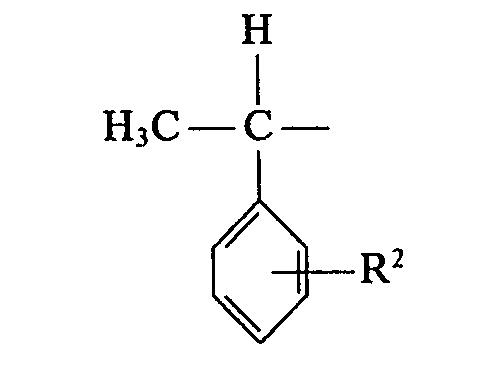
- Bevorzugte Ausgangsstoffe II, 111 und dementsprechend bevorzugte Endstoffe I sind solche, in deren Formeln im Rahmen der im Patentanspruch angegebenen Definition die einzelnen Reste R1 gleich oder verschieden sein können und 1 bis 3 Reste R' jeweils den Rest


- Folgende Naphthole kommen z. B. als Ausgangsstoffe II in Betracht: Methyl-, Ethyl-, n-Propyl-, Isopropyl-, n-Butyl-, Isobutyl-, sek.-Butyl-β- naphthol, wobei der Alkylsubstituent in 3-, 4-, 5-, 6-, 7- oder 8-Stellung sitzt; in 3,4-, 4,5-, 4,6-, 6,7-Stellung durch Methyl-, Ethyl-, n-Propyl-, Isopropyl-, n-Butyl-, Isobutyl-, sek.-Butyl-gruppen disubstituiertes β-Naphthol; entsprechende β-Naphthole mit 2 vorgenannten, aber unterschiedlichen Resten, z. B. 4-Ethyl-8-methyl-2-naphthol, 3-Methyl-4-butyl-2-naphthol; vorzugsweiseβ-Naphthol.
- Es können z. B. folgende Styrole als Ausgangsstoffe III verwendet werden: Styrol; in o-, m- oder p-Stellung durch die Methyl-, Ethyl-, Propyl-, Isopropyl-, Butyl-gruppe substituierte Styrole.
- Die Umsetzung wird bei einer Temperatur von 100 bis 180°C, vorzugsweise von 130 bis 150°C, mit Unterdruck, Überdruck oder drucklos, diskontinuierlich oder kontinuierlich durchgeführt. Man verwendet unter den Reaktionsbedingungen inerte Lösungsmittel mit einem Siedepunkt über 130°C, zweckmäßig von 131 bis 300°C, vorteilhaft 150 bis 250°C. Als Lösungsmittel kommen z. B. in Frage: Halogenkohlenwasserstoffe, insbesondere Fluor-, Brom- oder Chlorkohlenwasserstoffe, z. B. 1,2-Dibromethan, 1,1,2,2-Tetrachlorethan; aromatische Kohlenwasserstoffe, z. B. Naphthalin, Diphenyl, Dichlorbenzol, Chlorbenzol, Xylole, Ethylbenzol; aliphatische Kohlenwasserstoffe wie Dekalin, Testbenzin, Terpentinöl; und entsprechende Gemische. Bevorzugt sind Chlorbenzol, Dichlorbenzol, Dekalin, Testbenzin, die unter der Bezeichnung OShellsol F und Shellsol AB im Handel erhältlichen Lösungsmittelgemische aliphatischer bzw. aromatischer Kohlenwasserstoffe. Zweckmäßig verwendet man das Lösungsmittel in einer Menge von 10 bis 1000 Gewichtsprozent, vorzugsweise von 50 bis 200 Gewichtsprozent, bezogen auf Styrol 111.
- Als Sulfonsäuren kommen aromatische und aliphatische, vorteilhaft Alkylsulfonsäure mit 1 bis 8, insbesondere 1 bis 4 Kohlenstoffatomen, oder eine Alkylphenylsulfonsäure mit jeweils 7 bis 12 Kohlenstoffatomen oder Benzolsulfonsäure in Betracht. Die Sulfonsäure wird vorzugsweise in einem Verhältnis von 0,01 bis 1, insbesondere 0,05 bis 0,5 Äquivalenten Sulfonsäure je Mol Ausgangsstoff ll, verwendet.
- Beispielsweise sind folgende Sulfonsäuren geeignet: Benzol-, p-Toluol-, Ethylbenzol-, Propan-, Butan-, 2,5-Dimethylbenzol-, Methan-, Ethansulfonsäure.
- Die Reaktion kann wie folgt durchgeführt werden: Ein Gemisch von Ausgangsstoff II und 111, Sulfonsäure und Lösungsmittel wird während 1 bis 10 Stunden bei der Reaktionstemperatur gehalten. Zweckmäßig gibt man zu einem Gemisch von β-Naphthol und Lösungsmittel bei der Reaktionstemperatur unter Rühren Styrol oder ein Gemisch aus Styrol und einem Teil des Lösungsmittels zu. Dann wird aus dem Reaktionsgemisch der Endstoff in üblicher Weise, z. B. durch Destillation, isoliert.
- Die nach dem Verfahren der Erfindung herstellbaren (Aralkyl)-2-naphthole 1 sind wertvolle Ausgangsstoffe für die Herstellung von Farbstoffen, Schädlingsbekämpfungsmitteln, Pharmazeutika, Salben, Emulgatoren, Dispergiermitteln, Stabilisatoren, hydraulischen Flüssigkeiten, Weichmachern, Korrosionsinhibitoren, Desinfektionsmitteln, Pflanzenschutzmitteln. Sie finden beispielsweise bei der Herstellung von Farbstoffen zur Mineralölfärbung, Heizöl-, Wachs-, Fettfärbung Verwendung (DE-OS 2 852 863). Bezüglich der Verwendung wird auch auf die vorgenannten Veröffentlichungen verwiesen.
- In einem Rührreaktor wurde ein Gemisch aus 100 Gramm β-Naphthol und 100 Gramm ®Shellsol AB unter Stickstoff auf 130°C erhitzt, 3 Gramm p-Toluolsulfonsäuremonohydrat zugegeben und anschließend 100 Gramm Styrol innerhalb von 3 Stunden zugefügt. Nach Beendigung der Styrolzugabe wurde 3 Stunden bei 130°C gerührt. Entsprechend der gaschromatographischen Analyse enthielt das Reaktionsgemisch (196 Gramm) 3% β-Naphthol, 40% 6-(α-Phenylethyl)-β-naphthol, 7% eines Gemisches von 3- und 8-(α-Phenytethyl)-β-naphtholen, 39% eines Gemisches von 3,6-, 3,8- und 6,8-Di-(a-Penylet- hyl)-,8-naphthole und 10% 3,6,8-Tri-(α-phenylethyl)-β-naphthol. Dinaphthylether und Styrololigomere traten nicht in deutlicher Menge auf.
- In einem Rührreaktor wurde unter Stickstoff ein Gemisch aus 100 Gramm β-Naphthol und 3 Gramm 96prozentiger Schwefelsäure bei 130°C innerhalb von 2 Stunden mit 100 Gramm Styrol versetzt und nach Beendigung der Styrolzugabe noch 2 Stunden bei 130" C gerührt. Entsprechend der gaschromatographischen Analyse enthielt das Reaktionsgemisch (205 Gramm) 2% β-Naphthol, 2% Dinaphthylether, 45% 1-, 6- und 3-(α-Phenyleihyl)-β-naphthole, 34% Di-(α-phenylethyl)-β-naphthole und 6% Tri-(α-phenylethyl)-β-naphthole. Der Rest (11%) bestand aus Oligomeren des Styrols, höher aralkylierten Dinaphthylethern und aus Naphtholsulfonsäuren.
- In einem Rührreaktor wurde ein Gemisch aus 100 Gramm β-Naphthol und 100 Gramm 1,2-Dichlorbenzol unter Stickstoff auf 135°C erhitzt, 2 Gramm p-Toluolsulfonsäuremonohydrat zugefügt und anschließend 50 Gramm Styrol innerhalb von 2 Stunden zugefügt. Nach Beendigung der Styrolzugabe wurde 3 Stunden bei 135°C gerührt. Nach der Abtrennung des Katalysators und der destillativen Aufarbeitung erhielt man 96 Gramm (81% der Theorie) 6-(1'-Phenylethyl)-β-naphthol (Kp. 247-249°C/ 15 mbar). Der Rest bestand aus höher aralkylierten,β- Naphtholen. Man beobachtete keine wesentlichen Mengen an Dinaphthylether und Styrolpolymeren.
- In einem Rührreaktor wurde ein Gemisch aus 144 Gramm β-Naphthol und 5 Gramm Oxalsäure unter Rühren auf 130°C erhitzt und 104 Gramm Styrol innerhalb einer Stunde zugeführt. Nach Beendigung der Umsetzung wurde das Reaktionsgemisch im Vakuum destilliert. Man erhielt 213 Gramm (86% der Theorie) 1-(α-Phenylethyl)-β-naphthol (Kp. 172-176° C/0,2 mbar).
- Ein Gemisch aus 144 Gramm β-Naphthol, 100 Milliliter Toluol und 15 Gramm Schwefelsäure (96%ig) wurde auf 110°C erhitzt und ein Gemisch aus 52 Gramm Styrol und 25 Milliliter Toluol innerhalb einer Stunde zugegeben. Nach 3 Stunden Erhitzen am Rückfluß wurde das Reaktionsgemisch auf übliche Weise aufgearbeitet. Neben 21 Gramm Naphtholsulfonsäure erhielt man 41 Gramm 6-(a-Phenylethyl)-2-naphthol (34% der Theorie) vom Kp. 244-248° C/15 mbar.
- Ein Gemisch aus 144 Gramm β-Naphthol und 10 Gramm Amberlite IR- 120 wurde auf 130°C erhitzt und 94 Gramm Styrol zugegeben. Anschließend wurde das Gemisch 15 Stunden bei 130°C gerührt. Entsprechend der gaschromatographischen Analyse enthielt das Reaktionsgemisch ein Gemisch aus 14% Naphthol, 63% 1-(1'-Phenylethyl)-2-naphthol, 10% 6-(1'-Phenylethyl)-2-naphthol, 3% 3- und 8-(1'-Phe- nylethylnaphthol) und 9% zweifach und höher alkylierte Naphthole.
Claims (1)
- Verfahren zur Herstellung von in 1-Stellung unsubstituierten, durch araliphatische Reste substituierten β-Naphtholen der Formel



Applications Claiming Priority (2)
| Application Number | Priority Date | Filing Date | Title |
|---|---|---|---|
| DE19813152004 DE3152004A1 (de) | 1981-12-31 | 1981-12-31 | Verfahren zur herstellung von in l-stellung unsubstituierten, durch araliphatische reste substituierten ss-naphtholen |
| DE3152004 | 1981-12-31 |
Publications (2)
| Publication Number | Publication Date |
|---|---|
| EP0083428A1 EP0083428A1 (de) | 1983-07-13 |
| EP0083428B1 true EP0083428B1 (de) | 1985-07-10 |
Family
ID=6150060
Family Applications (1)
| Application Number | Title | Priority Date | Filing Date |
|---|---|---|---|
| EP82111521A Expired EP0083428B1 (de) | 1981-12-31 | 1982-12-11 | Verfahren zur Herstellung von in 1-Stellung unsubstituierten, durch araliphatische Reste substituierten beta-Naphtholen |
Country Status (2)
| Country | Link |
|---|---|
| EP (1) | EP0083428B1 (de) |
| DE (2) | DE3152004A1 (de) |
Family Cites Families (7)
| Publication number | Priority date | Publication date | Assignee | Title |
|---|---|---|---|---|
| US2247403A (en) * | 1939-03-24 | 1941-07-01 | Dow Chemical Co | Aralkyl polynuclear phenol |
| US2523939A (en) * | 1946-11-25 | 1950-09-26 | Reichhold Chemicals Inc | Preparation of substituted phenols |
| US2714120A (en) * | 1950-05-23 | 1955-07-26 | Goodrich Co B F | Method of preparing aralkylated phenolic compounds |
| US2978515A (en) * | 1956-05-24 | 1961-04-04 | Goodrich Co B F | Process for preparing phenol derivatives |
| US3267154A (en) * | 1963-08-13 | 1966-08-16 | Koppers Co Inc | Mixed salts of aluminum as ortho-alkylation catalysts |
| DE2852863A1 (de) * | 1978-12-07 | 1980-06-19 | Basf Ag | In organischen loesungsmitteln loesliche verbindungen |
| DE2950290A1 (de) * | 1979-12-14 | 1981-06-19 | Basf Ag, 6700 Ludwigshafen | Verfahren zur herstellung von 1-(aralkyl)-2-naphhtholen |
-
1981
- 1981-12-31 DE DE19813152004 patent/DE3152004A1/de not_active Withdrawn
-
1982
- 1982-12-11 DE DE8282111521T patent/DE3264692D1/de not_active Expired
- 1982-12-11 EP EP82111521A patent/EP0083428B1/de not_active Expired
Also Published As
| Publication number | Publication date |
|---|---|
| DE3264692D1 (en) | 1985-08-14 |
| EP0083428A1 (de) | 1983-07-13 |
| DE3152004A1 (de) | 1983-07-07 |
Similar Documents
| Publication | Publication Date | Title |
|---|---|---|
| DE882987C (de) | Verfahren zur Herstellung von tert.-Alkylbenzolcarbonsaeuren | |
| DE2139564B2 (de) | Verfahren zur Herstellung von 33'33'-Tetra-isopropyl-4,4'-hydroxydiphenyl | |
| EP0083428B1 (de) | Verfahren zur Herstellung von in 1-Stellung unsubstituierten, durch araliphatische Reste substituierten beta-Naphtholen | |
| EP0068372B1 (de) | Verfahren zur Herstellung von 2-Alkyl-4,4-diacyloxy-2-butenalen | |
| DE3884157T2 (de) | Verfahren zur Alkylierung von Phenolen. | |
| EP0025519A1 (de) | Verfahren zur Herstellung von 2-Alkyl- bzw. 2-Arylthiomethylphenol | |
| DE2949847C2 (de) | ||
| EP0032576A1 (de) | Verfahren zur Herstellung von p-substituierten Phenylpropanolen und deren Estern sowie von p-substituierten 3-Phenyl-2-methyl-propanalen | |
| CH631146A5 (de) | Verfahren zur herstellung von 2,6-dimethoxy-4-(quaternaeren-alkyl)phenolen. | |
| DE2712530C3 (de) | Verfahren zur Herstellung von 2,6-Di-tert.butylphenol | |
| EP0028725B1 (de) | Verfahren zur Herstellung von aromatischen Aldehyden nach der Sommelet-Reaktion | |
| EP0030701B1 (de) | Verfahren zur Herstellung von 1-(Aralkyl)-2-naphtholen | |
| EP0498847B1 (de) | Verfahren zur herstellung von 1,4-bis-(4-hydroxybenzoyl)-benzol | |
| EP0281929B1 (de) | Herstellung von Olefinen aus tertiären Alkylhalogeniden | |
| EP0544074A1 (de) | Verfahren zur Herstellung von ortho-substituierten Alkylphenolen und Katalysator hierfür | |
| DE2241156C3 (de) | Verfahren zur Herstellung von Hydroxyäthyläthern von a -Acetylenalkoholen | |
| CH616430A5 (en) | Process for preparing organic esters of phosphorus | |
| EP0564979B1 (de) | Verfahren zur Herstellung von Dixylylpropan | |
| DE19829828C1 (de) | Neue Indanonderivate und Verfahren zu deren Herstellung | |
| EP0526794B1 (de) | Verfahren zur Herstellung benzylierter Aromaten | |
| DE3544733A1 (de) | Verfahren zur herstellung von gegebenenfalls substituierten 2-benzyl-toluolen | |
| DE69014659T2 (de) | Verfahren zur Herstellung von Polyalkyltetrahydronaphthalenen. | |
| DE3031385A1 (de) | 1-hydroxypyrazol und verfahren zu seiner herstellung | |
| EP0222268B1 (de) | Verfahren zur Herstellung von Aryloxethylsulfonen | |
| EP0075613B1 (de) | Verfahren zur Herstellung von N-(1-Formylamido-2,2,2-trichloräthyl)-morpholin |
Legal Events
| Date | Code | Title | Description |
|---|---|---|---|
| PUAI | Public reference made under article 153(3) epc to a published international application that has entered the european phase |
Free format text: ORIGINAL CODE: 0009012 |
|
| 17P | Request for examination filed |
Effective date: 19821211 |
|
| AK | Designated contracting states |
Designated state(s): BE CH DE FR GB LI |
|
| GRAA | (expected) grant |
Free format text: ORIGINAL CODE: 0009210 |
|
| AK | Designated contracting states |
Designated state(s): BE CH DE FR GB LI |
|
| REF | Corresponds to: |
Ref document number: 3264692 Country of ref document: DE Date of ref document: 19850814 |
|
| ET | Fr: translation filed | ||
| PLBE | No opposition filed within time limit |
Free format text: ORIGINAL CODE: 0009261 |
|
| STAA | Information on the status of an ep patent application or granted ep patent |
Free format text: STATUS: NO OPPOSITION FILED WITHIN TIME LIMIT |
|
| 26N | No opposition filed | ||
| PGFP | Annual fee paid to national office [announced via postgrant information from national office to epo] |
Ref country code: FR Payment date: 19971127 Year of fee payment: 16 |
|
| PGFP | Annual fee paid to national office [announced via postgrant information from national office to epo] |
Ref country code: GB Payment date: 19971202 Year of fee payment: 16 |
|
| PGFP | Annual fee paid to national office [announced via postgrant information from national office to epo] |
Ref country code: CH Payment date: 19971205 Year of fee payment: 16 |
|
| PGFP | Annual fee paid to national office [announced via postgrant information from national office to epo] |
Ref country code: DE Payment date: 19971212 Year of fee payment: 16 Ref country code: BE Payment date: 19971212 Year of fee payment: 16 |
|
| PG25 | Lapsed in a contracting state [announced via postgrant information from national office to epo] |
Ref country code: GB Free format text: LAPSE BECAUSE OF NON-PAYMENT OF DUE FEES Effective date: 19981211 |
|
| PG25 | Lapsed in a contracting state [announced via postgrant information from national office to epo] |
Ref country code: DE Free format text: LAPSE BECAUSE OF THE APPLICANT RENOUNCES Effective date: 19981224 |
|
| PG25 | Lapsed in a contracting state [announced via postgrant information from national office to epo] |
Ref country code: LI Free format text: LAPSE BECAUSE OF NON-PAYMENT OF DUE FEES Effective date: 19981231 Ref country code: CH Free format text: LAPSE BECAUSE OF NON-PAYMENT OF DUE FEES Effective date: 19981231 Ref country code: BE Free format text: LAPSE BECAUSE OF NON-PAYMENT OF DUE FEES Effective date: 19981231 |
|
| BERE | Be: lapsed |
Owner name: BASF A.G. Effective date: 19981231 |
|
| GBPC | Gb: european patent ceased through non-payment of renewal fee |
Effective date: 19981211 |
|
| REG | Reference to a national code |
Ref country code: CH Ref legal event code: PL |
|
| PG25 | Lapsed in a contracting state [announced via postgrant information from national office to epo] |
Ref country code: FR Free format text: LAPSE BECAUSE OF NON-PAYMENT OF DUE FEES Effective date: 19990831 |
|
| REG | Reference to a national code |
Ref country code: FR Ref legal event code: ST |