EP0083463A1 - Waschkolonne - Google Patents
Waschkolonne Download PDFInfo
- Publication number
- EP0083463A1 EP0083463A1 EP82201666A EP82201666A EP0083463A1 EP 0083463 A1 EP0083463 A1 EP 0083463A1 EP 82201666 A EP82201666 A EP 82201666A EP 82201666 A EP82201666 A EP 82201666A EP 0083463 A1 EP0083463 A1 EP 0083463A1
- Authority
- EP
- European Patent Office
- Prior art keywords
- washing
- working space
- mother liquor
- space
- washing column
- Prior art date
- Legal status (The legal status is an assumption and is not a legal conclusion. Google has not performed a legal analysis and makes no representation as to the accuracy of the status listed.)
- Granted
Links
- 238000005406 washing Methods 0.000 title claims abstract description 102
- 239000007787 solid Substances 0.000 claims abstract description 43
- 239000012452 mother liquor Substances 0.000 claims abstract description 37
- 239000000126 substance Substances 0.000 claims abstract description 34
- 239000007788 liquid Substances 0.000 claims abstract description 28
- 239000011521 glass Substances 0.000 claims abstract description 26
- 238000000926 separation method Methods 0.000 claims abstract description 8
- 239000000155 melt Substances 0.000 claims abstract description 7
- 239000000725 suspension Substances 0.000 claims description 33
- 238000007599 discharging Methods 0.000 claims description 3
- 230000014759 maintenance of location Effects 0.000 claims description 2
- 239000012780 transparent material Substances 0.000 claims description 2
- 230000000694 effects Effects 0.000 abstract description 7
- 238000010276 construction Methods 0.000 abstract description 2
- -1 on the one hand Substances 0.000 abstract 1
- 239000002245 particle Substances 0.000 description 23
- URLKBWYHVLBVBO-UHFFFAOYSA-N Para-Xylene Chemical group CC1=CC=C(C)C=C1 URLKBWYHVLBVBO-UHFFFAOYSA-N 0.000 description 8
- 239000000463 material Substances 0.000 description 8
- 239000000203 mixture Substances 0.000 description 6
- 239000000243 solution Substances 0.000 description 6
- 239000013078 crystal Substances 0.000 description 4
- 238000002844 melting Methods 0.000 description 4
- 230000008018 melting Effects 0.000 description 4
- 239000004033 plastic Substances 0.000 description 4
- 229920003023 plastic Polymers 0.000 description 4
- UHOVQNZJYSORNB-UHFFFAOYSA-N Benzene Chemical compound C1=CC=CC=C1 UHOVQNZJYSORNB-UHFFFAOYSA-N 0.000 description 3
- 239000007864 aqueous solution Substances 0.000 description 3
- 230000015572 biosynthetic process Effects 0.000 description 3
- 238000004891 communication Methods 0.000 description 3
- UFWIBTONFRDIAS-UHFFFAOYSA-N Naphthalene Chemical compound C1=CC=CC2=CC=CC=C21 UFWIBTONFRDIAS-UHFFFAOYSA-N 0.000 description 2
- CTQNGGLPUBDAKN-UHFFFAOYSA-N O-Xylene Chemical group CC1=CC=CC=C1C CTQNGGLPUBDAKN-UHFFFAOYSA-N 0.000 description 2
- 238000009835 boiling Methods 0.000 description 2
- 238000002425 crystallisation Methods 0.000 description 2
- 230000008025 crystallization Effects 0.000 description 2
- 238000001514 detection method Methods 0.000 description 2
- 238000010586 diagram Methods 0.000 description 2
- 238000009413 insulation Methods 0.000 description 2
- 238000011835 investigation Methods 0.000 description 2
- IVSZLXZYQVIEFR-UHFFFAOYSA-N m-xylene Chemical group CC1=CC=CC(C)=C1 IVSZLXZYQVIEFR-UHFFFAOYSA-N 0.000 description 2
- 230000003287 optical effect Effects 0.000 description 2
- 230000001105 regulatory effect Effects 0.000 description 2
- 229920003002 synthetic resin Polymers 0.000 description 2
- 239000000057 synthetic resin Substances 0.000 description 2
- OCJBOOLMMGQPQU-UHFFFAOYSA-N 1,4-dichlorobenzene Chemical compound ClC1=CC=C(Cl)C=C1 OCJBOOLMMGQPQU-UHFFFAOYSA-N 0.000 description 1
- 229920005439 Perspex® Polymers 0.000 description 1
- 238000013019 agitation Methods 0.000 description 1
- 230000033228 biological regulation Effects 0.000 description 1
- 230000005540 biological transmission Effects 0.000 description 1
- 239000003795 chemical substances by application Substances 0.000 description 1
- FOCAUTSVDIKZOP-UHFFFAOYSA-N chloroacetic acid Chemical compound OC(=O)CCl FOCAUTSVDIKZOP-UHFFFAOYSA-N 0.000 description 1
- 229940106681 chloroacetic acid Drugs 0.000 description 1
- 239000004020 conductor Substances 0.000 description 1
- 230000001276 controlling effect Effects 0.000 description 1
- 238000000354 decomposition reaction Methods 0.000 description 1
- 238000001914 filtration Methods 0.000 description 1
- 239000011491 glass wool Substances 0.000 description 1
- 230000002452 interceptive effect Effects 0.000 description 1
- 238000005259 measurement Methods 0.000 description 1
- 230000007246 mechanism Effects 0.000 description 1
- 239000002184 metal Substances 0.000 description 1
- 238000000034 method Methods 0.000 description 1
- 239000011490 mineral wool Substances 0.000 description 1
- 230000007935 neutral effect Effects 0.000 description 1
- 229940078552 o-xylene Drugs 0.000 description 1
- 230000001151 other effect Effects 0.000 description 1
- 238000012856 packing Methods 0.000 description 1
- 230000000704 physical effect Effects 0.000 description 1
- 239000004926 polymethyl methacrylate Substances 0.000 description 1
- 239000011148 porous material Substances 0.000 description 1
- 238000004886 process control Methods 0.000 description 1
- 238000011112 process operation Methods 0.000 description 1
- 238000011084 recovery Methods 0.000 description 1
- 239000002562 thickening agent Substances 0.000 description 1
- 230000000007 visual effect Effects 0.000 description 1
Images

Classifications
-
- B—PERFORMING OPERATIONS; TRANSPORTING
- B01—PHYSICAL OR CHEMICAL PROCESSES OR APPARATUS IN GENERAL
- B01D—SEPARATION
- B01D9/00—Crystallisation
- B01D9/02—Crystallisation from solutions
- B01D9/04—Crystallisation from solutions concentrating solutions by removing frozen solvent therefrom
-
- B—PERFORMING OPERATIONS; TRANSPORTING
- B01—PHYSICAL OR CHEMICAL PROCESSES OR APPARATUS IN GENERAL
- B01D—SEPARATION
- B01D9/00—Crystallisation
- B01D9/004—Fractional crystallisation; Fractionating or rectifying columns
-
- B—PERFORMING OPERATIONS; TRANSPORTING
- B01—PHYSICAL OR CHEMICAL PROCESSES OR APPARATUS IN GENERAL
- B01D—SEPARATION
- B01D9/00—Crystallisation
- B01D9/0063—Control or regulation
Definitions
- Dutch patent application 79,04919 discloses a washing column with a sharp stable washing front, in particular for the separation of ice crysals from a suspension thereof in an aqueous solution. It was to be expected that the same princiaes for creating a sharp, stable washing front could be used for the separation of any solid chemical from a suspension thereof in a mother liquor.
- the system concerned is normally chemically neutral relative to structural parts, which are pressure- resistant, electrically insulating, and preferably transparent.
- the outer wall of the washing column may be made of a synthetic plastics material, such as Perspex (polymethylmetacrylate), which is available at a relatively low price and with a large thickness.
- Glass is a much better heat conductor than the synthetic resin materials referred to, which property turned out to cause problems, because with the chemical systems involved, it is often necessary to use temperatures differing considerably from the ambient temperature.
- a second problem was connnected with the necessary large wall thickness of the glass needed to withstand overpressures in the washing process, which normally range between 1 and 9 ats. Glass of large thickness is'difficult to provide with the small dimensional tolerances which produce few problems with the- synthetic resin materials referred to.
- As the mechanical strength of glass is inferior to that of the materials that can be used if ice crystals are to be separated from an aqueous'mother liquor, it is necessary to use glass of a relatively large thickness. All this leads to the following.
- Channel formation and generally the instability of the washing front are surprisingly found to be in addition promoted by minor irregularities in wall thickness and in the inner surface of the wall, and through heat transmission via the glass, causing heat exchange between the mother liquor plus solid particles, on the one hand, and the washing liquid (generally consisting of the melt of the solid chemical to be separated) plus solid particles, on the other, which irregularities and heat exchange will be more considerable according as the wall is thicker.
- the invention relates to a washing column for the continuous separation between, on the one hand, a solid chemical substance formed in a liquid multi-component system, and on the other hand, the mother liquor in-which this substance is suspended, said washing column comprising a cylindrical wall defining a working space, means for supplying the suspension to the working space, means in said working space for discharging mother liquor from the suspension with retention of the solid chemical substance, means for forming in said working space a packed bed of the solid chemical substance under an absolute pressure higher than 1 at., means for continuously advancing said packed bed in the axial direction in said working space, and means for forming in said packed bed a straight plane washing front perpendicular to the axis of the washing column, between, on the one hand,. said mother liquor, and on the other hand, a melt of the solid chemical substance, which washing front is practically stationary relative to the washing column.
- this washing column is the suspension must first be thickened in the working space, and measures must be taken to enable the thickened suspension to be homogeneously built up to a packed bed, and measures for imparting a translatory movement thereto in the axial direction.
- the most important point is that the solid particles, before reaching the washing front, should be uniformly distributed throughout the cross-section of the packed bed.
- the entraining effect of the flowing mother liquor for moving the packed bed, and nevertheless ensure a homogeneous build-up of the bed when this reaches the boundary surface between the solution and the washing liquid (the washing front).
- the entraining effect may bring the solid particles into the zone where the solution is withdrawn.
- the solid particles which there accumulate may propel other solid particles.
- homogenity may be reached if the washing front is at a sufficient dEtance from the place where the solution has been withdrawn, even if at the place where the aqueous solution is withdrawn the thickened suspension is initially of inhomogeneous build-up, for example, in case a wall filter is used.
- This thickened and initially inhomogeneous suspension must be given an opportunity to homogenize or to be homogenized.
- the suspension must be homogeneous throughout its cross-section when reaching the washing front. This is necessary to prevent radial differences in resistance against liquid flow. If there are such differences, the washing front will not be plane,but exhibit some curvature.
- the outer wall of the working space is of glass, said outer wall of the working space is surrounded by a second wall defining with the wall of the working space an enveloping space, a heat-insulating medium being provided in said enveloping space, and means being provided for attuning the pressure in said enveloping space to the pressure in said working space.
- the outer wall of the working space may consist of thin glass, so that the heat exchange phenomena are rendered harmless.
- the outer wall of the enveloping space consists, at least in part, of a transparent material, to enable visual observation of the washing front, and if desired regulating said washing front on the basis of optical detection methods.
- a suitable heat insulating medium in the envebping space is air, although other substances may be used, such as oil. If the regulation of the washing front is not effected on the basis of optical detection methods, but for example on the basis of temperature and conductivity measurements, the enveloping space may be filled in addition to pressurized gas, with solid insulating agents, such as balls of synthetic plastics material, glass wool, rock wool, and the like.
- the thickness of the glass will range between 1/30 and 1/20 of the inner diameter of the washing column.
- the suspension is. supplied near the bottom of a vertical cylinder.
- the bottom is provided with a sieve gauze, through which the mother liquor is withdrawn.
- a stirrer-scraper mounted on a shaft extending through the bottom of the cylinder, and driven by a motor, keeps the sieve gauze clean and homogenizes the thickened suspension.
- the suspension may be supplied laterally or through the (hollow) shaft of the stirrer-scraper.
- the sieve gauze through which the solution is withdrawn need not be mounted in the bottom, but for example may also be mounted in the cylinder wall adjacent to the bottom.
- the solid particles accumulating in the bottom portion of the cylinder proper other solid particles to form a packed bed.
- the liquid in the bottom portion of the cylinder is mother liquor, and the liquid in the top portion is washing liquid.
- the boundary face between the mother liquor and the washing liquid is the washing front, which is kept at a substantially constant level by regulating the pressure of the incoming suspension and the pressure of the washing liquid. This may be effected as described in more detail hereinafter.
- a scraper may be provided for disintegrating the washed packed bed, and discharging the disintegration product. This, too, will be described in greater detail hereinafter.
- the disintegration may also be effected by melting.
- the zone where the mother liquor is withdrawn from the suspension comprises hollow blades mounted on a rotary shaft and having perforations therein (provided with sieve gauxe) through which the mother liquor is withdrawn.
- These blades may be mounted on the shaft in such a manner as to enable them to rotate freely around small shafts at right angles to the main shaft, which means are capable of assuming an inclination depending on-prevalent-conditions, such as the rate of rotation of the shaft and the entraining effect of the mother liquor withdrawn through these hollow blades.
- the blades do not provide the energy for propelling the solid particles, but the moving force is the entraining effect of the mother liquor being withdrawn.
- the solid particles accumulating owing to the withdrawal of the mother liquor propel other solid particles.
- Another preferred feature according to the invention is the use of mechanical means for imparting a translatory movement to the thickened suspension of solid particles, whereby a constantly advancing packed bed of these particles is formed.
- This can be effected, for example, by using inclined blades mounted on the rotary main shaft in such a manner that they exhibit a fixed inclination.
- the sieve gauze for withdrawing the mother liquor may be provided in the blades if they are hollow.
- an annular structure of the bed is recommendable, in particular in the case of large washing column diameters, and if the mother liquor is withdrawn from the suspension through a sieve gauze provided in the direction of movement of the packed bed (for example, a filter in the cylinder wall). It is then possible to use an apparatus comprising a cylinder coaxially disposed within another cylinder of larger diameter. The difference in diameters and the distance between the sieve gauze and the washing front should be selected in such a manner that, under operating conditions, the packed bed near the washing front exhibits a homogeneous build-up.
- the annular space may be considerably larger. If, for example, inclined blades are used, and the inner diameter of the outer cylinder of the working space is 100 cm, the ring may have a width of 20 cm. The tendency of an inhomogeneous build-up of the packed bed is then much less.
- the mechanical means such as inclined blades, used for imparting a translatory movement to the packed bed in the direction of the axis of the cylindrical washing column, and scraper members used for the disintegration of the packed bed after it has passed through the washing front, may be mounted on the inner cylinder.
- the inner cylinders should be rotated.
- the inner cylinder may be kept stationary. In that case the mechanical means for advancing the packed bed and the scraper members, if present, should be driven separately. This will be described in more detail in the description of a preferred embodiment..
- the inner cylinder may also be mounted on the same shaft as the mechanical means for advancing the packed bed.
- An optimum possibility of process control may be provided, if desired, by providing the inner cylinder of the working space, the mechanical advancing means, and the scraper members with separate drive mechanisms, so that their respective rates of rotation may be varied as desired.
- the disintegration of the packed bed after it has passed the washing front may be effected by melting. Particularly good results are obtained, however, by using scrapers.
- Scrapers for this purpose are known per se, for example, from US patent 3,872,009; in the following description of a preferred embodiment, a slightly modified construction is described.
- the resistance force counteracting the translatory movement of the bed of solid particles will generally cause the bed to become packed.
- the washing front there will be a "jump" in temperature, as the mother liquor between the solid particles will have a lower temperature than the washing liquid, which normally consists of a melt of the solid substance suspended.in the mother liquor.
- washing front When contacting the washing liquid, some washing liquid between the solid particles will be solidified and thereby cause the solid particles to be cemented together by crystallization. In this way a solid porous plug of the chemical substance is formed at the washing front.
- the washing front which is practically stationary relative to the washing column, is moved relative to the packed bed through the pores in the plug. In this way the bed is "internally" washed.
- the position of the washing front relative to the washing column can be kept substantially fixed by means of a sensor with feedback to the position of the washing front. This may be effected, for example, by means of two temperature sensors placed on different sides of the washing front at a short distance from each other.
- the most preferred embodiments of the invention are those in which an annular structure of the working space of the washing column is combined with rotating hollow blades with a fixed inclination, through which the solution is withdrawn from the suspension, and in which the scraper members, on theme hand, and the inclined blades, on the other, are provided with separate drive means.
- the scraper members are given a higher rate of rotation than the inclined blades.
- a suspension of solid particles in mother liquor is supplied at 1.
- mother liquor is withdrawn from the suspension, which mother liquor is discharged at 3, leaving a thickened suspension.
- the thickened suspension is homogenized and at 5 a packed bed of solid particles is formed.
- the movement of the packed bed through a stationary layer of mother liquor is represented by 6, which bed then arrives at the washing front 7.
- the bed subsequently moves at 8 through a substantially stationary layer of washing liquid normally consisting of a melt of the solid chemical substance, whereby normally a solid porous plug 9 is formed, whereafter the plug is disintegrated at 9, and the product of the disintegration is washed away at 10 and discharged at 11.
- Some of the functions 2, 4, 5 and 6 may be carried out simultaneously, in particular in the embodiments of the invention described above.
- the functions 2, 4 and 5 may occur pratically simultaneously.
- the thickened suspension, when arriving at the washing front should be homogeneously packed, so that a plane, non-curved washing front perpendicular to the axis of the washing column is formed.
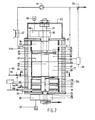
- Fig. 2 shows a preferred embodiment of the washing column according to the invention, partly in longitudinal section and partly in elevation, so as to show the interior in side-elevational view.
- a cylindrical glass envelope 17 is confined between two metal cylinders 17A and 17B.
- the total sub-assembly of 17A, 17 and 17B is in turn confined between a bottom plate 18 and a cover plate 19.
- an inner cylindrical body 20 is shown within envelope 17, an inner cylindrical body 20 is shown.
- Body 20 is connected with a shaft 21, which in turn is connected to a strip 22 bolted to comr plate 19.
- Another cylindrical body 23 is connected to a shaft 24 carrying a gear wheel 25.
- Gear wheel 25 cooperates with a gear wheel 26 driven by a motor 27.
- Body 23 carries hollow inclined blades 28, provided at their upper surface with a sieve gauze 29. The blades are shown in simplified form, and will be described in more detail with reference to Figs. 3 and 4.
- the interior of the hollow blades 28 is in communication with a duct 29', through which liquid can be withdrawn.
- Body 23 also carries pins 30, while envelope 17 is provided with vertical blades 31.
- a disc 32 provided with knives 33 and slots 34 functions as a scraper.
- Disc 32 is connected to a cylindrical body 35, which is connected to a gear wheel 37 cooperating with a gear wheel 38.
- Gear wheel 38 is driven by a motor 39.
- the suspension is supplied at 40, and is kept in agitation by pins 30 cooperating with blades 31 in order to prevent settling of the solid particles.
- Mother liquor is withdrawn through the sieve gauze 29, and is discharged through the hollow blades 28 and duct 29' leaving a thickened suspension on the surface of sieve gauze 29.
- This thickened suspension is packed and propelled through the annular space 41 by rotation of body 23 with blades 28.
- the dot-dash line 42 represents the washing front, which is the boundary face between space 41, in which the liquid consists of mother liquor, and the space 36, in which the liquid consists of washing liquid, normally a melt of the solid chemical substance.
- Temperature sensors 57 and 58 keep the movements of the washing front within narrow limits by means of a control unit 59. They sense a certain temperature difference existing between the mother liquor and the washing liquid. If the washing front moves upwardly or downwardly, this temperature difference will disappear, in which case an electrical pulse from control unit 59 will further open or close a valve 60.
- Space 36 will generally be filled with a solid porous plug, which is disintegrated by rotation of disc 32 with knives.33.
- the particles formed by this disintegration find their way into space 43 through slots 34.
- the washing liquid is circulated. This washing liquid enters space 43 and 45 and washes away the particles through 46. The particles are melted by means of a melting device 47. If the place of the washing front turns out to be fixed, the quantity of washing liquid leaving the system to valve 60 will be equal to the quantity of solid substance discharged by scraper 32. If the washing front moves downwards, valve 60 is opened somewhat further, so that more washing liquid is discharged, and the other way round. In this way the equilibrium is restored.
- a hollow cylinder 64 of synthetic plastics material Provided between bottom plate 18 and cover plate 19 is a hollow cylinder 64 of synthetic plastics material, and having a thick wall.
- the insulation space between the glass cylinder wall 17 and the hollow cylinder 64 of synthetic plastics material is maintained at a pressure equal to the washing pressure in the washing column. This is effected by a control unit 61.
- This unit measures the pressure in the supply line 40 of the suspension. If the pressure is exceeded in the insulation space, insulating medium, normally gas, is let off through valve 65 via duct 66; if the pressure is fallen short of, insulating medium is supplied through valve 62 via duct 63.
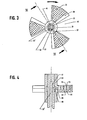
- Fig. 3 shows the sieve gauze 29 of one of the inclined blades with an edge 28. Between two inclined.blades, there is a space 48, through which the suspension passes. The blades are secured to cylindrical body 23, in which a circular groove 49 is provided. The interior of the hollow inclined blades is in communication with the circular groove 49 via channels 50. The annular cylindrical body 23 is secured to shaft 51 by means of a protecting pin 52. Shaft 51 is provided with a central channel 29', which via a channel 53 is in communication with the circular groove 49.
- Fig. 4 shows that the bottom 54 of the blade is provided in longitudinal direction with ridges 55 for supporting the sieve gauze 29. Ridges 55 are provided with apertures 56 for the discharge of the mother liquor.
- the blade is secured to the cylindrical body 23, which is provided with the channel 50 and the groove 49, where the liquid from all blades is collected. Cylindrical body 23 is secured to shaft 51, which is provided with the central channel 29', through which the mother liquor is discharged.
- a bottom filter may be used for the discharge of the liquid.
- Non-perforated blades are then arranged to rotate just above such bottom filter to drive along the crystal mass to form a packed bed.
- a washing column as described above which was provided with a glass cylinder having an internal diameter of 152.4 mm, a height of 296 mm, a wall thickness of 5.8 mm, and an annular working space of 31.4 mm, measured in the radial direction, was used for the treatment of a mixture of 81% by weight of p-xylene, 5% by weight of o-xylene, 10.5% by weight of m-xylene and 3.5% by weight of ehtyl benzene.
- the mixture was first cooled to +2°C, at which p-xylene crystallized.
- the supply rate was 250 kg/hour. Per hour, 60 kg p-xylene of purity 99.965% was separated. It is clear that the washing column makes possible a very sharp separation, while practically no washing liquid is lost.
- the separation of a chemical substance from a mixture by crystallization offers great advantages if the boiling point is high- and/or if there is a danger for decomposition at elevated temperature and/or if the mixture contains substances having a boiling point close to that of one or more other components in the mixture.
- the invention is of practical importance for the recovery of, for example, p-dichlorobenzene, p-xylene, chloroacetic acid, naphthalene and the like from mixtures in which these substances commonly occur.
Landscapes
- Chemical & Material Sciences (AREA)
- Crystallography & Structural Chemistry (AREA)
- Chemical Kinetics & Catalysis (AREA)
- Gas Separation By Absorption (AREA)
- Saccharide Compounds (AREA)
- Cleaning Or Drying Semiconductors (AREA)
- Physical Or Chemical Processes And Apparatus (AREA)
- Cleaning By Liquid Or Steam (AREA)
- Filtration Of Liquid (AREA)
- Vaporization, Distillation, Condensation, Sublimation, And Cold Traps (AREA)
Priority Applications (1)
| Application Number | Priority Date | Filing Date | Title |
|---|---|---|---|
| AT82201666T ATE15147T1 (de) | 1981-12-28 | 1982-12-27 | Waschkolonne. |
Applications Claiming Priority (2)
| Application Number | Priority Date | Filing Date | Title |
|---|---|---|---|
| NL8105872 | 1981-12-28 | ||
| NL8105872A NL8105872A (nl) | 1981-12-28 | 1981-12-28 | Waskolom. |
Publications (2)
| Publication Number | Publication Date |
|---|---|
| EP0083463A1 true EP0083463A1 (de) | 1983-07-13 |
| EP0083463B1 EP0083463B1 (de) | 1985-08-28 |
Family
ID=19838620
Family Applications (1)
| Application Number | Title | Priority Date | Filing Date |
|---|---|---|---|
| EP82201666A Expired EP0083463B1 (de) | 1981-12-28 | 1982-12-27 | Waschkolonne |
Country Status (11)
| Country | Link |
|---|---|
| US (1) | US4481169A (de) |
| EP (1) | EP0083463B1 (de) |
| JP (1) | JPS6038163B2 (de) |
| AT (1) | ATE15147T1 (de) |
| AU (1) | AU538190B2 (de) |
| BR (1) | BR8207493A (de) |
| CA (1) | CA1197076A (de) |
| DE (1) | DE3265915D1 (de) |
| MX (1) | MX162958B (de) |
| NL (1) | NL8105872A (de) |
| ZA (1) | ZA829221B (de) |
Cited By (5)
| Publication number | Priority date | Publication date | Assignee | Title |
|---|---|---|---|---|
| GB2142568A (en) * | 1983-06-30 | 1985-01-23 | Raychem Corp | Assembly of electronic components |
| EP0360876A1 (de) * | 1988-03-09 | 1990-04-04 | Societe Des Produits Nestle S.A. | Gefrierkonzentrationssystem und Verfahren |
| NL1007846C2 (nl) * | 1997-12-18 | 1999-06-21 | Niro Process Technology Bv | Werkwijze en inrichting voor het vriesconcentreren van stoffen. |
| US7540884B2 (en) | 2001-11-15 | 2009-06-02 | Basf Aktiengesellschaft | Method for performing the purifying separation of crystals out their suspension in a mother liquor |
| CN114917676A (zh) * | 2022-05-17 | 2022-08-19 | 恒丰泰精密机械股份有限公司 | 用于制备锂电池正极材料的过滤洗涤二合一搅拌设备 |
Families Citing this family (11)
| Publication number | Priority date | Publication date | Assignee | Title |
|---|---|---|---|---|
| EP0494045B1 (de) * | 1990-12-21 | 1995-04-19 | Sulzer Chemtech AG | Verfahren und Vorrichtung zur Stofftrennung mittels Kristallisation |
| US5304384A (en) * | 1993-03-23 | 1994-04-19 | Labatt Brewing Company Limited | Improvements in production of fermented malt beverages |
| USRE36897E (en) * | 1993-03-23 | 2000-10-03 | Labatt Brewing Company Limited | Methods for chill treating non-distilled malted barley beverages |
| US5695795A (en) * | 1993-03-23 | 1997-12-09 | Labatt Brewing Company Limited | Methods for chill-treating non-distilled malted barley beverages |
| US5869114A (en) * | 1994-03-18 | 1999-02-09 | Labatt Brewing Company Limited | Production of fermented malt beverages |
| BR0109929B1 (pt) * | 2000-04-11 | 2012-08-07 | processo para a purificaÇço de uma massa fundida de Ácido acrÍlico bruto. | |
| BE1018534A3 (fr) * | 2007-07-11 | 2011-03-01 | Basf Se | Procede pour la separation avec purification de cristaux acrylique, d'acide methacrylique, de n-vinulpyrrolidone ou de p-xylene a partir de leur suspension dans une lessive-mere. |
| EP2374786A1 (de) | 2010-04-09 | 2011-10-12 | GEA Niro PT B.V. | Reinigung monochloracetalsäurereicher Ströme |
| EP2923748A1 (de) | 2014-03-28 | 2015-09-30 | Sulzer Chemtech AG | Modulare Untereinheit für eine Suspensionskristallisationsanlage und Suspensionskristallisationsverfahren mit dieser modularen Untereinheit |
| CN106730979A (zh) * | 2016-12-09 | 2017-05-31 | 李伟科 | 一种可观察多功能化工用结晶釜 |
| CN107061349B (zh) * | 2017-04-05 | 2023-12-08 | 上海德耐泵业有限公司 | 叶轮、多相流反应器及多相流连续反应系统 |
Citations (4)
| Publication number | Priority date | Publication date | Assignee | Title |
|---|---|---|---|---|
| NL98747C (de) * | ||||
| DE1809104A1 (de) * | 1968-11-15 | 1970-06-04 | Dr Klaus Maas | Verfahren zum Transport von Kristallen und Schmelze |
| GB2023564A (en) * | 1978-06-23 | 1980-01-03 | Douwe Egberts Tabaksfab | Continuous Packed Bed Wash Column |
| US4279130A (en) * | 1979-05-22 | 1981-07-21 | El Paso Products Company | Recovery of 1,3-butadiene by fractional crystallization from four-carbon mixtures |
Family Cites Families (2)
| Publication number | Priority date | Publication date | Assignee | Title |
|---|---|---|---|---|
| US4172877A (en) * | 1976-06-04 | 1979-10-30 | Schwaig Robert H | Glass lined chemical reactor |
| US4332599A (en) * | 1977-01-12 | 1982-06-01 | Douwe Egberts Koninklijke, Tabaksfabriek-Koffiebranderijen - Theehandel B.V. | Continuous packed bed wash column |
-
1981
- 1981-12-28 NL NL8105872A patent/NL8105872A/nl not_active Application Discontinuation
-
1982
- 1982-12-13 CA CA000417517A patent/CA1197076A/en not_active Expired
- 1982-12-14 AU AU91480/82A patent/AU538190B2/en not_active Ceased
- 1982-12-15 ZA ZA829221A patent/ZA829221B/xx unknown
- 1982-12-17 MX MX195753A patent/MX162958B/es unknown
- 1982-12-27 EP EP82201666A patent/EP0083463B1/de not_active Expired
- 1982-12-27 AT AT82201666T patent/ATE15147T1/de not_active IP Right Cessation
- 1982-12-27 US US06/453,151 patent/US4481169A/en not_active Expired - Lifetime
- 1982-12-27 DE DE8282201666T patent/DE3265915D1/de not_active Expired
- 1982-12-27 BR BR8207493A patent/BR8207493A/pt not_active IP Right Cessation
- 1982-12-28 JP JP57227861A patent/JPS6038163B2/ja not_active Expired
Patent Citations (4)
| Publication number | Priority date | Publication date | Assignee | Title |
|---|---|---|---|---|
| NL98747C (de) * | ||||
| DE1809104A1 (de) * | 1968-11-15 | 1970-06-04 | Dr Klaus Maas | Verfahren zum Transport von Kristallen und Schmelze |
| GB2023564A (en) * | 1978-06-23 | 1980-01-03 | Douwe Egberts Tabaksfab | Continuous Packed Bed Wash Column |
| US4279130A (en) * | 1979-05-22 | 1981-07-21 | El Paso Products Company | Recovery of 1,3-butadiene by fractional crystallization from four-carbon mixtures |
Cited By (7)
| Publication number | Priority date | Publication date | Assignee | Title |
|---|---|---|---|---|
| GB2142568A (en) * | 1983-06-30 | 1985-01-23 | Raychem Corp | Assembly of electronic components |
| EP0360876A1 (de) * | 1988-03-09 | 1990-04-04 | Societe Des Produits Nestle S.A. | Gefrierkonzentrationssystem und Verfahren |
| NL1007846C2 (nl) * | 1997-12-18 | 1999-06-21 | Niro Process Technology Bv | Werkwijze en inrichting voor het vriesconcentreren van stoffen. |
| EP0923969A1 (de) * | 1997-12-18 | 1999-06-23 | Niro Process Technology B.V. | Gefrierkonzentrationssystem von Substanzen und Verfahren |
| US6247321B1 (en) | 1997-12-18 | 2001-06-19 | Niro Process Technology, B.V. | Method and apparatus for freezeconcentrating substances |
| US7540884B2 (en) | 2001-11-15 | 2009-06-02 | Basf Aktiengesellschaft | Method for performing the purifying separation of crystals out their suspension in a mother liquor |
| CN114917676A (zh) * | 2022-05-17 | 2022-08-19 | 恒丰泰精密机械股份有限公司 | 用于制备锂电池正极材料的过滤洗涤二合一搅拌设备 |
Also Published As
| Publication number | Publication date |
|---|---|
| NL8105872A (nl) | 1983-07-18 |
| MX162958B (es) | 1991-07-22 |
| DE3265915D1 (en) | 1985-10-03 |
| JPS58114701A (ja) | 1983-07-08 |
| AU538190B2 (en) | 1984-08-02 |
| BR8207493A (pt) | 1983-05-17 |
| AU9148082A (en) | 1983-07-07 |
| ATE15147T1 (de) | 1985-09-15 |
| EP0083463B1 (de) | 1985-08-28 |
| US4481169A (en) | 1984-11-06 |
| JPS6038163B2 (ja) | 1985-08-30 |
| CA1197076A (en) | 1985-11-26 |
| ZA829221B (en) | 1984-06-27 |
Similar Documents
| Publication | Publication Date | Title |
|---|---|---|
| EP0083463B1 (de) | Waschkolonne | |
| JP5620361B2 (ja) | 固−液分離方法 | |
| US4368986A (en) | Dual shell blender with intensifier | |
| US8962906B2 (en) | Apparatus and process for the separation of solids and liquids | |
| US4491462A (en) | Continuous packed bed wash column | |
| EP0098637B1 (de) | Verfahren und Vorrichtung zur Behandlung von suspendierten Feststoffen mit einer Flüssigkeit im Gegenstrom | |
| JPH0829032A (ja) | 製氷装置 | |
| JPS6239002B2 (de) | ||
| US2800411A (en) | Crystal purification apparatus and process | |
| US3652230A (en) | Crystallization apparatus with vertical helical conveyor | |
| CA1144056A (en) | Continuous packed bed wash column | |
| US2813099A (en) | Crystal purification process | |
| US2898271A (en) | Crystal purification apparatus | |
| SE7910519L (sv) | Forfarande och apparat for dispergering av en vetska i en annan vetska | |
| US4123174A (en) | Mixer | |
| EP4061520B1 (de) | Verfahren zum betrieb einer kristallisationsgefässanordnung sowie kristallisationsgefässanordnung | |
| ES2832655T3 (es) | Método de producción de ácido tereftálico | |
| US2945903A (en) | Fractional crystallization process and apparatus | |
| US1996988A (en) | Method and means for concentrating solutions | |
| US2833835A (en) | Continuous circulating crystallization process and apparatus | |
| JPH0245496B2 (de) | ||
| US2839411A (en) | Process and apparatus for the purification of crystals | |
| US329185A (en) | Fbanz o | |
| US608446A (en) | Sugar-crystallizer | |
| GB2031297A (en) | Improvements in conveyors |
Legal Events
| Date | Code | Title | Description |
|---|---|---|---|
| PUAI | Public reference made under article 153(3) epc to a published international application that has entered the european phase |
Free format text: ORIGINAL CODE: 0009012 |
|
| AK | Designated contracting states |
Designated state(s): AT CH DE FR GB IT LI NL SE |
|
| 17P | Request for examination filed |
Effective date: 19830922 |
|
| ITF | It: translation for a ep patent filed | ||
| GRAA | (expected) grant |
Free format text: ORIGINAL CODE: 0009210 |
|
| AK | Designated contracting states |
Designated state(s): AT CH DE FR GB IT LI NL SE |
|
| REF | Corresponds to: |
Ref document number: 15147 Country of ref document: AT Date of ref document: 19850915 Kind code of ref document: T |
|
| REF | Corresponds to: |
Ref document number: 3265915 Country of ref document: DE Date of ref document: 19851003 |
|
| ET | Fr: translation filed | ||
| PLBE | No opposition filed within time limit |
Free format text: ORIGINAL CODE: 0009261 |
|
| STAA | Information on the status of an ep patent application or granted ep patent |
Free format text: STATUS: NO OPPOSITION FILED WITHIN TIME LIMIT |
|
| 26N | No opposition filed | ||
| ITTA | It: last paid annual fee | ||
| PGFP | Annual fee paid to national office [announced via postgrant information from national office to epo] |
Ref country code: SE Payment date: 19921217 Year of fee payment: 11 |
|
| PGFP | Annual fee paid to national office [announced via postgrant information from national office to epo] |
Ref country code: CH Payment date: 19921222 Year of fee payment: 11 |
|
| PGFP | Annual fee paid to national office [announced via postgrant information from national office to epo] |
Ref country code: AT Payment date: 19921230 Year of fee payment: 11 |
|
| PG25 | Lapsed in a contracting state [announced via postgrant information from national office to epo] |
Ref country code: AT Effective date: 19931227 |
|
| PG25 | Lapsed in a contracting state [announced via postgrant information from national office to epo] |
Ref country code: SE Effective date: 19931228 |
|
| PG25 | Lapsed in a contracting state [announced via postgrant information from national office to epo] |
Ref country code: LI Effective date: 19931231 Ref country code: CH Effective date: 19931231 |
|
| REG | Reference to a national code |
Ref country code: CH Ref legal event code: PL |
|
| EUG | Se: european patent has lapsed |
Ref document number: 82201666.3 Effective date: 19940710 |
|
| REG | Reference to a national code |
Ref country code: FR Ref legal event code: CD |
|
| REG | Reference to a national code |
Ref country code: FR Ref legal event code: TP |
|
| REG | Reference to a national code |
Ref country code: GB Ref legal event code: 732E |
|
| NLS | Nl: assignments of ep-patents |
Owner name: NIRO PROCESS TECHNOLOGY B.V. |
|
| PGFP | Annual fee paid to national office [announced via postgrant information from national office to epo] |
Ref country code: DE Payment date: 20011220 Year of fee payment: 20 |
|
| PGFP | Annual fee paid to national office [announced via postgrant information from national office to epo] |
Ref country code: NL Payment date: 20011221 Year of fee payment: 20 Ref country code: FR Payment date: 20011221 Year of fee payment: 20 |
|
| PGFP | Annual fee paid to national office [announced via postgrant information from national office to epo] |
Ref country code: GB Payment date: 20011227 Year of fee payment: 20 |
|
| REG | Reference to a national code |
Ref country code: GB Ref legal event code: IF02 |
|
| PG25 | Lapsed in a contracting state [announced via postgrant information from national office to epo] |
Ref country code: GB Free format text: LAPSE BECAUSE OF EXPIRATION OF PROTECTION Effective date: 20021226 |
|
| PG25 | Lapsed in a contracting state [announced via postgrant information from national office to epo] |
Ref country code: NL Free format text: LAPSE BECAUSE OF EXPIRATION OF PROTECTION Effective date: 20021227 |
|
| REG | Reference to a national code |
Ref country code: GB Ref legal event code: PE20 Effective date: 20021226 |
|
| NLV7 | Nl: ceased due to reaching the maximum lifetime of a patent |
Effective date: 20021227 |