EP0083709A1 - Verfahren zur Behandlung von Holz und Holzwerkstoffen mit wässrigen Behandlungsmitteln - Google Patents
Verfahren zur Behandlung von Holz und Holzwerkstoffen mit wässrigen Behandlungsmitteln Download PDFInfo
- Publication number
- EP0083709A1 EP0083709A1 EP19820110557 EP82110557A EP0083709A1 EP 0083709 A1 EP0083709 A1 EP 0083709A1 EP 19820110557 EP19820110557 EP 19820110557 EP 82110557 A EP82110557 A EP 82110557A EP 0083709 A1 EP0083709 A1 EP 0083709A1
- Authority
- EP
- European Patent Office
- Prior art keywords
- wood
- water
- parts
- treatment
- treatment agents
- Prior art date
- Legal status (The legal status is an assumption and is not a legal conclusion. Google has not performed a legal analysis and makes no representation as to the accuracy of the status listed.)
- Granted
Links
Classifications
-
- C—CHEMISTRY; METALLURGY
- C08—ORGANIC MACROMOLECULAR COMPOUNDS; THEIR PREPARATION OR CHEMICAL WORKING-UP; COMPOSITIONS BASED THEREON
- C08G—MACROMOLECULAR COMPOUNDS OBTAINED OTHERWISE THAN BY REACTIONS ONLY INVOLVING UNSATURATED CARBON-TO-CARBON BONDS
- C08G59/00—Polycondensates containing more than one epoxy group per molecule; Macromolecules obtained by polymerising compounds containing more than one epoxy group per molecule using curing agents or catalysts which react with the epoxy groups
- C08G59/02—Polycondensates containing more than one epoxy group per molecule
- C08G59/027—Polycondensates containing more than one epoxy group per molecule obtained by epoxidation of unsaturated precursor, e.g. polymer or monomer
-
- B—PERFORMING OPERATIONS; TRANSPORTING
- B27—WORKING OR PRESERVING WOOD OR SIMILAR MATERIAL; NAILING OR STAPLING MACHINES IN GENERAL
- B27K—PROCESSES, APPARATUS OR SELECTION OF SUBSTANCES FOR IMPREGNATING, STAINING, DYEING, BLEACHING OF WOOD OR SIMILAR MATERIALS, OR TREATING OF WOOD OR SIMILAR MATERIALS WITH PERMEANT LIQUIDS, NOT OTHERWISE PROVIDED FOR; CHEMICAL OR PHYSICAL TREATMENT OF CORK, CANE, REED, STRAW OR SIMILAR MATERIALS
- B27K3/00—Impregnating wood, e.g. impregnation pretreatment, for example puncturing; Wood impregnation aids not directly involved in the impregnation process
- B27K3/02—Processes; Apparatus
- B27K3/0207—Pretreatment of wood before impregnation
- B27K3/0221—Pore opening
-
- B—PERFORMING OPERATIONS; TRANSPORTING
- B27—WORKING OR PRESERVING WOOD OR SIMILAR MATERIAL; NAILING OR STAPLING MACHINES IN GENERAL
- B27K—PROCESSES, APPARATUS OR SELECTION OF SUBSTANCES FOR IMPREGNATING, STAINING, DYEING, BLEACHING OF WOOD OR SIMILAR MATERIALS, OR TREATING OF WOOD OR SIMILAR MATERIALS WITH PERMEANT LIQUIDS, NOT OTHERWISE PROVIDED FOR; CHEMICAL OR PHYSICAL TREATMENT OF CORK, CANE, REED, STRAW OR SIMILAR MATERIALS
- B27K3/00—Impregnating wood, e.g. impregnation pretreatment, for example puncturing; Wood impregnation aids not directly involved in the impregnation process
- B27K3/02—Processes; Apparatus
- B27K3/15—Impregnating involving polymerisation including use of polymer-containing impregnating agents
-
- C—CHEMISTRY; METALLURGY
- C08—ORGANIC MACROMOLECULAR COMPOUNDS; THEIR PREPARATION OR CHEMICAL WORKING-UP; COMPOSITIONS BASED THEREON
- C08L—COMPOSITIONS OF MACROMOLECULAR COMPOUNDS
- C08L97/00—Compositions of lignin-containing materials
- C08L97/02—Lignocellulosic material, e.g. wood, straw or bagasse
-
- C—CHEMISTRY; METALLURGY
- C08—ORGANIC MACROMOLECULAR COMPOUNDS; THEIR PREPARATION OR CHEMICAL WORKING-UP; COMPOSITIONS BASED THEREON
- C08L—COMPOSITIONS OF MACROMOLECULAR COMPOUNDS
- C08L63/00—Compositions of epoxy resins; Compositions of derivatives of epoxy resins
-
- C—CHEMISTRY; METALLURGY
- C08—ORGANIC MACROMOLECULAR COMPOUNDS; THEIR PREPARATION OR CHEMICAL WORKING-UP; COMPOSITIONS BASED THEREON
- C08L—COMPOSITIONS OF MACROMOLECULAR COMPOUNDS
- C08L79/00—Compositions of macromolecular compounds obtained by reactions forming in the main chain of the macromolecule a linkage containing nitrogen with or without oxygen or carbon only, not provided for in groups C08L61/00 - C08L77/00
- C08L79/02—Polyamines
-
- C—CHEMISTRY; METALLURGY
- C08—ORGANIC MACROMOLECULAR COMPOUNDS; THEIR PREPARATION OR CHEMICAL WORKING-UP; COMPOSITIONS BASED THEREON
- C08L—COMPOSITIONS OF MACROMOLECULAR COMPOUNDS
- C08L9/00—Compositions of homopolymers or copolymers of conjugated diene hydrocarbons
-
- Y—GENERAL TAGGING OF NEW TECHNOLOGICAL DEVELOPMENTS; GENERAL TAGGING OF CROSS-SECTIONAL TECHNOLOGIES SPANNING OVER SEVERAL SECTIONS OF THE IPC; TECHNICAL SUBJECTS COVERED BY FORMER USPC CROSS-REFERENCE ART COLLECTIONS [XRACs] AND DIGESTS
- Y10—TECHNICAL SUBJECTS COVERED BY FORMER USPC
- Y10T—TECHNICAL SUBJECTS COVERED BY FORMER US CLASSIFICATION
- Y10T428/00—Stock material or miscellaneous articles
- Y10T428/4935—Impregnated naturally solid product [e.g., leather, stone, etc.]
- Y10T428/662—Wood timber product [e.g., piling, post, veneer, etc.]
Definitions
- the application relates to a method according to the preamble of claim 1.
- Wood preservatives are understood to mean wood-protecting, biocidal active substances.
- DE-PS 28 38 930 is already known in the field of application.
- the aqueous treatment agents for wood and wood-based materials described there have the disadvantage that their absorption capacity for the biocidal inorganic acids and salts which are usually used as water-soluble wood preservatives is inadequate, be it that the solubility of these additives in the treatment agents is or is insufficient it occurs that when the desired concentration of the additives in the treatment agents is set, coagulation of the binder occurs (cf. patent application P 30 26 300.4-44, page 15, table 3, impregnating agents A and B). Accordingly, the wood-protecting effect that can be achieved is in need of improvement.
- the object of the present application was to provide a process for the treatment of wood and wood-based materials with aqueous treatment agents, which allows the binder and, if appropriate, also the wood preservative to be transported deep enough into the wood parts to be protected by conventional treatment processes and the wood preservative there fix, d. H. to provide a method for improved wood protection.
- the 1,3-butadiene polymers containing epoxy groups are known. You can z. B. from butadiene (co) polymers, as exemplified in DE-PSS 11 86 631, 12 12 302, 12 41 119, 12 51 537, 12 92 853, 20 29 416, 21 22 956 and DE-OS 23 61 782 are described by epoxidation.
- the titratable epoxy oxygen content of the polymers (DIN 16 945) is 3 to 9% by mass, preferably 4 to 8% by mass.
- the base polymers on which the 1,3-butadiene polymers containing epoxy groups are based are those which are composed of at least 70 mol% of 1,3-butadiene.
- Copolymerizable 1,3-diolefins such as isoprene and 1,3-pentadiene, are suitable as comonomers.
- Copolymerizable, ⁇ -unsaturated monoolefins, such as styrene can also be used as comonomers. However, they are less preferred than comonomers.
- the copolymers are preferably composed of at least 90 mol% of 1,3-butadiene and a maximum of 10 mol% of the comonomers. Homopolybutadienes are very particularly preferred.
- the total double bond content should correspond to at least an iodine number of 100, preferably ⁇ 250 g iodine / 100 g, in order for the binders produced therefrom to have self-curing properties, eg. B. on the way of oxidative drying.
- the number average molecular weight (relative molecular mass, M n ) of the 1,3-butadiene polymers containing epoxide groups, which are suitable for the preparation of the treatment agents according to the invention, is 500 to 6,000, preferably 1,000 to 2,500.
- the determination of M n is done by vapor pressure osmometry.
- Diethanolamine is preferred.
- the amount of the total amine offered can be equimolar with respect to the content of epoxy groups in the epoxidized polymer. It is also possible to use an excess of amine and to remove the unreacted portion of amine after the reaction. The amine can also be added in a deficit so that some of the epoxy rings remain unchanged.
- the content of quaternizable amino groups must be sufficient to produce 0.05 to 0.5, preferably 0.07 to 0.25, mol of quaternary ammonium groups / 100 g of binder.
- the content of quaternizable amino groups is preferably 0.075 to 0.30 mol / 100 g.
- the quaternization of the aminated polymers which is known per se (DE-AS 28 31 785, DE-OS 28 47 600, Example 2, DE-PS 29 11 243), is carried out according to the invention with low molecular weight monoepoxides in the presence of water and acid, such as for example in Houben-Weyl, Methods of Organic Chemistry, Vol. 11/2 (1958), pp. 610 ff and Vol. 14/2 (1963), p. 444.
- Low molecular weight monoepoxides suitable for quaternizing the amination products correspond to the general formula II.
- R 3 and R 4 independently of one another represent a hydrogen atom or an alkyl radical having 1 or 2 carbon atoms, which is optionally substituted by a hydroxyl group or a chlorine atom.
- Suitable monoepoxides are e.g. As ethylene oxide, propylene oxide, epichlorohydrin or glycidol. Ethylene oxide is preferred.
- the monoepoxide is used in deficit, for quantitative quaternization usually in a slight excess.
- the acid required for quaternization with monoepoxides can be inorganic or organic. Suitable acids are, for example, HF, HC1, HC10 4 , HNO 3 , H 2 SO 4 , H 3 PO 4 , carbonic acid; Formic, vinegar, propionic, benzoic, salicylic, oxalic, amber, maleic, phthalic, terephthalic, lactic, wine and p-toluenesulfonic acids.
- p H values can be set in the range from 8 to 1.
- the non-quaternary amino groups may be converted into salt form, so that the solubility of P olymeri- sates in water is increased.
- the quaternized polymers have sufficient solubility or dispersibility in water if at least 0.05 mol of the tertiary amino groups / 100 g of the amination product have been quaternized.
- Polymers containing 0.07 to 0.25 mol of quaternized amino groups / 100 g are preferred.
- the quaternary ammonium group-containing polymers according to the invention are, in particular in the pH range from 2 to 6, infinitely miscible with water.
- the aqueous treatment agents thus produced can be used for various purposes. Because of their unexpectedly good penetration capacity, they are particularly suitable as deeply penetrating, deeply effective aqueous treatment agents for wood and wood-based materials.
- the pH of the aqueous solution or dispersion is preferably set to 2 to 6.
- Suitable water-soluble wood preservatives are water-soluble, biocidal inorganic salts and acids, such as, for example, alkali fluorides, alkali arsenates, silicon fluorides, hydrogen fluorides, boron compounds (boric acid, borates) and salts or compounds of lead, tin, cadmium, nickel, cobalt, manganese, copper, mercury , Chromium and zinc.
- Suitable, water-insoluble wood preservatives are, for example, 2,5-dimethylfuran-3-carboxylic acid-N-methoxy-N-cyclohexylamide, tributyltin benzoate, tributyltin naphthenate, ⁇ -hexachlorocyclohexane, pentachlorophenol laurate, 2-mercaptobenzothiadiazole-2, methoxycarbonidazino and benzoxycarbonylamino -Dimethyl-N'-phenyl-N'-fluoro-dichloromethylthiosulfamide. If the solubility is insufficient, organic, water-compatible solvents, such as lower alcohols and ketones, can be added.
- Suitable additives according to feature 3 are, for example, pigments, skin contraceptives, stabilizers, siccatives, surface-active substances, viscosity regulators and organic, water-compatible solvents.
- Additives of the type described can be mixed in amounts customary in practice.
- the type and quantity Such surcharges always depend on the material to be treated, its intended use and the treatment method, and can be easily determined by means of a few orientation tests. + )
- the treatment agents according to the invention generally have a binder content of 1 to 30, preferably 5 to 15 mass%, and can be applied by all known methods of the prior art (cf. DIN 68 800, sheet 3).
- the protective effect which can be achieved, as is known to the person skilled in the art, is closely linked to the treatment method.
- An impregnation process is particularly effective and therefore preferred, in which wood and wood-based materials are subjected to full impregnation, if appropriate under pressure or vacuum.
- the 1,3-butadiene polymers bearing epoxy groups are reacted in a manner known per se with the primary and / or secondary amines (DE-PS 28 38 930, Examples 3 to 7).
- 162 parts of amine adduct 1 are stirred with 29.4 parts of an aqueous 73% lactic acid at 40 ° C. until a homogeneous mixture is obtained.
- 13.8 parts of propylene oxide are stirred in at this temperature and heated to 70 ° C. for 3 hours.
- a reaction mixture is obtained which can be diluted with 200 parts of water to give a clear, yellow solution.
- the treatment agent I obtained has a solids content of 10%.
- amine adduct 1 65.0 parts of amine adduct 1 are stirred with 16.3 parts of an approximately 52% aqueous lactic acid (corresponding to a degree of neutralization of approximately 100%) at 60 ° C. and diluted with 631 parts of water. 22 parts of CuSO 4 .5H 2 O are added to the aqueous solution.
- the clear, blue comparison solution C has a solids content of approx. 12%.
- W was determined indirectly by determining the remaining amount of protective agent in the treatment agent after impregnation.
- the wooden blocks impregnated with the treatment agents III and IV are stacked on top of one another, they do not stick together on the contact surfaces, i. H. the binder shows the required penetration behavior and is not deposited on the surface of the test specimen.
- a corresponding proof can be provided for a test specimen impregnated with the fluoride-containing treatment agent IV (color reaction with ZA reagent; lit .: H. Becker: "About the detection and determination of wood preservatives in wood", soap-oil-fat waxes, 23. Year, No. 26/1967, page 1010). Lower penetration depths are observed in the test specimens impregnated with comparison solution C.
Landscapes
- Life Sciences & Earth Sciences (AREA)
- Chemical & Material Sciences (AREA)
- Engineering & Computer Science (AREA)
- Wood Science & Technology (AREA)
- Medicinal Chemistry (AREA)
- Organic Chemistry (AREA)
- Polymers & Plastics (AREA)
- Health & Medical Sciences (AREA)
- Chemical Kinetics & Catalysis (AREA)
- Forests & Forestry (AREA)
- Materials Engineering (AREA)
- Chemical And Physical Treatments For Wood And The Like (AREA)
- Fertilizers (AREA)
- Heterocyclic Carbon Compounds Containing A Hetero Ring Having Oxygen Or Sulfur (AREA)
- Steroid Compounds (AREA)
Abstract
Description
- Die Anmeldung betrifft ein Verfahren gemäß dem Oberbegriff des Patentanspruchs 1.
- Unter Holzschutzmitteln werden holzschützende, biozide Wirkstoffe verstanden.
- Die Anmeldung führt hin zur Imprägniertechnik von Holz und verwandten Techniken. Dabei wird ein wirksamer und dauerhafter Holzschutz angestrebt. In diesem Zusammenhang wird es als wichtig angesehen, das Bindemittel und gegebenenfalls auch das Holzschutzmittel, welches ein Holzschutzmittelgemisch mit breitem Wirkungsspektrum sein kann, in ausreichender Konzentration tief in die zu schützenden Holzteile zu transportieren (Penetration) und gegebenenfalls das Holzschutzmittel dort zu fixieren. Dabei kann unter Umständen zusätzlich eine dekorative Funktion in der Oberfläche des Holzes erzielt werden.
- Die Anmeldung führt nicht hin zur Lackiertechnik von Holz. Dort wird ausschließlich eine dekorative Funktion in der Holzoberfläche, jedenfalls keine Tiefenwirkung, angestrebt. Typische Zusatzstoffe sind daher Pigmente, nicht dagegen Holzschutzmittel. In der Lackiertechnik von Holz ist es üblich, vor dem Auftragen eines Lackierungsmittels, bei welchem für den Fachmann offensichtlich die Gefahr des Durchschlagens besteht, die Poren des Holzes durch eine geeignete Vorbehandlung zu verschließen, oder andere Maßnahmen zu ergreifen, beispielsweise den Einsatz von porenverschließenden Zusatzstoffen im Lackierungsmittel, die geeignet sind, die Poren hinreichend zu verschließen. Derartige Maßnahmen entfallen bei der Imprägniertechnik. Bei dieser Sachlage sind Verfahren zur Lackierung von Holz mit wäßrigen Lackierungsmitteln, auch wenn diese ein Bindemittel enthalten, das dem anmeldungsgemäß verwendeten Bindemittel entspricht (vgl. DE-OS 29 11 243), als entfernter Stand der Technik anzusehen.
- Auf dem Gebiet der Anmeldung ist bereits die DE-PS 28 38 930 bekannt. Die dort beschriebenen wäßrigen Behandlungsmittel für Holz und Holzwerkstoffe weisen den Nachteil auf, daß ihr Aufnahmevermögen für die üblicherweise als wasserlösliche Holzschutzmittel eingesetzten, biozid wirkenden, anorganischen Säuren und Salze unzureichend ist, sei es, daß die Löslichkeit dieser Zusätze in den Behandlungsmitteln unzureichend ist oder sei es, daß bei Einstellung der gewünschten Konzentration der Zusätze in den Behandlungsmitteln Koagulation des Bindemittels eintritt (vgl. Patentanmeldung P 30 26 300.4-44, Seite 15, Tabelle 3, Imprägnierungsmittel A und B). Dementsprechend ist die erreichbare holzschützende Wirkung verbesserungsbedürftig.
- Aufgabe der vorliegenden Anmeldung war es, ein Verfahren zur Behandlung von Holz und Holzwerkstoffen mit wäßrigen Behandlungsmitteln bereitzustellen, das es gestattet, das Bindemittel und gegebenenfalls auch das Holzschutzmittel durch übliche Behandlungsverfahren in ausreichender Konzentration tief in die zu schützenden Holzteile zu transportieren und das Holzschutzmittel dort zu fixieren, d. h. ein Verfahren zum verbesserten Holzschutz bereitzustellen.
- Die Aufgabe wurde erfindungsgemäß durch das Verfahren gemäß Patentanspruch 1 gelöst.
- Die Epoxidgruppen enthaltenden 1,3-Butadienpolymerisate sind bekannt. Sie lassen sich z. B. aus Butadien(co)-polymerisaten, wie sie beispielhaft in den DE-PSS 11 86 631, 12 12 302, 12 41 119, 12 51 537, 12 92 853, 20 29 416, 21 22 956 und der DE-OS 23 61 782 beschrieben sind, durch Epoxidierung herstellen.
- Die Epoxidierung dieser Polymerisate erfolgt in an sich bekannter Weise, beispielsweise wie in der DE-PS 28 38 930, Spalte 7, letzter Absatz, beschrieben, wobei gegebenenfalls auch Vinylgruppen epoxidiert werden.
- Einen anderen bekannten Weg zu geeigneten Epoxidgruppen enthaltenden 1,3-Butadienpolymerisaten zu gelangen, stellt die terminale Funktionalisierung mit z. B. Epichlorhydrin von Polymeren dar, die bei dem sogenannten Living-Polymerization-Prozeß erhalten werden. Derartige 1,3-Butadienpolymerisate mit endständigen Epoxidgruppen sind handelsüblich.
- Der Gehalt der Polymerisate an titrierbarem Epoxidsauerstoff (DIN 16 945) beträgt 3 bis 9 Massen-%, vorzugsweise 4 bis 8 Massen-%.
- Für die erfindungsgemäßen Behandlungsmittel eignen sich als den Epoxidgruppen enthaltenden 1,3-Butadienpolymerisaten zugrunde liegende Basispolymere solche, die zumindest aus 70 Mol-% 1,3-Butädien aufgebaut sind. Als Comonomere kommen copolymerisierbare 1,3-Diolefine, wie Isopren und 1,3-Pentadien, infrage. Ferner können copolymerisierbare, α-ungesättigte Monoolefine, wie Styrol, als Comonomere eingesetzt werden. Sie sind jedoch weniger als Comonomere bevorzugt.
- Die Copolymerisate sind vorzugsweise aus mindestens 90 Mol-% 1,3-Butadien sowie maximal 10 Mol-% der Comonomeren aufgebaut. Ganz besonders bevorzugt sind Homopolybutadiene.
- In den Epoxidgruppen enthaltenden Homo- oder Copolymerisaten liegen vorzugsweise weniger als 40 % der olefinischen Doppelbindungen in trans-Struktur vor. Der Gesamtdoppelbindungsgehalt soll wenigstens einer Iodzahl von 100, vorzugsweise ≥ 250 g Iod/100 g entsprechen, um den daraus hergestellten erfindungsgemäßen Bindemitteln selbsthärtende Eigenschaften, z. B. auf dem Wege der oxidativen Trocknung zu verleihen.
- Das zahlenmittlere Molgewicht (relative Molekülmasse,
M n) der Epoxidgruppen enthaltenden 1.3-Butadienpolymerisate, die sich zur Herstellung der erfindungsgemäßen Behandlungsmittel eignen, beträgt 500 bis 6 000, vorzugsweise 1 000 bis 2 500. Die Bestimmung vonM n erfolgt dampfdruckosmometrisch. - Die Aminierung der Epoxidgruppen enthaltenden 1.3-Butadienpolymerisate ist bekannt und beispielsweise in DE 27 32 736, 27 34 413, 28 28 014, 28 38 930 und 29 11 243 beschrieben. Für die Aminierung eignen sich aliphatische sekundäre und/oder primäre Amine der Formel (I):

- Beispiele für geeignete Amine sind:
- Methylamin, Ethylamin, Propylamine, Butylamine, Pentylamine, Hexylamine, Heptylamine, Octylamine wie n-Octylamin oder 2-Ethylhexylamini Dimethylamin, Diethylamin, Dipropylamin, Di-n-butylamin; Monoethanolamin, Diethanolamin, 2-Hydroxypropylamin, 3-Hydroxypropylamin, Diisopropanolamin; 2-Methoxyethylamin, 3-Methoxypropylamin, Bis-[2-methoxyethyl]-amin, Bis-[3-methoxypropyl]-amin.
- Bevorzugt wird Diethanolamin.
- Die Menge des insgesamt angebotenen Amins kann äquimolar in Bezug auf den Gehalt an Epoxidgruppen im epoxidierten Polymerisat sein.-Es ist auch möglich, Amin im Überschuß zu verwenden und den nicht umgesetzten Anteil an Amin nach der Umsetzung wieder zu entfernen. Das Amin kann auch im Unterschuß zugegeben werden, so daß einige der Epoxid-Ringe unverändert erhalten bleiben.
- Der Gehalt an quaternierbaren Aminogruppen muß ausreichen, um 0,05 bis 0,5, vorzugsweise 0,07 bis 0,25 Mol quartäre Ammoniumgruppen/100 g Bindemittel zu erzeugen. Vorzugsweise beträgt der Gehalt an quaternierbaren Aminogruppen 0,075 bis 0,30 Mol/100 g.
- Die Quaternierung der aminierten Polymerisate, die an sich bekannt ist (DE-AS 28 31 785, DE-OS 28 47 600, Beispiel 2, DE-PS 29 11 243), erfolgt erfindungsgemäß mit niedermolekularen Monoepoxiden in Gegenwart von Wasser und Säure, wie beispielsweise in Houben-Weyl, Methoden der organischen Chemie, Bd. 11/2 (1958), S. 610 ff und Bd. 14/2 (1963), S. 444 beschrieben.
- Zur Quatem ierung der Aminierungsprodukte geeignete, niedermolekulare Monoepoxide entsprechen der allgemeinen Formel II.

- Darin bedeuten R3und R4 unabhängig voneinander ein Wasserstoffatom oder einen Alkylrest mit 1 oder 2 C-Atomen, welcher gegebenenfalls mit einer Hydroxygruppe oder einem Chloratom substituiert ist.
- Geeignete Monoepoxide sind z. B. Ethylenoxid, Propylenoxid, Epichlorhydrin oder Glycidol. Bevorzugt ist Ethylenoxid.
- Der Zusatz von wasserverträglichen, inerten, organischen Lösemitteln, wie niederen Alkoholen, ist bei der Umsetzung in der Regel nicht erforderlich. Er erleichtert unter Umständen, insbesondere bei hohem Feststoffgehalt, die Herstellung einer wäßrigen Dispersion des Aminierungsproduktes zur Vorbereitung der Quaternierung.
- Zur partiellen Quaternierung der quaternierbaren Aminogruppen wird das Monoepoxid im Unterschuß, zur quantitativen Quaternierung in der Regel in geringem Überschuß eingesetzt.
- Die zur Quaternierung mit Monoepoxiden erforderliche Säure kann anorganisch oder organisch sein. Geeignete Säuren sind beispielsweise HF, HC1, HC104, HNO3, H2SO4, H3PO4, Kohlensäure; Ameisen-, Essig-, Propion-, Benzoe-, Salicyl-, Oxal-, Bernstein-, Malein-, Phthal-, Terephthal-, Milch-, Wein- und p-Toluolsulfonsäure.
- Je nach der Menge der zugesetzten Säure lassen sich pH-Werte im Bereich von 8 bis l einstellen. Dabei können auch die nicht quaternierten Aminogruppen in Salzform überführt werden, so daß die Löslichkeit des Polymeri- sates in Wasser erhöht wird.
- In der Regel besitzen die quaternierten Polymerisate eine ausreichende Löslichkeit oder Dispergierbarkeit in Wasser, wenn wenigstens 0,05 mol der tertiären Aminogruppen/100 g des Aminierungsproduktes quaterniert sind.
- Bevorzugt sind Polymerisate, die 0,07 bis 0,25 mol quaternierte Aminogruppen/100 g enthalten.
- Die erfindungsgemäßen, quartäre Ammoniumgruppen tragenden Polymerisate sind, insbesondere im pH-Bereich von 2 bis 6, mit Wasser unbegrenzt mischbar. Der Zusatz von wasserverträglichen, organischen Lösemitteln, wie niederen Alkoholen, ist dabei in der Regel nicht erforderlich.
- Die so hergestellten wäßrigen Behandlungsmittel können verschiedenen Verwendungszwecken zugeführt werden. Sie eignen sich wegen ihres'unerwartet guten Penetrationsvermögens besonders als tief eindringende, tiefenwirksame wäßrige Behandlungsmittel für Holz und Holzwerkstoffe.
- Für die erfindungsgemäße Verwendung der Behandlungsmittel für Holz oder Holzwerkstoffe wird der pH-Wert der wäßrigen Lösung oder Dispersion vorzugsweise auf 2 bis 6 eingestellt. Dazu werden vorzugsweise solche Säuren eingesetzt, welche eine biozide Wirkung aufweisen, wie Fluß-, Phosphor-, Phosphörig-, Arsen-, Benzoe- oder Salicylsäure, oder welche mit Metallionen Komplexe bilden, wie Weinsäure oder Ethylendiamintetraessigsäure.
- Unter Holzschutzmittel wird
- 1) ein übliches, wasserlösliches Holzschutzmittel(gemisch),
- 2) ein nicht wasserlösliches, organisches Holzschutzmittel (gemisch) oder
- 3) ein Gemisch aus 1) und 2) verstanden.
- Geeignete wasserlösliche Holzschutzmittel sind wasserlösliche, biozid wirkende, anorganische Salze und Säuren, wie beispielsweise Alkalifluoride, Alkaliarsenate, Silicofluoride, Hydrogenfluoride, Borverbindungen (Borsäure, Borate) und Salze oder Verbindungen des Bleis, Zinns, Cadmiums, Nickels, Kobalts, Mangans, Kupfers, Quecksilbers, Chroms und Zinks.
- Geeignete, nicht wasserlösliche Holzschutzmittel sind beispielsweise 2,5-Dimethylfuran-3-carbonsäure-N-methoxy-N-cyclohexylamid, Tributylzinnbenzoat, Tributylzinnnaphthenat, γ-Hexachlorcyclohexan, Pentachlorphenol-Laurat, 2-Mercaptobenzthiadiazol-2, Methoxycarbonylamino-benzimidazoe und N,N-Dimethyl-N'-phenyl-N'-fluor- dichlormethylthiosulfamid. Bei unzureichender Löslichkeit derselben können organische, wasserverträgliche Lösemittel, wie niedere Alkohole und Ketone, zugesetzt werden.
- Geeignete Zusatzstoffe gemäß Merkmal 3 sind beispielsweise Pigmente, Hautverhütungsmittel, Stabilisatoren, Sikkative, oberflächenaktive Stoffe, Viskositätsregulatoren und organische, wasserverträgliche Lösemittel.
- Zusatzstoffe der beschriebenen Art können in praxisüblichen Mengen zugemischt werden. Die Art und Menge solcher Zuschläge richten sich stets nach dem jeweilig zu behandelnden Werkstoff, seinem Verwendungszweck sowie dem Behandlungsverfahren und sind durch wenige orientierende Versuche leicht zu ermitteln. +)
- Die erfindungsgemäßen Behandlungsmittel haben im allgemeinen einen Bindemittelgehalt von 1 bis 30, vorzugsweise 5 bis 15 Massen-%, und können nach allen bekannten Verfahren des Standes der Technik (vgl. DIN 68 800, Blatt 3) appliziert werden. Dabei ist die erzielbare Schutzwirkung - wie dem Fachmann bekannt ist - eng mit dem Behandlungsverfahren verknüpft.
- Besonders wirksam und daher bevorzugt ist ein Imprägnierverfahren, bei dem Holz und Holzwerkstoffe gegebenenfalls unter Druck oder Vakuum einer Volltränkung unterworfen werden.
- Die nachfolgenden Beispiele dienen zur Erläuterung der Erfindung. Unter Teilen werden Massenteile und unter Prozenten Massenprozente verstanden, falls nicht anders angegeben.
- Für die Herstellung der in den erfindungsgemäßen Behandlungsmitteln eingesetzten Bindemittel werden die in Tabelle 1 beschriebenen Epoxide eingesetzt:
- Unter den auszuschließenden, porenverschließenden Zusatzstoffen gemäß Merkmal 3 des Patentanspruchs 1 werden nur solche verstanden, welche in ausreichender Konzentration vorliegend bei der Applikation des Behandlungsmittels einen Porenverschluß des Holzes herbeiführen.

- Zur Aminierung werden die Epoxidgruppen tragenden 1,3-Butadienpolymerisate in an sich bekannter Weise mit den primären und/oder sekundären Aminen umgesetzt (DE-PS 28 38 930, Beispiele 3 bis 7).
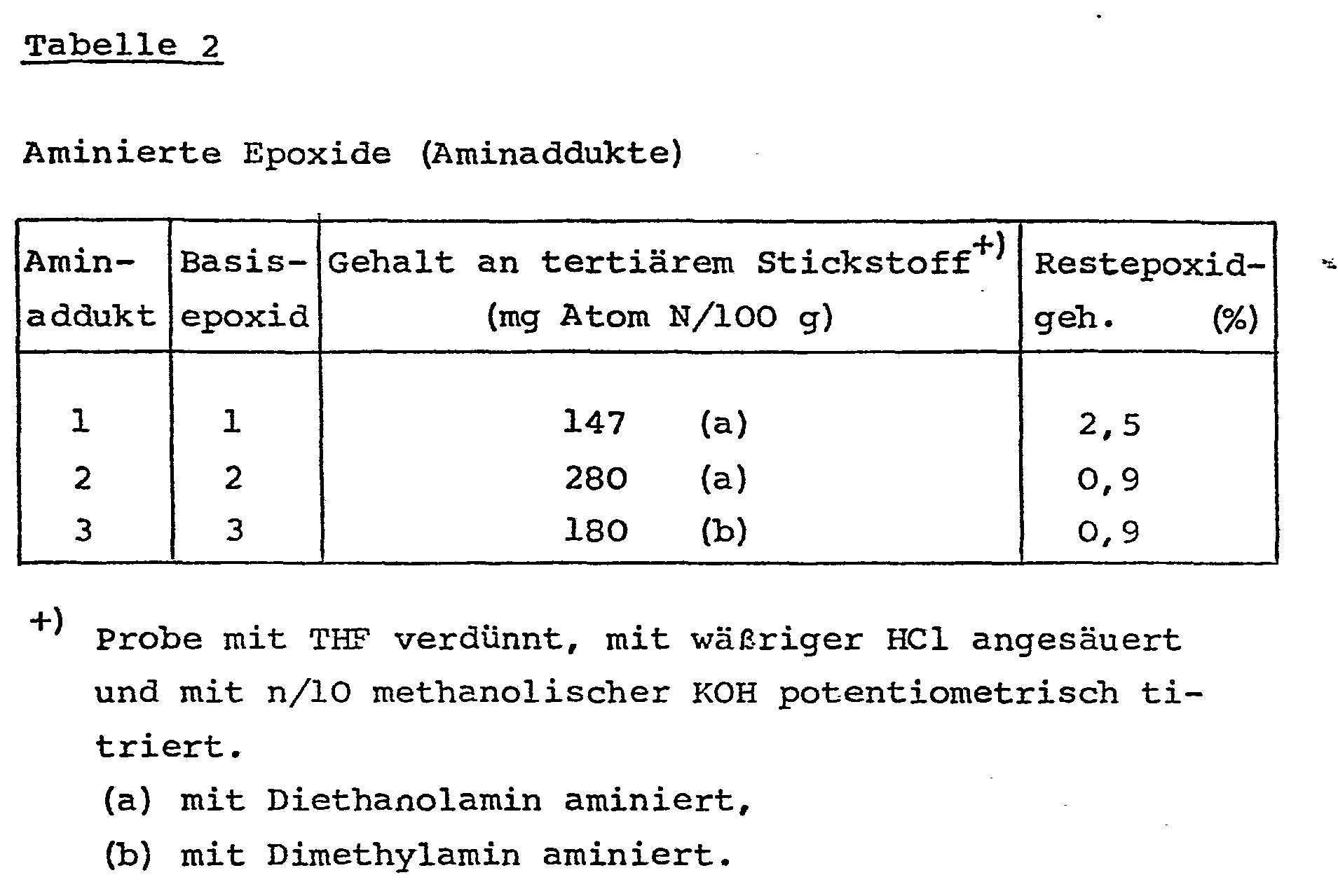
- 94,2 Teile epoxidiertes 1,3-Butadienpolymerisat (Epoxid 1) werden unter Stickstoff mit 17,5 Teilen Diethanolamin gemischt und unter Rühren bei 190 C zur Reaktion gebracht. Nach 6 Stunden ist das Amin praktisch quantitativ umgesetzt. Das Produkt enthält 145 mg Atom Stickstoff/100 g Addukt und 2,5 % Restepoxidsauerstoff. Das hochviskose Produkt zeigt eine blaßgelbe Färbung.
- Die Herstellung des Aminadduktes 2 erfolgt analog der Herstellung von Aminaddukt 1.
- 59,7 Teile Epoxid 3 werden bei 30 °C mit 16,7 Teilen einer 42,3 %igen wäßrigen Dimethylaminlösung und 13,6 Teilen THF versetzt. Die Mischung wird in einen Stahlautoklaven gefüllt. Nach Aufdrücken von 10 bar N2 wird innerhalb von 2 1/2 Stunden auf 150 °C aufgeheizt und 10 Stunden bei dieser Temperatur belassen. Als Reaktionsprodukt wird eine weiße Emulsion erhalten. Die Lösemittel werden im Vakuum abgezogen. Das so isolierte Aminaddukt 7 enthält 180 mg Atom Stickstoff/100 g Addukt und einen Restepoxid-Gehalt von 0,9 %.
-
- 200,7 Teile Aminaddukt 2 werden mit 71,1 Teilen einer 73 %igen wäßrigen Milchsäure entsprechend einem Neutralisationsgrad von ca. 100 % bei 20 °C gerührt und mit 666,4 Teilen Wasser versetzt. Es wird eine homogene Mischung erhalten. Dann werden bei dieser Temperatur 33,2 Teile Propylenoxid eingerührt und 1 Stunde auf 70 °C erhitzt. Es wird eine Reaktionsmischeung erhalten, welche sich mit Wasser zu einer klaren gelben Lösung verdünnen läßt und folgende Eigenschaften zeigt:
- Trockenrückstand (2 Stunden bei 120 °C) : 29,3 g/100 g Reaktionsaustrag Aminstickstoff: < 5 mmol/100 g Reaktionsaustrag
- Aus 100 Teilen Aminaddukt 3 und 771 Teilen Wasser wird bei 15 C unter Rühren und Durchleiten eines CO2-Stromes eine niedrig viskose, milchige homogene Flüssigkeit erhalten, in welche eine Lösung von 23,8 Teilen Ethylenoxid in 105 Teilen Wasser eingerührt wird. Die erhaltene Mischung wird in einen Stahlautoklaven gegeben, C02 wird bis zu einem Druck von 10 bar aufgedrückt und die Reaktionsmischung 3 Stunden auf 80 °C erhitzt, wobei sich ein Druck von ca. 20 bar einstellt. Nach dem Abkühlen und Entspannen wird eine blaßgelbe, durchscheinende Lösung mit folgenden Eigenschaften erhalten:
- Trockenrückstand (2 Stunden bei 120 °C) :
- 11,5 g/100 g Reaktionsaustrag
- Aminstickstoff: < 4 mmol/100 g Reaktionsaustrag
- 162 Teile Aminaddukt 1 werden mit 29,4 Teilen einer wäßrigen 73 %igen Milchsäure bei 40 °C gerührt, bis eine homogene Mischung erhalten wird. Nach Zugabe von 250 Teilen Wasser werden bei dieser Temperatur 13,8 Teile Propylenoxid eingerührt und 3 Stunden auf 70 °C erhitzt. Es wird eine Reaktionsmischung erhalten, die mit 200 Teilen Wasser zu einer klaren, gelben Lösung verdünnt werden kann.
- Trockenrückstand (2 Stunden bei 120 °C):
- 30,0 g/100 g Reaktionsaustrag
- Aminstickstoff: < 2 mmol/100 g Reaktionsaustrag
- Anwendungstechnische Versuche mit erfindungsgemäßen Behandlungsmitteln.
- 50 Teile Produkt 4 werden mit 96,5 Teilen Wasser verdünnt. Das erhaltene Behandlungsmittel I hat einen Feststoffgehalt von 10 %.
- 100 Teile Produkt 5 werden mit 15 Teilen Wasser verdünnt. Es wird eine klare, gelbe Lösung mit einem Feststoffgehalt von 10 % erhalten.
- 137 Teile Produkt 4 werden mit 244 Teilen Wasser verdünnt. In der erhaltenen klaren Lösung werden 20,2 Teile CuSO4 · 5H20 gelöst. Es wird eine klare, blaue Lösung erhalten (pH = 4,4, Feststoffgehalt = 13,2).
- 139 Teile Produkt 6 werden mit 257 Teilen Wasser verdünnt. Es wird eine klare, gelbe Lösung erhalten, in der 20,7 Teile KHF2 (techn.) gelöst werden (pH = 3,9, Feststoffgehalt = 15,0).
- 29,3 Teile Aminaddukt 1 werden mit 4 Teilen Kaliumhydrogenfluorid (techn.) (entsprechend einem Neutralisationsgrad von ca. 100 %) bei 60 C gerührt und mit 300 Teilen Wasser verdünnt. Es wird eine klare, gelbe Lösung wasser- ähnlicher Viskosität erhalten (pH = 3,7).
- 31,5 Teile Aminaddukt 3 werden mit 7 Teilen einer 73 %igen wäßrigen Milchsäure (entsprechend einem Neutralisationsgrad von ca. 100 %) bei 60 °C gerührt und mit 278 Teilen Wasser verdünnt. Es wird eine klare Lösung erhalten, die 10 % Feststoff enthält.
- 65,0 Teile Aminaddukt 1 werden mit 16,3 Teilen einer ca. 52 %igen wäßrigen Milchsäure (entsprechend einem Neutralisationsgrad von ca. 100 %) bei 60 °C gerührt und mit 631 Teilen Wasser verdünnt. Der wäßrigen Lösung werden 22 Teile CuSO4 · 5H2O zugesetzt. Die klare, blaue Vergleichslösung C hat einen Feststoffgehalt von ca. 12. %.
- In jeweils 100 g des Behandlungsmittels werden die in der folgenden Tabelle 3 aufgeführten Zusätze (in g bei 20 °C) portionsweise eingerührt, bis die Löslichkeitsgrenze erreicht ist, das polymere Bindemittel koaguliert oder die Zugabe nicht fortgesetzt wird (gekennzeichnet durch ).

- Die Imprägnierversuche wurden mit Kiefernsplintholzklötzchen (14 x 22 x 50) nach dem Volltränkverfahren (DIN 52 160, Seiten 2 und 3) durchgeführt. Die Ergebnisse sind in Tabelle 4 zusammengestellt.

- Die Bestimmung der Trockenaufnahme bzw. der relativen Trockenaufnahme erfolgte nach den Gleichungen:
- Trockenaufnahme (%) =

- relative Trockenaufnahme (%) =

- mit W = Gewicht des Holzes, imprägniert, getrocknet T = Gewicht des Holzes, unbehandelt, getrocknet I = Gewicht des Holzes, imprägniert, ohne Trocknung.
- Zur Berechnung der Schutzmittel-Trockenaufnahme (Spalte 3) wurde W indirekt durch Bestimmung der restlichen Schutzmittelmenge im Behandlungsmittel nach der Imprägnierung bestimmt.
- Wie aus der Tabelle 4 zu ersehen ist, entspricht die relative Trockenaufnahme (Spalte 4) für die Behandlungs- . mittel III und IV sehr gut ihren Feststoffgehalten. Zum anderen zeigt die analytische Untersuchung der zur Imprägnierung der Prüfkörper benutzten überschüssigen Lösung, daß durch die Behandlung die Zusammensetzung der Behandlungsmittel nicht verändert wird. Hieraus ist ersichtlich, daß sowohl das Bindemittel als auch das biozid wirkende Holzschutzmittel in die Prüfkörper penetrieren.
- Werden die mit den Behandlungsmitteln III und IV imprägnierten Holzklötzchen aufeinandergestapelt, kleben sie an den Berührungsflächen nicht zusammen, d. h. das Bindemittel zeigt das geforderte Penetrationsverhalten und wird nicht auf der Oberfläche der Prüfkörper abgeschieden.
- Wird ein mit dem Behandlungsmittel III imprägniertes Prüfklötzchen aufgespalten, ist ersichtlich, daß der biozid wirkende Zusatz (hier CuSO4) den Prüfkörper völlig durchdrungen hat.
- Ein entsprechender Nachweis kann für ein mit dem fluoridhaltigen Behandlungsmittel IV imprägnierten Prüfkörper (Farbreaktion mit ZA-Reagenz; Lit.: H. Becker: "Über den Nachweis und die Bestimmung von Holzschutzmitteln im Holz", Seifen-Öle-Fette-Wachse, 23. Jahrgang, Nr. 26/1967, Seite 1010) geführt werden. Bei den mit Vergleichslösung C imprägnierten Prüfkörpern werden geringere Penetrationstiefen beobachtet.
- Desweiteren ist aus Tabelle 4 ersichtlich, daß mit den erfindungsgemäßen Behandlungsmitteln erheblich größere Anteile an Holzschutzmitteln in die Prüfkörper eingebracht werden können als mit der zum Vergleich eingesetzten Vergleichslösung C (Spalte 3).
Claims (2)
dadurch gekennzeichnet, daß

Priority Applications (1)
| Application Number | Priority Date | Filing Date | Title |
|---|---|---|---|
| AT82110557T ATE11887T1 (de) | 1982-01-13 | 1982-11-16 | Verfahren zur behandlung von holz und holzwerkstoffen mit waessrigen behandlungsmitteln. |
Applications Claiming Priority (2)
| Application Number | Priority Date | Filing Date | Title |
|---|---|---|---|
| DE19823200782 DE3200782A1 (de) | 1982-01-13 | 1982-01-13 | Verfahren zur behandlung von holz und holzwerkstoffen mit waessrigen behandlungsmitteln |
| DE3200782 | 1982-01-13 |
Publications (2)
| Publication Number | Publication Date |
|---|---|
| EP0083709A1 true EP0083709A1 (de) | 1983-07-20 |
| EP0083709B1 EP0083709B1 (de) | 1985-02-20 |
Family
ID=6152959
Family Applications (1)
| Application Number | Title | Priority Date | Filing Date |
|---|---|---|---|
| EP19820110557 Expired EP0083709B1 (de) | 1982-01-13 | 1982-11-16 | Verfahren zur Behandlung von Holz und Holzwerkstoffen mit wässrigen Behandlungsmitteln |
Country Status (9)
| Country | Link |
|---|---|
| US (1) | US4496613A (de) |
| EP (1) | EP0083709B1 (de) |
| JP (1) | JPS58124603A (de) |
| AT (1) | ATE11887T1 (de) |
| CA (1) | CA1209416A (de) |
| DE (2) | DE3200782A1 (de) |
| DK (1) | DK6983A (de) |
| FI (1) | FI830050L (de) |
| NO (1) | NO830081L (de) |
Cited By (1)
| Publication number | Priority date | Publication date | Assignee | Title |
|---|---|---|---|---|
| EP0135112A1 (de) * | 1983-08-17 | 1985-03-27 | Dr. Wolman GmbH | Wässriges Holzschutzmittel |
Families Citing this family (20)
| Publication number | Priority date | Publication date | Assignee | Title |
|---|---|---|---|---|
| DE3331400A1 (de) * | 1983-08-31 | 1985-03-07 | Chemische Werke Hüls AG, 4370 Marl | Wasserverduennbares konzentrat, waessriges mittel und verfahren zur behandlung von holz |
| NL8400339A (nl) * | 1984-02-03 | 1985-09-02 | Tno | Samenstelling en werkwijze voor het verduurzamen van hout. |
| DE3605008A1 (de) * | 1986-02-18 | 1987-08-20 | Wolman Gmbh Dr | Holzschutzmittel |
| CA1316623C (en) * | 1989-04-06 | 1993-04-20 | Pavel Stovicek | Biocidal surface coating and casting compositions based on quarternary ammonium salts of nalkyl x,x bis (4,4' hydroxyphenyl) and quarternary salts of polyglycols as backbones of resins |
| DE4228352A1 (de) * | 1992-02-19 | 1993-08-26 | Ruetgerswerke Ag | Chromfreies holzschutzmittel |
| DE4228160A1 (de) * | 1992-08-25 | 1994-03-03 | Basf Ag | Polymerisate auf Basis von konjugierten Dienen |
| US5393843A (en) * | 1992-08-31 | 1995-02-28 | Shell Oil Company | Butadiene polymers having terminal functional groups |
| NZ329862A (en) * | 1993-06-09 | 1999-07-29 | Lonza Ag | Poly(ether)hydroxyls, esters, or fatty acids as waterproofing agents optionally in conjunction with quaternary ammonium compositions |
| US5314967A (en) * | 1993-08-24 | 1994-05-24 | Bridgestone/Firestone, Inc. | Process and isomerizing agent for isomerizing partially hydrogenated diene polymers |
| US5310817A (en) * | 1993-08-24 | 1994-05-10 | Bridgestone/Firestone, Inc. | Process and catalyst for producing partially hydrogenated diene polymers containing endo and exo chain trisubstituted unsaturation |
| US5468284A (en) * | 1994-06-27 | 1995-11-21 | Kop-Coat, Inc. | Method of waterproof wood and associated composition |
| DE19640873C2 (de) * | 1996-10-04 | 2001-04-19 | Staedtler Fa J S | Verwendung einer wässrigen Tensid-Emulsion oder- Dispersion zur Verbesserung der mechanischen Bearbeitbarkeit von Holz |
| CA2356100A1 (en) | 2000-09-06 | 2002-03-06 | George Tunis | Un-reinforced thermoplastic coating |
| EP1619357A3 (de) | 2003-10-02 | 2006-03-08 | Honda Motor Co., Ltd. | Rankinekreislaufvorrichtung |
| CA2580079A1 (en) * | 2004-09-10 | 2006-03-23 | Chemical Specialties, Inc. | Emulsion composition for wood protection |
| US7637558B2 (en) * | 2004-11-12 | 2009-12-29 | Société en Commandite Prolam | System and method for providing reinforcement and/or moisture protection at discrete locations on a wooden cargo-carrying floor |
| US7569157B2 (en) * | 2005-06-22 | 2009-08-04 | Hunt Holdings, Inc. | Rotted wood stabilizer composition and methods of making and using same |
| JP5328370B2 (ja) * | 2006-01-17 | 2013-10-30 | ビーエーエスエフ ソシエタス・ヨーロピア | 木質材料においてホルムアルデヒド放散を減少させるための方法 |
| US20070193179A1 (en) * | 2006-01-27 | 2007-08-23 | Prolam, Societe En Commandite | Wooden laminated floor product to improve strength, water protection and fatigue resistance |
| US7926524B2 (en) * | 2006-10-02 | 2011-04-19 | Prolam, Societe En Commandite | Utilization of coloration to improve the detection of “hit or miss” defects when using scanner equipment and an automated saw to remove defects in wood pieces |
Citations (4)
| Publication number | Priority date | Publication date | Assignee | Title |
|---|---|---|---|---|
| EP0009546A1 (de) * | 1978-09-07 | 1980-04-16 | Chemische Werke Hüls Ag | Wässriges Behandlungsmittel für Holz und Holzwerkstoffe |
| DE2911243A1 (de) * | 1979-03-22 | 1980-10-02 | Basf Ag | Verfahren zur herstellung kationischer bindemittel und deren verwendung |
| DE2751869B2 (de) * | 1976-11-24 | 1980-11-20 | Ppg Industries, Inc., Pittsburgh, Pa. (V.St.A.) | Verfahren zur elektrophoretischen Beschichtung einer als Kathode dienenden Oberfläche |
| EP0043901A1 (de) * | 1980-07-11 | 1982-01-20 | Chemische Werke Hüls Ag | Wasserlösliche, quartäre Ammoniumgruppen tragende Polymerisate, Verfahren zu ihrer Herstellung sowie ihre Verwendung |
-
1982
- 1982-01-13 DE DE19823200782 patent/DE3200782A1/de not_active Withdrawn
- 1982-11-16 DE DE8282110557T patent/DE3262451D1/de not_active Expired
- 1982-11-16 AT AT82110557T patent/ATE11887T1/de active
- 1982-11-16 EP EP19820110557 patent/EP0083709B1/de not_active Expired
-
1983
- 1983-01-07 FI FI830050A patent/FI830050L/fi not_active Application Discontinuation
- 1983-01-10 DK DK6983A patent/DK6983A/da not_active Application Discontinuation
- 1983-01-12 CA CA000419336A patent/CA1209416A/en not_active Expired
- 1983-01-12 NO NO830081A patent/NO830081L/no unknown
- 1983-01-12 JP JP58002378A patent/JPS58124603A/ja active Pending
- 1983-01-13 US US06/457,551 patent/US4496613A/en not_active Expired - Fee Related
Patent Citations (4)
| Publication number | Priority date | Publication date | Assignee | Title |
|---|---|---|---|---|
| DE2751869B2 (de) * | 1976-11-24 | 1980-11-20 | Ppg Industries, Inc., Pittsburgh, Pa. (V.St.A.) | Verfahren zur elektrophoretischen Beschichtung einer als Kathode dienenden Oberfläche |
| EP0009546A1 (de) * | 1978-09-07 | 1980-04-16 | Chemische Werke Hüls Ag | Wässriges Behandlungsmittel für Holz und Holzwerkstoffe |
| DE2911243A1 (de) * | 1979-03-22 | 1980-10-02 | Basf Ag | Verfahren zur herstellung kationischer bindemittel und deren verwendung |
| EP0043901A1 (de) * | 1980-07-11 | 1982-01-20 | Chemische Werke Hüls Ag | Wasserlösliche, quartäre Ammoniumgruppen tragende Polymerisate, Verfahren zu ihrer Herstellung sowie ihre Verwendung |
Cited By (1)
| Publication number | Priority date | Publication date | Assignee | Title |
|---|---|---|---|---|
| EP0135112A1 (de) * | 1983-08-17 | 1985-03-27 | Dr. Wolman GmbH | Wässriges Holzschutzmittel |
Also Published As
| Publication number | Publication date |
|---|---|
| DK6983A (da) | 1983-07-14 |
| FI830050A0 (fi) | 1983-01-07 |
| EP0083709B1 (de) | 1985-02-20 |
| FI830050A7 (fi) | 1983-07-14 |
| US4496613A (en) | 1985-01-29 |
| FI830050L (fi) | 1983-07-14 |
| DE3262451D1 (en) | 1985-03-28 |
| CA1209416A (en) | 1986-08-12 |
| NO830081L (no) | 1983-07-14 |
| DK6983D0 (da) | 1983-01-10 |
| JPS58124603A (ja) | 1983-07-25 |
| DE3200782A1 (de) | 1983-07-21 |
| ATE11887T1 (de) | 1985-03-15 |
Similar Documents
| Publication | Publication Date | Title |
|---|---|---|
| EP0083709B1 (de) | Verfahren zur Behandlung von Holz und Holzwerkstoffen mit wässrigen Behandlungsmitteln | |
| EP0009546B1 (de) | Wässriges Behandlungsmittel für Holz und Holzwerkstoffe | |
| EP0556454B1 (de) | Chromfreies Holzschutzmittel | |
| EP0606084B1 (de) | Holzschutzmittel | |
| EP0270848B1 (de) | Holzschutzmittel | |
| EP0482433B1 (de) | Polymere Stickstoffverbindungen und Metall fixierende Säuren enthaltende Holzschutzmittel | |
| EP0355316A2 (de) | Verfahren zum Konservieren von Holz und Holzwerkstoffen | |
| EP0423674B1 (de) | Polymere Stickstoffverbindungen enthaltende Holzschutzmittel | |
| EP0043901B1 (de) | Wasserlösliche, quartäre Ammoniumgruppen tragende Polymerisate, Verfahren zu ihrer Herstellung sowie ihre Verwendung | |
| EP0234461A1 (de) | Holzschutzmittel | |
| EP0739698A1 (de) | Holzschutzmittel | |
| DE1267409B (de) | Verfahren zum Impraegnieren von Holz | |
| DE3743821A1 (de) | Kupfer und zinn enthaltendes holzschutzmittel | |
| EP0364246A1 (de) | Zusammensetzung zur Holzkonservierung und deren Verwendung zur Holzbehandlung | |
| EP0135112B1 (de) | Wässriges Holzschutzmittel | |
| DE1745105C3 (de) | Verfahren zur Herstellung eines Katalysators für die Isoprenpolymerisation | |
| EP0092655A1 (de) | Wässriges Behandlungsmittel für Holz | |
| EP0043035A1 (de) | Mittel zum Konservieren von Holz und Holzwerkstoffen | |
| DE4137621A1 (de) | Holzschutzmittel | |
| DE3835370A1 (de) | Holzschutzmittel | |
| EP0242751A1 (de) | Holzschutzmittel auf Basis Borsäure | |
| DE512599C (de) | Verfahren zur Behandlung von Latex oder Latexkonzentraten | |
| DD247175A1 (de) | Holzschutzmittel | |
| DE4204941A1 (de) | Verfahren zur fixierung chromfreier holzschutzmittel | |
| AU2003268849A1 (en) | Improvements In Boron Wood Preservatives |
Legal Events
| Date | Code | Title | Description |
|---|---|---|---|
| PUAI | Public reference made under article 153(3) epc to a published international application that has entered the european phase |
Free format text: ORIGINAL CODE: 0009012 |
|
| AK | Designated contracting states |
Designated state(s): AT BE CH DE FR GB IT LI NL SE |
|
| 17P | Request for examination filed |
Effective date: 19830622 |
|
| ITF | It: translation for a ep patent filed | ||
| GRAA | (expected) grant |
Free format text: ORIGINAL CODE: 0009210 |
|
| AK | Designated contracting states |
Designated state(s): AT BE CH DE FR GB IT LI NL SE |
|
| REF | Corresponds to: |
Ref document number: 11887 Country of ref document: AT Date of ref document: 19850315 Kind code of ref document: T |
|
| REF | Corresponds to: |
Ref document number: 3262451 Country of ref document: DE Date of ref document: 19850328 |
|
| ET | Fr: translation filed | ||
| PGFP | Annual fee paid to national office [announced via postgrant information from national office to epo] |
Ref country code: AT Payment date: 19851129 Year of fee payment: 4 |
|
| PGFP | Annual fee paid to national office [announced via postgrant information from national office to epo] |
Ref country code: NL Payment date: 19851130 Year of fee payment: 4 |
|
| RAP2 | Party data changed (patent owner data changed or rights of a patent transferred) |
Owner name: HUELS AKTIENGESELLSCHAFT |
|
| BECN | Be: change of holder's name |
Effective date: 19850220 |
|
| PLBE | No opposition filed within time limit |
Free format text: ORIGINAL CODE: 0009261 |
|
| STAA | Information on the status of an ep patent application or granted ep patent |
Free format text: STATUS: NO OPPOSITION FILED WITHIN TIME LIMIT |
|
| 26N | No opposition filed | ||
| NLT2 | Nl: modifications (of names), taken from the european patent patent bulletin |
Owner name: HUELS AKTIENGESELLSCHAFT TE MARL, BONDSREPUBLIEK D |
|
| PG25 | Lapsed in a contracting state [announced via postgrant information from national office to epo] |
Ref country code: AT Effective date: 19861116 |
|
| PG25 | Lapsed in a contracting state [announced via postgrant information from national office to epo] |
Ref country code: SE Effective date: 19861117 |
|
| PG25 | Lapsed in a contracting state [announced via postgrant information from national office to epo] |
Ref country code: LI Effective date: 19861130 Ref country code: CH Effective date: 19861130 Ref country code: BE Effective date: 19861130 |
|
| BERE | Be: lapsed |
Owner name: HULS A.G. Effective date: 19861130 |
|
| PG25 | Lapsed in a contracting state [announced via postgrant information from national office to epo] |
Ref country code: NL Effective date: 19870601 |
|
| NLV4 | Nl: lapsed or anulled due to non-payment of the annual fee | ||
| GBPC | Gb: european patent ceased through non-payment of renewal fee | ||
| PG25 | Lapsed in a contracting state [announced via postgrant information from national office to epo] |
Ref country code: FR Free format text: LAPSE BECAUSE OF NON-PAYMENT OF DUE FEES Effective date: 19870731 |
|
| REG | Reference to a national code |
Ref country code: CH Ref legal event code: PL |
|
| PG25 | Lapsed in a contracting state [announced via postgrant information from national office to epo] |
Ref country code: DE Effective date: 19870801 |
|
| REG | Reference to a national code |
Ref country code: FR Ref legal event code: ST |
|
| PG25 | Lapsed in a contracting state [announced via postgrant information from national office to epo] |
Ref country code: GB Effective date: 19881122 |
|
| EUG | Se: european patent has lapsed |
Ref document number: 82110557.4 Effective date: 19870901 |