EP0083744A2 - Oximcarbamate, Verfahren zu ihrer Herstellung, ihre Verwendung als Schädlingsbekämpfungsmittel, sowie Zwischenprodukte zu ihrer Herstellung und Verfahren zur Herstellung dieser Zwischenprodukte - Google Patents
Oximcarbamate, Verfahren zu ihrer Herstellung, ihre Verwendung als Schädlingsbekämpfungsmittel, sowie Zwischenprodukte zu ihrer Herstellung und Verfahren zur Herstellung dieser Zwischenprodukte Download PDFInfo
- Publication number
- EP0083744A2 EP0083744A2 EP82111462A EP82111462A EP0083744A2 EP 0083744 A2 EP0083744 A2 EP 0083744A2 EP 82111462 A EP82111462 A EP 82111462A EP 82111462 A EP82111462 A EP 82111462A EP 0083744 A2 EP0083744 A2 EP 0083744A2
- Authority
- EP
- European Patent Office
- Prior art keywords
- formula
- alkyl
- spp
- optionally substituted
- haloalkyl
- Prior art date
- Legal status (The legal status is an assumption and is not a legal conclusion. Google has not performed a legal analysis and makes no representation as to the accuracy of the status listed.)
- Withdrawn
Links
- -1 Oxime carbamates Chemical class 0.000 title claims abstract description 42
- 238000000034 method Methods 0.000 title claims abstract description 34
- 239000000543 intermediate Substances 0.000 title description 4
- 238000004519 manufacturing process Methods 0.000 title description 4
- 239000003139 biocide Substances 0.000 title 1
- 150000002923 oximes Chemical class 0.000 claims abstract description 13
- 150000001412 amines Chemical class 0.000 claims abstract description 8
- YGYAWVDWMABLBF-UHFFFAOYSA-N Phosgene Chemical compound ClC(Cl)=O YGYAWVDWMABLBF-UHFFFAOYSA-N 0.000 claims abstract description 7
- 239000012948 isocyanate Substances 0.000 claims abstract description 6
- 150000002513 isocyanates Chemical class 0.000 claims abstract description 6
- 125000000217 alkyl group Chemical group 0.000 claims description 66
- 238000002360 preparation method Methods 0.000 claims description 28
- 125000001188 haloalkyl group Chemical group 0.000 claims description 26
- 125000003342 alkenyl group Chemical group 0.000 claims description 16
- 125000004183 alkoxy alkyl group Chemical group 0.000 claims description 15
- 125000001997 phenyl group Chemical group [H]C1=C([H])C([H])=C(*)C([H])=C1[H] 0.000 claims description 14
- PXGOKWXKJXAPGV-UHFFFAOYSA-N Fluorine Chemical compound FF PXGOKWXKJXAPGV-UHFFFAOYSA-N 0.000 claims description 13
- 125000004663 dialkyl amino group Chemical group 0.000 claims description 13
- 229910052731 fluorine Inorganic materials 0.000 claims description 13
- 239000011737 fluorine Substances 0.000 claims description 13
- 125000000304 alkynyl group Chemical group 0.000 claims description 11
- UFHFLCQGNIYNRP-UHFFFAOYSA-N Hydrogen Chemical compound [H][H] UFHFLCQGNIYNRP-UHFFFAOYSA-N 0.000 claims description 9
- 125000006350 alkyl thio alkyl group Chemical group 0.000 claims description 9
- 125000000753 cycloalkyl group Chemical group 0.000 claims description 9
- ZAMOUSCENKQFHK-UHFFFAOYSA-N Chlorine atom Chemical compound [Cl] ZAMOUSCENKQFHK-UHFFFAOYSA-N 0.000 claims description 7
- 241000607479 Yersinia pestis Species 0.000 claims description 7
- 125000004453 alkoxycarbonyl group Chemical group 0.000 claims description 7
- 229910052801 chlorine Inorganic materials 0.000 claims description 7
- 239000000460 chlorine Substances 0.000 claims description 7
- 229910052739 hydrogen Inorganic materials 0.000 claims description 6
- 239000001257 hydrogen Substances 0.000 claims description 6
- 125000000547 substituted alkyl group Chemical group 0.000 claims description 6
- 150000001805 chlorine compounds Chemical class 0.000 claims description 5
- AVXURJPOCDRRFD-UHFFFAOYSA-N Hydroxylamine Chemical compound ON AVXURJPOCDRRFD-UHFFFAOYSA-N 0.000 claims description 4
- 150000002576 ketones Chemical class 0.000 claims description 4
- 239000000575 pesticide Substances 0.000 claims description 3
- 150000003839 salts Chemical class 0.000 claims description 3
- 239000004606 Fillers/Extenders Substances 0.000 claims 1
- 239000004094 surface-active agent Substances 0.000 claims 1
- 239000002917 insecticide Substances 0.000 abstract description 4
- 230000000895 acaricidal effect Effects 0.000 abstract description 3
- 239000000642 acaricide Substances 0.000 abstract description 3
- 239000005645 nematicide Substances 0.000 abstract description 3
- FWMUJAIKEJWSSY-UHFFFAOYSA-N sulfur dichloride Chemical class ClSCl FWMUJAIKEJWSSY-UHFFFAOYSA-N 0.000 abstract 1
- 150000001875 compounds Chemical class 0.000 description 42
- 125000004432 carbon atom Chemical group C* 0.000 description 30
- 239000004480 active ingredient Substances 0.000 description 17
- YMWUJEATGCHHMB-UHFFFAOYSA-N Dichloromethane Chemical compound ClCCl YMWUJEATGCHHMB-UHFFFAOYSA-N 0.000 description 16
- ZMXDDKWLCZADIW-UHFFFAOYSA-N N,N-Dimethylformamide Chemical compound CN(C)C=O ZMXDDKWLCZADIW-UHFFFAOYSA-N 0.000 description 15
- 239000002904 solvent Substances 0.000 description 15
- 239000003995 emulsifying agent Substances 0.000 description 14
- ZMANZCXQSJIPKH-UHFFFAOYSA-N Triethylamine Chemical compound CCN(CC)CC ZMANZCXQSJIPKH-UHFFFAOYSA-N 0.000 description 13
- 239000007858 starting material Substances 0.000 description 13
- 239000002689 soil Substances 0.000 description 12
- XLYOFNOQVPJJNP-UHFFFAOYSA-N water Substances O XLYOFNOQVPJJNP-UHFFFAOYSA-N 0.000 description 11
- 239000000203 mixture Substances 0.000 description 10
- 240000007124 Brassica oleracea Species 0.000 description 8
- RTZKZFJDLAIYFH-UHFFFAOYSA-N Diethyl ether Chemical compound CCOCC RTZKZFJDLAIYFH-UHFFFAOYSA-N 0.000 description 8
- 241001465754 Metazoa Species 0.000 description 8
- 125000002496 methyl group Chemical group [H]C([H])([H])* 0.000 description 8
- DDCYYCUMAFYDDU-UHFFFAOYSA-N methyl thiohypochlorite Chemical compound CSCl DDCYYCUMAFYDDU-UHFFFAOYSA-N 0.000 description 8
- CSCPPACGZOOCGX-UHFFFAOYSA-N Acetone Chemical compound CC(C)=O CSCPPACGZOOCGX-UHFFFAOYSA-N 0.000 description 7
- 125000005843 halogen group Chemical group 0.000 description 7
- LFNUDFUTYUIUQA-UHFFFAOYSA-N N-[1-methoxyimino-3,3-dimethyl-1-(1,2,4-triazol-1-yl)butan-2-ylidene]hydroxylamine Chemical compound CC(C(C(N1N=CN=C1)=NOC)=NO)(C)C LFNUDFUTYUIUQA-UHFFFAOYSA-N 0.000 description 6
- 125000001309 chloro group Chemical group Cl* 0.000 description 6
- 239000012141 concentrate Substances 0.000 description 6
- 230000000694 effects Effects 0.000 description 6
- 230000009885 systemic effect Effects 0.000 description 6
- ROSDSFDQCJNGOL-UHFFFAOYSA-N Dimethylamine Chemical compound CNC ROSDSFDQCJNGOL-UHFFFAOYSA-N 0.000 description 5
- 241000244206 Nematoda Species 0.000 description 5
- JUJWROOIHBZHMG-UHFFFAOYSA-N Pyridine Chemical compound C1=CC=NC=C1 JUJWROOIHBZHMG-UHFFFAOYSA-N 0.000 description 5
- 238000009472 formulation Methods 0.000 description 5
- 125000001424 substituent group Chemical group 0.000 description 5
- 241001143309 Acanthoscelides obtectus Species 0.000 description 4
- 235000011303 Brassica alboglabra Nutrition 0.000 description 4
- 235000011302 Brassica oleracea Nutrition 0.000 description 4
- 235000003899 Brassica oleracea var acephala Nutrition 0.000 description 4
- 235000011301 Brassica oleracea var capitata Nutrition 0.000 description 4
- 235000001169 Brassica oleracea var oleracea Nutrition 0.000 description 4
- WKBOTKDWSSQWDR-UHFFFAOYSA-N Bromine atom Chemical compound [Br] WKBOTKDWSSQWDR-UHFFFAOYSA-N 0.000 description 4
- HEDRZPFGACZZDS-UHFFFAOYSA-N Chloroform Chemical compound ClC(Cl)Cl HEDRZPFGACZZDS-UHFFFAOYSA-N 0.000 description 4
- 241000254173 Coleoptera Species 0.000 description 4
- 241000196324 Embryophyta Species 0.000 description 4
- LFQSCWFLJHTTHZ-UHFFFAOYSA-N Ethanol Chemical compound CCO LFQSCWFLJHTTHZ-UHFFFAOYSA-N 0.000 description 4
- 241000258937 Hemiptera Species 0.000 description 4
- 241000238631 Hexapoda Species 0.000 description 4
- 241000257303 Hymenoptera Species 0.000 description 4
- 241001481703 Rhipicephalus <genus> Species 0.000 description 4
- 239000013543 active substance Substances 0.000 description 4
- 125000006193 alkinyl group Chemical group 0.000 description 4
- 125000002877 alkyl aryl group Chemical group 0.000 description 4
- 239000011230 binding agent Substances 0.000 description 4
- GDTBXPJZTBHREO-UHFFFAOYSA-N bromine Substances BrBr GDTBXPJZTBHREO-UHFFFAOYSA-N 0.000 description 4
- 229910052794 bromium Inorganic materials 0.000 description 4
- 229910052736 halogen Inorganic materials 0.000 description 4
- 150000002367 halogens Chemical class 0.000 description 4
- HAMGRBXTJNITHG-UHFFFAOYSA-N methyl isocyanate Chemical compound CN=C=O HAMGRBXTJNITHG-UHFFFAOYSA-N 0.000 description 4
- 229920000151 polyglycol Polymers 0.000 description 4
- 239000010695 polyglycol Substances 0.000 description 4
- 238000003756 stirring Methods 0.000 description 4
- 125000002023 trifluoromethyl group Chemical group FC(F)(F)* 0.000 description 4
- ZWEHNKRNPOVVGH-UHFFFAOYSA-N 2-Butanone Chemical compound CCC(C)=O ZWEHNKRNPOVVGH-UHFFFAOYSA-N 0.000 description 3
- WEVYAHXRMPXWCK-UHFFFAOYSA-N Acetonitrile Chemical compound CC#N WEVYAHXRMPXWCK-UHFFFAOYSA-N 0.000 description 3
- QGZKDVFQNNGYKY-UHFFFAOYSA-N Ammonia Chemical compound N QGZKDVFQNNGYKY-UHFFFAOYSA-N 0.000 description 3
- 241000239223 Arachnida Species 0.000 description 3
- CKDWPUIZGOQOOM-UHFFFAOYSA-N Carbamyl chloride Chemical compound NC(Cl)=O CKDWPUIZGOQOOM-UHFFFAOYSA-N 0.000 description 3
- QUSNBJAOOMFDIB-UHFFFAOYSA-N Ethylamine Chemical compound CCN QUSNBJAOOMFDIB-UHFFFAOYSA-N 0.000 description 3
- 206010061217 Infestation Diseases 0.000 description 3
- BAVYZALUXZFZLV-UHFFFAOYSA-N Methylamine Chemical compound NC BAVYZALUXZFZLV-UHFFFAOYSA-N 0.000 description 3
- 241001608567 Phaedon cochleariae Species 0.000 description 3
- 241000500437 Plutella xylostella Species 0.000 description 3
- 241001454294 Tetranychus Species 0.000 description 3
- 239000002253 acid Substances 0.000 description 3
- 125000003545 alkoxy group Chemical group 0.000 description 3
- LIWAQLJGPBVORC-UHFFFAOYSA-N ethylmethylamine Chemical compound CCNC LIWAQLJGPBVORC-UHFFFAOYSA-N 0.000 description 3
- 125000000449 nitro group Chemical group [O-][N+](*)=O 0.000 description 3
- 239000000047 product Substances 0.000 description 3
- 239000011734 sodium Substances 0.000 description 3
- GBXVJYYOXPYJGH-UHFFFAOYSA-N 1,1,1-trifluoro-n-methylmethanamine Chemical compound CNC(F)(F)F GBXVJYYOXPYJGH-UHFFFAOYSA-N 0.000 description 2
- 125000003626 1,2,4-triazol-1-yl group Chemical group [*]N1N=C([H])N=C1[H] 0.000 description 2
- YIDSTEJLDQMWBR-UHFFFAOYSA-N 1-isocyanatododecane Chemical compound CCCCCCCCCCCCN=C=O YIDSTEJLDQMWBR-UHFFFAOYSA-N 0.000 description 2
- RFXBSYPBSRSQDU-UHFFFAOYSA-N 1-isocyanatoheptane Chemical compound CCCCCCCN=C=O RFXBSYPBSRSQDU-UHFFFAOYSA-N 0.000 description 2
- YNVUTAPHFZKPBN-UHFFFAOYSA-N 1-methoxy-n-methylmethanamine Chemical compound CNCOC YNVUTAPHFZKPBN-UHFFFAOYSA-N 0.000 description 2
- MGOLNIXAPIAKFM-UHFFFAOYSA-N 2-isocyanato-2-methylpropane Chemical compound CC(C)(C)N=C=O MGOLNIXAPIAKFM-UHFFFAOYSA-N 0.000 description 2
- 125000003903 2-propenyl group Chemical group [H]C([*])([H])C([H])=C([H])[H] 0.000 description 2
- 125000001494 2-propynyl group Chemical group [H]C#CC([H])([H])* 0.000 description 2
- 241000238876 Acari Species 0.000 description 2
- 241000934064 Acarus siro Species 0.000 description 2
- 241000238818 Acheta domesticus Species 0.000 description 2
- 241000256111 Aedes <genus> Species 0.000 description 2
- 241000902874 Agelastica alni Species 0.000 description 2
- 241001136265 Agriotes Species 0.000 description 2
- 241000218473 Agrotis Species 0.000 description 2
- 241000238679 Amblyomma Species 0.000 description 2
- 241000411449 Anobium punctatum Species 0.000 description 2
- 241000256186 Anopheles <genus> Species 0.000 description 2
- 241001427556 Anoplura Species 0.000 description 2
- 241000254177 Anthonomus Species 0.000 description 2
- 241001640910 Anthrenus Species 0.000 description 2
- 241001414828 Aonidiella aurantii Species 0.000 description 2
- 241001425390 Aphis fabae Species 0.000 description 2
- 241001600408 Aphis gossypii Species 0.000 description 2
- 241001095118 Aphis pomi Species 0.000 description 2
- 241001162025 Archips podana Species 0.000 description 2
- 241001480748 Argas Species 0.000 description 2
- 241000722809 Armadillidium vulgare Species 0.000 description 2
- 241000387321 Aspidiotus nerii Species 0.000 description 2
- 241001174347 Atomaria Species 0.000 description 2
- 241000131286 Attagenus Species 0.000 description 2
- 241001490249 Bactrocera oleae Species 0.000 description 2
- 241000254127 Bemisia tabaci Species 0.000 description 2
- 241001142392 Bibio Species 0.000 description 2
- 241001573716 Blaniulus guttulatus Species 0.000 description 2
- 241000238657 Blattella germanica Species 0.000 description 2
- 241001444260 Brassicogethes aeneus Species 0.000 description 2
- 241000982105 Brevicoryne brassicae Species 0.000 description 2
- 241000398201 Bryobia praetiosa Species 0.000 description 2
- 241001517925 Bucculatrix Species 0.000 description 2
- 241001491664 Bupalus Species 0.000 description 2
- 241000257163 Calliphora vicina Species 0.000 description 2
- 241001350371 Capua Species 0.000 description 2
- 241001221118 Cecidophyopsis ribis Species 0.000 description 2
- 241000255579 Ceratitis capitata Species 0.000 description 2
- 241001098608 Ceratophyllus Species 0.000 description 2
- 241000426499 Chilo Species 0.000 description 2
- 241000258920 Chilopoda Species 0.000 description 2
- 241000359266 Chorioptes Species 0.000 description 2
- 241000255942 Choristoneura fumiferana Species 0.000 description 2
- 241001414836 Cimex Species 0.000 description 2
- 241001427559 Collembola Species 0.000 description 2
- 241000683561 Conoderus Species 0.000 description 2
- 241001212534 Cosmopolites sordidus Species 0.000 description 2
- 241000500845 Costelytra zealandica Species 0.000 description 2
- 241001094916 Cryptomyzus ribis Species 0.000 description 2
- 241000256054 Culex <genus> Species 0.000 description 2
- 241000692095 Cuterebra Species 0.000 description 2
- 241001635274 Cydia pomonella Species 0.000 description 2
- 241001481695 Dermanyssus gallinae Species 0.000 description 2
- 241001124144 Dermaptera Species 0.000 description 2
- 241001641895 Dermestes Species 0.000 description 2
- 241000489975 Diabrotica Species 0.000 description 2
- YIIMEMSDCNDGTB-UHFFFAOYSA-N Dimethylcarbamoyl chloride Chemical compound CN(C)C(Cl)=O YIIMEMSDCNDGTB-UHFFFAOYSA-N 0.000 description 2
- 241000258963 Diplopoda Species 0.000 description 2
- 241000511318 Diprion Species 0.000 description 2
- 241000255925 Diptera Species 0.000 description 2
- 241000255601 Drosophila melanogaster Species 0.000 description 2
- 241001425477 Dysdercus Species 0.000 description 2
- 241000353522 Earias insulana Species 0.000 description 2
- 241000995023 Empoasca Species 0.000 description 2
- 241000122098 Ephestia kuehniella Species 0.000 description 2
- 241000462639 Epilachna varivestis Species 0.000 description 2
- 241000917107 Eriosoma lanigerum Species 0.000 description 2
- 241000060469 Eupoecilia ambiguella Species 0.000 description 2
- 241000483001 Euproctis chrysorrhoea Species 0.000 description 2
- 241000515838 Eurygaster Species 0.000 description 2
- 241000239245 Euscelis Species 0.000 description 2
- 241001585293 Euxoa Species 0.000 description 2
- 241000371383 Fannia Species 0.000 description 2
- 241000233488 Feltia Species 0.000 description 2
- 241000255896 Galleria mellonella Species 0.000 description 2
- 241001660203 Gasterophilus Species 0.000 description 2
- 241000723283 Geophilus carpophagus Species 0.000 description 2
- 241001043186 Gibbium Species 0.000 description 2
- 241001243091 Gryllotalpa Species 0.000 description 2
- 241000790933 Haematopinus Species 0.000 description 2
- 241000256257 Heliothis Species 0.000 description 2
- 241001659688 Hercinothrips femoralis Species 0.000 description 2
- 241001466007 Heteroptera Species 0.000 description 2
- 241001201623 Hofmannophila pseudospretella Species 0.000 description 2
- 241000957299 Homona magnanima Species 0.000 description 2
- 241001417351 Hoplocampa Species 0.000 description 2
- 241001480803 Hyalomma Species 0.000 description 2
- 241001251909 Hyalopterus pruni Species 0.000 description 2
- VEXZGXHMUGYJMC-UHFFFAOYSA-N Hydrochloric acid Chemical compound Cl VEXZGXHMUGYJMC-UHFFFAOYSA-N 0.000 description 2
- WTDHULULXKLSOZ-UHFFFAOYSA-N Hydroxylamine hydrochloride Chemical compound Cl.ON WTDHULULXKLSOZ-UHFFFAOYSA-N 0.000 description 2
- 241000832180 Hylotrupes bajulus Species 0.000 description 2
- 241001508566 Hypera postica Species 0.000 description 2
- 241000257176 Hypoderma <fly> Species 0.000 description 2
- 241001495069 Ischnocera Species 0.000 description 2
- 241001149911 Isopoda Species 0.000 description 2
- 241000256602 Isoptera Species 0.000 description 2
- 241000238681 Ixodes Species 0.000 description 2
- 241001470017 Laodelphax striatella Species 0.000 description 2
- 241000256686 Lasius <genus> Species 0.000 description 2
- 241000238866 Latrodectus mactans Species 0.000 description 2
- 241000255777 Lepidoptera Species 0.000 description 2
- 241000500881 Lepisma Species 0.000 description 2
- 241000258916 Leptinotarsa decemlineata Species 0.000 description 2
- 241001113970 Linognathus Species 0.000 description 2
- 241000254025 Locusta migratoria migratorioides Species 0.000 description 2
- 241000257162 Lucilia <blowfly> Species 0.000 description 2
- 241001177134 Lyctus Species 0.000 description 2
- 241000721696 Lymantria Species 0.000 description 2
- 241000255685 Malacosoma neustria Species 0.000 description 2
- 241000555303 Mamestra brassicae Species 0.000 description 2
- 241001415015 Melanoplus differentialis Species 0.000 description 2
- 241000952627 Monomorium pharaonis Species 0.000 description 2
- 241000257229 Musca <genus> Species 0.000 description 2
- 241000721623 Myzus Species 0.000 description 2
- 241000721621 Myzus persicae Species 0.000 description 2
- OCCNAIFMULTPHB-UHFFFAOYSA-N N-[3-methyl-1-[1-(1,2,4-triazol-1-yl)butylideneamino]oxybutan-2-ylidene]hydroxylamine Chemical compound CC(C(CON=C(CCC)N1N=CN=C1)=NO)C OCCNAIFMULTPHB-UHFFFAOYSA-N 0.000 description 2
- 241000358422 Nephotettix cincticeps Species 0.000 description 2
- 241001556089 Nilaparvata lugens Species 0.000 description 2
- 241001385056 Niptus hololeucus Species 0.000 description 2
- 241000384103 Oniscus asellus Species 0.000 description 2
- 241000963703 Onychiurus armatus Species 0.000 description 2
- 241001491877 Operophtera brumata Species 0.000 description 2
- 241000238887 Ornithodoros Species 0.000 description 2
- 241000238814 Orthoptera Species 0.000 description 2
- 241000131101 Oryzaephilus surinamensis Species 0.000 description 2
- 241000975417 Oscinella frit Species 0.000 description 2
- 241001147398 Ostrinia nubilalis Species 0.000 description 2
- 241000486438 Panolis flammea Species 0.000 description 2
- 241000488585 Panonychus Species 0.000 description 2
- 241001450657 Parthenolecanium corni Species 0.000 description 2
- 241000721451 Pectinophora gossypiella Species 0.000 description 2
- 241000517306 Pediculus humanus corporis Species 0.000 description 2
- 241000721454 Pemphigus Species 0.000 description 2
- 241000238675 Periplaneta americana Species 0.000 description 2
- 244000046052 Phaseolus vulgaris Species 0.000 description 2
- 241001401861 Phorodon humuli Species 0.000 description 2
- 241001525654 Phyllocnistis citrella Species 0.000 description 2
- 241000497192 Phyllocoptruta oleivora Species 0.000 description 2
- 241001517955 Phyllonorycter blancardella Species 0.000 description 2
- 241000255972 Pieris <butterfly> Species 0.000 description 2
- 241000690748 Piesma Species 0.000 description 2
- 241000908127 Porcellio scaber Species 0.000 description 2
- 235000005805 Prunus cerasus Nutrition 0.000 description 2
- 241000722234 Pseudococcus Species 0.000 description 2
- 241001649229 Psoroptes Species 0.000 description 2
- 241000526145 Psylla Species 0.000 description 2
- 241001180370 Psylliodes chrysocephalus Species 0.000 description 2
- 241001105129 Ptinus Species 0.000 description 2
- 241001509970 Reticulitermes <genus> Species 0.000 description 2
- 241000722249 Rhodnius prolixus Species 0.000 description 2
- 241000125167 Rhopalosiphum padi Species 0.000 description 2
- 241001510236 Rhyparobia maderae Species 0.000 description 2
- 241000318997 Rhyzopertha dominica Species 0.000 description 2
- XYAJYSOVXSEMPW-UHFFFAOYSA-N S-(dimethylamino) fluoromethanethioate Chemical compound FC(=O)SN(C)C XYAJYSOVXSEMPW-UHFFFAOYSA-N 0.000 description 2
- 241000316887 Saissetia oleae Species 0.000 description 2
- 241000509416 Sarcoptes Species 0.000 description 2
- 241000253973 Schistocerca gregaria Species 0.000 description 2
- 241000522594 Scorpio maurus Species 0.000 description 2
- 241001157779 Scutigera Species 0.000 description 2
- 241001313237 Scutigerella immaculata Species 0.000 description 2
- 241000258242 Siphonaptera Species 0.000 description 2
- 241000180219 Sitobion avenae Species 0.000 description 2
- 241000254181 Sitophilus Species 0.000 description 2
- KEAYESYHFKHZAL-UHFFFAOYSA-N Sodium Chemical compound [Na] KEAYESYHFKHZAL-UHFFFAOYSA-N 0.000 description 2
- CDBYLPFSWZWCQE-UHFFFAOYSA-L Sodium Carbonate Chemical compound [Na+].[Na+].[O-]C([O-])=O CDBYLPFSWZWCQE-UHFFFAOYSA-L 0.000 description 2
- VMHLLURERBWHNL-UHFFFAOYSA-M Sodium acetate Chemical compound [Na+].CC([O-])=O VMHLLURERBWHNL-UHFFFAOYSA-M 0.000 description 2
- 241000256248 Spodoptera Species 0.000 description 2
- 241000256247 Spodoptera exigua Species 0.000 description 2
- 241000985245 Spodoptera litura Species 0.000 description 2
- 241001494139 Stomoxys Species 0.000 description 2
- 241000883295 Symphyla Species 0.000 description 2
- 241000255626 Tabanus <genus> Species 0.000 description 2
- 241000254109 Tenebrio molitor Species 0.000 description 2
- WYURNTSHIVDZCO-UHFFFAOYSA-N Tetrahydrofuran Chemical compound C1CCOC1 WYURNTSHIVDZCO-UHFFFAOYSA-N 0.000 description 2
- 241001454295 Tetranychidae Species 0.000 description 2
- 241000339374 Thrips tabaci Species 0.000 description 2
- 241001414989 Thysanoptera Species 0.000 description 2
- 241000130771 Tinea pellionella Species 0.000 description 2
- 241000333690 Tineola bisselliella Species 0.000 description 2
- 241000511627 Tipula paludosa Species 0.000 description 2
- 241001238451 Tortrix viridana Species 0.000 description 2
- 241000018137 Trialeurodes vaporariorum Species 0.000 description 2
- 241001414833 Triatoma Species 0.000 description 2
- 241000254086 Tribolium <beetle> Species 0.000 description 2
- 241001259047 Trichodectes Species 0.000 description 2
- 241000255993 Trichoplusia ni Species 0.000 description 2
- 241000267823 Trogoderma Species 0.000 description 2
- 241001274788 Viteus vitifoliae Species 0.000 description 2
- 235000013447 Xanthosoma atrovirens Nutrition 0.000 description 2
- 240000001781 Xanthosoma sagittifolium Species 0.000 description 2
- 241000353223 Xenopsylla cheopis Species 0.000 description 2
- 241001466337 Yponomeuta Species 0.000 description 2
- 241001414985 Zygentoma Species 0.000 description 2
- 125000003668 acetyloxy group Chemical group [H]C([H])([H])C(=O)O[*] 0.000 description 2
- 125000004414 alkyl thio group Chemical group 0.000 description 2
- AVKUERGKIZMTKX-NJBDSQKTSA-N ampicillin Chemical compound C1([C@@H](N)C(=O)N[C@H]2[C@H]3SC([C@@H](N3C2=O)C(O)=O)(C)C)=CC=CC=C1 AVKUERGKIZMTKX-NJBDSQKTSA-N 0.000 description 2
- 239000002585 base Substances 0.000 description 2
- 125000000484 butyl group Chemical group [H]C([*])([H])C([H])([H])C([H])([H])C([H])([H])[H] 0.000 description 2
- 125000004093 cyano group Chemical group *C#N 0.000 description 2
- 238000001035 drying Methods 0.000 description 2
- 230000012173 estrus Effects 0.000 description 2
- 125000001495 ethyl group Chemical group [H]C([H])([H])C([H])([H])* 0.000 description 2
- WUDNUHPRLBTKOJ-UHFFFAOYSA-N ethyl isocyanate Chemical compound CCN=C=O WUDNUHPRLBTKOJ-UHFFFAOYSA-N 0.000 description 2
- 238000011156 evaluation Methods 0.000 description 2
- 230000002147 killing effect Effects 0.000 description 2
- 125000004092 methylthiomethyl group Chemical group [H]C([H])([H])SC([H])([H])* 0.000 description 2
- QNXQVLFWRVUENR-UHFFFAOYSA-N n-(methoxymethyl)-n-methylcarbamoyl chloride Chemical compound COCN(C)C(Cl)=O QNXQVLFWRVUENR-UHFFFAOYSA-N 0.000 description 2
- XZVYDRLPXWFRIS-UHFFFAOYSA-N n-ethyl-n-methylcarbamoyl chloride Chemical compound CCN(C)C(Cl)=O XZVYDRLPXWFRIS-UHFFFAOYSA-N 0.000 description 2
- REXZHUXXBPYZOL-UHFFFAOYSA-N n-methyl-n-(trifluoromethyl)carbamoyl chloride Chemical compound ClC(=O)N(C)C(F)(F)F REXZHUXXBPYZOL-UHFFFAOYSA-N 0.000 description 2
- FDPIMTJIUBPUKL-UHFFFAOYSA-N pentan-3-one Chemical compound CCC(=O)CC FDPIMTJIUBPUKL-UHFFFAOYSA-N 0.000 description 2
- BWHMMNNQKKPAPP-UHFFFAOYSA-L potassium carbonate Chemical compound [K+].[K+].[O-]C([O-])=O BWHMMNNQKKPAPP-UHFFFAOYSA-L 0.000 description 2
- 125000001436 propyl group Chemical group [H]C([*])([H])C([H])([H])C([H])([H])[H] 0.000 description 2
- UMJSCPRVCHMLSP-UHFFFAOYSA-N pyridine Natural products COC1=CC=CN=C1 UMJSCPRVCHMLSP-UHFFFAOYSA-N 0.000 description 2
- 239000011541 reaction mixture Substances 0.000 description 2
- 239000001632 sodium acetate Substances 0.000 description 2
- 235000017281 sodium acetate Nutrition 0.000 description 2
- 239000012312 sodium hydride Substances 0.000 description 2
- 229910000104 sodium hydride Inorganic materials 0.000 description 2
- 239000000126 substance Substances 0.000 description 2
- VZGDMQKNWNREIO-UHFFFAOYSA-N tetrachloromethane Chemical compound ClC(Cl)(Cl)Cl VZGDMQKNWNREIO-UHFFFAOYSA-N 0.000 description 2
- 125000003866 trichloromethyl group Chemical group ClC(Cl)(Cl)* 0.000 description 2
- HGKUXIBLMFZDRP-UHFFFAOYSA-N (2-chlorophenyl) thiohypochlorite Chemical compound ClSC1=CC=CC=C1Cl HGKUXIBLMFZDRP-UHFFFAOYSA-N 0.000 description 1
- ZAFDTQJIAOZBAA-UHFFFAOYSA-N (3-methylphenyl) thiohypochlorite Chemical compound CC1=CC=CC(SCl)=C1 ZAFDTQJIAOZBAA-UHFFFAOYSA-N 0.000 description 1
- 125000001607 1,2,3-triazol-1-yl group Chemical group [*]N1N=NC([H])=C1[H] 0.000 description 1
- RYHBNJHYFVUHQT-UHFFFAOYSA-N 1,4-Dioxane Chemical compound C1COCCO1 RYHBNJHYFVUHQT-UHFFFAOYSA-N 0.000 description 1
- KFAKZJUYBOYVKA-UHFFFAOYSA-N 1,4-dichloro-2-methylbenzene Chemical compound CC1=CC(Cl)=CC=C1Cl KFAKZJUYBOYVKA-UHFFFAOYSA-N 0.000 description 1
- SMNOVRZDAZZQTI-UHFFFAOYSA-N 1-[dibutyl(dodecanoyl)stannyl]dodecan-1-one Chemical compound CCCCCCCCCCCC(=O)[Sn](CCCC)(CCCC)C(=O)CCCCCCCCCCC SMNOVRZDAZZQTI-UHFFFAOYSA-N 0.000 description 1
- NFDXQGNDWIPXQL-UHFFFAOYSA-N 1-cyclooctyldiazocane Chemical compound C1CCCCCCC1N1NCCCCCC1 NFDXQGNDWIPXQL-UHFFFAOYSA-N 0.000 description 1
- ZLXUXYGZHYZYEF-UHFFFAOYSA-N 1-methoxyimino-3,3-dimethyl-1-(1,2,4-triazol-1-yl)butan-2-one Chemical compound CON=C(C(=O)C(C)(C)C)N1C=NC=N1 ZLXUXYGZHYZYEF-UHFFFAOYSA-N 0.000 description 1
- GCGSLMNJWBLLAH-UHFFFAOYSA-N 2-chloroethyl thiohypochlorite Chemical compound ClCCSCl GCGSLMNJWBLLAH-UHFFFAOYSA-N 0.000 description 1
- GSLTVFIVJMCNBH-UHFFFAOYSA-N 2-isocyanatopropane Chemical compound CC(C)N=C=O GSLTVFIVJMCNBH-UHFFFAOYSA-N 0.000 description 1
- 125000006418 4-methylphenylsulfonyl group Chemical group 0.000 description 1
- 241001398046 Amphimallon solstitiale Species 0.000 description 1
- 241000294569 Aphelenchoides Species 0.000 description 1
- 241000239290 Araneae Species 0.000 description 1
- 240000003291 Armoracia rusticana Species 0.000 description 1
- 235000011330 Armoracia rusticana Nutrition 0.000 description 1
- 241000221377 Auricularia Species 0.000 description 1
- 241001028523 Bentholebouria blatta Species 0.000 description 1
- 241000238662 Blatta orientalis Species 0.000 description 1
- 241001674044 Blattodea Species 0.000 description 1
- 241000913391 Brachionus forficula Species 0.000 description 1
- SGPZTSOKXPIFNO-UHFFFAOYSA-M C(O)(O)=O.[SH-].[Na+] Chemical compound C(O)(O)=O.[SH-].[Na+] SGPZTSOKXPIFNO-UHFFFAOYSA-M 0.000 description 1
- VEXZGXHMUGYJMC-UHFFFAOYSA-M Chloride anion Chemical compound [Cl-] VEXZGXHMUGYJMC-UHFFFAOYSA-M 0.000 description 1
- 241001124134 Chrysomelidae Species 0.000 description 1
- XBPCUCUWBYBCDP-UHFFFAOYSA-N Dicyclohexylamine Chemical compound C1CCCCC1NC1CCCCC1 XBPCUCUWBYBCDP-UHFFFAOYSA-N 0.000 description 1
- 241000399949 Ditylenchus dipsaci Species 0.000 description 1
- 241000720914 Forficula auricularia Species 0.000 description 1
- 241001480224 Heterodera Species 0.000 description 1
- 240000008415 Lactuca sativa Species 0.000 description 1
- 235000003228 Lactuca sativa Nutrition 0.000 description 1
- 241001220360 Longidorus Species 0.000 description 1
- 241001143352 Meloidogyne Species 0.000 description 1
- 241000254071 Melolontha Species 0.000 description 1
- FLWCEUCESHXQEH-UHFFFAOYSA-N N-[1-methoxyimino-1-(1,2,4-triazol-1-yl)butan-2-ylidene]hydroxylamine Chemical compound N(O)=C(C(N1N=CN=C1)=NOC)CC FLWCEUCESHXQEH-UHFFFAOYSA-N 0.000 description 1
- ZNXGKYKPAXZKRP-UHFFFAOYSA-N N-but-1-enylcarbamoyl chloride Chemical compound C(C)C=CNC(=O)Cl ZNXGKYKPAXZKRP-UHFFFAOYSA-N 0.000 description 1
- 241001608568 Phaedon Species 0.000 description 1
- 235000010627 Phaseolus vulgaris Nutrition 0.000 description 1
- 241000500439 Plutella Species 0.000 description 1
- 241000193943 Pratylenchus Species 0.000 description 1
- 241000201375 Radopholus similis Species 0.000 description 1
- 241001065719 Tetranychus ludeni Species 0.000 description 1
- 241001454293 Tetranychus urticae Species 0.000 description 1
- 241001267621 Tylenchulus semipenetrans Species 0.000 description 1
- FZNCGRZWXLXZSZ-CIQUZCHMSA-N Voglibose Chemical compound OCC(CO)N[C@H]1C[C@](O)(CO)[C@@H](O)[C@H](O)[C@H]1O FZNCGRZWXLXZSZ-CIQUZCHMSA-N 0.000 description 1
- UKLDJPRMSDWDSL-UHFFFAOYSA-L [dibutyl(dodecanoyloxy)stannyl] dodecanoate Chemical compound CCCCCCCCCCCC(=O)O[Sn](CCCC)(CCCC)OC(=O)CCCCCCCCCCC UKLDJPRMSDWDSL-UHFFFAOYSA-L 0.000 description 1
- 125000004423 acyloxy group Chemical group 0.000 description 1
- 239000003513 alkali Substances 0.000 description 1
- 150000003973 alkyl amines Chemical group 0.000 description 1
- 125000005196 alkyl carbonyloxy group Chemical group 0.000 description 1
- 150000005215 alkyl ethers Chemical group 0.000 description 1
- 229910021529 ammonia Inorganic materials 0.000 description 1
- 239000008346 aqueous phase Substances 0.000 description 1
- 150000003975 aryl alkyl amines Chemical class 0.000 description 1
- 239000005667 attractant Substances 0.000 description 1
- SZOLUXDHHKCYKT-UHFFFAOYSA-N but-1-en-1-amine Chemical compound CCC=CN SZOLUXDHHKCYKT-UHFFFAOYSA-N 0.000 description 1
- 150000004657 carbamic acid derivatives Chemical class 0.000 description 1
- 150000001714 carbamic acid halides Chemical class 0.000 description 1
- PVXRCPDNJSFYBV-UHFFFAOYSA-N carbamoyl fluoride Chemical compound NC(F)=O PVXRCPDNJSFYBV-UHFFFAOYSA-N 0.000 description 1
- 150000001733 carboxylic acid esters Chemical class 0.000 description 1
- 239000003054 catalyst Substances 0.000 description 1
- 150000008280 chlorinated hydrocarbons Chemical class 0.000 description 1
- 239000004927 clay Substances 0.000 description 1
- 239000012973 diazabicyclooctane Substances 0.000 description 1
- 239000012975 dibutyltin dilaurate Substances 0.000 description 1
- 125000004774 dichlorofluoromethyl group Chemical group FC(Cl)(Cl)* 0.000 description 1
- 239000003085 diluting agent Substances 0.000 description 1
- 239000007862 dimeric product Substances 0.000 description 1
- XXBDWLFCJWSEKW-UHFFFAOYSA-N dimethylbenzylamine Chemical compound CN(C)CC1=CC=CC=C1 XXBDWLFCJWSEKW-UHFFFAOYSA-N 0.000 description 1
- 150000002170 ethers Chemical class 0.000 description 1
- MDDRQVPVBIQMQV-UHFFFAOYSA-N ethyl chlorosulfanylformate Chemical compound CCOC(=O)SCl MDDRQVPVBIQMQV-UHFFFAOYSA-N 0.000 description 1
- 230000002349 favourable effect Effects 0.000 description 1
- OMRRUNXAWXNVFW-UHFFFAOYSA-N fluoridochlorine Chemical compound ClF OMRRUNXAWXNVFW-UHFFFAOYSA-N 0.000 description 1
- 150000003948 formamides Chemical class 0.000 description 1
- 239000000417 fungicide Substances 0.000 description 1
- 125000000262 haloalkenyl group Chemical group 0.000 description 1
- 150000008282 halocarbons Chemical class 0.000 description 1
- 238000010438 heat treatment Methods 0.000 description 1
- 239000004009 herbicide Substances 0.000 description 1
- GNOIPBMMFNIUFM-UHFFFAOYSA-N hexamethylphosphoric triamide Chemical compound CN(C)P(=O)(N(C)C)N(C)C GNOIPBMMFNIUFM-UHFFFAOYSA-N 0.000 description 1
- 125000002887 hydroxy group Chemical group [H]O* 0.000 description 1
- 125000002962 imidazol-1-yl group Chemical group [*]N1C([H])=NC([H])=C1[H] 0.000 description 1
- 239000013067 intermediate product Substances 0.000 description 1
- 230000001418 larval effect Effects 0.000 description 1
- 239000000463 material Substances 0.000 description 1
- TXJXPZVVSLAQOQ-UHFFFAOYSA-N methyl chlorosulfanylformate Chemical compound COC(=O)SCl TXJXPZVVSLAQOQ-UHFFFAOYSA-N 0.000 description 1
- 244000005700 microbiome Species 0.000 description 1
- 150000007522 mineralic acids Chemical class 0.000 description 1
- RRLYDCIAOFLAQI-UHFFFAOYSA-N n-(4-chlorophenyl)sulfanyl-n-methylcarbamoyl fluoride Chemical compound FC(=O)N(C)SC1=CC=C(Cl)C=C1 RRLYDCIAOFLAQI-UHFFFAOYSA-N 0.000 description 1
- HFOZPWXZQUVWJT-UHFFFAOYSA-N n-ethenyl-n-ethylcarbamoyl chloride Chemical compound CCN(C=C)C(Cl)=O HFOZPWXZQUVWJT-UHFFFAOYSA-N 0.000 description 1
- AZDJPUNWDYYMIK-UHFFFAOYSA-N n-ethenylethanamine Chemical compound CCNC=C AZDJPUNWDYYMIK-UHFFFAOYSA-N 0.000 description 1
- RFRYZVINQQPPSF-UHFFFAOYSA-N n-methyl-n-[methyl-(4-methylphenyl)sulfonylamino]sulfanylcarbamoyl fluoride Chemical compound FC(=O)N(C)SN(C)S(=O)(=O)C1=CC=C(C)C=C1 RFRYZVINQQPPSF-UHFFFAOYSA-N 0.000 description 1
- IOXXVNYDGIXMIP-UHFFFAOYSA-N n-methylprop-2-en-1-amine Chemical compound CNCC=C IOXXVNYDGIXMIP-UHFFFAOYSA-N 0.000 description 1
- 150000002825 nitriles Chemical class 0.000 description 1
- 239000003921 oil Substances 0.000 description 1
- 150000007524 organic acids Chemical class 0.000 description 1
- 239000003960 organic solvent Substances 0.000 description 1
- 239000012071 phase Substances 0.000 description 1
- 150000003014 phosphoric acid esters Chemical class 0.000 description 1
- 239000003495 polar organic solvent Substances 0.000 description 1
- 229910000027 potassium carbonate Inorganic materials 0.000 description 1
- FVSKHRXBFJPNKK-UHFFFAOYSA-N propionitrile Chemical compound CCC#N FVSKHRXBFJPNKK-UHFFFAOYSA-N 0.000 description 1
- 125000004353 pyrazol-1-yl group Chemical group [H]C1=NN(*)C([H])=C1[H] 0.000 description 1
- 229910000029 sodium carbonate Inorganic materials 0.000 description 1
- 241000894007 species Species 0.000 description 1
- 239000000758 substrate Substances 0.000 description 1
- YLQBMQCUIZJEEH-UHFFFAOYSA-N tetrahydrofuran Natural products C=1C=COC=1 YLQBMQCUIZJEEH-UHFFFAOYSA-N 0.000 description 1
- 230000001988 toxicity Effects 0.000 description 1
- 231100000419 toxicity Toxicity 0.000 description 1
- 239000002023 wood Substances 0.000 description 1
Classifications
-
- C—CHEMISTRY; METALLURGY
- C07—ORGANIC CHEMISTRY
- C07D—HETEROCYCLIC COMPOUNDS
- C07D231/00—Heterocyclic compounds containing 1,2-diazole or hydrogenated 1,2-diazole rings
- C07D231/02—Heterocyclic compounds containing 1,2-diazole or hydrogenated 1,2-diazole rings not condensed with other rings
- C07D231/10—Heterocyclic compounds containing 1,2-diazole or hydrogenated 1,2-diazole rings not condensed with other rings having two or three double bonds between ring members or between ring members and non-ring members
- C07D231/12—Heterocyclic compounds containing 1,2-diazole or hydrogenated 1,2-diazole rings not condensed with other rings having two or three double bonds between ring members or between ring members and non-ring members with only hydrogen atoms, hydrocarbon or substituted hydrocarbon radicals, directly attached to ring carbon atoms
-
- A—HUMAN NECESSITIES
- A01—AGRICULTURE; FORESTRY; ANIMAL HUSBANDRY; HUNTING; TRAPPING; FISHING
- A01N—PRESERVATION OF BODIES OF HUMANS OR ANIMALS OR PLANTS OR PARTS THEREOF; BIOCIDES, e.g. AS DISINFECTANTS, AS PESTICIDES OR AS HERBICIDES; PEST REPELLANTS OR ATTRACTANTS; PLANT GROWTH REGULATORS
- A01N47/00—Biocides, pest repellants or attractants, or plant growth regulators containing organic compounds containing a carbon atom not being member of a ring and having no bond to a carbon or hydrogen atom, e.g. derivatives of carbonic acid
- A01N47/08—Biocides, pest repellants or attractants, or plant growth regulators containing organic compounds containing a carbon atom not being member of a ring and having no bond to a carbon or hydrogen atom, e.g. derivatives of carbonic acid the carbon atom having one or more single bonds to nitrogen atoms
- A01N47/10—Carbamic acid derivatives, i.e. containing the group —O—CO—N<; Thio analogues thereof
- A01N47/24—Carbamic acid derivatives, i.e. containing the group —O—CO—N<; Thio analogues thereof containing the groups, or; Thio analogues thereof
-
- C—CHEMISTRY; METALLURGY
- C07—ORGANIC CHEMISTRY
- C07D—HETEROCYCLIC COMPOUNDS
- C07D233/00—Heterocyclic compounds containing 1,3-diazole or hydrogenated 1,3-diazole rings, not condensed with other rings
- C07D233/54—Heterocyclic compounds containing 1,3-diazole or hydrogenated 1,3-diazole rings, not condensed with other rings having two double bonds between ring members or between ring members and non-ring members
- C07D233/56—Heterocyclic compounds containing 1,3-diazole or hydrogenated 1,3-diazole rings, not condensed with other rings having two double bonds between ring members or between ring members and non-ring members with only hydrogen atoms or radicals containing only hydrogen and carbon atoms, attached to ring carbon atoms
-
- C—CHEMISTRY; METALLURGY
- C07—ORGANIC CHEMISTRY
- C07D—HETEROCYCLIC COMPOUNDS
- C07D249/00—Heterocyclic compounds containing five-membered rings having three nitrogen atoms as the only ring hetero atoms
- C07D249/02—Heterocyclic compounds containing five-membered rings having three nitrogen atoms as the only ring hetero atoms not condensed with other rings
- C07D249/08—1,2,4-Triazoles; Hydrogenated 1,2,4-triazoles
Definitions
- the present invention relates to new oxime carbamates, processes for their preparation, their use as pesticides, and intermediates for their preparation and processes for the preparation of these intermediates.
- Oxime carbamates such as 3,3-dimethyl-2-oximino-N-methylcarbamoyl-1- (pyrazol-1-yl) butane are already known. However, their effect is not always completely satisfactory, especially at low expenditure concentrations (cf. DE-OS 2 613 167).
- oximes of the formula (II) can be prepared by ketones of the formula (VIII) reacted with hydroxylamine or its salts.
- the compounds of formula (I) according to the invention can be used as insecticides, acaricides and nematicides. Surprisingly, they show better effects than the compounds known from the prior art.
- the oxime carbamates according to the invention are generally defined by the formula (I).
- Az preferably represents the optionally substituted azolyl radicals pyrazol-1-yl, imidazol-1-yl, 1,2,4-triazol-1-yl, 1,2,3-triazol-1-yl, 1 , 3,4-triazol-1-yl, the preferred substituents being: halogen, in particular fluorine, chlorine and bromine, alkyl having 1 to 4 carbon atoms, haloalkyl having up to 2 carbon atoms and up to 5 halogen atoms, in particular Fluorine and chlorine atoms, for example trifluoromethyl, alkoxy and alkylthio each with up to 4 carbon atoms and the nitro group.
- R preferably represents optionally mono- or disubstituted alkyl having 1 to 4 carbon atoms, the preferred substituents being: halogen, in particular fluorine, chlorine or bromine; Acyloxy, especially alkylcarbonyloxy with 1 to 4 carbon atoms in the alkyl part; Hydroxy, nitro, cyano, and alkoxy and alkylthio, each with 1 to 4 carbon atoms.
- R preferably represents alkyl with 1 to 4 carbon atoms, alkenyl with 2 to 4 carbon atoms, alkynyl with 2 to 4 carbon atoms, haloalkyl with 1 to 4 carbon atoms and up to 3 halogen atoms, cycloalkyl with 3 to 6 C atoms, alkylthioalkyl with 1 to 2 C atoms in each alkyl part and for alkoxyiminomethyl with 1 to 4 C atoms in the alkyl ether part.
- R 3 preferably represents hydrogen or straight-chain or branched alkyl having 1 to 4 carbon atoms.
- R 4 preferably represents straight-chain or branched alkyl having 1 to 12 carbon atoms, alkenyl and alkynyl each having 2 to 4 carbon atoms, more preferably halogenoalkyl having up to 2 carbon atoms and up to 5 halogen atoms, such as in particular fluorine and chlorine atoms, haloalkenyl 2 to 4 carbon atoms and up to 5 halogen atoms, such as in particular fluorine and chlorine atoms, and preferably for alkoxyalkyl with up to 2 carbon atoms in each alkyl part.
- R 4 also preferably represents the group - S - R 5 if R 3 represents alkyl.
- R 5 preferably represents straight-chain or branched alkyl having 1 to 4 carbon atoms, haloalkyl having 1 to 2 carbon atoms and up to 5 halogen atoms, such as in particular fluorine and chlorine atoms, for example trifluoromethyl, optionally substituted phenyl, the substituents preferably being mentioned are: halogen, in particular fluorine, chlorine or bromine, alkyl with 1 or 2 carbon atoms and haloalkyl with 1 or 2 carbon atoms and up to 5 halogen atoms, such as in particular fluorine and chlorine atoms, for example the trifluoromethyl group, and preferably for alkoxycarbonyl with 1 up to 4 carbon atoms in the alkoxy part.
- R 5 also preferably represents the same radical to which the group -SR S is bonded and the group -NR 6- S0 2 R 7 , where R 6 preferably represents alkyl having 1 to 4 carbon atoms.
- R 7 preferably represents alkyl having 1 to 4 carbon atoms, dialkylamino each having 1 to 4 carbon atoms in each alkyl part and optionally substituted phenyl, the preferred substituents being: halogen, in particular fluorine, chlorine or bromine, alkyl with 1 to 2 carbon atoms, haloalkyl with 1 to 2 carbon atoms and up to 5 halogen atoms, such as in particular fluorine and chlorine atoms, for example trifluoromethyl, cyano and nitro.
- halogen in particular fluorine, chlorine or bromine
- alkyl with 1 to 2 carbon atoms haloalkyl with 1 to 2 carbon atoms and up to 5 halogen atoms, such as in particular fluorine and chlorine atoms, for example trifluoromethyl, cyano and nitro.
- Suitable diluents for the reaction according to process variant (a), (b), (c) and (d) are preferably all inert organic solvents. These preferably include ketones, such as diethyl ketone, in particular acetone and methyl ethyl ketone; Nitriles, such as propionitrile, especially acetonitrile; Ethers such as tetrahydrofuran or dioxane; Formamides, such as in particular dimethylformamide and halogenated hydrocarbons, such as methylene chloride, carbon tetrachloride or chloroform. When using sodium hydride as an auxiliary, polar organic solvents are preferably used, such as, in particular, hexamethylphosphoric triamide.
- ketones such as diethyl ketone, in particular acetone and methyl ethyl ketone
- Nitriles such as propionitrile, especially acetonitrile
- Ethers such as tetrahydrofur
- the reaction is carried out according to processes (b), (c) and (d) in the presence of an acid binder, it is possible to add all of the inorganic and organic acid binders which can usually be used.
- These preferably include sodium carbonate, potassium carbonate and sodium hydrosulfide - bicarbonate, and furthermore lower tertiary alkylamines, cycloalkylamines or arylalkylamines such as triethylamine, N, N-dimethyl-benzylamine, dicyclohexylamine, and furthermore pyridine and diazabicyclooctane.
- reaction temperatures can be varied within a substantial range when carrying out process (b). Generally one works between 0 and 100 ° C, preferably between 10 and 80 ° C.
- reaction temperatures can be varied within a substantial range when carrying out process (a). Generally one works between 0 and 100 ° C, preferably between 20 and 85 ° C.
- reaction temperatures can be varied within a substantial range when carrying out process (c). Generally one works between 0 and 100 ° C, preferably between 0 and 85 ° C.
- reaction temperatures can be varied within a substantial range when carrying out process (d). Generally one works between 0 and 100 ° C, preferably between 10 and 50 ° C.
- the starting materials are preferably used in molar amounts.
- the compounds of the formula (I) are isolated by customary methods.
- Formula (II) provides a general definition of the oximes to be used as starting materials for processes (a), (b) and (c).
- Az, R 1 and R 2 preferably represent the radicals which have the preferred and particularly preferred meaning given for the compounds of the formula (I).
- the oximes of the formula (II) are not yet known and can be prepared by ketones of the formula (VIII) in which Az , R 1 and R 2 have the meaning given above, with hydroxylamine in the presence of a solvent, preferably alcohol or aqueous alcohol, at temperatures preferably between 50 and 80 ° C.
- a solvent preferably alcohol or aqueous alcohol
- the hydroxylamine is preferably used in the form of its salts, in particular as the hydrochloride, in the presence of an auxiliary base such as sodium acetate.
- the compounds of the formula (II) are isolated by removing the product formed during the reaction after distilling off the solvent processed according to usual methods.
- Formula (III) provides a general definition of the isocyanates which are further required as starting materials for reaction (a) according to the invention.
- R 4 preferably represents straight-chain or branched alkyl having 1 to 12 carbon atoms.
- the isocyanates of the formula (III) are known or can be prepared by generally customary and known processes, e.g. by reacting amines with phosgene and then heating. These methods are known from the general textbooks on organic chemistry.
- Formula (IV) provides a general definition of the carbamoyl halides required as starting materials for reaction (b) according to the invention.
- R 3 and R 4 preferably represent the radicals which have already been mentioned as preferred for the compounds of the formula (I).
- the carbamoyl halides of the formula (IV) are known or can be prepared by generally customary and known processes, e.g. they are obtained by reacting amines with phosgene (these processes are known from the general textbooks of organic chemistry) or by reacting the corresponding carbamic acid halides with corresponding sulfenic chlorides (cf. also the details in DE-AS 1 297 096, DE-OS 2 357,930 and 2,409,463 and U.S. Patent 3,939,192).
- R 3 and R 4 preferably represent the radicals which have already been mentioned as preferred for the compounds of the formula (I).
- Formula (VII) provides a general definition of the sulfen chlorides to be used as starting materials for the reaction (d) according to the invention.
- R preferably represents the radicals which have already been mentioned as preferred for the compounds of the formula (I).
- Plant-parasitic nematodes include Pratylenchus spp., Radopholus similis, Ditylenchus dipsaci, Tylenchulus semipenetrans, Heterodera spp., Meloidogyne spp., Aphelenchoides spp., Longidorus spp., Xyphinema spp., Trichoderus spp., Trichoderus spp.
- the active compounds according to the invention can be present in their commercially available formulations and in the use forms prepared from these formulations in a mixture with other active compounds, such as insecticides, attractants, sterilants, acaricides, nematicides, fungicides, growth-regulating substances or herbicides.
- Insecticides include, for example, phosphoric acid esters, carbamates, carboxylic acid esters, chlorinated hydrocarbons, phenylureas, substances produced by microorganisms, etc.
- the active compounds according to the invention can furthermore be present in their commercially available formulations and in the use forms prepared from these formulations in a mixture with synergists.
- Synergists are compounds through which the action of the active ingredients is increased without the added synergist itself having to be active.
- the active substance content of the use forms prepared from the commercially available formulations can vary within wide ranges.
- the active substance concentration of the use forms can be from 0.0000001 to 100% by weight of active substance, preferably between 0.0001 and 1% by weight.
- the application takes place in a customary manner adapted to the application forms.
- the active ingredients When used against hygiene pests and pests of stored products, the active ingredients are distinguished by an excellent residual action on wood and clay and by a good stability to alkali on limed substrates.
- active compound 1 part by weight of active compound is mixed with the stated amount of solvent and the stated amount of emulsifier, and the concentrate is diluted with water to the desired concentration.
- Cabbage leaves (Brassica oleracea) are treated by being dipped into the preparation of active compound of the desired concentration and populated with horseradish leaf beetle larvae (Phaedon cochleariae) while the leaves are still moist.
- the kill is determined in%. 100% means that all beetle larvae have been killed; 0% means that no beetle larvae have been killed.
- active compound 1 part by weight of active compound is mixed with the stated amount of solvent and the stated amount of emulsifier, and the concentrate is diluted with water to the desired concentration.
- Cabbage leaves (Brassica oleracea) are treated by being dipped into the preparation of active ingredient of the desired concentration and populated with caterpillars of the cockroach (Plutella maculipennis) while the leaves are still moist.
- the kill is determined in%. 100% means that all caterpillars have been killed; 0% means that no caterpillars have been killed.
- active compound 1 part by weight of active compound is mixed with the stated amount of solvent and the stated amount of emulsifier, and the concentrate is diluted with water to the desired concentration.
- Bean plants Phaseolus vulgaris
- Bean plants which are severely affected by all stages of development of the common spider mite or bean spider mite (Tetranychus urticae)
- the kill is determined in%. 100% means that all spider mites have been killed; 0% means that no spider mites have been killed.
- active compound 1 part by weight of active compound is mixed with the stated amount of solvent, the stated amount of emulsifier is added and the concentrate is diluted with water to the desired concentration.
- the active ingredient preparation is mixed intimately with soil.
- the treated soil is filled into pots and planted with cabbage (Brassica oleracea).
- the active ingredient can be taken up from the soil by the plant roots and transported to the leaves.
- the root systemic effect of the active ingredient is derived from the number of killings. It is 100% when all test animals have been killed and O% when as many test insects are still alive as in the untreated control.
- active compound 1 part by weight of active compound is mixed with the stated amount of solvent, the stated amount of emulsifier is added and the concentrate is diluted with water to the desired concentration.
- the active ingredient preparation is mixed intimately with soil.
- the treated soil is filled into pots and planted with cabbage (Brassica oleracea).
- the active ingredient can be taken up from the soil by the plant roots and transported to the leaves.
- the root systemic effect of the active ingredient is derived from the number of killings. It is 100% when all test animals have been killed and O% when as many test insects are still alive as in the untreated control.
- active compound 1 part by weight of active compound is mixed with the stated amount of solvent, the stated amount of emulsifier is added and the concentrate is diluted with water to the desired concentration.
- the active ingredient preparation is intimately mixed with soil that is heavily contaminated with the test nematodes.
- concentration of the active ingredient in the preparation is practically irrelevant; the decisive factor is the amount of active ingredient per unit volume of soil, which is given in ppm.
- the treated soil is filled into pots, seeds are sown and the pots are kept at a greenhouse temperature of 27 ° C.
- the lettuce roots are examined for nematode infestation (root galls) and the effectiveness of the active ingredient is determined in%.
- the efficiency is 100% if the infestation is completely avoided, it is 0% if the infestation is as high as that of the control plants in untreated, but equally contaminated soil.
Landscapes
- Chemical & Material Sciences (AREA)
- Organic Chemistry (AREA)
- Life Sciences & Earth Sciences (AREA)
- Agronomy & Crop Science (AREA)
- Pest Control & Pesticides (AREA)
- Plant Pathology (AREA)
- Health & Medical Sciences (AREA)
- Engineering & Computer Science (AREA)
- Dentistry (AREA)
- General Health & Medical Sciences (AREA)
- Wood Science & Technology (AREA)
- Zoology (AREA)
- Environmental Sciences (AREA)
- Agricultural Chemicals And Associated Chemicals (AREA)
Abstract
Die vorliegende Erfindung betrifft die neuen Oximcarbamate den Formel (I)

in welcher
- R1, R2, R3, R4, Az die in der Beschreibung angegebene Bedeutung besitzen. Sie werden erhalten, indem man
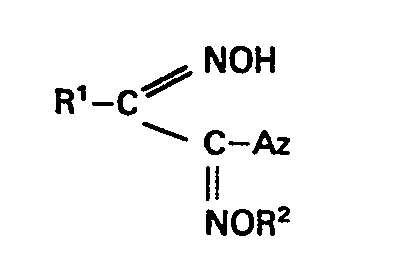
- a) Oxime der Formel (II)
- mit Isocyanaten der Formel

- oder mit Carbamoylhalogeniden der Formel (IV)

- umsetzt oder mit Phosgen und anschließend mit Aminen

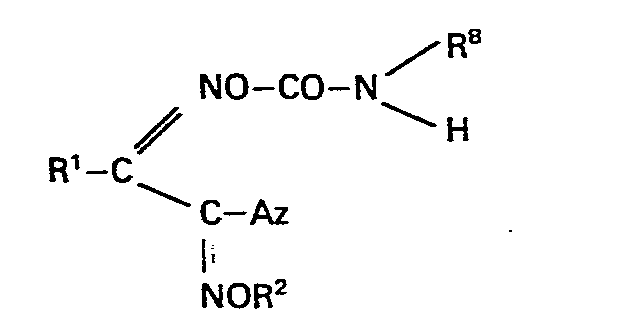
- umsetzt, oder gegebenenfalls die nach den obengenannten Verfahren erhältlichen Oximcarbamate der Formel (VI)
- mit Sulfenchloriden der Formel

Die Oximcarbamate der Formel (I) lassen sich als Insektizide, Akarizide und Nematizide verwenden.
Description
- Die vorliegende Erfindung betrifft neue Oximcarbamate, Verfahren zu ihrer Herstellung, ihre Verwendung als Schädlingsbekämpfungsmittel, sowie Zwischenprodukte zu ihrer Herstellung und Verfahren zur Herstellung dieser Zwischenprodukte.
- Es sind bereits Oximcarbamate wie 3,3-Dimethyl-2- oximino-N-methylcarbamoyl-1-(pyrazol-1-yl)-butan bekannt. Doch befriedigt deren Wirkung vor allem bei niedrigen Aufwandkonzentrationen nicht immer voll (vgl. DE-OS 2 613 167).
- Es wurden die neuen Oximcarbamate der Formel (I) gefunden

- Az für einen gegebenenfalls substituierten Azolylrest steht,
- R 1 für gegebenenfalls substituiertes Alkyl steht,
- R 2 für Alkyl, Halogenalkyl, Cycloalkyl, Alkenyl, Alkinyl, Alkyloxyalkyl, Alkylthioalkyl und Alkoximinomethyl steht,
- R 3 für Wasserstoff oder Alkyl steht,
- R4 für Alkyl, Alkenyl, Alkinyl, Halogenalkyl, Alkoxyalkyl sowie, falls R3 für Alkyl steht, für die Gruppe -SR5 steht,
- R5 für Alkyl, Halogenalkyl, gegebenenfalls substituiertes Phenyl, Alkoxycarbonyl, Dialkylamino steht, oder für den gleichen Rest steht, an den die Gruppierung -SRS gebunden ist, sowie für die Gruppierung -NR6-SO2R7 steht, wobei
- R 6 für Alkyl steht und
- R7 für Alkyl, Dialkylamino oder gegebenenfalls substituiertes Phenyl steht.
- Es wurde gefunden, daß die Oximcarbamate der Formel (I)

- Az für einen gegebenenfalls substituierten Azolylrest steht,
- R für gegebenenfalls substituiertes Alkyl steht,
- R2 für Alkyl, Halogenalkyl, Cycloalkyl, Alkenyl, Alkinyl, Alkyloxyalkyl, Alkylthioalkyl und Alkoximinomethyl steht,
- R3 für Wasserstoff oder Alkyl steht,
- R4 für Alkyl, Alkenyl, Alkinyl, Halogenalkyl, Alkoxyalkyl sowie, falls R 3 für Alkyl steht, für die Gruppe -SR 5 steht,
- R5 für Alkyl, Halogenalkyl, gegebenenfalls substituiertes Phenyl, Alkoxycarbonyl, Dialkylamino steht, oder für den gleichen Rest steht, an den die Gruppierung -SR5 gebunden ist, sowie für die Gruppierung -NR6-SO2R7 steht, wobei
- R 6 für Alkyl steht und
- R7 für Alkyl, Dialkylamino oder gegebenenfalls substituiertes Phenyl steht;
-
- a) Oxime der Formel (II)

- Az,R und R2 die oben angegebenen Bedeutungen haben,
- mit Isocyanaten der Formel (III)

- in welcher R 4 für Alkyl steht,
umsetzt oder - b) Oxime der Formel (II) mit Carbamoylhalogeniden der Formel (IV)

- R3 und R4 die oben angegebene Bedeutung haben und Hal für Fluor oder Chlor steht,
umsetzt, oder - c) Oxime der Formel (II) mit Phosgen und anschließend mit Aminen der Formel (V)

- R 3 und R 4 die oben angegebene Bedeutung haben,
umsetzt, oder - d) gegebenenfalls die nach Verfahren a), b) oder c) erhältlichen Oximcarbamate der Formel (VI)

- Az, R 1 und R2 die oben angegebene Bedeutung haben und
- R 8 für Alkyl steht,
- mit Sulfenchloriden der Formel (VII)

- in welcher R 5 die oben angegebene Bedeutung hat,
umsetzt. - Es wurden die neuen Oxime der Formel (II) gefunden

- Es wurde gefunden, daß die Oxime der Formel (II) hergestellt werden können, indem man Ketone der Formel (VIII)

- Die erfindungsgemäßen Verbindungen der Formel (I) lassen sich als Insektizide, Akarizide und Nematizide verwenden. Sie zeigen dabei überraschenderweise bessere Wirkungen als die aus dem Stand der Technik bekannten Verbindungen.
- Die erfindungsgemäßen Oximcarbamate sind durch die Formel (I) allgemein definiert. In dieser Formel steht Az vorzugsweise für die gegebenenfalls substituierten Azolyl-Reste Pyrazol-1-yl, Imidazol-1-yl, 1,2,4-Triazol-1-yl, 1,2,3-Triazol-1-yl, 1,3,4-Triazol-1-yl, wobei als Substituenten vorzugsweise in Frage kommen: Halogen, insbesondere Fluor, Chlor und Brom, Alkyl mit 1 bis 4 Kohlenstoffatomen, Halogenalkyl mit bis zu 2 Kohlenstoff- und bis zu 5 Halogenatomen, wie insbesondere Fluor- und Chloratomen, beispielsweise sei Trifluormethyl genannt, Alkoxy und Alkylthio mit jeweils bis zu 4 Kohlenstoffatomen und die Nitrogruppe.
- R steht vorzugsweise für gegebenenfalls ein- oder zweifach substituiertes Alkyl mit 1 bis 4 Kohlenstoffatomen, wobei als Substituenten vorzugsweise in Frage kommen: Halogen, insbesondere Fluor, Chlor oder Brom; Acyloxy, insbesondere Alkylcarbonyloxy mit 1 bis 4 Kohlenstoffatomen im Alkylteil; Hydroxy, Nitro, Cyano, sowie Alkoxy und Alkylthio mit jeweils 1 bis 4 Kohlenstoffatomen.
- R steht vorzugsweise für Alkyl mit 1 bis 4 C-Atomen, Alkenyl mit 2 bis 4 C-Atomen, Alkinyl mit 2 bis 4 C-Atomen, Halogenalkyl mit 1 bis 4 C-Atomen und bis zu 3 Halogenatomen, Cycloalkyl mit 3 bis 6 C-Atomen, Alkylthioalkyl mit 1 bis 2 C-Atomen in jedem Alkylteil sowie für Alkoxyiminomethyl mit 1 bis 4 C-Atomen im Alkyletherteil.
- R 3 steht vorzugsweise für Wasserstoff oder geradkettiges oder verzweigtes Alkyl mit 1 bis 4 Kohlenstoffatomen.
- R 4 steht vorzugsweise für geradkettiges oder verzweigtes Alkyl mit 1 bis 12 Kohlenstoffatomen, Alkenyl und Alkinyl mit jeweils 2 bis 4 Kohlenstoffatomen, ferner vorzugsweise für Halogenalkyl mit bis zu 2 Kohlenstoff-und bis zu 5 Halogenatomen, wie insbesondere Fluor- und Chloratomen, Halogenalkenyl mit 2 bis 4 Kohlenstoff-und bis zu 5 Halogenatomen, wie insbesondere Fluor-und Chloratomen, sowie vorzugsweise für Alkoxyalkyl mit bis zu 2 Kohlenstoffatomen in jedem Alkylteil. R4 steht außerdem vorzugsweise für die Gruppe -S-R 5, falls R3 für Alkyl steht.
- Dabei steht R5 vorzugsweise für geradkettiges oder verzweigtes Alkyl mit 1 bis 4 Kohlenstoffatomen, Halogenalkyl mit 1 bis 2 Kohlenstoff- und bis zu 5 Halogenatomen, wie insbesondere Fluor- und Chloratomen, beispielsweise sei Trifluormethyl genannt, gegebenenfalls substituiertes Phenyl, wobei als Substituenten vorzugsweise genannt seien: Halogen, insbesondere Fluor, Chlor oder Brom, Alkyl mit 1 oder 2 Kohlenstoffatomen und Halogenalkyl mit 1 bis 2 Kohlenstoff- und bis zu 5 Halogenatomen, wie insbesondere Fluor- und Chloratomen, beispielsweise sei die Trifluormethylgruppe genannt, sowie vorzugsweise für Alkoxycarbonyl mit 1 bis 4 Kohlenstoffatomen im Alkoxyteil. R5 steht ferner vorzugsweise für den gleichen Rest, an den die Gruppe -S-RS gebunden ist sowie für die Gruppe -NR6-S02R7, wobei R6 vorzugsweise für Alkyl mit 1 bis 4 C-Atomen steht.
- R7 steht vorzugsweise für Alkyl mit 1 bis 4 C-Atomen, Dialkylamino mit jeweils 1 bis 4 C-Atomen in jedem Alkylteil sowie für gegebenenfalls substituiertes Phenyl, wobei als Substituenten vorzugsweise in Frage kommen: Halogen, insbesondere Fluor, Chlor oder Brom, Alkyl mit 1 bis 2 C-Atomen, Halogenalkyl mit 1 bis 2 C-Atomen und bis zu 5 Halogenatomen, wie insbesondere Fluor-und Chloratomen, beispielsweise sei Trifluormethyl genannt, Cyano und Nitro.
- Ganz besonders bevorzugt sind diejenigen-Oximcarbamate der Formel (I) in denen Az für Pyrazol-1-yl und 1,2,4-Triazol-1-yl steht;
- R 1 für Methyl und gegebenenfalls substituiertes tertiäres Butyl steht, wobei als Substituenten genannt seien: Chlor, Fluor und Acetyloxy.
- Ganz besonders bevorzugt steht R2 für Methyl, Ethyl, Propyl, Allyl, Propargyl, Methylthiomethyl und Methoximinomethyl;
- R 3 für Wasserstoff oder Methyl und
- R4 für Methyl oder die Gruppe -S-R5, wobei R5 für Trichlormethyl, Dichlorfluormethyl sowie für den gleichen Rest an den die Gruppierung -S-R5 gebunden ist, steht.
- Im einzelnen seien außer den Herstellungsbeispielen die folgenden Verbindungen genannt:


- Verwendet man beispielsweise 3,3-Dimethyl-2-oximino-1-methoximino-1-(1,2,4-triazol-1-yl)-butan und Methylisocyanat als Ausgangsstoffe, so kann der Reaktionsablauf durch das folgende Formelschema wiedergegeben werden (Verfahren a)):

- Verwendet man beispielsweise 2-Oximino-1-methoximino-1-(1,2,4-triazol-1-yl)-butan und N,N'-Bis-(fluorcarbonyl)-thio-bis-methylamin als Ausgangsstoffe, so kann der Reaktionsablauf durch das folgende Formelschema wiedergegeben werden (Verfahren b)):

- Verwendet man 3,3-Dimethyl-2-oximino-1-ethoximino-1-(1,2,4-triazol-1-yl)-butan, Phosgen und Dimethylamin als Ausgangsstoffe, so kann der Reaktionsablauf durch das folgende Formelschema wiedergegeben werden (Verfahren c)):

- Verwendet man 3,3-Dimethyl-2-methylcarbamoyloximino-1-methoximino-1-(1,2,4-triazol-1-yl)-butan und Chlorphenyl-sulfenyl-chlorid als Ausgangsstoffe, so kann der Reaktionsablauf durch das folgende Formelschema wiedergegeben werden (Verfahren d)):

- Als Verdünnungsmittel kommen für die Umsetzung gemäß Verfahrensvariante (a), (b), (c) und (d) vorzugsweise alle inerten organischen Lösungsmittel in Frage. Hierzu gehören vorzugsweise Ketone, wie Diethylketon, insbesondere Aceton und Methylethylketon; Nitrile, wie Propionitril, insbesondere Acetonitril; Ether, wie Tetrahydrofuran oder Dioxan; Formamide, wie insbesondere Dimethylformamid und halogenierte Kohlenwasserstoffe, wie Methylenchlorid, Tetrachlorkohlenstoff oder Chloroform. Bei Verwendung von Natriumhydrid als Hilfsstoff werden vorzugsweise polare organische Lösungsmittel verwendet, wie insbesondere Hexamethylphosphorsäuretriamid.
- Wird die Umsetzung nach Verfahren (b), (c) und (d) in Gegenwart eines Säurebinders vorgenommen, so kann man alle üblicherweise verwendbaren anorganischen und organischen Säurebinder zugeben. Hierzu gehören vorzugsweise Natriumcarbonat, Kaliumcarbonat und Natriumhydro- gencarbonat, ferner niedere tertiäre Alkylamine, Cycloalkylamine oder Arylalkylamine, wie beispielsweise Triethylamin, N,N-Dimethyl-benzylamin, Dicyclohexylamin, weiterhin Pyridin und Diazabicyclooctan.
- Die Reaktionstemperaturen können bei der Durchführung des Verfahrens (b) in einem größeren Bereich variiert werden. Im allgemeinen arbeitet man zwischen 0 und 100°C, vorzugsweise zwischen 10 und 80°C.
- Bei der Durchführung des Verfahrens (b) setzt man vorzugsweise auf 1 Mol der Verbindung der Formel (II) 1 bis 2 Mol, für den Fall eines dimeren Produktes 0,5 Mol, an Carbamoylchlorid der Formel (IV) und 1 bis 2 Mol Säurebinder ein. Die Isolierung der Verbindungen der Formel (I) erfolgt in allgemein üblicher und bekannter Weise.
- Als Katalysatoren können beim Verfahren (a) vorzugsweise verwendet werden:
- tertiäre Basen, wie Triethylamin, Pyridin, Zinn-organische Verbindungen, wie Dibutylzinndilaurat.
- Die Reaktionstemperaturen können bei der Durchführung des Verfahrens (a) in einem größeren Bereich variiert werden. Im allgemeinen arbeitet man zwischen 0 und 100°C, vorzugsweise zwischen 20 und 85°C.
- Bei der Durchführung des Verfahrens (a) setzt man auf 1 Mol der Verbindung der Formel (II) 1 bis 2 Mol Isocyanat der Formel (III) ein. Zur Isolierung der Verbindungen der Formel (I) wird das Lösungsmittel abdestilliert und der Rückstand nach üblichen Methoden aufgearbeitet.
- Die Reaktionstemperaturen können bei der Durchführung des Verfahrens (c) in einem größeren Bereich variiert werden. Im allgemeinen arbeitet man zwischen 0 und 100°C, vorzugsweise zwischen 0 und 85°C.
- Bei der Durchführung des Verfahrens (c) setzt man vorzugsweise auf 1 Mol der Verbindung der Formel (II) 1 bis 1,5 Mol Phosgen und 1 bis 1,5 Mol an Amin der Formel (V) ein. Es hat sich als vorteilhaft erwiesen, den Säurebinder in geringem Überschuß (bis ca. 30 Gew.-%) und gegebenenfalls das Natriumhydrid in einem Überschuß bis zu ca. 50 Gew.-% einzusetzen. Die Isolierung der Verbindungen der Formel (I) erfolgt in üblicher Weise.
- Die Reaktionstemperaturen können bei der Durchführung des Verfahrens (d) in einem größeren Bereich variiert werden. Im allgemeinen arbeitet man zwischen 0 und 100°C, vorzugsweise zwischen 10 und 50°C.
- Bei der Durchführung des Verfahrens (d) werden die Ausgangsstoffe vorzugsweise in molaren Mengen eingesetzt. Die Isolierung der Verbindungen der Formel (I) erfolgt nach üblichen Methoden.
- Die für die Verfahren (a), (b) und (c) als Ausgangsstoffe zu verwendenden Oxime sind durch die Formel (II) allgemein definiert. In dieser Formel stehen Az, R 1 und R 2 vorzugsweise für die Reste, die die bei den Verbindungen der Formel (I) angegebene bevorzugte und besonders bevorzugte Bedeutung besitzen.
- Die Oxime der Formel (II) sind noch nicht bekannt und können hergestellt werden, indem man Ketone der Formel (VIII)

- Als Ausgangsstoffe der Formel (II) seien beispielsweise genannt:
- 3,3-Dimethyl-2-oximino-1-methoximino-1-(1,2,4-triazol-1-yl)-butan
- 3,3-Dimethyl-2-oximino-1-ethoximino-1-(1,2,4-triazol-1-yl)-butan
- 3,3-Dimethyl-2-oximino-1-propoximino-1-(1,2,4-triazol-1-yl)-butan.
- Die weiterhin für die erfindungsgemäße Umsetzung (a) als Ausgangsstoffe benötigten Isocyanate sind durch die Formel (III) allgemein definiert. In dieser Formel steht R 4 vorzugsweise für geradkettiges oder verzweigtes Alkyl mit 1 bis 12 Kohlenstoffatomen.
- Die Isocyanate der Formel (III) sind bekannt oder lassen sich nach allgemein üblichen und bekannten Verfahren herstellen, z.B. durch Umsetzung von Aminen mit Phosgen und anschließendem Erhitzen. Diese Verfahren sind aus den allgemeinen Lehrbüchern der organischen Chemie bekannt.
- Als Ausgangsstoffe der Formel (III) seien beispielsweise genannt:
- Methylisocyanat, Ethylisocyanat, i-Propylisocyanat, t-Butylisocyanat, Heptylisocyanat, Dodecylisocyanat.
- Die für die erfindungsgemäße Umsetzung (b) als Ausgangsstoffe benötigten Carbamoylhalogenide sind durch die Formel (IV) allgemein definiert. In dieser Formel stehen R 3 und R 4 vorzugsweise für die Reste, die bei den Verbindungen der Formel (I) bereits vorzugsweise genannt wurden.
- Die Carbamoylhalogenide der Formel (IV) sind bekannt oder lassen sich nach allgemein üblichen und bekannten Verfahren herstellen, z.B. erhält man sie durch Umsetzung von Aminen mit Phosgen (diese Verfahren sind aus den allgemeinen Lehrbüchern der organischen Chemie bekannt) oder durch Umsetzung der entsprechenden Carbamidsäurehalogenide mit entsprechenden Sulfenchloriden (vgl. hierzu auch die Angaben in DE-AS 1 297 096, DE-OS 2 357 930 und 2 409 463 sowie US-Patentschrift 3 939 192).
- Als Ausgangsstoffe der Formel (IV) seien beispielsweise genannt:
- Dimethylcarbamoylchlorid, Methylethylcarbamoylchlorid, Allylmethylcarbamoylchlorid, Methoxymethyl-methylcarbamoylchlorid, Methyl-trifluormethylcarbamoylchlorid, Ethylvinylcarbamoylchlorid, N,N'-Bis-(fluorcarbonyl)-thio-bis-methylamin, N-Methyl-N-trichlormethylsulfenylcarbamidsäurefluorid, N-Methyl-N-fluordichlormethylsulfenyl-carbamidsäurefluorid, N-Methyl-N-chlordifluormethylsulfenyl-carbamidsäurefluorid, N-Methyl-N-(3-trifluormethylphenyl)-sulfenyl-carbamidsäurefluorid, N-Methyl-N-(methoxycarbonyl-sulfenyl)-carbamidsäure- fluorid, N-Methyl-N-[(3-methylphenyl-sulfonyl)-methyl- amino-sulfenyl)]-carbamidsäurefluorid, N-Methyl-N-[(4-chlorphenyl)-sulfenyl]-carbamidsäurefluorid, N-Methyl-N-[(4-methylphenyl-sulfonyl)-methylamino-sul- fenyl]-carbamidsäurefluorid und die entsprechenden Carbamidsäure-chloride.
- Die für die erfindungsgemäße Umsetzung (c) als Ausgangsstoffe zu verwendenden Amine sind durch die Formel (V) allgemein definiert. In dieser Formel stehen R 3 und R 4 vorzugsweise für die Reste, die bei den Verbindungen der Formel (I) bereits vorzugsweise genannt wurden.
- Die Amine der Formel (V) sind allgemein bekannte Verbindungen. Als Beispiele seien genannt:
- Ammoniak, Methylamin, Ethylamin, Dimethylamin, Methylethylamin, Allylmethylamin, Methoxymethyl-methylamin, Methyl-trifluormethylamin, Ethylvinylamin.
- Die für die erfindungsgemäße Umsetzung (d) als Ausgangsstoffe zu verwendenden Sulfenchloride sind durch die Formel (VII) allgemein definiert. In dieser Formel steht R vorzugsweise für die Reste, die bei den Verbindungen der Formel (I) bereits vorzugsweise genannt wurden.
- Die Sulfenchloride der Formel (VII) sind allgemein bekannte Verbindungen der organischen Chemie. Als Beispiele seien genannt:
- Trichlormethylsulfenchlorid, Dichlorfluormethylsulfenchlorid, Chlordifluormethylsulfenchlorid, Trifluormethylsulfenchlorid, Phenylsulfenchlorid, 2,4-Dichlorphenylsulfenchlorid, 3-Trifluormethylsulfenchlorid, 3-Methylphenylsulfenchlorid, Methylsulfenylchlorid, 4-Chlor-3-trifluor-methylphenylsulfenylchlorid, Methoxycarbonylsulfenylchlorid, Ethoxycarbonylsulfenylchlorid.
- Die Wirkstoffe eignen sich bei guter Pflanzenverträglichkeit und günstiger Warmblütertoxizität zur Bekämpfung von tierischen Schädlingen, insbesondere Insekten, Spinnentieren und Nematoden, die in der Landwirtschaft, in Forsten, im Vorrats- und Materialschutz sowie auf dem Hygienesektor vorkommen.Sie sind gegen normal sensible und resistente Arten sowie gegen alle oder einzelne Entwicklungsstadien wirksam. Zu den oben erwähnten Schädlingen gehören:
- Aus der Ordnung der Isopoda z.B. Oniscus asellus, Armadillidium vulgare, Porcellio scaber.
- Aus der. Ordnung der Diplopoda z.B. Blaniulus guttulatus.
- Aus der Ordnung der Chilopoda z.B. Geophilus carpophagus, Scutigera spec.
- Aus der Ordnung der Symphyla z.B. Scutigerella immaculata.
- Aus der Ordnung der Thysanura z.B. Lepisma saccharina.
- Aus der Ordnung der Collembola z.B. Onychiurus armatus.
- Aus der Ordnung der Orthoptera z.B. Blatta orientalis,
- Periplaneta americana, Leucophaea maderae, Blattella germanica, Acheta domesticus, Gryllotalpa spp., Locusta migratoria migratorioides, Melanoplus differentialis, Schistocerca gregaria.
- Aus der Ordnung der Dermaptera z.B. Forficula auricularia.
- Aus der Ordnung der Isoptera z.B. Reticulitermes spp..
- Aus der Ordnung der Anoplura z.B. Phylloxera vastatrix,
- Pemphigus spp., Pediculus humanus corporis, Haematopinus spp., Linognathus spp.
- Aus der Ordnung der Mallophaga z.B. Trichodectes spp., Damalinea spp.
- Aus der Ordnung der Thysanoptera z.B. Hercinothrips femoralis, Thrips tabaci.
- Aus der Ordnung der Heteroptera z.B. Eurygaster spp.,
- Dysdercus intermedius, Piesma quadrata, Cimex lectularivs, Rhodnius prolixus, Triatoma spp.
- Aus der Ordnung der Homoptera z.B. Aleurodes brassicae,
- Bemisia tabaci, Trialeurodes vaporariorum, Aphis gossypii,
- Brevicoryne brassicae, Cryptomyzus ribis, Doralis fabae, Doralis pomi, Eriosoma lanigerum, Hyalopterus arundinis, Macrosiphum avenae, Myzus spp.,Phorodon humuli,
- Rhopalosiphum padi, Empoasca spp., Euscelis bilobatus, Nephotettix cincticeps, Lecanium corni, Saissetia oleae,
- Laodelphax striatellus, Nilaparvata lugens, Aonidiella aurantii, Aspidiotus hederae, Pseudococcus spp. Psylla spp.
- Aus der Ordnung der Lepidoptera z.B. Pectinophora gossypiella, Bupalus'piniarius, Cheimatobia brumata,
- Lithocolletis blancardella, Hyponomeuta padella, Plutella maculipennis, Malacosoma neustria, Euproctis chrysorrhoea,
- Lymantria spp. Bucculatrix thurberiella, Phyllocnistis citrella, Agrotis spp., Euxoa spp., Feltia spp. Earias insulana, Heliothis spp., Laphygma exigua, Mamestra brassicae, Panolis flammea, Prodenia litura, Spodoptera spp., Trichoplusia ni, Carpocapsa pomonella, Pieris spp., Chilo spp., Pyrausta nubilalis, Ephestia kuehniella, i
- Galleria mellonella, Tineola bisselliella, Tinea pellionella,
- Hofmannophila pseudospretella, Cacoecia podana, Capua reticulana, Choristoneura fumiferana, Clysia ambiguella, Homona magnanima, Tortrix viridana.
- Aus der Ordnung der Coleoptera z.B. Anobium punctatum, Rhizopertha dominica, Bruchidius obtectus, Acanthoscelides obtectus, Hylotrupes bajulus, Agelastica alni, Leptinotarsa decemlineata, Phaedon cochleariae, Diabrotica spp.,
- Psylliodes chrysocephala, Epilachna varivestis, Atomaria spp.,Oryzaephilus surinamensis, Anthonomus spp., Sitophilus spp., Otiorrhynchus sulcatus, Cosmopolites sordidus,
- Ceuthorrhynchus assimilis, Hypera postica, Dermestes spp.,
- Trogoderma spp., Anthrenus spp., Attagenus spp., Lyctus spp., Meligethes aeneus, Ptinus spp., Niptus hololeucus, Gibbium psylloides, Tribolium spp., Tenebrio molitor, Agriotes spp., Conoderus spp., Melolantha melolontha, Amphimallon solstitialis, Costelytra zealandica.
- Aus der Ordnung der Hymenoptera z.B. Diprion spp., Hoplocampa spp., Lasius spp., Monomorium pharaonis, Vespa spp.
- Aus der Ordnung der Diptera z.B. Aedes spp., Anopheles spp., Culex spp., Drosophila melanogaster, Musca spp., Fannia spp., Calliphora erythrocephala, Lucilia spp., Chrysomyia spp., Cuterebra spp., Gastrophilus spp., Hyppobosca spp., Stomoxys spp., Oestrus spp., Hypoderma spp., Tabanus spp., Tannia spp., Bibio hortulanus, Oscinella frit, Phorbia spp., Pegomyia hyoscyami, Ceratitis capitata, Dacus oleae, Tipula paludosa.
- Aus der Ordnung der Siphonaptera z.B. Xenopsylla cheopis, Ceratophyllus spp.
- Aus der Ordnung der Arachnida z.B. Scorpio maurus, Latrodectus mactans.
- Aus der Ordnung der Acarina z.B. Acarus siro, Argas spp., Ornithodoros spp., Dermanyssus gallinae, Eriophyes ribis, Phyllocoptruta oleivora, Boophilus spp., Rhipicephalus spp., Amblyomma spp., Hyalomma spp., Ixodes spp., Psoroptes spp., Chorioptes spp., Sarcoptes spp., Tarsonemus spp., Bryobia praetiosa, Panonychus spp., Tetranychus spp.
- Zu den pflanzenparasitären Nematoden gehören Pratylenchus spp., Radopholus similis, Ditylenchus dipsaci, Tylenchulus semipenetrans, Heterodera spp., Meloidogyne spp., Aphelenchoides spp., Longidorus spp., Xyphinema spp., Trichodorus spp., Globodera spp.
- Die erfindungsgemäßen Wirkstoffe können in ihren handelsüblichen Formulierungen sowie in den aus diesen Formulierungen bereiteten Anwendungsformen in Mischung mit anderen Wirkstoffen, wie Insektiziden, Lockstoffen, Sterilantien, Akariziden, Nematiziden, Fungiziden, wachstumsregulierenden Stoffen oder Herbiziden vorliegen. Zu den Insektiziden zählen beispielsweise Phosphorsäureester, Carbamate, Carbonsäureester, chlorierte Kohlenwasserstoffe, Phenylharnstoffe, durch Mikroorganismen hergestellte Stoffe u.a.
- Die erfindungsgemäßen Wirkstoffe können ferner in ihren handelsüblichen Formulierungen sowie in den aus diesen Formulierungen bereiteten Anwendungsformen in Mischung mit Synergisten vorliegen. Synergisten sind Verbindungen, durch die die Wirkung der Wirkstoffe gesteigert wird, ohne daß der zugesetzte Synergist selbst aktiv wirksam sein muß.
- Der Wirkstoffgehalt der aus den handelsüblichen Formulierungen bereiteten Anwendungsformen kann in weiten Bereichen variieren. Die Wirkstoffkonzentration der Anwendungsformen kann von 0,0000001 bis zu 100 Gew.-% Wirkstoff, vorzugsweise zwischen 0,0001 und 1 Gew.-% liegen.
- Die Anwendung geschieht in einer den Anwendungsformen angepaßten üblichen Weise.
- Bei der Anwendung gegen Hygiene- und Vorratsschädlinge zeichnen sich die Wirkstoffe durch eine hervorragende Residualwirkung auf Holz und Ton sowie durch eine gute Alkalistabilität auf gekälkten Unterlagen aus.
-

- Ausbeute: 2,5 g (89 % der Theorie), Fp. 127°C.
-

- Ausbeute: 2,5 g öl (71 % der Theorie),

-

- Ausbeute: 3,9 g (71 % der Theorie), Fp. 60°C.


-

- Ausbeute: 23 g (51 % der Theorie), Fp. 137°C.
- Phaedon-Larven-Test
- Lösungsmittel: 3 Gewichtsteile Dimethylformamid
- Emulgator: 1 Gewichtsteil Alkylarylpolyglykoläther
- Zur Herstellung einer zweckmäßigen Wirkstoffzubereitung vermischt man 1 Gewichtsteil Wirkstoff mit der angegebenen Menge Lösungsmittel und der angegebenen Menge Emulgator und verdünnt das Konzentrat mit Wasser auf die gewünschte Konzentration.
- Kohlblätter (Brassica oleracea) werden durch Tauchen in die Wirkstoffzubereitung der gewünschten Konzentration behandelt und mit Meerrettichblattkäfer-Larven (Phaedon cochleariae) besetzt, solange die Blätter noch feucht sind.
- Nach der gewünschten Zeit wird die Abtötung in % bestimmt. Dabei bedeutet 100 %, daß alle Käfer-Larven abgetötet wurden; 0 % bedeutet, daß keine Käfer-Larven abgetötet wurden.
- Bei diesem Test zeigen z.B. die folgenden Verbindungen der Herstellungsbeispiele überlegene Wirksamkeit gegenüber dem Stand der Technik:

- Plutella-Test
- Lösungsmittel: 3 Gewichtsteile Dimethylformamid
- Emulgator : 1 Gewichtsteil Alkylarylpolyglykolether
- Zur Herstellung einer zweckmäßigen Wirkstoffzubereitung vermischt man 1 Gewichtsteil Wirkstoff mit der angegebenen Menge Lösungsmittel und der angegebenen Menge Emulgator und verdünnt das Konzentrat mit Wasser auf die gewünschte Konzentration.
- Kohlblätter (Brassica oleracea) werden durch Tauchen in die Wirkstoffzubereitung der gewünschten Konzentration behandelt und mit Raupen der Kohlschabe (Plutella maculipennis) besetzt, solange die Blätter noch feucht sind.
- Nach der gewünschten Zeit wird die Abtötung in % bestimmt. Dabei bedeutet 100 %, daß alle Raupen abgetötet wurden; 0 % bedeutet, daß keine Raupen abgetötet wurden.
- Bei diesem Test zeigen z.B. die folgenden Verbindungen der Herstellungsbeispiele überlegene Wirksamkeit gegenüber dem Stand der Technik:

- Tetranychus-Test (resistent)
- Lösungsmittel: 3 Gewichtsteile Dimethylformamid
- Emulgator: 1 Gewichtsteil Alkylarylpolyglykoläther
- Zur Herstellung einer zweckmäßigen Wirkstoffzubereitung vermischt man 1 Gewichtsteil Wirkstoff mit der angegebenen Menge Lösungsmittel und der angegebenen Menge Emulgator und verdünnt das Konzentrat mit Wasser auf die gewünschte Konzentration.
- Bohnenpflanzen (Phaseolus vulgaris), die stark von allen Entwicklungsstadien der gemeinen Spinnmilbe oder Bohnenspinnmilbe (Tetranychus urticae) befallen sind, werden durch Tauchen in die Wirkstoffzubereitung der gewünschten Konzentration behandelt.
- Nach der gewünschten Zeit wird die Abtötung in % bestimmt. Dabei bedeutet 100 %, daß alle Spinnmilben abgetötet wurden; 0 % bedeutet, daß keine Spinnmilben abgetötet wurden.
- Bei diesem Test zeigen z.B. die folgenden Verbindungen der Herstellungsbeispiele überlegene Wirksamkeit gegenüber dem Stand der Technik: 1

- Grenzkonzentrations-Test / Wurzelsystemische Wirkung
- Testinsekt: Myzus persicae
- Lösungsmittel: 3 Gewichtsteile Aceton
- Emulgator: 1 Gewichtsteil Alkylarylpolyglykoläther
- Zur Herstellung einer zweckmäßigen Wirkstoffzubereitung vermischt man 1 Gewichtsteil Wirkstoff mit der angegebenen Menge Lösungsmittel, gibt die angegebene Menge Emulgator zu und verdünnt das Konzentrat mit Wasser auf die gewünschte Konzentration.
- Die Wirkstoffzubereitung wird innig mit Boden vermischt. Dabei spielt die Konzentration des Wirkstoffs in der Zubereitung praktisch keine Rolle, entscheidend ist allein die Wirkstoffgewichtsmenge pro Volumeneinheit Boden, welche in ppm (=mg/l) angegeben wird. Man füllt den behandelten Boden in Töpfe und bepflanzt diese mit Kohl (Brassica oleracea). Der Wirkstoff kann so von den Pflanzenwurzeln aus dem Boden aufgenommen und in die Blätter transportiert werden.
- Für den Nachweis des wurzelsystemischen Effektes werden nach 7 Tagen ausschließlich die Blätter mit den obengenannten Testtieren besetzt. Nach weiteren 2 Tagen erfolgt die Auswertung durch Zählen oder Schätzen der toten Tiere. Aus den Abtötungszahlen wird die wurzelsystemische Wirkung des Wirkstoffs abgeleitet. Sie ist 100 %, wenn alle Testtiere abgetötet sind und O %, wenn noch genau so viele Testinsekten leben wie bei der unbehandelten Kontrolle.
- Bei diesem Test zeigen z.B. die folgenden Verbindungen der Herstellungsbeispiele überlegene Wirkung gegenüber dem Stand der Technik:

- Grenzkonzentrations-Test / Wurzelsystemische Wirkung

- Zur Herstellung einer zweckmäßigen Wirkstoffzubereitung vermischt man 1 Gewichtsteil Wirkstoff mit der angegebenen Menge Lösungsmittel, gibt die angegebene Menge Emulgator zu und verdünnt das Konzentrat mit Wasser auf die gewünschte Konzentration.
- Die Wirkstoffzubereitung wird innig mit Boden vermischt. Dabei spielt die Konzentration des Wirkstoffs in der Zubereitung praktisch keine Rolle, entscheidend ist allein die Wirkstoffgewichtsmenge pro Volumeneinheit Boden, welche in ppm (=mg/l) angegeben wird. Man füllt den behandelten Boden in Töpfe und bepflanzt diese mit Kohl (Brassica oleracea). Der Wirkstoff kann so von den Pflanzenwurzeln aus dem Boden aufgenommen und in die Blätter transportiert werden.
- Für den Nachweis des wurzelsystemischen Effektes werden nach 7 Tagen ausschließlich die Blätter mit den obengenannten Testtieren besetzt. Nach weiteren 2 Tagen erfolgt die Auswertung durch Zählen oder Schätzen der toten Tiere. Aus den Abtötungszahlen wird die wurzelsystemische Wirkung des Wirkstoffs abgeleitet. Sie ist 100 %, wenn alle Testtiere abgetötet sind und O %, wenn noch genau so viele Testinsekten leben wie bei der unbehandelten Kontrolle.
- Bei diesem Test zeigen z.B. die folgenden Verbindungen der Herstellungsbeispiele überlegene Wirkung gegenüber dem Stand der Technik:

- Grenzkonzentrations-Test / Nematoden

- Zur Herstellung einer zweckmäßigen Wirkstoffzubereitung vermischt man 1 Gewichtsteil Wirkstoff mit der angegebenen Menge Lösungsmittel, gibt die angegebene Menge Emulgator zu und verdünnt das Konzentrat mit Wasser auf die gewünschte Konzentration.
- Die Wirkstoffzubereitung wird innig mit Boden vermischt, der mit den Testnematoden stark verseucht ist. Dabei spielt die Konzentration des Wirkstoffs in der Zubereitung praktisch keine Rolle, entscheidend ist allein die Wirkstoffmenge pro Volumeneinheit Boden, welche in ppm angegeben wird. Man füllt den behandelten Boden in Töpfe, sät Salat ein und hält die Töpfe bei einer Gewächshaus-Temperatur von 27°C.
- Nach vier Wochen werden die Salatwurzeln auf Nematodenbefall (Wurzelgallen) untersucht und der Wirkungsgrad des Wirkstoffs in % bestimmt. Der Wirkungsgrad ist 100 %, wenn der Befall vollständig vermieden wird, er ist 0 %, wenn der Befall genau so hoch ist wie bei den Kontrollpflanzen in unbehandeltem, aber in gleicher Weise verseuchtem Boden.
- Bei diesem Test zeigen z.B. die folgenden Verbindungen der Herstellungsbeispiele überlegene Wirksamkeit gegenüber dem Stand der Technik:

hergestellt werden können, indem man
Claims (8)
1) Oximcarbamate der Formel (I)

in welcher
Az für einen gegebenenfalls substituierten Azolylrest steht,
R für gegebenenfalls substituiertes Alkyl steht, R2 für Alkyl, Halogenalkyl, Cycloalkyl, Alkenyl, Alkinyl, Alkyloxyalkyl, Alkylthioalkyl und Alkoximinomethyl steht,
R3 für Wasserstoff oder Alkyl steht,
R4 für Alkyl, Alkenyl, Alkinyl, Halogenalkyl, Alkoxyalkyl sowie, falls R3 für Alkyl steht, für die Gruppe -SR 5 steht,
R 5 für Alkyl, Halogenalkyl, gegebenenfalls substituiertes Phenyl, Alkoxycarbonyl, Dialkylamino steht, oder für den gleichen Rest steht, an den die Gruppierung -SR5 gebunden ist, sowie für die Gruppierung -NR6-SO2R7 steht, wobei
R 6 für Alkyl steht und
R7 für Alkyl, Dialkylamino oder gegebenenfalls substituiertes Phenyl steht.
2) Verfahren zur Herstellung der Oximcarbamate der Formel (I)

in welcher
indem man
Az für einen gegebenenfalls substituierten Azolylrest steht,
R1 für gegebenenfalls substituiertes Alkyl steht,
R 2 für Alkyl, Halogenalkyl, Cycloalkyl, Alkenyl, Alkinyl, Alkyloxyalkyl, Alkylthioalkyl und Alkoximinomethyl steht,
R 3 für Wasserstoff oder Alkyl steht,
R 4 für Alkyl, Alkenyl, Alkinyl, Halogenalkyl, Alkoxyalkyl sowie, falls R3 für Alkyl steht, für die Gruppe -SR steht,
R5 für Alkyl, Halogenalkyl, gegebenenfalls substituiertes Phenyl, Alkoxycarbonyl, Dialkylamino steht, oder für den gleichen Rest steht, an den die Gruppierung -SR5 gebunden ist, sowie für die Gruppierung -NR6-SO2R7 steht, wobei
R 6 für Alkyl steht und
R7 für Alkyl, Dialkylamino oder gegebenenfalls substituiertes Phenyl steht;
indem man
a) Oxime der Formel (II)

in welcher
umsetzt oder
Az, R1 und R2 die oben angegebenen Bedeutungen haben,
mit Isocyanaten der Formel (III)

in welcher R 4 für Alkyl steht,
umsetzt oder
b) Oxime der Formel (II) mit Carbamoylhalogeniden der Formel (IV)

in welcher
umsetzt, oder
R 3 und R 4 die oben angegebene Bedeutung haben und
Hal für Fluor oder Chlor steht,
umsetzt, oder
c) Oxime der Formel (II) mit Phosgen und anschließend mit Aminen der Formel (V)

in welcher
umsetzt, oder
R 3 und R 4 die oben angegebene Bedeutung haben,
umsetzt, oder
d) gegebenenfalls die nach Verfahren a), b) oder c) erhältlichen Oximcarbamate der Formel (VI)

in welcher
umsetzt.
Az, R1 und R2 die oben angegebene Bedeutung haben und
R 8 für Alkyl steht, mit Sulfenchloriden der Formel (VII)

in welcher R5 die oben angegebene Bedeutung hat,
umsetzt.
3) Oxime der Formel (II)

in welcher
Az für einen gegebenenfalls substituierten Azolylrest steht,
R1 für gegebenenfalls substituiertes Alkyl steht,
R 2 für Alkyl, Halogenalkyl, Cycloalkyl, Alkenyl, Alkinyl, Alkyloxyalkyl, Alkylthioalkyl und Alkoximinomethyl steht.
4) Verfahren zur Herstellung der Oxime der Formel (II)

in welcher
Az für einen gegebenenfalls substituierten Azolylrest steht,
R1 für gegebenenfalls substituiertes Alkyl steht,
R 2 für Alkyl, Halogenalkyl, Cycloalkyl, Alkenyl, Alkinyl, Alkyloxyalkyl, Alkylthioalkyl und Alkoximinomethyl steht,
indem man Ketone der Formel (VIII)

in welcher
A2, R1 und R2 die oben angegebene Bedeutung hat, mit Hydroxylamin oder seinen Salzen umsetzt.
5) Schädlingsbekämpfungsmittel, gekennzeichnet durch einen Gehalt an mindestens einem Oximcarbamat der Formel (I).
6) Verwendung von Oximcarbamaten der Formel (I) zur Bekämpfung von Schädlingen.
7) Verfahren zur Bekämpfung von Schädlingen, dadurch gekennzeichnet, daß man Oximcarbamate der Formel (I) auf Schädlinge und/oder ihren Lebensraum einwirken läßt.
8) Verfahren zur Herstellung von Schädlingsbekämpfungsmitteln, dadurch gekennzeichnet, daß man Oximcarbamate der Formel (I) mit Streckmitteln und/oder oberflächenaktiven Mitteln vermischt.
Applications Claiming Priority (2)
| Application Number | Priority Date | Filing Date | Title |
|---|---|---|---|
| DE19813150984 DE3150984A1 (de) | 1981-12-23 | 1981-12-23 | Oximcarbamate, verfahren zu ihrer herstellung und ihre verwendung als schaedlingsbekaempfungsmittel |
| DE3150984 | 1981-12-23 |
Publications (1)
| Publication Number | Publication Date |
|---|---|
| EP0083744A2 true EP0083744A2 (de) | 1983-07-20 |
Family
ID=6149499
Family Applications (1)
| Application Number | Title | Priority Date | Filing Date |
|---|---|---|---|
| EP82111462A Withdrawn EP0083744A2 (de) | 1981-12-23 | 1982-12-10 | Oximcarbamate, Verfahren zu ihrer Herstellung, ihre Verwendung als Schädlingsbekämpfungsmittel, sowie Zwischenprodukte zu ihrer Herstellung und Verfahren zur Herstellung dieser Zwischenprodukte |
Country Status (8)
| Country | Link |
|---|---|
| EP (1) | EP0083744A2 (de) |
| JP (1) | JPS58110569A (de) |
| AU (1) | AU9177782A (de) |
| BR (1) | BR8207458A (de) |
| DE (1) | DE3150984A1 (de) |
| DK (1) | DK568682A (de) |
| IL (1) | IL67524A0 (de) |
| ZA (1) | ZA829407B (de) |
Cited By (1)
| Publication number | Priority date | Publication date | Assignee | Title |
|---|---|---|---|---|
| WO1996011183A1 (en) * | 1994-10-07 | 1996-04-18 | Novartis Ag | N-(ortho-substituted benzyloxy)imine derivatives and their use as fungicides, acaricides or insecticides |
Families Citing this family (2)
| Publication number | Priority date | Publication date | Assignee | Title |
|---|---|---|---|---|
| DE3334220A1 (de) * | 1983-09-22 | 1985-04-11 | Bayer Ag, 5090 Leverkusen | 1-azolyl-substituierte oximether |
| BR112012033095B1 (pt) | 2010-06-24 | 2018-10-30 | Ihara Chemical Ind Co | derivado de alcoxiimino, agente e método de controle de peste |
-
1981
- 1981-12-23 DE DE19813150984 patent/DE3150984A1/de not_active Withdrawn
-
1982
- 1982-12-10 EP EP82111462A patent/EP0083744A2/de not_active Withdrawn
- 1982-12-20 IL IL67524A patent/IL67524A0/xx unknown
- 1982-12-20 JP JP57222234A patent/JPS58110569A/ja active Pending
- 1982-12-22 ZA ZA829407A patent/ZA829407B/xx unknown
- 1982-12-22 DK DK568682A patent/DK568682A/da not_active Application Discontinuation
- 1982-12-22 BR BR8207458A patent/BR8207458A/pt unknown
- 1982-12-22 AU AU91777/82A patent/AU9177782A/en not_active Abandoned
Cited By (1)
| Publication number | Priority date | Publication date | Assignee | Title |
|---|---|---|---|---|
| WO1996011183A1 (en) * | 1994-10-07 | 1996-04-18 | Novartis Ag | N-(ortho-substituted benzyloxy)imine derivatives and their use as fungicides, acaricides or insecticides |
Also Published As
| Publication number | Publication date |
|---|---|
| JPS58110569A (ja) | 1983-07-01 |
| IL67524A0 (en) | 1983-05-15 |
| ZA829407B (en) | 1983-10-26 |
| AU9177782A (en) | 1983-06-30 |
| DK568682A (da) | 1983-06-24 |
| BR8207458A (pt) | 1983-10-18 |
| DE3150984A1 (de) | 1983-06-30 |
Similar Documents
| Publication | Publication Date | Title |
|---|---|---|
| EP0043917B1 (de) | N-acylierte N-Methyl-O-pyrazol(4)yl-carbaminsäureester, Verfahren zu ihrer Herstellung und ihre Verwendung in Schädlingsbekämpfungsmitteln | |
| EP0005249B1 (de) | Substituierte Alkanyl-azolyl-oximcarbamate, Verfahren zu ihrer Herstellung und ihre Verwendung als Insektizide, Akarizide und Nematozide | |
| DE2631522A1 (de) | Oximcarbamate fluorierter ketone, verfahren zu ihrer herstellung und ihre verwendung als insektizide, akarizide und nematizide | |
| DE3012642A1 (de) | 3-carbamoyl-4-hydroxy-cumarine, verfahren zu ihrer herstellung als schaedlingsbekaepfungsmittel | |
| EP0083744A2 (de) | Oximcarbamate, Verfahren zu ihrer Herstellung, ihre Verwendung als Schädlingsbekämpfungsmittel, sowie Zwischenprodukte zu ihrer Herstellung und Verfahren zur Herstellung dieser Zwischenprodukte | |
| EP0061114B1 (de) | Phenoxypyridylmethylester, Verfahren zu ihrer Herstellung und ihre Verwendung in Schädlingsbekämpfungsmitteln | |
| EP0058346B1 (de) | N-sulfenylierte Oximcarbamate, Verfahren zu ihrer Herstellung und ihre Verwendung in Schädlingsbekämpfungsmitteln | |
| DE3126390A1 (de) | S-azolyl-methyl-di(tri)-thiophosphorsaeureester, verfahren zu ihrer herstellung und ihre verwendung als schaedlingsbekaempfungsmittel | |
| EP0050283B1 (de) | Hydroxamsäureester, Verfahren zu ihrer Herstellung, ihre Verwendung in Schädlingsbekämpfungsmitteln und Zwischenprodukte dafür | |
| EP0118822B1 (de) | Substituierte Hydroxy-malonsäureamidthioamide, Verfahren zu ihrer Herstellung sowie ihre Verwendung als Schädlingsbekämpfungsmittel | |
| DE3224787A1 (de) | Oximcarbamate, verfahren zu ihrer herstellung und ihre verwendung als schaedlingsbekaempfungsmittel | |
| EP0062821A1 (de) | N-Alkyl-O-pyrazol-4-yl-carbaminsäureester, Verfahren zu ihrer Herstellung und ihre Verwendung als Schädlingsbekämpfungsmittel | |
| EP0060474A1 (de) | Phosphor(phosphon)-säureesteramide, ihre Herstellung und Verwendung | |
| DE2704682A1 (de) | Beta-azolyl-aldoxim-carbamate, verfahren zu ihrer herstellung und ihre verwendung als insektizide, akarizide und nematizide | |
| EP0003301A1 (de) | N-Sulfenylierte Carbamoyl-oxime, Verfahren zu ihrer Herstellung und ihre Verwendung als Insektizide, Akarizide und Nematozide | |
| DE3304203A1 (de) | Substituierte oximether | |
| DE2734107A1 (de) | Beta-azolyl-aldoxim-carbamate, verfahren zu ihrer herstellung und ihre verwendung als insektizide, akarizide und nematizide | |
| EP0079467A1 (de) | N-Substituierte O-Pyrazol-4-yl-carbaminsäureester, Verfahren zu ihrer Herstellung und ihre Verwendung in Schädlingsbekämpfungsmitteln | |
| DE4217864A1 (de) | Substituierte Pyrazoline | |
| DE3328273A1 (de) | Tetrazolyl-(alkylen)-oximcarbamate, verfahren zu ihrer herstellung und ihre verwendung als schaedlingsbekaempfungsmittel | |
| EP0535461A1 (de) | Phosphorylierte Diazacycloalkane | |
| DE3222154A1 (de) | Heterocyclisch substituierte alkylthioalkyl-oximcarbamate, verfahren zu ihrer herstellung und ihre verwendung als schaedlingsbekaempfungsmittel | |
| EP0063742A2 (de) | Substituierte Carbamoyloximino-tetrahydrothiophene, Verfahren zu ihrer Herstellung und ihre Verwendung als Schädlingsbekämpfungsmittel | |
| EP0024329A2 (de) | Substituierte 2-Carbamoyloximino-butane, Verfahren zu ihrer Herstellung und ihre Verwendung als Schädlingsbekämpfungsmittel | |
| EP0092721A1 (de) | N-sulfenylierte Carbamate, Verfahren zu ihrer Herstellung sowie ihre Verwendung als Schädlingsbekämpfungsmittel |
Legal Events
| Date | Code | Title | Description |
|---|---|---|---|
| PUAI | Public reference made under article 153(3) epc to a published international application that has entered the european phase |
Free format text: ORIGINAL CODE: 0009012 |
|
| 17P | Request for examination filed |
Effective date: 19821210 |
|
| AK | Designated contracting states |
Designated state(s): AT BE CH DE FR GB IT LI NL |
|
| STAA | Information on the status of an ep patent application or granted ep patent |
Free format text: STATUS: THE APPLICATION HAS BEEN WITHDRAWN |
|
| 18W | Application withdrawn |
Withdrawal date: 19830922 |
|
| RIN1 | Information on inventor provided before grant (corrected) |
Inventor name: HAMMANN, INGEBORG, DR. Inventor name: SCHMETZER, JOHANNES, DR. Inventor name: STETTER, JOERG, DR. Inventor name: HOMEYER, BERNHARD, DR. |