EP0084143A1 - Procédé de fabrication d'un milieu filtrant - Google Patents
Procédé de fabrication d'un milieu filtrant Download PDFInfo
- Publication number
- EP0084143A1 EP0084143A1 EP82111780A EP82111780A EP0084143A1 EP 0084143 A1 EP0084143 A1 EP 0084143A1 EP 82111780 A EP82111780 A EP 82111780A EP 82111780 A EP82111780 A EP 82111780A EP 0084143 A1 EP0084143 A1 EP 0084143A1
- Authority
- EP
- European Patent Office
- Prior art keywords
- fleece
- fibers
- grid
- melting point
- softenable
- Prior art date
- Legal status (The legal status is an assumption and is not a legal conclusion. Google has not performed a legal analysis and makes no representation as to the accuracy of the status listed.)
- Granted
Links
- 238000000034 method Methods 0.000 title claims abstract description 17
- 238000004519 manufacturing process Methods 0.000 title abstract description 6
- 239000000835 fiber Substances 0.000 claims abstract description 28
- 238000002844 melting Methods 0.000 claims abstract description 15
- 230000008018 melting Effects 0.000 claims abstract description 15
- XLYOFNOQVPJJNP-UHFFFAOYSA-N water Substances O XLYOFNOQVPJJNP-UHFFFAOYSA-N 0.000 claims abstract description 10
- 239000000203 mixture Substances 0.000 claims abstract 2
- 238000003825 pressing Methods 0.000 claims description 6
- 230000006835 compression Effects 0.000 abstract 1
- 238000007906 compression Methods 0.000 abstract 1
- 239000004745 nonwoven fabric Substances 0.000 description 8
- 239000000463 material Substances 0.000 description 6
- 238000010438 heat treatment Methods 0.000 description 5
- -1 polypropylene Polymers 0.000 description 5
- 239000004698 Polyethylene Substances 0.000 description 3
- 229920000728 polyester Polymers 0.000 description 3
- 229920000573 polyethylene Polymers 0.000 description 3
- 239000004800 polyvinyl chloride Substances 0.000 description 3
- 229920000915 polyvinyl chloride Polymers 0.000 description 3
- 239000004743 Polypropylene Substances 0.000 description 2
- 239000011230 binding agent Substances 0.000 description 2
- 238000000354 decomposition reaction Methods 0.000 description 2
- 238000001914 filtration Methods 0.000 description 2
- 238000005187 foaming Methods 0.000 description 2
- 229920001155 polypropylene Polymers 0.000 description 2
- 229920003002 synthetic resin Polymers 0.000 description 2
- 239000000057 synthetic resin Substances 0.000 description 2
- 229920001187 thermosetting polymer Polymers 0.000 description 2
- 239000004925 Acrylic resin Substances 0.000 description 1
- 229920000178 Acrylic resin Polymers 0.000 description 1
- ISWSIDIOOBJBQZ-UHFFFAOYSA-N Phenol Chemical compound OC1=CC=CC=C1 ISWSIDIOOBJBQZ-UHFFFAOYSA-N 0.000 description 1
- 239000004952 Polyamide Substances 0.000 description 1
- 239000004642 Polyimide Substances 0.000 description 1
- 239000004372 Polyvinyl alcohol Substances 0.000 description 1
- 239000000853 adhesive Substances 0.000 description 1
- 230000001070 adhesive effect Effects 0.000 description 1
- 238000004378 air conditioning Methods 0.000 description 1
- 238000003490 calendering Methods 0.000 description 1
- 238000007596 consolidation process Methods 0.000 description 1
- 238000001816 cooling Methods 0.000 description 1
- 238000004132 cross linking Methods 0.000 description 1
- 238000005202 decontamination Methods 0.000 description 1
- 230000003588 decontaminative effect Effects 0.000 description 1
- 230000003247 decreasing effect Effects 0.000 description 1
- 230000001419 dependent effect Effects 0.000 description 1
- 230000000694 effects Effects 0.000 description 1
- 239000005038 ethylene vinyl acetate Substances 0.000 description 1
- 238000005470 impregnation Methods 0.000 description 1
- 230000010354 integration Effects 0.000 description 1
- 238000002156 mixing Methods 0.000 description 1
- 229920003023 plastic Polymers 0.000 description 1
- 239000004033 plastic Substances 0.000 description 1
- 239000002985 plastic film Substances 0.000 description 1
- 229920006255 plastic film Polymers 0.000 description 1
- 239000004014 plasticizer Substances 0.000 description 1
- 229920001200 poly(ethylene-vinyl acetate) Polymers 0.000 description 1
- 229920002239 polyacrylonitrile Polymers 0.000 description 1
- 229920002647 polyamide Polymers 0.000 description 1
- 229920001721 polyimide Polymers 0.000 description 1
- 229920002451 polyvinyl alcohol Polymers 0.000 description 1
- 230000002787 reinforcement Effects 0.000 description 1
- 229920005989 resin Polymers 0.000 description 1
- 239000011347 resin Substances 0.000 description 1
- 230000000284 resting effect Effects 0.000 description 1
- 229920002994 synthetic fiber Polymers 0.000 description 1
- 239000012209 synthetic fiber Substances 0.000 description 1
- 229920001169 thermoplastic Polymers 0.000 description 1
- 239000012815 thermoplastic material Substances 0.000 description 1
- 239000004416 thermosoftening plastic Substances 0.000 description 1
- 230000008719 thickening Effects 0.000 description 1
- 238000011144 upstream manufacturing Methods 0.000 description 1
- 238000009423 ventilation Methods 0.000 description 1
- 238000010792 warming Methods 0.000 description 1
Images

Classifications
-
- D—TEXTILES; PAPER
- D04—BRAIDING; LACE-MAKING; KNITTING; TRIMMINGS; NON-WOVEN FABRICS
- D04H—MAKING TEXTILE FABRICS, e.g. FROM FIBRES OR FILAMENTARY MATERIAL; FABRICS MADE BY SUCH PROCESSES OR APPARATUS, e.g. FELTS, NON-WOVEN FABRICS; COTTON-WOOL; WADDING ; NON-WOVEN FABRICS FROM STAPLE FIBRES, FILAMENTS OR YARNS, BONDED WITH AT LEAST ONE WEB-LIKE MATERIAL DURING THEIR CONSOLIDATION
- D04H1/00—Non-woven fabrics formed wholly or mainly of staple fibres or like relatively short fibres
- D04H1/40—Non-woven fabrics formed wholly or mainly of staple fibres or like relatively short fibres from fleeces or layers composed of fibres without existing or potential cohesive properties
- D04H1/58—Non-woven fabrics formed wholly or mainly of staple fibres or like relatively short fibres from fleeces or layers composed of fibres without existing or potential cohesive properties by applying, incorporating or activating chemical or thermoplastic bonding agents, e.g. adhesives
- D04H1/60—Non-woven fabrics formed wholly or mainly of staple fibres or like relatively short fibres from fleeces or layers composed of fibres without existing or potential cohesive properties by applying, incorporating or activating chemical or thermoplastic bonding agents, e.g. adhesives the bonding agent being applied in dry state, e.g. thermo-activatable agents in solid or molten state, and heat being applied subsequently
-
- B—PERFORMING OPERATIONS; TRANSPORTING
- B01—PHYSICAL OR CHEMICAL PROCESSES OR APPARATUS IN GENERAL
- B01D—SEPARATION
- B01D39/00—Filtering material for liquid or gaseous fluids
- B01D39/14—Other self-supporting filtering material ; Other filtering material
- B01D39/16—Other self-supporting filtering material ; Other filtering material of organic material, e.g. synthetic fibres
- B01D39/1607—Other self-supporting filtering material ; Other filtering material of organic material, e.g. synthetic fibres the material being fibrous
- B01D39/1623—Other self-supporting filtering material ; Other filtering material of organic material, e.g. synthetic fibres the material being fibrous of synthetic origin
- B01D39/163—Other self-supporting filtering material ; Other filtering material of organic material, e.g. synthetic fibres the material being fibrous of synthetic origin sintered or bonded
-
- B—PERFORMING OPERATIONS; TRANSPORTING
- B01—PHYSICAL OR CHEMICAL PROCESSES OR APPARATUS IN GENERAL
- B01D—SEPARATION
- B01D2239/00—Aspects relating to filtering material for liquid or gaseous fluids
- B01D2239/10—Filtering material manufacturing
Definitions
- the invention relates to a method for producing a filter mat, in particular a method for the effective and inexpensive production of filter mats, in particular for attachment to the suction points of various instruments.
- the filter mats should have great durability and flexibility, as well as good dimensional stability and a particularly low pressure drop.
- the filter mats usually used at the suction points of air conditioning systems, cooling systems, heating, various ventilation devices, air cleaners and the like consist of nets made of polypropylene fibers or very rough nonwovens. These only have a very unsatisfactory lint resistance, which can result in decontamination of the cleaned air by detached fiber components. Subsequent reinforcement, in particular of the edge zones, by topstitching or foaming into a plastic frame was therefore absolutely necessary.
- the invention has for its object to develop a method for producing a filter mat that overcomes the above disadvantages in their entirety.
- the filter mats obtainable by the proposed method should have optimal lint safety, in particular with a minimal pressure drop, and make the use of secondary support measures superfluous, such as the use of support grids or the topstitching or foaming of the edge zone.
- thermally softenable fibers od l r are combined in admixture with non-softenable fibers to form a web alone, / m 2 having a pressure drop of 1 to 3 mm water column at a basis weight of 75 to 200 g, measured at an air speed of 2 m / sec. that the fleece is placed on a thermally softenable grid with discretely distributed, convex areas that rise at least 0.3 mm above its surface and that has a melting point of 50 ° C or more below that of the thermally softenable fibers, that the multilayer structure thus obtained is heated from the direction of the fleece to a temperature which is 20 ° C. or more above the melting point of the grid, but below that of the thermally softenable fibers and that for mutual connection a joint pressing is carried out simultaneously or immediately thereafter.
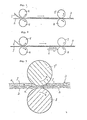
- the fleece 1 and the grating 2 used are layered on top of one another in a first working step and to ensure a uniform contact between convex regions of the grating and the surface of the fleece by means of a calender consisting of the rollers 4 and 5 passed.
- the effect can be enhanced by a slight warming ge -. if necessary, both rolls of the calender, which, however, must not exceed the melting point of a component contained in the two flat structures.
- the multilayer structure obtained in this way is then heated asymmetrically in order to achieve thermal softening, if possible, only of the convex regions of the lattice. As a result, these are converted into a sticky state and enter into an adhesive bond with the nonwoven during the joint pressing.
- an infrared radiator 6 arranged on the side of the nonwoven is directly connected upstream of the calender consisting of the rollers 7 and 8.
- the heat imitated by it is dimensioned such that the convex areas of the lattice touching the nonwoven thermally soften and are able to stick to the nonwoven during the subsequent calendering process.
- the fleece used has a weight per unit area of 75 to 200 g / m 2 and a pressure drop of 1 to 3 mm water column, measured at an air speed of 2 m / sec.
- nonwovens with a weight per unit area greater than 200 g / m 2 have an insufficient thermal conductivity, which makes it difficult to heat the associated grids to the required temperature only in the convex areas.
- Nonwovens that are too thick lead to difficulties during thermal pressing.
- nonwovens whose pressure drop is greater than 3.0 mm water column, measured at an air speed of 2 m / sec. Show a lower thermal conductivity and it can therefore be difficult to melt the convex areas of the grids 2 to be used as required .
- nonwovens which have a basis weight of less than 75 g / m 2 and / or a pressure drop of less than 1 mm water column, measured at an air speed of 2 m / sec., Then an insufficient degree of filtration is achieved, which is also not the case is desired.
- the nonwovens used can be made wholly or partly of synthetic fibers, such as polyester fibers, polyamide fibers, polyacrylonitrile fibers, polyvinyl alcohol fibers, polypropylene fibers, polyfural fibers, polyimide fibers, phenol fibers and the like. These can be used individually or in mutual mixing with any one or more of the types of fibers mentioned, the nonwoven formed being able to undergo additional consolidation if necessary by impregnation with a binder and / or by a thermal or mechanical aftertreatment, such as, for example, a needling process.
- synthetic fibers such as polyester fibers, polyamide fibers, polyacrylonitrile fibers, polyvinyl alcohol fibers, polypropylene fibers, polyfural fibers, polyimide fibers, phenol fibers and the like.
- thermosetting resins are preferred in order to ensure that the fleece assumes the original thickness again after being pressed with the grid.
- FIG. 4 shows a section of such a grating in a top view
- FIG. 5 shows this section in a cross-sectional representation along the line AA '.
- the grating 2 consists, as can be clearly seen from both FIGS. 4 and 5, essentially of a plastic film having openings at regular intervals.
- the individual openings are separated from one another only by relatively narrow webs b, which are convex on both sides at the nodes Areas are thickened. These protrude the level of the other webs by the dimension h of at least 0.3 mm, which ensures that the webs are initially at an equal distance from the fleece after being placed on it. If the value h is less than 0.3 mm, there is a risk that the softening of the convex regions a required for the connection of the fleece will overlap the webs b, which leads to an increased pressure drop and is therefore not desirable.
- the value 0.3 mm also represents only a minimum value and can be increased slightly if necessary up to a maximum value of 0.9 mm.
- the proportion of holes in the grid should be at least 50%, preferably at least 62%.
- the smallest mutual distance between the convex regions is accordingly preferably 8 to 20 mm.
- the melting point of the lattice must be at least 50 ° C less than the melting or decomposition point of components contained in the nonwoven. This ensures that the change in the convex regions a of the lattice 2 caused by heat and pressure remains essentially restricted to these, avoiding the inclusion of components of the nonwoven.
- synthetic resins which have a melting point which is considerably lower than the fibers mentioned above, in particular polyethylene, polyvinyl chloride copolymer, ethylene-vinyl acetate copolymer, PVC and the like, are preferably used for the production of the grids.
- the preferred material is polyethylene.
- PVC Depending on the plasticizer content, PVC has an indefinitely stored and very narrow softening range, which requires the use of very precise temperature controls in order to achieve a good result.
- the laminate should be heated to a temperature of at least 20 ° C. above the softening point of the network before or during its connection in a calender in order to ensure good integration of the fibers of the nonwoven into the convex regions a.
- a temperature of at least 20 ° C. above the softening point of the network before or during its connection in a calender in order to ensure good integration of the fibers of the nonwoven into the convex regions a.
- an even greater heating can be expedient while observing the other boundary conditions, provided that it is ensured that softening which affects the mechanical stability of the webs b does not occur in these areas.
- the conditions for pressing which can be carried out simultaneously with or after heating, are not particularly limited, it is of course necessary that the distance between the pressure rollers 7, 8 and 7 ', 8 is chosen so that a good one and a connection between the fleece and the grid made of thermoplastic material is obtained which is restricted to the convex regions a. With usual nonwovens This is usually the case if the value is slightly below the total thickness H of the grating.
- the filter mats obtainable by the proposed method contain a filter fleece which is essentially only removed in a punctiform manner. This means that almost the entire surface of the fleece is available for filtering purposes, which enables a minimal pressure drop to be achieved with good filter performance.
- the fleece together with the grid carrying it, forms an easy-to-use and inexpensive unit that is characterized by particularly good dimensional stability.
- the high mechanical resistance and the ease of assembly of the proposed filter mat are remarkable. This can easily be cut to any desired size and used as a flat or folded sheet. Edge processing is unnecessary and damage can be easily repaired.
- a polyester fleece with a basis weight of 40 g / m 2 is prepared from polyester fibers with a melting point of 255 ° C., a titer of 20 den and a stack length of 64 mm. This is pre-consolidated in a calender, impregnated with a thermosetting acrylic resin, dried and for crosslinking exposed to heat. The final weight was 70 g / m 2 , the thickness 3 mm.
- the fleece then showed a pressure drop of 1.2 mm water column, measured at an air speed of 2 m / sec.
- a grid similar to FIG. 4 was produced from polyethylene with a melting point of 130 ° C.
- the webs b had a length of 13 mm, the height h was 5 mm, the maximum total thickness (H) 1.8, the weight per unit area 220 g / m 2 and the pressure drop 0.3 mm water column, measured at an air speed of 2 m / sec.
- the fleece and grid were then stacked on top of one another and pressed between unheated pressure rollers 4, 5 in order to ensure a uniform contact between all convex regions of the grid and the surface of the fleece.
- the multilayer structure thus obtained was 5 mm set gap of an asymmetrically heated calender.
- the calender roll 7 'resting on the fleece was heated to a temperature of 170 ° C., while the counter roll 8 was cooled with water.
- the filter mat emerging from the gap consisted of a grid that was non-detachably connected to the fleece.
- the connection between the two parts was on the originally convex areas of the grid limited, and the fleece showed no significant change in its original shape.
- the filter mat obtained in this way had a thickness of 4.2 mm at a basis weight of 290 g / m 2 .
- the pressure drop was 1.6 mm water column, measured at an air speed of 2 m / sec., which corresponds almost to that of the fleece used in connection with that of the grating used under the same conditions.
- the filter mats obtained also have an excellent dimensional stability, they are easy to cut, have a higher mechanical stability and an improved durability and can therefore be used successfully as a filter for the suction points of various instruments.
Landscapes
- Engineering & Computer Science (AREA)
- Textile Engineering (AREA)
- Chemical & Material Sciences (AREA)
- Chemical Kinetics & Catalysis (AREA)
- Filtering Materials (AREA)
- Nonwoven Fabrics (AREA)
Applications Claiming Priority (2)
| Application Number | Priority Date | Filing Date | Title |
|---|---|---|---|
| JP56206647A JPS58109113A (ja) | 1981-12-21 | 1981-12-21 | 「あ」材の製造方法 |
| JP206647/81 | 1981-12-21 |
Publications (2)
| Publication Number | Publication Date |
|---|---|
| EP0084143A1 true EP0084143A1 (fr) | 1983-07-27 |
| EP0084143B1 EP0084143B1 (fr) | 1986-02-26 |
Family
ID=16526808
Family Applications (1)
| Application Number | Title | Priority Date | Filing Date |
|---|---|---|---|
| EP82111780A Expired EP0084143B1 (fr) | 1981-12-21 | 1982-12-18 | Procédé de fabrication d'un milieu filtrant |
Country Status (4)
| Country | Link |
|---|---|
| US (1) | US4478620A (fr) |
| EP (1) | EP0084143B1 (fr) |
| JP (1) | JPS58109113A (fr) |
| DE (1) | DE3269523D1 (fr) |
Cited By (3)
| Publication number | Priority date | Publication date | Assignee | Title |
|---|---|---|---|---|
| DE3904623A1 (de) * | 1989-02-16 | 1990-08-23 | Sandler Helmut Helsa Werke | Filter, insbes. fuer ein fahrzeug |
| EP0292294A3 (fr) * | 1987-05-19 | 1991-04-03 | Chisso Corporation | Filtre cylindrique |
| DE102010025219A1 (de) * | 2010-06-23 | 2011-12-29 | Hydac Filtertechnik Gmbh | Filtermaterial für Fluide und Verfahren zur Herstellung eines Filtermaterials |
Families Citing this family (36)
| Publication number | Priority date | Publication date | Assignee | Title |
|---|---|---|---|---|
| EP0246917B1 (fr) * | 1986-05-23 | 1992-07-22 | W.L. Gore & Associates, Inc. | Filtre à gaz de haute performance |
| US4887363A (en) * | 1987-07-08 | 1989-12-19 | Nordson Corporation | Fluidized bed hopper |
| JPH059056Y2 (fr) * | 1987-08-04 | 1993-03-05 | ||
| US5045094A (en) * | 1988-12-15 | 1991-09-03 | Monsanto Company | Nonwoven fiber bed mist eliminator |
| US5019140A (en) * | 1988-12-21 | 1991-05-28 | W. L. Gore & Associates, Inc. | Irradiated expanded polytetrafluoroethylene composites, and devices using them, and processes for making them |
| US4917942A (en) * | 1988-12-22 | 1990-04-17 | Minnesota Mining And Manufacturing Company | Nonwoven filter material |
| JPH0538812Y2 (fr) * | 1988-12-30 | 1993-09-30 | ||
| DE4128396C2 (de) * | 1991-08-23 | 1995-06-01 | Mannesmann Ag | Verfahren zum Verbinden eines feinmaschigen Filtergewebes mit einem grobmaschigen Trägergewebe zu einem Doppelfilterband |
| US5980616A (en) * | 1993-02-16 | 1999-11-09 | Donaldson Company, Inc. | Filter media for preventing carbon migration |
| US5582907A (en) * | 1994-07-28 | 1996-12-10 | Pall Corporation | Melt-blown fibrous web |
| WO1996003194A1 (fr) * | 1994-07-28 | 1996-02-08 | Pall Corporation | Bande fibreuse pour traiter un fluide |
| US6146436A (en) * | 1994-08-05 | 2000-11-14 | Firma Carl Freudenberg | Cartridge filter |
| US5721180A (en) * | 1995-12-22 | 1998-02-24 | Pike; Richard Daniel | Laminate filter media |
| US5792242A (en) * | 1996-02-26 | 1998-08-11 | Minnesota Mining And Manufacturing Co. | Electrostatic fibrous filter web |
| US6211100B1 (en) * | 1996-04-30 | 2001-04-03 | Minnesota Mining And Manufacturing Company | Synthetic filter media |
| DE19628184A1 (de) * | 1996-07-12 | 1998-01-15 | Irema Filter Gmbh | Partikelfilter in Form eines plissierten schichtförmigen Vliesmaterials |
| US5874373A (en) * | 1997-03-14 | 1999-02-23 | American Felt & Filter Company | Enhanced electret needled filtration media and composites |
| KR100225024B1 (ko) * | 1997-06-16 | 1999-10-15 | 롤프 에취, 켈러 | 자동차 실내용 에어 필터 메디아와 그 가공방법 |
| US6036752A (en) * | 1998-07-28 | 2000-03-14 | 3M Innovative Properties Company | Pleated filter |
| EP1173269B1 (fr) * | 1999-04-20 | 2003-07-02 | Gore Enterprise Holdings, Inc. | Milieux filtrants |
| US6419729B1 (en) * | 2000-04-17 | 2002-07-16 | 3M Innovative Properties Company | Filter assemblies with adhesive attachment systems |
| JP4631185B2 (ja) * | 2001-03-13 | 2011-02-16 | トヨタ紡織株式会社 | フィルタ及びその製造方法 |
| KR100399151B1 (ko) * | 2001-04-24 | 2003-09-26 | (주)텍스테크 | 망사와 부직포를 결합한 레이스용 직물 |
| US7179377B1 (en) * | 2003-02-27 | 2007-02-20 | Caughman Jr Carl Russell | Filter for sludge filtration |
| US7413588B2 (en) * | 2004-11-24 | 2008-08-19 | Fleetguard, Inc. | High efficiency, low restriction, cost effective filter |
| US7828870B1 (en) | 2004-11-24 | 2010-11-09 | Cummins Filtration Ip, Inc. | Filter assembly with cost effective seal |
| US20060137317A1 (en) * | 2004-12-28 | 2006-06-29 | Bryner Michael A | Filtration media for filtering particulate material from gas streams |
| US7582131B2 (en) * | 2005-09-15 | 2009-09-01 | Conwed Plastics Llc | Plastic support net for filter media |
| DE202005019004U1 (de) * | 2005-12-06 | 2007-04-19 | Melitta Haushaltsprodukte Gmbh & Co. Kg | Filtermaterial und Staubsaugerbeutel |
| US7976712B2 (en) * | 2007-10-01 | 2011-07-12 | Cummins Filtration Ip, Inc. | Apparatus, system, and method for filtration of a dosing fluid in an exhaust aftertreatment system |
| US8343251B2 (en) * | 2008-04-14 | 2013-01-01 | Columbus Industries, Inc. | Composite filter media |
| DE102008019085A1 (de) * | 2008-04-15 | 2009-10-22 | Microdyn - Nadir Gmbh | Filterverbundmaterial, Verfahren zu seiner Herstellung sowie aus dem Filterverbundmaterial hergestellte Flachfilterelemente |
| US9012013B2 (en) * | 2008-12-18 | 2015-04-21 | 3M Innovative Properties Company | Expandable face mask with reinforcing netting |
| JP6129655B2 (ja) * | 2013-06-17 | 2017-05-17 | 倉敷繊維加工株式会社 | エアフィルタ濾材の製造方法 |
| KR101878355B1 (ko) * | 2015-06-01 | 2018-07-16 | 주식회사 아모그린텍 | 기체필터 |
| WO2018091531A1 (fr) | 2016-11-15 | 2018-05-24 | Mann+Hummel Gmbh | Procédé de fabrication d'un milieu filtrant, milieu filtrant et élément filtrant |
Citations (7)
| Publication number | Priority date | Publication date | Assignee | Title |
|---|---|---|---|---|
| CH469847A (de) * | 1965-12-15 | 1969-03-15 | Kendall & Co | Nonwoven, Verfahren zur Herstellung und Verwendung desselben |
| US3640839A (en) * | 1968-07-13 | 1972-02-08 | Tokyo Roki Kk | Filter paper for oil filters |
| DE2140287A1 (de) * | 1971-07-27 | 1973-02-15 | Tatsuji Hamano | Filter zum reinigen verschiedener fluessigkeiten, sowie verfahren zu dessen herstellung |
| US3727769A (en) * | 1971-04-14 | 1973-04-17 | American Air Filter Co | Prestressed filter media |
| FR2156521A1 (en) * | 1971-10-05 | 1973-06-01 | Siv Soc Italiana Vetro | Composite support material - consisting of fibrous sheet and reinforcing net embedded in sheet |
| DE2723528A1 (de) * | 1976-06-01 | 1977-12-22 | Hollingsworth & Vose Co | Filtermittel und seine herstellung |
| DE2947349A1 (de) * | 1978-11-23 | 1980-06-04 | Tissmetal Lionel Dupont | Filter bzw. filtertuch fuer einen banddruckfilter |
Family Cites Families (5)
| Publication number | Priority date | Publication date | Assignee | Title |
|---|---|---|---|---|
| US2389435A (en) * | 1942-07-09 | 1945-11-20 | Electrolux Corp | Filter material |
| US3543940A (en) * | 1968-08-14 | 1970-12-01 | Industrial Filter Pump Mfg Co | Filter construction |
| US3675403A (en) * | 1970-03-10 | 1972-07-11 | Johnson & Johnson | Flame retardant air filter construction with thermoplastic scrim |
| US4159360A (en) * | 1976-10-15 | 1979-06-26 | Hercules Incorporated | Stabilized fabrics |
| JPS5353076A (en) * | 1976-10-25 | 1978-05-15 | Matsushita Electric Ind Co Ltd | Filter for vacuum cleaner |
-
1981
- 1981-12-21 JP JP56206647A patent/JPS58109113A/ja active Granted
-
1982
- 1982-12-06 US US06/446,979 patent/US4478620A/en not_active Expired - Fee Related
- 1982-12-18 EP EP82111780A patent/EP0084143B1/fr not_active Expired
- 1982-12-18 DE DE8282111780T patent/DE3269523D1/de not_active Expired
Patent Citations (7)
| Publication number | Priority date | Publication date | Assignee | Title |
|---|---|---|---|---|
| CH469847A (de) * | 1965-12-15 | 1969-03-15 | Kendall & Co | Nonwoven, Verfahren zur Herstellung und Verwendung desselben |
| US3640839A (en) * | 1968-07-13 | 1972-02-08 | Tokyo Roki Kk | Filter paper for oil filters |
| US3727769A (en) * | 1971-04-14 | 1973-04-17 | American Air Filter Co | Prestressed filter media |
| DE2140287A1 (de) * | 1971-07-27 | 1973-02-15 | Tatsuji Hamano | Filter zum reinigen verschiedener fluessigkeiten, sowie verfahren zu dessen herstellung |
| FR2156521A1 (en) * | 1971-10-05 | 1973-06-01 | Siv Soc Italiana Vetro | Composite support material - consisting of fibrous sheet and reinforcing net embedded in sheet |
| DE2723528A1 (de) * | 1976-06-01 | 1977-12-22 | Hollingsworth & Vose Co | Filtermittel und seine herstellung |
| DE2947349A1 (de) * | 1978-11-23 | 1980-06-04 | Tissmetal Lionel Dupont | Filter bzw. filtertuch fuer einen banddruckfilter |
Cited By (4)
| Publication number | Priority date | Publication date | Assignee | Title |
|---|---|---|---|---|
| EP0292294A3 (fr) * | 1987-05-19 | 1991-04-03 | Chisso Corporation | Filtre cylindrique |
| DE3904623A1 (de) * | 1989-02-16 | 1990-08-23 | Sandler Helmut Helsa Werke | Filter, insbes. fuer ein fahrzeug |
| DE102010025219A1 (de) * | 2010-06-23 | 2011-12-29 | Hydac Filtertechnik Gmbh | Filtermaterial für Fluide und Verfahren zur Herstellung eines Filtermaterials |
| US10239002B2 (en) | 2010-06-23 | 2019-03-26 | Hydac Filtertechnik Gmbh | Filter material for fluids and method for producing a filter material |
Also Published As
| Publication number | Publication date |
|---|---|
| EP0084143B1 (fr) | 1986-02-26 |
| DE3269523D1 (en) | 1986-04-03 |
| US4478620A (en) | 1984-10-23 |
| JPS58109113A (ja) | 1983-06-29 |
| JPH0230725B2 (fr) | 1990-07-09 |
Similar Documents
| Publication | Publication Date | Title |
|---|---|---|
| EP0084143B1 (fr) | Procédé de fabrication d'un milieu filtrant | |
| EP0512433B1 (fr) | Nid d'abeilles poreux, procédé pour sa fabrication et son application | |
| DE3780511T2 (de) | Hochleistungsgasfilter. | |
| DE69216145T2 (de) | Verfahren zur Herstellung einer selbsttragenden Filtereinheit und selbsttragende Filtereinheit | |
| DE69717425T2 (de) | Nicht gewebte fasermatte entsprechendes herstellverfahren | |
| DE69403361T2 (de) | Verbesserte Faserbetten für Faserbetttropfenabscheider | |
| DE3781105T2 (de) | Adsorptives blatt. | |
| EP0435001B1 (fr) | Laminé | |
| DE69321549T2 (de) | Verformbarer verbundvliesstoff und herstellverfahren hierfür | |
| DE69129972T2 (de) | Kernmaterial für Schichtstoffe sowie Verfahren zu seiner Herstellung | |
| DE69729936T2 (de) | Hochpräzisionsfilter | |
| DE69816250T2 (de) | Reinigungsprodukt und Verfahren zu seiner Herstellung | |
| EP1277865B1 (fr) | Non-tissé tridimensionnel à motifs réguliers, son procédé de fabrication ainsi que ses applications | |
| DE69402688T2 (de) | Luftfilter und verfahren zu seiner herstellung | |
| DE10135111C2 (de) | Verbundstoff, Verfahren zu dessen Herstellung und dessen Verwendung | |
| DE3940264A1 (de) | Zwei- oder mehrschichtiges vliesstoffmaterial, insbesondere mit langzeitfiltereigenschaften, sowie verfahren zu seiner herstellung | |
| DE2721511C2 (de) | Adsorbierender, nichtgewebter Stoff und Verfahren zu dessen Herstellung | |
| DE3733097A1 (de) | Reissbare wirrfaservliesbahn und verfahren zu deren herstellung | |
| DE2623044C2 (de) | Flächengebilde aus Borfäden | |
| DE3688791T2 (de) | Wasserabsorbierendes material sowie dessen herstellung. | |
| DE2246051A1 (de) | Web- und vliesstoffe aus gestreckten kunststoffbaendern sowie verfahren zu deren herstellung | |
| EP0081218A2 (fr) | Procédé de fabrication d'une nappe de fibres | |
| EP0250005B1 (fr) | Corps à structure sandwich, de forme plane | |
| DE4234816C1 (de) | Textilverstärkte Membran und Verfahren zu deren Herstellung | |
| DE3126645A1 (de) | Filtermatte, insbesondere fuer kuechendunsthauben u.dgl. und verfahren zu ihrer herstellung |
Legal Events
| Date | Code | Title | Description |
|---|---|---|---|
| PUAI | Public reference made under article 153(3) epc to a published international application that has entered the european phase |
Free format text: ORIGINAL CODE: 0009012 |
|
| AK | Designated contracting states |
Designated state(s): DE FR GB IT |
|
| 17P | Request for examination filed |
Effective date: 19830530 |
|
| GRAA | (expected) grant |
Free format text: ORIGINAL CODE: 0009210 |
|
| ITF | It: translation for a ep patent filed | ||
| AK | Designated contracting states |
Designated state(s): DE FR GB IT |
|
| REF | Corresponds to: |
Ref document number: 3269523 Country of ref document: DE Date of ref document: 19860403 |
|
| ET | Fr: translation filed | ||
| PLBI | Opposition filed |
Free format text: ORIGINAL CODE: 0009260 |
|
| 26 | Opposition filed |
Opponent name: ENKA AG Effective date: 19861120 |
|
| PLBN | Opposition rejected |
Free format text: ORIGINAL CODE: 0009273 |
|
| STAA | Information on the status of an ep patent application or granted ep patent |
Free format text: STATUS: OPPOSITION REJECTED |
|
| 27O | Opposition rejected |
Effective date: 19880326 |
|
| PGFP | Annual fee paid to national office [announced via postgrant information from national office to epo] |
Ref country code: FR Payment date: 19911113 Year of fee payment: 10 |
|
| PGFP | Annual fee paid to national office [announced via postgrant information from national office to epo] |
Ref country code: GB Payment date: 19911204 Year of fee payment: 10 |
|
| ITTA | It: last paid annual fee | ||
| PG25 | Lapsed in a contracting state [announced via postgrant information from national office to epo] |
Ref country code: GB Effective date: 19921218 |
|
| GBPC | Gb: european patent ceased through non-payment of renewal fee |
Effective date: 19921218 |
|
| PG25 | Lapsed in a contracting state [announced via postgrant information from national office to epo] |
Ref country code: FR Effective date: 19930831 |
|
| REG | Reference to a national code |
Ref country code: FR Ref legal event code: ST |
|
| PGFP | Annual fee paid to national office [announced via postgrant information from national office to epo] |
Ref country code: DE Payment date: 19941124 Year of fee payment: 13 |
|
| PG25 | Lapsed in a contracting state [announced via postgrant information from national office to epo] |
Ref country code: DE Effective date: 19950610 |