EP0084331B1 - Interrupteur à élément contacteur flottant commandé - Google Patents
Interrupteur à élément contacteur flottant commandé Download PDFInfo
- Publication number
- EP0084331B1 EP0084331B1 EP83100091A EP83100091A EP0084331B1 EP 0084331 B1 EP0084331 B1 EP 0084331B1 EP 83100091 A EP83100091 A EP 83100091A EP 83100091 A EP83100091 A EP 83100091A EP 0084331 B1 EP0084331 B1 EP 0084331B1
- Authority
- EP
- European Patent Office
- Prior art keywords
- switch
- contact
- recited
- sleeve
- contact surfaces
- Prior art date
- Legal status (The legal status is an assumption and is not a legal conclusion. Google has not performed a legal analysis and makes no representation as to the accuracy of the status listed.)
- Expired
Links
- 238000007667 floating Methods 0.000 title claims description 8
- 230000000694 effects Effects 0.000 claims description 17
- 239000004020 conductor Substances 0.000 claims description 8
- 239000007787 solid Substances 0.000 claims description 2
- 230000000452 restraining effect Effects 0.000 claims 1
- 230000008901 benefit Effects 0.000 description 9
- 230000002093 peripheral effect Effects 0.000 description 7
- 238000010276 construction Methods 0.000 description 6
- 239000012190 activator Substances 0.000 description 5
- 239000000463 material Substances 0.000 description 4
- QSHDDOUJBYECFT-UHFFFAOYSA-N mercury Chemical compound [Hg] QSHDDOUJBYECFT-UHFFFAOYSA-N 0.000 description 4
- 229910052753 mercury Inorganic materials 0.000 description 4
- 230000007797 corrosion Effects 0.000 description 3
- 238000005260 corrosion Methods 0.000 description 3
- 239000012858 resilient material Substances 0.000 description 3
- 230000003213 activating effect Effects 0.000 description 2
- 230000004913 activation Effects 0.000 description 2
- 238000001994 activation Methods 0.000 description 2
- 238000005452 bending Methods 0.000 description 2
- 238000013461 design Methods 0.000 description 2
- 238000001746 injection moulding Methods 0.000 description 2
- 239000012528 membrane Substances 0.000 description 2
- 239000002991 molded plastic Substances 0.000 description 2
- 238000012545 processing Methods 0.000 description 2
- 230000000717 retained effect Effects 0.000 description 2
- 229920002379 silicone rubber Polymers 0.000 description 2
- 239000004945 silicone rubber Substances 0.000 description 2
- BQCADISMDOOEFD-UHFFFAOYSA-N Silver Chemical compound [Ag] BQCADISMDOOEFD-UHFFFAOYSA-N 0.000 description 1
- 230000009286 beneficial effect Effects 0.000 description 1
- 230000008878 coupling Effects 0.000 description 1
- 238000010168 coupling process Methods 0.000 description 1
- 238000005859 coupling reaction Methods 0.000 description 1
- 230000002939 deleterious effect Effects 0.000 description 1
- 230000000881 depressing effect Effects 0.000 description 1
- 230000000994 depressogenic effect Effects 0.000 description 1
- 230000001627 detrimental effect Effects 0.000 description 1
- 238000006073 displacement reaction Methods 0.000 description 1
- 229920001971 elastomer Polymers 0.000 description 1
- 230000007613 environmental effect Effects 0.000 description 1
- 238000002347 injection Methods 0.000 description 1
- 239000007924 injection Substances 0.000 description 1
- 230000005389 magnetism Effects 0.000 description 1
- 238000012423 maintenance Methods 0.000 description 1
- 238000000034 method Methods 0.000 description 1
- 230000000630 rising effect Effects 0.000 description 1
- 229910052709 silver Inorganic materials 0.000 description 1
- 239000004332 silver Substances 0.000 description 1
- 238000005494 tarnishing Methods 0.000 description 1
- 238000012360 testing method Methods 0.000 description 1
Images

Classifications
-
- H—ELECTRICITY
- H01—ELECTRIC ELEMENTS
- H01H—ELECTRIC SWITCHES; RELAYS; SELECTORS; EMERGENCY PROTECTIVE DEVICES
- H01H1/00—Contacts
- H01H1/12—Contacts characterised by the manner in which co-operating contacts engage
- H01H1/14—Contacts characterised by the manner in which co-operating contacts engage by abutting
- H01H1/20—Bridging contacts
-
- H—ELECTRICITY
- H01—ELECTRIC ELEMENTS
- H01H—ELECTRIC SWITCHES; RELAYS; SELECTORS; EMERGENCY PROTECTIVE DEVICES
- H01H1/00—Contacts
- H01H1/64—Protective enclosures, baffle plates, or screens for contacts
-
- Y—GENERAL TAGGING OF NEW TECHNOLOGICAL DEVELOPMENTS; GENERAL TAGGING OF CROSS-SECTIONAL TECHNOLOGIES SPANNING OVER SEVERAL SECTIONS OF THE IPC; TECHNICAL SUBJECTS COVERED BY FORMER USPC CROSS-REFERENCE ART COLLECTIONS [XRACs] AND DIGESTS
- Y10—TECHNICAL SUBJECTS COVERED BY FORMER USPC
- Y10S—TECHNICAL SUBJECTS COVERED BY FORMER USPC CROSS-REFERENCE ART COLLECTIONS [XRACs] AND DIGESTS
- Y10S200/00—Electricity: circuit makers and breakers
- Y10S200/29—Ball
Definitions
- the invention refers to a controlled floating conductor switch comprising a housing having a cavity therein, a pair of contact members mounted in that cavity with the ends thereof spaced to provide opposed contact surfaces, a floating contact member disposed between the said contact surfaces and the space there between and actuator means associated with said housing to apply force through a resilient member on said contactor member to effect closing of the switch.
- a switch of this type is disclosed in document BE-A-670 925.
- the contactor member is a drop of mercury which rests in a recess in the bottom of the cavity. Above the mercury drop is placed an actuator which, when depressed, lowers a membrane onto the mercury drop which becomes larger in diameter so as to make contact between the opposing contact members at the periphery of the recess. A lifting of the actuator causes the mercury drop to shrink again in diameter since the rising membrane allows space to a more constricted configuration.
- keyboard applications exist, wherein keys or push-buttons on a key effect actuation of switches that are integrated into electronic circuits for carrying out a variety of computer or data processing operations. These range from key board applications in pocket calculators to both local and remote computer terminals. The costs of such key boards is indeed a significant factor when the substantial number of terminals, input devices and other peripheral equipment uses in computers and data processing applications are considered. Beside the cost of producing corresponding switches a low initial investment, a maintenance free operation and a high operational reliability are important criteria for a successful miniaturized electrical switch.
- each contact surface is defined within an area bounded by the periphery of the contact member end, that portions of said surface are spaced a predetermined distance with said distance being less than the spatial distance between the remainder of the areas of said surfaces, that the dimension of the solid floating contactor member in the direction of said contact surfaces is at least as great as said predetermined distance, that said resilient member consists of a resilient sleeve enclosing said contact surface and the space therebetween and that the actuating displaces said contactor member and effects and interengagement between said members.
- the miniaturized switch according to the invention may be mechanically or magnetically operated with the actuator means in either case acting to displace the contact member with the sleeve relative to the contact members to effect closing of the switch.
- the particular form of actuator means may be provided by a trigger means moveably carried by a switch housing to apply force generally radially to the exterior of the resilient sleeve so as to displace the contact member within such sleeve.
- the contact members and the conductive conductor member are totally enclosed within the resilient sleeve so that the electrically conductive parts of the switch are fully protected against the deleterious effects of environmental conditions to which the switch may be exposed in use.
- the switch parts enclosed within the resilient sleeve may be silverplated for benefits to be gained in switch operation but without fear of these silverplated parts to tarnishing to shorten switch life expectancy.
- FIG. 1 A single miniaturized switch 10 incorporating an appropriate mechanical actuator is shown in perspective on Figure 1 and in bottom plan in Figure 3.
- Figure 2 shows switch 10 in section as it might be associated with an appropriate mechanical operator where the switch is employed in a keyboard type application.
- the keytop operator and limiting stop therefore are shown in phantom lines on Figure 2 in association with the switch 10 that is shown in section on such figure.
- Miniaturized switch 10 is formed by a housing 12 having an elongated cavity 14 formed therein.
- housing 12 is preferably easily formed by a single injection molded component.
- the cavity 14 and other shape configurations for housing 12 may be most expeditiously provided by injection molding the housing 12 to the shape desired.
- any desired external configuration for the housing 12 to accommodate the environment in which the switch 10 is to be employed may be simply provided for.
- the elongated cavity 14 in housing 12 is made up of several segments.
- a central segment 16 houses the essential operating parts of the switch with narrow end segments 18 extending axially outwardly of each end of central segment 16.
- Segments 18 provide pockets which retain a pair of contact members 20 for the switch 10.
- each pocket end segment 18 is preferably formed with an enlarged recess 22 intermediate the length of the segment 18.
- each contact member 20 has a collar portion 24 which snugly fits into the recess 22 of segment 18 when the contact member 20 is being assembled into the cavity 14 of switch housing 12. With the two contact members 20 having their collar portions 24 engaged in the cavity recesses 22 the ends of these contact members are held in the desired precisely spaced relation to each other to achieve optimal operating characteristics for the switch 10.
- each contact member 20 is formed with a downturned connector 26.
- each contact member 20 provides a contact surface 30 to provide opposed contact surfaces between the spaced ends of contact members 20.
- Each contact surface 30 on an end of a contact member 20 is formed with a female conical configuration.
- These opposed conical contact surfaces 30 define a space therebetween which is characterized by a peripheral portion of these surfaces being spaced a predetermined distance which is less than the spatial distance between the remainder of the areas of surfaces 30.
- both of the opposed contact surfaces be conical, it will be understood that the above-mentioned spacing characteristic between a peripheral portion of. the surfaces and the remainder of the areas of such surfaces does not require that both surfaces 30 be conical or that either contact member end be conical.
- a contactor member 32 of conductive material in the form of a sphere or ball is shown disposed in the space between the opposed contact surfaces 30.
- This member 32 requires a diameter at least as great as the above described predetermined distance which is to exist between a peripheral portion of the contact surfaces 30. This dimensional relationship ensures that when member 32 is displaced to effect closing of switch 10 is will make contact with both contact surfaces 30 with the conductive contact member 32 forming the electrically conductive link between the two contact members 20.
- a resilient sleeve 34 encloses the contact surfaces 30 that are provided on the ends of contact members 20 and also acts to encircle the contactor member 32.
- the resilient sleeve 34 is housed within central segment 16 of cavity 14 of switch housing 12.
- the sleeve 34 totally encloses all of the active parts of switch 10.
- the conductive ball contactor member 32 and the opposed conical contact surfaces 30 are all protected from the exterior environment by the presence of resilient sleeve 34.
- contact members 20 are silver- plated and ball members 32 also silver-plated to give the recognized advantages of silver contacts in a switch construction
- the total enclosing effect of resilient sleeve 34 essentially eliminates tarnish or corrosion of the contacting parts of the switch.
- the minimal amount of atmosphere trapped within the space between opposed contact surfaces 30 which is mainly occupied by contactor member 32 is insufficient to create any significant tarnish or corrosion of these silver-plated surfaces.
- the ends of contact members 20 which provide the opposed contact surfaces 30 be circular and that, where the contact member 32 is spherical in the form of a ball, the ball be of a diameter substantially to the circular diameter of these contact member ends.
- the resilient sleeve 34 defines an inner cylindrical walls which encircles and to a limited extent frictionally restrains and controls members 32 in the space between opposed contact surfaces 30.
- this relationship common to all illustrated embodiments, results in the resiliency of the sleeve tending to hold the contactor member out of engagement with at least one of the opposed contact surfaces of the contact members. This gives the switch a normally open condition which is desired in a multitude of applications to which these switches may be applied, particularly in keyboard environments as mentioned hereinabove.
- the conductive contactor member could be somewhat larger or smaller than the dimensions of the contact member ends. Obviously the contactor member cannot be sufficiently large as to continually engage both contact members ends nor so small as to be unable to bridge the space between the closest spaced portions of these contact member ends. Importantly, the resiliency of the sleeve offers the capability of applying force through the sleeve to the contactor member to displace such member and effect closing of switch by engagement between contact members and the conductive contractor member.
- a suitable mechanical actuator is shown on the drawing associated with housing 12.
- This actuator means is in the form of a trigger 40 which is pivotally mounted on its stub shaft 42 by being snapped into a pocket 44 formed on the underside of the molded plastic housing 12 of switch 10.
- Trigger 40 may take a variety of configurations and may itself be of molded plastic.
- tt has a pressure finger 46 which as shown on Figure 2 is related to the pivot axis provided by stub shaft 42 of trigger 40 such that when trigger 40 is actuated, pressure finger 46 will apply switch actuating force generally radially against the exterior of resilient sleeve 34 to thereupon displace contactor member 32 within the sleeve and effect closing of the switch by engagement between the contact members and contactor member.
- sleeve 34 An important feature of the invention stems from the resilient material of sleeve 34 allowing excessive mechanical force which could be applied through a trigger 40 to be dissipated without creating undue or abrupt concentration of force engagement between the contactor member 32 and contact surfaces 30.
- the sleeve 34 may be made of an appropriate silicone rubber and excess force applied through a pressure finger such as 46 on trigger 40 will merely squeeze the rubber without damaging the contact between the switch members which could possibly destroy the operability of the switch 10.
- switch 10 of this invention is shown, solely for purposes of illustration, in relation to an operating cam plunger P as it might be in an actual keyboard application environment.
- an actuator means in the form of a mechanical force applying trigger 40 which is associated with housing 12 of switch 10
- operator plunger P having a cam surface C could be reciprocably mounted relative to the end of activator 48 as shown in phantom lines on Figure 2.
- the reciprocable plunger P would carry a conventional keytop T.
- a limit stop S diagrammatically shown on Figure 2, could conventionally be provided so that the force manually applied in depressing keytop T would be absorbed by the keytop and parts associated therewith engaging against abutment stop S. This would isolate the application of excessive forces to the keytop T by the keyboard user from being transmitted to the components of switch 10, forces that might damage or destroy switch 10 if directly applied to resilient sleeve 34 in displacing contactor member 32 into engagement with opposed contact surfaces 30.
- the downward reciprocation of operating plunger P in a keyboard environment as diagrammatically illustrated on Figure 2 may be in order of ten to twenty times the amount of movement needed for pressure finger 46 on trigger 40 to effect switch closing.
- squeezing the switch sleeve 34 in the order of 0,2 mm can be effective to close the switch and over travel of pressure finger 46 by about one tenth of a millimeter will not apply undue force between the contact surfaces within the sleeve but will be dissipated through resilient distortion of the sleeve material.
- the displacement of contactor member 32 to effect switch closing may be provided by an actuator means associated with housing 12 to apply magnetic force through sleeve 34 to the contactor member 32.
- the contactor member is made of magnetic conductive material.
- the contact members 20 will also be made of a magnetic conductive material.
- Switch 10 may be easily constructed of a miniature size, be rugged in construction and be easily assembled from a very few low cost components.
- the resilient sleeve 34 which may be of silicone rubber, serves three functions in the construction of switch 10. It protects the contact surfaces from atmosphere; it automatically controls by returning and centering the contactor member 32 so that the switch remains in a normally open condition such as desired in a majority of electronic control applications; and by virtue of its compressibility it allows over travel of an external actuator member where mechanical actuation of the switch is employed without an abrupt increase in operating force at the point of contact between the contacting members within the switch.
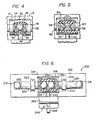
- FIG. 5 on the drawing shows a modified version of the switch invention having all of'the advantages and characteristics possessed by the above-described embodiment for the switch illustrated on Figures 1-4.
- the contact members and the contactor member are shown in a different version to illustrate but one alternative configuration which these members may have in carrying out the concepts of this invention.
- all of the switch parts in Figure 5 function in the same manner as those hereinabove described for the first switch embodiment, the parts on Figure 5 are numbered in a 100 series to distinguish them from the corresponding parts on the first switch embodiment.
- the contact members 120 are mounted to provide opposed contact surfaces 130.
- Each surface 130 on the end of a contact member 120 is formed with a conical configuration.
- both of the opposed surfaces 130 are defined by male cone configurations.
- the contactor member 132 in the switch version of Figure 5 is enclosed within resilient sleeve 134 to give the switch the same advantageous characteristics possessed by the above-described switch version employing a ball contactor member 32.
- the contactor member 132 is cylindrical, being elongated in the direction of the contact members 120.
- This cylindrical contactor member 132 has conically formed ends 136. As shown on Figure 5, both ends 136 have a female conical configuration with each end 136 facing one of the opposed contact surfaces 130.
- Figure 5 shows a portion of a pressure finger 146 that can be part of a mechanical trigger actuator means like in the first embodiment. All of the other characteristics described hereinabove for the first switch embodiment will also be possessed by the embodiment of Figure 5 and they need not be repeated with reference to the Figure 5 embodiment.
- FIG. 6 A second modified version of the switch invention is illustrated on Figure 6, this version having additional advantages to those possessed by the above described embodiments.
- the switch parts shown in Figure 6 function in the same manner as those hereinabove described for the first two switch embodiments with the parts on Figure 6 being numbers in a 200 series to distinguish them from the corresponding parts on the previously described switch embodiments.
- the switch 200 of Figure 6 has a housing 212 provided with an elongated cavity 214 made up of a central segment 216 that houses the essential operating parts of the switch with narrow end segments (218) extending axially outwardly of each end of central segment 216.
- a pair of contact members 220 are retained in the cavity segments 218 as by means of a collar portion 224 on each contact member snugly fitting into an enlarged recess 222 formed intermediate the length of each segment 218.
- Each contact member 220 provides a contact surface 230 with the pair thus defining opposed contact surfaces between the spaced ends of contact members 220.
- Each contact surface 230 is preferably formed with a female conical configuration.
- a resilient sleeve 234 encloses the contact surfaces 230 that are provided on the ends of contact members 220.
- the resilient sleeve 234 is housed within central segment 216 of the cavity 214 in the switch housing 212 of switch 200.
- FIG. 6 Portions of a suitable mechanical actuator means are shown on Figure 6 associated with the housing 212.
- This actuator means similar to that described hereinabove as to the other embodiments, may take the form of a trigger 240 having a stub shaft 242 by means of which it is pivotally mounted on the housing 212 with trigger 240 having a pressure finger 246 and an activator 248 all in accordance with the mechanical actuator means shown and described with reference to the earlier disclosed embodiments.
- switch 200 a pair of spherical elements or balls 232 form the contactor member of the switch.
- the elements 232 are of conductive material and are disposed in the space between the opposed contact surfaces 230.
- opposed conical contact surfaces 230 define a space therebetween which is characterized by a peripheral portion of these surfaces being spaced a predetermined distance that is less than the spatial distance between the remainder of the areas of surfaces 230.
- both of these opposed contact surfaces be conical, it will be understood that the above mentioned spacing characteristic between a peripheral portion of the surfaces and the remainder of the areas of such surfaces does not require that both the surfaces 230 be conical or that either contact member end be conical.
- the conductive contactor member formed by the separate spherical elements or balls 232 is such that together the elements 232 define a combined length that is at least as great as the above described predetermined distance which exists between the above referred to peripheral portions of the contact surfaces 230. This dimensional relationship ensures that when the two spherical elements 232 making up the switch contactor member are displaced to effect closing of switch 200, the contactor member will make contact with both contact surfaces 230. In such state the conductive contactor member elements 232 form the electrically conductive link between the two contact members 220.
- the resilient sleeve 234 encloses the contact surfaces 230 that are provided on the ends of contact members 220 and also acts to encircle the contactor member made up of the spherical elements 232.
- a particular advantage found to be derived from the switch 200 construction of Figure 6 derives from the fact that switch activating force applied centrally to the exterior of sleeve 234, as by means of a suitable actuator, presses the resilient material of sleeve 234 down between the spherical elements 232 making up the contractor member. Whereas this activating force effectively displaces the elements 232 within sleeve 234 both into contact with each other and also into contact with the opposed contact surfaces 230 to electrically close the switch, the resilent material making up the sleeve 234 is not directly pinched against the diametrically opposite surface portions of either spherical element 232. Rather the sleeve material is merely squeezed down between these elements 232.
- switch actuation effects in the embodiment of switch 200 as illustrated on Figure 6 have been found to provide substantially increased switch life with minimal damage to the resilient material of sleeve 234 over an extended number of switch actuations. Consequently, greatly increased switch activations without switch failure are achieved with switch 200; these switch activations running well over ten million in switch life reliability testings.
- a protecting ring may be applied encircling the exterior of the sleeve at the point where this mechanical actuator force is to be repeatedly applied in switch closings.
- switch 10 is extremely uncomplicated and operates in an efficient manner with a minimum of moving parts. While the switch may find applicability primarily in keyboard applications, it will be recognized that it is subject to utilization in a multitude of environments other than keyboard applications.
Landscapes
- Push-Button Switches (AREA)
Claims (14)
Applications Claiming Priority (4)
| Application Number | Priority Date | Filing Date | Title |
|---|---|---|---|
| US34036682A | 1982-01-18 | 1982-01-18 | |
| US450227 | 1982-12-16 | ||
| US06/450,227 US4433317A (en) | 1982-01-18 | 1982-12-16 | Controlled floating contactor switch |
| US340366 | 2006-01-26 |
Publications (2)
| Publication Number | Publication Date |
|---|---|
| EP0084331A1 EP0084331A1 (fr) | 1983-07-27 |
| EP0084331B1 true EP0084331B1 (fr) | 1985-08-14 |
Family
ID=26992082
Family Applications (1)
| Application Number | Title | Priority Date | Filing Date |
|---|---|---|---|
| EP83100091A Expired EP0084331B1 (fr) | 1982-01-18 | 1983-01-07 | Interrupteur à élément contacteur flottant commandé |
Country Status (3)
| Country | Link |
|---|---|
| US (1) | US4433317A (fr) |
| EP (1) | EP0084331B1 (fr) |
| DE (1) | DE3360530D1 (fr) |
Families Citing this family (2)
| Publication number | Priority date | Publication date | Assignee | Title |
|---|---|---|---|---|
| US4600819A (en) * | 1985-03-08 | 1986-07-15 | Mechanical Enterprises, Inc. | Switch assembly |
| US4980575A (en) * | 1990-04-10 | 1990-12-25 | Sensormatic Electronics Corporation | Motion sensor and detection system |
Family Cites Families (16)
| Publication number | Priority date | Publication date | Assignee | Title |
|---|---|---|---|---|
| BE514238A (fr) * | ||||
| US1964954A (en) * | 1932-01-11 | 1934-07-03 | Milwaukee Gas Specialty Co | Ball contact switch |
| US2195199A (en) * | 1937-10-11 | 1940-03-26 | Amalgamated Engineering And Re | Apparatus for controlling electric circuits |
| US2238312A (en) * | 1940-08-04 | 1941-04-15 | Air Pressure Indicators Inc | Switch assembly for pressure indicators |
| NL230361A (fr) * | 1957-08-13 | |||
| CH389095A (de) * | 1961-11-23 | 1965-03-15 | Standard Telephon & Radio Ag | Elektromagnetische Relais mit Kontakt-Kugel |
| AT253041B (de) * | 1964-12-16 | 1967-03-28 | Gec Sunvic Regler Gmbh | Quecksilberschalter |
| DE1540620A1 (de) * | 1965-12-22 | 1970-01-08 | Siemens Ag | Lageunabhaengige Kontaktanordnung unter Verwendung von Quecksilber |
| GB1151331A (en) * | 1966-01-20 | 1969-05-07 | Westwood Switchgear Ltd | Electric Switch |
| US3569649A (en) * | 1969-01-31 | 1971-03-09 | Collins Radio Co | Electrical switch contact structure with improved inflatable bladder actuating means |
| US3654407A (en) * | 1970-06-08 | 1972-04-04 | Sylvania Electric Prod | Compression switch |
| DE2141138C3 (de) * | 1971-08-12 | 1981-12-03 | Siemens AG, 1000 Berlin und 8000 München | Elektrische Kontaktvorrichtung |
| DE2228683C2 (de) * | 1972-06-13 | 1982-01-21 | Artur 7060 Schorndorf Föhl | Beschleunigungs- und verzögerungsabhängige, elektrische Schaltvorrichtung zum Einbau in Fahrzeuge |
| US3812308A (en) * | 1972-08-23 | 1974-05-21 | Technar Inc | Ball actuated inertia switch |
| US3889774A (en) * | 1974-06-24 | 1975-06-17 | George B Schwenk | Accident responsive automatic ignition cut-off switch |
| US4115995A (en) * | 1976-09-20 | 1978-09-26 | Andre Guy Brien | Automatic wristwatch construction |
-
1982
- 1982-12-16 US US06/450,227 patent/US4433317A/en not_active Expired - Fee Related
-
1983
- 1983-01-07 EP EP83100091A patent/EP0084331B1/fr not_active Expired
- 1983-01-07 DE DE8383100091T patent/DE3360530D1/de not_active Expired
Also Published As
| Publication number | Publication date |
|---|---|
| EP0084331A1 (fr) | 1983-07-27 |
| US4433317A (en) | 1984-02-21 |
| DE3360530D1 (en) | 1985-09-19 |
Similar Documents
| Publication | Publication Date | Title |
|---|---|---|
| US6180903B1 (en) | Tact Switch | |
| CA1077104A (fr) | Actionneur a plaque mobile articulee | |
| KR100371753B1 (ko) | 푸시 버튼 스위치 및 푸시버튼 스위치용 가동접점체 | |
| US5626223A (en) | Cam-assisted switch | |
| US3928741A (en) | Momentary contact single pole switch | |
| GB2046996A (en) | Electrical switch | |
| US6703571B2 (en) | Multi-directional operating switch | |
| US20190333718A1 (en) | Push switch | |
| US5066841A (en) | Dual plunger switch | |
| GB2073494A (en) | Electrical keyswitch | |
| US3671693A (en) | Rocker switch | |
| US4609795A (en) | Vibration protected switch | |
| US4433317A (en) | Controlled floating contactor switch | |
| US3591748A (en) | Electric switch | |
| US3346708A (en) | Rotary switch with roller detent apparatus directly biasing contact structure into open and closed positions | |
| US4600819A (en) | Switch assembly | |
| US3783205A (en) | Keyboard switch matrix assembly with improved guide means for reducing transfer of bounding motion to movable conductor | |
| EP1014405B1 (fr) | Interrupteur à bouton poussoir | |
| US4046982A (en) | Switch means for short-stroke push-button keys | |
| JP2000348556A (ja) | 接点ばねとこれを用いたスイッチ | |
| US4249056A (en) | Sequential switching device | |
| KR100405994B1 (ko) | 푸쉬버튼 스위치 | |
| JPS58145028A (ja) | スイツチ | |
| US6274834B1 (en) | Push-button switch with part to a wire rod exposed to an inside bottom of housing to form a contact portion | |
| US20250329505A1 (en) | Double pole double throw switch |
Legal Events
| Date | Code | Title | Description |
|---|---|---|---|
| PUAI | Public reference made under article 153(3) epc to a published international application that has entered the european phase |
Free format text: ORIGINAL CODE: 0009012 |
|
| AK | Designated contracting states |
Designated state(s): CH DE FR GB IT LI SE |
|
| 17P | Request for examination filed |
Effective date: 19830914 |
|
| GRAA | (expected) grant |
Free format text: ORIGINAL CODE: 0009210 |
|
| AK | Designated contracting states |
Designated state(s): CH DE FR GB IT LI SE |
|
| PG25 | Lapsed in a contracting state [announced via postgrant information from national office to epo] |
Ref country code: LI Effective date: 19850814 Ref country code: IT Free format text: LAPSE BECAUSE OF FAILURE TO SUBMIT A TRANSLATION OF THE DESCRIPTION OR TO PAY THE FEE WITHIN THE PRESCRIBED TIME-LIMIT;WARNING: LAPSES OF ITALIAN PATENTS WITH EFFECTIVE DATE BEFORE 2007 MAY HAVE OCCURRED AT ANY TIME BEFORE 2007. THE CORRECT EFFECTIVE DATE MAY BE DIFFERENT FROM THE ONE RECORDED. Effective date: 19850814 Ref country code: FR Free format text: THE PATENT HAS BEEN ANNULLED BY A DECISION OF A NATIONAL AUTHORITY Effective date: 19850814 Ref country code: CH Effective date: 19850814 |
|
| PG25 | Lapsed in a contracting state [announced via postgrant information from national office to epo] |
Ref country code: SE Effective date: 19850830 |
|
| REF | Corresponds to: |
Ref document number: 3360530 Country of ref document: DE Date of ref document: 19850919 |
|
| REG | Reference to a national code |
Ref country code: CH Ref legal event code: PL |
|
| PLBE | No opposition filed within time limit |
Free format text: ORIGINAL CODE: 0009261 |
|
| STAA | Information on the status of an ep patent application or granted ep patent |
Free format text: STATUS: NO OPPOSITION FILED WITHIN TIME LIMIT |
|
| EN | Fr: translation not filed | ||
| 26N | No opposition filed | ||
| PG25 | Lapsed in a contracting state [announced via postgrant information from national office to epo] |
Ref country code: DE Effective date: 19861001 |
|
| PG25 | Lapsed in a contracting state [announced via postgrant information from national office to epo] |
Ref country code: GB Effective date: 19890107 |
|
| GBPC | Gb: european patent ceased through non-payment of renewal fee |