EP0084525A2 - Verfahren zur Herstellung von beschichteten Hartmetallkörpern und nach diesem Verfahren hergestellte Formkörper - Google Patents
Verfahren zur Herstellung von beschichteten Hartmetallkörpern und nach diesem Verfahren hergestellte Formkörper Download PDFInfo
- Publication number
- EP0084525A2 EP0084525A2 EP83850001A EP83850001A EP0084525A2 EP 0084525 A2 EP0084525 A2 EP 0084525A2 EP 83850001 A EP83850001 A EP 83850001A EP 83850001 A EP83850001 A EP 83850001A EP 0084525 A2 EP0084525 A2 EP 0084525A2
- Authority
- EP
- European Patent Office
- Prior art keywords
- layer
- phosphorus
- substrate
- oxide
- gas
- Prior art date
- Legal status (The legal status is an assumption and is not a legal conclusion. Google has not performed a legal analysis and makes no representation as to the accuracy of the status listed.)
- Granted
Links
- 238000004519 manufacturing process Methods 0.000 title claims description 7
- PNEYBMLMFCGWSK-UHFFFAOYSA-N Alumina Chemical compound [O-2].[O-2].[O-2].[Al+3].[Al+3] PNEYBMLMFCGWSK-UHFFFAOYSA-N 0.000 claims abstract description 81
- 238000000034 method Methods 0.000 claims abstract description 35
- 229910052698 phosphorus Inorganic materials 0.000 claims abstract description 30
- 239000000919 ceramic Substances 0.000 claims abstract description 20
- 229910052787 antimony Inorganic materials 0.000 claims abstract description 11
- 229910052785 arsenic Inorganic materials 0.000 claims abstract description 11
- 239000010410 layer Substances 0.000 claims description 44
- 239000000758 substrate Substances 0.000 claims description 31
- OAICVXFJPJFONN-UHFFFAOYSA-N Phosphorus Chemical compound [P] OAICVXFJPJFONN-UHFFFAOYSA-N 0.000 claims description 30
- 239000011574 phosphorus Substances 0.000 claims description 29
- 229910052751 metal Inorganic materials 0.000 claims description 13
- 239000002184 metal Substances 0.000 claims description 13
- 229910052797 bismuth Inorganic materials 0.000 claims description 11
- RQNWIZPPADIBDY-UHFFFAOYSA-N arsenic atom Chemical compound [As] RQNWIZPPADIBDY-UHFFFAOYSA-N 0.000 claims description 10
- JCXGWMGPZLAOME-UHFFFAOYSA-N bismuth atom Chemical compound [Bi] JCXGWMGPZLAOME-UHFFFAOYSA-N 0.000 claims description 10
- WATWJIUSRGPENY-UHFFFAOYSA-N antimony atom Chemical compound [Sb] WATWJIUSRGPENY-UHFFFAOYSA-N 0.000 claims description 9
- 150000001875 compounds Chemical class 0.000 claims description 8
- 150000004767 nitrides Chemical class 0.000 claims description 7
- 150000001247 metal acetylides Chemical class 0.000 claims description 6
- 239000002344 surface layer Substances 0.000 claims description 6
- 229910052710 silicon Inorganic materials 0.000 claims description 3
- 229910052804 chromium Inorganic materials 0.000 claims description 2
- 229910052735 hafnium Inorganic materials 0.000 claims description 2
- 150000004820 halides Chemical class 0.000 claims description 2
- 229910052750 molybdenum Inorganic materials 0.000 claims description 2
- 229910052758 niobium Inorganic materials 0.000 claims description 2
- 229910052715 tantalum Inorganic materials 0.000 claims description 2
- 229910052719 titanium Inorganic materials 0.000 claims description 2
- 229910052721 tungsten Inorganic materials 0.000 claims description 2
- 229910052720 vanadium Inorganic materials 0.000 claims description 2
- 229910052726 zirconium Inorganic materials 0.000 claims description 2
- 230000003301 hydrolyzing effect Effects 0.000 claims 1
- 150000002739 metals Chemical class 0.000 claims 1
- 239000007800 oxidant agent Substances 0.000 claims 1
- 238000000576 coating method Methods 0.000 abstract description 49
- 239000011248 coating agent Substances 0.000 abstract description 29
- 238000005520 cutting process Methods 0.000 abstract description 4
- 239000007792 gaseous phase Substances 0.000 abstract description 3
- 239000007789 gas Substances 0.000 description 36
- 230000008569 process Effects 0.000 description 21
- 239000000203 mixture Substances 0.000 description 16
- CURLTUGMZLYLDI-UHFFFAOYSA-N Carbon dioxide Chemical compound O=C=O CURLTUGMZLYLDI-UHFFFAOYSA-N 0.000 description 11
- 238000000151 deposition Methods 0.000 description 11
- 230000008021 deposition Effects 0.000 description 11
- 239000012071 phase Substances 0.000 description 11
- VNWKTOKETHGBQD-UHFFFAOYSA-N methane Chemical compound C VNWKTOKETHGBQD-UHFFFAOYSA-N 0.000 description 7
- 239000000047 product Substances 0.000 description 7
- VSCWAEJMTAWNJL-UHFFFAOYSA-K aluminium trichloride Chemical compound Cl[Al](Cl)Cl VSCWAEJMTAWNJL-UHFFFAOYSA-K 0.000 description 6
- 229910002092 carbon dioxide Inorganic materials 0.000 description 6
- 239000001569 carbon dioxide Substances 0.000 description 5
- 229910052593 corundum Inorganic materials 0.000 description 5
- 239000002019 doping agent Substances 0.000 description 5
- 230000000694 effects Effects 0.000 description 5
- 229910052739 hydrogen Inorganic materials 0.000 description 5
- 239000001257 hydrogen Substances 0.000 description 5
- XLYOFNOQVPJJNP-UHFFFAOYSA-N water Chemical compound O XLYOFNOQVPJJNP-UHFFFAOYSA-N 0.000 description 5
- 229910001845 yogo sapphire Inorganic materials 0.000 description 5
- IJGRMHOSHXDMSA-UHFFFAOYSA-N Atomic nitrogen Chemical compound N#N IJGRMHOSHXDMSA-UHFFFAOYSA-N 0.000 description 4
- 239000004411 aluminium Substances 0.000 description 4
- 229910052782 aluminium Inorganic materials 0.000 description 4
- 238000004458 analytical method Methods 0.000 description 4
- 239000011230 binding agent Substances 0.000 description 4
- 238000006243 chemical reaction Methods 0.000 description 4
- 238000005660 chlorination reaction Methods 0.000 description 4
- -1 e.g. Substances 0.000 description 4
- UFHFLCQGNIYNRP-UHFFFAOYSA-N Hydrogen Chemical compound [H][H] UFHFLCQGNIYNRP-UHFFFAOYSA-N 0.000 description 3
- XYFCBTPGUUZFHI-UHFFFAOYSA-N Phosphine Chemical compound P XYFCBTPGUUZFHI-UHFFFAOYSA-N 0.000 description 3
- 229910003074 TiCl4 Inorganic materials 0.000 description 3
- 230000008901 benefit Effects 0.000 description 3
- 230000000052 comparative effect Effects 0.000 description 3
- 238000010438 heat treatment Methods 0.000 description 3
- 238000006460 hydrolysis reaction Methods 0.000 description 3
- 229910001507 metal halide Inorganic materials 0.000 description 3
- 150000005309 metal halides Chemical class 0.000 description 3
- 230000004048 modification Effects 0.000 description 3
- 238000012986 modification Methods 0.000 description 3
- XJDNKRIXUMDJCW-UHFFFAOYSA-J titanium tetrachloride Chemical compound Cl[Ti](Cl)(Cl)Cl XJDNKRIXUMDJCW-UHFFFAOYSA-J 0.000 description 3
- OKTJSMMVPCPJKN-UHFFFAOYSA-N Carbon Chemical compound [C] OKTJSMMVPCPJKN-UHFFFAOYSA-N 0.000 description 2
- ZAMOUSCENKQFHK-UHFFFAOYSA-N Chlorine atom Chemical compound [Cl] ZAMOUSCENKQFHK-UHFFFAOYSA-N 0.000 description 2
- VEXZGXHMUGYJMC-UHFFFAOYSA-N Hydrochloric acid Chemical compound Cl VEXZGXHMUGYJMC-UHFFFAOYSA-N 0.000 description 2
- XAGFODPZIPBFFR-UHFFFAOYSA-N aluminium Chemical compound [Al] XAGFODPZIPBFFR-UHFFFAOYSA-N 0.000 description 2
- QVGXLLKOCUKJST-UHFFFAOYSA-N atomic oxygen Chemical compound [O] QVGXLLKOCUKJST-UHFFFAOYSA-N 0.000 description 2
- 230000015572 biosynthetic process Effects 0.000 description 2
- 239000003054 catalyst Substances 0.000 description 2
- 238000005229 chemical vapour deposition Methods 0.000 description 2
- 239000000460 chlorine Substances 0.000 description 2
- 229910052801 chlorine Inorganic materials 0.000 description 2
- 230000001627 detrimental effect Effects 0.000 description 2
- 238000009792 diffusion process Methods 0.000 description 2
- 230000008020 evaporation Effects 0.000 description 2
- 238000001704 evaporation Methods 0.000 description 2
- 150000002431 hydrogen Chemical class 0.000 description 2
- 238000011065 in-situ storage Methods 0.000 description 2
- 230000007246 mechanism Effects 0.000 description 2
- 229910052757 nitrogen Inorganic materials 0.000 description 2
- 229910052760 oxygen Inorganic materials 0.000 description 2
- 239000001301 oxygen Substances 0.000 description 2
- RVTZCBVAJQQJTK-UHFFFAOYSA-N oxygen(2-);zirconium(4+) Chemical compound [O-2].[O-2].[Zr+4] RVTZCBVAJQQJTK-UHFFFAOYSA-N 0.000 description 2
- 229910000073 phosphorus hydride Inorganic materials 0.000 description 2
- FAIAAWCVCHQXDN-UHFFFAOYSA-N phosphorus trichloride Chemical compound ClP(Cl)Cl FAIAAWCVCHQXDN-UHFFFAOYSA-N 0.000 description 2
- 239000000376 reactant Substances 0.000 description 2
- 229910017009 AsCl3 Inorganic materials 0.000 description 1
- VEXZGXHMUGYJMC-UHFFFAOYSA-M Chloride anion Chemical compound [Cl-] VEXZGXHMUGYJMC-UHFFFAOYSA-M 0.000 description 1
- BUGBHKTXTAQXES-UHFFFAOYSA-N Selenium Chemical compound [Se] BUGBHKTXTAQXES-UHFFFAOYSA-N 0.000 description 1
- NINIDFKCEFEMDL-UHFFFAOYSA-N Sulfur Chemical compound [S] NINIDFKCEFEMDL-UHFFFAOYSA-N 0.000 description 1
- 239000005864 Sulphur Substances 0.000 description 1
- NRTOMJZYCJJWKI-UHFFFAOYSA-N Titanium nitride Chemical compound [Ti]#N NRTOMJZYCJJWKI-UHFFFAOYSA-N 0.000 description 1
- 238000002441 X-ray diffraction Methods 0.000 description 1
- 230000002411 adverse Effects 0.000 description 1
- 229910045601 alloy Inorganic materials 0.000 description 1
- 239000000956 alloy Substances 0.000 description 1
- OEYOHULQRFXULB-UHFFFAOYSA-N arsenic trichloride Chemical compound Cl[As](Cl)Cl OEYOHULQRFXULB-UHFFFAOYSA-N 0.000 description 1
- 125000004429 atom Chemical group 0.000 description 1
- 229910052799 carbon Inorganic materials 0.000 description 1
- 238000001311 chemical methods and process Methods 0.000 description 1
- 239000007795 chemical reaction product Substances 0.000 description 1
- 238000001816 cooling Methods 0.000 description 1
- 230000003247 decreasing effect Effects 0.000 description 1
- 238000009826 distribution Methods 0.000 description 1
- 239000008246 gaseous mixture Substances 0.000 description 1
- 229910002804 graphite Inorganic materials 0.000 description 1
- 239000010439 graphite Substances 0.000 description 1
- 229910052736 halogen Inorganic materials 0.000 description 1
- 150000002367 halogens Chemical class 0.000 description 1
- 229910000039 hydrogen halide Inorganic materials 0.000 description 1
- 239000012433 hydrogen halide Substances 0.000 description 1
- 230000007062 hydrolysis Effects 0.000 description 1
- 229910001026 inconel Inorganic materials 0.000 description 1
- 230000006698 induction Effects 0.000 description 1
- 239000000543 intermediate Substances 0.000 description 1
- 239000007788 liquid Substances 0.000 description 1
- 239000007791 liquid phase Substances 0.000 description 1
- 238000003754 machining Methods 0.000 description 1
- 239000000463 material Substances 0.000 description 1
- 229910044991 metal oxide Inorganic materials 0.000 description 1
- 150000004706 metal oxides Chemical class 0.000 description 1
- 239000012299 nitrogen atmosphere Substances 0.000 description 1
- 230000006911 nucleation Effects 0.000 description 1
- 238000010899 nucleation Methods 0.000 description 1
- 150000003018 phosphorus compounds Chemical class 0.000 description 1
- 230000002035 prolonged effect Effects 0.000 description 1
- 238000000190 proton-induced X-ray emission spectroscopy Methods 0.000 description 1
- 230000009467 reduction Effects 0.000 description 1
- 229910052711 selenium Inorganic materials 0.000 description 1
- 239000011669 selenium Substances 0.000 description 1
- 239000010703 silicon Substances 0.000 description 1
- 239000007790 solid phase Substances 0.000 description 1
- 239000006104 solid solution Substances 0.000 description 1
- 239000000126 substance Substances 0.000 description 1
- 229910052714 tellurium Inorganic materials 0.000 description 1
- PORWMNRCUJJQNO-UHFFFAOYSA-N tellurium atom Chemical compound [Te] PORWMNRCUJJQNO-UHFFFAOYSA-N 0.000 description 1
- 239000010936 titanium Substances 0.000 description 1
- MTPVUVINMAGMJL-UHFFFAOYSA-N trimethyl(1,1,2,2,2-pentafluoroethyl)silane Chemical compound C[Si](C)(C)C(F)(F)C(F)(F)F MTPVUVINMAGMJL-UHFFFAOYSA-N 0.000 description 1
- 229910001928 zirconium oxide Inorganic materials 0.000 description 1
Images
Classifications
-
- C—CHEMISTRY; METALLURGY
- C23—COATING METALLIC MATERIAL; COATING MATERIAL WITH METALLIC MATERIAL; CHEMICAL SURFACE TREATMENT; DIFFUSION TREATMENT OF METALLIC MATERIAL; COATING BY VACUUM EVAPORATION, BY SPUTTERING, BY ION IMPLANTATION OR BY CHEMICAL VAPOUR DEPOSITION, IN GENERAL; INHIBITING CORROSION OF METALLIC MATERIAL OR INCRUSTATION IN GENERAL
- C23C—COATING METALLIC MATERIAL; COATING MATERIAL WITH METALLIC MATERIAL; SURFACE TREATMENT OF METALLIC MATERIAL BY DIFFUSION INTO THE SURFACE, BY CHEMICAL CONVERSION OR SUBSTITUTION; COATING BY VACUUM EVAPORATION, BY SPUTTERING, BY ION IMPLANTATION OR BY CHEMICAL VAPOUR DEPOSITION, IN GENERAL
- C23C16/00—Chemical coating by decomposition of gaseous compounds, without leaving reaction products of surface material in the coating, i.e. chemical vapour deposition [CVD] processes
- C23C16/22—Chemical coating by decomposition of gaseous compounds, without leaving reaction products of surface material in the coating, i.e. chemical vapour deposition [CVD] processes characterised by the deposition of inorganic material, other than metallic material
- C23C16/30—Deposition of compounds, mixtures or solid solutions, e.g. borides, carbides, nitrides
- C23C16/40—Oxides
- C23C16/403—Oxides of aluminium, magnesium or beryllium
-
- C—CHEMISTRY; METALLURGY
- C23—COATING METALLIC MATERIAL; COATING MATERIAL WITH METALLIC MATERIAL; CHEMICAL SURFACE TREATMENT; DIFFUSION TREATMENT OF METALLIC MATERIAL; COATING BY VACUUM EVAPORATION, BY SPUTTERING, BY ION IMPLANTATION OR BY CHEMICAL VAPOUR DEPOSITION, IN GENERAL; INHIBITING CORROSION OF METALLIC MATERIAL OR INCRUSTATION IN GENERAL
- C23C—COATING METALLIC MATERIAL; COATING MATERIAL WITH METALLIC MATERIAL; SURFACE TREATMENT OF METALLIC MATERIAL BY DIFFUSION INTO THE SURFACE, BY CHEMICAL CONVERSION OR SUBSTITUTION; COATING BY VACUUM EVAPORATION, BY SPUTTERING, BY ION IMPLANTATION OR BY CHEMICAL VAPOUR DEPOSITION, IN GENERAL
- C23C16/00—Chemical coating by decomposition of gaseous compounds, without leaving reaction products of surface material in the coating, i.e. chemical vapour deposition [CVD] processes
- C23C16/22—Chemical coating by decomposition of gaseous compounds, without leaving reaction products of surface material in the coating, i.e. chemical vapour deposition [CVD] processes characterised by the deposition of inorganic material, other than metallic material
- C23C16/30—Deposition of compounds, mixtures or solid solutions, e.g. borides, carbides, nitrides
Definitions
- the present invention relates to a method of producing thin, even and extremely wear resistant surface layers of ceramic oxide, preferably aluminium oxide, on cemented carbide substrates.
- ceramic oxide preferably aluminium oxide
- the latter may be.uncoated or have coatings produced in other processes or in process steps immediately preceding the process step described hereinbelow.
- the main method of applying the surface coatings is the CVD-technique or "Chemical Vapor Deposition", in which the coatings are deposited on a hot substrate by reaction between gaseous components.
- the most common chemical vapor deposition system which has been employed utilizes a hydrolysis reaction of a metal halide to form the specific ceramic oxide, the metal halide being either evaporated directly or formed by the reaction between the specific metal and halogen or hydrogen halide.
- the hydrolysis reaction is performed with water vapor, which is either evaporated directly or formed in situ by the reaction between hydrogen and carbon dioxide or oxygen.
- aluminium chloride is hydrolyzed.
- an aluminium oxide coating depends, among other things, upon the diffusion of species from the substrate and/or the gas phase.
- the relationship between the various diffusion, nucleation and growth mechanisms which govern the formation of a coating are of a very critical nature and are often difficult to govern in the desired direction.
- it can be extremely difficult to produce relatively thick coatings of aluminium oxide using known processes if the coatings are to be uniformly distributed around the coated body.
- If one wants to use the known processes see for example Swedish pat. 357.984, US Pat. 3.736.107, US Pat. 3.836.392 and Swedish Pat. 406.090) in order to produce such coatings, drastic modifications of the coating conditions are needed. However, such modifications often give rise to conditions in the process, which are harmful to the substrate or lead to significant reduction of production capacity.
- the present invention now makes it possible to produce cemented carbide bodies having ceramic oxide, preferably aluminium oxide, coatings of uniform thickness around the individual body and with, among other things, thicknesses in ranges of interest in cutting applications.
- the coatings pertaining to the invention can be applied to previously coated as well as uncoated cemented carbide substrates, e.g., substrates containing at least one carbide in addition to the binder metal.
- the coatings can also form surface or intermediate layers in multiple coatings of various kinds.
- the coating can advantageously be deposited on intermediate layers of wear resistant carbides, nitrides, carbonitrides, oxides, borides or combinations and/or mixtures of such compounds, applied in the form of one or more successive layers.
- the invention can also be of advantage in the deposition of coatings on ceramic bodies.
- the carbides, nitrides, oxides and borides mentioned above, as well as combinations thereof may be those of one or several of the elements Ti, Zr, Hf, V, Nb, Ta, Cr, Mo, W, Si and, where applicable, B.
- Layers of titanium carbide, nitride and/or carbonitride are especially suited as intermediate layers.
- a distinct feature of the invention is that a controlled amount of phosphorus, arsenic, antimony and/or bismuth is supplied to the substrate during the deposition.
- the dopant is preferably phosphorus and the process of the present invention will be described below with reference to phosphorus (unless otherwise indicated) although it will be understood that it is equally applicable to arsenic, antimony and bismuth and mixtures of all the various dopants.
- a suitable form for this additional supply of the dopant is a gas with molecules containing the elements mentioned. According to the present invention, phosphorus and/or corresponding elements are generally introduced in the process in compound form.
- the compound used for the supply of phosphorus is not only of adequate purity but also free from elements which have a detrimental effect on the process itself or on the product made by means of the process.
- the phosphorus containing component (or components) participating in the process should therefore be of such a composition that it (they)does not contain any foreign elements which are harmful to the process.
- silicon is an element which is considered harmful.
- Other elements or compounds which would also interfere with the straight forward manner of the process of the present invention should also be avoided.
- An example of a compound which satisfies these requirements and which permits a carefully controlled and optimized introduction into the gas mixture used in the process is phosphorus chloride (PC13).
- Phosphine (PH J ) can also be used.
- a coating produced according to the present invention has quite surprisingly, such mechanical, physical and chemical properties as to provide the coated body with a performance in technologically interesting applications which clearly exceeds the performance of products manufactured by means of similar processes not using the method which characterizes the present invention.
- the process described by the invention is adjusted with respect to coating thickness and thickness distribution in such a manner that the finished product is more or less identical with products manufactured by means of known processes, quite surprisingly, a product is obtained having a performance which is in no way inferior to th-it of the latter products.
- the increase in the rate of deposition is of direct benefit for the quality of the coating in that an increased rate reduces the period of time during which coating and substrate are treated at a high temperature. This reduces the probability of detrimental changes in the structure and composition of coating and substrate and intermediate zone respectively which might occur as a result of prolonged exposure to higher temperatures.
- the principal method of producing an aluminium oxide coating is, according to the invention, by means of CVD-techniques in combination with an addition of phosphorus. This applies to substrates consisting exclusively of hard materials (together with a binder metal where applicable) as well as for substrates already having one or more coatings.
- the cemented carbide substrate may have a surface region enriched with respect to the so-called gamma phase. This holds true for those instances when additional layers are to be added on to the aluminium oxide coating produced according to the invention, A CVD-process made according to the invention can be done in a step separate from the deposition of the other layers but should preferably be made successively in the same apparatus so that well-defined surfaces are available for each deposition step.
- An amount of methane from about 0.5 to about 90 vol. % of the total amount of the supplied gas may be added to the gas for the A1 2 0 3 coating step so that at least a substantial portion, often at least about 85%, of the A1 2 0 3 is in the kappa form.
- the methane thus acts in the same manner as the dopant disclosed in commonly assigned U.S. Patent 4.180.400 and may be added in conjunction with the phosphorus dopant or alone in those instances where the kappa form is desired and uneven A1 2 0 3 layers are not critical.
- the aluminium oxide coating is typically 0.1 - 20 / um and preferably 0.3 - 9 / um.
- the thicknesses of the intermediate or of the successive layers, on top of as well as beneath the aluminium oxide layer under consideration, normally fall in the range of 0.1 - 20 / um, that is, they are of the same order of magnitude..
- the thickness of the aluminium oxide layer is usually 0.1-15/um.
- intermediate layers are obtained beneath and/or within the outer ceramic layer (e.g. Al 2 O 3 ).
- the intermediate layers contain phosphorus and metal diffused from the substrate e.g. the binder phase of the substrate.
- Such an intermediate layer can consist of Co 2 P.
- the thickness is about 0.1-3 / urn. Phosphorus may occasionally diffuse into the cemented carbide substrate.
- the outer layer zone can be enriched in metal diffused from the binder phase of the substrate, e.g. Co.
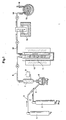
- the equipment shown in Fig. 1 consists of sources of gas, for example gas tubes 1 and 2 for the supply of hydrogen, methane and/or nitrogen.
- the conduits 3 and 4 each join a source of gas with conduit No. 5 through which the gas mixture is transported to a vessel 6 where a metal halide, e:g., TiCl 4 , is heated so as to give off an adequate amount of vapor.
- the mixture of these gases is then fed to the reactor 11 via a common conduit 9.
- the gas mixture thereby passes a heat exchanger 7 which is controlled by a thermostat 8 so that the amount of TiCl 4 , in the gas mixture is held at the correct level.
- the substrate to be coated is placed in the reactor 11, the latter being heated by an oven 10.
- the gas is sucked out of the reactor via a conduit 12 equipped with a valve and a cold trap 13.
- the system is evacuated via conduit 14 by means of a vacuum pump 15 with an exhaust pipe 16.
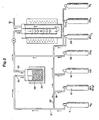
- Fig. 2 illustrates the use of a separate reactor 25 for the chlorination of Al, the latter being in the form of e.g., grains or chips 26.
- a separate reactor 25 for the chlorination of Al the latter being in the form of e.g., grains or chips 26.
- hydrogen from a source of gas 1 is mixed with chlorine or hydrochloric acid via conduits 19 and 20, the latter coming from the source -17.
- the mixture is then brought to the chlorination reactor via a conduit 21.
- the gas mixture from the chlorination reactor 25 is then further mixed with hydrogen, as well as with carbon mon. oxide and carbon dioxide from the sources 18 and 28 respectively.
- This gas mixture is then routed to the deposition reactor 11 via the conduit 27 which is equipped with a valve. (The systems for purifying the gases have been left out in the Figures).
- aluminium oxide can thus be performed by means of a process namely hydrolysis of an aluminium halide, viz. preferably a chloride (AlCl 3 ), using water vapor (oxygen).
- an aluminium halide viz. preferably a chloride (AlCl 3 )
- water vapor oxygen
- the aluminium halide can be produced in the form of a gas either by evaporation of the solid or liquid phase or by reacting metallic aluminium with chlorine or hydrochlorine gas 26.
- the water vapor can be added to the gas phase either by evaporation of water or, preferably, by reacting hydrogen with carbon dioxide 28.
- Phosphorus can be added to the gas phase by adding preferably gases or gas mixtures 29 containing phosphorus or compounds of phosphorus.
- the addition is made in the form of phosphorus chloride (PCl 3 ), which is introduced throughout the whole process or part of the process.
- Phosphorus or phosphorus compounds may also be generated in the reactor in situ.
- the reactants are fed into the reactor 11, in which the bodies which are to be coated have been placed.
- the bodies can be heated either directly by means of induction heating or indirectly by heating e.g. supporting plates or the reactor itself by e.g., resistance heating 10.
- the deposition temperature can be in the range 700°C to 1200°C, but preferably in the range 950°C to 1150°C.
- the concentrations of aluminium chloride vapor in the gaseous mixture of reactants should preferably be over stoichiometric with respect to the water vapor.
- the concentration of the phosphorus-, arsenic-, antimony- or bismuth-containing gas should be in the range 0.003-1, preferably in the range 0.02-0.3 vol% per atom ofP, As, Sb, Bi in the gas molecule as referred to the total gas volume being brought into the reactor.
- the amount of phosphorus containing gas recommended above refers to the case of roughly stoichiometric proportions of carbon dioxide and aluminium chloride in the gas entering the reactor at a temperature of 1000°C and 6 kPa.
- the total pressure of the gaseous phase may be in the range of 0.1 - 100 kPa, but should preferably be in the range 1-30 kPa.
- Coating with an intermediate layer of TiC was performed in a reactor, the essential parts of which were made of "Inconel” alloy.
- the inserts to be coated contained WC 86% (by weight), cubic carbides (TiC, TaC, NbC) 9%, balance Co.
- the inserts are placed on nets providing good contact with the surrounding gas.
- the gas which consisted of a mixture containing 4% CH 4 , 4% TiCl 4 and 92% H2, by vol., manufactured in a normal way, is brought to the reactor in one single conduit.
- the pressure in the reactor is maintained at 7 kPa by sucking out the gas from the reaction vessel by means of a vacuum pump protected from corrosive reaction products (for instance HC1) by the help of a cooling trap with liquid nitrogen situated ahead of the pump. In this way a linear gas flow rate of 1 m/sec is obtained in the charge.
- the treatment went on for 7 hours.
- the 3000 inserts are treated in the same apparatus as the one desribed, the gas supply being 91% H 2 , 5% CO 2 , 2% HC1, 2% AlCl 3 , 0.07% P C 1 3 .
- the temperature of the substratum is 1030° and the pressure 7'kPa.
- a linear gas flow rate of 3 m/sec is used.
- a 1 / um thick layer of Al 2 O 3 has been formed on the TiC-coated hard metal inserts.
- the binding between the A1 2 0 3 layer and TiC layer is good and almost no embrittling ⁇ -phase has been formed in the boundary layer, cemented carbide-TiC-layer.
- Inserts coated without PCl 3 during similar conditions but for 8 h obtain 1 ⁇ m A1 2 0 3 .
- a coating thickness of 2-8 / um Al 2 O 3 is obtained.
- Inserts are produced in a similar manner as described in Example 1. The only difference is that PH 3 is used instead of PCl 3 . Similar results are obtained.
- Inserts are produced in a similar manner as described in Example 1. However, 0.1 vol% PC1 3 is used resulting in an intermediate layer (about 1 ⁇ m) of Co 2 P beneath the Al 2 O 3 layer.
- Inserts are produced comprising a surface zone of gamma phase using the following method.
- the substrate is chosen in accordance with Example 1.
- the inserts are treated in a nitrogen atmosphere (pressure 5 kPa) at 1410°C for 30 minutes (graphite in the furnace), whereafter the inserts are cooled. Grains of gamma phase have been enriched in the surface zone of the inserts to a 0.5 - 2 / um thick continuous zone.
- Coating with A1 2 0 3 is performed in accordance with Example 1 but a very thin TiC-layer (0.2 / um) is positioned immediately under the Al 2 O 3 -layer.
- the TiC coating is deposited in accordance with Example 1 but the duration of the deposition is decreased to 1 h.
- the inserts have very even layers of Al 2 O 3 all over the coated objects.
- Inserts are produced as in Example 1 (a) but 0.05 % AsCl 3 is added to the gas mixture (the amount of PCl 3 is reduced accordingly).
Landscapes
- Chemical & Material Sciences (AREA)
- Inorganic Chemistry (AREA)
- General Chemical & Material Sciences (AREA)
- Chemical Kinetics & Catalysis (AREA)
- Engineering & Computer Science (AREA)
- Materials Engineering (AREA)
- Mechanical Engineering (AREA)
- Metallurgy (AREA)
- Organic Chemistry (AREA)
- Chemical Vapour Deposition (AREA)
- Laminated Bodies (AREA)
Applications Claiming Priority (2)
| Application Number | Priority Date | Filing Date | Title |
|---|---|---|---|
| SE8200400A SE430261B (sv) | 1982-01-26 | 1982-01-26 | Sett att framstella belagd hardmaterialkropp |
| SE8200400 | 1982-01-26 |
Publications (3)
| Publication Number | Publication Date |
|---|---|
| EP0084525A2 true EP0084525A2 (de) | 1983-07-27 |
| EP0084525A3 EP0084525A3 (en) | 1984-02-22 |
| EP0084525B1 EP0084525B1 (de) | 1985-09-18 |
Family
ID=20345822
Family Applications (1)
| Application Number | Title | Priority Date | Filing Date |
|---|---|---|---|
| EP19830850001 Expired EP0084525B1 (de) | 1982-01-26 | 1983-01-11 | Verfahren zur Herstellung von beschichteten Hartmetallkörpern und nach diesem Verfahren hergestellte Formkörper |
Country Status (4)
| Country | Link |
|---|---|
| EP (1) | EP0084525B1 (de) |
| JP (1) | JPS58130180A (de) |
| DE (1) | DE3360801D1 (de) |
| SE (1) | SE430261B (de) |
Cited By (1)
| Publication number | Priority date | Publication date | Assignee | Title |
|---|---|---|---|---|
| EP0523021A1 (de) * | 1991-06-25 | 1993-01-13 | Sandvik Aktiebolag | Verfahren zur Herstellung eines mit Aluminiumoxyd beschichteten gesinterten Formkörper |
Families Citing this family (1)
| Publication number | Priority date | Publication date | Assignee | Title |
|---|---|---|---|---|
| DE10314929B9 (de) * | 2002-04-17 | 2010-12-23 | Cemecon Ag | Körper mit einer Beschichtung in R-3c Struktur, Verfahren und Vorrichtung zur PVD-Beschichtung |
Family Cites Families (2)
| Publication number | Priority date | Publication date | Assignee | Title |
|---|---|---|---|---|
| SE406090B (sv) * | 1977-06-09 | 1979-01-22 | Sandvik Ab | Belagd hardmetallkropp samt sett att framstalla en dylik kropp |
| ATA261878A (de) * | 1978-04-14 | 1979-05-15 | Ver Edelstahlwerke Ag | Verfahren zur herstellung beschichteter hart- metallkoerper |
-
1982
- 1982-01-26 SE SE8200400A patent/SE430261B/sv not_active IP Right Cessation
-
1983
- 1983-01-11 DE DE8383850001T patent/DE3360801D1/de not_active Expired
- 1983-01-11 EP EP19830850001 patent/EP0084525B1/de not_active Expired
- 1983-01-26 JP JP1001683A patent/JPS58130180A/ja active Granted
Cited By (1)
| Publication number | Priority date | Publication date | Assignee | Title |
|---|---|---|---|---|
| EP0523021A1 (de) * | 1991-06-25 | 1993-01-13 | Sandvik Aktiebolag | Verfahren zur Herstellung eines mit Aluminiumoxyd beschichteten gesinterten Formkörper |
Also Published As
| Publication number | Publication date |
|---|---|
| JPH0341429B2 (de) | 1991-06-24 |
| DE3360801D1 (en) | 1985-10-24 |
| SE8200400L (sv) | 1983-07-27 |
| JPS58130180A (ja) | 1983-08-03 |
| SE430261B (sv) | 1983-10-31 |
| EP0084525A3 (en) | 1984-02-22 |
| EP0084525B1 (de) | 1985-09-18 |
Similar Documents
| Publication | Publication Date | Title |
|---|---|---|
| US4619866A (en) | Method of making a coated cemented carbide body and resulting body | |
| US5827570A (en) | Composite ceramic articles and method for making such articles | |
| US3977061A (en) | Cutting insert and method of making the same | |
| US5674564A (en) | Alumina-coated sintered body | |
| EP0530779B1 (de) | Verbesserte, mit Titancarbonitrid überzogene Schneideinsätze sowie Verfahren zu deren Herstellung | |
| EP0106817B1 (de) | Schneideinsatz und Verfahren zu seiner Herstellung | |
| US3837896A (en) | Sintered cemented carbide body coated with two layers | |
| EP1980649B1 (de) | Schneideeinsatz mit keramischer Beschichtung | |
| US4180400A (en) | Coated cemented carbide body and method of making such a body | |
| US4035541A (en) | Sintered cemented carbide body coated with three layers | |
| US4751109A (en) | A process for depositing a composite ceramic coating on a hard ceramic substrate | |
| USRE29420E (en) | Sintered cemented carbide body coated with two layers | |
| JP2011137238A (ja) | 中温化学蒸着処理 | |
| JPH07100701A (ja) | 被覆切削工具とその製造方法 | |
| EP0045291B1 (de) | Verfahren zum Herstellen überzogener Sinterkarbidkörper und hieraus resultierender Körper | |
| EP0084525B1 (de) | Verfahren zur Herstellung von beschichteten Hartmetallkörpern und nach diesem Verfahren hergestellte Formkörper | |
| EP0117542B1 (de) | Chemische Dampfabscheidung von Überzügen aus metallischen Verbindungen unter Verwendung von metallischen Subhalogeniden | |
| EP0275978B2 (de) | Verfahren zum Aufbringen von Verbundschichten | |
| SE430905B (sv) | Belagd hardmaterialkropp | |
| KR810001150B1 (ko) | 표면 피복된 초경합금 제품 | |
| JP2025155034A (ja) | 表面被覆切削工具 | |
| JPH03267361A (ja) | 硬質被膜とその製造方法 |
Legal Events
| Date | Code | Title | Description |
|---|---|---|---|
| PUAI | Public reference made under article 153(3) epc to a published international application that has entered the european phase |
Free format text: ORIGINAL CODE: 0009012 |
|
| AK | Designated contracting states |
Designated state(s): DE FR GB IT |
|
| PUAL | Search report despatched |
Free format text: ORIGINAL CODE: 0009013 |
|
| AK | Designated contracting states |
Designated state(s): DE FR GB IT |
|
| 17P | Request for examination filed |
Effective date: 19840126 |
|
| ITF | It: translation for a ep patent filed | ||
| GRAA | (expected) grant |
Free format text: ORIGINAL CODE: 0009210 |
|
| AK | Designated contracting states |
Designated state(s): DE FR GB IT |
|
| REF | Corresponds to: |
Ref document number: 3360801 Country of ref document: DE Date of ref document: 19851024 |
|
| ET | Fr: translation filed | ||
| PLBE | No opposition filed within time limit |
Free format text: ORIGINAL CODE: 0009261 |
|
| STAA | Information on the status of an ep patent application or granted ep patent |
Free format text: STATUS: NO OPPOSITION FILED WITHIN TIME LIMIT |
|
| 26N | No opposition filed | ||
| ITTA | It: last paid annual fee | ||
| PGFP | Annual fee paid to national office [announced via postgrant information from national office to epo] |
Ref country code: FR Payment date: 19990111 Year of fee payment: 17 |
|
| PGFP | Annual fee paid to national office [announced via postgrant information from national office to epo] |
Ref country code: GB Payment date: 19990114 Year of fee payment: 17 |
|
| PGFP | Annual fee paid to national office [announced via postgrant information from national office to epo] |
Ref country code: DE Payment date: 19990115 Year of fee payment: 17 |
|
| PG25 | Lapsed in a contracting state [announced via postgrant information from national office to epo] |
Ref country code: GB Free format text: LAPSE BECAUSE OF NON-PAYMENT OF DUE FEES Effective date: 20000111 |
|
| GBPC | Gb: european patent ceased through non-payment of renewal fee |
Effective date: 20000111 |
|
| PG25 | Lapsed in a contracting state [announced via postgrant information from national office to epo] |
Ref country code: FR Free format text: LAPSE BECAUSE OF NON-PAYMENT OF DUE FEES Effective date: 20000929 |
|
| PG25 | Lapsed in a contracting state [announced via postgrant information from national office to epo] |
Ref country code: DE Free format text: LAPSE BECAUSE OF NON-PAYMENT OF DUE FEES Effective date: 20001101 |
|
| REG | Reference to a national code |
Ref country code: FR Ref legal event code: ST |