EP0084797A2 - Verfahren zur Herstellung eines magnetischen Speichermediums mit strahlenhärtbaren Bindemitteln - Google Patents
Verfahren zur Herstellung eines magnetischen Speichermediums mit strahlenhärtbaren Bindemitteln Download PDFInfo
- Publication number
- EP0084797A2 EP0084797A2 EP83100179A EP83100179A EP0084797A2 EP 0084797 A2 EP0084797 A2 EP 0084797A2 EP 83100179 A EP83100179 A EP 83100179A EP 83100179 A EP83100179 A EP 83100179A EP 0084797 A2 EP0084797 A2 EP 0084797A2
- Authority
- EP
- European Patent Office
- Prior art keywords
- meth
- acrylate
- producing
- storage medium
- magnetic storage
- Prior art date
- Legal status (The legal status is an assumption and is not a legal conclusion. Google has not performed a legal analysis and makes no representation as to the accuracy of the status listed.)
- Granted
Links
- 230000005291 magnetic effect Effects 0.000 title claims abstract description 77
- 239000011230 binding agent Substances 0.000 title claims abstract description 63
- 238000000034 method Methods 0.000 title claims description 13
- 239000006185 dispersion Substances 0.000 claims abstract description 28
- 238000004519 manufacturing process Methods 0.000 claims abstract description 23
- 229920000642 polymer Polymers 0.000 claims abstract description 23
- 239000004814 polyurethane Substances 0.000 claims abstract description 22
- 229920002635 polyurethane Polymers 0.000 claims abstract description 22
- 238000003860 storage Methods 0.000 claims abstract description 22
- UFHFLCQGNIYNRP-UHFFFAOYSA-N Hydrogen Chemical compound [H][H] UFHFLCQGNIYNRP-UHFFFAOYSA-N 0.000 claims abstract description 19
- 239000001257 hydrogen Substances 0.000 claims abstract description 19
- 229910052739 hydrogen Inorganic materials 0.000 claims abstract description 19
- 239000000049 pigment Substances 0.000 claims abstract description 16
- 238000010894 electron beam technology Methods 0.000 claims abstract description 8
- 230000005855 radiation Effects 0.000 claims abstract description 8
- 239000012948 isocyanate Substances 0.000 claims description 56
- 150000002513 isocyanates Chemical class 0.000 claims description 54
- 238000006243 chemical reaction Methods 0.000 claims description 46
- NIXOWILDQLNWCW-UHFFFAOYSA-M Acrylate Chemical compound [O-]C(=O)C=C NIXOWILDQLNWCW-UHFFFAOYSA-M 0.000 claims description 31
- -1 methacryloyl groups Chemical group 0.000 claims description 27
- 125000002887 hydroxy group Chemical group [H]O* 0.000 claims description 25
- 150000001875 compounds Chemical class 0.000 claims description 22
- 125000002768 hydroxyalkyl group Chemical group 0.000 claims description 22
- 150000001252 acrylic acid derivatives Chemical class 0.000 claims description 21
- PEDCQBHIVMGVHV-UHFFFAOYSA-N Glycerine Chemical compound OCC(O)CO PEDCQBHIVMGVHV-UHFFFAOYSA-N 0.000 claims description 18
- 125000003647 acryloyl group Chemical group O=C([*])C([H])=C([H])[H] 0.000 claims description 17
- JOYRKODLDBILNP-UHFFFAOYSA-N Ethyl urethane Chemical compound CCOC(N)=O JOYRKODLDBILNP-UHFFFAOYSA-N 0.000 claims description 13
- 229920000728 polyester Polymers 0.000 claims description 11
- 125000004435 hydrogen atom Chemical group [H]* 0.000 claims description 9
- ZJCCRDAZUWHFQH-UHFFFAOYSA-N Trimethylolpropane Chemical compound CCC(CO)(CO)CO ZJCCRDAZUWHFQH-UHFFFAOYSA-N 0.000 claims description 7
- IQPQWNKOIGAROB-UHFFFAOYSA-N isocyanate group Chemical group [N-]=C=O IQPQWNKOIGAROB-UHFFFAOYSA-N 0.000 claims description 7
- 239000005056 polyisocyanate Substances 0.000 claims description 7
- 229920001228 polyisocyanate Polymers 0.000 claims description 7
- BZHJMEDXRYGGRV-UHFFFAOYSA-N Vinyl chloride Chemical compound ClC=C BZHJMEDXRYGGRV-UHFFFAOYSA-N 0.000 claims description 6
- XXROGKLTLUQVRX-UHFFFAOYSA-N allyl alcohol Chemical compound OCC=C XXROGKLTLUQVRX-UHFFFAOYSA-N 0.000 claims description 6
- 229920001577 copolymer Polymers 0.000 claims description 6
- 238000003847 radiation curing Methods 0.000 claims description 6
- QORUGOXNWQUALA-UHFFFAOYSA-N N=C=O.N=C=O.N=C=O.C1=CC=C(C(C2=CC=CC=C2)C2=CC=CC=C2)C=C1 Chemical compound N=C=O.N=C=O.N=C=O.C1=CC=C(C(C2=CC=CC=C2)C2=CC=CC=C2)C=C1 QORUGOXNWQUALA-UHFFFAOYSA-N 0.000 claims description 5
- 239000004202 carbamide Substances 0.000 claims description 5
- RRAMGCGOFNQTLD-UHFFFAOYSA-N hexamethylene diisocyanate Chemical compound O=C=NCCCCCCN=C=O RRAMGCGOFNQTLD-UHFFFAOYSA-N 0.000 claims description 5
- XEEYBQQBJWHFJM-UHFFFAOYSA-N Iron Chemical compound [Fe] XEEYBQQBJWHFJM-UHFFFAOYSA-N 0.000 claims description 4
- 229920002678 cellulose Polymers 0.000 claims description 4
- 239000007795 chemical reaction product Substances 0.000 claims description 4
- 125000005442 diisocyanate group Chemical group 0.000 claims description 4
- 239000005057 Hexamethylene diisocyanate Substances 0.000 claims description 3
- 229910001583 allophane Inorganic materials 0.000 claims description 3
- 229920001567 vinyl ester resin Polymers 0.000 claims description 3
- XLYOFNOQVPJJNP-UHFFFAOYSA-N water Substances O XLYOFNOQVPJJNP-UHFFFAOYSA-N 0.000 claims description 3
- 229920000877 Melamine resin Polymers 0.000 claims description 2
- XSQUKJJJFZCRTK-UHFFFAOYSA-N Urea Chemical compound NC(N)=O XSQUKJJJFZCRTK-UHFFFAOYSA-N 0.000 claims description 2
- 229920000180 alkyd Polymers 0.000 claims description 2
- 229910045601 alloy Inorganic materials 0.000 claims description 2
- 239000000956 alloy Substances 0.000 claims description 2
- WXZMFSXDPGVJKK-UHFFFAOYSA-N pentaerythritol Chemical compound OCC(CO)(CO)CO WXZMFSXDPGVJKK-UHFFFAOYSA-N 0.000 claims description 2
- 229920001568 phenolic resin Polymers 0.000 claims description 2
- 239000005011 phenolic resin Substances 0.000 claims description 2
- 229920000058 polyacrylate Polymers 0.000 claims description 2
- 229920000647 polyepoxide Polymers 0.000 claims description 2
- 229920000570 polyether Polymers 0.000 claims description 2
- 229920002050 silicone resin Polymers 0.000 claims description 2
- 229920006305 unsaturated polyester Polymers 0.000 claims description 2
- 239000008096 xylene Substances 0.000 claims description 2
- UQSXHKLRYXJYBZ-UHFFFAOYSA-N iron oxide Inorganic materials [Fe]=O UQSXHKLRYXJYBZ-UHFFFAOYSA-N 0.000 claims 4
- 239000001913 cellulose Substances 0.000 claims 2
- SZVJSHCCFOBDDC-UHFFFAOYSA-N iron(II,III) oxide Inorganic materials O=[Fe]O[Fe]O[Fe]=O SZVJSHCCFOBDDC-UHFFFAOYSA-N 0.000 claims 2
- HJOVHMDZYOCNQW-UHFFFAOYSA-N isophorone Chemical compound CC1=CC(=O)CC(C)(C)C1 HJOVHMDZYOCNQW-UHFFFAOYSA-N 0.000 claims 2
- RCHKEJKUUXXBSM-UHFFFAOYSA-N n-benzyl-2-(3-formylindol-1-yl)acetamide Chemical compound C12=CC=CC=C2C(C=O)=CN1CC(=O)NCC1=CC=CC=C1 RCHKEJKUUXXBSM-UHFFFAOYSA-N 0.000 claims 2
- 125000000954 2-hydroxyethyl group Chemical group [H]C([*])([H])C([H])([H])O[H] 0.000 claims 1
- KXGFMDJXCMQABM-UHFFFAOYSA-N 2-methoxy-6-methylphenol Chemical compound [CH]OC1=CC=CC([CH])=C1O KXGFMDJXCMQABM-UHFFFAOYSA-N 0.000 claims 1
- QOXOZONBQWIKDA-UHFFFAOYSA-N 3-hydroxypropyl Chemical group [CH2]CCO QOXOZONBQWIKDA-UHFFFAOYSA-N 0.000 claims 1
- SXIFAEWFOJETOA-UHFFFAOYSA-N 4-hydroxy-butyl Chemical group [CH2]CCCO SXIFAEWFOJETOA-UHFFFAOYSA-N 0.000 claims 1
- CTQNGGLPUBDAKN-UHFFFAOYSA-N O-Xylene Chemical compound CC1=CC=CC=C1C CTQNGGLPUBDAKN-UHFFFAOYSA-N 0.000 claims 1
- 239000004721 Polyphenylene oxide Substances 0.000 claims 1
- 229940090961 chromium dioxide Drugs 0.000 claims 1
- IAQWMWUKBQPOIY-UHFFFAOYSA-N chromium(4+);oxygen(2-) Chemical compound [O-2].[O-2].[Cr+4] IAQWMWUKBQPOIY-UHFFFAOYSA-N 0.000 claims 1
- AYTAKQFHWFYBMA-UHFFFAOYSA-N chromium(IV) oxide Inorganic materials O=[Cr]=O AYTAKQFHWFYBMA-UHFFFAOYSA-N 0.000 claims 1
- CZZYITDELCSZES-UHFFFAOYSA-N diphenylmethane Chemical compound C=1C=CC=CC=1CC1=CC=CC=C1 CZZYITDELCSZES-UHFFFAOYSA-N 0.000 claims 1
- 229910052742 iron Inorganic materials 0.000 claims 1
- JDSHMPZPIAZGSV-UHFFFAOYSA-N melamine Chemical compound NC1=NC(N)=NC(N)=N1 JDSHMPZPIAZGSV-UHFFFAOYSA-N 0.000 claims 1
- 229920000768 polyamine Polymers 0.000 claims 1
- 229920005989 resin Polymers 0.000 claims 1
- 239000011347 resin Substances 0.000 claims 1
- 229920006395 saturated elastomer Polymers 0.000 claims 1
- 125000005628 tolylene group Chemical group 0.000 claims 1
- 229910000859 α-Fe Inorganic materials 0.000 claims 1
- 239000000203 mixture Substances 0.000 description 26
- JHIVVAPYMSGYDF-UHFFFAOYSA-N cyclohexanone Chemical compound O=C1CCCCC1 JHIVVAPYMSGYDF-UHFFFAOYSA-N 0.000 description 20
- ZWEHNKRNPOVVGH-UHFFFAOYSA-N 2-Butanone Chemical compound CCC(C)=O ZWEHNKRNPOVVGH-UHFFFAOYSA-N 0.000 description 18
- 238000004132 cross linking Methods 0.000 description 16
- 239000002904 solvent Substances 0.000 description 14
- 238000009472 formulation Methods 0.000 description 13
- 238000000576 coating method Methods 0.000 description 12
- 239000011248 coating agent Substances 0.000 description 11
- HZAXFHJVJLSVMW-UHFFFAOYSA-N 2-Aminoethan-1-ol Chemical compound NCCO HZAXFHJVJLSVMW-UHFFFAOYSA-N 0.000 description 10
- CSCPPACGZOOCGX-UHFFFAOYSA-N Acetone Chemical compound CC(C)=O CSCPPACGZOOCGX-UHFFFAOYSA-N 0.000 description 9
- YMWUJEATGCHHMB-UHFFFAOYSA-N Dichloromethane Chemical compound ClCCl YMWUJEATGCHHMB-UHFFFAOYSA-N 0.000 description 9
- XEKOWRVHYACXOJ-UHFFFAOYSA-N Ethyl acetate Chemical compound CCOC(C)=O XEKOWRVHYACXOJ-UHFFFAOYSA-N 0.000 description 9
- LYCAIKOWRPUZTN-UHFFFAOYSA-N Ethylene glycol Chemical compound OCCO LYCAIKOWRPUZTN-UHFFFAOYSA-N 0.000 description 9
- ZMXDDKWLCZADIW-UHFFFAOYSA-N N,N-Dimethylformamide Chemical compound CN(C)C=O ZMXDDKWLCZADIW-UHFFFAOYSA-N 0.000 description 9
- YXFVVABEGXRONW-UHFFFAOYSA-N Toluene Chemical compound CC1=CC=CC=C1 YXFVVABEGXRONW-UHFFFAOYSA-N 0.000 description 9
- WNLRTRBMVRJNCN-UHFFFAOYSA-N adipic acid Chemical compound OC(=O)CCCCC(O)=O WNLRTRBMVRJNCN-UHFFFAOYSA-N 0.000 description 9
- QIGBRXMKCJKVMJ-UHFFFAOYSA-N Hydroquinone Chemical compound OC1=CC=C(O)C=C1 QIGBRXMKCJKVMJ-UHFFFAOYSA-N 0.000 description 8
- 238000003490 calendering Methods 0.000 description 7
- XTHFKEDIFFGKHM-UHFFFAOYSA-N Dimethoxyethane Chemical compound COCCOC XTHFKEDIFFGKHM-UHFFFAOYSA-N 0.000 description 6
- IAZDPXIOMUYVGZ-UHFFFAOYSA-N Dimethylsulphoxide Chemical compound CS(C)=O IAZDPXIOMUYVGZ-UHFFFAOYSA-N 0.000 description 6
- WYURNTSHIVDZCO-UHFFFAOYSA-N Tetrahydrofuran Chemical compound C1CCOC1 WYURNTSHIVDZCO-UHFFFAOYSA-N 0.000 description 6
- 125000001931 aliphatic group Chemical group 0.000 description 6
- HQABUPZFAYXKJW-UHFFFAOYSA-N butan-1-amine Chemical compound CCCCN HQABUPZFAYXKJW-UHFFFAOYSA-N 0.000 description 6
- 239000004922 lacquer Substances 0.000 description 6
- 238000002156 mixing Methods 0.000 description 6
- 239000011877 solvent mixture Substances 0.000 description 6
- DVKJHBMWWAPEIU-UHFFFAOYSA-N toluene 2,4-diisocyanate Chemical compound CC1=CC=C(N=C=O)C=C1N=C=O DVKJHBMWWAPEIU-UHFFFAOYSA-N 0.000 description 6
- OMIGHNLMNHATMP-UHFFFAOYSA-N 2-hydroxyethyl prop-2-enoate Chemical compound OCCOC(=O)C=C OMIGHNLMNHATMP-UHFFFAOYSA-N 0.000 description 5
- UPMLOUAZCHDJJD-UHFFFAOYSA-N 4,4'-Diphenylmethane Diisocyanate Chemical compound C1=CC(N=C=O)=CC=C1CC1=CC=C(N=C=O)C=C1 UPMLOUAZCHDJJD-UHFFFAOYSA-N 0.000 description 5
- LFQSCWFLJHTTHZ-UHFFFAOYSA-N Ethanol Chemical compound CCO LFQSCWFLJHTTHZ-UHFFFAOYSA-N 0.000 description 5
- NIXOWILDQLNWCW-UHFFFAOYSA-N acrylic acid group Chemical group C(C=C)(=O)O NIXOWILDQLNWCW-UHFFFAOYSA-N 0.000 description 5
- 239000003795 chemical substances by application Substances 0.000 description 5
- 239000010949 copper Substances 0.000 description 5
- ZBCBWPMODOFKDW-UHFFFAOYSA-N diethanolamine Chemical compound OCCNCCO ZBCBWPMODOFKDW-UHFFFAOYSA-N 0.000 description 5
- 238000003756 stirring Methods 0.000 description 5
- WJFKNYWRSNBZNX-UHFFFAOYSA-N 10H-phenothiazine Chemical compound C1=CC=C2NC3=CC=CC=C3SC2=C1 WJFKNYWRSNBZNX-UHFFFAOYSA-N 0.000 description 4
- 239000005058 Isophorone diisocyanate Substances 0.000 description 4
- OPKOKAMJFNKNAS-UHFFFAOYSA-N N-methylethanolamine Chemical compound CNCCO OPKOKAMJFNKNAS-UHFFFAOYSA-N 0.000 description 4
- 239000000654 additive Substances 0.000 description 4
- 239000001361 adipic acid Substances 0.000 description 4
- 235000011037 adipic acid Nutrition 0.000 description 4
- JQZRVMZHTADUSY-UHFFFAOYSA-L di(octanoyloxy)tin Chemical compound [Sn+2].CCCCCCCC([O-])=O.CCCCCCCC([O-])=O JQZRVMZHTADUSY-UHFFFAOYSA-L 0.000 description 4
- MTHSVFCYNBDYFN-UHFFFAOYSA-N diethylene glycol Chemical compound OCCOCCO MTHSVFCYNBDYFN-UHFFFAOYSA-N 0.000 description 4
- NIMLQBUJDJZYEJ-UHFFFAOYSA-N isophorone diisocyanate Chemical compound CC1(C)CC(N=C=O)CC(C)(CN=C=O)C1 NIMLQBUJDJZYEJ-UHFFFAOYSA-N 0.000 description 4
- 239000000178 monomer Substances 0.000 description 4
- 229950000688 phenothiazine Drugs 0.000 description 4
- 230000009257 reactivity Effects 0.000 description 4
- 239000000126 substance Substances 0.000 description 4
- KSBAEPSJVUENNK-UHFFFAOYSA-L tin(ii) 2-ethylhexanoate Chemical compound [Sn+2].CCCCC(CC)C([O-])=O.CCCCC(CC)C([O-])=O KSBAEPSJVUENNK-UHFFFAOYSA-L 0.000 description 4
- RYHBNJHYFVUHQT-UHFFFAOYSA-N 1,4-Dioxane Chemical compound C1COCCO1 RYHBNJHYFVUHQT-UHFFFAOYSA-N 0.000 description 3
- DKPFZGUDAPQIHT-UHFFFAOYSA-N Butyl acetate Natural products CCCCOC(C)=O DKPFZGUDAPQIHT-UHFFFAOYSA-N 0.000 description 3
- 239000004970 Chain extender Substances 0.000 description 3
- XDTMQSROBMDMFD-UHFFFAOYSA-N Cyclohexane Chemical compound C1CCCCC1 XDTMQSROBMDMFD-UHFFFAOYSA-N 0.000 description 3
- VZCYOOQTPOCHFL-OWOJBTEDSA-N Fumaric acid Chemical compound OC(=O)\C=C\C(O)=O VZCYOOQTPOCHFL-OWOJBTEDSA-N 0.000 description 3
- OKKJLVBELUTLKV-UHFFFAOYSA-N Methanol Chemical compound OC OKKJLVBELUTLKV-UHFFFAOYSA-N 0.000 description 3
- NTIZESTWPVYFNL-UHFFFAOYSA-N Methyl isobutyl ketone Chemical compound CC(C)CC(C)=O NTIZESTWPVYFNL-UHFFFAOYSA-N 0.000 description 3
- UIHCLUNTQKBZGK-UHFFFAOYSA-N Methyl isobutyl ketone Natural products CCC(C)C(C)=O UIHCLUNTQKBZGK-UHFFFAOYSA-N 0.000 description 3
- 239000004952 Polyamide Substances 0.000 description 3
- TUOBEAZXHLTYLF-UHFFFAOYSA-N [2-(hydroxymethyl)-2-(prop-2-enoyloxymethyl)butyl] prop-2-enoate Chemical compound C=CC(=O)OCC(CO)(CC)COC(=O)C=C TUOBEAZXHLTYLF-UHFFFAOYSA-N 0.000 description 3
- 150000001412 amines Chemical class 0.000 description 3
- 238000000149 argon plasma sintering Methods 0.000 description 3
- 125000003118 aryl group Chemical group 0.000 description 3
- 229910001566 austenite Inorganic materials 0.000 description 3
- FUZZWVXGSFPDMH-UHFFFAOYSA-N hexanoic acid Chemical compound CCCCCC(O)=O FUZZWVXGSFPDMH-UHFFFAOYSA-N 0.000 description 3
- 239000000463 material Substances 0.000 description 3
- 238000005259 measurement Methods 0.000 description 3
- 150000002989 phenols Chemical class 0.000 description 3
- 229920002647 polyamide Polymers 0.000 description 3
- 239000000758 substrate Substances 0.000 description 3
- YLQBMQCUIZJEEH-UHFFFAOYSA-N tetrahydrofuran Natural products C=1C=COC=1 YLQBMQCUIZJEEH-UHFFFAOYSA-N 0.000 description 3
- 229920005992 thermoplastic resin Polymers 0.000 description 3
- POTYORUTRLSAGZ-UHFFFAOYSA-N (3-chloro-2-hydroxypropyl) prop-2-enoate Chemical compound ClCC(O)COC(=O)C=C POTYORUTRLSAGZ-UHFFFAOYSA-N 0.000 description 2
- VGHSXKTVMPXHNG-UHFFFAOYSA-N 1,3-diisocyanatobenzene Chemical compound O=C=NC1=CC=CC(N=C=O)=C1 VGHSXKTVMPXHNG-UHFFFAOYSA-N 0.000 description 2
- AZQWKYJCGOJGHM-UHFFFAOYSA-N 1,4-benzoquinone Chemical compound O=C1C=CC(=O)C=C1 AZQWKYJCGOJGHM-UHFFFAOYSA-N 0.000 description 2
- ALQLPWJFHRMHIU-UHFFFAOYSA-N 1,4-diisocyanatobenzene Chemical compound O=C=NC1=CC=C(N=C=O)C=C1 ALQLPWJFHRMHIU-UHFFFAOYSA-N 0.000 description 2
- BMVXCPBXGZKUPN-UHFFFAOYSA-N 1-hexanamine Chemical compound CCCCCCN BMVXCPBXGZKUPN-UHFFFAOYSA-N 0.000 description 2
- SMZOUWXMTYCWNB-UHFFFAOYSA-N 2-(2-methoxy-5-methylphenyl)ethanamine Chemical compound COC1=CC=C(C)C=C1CCN SMZOUWXMTYCWNB-UHFFFAOYSA-N 0.000 description 2
- XNFIEYMGNIUQIF-UHFFFAOYSA-N 2-ethyl-2-(hydroxymethyl)propane-1,3-diol;prop-2-enoic acid Chemical class OC(=O)C=C.OC(=O)C=C.CCC(CO)(CO)CO XNFIEYMGNIUQIF-UHFFFAOYSA-N 0.000 description 2
- PGSWEKYNAOWQDF-UHFFFAOYSA-N 3-methylcatechol Chemical compound CC1=CC=CC(O)=C1O PGSWEKYNAOWQDF-UHFFFAOYSA-N 0.000 description 2
- HFLGBNBLMBSXEM-UHFFFAOYSA-N 4-Ethyl-1,2-benzenediol Chemical compound CCC1=CC=C(O)C(O)=C1 HFLGBNBLMBSXEM-UHFFFAOYSA-N 0.000 description 2
- 229910020630 Co Ni Inorganic materials 0.000 description 2
- 229910002440 Co–Ni Inorganic materials 0.000 description 2
- KFZMGEQAYNKOFK-UHFFFAOYSA-N Isopropanol Chemical compound CC(C)O KFZMGEQAYNKOFK-UHFFFAOYSA-N 0.000 description 2
- OFOBLEOULBTSOW-UHFFFAOYSA-N Malonic acid Chemical compound OC(=O)CC(O)=O OFOBLEOULBTSOW-UHFFFAOYSA-N 0.000 description 2
- BAVYZALUXZFZLV-UHFFFAOYSA-N Methylamine Chemical compound NC BAVYZALUXZFZLV-UHFFFAOYSA-N 0.000 description 2
- LRHPLDYGYMQRHN-UHFFFAOYSA-N N-Butanol Chemical compound CCCCO LRHPLDYGYMQRHN-UHFFFAOYSA-N 0.000 description 2
- KKEYFWRCBNTPAC-UHFFFAOYSA-N Terephthalic acid Chemical compound OC(=O)C1=CC=C(C(O)=O)C=C1 KKEYFWRCBNTPAC-UHFFFAOYSA-N 0.000 description 2
- 239000004433 Thermoplastic polyurethane Substances 0.000 description 2
- XTXRWKRVRITETP-UHFFFAOYSA-N Vinyl acetate Chemical compound CC(=O)OC=C XTXRWKRVRITETP-UHFFFAOYSA-N 0.000 description 2
- YIMQCDZDWXUDCA-UHFFFAOYSA-N [4-(hydroxymethyl)cyclohexyl]methanol Chemical compound OCC1CCC(CO)CC1 YIMQCDZDWXUDCA-UHFFFAOYSA-N 0.000 description 2
- UKLDJPRMSDWDSL-UHFFFAOYSA-L [dibutyl(dodecanoyloxy)stannyl] dodecanoate Chemical compound CCCCCCCCCCCC(=O)O[Sn](CCCC)(CCCC)OC(=O)CCCCCCCCCCC UKLDJPRMSDWDSL-UHFFFAOYSA-L 0.000 description 2
- 229940053200 antiepileptics fatty acid derivative Drugs 0.000 description 2
- 239000003963 antioxidant agent Substances 0.000 description 2
- WERYXYBDKMZEQL-UHFFFAOYSA-N butane-1,4-diol Chemical compound OCCCCO WERYXYBDKMZEQL-UHFFFAOYSA-N 0.000 description 2
- 239000000969 carrier Substances 0.000 description 2
- 239000003054 catalyst Substances 0.000 description 2
- 230000000052 comparative effect Effects 0.000 description 2
- 238000001723 curing Methods 0.000 description 2
- QSAWQNUELGIYBC-UHFFFAOYSA-N cyclohexane-1,2-dicarboxylic acid Chemical compound OC(=O)C1CCCCC1C(O)=O QSAWQNUELGIYBC-UHFFFAOYSA-N 0.000 description 2
- VKONPUDBRVKQLM-UHFFFAOYSA-N cyclohexane-1,4-diol Chemical compound OC1CCC(O)CC1 VKONPUDBRVKQLM-UHFFFAOYSA-N 0.000 description 2
- JQVDAXLFBXTEQA-UHFFFAOYSA-N dibutylamine Chemical compound CCCCNCCCC JQVDAXLFBXTEQA-UHFFFAOYSA-N 0.000 description 2
- 239000012975 dibutyltin dilaurate Substances 0.000 description 2
- 235000014113 dietary fatty acids Nutrition 0.000 description 2
- 150000002148 esters Chemical class 0.000 description 2
- 239000000194 fatty acid Substances 0.000 description 2
- 229930195729 fatty acid Natural products 0.000 description 2
- 150000004665 fatty acids Chemical class 0.000 description 2
- 238000000227 grinding Methods 0.000 description 2
- 239000012442 inert solvent Substances 0.000 description 2
- 239000003112 inhibitor Substances 0.000 description 2
- 239000000696 magnetic material Substances 0.000 description 2
- XNGIFLGASWRNHJ-UHFFFAOYSA-N phthalic acid Chemical compound OC(=O)C1=CC=CC=C1C(O)=O XNGIFLGASWRNHJ-UHFFFAOYSA-N 0.000 description 2
- 150000003141 primary amines Chemical class 0.000 description 2
- 239000011541 reaction mixture Substances 0.000 description 2
- 230000001105 regulatory effect Effects 0.000 description 2
- TYFQFVWCELRYAO-UHFFFAOYSA-N suberic acid Chemical compound OC(=O)CCCCCCC(O)=O TYFQFVWCELRYAO-UHFFFAOYSA-N 0.000 description 2
- 229920002803 thermoplastic polyurethane Polymers 0.000 description 2
- VZCYOOQTPOCHFL-UHFFFAOYSA-N trans-butenedioic acid Natural products OC(=O)C=CC(O)=O VZCYOOQTPOCHFL-UHFFFAOYSA-N 0.000 description 2
- ZIBGPFATKBEMQZ-UHFFFAOYSA-N triethylene glycol Chemical compound OCCOCCOCCO ZIBGPFATKBEMQZ-UHFFFAOYSA-N 0.000 description 2
- HVLLSGMXQDNUAL-UHFFFAOYSA-N triphenyl phosphite Chemical compound C=1C=CC=CC=1OP(OC=1C=CC=CC=1)OC1=CC=CC=C1 HVLLSGMXQDNUAL-UHFFFAOYSA-N 0.000 description 2
- 125000000391 vinyl group Chemical group [H]C([*])=C([H])[H] 0.000 description 2
- 229920002554 vinyl polymer Polymers 0.000 description 2
- DNIAPMSPPWPWGF-VKHMYHEASA-N (+)-propylene glycol Chemical compound C[C@H](O)CO DNIAPMSPPWPWGF-VKHMYHEASA-N 0.000 description 1
- JNYAEWCLZODPBN-JGWLITMVSA-N (2r,3r,4s)-2-[(1r)-1,2-dihydroxyethyl]oxolane-3,4-diol Chemical class OC[C@@H](O)[C@H]1OC[C@H](O)[C@H]1O JNYAEWCLZODPBN-JGWLITMVSA-N 0.000 description 1
- LGPAKRMZNPYPMG-UHFFFAOYSA-N (3-hydroxy-2-prop-2-enoyloxypropyl) prop-2-enoate Chemical compound C=CC(=O)OC(CO)COC(=O)C=C LGPAKRMZNPYPMG-UHFFFAOYSA-N 0.000 description 1
- DNIAPMSPPWPWGF-GSVOUGTGSA-N (R)-(-)-Propylene glycol Chemical compound C[C@@H](O)CO DNIAPMSPPWPWGF-GSVOUGTGSA-N 0.000 description 1
- YPFDHNVEDLHUCE-UHFFFAOYSA-N 1,3-propanediol Substances OCCCO YPFDHNVEDLHUCE-UHFFFAOYSA-N 0.000 description 1
- PXGZQGDTEZPERC-UHFFFAOYSA-N 1,4-cyclohexanedicarboxylic acid Chemical compound OC(=O)C1CCC(C(O)=O)CC1 PXGZQGDTEZPERC-UHFFFAOYSA-N 0.000 description 1
- RTBFRGCFXZNCOE-UHFFFAOYSA-N 1-methylsulfonylpiperidin-4-one Chemical compound CS(=O)(=O)N1CCC(=O)CC1 RTBFRGCFXZNCOE-UHFFFAOYSA-N 0.000 description 1
- APTGHASZJUAUCP-UHFFFAOYSA-N 1-n,4-n-di(octan-2-yl)benzene-1,4-diamine Chemical compound CCCCCCC(C)NC1=CC=C(NC(C)CCCCCC)C=C1 APTGHASZJUAUCP-UHFFFAOYSA-N 0.000 description 1
- VETPHHXZEJAYOB-UHFFFAOYSA-N 1-n,4-n-dinaphthalen-2-ylbenzene-1,4-diamine Chemical compound C1=CC=CC2=CC(NC=3C=CC(NC=4C=C5C=CC=CC5=CC=4)=CC=3)=CC=C21 VETPHHXZEJAYOB-UHFFFAOYSA-N 0.000 description 1
- IIZPXYDJLKNOIY-JXPKJXOSSA-N 1-palmitoyl-2-arachidonoyl-sn-glycero-3-phosphocholine Chemical compound CCCCCCCCCCCCCCCC(=O)OC[C@H](COP([O-])(=O)OCC[N+](C)(C)C)OC(=O)CCC\C=C/C\C=C/C\C=C/C\C=C/CCCCC IIZPXYDJLKNOIY-JXPKJXOSSA-N 0.000 description 1
- UGXAIVCNTXGYSA-UHFFFAOYSA-N 2,2,2-trichloroethyl dihydrogen phosphite Chemical compound OP(O)OCC(Cl)(Cl)Cl UGXAIVCNTXGYSA-UHFFFAOYSA-N 0.000 description 1
- ZZYASVWWDLJXIM-UHFFFAOYSA-N 2,5-di-tert-Butyl-1,4-benzoquinone Chemical compound CC(C)(C)C1=CC(=O)C(C(C)(C)C)=CC1=O ZZYASVWWDLJXIM-UHFFFAOYSA-N 0.000 description 1
- GSOYMOAPJZYXTB-UHFFFAOYSA-N 2,6-ditert-butyl-4-(3,5-ditert-butyl-4-hydroxyphenyl)phenol Chemical compound CC(C)(C)C1=C(O)C(C(C)(C)C)=CC(C=2C=C(C(O)=C(C=2)C(C)(C)C)C(C)(C)C)=C1 GSOYMOAPJZYXTB-UHFFFAOYSA-N 0.000 description 1
- GJDRKHHGPHLVNI-UHFFFAOYSA-N 2,6-ditert-butyl-4-(diethoxyphosphorylmethyl)phenol Chemical compound CCOP(=O)(OCC)CC1=CC(C(C)(C)C)=C(O)C(C(C)(C)C)=C1 GJDRKHHGPHLVNI-UHFFFAOYSA-N 0.000 description 1
- WAXJSQREIWGYCB-UHFFFAOYSA-N 2-[4-(carboxymethyl)cyclohexyl]acetic acid Chemical compound OC(=O)CC1CCC(CC(O)=O)CC1 WAXJSQREIWGYCB-UHFFFAOYSA-N 0.000 description 1
- CFWRDBDJAOHXSH-SECBINFHSA-N 2-azaniumylethyl [(2r)-2,3-diacetyloxypropyl] phosphate Chemical compound CC(=O)OC[C@@H](OC(C)=O)COP(O)(=O)OCCN CFWRDBDJAOHXSH-SECBINFHSA-N 0.000 description 1
- VHSHLMUCYSAUQU-UHFFFAOYSA-N 2-hydroxypropyl methacrylate Chemical compound CC(O)COC(=O)C(C)=C VHSHLMUCYSAUQU-UHFFFAOYSA-N 0.000 description 1
- GWZMWHWAWHPNHN-UHFFFAOYSA-N 2-hydroxypropyl prop-2-enoate Chemical compound CC(O)COC(=O)C=C GWZMWHWAWHPNHN-UHFFFAOYSA-N 0.000 description 1
- GNSFRPWPOGYVLO-UHFFFAOYSA-N 3-hydroxypropyl 2-methylprop-2-enoate Chemical compound CC(=C)C(=O)OCCCO GNSFRPWPOGYVLO-UHFFFAOYSA-N 0.000 description 1
- QZPSOSOOLFHYRR-UHFFFAOYSA-N 3-hydroxypropyl prop-2-enoate Chemical compound OCCCOC(=O)C=C QZPSOSOOLFHYRR-UHFFFAOYSA-N 0.000 description 1
- UJAWGGOCYUPCPS-UHFFFAOYSA-N 4-(2-phenylpropan-2-yl)-n-[4-(2-phenylpropan-2-yl)phenyl]aniline Chemical compound C=1C=C(NC=2C=CC(=CC=2)C(C)(C)C=2C=CC=CC=2)C=CC=1C(C)(C)C1=CC=CC=C1 UJAWGGOCYUPCPS-UHFFFAOYSA-N 0.000 description 1
- VSAWBBYYMBQKIK-UHFFFAOYSA-N 4-[[3,5-bis[(3,5-ditert-butyl-4-hydroxyphenyl)methyl]-2,4,6-trimethylphenyl]methyl]-2,6-ditert-butylphenol Chemical compound CC1=C(CC=2C=C(C(O)=C(C=2)C(C)(C)C)C(C)(C)C)C(C)=C(CC=2C=C(C(O)=C(C=2)C(C)(C)C)C(C)(C)C)C(C)=C1CC1=CC(C(C)(C)C)=C(O)C(C(C)(C)C)=C1 VSAWBBYYMBQKIK-UHFFFAOYSA-N 0.000 description 1
- YKXAYLPDMSGWEV-UHFFFAOYSA-N 4-hydroxybutyl 2-methylprop-2-enoate Chemical compound CC(=C)C(=O)OCCCCO YKXAYLPDMSGWEV-UHFFFAOYSA-N 0.000 description 1
- NDWUBGAGUCISDV-UHFFFAOYSA-N 4-hydroxybutyl prop-2-enoate Chemical compound OCCCCOC(=O)C=C NDWUBGAGUCISDV-UHFFFAOYSA-N 0.000 description 1
- XESZUVZBAMCAEJ-UHFFFAOYSA-N 4-tert-butylcatechol Chemical compound CC(C)(C)C1=CC=C(O)C(O)=C1 XESZUVZBAMCAEJ-UHFFFAOYSA-N 0.000 description 1
- XFOFBPRPOAWWPA-UHFFFAOYSA-N 6-hydroxyhexyl 2-methylprop-2-enoate Chemical compound CC(=C)C(=O)OCCCCCCO XFOFBPRPOAWWPA-UHFFFAOYSA-N 0.000 description 1
- OCIFJWVZZUDMRL-UHFFFAOYSA-N 6-hydroxyhexyl prop-2-enoate Chemical compound OCCCCCCOC(=O)C=C OCIFJWVZZUDMRL-UHFFFAOYSA-N 0.000 description 1
- HRPVXLWXLXDGHG-UHFFFAOYSA-N Acrylamide Chemical group NC(=O)C=C HRPVXLWXLXDGHG-UHFFFAOYSA-N 0.000 description 1
- 229920001747 Cellulose diacetate Polymers 0.000 description 1
- 229920002284 Cellulose triacetate Polymers 0.000 description 1
- RYGMFSIKBFXOCR-UHFFFAOYSA-N Copper Chemical compound [Cu] RYGMFSIKBFXOCR-UHFFFAOYSA-N 0.000 description 1
- 229910020674 Co—B Inorganic materials 0.000 description 1
- 229910020516 Co—V Inorganic materials 0.000 description 1
- 229910017061 Fe Co Inorganic materials 0.000 description 1
- WOBHKFSMXKNTIM-UHFFFAOYSA-N Hydroxyethyl methacrylate Chemical compound CC(=C)C(=O)OCCO WOBHKFSMXKNTIM-UHFFFAOYSA-N 0.000 description 1
- CERQOIWHTDAKMF-UHFFFAOYSA-N Methacrylic acid Chemical compound CC(=C)C(O)=O CERQOIWHTDAKMF-UHFFFAOYSA-N 0.000 description 1
- CMEWLCATCRTSGF-UHFFFAOYSA-N N,N-dimethyl-4-nitrosoaniline Chemical compound CN(C)C1=CC=C(N=O)C=C1 CMEWLCATCRTSGF-UHFFFAOYSA-N 0.000 description 1
- KEQFTVQCIQJIQW-UHFFFAOYSA-N N-Phenyl-2-naphthylamine Chemical compound C=1C=C2C=CC=CC2=CC=1NC1=CC=CC=C1 KEQFTVQCIQJIQW-UHFFFAOYSA-N 0.000 description 1
- 229930192627 Naphthoquinone Natural products 0.000 description 1
- 239000004642 Polyimide Substances 0.000 description 1
- 239000004743 Polypropylene Substances 0.000 description 1
- KDYFGRWQOYBRFD-UHFFFAOYSA-N Succinic acid Natural products OC(=O)CCC(O)=O KDYFGRWQOYBRFD-UHFFFAOYSA-N 0.000 description 1
- ULUAUXLGCMPNKK-UHFFFAOYSA-N Sulfobutanedioic acid Chemical class OC(=O)CC(C(O)=O)S(O)(=O)=O ULUAUXLGCMPNKK-UHFFFAOYSA-N 0.000 description 1
- 239000007983 Tris buffer Substances 0.000 description 1
- 229920001807 Urea-formaldehyde Polymers 0.000 description 1
- 229920006311 Urethane elastomer Polymers 0.000 description 1
- NNLVGZFZQQXQNW-ADJNRHBOSA-N [(2r,3r,4s,5r,6s)-4,5-diacetyloxy-3-[(2s,3r,4s,5r,6r)-3,4,5-triacetyloxy-6-(acetyloxymethyl)oxan-2-yl]oxy-6-[(2r,3r,4s,5r,6s)-4,5,6-triacetyloxy-2-(acetyloxymethyl)oxan-3-yl]oxyoxan-2-yl]methyl acetate Chemical compound O([C@@H]1O[C@@H]([C@H]([C@H](OC(C)=O)[C@H]1OC(C)=O)O[C@H]1[C@@H]([C@@H](OC(C)=O)[C@H](OC(C)=O)[C@@H](COC(C)=O)O1)OC(C)=O)COC(=O)C)[C@@H]1[C@@H](COC(C)=O)O[C@@H](OC(C)=O)[C@H](OC(C)=O)[C@H]1OC(C)=O NNLVGZFZQQXQNW-ADJNRHBOSA-N 0.000 description 1
- JUDXBRVLWDGRBC-UHFFFAOYSA-N [2-(hydroxymethyl)-3-(2-methylprop-2-enoyloxy)-2-(2-methylprop-2-enoyloxymethyl)propyl] 2-methylprop-2-enoate Chemical compound CC(=C)C(=O)OCC(CO)(COC(=O)C(C)=C)COC(=O)C(C)=C JUDXBRVLWDGRBC-UHFFFAOYSA-N 0.000 description 1
- HVVWZTWDBSEWIH-UHFFFAOYSA-N [2-(hydroxymethyl)-3-prop-2-enoyloxy-2-(prop-2-enoyloxymethyl)propyl] prop-2-enoate Chemical compound C=CC(=O)OCC(CO)(COC(=O)C=C)COC(=O)C=C HVVWZTWDBSEWIH-UHFFFAOYSA-N 0.000 description 1
- 239000003082 abrasive agent Substances 0.000 description 1
- 230000001133 acceleration Effects 0.000 description 1
- 150000001298 alcohols Chemical class 0.000 description 1
- 229910052782 aluminium Inorganic materials 0.000 description 1
- XAGFODPZIPBFFR-UHFFFAOYSA-N aluminium Chemical compound [Al] XAGFODPZIPBFFR-UHFFFAOYSA-N 0.000 description 1
- 150000003863 ammonium salts Chemical class 0.000 description 1
- JFCQEDHGNNZCLN-UHFFFAOYSA-N anhydrous glutaric acid Natural products OC(=O)CCCC(O)=O JFCQEDHGNNZCLN-UHFFFAOYSA-N 0.000 description 1
- 239000000010 aprotic solvent Substances 0.000 description 1
- SSRHZSLSLDOUJB-UHFFFAOYSA-N benzene-1,4-diol;toluene Chemical compound CC1=CC=CC=C1.OC1=CC=C(O)C=C1 SSRHZSLSLDOUJB-UHFFFAOYSA-N 0.000 description 1
- HIFVAOIJYDXIJG-UHFFFAOYSA-N benzylbenzene;isocyanic acid Chemical compound N=C=O.N=C=O.C=1C=CC=CC=1CC1=CC=CC=C1 HIFVAOIJYDXIJG-UHFFFAOYSA-N 0.000 description 1
- 229910052797 bismuth Inorganic materials 0.000 description 1
- CDQSJQSWAWPGKG-UHFFFAOYSA-N butane-1,1-diol Chemical compound CCCC(O)O CDQSJQSWAWPGKG-UHFFFAOYSA-N 0.000 description 1
- BMRWNKZVCUKKSR-UHFFFAOYSA-N butane-1,2-diol Chemical compound CCC(O)CO BMRWNKZVCUKKSR-UHFFFAOYSA-N 0.000 description 1
- KDYFGRWQOYBRFD-NUQCWPJISA-N butanedioic acid Chemical compound O[14C](=O)CC[14C](O)=O KDYFGRWQOYBRFD-NUQCWPJISA-N 0.000 description 1
- 125000004432 carbon atom Chemical group C* 0.000 description 1
- 125000003178 carboxy group Chemical group [H]OC(*)=O 0.000 description 1
- 235000010980 cellulose Nutrition 0.000 description 1
- 239000000470 constituent Substances 0.000 description 1
- 229910052802 copper Inorganic materials 0.000 description 1
- 229940120693 copper naphthenate Drugs 0.000 description 1
- SEVNKWFHTNVOLD-UHFFFAOYSA-L copper;3-(4-ethylcyclohexyl)propanoate;3-(3-ethylcyclopentyl)propanoate Chemical compound [Cu+2].CCC1CCC(CCC([O-])=O)C1.CCC1CCC(CCC([O-])=O)CC1 SEVNKWFHTNVOLD-UHFFFAOYSA-L 0.000 description 1
- VNZQQAVATKSIBR-UHFFFAOYSA-L copper;octanoate Chemical compound [Cu+2].CCCCCCCC([O-])=O.CCCCCCCC([O-])=O VNZQQAVATKSIBR-UHFFFAOYSA-L 0.000 description 1
- 239000013078 crystal Substances 0.000 description 1
- HPXRVTGHNJAIIH-UHFFFAOYSA-N cyclohexanol Chemical compound OC1CCCCC1 HPXRVTGHNJAIIH-UHFFFAOYSA-N 0.000 description 1
- 150000001470 diamides Chemical class 0.000 description 1
- 150000002009 diols Chemical class 0.000 description 1
- 239000002270 dispersing agent Substances 0.000 description 1
- 238000009826 distribution Methods 0.000 description 1
- 238000001035 drying Methods 0.000 description 1
- 230000000694 effects Effects 0.000 description 1
- 238000001227 electron beam curing Methods 0.000 description 1
- UHESRSKEBRADOO-UHFFFAOYSA-N ethyl carbamate;prop-2-enoic acid Chemical class OC(=O)C=C.CCOC(N)=O UHESRSKEBRADOO-UHFFFAOYSA-N 0.000 description 1
- 238000001704 evaporation Methods 0.000 description 1
- 230000008020 evaporation Effects 0.000 description 1
- 238000001125 extrusion Methods 0.000 description 1
- 230000005293 ferrimagnetic effect Effects 0.000 description 1
- 238000001914 filtration Methods 0.000 description 1
- 239000011888 foil Substances 0.000 description 1
- 239000001530 fumaric acid Substances 0.000 description 1
- 238000005227 gel permeation chromatography Methods 0.000 description 1
- 238000013007 heat curing Methods 0.000 description 1
- XXMIOPMDWAUFGU-UHFFFAOYSA-N hexane-1,6-diol Chemical compound OCCCCCCO XXMIOPMDWAUFGU-UHFFFAOYSA-N 0.000 description 1
- 238000007654 immersion Methods 0.000 description 1
- 230000005865 ionizing radiation Effects 0.000 description 1
- 229910001337 iron nitride Inorganic materials 0.000 description 1
- HLJDOURGTRAFHE-UHFFFAOYSA-N isocyanic acid;3,5,5-trimethylcyclohex-2-en-1-one Chemical compound N=C=O.N=C=O.CC1=CC(=O)CC(C)(C)C1 HLJDOURGTRAFHE-UHFFFAOYSA-N 0.000 description 1
- 239000000787 lecithin Substances 0.000 description 1
- 235000010445 lecithin Nutrition 0.000 description 1
- 229940067606 lecithin Drugs 0.000 description 1
- 239000000314 lubricant Substances 0.000 description 1
- VZCYOOQTPOCHFL-UPHRSURJSA-N maleic acid Chemical compound OC(=O)\C=C/C(O)=O VZCYOOQTPOCHFL-UPHRSURJSA-N 0.000 description 1
- 239000011976 maleic acid Substances 0.000 description 1
- 239000002184 metal Substances 0.000 description 1
- 229910052751 metal Inorganic materials 0.000 description 1
- 125000005395 methacrylic acid group Chemical group 0.000 description 1
- CRVGTESFCCXCTH-UHFFFAOYSA-N methyl diethanolamine Chemical compound OCCN(C)CCO CRVGTESFCCXCTH-UHFFFAOYSA-N 0.000 description 1
- 238000003801 milling Methods 0.000 description 1
- DNIAPMSPPWPWGF-UHFFFAOYSA-N monopropylene glycol Natural products CC(O)CO DNIAPMSPPWPWGF-UHFFFAOYSA-N 0.000 description 1
- DILRJUIACXKSQE-UHFFFAOYSA-N n',n'-dimethylethane-1,2-diamine Chemical compound CN(C)CCN DILRJUIACXKSQE-UHFFFAOYSA-N 0.000 description 1
- KVKFRMCSXWQSNT-UHFFFAOYSA-N n,n'-dimethylethane-1,2-diamine Chemical compound CNCCNC KVKFRMCSXWQSNT-UHFFFAOYSA-N 0.000 description 1
- BKFPILLUYYCDSK-UHFFFAOYSA-N n-(4-formamido-3-methylphenyl)formamide Chemical compound CC1=CC(NC=O)=CC=C1NC=O BKFPILLUYYCDSK-UHFFFAOYSA-N 0.000 description 1
- 150000002791 naphthoquinones Chemical class 0.000 description 1
- GLZWNFNQMJAZGY-UHFFFAOYSA-N octaethylene glycol Chemical compound OCCOCCOCCOCCOCCOCCOCCOCCO GLZWNFNQMJAZGY-UHFFFAOYSA-N 0.000 description 1
- 239000003921 oil Substances 0.000 description 1
- 150000007524 organic acids Chemical class 0.000 description 1
- 235000005985 organic acids Nutrition 0.000 description 1
- AJCDFVKYMIUXCR-UHFFFAOYSA-N oxobarium;oxo(oxoferriooxy)iron Chemical compound [Ba]=O.O=[Fe]O[Fe]=O.O=[Fe]O[Fe]=O.O=[Fe]O[Fe]=O.O=[Fe]O[Fe]=O.O=[Fe]O[Fe]=O.O=[Fe]O[Fe]=O AJCDFVKYMIUXCR-UHFFFAOYSA-N 0.000 description 1
- 239000003973 paint Substances 0.000 description 1
- 239000000123 paper Substances 0.000 description 1
- ISWSIDIOOBJBQZ-UHFFFAOYSA-N phenol group Chemical group C1(=CC=CC=C1)O ISWSIDIOOBJBQZ-UHFFFAOYSA-N 0.000 description 1
- AQSJGOWTSHOLKH-UHFFFAOYSA-N phosphite(3-) Chemical class [O-]P([O-])[O-] AQSJGOWTSHOLKH-UHFFFAOYSA-N 0.000 description 1
- 150000003014 phosphoric acid esters Chemical class 0.000 description 1
- 239000004014 plasticizer Substances 0.000 description 1
- 229920000515 polycarbonate Polymers 0.000 description 1
- 239000004417 polycarbonate Substances 0.000 description 1
- 229920006267 polyester film Polymers 0.000 description 1
- 229920001225 polyester resin Polymers 0.000 description 1
- 229920000139 polyethylene terephthalate Polymers 0.000 description 1
- 239000005020 polyethylene terephthalate Substances 0.000 description 1
- 229920001721 polyimide Polymers 0.000 description 1
- 229920005862 polyol Polymers 0.000 description 1
- 229920000098 polyolefin Polymers 0.000 description 1
- 150000003077 polyols Chemical class 0.000 description 1
- 229920001155 polypropylene Polymers 0.000 description 1
- 229920001343 polytetrafluoroethylene Polymers 0.000 description 1
- 239000004810 polytetrafluoroethylene Substances 0.000 description 1
- 229920000166 polytrimethylene carbonate Polymers 0.000 description 1
- 229920005749 polyurethane resin Polymers 0.000 description 1
- 125000002924 primary amino group Chemical group [H]N([H])* 0.000 description 1
- 239000000047 product Substances 0.000 description 1
- 235000013772 propylene glycol Nutrition 0.000 description 1
- 239000003586 protic polar solvent Substances 0.000 description 1
- 150000004053 quinones Chemical class 0.000 description 1
- 239000012429 reaction media Substances 0.000 description 1
- 230000000717 retained effect Effects 0.000 description 1
- 239000004576 sand Substances 0.000 description 1
- 125000000467 secondary amino group Chemical group [H]N([*:1])[*:2] 0.000 description 1
- 230000035945 sensitivity Effects 0.000 description 1
- 229920002545 silicone oil Polymers 0.000 description 1
- 239000000243 solution Substances 0.000 description 1
- 239000003381 stabilizer Substances 0.000 description 1
- 150000003871 sulfonates Chemical class 0.000 description 1
- 230000008961 swelling Effects 0.000 description 1
- UGNWTBMOAKPKBL-UHFFFAOYSA-N tetrachloro-1,4-benzoquinone Chemical compound ClC1=C(Cl)C(=O)C(Cl)=C(Cl)C1=O UGNWTBMOAKPKBL-UHFFFAOYSA-N 0.000 description 1
- 229920001169 thermoplastic Polymers 0.000 description 1
- 239000004416 thermosoftening plastic Substances 0.000 description 1
- RUELTTOHQODFPA-UHFFFAOYSA-N toluene 2,6-diisocyanate Chemical compound CC1=C(N=C=O)C=CC=C1N=C=O RUELTTOHQODFPA-UHFFFAOYSA-N 0.000 description 1
- CYTQBVOFDCPGCX-UHFFFAOYSA-N trimethyl phosphite Chemical compound COP(OC)OC CYTQBVOFDCPGCX-UHFFFAOYSA-N 0.000 description 1
- QOPBTFMUVTXWFF-UHFFFAOYSA-N tripropyl phosphite Chemical compound CCCOP(OCCC)OCCC QOPBTFMUVTXWFF-UHFFFAOYSA-N 0.000 description 1
- 239000001993 wax Substances 0.000 description 1
- 238000010626 work up procedure Methods 0.000 description 1
Classifications
-
- G—PHYSICS
- G11—INFORMATION STORAGE
- G11B—INFORMATION STORAGE BASED ON RELATIVE MOVEMENT BETWEEN RECORD CARRIER AND TRANSDUCER
- G11B5/00—Recording by magnetisation or demagnetisation of a record carrier; Reproducing by magnetic means; Record carriers therefor
- G11B5/62—Record carriers characterised by the selection of the material
- G11B5/68—Record carriers characterised by the selection of the material comprising one or more layers of magnetisable material homogeneously mixed with a bonding agent
- G11B5/70—Record carriers characterised by the selection of the material comprising one or more layers of magnetisable material homogeneously mixed with a bonding agent on a base layer
- G11B5/702—Record carriers characterised by the selection of the material comprising one or more layers of magnetisable material homogeneously mixed with a bonding agent on a base layer characterised by the bonding agent
- G11B5/7026—Radiation curable polymers
-
- G—PHYSICS
- G11—INFORMATION STORAGE
- G11B—INFORMATION STORAGE BASED ON RELATIVE MOVEMENT BETWEEN RECORD CARRIER AND TRANSDUCER
- G11B5/00—Recording by magnetisation or demagnetisation of a record carrier; Reproducing by magnetic means; Record carriers therefor
- G11B5/62—Record carriers characterised by the selection of the material
- G11B5/68—Record carriers characterised by the selection of the material comprising one or more layers of magnetisable material homogeneously mixed with a bonding agent
- G11B5/70—Record carriers characterised by the selection of the material comprising one or more layers of magnetisable material homogeneously mixed with a bonding agent on a base layer
- G11B5/702—Record carriers characterised by the selection of the material comprising one or more layers of magnetisable material homogeneously mixed with a bonding agent on a base layer characterised by the bonding agent
- G11B5/7023—Record carriers characterised by the selection of the material comprising one or more layers of magnetisable material homogeneously mixed with a bonding agent on a base layer characterised by the bonding agent containing polyesters, polyethers, silicones, polyvinyl resins, polyacrylresins or epoxy resins
Definitions
- the present invention relates to a method for producing a magnetic recording medium with a magnetic layer, produced from olefinically unsaturated, radiation-curing binders and magnetic pigment.
- Magnetic recording media such.
- B. Magnetic tapes consist of a carrier film on which a dispersion of magnetic pigment is applied in a binder.
- thermoplastic resins such as various copolymers, urethane elastomers, polyesters or polyamides
- high-quality magnetic tapes are also used as binders which can be crosslinked with polyfunctional isocyanates.
- examples include higher molecular weight polyhydroxyl compounds, such as partially saponified vinyl chloride-vinyl ester copolymers, copolymers of vinyl chloride with olefinically unsaturated monomers containing hydroxyl groups, such as allyl alcohol and hydroxyalkyl (meth) acrylates, hydroxyl-containing polyester and polyurethane resins.
- Systems of this type are described, for example, in German Patents 12 69 661 and 12 95 011 and in German Patent Specifications 11 06 959 and 12 82 700.
- binders for magnetic recording media which have an improved pot life. This is achieved in that the usual excess of isocyanate required for crosslinking can be reduced by using radiation-curing binders consisting of a mixture of a polyisocyanate and an active hydrogen-containing monomer, oligomer or polymer and / or an active hydrogen and also at least one unsaturated bond monomers, oligomers or polymers containing per molecule.
- This binder mixture can be used to produce a dispersion containing magnetic pigment, which, as stated in the examples of DE-OS 30 29 818, is dried, calendered and subjected to a 24-hour heat curing at 60 ° C. after application, for example, on a carrier film. Electron beam curing is then carried out to ensure sufficient crosslinking.
- DE-OS 30 29 819 claims a radiation-hardened magnetic recording medium which has a binder formulation consisting of a plurality of unsaturated bonds in its molecule having acrylic compound and a thermoplastic resin.
- a magnetic dispersion can be produced from such a binder formulation and a magnetic pigment and further additives using a solvent or solvent mixture.
- Low molecular weight, volatile acrylic compounds in the binder formulation have the disadvantage that they accumulate in the recovered solvents when the applied magnetic dispersion dries and thus do not allow the solvents to be reused without appropriate workup.
- these losses of acrylic compounds in the binder formulation result in a non-uniform crosslinking density when crosslinking with electron beams.
- the radiation essentially only leads to self-crosslinking of the acrylate portion.
- German Auslegeschrift 21 00 037 magnetic recording media which by irradiation by means of ionizing radiation of a magnetic dispersion consisting of a radiation-curing acrylic and / or methacrylic group-containing binder formulation with a viscosity between 0.05 and 3 Pa s (20 ° C) and a magnetic pigment.
- a calendering like the one used in magnetic tape production is necessary, leads to considerable problems with the binder formulations described in this patent and is generally only possible after technically complex pre-crosslinking.
- WO 81/02646 discloses magnetic recording media which are produced using a combination of radiation-curable binders A, B and, if appropriate, C.
- the binder A has a molecular weight greater than 5000
- the binder B has a molecular weight between 400 and 5000
- the binder C has a molecular weight below 400.
- a combination of the binders A and C is not preferred for the reasons described above.
- reaction-improving, radiation-curing oligomers B are also used here.
- Clear lacquer films of such radiation-hardened binder formulations show that the films have only insufficient elasticity. This is particularly disadvantageous since, as is known, the high pigment content used in magnetic recording media further drastically reduces the elasticity of the coatings.
- dispersion such binder formulations also do not meet the requirement for a narrow molecular weight distribution of the binders.
- the object of the present invention is to provide binders for magnetic recording media which are curable by means of high-energy radiation and which do not have the disadvantages mentioned above, such as limited pot life, volatility, stickiness, incomplete crosslinking, embrittlement, insufficient elasticity and unfavorable dispersing properties, and magnetic layers with excellent mechanical properties Properties with low radiation doses result and thus enables an advantageous technical production of magnetic recording media.
- olefinically unsaturated, radiation-curable binders are used to produce a magnetic storage medium, characterized in that a binder A, which is a ⁇ , ⁇ -unsaturated polymer which is curable with electron beams, and by reacting an active hydrogen-containing one Average molecular weight polymers M W (weight average) of 10,000 to 200,000, with a polyfunctional isocyanate and a hydroxyalkyl (meth) acrylate and / or an oligo (meth) acrylate with one hydroxyl group per molecule and / or is derived from a binder B which is a via Urethane, allophane and / or urea bridges are end-to-end and pendant (meth) acryloyl residues-bearing polyurethane and an average molecular weight M W from 10,000 to 200,000, and the dispersion containing the binder and magnetic pigment after application to: the support is hardened by electron beams.
- a binder A which is
- the binders A on which the invention is based are polymers containing acryloyl and / or methacryloyl groups which result from an active hydrogen-containing polymer such as, for. B. alkyd resins, polyesters, unsaturated polyesters, polyethers, polyepoxides, polyacrylates, phenolic resins, polyamides, melamine resins, urea resins, silicone resins, celluloses, but in particular, however, partially saponified vinyl chloride-vinyl ester copolymers and copolymers of vinyl chloride and allyl alcohol and / or hydroxyalkyl (meth) acrylates .
- Carriers for the active hydrogen in these polymers are carboxyl, primary and secondary amino, mercapto and hydroxyl groups.
- the polyfunctional isocyanates can be any organic isocyanate compounds that have at least two free isocyanate groups. Di- and trifunctional isocyanate compounds and mixtures thereof are preferably used.
- a further reaction component is a hydroxyalkyl (meth) acrylate containing hydroxyl groups per molecule and / or oligo (meth) acrylates containing one hydroxyl group per molecule with 1 to 3, preferably 2 to 3, (meth) acryloyl groups per molecule.
- the esters of acrylic acid are particularly preferred. Examples include:
- a combination of isocyanates and one hydroxyl group per molecule-containing hydroxyalkyl (meth) acrylates and / or oligo (meth) acrylates, which lead to 2 to 3, preferably 2 (meth) acryloyl groups per side chain, are preferred.
- Such combinations are, for example, 1 mole of 2,4-tolylene diisocyanate and 1 mole of trimethylol propane diacrylate or 1 mole of triphenylmethane triisocyanate and 2 moles of hydroxyethyl acrylate; each combination based on 1 mol of active hydrogen of a polymer.
- the reaction can be carried out by introducing the active hydrogen-containing polymer and hydroxyalkyl (meth) acrylate or an oligoacrylate containing one hydroxyl group per molecule and adding the isocyanate.
- a two-stage process is preferred, in the first stage of which the polyfunctional isocyanate is reacted with a hydroxyalkyli (meth) acrylate and / or an oligo (meth) acrylate containing one hydroxyl group per molecule, preferably in a ratio such that only one isocyanate group per Molecule remains.
- the reaction with the active hydrogen-containing polymer takes place.
- these reactions, in particular the second stage are performed s or solvent mixture in the presence of a solvent which is not capable of reaction with free isocyanate such.
- reaction temperatures for these reactions are generally 20-90 ° C, but higher temperatures can also be used under certain circumstances.
- the reaction of the polyisocyanates with the active hydrogen-containing polymers and one hydroxyl group per molecule-containing hydroxyalkyl (meth) acrylates and / or oligo (meth) acrylates can be carried out in a manner known per se, e.g. B. with tin octoate, dibutyltin dilaurate or tert. Amines are catalyzed.
- a binder B is used as the binder formulation, which is a polyurethane and carries (meth) acryloyl groups on the chain end and chain side via urethane, allophane and / or urea bridges.
- the chain frame is a polyurethane.
- Such polyurethanes are obtained by reacting an aliphatic and / or aromatic diisocyanate with a chain-extending dihydroxy compound.
- the polyurethanes can also have smaller proportions of urea segments which are obtained by using compounds such as 2-methylaminoethanol, N, N'-dimethylethylenediamine and primary amines such as butylamine or hexylamine.
- Trifunctional compounds such as glycerol, trimethylolpropane, 2-aminoethanol, bis (2-hydroxyethyl) amine and the like can also be used to a small extent with respect to an isocyanate reaction.
- the molecular weight of the polyurethanes formed can be regulated in a polyaddition reaction, and hydroxyl-terminated polyurethanes are also obtained.
- These terminal hydroxyl groups, the active hydrogen atoms of the urethane bonds and those caused by the trifunctional compounds can be reacted with polyfunctional isocyanates and one hydroxyl group per molecule-containing hydroxyalkyl (meth) acrylates and / or oligo (meth) acrylates, such as this has already been carried out under the section on binder A.
- Also preferred here is a two-stage process, in the first stage of which the polyfunctional isocyanate is reacted with a hydroxyalkyl (meth) acrylate and / or an oligo (meth) acrylate containing one hydroxyl group per molecule, preferably in a ratio such that only one isocyanate group remains per molecule.
- the reaction with the active hydrogen-containing polyurethanes takes place.
- these reactions, especially the second step are in the presence of a solvent or solvent mixture carried out, which is not capable of reaction with free isocyanate, such as. B.
- reaction temperatures for these reactions are generally 20-90 ° C, but higher temperatures can also be used under certain circumstances.
- the reaction of the polyisocyanates with the active hydrogen-containing polyurethanes and one hydroxyalkyl (meth) acrylate and / or oligo (meth) acrylate per molecule contains can be carried out in a manner known per se, e.g. with tin octoate, dibutyl tin dilaurate or tert. Amines are catalyzed.
- Another advantageous method of producing (meth) acryloyl group-containing polyurethanes of the binder B type is to implement difunctional urethane (meth) acrylates as chain extenders with difunctional isocyanates with regard to active hydrogen atoms.
- Such difunctional urethane (meth) acrylates containing active hydrogen atoms are obtained by reacting an at least difunctional isocyanate with a hydroxyalkyl (meth) acrylate and / or oligo (meth) acrylate containing one hydroxyl group per molecule and a compound which is trifunctional in terms of active hydrogen atoms.
- Suitable polyisocyanates and one hydroxy group have been described previously.
- Examples of compounds which carry trifunctional active hydrogen atoms are glycerol, trimethylolpropane, pentaerythritol and bis- (2-hydroxy ethyl) amine, called 2-aminoethanol.
- 2-aminoethanol preference is given to compounds of glycerol, 2-aminoethanol and bis- (2-hydroxyethyl) amine which have active hydrogen atoms with a graduated reactivity towards isocyanates.
- the reaction is preferably carried out in such a way that in a first stage an at least difunctional isocyanate is reacted with a hydroxyalkyl (meth) acrylate and / or oligo (meth) acrylate containing one hydroxyl group per molecule in a molar ratio such that one mole of isocyanate remains per mole of reaction product .
- the remaining isocyanate is reacted with one of the trifunctional compounds already exemplified in a molar ratio of 1: 1.
- the reaction temperatures are generally between 20 and 90 ° C.
- the reactions can be accelerated by the known catalysts. To regulate the viscosity, the reactions can be carried out in the inert solvents already mentioned. will.
- urethane (meth) acrylates which act as chain extenders, can be reacted alone or in combination with the dihydroxy compounds already mentioned above and the difunctional isocyanates in a polyaddition reaction.
- compounds such as 2-methylaminoethanol, N, N-dimethylethylenediamine, primary amines such as butylamine and hexylamine and also branching compounds such as glycerol, trimethylolpropane, 2-aminoethanol, bis- (2-hydroxyethyl) amine can also be used to a small extent .
- the molecular weight of these polyurethanes can be regulated by an excess of the chain-extending compounds or by adding a monofunctional compound such as.
- the polyaddition reaction can also be accelerated by the catalysts already described in the example.
- reaction temperatures are 20 ° to 90 ° C, but higher temperatures can be used if necessary, provided that the inert solvents or solvent mixtures used as the reaction medium permit this.
- Suitable solvents are e.g. B. tetrahydrofuran, dioxane, acetone, butanone, cyclohexanone, methyl isobutyl ketone, cyclohexane, toluene, methylene chloride, ethylene glycol dimethyl ether, ethyl acetate, butyl acetate, dimethylformamide, dimethyl sulfoxide.
- Another method of producing a B-type polyurethane is that a difunctional isocyanate is used in the polyaddition reaction described above, which is obtained by reacting an at least trifunctional isocyanate with a hydroxyalkyl (meth) acrylate and / or oligo containing one hydroxyl group per molecule (Meth) acrylate is obtained, the molar ratio of isocyanate to hydroxyl compound being chosen so that two isocyanate groups are retained per molecule.
- such compounds can be obtained by reacting 1 mole of triphenylmethane triisocyanate with 1 mole of 2-hydroxyethyl acrylate.
- inhibitors and antioxidants added in the production of the (meth) acryloyl-containing binders A and B which are added in amounts of 0.001-0.1% by weight, based on the mixture as a whole, do not guarantee adequate dark storage stability, these inhibitors and Antioxidants can be post-stabilized.
- auxiliaries of this type are, for example, phenols and phenol derivatives, preferably sterically hindered phenols, which contain alkyl substituents with 1-6 C atoms in both o-positions to the phenolic hydroxyl group, amines, preferably secondary acrylamines and their derivatives', quinones, copper-I- Salts of organic acids or addition compounds of copper (I) halides with phosphites.
- the acryloyl- and / or methacryloyl-containing binders A and B can be mixed with copolymerizable monomers and / or oligomers; however, such a measure is not the subject of this invention.
- the (meth) acryloyl-containing binders A and / or B are rubbed or ground with a magnetic pigment using a solvent or solvent mixture by known methods.
- All substances suitable for storage purposes such as ⁇ -Fe 2 O 3 , mixed crystals of ⁇ -Fe 2 O 3 and Fe 3 0 41 cobalt-doped ⁇ -Fe 2 O 3 or Fe 3 0 41 Cr0 2 , barium ferrite are suitable as magnetic pigment , ferrimagnetic alloys such as Fe-Co, Co-Ni, Fe-Co-Ni,
- Fe-Co-B Fe-Co-Cr-B, Mn-Bi, Mn-A1, Fe-Co-V, iron nitride or mixtures of these substances.
- protic solvents can also be used in addition to the aprotic solvents or solvent mixtures already mentioned, such as, for. As ethanol, isopropanol, butanol and. a.
- dispersion aids will be used to produce the magnetic dispersion, which must in any case be matched to the pigment present, the solvent and the other formulation constituents and the properties of the finished layer.
- the selection is made from the large number of known surface-active compounds, such as. B. lecithin, cephalin, fatty acid amides or diamides or their ammonium salts, ethoxylated fatty acid derivatives, aliphatic or aromatic 99 f. ethoxylated phosphoric acid esters, sulfosuccinic acid esters, sorbitan esters, aliphatic or aromatic sulfonic acids or sulfonates, fatty alcohol sulfates and others.
- lubricants such as. B. fatty acids or fatty acid derivatives, silicone oils, paraffins, waxes, fluorinated oils, dispersions of polytetrafluoroethylene.
- Other possible additives include plasticizers, abrasives, viscosity regulators and the like.
- the coating dispersion is produced in a known manner by mixing the magnetic material with a suitable solvent using a kneader, stirrer, dissolver, or by means of other mixing units.
- the solvent can contain the dissolved binder in whole or in part, as well as dispersants or other additives.
- the premixed dispersion is usually subjected to a milling process until the magnetic pigment is sufficiently distributed.
- the grinding takes place e.g. B. in Ball mills, pearl mills, sand mills or similar. residual binder or additives are mixed in after the grinding process.
- the magnetic dispersion is applied by applying a magnetic field using a suitable unit (reverse roll coater, raster printer, extrusion molding machine) to a non-magnetizable carrier, which is made, for example, of a polyester such as polyethylene terephthalate, a polyolefin such as polypropylene, a cellulose ester such as cellulose diacetate or cellulose triacetate , a polycarbonate, polyamide, polyimide, paper, a metal foil, aluminum or copper or other material.
- a suitable unit reverse roll coater, raster printer, extrusion molding machine
- the uncured magnetic recording layer can be subjected to calendering and then cured with ionizing rays (electron, neutron, gamma, X-rays). Curing is preferably carried out by electron beams with a radiation dose of 0.5-25 Mrad . especially from 0.5 - 10 Mrad. In order to achieve sufficient depth hardening, the accelerator voltage should not be below 100 kV.
- a higher accelerator voltage enables, particularly in the case of strip material, the simultaneous and very economical curing of several strip layers under one radiation source, so that high production speeds can be achieved.
- hydroxyethyl acrylate are slowly added dropwise to 286 g of polyfunctional aliphatic polyisocyanate (Desmodur N R , manufactured by Bayer AG) and 0.16 g of phenothiazine while passing air through at 60 ° C. After the addition is complete, the temperature is kept at 60 ° C. until the isocyanate salary has dropped to 6%. Then 1644 g of butanone, 2.2 g of stannous octoate and 460 g of partially hydrolyzed copolymer of vinyl chloride and vinyl acetate (VAGH, manufactured by UCC Co. Ltd.) with an average molecular weight Mw of 105,000 (determined by light scattering measurements) are stirred in. The reaction is carried out at 60 ° C. until isocyanate can no longer be detected. The fixed salary is determined at 35%.
- Diol and polyols as chain extenders with an aromatic polyisocyanate (Impranil CHW R , manufactured by Bayer AG), dissolved in 1414.8 g of butanone, and 530 g of butanone were added. The reaction is carried out at 65 ° C. until isocyanate can no longer be detected. The fixed salary is determined at 30%.
- the mixture is predispersed in a disperser and ground in a stirred ball mill for 3 hours.
- the coating lacquer is poured onto a 15 ⁇ m polyester film (dry layer thickness 5 p) and, after drying, calendered with a line pressure of 80 kp / cm.
- the coated material is then irradiated in an electron beam system with a dose of 10 Mrad at an acceleration voltage of 175 kV and then separated.
- a magnetic coating dispersion is produced by mixing the following components:
- a magnetic coating dispersion is produced from the following components
- a magnetic coating dispersion is produced by mixing the following components:
- a magnetic coating dispersion is produced by mixing the following components:
- a magnetic coating dispersion is made from:
- the magnetic coating dispersion is made from the mixture of the following components:
- a magnetic lacquer is produced by mixing the following components:
- the magnetic dispersions produced with the aid of the olefinically unsaturated, radiation-curing binders described are distinguished by a practically unlimited pot life.
- the magnetic materials formed by pouring these magnetic dispersions onto suitable substrates have the preferred property that they can be calendered without pre-crosslinking.
- the magnetic layers produced according to the invention are completely crosslinked immediately after the irradiation. They are characterized by the lowest tendency to stick, improved mechanical and storage values compared to conventional systems, excellent solvent resistance and crosslinking.
- the degree of crosslinking achieved is determined quantitatively with the aid of the swelling temperature method (K. Ch. Scangefarth, Aid + Lack 84, 13 (1978).
- the method is based on the effect that the magnetic layers applied to non-magnetic substrates are immersed in suitable thermostatted substrates suddenly unfold solvents after a certain time.
- the magnetic tape sample to be examined (1 cm x 2 cm) is immersed in a thermostatted bath with cyclohexanone. At constant bath temperatures between - 15 ° C and 140 ° C, the time that elapses between the immersion of the sample and the sudden unfolding of the magnetic layer is determined. The bath temperature at which the layer unfolds exactly after 10 seconds is defined as the source temperature. It is a good quantitative measure of the degree of crosslinking of the layer. The results are shown in Table 1 below.
- a clear lacquer film is produced from an oligoacrylate ( R Aronix M-8030 from Toa Gosei Kagaku Co.) and a thermoplastic polyurethane ( R Estane 5702 from Goodrich Co.) according to DE-OS 30 29 819.
- a clear lacquer film according to WO 81/02646 is produced from the urethane acrylates a and g in a ratio according to example 1 of the patent application mentioned. The results are shown in Table 2.
Landscapes
- Paints Or Removers (AREA)
Abstract
Description
- Die vorliegende Erfindung betrifft ein Verfahren zur Herstellung eines magnetischen Aufzeichnungsträgers mit einer magnetischen Schicht, hergestellt aus olefinisch ungesättigten, strahlenhärtenden Bindemitteln und magnetischem Pigment.
- Magnetische Aufzeichnungsträger wie z. B. Magnetbänder bestehen aus einer Trägerfolie, auf die eine Dispersion von Magnetpigment in einem Bindemittel aufgebracht ist. Für hochwertige Magnetbänder werden als Bindemittel neben thermoplastischen Harzen wie verschiedene Mischpolymerisate, Urethanelastomere, Polyester oder Polyamide auch solche Harze verwendet, die mit polyfunktionellen Isocyanaten vernetzt werden können. Beispielsweise seien höhermolekulare Polyhydroxylverbindungen genannt, wie partiell verseifte Vinylchlorid-Vinylester-Copolymerisate, Copolymerisate von.:Vinylchlorid mit hydroxylgruppenhaltigen olefinisch ungesättigten Monomeren wie Allylalkohol und Hydroxyalkyl(meth)-acrylate, hydroxylgruppenhaltige Polyester- und Polyurethanharze. Beschrieben sind derartige Systeme beispielsweise in den Deutschen Patentschriften 12 69 661 und 12 95 011 sowie in den Deutschen Auslegeschriften 11 06 959 und 12 82 700.
- Da die Isocyanatreaktion schon bei Raumtemperatur abläuft, je nach Reaktivität der Isocyanate mit unterschiedlicher Geschwindigkeit, weisen Magnetdispersionen mit diesen herkömmlichen vernetzenden Bindemittel nur eine kurze Topfzeit auf. Weitere Nachteile bestehen . darin, daß die Isocyanatreaktion von der durch die Lackkomponenten eingeschleppten Feuchte im Lack und von der Luftfeuchtigkeit beeinflußt wird und damit die Produktion von magnetischen Aufzeichnungsträgern gleichbleibender Qualität erschwert ist und daß zur Vervollständigung der Isocyanatreaktion eine aufwendige Nachbehandlung, d. h. Lagerung in temperierten und klimatisierten Räumen, der mit diesen herkömmlichen Bindemittel erzeugten magnetischen Aufzeichnungsträgern erforderlich ist.
- In der DE-OS 30 29 818 werden Bindemittel für magnetische Aufzeichnungsträger beansprucht, die eine verbesserte Topfzeit aufweisen. Diese wird dadurch erzielt, daß der sonst zur Vernetzung erforderliche übliche Isocyanatüberschuß reduziert werden kann durch die Verwendung strahlenhärtender Bindemittel, bestehend aus einer Mischung eines Polyisocyanates und eines aktiven Wasserstoff enthaltenden Monomeren, Oligomeren oder Polymeren und/oder eines aktiven Wasserstoff und auch wenigstens eine ungesättigte Bindung pro Molekül enthaltendeτMonomeren, Oligomeren oder Polymeren.
- Mit dieser Bindemittelmischung kann eine Magnetpigment enthaltende Dispersion erstellt werden, die, wie in den Beispielen der DE-OS 30 29 818 ausgeführt, nach Auftrag beispielsweise auf eine Trägerfolie getrocknet, kalandert und einer 24-stündigen Wärmehärtung bei 60°C unterzogen wird. Anschließend wird zur ausreichenden Vernetzung eine Elektronenstrahlhärtung durchgeführt.
- Mit der in dieser Patentanmeldung beschriebenen Binderformulierung kann eine verbesserte Topfzeit gegenüber herkömmlichen Systemen erzielt werden, jedoch ist auch hier das Problem der beschränkten Topfzeit nicht vollständig beseitigt. Abgesehen von der aufwendigen Vorvernetzung mittels Wärme, ist hier, infolge der prinzipiellen Empfindlichkeit der Isocyanatreaktion gegenüber Luftfeuchtigkeit, das Problem der Herstellung von hochwertigen magnetischen Aufzeichnungsträgern stets gleichbleibender Güte nicht gelöst.
- In der DE-OS 30 29 819 wird ein strahlengehärtetes magnetisches Aufzeichnungsmedium beansprucht, das mit einer Binderformulierung, bestehend aus einer eine Mehrzahl von ungesättigten Bindungen in ihrem Molekül aufweisenden Acrylverbindung und einem thermoplastischen Harz, erhalten wird. Aus einer solchen Binderformulierung und einem magnetischen Pigment sowie weiteren Zusätzen kann unter Verwendung eines Lösungsmittels oder Lösungsmittelgemisches eine Magnetdispersion hergestellt werden. Niedermolekulare, flüchtige Acrylverbindungen in der Binderformulierung haben jedoch den Nachteil, daß sie sich beim Trocknen der aufgetragenen Magnetdispersion in den zurückgewonnenen Lösungsmitteln anreichern und damit eine Wiederverwendung der Lösungsmittel ohne entsprechende Aufarbeitung nicht zulassen. Zusätzlich wird durch diese Verluste an Acrylverbindungen in der Binderformulierung beim Vernetzen mit Elektronenstrahlen eine uneinheitliche Vernetzungsdichte erzielt. Außerdem kommt es durch die Bestrahlung im wesentlichen nur zu einer Eigenvernetzung des Acrylatanteils.
- Weitere Probleme ergeben sich aus dem Verhältnis Oligoacrylat zu thermoplastischem Harz. Ist das Verhältnis klein, so besteht aufgrund der geringen Doppelbindungsdichte die Gefahr, daß bei den durch die hohen Produktionsgeschwindigkeiten bedingten geringen Strahlungsdosen eine nur unzureichende Vernetzung erreicht wird, während bei großem Verhältnis die Magnetschicht ungeeignete mechanische Eigenschaften wie Versprödung und geringe Haftung auf einer Trägerfolie aufweist. Ein weiterer Nachteil bei Verwendung einer Binderformulierung mit hohem Anteil an Oligoacrylat besteht in der Klebrigkeit der ungehärteten Magnetschicht, so daß die erforderliche Kalanderung nur nach einer apparativ aufwendigen und kostspieligen Vorvernetzung mit ionisierenden Strahlen möglich ist. Im Anschluß an die Kalanderung muß der magnetische Aufzeichnungsträger zur Vervollständigung der Vernetzung nochmals bestrahlt werden.
- In der Deutschen Auslegeschrift 21 00 037 werden magnetische Aufzeichnungsträger beschrieben, die durch Bestrahlen mittels ionisierender Strahlen einer Magnetdispersion, bestehend aus einer strahlenhärtenden Acryl- und/oder Methacrylgruppen enthaltenden Binderformulierung mit einer Viskosität zwischen 0,05 und 3 Pa s (20°C) und einem magnetischen Pigment, erhalten werden. Eine Kalanderung, wie sie bei der Magnetbandherstellung erforderlich ist, führt mit den in dieser Patentschrift beschriebenen Binderformulierungen zu erheblichen Problemen und ist in der Regel nur nach technisch aufwendiger Vorvernetzung möglich.
- Durch die WO 81/02646 sind magnetische Aufzeichnungsmedien bekannt geworden, die unter Verwendung einer Kombination strahlenhärtbarer Bindemittel A, B und ggf. C hergestellt werden. Das Bindemittel A besitzt ein Molekulargewicht größer als 5000, das Bindemittel B weist ein Molekulargewicht zwischen 400 und 5000 auf und das Bindemittel C hat ein Molekulargewicht unter 400. Eine Kombination aus den Bindemitteln A und C ist aus den schon zuvor geschilderten Gründen nicht bevorzugt.
- Zur Erzielung einer ausreichenden Reaktivität der strahlenhärtbaren Binderformulierung werden hier reaktionsverbessernde, strahlenhärtende Oligomere B mitverwendet. Klarlackfilme von solchen strahlengehärteten Binderformulierungen zeigen jedoch, daß die Filme nur eine unzureichende Elastizität aufweisen. Dieses ist von besonderem Nachteil, da bekanntlich der hohe Pigmentgehalt, wie er bei magnetischen Aufzeichnungsmedien verwendet wird, die El/astizität der Beschichtungen noch zusätzlich drastisch vermindert. Bezüglich der Dispergierung werden solche Binderformulierungen ferner der Forderung nach einer möglichst engen Molekulargewichtsverteilung der Bindemittel nicht gerecht.
- Aufgabe der vorliegenden Erfindung ist es, mittels energiereicher Strahlen härtbare Bindemittel für magnetische Aufzeichnungsträger zur Verfügung zu stellen, die die zuvor angeführten Nachteile wie begrenzte Topfzeit, Flüchtigkeit, Klebrigkeit, unvollständige Vernetzung, Versprödung, unzureichende Elastizität und ungünstige Dispergiereigenschaften nicht aufweisen und Magnetschichten mit hervorragenden mechanischen Eigenschaften bei geringen Strahlungsdosen ergeben und damit eine vorteilhafte technische Produktion von magnetischen Aufzeichnungsträgern ermöglicht.
- Die zuvor geschilderten Nachteile können überwunden werden, wenn zur Herstellung eines magnetischen Speichermediums olefinisch ungesättigte, strahlenhärtbare Bindemittel verwendet werden, dadurch gekennzeichnet, daß von einem Bindemittel A, das eir α,β-ungesättigtes mit Elektronenstrahlen härtbares Polymeres ist und durch Umsetzung eines aktiven Wasserstoff enthaltenden Polymeren mit einem mittleren Molekulargewicht
M W (Gewichtsmittel) von 10000 bis 200000, mit einem polyfunktionellen Isocyanat und einem Hydroxyalkyl(meth)acrylat und/oder einem Oligo(meth)acrylat mit einer Hydroxylgruppe pro Molekül erhalten worden ist und/oder von einem Bindemittel B ausgegangen wird, das ein über Urethan-, Allophan- und/oder Harnstoffbrücken kettenend- und seitenständige (Meth)Acryloylreste tragendes Polyurethan ist und ein mittleres MolekulargewichtM W von 10000 bis 200000, aufweist und die Bindemittel und magnetisches Pigment enthaltende Dispersion nach dem Auftragen auf : den Schichtträger durch Elektronenstrahlen gehärtet wird. - Die der Erfindung zugrunde liegenden Bindemittel A sind Acryloyl- und/oder Methacryloylgruppen enthaltende Polymere, die aus einem aktiven Wasserstoff enthaltenden Polymeren hervorgehen wie z. B. Alkydharze, Polyester, ungesättigte Polyester, Polyether, Polyepoxide, Polyacrylate, Phenolharze, Polyamide, Melaminharze, Harnstoffharze, Silikonharze, Cellulosen, insbesondere jedoch partiell verseifte Vinylchlorid-Vinylester-Copolymere und Copolymerisate von Vinylchlorid und Allylalkohol und/oder Hydroxyalkyl(meth)acrylaten. Träger für den aktiven Wasserstoff in diesen Polymeren sind Carboxyl- , primäre und sekundäre Amino-, Mercapto-und Hydroxylgruppen.
- Die polyfunktionellen Isocyanate können jegliche organische Isocyanatverbindungen sein, die mindestens zwei freie Isocyanatgruppen aufweisen. Vorzugsweise werden di- und trifunktionelle Isocyanatverbindungen sowie Gemische dieser verwendet.
- Beispielhaft seien genannt:
- Toluylendiisocyanat, Diphenylmethandiisocyanat, Isophorondiisocyanat, Xylendiisocyanat, Hexamethylendiisocyanat, Triphenylmethantriisocyanat, die Produkte erhalten durch Reaktion von Trimethylolpropan und Diisocyanaten im Verhältnis 1:3 und die Triisocyanate, die durch Reaktion von Diisocyanaten mit Wasser erhalten werden.
- Als weitere Reaktionskomponente werden eine Hydroxylgruppe pro Molekül enthaltende Hydroxyalkyl(meth)acrylate und/oder eine Hydroxylgruppe pro Molekül enthaltende Oligo(meth)acrylate mit 1 bis 3, vorzugsweise 2 bis 3, (Meth)Acryloylgruppen pro Molekül. Besonders bevorzugt sind die Ester der Acrylsäure. Beispielhaft seien genannt:
- 2-Hydroxyethylacrylat, 2-Hydroxyethylmethacrylat, 2-Hydroxypropylacrylat, 2-Hydroxypropylmethacrylat, 3-Hydroxypropylacrylat, 3-Hydroxypropylmethacrylat, 4-Hydroxybutylacrylat, 4-Hydroxybutylmethacrylat, 3-Chlor-2-hydroxypropylacrylat, 3-Chlor-2-hydroxypropylmethacrylat, 6-Hydroxyhexylacrylat, 6-Hydroxyhexylmethacrylat, Glycerindiacrylat, -dimethacrylat, Trimethylolpropandiacrylat, -dimethacrylat, Pentaerythrittriacrylat, -trimethacrylat sowie die Ester der Acrylsäure oder Methacrylsäure der oxethylierten oder oxpropylierten Alkohole.
- Bevorzugt sind Kombination aus Isocyanaten und eineHydroxylgruppe pro Molekül enthaltenden Hydroxyalkyl(meth)acrylaten und/oder Oligo(meth)acrylaten, die zu 2 bis 3, vorzugsweise 2 (Meth)Acryloylgruppen pro Seitenkette führen. Solche Kombinationen sind zum Beispiel 1 Mol 2,4-Toluylendiisocyanat und 1 Mol Trimethylolpropandiacrylat oder 1 Mol Triphenylmethantriisocyanat und 2 Mol Hydroxyethylacrylat; jede Kombination jeweils auf 1 Mol aktiven Wasserstoff eines Polymeren bezogen.
- Die Umsetzung kann in der Art erfolgen, daß das aktiven Wasserstoff enthaltende Polymere und Hydroxyalkyl(meth)acrylat oder eine Hydroxylgruppe pro Molekül enthaltende Oligoacrylat vorgelegt werden und das Isocyanat zugesetzt wird.
- Bevorzugt ist jedoch ein zweistufiges Verfahren, in dessen erster Stufe die Umsetzung des polyfunktionellen Isocyanats mit einem Hydroxyalkyli(meth)acrylat und/oder einem eine Hydroxylgruppe pro Molekül enthaltenden Oligo(meth)acrylat erfolgt, vorzugsweise in einem solchen Verhältnis, daß lediglich eine Isocyanatgruppe pro Molekül verbleibt. In einer zweiten Stufe erfolgt die Umsetzung mit dem aktiven Wasserstoff enthaltenden Polymeren. Im allgemeinen werden diese Umsetzungen, insbesondere die zweite Stufe, in Gegenwart eines Lösungsmittelsbzw. Lösungsmittelgemisches durchgeführt, das nicht zur Reaktion mit freiem Isocyanat befähigt ist, wie z. B. Tetrahydrofuran, Dioxan, Aceton, Butanon, Cyclohexanon, Methylisobutylketon, Cyclohexan, Toluol, Methylenchlorid, Ethylenglykoldimethylether, Ethylacetat, Butylacetat, Dimethylformamid, Dimethylsulfoxid u. a.
- Die Reaktionstemperaturen betragen bei diesen Umsetzungen im allgemeinen 20 - 90° C, jedoch lassen sich unter Umständen auch höhere Temperaturen anwenden.
- Die Umsetzung der Polyisocyanate mit den aktiven Wasserstoff enthaltenden Polymeren und eine Hydroxylgruppe pro Molekül enthaltenden Hydroxyalkyl(meth)acrylaten und/oder Oligo(meth)acrylaten kann in an sich bekannter Weise, z. B. mit Zinnoctoat, Dibutylzinndilaurat oder tert. Aminen, katalysiert werden.
- In Kombination mit dem Bindemittel A oder auch allein wird als Binderformulierung ein Bindemittel B benutzt, das ein Polyurethan ist und über Urethan-, Allophan- und/ oder Harnstoffbrücken kettenend- und kettenseitenständig (Meth)Acryloylgruppen trägt. Das Kettengerüst ist ein Polyurethan.
- Solche Polyurethane werden durch Umsetzung eines aliphatischen und/oder aromatischen Diisocyanats mit einer kettenverlängernden Dihydroxyverbindung erhalten.
- Als aliphatische und aromatische Diisocyanate seien beispielsweise genannt:
- Butylen-1,4-diisocyanat, Hexamethylendiisocyanat, Polymethylendiisocyanat, 2,4-Toluylendiisocyanat, 2,6-Toluylendiisocyanat, Diphenylmethan-4,4'-diisocyanat sowie die Isomeren und Isomerengemische, p-Phenylendiisocyanat, m-Phenylendiisocyanat und 2,4-Naphthalindiisocyanat.
- Als kettenverlängernde Dihydroxyverbindungen seien beispielhaft aufgeführt:
- Ethylenglykol, Propandiol-1,2; Propandiol-1,3, Butandiol-1,2, Butandiol-1,4 Hexandiol-1,6, 1,4-Bis-(hydroxymethyl)cyclohexan, 1,4-Dihydroxycyclohexan, Diethylenglykol, Triethylenglykol, Octaethylenglykol, Bis-(2-hydroxyethyl)methylamin und auch lineare, auf Hydroxylgruppen endende Polyester aus beispielsweise den zuvor genannten Dihydroxyverbindungen und einer der bekannten aliphatischen, cycloaliphatischen oder . 1 aromatischen Dicarbonsäure wie z. B. Bernsteinsäure, Glutarsäure, Adipinsäure, Korksäure, 1,4-Cyclohexandicarbonsäure, Hexahydrophthalsäure, Phthalsäure, Terephthalsäure, Fumarsäure, Maleinsäure u. a..
- Die Polyurethane können auch kleinere Anteile von Harnstoffsegmenten aufweisen, die dadurch erhalten werden, daß Verbindungen wie beispielsweise 2-Methylaminoethanol, N,N'-Dimethylethylendiamin und primäre Amine wie Butylamin oder Hexylamin mit verwendet werden.
- Auch können im geringen Umfang, bezüglich einer Isocyanatreaktion, trifunktionelle Verbindungen eingesetzt werden wie zum Beispiel Glycerin, Trimethylolpropan, 2-Aminoethanol, Bis-(2-hydroxyethyl)amin u. a.. Bevorzugt sind solche Verbindungen wie zum Beispiel Glycerin und 2-Aminoethanol, die aktive Wasserstoffatome unterschiedlicher Reaktivität gegenüber Isocyanaten.
- Durch den Einsatz eines geringen Überschußes der Dihydroxyverbindungen kann in einer Polyadditionsreaktion das Molekulargewicht der entstehenden Polyurethane geregelt werden, und es werden außerdem hydroxylgruppenendständige Polyurethane erhalten. Diese endständigen Hydroxylgruppen, die aktiven Wasserstoffatome der Urethanbindungen und die, die durch die trifunktionellen Verbindungen bedingt sind, können mit polyfunktionellen Iso-' cyanaten und eine Hydroxylgruppe pro Molekül enthaltenden Hydroxyalkyl(meth)acrylaten und/oder Oligo(meth)acrylaten umgesetzt werden, wie dieses bereits unter dem Abschnitt über das Bindemittel A ausgeführt worden ist.
- Bevorzugt ist auch hier ein zweistufiges Verfahren, in dessen erster Stufe die Umsetzung des polyfunktionellen Isocyanats mit einem Hydroxyalkyl(meth)acrylat und/oder einem eine Hydroxylgruppe pro Molekül enthaltenden Oligo(meth)acrylat erfolgt, vorzugsweise in einem solchen Verhältnis, daß lediglich eine Isocyanatgruppen pro Molekül verbleibt. In einer zweiten Stufe erfolgt die Umsetzung mit dem aktiven Wasserstoff enthaltenden Polyurethanen. Im allgemeinen werden diese Umsetzungen, insbesondere die zweite Stufe, in Gegenwart eines Lösungsmittels bzw. Lösungsmittelgemisches durchgeführt, das nicht zur Rea.ktion mit freiem Isocyanat befähigt ist, wie z. B. Tetrahydrofuran, Dioxan, Aceton, Butanon, Cyclohexanon, Methylisobutylketon, Cyclohexan, Toluol, Methylenchlorid, Ethylenglykoldimethylether, Ethylacetat, Butylacetat, Dimethylformamid, Dimethylsulfoxid u. a.
- Die Reaktionstemperaturen betragen bei diesen Umsetzungen im allgemeinen 20 - 90 °C, jedoch lassen sich unter Umständen auch höhere Temperaturen anwenden.
- Die Umsetzung der Polyisocyanate mit den aktiven Wasserstoff enthaltenden Polyurethanen und eine Hydroxylgruppe pro Molekül enthaltenen Hydroxyalkyl(meth)acrylaten und/oder Oligo(meth)acrylaten kann in an sich bekannter Weise, z.B. mit Zinnoctoat,Dibutyl zinndilaurat oder tert. Aminen, katalysiert werden.
- Eine weitere vorteilhafte Methode der Herstellung von (Meth)-Acryloylgruppen enthaltenden Polyurethanen vom Typ des Bindemittels B besteht darin, bezüglich aktive Wasserstoffatome, difunk tionelle Urethan(meth)acrylate als Kettenverlängerer mit difunktionellen Isocyanaten umzusetzen.
- Solche aktive Wasserstoffatome enthaltenden difunktionelle Urethan(meth)acrylate werden durch Umsetzung eines wenigstens difunktionellen Isocyanats mit einem eine Hydroxylgruppe pro Molekül enthaltenden Hydroxyalkyl(meth)acrylat und/oder Oligo(meth)-acrylat und eine bezüglich aktive Wasserstoffatome trifunktionelle Verbindung erhalten.
- Geeignet Polyisocyanate und eine Hydroxylgruppe pro Molekül enthaltende Hydroxyalkyl(meth)acrylate und Oligo(meth)acrylate sind bereits zuvor beschrieben worden. Als trifunktionelle aktive Wasserstoffatome tragende Verbindungen seien beispielsweise Glycerin, Trimethylolpropan, Pentaerythrit, Bis-(2-hydroxyethyl)amin, 2-Aminoethanol genannt. Bevorzugt sind auch hier Verbindungen von Glycerin, 2-Aminoethanol und Bis-(2-hydroxyethyl)amin, die aktive Wasserstoffatome mit einer abgestuften Reaktivität gegenüber Isocyanaten haben.
- Bevorzugt erfolgt die Umsetzung derart, daß in einer ersten Stufe ein wenigstens difunktionelles Isocyanat mit einem eine Hydroxylgruppe pro Molekül enthaltenden Hydroxyalkyl(meth)acrylat und/oder Oligo(meth)acrylat in einem solchen Molverhältnis umgesetzt werden, daß ein Mol Isocyanat pro Mol Umsetzungsprodukt verbleibt. In einer zweiten Stufe wird das verbliebene Isocyanat mit einer der schon zuvor beispielhaft aufgeführten trifunktionellen Verbindung im Molverhältnis 1:1 umgesetzt. Die Reaktionstemperaturen liegen im allgemeinen zwischen 20 und 900C. Durch die bekannten Katalysatoren können die Umsetzungen beschleunigt werden. Zur Viskositätsregelung können die Umsetzungen in den bereits genannten inerten Lösungsmitteln durchgeführt. werden.
- Diese als Kettenverlängerer wirkenden Urethan(meth)acrylate können allein oder in Kombination mit den bereits zuvor beispielhaft genannten Dihydroxyverbindungen und den difunktionellen Isocyanaten in einer Polyadditionsreaktion umgesetzt werden. Ebenso können Verbindungen wie beispielsweise 2-Methylaminoethanol, N,N-Dimethylethylendiamin, primäre Amine wie Butylamin und Hexylamin sowie auch verzweigend wirkende Verbindungen wie zum Beispiel Glycerin, Trimethylolpropan, 2-Aminoethanol, Bis-(2-hydroxyethyl)amin in geringem Umfang mitverwendet werden. Das Molekulargewicht dieser Polyurethane kann durch einen Überschuß der kettenverlängernd wirkenden Verbindungen geregelt werden oder durch Zusatz einer monofunktionell wirkenden Verbindung wie z. B. Methanol, Ethanol, Cyclohexanol, Butylamin.
- Ebenso wie die Herstellung der difunktionellen Urethan-(meth)-acrylate, kann auch die Polyadditionsreaktion durch die bereits bei spielhaft beschriebenen Katalysatoren beschleunigt werden.
- Die Reaktionstemperaturen betragen 20° bis 90°C, jedoch können nötigenfalls höhere Temperaturen angewendet werden, soweit das die als Reaktionsmedium verwendeten inerten Lösungsmittel bzw. Lösungsmittelgemische zulassen. Geeignete Lösungsmittel sind z. B. Tetrahydrofuran, Dioxan, Aceton, Butanon, Cyclohexanon, Methylisobutylketon, Cyclohexan, Toluol, Methylenchlorid, Ethylenglykoldimethylether, Ethylacetat, Butylacetat, Dimethylformamid, Dimethylsulfoxid.
- Eine weitere Methode der Herstellung eines Polyurethans vom Typ des Bindemittels B besteht darin, daß in der zuvor beschriebenen Polyadditionsreaktion ein difunktionelles Isocyanat verwendet wird, das durch Umsetzung eines wenigstens trifunktionellen Isocyanats mit einem eine Hydroxylgruppe pro Molekül enthaltenden Hydroxyalkyl(meth)acrylat und/oder Oligo(meth)acrylat erhalten wird, wobei das Molverhältnis von Isocyanat zu Hydroxylverbindung so gewählt wird, daß zwei Isocyanatgruppen pro Molekül erhalten bleiben. Zum Beispiel können solche Verbindungen durch Umsetzung von 1 Mol Triphenylmethan-triisocyanät mit 1 Mol 2-Hydroxyethylacrylat erhalten werden.
- Diese (Meth)Acryloylgruppen tragenden difunktionellen Isocyanate können allein, oder in Kombination mit den bereits beschriebenen nicht modifizierten difunktionellen Isocyanaten in einer Polyadditionsreaktion eingesetzt werden.
- Sofern die bei der Herstellung der (meth)acryloylhaltigen Bindemittel A und B zugegebenen Inhibitoren und Antioxidantien, die in Mengen von je 0,001-0,1 Gew.% bezogen auf die Gesamtmischung zugesetzt werden, noch keine ausreichende Dunkellagerstabilität gewährleisten, kann mit diesen Inhibitoren und Antioxidantien eine Nachstabilisierung durchgeführt werden.
- Geeignete Hilfsmittel dieser Art sind beispielsweise Phenole und Phenolderivate, vorzugsweise sterisch gehinderte Phenole, die in beiden o-Stellungen zur phenolischen Hydroxygruppe Alkylsubstituenten mit 1 - 6 C-Atomen enthalten, Amine, vorzugsweise sekundäre Acrylamine und ihre Derivate', Chinone, Kupfer-I-Salze organischer Säuren oder Anlagerungsverbindungen von Kupfer (I) halogeniden an Phosphite.
- Namentlich seien genannt: 4,4'-Bis-(2,6-di-tert.-butylphenol); 1,3,5-Trimethyl-2,4,6-tris-(3,5-di-tert.-butyl-4-hydroxy-benzyl)-benzol, 4,4'-Butyliden-bis-(6-tert.-butyl-m-kresol), 3,5-Di-tert.-butyl-4-hydroxybenzylphosphonsäure- diethylester, N,N'-Bis-(β-naphtyl)-p-phenylendiamin, N,N'-Bis-(1-methylheptyl)-p-phenylendiamin, Phenyl-β-naphthylamin, 4,4'-Bis-(α,α-dimethylbenzyl)-diphenylamin, 1,3,5-Tris-(3,5-di-tert.-butyl-4-hydroxy-hydrocinnamoyl)-hexahydro-s-triazin, Hydrochinon, p-Benzochinon, 2,5-Di-tert.-butylchinon, Toluolhydrochino, p-tert.-Butyl-brenzcatechin, 3-Methylbrenzcatechin, 4-Ethylbrenzcatechin, Chloranil, Naphthochinon, Kupfernaphthenat, Kupferoctoat, Cu(I) Cl/Triphenylphosphit, Cu(I)Cl/Trimethylphosphit, Cu(I)Cl/Trichlor- ethyl-phosphit, Cu(I)Cl/Tripropylphosphit, p- Nitrosodimethylanilin.
- Weitere geeeignete Stabilisatoren sind in "Methoden der organischen Chemie" (Houben-Weyl), 4. Auflage, Band XIV/1, S. 433 - 452, 756, Georg Thieme Verlag; Stuttgart, 1961, beschrieben.
- Die acryloyl- und/oder methacryloyl haltigen Bindemittel A und B können mit copolymerisierbaren Monomeren und/oder Oligomeren vermischt werden ; jedoch ist eine solche Maßnahme nicht Gegenstand dieser Erfindung.
- Zur Herstellung einer erfindungsgemäßen magnetischen Aufzeichnungsschicht werden die (meth)acryloylhaltigen Bindemittel A und/oder B mit einem magnetischen Pigment unter Verwendung eines Lösungsmittels oder Lösungsmittelgemisches nach bekannten Verfahren angerieben oder vermahlen.
- Als Magnetpigment kommen alle für Speicherzwecke geeigneten Stoffe in Betracht, wie γ-Fe2O3, Mischkristalle aus γ-Fe2O3 und Fe3041 cobalt-dotiertes γ-Fe2O3 oder Fe3041 Cr02, Bariumferrit, ferrimagnetische Legierungen wie Fe-Co, Co-Ni, Fe-Co-Ni,
- Fe-Co-B, Fe-Co-Cr-B, Mn-Bi, Mn-A1, Fe-Co-V, Eisennitrid oder Gemische dieser Stoffe.
- Zum Einstellen einer geeigneten Verarbeitungsviskosität können neben den schon genannten aprotischen Lösungsmitteln bzw. Lösungsmittelgemischen auch protische Lösungsmittel verwendet werden, wie z. B. Ethanol, Isopropanol, Butanol u. a.
- In der Regel wird man zur Herstellung der Magnetdispersion Dispergierhilfsmittel einsetzen, die in jedem Fall auf das vorgelege Pigment, das Lösungsmittel und die übrigen Rezepturbestandteile sowie die Eigenschaften der fertigen Schicht abgestimmt sein müssen. Die Auswahl erfolgt aus der Vielzahl bekannter oberflächenaktiver Verbindungen, wie z. B. Lecithin, Cephalin, Fettsäureamide oder -diamide bzw. deren Ammoniumsalze, ethoxylierte Fettsäurederivate, aliphatische oder aromatische 99f. ethoxylierte Phosphorsäureester, Sulfobernsteinsäureester, Sorbitan-Ester, aliphatische oder aromatische Sulfonsäuren oder Sulfonate, Fettalkoholsulfate und andere mehr.
- Weitere Rezepturbestandteile können je nach den gewünschten Eigenschaften der Dispersion oder der fertigen Schicht Verwendung finden. In Frage kommen vor allem Gleitmittel wie z. B. Fettsäuren oder Fettsäurederivate, Silikonöle, Paraffine, Wachse, fluorierte Öle, Dispersionen von Polytetrafluorethylen. Mögliche andere Zusätze sind beispielsweise Weichmacher, Schleifmittel, viskositätsregulierende Stoffe u. a.
- Die Herstellung der Beschichtungsdispersion erfolgt in bekannter Weise durch Vermischen des magnetischen Materials mit einem geeigneten Lösemittel durch Kneter, Rührer, Dissolver, oder mittels anderer Mischaggregate. Das Lösemittel kann das gelöste Bindemittel ganz oder nur Teile davon enthalten, ebenso Dispergatoren oder andere Additive. Die vorgemischte Dispersion wird üblicherweise bis zur ausreichenden Verteilung des magnetischen Pigments einem Mahlprozeß unterworfen. Die Mahlung erfolgt z. B. in Kugelmühlen, Perlmühlen, Sandmühlen o. ä. Ggf. werden restliche Bindemittelanteile oder Additive nach Beendigung des Mahlvorganges zugemischt.
- Die Auftragung der Magnetdispersion erfolgt unter Beaufschlagung mit einem Magnetfeld mittels eines geeigneten Aggregats (Reverse-Roll-Coater, Rasterdrucker, Extrudergießer) auf einen nicht magnetisierbaren Träger, der beispielsweise aus einem Polyester wie Polyethylenterephthalat, einem Polyolefin wie Polypropylen, einem Celluloseester wie Cellulosediacetat oder Cellulosetriacetat, einem Polycarbonat, Polyamid, Polyimid, aus Papier, einer Metallfolie, aus Aluminium oder Kupfer oder auch anderem Material bestehen kann.
- Nach Abdampfen der Lösungsmittel kann die ungehärtete magnetische Aufzeichnungsschicht einer Kalanderung unterzogen werden und anschließend mit ionisierenden Strahlen (Elektronen-, Neutronen-, Gamma-, Röntgenstrahlen) gehärtet werden. Vorzugsweise erfolgt die Aushärtung durch Elektronenstrahlen mit einer Strahlungsdosis von 0,5 - 25 Mrad.insbesondere von 0,5 - 10 Mrad. Um eine ausreichende Tiefenhärtung zu erzielen, sollte die Beschleunigerspannung nicht unter 100 kV liegen.
- Eine höhere Beschleunigerspannung ermöglicht, insbesondere bei Bandmaterial, das gleichzeitige und sehr wirtschaftliche Aushärten mehrerer Bandlagen unter einer Strahlungsquelle, so daß hohe Produktionsgeschwindigkeiten erzielt werden können.
- Nachfolgend wird die Erfindung anhand von Beispielen und zwei Tabellen näher erläutert:
- In einer Rührapparatur werden zu 286 g polyfunktionellem aliphatischen Polyisocyanat (Desmodur NR, hergestellt von Fa. Bayer AG) und 0,16 g Phenothiazin unter Durchleitung von Luft bei 60°C langsam 139 g Hydroxyethylacrylat zugetropft. Nach vollständiger Zugabe wird die Temperatur bei 60 °C gehalten bis der Isocyanatgehalt auf 6 % gefallen ist. Anschließend werden 1644 g Butanon, 2,2 g Zinn(II)octoat und 460 g teilhydrolysiertes Copolymerisat aus Vinylchlorid und Vinylacetat (VAGH, hergestellt von UCC Co. Ltd.) mit einem mittleren Molekulargewicht Mw von 105 000 (durch Lichtstreumessungen bestimmt) eingerührt. Die Umsetzung wird solange bei 60° C durchgeführt, bis kein Isocyanat mehr nachgewiesen werden kann. Der Festgehalt wird zu 35 % bestimmt.
- In einer Rührapparatur werden zu 122,1 g Isophorondiisocyanat und 0,15 g Phenothiazin unter Durchleitung von Luft bei 60° C langsam 293,7 g oxethyliertes Trimethylolpropandiacrylat (Oxethylierungsgrad 3,7) zugetropft. Nach vollständiger Zugabe wird die Temperatur bei 60° C gehalten bis der Isocyanatgehalt auf 6,9 % gefallen ist.
- Anschließend werden 1731 g Butanon, 1,85 g Zinn(II)octoat und 326gteilhydrolysiertes Copolymerisat aus Vinylchlorid und Vinylacetat (VAGH, hergestellt von UCC Co. Ltd.) mit einem mittleren Molekulargewicht
M W von 105000 (durch Lichtstreumessung bestimmt) eingerührt. Die Umsetzung wird solange bei 60° C durchgeführt, bis kein Isocyanat mehr nachgewiesen werden kann. Der Festgehalt wird zu 30 % bestimmt. - Zu 66,6 g Isophorondiisocyanat und 0,17 g Phenothiazin in einer Rührapparatur werden bei 60 °C und unter Rühren und Durchleiten von Luft langsam 160,5 g oxethyliertes Trimethylolpropandiacrylat (Oxethylierungsgrad 3,7) zugetropft. Nach vollständiger Zugabe wird die Reaktionstemperatur bei 65 °C gehalten, bis ein Isocyanatgehalt von 5,7 % erreicht ist. Anschließend werden 2,63 g Zinn-(II)octoat und 589,0 g thermoplastisches Polyesterurethan, mit einem mittleren Molekulargewicht
M W von 75 000 (durch Lichtstreumessung bestimmt), hervorgegangen aus der Umsetzung eines Polyesters aus Adipinsäure, aliph. Diol sowie Polyolen als Kettenverlängerungsmittel mit einem aromatischen Polyisocyanat (Impranil CHWR, hergestellt von Fa. Bayer AG), gelöst in 1414,8 g Butanon, und 530gßutanon zugesetzt. Die Umsetzung wird solange bei 65 °C durchgeführt, bis kein Isocyanat mehr nachgewiesen werden kann. Der Festgehalt wird zu 30 % bestimmt. - In einer Rührapparatur werden bei 60°C zu 44,4 g Isophorondiisocyanat und 0,11 g Phenothiazin unter Rühren und Durchleiten von Luft langsam 107 g Trimethylolpropan-diacrylat (Oxethylierungsgrad 3,7) zugetropft. Nach vollständiger Zugabe wird die Reaktionstemperatur bei 65°C gehalten, bis ein Isocyanatgehalt von 5,7 erreicht ist. Anschließend werden 1,75 g Zinn(II)octoat und 772,6 g eines Polyesterurethans auf Basis von Toluylendiisocyanat (Impranil CR, hergestellt von der Fa. Bayer AG) mit einem mittleren Molekulargewicht von 108500 (gelchromatographisch bestimmt), das in 1804 g Butanon gelöst worden ist, und 353 g Butanon zugesetzt. Die Umsetzung wird solange bei 65°C durchgeführt, bis kein Isocyanat mehr nachgewiesen werden kann. Der Festgehalt beträgt 30 %.
- In einer Rührapparatur werden 261 g 2,4-Toluylendiisocyanat und 0,3 g Hydrochinon vorgelegt und auf 60 °C erwärmt. Anschließend werden 174 g 2-Hydroxyethylacrylat langsam zugetropft und die Reaktionsmischung wird solange bei 60 °C gehalten, bis ein Isocyanatgehalt von 14,5 % erreicht worden ist. Die Reaktionsmischung wird mit 593 g Cyclohexanon verdünnt, und es werden unter Kühlung und Durchleiten von Luft 158 g Bis-(2-hydroxyethyl)amin so zugetropft, daß die Temperatur 20° C nicht übersteigt. Anschließend wird bei Raumtemperatur solange nachgerührt, bis kein Isocyanat mehr nachgewiesen werden kann.
- 134 g eines Polyesters aus Adipinsäure und Ethylenglykol mit einer OH-Zahl von 63 (mg KOH/g Substanz), 118 g des Urethanadduktes nach Beispiel 5,4,7 g Ethylenglykol, 0,05 g Hydrochinon, 0,6 g Zinn (II)octoat und 1300 g Cyclohexanon werden in einer Rührapparatur vorgelegt und auf 60 oC erwärmt. Unter Durchleiten von Luft werden 75 g Diphenylmethan-4,4'-diisocyanat, gelöst in 186 g Cyclohexanon, zugetropft. Es wird solange bei der angegebenen Temperatur gerührt, bis kein Isocyanat mehr nachgewiesen werden kann. Durch 2 g N,N-Dibutylamin wird die Reaktion endgültig abgestoppt. Der Festgehalt beträgt 14,2 %.
- 74,3 g eines Polyesters aus Adipinsäure und Butandiol - 1,4 mit einer OH-Zahl von 118 (mg KOH/g Substanz), 0,1 g Hydrochinon, 0,5 g Zinn(II)octoat und 83 g Cyclohexanon werden in einer Apparatur vorgelegt und auf 60 °C erwärmt. Unter Durchleiten von Luft werden 8,7 g Toluylendiisocyanat zugetropft. Es wird so lange bei dieser Temperatur gerührt, bis kein Isocyanat mehr nachgewiesen werden kann. Anschließend werden 50 g Diphenylmethan - 4,4' - diisocyanat, gelöst in 649 g Cyclohexanon, zugetropft und es wird so lange bei 60 °C gerührt bis ein Isocyanatgehalt von 9,5 % erreicht ist. Anschließend werden 118 g des Urethanaddukts nach Beispiel 5 und 275 g Cyclohexanon zugesetzt und es wird wieder unter Durchleiten von Luft bei 60 °C gerührt bis kein Isocyanat mehr nachgewiesen werden kann. Durch 2 g N,N-Dibutylamin wird die Reaktion endgültig abgestoppt. Der Festgehalt beträgt 14,1 %.
- Zur Herstellung einer Magnetbeschichtungsdispersion werden folgende Komponenten gemischt:

- Die Mischung wird in einem Disperser vordispergiert und in einer Rührwerkskugelmühle 3 Stunden gemahlen. Nach der Filtration wird der Beschichtungslack auf eine 15 µm-Polyesterfolie vergossen (Trockenschichtdicke 5 p) und nach der Trocknung mit 80 kp/cm Liniendruck kalandriert. Danach wird das beschichtete Material in einer Elektronenstrahlanlage mit einer Dosis von 10 Mrad bei einer Beschleunigungsspannung von 175 kV bestrahlt und anschließend getrennt.
- Eine Magnetbeschichtungsdispersion wird durch Mischung folgender Komponenten hergestellt:

- Die Verarbeitung erfolgt analog Beispiel 8.
- Man stellt eine Magnetbeschichtungsdispersion aus folgenden Komponenten her

- Die Verarbeitung erfolgt analog Beispiel 8.
- Eine Magnetbeschichtungsdispersion wird durch Mischen folgender Komponenten hergestellt:
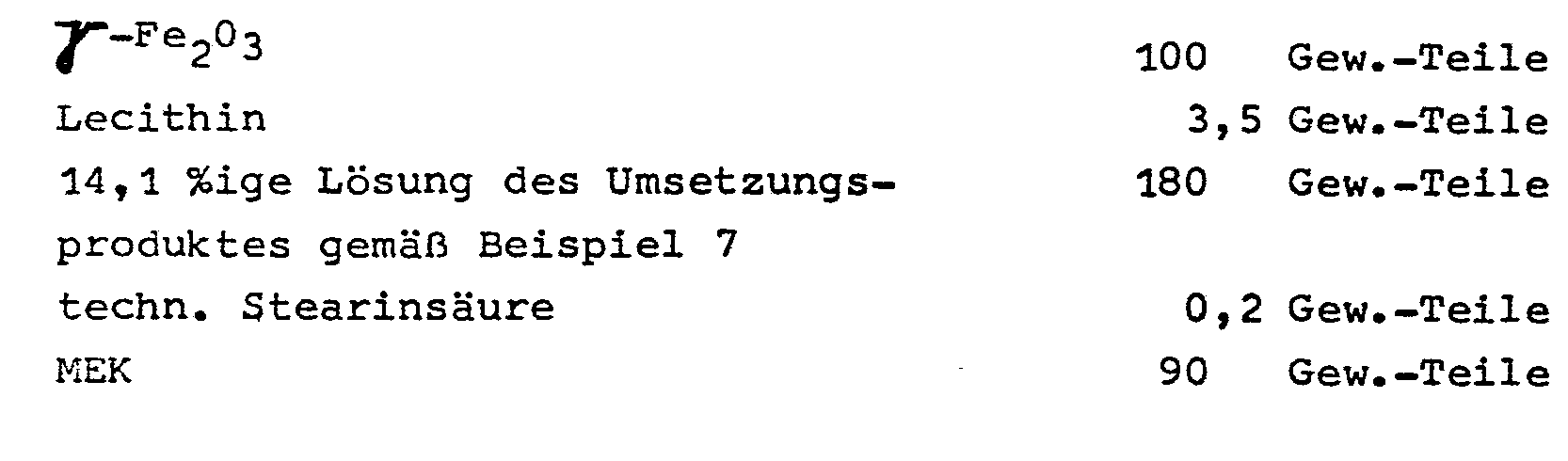
- Die Verarbeitung erfolgt analog Beispiel 8.
- Zur Herstellung einer Magnetbeschichtungsdispersion werden folgende Komponenten gemischt:


- Die Verarbeitung erfolgt analog Beispiel 8.
- Zur Herstellung einer Magnetbeschichtungsdispersion werden folgende Komponenten gemischt:

- Die Verarbeitung erfolgt analog Beispiel 8.
- Eine Magnetbeschichtungsdispersion wird durch Mischen folgender Bestandteile hergestellt:

- Die Verarbeitung erfolgt analog Beispiel 8.
- Eine magnetische Beschichtungsdispersion wird hergestellt aus:

- Die Verarbeitung erfolgt analog Beispiel 8.
- Die Magnetbeschichtungsdispersion wird aus der Mischung folgender Komponenten hergestellt:

- Die Verarbeitung erfolgt analog Beispiel 8.
- Ein Magnetlack wird durch Mischen folgender Bestandteile hergestellt:
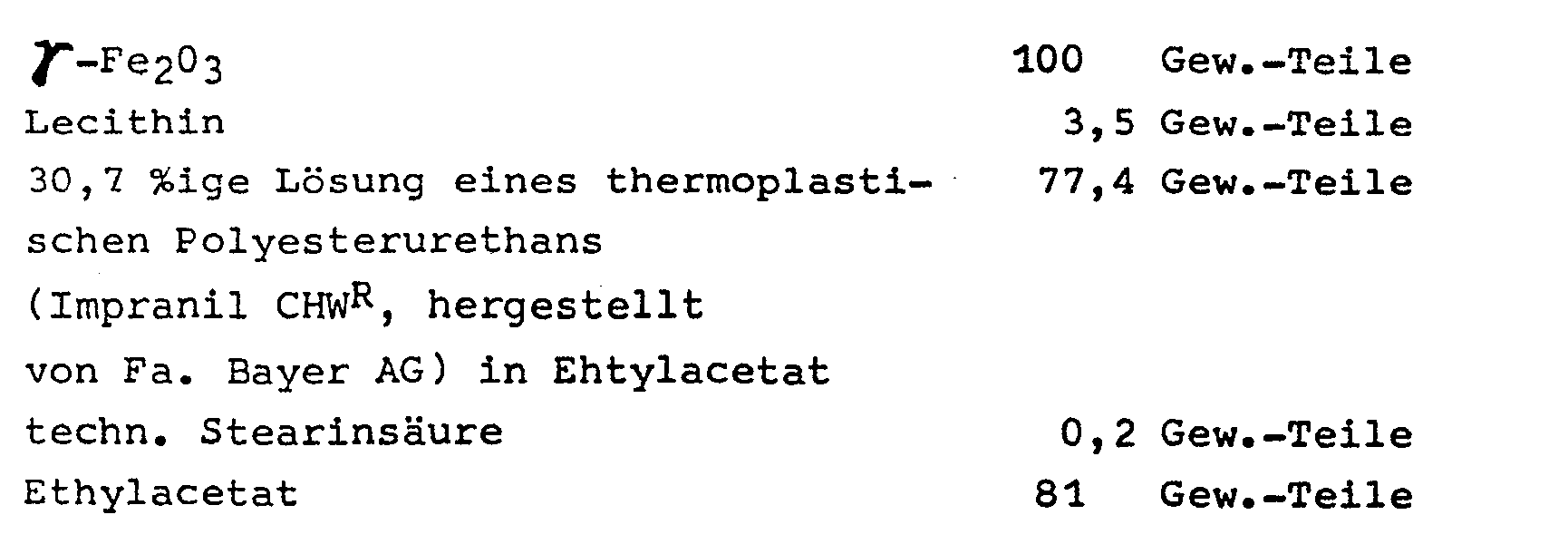
- Die Verarbeitung erfolgt analog Beispiel 8.
- Die mit Hilfe der beschriebenen olefinisch ungesättigten, strahlenhärtenden Bindemittel hergestellten Magnetdispersionen zeichnen sich durch eine praktisch unbegrenzte Topfzeit aus. Die durch Beguß dieser Magnetdispersionen auf geeignete Unterlagen gebildeten magnetischen Materialien weisen die bevorzugte Eigenschaft auf, daß sie ohne Vorvernetzung kalandert werden können. Die erfindungsgemäß hergestellten Magnetschichten sind unmittelbar nach der Bestrahlung vollständig vernetzt. Sie zeichnen sich durch geringste Klebeneigung, gegenüber herkömmlichen Systemen verbesserten mechanischen und speichertechnischen Werten, hervorragende Lösungsmittelfestigkeit und Vernetzung aus.
- Der Grad der erzielten Vernetzung wird quantitativ mit Hilfe der Quelltemperaturmethode ermittelt (K. Ch. Schilffarth, Farbe + Lack 84, 13 (1978). Das Verfahren beruht auf dem Effekt, daß sich die auf unmagnetischen Unterlagen aufgebrachten Magnetschichten nach dem Eintauchen in thermostatisierten geeigneten Lösungsmitteln nach einer gewissen Zeit plötzlich auffalten.
- Die zu untersuchende Magnetbandprobe (1 cm x 2 cm) wird in ein thermostatisiertes Bad mit Cyclohexanon getaucht. Bei jeweils konstanten Badtemperaturen zwischen - 15 °C und 140°C wird die Zeit bestimmt, die zwischen dem Eintauchen der Probe und dem plötzlichen Auffalten der Magnetschicht verstreicht. Die Badtempera#tur, bei der sich exakt nach 10 Sekunden die Schicht auffaltet, wird als Quellentemperatur definiert. Sie ist ein gutes quantitatives Maß für den Vernetzungsgrad der Schicht. Die Ergebnisse sind in der nachfolgenden Tabelle 1 wiedergegeben.
-
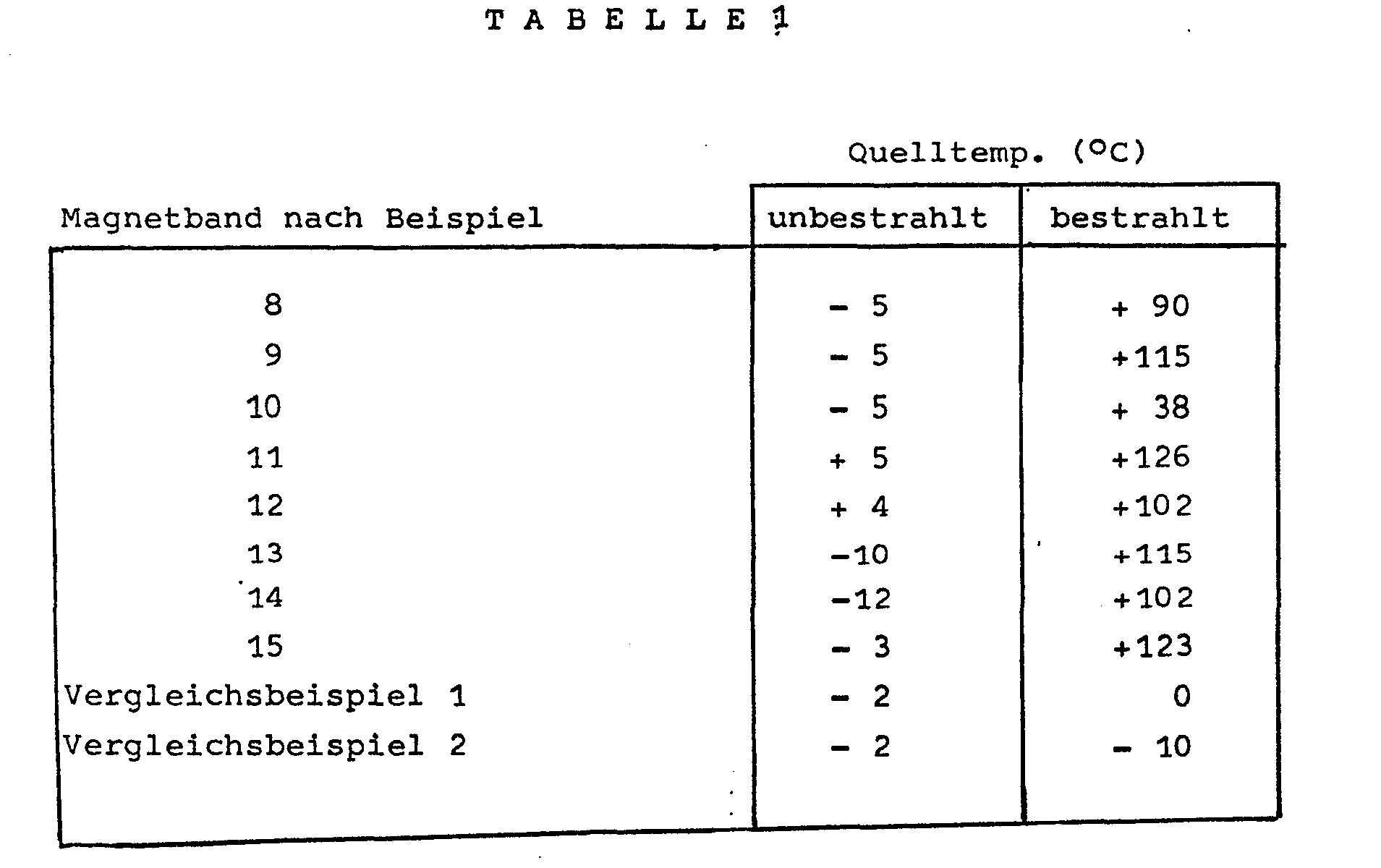
- Zur Demonstration der Elastizität der gehärteten erfindungsgemäßen Bindemittel wurden Klarlackfilme von den Bindemitteln bzw. Bindemittelkombinationen aus Lösung gezogen, nach Abdunsten des Lösungsmittels einer Elektron enbastrahlung von 5 Mrad. ausgesetzt, und die Filme wurden auf ihre Reißdehnung geprüft. Als Vergleich 3 wird ein Klarlackfilm aus einem thermoplastischen Polyurethan (R Impranil CHW der Fa. Bayer AG), (R Aronix M-8030, Produkt der Fa. Toa Gosei Kagaku Co.) und einem trifunktionellen Isocyanat (R Desmodur L der Fa. Bayer AG) analog Beispiel 2 der DE-OS 30 29 818 hergestellt. Als Vergleich 4 wird ein Klarlackfilm aus einem Oligoacrylat (R Aronix M-8030 der Fa. Toa Gosei Kagaku Co.) und einem thermoplastischen Polyurethan (R Estane 5702 der Fa. Goodrich Co.) gemäß DE-OS 30 29 819 hergestellt. Als Vergleich 5 wird ein Klarlackfilm gemäß der WO 81/02646 aus dem Urethanacrylaten a und g in einem Verhältnis nach Beispiel 1 der angeführten Patentanmeldung hergestellt. Die Ergebnisse gibt Tabelle 2 wieder.

Claims (16)
Applications Claiming Priority (2)
| Application Number | Priority Date | Filing Date | Title |
|---|---|---|---|
| DE3200970A DE3200970C2 (de) | 1982-01-14 | 1982-01-14 | Magnetisches Speichermedium mit strahlenhärtbaren Bindemitteln |
| DE3200970 | 1982-01-14 |
Publications (3)
| Publication Number | Publication Date |
|---|---|
| EP0084797A2 true EP0084797A2 (de) | 1983-08-03 |
| EP0084797A3 EP0084797A3 (en) | 1985-10-16 |
| EP0084797B1 EP0084797B1 (de) | 1987-12-23 |
Family
ID=6153068
Family Applications (1)
| Application Number | Title | Priority Date | Filing Date |
|---|---|---|---|
| EP83100179A Expired EP0084797B1 (de) | 1982-01-14 | 1983-01-12 | Verfahren zur Herstellung eines magnetischen Speichermediums mit strahlenhärtbaren Bindemitteln |
Country Status (2)
| Country | Link |
|---|---|
| EP (1) | EP0084797B1 (de) |
| DE (2) | DE3200970C2 (de) |
Cited By (1)
| Publication number | Priority date | Publication date | Assignee | Title |
|---|---|---|---|---|
| EP0097938A3 (de) * | 1982-06-28 | 1984-10-17 | The B.F. GOODRICH Company | Härtbare Polyurethane |
Families Citing this family (6)
| Publication number | Priority date | Publication date | Assignee | Title |
|---|---|---|---|---|
| JPS6052922A (ja) * | 1983-09-02 | 1985-03-26 | Tdk Corp | 磁気記録媒体 |
| US4689269A (en) * | 1984-04-14 | 1987-08-25 | Victor Company Of Japan, Ltd. | Magnetic recording medium comprising a specific type of copolymer binder |
| JPH0610856B2 (ja) * | 1984-08-04 | 1994-02-09 | ティーディーケイ株式会社 | 磁気記録媒体 |
| US4842942A (en) * | 1984-08-15 | 1989-06-27 | Toyo Boseki Kabushiki Kaisha | Magnetic recording medium |
| JPS62188019A (ja) * | 1986-02-13 | 1987-08-17 | Victor Co Of Japan Ltd | 磁気記録媒体 |
| JP2523279B2 (ja) * | 1986-05-02 | 1996-08-07 | ティーディーケイ株式会社 | 磁気記録媒体およびその製造方法 |
Family Cites Families (3)
| Publication number | Priority date | Publication date | Assignee | Title |
|---|---|---|---|---|
| DE2100037C3 (de) * | 1971-01-02 | 1980-06-19 | Hartmann, Job-Werner, Dr., 6700 Ludwigshafen | Verfahren zur Herstellung von magnetischen Aufzeichnungsträgern |
| JPS5625230A (en) * | 1979-08-06 | 1981-03-11 | Sony Corp | Magnetic recording medium |
| JPS56122802A (en) * | 1980-03-03 | 1981-09-26 | Toyo Ink Mfg Co Ltd | Radiation-curable resin composition |
-
1982
- 1982-01-14 DE DE3200970A patent/DE3200970C2/de not_active Expired
-
1983
- 1983-01-12 EP EP83100179A patent/EP0084797B1/de not_active Expired
- 1983-01-12 DE DE8383100179T patent/DE3375050D1/de not_active Expired
Cited By (1)
| Publication number | Priority date | Publication date | Assignee | Title |
|---|---|---|---|---|
| EP0097938A3 (de) * | 1982-06-28 | 1984-10-17 | The B.F. GOODRICH Company | Härtbare Polyurethane |
Also Published As
| Publication number | Publication date |
|---|---|
| DE3200970A1 (de) | 1983-07-28 |
| DE3375050D1 (en) | 1988-02-04 |
| EP0084797A3 (en) | 1985-10-16 |
| EP0084797B1 (de) | 1987-12-23 |
| DE3200970C2 (de) | 1983-11-24 |
Similar Documents
| Publication | Publication Date | Title |
|---|---|---|
| EP0099533B1 (de) | Magnetische Aufzeichnungsträger | |
| DE3303805A1 (de) | Magnetischer aufzeichnungstraeger | |
| EP0161536B1 (de) | Magnetische Aufzeichnungsträger | |
| DE3029818A1 (de) | Magnetisches aufzeichnungsmedium | |
| EP0084797B1 (de) | Verfahren zur Herstellung eines magnetischen Speichermediums mit strahlenhärtbaren Bindemitteln | |
| EP0169524B1 (de) | Magnetische Aufzeichnungsträger | |
| EP0100017B1 (de) | Magnetische Aufzeichnungsträger | |
| EP0416386A2 (de) | Magnetische Aufzeichnungsträger | |
| DE3786608T2 (de) | Alkylakrylatcopolymere, diese Copolymere enthaltende Aufzeichnungsträger und Verfahren zur Herstellung dieser Copolymere und Aufzeichnungsträger. | |
| EP0142796B1 (de) | Magnetische Aufzeichnungsträger | |
| EP0142798A2 (de) | Magnetische Aufzeichnungsträger | |
| EP0219765B1 (de) | Magnetischer Aufzeichnungsträger mit strahlenhärtbaren Dispergatoren | |
| EP0490201B1 (de) | Magnetische Aufzeichnungsträger | |
| EP0414111B1 (de) | Magnetischer Aufzeichnungsträger | |
| EP0490223B1 (de) | Magnetische Aufzeichnungsträger | |
| EP0281873B1 (de) | Magnetische Aufzeichnungsträger | |
| DE3430759A1 (de) | Magnetisches aufzeichnungsmedium | |
| EP0416387A2 (de) | Magnetische Aufzeichnungsträger | |
| EP0601472A1 (de) | Magnetische Aufzeichnungsträger | |
| EP0169523B1 (de) | Verfahren zur Herstellung schichtförmiger magnetischer Aufzeichnungsträger | |
| DE3227163A1 (de) | Magnetische aufzeichnungstraeger | |
| DE3537620A1 (de) | Magnetischer aufzeichnungstraeger mit strahlenhaertbaren dispergatoren | |
| EP1042748A1 (de) | Magnetischer aufzeichnungsträger auf der basis eines hydroxyl- und aminogruppenhaltigen polyurethanpräpolymers | |
| EP0601471A1 (de) | Magnetische Aufzeichnungsträger | |
| EP0416388A2 (de) | Magnetische Aufzeichnungsträger |
Legal Events
| Date | Code | Title | Description |
|---|---|---|---|
| PUAI | Public reference made under article 153(3) epc to a published international application that has entered the european phase |
Free format text: ORIGINAL CODE: 0009012 |
|
| 17P | Request for examination filed |
Effective date: 19830112 |
|
| AK | Designated contracting states |
Designated state(s): DE FR GB IT NL |
|
| PUAL | Search report despatched |
Free format text: ORIGINAL CODE: 0009013 |
|
| AK | Designated contracting states |
Designated state(s): DE FR GB IT NL |
|
| 17Q | First examination report despatched |
Effective date: 19860918 |
|
| RAP1 | Party data changed (applicant data changed or rights of an application transferred) |
Owner name: AGFA-GEVAERT AG |
|
| GRAA | (expected) grant |
Free format text: ORIGINAL CODE: 0009210 |
|
| AK | Designated contracting states |
Kind code of ref document: B1 Designated state(s): DE FR GB IT NL |
|
| ITF | It: translation for a ep patent filed | ||
| ET | Fr: translation filed | ||
| REF | Corresponds to: |
Ref document number: 3375050 Country of ref document: DE Date of ref document: 19880204 |
|
| GBT | Gb: translation of ep patent filed (gb section 77(6)(a)/1977) | ||
| PLBE | No opposition filed within time limit |
Free format text: ORIGINAL CODE: 0009261 |
|
| STAA | Information on the status of an ep patent application or granted ep patent |
Free format text: STATUS: NO OPPOSITION FILED WITHIN TIME LIMIT |
|
| 26N | No opposition filed | ||
| REG | Reference to a national code |
Ref country code: GB Ref legal event code: 746 |
|
| ITPR | It: changes in ownership of a european patent |
Owner name: OFFERTA DI LICENZA AL PUBBLICO |
|
| ITTA | It: last paid annual fee | ||
| REG | Reference to a national code |
Ref country code: GB Ref legal event code: 732 |
|
| ITPR | It: changes in ownership of a european patent |
Owner name: CESSIONE;BASF MAGNETICS GMBH |
|
| NLS | Nl: assignments of ep-patents |
Owner name: BASF MAGNETICS GMBH TE MANNHEIM, BONDSREPUBLIEK DU |
|
| REG | Reference to a national code |
Ref country code: FR Ref legal event code: TP |
|
| PGFP | Annual fee paid to national office [announced via postgrant information from national office to epo] |
Ref country code: FR Payment date: 19931213 Year of fee payment: 12 |
|
| PGFP | Annual fee paid to national office [announced via postgrant information from national office to epo] |
Ref country code: GB Payment date: 19940104 Year of fee payment: 12 |
|
| PGFP | Annual fee paid to national office [announced via postgrant information from national office to epo] |
Ref country code: DE Payment date: 19940117 Year of fee payment: 12 |
|
| PGFP | Annual fee paid to national office [announced via postgrant information from national office to epo] |
Ref country code: NL Payment date: 19940131 Year of fee payment: 12 |
|
| PG25 | Lapsed in a contracting state [announced via postgrant information from national office to epo] |
Ref country code: GB Effective date: 19950112 |
|
| PG25 | Lapsed in a contracting state [announced via postgrant information from national office to epo] |
Ref country code: NL Effective date: 19950801 |
|
| GBPC | Gb: european patent ceased through non-payment of renewal fee |
Effective date: 19950112 |
|
| PG25 | Lapsed in a contracting state [announced via postgrant information from national office to epo] |
Ref country code: FR Effective date: 19950929 |
|
| NLV4 | Nl: lapsed or anulled due to non-payment of the annual fee |
Effective date: 19950801 |
|
| PG25 | Lapsed in a contracting state [announced via postgrant information from national office to epo] |
Ref country code: DE Effective date: 19951003 |
|
| REG | Reference to a national code |
Ref country code: FR Ref legal event code: ST |