EP0084917A2 - Procédé de fabrication de panneaux isolants et machine destinée à réaliser le procédé - Google Patents
Procédé de fabrication de panneaux isolants et machine destinée à réaliser le procédé Download PDFInfo
- Publication number
- EP0084917A2 EP0084917A2 EP83200096A EP83200096A EP0084917A2 EP 0084917 A2 EP0084917 A2 EP 0084917A2 EP 83200096 A EP83200096 A EP 83200096A EP 83200096 A EP83200096 A EP 83200096A EP 0084917 A2 EP0084917 A2 EP 0084917A2
- Authority
- EP
- European Patent Office
- Prior art keywords
- panel
- preforming
- insulating
- insulating panel
- textile waste
- Prior art date
- Legal status (The legal status is an assumption and is not a legal conclusion. Google has not performed a legal analysis and makes no representation as to the accuracy of the status listed.)
- Granted
Links
Images

Classifications
-
- D—TEXTILES; PAPER
- D21—PAPER-MAKING; PRODUCTION OF CELLULOSE
- D21J—FIBREBOARD; MANUFACTURE OF ARTICLES FROM CELLULOSIC FIBROUS SUSPENSIONS OR FROM PAPIER-MACHE
- D21J3/00—Manufacture of articles by pressing wet fibre pulp, or papier-mâché, between moulds
- D21J3/12—Manufacture of articles by pressing wet fibre pulp, or papier-mâché, between moulds of sheets; of diaphragms
-
- D—TEXTILES; PAPER
- D21—PAPER-MAKING; PRODUCTION OF CELLULOSE
- D21B—FIBROUS RAW MATERIALS OR THEIR MECHANICAL TREATMENT
- D21B1/00—Fibrous raw materials or their mechanical treatment
- D21B1/04—Fibrous raw materials or their mechanical treatment by dividing raw materials into small particles, e.g. fibres
- D21B1/12—Fibrous raw materials or their mechanical treatment by dividing raw materials into small particles, e.g. fibres by wet methods, by the use of steam
- D21B1/30—Defibrating by other means
- D21B1/32—Defibrating by other means of waste paper
-
- D—TEXTILES; PAPER
- D21—PAPER-MAKING; PRODUCTION OF CELLULOSE
- D21J—FIBREBOARD; MANUFACTURE OF ARTICLES FROM CELLULOSIC FIBROUS SUSPENSIONS OR FROM PAPIER-MACHE
- D21J1/00—Fibreboard
- D21J1/16—Special fibreboard
- D21J1/20—Insulating board
-
- E—FIXED CONSTRUCTIONS
- E04—BUILDING
- E04C—STRUCTURAL ELEMENTS; BUILDING MATERIALS
- E04C2/00—Building elements of relatively thin form for the construction of parts of buildings, e.g. sheet materials, slabs, or panels
- E04C2/02—Building elements of relatively thin form for the construction of parts of buildings, e.g. sheet materials, slabs, or panels characterised by specified materials
- E04C2/10—Building elements of relatively thin form for the construction of parts of buildings, e.g. sheet materials, slabs, or panels characterised by specified materials of wood, fibres, chips, vegetable stems, or the like; of plastics; of foamed products
- E04C2/16—Building elements of relatively thin form for the construction of parts of buildings, e.g. sheet materials, slabs, or panels characterised by specified materials of wood, fibres, chips, vegetable stems, or the like; of plastics; of foamed products of fibres, chips, vegetable stems, or the like
-
- Y—GENERAL TAGGING OF NEW TECHNOLOGICAL DEVELOPMENTS; GENERAL TAGGING OF CROSS-SECTIONAL TECHNOLOGIES SPANNING OVER SEVERAL SECTIONS OF THE IPC; TECHNICAL SUBJECTS COVERED BY FORMER USPC CROSS-REFERENCE ART COLLECTIONS [XRACs] AND DIGESTS
- Y02—TECHNOLOGIES OR APPLICATIONS FOR MITIGATION OR ADAPTATION AGAINST CLIMATE CHANGE
- Y02W—CLIMATE CHANGE MITIGATION TECHNOLOGIES RELATED TO WASTEWATER TREATMENT OR WASTE MANAGEMENT
- Y02W30/00—Technologies for solid waste management
- Y02W30/50—Reuse, recycling or recovery technologies
- Y02W30/64—Paper recycling
Definitions
- the present invention relates to the manufacture of insulating panels.
- the object of the invention is the use of waste of different kinds, which are generally available at low cost.
- the insulating panel produced according to the invention consists of pulp prepared from mixed old paper, in which are incorporated crushed textile waste.
- the panel thus obtained can be produced in different thicknesses and has, depending on the desired thermal conductivity, a textile fiber content which can vary from 5% to 45%.
- the incorporation of additives in the pulp can give the panels special properties so as to make them fireproof, impermeable, rot-proof and to treat them as fungicides.
- the panels thus formed are characterized by their exceptional qualities of thermal and sound insulation, alongside a relatively low cost of recovered materials and a relatively simple manufacture.
- the originality lies not only in obtaining a light and insulating panel but also in the method of manufacturing this panel. Unlike products produced for the same purposes, the panel is manufactured in a single forming operation at very low pressure, thanks to the development of a special preforming machine.
- the preforming machine is intended to shape the panels by eliminating approximately 4/5 of all the water contained in the base mixture and this at very low pressure and by providing high insulating characteristics and low density.
- the low density of the panel and the non-conductive nature of the materials used help to create a light panel with important insulating qualities.
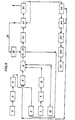
- the schematic diagram of the production line for insulating panels is represented in FIG. 1.
- the mixed paper After a summary sorting of the mixed paper 1 obtained from selective harvests to eliminate the visible part of waste contained in the paper (maximum 1% by weight), the mixed paper can be bundled by a multi-density press 2. Buffer storage of the bundles is carried out in 3. The bundles are taken from the stock and the papers are introduced into a conventional pulper 4 supplied with water from the reserve 5 This reserve is fed partly by the network and partly by the draining coming from the preforming machine, which will be described later. Waste from the cutting and the tongue of the panels can also be introduced into the pulper 4.
- clothes are sorted in 7. For the intended use, only clothing that cannot be recycled as is selected: torn clothes or sewing waste.
- FIG. 2 represents the apparatus or preforming machine comprising a rigid frame made up of beams 11, which support an attached grid 12. Above this there is arranged a movable frame 13 itself actuated by two jacks 14. The movable frame slides along four columns 15 and can surround the attached grid 12.
- the plate 16 of the preforming machine is actuated by four jacks 17 and its stroke is calibrated so as to ensure a constant thickness of the dough cake deposited on the grid inside the movable frame.
- a 25% perforated sheet taken from a reserve 18 is brought to the preforming machine on the attached grid 12 (FIG. 2).
- the movable frame 13 descends, trapping the sides of the perforated sheet 19 and of the attached grid 12.
- a measured quantity of dough is brought under pressure onto the perforated sheet 19, where it drips naturally.
- An operator monitors the operation and can optionally level the dough.
- the plate 16 descends and stops automatically as soon as the required dimension is reached with a pressure of the order of 1 kg / cm 2 .
- the mo frame bile 13 recast and pressurized air is injected into the plate 16 to facilitate detachment of the upper part of the panel.
- the tray 16 rises and the panel is conveyed by an appropriate means to the unloading apparatus 20, which then deposits the panels on the racks of a drying cart 21.
- the drying carriages each loaded with about twenty panels, are gradually introduced into an oven 22, where the temperature reaches 150 ° C. Once cooled, the panels are unloaded and the carriages with the perforated sheets 19 return to their starting point 21.18. The panels are then cut at 23 to the desired measurement, then optionally tabbed at 24 (groove and tongue are provided so as to avoid thermal bridges), from where the waste is conveyed to the pulper 4. At 25 the various treatments are carried out of surface. Then we go to packaging 26 and storage 27.
- the production of insulating panels according to the invention can be carried out continuously. It then requires the replacement of the preforming machine 11-17 by a stationery train, modified so as to ensure very low pressures, a slow scrolling speed and a modification of the oven 22 to ensure continuous scrolling of the panels.
Landscapes
- Engineering & Computer Science (AREA)
- Architecture (AREA)
- Wood Science & Technology (AREA)
- Life Sciences & Earth Sciences (AREA)
- Civil Engineering (AREA)
- Manufacturing & Machinery (AREA)
- Mechanical Engineering (AREA)
- Structural Engineering (AREA)
- Dry Formation Of Fiberboard And The Like (AREA)
- Filling Or Discharging Of Gas Storage Vessels (AREA)
- Building Environments (AREA)
- Paper (AREA)
- Laminated Bodies (AREA)
Abstract
Description
- La présente invention est relative à la fabrication de panneaux isolante.
- L'objet de l'invention est l'utilisation de déchets de différentes natures, qui se trouvent généralement à la disposition à peu de frais.
- Suivant l'invention, il a paru avantageux de réaliser des panneaux isolants à partir de déchets de récupération et le panneau isolant réalisé suivant l'invention est constitué par de la pâte à papier préparée à partir de vieux papiers mêlés, à laquelle sont incorporés des déchets textiles broyés.
- Le panneau ainsi obtenu peut être réalisé en différentes épaisseurs et a, suivant la conductivité thermique souhaitée, une teneur en fibres textiles pouvant varier de 5% à 45 %.
- L'incorporation d'additifs dans la pâte à papier peut conférer aux panneaux des propriétés spéciales de manière à les rendre ignifuges, imperméables, imputrescibles et à les traiter fongicides.
- En outre, il est encore prévu, suivant l'invention, d'appliquer sur un panneau ainsi réalisé une couche de revêtement destinée soit à le protéger, soit à faciliter les traitements ultérieurs de peinture, de tapissage et autres.
- Les panneaux ainsi constitués se caractérisent par leurs qualités exceptionnelles d'isolation thermique et phonique, à côté d'un coût de matières de récupération assez bas et d'une fabrication relativement simple.
- L'originalité réside non seulement dans l'obtention d'un panneau léger et isolant mais aussi dans le mode de fabrication de ce panneau. Contrairement à des produits réalisés en vue des mêmes objectifs, le panneau est fabriqué en une seule opération de mise en forme à très basse pression, grâce à la mise au point d'une machine préformeuse spéciale.
- La machine préformeuse est destinée à mettre en forme les panneaux en éliminant approximativement les 4/5 de la totalité de l'eau contenue dans le mélange de base et cela à très basse pression et en procurant des caractéristiques isolantes élevées et à poids volumique faible.
- La faible densité du panneau et le caractère non conducteur des matériaux utilisés contribuent à créer un panneau léger présentant des qualités isolantes importantes.
- La présence de déchets textiles contribue à conférer au produit des caractéristiques isolantes intéressantes.
- L'invention est exposée plus en détail ci-après à l'aide de dessins annexés, dans lesquels :
- Figure 1 représente le schéma de principe d'une chaîne de production de panneaux isolants réalisés conformément à la présente invention ;
- Figure 2 représente une machine préformeuse destinée à la fabrication des panneaux isolants.
- Le schéma de principe de la chaîne de production de panneaux isolants est représenté à la figure 1. Après un tri sommaire du papier mêlé 1 issu de récoltes sélectives pour éliminer la partie visible de déchets contenus dans le papier (maximum 1 % en poids), le papier mêlé peut être mis en ballots par une presse multi densité 2. Un stockage tampon des ballots est réalisé en 3. Les ballots sont prélevés du stock et les papiers sont introduits dans un pulpeur conventionnel 4 alimenté en eau à partir de la réserve 5. Cette réserve est alimentée en partie par le réseau et en partie par l'égouttage provenant de la machine préformeuse, qui sera décrite plus loin. Des déchets provenant de la découpe et du languettagè des panneaux peuvent être également introduits dans le pulpeur 4.
- Dans le pulpeur 4 on réalise une pâte contenant 4 % à 5 % de matières sèches. Une fois homogénéisée, cette pâte est introduite dans un cuvier 6 où elle est agitée continuellement.
- Parallèlement au tri du papier, on réalise un tri des vêtements en 7. Pour l'usage envisagé, on ne sélectionne que les vêtements qui ne peuvent être recyclés tels quels: vêtements déchirés ou déchets de couture.
- Il n'y a pas de tri quant aux matières des vêtements, qu'elles scient synthétiques, végétales ou animales. Les déchets sent découpés en 8 et broyés dans un broyeur 9 avec un tamis ayant des perforations de 8 mm x 8 mm. Le textile broyé est amené par soufflage dans le cuvier 6, où la teneur en fibres peut atteindre de 5 % à 45 % du total des matières sèches.
- Divers produits chimiques, décrits plus loin, sont préparés en 10 et introduits dans le cuvier 6. Une fois le mélange homogénéisé, la pâte est prête pour le préformage.
- La figure 2 représente l'appareillage ou machine préformeuse comprenant un bâti rigide constitué de poutrelles 11, qui supportent une grille rapportée 12. Au dessus de celle-ci vient s'agencer un cadre mobile 13 lui-même actionné par deux vérins 14. Le cadre mobile coulisse le long de quatre colonnes 15 et peut venir entourer la grille rapportée 12.
- Le plateau 16 de la machine préformeuse est actionné par quatre vérins 17 et sa course est calibrée de façon à assurer une épaisseur constante du gâteau de pâte déposé sur la grille à l'intérieur du cadre mobile.
- Une tôle perforée à 25 % prélevée d'une réserve 18 est amenée à la machine préformeuse sur la grille rapportée 12 (figure 2). Le cadre mobile 13 descend, emprisonnant les côtés de la tôle perforée 19 et de la grille rapportée 12. Une quantité mesurée de pâte est amenée sous pression sur la tôle perforée 19, où elle s'égoutte naturellement. Un opérateur surveille l'opération et peut éventuellement niveler la pâte.
- Ensuite, le plateau 16 (figure 2) descend et s'arrête automatiquement dès que la dimension requise est atteinte avec une pression de l'ordre de 1 kg/cm2. Le cadre mobile 13 refonte et de l'air sous pression est injecté dans le plateau 16 pour faciliter le décollement de la partie supérieure du panneau. Le plateau 16 remonte et le panneau est acheminé par un moyen approprié sur l'appareil de déchargement 20, qui dépose ensuite les panneaux sur les claies d'un chariot de séchage 21.
- Les chariots de séchage chargés chacun d'une vingtaine de panneaux sont introduits au fur et à mesure dans un four 22, où la température atteint 150° C. Une fois refroidis, les panneaux sont déchargés et les chariots avec les tôles perforées 19 retournent à leur point de départ 21,18. Les panneaux sont ensuite découpés en 23 à la mesure désirée, puis éventuellement languettés en 24 (rainure et languette sont prévues de façon à éviter les ponts thermiques), d'où les déchets sont acheminés au pulpeur 4. En 25 sont réalisés les différents traitements de surface. On passe ensuite à l'emballage 26 et au stockage 27.
- Tel que réalisé dans la chaîne décrite ci-dessus, le panneau présente les caractéristiques suivantes :
- a) densité : £ 250 kg/m3
- b) À conductivité thermique : ≤ 0,070 W/mK
- c) R affaiblissement acoustique à 4.000 Hertz R ≥ 30 dB si e = 0,03 m
- d) α coefficient d'absorption phonique pour 4.000 Hertz α≥60 %.
- Des traitements sont prévus pour lui conférer des propriétés intéressantes :
- 1) ignifuge : soit en surface, soit par traitement dans la masse, soit par une combinaison des deux. Ainsi le panneau atteint les classifications M1 ou M2 suivant les cas (NFP 92-501).
- 2) hydrofuge : pose d'un pare vapeur.
- 3) imputrescible et fongicide: traitement dans la masse par un fongicide à base de polychloro- phénols d'amines grasses à longues chaînes carbonées.
- La production de panneaux isolants suivant l'invention peut être réalisée en continu. Elle requiert alors le remplacement de la machine préformeuse 11-17 par un train de papeterie, modifié de façon à assurer de très basses pressions, une vitesse de défilement lente et une modification du four 22 pour assurer un défilement en continu des panneaux.
Claims (9)
Priority Applications (1)
| Application Number | Priority Date | Filing Date | Title |
|---|---|---|---|
| AT83200096T ATE31565T1 (de) | 1982-01-26 | 1983-01-22 | Verfahren zur herstellung einer isolierplatte und maschine zur durchfuehrung des verfahrens. |
Applications Claiming Priority (2)
| Application Number | Priority Date | Filing Date | Title |
|---|---|---|---|
| LU83899A LU83899A1 (fr) | 1982-01-26 | 1982-01-26 | Panneau isolant |
| LU83899 | 1982-01-26 |
Publications (3)
| Publication Number | Publication Date |
|---|---|
| EP0084917A2 true EP0084917A2 (fr) | 1983-08-03 |
| EP0084917A3 EP0084917A3 (en) | 1984-08-22 |
| EP0084917B1 EP0084917B1 (fr) | 1987-12-23 |
Family
ID=19729801
Family Applications (1)
| Application Number | Title | Priority Date | Filing Date |
|---|---|---|---|
| EP83200096A Expired EP0084917B1 (fr) | 1982-01-26 | 1983-01-22 | Procédé de fabrication de panneaux isolants et machine destinée à réaliser le procédé |
Country Status (4)
| Country | Link |
|---|---|
| EP (1) | EP0084917B1 (fr) |
| AT (1) | ATE31565T1 (fr) |
| DE (1) | DE3375032D1 (fr) |
| LU (1) | LU83899A1 (fr) |
Cited By (9)
| Publication number | Priority date | Publication date | Assignee | Title |
|---|---|---|---|---|
| WO1989010449A1 (fr) * | 1988-04-29 | 1989-11-02 | Terre Engineering S.A. | Procede de fabrication de panneaux isolants, thermiques et acoustiques, et absorbants phoniques et panneaux realises suivant le procede |
| WO1990004677A1 (fr) * | 1988-10-25 | 1990-05-03 | Brødrene Hartmann A/S | Fabrication d'objets moules a partir d'un materiau brut fibreux fluidise |
| GR890100687A (el) * | 1988-10-25 | 1990-11-29 | Hartmann As Brdr | Μέ?οδος για την κατασκευή αντικειμένων στα?ερού περιγράμματος. |
| US5354427A (en) * | 1988-10-25 | 1994-10-11 | Torben Rasmussen | Manufacture of moulded objects from a fluidized fiber raw material |
| WO2002008519A1 (fr) * | 2000-07-26 | 2002-01-31 | Machacek Jan | Procede de production d'un panneau a partir de dechets de papier, panneau ainsi obtenu, et son utilisation |
| CN102517965A (zh) * | 2011-11-23 | 2012-06-27 | 苏州工业园区宝优际通讯科技有限公司 | 快巴纸的加工工艺 |
| CN110846940A (zh) * | 2019-10-21 | 2020-02-28 | 兰考裕德环保材料科技有限公司 | 纸浆模塑品的制造方法及制备系统 |
| IT202200002246A1 (it) * | 2022-02-08 | 2023-08-08 | Sn Innovative S R L | Pannello isolante e fonoassorbente e relativo procedimento di realizzazione |
| IT202300013743A1 (it) * | 2023-07-03 | 2025-01-03 | Dp Company Srl | Pannello per mobilio comprendente fibre tessili |
Families Citing this family (1)
| Publication number | Priority date | Publication date | Assignee | Title |
|---|---|---|---|---|
| CN101193568B (zh) | 2004-10-29 | 2011-11-30 | 博技术有限公司 | 基于卷轴的闭合系统及使用该系统的鞋类物品 |
Family Cites Families (8)
| Publication number | Priority date | Publication date | Assignee | Title |
|---|---|---|---|---|
| FR342735A (fr) * | 1903-05-07 | 1904-09-15 | Thomas John Palmer | Perfectionnements à la fabrication de panneaux moulés ou repoussés et autres articles du meme genre |
| DE569463C (de) * | 1930-04-01 | 1933-09-02 | Herman Doehler | Verfahren zur Herstellung von waerme- und schallisolierenden Koerpern |
| FR873682A (fr) * | 1940-09-26 | 1942-07-16 | Dynamit Aktien Ges Vormals Alf | Plaques et pièces de forme en matière calorifuge |
| US2415244A (en) * | 1942-07-08 | 1947-02-04 | Hillbom Tor Ove | Press for the manufacture of fiberboards |
| FR1002294A (fr) * | 1946-09-04 | 1952-03-04 | Procédé de fabrication de panneaux agglomérés isolants et analogues, et produitsagglomérés obtenus par son application | |
| FR1018408A (fr) * | 1949-04-25 | 1953-01-07 | Dispositif pour la fabrication de plaques de matière fibreuse, en particulier, de plaques de fibre dures | |
| GB1275042A (en) * | 1968-01-25 | 1972-05-24 | Nat Res Dev | The utilisation of paper sludge for sheeting or moulding |
| GB1405587A (en) * | 1971-07-21 | 1975-09-10 | Nat Res Dev | Production of shaped articles |
-
1982
- 1982-01-26 LU LU83899A patent/LU83899A1/fr unknown
-
1983
- 1983-01-22 DE DE8383200096T patent/DE3375032D1/de not_active Expired
- 1983-01-22 AT AT83200096T patent/ATE31565T1/de not_active IP Right Cessation
- 1983-01-22 EP EP83200096A patent/EP0084917B1/fr not_active Expired
Cited By (13)
| Publication number | Priority date | Publication date | Assignee | Title |
|---|---|---|---|---|
| AU615452B2 (en) * | 1988-04-29 | 1991-10-03 | Terre Engineering S.A. | Insulating panel |
| WO1989010449A1 (fr) * | 1988-04-29 | 1989-11-02 | Terre Engineering S.A. | Procede de fabrication de panneaux isolants, thermiques et acoustiques, et absorbants phoniques et panneaux realises suivant le procede |
| AU643941B2 (en) * | 1988-10-25 | 1993-12-02 | Brodrene Hartmann A/S | Manufacture of moulded objects from a fluidized fibre raw material |
| GR890100680A (en) * | 1988-10-25 | 1990-11-29 | Hartmann As Brdr | Construction of moulded objects using fibres as raw material |
| GR890100687A (el) * | 1988-10-25 | 1990-11-29 | Hartmann As Brdr | Μέ?οδος για την κατασκευή αντικειμένων στα?ερού περιγράμματος. |
| GB2242445B (en) * | 1988-10-25 | 1993-02-24 | Hartmann As Brdr | Manafacture of moulded objects from a fluidized fibre raw material |
| WO1990004677A1 (fr) * | 1988-10-25 | 1990-05-03 | Brødrene Hartmann A/S | Fabrication d'objets moules a partir d'un materiau brut fibreux fluidise |
| US5354427A (en) * | 1988-10-25 | 1994-10-11 | Torben Rasmussen | Manufacture of moulded objects from a fluidized fiber raw material |
| WO2002008519A1 (fr) * | 2000-07-26 | 2002-01-31 | Machacek Jan | Procede de production d'un panneau a partir de dechets de papier, panneau ainsi obtenu, et son utilisation |
| CN102517965A (zh) * | 2011-11-23 | 2012-06-27 | 苏州工业园区宝优际通讯科技有限公司 | 快巴纸的加工工艺 |
| CN110846940A (zh) * | 2019-10-21 | 2020-02-28 | 兰考裕德环保材料科技有限公司 | 纸浆模塑品的制造方法及制备系统 |
| IT202200002246A1 (it) * | 2022-02-08 | 2023-08-08 | Sn Innovative S R L | Pannello isolante e fonoassorbente e relativo procedimento di realizzazione |
| IT202300013743A1 (it) * | 2023-07-03 | 2025-01-03 | Dp Company Srl | Pannello per mobilio comprendente fibre tessili |
Also Published As
| Publication number | Publication date |
|---|---|
| DE3375032D1 (en) | 1988-02-04 |
| LU83899A1 (fr) | 1983-09-02 |
| EP0084917A3 (en) | 1984-08-22 |
| EP0084917B1 (fr) | 1987-12-23 |
| ATE31565T1 (de) | 1988-01-15 |
Similar Documents
| Publication | Publication Date | Title |
|---|---|---|
| US5500089A (en) | Method for making disposable bowls and trays | |
| US3895997A (en) | Production of shaped articles from paper sludge | |
| AU2017327693B2 (en) | Improved pulp disposable tray | |
| EP0084917B1 (fr) | Procédé de fabrication de panneaux isolants et machine destinée à réaliser le procédé | |
| US8802205B2 (en) | Corrugated water resistant box | |
| CA2003087C (fr) | Papier en bande facile a defibrer et methode de fabrication | |
| US2167440A (en) | Continuous production of ligno-cellulose fiber product | |
| US3011938A (en) | Process of making board products | |
| CA2015370C (fr) | Methode de production de produits de charpente agglomeres a partir de baguettes longues, minces et etroites de bois vert | |
| US3061878A (en) | Press apparatus forming composite boards | |
| FR2531727A1 (fr) | Procede et dispositif pour former des nappes non tissees | |
| US2173391A (en) | Process of manufacturing fibrous products | |
| US11027878B2 (en) | Repulpable corrugated protein box and process for making same using wire side impregnation | |
| JPH10298900A (ja) | 食品容器の製造方法 | |
| US1831064A (en) | Machine for making composite material | |
| JPH08158299A (ja) | モールディング成形体 | |
| US2030626A (en) | Fibrous product and method of making the same | |
| CN108330728A (zh) | 一种利用秸秆和粉煤灰制造防火板的方法 | |
| US11911932B2 (en) | System for making a rigid foam substitute | |
| RU2634235C1 (ru) | Способ переработки отходов сортирования сульфатной целлюлозы в формованные изделия | |
| FI63808B (fi) | Anordning och foerfarande foer framstaellning av en fibermaterialskiva | |
| JP2002362618A (ja) | 竹皮や木削薄葉片のその他加工品 | |
| RU1805156C (ru) | Лини дл производства волокнистых плит | |
| RU2373315C1 (ru) | Способ изготовления бумаги упаковочной | |
| JP2023182132A (ja) | セルロース繊維体の製造方法 |
Legal Events
| Date | Code | Title | Description |
|---|---|---|---|
| PUAI | Public reference made under article 153(3) epc to a published international application that has entered the european phase |
Free format text: ORIGINAL CODE: 0009012 |
|
| AK | Designated contracting states |
Designated state(s): AT BE CH DE FR GB IT LI NL SE |
|
| PUAL | Search report despatched |
Free format text: ORIGINAL CODE: 0009013 |
|
| AK | Designated contracting states |
Designated state(s): AT BE CH DE FR GB IT LI NL SE |
|
| 17P | Request for examination filed |
Effective date: 19850215 |
|
| 17Q | First examination report despatched |
Effective date: 19860131 |
|
| R17C | First examination report despatched (corrected) |
Effective date: 19860905 |
|
| ITF | It: translation for a ep patent filed | ||
| GRAA | (expected) grant |
Free format text: ORIGINAL CODE: 0009210 |
|
| RAP1 | Party data changed (applicant data changed or rights of an application transferred) |
Owner name: S.A. TERRE ENGINEERING |
|
| AK | Designated contracting states |
Kind code of ref document: B1 Designated state(s): AT BE CH DE FR GB IT LI NL SE |
|
| PG25 | Lapsed in a contracting state [announced via postgrant information from national office to epo] |
Ref country code: AT Effective date: 19871223 |
|
| REF | Corresponds to: |
Ref document number: 31565 Country of ref document: AT Date of ref document: 19880115 Kind code of ref document: T |
|
| PG25 | Lapsed in a contracting state [announced via postgrant information from national office to epo] |
Ref country code: LI Effective date: 19880131 Ref country code: CH Effective date: 19880131 |
|
| REF | Corresponds to: |
Ref document number: 3375032 Country of ref document: DE Date of ref document: 19880204 |
|
| GBT | Gb: translation of ep patent filed (gb section 77(6)(a)/1977) | ||
| REG | Reference to a national code |
Ref country code: CH Ref legal event code: PL |
|
| PLBE | No opposition filed within time limit |
Free format text: ORIGINAL CODE: 0009261 |
|
| STAA | Information on the status of an ep patent application or granted ep patent |
Free format text: STATUS: NO OPPOSITION FILED WITHIN TIME LIMIT |
|
| 26N | No opposition filed | ||
| PGFP | Annual fee paid to national office [announced via postgrant information from national office to epo] |
Ref country code: SE Payment date: 19890120 Year of fee payment: 7 |
|
| PG25 | Lapsed in a contracting state [announced via postgrant information from national office to epo] |
Ref country code: SE Effective date: 19900123 |
|
| ITTA | It: last paid annual fee | ||
| PGFP | Annual fee paid to national office [announced via postgrant information from national office to epo] |
Ref country code: GB Payment date: 19950117 Year of fee payment: 13 |
|
| EUG | Se: european patent has lapsed |
Ref document number: 83200096.2 Effective date: 19901106 |
|
| PGFP | Annual fee paid to national office [announced via postgrant information from national office to epo] |
Ref country code: DE Payment date: 19960120 Year of fee payment: 14 |
|
| PG25 | Lapsed in a contracting state [announced via postgrant information from national office to epo] |
Ref country code: GB Effective date: 19960122 |
|
| GBPC | Gb: european patent ceased through non-payment of renewal fee |
Effective date: 19960122 |
|
| PG25 | Lapsed in a contracting state [announced via postgrant information from national office to epo] |
Ref country code: DE Effective date: 19971001 |
|
| PGFP | Annual fee paid to national office [announced via postgrant information from national office to epo] |
Ref country code: NL Payment date: 19980130 Year of fee payment: 16 |
|
| PG25 | Lapsed in a contracting state [announced via postgrant information from national office to epo] |
Ref country code: NL Free format text: LAPSE BECAUSE OF NON-PAYMENT OF DUE FEES Effective date: 19990801 |
|
| PGFP | Annual fee paid to national office [announced via postgrant information from national office to epo] |
Ref country code: FR Payment date: 20020114 Year of fee payment: 20 |
|
| PGFP | Annual fee paid to national office [announced via postgrant information from national office to epo] |
Ref country code: BE Payment date: 20020123 Year of fee payment: 20 |
|
| BE20 | Be: patent expired |
Owner name: S.A. *TERRE ENGINEERING Effective date: 20030122 |