EP0084943A2 - Sekundäre und tertiäre Aminoalkohole - Google Patents
Sekundäre und tertiäre Aminoalkohole Download PDFInfo
- Publication number
- EP0084943A2 EP0084943A2 EP83300185A EP83300185A EP0084943A2 EP 0084943 A2 EP0084943 A2 EP 0084943A2 EP 83300185 A EP83300185 A EP 83300185A EP 83300185 A EP83300185 A EP 83300185A EP 0084943 A2 EP0084943 A2 EP 0084943A2
- Authority
- EP
- European Patent Office
- Prior art keywords
- carbon atoms
- alkyl
- hydrogen
- radicals
- tertiary amino
- Prior art date
- Legal status (The legal status is an assumption and is not a legal conclusion. Google has not performed a legal analysis and makes no representation as to the accuracy of the status listed.)
- Granted
Links
Images


Classifications
-
- B—PERFORMING OPERATIONS; TRANSPORTING
- B01—PHYSICAL OR CHEMICAL PROCESSES OR APPARATUS IN GENERAL
- B01D—SEPARATION
- B01D53/00—Separation of gases or vapours; Recovering vapours of volatile solvents from gases; Chemical or biological purification of waste gases, e.g. engine exhaust gases, smoke, fumes, flue gases, aerosols
- B01D53/14—Separation of gases or vapours; Recovering vapours of volatile solvents from gases; Chemical or biological purification of waste gases, e.g. engine exhaust gases, smoke, fumes, flue gases, aerosols by absorption
- B01D53/1493—Selection of liquid materials for use as absorbents
Definitions
- the present invention relates to a class of secondary and tertiary amino alcohols and the processes for their preparation. These compounds are useful, for example, in the removal of hydrogen sulfide from normally gaseous streams, including selective removal from such streams which also contain carbon dioxide.
- R 3 , R 4 and R 5 are each independently hydrogen or alkyl or hydroxyalkyl radicals having 1 to 4 carbon atoms, x and y are each 2, 3 or 4, and wherein if the alcohol is a secondary aminoether alcohol, R 1 has the formula where R and R' are each independently alkyl or hydroxyalkyl radicals having 1-4 carbon atoms and R " is hydrogen or an alkyl or hydroxyalkyl radical having 1 to 4 carbon atoms, R 2 and R 6 are hydrogen, and z is 1, 2, 3 or 4, with the proviso that when R" is hydrogen at least one of R 3 and R 4 bonded to the carbon atom which is directly bonded to the nitrogen atom is an alkyl or hydroxyalkyl radical having 1 to 4 carbon atoms, and wherein if the alcohol is a tertiary amino alcohol, R 1 and R 2 are each independently alkyl
- the secondary aminoether alcohols of the invention are preferably characterized by the following general formula: where:
- the preferred secondary aminoether alcohols herein are tertiarybutylaminoethoxyethanol, 2-(2-tertiarybutylamino)propoxyethanol and 2-(2-isopro- pylamino)propoxyethanol. Most preferred is tertiarybutylaminoethoxyethanol (TBEE).
- novel secondary aminoether alcohols may be prepared by a process comprising reacting, at an elevated temperature, and preferably in the presence of a solvent, a secondary or tertiary alkyl primary amine with an ether alcohol containing a carbonyl functionality in the presence of a source of hydrogen, or with a haloalkoxyalkanol.
- Typical secondary or tertiary alkyl primary amines useful in the process for preparing secondary aminoether alcohols include isopropylamine, tertiarybutylamine, 1-methyl-l-ethylpropylamine, and tertiaryamylamine.
- Typical haloalkoxyalkanols include 2-chloroethoxyethanol and the like.
- Typical ether alcohols containing a carbonyl functionality such as a ketone or aldehyde group
- Typical solvents include lower alkanols, ether alkanols and acyclic and cyclic ethers and the secondary alkyl primary amine reagent.
- solvents examples include hydroxy- containing compounds, such as water, methanol, ethanol, propanol, ethylene glycol monomethylether, tetrahydrofuran, isopropylamine, tertiarybutylamine, tertiaryamylamine and the like.
- the solvent is a polar compound.
- the preferred solvent are ethanol and ethylene glycol monomethylether.
- the elevated temperatures which may be employed for the above reaction will depend on the particular type of reaction being carried out and on the particular amine employed and the pressures utilized.
- the reaction temperatures employed are preferably at least 80°C and more preferably at least 100°C at atmospheric pressure.
- elevated pressures e.g., autogenous pressure in an autoclave
- this reaction is preferably carried out at temperatures of at least about 110°C and preferably less than about 250 0 C, and more preferably from 125°C to about 200 o C.
- Suitable autogenous pressures range from 3.5 kg/cm 2 to about 70.3 kg/cm 2 , more preferably 10.5 to about 28.1 kg/cm 2 .
- Such autogenous pressure conditions are particularly preferred in the synthesis of tertiarybutylaminoethoxyethanol.
- the temperatures employed are preferably at least 80 o C , more preferably 90 to 120 o C.
- the latter reaction process may be carried out by a catalytic reductive amination in the presence of hydrogen gas, preferably at a pressure of 70.3 to 98.4 kg/cm 2 .
- the latter reaction process may be carried out by a non-catalytic reductive amination wherein the hydrogen source is a metal hydride.
- the reaction mixture preferably contains a molar excess of the amine, preferably at least a 2:1 molar excess.
- tertiary aminoether alcohols of this invention are preferably characterized by the following formula: wherein R 1 is a tertiary butyl, tertiary amyl or hydroxy tertiary butyl radical, x and y are each 2-4 and z is 0 or 1.
- Preferred tertiary amino compounds defined by the general formula above include:
- the most preferred compound is N-methyl-N-tertiarybutylaminoethoxyethanol.
- tertiary amino alcohols may be prepared in a catalytic process by reacting the corresponding severely sterically hindered secondary amino alcohol of the formula: wherein R l, R3, R4, R 5 , R 6 , x, y and z are defined as described above in the general formula for tertiary amino alcohols with an aldehyde of the formula R 2 CHO wherein R 2 is an alkyl radical having 1 to 8 carbon atoms or a hydroxyalkyl radical having 2 to 8 carbon atoms or a cycloalkyl or hydroxycycloalkyl radical having 3 to 8 carbon atoms, with the proviso that if the carbon atom of R 1 which is directly bonded to the nitrogen atom is secondary and the carbon atom of R 2 which is directly bonded to the carbon atom of CHO is primary, at least one of R 3 or R 4 is an alkyl or hydroxyalkyl radical.
- the reaction takes place at elevated temperatures in the presence of hydrogen gas under hydrogenation conditions or in the presence of an organic and inorganic acid such as formic acid and hydrochloric acid.
- Hydrogenation conditions may involve temperatures of, e.g., about 60-100 0 C and pressures of up to, e.g., 1000 psi or more and include the presence of a Pd/C catalyst and an appropriate solvent for the reaction such as, e.g., methanol.
- the product is typically recovered by separation of the reaction mixture and distillation of the separated portion.
- the amino compounds herein. are found to be particularly useful in removal of H 2 S from normally gaseous mixtures containing the same, and are found to be superior to amino compounds used in the past, particularly methyldiethanolamine (MDEA) and diethylmonoethanolamine (DEAE), in terms of both selectivity and capacity for maintaining selectivity over a broad loading range, when used for selective absorption of H 2 S from mixtures containing H 2 S and C0 2 .
- MDEA methyldiethanolamine
- DEAE diethylmonoethanolamine
- a gaseous stream to be treated having a 1:10 mole ratio of H 2 S:CO 2 from an apparatus for thermal conversion of heavy residual oil, or a Lurgi coal gas having a mole ratio of H 2 S:CO 2 of less than 1:10 will yield an acid gas having a mole ratio of H 2 S:C0 2 of about 1:1 after contacting the stream with an absorbent solution of the amino compound herein under conditions whereby H 2 S is selectively absorbed from the stream.
- water as the polar solvent, provides a rate enhancement in the production of TBEE. Also, the use of water reduces solvent costs to a negligible amount and eliminates the need for solvent recovery and enables one to enjoy low solvent/reactant concentrations. Thus, water, as the polar solvent, provides significant technical and economic advantages in producing hindered amines such as TBEE.
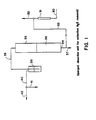
- Fig. 1 illustrates the sparged absorber unit, operated on a semi-batch mode, used to evaluate the selectivity for H 2 S removal of the amino compounds of the invention herein.
- a gas mixture comprised of 10% C0 2 , 1% H 2 S and 89% N 2 , expressed as volume percent, respectively, was passed from a gas cylinder (not shown) through line 30 to a meter 31 measuring the rate at which the gas is fed to the absorber. For all examples this rate was 3.6 liters per minute.
- the gas was then passed through line 32 to a gas chromatography column (not shown) continuously monitoring the composition of the inlet gas and through lines 33 and 34 to a sparged absorber unit 35, which is a cylindrical glass tube 45 cm high and 3.1 cm in diameter charged with 100 ml of the absorbent amine solution 36.
- the gas was passed through the solution at a solution temperature of 40 o C, and 10-ml samples of the solution were periodically removed from the bottom of the absorber unit through lines 34 and 37 to be analyzed for H 2 S and C0 2 content.
- the H 2 S content in the liquid sample was determined by titration with silver nitrate.
- the C0 2 content of the liquid sample was then analyzed by acidifying the sample with an aqueous solution of 10% HC1 and measuring the evolved C0 2 by weight gain on NaOH- coated asbestos.
- the gas mixture was removed from the top thereof via line 38 to a trap 39 which served to scrub out any H 2 S in the outlet gas.
- the resulting gas could optionally then be passed via lines 40 and 41 for final disposal or via line 42 to a gas chromatography column (not shown) for periodic evaluation of the composition of the outlet gas to check for system leaks.
- the H 2 S and C0 2 contents of the inlet gas phase were measured and the H 2 S and C0 2 contents of the liquid phase were determined as described above.
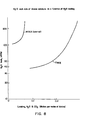
- TBEE is superior to both TBE and especially MDEA in terms of H 2 S selectivity, particularly at high H 2 S and C0 2 loadings. It is noteworthy that TBEE is superior to TBE even though both compounds have a pK a of about 10.3.
- TEE tertiarybutylaminoethoxyethanol
- SBEE secondarybutylaminoethoxyethanol
- IPEE isopropylamino- ethoxyethanol
- MDEA methyldiethanolamine
- MTBEE and 2-IMPE have a higher H 2 S selectivity than MDEA.
- Example 13 The procedure of Example 13 was repeated except that an aqueous 1M solution of N-methyl-N-tertiarybutylaminoethoxyethanol (MTBEE) was used as absorbent solution along with an aqueous 1.6M solution of methyldiethanolamine (MDEA) as comparison using the same gas mixture and conditions. From the plots of selectivity for H 2 S removal shown in Fig. 5, it can be seen that the capacity for H 2 S of MTBEE increases with decreasing solution concentration, whereas the capacity for H 2 S of MDEA decreases with decreasing concentration.
- MTBEE N-methyl-N-tertiarybutylaminoethoxyethanol
- MDEA methyldiethanolamine
- MTBEE N-methyl-N-tertiarybutylaminoethoxyethanol
- TBDEA N-tertiarybutyldiethanolamine
- Figs. 2, 4 and 5 show that the amino compounds of the present invention have very high capacity for both H 2 S and C0 2 compared to methyldiethanolamine ( MD EA) in addition to high H 2 S selectivities. It will be apparent from an inspection of the data in Fig. 2 that if the absorption process is conducted under conditions such that the amino compound has a long contact time with the gases to be absorbed, the selectivity for H 2 S decreases, but the overall capacity for both C0 2 and H 2 S remains rather high. Therefore, one may, in some instances, wish to carry out a "non-selective" acid gas absorption process to take advantage of the large absorption capacity of the amino compounds of the invention.
- a "non-selective" acid gas absorption process to take advantage of the large absorption capacity of the amino compounds of the invention.
- non-selective processes are particularly useful in scrubbing natural gases which contain relatively high levels of H 2 S and low to nil levels of C0 2 .
- the amino compounds of the present invention may replace some or all of monoethanolamine (MEA) or diethanolamine (DEA) commonly used for such scrubbing processes.
- the amino compounds herein are typically capable of reducing the H 2 S in gaseous mixtures to a relatively low level, e.g., less than about 200 ppm and typically have a relatively high capacity for H 2 S, e.g., greater than about 0.5 mole of H 2 S per mole of amine.
- the amino compounds are characterized as having a "kinetic selectivity" for H 2 S, i.e., a faster reaction rate for H 2 S than for C0 2 at absorption conditions.
- they have a higher capacity for H 2 S at equivalent kinetic selectivity for H 2 S over C0 2 . This higher capacity results in the economic advantage of lower steam requirements during regeneration.
- aqueous 1.5M solution of tertiarybutylaminoethoxyethanol (TBEE) was charged via pipe 5 into the upper portion of a gas-liquid countercurrent absorption column 2 having a lower section 3 and an upper section 4 and being segregated by three packed beds.
- the gas to be purified was a synthetic mixture containing 1% H 2 S, 11% C0 2 and 88% N 2 , expressed as volume percent, respectively.
- the gas was introduced through line 1 into the lower portion of column 2 at a gas flow rate of 67 standard cubic feet per minute.
- the absorber pressure was adjusted to 31 psia.
- the aqueous amine solution containing H 2 S and C0 2 was flowed toward the lower portion of the absorber, from which it was discharged through pipe 7.
- the solution was then passed via pump 8 through a simulated heat exchanger and cooler 9 disposed in pipe 7, which allowed the hot solution from the regenerator 12 to equilibrate in temperature 'with the cooler solution from the absorber column 2.
- the hot rich solution was then entered, via pipe 7, to a flash drum 10 equipped with a line (not shown) which vents to line 13 and then introduced by pipe 11 into the upper portion of the regenerator 12, which is equipped with several plates and effects desorption of the H 2 S gas.
- the pressure of the regenerator was set at 2.3 kg/cm 2 .
- the H 2 S gas was passed through a pipe 13 into a condenser 14 wherein cooling and condensation of water and amine solution from the gas occurred. The gas was then entered into a separator 15 where further condensation took place. The condensed solution was returned through pipe 16 to the upper portion of the regenerator 12. The gas remaining from the condensation which contains H 2 S and some C0 2 may be removed through pipe 17 for final disposal (e.g., to a vent or incinerator or to an apparatus which converts the H 2 S to sulfur such as a Claus unit or a Stretford conversion unit (not shown)). The solution liberated from the gas which it contained was flowed downward through the regenerator 12 and left through pipe 18 at the bottom of the regenerator for transfer to a reboiler 19.
- Reboiler 19 equipped with a steam injection pipe 20 and a condensate exit pipe (not shown), vaporized a portion of this solution to drive additional H 2 S therefrom.
- the H 2 S driven off was returned via pipe 21 to the lower section of the regenerator 12 and left - through pipe 13, for entry into the condensation stages of gas treatment.
- the solution remaining in the reboiler 19 was drawn through pipe 22, cooled in heat exchanger 9, and introduced via the action of pump 23 through pipe 5 into absorber 2.
- this invention is seen to provide a special class of amino compounds characterized as being severely sterically hindered acyclic secondary and tertiary amino alcohols.
Landscapes
- Chemical & Material Sciences (AREA)
- Engineering & Computer Science (AREA)
- Analytical Chemistry (AREA)
- General Chemical & Material Sciences (AREA)
- Oil, Petroleum & Natural Gas (AREA)
- Chemical Kinetics & Catalysis (AREA)
- Organic Low-Molecular-Weight Compounds And Preparation Thereof (AREA)
Applications Claiming Priority (6)
| Application Number | Priority Date | Filing Date | Title |
|---|---|---|---|
| US33989282A | 1982-01-18 | 1982-01-18 | |
| US339892 | 1982-01-18 | ||
| US06/339,881 US4405811A (en) | 1982-01-18 | 1982-01-18 | Severely sterically hindered tertiary amino compounds |
| US339881 | 1982-01-18 | ||
| US41875182A | 1982-09-16 | 1982-09-16 | |
| US418751 | 1982-09-16 |
Publications (4)
| Publication Number | Publication Date |
|---|---|
| EP0084943A2 true EP0084943A2 (de) | 1983-08-03 |
| EP0084943A3 EP0084943A3 (en) | 1984-01-18 |
| EP0084943B1 EP0084943B1 (de) | 1986-04-02 |
| EP0084943B2 EP0084943B2 (de) | 1989-08-02 |
Family
ID=27407370
Family Applications (1)
| Application Number | Title | Priority Date | Filing Date |
|---|---|---|---|
| EP83300185A Expired EP0084943B2 (de) | 1982-01-18 | 1983-01-14 | Sekundäre und tertiäre Aminoalkohole |
Country Status (8)
| Country | Link |
|---|---|
| EP (1) | EP0084943B2 (de) |
| AU (1) | AU566867B2 (de) |
| BR (1) | BR8300208A (de) |
| CA (1) | CA1212962A (de) |
| DE (2) | DE3362734D1 (de) |
| MY (1) | MY8700276A (de) |
| NO (1) | NO155839C (de) |
| SG (1) | SG74186G (de) |
Cited By (13)
| Publication number | Priority date | Publication date | Assignee | Title |
|---|---|---|---|---|
| EP0147990A1 (de) * | 1983-12-23 | 1985-07-10 | Exxon Research And Engineering Company | Verfahren zur Herstellung von sekundären Aminoätheralkoholen |
| EP0147188A3 (en) * | 1983-12-23 | 1985-08-07 | Exxon Research And Engineering Company | Process for preparing tertiary polyalkylene aminoether alcohols |
| EP0148005A3 (en) * | 1983-12-23 | 1985-08-07 | Exxon Research And Engineering Company | Process for preparing di-amino-polyalkenyl |
| EP0214814A3 (en) * | 1985-08-30 | 1989-05-24 | Exxon Research And Engineering Company | Absorbent composition containing a severely hindered amino compound and an amine salt and process for the absorption of h2s using the same |
| EP1718598A4 (de) * | 2004-02-17 | 2008-06-25 | Exxonmobil Res & Eng Co | Synthese von sterisch gehinderten sekundären aminoetheralkoholen aus säureanhydrid und/oder säurehalogenid und schwefeltrioxid |
| EP1718600A4 (de) * | 2004-02-17 | 2008-06-25 | Exxonmobil Res & Eng Co | Synthese von sterisch stark gehinderten sekundären aminoetheralkoholen aus einem keten und/oder carbonsäurehalogenid und/oder einem carbonsäureanhydrid |
| EP1718599A4 (de) * | 2004-02-17 | 2008-06-25 | Exxonmobil Res & Eng Co | Synthese sterisch gehinderter sekundärer aminoetheralkohole |
| EP1716096A4 (de) * | 2004-02-17 | 2008-06-25 | Exxonmobil Res & Eng Co | Synthese von sterisch gehinderten sekundären aminoether-alkoholen |
| EP2990090A1 (de) | 2014-08-25 | 2016-03-02 | Basf Se | Absorptionsmittel zur selektiven Entfernung von Schwefelwasserstoff aus einem Fluidstrom |
| WO2017055304A2 (de) | 2015-09-29 | 2017-04-06 | Basf Se | Absorptionsmittel zur selektiven entfernung von schwefelwasserstoff |
| US9724642B2 (en) | 2013-12-03 | 2017-08-08 | Kabushiki Kaisha Toshiba | Acid gas absorbent, acid gas removal device, and acid gas removal method |
| US10207217B2 (en) | 2014-08-25 | 2019-02-19 | Basf Se | Removal of hydrogen sulphide and carbon dioxide from a stream of fluid |
| CN116751130A (zh) * | 2023-05-09 | 2023-09-15 | 浙江恒逸石化研究院有限公司 | 一种空间位阻胺的制备方法 |
Families Citing this family (2)
| Publication number | Priority date | Publication date | Assignee | Title |
|---|---|---|---|---|
| CA2005574C (en) * | 1988-12-27 | 1999-09-07 | Warren Alan Thaler | Primary hindered aminoacids for promoted acid gas scrubbing process |
| CN108816196B (zh) * | 2018-07-24 | 2021-05-14 | 淄博凯美可工贸有限公司 | 高选择性的复配型脱硫剂及其制备方法 |
Family Cites Families (3)
| Publication number | Priority date | Publication date | Assignee | Title |
|---|---|---|---|---|
| US3364239A (en) * | 1963-12-05 | 1968-01-16 | Jefferson Chem Co Inc | Method for preparing secondary amino polyalkoxy monoalkanols |
| FR2100475A5 (en) * | 1970-07-13 | 1972-03-17 | Union Carbide Corp | Selective sulphide gas absorption - using a solvent comprising water, polyoxyalkyl cpd. and N cpd. |
| BE842528R (fr) * | 1976-06-03 | 1976-12-03 | Derives actifs de methylamine, compositions therapeutiques les contenant ainsi que les procedes de preparation de ces derives et compositions |
-
1983
- 1983-01-14 DE DE8383300185T patent/DE3362734D1/de not_active Expired
- 1983-01-14 DE DE198383300185T patent/DE84943T1/de active Pending
- 1983-01-14 EP EP83300185A patent/EP0084943B2/de not_active Expired
- 1983-01-17 BR BR8300208A patent/BR8300208A/pt not_active IP Right Cessation
- 1983-01-17 CA CA000419575A patent/CA1212962A/en not_active Expired
- 1983-01-17 NO NO830136A patent/NO155839C/no unknown
- 1983-01-17 AU AU10521/83A patent/AU566867B2/en not_active Ceased
-
1986
- 1986-09-17 SG SG741/86A patent/SG74186G/en unknown
-
1987
- 1987-12-30 MY MY276/87A patent/MY8700276A/xx unknown
Cited By (20)
| Publication number | Priority date | Publication date | Assignee | Title |
|---|---|---|---|---|
| EP0147990A1 (de) * | 1983-12-23 | 1985-07-10 | Exxon Research And Engineering Company | Verfahren zur Herstellung von sekundären Aminoätheralkoholen |
| EP0147188A3 (en) * | 1983-12-23 | 1985-08-07 | Exxon Research And Engineering Company | Process for preparing tertiary polyalkylene aminoether alcohols |
| EP0148005A3 (en) * | 1983-12-23 | 1985-08-07 | Exxon Research And Engineering Company | Process for preparing di-amino-polyalkenyl |
| EP0214814A3 (en) * | 1985-08-30 | 1989-05-24 | Exxon Research And Engineering Company | Absorbent composition containing a severely hindered amino compound and an amine salt and process for the absorption of h2s using the same |
| EP1718598A4 (de) * | 2004-02-17 | 2008-06-25 | Exxonmobil Res & Eng Co | Synthese von sterisch gehinderten sekundären aminoetheralkoholen aus säureanhydrid und/oder säurehalogenid und schwefeltrioxid |
| EP1718600A4 (de) * | 2004-02-17 | 2008-06-25 | Exxonmobil Res & Eng Co | Synthese von sterisch stark gehinderten sekundären aminoetheralkoholen aus einem keten und/oder carbonsäurehalogenid und/oder einem carbonsäureanhydrid |
| EP1718599A4 (de) * | 2004-02-17 | 2008-06-25 | Exxonmobil Res & Eng Co | Synthese sterisch gehinderter sekundärer aminoetheralkohole |
| EP1716096A4 (de) * | 2004-02-17 | 2008-06-25 | Exxonmobil Res & Eng Co | Synthese von sterisch gehinderten sekundären aminoether-alkoholen |
| CN1922131B (zh) * | 2004-02-17 | 2011-04-20 | 埃克森美孚研究工程公司 | 具有空间位阻的仲氨基醚醇的合成 |
| US9724642B2 (en) | 2013-12-03 | 2017-08-08 | Kabushiki Kaisha Toshiba | Acid gas absorbent, acid gas removal device, and acid gas removal method |
| WO2016030262A1 (de) | 2014-08-25 | 2016-03-03 | Basf Se | Absorptionsmittel zur selektiven entfernung von schwefelwasserstoff aus einem fluidstrom |
| EP2990090A1 (de) | 2014-08-25 | 2016-03-02 | Basf Se | Absorptionsmittel zur selektiven Entfernung von Schwefelwasserstoff aus einem Fluidstrom |
| US10207217B2 (en) | 2014-08-25 | 2019-02-19 | Basf Se | Removal of hydrogen sulphide and carbon dioxide from a stream of fluid |
| US10464013B2 (en) | 2014-08-25 | 2019-11-05 | Basf Se | Absorbent for selective removal of hydrogen sulfide from a fluid stream |
| EP3903909A1 (de) | 2014-08-25 | 2021-11-03 | Basf Se | Entfernung von schwefelwasserstoff und kohlendioxid aus einem fluidstrom |
| US11278841B2 (en) | 2014-08-25 | 2022-03-22 | Basf Se | Removal of hydrogen sulphide and carbon dioxide from a stream of fluid |
| US11369919B2 (en) | 2014-08-25 | 2022-06-28 | Basf Se | Absorbent for selective removal of hydrogen sulfide from a fluid stream |
| WO2017055304A2 (de) | 2015-09-29 | 2017-04-06 | Basf Se | Absorptionsmittel zur selektiven entfernung von schwefelwasserstoff |
| US10617993B2 (en) | 2015-09-29 | 2020-04-14 | Basf Se | Absorbent for the selective removal of hydrogen sulfide |
| CN116751130A (zh) * | 2023-05-09 | 2023-09-15 | 浙江恒逸石化研究院有限公司 | 一种空间位阻胺的制备方法 |
Also Published As
| Publication number | Publication date |
|---|---|
| NO155839C (no) | 1987-06-10 |
| SG74186G (en) | 1987-02-27 |
| NO155839B (no) | 1987-03-02 |
| MY8700276A (en) | 1987-12-31 |
| BR8300208A (pt) | 1983-10-11 |
| EP0084943B2 (de) | 1989-08-02 |
| CA1212962A (en) | 1986-10-21 |
| DE84943T1 (de) | 1983-11-10 |
| AU1052183A (en) | 1983-07-28 |
| DE3362734D1 (en) | 1986-05-07 |
| EP0084943B1 (de) | 1986-04-02 |
| EP0084943A3 (en) | 1984-01-18 |
| AU566867B2 (en) | 1987-11-05 |
| NO830136L (no) | 1983-07-19 |
Similar Documents
| Publication | Publication Date | Title |
|---|---|---|
| US4471138A (en) | Severely sterically hindered secondary aminoether alcohols | |
| US4894178A (en) | Absorbent composition containing severely-hindered amine mixture for the absorption of H2 S | |
| US4405585A (en) | Process for the selective removal of hydrogen sulfide from gaseous mixtures with severely sterically hindered secondary aminoether alcohols | |
| US4405811A (en) | Severely sterically hindered tertiary amino compounds | |
| US4405583A (en) | Process for selective removal of H2 S from mixtures containing H22 using di-severely sterically hindered secondary aminoethers | |
| US4405582A (en) | Process for selective removal of H2 S from mixtures containing H22 using diaminoether solutions | |
| EP0088485B1 (de) | Verfahren zur Entfernung von Schwefelwasserstoff aus Gasmischungen mit stark basischen tertiären Aminoverbindungen | |
| EP0084943B2 (de) | Sekundäre und tertiäre Aminoalkohole | |
| US4483833A (en) | Process for selective removal of H2 S from mixtures containing H22 with heterocyclic tertiary aminoalkanols | |
| US4405581A (en) | Process for the selective removal of hydrogen sulfide from gaseous mixtures with severely sterically hindered secondary amino compounds | |
| US8486183B2 (en) | Alkylamino alkyloxy (alcohol) monoalkyl ether for acid gas scrubbing process | |
| US4892674A (en) | Addition of severely-hindered amine salts and/or aminoacids to non-hindered amine solutions for the absorption of H2 S | |
| EP0214814B1 (de) | Absorbenszusammensetzung, die ein sterisch schwer gehindertes Amino-Komponent und ein Aminesalz enthält und Verfahren zur Absorption von Schwefelwasserstoff damit | |
| CA2598388C (en) | Method for capturing carbon dioxide from gas streams | |
| US4417075A (en) | Di-(Secondary and tertiaryalkylaminoalkoxy)alkanes | |
| US4961873A (en) | Absorbent composition containing a severely-hindered amine mixture with amine salts and/or aminoacid additives for the absorption of H2 S | |
| WO1995003874A1 (en) | Solvent composition for removing acid gases | |
| US4405580A (en) | Process for selective removal of H2 S from mixtures containing H22 with tertiary amino azabicyclic alcohols | |
| EP0087856B1 (de) | Verfahren zur Entfernung von H2S aus Gasmischungen unter Verwendung von Diaminoäthern | |
| US4665234A (en) | Severely sterically hindered secondary aminoether alcohols | |
| US4895670A (en) | Addition of severely-hindered aminoacids to severely-hindered amines for the absorption of H2 S | |
| EP0087208B1 (de) | Verfahren zur Entfernung von Schwefelwasserstoff aus Gasmischungen durch sterisch stark gehinderte sekundäre Aminoverbindungen | |
| EP0087207B1 (de) | Verfahren zum Entfernen von H2S aus Gasströmen mit Aminoverbindungen | |
| US4762934A (en) | Diaminoether compositions | |
| US7909914B2 (en) | Method of removing acid gases contained in gaseous effluents |
Legal Events
| Date | Code | Title | Description |
|---|---|---|---|
| PUAI | Public reference made under article 153(3) epc to a published international application that has entered the european phase |
Free format text: ORIGINAL CODE: 0009012 |
|
| AK | Designated contracting states |
Designated state(s): BE DE FR GB IT NL |
|
| ITCL | It: translation for ep claims filed |
Representative=s name: ING. C. GREGORJ S.P.A. |
|
| EL | Fr: translation of claims filed | ||
| TCNL | Nl: translation of patent claims filed | ||
| DET | De: translation of patent claims | ||
| PUAL | Search report despatched |
Free format text: ORIGINAL CODE: 0009013 |
|
| AK | Designated contracting states |
Designated state(s): BE DE FR GB IT NL |
|
| 17P | Request for examination filed |
Effective date: 19840202 |
|
| GRAA | (expected) grant |
Free format text: ORIGINAL CODE: 0009210 |
|
| AK | Designated contracting states |
Kind code of ref document: B1 Designated state(s): BE DE FR GB IT NL |
|
| ITF | It: translation for a ep patent filed | ||
| REF | Corresponds to: |
Ref document number: 3362734 Country of ref document: DE Date of ref document: 19860507 |
|
| ET | Fr: translation filed | ||
| PLBI | Opposition filed |
Free format text: ORIGINAL CODE: 0009260 |
|
| 26 | Opposition filed |
Opponent name: SNAMPROGETTI S.P.A. Effective date: 19861224 |
|
| NLR1 | Nl: opposition has been filed with the epo |
Opponent name: SNAMPROGETTI S.P.A. |
|
| PUAH | Patent maintained in amended form |
Free format text: ORIGINAL CODE: 0009272 |
|
| STAA | Information on the status of an ep patent application or granted ep patent |
Free format text: STATUS: PATENT MAINTAINED AS AMENDED |
|
| 27A | Patent maintained in amended form |
Effective date: 19890802 |
|
| AK | Designated contracting states |
Kind code of ref document: B2 Designated state(s): BE DE FR GB IT NL |
|
| ITF | It: translation for a ep patent filed | ||
| NLR2 | Nl: decision of opposition | ||
| ET3 | Fr: translation filed ** decision concerning opposition | ||
| NLR3 | Nl: receipt of modified translations in the netherlands language after an opposition procedure | ||
| ITTA | It: last paid annual fee | ||
| PGFP | Annual fee paid to national office [announced via postgrant information from national office to epo] |
Ref country code: FR Payment date: 19931202 Year of fee payment: 12 |
|
| PGFP | Annual fee paid to national office [announced via postgrant information from national office to epo] |
Ref country code: DE Payment date: 19931203 Year of fee payment: 12 |
|
| PGFP | Annual fee paid to national office [announced via postgrant information from national office to epo] |
Ref country code: GB Payment date: 19931208 Year of fee payment: 12 |
|
| PGFP | Annual fee paid to national office [announced via postgrant information from national office to epo] |
Ref country code: BE Payment date: 19931217 Year of fee payment: 12 |
|
| PGFP | Annual fee paid to national office [announced via postgrant information from national office to epo] |
Ref country code: NL Payment date: 19940131 Year of fee payment: 12 |
|
| PG25 | Lapsed in a contracting state [announced via postgrant information from national office to epo] |
Ref country code: GB Effective date: 19950114 |
|
| PG25 | Lapsed in a contracting state [announced via postgrant information from national office to epo] |
Ref country code: BE Effective date: 19950131 |
|
| BERE | Be: lapsed |
Owner name: EXXON RESEARCH AND ENGINEERING CY Effective date: 19950131 |
|
| PG25 | Lapsed in a contracting state [announced via postgrant information from national office to epo] |
Ref country code: NL Effective date: 19950801 |
|
| GBPC | Gb: european patent ceased through non-payment of renewal fee |
Effective date: 19950114 |
|
| PG25 | Lapsed in a contracting state [announced via postgrant information from national office to epo] |
Ref country code: FR Effective date: 19950929 |
|
| NLV4 | Nl: lapsed or anulled due to non-payment of the annual fee |
Effective date: 19950801 |
|
| PG25 | Lapsed in a contracting state [announced via postgrant information from national office to epo] |
Ref country code: DE Effective date: 19951003 |
|
| REG | Reference to a national code |
Ref country code: FR Ref legal event code: ST |