EP0085949A2 - Stabilisiertes Trichlorethen und Mittel zur Stabilisierung von Trichlorethen - Google Patents
Stabilisiertes Trichlorethen und Mittel zur Stabilisierung von Trichlorethen Download PDFInfo
- Publication number
- EP0085949A2 EP0085949A2 EP83101002A EP83101002A EP0085949A2 EP 0085949 A2 EP0085949 A2 EP 0085949A2 EP 83101002 A EP83101002 A EP 83101002A EP 83101002 A EP83101002 A EP 83101002A EP 0085949 A2 EP0085949 A2 EP 0085949A2
- Authority
- EP
- European Patent Office
- Prior art keywords
- und
- tert
- oder
- ppm
- butylphenol
- Prior art date
- Legal status (The legal status is an assumption and is not a legal conclusion. Google has not performed a legal analysis and makes no representation as to the accuracy of the status listed.)
- Granted
Links
Classifications
-
- C—CHEMISTRY; METALLURGY
- C11—ANIMAL OR VEGETABLE OILS, FATS, FATTY SUBSTANCES OR WAXES; FATTY ACIDS THEREFROM; DETERGENTS; CANDLES
- C11D—DETERGENT COMPOSITIONS; USE OF SINGLE SUBSTANCES AS DETERGENTS; SOAP OR SOAP-MAKING; RESIN SOAPS; RECOVERY OF GLYCEROL
- C11D7/00—Compositions of detergents based essentially on non-surface-active compounds
- C11D7/22—Organic compounds
- C11D7/26—Organic compounds containing oxygen
- C11D7/261—Alcohols; Phenols
- C11D7/262—Alcohols; Phenols fatty or with at least 8 carbon atoms in the alkyl or alkenyl chain
-
- C—CHEMISTRY; METALLURGY
- C11—ANIMAL OR VEGETABLE OILS, FATS, FATTY SUBSTANCES OR WAXES; FATTY ACIDS THEREFROM; DETERGENTS; CANDLES
- C11D—DETERGENT COMPOSITIONS; USE OF SINGLE SUBSTANCES AS DETERGENTS; SOAP OR SOAP-MAKING; RESIN SOAPS; RECOVERY OF GLYCEROL
- C11D7/00—Compositions of detergents based essentially on non-surface-active compounds
- C11D7/50—Solvents
- C11D7/5004—Organic solvents
- C11D7/5018—Halogenated solvents
-
- D—TEXTILES; PAPER
- D06—TREATMENT OF TEXTILES OR THE LIKE; LAUNDERING; FLEXIBLE MATERIALS NOT OTHERWISE PROVIDED FOR
- D06L—DRY-CLEANING, WASHING OR BLEACHING FIBRES, FILAMENTS, THREADS, YARNS, FABRICS, FEATHERS OR MADE-UP FIBROUS GOODS; BLEACHING LEATHER OR FURS
- D06L1/00—Dry-cleaning or washing fibres, filaments, threads, yarns, fabrics, feathers or made-up fibrous goods
- D06L1/02—Dry-cleaning or washing fibres, filaments, threads, yarns, fabrics, feathers or made-up fibrous goods using organic solvents
- D06L1/04—Dry-cleaning or washing fibres, filaments, threads, yarns, fabrics, feathers or made-up fibrous goods using organic solvents combined with specific additives
-
- C—CHEMISTRY; METALLURGY
- C11—ANIMAL OR VEGETABLE OILS, FATS, FATTY SUBSTANCES OR WAXES; FATTY ACIDS THEREFROM; DETERGENTS; CANDLES
- C11D—DETERGENT COMPOSITIONS; USE OF SINGLE SUBSTANCES AS DETERGENTS; SOAP OR SOAP-MAKING; RESIN SOAPS; RECOVERY OF GLYCEROL
- C11D7/00—Compositions of detergents based essentially on non-surface-active compounds
- C11D7/22—Organic compounds
- C11D7/24—Hydrocarbons
-
- C—CHEMISTRY; METALLURGY
- C11—ANIMAL OR VEGETABLE OILS, FATS, FATTY SUBSTANCES OR WAXES; FATTY ACIDS THEREFROM; DETERGENTS; CANDLES
- C11D—DETERGENT COMPOSITIONS; USE OF SINGLE SUBSTANCES AS DETERGENTS; SOAP OR SOAP-MAKING; RESIN SOAPS; RECOVERY OF GLYCEROL
- C11D7/00—Compositions of detergents based essentially on non-surface-active compounds
- C11D7/22—Organic compounds
- C11D7/26—Organic compounds containing oxygen
- C11D7/266—Esters or carbonates
-
- C—CHEMISTRY; METALLURGY
- C11—ANIMAL OR VEGETABLE OILS, FATS, FATTY SUBSTANCES OR WAXES; FATTY ACIDS THEREFROM; DETERGENTS; CANDLES
- C11D—DETERGENT COMPOSITIONS; USE OF SINGLE SUBSTANCES AS DETERGENTS; SOAP OR SOAP-MAKING; RESIN SOAPS; RECOVERY OF GLYCEROL
- C11D7/00—Compositions of detergents based essentially on non-surface-active compounds
- C11D7/22—Organic compounds
- C11D7/28—Organic compounds containing halogen
-
- C—CHEMISTRY; METALLURGY
- C11—ANIMAL OR VEGETABLE OILS, FATS, FATTY SUBSTANCES OR WAXES; FATTY ACIDS THEREFROM; DETERGENTS; CANDLES
- C11D—DETERGENT COMPOSITIONS; USE OF SINGLE SUBSTANCES AS DETERGENTS; SOAP OR SOAP-MAKING; RESIN SOAPS; RECOVERY OF GLYCEROL
- C11D7/00—Compositions of detergents based essentially on non-surface-active compounds
- C11D7/22—Organic compounds
- C11D7/32—Organic compounds containing nitrogen
- C11D7/3281—Heterocyclic compounds
Definitions
- trichlorethylene must be stabilized against the decomposing influences of heat, light, air, moisture and metals.
- a commonly used, well stabilizing additive for trichlorethylene is butylene oxide.
- Stabilizing mixtures containing nitriles, such as propionitrile, acrylonitrile and the like, have also proven useful for trichlorethylene, which is used as an auxiliary for paints.
- the object of the invention was to provide means for stabilizing trichlorethylene and thus stabilized trichlorethylene which does not contain the stabilizing additives mentioned above. Furthermore, it was an object of the invention to find agents for stabilizing trichlorethylene which can make appropriately formulated trichlorethylene suitable both as an auxiliary for paints and as a degreasing agent.
- the invention furthermore relates to stabilized trichlorethylene which contains the stabilizer mixture according to the invention.
- the amount of stabilizer is generally between 3,200 and 25,000 ppm by weight, preferably 5,000 to 10,000 ppm by weight, in each case based on the total amount of stabilized trichloroethene.
- Amines boiling between 1 and 110 ° C at 1 bar are equivalent to diisopropylamine in the context of the invention. Examples of these are triethylamine and dimethylisobutylamine.
- the proportion of epoxides is preferably 4,000 to 6,000 ppm by weight.
- the stability criterion used was the time that the stabilized trichlorethylene had to be exposed to the above test conditions until an HCl content of 0.02% by weight was reached.
- the HCl content was determined by regular sampling and subsequent titration with 0.1 nNaOH against phenolphthalein.
- DKH test The test arrangement described above was used, with the modification that steel strips were used instead of the aluminum strips.
- the BAM test was unresponsive.
- the accelerated oxidation text according to MIL-T-81533 A resulted in a service life of 1920 hours.
- the pH was 9.5 after 48 hours.
- the test liquid was colorless.
- the service life until the acidity limit of 0.02% by weight of HC1 was reached was 240 hours.
- the results are summarized in the following table.
- the results according to Examples 1 to 11 and the comparative examples show the excellent stability of the trichlorethylene according to the invention against light metals, such as aluminum, which is reflected in the extremely long service life.
- the DKH tests further prove that the trichloroethene stabilized according to the invention is not only suitable as a degreasing agent, but also meets the requirements which are to be placed on trichloroethene as an auxiliary for paints.
- the comparative experiments illustrate that when the phenolic components to be used according to the invention are replaced by structurally similar phenolic compounds, the task according to the invention is not achieved.
Landscapes
- Chemical & Material Sciences (AREA)
- Engineering & Computer Science (AREA)
- Life Sciences & Earth Sciences (AREA)
- Chemical Kinetics & Catalysis (AREA)
- Oil, Petroleum & Natural Gas (AREA)
- Wood Science & Technology (AREA)
- Organic Chemistry (AREA)
- Health & Medical Sciences (AREA)
- Emergency Medicine (AREA)
- Textile Engineering (AREA)
- Organic Low-Molecular-Weight Compounds And Preparation Thereof (AREA)
Abstract
- N-Methylpyrrol und/oder 2-tert.-Butylphenol und/oder 2.4-Ditert: Butylphenol und/oder 4-Hydroxyanisol und/oder 2-tert.-Butyl-4-hydroxyanisol und/oder 3-tert.-Butyl-4-hydroxyanisol und/oder 2.6-Dimethylphenol,
- ferner 2-Methyl-2.3-Epoxybutan und/oder 2.3-Dimethyl-2.3-epoxybutan und/oder 3.3-Dimethyl-1.2-epoxybutan und/ oder 1.2-Epoxypentan und/oder Cyclopentenoxid
- sowie Düsobutylen, Ethylacetat und/oder Propylacetat und Diisopropylamin
- enthält.
Description
- Bekanntlich muß Trichlorethen gegen die zersetzenden Einflüsse von Wärme, Licht, Luft, Feuchtigkeit und Metallen stabilisiert werden.
- Ein häufig eingesetzter, gut stabilisierender Zusatz für Trichlorethen ist Butylenoxid. Für Trichlorethen, das als Hilfsstoff für Lacke eingesetzt wird, haben sich ferner stabilisierende Mischungen, die Nitrile, wie Propionitril, Acrylnitril und dergleichen enthalten, bewährt.
- Es wurden nun in jüngster Zeit toxikologische Untersuchungen bekannt, die es angeraten sein lassen, Nitrile und namentlich Butylenoxid als stabilisierende Zusätze für Trichlorethen nicht mehr zu verwenden.
- Aufgabe der Erfindung war es, Mittel zur Stabilisierung von Trichlorethen und somit stabilisiertes Trichlorethen zur Verfügung zu stellen, das die obengenannten Stabilisierungszusätze nicht enthält. Weiterhin war es Aufgabe der Erfindung, Mittel zur Stabilisierung von Trichlorethen aufzufinden, die entsprechend formuliertes Trichlorethen sowohl als Hilfsstoff für Lacke als auch als Entfettungsmittel geeignet machen können.
- Gegenstand der Erfindung ist ein Mittel zur Stabilisierung von Trichlorethen, das durch die Kombination der folgenden Bestandteile gekennzeichnet ist:
- a) N-Methylpyrrol und/oder 2-tert.-Butylphenol und/oder 2.4-Ditert.-Butylphenol und/oder 4-Hydroxyanisol und/oder 2-tert.-Butyl-4-hydroxyanisol und/oder 3-tert.-Butyl-4-hydroxyanisol und/oder 2.6-Dimethylphenol
- b) 2-Methyl-2.3-epoxybutan und/oder 2.3-Dimethyl-2.3-epoxybutan und/oder 3.3-Dimethyl-1.2-epoxybutan und/ oder 1.2-Epoxypentan und/oder Cyclopentenoxid
- c) Diisobutylen
- d) Ethylacetat und/oder Propylacetat
- e) Diisopropylamin
- Gegenstand der Erfindung ist weiterhin stabilisiertes Trichlorethylen, das die erfindungsgemäße Stabilisatormischung enthält. Die Stabilisatormenge liegt in der Regel zwischen 3.200 und 25.000 Gew.ppm, vorzugsweise bei 5.000 bis 10.000 Gew.ppm, jeweils bezogen auf die Gesamtmenge stabilisierten Trichlorethens.
- Vorzugsweise enthält das erfindungsgemäß stabilisierte Trichlorethen
- a) 0 - 500 Gew.ppm N-Methylpyrrol
- b) 0 - 500 Gew.ppm 2-tert.-Butylphenol und/oder 2.4-Ditert.-Butylphenol und/oder 4-Hydroxyanisol und/oder 2-tert.-Butyl-4-hydroxyanisol und/oder 3-tert.-Butyl-4-hydroxyanisol und/oder 2.6-Dimethylphenol
- c) 1.000 - 8.000 Gew.ppm 2-Methyl-2.3-epoxybutan und/oder 2.3-Dimethyl-2.3-epoxybutan und/ oder 3.3-Dimethyl-1.2-epoxybutan und/oder 1.2-Epoxypentan und/oder Cyclopentenoxid
- d ) - 100 i -, 4.000 Gew.ppm Diisobutylen
- e) 2.000 - 3.000 Gew.ppm Ethylacetat und/oder Propylacetat
- f) 10 - 100 Gew.ppm Diisopropropylamin
- Amine, die bei 1 bar zwischen und 110 °C sieden, sind Diisopropylamin im Rahmen der Erfindung äquivalent. Beispiele hierfür sind Triethylamin und Dimethylisobutylamin.
- Vorzugsweise beträgt der Anteil an Epoxiden (gemäß c)) 4.000 bis 6.000 Gew.ppm.
- Bei erfindungsgemäßem Trichlorethen als Hilfsstoff für Lacke beträgt der Anteil an N-Methylpyrrol vorzugsweise maximal 10 Gew.ppm, besonders bevorzugt 0 oder 0 bis 5 Gew.ppm. Vorteilhafterweise wird die Menge eingesetzten Diisobutylens auf Menge und Art des Phenols abgestimmt:
- Bei 1.000 bis 3.000 Gew.ppm Diisobutylen beträgt die optimale Konzentration für
- 2-tert.-Butylphenol und 2.4-Ditert.-Butylphenol 200 bis 500 Gew.ppm und für
- 4-Hydroxyanisol 50 bis 100 Gew.ppm.
- Bei Einsatz von 2-tert.-Butyl-4-hydroxyanisol werden vorzugsweise lediglich 10 bis 50 Gew.ppm neben 100 bis 200 Gew.ppm Diisobutylen zugegeben.
- Zur Prüfung auf Stabilität wurde das erfindungsgemäße Trichlorethen den drei folgenden Tests unterworfen:
- 1. Es wurde der beschleunigte Oxidationstest nach MIL-T-81533 A durchgeführt. Als Testapparatur diente ein mit 200 ml erfindungsgemäß stabilisierten Trichlorethens gefülltes Siedegefäß mit Rückflußkühler, das mittels einer 150-Watt-Glühlampe beheizt wurde. In die Testflüssigkeit wurde ein stetiger wasserdampfgesättigter Sauerstoffstrom (10 bis 12 Blasen pro Minute) geleitet.
- Weiter war ein Streifen aus metallischem Aluminium so angeordnet, daß er zur Hälfte in die Testflüssigkeit eintauchte. Ein zweiter Aluminiumstreifen befand sich am Gefäßboden.
- Als Stabilitätskriterium wurde die Zeit herangezogen, die das stabilisierte Trichlorethen den obigen Testbedingungen ausgesetzt werden mußte, bis ein HCl-Gehalt von 0,02 Gew.% erreicht war.. Der HCl-Gehalt wurde durch regelmäßige Probeentnahme und anschließende Titration mit 0,1 nNaOH gegen Phenolphthalein ermittelt.
- 2. DKH-Test: Es wurde die oben beschriebene Testanordnung benutzt, mit der Abänderung, daß anstatt der Aluminiumstreifen Stahlstreifen eingesetzt wurden.
- Nach 48 Stunden wurde auf pH-Wert und Farbe der Testflüssigkeit bonitiert. Ferner wurde die Standzeit bis zum Erreichen der Aciditätsgrenze von 0,02 Gew.% HCl-Gehalt ermittelt.
- 3. Als weitere Qualitätsprüfung diente eine von der Bundesanstalt für Materialprüfung vorgeschlagene Testmethode (BAM-Test): Hierzu wurden 100 ml erfindungsgemäß stabilisierten Trichlorethens mit 100 ml Toluol vermischt und zusammen mit 18 g Aluminiumflitter einer Teilchengröße < 0,5 mm und zusammen mit 0,7 g wasserfreien Aluminiumchlorids 18 Stunden am Rückfluß gekocht. Eine zweite, im übrigen gleiche Probe enthielt zusätzlich 1 g Zinkstearat und eine dritte Probe zusätzlich 10 ml Ölsäure. Schließlich wurden die drei beschriebenen Tests noch mit Destillaten des erfindungsgemäß stabilisierten Trichlorethens wiederholt. Das Prüfverfahren galt als bestanden, wenn bei keinem der beschriebenen Einzeltests exotherme Reaktionen auftraten.
- Die Erfindung wird nun anhand von Beispielen und Vergleichsbeispielen näher erläutert. Die Daten beziehen sich auf die Ergebnisse der drei oben beschriebenen Tests. Das Zeichen (-) steht für keine Reaktion während des BAM-Tests.
- 3 kg Trichlorethen wurden mit 0,9 g N-Methylpyrrol, 15 g 2-Methyl-2.3-epoxybutan, 8,3 g Diisobutylen,. 8,3 g Ethylacetat und 0,08 g Diisopropylamin versetzt..
- Der BAM-Test verlief ohne Reaktion. Der beschleunigte Oxidationstext nach MIL-T-81533 A ergab eine Standzeit von 1920 Stunden.
- Weitere Ergebnisse von Tests, die analog Beispiel 1 durchgeführt wurden, werden in der nun folgenden Tabelle aufgeführt.

- Es wurden 3 kg Trichlorethylen mit 0,66 g 2.4-Ditert.-Butylphenol, 13,5 g 2-Methyl-2.3-epoxybutan, 6 g Diisobutylen, 8,4 g Ethylacetat und 0,06 g Diisopropylamin versetzt.
- Das derart stabilisierte Trichlorethen wurde dem beschriebenen DKH-Test unterworfen.
- Der pH-Wert betrug nach 48 Stunden 9,5. Die Testflüssigkeit war farblos. Die Standzeit bis zum Erreichen der Aciditätsgrenze von 0,02 Gew.% HC1 betrug 240 Stunden.
- Weitere Ergebnisse von Tests, die analog Beispiel 5 durchgeführt wurden, sind in der nachfolgenden Tabelle aufgeführt.

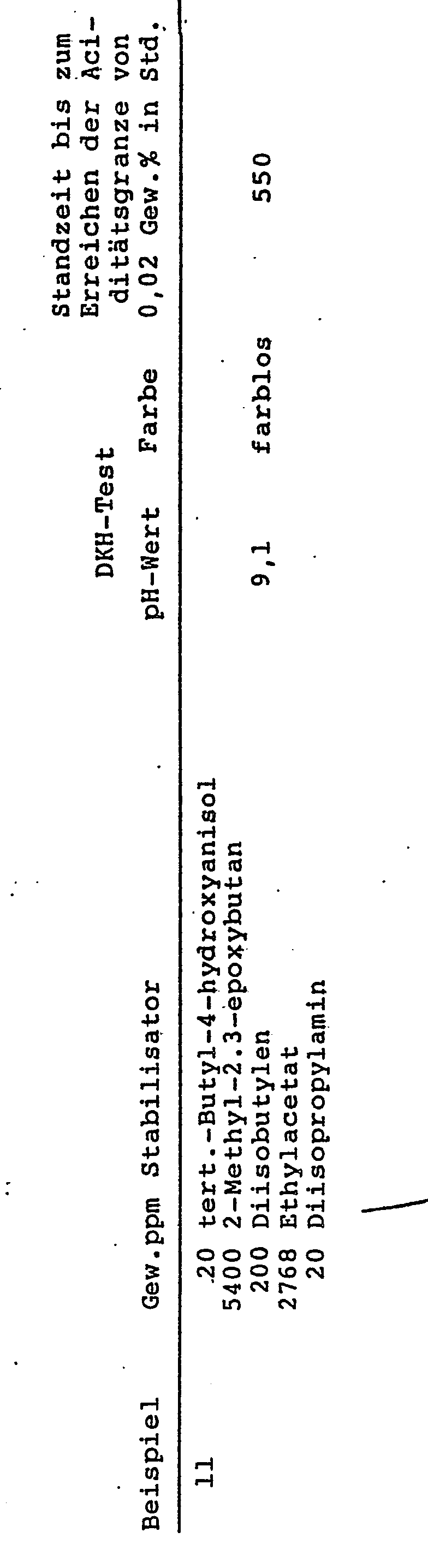
- Es wurde die gemäß Beispiel 5 beschriebene Formulierung dem DKH-Test unterworfen, mit der Abänderung, daß anstatt 220 ppm 2.4-Ditert.Butylphenol
- a) 220 ppm 2.6-Ditert.-Butylphenol
- b) 220 ppm Anisol
- c) 220 ppm 2.6-Dimethyl-p-Kresol
- d) 220 ppm 4-tert.-Amylphenol
- e) 220 ppm 2.6-ditert.-butyl-p-kresol
- f) 220 ppm 4-tert.-Butylphenol
- Die Ergebnisse sind in der folgenden Tabelle zusammengestellt.

mit der Maßgabe, daß die Komponenten gemäß a) und b) zumindest in einer Menge von 10 Gew.ppm vorliegen,
eingesetzt wurden.
Claims (4)
Priority Applications (1)
| Application Number | Priority Date | Filing Date | Title |
|---|---|---|---|
| AT83101002T ATE53565T1 (de) | 1982-02-05 | 1983-02-03 | Stabilisiertes trichlorethen und mittel zur stabilisierung von trichlorethen. |
Applications Claiming Priority (2)
| Application Number | Priority Date | Filing Date | Title |
|---|---|---|---|
| DE19823203907 DE3203907A1 (de) | 1982-02-05 | 1982-02-05 | Stabilisiertes trichlorethen und mittel zur stabilisierung von trichlorethen |
| DE3203907 | 1982-02-05 |
Publications (3)
| Publication Number | Publication Date |
|---|---|
| EP0085949A2 true EP0085949A2 (de) | 1983-08-17 |
| EP0085949A3 EP0085949A3 (en) | 1984-07-18 |
| EP0085949B1 EP0085949B1 (de) | 1990-06-13 |
Family
ID=6154849
Family Applications (1)
| Application Number | Title | Priority Date | Filing Date |
|---|---|---|---|
| EP83101002A Expired - Lifetime EP0085949B1 (de) | 1982-02-05 | 1983-02-03 | Stabilisiertes Trichlorethen und Mittel zur Stabilisierung von Trichlorethen |
Country Status (5)
| Country | Link |
|---|---|
| EP (1) | EP0085949B1 (de) |
| JP (1) | JPS58135827A (de) |
| AT (1) | ATE53565T1 (de) |
| CA (1) | CA1175220A (de) |
| DE (2) | DE3203907A1 (de) |
Cited By (2)
| Publication number | Priority date | Publication date | Assignee | Title |
|---|---|---|---|---|
| WO2002036531A3 (en) * | 2000-11-03 | 2002-07-25 | Dow Global Technologies Inc | Stabilizer and solvent compositions |
| KR100754721B1 (ko) * | 2002-04-26 | 2007-09-03 | 삼성전자주식회사 | 직교주파수분할다중화 통신시스템에서 다중화 데이터 송수신 장치 및 방법 |
Families Citing this family (1)
| Publication number | Priority date | Publication date | Assignee | Title |
|---|---|---|---|---|
| FR2861390B1 (fr) * | 2003-10-24 | 2006-01-21 | Arkema | Stabilisation du trans-1,2-dichlorethylene |
Family Cites Families (6)
| Publication number | Priority date | Publication date | Assignee | Title |
|---|---|---|---|---|
| US2797250A (en) * | 1954-05-13 | 1957-06-25 | Du Pont | Stabilization of chlorinated hydrocarbons |
| BE562288A (de) * | 1957-11-09 | |||
| DE1136695B (de) * | 1957-11-15 | 1962-09-20 | Sicedison Spa | Stabilisieren von Trichloraethylen gegen Zersetzung |
| FR1233249A (fr) * | 1958-08-15 | 1960-10-12 | Canadian Ind | Stabilisation des halohydrocarbures, en particulier pour empêcher la décomposition du trichloroéthylène |
| GB932138A (en) * | 1960-10-27 | 1963-07-24 | Canadian Ind | Stabilization of halogenated hydrocarbons used as metal degreasing solvents |
| JPS494448B1 (de) * | 1970-12-23 | 1974-02-01 |
-
1982
- 1982-02-05 DE DE19823203907 patent/DE3203907A1/de not_active Withdrawn
- 1982-11-09 CA CA000415213A patent/CA1175220A/en not_active Expired
-
1983
- 1983-02-01 JP JP58013819A patent/JPS58135827A/ja active Granted
- 1983-02-03 EP EP83101002A patent/EP0085949B1/de not_active Expired - Lifetime
- 1983-02-03 AT AT83101002T patent/ATE53565T1/de not_active IP Right Cessation
- 1983-02-03 DE DE8383101002T patent/DE3381638D1/de not_active Expired - Lifetime
Cited By (2)
| Publication number | Priority date | Publication date | Assignee | Title |
|---|---|---|---|---|
| WO2002036531A3 (en) * | 2000-11-03 | 2002-07-25 | Dow Global Technologies Inc | Stabilizer and solvent compositions |
| KR100754721B1 (ko) * | 2002-04-26 | 2007-09-03 | 삼성전자주식회사 | 직교주파수분할다중화 통신시스템에서 다중화 데이터 송수신 장치 및 방법 |
Also Published As
| Publication number | Publication date |
|---|---|
| JPS58135827A (ja) | 1983-08-12 |
| DE3381638D1 (de) | 1990-07-19 |
| EP0085949A3 (en) | 1984-07-18 |
| JPS6121604B2 (de) | 1986-05-28 |
| DE3203907A1 (de) | 1983-08-11 |
| ATE53565T1 (de) | 1990-06-15 |
| CA1175220A (en) | 1984-10-02 |
| EP0085949B1 (de) | 1990-06-13 |
Similar Documents
| Publication | Publication Date | Title |
|---|---|---|
| DE2601466C2 (de) | Verfahren zur Entfernung von in Wasser gelöstem Sauerstoff und hierzu geeignete Zubereitungen | |
| DE1138387B (de) | Stabilisierung von Trichloraethylen und Tetrachloraethylen sowie anderen aliphatischen Halogenkohlenwasserstoffen gegen Zersetzung | |
| EP0085949A2 (de) | Stabilisiertes Trichlorethen und Mittel zur Stabilisierung von Trichlorethen | |
| DE1197869B (de) | Verfahren zur Herstellung von als Schmiermittel dienenden Estern der Pivalinsaeure | |
| DE2449667C3 (de) | Stabilisiertes Perchloräthylen | |
| DE1193937B (de) | Stabilisierung von chlorierten ungesaettigten Kohlenwasserstoffen | |
| DE2164394B2 (de) | Stabilisierung von Trichlorethylen oder Tetrachlorethylen | |
| DE1057099B (de) | Stabilisiertes, einen halogenierten aliphatischen Kohlenwasserstoff mit bis zu 3 Kohlenstoffatomen enthaltendes Loesungsmittel | |
| DE951951C (de) | Verfahren zur Umwandlung von Merkaptanen oder Merkaptiden in Disulfide mittels Sauersoff in einem Zweiphasensystem | |
| DE1115732B (de) | Stabilisierung von Trichloraethylen, Perchloraethylen und aehnlichen aliphatischen Chlorkohlenwasserstoffen gegen Zersetzung | |
| EP0111894B1 (de) | Verfahren zum Stabilisieren von epoxidhaltigem Perchlorethylen | |
| DE2714836C2 (de) | ||
| DE2939242A1 (de) | Verfahren zum reinigen von fettsaeuren | |
| DE2202732C3 (de) | Hydraulische Flüssigkeiten | |
| EP0059251B1 (de) | Mittel zur Stabilisierung von Trichlorethylen, sowie das mit diesem Mittel stabilisierte Trichlorethylen | |
| EP0148481B1 (de) | Verfahren zum Stabilisieren von cyclohexenoxidhaltigem Perchlorethylen | |
| EP0033782B1 (de) | Stabilisiertes Trichloräthylen | |
| DE2340204A1 (de) | Stabilisiertes methylchloroform | |
| DE2716534A1 (de) | Verfahren zur stabilisierung von methylenchlorid | |
| EP0003140A1 (de) | Verfahren zur Stabilisierung von Polychloralkanen und Stabilisatorkombinationen | |
| DE2360969A1 (de) | Stabilisierung von methylchloroform | |
| DE1217365B (de) | ||
| DE1098506B (de) | Stabilisierung von Trichloraethylen | |
| DE1906758B2 (de) | Aus trichlor- oder perchloraethylen bestehendes, stabilisiertes entfettungsmittel fuer metalle | |
| DE2710088A1 (de) | Stabilisiertes perchloraethylen |
Legal Events
| Date | Code | Title | Description |
|---|---|---|---|
| PUAI | Public reference made under article 153(3) epc to a published international application that has entered the european phase |
Free format text: ORIGINAL CODE: 0009012 |
|
| 17P | Request for examination filed |
Effective date: 19830203 |
|
| AK | Designated contracting states |
Designated state(s): AT BE DE FR GB IT NL SE |
|
| PUAL | Search report despatched |
Free format text: ORIGINAL CODE: 0009013 |
|
| RHK1 | Main classification (correction) |
Ipc: C07C 17/42 |
|
| AK | Designated contracting states |
Designated state(s): AT BE DE FR GB IT NL SE |
|
| 17Q | First examination report despatched |
Effective date: 19860428 |
|
| GRAA | (expected) grant |
Free format text: ORIGINAL CODE: 0009210 |
|
| ITF | It: translation for a ep patent filed | ||
| AK | Designated contracting states |
Kind code of ref document: B1 Designated state(s): AT BE DE FR GB IT NL SE |
|
| REF | Corresponds to: |
Ref document number: 53565 Country of ref document: AT Date of ref document: 19900615 Kind code of ref document: T |
|
| REF | Corresponds to: |
Ref document number: 3381638 Country of ref document: DE Date of ref document: 19900719 |
|
| GBT | Gb: translation of ep patent filed (gb section 77(6)(a)/1977) | ||
| ET | Fr: translation filed | ||
| PGFP | Annual fee paid to national office [announced via postgrant information from national office to epo] |
Ref country code: AT Payment date: 19910118 Year of fee payment: 9 |
|
| PGFP | Annual fee paid to national office [announced via postgrant information from national office to epo] |
Ref country code: SE Payment date: 19910122 Year of fee payment: 9 |
|
| PGFP | Annual fee paid to national office [announced via postgrant information from national office to epo] |
Ref country code: FR Payment date: 19910124 Year of fee payment: 9 |
|
| PGFP | Annual fee paid to national office [announced via postgrant information from national office to epo] |
Ref country code: GB Payment date: 19910131 Year of fee payment: 9 |
|
| PGFP | Annual fee paid to national office [announced via postgrant information from national office to epo] |
Ref country code: BE Payment date: 19910206 Year of fee payment: 9 |
|
| PGFP | Annual fee paid to national office [announced via postgrant information from national office to epo] |
Ref country code: NL Payment date: 19910228 Year of fee payment: 9 |
|
| PGFP | Annual fee paid to national office [announced via postgrant information from national office to epo] |
Ref country code: DE Payment date: 19910306 Year of fee payment: 9 |
|
| PLBE | No opposition filed within time limit |
Free format text: ORIGINAL CODE: 0009261 |
|
| STAA | Information on the status of an ep patent application or granted ep patent |
Free format text: STATUS: NO OPPOSITION FILED WITHIN TIME LIMIT |
|
| 26N | No opposition filed | ||
| PG25 | Lapsed in a contracting state [announced via postgrant information from national office to epo] |
Ref country code: GB Effective date: 19920203 Ref country code: AT Effective date: 19920203 |
|
| PG25 | Lapsed in a contracting state [announced via postgrant information from national office to epo] |
Ref country code: SE Effective date: 19920204 |
|
| PG25 | Lapsed in a contracting state [announced via postgrant information from national office to epo] |
Ref country code: BE Effective date: 19920228 |
|
| BERE | Be: lapsed |
Owner name: WACKER-CHEMIE G.M.B.H. Effective date: 19920228 |
|
| PG25 | Lapsed in a contracting state [announced via postgrant information from national office to epo] |
Ref country code: NL Effective date: 19920901 |
|
| GBPC | Gb: european patent ceased through non-payment of renewal fee | ||
| NLV4 | Nl: lapsed or anulled due to non-payment of the annual fee | ||
| PG25 | Lapsed in a contracting state [announced via postgrant information from national office to epo] |
Ref country code: FR Effective date: 19921030 |
|
| PG25 | Lapsed in a contracting state [announced via postgrant information from national office to epo] |
Ref country code: DE Effective date: 19921103 |
|
| REG | Reference to a national code |
Ref country code: FR Ref legal event code: ST |
|
| EUG | Se: european patent has lapsed |
Ref document number: 83101002.0 Effective date: 19920904 |