EP0086088A2 - Verfahren und Vorrichtung zur Ausscheidung und Rückgewinnung von Dampf in einer dauerbetriebenen Auftragemaschine - Google Patents
Verfahren und Vorrichtung zur Ausscheidung und Rückgewinnung von Dampf in einer dauerbetriebenen Auftragemaschine Download PDFInfo
- Publication number
- EP0086088A2 EP0086088A2 EP83300549A EP83300549A EP0086088A2 EP 0086088 A2 EP0086088 A2 EP 0086088A2 EP 83300549 A EP83300549 A EP 83300549A EP 83300549 A EP83300549 A EP 83300549A EP 0086088 A2 EP0086088 A2 EP 0086088A2
- Authority
- EP
- European Patent Office
- Prior art keywords
- precipitant
- baffle
- chamber
- spray
- vapours
- Prior art date
- Legal status (The legal status is an assumption and is not a legal conclusion. Google has not performed a legal analysis and makes no representation as to the accuracy of the status listed.)
- Withdrawn
Links
Images


Classifications
-
- B—PERFORMING OPERATIONS; TRANSPORTING
- B01—PHYSICAL OR CHEMICAL PROCESSES OR APPARATUS IN GENERAL
- B01D—SEPARATION
- B01D50/00—Combinations of methods or devices for separating particles from gases or vapours
- B01D50/40—Combinations of devices covered by groups B01D45/00 and B01D47/00
-
- B—PERFORMING OPERATIONS; TRANSPORTING
- B05—SPRAYING OR ATOMISING IN GENERAL; APPLYING FLUENT MATERIALS TO SURFACES, IN GENERAL
- B05B—SPRAYING APPARATUS; ATOMISING APPARATUS; NOZZLES
- B05B14/00—Arrangements for collecting, re-using or eliminating excess spraying material
- B05B14/40—Arrangements for collecting, re-using or eliminating excess spraying material for use in spray booths
- B05B14/46—Arrangements for collecting, re-using or eliminating excess spraying material for use in spray booths by washing the air charged with excess material
-
- Y—GENERAL TAGGING OF NEW TECHNOLOGICAL DEVELOPMENTS; GENERAL TAGGING OF CROSS-SECTIONAL TECHNOLOGIES SPANNING OVER SEVERAL SECTIONS OF THE IPC; TECHNICAL SUBJECTS COVERED BY FORMER USPC CROSS-REFERENCE ART COLLECTIONS [XRACs] AND DIGESTS
- Y02—TECHNOLOGIES OR APPLICATIONS FOR MITIGATION OR ADAPTATION AGAINST CLIMATE CHANGE
- Y02P—CLIMATE CHANGE MITIGATION TECHNOLOGIES IN THE PRODUCTION OR PROCESSING OF GOODS
- Y02P70/00—Climate change mitigation technologies in the production process for final industrial or consumer products
- Y02P70/10—Greenhouse gas [GHG] capture, material saving, heat recovery or other energy efficient measures, e.g. motor control, characterised by manufacturing processes, e.g. for rolling metal or metal working
-
- Y—GENERAL TAGGING OF NEW TECHNOLOGICAL DEVELOPMENTS; GENERAL TAGGING OF CROSS-SECTIONAL TECHNOLOGIES SPANNING OVER SEVERAL SECTIONS OF THE IPC; TECHNICAL SUBJECTS COVERED BY FORMER USPC CROSS-REFERENCE ART COLLECTIONS [XRACs] AND DIGESTS
- Y10—TECHNICAL SUBJECTS COVERED BY FORMER USPC
- Y10S—TECHNICAL SUBJECTS COVERED BY FORMER USPC CROSS-REFERENCE ART COLLECTIONS [XRACs] AND DIGESTS
- Y10S118/00—Coating apparatus
- Y10S118/07—Hoods
-
- Y—GENERAL TAGGING OF NEW TECHNOLOGICAL DEVELOPMENTS; GENERAL TAGGING OF CROSS-SECTIONAL TECHNOLOGIES SPANNING OVER SEVERAL SECTIONS OF THE IPC; TECHNICAL SUBJECTS COVERED BY FORMER USPC CROSS-REFERENCE ART COLLECTIONS [XRACs] AND DIGESTS
- Y10—TECHNICAL SUBJECTS COVERED BY FORMER USPC
- Y10S—TECHNICAL SUBJECTS COVERED BY FORMER USPC CROSS-REFERENCE ART COLLECTIONS [XRACs] AND DIGESTS
- Y10S55/00—Gas separation
- Y10S55/46—Spray booths
Definitions
- This invention relates to continuous coaters of the type having a spray booth through which products are transported and sprayed with an appropriate coating. More particularly, the invention relates to a method for recovering particulate matter from vapours seeking to escape from the spray booth out of the entrance or exit through which the products are conveyed.
- the coating material is atomised hydra-u-lically and directed onto a substrate to be coated.
- hydraulic atomisation it is meant that the coating material is atomised by means of an orifice through which coating material is pumped at high pressure.
- Solvent-rich atmosphere coaters result in a condition within the spray booth where oversprayed material does not tend to solidify on the interior of the chamber walls, or other interior surfaces.
- This expanding solvent-rich cloud is desirably maintained within the coating booth and prevented from escaping into the work area in which the continuous coater is maintained. Since most continuous coaters have entrance and exit openings in them for the transport of products, special care must be taken to prevent escape of the solvent vapours within the booth.
- the systems typically comprise a plurality of chambers.
- the first chamber receives the vapour and air through the holes or slots and passes them on to a second chamber where the vapour is subjected to a precipitant spray, causing paint particles and other contaminants in the vapour to be precipitated out of the vapour.
- This second chamber is typically isolated by sheet metal or the like from the first chamber, so that the precipitant spray does not have an opportunity to pass through the holes or slot and enter into the spray booth or into the area of the conveyor transporting the workpiece to the spray booth.
- a plenum chamber to receive the precipitated paint particles and contaminants, allowing them to drop out of the plenum chamber and into a recovery tank positioned therebelow.
- the plenum chamber In order to allow very small particles to settle, the plenum chamber must be of a large size; particles of 3 microns settling in an eleven foot diameter chamber. Indeed, the plenum chamber acts as a setting area of the precipitated paint and contaminants.
- an exhaust stack generally having a fan positioned at the top thereof to draw the air and vapour, which has now been scrubbed, upward for dissipation into the atmosphere.
- a precipitation baffle Positioned at the top of the stack, just before the exhaust fan, a precipitation baffle has been positioned to provide means for condensation of the precipitated vapour with the resulting condensed liquid dropping from the precipitation baffle down the exhaust stack and into the recovery tank. Accordingly, particles are first allowed to settle out of the precipitated vapour in the settling area defined by the plenum chamber, with further settling being achieved by a precipitation or moisture separation baffle positioned at the top of the exhaust stack.
- vapour and air have been drawn through the holes or slots in the entrance and exit bv means of the draft generated by the precipitant spray achieved in the second chamber.
- An exhaust fan was used in the exhaust stack only to aid this draft generation, it being desired that the draft be a gentle one such that the plenum chamber would be sufficiently quiescent to allow the precipitated matter to drop out into the settling tank. Accordingly, it was difficult to obtain designs having sufficient air flow to maintain the cloud within the spray booth while having a plenum chamber sufficiently quiescent to allow for the settling of small D articles.
- the prior art has taught the need of three separate chambers.
- the first, or inlet chamber was configured to prevent the precipitant spray from reaching the coating booth or the entrance or exit through which the product passed.
- the second chamber was the precipitant spray chamber in which the air and vapour were subjected to the spray of a suitable precipitant such as water.
- the third chamber was that of the plenum, being of sufficiently large geometric size to accommodate the settling of small particles.
- Below the plenum chamber was a settling tank to which the precipitant or water returned along with the settled-out paint or other contaminants.
- Above the plenum chamber was the exhaust stack, being characterised by a precipitant or moisture separation baffle for final condensation of particulate matter. It will be appreciated that these baffles provide a tortuous path for air to escape, such path accommodating condensation.
- the paint and other contaminants which rise to the top are filtered and recycled for use in the spray booth.
- vapour precipitation and recovery system which is of a compact nature, being substantially reduced in size over systems of the prior art.
- a vapour precipitation and recovery system for use in a continuous coater having entrance and exit passages in accordance with the invention comprises a scrubbing chamber adjacent at least one of the passages and in communication therewith; means for providing a precipitant spray within the scrubbing chamber; and a precipitant baffle within the scrubbing chamber and in juxtaposition to the spray means.
- a method for precipitating vapours and recovering particulate matter from a continuous coater comprises drawing vapours escaping from a coating booth into a chamber and spraying the vapours with a precipitant directly onto a precipitant baffle. This keeps the baffle clean, resulting in larger particles and obviates the necessity of a plenum chamber for settling such particles.
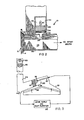
- the vapour precipitation and recovery system is designated generally by the numeral 10.
- the system includes a passage 12 which communicates with a spray coater booth (not shown) for passing products to the booth for spray coating, or for receiving the products from the booth after the same have been coated. Accordingly, it will be understood that there would typically be provided two systems 10, one at the entrance to the coating booth, and the other at the exit of the booth. Obviously, a conveyor system of a suitable nature passes through the passage 12 for carrying products to the booth.
- the passage 12 has a lower lip 14, flared or extending downward along the bottom edge thereof and a lip 16 flared upwardly along the top edge thereof.
- the lips 16 are angled with respect to the horizontal and intersect at an apex centrally above the passage 12.
- Side lips 18 flare or extend outwardly from the passage 12, interconnecting the lower lip 14 with the upper lip 16 as illustrated.
- the flaring of the lips effectively enlarges the opening of the passage 12 and provides a funnel effect for drawing air from the ambient into the passage. By effectively enlarging this opening, the ambient air is more efficiently drawn into the passage 12 and to the system 10 to prevent escape of the vapour cloud within the coater booth.
- Top and bottom plates 20, 22 are interconnected by side plates to define a tunnel extending from the flared lips 14 to 18 to a slot opening 26.
- the tunnel portion between the slot opening 26 and the front opening defined by the lips 14 to 18 establishes a vestibule 24.
- the opening 26 transverses substantially across the entire width of the top plates 20, thereby providing an opening across the top of the tunnel.
- the opening 26 in the top plates 20 substantially transverses the tunnel, making communication with an input chamber 28, maintained within a housing 32, which similarly transverses the tunnel.
- the scrubbing chamber 30 is defined by a base plate 34 which extends between the side walls of the housing 32 and is angled downwardly as best shown in Figure 1.
- a shi'eld plate 36 is interconnected between the walls of the housing 32 and extending upwardly from a back edge portion of the base plate 34.
- This shield-plate isolates the spray nozzle 38; maintained within the scrubbing chamber 30, from back splashing or misting into the input chamber 28, and subsequently through the opening 2b onto the product being conveyed to or from the coating booth.
- the spray nozzle 38 is preferably of the full cone type for purposes of creating a draft through the opening 26, input chamber 28 , and into the scrubbing chamber 30 flooding the baffle 42.
- Water or other suitable precipitant is provided through the conduit 40 to the full cone spray nozzle 38.
- This spray of precipitant is directed onto a precipitant baffle 42 of the type previously used in this art at the top of the exhaust stack.
- the baffle 42 is not placed within the exhaust stack of the recovery system, but is placed in immediate juxtaposition to the spray nozzle 38, covering the cross-section of the chamber 30. Accordingly, ambient air and vapour drawn through the opening 20 and into the scrubbing chamber 30 is forcefully sprayed against the baffle 42 by means of a precipitant emitted from the nozzle 38.
- the included spray angle of the nozzle 38 would be 95° to 125 , dependent upon spray force, with 110 0 being preferred.
- the nozzle 38 would normally be positioned within a foot of the baffle 42, and preferably within six inches thereof, dependent upon the size of the face surface of the baffle and the included angle of the nozzle. It is desired to have the nozzle as close to the baffle as possible while obtaining full coverage of the baffle.
- the tortuous path through the baffle 42 causes paint and contaminants suspended in the vapour to be precipitated into large droplets on the exit side of the baffle 42, such large droplets or particles washing directly into a recovery tank, obviating the necessity of a plenum chamber. Accordingly, the exit side of the baffle 42 goes directly to an exhaust stack 44, having a drain 46 at the bottom thereof for conveying precipitated liquids to an appropriate recovery tank. The scrubbed vapours and air then exhaust upwardly through the exhaust stack 44.
- the baffle 48 may be provided at the top of the exhaust stack 44 to condense any precipitated paint or contaminants seeking to escape through the stack.
- the baffle 48 will generally not be required.
- the exhaust fan 50 is provided at the top of the stack 44 for assisting in the creation of a draft from the coating booth and ambient, through the opening 26 and input chamber 28, for ultimate cleaning of the scrubbing chamber 30.
- a door 52 may be provided for accessing the baffle 48 and fan 50 for any required servicing or repair.
- a similar door 54 may be provided in a lower part of the stack 44 for access thereto.
- a door (not shown) will generally be included on the top panel of the housing 32 to allow access to the input chamber 28, scrubbing chamber 30, and related scrubbing means 38, 42. It will be understood that the input chamber 28 will require occasional cleaning, since that chamber is subjected to a combination of solvent-rich vapours and ambient air. Since the ambient air reduces the solvent-rich atmosphere of the vapours, paint particles and other suspended contaminants have a tendency to adhere to the walls of the input chamber 28.
- the recovery system 10 would typically include a water supply and paint flotation tank 56 in communication with the drain 46.
- the liquid passing through the baffle 42 is transferred by the drain 46 to the tank 56 where paint and other contaminants are floated to the top, filtered, and recycled for use in the spray booth.
- Water which is lost as by mist or evaporation is replenished from an appropriate water supply, and the water is recirculated through the conduit 40 to the spray nozzle 38. In this fashion, economic use of paint or other coating sprays is achieved, as well as an economic use of the water or other precipitant.
- a part to be coated is transported through the passage 12 and into a spray booth for coating.
- the expanding vapour cloud in the spray booth is drawn by the fan 50 and cone nozzle 38 upward through the opening 26 and input chamber 28 and into the scrubbing chamber 30.
- Ambient air is similarly drawn through the flared opening of the passage 12, the vestibule 24, and through the opening 26. This air flow prevents escape of the vapour cloud from the passage 12.
- the precipitant from the nozzle 38 drives the vapour-air mixture against the baffle 42 where paint and other contaminants contained in the vapour are precipitated into large droplets which fall through the drain 46 into the paint flotation tank 56.
- the scrubbed air and vapour is then exhausted up the stack 44.
- FIG. 4 Another embodiment of the concept of the invention is diagrammatically illustrated in Figure 4 and designated by the numeral 60.
- the entrance 62 and exit 64 of the coating booth 66 are chacterised by a flared opening to facilitate ambient air flow into the recovery system.
- the recovery system 68 comprises a single chamber 70 which communicates with the entrance 62 by means of a baffle or vaned vent 72.
- the vanes of the baffle 72 as illustrated in Figure 4, are inclined upwardly and inwardly into the passage such that precipitant spray from the cone nozzle 74 will not enter the passage from the entrance 62 to the coating booth 66.
- the area between the baffled vent 72 and the entrance 62 defines a vestibule for purposes discussed hereinabove.
- the nozzle 74 is preferably a low velocity hollow cone nozzle, particularly as related to a higher velocity full cone nozzle 76 which sprays directly onto the precipitant baffle 78 which covers the cross-section of the chamber 70, as shown.
- the nozzle 74 is positioned above the vent 72 a sufficient distance that the precipitant spray therefrom washes all wall surfaces of the chamber 70 below the top of the vent 72. Such positioning thus depends on the dimensional cross-section of the chamber 70 and the included angle of the nozzle 74.
- the nozzle 74 has an included angle of 110° and is positioned within six inches of the top of the vent 72.
- the included angle be between 95° to 125 0 and that the nozzle 74 be within one foot of the top of the vent 72.
- the full cone nozzle 76 would typically have an included angle of 95° to 125°, dependent on spray force, with 110 being preferred.
- the nozzle 76 would normally be positioned within a foot of the baffle 78, and preferably within six inches thereof, dependent upon the size of the face surface of the baffle and the included angle of the nozzle. It is preferred to have the nozzle as close to the baffle as possible while obtaining full spray coverage of the baffle.
- the large droplets or particles of contaminants precipitated by the baffle 78 stop directly into the recovery tank 80, there again being an absence of a settling or plenum chamber.
- the scrubbed vapours and air are exhausted via the exhaust 82 again having an exhaust fan at the top thereof.
- a baffle may be provided in the exhaust 82, although the same is not deemed required.
- the large particles precipitated by the spray 76 against the baffle 78 are received by the tank 80, while the scrubbed air and vapour are directed totally to the exhaust 82 by the dividing plate 86 which isolates the remainder of the recovery tank from such gaseous elements. With the plate 86, depending into the fluid as illustrated, this isolation or blocking is achieved.
- the precipitant in the tank 80 is recycled to the spray nozzles 74, 76, while the paint, coatings, or contaminants which float to the top of the tank are filtered and recycled to the spray booth 56.
- a pump 90 communicates with the tank 80 through a conduit 92, drawing precipitant from the tank 80 to the nozzles 74, 76.
- the system 60 operates in a closed loop mode, recirculating the precipitant between the tank 80 and the nozzles 74, 76. It has been found that with continuous operation, precipitant need be replenished only about three times weekly.
- the top hollow cone 74 continually cleans the chamber 70 by spraying from the top thereof downward, while the lower full cone nozzle 76 drives the combination of air and vapour through the precipitant baffle 78 to create large particles 84 for settling into the tank 80.
- the scrubbed vapours then exhaust up the stack 82 via an appropriate fan at the top thereof.
- the nozzles 74, 76 aid in generating the required length of the vestibule.
- the single chamber is constantly washed, and servicing needs are greatly reduced.
- vent 72 Only the baffled vent 72 is susceptible to paint or other coating adhered thereto. To limit down time, it is contemplated that the vent 72 may be removably secured between the chamber 70 and the passageway and that it be of the type which may be easily cleaned. Of course, when the vent 72 is removed for cleaning, a new or previously cleaned vent may be immediately replaced to limit the down time. As a point of fact, the vent 72 may be of plastic or other suitable material to which the coating will not tightly bond. Further, and similar to the earlier discussed embodiment, with the baffle 78 being directly sprayed by the nozzle 76, there is virtually no likelihood that it will plug or clog, greatly reducing the need for servicing of the same.
Landscapes
- Chemical & Material Sciences (AREA)
- Chemical Kinetics & Catalysis (AREA)
- Details Or Accessories Of Spraying Plant Or Apparatus (AREA)
- Application Of Or Painting With Fluid Materials (AREA)
- Coating Apparatus (AREA)
Applications Claiming Priority (2)
| Application Number | Priority Date | Filing Date | Title |
|---|---|---|---|
| US346014 | 1982-02-05 | ||
| US06/346,014 US4416193A (en) | 1982-02-05 | 1982-02-05 | System for vapor precipitation and recovery in a continuous coater |
Publications (2)
| Publication Number | Publication Date |
|---|---|
| EP0086088A2 true EP0086088A2 (de) | 1983-08-17 |
| EP0086088A3 EP0086088A3 (de) | 1984-09-26 |
Family
ID=23357567
Family Applications (1)
| Application Number | Title | Priority Date | Filing Date |
|---|---|---|---|
| EP83300549A Withdrawn EP0086088A3 (de) | 1982-02-05 | 1983-02-03 | Verfahren und Vorrichtung zur Ausscheidung und Rückgewinnung von Dampf in einer dauerbetriebenen Auftragemaschine |
Country Status (4)
| Country | Link |
|---|---|
| US (1) | US4416193A (de) |
| EP (1) | EP0086088A3 (de) |
| JP (1) | JPS58146467A (de) |
| CA (1) | CA1231838A (de) |
Cited By (2)
| Publication number | Priority date | Publication date | Assignee | Title |
|---|---|---|---|---|
| EP0390464A3 (de) * | 1989-03-27 | 1992-05-06 | Nalco Chemical Company | Hebelentfernung beim Farbspritzen |
| KR20140050649A (ko) * | 2011-07-05 | 2014-04-29 | 어플라이드 머티어리얼스, 인코포레이티드 | 가요성 기판을 프로세싱하기 위한 방법 |
Families Citing this family (4)
| Publication number | Priority date | Publication date | Assignee | Title |
|---|---|---|---|---|
| DE3332457C2 (de) * | 1983-09-08 | 1986-06-05 | Wolfgang Dipl.-Ing. 8941 Memmingerberg Richter | Verfahren zur Rückgewinnung von Lackiermaterial aus dem beim Spritzlackieren entstehenden Overspray und Anordnung zur Durchführung des Verfahrens |
| US4696254A (en) * | 1986-06-11 | 1987-09-29 | George Koch Sons, Inc. | Fluid wash spray paint system |
| US9433898B2 (en) * | 2014-06-19 | 2016-09-06 | Saeed J. Almalowi | Toxic gas condensation and retreatment system |
| PL3829781T3 (pl) * | 2018-10-01 | 2024-02-26 | Gallagher-Kaiser Corporation | Zespół kabiny lakierniczej i jednostka płucząca |
Family Cites Families (15)
| Publication number | Priority date | Publication date | Assignee | Title |
|---|---|---|---|---|
| US1966280A (en) * | 1932-02-03 | 1934-07-10 | R C Mahon Company | Air cleaner |
| US2337983A (en) * | 1941-05-13 | 1943-12-28 | Ernest F Fisher | Spray booth |
| BE477874A (de) * | 1946-12-06 | |||
| US3092333A (en) * | 1957-10-16 | 1963-06-04 | Gaiotto Battista | Spray nozzle |
| BE619761A (de) * | 1961-07-05 | |||
| US3382845A (en) * | 1964-07-21 | 1968-05-14 | Avisun Corp | Separating liquid droplets in spray coating operation |
| US3608274A (en) * | 1969-01-27 | 1971-09-28 | Ingersoll Rand Co | Apparatus and method for pumping and cleaning a fluid |
| US3964886A (en) * | 1974-10-29 | 1976-06-22 | Baltimore Aircoil Company, Inc. | Gas scrubbing apparatus |
| US3966438A (en) * | 1974-12-05 | 1976-06-29 | Nicholson Jerry W | Apparatus for washing stack gases |
| US4132537A (en) * | 1978-02-27 | 1979-01-02 | Bennett Dillard A | Down draft scrubber apparatus |
| US4185975A (en) * | 1978-07-10 | 1980-01-29 | Nordson Corporation | Exhaust for an opening into a coater |
| US4206159A (en) * | 1979-01-05 | 1980-06-03 | Combustion Engineering, Inc. | Rod scrubber |
| US4313742A (en) * | 1979-04-26 | 1982-02-02 | Ostlie L David | Multiple angle single stage scrubber |
| CA1162732A (en) * | 1980-01-14 | 1984-02-28 | James L. Kennon | Continuous coater |
| US4338364A (en) * | 1980-01-14 | 1982-07-06 | Nordson Corporation | Continuous coater |
-
1982
- 1982-02-05 US US06/346,014 patent/US4416193A/en not_active Expired - Fee Related
-
1983
- 1983-02-03 EP EP83300549A patent/EP0086088A3/de not_active Withdrawn
- 1983-02-04 CA CA000420947A patent/CA1231838A/en not_active Expired
- 1983-02-04 JP JP58016342A patent/JPS58146467A/ja active Granted
Cited By (2)
| Publication number | Priority date | Publication date | Assignee | Title |
|---|---|---|---|---|
| EP0390464A3 (de) * | 1989-03-27 | 1992-05-06 | Nalco Chemical Company | Hebelentfernung beim Farbspritzen |
| KR20140050649A (ko) * | 2011-07-05 | 2014-04-29 | 어플라이드 머티어리얼스, 인코포레이티드 | 가요성 기판을 프로세싱하기 위한 방법 |
Also Published As
| Publication number | Publication date |
|---|---|
| US4416193A (en) | 1983-11-22 |
| EP0086088A3 (de) | 1984-09-26 |
| JPS58146467A (ja) | 1983-09-01 |
| CA1231838A (en) | 1988-01-26 |
| JPH0476740B2 (de) | 1992-12-04 |
Similar Documents
| Publication | Publication Date | Title |
|---|---|---|
| US4338364A (en) | Continuous coater | |
| JP5662473B2 (ja) | 塗料スプレーしぶきを分離するためのフィルタ装置、分離装置及び方法 | |
| EP1462182B1 (de) | Selbstreinigendes System zur trockenen Rückgewinnung vom Nebel aus automatischen Farbspritzmaschinen | |
| US9545645B2 (en) | Paint spray booth | |
| US4567818A (en) | Circular spray booth | |
| US10857494B2 (en) | Exhaust configuration for a wet scrubber | |
| US4416193A (en) | System for vapor precipitation and recovery in a continuous coater | |
| JPS62500182A (ja) | 噴霧装置による冷却用設備 | |
| US20070166463A1 (en) | Paint spray booth | |
| US4601236A (en) | Pump-less paint spray booth | |
| EP0032810B1 (de) | Durchlaufspritzanlage | |
| US6716272B2 (en) | Scrubber for paint booths | |
| US5741178A (en) | Reducing area, increasing velocity paint booth structure and method | |
| JP2003126743A (ja) | 水性塗料用塗装装置 | |
| JPS6130631B2 (de) | ||
| JPH06142573A (ja) | 塗装方法および装置 | |
| JP3615577B2 (ja) | ウォーターカーテン式塗装ブース装置 | |
| WO1988008755A1 (en) | After-filter for a powder paint spraying installation | |
| EP1332802A2 (de) | Lackspritzkabine | |
| JPS62183874A (ja) | 塗布調整装置 | |
| US6267805B1 (en) | Apparatus for scrubbing a continuous flow of gas charged with solid particles | |
| JP4526932B2 (ja) | 塗装ブース | |
| JP2003260388A (ja) | 塗装ブース | |
| JP2993807B2 (ja) | 給気付塗装ブースの排気処理装置 | |
| JPH0127894Y2 (de) |
Legal Events
| Date | Code | Title | Description |
|---|---|---|---|
| PUAI | Public reference made under article 153(3) epc to a published international application that has entered the european phase |
Free format text: ORIGINAL CODE: 0009012 |
|
| AK | Designated contracting states |
Designated state(s): BE DE FR GB LU NL |
|
| PUAL | Search report despatched |
Free format text: ORIGINAL CODE: 0009013 |
|
| AK | Designated contracting states |
Designated state(s): BE DE FR GB LU NL |
|
| 17P | Request for examination filed |
Effective date: 19841122 |
|
| STAA | Information on the status of an ep patent application or granted ep patent |
Free format text: STATUS: THE APPLICATION IS DEEMED TO BE WITHDRAWN |
|
| 18D | Application deemed to be withdrawn |
Effective date: 19861006 |
|
| RIN1 | Information on inventor provided before grant (corrected) |
Inventor name: SHARPLESS, JOHN |