EP0086436A1 - Procédé d'utilisation d'une installation d'adsorption de pression oscillante travaillant cycliquement - Google Patents
Procédé d'utilisation d'une installation d'adsorption de pression oscillante travaillant cycliquement Download PDFInfo
- Publication number
- EP0086436A1 EP0086436A1 EP83101159A EP83101159A EP0086436A1 EP 0086436 A1 EP0086436 A1 EP 0086436A1 EP 83101159 A EP83101159 A EP 83101159A EP 83101159 A EP83101159 A EP 83101159A EP 0086436 A1 EP0086436 A1 EP 0086436A1
- Authority
- EP
- European Patent Office
- Prior art keywords
- adsorbers
- pressure
- adsorber
- adsorption
- cycle
- Prior art date
- Legal status (The legal status is an assumption and is not a legal conclusion. Google has not performed a legal analysis and makes no representation as to the accuracy of the status listed.)
- Granted
Links
- 238000001179 sorption measurement Methods 0.000 title claims abstract description 53
- 238000000034 method Methods 0.000 title claims abstract description 32
- 230000008569 process Effects 0.000 title claims description 8
- 239000007789 gas Substances 0.000 claims abstract description 29
- 230000007547 defect Effects 0.000 claims abstract description 11
- 230000002950 deficient Effects 0.000 claims abstract description 10
- 238000011010 flushing procedure Methods 0.000 claims abstract description 4
- 230000000903 blocking effect Effects 0.000 claims description 9
- 230000008859 change Effects 0.000 claims description 6
- 238000000746 purification Methods 0.000 claims description 3
- 238000000926 separation method Methods 0.000 claims description 3
- 230000008030 elimination Effects 0.000 claims description 2
- 238000003379 elimination reaction Methods 0.000 claims description 2
- 238000013022 venting Methods 0.000 claims 1
- 238000004140 cleaning Methods 0.000 abstract 1
- 238000010586 diagram Methods 0.000 description 18
- 238000010926 purge Methods 0.000 description 4
- 230000000977 initiatory effect Effects 0.000 description 3
- 230000007257 malfunction Effects 0.000 description 3
- 230000007704 transition Effects 0.000 description 3
- 230000008901 benefit Effects 0.000 description 2
- 238000004590 computer program Methods 0.000 description 2
- 230000000694 effects Effects 0.000 description 2
- 239000012535 impurity Substances 0.000 description 2
- 230000007246 mechanism Effects 0.000 description 2
- 230000009467 reduction Effects 0.000 description 2
- 230000009471 action Effects 0.000 description 1
- 238000011217 control strategy Methods 0.000 description 1
- 238000003795 desorption Methods 0.000 description 1
- 238000001514 detection method Methods 0.000 description 1
- 230000018109 developmental process Effects 0.000 description 1
- 238000011835 investigation Methods 0.000 description 1
- 239000000203 mixture Substances 0.000 description 1
- 238000012544 monitoring process Methods 0.000 description 1
- 230000002085 persistent effect Effects 0.000 description 1
- 230000008929 regeneration Effects 0.000 description 1
- 238000011069 regeneration method Methods 0.000 description 1
- 230000001105 regulatory effect Effects 0.000 description 1
- 230000002040 relaxant effect Effects 0.000 description 1
- 230000000754 repressing effect Effects 0.000 description 1
- 230000000717 retained effect Effects 0.000 description 1
- 239000007787 solid Substances 0.000 description 1
- 238000013024 troubleshooting Methods 0.000 description 1
- 238000011144 upstream manufacturing Methods 0.000 description 1
Images



Classifications
-
- B—PERFORMING OPERATIONS; TRANSPORTING
- B01—PHYSICAL OR CHEMICAL PROCESSES OR APPARATUS IN GENERAL
- B01D—SEPARATION
- B01D53/00—Separation of gases or vapours; Recovering vapours of volatile solvents from gases; Chemical or biological purification of waste gases, e.g. engine exhaust gases, smoke, fumes, flue gases, aerosols
- B01D53/02—Separation of gases or vapours; Recovering vapours of volatile solvents from gases; Chemical or biological purification of waste gases, e.g. engine exhaust gases, smoke, fumes, flue gases, aerosols by adsorption, e.g. preparative gas chromatography
- B01D53/04—Separation of gases or vapours; Recovering vapours of volatile solvents from gases; Chemical or biological purification of waste gases, e.g. engine exhaust gases, smoke, fumes, flue gases, aerosols by adsorption, e.g. preparative gas chromatography with stationary adsorbents
- B01D53/047—Pressure swing adsorption
-
- B—PERFORMING OPERATIONS; TRANSPORTING
- B01—PHYSICAL OR CHEMICAL PROCESSES OR APPARATUS IN GENERAL
- B01D—SEPARATION
- B01D2259/00—Type of treatment
- B01D2259/40—Further details for adsorption processes and devices
- B01D2259/40007—Controlling pressure or temperature swing adsorption
-
- B—PERFORMING OPERATIONS; TRANSPORTING
- B01—PHYSICAL OR CHEMICAL PROCESSES OR APPARATUS IN GENERAL
- B01D—SEPARATION
- B01D2259/00—Type of treatment
- B01D2259/40—Further details for adsorption processes and devices
- B01D2259/40011—Methods relating to the process cycle in pressure or temperature swing adsorption
- B01D2259/40013—Pressurization
- B01D2259/40015—Pressurization with two sub-steps
-
- B—PERFORMING OPERATIONS; TRANSPORTING
- B01—PHYSICAL OR CHEMICAL PROCESSES OR APPARATUS IN GENERAL
- B01D—SEPARATION
- B01D2259/00—Type of treatment
- B01D2259/40—Further details for adsorption processes and devices
- B01D2259/40011—Methods relating to the process cycle in pressure or temperature swing adsorption
- B01D2259/4002—Production
- B01D2259/40026—Production with more than three sub-steps
-
- B—PERFORMING OPERATIONS; TRANSPORTING
- B01—PHYSICAL OR CHEMICAL PROCESSES OR APPARATUS IN GENERAL
- B01D—SEPARATION
- B01D2259/00—Type of treatment
- B01D2259/40—Further details for adsorption processes and devices
- B01D2259/40011—Methods relating to the process cycle in pressure or temperature swing adsorption
- B01D2259/40028—Depressurization
- B01D2259/40033—Depressurization with more than three sub-steps
-
- B—PERFORMING OPERATIONS; TRANSPORTING
- B01—PHYSICAL OR CHEMICAL PROCESSES OR APPARATUS IN GENERAL
- B01D—SEPARATION
- B01D2259/00—Type of treatment
- B01D2259/40—Further details for adsorption processes and devices
- B01D2259/40011—Methods relating to the process cycle in pressure or temperature swing adsorption
- B01D2259/40035—Equalization
- B01D2259/40041—Equalization with more than three sub-steps
-
- B—PERFORMING OPERATIONS; TRANSPORTING
- B01—PHYSICAL OR CHEMICAL PROCESSES OR APPARATUS IN GENERAL
- B01D—SEPARATION
- B01D2259/00—Type of treatment
- B01D2259/40—Further details for adsorption processes and devices
- B01D2259/40011—Methods relating to the process cycle in pressure or temperature swing adsorption
- B01D2259/40043—Purging
- B01D2259/40045—Purging with two sub-steps
-
- B—PERFORMING OPERATIONS; TRANSPORTING
- B01—PHYSICAL OR CHEMICAL PROCESSES OR APPARATUS IN GENERAL
- B01D—SEPARATION
- B01D2259/00—Type of treatment
- B01D2259/40—Further details for adsorption processes and devices
- B01D2259/406—Further details for adsorption processes and devices using more than four beds
- B01D2259/4066—Further details for adsorption processes and devices using more than four beds using nine beds
-
- B—PERFORMING OPERATIONS; TRANSPORTING
- B01—PHYSICAL OR CHEMICAL PROCESSES OR APPARATUS IN GENERAL
- B01D—SEPARATION
- B01D53/00—Separation of gases or vapours; Recovering vapours of volatile solvents from gases; Chemical or biological purification of waste gases, e.g. engine exhaust gases, smoke, fumes, flue gases, aerosols
- B01D53/02—Separation of gases or vapours; Recovering vapours of volatile solvents from gases; Chemical or biological purification of waste gases, e.g. engine exhaust gases, smoke, fumes, flue gases, aerosols by adsorption, e.g. preparative gas chromatography
- B01D53/04—Separation of gases or vapours; Recovering vapours of volatile solvents from gases; Chemical or biological purification of waste gases, e.g. engine exhaust gases, smoke, fumes, flue gases, aerosols by adsorption, e.g. preparative gas chromatography with stationary adsorbents
- B01D53/0407—Constructional details of adsorbing systems
- B01D53/0446—Means for feeding or distributing gases
Definitions
- the invention relates to a method for operating a cyclically operating pressure swing adsorption system for the purification and separation of gases with a plurality of adsorbers, each of which passes through a predetermined number of adsorption, relaxation or pressure compensation, rinsing and repressing cycles within a cycle. whereby measurable physical variables are selected and continuously measured for the adsorbers, the pipelines and / or the valves of the pressure swing adsorption system, and the occurrence of differences between actual and target values of these variables is evaluated as an indication of a defect in the adsorption system and the adsorption system after Blocking of the apparatus parts determined as a defect continues to be operated with a reduced number of adsorbers.
- This object is achieved according to the invention in that when a difference between the setpoint and actual values of one of these variables occurs, the occurrence of a difference between the setpoint and actual values of at least one other variable assigned to the same system part is waited for, and only then are the apparatus parts determined thereby as defective are blocked and the adsorption system is operated with a reduced number of adsorbers.
- the method according to the invention initially reliably prevents individual adsorbers from being present in the event of short-term or non-serious faults, e.g. be switched off by a mechanical hysteresis of the switching valves or by inaccuracies or faults in valve position detectors and pressure transmitters.
- the occurrence of only one malfunction does not lead to the adsorber in question being taken out of operation. Rather, this fault characteristic is only displayed.
- an investigation is first initiated by checking the system signals (valve position indicators, adsorber pressures).
- This examination determines whether the malfunction is significant and persistent (e.g. in the event of a valve malfunction) or whether there is only one fault that can be remedied by slightly increasing the cycle time. In the latter case, the adsorption system is switched on by the switching mechanism to the next cycle with an unchanged number of adsorbers.
- the pressure in the adsorbers or lines has proven to be a suitable physical quantity, which is continuously monitored, in pressure swing adsorption systems.
- the pressure is measured, or whether an absolute pressure or a change in pressure or a pressure curve is measured appropriately for this, depends on the type of pressure change process that is carried out, the technical aids and monitoring means available, the pressure differences between adsorption and desorption, etc.
- it is possible to effect a predetermined change in pressure by automatically regulating the valves within a certain time. Then, for example, the valve position at a specific point in time during the pressure change can be selected as the physical variable to be monitored.
- the problem with adsorption plants continues to be that the transition to a reduced number of adsorbers is carried out as quickly as possible.
- the problem of the transition to the reduced number of adsorbers is solved in the known method in that the adsorbers remaining after the switchover continue to be operated in part up to predetermined cycles while adhering to a predetermined cycle sequence and in some cases remain in their state.
- a certain number of synchronization cycles is required until the system is adapted to the reduced number of adsorbers.
- the synchronization cycles which can only be carried out one after the other in the individual switching programs often result in valuable time being lost until the system is functional again.
- the adsorbers remaining when switching to the next cycle after blocking defective system parts are brought to suitable lower or higher pressure levels by skipping several cycles in one cycle will.
- the entire system can thus be operated in a matter of seconds in accordance with the invention.
- the cycles to be run through after the blocking by the remaining adsorbers are shifted in such a way that the original sequence of the functions within each cycle is restored with the elimination of a number of adsorption cycles corresponding to the number of adsorbers that have been switched off, wherein the one or more adsorbers that have been in adsorption for a long time take over the relaxation cycle (s) taking place at the relatively higher pressures and the one or more because only recently adsorbers in adsorption remain in adsorption. Accordingly, from the disturbed cycle, the print image without the blocked adsorber (s) is used and a print image for the process with the reduced number of adsorbers is sought for different steps.
- the system is then transferred to the step that has the least deviation from the previous print image in the course of the print.
- the similarity of the printed image to the new scheme with the previous scheme is therefore of the utmost importance for the rapid execution of the process. It is clear that this requires computers that make this comparison within microseconds.
- the adsorber is always used for the replacement of the failed function, which is located in the pressure flow diagram in front of the blocked adsorber, if you go through the: diagram from left to right.
- the switch to the new clock scheme takes place in one cycle.
- the method according to the invention offers the advantage over the known method that adsorbers are only switched off when faults actually occur, that throttling of the product quantity is no longer necessary, and the switchover to a new cycle pattern follows in a very short time.
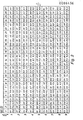
- Table 1 gives an overview of the cycles to be run through by each adsorber of a plant according to FIG. 1.
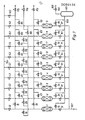
- raw gas passes through line 107 and valve 11 into the adsorber 1.
- the easily adsorbable components are retained in the adsorber 1, while the components which are more difficult to adsorb leave the plant via the valve 12 and the line 104.
- the part of the raw gas stream previously led to adsorber 1 is switched to another adsorber (in the present case to adsorber 4) and the pressure in adsorber 1 is reduced to a first intermediate pressure (E1). This is done by pressure equalization with the adsorber 5 by opening the valves 15 and 55.
- the pressure in the adsorber 1 is reduced to a second intermediate pressure (E21, E22), namely by pressure equalization with the adsorber 6 via the valves 16 and 66, and to a third intermediate pressure (E3) by pressure equalization with the adsorber 7 via the valves 16 and 76.
- valves 83 and 84 are then closed and the valves 93 and 94 are opened (E 43), as a result of which the adsorber 9 is also flushed in countercurrent from part of the previously adsorbed components (SP1).
- valves 13, 93 and 94 are closed and the remaining gas in the adsorber 1 is discharged into the container 101 by opening the valve 14 as residual gas (E51, E52). Then the adsorber 1 is no longer under pressure and is ready for rinsing.
- the purging (SP1) is accomplished by connecting the adsorber 1 to the still pressurized adsorber 2 via the open valves 23, 13 and 14. The gas reaches the container 101 via line 105.
- the adsorber 2 runs through its 7th relaxation cycle (E43).
- the valve 23 is closed and the valve 33 is opened, so that the adsorber now receives purging gas from the adsorber 3, which runs through its 5th relaxation cycle (E41). The gas gets back into the container 101.
- the increase in pressure in the adsorber 1 following the flushing is carried out in seven steps.
- the adsorber 1 is closed by closing the valve 14 and opening the valves 46 and 16 with the adsorber 4 Pressure equalization brought (B3), the latter going through its 4th relaxation cycle (E3).
- a further increase in pressure in the adsorber 1 (B21, B22) takes place by closing the valve 46 and opening the valve 56, the adsorber 5 being relaxed (E 21, E22).
- the 5th pressure increase (B1) takes place by closing the valve 56 and opening the valves 65 and 15 and thus connecting it to the adsorber 6, which also experiences relaxation (E1).
- the last pressure increase (B01, B02) to the adsorption pressure is carried out with branched product gas by opening the valves 102 and 15.
- Adsorber 1 is now available again for adsorption.
- valves 113, 115 and 116 are used to deliver overpressure gas if necessary.
- the adsorbers are plotted one below the other in the numbering in FIG. 1, the cycle numbers being indicated in the top line and the cycle names for each cycle, which result from Table 1. It can be seen from the diagram in FIG. 2 that in the system shown in FIG. 1, 3 adsorbers are always switched to adsorption at the same time, but somewhat shifted in time. With each adsorption cycle, only 1/3 of the raw gas quantity reaches each adsorber.
- FIG. 3 shows a diagram of the pressure curve over time in an adsorber during an adsorption cycle.
- the adsorber pressure is plotted in abs against the cycle time in seconds as the abscissa.
- This diagram also clearly shows the assignment of the individual relaxation and covering cycles (e.g. E3-B3 or E42-B4), which, seen in absolute terms, are characterized by the same pressure change.
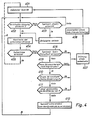
- the first query 402 relates to whether the ballast condition for the respective adsorber has been reached.
- the final pressure in an adsorber or in a line, the time until a certain pressure is set, the time until a certain valve position occurs, or the valve position after a certain time has elapsed, can be regarded as the pre-switching condition.
- the final pressure in an adsorber for example, is selected as the pre-switching condition at 402.
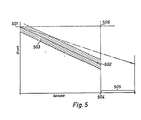
- 501 denotes the start pressure of an adsorber after the adsorption has ended, which is to be reduced to a final or target pressure 502 (solid arrow).
- a permitted pressure deviation 503 (hatched area within the dashed lines) is possible. If the end pressure has not yet been reached, a query is made 403 as to whether the cycle time has reached its end value (504 in FIG. 5). If this is not the case, you will be asked whether the target pressure has been reached. If the setpoint 504 of the cycle time has been reached, a time alarm is set and the pressure reached checks 404. If it is found 405 that the setpoint pressure has been reached or is within the permitted pressure deviation 503, the next switching step or cycle 401 is activated via A initiated.
- a query is made 406 as to whether the target + safety cycle time has been reached.
- An allowable time deviation (505 in FIG. 5) of approximately 10% of the cycle time is considered as security. If the target + safety time has elapsed (dash-dotted arrow in FIG. 5) and the final pressure has not yet been reached, then this indicates the fault 407 of an adsorber and, if this query path is repeated again according to the invention, leads to switching off 408 of an adsorber with the same result. This two repetition is a feature essential to the invention, since switch-offs that are not necessary often take place with a single query.
- query 406 yields a negative result (i.e. the target + safety time has not yet been reached)
- another query 409 takes place, which provides information about the difference between the current pressure and the starting pressure in an adsorber. If the pressure is the same as the start pressure (dotted line 501 to 506 in FIG. 5), then the fault 407 of an adsorber is displayed again. If there is a pressure difference, it is queried 410 whether the pressure currently remains constant. If this is the case, then the adsorber is faulty 407.
- an inquiry is made 411 as to whether there is a valve fault at the same time. If there is a valve fault, then the adsorber is faulty 407. If there is no valve fault, the cycle time is increased 412 by the To reach final pressure. If the final pressure is reached within the increased cycle time, then query 402, check 404 and query 405 are carried out again on route B and, if all inquiries are positive, initiation of the next switching step via A 401.
- an adsorber If an adsorber is now found to be defective on the basis of the above-described method, it is blocked by closing all of the valves assigned to it and, if appropriate, manual valves. The adsorber system must now continue to be operated with the remaining adsorbers. The switch from, for example, 9 to the remaining 8 adsorbers takes place in a single cycle without an intermediate synchronization step. This measure has the advantage that no throttling of the product quantity is necessary. !
Landscapes
- Chemical & Material Sciences (AREA)
- Engineering & Computer Science (AREA)
- Analytical Chemistry (AREA)
- General Chemical & Material Sciences (AREA)
- Oil, Petroleum & Natural Gas (AREA)
- Chemical Kinetics & Catalysis (AREA)
- Separation Of Gases By Adsorption (AREA)
- Display Devices Of Pinball Game Machines (AREA)
- Blow-Moulding Or Thermoforming Of Plastics Or The Like (AREA)
- Control Of Multiple Motors (AREA)
- Supplying Of Containers To The Packaging Station (AREA)
- Electrical Discharge Machining, Electrochemical Machining, And Combined Machining (AREA)
- Control Of Fluid Pressure (AREA)
Priority Applications (1)
| Application Number | Priority Date | Filing Date | Title |
|---|---|---|---|
| AT83101159T ATE10811T1 (de) | 1982-02-16 | 1983-02-07 | Verfahren zum betrieb einer zyklisch arbeitenden druckwechsel-adsorptionsanlage. |
Applications Claiming Priority (2)
| Application Number | Priority Date | Filing Date | Title |
|---|---|---|---|
| DE3205505 | 1982-02-16 | ||
| DE19823205505 DE3205505A1 (de) | 1982-02-16 | 1982-02-16 | Verfahren zum betrieb einer zyklisch arbeitenden druckwechsel-adsorptionsanlage |
Publications (2)
| Publication Number | Publication Date |
|---|---|
| EP0086436A1 true EP0086436A1 (fr) | 1983-08-24 |
| EP0086436B1 EP0086436B1 (fr) | 1984-12-19 |
Family
ID=6155866
Family Applications (1)
| Application Number | Title | Priority Date | Filing Date |
|---|---|---|---|
| EP83101159A Expired EP0086436B1 (fr) | 1982-02-16 | 1983-02-07 | Procédé d'utilisation d'une installation d'adsorption de pression oscillante travaillant cycliquement |
Country Status (9)
| Country | Link |
|---|---|
| EP (1) | EP0086436B1 (fr) |
| JP (1) | JPS58146419A (fr) |
| AT (1) | ATE10811T1 (fr) |
| BR (1) | BR8300609A (fr) |
| CA (1) | CA1193981A (fr) |
| DE (2) | DE3205505A1 (fr) |
| ES (1) | ES519661A0 (fr) |
| NO (1) | NO158330C (fr) |
| ZA (1) | ZA831009B (fr) |
Cited By (3)
| Publication number | Priority date | Publication date | Assignee | Title |
|---|---|---|---|---|
| EP0146124A3 (en) * | 1983-12-20 | 1986-12-30 | Linde Aktiengesellschaft | Pressure swing adsorption process |
| EP1736230A1 (fr) | 2005-06-23 | 2006-12-27 | Air Products and Chemicals, Inc. | Méthode de diagnostic des soupapes dans des installations d'adsorption à pression alternée |
| EP1993706A4 (fr) * | 2006-03-06 | 2010-07-21 | Lummus Technology Inc | Système de mesure et de commande de pression d'adsorption modulée en pression (amp) |
Families Citing this family (4)
| Publication number | Priority date | Publication date | Assignee | Title |
|---|---|---|---|---|
| US4650500A (en) * | 1985-02-22 | 1987-03-17 | Union Carbide Corporation | Enhanced pressure swing adsorption process and system |
| US6699307B1 (en) * | 2002-10-11 | 2004-03-02 | H2Gen Innovations, Inc. | High recovery PSA cycles and apparatus with reduced complexity |
| CN1250321C (zh) * | 2004-06-11 | 2006-04-12 | 成都天立化工科技有限公司 | 一种两段全回收变压吸附气体分离方法 |
| EP4691600A4 (fr) * | 2023-03-28 | 2026-07-22 | Asahi Chemical Ind | Appareil de séparation de gaz, procédé de gestion d'appareil de séparation de gaz, procédé de séparation de gaz et procédé de production de gaz purifié |
Citations (1)
| Publication number | Priority date | Publication date | Assignee | Title |
|---|---|---|---|---|
| DE2851847A1 (de) * | 1978-11-30 | 1980-06-12 | Linde Ag | Verfahren zum betrieb einer zyklisch arbeitenden druckwechsel-adsorptionsanlage |
-
1982
- 1982-02-16 DE DE19823205505 patent/DE3205505A1/de not_active Withdrawn
-
1983
- 1983-02-07 EP EP83101159A patent/EP0086436B1/fr not_active Expired
- 1983-02-07 DE DE8383101159T patent/DE3360030D1/de not_active Expired
- 1983-02-07 AT AT83101159T patent/ATE10811T1/de not_active IP Right Cessation
- 1983-02-08 BR BR8300609A patent/BR8300609A/pt not_active IP Right Cessation
- 1983-02-08 JP JP58018266A patent/JPS58146419A/ja active Granted
- 1983-02-09 ES ES519661A patent/ES519661A0/es active Granted
- 1983-02-15 ZA ZA831009A patent/ZA831009B/xx unknown
- 1983-02-15 NO NO830504A patent/NO158330C/no unknown
- 1983-02-16 CA CA000421720A patent/CA1193981A/fr not_active Expired
Patent Citations (1)
| Publication number | Priority date | Publication date | Assignee | Title |
|---|---|---|---|---|
| DE2851847A1 (de) * | 1978-11-30 | 1980-06-12 | Linde Ag | Verfahren zum betrieb einer zyklisch arbeitenden druckwechsel-adsorptionsanlage |
Cited By (6)
| Publication number | Priority date | Publication date | Assignee | Title |
|---|---|---|---|---|
| EP0146124A3 (en) * | 1983-12-20 | 1986-12-30 | Linde Aktiengesellschaft | Pressure swing adsorption process |
| EP1736230A1 (fr) | 2005-06-23 | 2006-12-27 | Air Products and Chemicals, Inc. | Méthode de diagnostic des soupapes dans des installations d'adsorption à pression alternée |
| US7491260B2 (en) | 2005-06-23 | 2009-02-17 | Air Products And Chemicals, Inc. | Valve operation diagnostic method for pressure swing adsorption systems |
| EP1993706A4 (fr) * | 2006-03-06 | 2010-07-21 | Lummus Technology Inc | Système de mesure et de commande de pression d'adsorption modulée en pression (amp) |
| AU2007223118B2 (en) * | 2006-03-06 | 2011-11-03 | Lummus Technology Inc. | PSA pressure measurement and control system |
| CN101394912B (zh) * | 2006-03-06 | 2012-03-28 | 鲁姆斯技术公司 | Psa压力测量和控制系统 |
Also Published As
| Publication number | Publication date |
|---|---|
| CA1193981A (fr) | 1985-09-24 |
| NO830504L (no) | 1983-08-17 |
| NO158330C (no) | 1988-08-24 |
| ATE10811T1 (de) | 1985-01-15 |
| BR8300609A (pt) | 1983-11-08 |
| NO158330B (no) | 1988-05-16 |
| DE3205505A1 (de) | 1983-08-25 |
| ES8400675A1 (es) | 1983-11-16 |
| DE3360030D1 (en) | 1985-01-31 |
| JPH0245488B2 (fr) | 1990-10-09 |
| ZA831009B (en) | 1983-11-30 |
| JPS58146419A (ja) | 1983-09-01 |
| EP0086436B1 (fr) | 1984-12-19 |
| ES519661A0 (es) | 1983-11-16 |
Similar Documents
| Publication | Publication Date | Title |
|---|---|---|
| EP0011872B1 (fr) | Procédé pour le fonctionnement d'un dispositif d'adsorption à pression alternée travaillant cycliquement | |
| EP0006138B1 (fr) | Procédé pour actionner un dispositif d'adsorption à pression alternée | |
| EP0045404B1 (fr) | Dispositif d'approvisionnement en gaz respirable | |
| DE69418996T2 (de) | Verfahren und vorrichtung zur abtrennung von stickstoffreichen gasen | |
| DE60314051T2 (de) | Verfahren zur Regelung einer Vorrichtung zur Behandlung einer Gascharge durch Druckwechseladsorption | |
| EP0146124B1 (fr) | Procédé d'adsorption par pression alternée | |
| EP0023679A1 (fr) | Procédé pour la purification par adsorption ou séparation de mélanges gazeux | |
| DE3716898A1 (de) | Verfahren und vorrichtung zur heliumanreicherung | |
| DE3040495C2 (de) | Ventilsteuerung | |
| EP0066869A2 (fr) | Procédé pour séparer des mélanges gazeux par la technique de la pression alternée | |
| EP0086436B1 (fr) | Procédé d'utilisation d'une installation d'adsorption de pression oscillante travaillant cycliquement | |
| DE2743861C2 (de) | Verfahren zum Zerlegen eines Gasgemisches | |
| DE2303153C2 (fr) | ||
| DE60304497T2 (de) | Verfahren zur Steuerung einer Gasbehandlungsanlage durch Adsorption und entsprechende Anlage | |
| EP3439765A1 (fr) | Dispositif et procédé d'épuration d'air | |
| EP0086435A1 (fr) | Procédé d'utilisation d'une installation d'adsorption de pression oscillante travaillant cycliquement | |
| DE2951626C2 (de) | Vorrichtung zum Zerlegen eines Gas-Gemisches | |
| DE60037952T2 (de) | Druckwechseladsorptionseinheit | |
| DE3530920C2 (fr) | ||
| DE2752801C2 (fr) | ||
| DE19506762C1 (de) | Druckwechseladsorptionsverfahren | |
| EP0728515B1 (fr) | Dispositif d'adsorption à pression alternée | |
| EP0728514B1 (fr) | Dispositif d'adsorption à pression alternée | |
| DD288533A5 (de) | Verfahren zum trennen von gasgemischen durch druckwechseladsorption | |
| DD265809A1 (de) | Vorrichtung zum steuern der gasstroeme in druckwechseladsorptionsanlagen |
Legal Events
| Date | Code | Title | Description |
|---|---|---|---|
| PUAI | Public reference made under article 153(3) epc to a published international application that has entered the european phase |
Free format text: ORIGINAL CODE: 0009012 |
|
| 17P | Request for examination filed |
Effective date: 19830610 |
|
| AK | Designated contracting states |
Designated state(s): AT BE CH DE FR GB IT LI NL |
|
| ITF | It: translation for a ep patent filed | ||
| GRAA | (expected) grant |
Free format text: ORIGINAL CODE: 0009210 |
|
| AK | Designated contracting states |
Designated state(s): AT BE CH DE FR GB IT LI NL |
|
| REF | Corresponds to: |
Ref document number: 10811 Country of ref document: AT Date of ref document: 19850115 Kind code of ref document: T |
|
| REF | Corresponds to: |
Ref document number: 3360030 Country of ref document: DE Date of ref document: 19850131 |
|
| ET | Fr: translation filed | ||
| PLBE | No opposition filed within time limit |
Free format text: ORIGINAL CODE: 0009261 |
|
| STAA | Information on the status of an ep patent application or granted ep patent |
Free format text: STATUS: NO OPPOSITION FILED WITHIN TIME LIMIT |
|
| 26N | No opposition filed | ||
| ITTA | It: last paid annual fee | ||
| PGFP | Annual fee paid to national office [announced via postgrant information from national office to epo] |
Ref country code: GB Payment date: 19940128 Year of fee payment: 12 |
|
| PGFP | Annual fee paid to national office [announced via postgrant information from national office to epo] |
Ref country code: AT Payment date: 19940214 Year of fee payment: 12 |
|
| PGFP | Annual fee paid to national office [announced via postgrant information from national office to epo] |
Ref country code: CH Payment date: 19940215 Year of fee payment: 12 |
|
| PG25 | Lapsed in a contracting state [announced via postgrant information from national office to epo] |
Ref country code: GB Effective date: 19950207 Ref country code: AT Effective date: 19950207 |
|
| PG25 | Lapsed in a contracting state [announced via postgrant information from national office to epo] |
Ref country code: LI Effective date: 19950228 Ref country code: CH Effective date: 19950228 |
|
| GBPC | Gb: european patent ceased through non-payment of renewal fee |
Effective date: 19950207 |
|
| PGFP | Annual fee paid to national office [announced via postgrant information from national office to epo] |
Ref country code: DE Payment date: 20000323 Year of fee payment: 18 |
|
| PGFP | Annual fee paid to national office [announced via postgrant information from national office to epo] |
Ref country code: FR Payment date: 20010213 Year of fee payment: 19 |
|
| PGFP | Annual fee paid to national office [announced via postgrant information from national office to epo] |
Ref country code: NL Payment date: 20010228 Year of fee payment: 19 |
|
| PGFP | Annual fee paid to national office [announced via postgrant information from national office to epo] |
Ref country code: BE Payment date: 20010427 Year of fee payment: 19 |
|
| PG25 | Lapsed in a contracting state [announced via postgrant information from national office to epo] |
Ref country code: DE Free format text: LAPSE BECAUSE OF NON-PAYMENT OF DUE FEES Effective date: 20011201 |
|
| PG25 | Lapsed in a contracting state [announced via postgrant information from national office to epo] |
Ref country code: BE Free format text: LAPSE BECAUSE OF NON-PAYMENT OF DUE FEES Effective date: 20020228 |
|
| BERE | Be: lapsed |
Owner name: LINDE A.G. Effective date: 20020228 |
|
| PG25 | Lapsed in a contracting state [announced via postgrant information from national office to epo] |
Ref country code: NL Free format text: LAPSE BECAUSE OF NON-PAYMENT OF DUE FEES Effective date: 20020901 |
|
| PG25 | Lapsed in a contracting state [announced via postgrant information from national office to epo] |
Ref country code: FR Free format text: LAPSE BECAUSE OF NON-PAYMENT OF DUE FEES Effective date: 20021031 |
|
| NLV4 | Nl: lapsed or anulled due to non-payment of the annual fee |
Effective date: 20020901 |
|
| REG | Reference to a national code |
Ref country code: FR Ref legal event code: ST |