EP0086437A2 - Procédé et dispositif de régénération de compression de matériaux poreux flexibles - Google Patents
Procédé et dispositif de régénération de compression de matériaux poreux flexibles Download PDFInfo
- Publication number
- EP0086437A2 EP0086437A2 EP83101160A EP83101160A EP0086437A2 EP 0086437 A2 EP0086437 A2 EP 0086437A2 EP 83101160 A EP83101160 A EP 83101160A EP 83101160 A EP83101160 A EP 83101160A EP 0086437 A2 EP0086437 A2 EP 0086437A2
- Authority
- EP
- European Patent Office
- Prior art keywords
- water
- reactor
- press
- pressing device
- substances
- Prior art date
- Legal status (The legal status is an assumption and is not a legal conclusion. Google has not performed a legal analysis and makes no representation as to the accuracy of the status listed.)
- Withdrawn
Links
- 238000000034 method Methods 0.000 title claims abstract description 29
- 230000008929 regeneration Effects 0.000 title claims abstract description 28
- 238000011069 regeneration method Methods 0.000 title claims abstract description 28
- 230000006835 compression Effects 0.000 title claims abstract description 8
- 238000007906 compression Methods 0.000 title claims abstract description 8
- 239000011148 porous material Substances 0.000 title claims abstract description 8
- XLYOFNOQVPJJNP-UHFFFAOYSA-N water Substances O XLYOFNOQVPJJNP-UHFFFAOYSA-N 0.000 claims abstract description 62
- 239000000463 material Substances 0.000 claims abstract description 54
- 238000003825 pressing Methods 0.000 claims abstract description 43
- 239000000126 substance Substances 0.000 claims abstract description 25
- 239000002245 particle Substances 0.000 claims abstract description 16
- 239000007788 liquid Substances 0.000 claims abstract description 9
- 239000007787 solid Substances 0.000 claims abstract description 7
- 241000894006 Bacteria Species 0.000 claims abstract description 6
- 238000011068 loading method Methods 0.000 claims abstract description 4
- 239000013505 freshwater Substances 0.000 claims description 7
- 239000002351 wastewater Substances 0.000 claims description 6
- 239000008237 rinsing water Substances 0.000 claims description 5
- 238000011049 filling Methods 0.000 claims description 2
- 239000012535 impurity Substances 0.000 abstract description 2
- 229920005830 Polyurethane Foam Polymers 0.000 description 4
- 239000012876 carrier material Substances 0.000 description 4
- 239000011496 polyurethane foam Substances 0.000 description 4
- 238000006073 displacement reaction Methods 0.000 description 2
- 238000011010 flushing procedure Methods 0.000 description 2
- 239000006260 foam Substances 0.000 description 2
- 239000012528 membrane Substances 0.000 description 2
- -1 polyethylene Polymers 0.000 description 2
- 229920002635 polyurethane Polymers 0.000 description 2
- 239000004814 polyurethane Substances 0.000 description 2
- 238000004065 wastewater treatment Methods 0.000 description 2
- 206010010774 Constipation Diseases 0.000 description 1
- 241001503485 Mammuthus Species 0.000 description 1
- 239000004698 Polyethylene Substances 0.000 description 1
- 239000004743 Polypropylene Substances 0.000 description 1
- 238000010521 absorption reaction Methods 0.000 description 1
- 239000012620 biological material Substances 0.000 description 1
- 238000006243 chemical reaction Methods 0.000 description 1
- 239000000356 contaminant Substances 0.000 description 1
- 230000018109 developmental process Effects 0.000 description 1
- 230000000694 effects Effects 0.000 description 1
- 230000002349 favourable effect Effects 0.000 description 1
- 238000001914 filtration Methods 0.000 description 1
- 238000003306 harvesting Methods 0.000 description 1
- 229930195733 hydrocarbon Natural products 0.000 description 1
- 150000002430 hydrocarbons Chemical class 0.000 description 1
- 230000014759 maintenance of location Effects 0.000 description 1
- 238000002156 mixing Methods 0.000 description 1
- 229920003023 plastic Polymers 0.000 description 1
- 239000004033 plastic Substances 0.000 description 1
- 229920000573 polyethylene Polymers 0.000 description 1
- 229920000642 polymer Polymers 0.000 description 1
- 229920001155 polypropylene Polymers 0.000 description 1
- 229920001296 polysiloxane Polymers 0.000 description 1
- 239000010802 sludge Substances 0.000 description 1
- 239000002562 thickening agent Substances 0.000 description 1
Images


Classifications
-
- B—PERFORMING OPERATIONS; TRANSPORTING
- B01—PHYSICAL OR CHEMICAL PROCESSES OR APPARATUS IN GENERAL
- B01D—SEPARATION
- B01D17/00—Separation of liquids, not provided for elsewhere, e.g. by thermal diffusion
- B01D17/02—Separation of non-miscible liquids
- B01D17/0202—Separation of non-miscible liquids by ab- or adsorption
-
- B—PERFORMING OPERATIONS; TRANSPORTING
- B01—PHYSICAL OR CHEMICAL PROCESSES OR APPARATUS IN GENERAL
- B01D—SEPARATION
- B01D41/00—Regeneration of the filtering material or filter elements outside the filter for liquid or gaseous fluids
- B01D41/02—Regeneration of the filtering material or filter elements outside the filter for liquid or gaseous fluids of loose filtering material
-
- C—CHEMISTRY; METALLURGY
- C02—TREATMENT OF WATER, WASTE WATER, SEWAGE, OR SLUDGE
- C02F—TREATMENT OF WATER, WASTE WATER, SEWAGE, OR SLUDGE
- C02F3/00—Biological treatment of water, waste water, or sewage
- C02F3/02—Aerobic processes
- C02F3/10—Packings; Fillings; Grids
-
- C—CHEMISTRY; METALLURGY
- C02—TREATMENT OF WATER, WASTE WATER, SEWAGE, OR SLUDGE
- C02F—TREATMENT OF WATER, WASTE WATER, SEWAGE, OR SLUDGE
- C02F3/00—Biological treatment of water, waste water, or sewage
- C02F3/02—Aerobic processes
- C02F3/08—Aerobic processes using moving contact bodies
- C02F3/085—Fluidized beds
- C02F3/087—Floating beds with contact bodies having a lower density than water
-
- Y—GENERAL TAGGING OF NEW TECHNOLOGICAL DEVELOPMENTS; GENERAL TAGGING OF CROSS-SECTIONAL TECHNOLOGIES SPANNING OVER SEVERAL SECTIONS OF THE IPC; TECHNICAL SUBJECTS COVERED BY FORMER USPC CROSS-REFERENCE ART COLLECTIONS [XRACs] AND DIGESTS
- Y02—TECHNOLOGIES OR APPLICATIONS FOR MITIGATION OR ADAPTATION AGAINST CLIMATE CHANGE
- Y02W—CLIMATE CHANGE MITIGATION TECHNOLOGIES RELATED TO WASTEWATER TREATMENT OR WASTE MANAGEMENT
- Y02W10/00—Technologies for wastewater treatment
- Y02W10/10—Biological treatment of water, waste water, or sewage
Definitions
- the invention relates to a method and a device for the compression regeneration of flexible, porous materials serving as filter, oil separating and / or carrier particles, which in a reactor contain substances to be removed from liquids, such as water, such as, in particular, separated solids, oil droplets and / or bacteria, are loaded and, after loading, are fed to a pressing chamber having a pressing device.
- polyurethane foam is not only used as a filter material for (Ab ⁇ Wasserfiltration), but is also used as a carrier material for bacteria, which are required to activate processes that take place during wastewater treatment, and as a coalescing medium for the removal of undissolved liquid hydrocarbons from the process and waste water and used in fermenter technology.
- the object of the present invention is therefore to improve a method and a device for compression regeneration in such a way that the additional conveying devices are dispensed with and the regeneration is thus more economical.
- This object is achieved in that the material loaded with the substances to be removed is sucked together with the water by moving the pressing device backwards out of the reactor into the pressing chamber, that there by moving the pressing device forward the water and the substances to be removed are squeezed out of the material, that conveying water is sucked in by the backward movement of the pressing device and that the regenerated material is pressed back into the reactor by forward movement of the pressing device again.
- the material to be regenerated, together with the liquid, which in most cases is water, is conveyed out of the reactor into the pressing chamber as a result of the suction force caused by the backward movement of the pressing device.
- the material is pressed together by moving the pressing device forward, initially only the water adhering to the material is squeezed out and drained off and only by further pressing together are the substances to be removed pressed out of the pores of the loaded material, so that the water and the substances to be removed already separated from the material and a concentrated regrind is obtained.
- Subsequent backward movement of the press means that the suction effect that occurs causes water to be drawn in either from the reactor or from a fresh water source, so that the compressed material particles are relaxed again and distributed in the water, making them easy to move back into the appropriate position of the shut-off elements by moving the press forward Reactor can be funded.
- the conveying, pressing out, separating the water from the impurities and returning the regenerated material to the reactor is accordingly accomplished according to the invention with a single device, which works simultaneously as a press and as a conveying unit.
- the method according to the invention thus makes it possible to dispense with the previously necessary and necessary conveying devices, which results in considerable cost savings.
- the invention also offers the advantage that the same regeneration system can be used both for countercurrent and for direct current gates can be used. Continuous regeneration is also possible by automating the regeneration steps.
- the water is squeezed out of the loaded material by partially moving the pressing device forward, water is drawn in to flush the material out of the reactor or a fresh water source by partially subsequently moving the pressing device backwards, and that by moving forward the pressing device the water and the substances to be removed are pressed out of the material.
- This mode of operation allows the loaded material to be finely cleaned, in particular if the compression and relaxation are repeated several times while rinsing water is sucked in.
- the flushing water particularly when using fresh water, is advantageously pressed into the space behind the pressing device, so that no additional storage space for flushing water is required.
- the loaded material is expressed to about 20 to 5% of its relaxed volume.
- compressed air is blown into the feed water while the regenerated material distributed in the feed water is pressed back into the reactor. This ensures that the material particles are loosened and better distributed in the water, which in turn facilitates the return to the reactor.
- the invention also relates to a device for carrying out the method with a reactor and a pressing chamber having a pressing device, which is characterized in that the pressing chamber is connected to the upper and lower parts of the reactor via a material transport line each with a shut-off device the press room is connected to a lockable drain line for the water and the substances to be removed with a retention device for the material to be regenerated and a lockable inlet for the pumped water.
- the feed for the feed water preferably opens into the drain for the water and the substances to be removed, the feed for the feed water advantageously being connected to the outlet of the reactor.
- a compressed air line is connected to the inlet for the pumped water.
- the pressing device is preferably designed as a press ram, but it can alternatively also be designed as a diaphragm pump press, the lifting speed in each case being in the preferred range from 0.01 to 0.5 m / sec.
- the retaining device for the material to be regenerated is preferably designed as a sieve plate and has one to five holes per 10 CM 2 with a diameter of 2 to 10 mm, depending on the size of the carrier part. This ensures that the material, which is preferably in comminuted form, is not discharged from the regeneration system together with the water and the substances to be removed.
- the method according to the invention and the device for carrying out this method are suitable for the regeneration of all types of flexible, porous filter, oil separating and / or carrier materials, such as in particular polyurethane foam and open-cell, porous body based on polyethylene, polypropylene and silicone.
- carrier materials such as in particular polyurethane foam and open-cell, porous body based on polyethylene, polypropylene and silicone.
- the process can also be used as a harvesting process in fermenter technology, where it is also possible to use foam as a filter or carrier material.
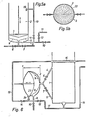
- the regeneration apparatus shown in Figure 1 consists of a reactor 1, which can be operated both in cocurrent and in countercurrent, from a press room 2 with Press ram 3, material transport lines 4 and 5 with shut-off devices 6 and 7, a drain line 8 with sieve plate 9 and valve 10 and an inlet 11 with valve 12 for counter-current operation or inlet 13 with valve 14 for direct-current operation.
- the inlet is connected to the outlet 15 for countercurrent operation or 16 for direct current operation of the reactor.
- Direct current operation is understood to mean that the air and the incoming water to be cleaned are passed into the reactor from below, while in countercurrent operation the water is introduced into the reactor from above and the air from below.
- Flexible, porous material which serves as filter, oil separating and / or carrier material, is located in the reactor 1 and is filled with substances, such as separated solids, oil droplets and / or bacteria, which are present in the liquid coming from above, usually water. are and should be removed from it (for which purpose the biological material conversion and / or for better mixing air is blown into the reactor from below), after which the loaded material must be regenerated from time to time or continuously.
- valve flap 6 is opened with otherwise closed valves and shut-off devices and the plunger 3 is moved from the front position v to the rear position z (backward movement), so that the loaded material particles, such as polyurethane foam particles, together with water into the press space due to the suction force 2 are promoted.
- the valve flap 6 is then closed and valve 14 opened, while at the same time the plunger 3 is moved from the rear to the middle position (from z to m).
- the entrained water is pressed out and mixed into the counterflow reactor 1 via line 13 to the incoming wastewater to be cleaned.
- valve 14 is closed again.
- valve flap 6 can be opened again, the plunger 3 moved from the central position into the rear position, and thereby further, loaded material and water are sucked out of the reactor. Then valve flap 6 is closed. Valve 14 opened, the plunger 3 moved from the rear to the middle position, thereby removing the water and feeding it to the inlet of the reactor 1 via line 13, valve 14 closed, valve 10 opened and the plunger moved from the middle to the front position, thus the loaded material is squeezed out (advantageously to 20 to 5% of its relaxed volume). The substances to be removed are pressed out of the material particles via line 8. The sieve bottom 9 prevents the material particles from being discharged. If these substances are separated solids, for example, they are used as excess sludge e.g. fed to a thickener. For other substances, these continue to be used according to their properties.
- valve 10 is closed and valve 12 is opened, so that via line 11, which is connected to the outlet 15 of the countercurrent reactor, conveyed water by moving the plunger backwards (from k to z) into the Press room is sucked.
- fresh water can also be drawn in via a supply line 17 leading directly into the baling chamber.
- compressed air can be blown in via a compressed air line 18 which leads into line 8 and which escapes via an introduction valve 19.
- valve 12 As soon as the press chamber is filled with pumped water, valve 12 is closed, the valve flap 7 is opened and the stamp is moved from the rear to the front Position moved, so that the regenerated material particles distributed in the conveyed water are returned together with the conveyed water through the transport line 5 in the lower part of the reactor 1.
- the punch is moved at a speed of approx. 0.01 to 0.5 m / sec, whereby the drive can be mechanical (e.g. spindle or rack) or hydraulic.
- the press chamber should be dimensioned so that the displacement length: displacement diameter ratio is not greater than 3: 1.
- shut-off devices i.e. To prevent valve flaps 6 and 7, for example, they should respond as quickly as possible when opening and closing and have a large cross section.
- the shut-off devices for the closing or opening process can be flushed out by briefly feeding in air or waste water. It is also useful if the material transport lines 4 and 5 are designed to be as short as possible, so that laying with material particles can also be prevented here. A diameter of the transport lines of at least 10 cm, preferably from 10 to 30 cm, is also favorable.
- the regeneration apparatus shown in FIG. 2 corresponds to the above-described apparatus of FIG. 1, with the only difference that a vertical pressing is carried out.
- the sequence of steps shown in Table I applies.
- the device according to Figure 3 shown schematically also corresponds closely to the Regenerierapparatur according to Figure 1, but is used for fine regeneration and has for this purpose a branch line 20 from line 13 which leads into the rear compression chamber, and by H domestic and movement of the Press ram, water to flush the material particles from the press room to the rear press room back and forth.
- Another difference to the device according to Figure 1 is that the stamp only in one front and one out more position can be moved.
- a device for fine regeneration with horizontal pressing is also conceivable, but is not shown separately.
- the regeneration steps for the fine regeneration are summarized in Table II.
- FIG. 4 shows a partial section of a regeneration apparatus, namely the return of the squeezed water. This is not admixed to the outlet of the reactor, but is fed directly into the press chamber via a line 21, which can partly be designed as a flexible hose, with valve 22, as has already been explained for example in the case of fine regeneration.
- Figure 5 shows a side view of a special stamp design, namely a cone stamp, which has the advantage that a larger pressing surface is achieved and only one opening is required for the entry and exit.
- the two material transport lines open into a common line in the lower part of the press room 2, while the line for removing the substances to be removed leads laterally out of the lower part of the press room.
- the cone punch is designed as a sieve surface except for the surface corresponding to the outlet opening 23.
- FIG. 6 finally shows a regeneration apparatus, in particular for cocurrent and countercurrent reactors, based on the diaphragm pump principle.
- the pressing in the present case is carried out by means of a pressing membrane 24 which is moved mechanically or hydraulically back and forth between a rear and a front position.
- the press chamber is connected to line 13 via a further valve 25, so that, similar to FIGS. 3 and 4, the rear press chamber is also used as a storage chamber.
Landscapes
- Chemical & Material Sciences (AREA)
- Life Sciences & Earth Sciences (AREA)
- Chemical Kinetics & Catalysis (AREA)
- Microbiology (AREA)
- Thermal Sciences (AREA)
- Biodiversity & Conservation Biology (AREA)
- Physics & Mathematics (AREA)
- Hydrology & Water Resources (AREA)
- Engineering & Computer Science (AREA)
- Environmental & Geological Engineering (AREA)
- Water Supply & Treatment (AREA)
- Organic Chemistry (AREA)
- Biological Treatment Of Waste Water (AREA)
Applications Claiming Priority (2)
| Application Number | Priority Date | Filing Date | Title |
|---|---|---|---|
| DE19823205377 DE3205377A1 (de) | 1982-02-16 | 1982-02-16 | Verfahren und vorrichtung zur kompressionsregenerierung flexibler poroeser materialien |
| DE3205377 | 1982-02-16 |
Publications (2)
| Publication Number | Publication Date |
|---|---|
| EP0086437A2 true EP0086437A2 (fr) | 1983-08-24 |
| EP0086437A3 EP0086437A3 (fr) | 1986-10-08 |
Family
ID=6155782
Family Applications (1)
| Application Number | Title | Priority Date | Filing Date |
|---|---|---|---|
| EP19830101160 Withdrawn EP0086437A3 (fr) | 1982-02-16 | 1983-02-07 | Procédé et dispositif de régénération de compression de matériaux poreux flexibles |
Country Status (3)
| Country | Link |
|---|---|
| US (1) | US4524139A (fr) |
| EP (1) | EP0086437A3 (fr) |
| DE (1) | DE3205377A1 (fr) |
Cited By (1)
| Publication number | Priority date | Publication date | Assignee | Title |
|---|---|---|---|---|
| US4524139A (en) * | 1982-02-16 | 1985-06-18 | Linde Aktiengesellschaft | Process for the compressive regeneration of flexible, porous materials |
Families Citing this family (18)
| Publication number | Priority date | Publication date | Assignee | Title |
|---|---|---|---|---|
| US4681685A (en) * | 1985-06-25 | 1987-07-21 | Dorr-Oliver Inc. | Method and apparatus for concentrating bioparticles |
| US6153094A (en) * | 1992-05-13 | 2000-11-28 | E. Craig Jowett | Wastewater treatment method and apparatus |
| US5707513A (en) * | 1992-05-13 | 1998-01-13 | Jowett; E. Craig | Wastewater treatment method and apparatus |
| US5690825A (en) * | 1993-12-21 | 1997-11-25 | Genera Technologies Limited | Filtration method and apparatus |
| CA2139554C (fr) * | 1994-01-06 | 2008-09-09 | E. Craig Jowett | Methode et appareil d'epuration de l'eau usee |
| GB9522986D0 (en) * | 1995-11-09 | 1996-01-10 | Craig Jowett E | Treatment of phosphorous in septic tank effluent |
| RU2177364C1 (ru) * | 2001-04-18 | 2001-12-27 | Острецов Валерий Иванович | Способ регенерации сорбента, отработанного в процессах очистки вод и твердых поверхностей от нефти |
| US7309434B2 (en) * | 2004-06-28 | 2007-12-18 | Potts David A | Apparatus and method for wastewater treatment |
| GB2422147A (en) * | 2005-01-15 | 2006-07-19 | Geoffrey Kevin Ellison | Method of treating effluent comprising the provision of a plurality of bacteria supporting elements |
| GB0625791D0 (en) * | 2006-12-22 | 2007-02-07 | Jowett Craig E | Lateral flow filter,water & wastewater treatment system |
| IL184441A0 (en) * | 2007-07-05 | 2007-10-31 | Gavrieli Jonah | Method and device for water treatment |
| US20110147321A1 (en) * | 2008-08-29 | 2011-06-23 | Nir Oz | Filter with adjustable porosity |
| WO2010088720A1 (fr) * | 2009-02-03 | 2010-08-12 | Robert Joseph Peter Lennon | Procédé et appareil de filtration de fluides |
| WO2018132195A1 (fr) * | 2017-01-10 | 2018-07-19 | Regent Of The University Of Minnesota | Filtration améliorée à l'aide d'un sorbant compressible |
| FR3086553B1 (fr) | 2018-09-28 | 2020-11-13 | Ifp Energies Now | Procede de nettoyage d’un support solide de reacteur fermentaire comprenant une mousse de polyurethane contaminee |
| FR3118061B1 (fr) * | 2020-12-18 | 2023-07-14 | Ifp Energies Now | Procédé de production d’alcools avec un support sur lequel sont immobilisés des micro-organismes |
| FR3117890B1 (fr) | 2020-12-23 | 2024-01-12 | Ifp Energies Now | Reacteur gaz/liquide d’oligomerisation comprenant un double distributeur gaz/liquide |
| US11583788B1 (en) * | 2022-01-18 | 2023-02-21 | Theodore A. Kuepper | Lightweight fibrous media (LFM) filter |
Family Cites Families (11)
| Publication number | Priority date | Publication date | Assignee | Title |
|---|---|---|---|---|
| US2089214A (en) * | 1935-01-26 | 1937-08-10 | Frank B Lomax | Apparatus for filtering eggs |
| CH395932A (fr) * | 1963-07-05 | 1965-07-31 | I A C Societe Anonyme Internat | Filtre |
| DE1636297A1 (de) * | 1968-03-04 | 1971-03-11 | Martin Hanke | Filterapparat |
| FR2269992B1 (fr) * | 1974-05-06 | 1981-11-27 | Hydronautics | |
| US4055490A (en) * | 1975-06-24 | 1977-10-25 | Seisuikogyo Co., Ltd. | Activated sludge process |
| JPS596715B2 (ja) * | 1976-09-10 | 1984-02-14 | 日石三菱株式会社 | 排水の処理方法 |
| GB2006181B (en) * | 1977-10-20 | 1982-05-19 | Hartley Simon Ltd | Growth of biological material |
| US4213863A (en) * | 1979-01-08 | 1980-07-22 | Marine Construction & Design Co. | Flow-through coalescing separator |
| US4387633A (en) * | 1981-02-06 | 1983-06-14 | James Ballantyne | Sludge processing system |
| DE3145667A1 (de) * | 1981-11-17 | 1983-05-26 | Linde Ag, 6200 Wiesbaden | Verfahren und vorrichtung zur kompressionsregenerierung flexibler filter-, oelabscheide- und/oder traegermaterialien |
| DE3205377A1 (de) * | 1982-02-16 | 1983-08-25 | Linde Ag, 6200 Wiesbaden | Verfahren und vorrichtung zur kompressionsregenerierung flexibler poroeser materialien |
-
1982
- 1982-02-16 DE DE19823205377 patent/DE3205377A1/de not_active Withdrawn
-
1983
- 1983-02-07 EP EP19830101160 patent/EP0086437A3/fr not_active Withdrawn
- 1983-02-16 US US06/467,007 patent/US4524139A/en not_active Expired - Fee Related
Cited By (1)
| Publication number | Priority date | Publication date | Assignee | Title |
|---|---|---|---|---|
| US4524139A (en) * | 1982-02-16 | 1985-06-18 | Linde Aktiengesellschaft | Process for the compressive regeneration of flexible, porous materials |
Also Published As
| Publication number | Publication date |
|---|---|
| US4524139A (en) | 1985-06-18 |
| DE3205377A1 (de) | 1983-08-25 |
| EP0086437A3 (fr) | 1986-10-08 |
Similar Documents
| Publication | Publication Date | Title |
|---|---|---|
| DE3205377A1 (de) | Verfahren und vorrichtung zur kompressionsregenerierung flexibler poroeser materialien | |
| EP0827767B1 (fr) | Dispositif de déshydratation de boues et substances similaires | |
| DE69427874T2 (de) | Anlage und Verfahren zum Filtern und Eindicken von Schlämmen | |
| DE69201519T2 (de) | Kunststoffilter mit Rückspülpumpe. | |
| DE2639197A1 (de) | Reiniger fuer fluessigkeiten | |
| DE3140997A1 (de) | Vorrichtung zur trennung von fluiden und feststoffen | |
| EP0100007A2 (fr) | Procédé et dispositif pour la purification biologique d'eau usée | |
| EP0030697A1 (fr) | Procédé de traitement à contre-courant de liquides par un échangeur d'ions et filtre échangeur d'ions pour la mise en oeuvre du procédé | |
| DE19636254C2 (de) | Vorrichtung und Verfahren zum Filtern von Suspensionen | |
| DE2719792A1 (de) | Behandlungseinrichtung fuer abfallstoffe | |
| DE69206213T2 (de) | Traubenentsafter und Verfahren zum Entsaften von Traubenverwendung diesem Entsafter. | |
| EP0266476B1 (fr) | Procédé et dispositif pour le traitement d'eaux boueuses | |
| DE3107639A1 (de) | Verfahren und vorrichtung zur entfernung von feststoffen aus fluessigkeiten | |
| DE4300709C2 (de) | Verfahren zum Entsorgen von aus einer Kraftfahrzeug-Waschstraße stammenden Abwässern und Vorrichtung zur Durchführung des Verfahrens | |
| EP0222180B1 (fr) | Procédé et appareil pour le rinçage en retour d'un échangeur à lit fixe | |
| DE2920869C2 (fr) | ||
| AT393118B (de) | Einrichtung zum entwaessern von schlaemmen | |
| DE2262599A1 (de) | Verfahren und vorrichtung zum reinigen von schwebstoffe enthaltenden fluessigkeiten | |
| DE3116876A1 (de) | Anordnung zum belueften von zu reinigendem abwasser | |
| DE2523016A1 (de) | Verfahren und einrichtung zur foerderung der abscheidung von in einer fluessigkeit suspendierten teilchen | |
| DE4325907C1 (de) | Pelletiervorrichtung für entwässertes pastöses Material, insbesondere Klärschlamm | |
| DE3408759A1 (de) | Verfahren und vorrichtung zur biologischen reinigung von abwasser | |
| DE4307701A1 (de) | Verfahren und Vorrichtung zum Austrag von Öl aus Gemischen des Öls mit festen Substanzen | |
| EP0077411B1 (fr) | Procédé d'élimination de matières solides d'un liquide | |
| WO2003101582A1 (fr) | Dispositif et procede de separation de solides dans des liquides |
Legal Events
| Date | Code | Title | Description |
|---|---|---|---|
| PUAI | Public reference made under article 153(3) epc to a published international application that has entered the european phase |
Free format text: ORIGINAL CODE: 0009012 |
|
| AK | Designated contracting states |
Designated state(s): AT BE CH DE FR IT LI NL SE |
|
| PUAL | Search report despatched |
Free format text: ORIGINAL CODE: 0009013 |
|
| AK | Designated contracting states |
Kind code of ref document: A3 Designated state(s): AT BE CH DE FR IT LI NL SE |
|
| 17P | Request for examination filed |
Effective date: 19861128 |
|
| STAA | Information on the status of an ep patent application or granted ep patent |
Free format text: STATUS: THE APPLICATION IS DEEMED TO BE WITHDRAWN |
|
| 18D | Application deemed to be withdrawn |
Effective date: 19870903 |
|
| RIN1 | Information on inventor provided before grant (corrected) |
Inventor name: FUCHS, UWE, CHEM.-ING. |