EP0086893A2 - Selbstvernetzende kataphoretische amidgruppenhaltige Aminoharnstoffharze mit gegebenenfalls Urethangruppierungen - Google Patents
Selbstvernetzende kataphoretische amidgruppenhaltige Aminoharnstoffharze mit gegebenenfalls Urethangruppierungen Download PDFInfo
- Publication number
- EP0086893A2 EP0086893A2 EP82111786A EP82111786A EP0086893A2 EP 0086893 A2 EP0086893 A2 EP 0086893A2 EP 82111786 A EP82111786 A EP 82111786A EP 82111786 A EP82111786 A EP 82111786A EP 0086893 A2 EP0086893 A2 EP 0086893A2
- Authority
- EP
- European Patent Office
- Prior art keywords
- und
- optionally
- oder
- fatty acids
- einem
- Prior art date
- Legal status (The legal status is an assumption and is not a legal conclusion. Google has not performed a legal analysis and makes no representation as to the accuracy of the status listed.)
- Granted
Links
Classifications
-
- C—CHEMISTRY; METALLURGY
- C09—DYES; PAINTS; POLISHES; NATURAL RESINS; ADHESIVES; COMPOSITIONS NOT OTHERWISE PROVIDED FOR; APPLICATIONS OF MATERIALS NOT OTHERWISE PROVIDED FOR
- C09D—COATING COMPOSITIONS, e.g. PAINTS, VARNISHES OR LACQUERS; FILLING PASTES; CHEMICAL PAINT OR INK REMOVERS; INKS; CORRECTING FLUIDS; WOODSTAINS; PASTES OR SOLIDS FOR COLOURING OR PRINTING; USE OF MATERIALS THEREFOR
- C09D5/00—Coating compositions, e.g. paints, varnishes or lacquers, characterised by their physical nature or the effects produced; Filling pastes
- C09D5/44—Coating compositions, e.g. paints, varnishes or lacquers, characterised by their physical nature or the effects produced; Filling pastes for electrophoretic applications
- C09D5/4419—Coating compositions, e.g. paints, varnishes or lacquers, characterised by their physical nature or the effects produced; Filling pastes for electrophoretic applications with polymers obtained otherwise than by polymerisation reactions only involving carbon-to-carbon unsaturated bonds
- C09D5/4465—Polyurethanes
-
- C—CHEMISTRY; METALLURGY
- C08—ORGANIC MACROMOLECULAR COMPOUNDS; THEIR PREPARATION OR CHEMICAL WORKING-UP; COMPOSITIONS BASED THEREON
- C08G—MACROMOLECULAR COMPOUNDS OBTAINED OTHERWISE THAN BY REACTIONS ONLY INVOLVING UNSATURATED CARBON-TO-CARBON BONDS
- C08G18/00—Polymeric products of isocyanates or isothiocyanates
- C08G18/06—Polymeric products of isocyanates or isothiocyanates with compounds having active hydrogen
- C08G18/08—Processes
- C08G18/0804—Manufacture of polymers containing ionic or ionogenic groups
- C08G18/0809—Manufacture of polymers containing ionic or ionogenic groups containing cationic or cationogenic groups
- C08G18/0814—Manufacture of polymers containing ionic or ionogenic groups containing cationic or cationogenic groups containing ammonium groups or groups forming them
-
- C—CHEMISTRY; METALLURGY
- C08—ORGANIC MACROMOLECULAR COMPOUNDS; THEIR PREPARATION OR CHEMICAL WORKING-UP; COMPOSITIONS BASED THEREON
- C08G—MACROMOLECULAR COMPOUNDS OBTAINED OTHERWISE THAN BY REACTIONS ONLY INVOLVING UNSATURATED CARBON-TO-CARBON BONDS
- C08G18/00—Polymeric products of isocyanates or isothiocyanates
- C08G18/06—Polymeric products of isocyanates or isothiocyanates with compounds having active hydrogen
- C08G18/28—Polymeric products of isocyanates or isothiocyanates with compounds having active hydrogen characterised by the compounds used containing active hydrogen
- C08G18/40—High-molecular-weight compounds
- C08G18/60—Polyamides or polyester-amides
- C08G18/603—Polyamides
-
- C—CHEMISTRY; METALLURGY
- C08—ORGANIC MACROMOLECULAR COMPOUNDS; THEIR PREPARATION OR CHEMICAL WORKING-UP; COMPOSITIONS BASED THEREON
- C08G—MACROMOLECULAR COMPOUNDS OBTAINED OTHERWISE THAN BY REACTIONS ONLY INVOLVING UNSATURATED CARBON-TO-CARBON BONDS
- C08G18/00—Polymeric products of isocyanates or isothiocyanates
- C08G18/06—Polymeric products of isocyanates or isothiocyanates with compounds having active hydrogen
- C08G18/28—Polymeric products of isocyanates or isothiocyanates with compounds having active hydrogen characterised by the compounds used containing active hydrogen
- C08G18/67—Unsaturated compounds having active hydrogen
- C08G18/671—Unsaturated compounds having only one group containing active hydrogen
Definitions
- urethane urethane
- Verwenduna cathodic electrical coating electrically conductive objects.
- cathodic electrical coating has been carried out on an industrial scale for some time and in principle takes place in such a way that an electrically conductive object is immersed in an aqueous dispersion of a cationic polymeric material.
- the current conducted between the electrically conductive object acting as the cathode and the anode as the counter electrode through the dispersion causes the deposition on the cathode.
- the present invention therefore has as its object to provide specific resins and a new process for crosslinking cathodically depositable coating agents with which higher layer thicknesses of up to 40-50 u can be achieved and the baking of the coating agents without loss of physical properties at a temperature between 100 ° C and 14 ⁇ ° C can be carried out without in this way unprofitable elimination of volatile polyisocyanate blocking agents that are lost with the exhaust air and pollute the environment.
- the polyaminoamide component A (1) is derived primarily from higher fatty acids with regard to the acid component. These can be saturated fatty acids, but can also contain one or more double bonds.
- Examples of the polyunsaturated fatty acids which occur as fatty acid derivatives in natural oils such as linseed oil, tall oil and castor oil are 9.11-octadecadienoic acid, 9.12-octadecadienoic acid, linoleic acid, linolenic acid, ⁇ -elaestearic acid and ⁇ -elaestearic acid.
- monounsaturated fatty acids are e.g. Oleic acid, its higher homologues and zoomaric acid.
- substantially unsaturated fatty acids can be used individually or as a mixture as a polyaminoamide component. For economic reasons, however, it is preferred to use the commercially available mixtures of such acids which also contain saturated fatty acids.
- ricin fatty acids are particularly suitable as the acid component for the polyaminoamide (A) (1).
- These are mixtures of dehydrated castor oil fatty acids and consist essentially of 9.11-octadecadienoic acid and 9.12-octadienoic acid (ricinenoic acids) in addition to 5-7% oleic acid and 3-5% saturated fatty acids.
- ricinenoic acids 9.11-octadecadienoic acid and 9.12-octadienoic acid
- linseed oil fatty acids the mixtures of linolenic acid ( ⁇ 38%), linoleic acid ( ⁇ 42%), oleic acid ( ⁇ 10%) and stearin represent acid ( ⁇ 3%) and palmitic acid ( ⁇ 7%), the percentage composition of which can of course vary within limits.
- Tall oil fatty acids which in particular contain palmitic, stearic, oleic, linoleic and linolenic acid, can be used.
- saturated fatty acids such as stearic and pamitic acid
- saturated fatty acids can also be used or used as higher fatty acids. It is often advisable to replace some of the long-chain fatty acids with short-chain fatty acids such as acetic acid, propionic acid or butyric acid. In some cases this leads to more stable suspensions and harder baked films.
- the polyaminoamide component (A) (1) can be derived from an ethylenediamine and / or a polyethylene polyamine with respect to the amine component.
- Suitable ketones are, for example, methyl isobutyl ketone, methyl ethyl ketone, cyclohexanone. The ketone is split off in the aqueous suspension and the primary amine is re-formed.
- R is ethylene (-CH 2 -CH z ) or diethylene amine (-CH 2 -CH 2 -NH-CH 2 -CH 2 -) can be used. They can easily be prepared by addition of the corresponding amines (ethylenediamine or diethylenetetramine) to acrylonitrile and subsequent hydrogenation.
- the polyamides made from this polyamine with acids can also under drastic reaction conditions split off intramolecular water and thereby form tetrahydropyrimidine derivatives.
- the polyaminoamide component (A) (2) is derived from dimer fatty acids with respect to the acid component. These are in turn produced from vegetable double or triple unsaturated fatty acids (linoleic, linolenic and ricinic acid, wood oil fatty acid) or their methyl esters by thermal dimerization, usually in the presence of catalysts (bentonite, montmorillonite, fuller's earth). The addition reaction, essentially according to Diels-Alder, presupposes isomerization to acids with a conjugated double bond. In addition to the dimer fatty acids, 20-30% trimeric fatty acids can also be formed. To build up the polyaminoamide component (A) (2), up to 60% by weight of the higher, essentially unsaturated fatty acids described above, in particular tall oil fatty acids and ricin fatty acids, can be mixed in with the dimer fatty acids.
- these polyethylene amines are reacted with dimer fatty acids, if appropriate in a mixture with higher, essentially unsaturated fatty acids, the formation of imidazoline-containing condensation products is additionally sought in part, which takes place by cyclization of the aminoamide component with elimination of 1 mol of water.
- the reaction product of the dimeric fatty acids and the polyethylene amine for example produced at 160 ° C., is heated to 300 ° C. for 6 hours, for example.
- the products in question are For example, commercially available under the Versamid trademark (Schering company).
- Another suitable amine component for the polyaminoamide (A) (2) is e.g. the polyalkylene polyamine of the formula
- R -CH 2 -CH 2 -or -CH 2 -CH 2 -NH-CH 2 -CH 2 -.
- the polyaminoamides A (2) likewise contain primary amino groups. Again, it is often advantageous to block them with ketone as ketimine prior to reaction with polyisocyanates. The same ketones are considered for this blocking as for the polyaminoamide components A (1).
- the polyaminoamide (A) (1) and / or (A) (2) and others are used to form amine group-containing aminourea resins with optionally urethane groups.
- the diisocyanates which can be used here include, for example, the aliphatic diisocyanates, e.g.
- component (B) is a mixture of 2,4- and 2,6-diisocyanatotoluene and / or 4,4'-diisocyanatodiphenylmethane.
- the use of one or more of the compounds (C) set out in claim 1 may be advantageous.
- all unsaturated amines in particular the primary or secondary allyl or methallylamines, e.g. Allylamine, methallylamine, diallylamine and dimethallylamine.
- suitable compounds for component C (2) are saturated primary and / or secondary aliphatic and cycloaliphatic as well as aromatic and heterocyclic amines. These compounds, which are particularly effective as chain terminators, help to avoid excessive crosslinking of the resin and to increase the hardness of the burned-in compounds Filnen bei. They generally improve the emulsification behavior in water.
- Unsaturated alcohols in particular allyl alcohol and methallyl alcohol, are also suitable as component C. They not only act as chain terminators, but also participate in the later crosslinking of the resin via the reactive double bond.
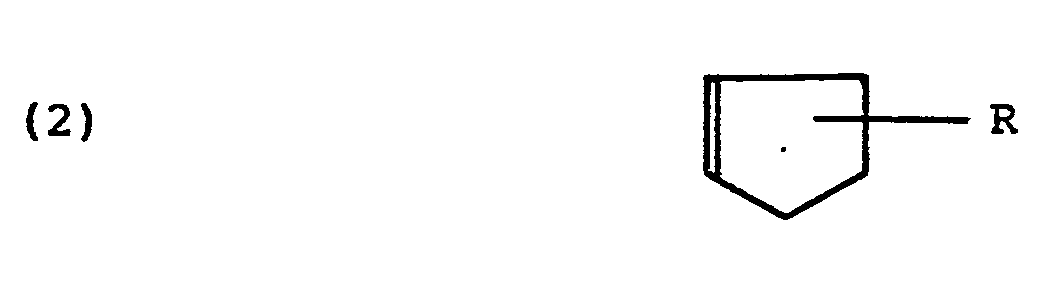
- cyclic or polycyclic alcohols which are olefinically unsaturated in their cyclic or polycyclic ring system act in the same way. Examples of particularly suitable compounds are shown in the formula pictures below.
- saturated monoalcohols which contain a tertiary N atom such as, for example, Dimethylethanolamine.
- Other compounds of this type are, for example, diethyl ethanolamine, dipropyl ethanolamine, dibutyl ethanolamine, 4- (2-hydroxyethyl) morpholine and ethyl oxyethyl aniline.
- diols with a tertiary N atom as the chain extender for component (C).
- diols are polyglycols, such as polyethylene glycol and polypropylene glycol and their copolymers with a molecular weight of up to 1000, Glycerol monoether of the general formula where R is a dicyclopentenyl, athoxidicyclopentenyl, norborneyl, dihydropyranyl, cyclopentenyl, cyclohexenyl group, methyldiethanolamine, n-butyldiethanolamine and cyclohexyldiethanolamine.
- the proportions of the starting component (A), (B) and (C) are chosen so that the content of the polyaminoamide component (A) in the resin is between 30-80% by weight and the content of the diisocyanate component (B) is between 10-45% by weight .-% and when using component (C) whose content is up to 40 wt .-%.
- the amino groups of the resins produced on the basis of the various variation possibilities of the starting components (A) to (C) are at least partially, for example 10, 30, 50, 70 or 80%, reacted with an acid to form amine salt groups, thereby rendering the resin water-dispersible.
- the basic N content of the resin is 0.5-2.5 equivalents / 1000 g resin and the degree of neutralization of the acid-reacted basic resin is 0.1-1 equivalents / 1000 g resin.
- the formation of amine salt groups is accomplished in a known manner using an inorganic, organic, complexing or non-complexing acid.
- Suitable acids which can also be used as mixtures, are carboxylic acids, such as formic acid, acetic acid and propionic acid, glycolic acid, lactic acid and tartaric acid, as well as inorganic acids such as sulfuric and phosphoric acid.
- carboxylic acids such as formic acid, acetic acid and propionic acid
- glycolic acid lactic acid and tartaric acid
- inorganic acids such as sulfuric and phosphoric acid.
- the acid is added diluted with water for better incorporation. In general, so much water is used that a suspension with a solids content of 50-80% is then obtained.
- the aqueous medium can also contain another solvent for better solubility.
- solvents are e.g. Esters, such as the monomethyl, monoethyl, monobutyl and monohexyl ethers of ethylene glycol acetates, ketones, such as diethyl ketone and methyl isobutyl ketone, or dieters of glycols or diglycols, such as diglycol diethyl ether and diglycol-di-n-butyl ether, and also tetrahanrofuran, as well as tetrahanrofuran.
- the amount is generally between 2 and 20 wt .-%, based on the total weight of the aqueous medium.
- the product with a solids content of 50-80% by weight can be mixed using conventional mixing techniques with further dilution with water as a 10 to 25% by weight dispersion with sulfur and / or siccatives based on naphthenates, oleates or acetates of heavy metal compounds such as those of cobalt, manganese, lead or zinc, and / or pigments based on heavy metal compounds, such as Ti0 2 , PbCr0 4 , PbSi0 3 , lead acetate and SrCr0 4 , and / or fillers, such as Si0 2 , talc and carbon black, homogeneously mixed , which further increases the hardness and the corrosion stability of the baked films.
- heavy metal compounds such as those of cobalt, manganese, lead or zinc
- / or pigments based on heavy metal compounds such as Ti0 2 , PbCr0 4 , PbSi0 3 , lead acetate and SrCr0 4
- fillers such as Si
- the aqueous coating composition which preferably contains in amounts of 1 to 20 percent by weight, based on the resin, sulfur and / or desiccant based on naphthenates, oleates or acetates of heavy metal compounds and / or pigments based on heavy metal compounds and / or fillers, can also contain the usual auxiliaries and additives, such as surfactants, anti-settling agents, antioxidants and dyes.
- the dispersions are characterized by good stability, high breakdown voltage and good wrap values.
- the applicable coating agent is brought into contact with the anode and the electrically conductive substrate to be coated, which acts as the cathode.
- the voltage used for their deposition on the cathode is usually 200 to 350 volts, the initial current density by current limitation 0.1 2 to 1 A / 100 cm.
- the conditions mentioned are therefore generally similar to those which are usually used for the deposition of other cationic resins.
- the substrate consisting of steel, aluminum or a metal alloy is washed in a customary manner, dried and then heated to a temperature from 100 ° C., preferably from 120 to 140 ° C., for curing.
- the invention Self-crosslinking amine group-containing aminourea resins, optionally with urethane groups, make it possible to achieve layer thicknesses of up to 40-50 u, using lower temperatures than in the case of the isocyanate crosslinking which has been customary to date. They are not only energy-saving, but also environmentally friendly, since no volatile polyisocyanate blocking agents are used in the resin systems according to the invention.
- the high layer thicknesses achieved enable two-coat painting of vehicle bodies.
- the salt spray test values are generally good. After 300 hours, phosphated steel sheets that had been provided with the unpigmented films did not show any infiltration at the cross cut.
- the polyalkylene amine is dissolved in approximately the same amount of methanol and an approximately 70% solution of the organic acids in methanol is added with stirring.
- the mixture is then first heated to 170-180 ° C. while distilling off the solvent and finally the water of reaction.
- imidazolidine or tetrahydropyrimidine formation occurs over time.
- the total basic amine is determined by titration with n / 10 HClO 4 in glacial acetic acid, that of the basic cyclic amidine nitrogen after acetylation of the primary and secondary amines also by titration with n / 10 HCl0 4 in glacial acetic acid.
- the reaction mixture is mixed with ketone and toluene and the water of reaction is removed using a water separator. Excess ketone and toluene are then removed under vacuum.
- MEK methyl ethyl ketone
- the mixture is left to react for a further 15 minutes at room temperature, then 4 times the amount, based on solids, of deionized water, mixed with 0.3 mmol acetic acid per g solid, is added at room temperature and the mixture is stirred for 3-4 days in an open vessel.
- the resin is then cataphoretically deposited on phosphated iron sheets (Bonder 101), baked at a maximum of 140 ° C, and then pendulum hardness and film thickness are measured.
- any additives such as elemental sulfur or siccative, are incorporated in a finely divided form before separation into the aqueous suspension or, in the presence of pigments, into the pigment paste.
- the isocyanate containing urethane groups is first prepared by reacting the diisocyanate with the unsaturated alcohol in equal parts by weight of methyl ethyl ketone at 50 ° C. and a reaction time of 1 hour, and this 50% solution is then added dropwise within 15 minutes with stirring and N 2 atmosphere at 20-30 ° C in the 50% solution of the mixed polyaminoamides A in MEK. After a reaction time of about 15 minutes, the calculated amount of acetic acid (50% neutralization of the basic nitrogen) and enough deionized water are added at room temperature that a 20% suspension results after removal of the solvent in vacuo. After stirring for 3-4 days in an open vessel at room temperature, the resin is cataphoretically deposited on phosphated iron sheet (Bonder 101). Pendulum hardness and film thickness are measured from the films baked at ⁇ 140 ° C.
- the additives are finely divided into the suspension.
- the ricinenamide IIIa and the chain-extending alcohols from group C (5) mentioned in Table 7 are introduced in a N 2 atmosphere, dissolved in 3-5 times the amount by weight of anhydrous acetone, tetrahydrofuran or Dioxane.
- the solution of the diisocyanate in 3-5 times the amount of the same solvent is added dropwise within 30-90 minutes, followed by the chain terminator C (5).
- the post-reaction time is 60 minutes.
- the resulting amino resin is partially neutralized with acetic acid to 50% and so much water is added that after removal of the organic solvent at 60 ° C./30 torr in a rotary evaporator, a 20% strength polymer dispersion is formed. After further additives, such as desiccants, have been added, the cathodic deposition takes place under the specified conditions.
- This pigment paste is then mixed into the resin of Example No. 13 in Table 4 in such a ratio that the pigment paste (calculated without solvent) accounts for 28.4% of the paint solids.
- the ratio of resin to pigments is therefore 1: 0.166.
- Ti0 2 , talc, carbon black and lead silicate (weight ratio 1: 0.63: 0.50: 0.15) are mixed with the 40% resin suspension of Example No. 2a of Table 6, partially neutralized with acetic acid, in a weight ratio of Resin to pigments like I: 0.228 ground in the sand mill. After dilution to 20% solids content, the paint is deposited as usual.
Landscapes
- Chemical & Material Sciences (AREA)
- Organic Chemistry (AREA)
- Chemical Kinetics & Catalysis (AREA)
- Health & Medical Sciences (AREA)
- Polymers & Plastics (AREA)
- Medicinal Chemistry (AREA)
- Engineering & Computer Science (AREA)
- Life Sciences & Earth Sciences (AREA)
- Wood Science & Technology (AREA)
- Materials Engineering (AREA)
- Molecular Biology (AREA)
- Manufacturing & Machinery (AREA)
- Polyurethanes Or Polyureas (AREA)
- Paints Or Removers (AREA)
- Compositions Of Macromolecular Compounds (AREA)
- Treatments For Attaching Organic Compounds To Fibrous Goods (AREA)
- Laminated Bodies (AREA)
- Polysaccharides And Polysaccharide Derivatives (AREA)
- Processes Of Treating Macromolecular Substances (AREA)
- Organic Low-Molecular-Weight Compounds And Preparation Thereof (AREA)
- Conductive Materials (AREA)
Abstract
- (A) einem Polyaminoamid, das aus
- (1) überwiegend höheren Fettsäuren und Alkylen- bzw. Polyalkylen-polyaminen und/oder
- (2) Dimerfettsäuren, gegebenenfalls im Gemisch mit vorwiegend höheren, im wesentlichen ungesättigten Fettsäuren, und Alkylen- bzw. Polyalkylenpolyaminen hergestellt wurde und zusätzlich teilweise cyclische Amidingruppierungen und gegebenenfalls als Ketimin blockierte Aminogruppen enthält,
- (B) einem Diisocyanat und gegebenenfalls von
-
- (C) (1) einem primären und/oder sekundären Allyl- bzw. Methallylamin und/oder
- (2) einem oder mehreren gesättigten primären und/ oder sekundären Aminen und/oder
- (3) einem Allyl- bzw. Methallylalkohol und/oder
- (4) einem oder mehreren cyclischen oder polycyclischen Alkoholen, die in ihrem cyclischen oder polycyclischen Ringsystemen olefinisch ungesättigt sind, und/oder
- (5) einem Monoalkohol mit einem tert. N-Atom und/ oder Diol mit gegebenenfalls einem tertiären N-Atom und mit einer Säure wasserdispergierbar gemacht.
Description
- Die vorliegende Erfindung betrifft selbstvernetzende kataphoretische amidgruppenhaltige Aminoharnstoffharze mit qegebenenfalls Urethangruppierungen und deren Verwenduna zur kathodischen elektrischen Beschichtung von elektrisch leitenden Gegenständen.
- Die kathodische elektrische Beschichtuna wird bekanntlich seit einiger Zeit in industriellem Maßstab durchgeführt und erfolgt im Prinzip so, daß ein elektrisch leitender Geqenstand in eine wäßrige Dispersion eines kationischen polymeren Materials eingetaucht wird. Der zwischen dem elektrisch leitenden und als Kathode fungierenden Gegenstand und der Anode als Gegenelektrode durch die Dispersion aeleitete Strom bewirkt die Abscheidung auf der Kathode.
- Die bisher in der Technik bekannten, an der Kathode elektrisch abscheidbaren Harze erfüllen ihren Zweck insofern noch nicht optimal, als die mit ihnen erzielbaren Schichtdicken noch gering, die erforderlichen Härtungstemperaturen noch relativ hoch (= 170°C) und die Emission beim Einbrennen der Überzugsmittel infolge Abspaltung von Polyisocyanat-Blockierungsmitteln ziemlich beträchtlich sind. Ein Beispiel hierfür stellen die in der DE-OS 3 004 538 beschriebenen Harze dar, die aus definierten basischen Polyaminoharzaddukten mit maskierten Polyisocyanaten hergestellt werden.
- Die vorliegende Erfindung stellt sich daher die Aufgabe, spezifische Harze und ein neues Verfahren zur Vernetzung von kathodisch abscheidbaren Überzugsmitteln bereitzustellen, mit denen höhere Schichtdicken bis zu 40 - 50 u realisiert werden können und das Einbrennen der Überzugsmittel ohne Einbuße von physikalischen Eigenschaften bei einer Temperatur zwischen 100°C und 14Ö°C ausgeführt werden kann, ohne daß hierbei in unrentabler Weise flüchtige Polyisocyanatblockierungsmittel abgespalten werden, die mit der Abluft verloren gehen und die Umwelt belasten.
- Die Aufgabe wird erfindungsgemäß durch selbstvernetzende kataphoretische amidgruppenhaltige Aminoharnstoffharze mit gegebenenfalls Urethangruppierungen gelöst, die dadurch gekennzeichnet sind, daß sie das Reaktionsprodukt von mindestens
- (A) einem Polyaminoamid, das aus
- (1) einer oder mehreren überwiegend höheren Fettsäure(n) und einem oder mehreren Alkylen- bzw. Polyalkylen-polyaminen und/oder
- (2) Dimerfettsäuren, gegebenenfalls im Gemisch mit vorwiegend höheren, im wesentlichen ungesättigten Fettsäuren, und einem oder mehreren Alkylen- bzw. Polyalkylenpolyaminen hergestellt worden ist und zusätzlich teilweise unter Wasserabspaltung entstandene cyclische Amidingruppierungen und gegebenenfalls als Ketimin blockierte Amino- gruppen enthält,
- (B) einem Diisocyanat und gegebenenfalls von
-
- (C) (1) einem primären und/oder sekundären Allyl- bzw. Methallylamin und/oder
- (2) einem oder mehreren gesättigten primären und/ oder sekundären aliphatischen, cycloalophatischen, heterecyclischen oder aromatischen Aminen und/oder
- (3) einem Allyl- bzw. Methallylalkohol und/oder
- (4) einem oder mehreren cyclischen oder polycyclischen Alkoholen, die in ihren cyclischen oder polycyclischen Ringsystemen olefinisch ungesättigt sind, und/oder
- (5) einem Monoalkohol mit einem tert. N-Atom und/ oder Diol mit gegebenenfalls einem tertiären N-Atom
- Die Polyaminoamid-Komponente A (1) leitet sich bezüglich der Säurekomponente vorwiegend von höheren Fettsäuren ab. Diese können gesättigte Fettsäuren darstellen, aber auch eine oder mehrere Doppelbindungen enthalten. Beispiele für die in natürlichen ölen, wie Leinöl, Tallöl und Ricinusöl, als Fettsäurederivate vorkommenden mehrfach ungesättigten Fettsäuren sind 9.11-Octadecadiensäure, 9.12-Octadecadiensäure, Linolsäure, Linolensäure, α-Eläostearinsäure und ß-Eläöstearinsäure. Beispiele für einfach ungesättigte Fettsäuren sind z.B. Ölsäure, deren höheren Homologe und Zoomarinsäure. Selbstverständlich können auch entsprechende und ähnliche synthetische Fettsäuren als Ausgangsmaterial dienen. Die im wesentlichen ungesättigten Fettsäuren können als Polyaminoamidbestandteil einzeln oder als Gemisch eingesetzt werden. Aus ökonomischen Gründen wird es jedoch bevorzugt, die im Handel erhältlichen Gemische derartiger Säuren einzusetzen, die auch noch gesättigte Fettsäuren enthalten.
- So eignen sich als Säurekomponente für das Polyaminoamid (A) (1) insbesondere Ricinenfettsäuren. Diese stellen Gemische dehydratisierter Ricinusöl-Fettsäuren dar und bestehen im wesentlichen aus 9.11-Octadecadiensäure und 9.12-Octadiensäure (Ricinensäuren) neben 5 - 7% ölsäure und 3 - 5% gesättigter Fettsäuren. Ebenso sind auch die Leinölfettsäuren geeignet, die Gemische aus Linolensäure ( ~ 38%) , Linolsäure (~ 42%) , ölsäure (~ 10%), Stearinsäure (~3%) und Palmitinsäure (~7%) darstellen, deren prozentuale Zusammensetzung natürlich in Grenzen schwanken kann. Auch Tallölfettsäuren, die als Fettsäuren insbesondere Palmitin-, Stearin-, Olein-, Linol- und Linolensäure enthalten, sind verwendbar.
- Als höhere Fettsäuren lassen sich grundsätzlich auch gesättigte Fettsäuren, wie Stearin- und Pamitinsäure,verwenden oder mitverwenden. Häufig empfiehlt es sich, die langkettigen Fettsäuren zu einem Teil durch kurzkettige Fettsäuren wie Essigsäure, Propionsäure oder Buttersäure zu ersetzen. Dies führt in einigen Fällen zu stabileren Suspensionen und härteren eingebrannten Filmen.
- Die Polyaminoamid-Komponente (A) (1) kann sich bezüglich der Aminkomponente von einem Äthylendiamin und/oder einem Polyäthylenpolyamin ableiten. Als Beispiele derartiger Verbindungen seien genannt: Äthylendiamin, Diäthylen-triamin, Triäthylentetramin, Tetraäthylen-pentamin, Gemische von Polyäthylen-polyaminen der Formel


- Häufig empfiehlt es sich für eine Verbesserung der Disper- gierbarkeit des Harzes in Wasser und für eine stärkere Vernetzung bei dem Einbrennvorgang, einen Teil der primären Aminogruppen nicht mit Säuren zum Amid umzusetzen, sondern mit Keton als Ketimin zu blockieren. Geeignete Ketone sind z.B. Methylisobutylketon, Methyläthylketon, Cyclohexanon. In der wäßrigen Suspension wird das Keton abgespalten und das primäre Amin zurückgebildet.
- Des weiteren können gemischte Polyalkylenpolyamine der allgemeinen Formel

- Die aus diesem Polyamin mit Säuren hergestellten Polyamide können unter drastischen Reaktionsbedingungen ebenfalls intramolekular Wasser abspalten und dabei Tetrahydropyrimidinderivate bilden.

- Auch bei diesen Polyaminoamiden ist es häufig von Vorteil, wenn ein Teil der primären Amino-Gruppen nicht mit Säuren umgesetzt, sondern mit Keton als Ketimin blockiert wird, das in wäßriger Suspension wieder gespalten wird.
- Es wird bevorzugt, daß das Polyaminoamid A (1) ein Reaktionsprodukt aus Ricinenfettsäuren oder Ricinenfettsäuren und Essigsäure oder Stearinsäure mit einem oder mehreren Alkylen- bzw. Polyalkylenpolyaminen der Formeln


- Die Polyaminoamid-Komponente (A) (2) leitet sich bezüglich der Säurekomponente von Dimerfettsäuren ab. Diese werden ihrerseits aus pflanzlichen doppelt oder dreifach ungesättigten Fettsäuren (Linol-, Linolen- und Rizinensäure, Holzöl-Fettsäure) bzw. deren Methylestern durch thermische Dimerisation, meist in Gegenwart von Katalysatoren (Bentonit, Montmorillonit, Fullererde), hergestellt. Die im wesentlichen nach Diels-Alder verlaufende Additionsreaktion setzt eine Isomerisierung zu Säuren mit konjugierter Doppelbindung voraus. Neben den Dimerfettsäuren können dabei noch 20 - 30% trimere Fettsäuren entstehen. Zum Aufbau der Polyaminoamid-Komponente (A) (2) können den Dimerfettsäuren bis zu 60 Gewichtsprozent der oben beschriebenen höheren, im wesentlichen ungesättigten Fettsäuren zugemischt werden, insbesondere Tallölfettsäuren und Ricinenfettsäuren.
- Als Aminokomponente der Polyaminoamide (A) (2) kommen insbesondere Polyäthylenamine oder ihre Gemische vom Typ H2N-(CH2-CH2-NH)n-CH2-CHz-NH2 mit n = 0 - 3 in Betracht. Bei der Umsetzung dieser Polyäthylenamine mit Dimerfettsäuren, gegebenenfalls im Gemisch mit höheren, im wesentlichen ungesättigten Fettsäuren, wird zusätzlich teilweise die Bildung von Imidazolin-haltigen Kondensationsprodukten angestrebt, die durch Cyclisierung der Aminoamidkomponente unter Abspaltung von 1 Mol Wasser erfolgt. Zu diesem Zweck wird das beispielsweise bei 160°C hergestellte Umsetzungsprodukt aus den dimeren Fettsäuren und dem Polyäthylenamin z.B. 6 Stunden lang auf 300°C erhitzt. Die in Rede stehenden Produkte sind z.B. unter dem Warenzeichen Versamid im Handel erhältlich (Firma Schering).
- Eine weitere geeignete Aminkomponente für das Polyaminoamid (A) (2), auch in Form eines Gemisches mit den obigen Polyäthylenaminen, ist z.B. das Polyalkylenpolyamin der Formel
-

- Es wird bevorzugt, daß das Polyaminoamid (A) (2) ein Reak- tionsprodukt aus Dimerfettsäuren und gegebenenfalls Tallölfettsäuren oder Ricinenfettsäuren mit einem oder mehreren Polyalkylen-polyaminen der Formel

- Die Polyaminoamide A (2) enthalten in den überwiegenden Fällen ebenfalls primäre Aminogruppen. Auch hierbei ist es häufig von Vorteil, wenn man sie vor der Umsetzung mit Polyisocyanaten mit Keton als Ketimin blockiert. Für dieses Blockieren kommen dieselben Ketone in Betracht, wie bei den Polyaminoamidkomponenten A (1).
- Zur Bildung von amidgruppenhaltigen Aminoharnstoffharzen mit gegebenenfalls Urethangruppierungen wird das Polyaminoamid (A) (1) und/oder (A) (2) u.a. mit einem oder mehreren Diisocyanaten nach an sich konventionellen Verfahrensmethoden umgesetzt. Zu den hierbei verwendbaren Diisocyanaten gehören beispielsweise die aliphatischen Diisocyanate, wie z.B. 1,6-Hexamethylendiisocyanat, 1,8-Octamethylendiisocyanat, 1,12-Dodecamethylendiisocyanat, 2,2,4-Trimethylhexamethylendiisocyanat und ähnliche Alkylendiisocyanate, 3,3'-Diisocyanatdipropyläther, 3-Isocyanatmethyl-3,5,5-trimethyl-cyclohexylisocyanat, Cyclopentylen-l,3-diisocyanat, Cyclohexylen-l,4-diisocyanat, 4-Methyl-l,3-diisocy- anatcyclohexan, trans-Vinylidendiisocyanat und ähnlich ungesättigte Diisocyanate, 4,4'-Methylen-bis(isocyanat- cyclohexan) und verwandte Isocyanate, aromatische Diisocyanate, wie 4,4'-Diisocyanatodiphenyl, 4,4'-Diisocyanato-3,3'-dichlor-diphenyl, 4,4'-Diisocyanato-3,3'-dimethoxy- diphenyl, 4,4'-Diisocyanato-3,3'-dimethyl-diphenyl, 4,4'-Diisocyanato-3,3'-diphenyl-diphenyl, 4,4'-Diisocyanato-diphenylmethan, 4,4'-Diisocyanato-3,3'-dimethyl- diphenylmethan, 1,5-Diisocyanatonaphthalin, Diisocyanato- toluole,N,N'-(4,4'-Dimethyl-3,3'-diisocyanatodiphenyl)-uretdion und Bis-1,3-(isocyanatomethyl)-benzol.
- Es wird bevorzugt, daß die Komponente (B) ein Gemisch aus 2,4- und 2,6-Diisocyanatotoluol und/oder 4,4'-Diisocyanatodiphenylmethan ist.
- Zur leichteren Steuerung spezifischer Harzeigenschaften, beispielsweise zur Erzielung einer stärkeren Vernetzung oder einer Kettenverlängerung des Makromoleküls oder einer besseren Dispergierbarkeit oder verbesserten Verlaufseigenschaften, kann gegebenenfalls die Mitverwendung einer oder mehrerer der im Anspruch 1 ausgeführten Verbindungen (C) vorteilhaft sein.
- Im Rahmen der Verbindungen C (1) eignen sich im Prinzip alle ungesättigten Amine, insbesondere die primären oder sekundären Allyl- bzw.Methallylamine, z.B. Allylamin, Methallylamin, Diallylamin und Dimethallylamin.
- Weitere geeignete Verbindungen für die Komponente C (2) stellen gesättigte primäre und/oder sekundäre aliphatische und cycloaliphatische sowie aromatische und heterocyclische Amine dar. Diese insbesondere als Kettenabbrecher wirksamen Verbindungen tragen zur Vermeidung einer zu starken Vernetzung des Harzes und zur Erhöhung der Härte bei den eingebrannten Filnen bei. Sie verbessern im allgemeinen das Emulgierverhalten in Wasser. Verwendbar sind z.B. Äthylamin, Propylamin, Di-n-propylamin, Di-i-propylamin, Di-sec-butylamin, n-Butylamin, sek.-Butylamin, n-Hexylamin, n-Octylamin, 2-Äthyl-hexylamin, n-Decylamin, i-Amylamin, Di-i-amylamin, Di-i-butylamin, oL-Naphthylamin, Pyrrolidin, Diäthylamin, Cyclohexylamin, Piperidin, Anilin, Methylanilin usw.
- Es können nicht nur die Einzelverbindungen als solche, sondern auch Mischungen von zwei oder mehreren der oben beispielhaft genannten Amine verwendet werden. Dies gilt auch für Mischungen mit den anderen für die Komponente (C) genannten Verbindungsklassen.
- Als Komponente C eignen sich ebenfalls ungesättigte Alkohole, insbesondere Allylalkohol und Methallylalkohol. Sie wirken nicht nur als Kettenabbrechner, sondern nehmen über die reaktive Doppelbindung an der späteren Vernetzung des Harzes teil.
- In gleicher Weise wirken die cyclischen oder polycyclischen Alkohole, die in ihrem cyclischen oder polycyclischen Ringsystem olefinisch ungesättigt sind. Beispiele besonders gut geeigneter Verbindungen sind in den nachfolgenden Formelbildern dargestellt.



- Im Rahmen der Komponente C (5) eignen sich als Kettenabbrecher auch gesättigte Monoalkohole, die ein tertiäres N-Atom enthalten, wie z.B. Dimethyläthanolamin. Weitere Verbindungen dieser Art sind zum Beispiel Diäthyläthanolamin, Dipropyläthanolamin, Dibutyläthanolamin, 4-(2-Hydroxyäthyl)-morpholin und Äthyloxäthylanilin.
- Für den Aufbau von Polyharnstoffurethan-Harzen ist es manchmal vorteilhaft, für die Komponente (C) als Kettenverlängerungsmittel Diole mit gegebenenfalls einem tertiären N-Atom einzusetzen. Beispiele solcher Diole sind Polyglykole, wie Polyäthylenglykol und Polypropylenglykol und deren Mischpolymerisate mit einem Molekulargewicht bis zu 1000, Glycerinmonoäther der allgemeinen Formel

- Die Mengenverhältnisse der Ausgangskomponente (A), (B) und (C) werden so gewählt, daß im Harz der Gehalt der Polyaminoamidkomponente (A) zwischen 30 - 80 Gew.-%, der Gehalt der Diisocyanatkomponente (B) zwischen 10 - 45 Gew.-% und bei Verwendung der Komponente (C) deren Gehalt bis zu 40 Gew.-% beträgt.
- Die Aminogruppen der auf der Basis der verschiedenen Variationsmöglichkeiten der Ausgangskomponenten (A) bis (C) hergestellten Harze werden mit einer Säure wenigstens teilweise, z.B. zu 10, 30, 50, 70 oder 80%, zu Aminsalzgruppen umgesetzt und das Harz damit wasserdispergierbar gemacht. In diesem Zusammenhang wird es bevorzugt, daß der basische N-Gehalt des Harzes 0,5 - 2,5 Äquivalente/1000 g Harz und der Neutralisationsgrad des mit Säure umgesetzten basischen Harzes O,l - 1 Äquivalente/1000 g Harz beträgt. Die Bildung von Aminsalzgruppen wird in bekannter Weise mittels einer anorganischen, organischen, komplexbildenden oder nicht komplexbildenden Säure bewerkstelligt. Beispiele geeigneter Säuren, die auch als Gemische verwendet werden können, sind Carbonsäuren, wie Ameisensäure, Essigsäure und Propionsäure, Glykolsäure, Milchsäure und Weinsäure, sowie anorganische Säuren wie Schwefel- und Phosphorsäure. Die Säure wird zur besseren Einarbeitung mit Wasser verdünnt zugegeben. Im allgemeinen verwendet man soviel Wasser, daß danach eine Suspension mit 50 - 80% Feststoffgehalt erhalten wird.
- Außer Wasser kann das wäßrige Medium der besseren Löslichkeit wegen noch ein anderes Lösungsmittel enthalten. Derartige Lösungsmittel sind z.B. Ester, wie die Monomethyl-, Monoäthyl-, Monobutyl- und Monohexyläther der Äthylenglykolacetate, Ketone, wie Diäthylketon und Methylisobutylketon, oder Diäther von Glykolen oder Diglykolen, wie Diglykoldiäthyläther und Diglykol-di-n-butyläther, außerdem Tetrahydrofuran und Dioxan. Die Menge liegt im allgemeinen zwischen 2 und 20 Gew.-%, bezogen auf das Gesamtgewicht des wäßrigen Mediums.
- Das Produkt mit einem Feststoffgehalt von 50 - 80 Gew.-% kann mittels herkömmlicher Mischtechniken unter weiterer Verdünnung mit Wasser als 10 bis 25 Gew.-%ige Dispersion mit Schwefel und/oder Sikkativen auf der Basis von Naphthenaten, Oleaten oder Acetaten von Schwermetallverbindungen wie die des Kobalts, Mangans, Blei oder Zinks, und/oder Pigmenten auf der Basis von Schwermetallverbindungen, wie Ti02, PbCr04, PbSi03, Bleiacetat und SrCr04, und/oder Füllstoffen, wie Si02, Talkum und Ruß,homogen vermischt werden, wodurch die Härte und die Korrosionsstabilität der eingebrannten Filme noch weiter erhöht wird. Darüber hinaus ist es ebenfalls möglich, den Schwefel und/oder die Sikkative und/oder die Pigmente unter Verwendung eines gekühlten Walzenstuhles mit der 50 bis 60 Gew.-%igen Harzdispersion gleichmäßig zu verreiben. Die erhaltene Mischung wird sodann in Wasser dispergiert und mit weiterem Wasser auf die in der Praxis übliche Konzentration von 10 - 25 Gew.-% verdünnt.
- Die wäßrige Beschichtungsmasse, die bevorzugt in Mengen von 1 bis 20 Gewichtsprozent, bezogen auf das Harz, Schwefel und/oder Sikkative auf der Basis von Naphthenaten, Oleaten oder Acetaten von Schwermetallverbindungen und/oder Pigmente auf der Basis von Schwermetallverbindungen und/oder Füllstoffe enthält, kann weiterhin die üblichenHilfsmittel und Zusatzstoffe, wie oberflächenaktive Stoffe, Antiabsetzmittel, Antioxydantien und Farbstoffe enthalten. Die Dispersionen zeichnen sich durch gute Stabilität, hohe Durchschlagsspannung und gute -Umgriffswerte aus. Das anwendungsfähige Überzugsmittel wird mit der Anode und dem zu beschichtenden elektrisch leitfähigen Substrat in Berührung gebracht, das als Kathode fungiert. Die zu ihrer Abscheidung auf der Kathode angewendete Spannung beträgt in der Regel 200 bis 350 Volt, die anfängliche Stromdichte durch Strombegrenzung 0,1 2 bis 1 A/100 cm . Die genannten Bedingungen sind also im allgemeinen denjenigen ähnlich, die üblicherweise für die Abscheidung anderer kationischer Harze verwendet werden.
- Nach dem Aufbringen der Beschichtungsmasse wird das aus Stahl, Aluminium oder einer Metall-Legierung bestehende Substrat in üblicher Weise gewaschen, getrocknet und anschließend zur Härtung auf eine Temperatur ab 100°C, vorzugsweise von 120 bis 140°C, erhitzt. Die erfindungsgemäßen selbstvernetzenden amidgruppenhaltigen Aminoharnstoffharze mit gegebenenfalls Urethangruppierungen gestatten es, Schichtdicken bis zu 40 - 50 u zu erreichen, und das bei Verwendung niedrigerer Temperaturen als im Falle der bisher üblichen Isocyanatvernetzung. Sie sind nicht nur energiesparend, sondern auch umweltfreundlich, da in den erfindungsgemäßen Harzsystemen keine flüchtigen Polyisocyanatblockierungsmittel verwendet werden.
- Infolge der erniedrigten Einbrenntemperatur ist es möglich, Metallteile, die Kunststoffeinbauten oder einseitige Kunststoffüberzüge aufweisen, mit diesen Kataphoreseharzen zu beschichten und gemeinsam einzubrennen.
- Die erzielten hohen Schichtdicken machen eine Zweischichtlackierung von Fahrzeugkarosserien möglich.
- Die Salzsprühtestwerte sind im allgemeinen gut. Phosphatierte Stahlbleche, die selbst mit den unpigmentierten Filmen versehen wurden, zeigen nach 300 Std. noch keine Unterwanderung am Kreuzschnitt.
- Anhand der folgenden Beispiele wird die Erfindung näher erläutert.
- Das Polyalkylenamin wird in etwa der gleichen Menge Methanol gelöst und unter Rühren mit einer etwa 70%-igen Lösung der organischen Säuren in Methanol versetzt.
- Anschließend erhitzt man das Gemisch zunächst unter Abdestillieren des Lösungsmittels und schließlich des Reaktionswassers auf 170 - 180°C. Hierbei tritt neben der Amidbildung mit fortschreitender Zeit die Imidazolidin- bzw. Tetrahydropyrimidinbildung ein. Die Bestimmung des gesamten basischen Amins erfolgt durch Titration mit n/10 HClO4 in Eisessig, die des basischen cyclischen Amidin-Stickstoffs nach Acetylierung der primären und sekundären Amine ebenfalls durch Titration mit n/10 HCl04 in Eisessig.
- Im Falle der Herstellung des Ketimins versetzt man das Reaktionsgemisch nach der Amidbildung und dem teilweisen Ringschluß mit Keton und Toluol und kreist mit Hilfe eines Wasserabscheiders das Reaktionswasser aus. Überschüssiges Keton und Toluol werden anschließend unter Vakuum abgezogen.
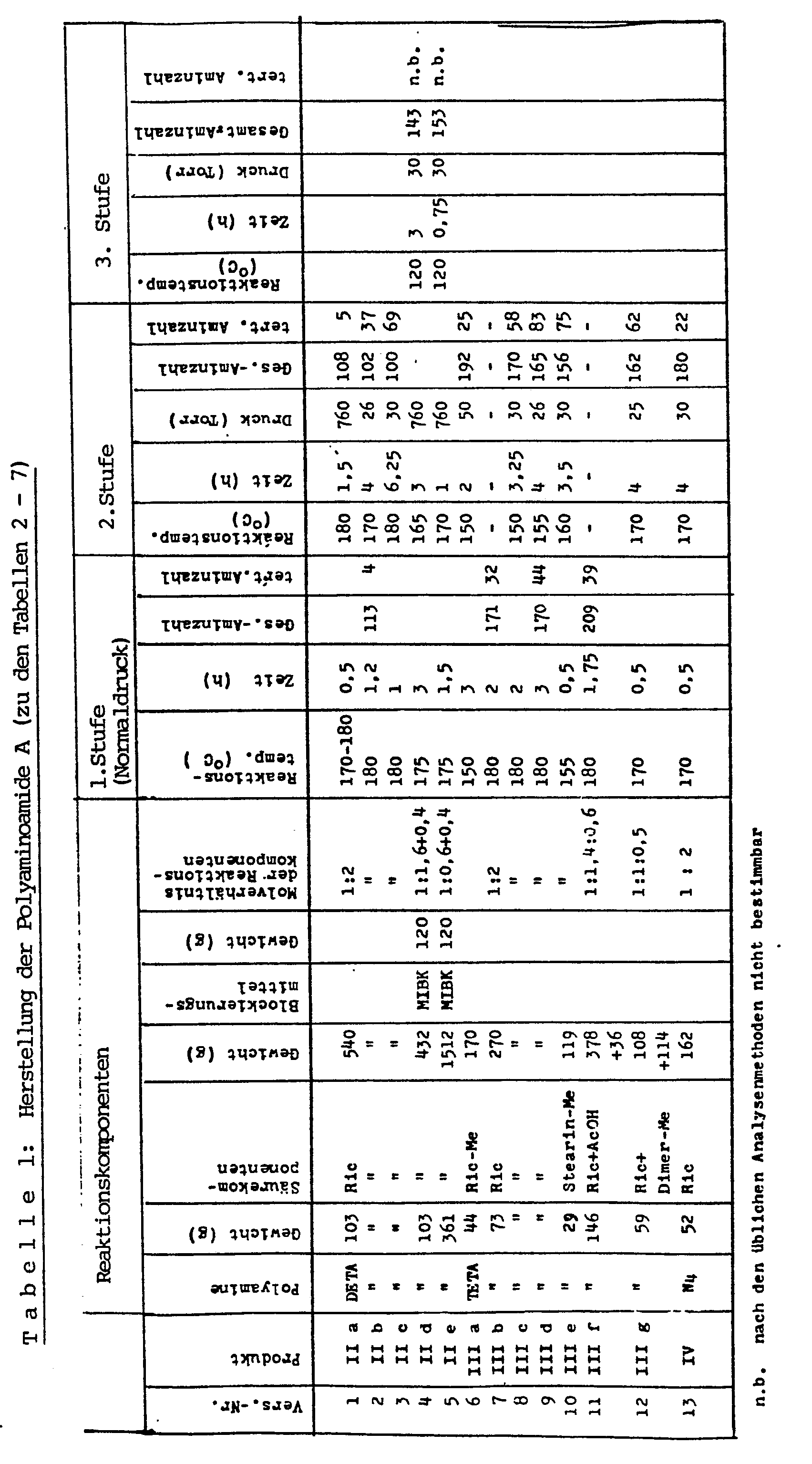
- Man löst die Polyaminoamide A und die Amine in der gleichen Gewichtsmenge MEK ( = Methyläthylketon) und gibt bei 20 - 30°C eine 50%-ige Lösung bzw. Suspension von Diisocyanat in MEK unter Rühren und Nz-Atmosphäre innerhalb von ca. 15 Minuten hinzu. Man läßt noch 15 Minuten bei Raumtemperatur nachreagieren, gibt anschließend die 4-fache Menge, bezogen auf Feststoff, an entionisiertem Wasser, vermischt mit 0,3 mMol Essigsäure pro g Feststoff, bei Raumtemperatur hinzu und läßt 3 - 4 Tage im offenen Gefäß rühren. Danach wird das Harz kataphoretisch auf phosphatierten Eisenblechen (Bonder 101) abgeschieden, bei maximal 140°C eingebrannt, und anschließend werden Pendelhärte und Fimstärke gemessen.
- Eventuelle Zusätze, wie elementarer Schwefel oder Siccative, werden feinstverteilt vor der Abscheidung in die wäßrige Suspension oder bei Anwesenheit von Pigmenten in die Pigmentpaste mit eingearbeitet.
- Man stellt zunächst das urethangruppenhaltige Isocyanat durch Reaktion des Diisocyanats mit dem ungesättigten Alkohol in gleichen Gewichtsteilen an Methyläthylketon bei 50°C und einer Reaktionszeit von 1 Stunde her und tropft diese 50%-ige Lösung anschließend innerhalb von 15 Minuten unter Rühren und N2-Atmosphäre bei 20 - 30°C in die 50%-ige Lösung der gemischten Polyaminoamide A in MEK. Nach einer Nachreaktionszeit von etwa 15 Minuten setzt man bei Raumtemperatur die berechnete Essigsäuremenge (50%-ige Neutralisation des basischen Stickstoffs) und soviel entionisiertes Wasser zu, daß nach Abziehen des Lösungsmittels im Vakuum eine 20%-ige Suspension resultiert. Nach 3-4-tägigem Rühren im offenen Gefäß bei Raumtemperatur wird das Harz kataphoretisch auf phosphatiertem Eisenblech (Bonder 101) abgeschieden. Von den bei ≦ 140°C eingebrannten Filmen werden Pendelhärte und Filmstärke gemessen.
- Die Zusätze werden feinstverteilt in die Suspension eingetragen.
- In einem mit Rührer, Tropftrichter und Thermometer versehenen Reaktionsgefäß werden in N2-Atmosphäre das Ricinenamid IIIa, sowie die in Tabelle 7 genannten kettenverlängernden Alkohole der Gruppe C (5) vorgelegt, gelöst in der 3-5-fachen Gewichtsmenge wasserfreien Acetons, Tetrahydrofurans oder Dioxans. Bei Raumtemperatur tropft man innerhalb von 30-90 Minuten die Lösung des Diisocyanates in der 3-5- fachen Menge des gleiehen Lösungsmittels zu, anschließend daran den Kettenabbrecher C (5). Die Nachreaktionszeit beträgt 60 Minuten. Danach wird das entstandene Aminoharz mit Essigsäure zu 50% teilneutralisiert und mit soviel Wasser versetzt, daß nach Abziehen des organischen Lösungsmittels bei 60°C/30 Torr im Rotationsverdampfer eine 20%- ige Polymerdispersion entsteht. Nachdem man noch weitere Zusätze, wie beispielsweise Sikkative, zugegeben hat, erfolgt die kathodische Abscheidung unter den angegebenen Bedingungen.
- Ti02, Si02, Bleisilikat und Ruß (Gewichtsverhältnis l : 0, 84 : 0, 21 : 0,04) werden mit der doppelten Menge der mit Essigsäure teilneutralisierten (0,3 mMol AcOH/g Feststoff), 50%-igen Harzsuspension des Beispiels Nr. 13 der Tabelle 4 (Gewichtsverhältnis MEK: Wasser = 1 : 0,73) vermischt und auf einem gekühlten Walzenstuhl mehrmals innig verrieben.
- Diese Pigmentpaste wird dann dem Harz des Beispiels Nr. 13 der Tabelle 4 in einem solchen Verhältnis zugemischt, daß die Pigmentpaste (ohne Lösungsmittel berechnet) 28,4% des Lackfeststoffes ausmacht. Das Verhältnis von Harz zu Pigmenten beträgt demnach 1 : 0,166. Nach Verdünnen mit Wasser auf einen Feststoffgehalt von 20% wird der Lack wie üblich abgeschieden.
- Ti02, Talkum, Ruß und Bleisilikat (Gewichtsverhältnis 1 : 0,63 : 0,50 : 0,15) werden mit der mit Essigsäure zu 50% teilneutralisierten 40%-igen Harzsuspension des Beispiels Nr. 2a der Tabelle 6 in einem Gewichtsverhältnis von Harz zu Pigmenten wie I : 0,228 innig in der Sandmühle verrieben. Nach Verdünnen auf 20% Feststoffgehalt wird der Lack wie üblich abgeschieden.
-


-

-



darstellen und mit einer Säure unter Ausbildung von kationischen Gruppen in Wasser dispergierbar gemacht worden sind.
Claims (9)
darstellen und mit einer Säure unter Ausbildung von kationischen Gruppen in Wasser dispergierbar gemacht worden sind.


Priority Applications (1)
| Application Number | Priority Date | Filing Date | Title |
|---|---|---|---|
| AT82111786T ATE16815T1 (de) | 1982-01-20 | 1982-12-18 | Selbstvernetzende kataphoretische amidgruppenhaltige aminoharnstoffharze mit gegebenenfalls urethangruppierungen. |
Applications Claiming Priority (2)
| Application Number | Priority Date | Filing Date | Title |
|---|---|---|---|
| DE19823201565 DE3201565A1 (de) | 1982-01-20 | 1982-01-20 | Selbstvernetzende kataphoretische amidgruppenhaltige aminoharnstoffharze mit gegebenenfalls urethangruppierungen |
| DE3201565 | 1982-01-20 |
Publications (3)
| Publication Number | Publication Date |
|---|---|
| EP0086893A2 true EP0086893A2 (de) | 1983-08-31 |
| EP0086893A3 EP0086893A3 (en) | 1984-02-22 |
| EP0086893B1 EP0086893B1 (de) | 1985-12-04 |
Family
ID=6153443
Family Applications (1)
| Application Number | Title | Priority Date | Filing Date |
|---|---|---|---|
| EP82111786A Expired EP0086893B1 (de) | 1982-01-20 | 1982-12-18 | Selbstvernetzende kataphoretische amidgruppenhaltige Aminoharnstoffharze mit gegebenenfalls Urethangruppierungen |
Country Status (9)
| Country | Link |
|---|---|
| US (1) | US4463157A (de) |
| EP (1) | EP0086893B1 (de) |
| JP (1) | JPS58127722A (de) |
| AT (1) | ATE16815T1 (de) |
| AU (1) | AU9178082A (de) |
| BR (1) | BR8300235A (de) |
| DE (2) | DE3201565A1 (de) |
| ES (1) | ES519096A0 (de) |
| ZA (1) | ZA83398B (de) |
Cited By (2)
| Publication number | Priority date | Publication date | Assignee | Title |
|---|---|---|---|---|
| EP0134970A1 (de) * | 1983-07-18 | 1985-03-27 | Akzo GmbH | Flüssige Beschichtungskompositionen auf der Basis von amidgruppenhaltigen Aminoharnstoffharzen mit gegebenenfalls Urethan- oder Thiourethangruppierungen |
| EP0672698A1 (de) * | 1994-03-17 | 1995-09-20 | Bayer Ag | Verfahren zur Herstellung von gegebenenfalls zellförmigen Polyurethanen und/oder Polyurethanharnstoffen |
Families Citing this family (16)
| Publication number | Priority date | Publication date | Assignee | Title |
|---|---|---|---|---|
| DE3333834A1 (de) * | 1983-09-20 | 1985-04-04 | Herberts Gmbh, 5600 Wuppertal | Verfahren zur herstellung von lack-kunstharzen und diese enthaltendes elektrotauchlack-ueberzugsmittel |
| FR2553091B1 (fr) * | 1983-10-05 | 1986-04-11 | Atochem | Composition reactive a plusieurs constituants, polymeres obtenus a partir de cette composition et applications de celle-ci |
| US4732959A (en) * | 1984-11-22 | 1988-03-22 | Toyo Tire & Rubber Company Limited | Polyesterpolyol derivative and a poly(urethane)ureamide obtained therefrom |
| DE3726636C1 (de) * | 1987-08-11 | 1988-10-06 | Grillo Werke Ag | Desodorantien und ihre Verwendung |
| US5262535A (en) * | 1992-02-20 | 1993-11-16 | Binney & Smith Inc. | Surfactant composition and method of making the same |
| CN100410278C (zh) * | 2003-01-29 | 2008-08-13 | 特拉华特威德·格林公司 | 用于全氟弹性体组合物的基于双氨基苯基的固化剂和基于脒的固化剂以及固化促进剂 |
| US20070287808A1 (en) * | 2006-06-09 | 2007-12-13 | Gamini Ananda Vedage | Polyamide curing agent compositions |
| US8293863B2 (en) * | 2006-06-09 | 2012-10-23 | Air Products And Chemicals, Inc. | Polyamide curative from substituted amine and dimer fatty acid or ester |
| US7655736B2 (en) * | 2006-06-09 | 2010-02-02 | Air Products And Chemicals, Inc. | Polyamide curative from substituted amine mixture and dimer fatty acid or ester |
| JP5339768B2 (ja) * | 2008-04-17 | 2013-11-13 | 日本ペイント株式会社 | カチオン性樹脂組成物、その製造方法、水性塗料組成物、およびカチオン電着塗料組成物 |
| US8513376B2 (en) | 2011-03-15 | 2013-08-20 | Air Products And Chemicals, Inc. | Polyamides and amidoamines from selectively modified amine amines |
| JP6507103B2 (ja) * | 2013-02-13 | 2019-04-24 | ルブリゾル アドバンスド マテリアルズ, インコーポレイテッド | 水性ポリアミド−尿素分散物 |
| US9988555B2 (en) | 2013-02-13 | 2018-06-05 | Lubrizol Advanced Materials, Inc. | Water-borne polyamide-urea dispersions |
| US10676564B2 (en) * | 2016-02-02 | 2020-06-09 | Evonik Operations Gmbh | Amidoamine and polyamide curing agents, compositions, and methods |
| EP3504303B1 (de) * | 2016-08-25 | 2020-04-01 | Evonik Operations GmbH | Substituierte mannich-base-kraftstoffadditive, zusammensetzungen und verfahren |
| TWI841234B (zh) | 2017-04-28 | 2024-05-01 | 美商盧伯利索先進材料有限公司 | 消光聚醯胺-pud |
Family Cites Families (8)
| Publication number | Priority date | Publication date | Assignee | Title |
|---|---|---|---|---|
| US2450940A (en) * | 1944-04-20 | 1948-10-12 | John C Cowan | Polyamides from polymeric fat acids |
| DE2040658A1 (de) * | 1970-08-17 | 1972-02-24 | Veba Chemie Ag | Polyamidureide und Polyamidurethane |
| FR2398767A1 (fr) * | 1977-07-22 | 1979-02-23 | Kansai Paint Co Ltd | Procede pour la preparation de composition pour revetement par electrophorese cationique |
| US4153776A (en) * | 1978-03-28 | 1979-05-08 | Ppg Industries, Inc. | Amide-modified urethane acrylate radiation curable compounds and coating compositions and methods of making same |
| US4169080A (en) * | 1978-05-04 | 1979-09-25 | Mobil Oil Corporation | Cationic aqueous emulsion systems |
| DE2962966D1 (en) * | 1978-11-06 | 1982-07-15 | Herberts & Co Gmbh | Heat-hardenable aqueous coating composition, application thereof to the electrodeposition and method for coating a conductive substrate by cathodic deposition |
| JPS5937029B2 (ja) * | 1979-02-26 | 1984-09-07 | 三菱化学株式会社 | 陰極電着塗装法 |
| JPS55127472A (en) * | 1979-03-26 | 1980-10-02 | Kansai Paint Co Ltd | Resin composition for cation electrodeposition coating |
-
1982
- 1982-01-20 DE DE19823201565 patent/DE3201565A1/de not_active Withdrawn
- 1982-12-18 DE DE8282111786T patent/DE3267844D1/de not_active Expired
- 1982-12-18 EP EP82111786A patent/EP0086893B1/de not_active Expired
- 1982-12-18 AT AT82111786T patent/ATE16815T1/de not_active IP Right Cessation
- 1982-12-22 AU AU91780/82A patent/AU9178082A/en not_active Abandoned
-
1983
- 1983-01-14 JP JP58003631A patent/JPS58127722A/ja active Pending
- 1983-01-18 BR BR8300235A patent/BR8300235A/pt unknown
- 1983-01-19 ES ES519096A patent/ES519096A0/es active Granted
- 1983-01-20 ZA ZA83398A patent/ZA83398B/xx unknown
- 1983-01-20 US US06/459,623 patent/US4463157A/en not_active Expired - Fee Related
Cited By (2)
| Publication number | Priority date | Publication date | Assignee | Title |
|---|---|---|---|---|
| EP0134970A1 (de) * | 1983-07-18 | 1985-03-27 | Akzo GmbH | Flüssige Beschichtungskompositionen auf der Basis von amidgruppenhaltigen Aminoharnstoffharzen mit gegebenenfalls Urethan- oder Thiourethangruppierungen |
| EP0672698A1 (de) * | 1994-03-17 | 1995-09-20 | Bayer Ag | Verfahren zur Herstellung von gegebenenfalls zellförmigen Polyurethanen und/oder Polyurethanharnstoffen |
Also Published As
| Publication number | Publication date |
|---|---|
| ES8400456A1 (es) | 1983-10-16 |
| EP0086893A3 (en) | 1984-02-22 |
| DE3201565A1 (de) | 1983-07-28 |
| ATE16815T1 (de) | 1985-12-15 |
| US4463157A (en) | 1984-07-31 |
| JPS58127722A (ja) | 1983-07-29 |
| ES519096A0 (es) | 1983-10-16 |
| DE3267844D1 (en) | 1986-01-16 |
| EP0086893B1 (de) | 1985-12-04 |
| AU9178082A (en) | 1983-07-28 |
| BR8300235A (pt) | 1983-10-18 |
| ZA83398B (en) | 1983-10-26 |
Similar Documents
| Publication | Publication Date | Title |
|---|---|---|
| EP0086893B1 (de) | Selbstvernetzende kataphoretische amidgruppenhaltige Aminoharnstoffharze mit gegebenenfalls Urethangruppierungen | |
| DE2940134C2 (de) | Kationische, elektrophoretisch abscheidbare Harzzusammensetzung | |
| EP0010670B1 (de) | Verfahren zur Herstellung kathodisch abscheidbarer Elektrotauchlackbindemittel | |
| EP0178531B1 (de) | Wässriges Elektrotauchlack-Überzugsmittel und dessen Verwendung zum Beschichten von Gegenständen | |
| DE10001222A1 (de) | Beschichtung, enthaltend kolloidal verteiltes metallisches Bismut | |
| DE3004538A1 (de) | Harzmasse fuer kationische, elektrophoretisch abscheidbare anstrichmittel | |
| EP0528853B1 (de) | Verfahren zum beschichten elektrisch leitfähiger substrate und kathodisch abscheidbarer wässriger elektrotauchlack | |
| EP0137459B2 (de) | Kathodisch abscheidbares wässriges Elektrotauchlack-Überzugsmittel und dessen Verwendung | |
| DE3014733A1 (de) | Wasserdispergierbare kationische harze | |
| DE102006059123A1 (de) | Anstrichmittel für die Elektroabscheidung | |
| EP0135909A2 (de) | Kathodisch abscheidbares wässriges Elektrotauchlack-Überzugsmittel | |
| EP0134970A1 (de) | Flüssige Beschichtungskompositionen auf der Basis von amidgruppenhaltigen Aminoharnstoffharzen mit gegebenenfalls Urethan- oder Thiourethangruppierungen | |
| EP0334284B1 (de) | Härter für Kunstharze, diesen enthaltende härtbare Mischungen sowie dessen Verwendung | |
| DE4012702C2 (de) | ||
| DE10242897A1 (de) | Kationische Harzmasse | |
| DE4306024A1 (de) | ||
| EP0225530A2 (de) | Durch Protonieren mit Säure wasserverdünnbares Bindemittel, dessen Herstellung und Verwendung | |
| DE69210392T2 (de) | Reaktionprodukten von einem amindiol mit einem polyfunktionellen verbindung und ihre verwendung in cationischer lackierungzusammensetzungen | |
| EP0123140B1 (de) | Bindemittel für die kathodische Elektrotauchlackierung | |
| EP0230031B1 (de) | Kathodisch abscheidbares wässriges Elektrotauchlack-Überzugsmittel und dessen Verwendung zum Beschichten von Gegenständen | |
| DE4018087A1 (de) | Verfahren zum beschichten elektrisch leitfaehiger substrate, waessrige lacke und blockierte nco-gruppen enthaltende vernetzungsmittel | |
| DE3801787A1 (de) | Verfahren zur beschichtung elektrisch leitfaehiger substrate, nach diesem verfahren beschichtete substrate und waessrige elektrotauchlackbaeder | |
| EP0739954B1 (de) | Wässriger kathodisch abscheidbarer Elektrotauchlack und Beschichtungsverfahren unter dessen Verwendung | |
| EP0230957A2 (de) | Härtungskomponente für Kunstharze, die zur Amid- oder Esterbildung mit Carbonsäuren befähigte Gruppen enthalten | |
| DE3109282A1 (de) | Kationisch elektrophoretisch abscheidbare harzmasse mit blockierten isocyanatgruppen vom gehaerteten typ |
Legal Events
| Date | Code | Title | Description |
|---|---|---|---|
| PUAI | Public reference made under article 153(3) epc to a published international application that has entered the european phase |
Free format text: ORIGINAL CODE: 0009012 |
|
| AK | Designated contracting states |
Designated state(s): AT BE DE FR GB IT NL SE |
|
| PUAL | Search report despatched |
Free format text: ORIGINAL CODE: 0009013 |
|
| 17P | Request for examination filed |
Effective date: 19831025 |
|
| AK | Designated contracting states |
Designated state(s): AT BE DE FR GB IT NL SE |
|
| ITF | It: translation for a ep patent filed | ||
| GRAA | (expected) grant |
Free format text: ORIGINAL CODE: 0009210 |
|
| AK | Designated contracting states |
Designated state(s): AT BE DE FR GB IT NL SE |
|
| REF | Corresponds to: |
Ref document number: 16815 Country of ref document: AT Date of ref document: 19851215 Kind code of ref document: T |
|
| ET | Fr: translation filed | ||
| PGFP | Annual fee paid to national office [announced via postgrant information from national office to epo] |
Ref country code: AT Payment date: 19860115 Year of fee payment: 4 |
|
| REF | Corresponds to: |
Ref document number: 3267844 Country of ref document: DE Date of ref document: 19860116 |
|
| PLBE | No opposition filed within time limit |
Free format text: ORIGINAL CODE: 0009261 |
|
| STAA | Information on the status of an ep patent application or granted ep patent |
Free format text: STATUS: NO OPPOSITION FILED WITHIN TIME LIMIT |
|
| 26N | No opposition filed | ||
| PG25 | Lapsed in a contracting state [announced via postgrant information from national office to epo] |
Ref country code: AT Effective date: 19861218 |
|
| PG25 | Lapsed in a contracting state [announced via postgrant information from national office to epo] |
Ref country code: SE Effective date: 19861219 |
|
| PGFP | Annual fee paid to national office [announced via postgrant information from national office to epo] |
Ref country code: NL Payment date: 19871231 Year of fee payment: 6 |
|
| PG25 | Lapsed in a contracting state [announced via postgrant information from national office to epo] |
Ref country code: GB Effective date: 19881218 |
|
| PG25 | Lapsed in a contracting state [announced via postgrant information from national office to epo] |
Ref country code: BE Effective date: 19881231 |
|
| NLT1 | Nl: modifications of names registered in virtue of documents presented to the patent office pursuant to art. 16 a, paragraph 1 |
Owner name: AKZO PATENTE GMBH TE WUPPERTAL, BONDSREPUBLIEK DUI |
|
| BERE | Be: lapsed |
Owner name: AKZO G.M.B.H. Effective date: 19881231 |
|
| PG25 | Lapsed in a contracting state [announced via postgrant information from national office to epo] |
Ref country code: NL Effective date: 19890701 |
|
| NLV4 | Nl: lapsed or anulled due to non-payment of the annual fee | ||
| GBPC | Gb: european patent ceased through non-payment of renewal fee | ||
| PG25 | Lapsed in a contracting state [announced via postgrant information from national office to epo] |
Ref country code: FR Free format text: LAPSE BECAUSE OF NON-PAYMENT OF DUE FEES Effective date: 19890831 |
|
| PG25 | Lapsed in a contracting state [announced via postgrant information from national office to epo] |
Ref country code: DE Effective date: 19890901 |
|
| REG | Reference to a national code |
Ref country code: FR Ref legal event code: ST |
|
| EUG | Se: european patent has lapsed |
Ref document number: 82111786.8 Effective date: 19870917 |