EP0087670B1 - Procédé pour éviter une phase gazeuse explosible auprès des réactions gaz-liquide - Google Patents
Procédé pour éviter une phase gazeuse explosible auprès des réactions gaz-liquide Download PDFInfo
- Publication number
- EP0087670B1 EP0087670B1 EP83101432A EP83101432A EP0087670B1 EP 0087670 B1 EP0087670 B1 EP 0087670B1 EP 83101432 A EP83101432 A EP 83101432A EP 83101432 A EP83101432 A EP 83101432A EP 0087670 B1 EP0087670 B1 EP 0087670B1
- Authority
- EP
- European Patent Office
- Prior art keywords
- gas
- reactor
- liquid
- reactant
- jet
- Prior art date
- Legal status (The legal status is an assumption and is not a legal conclusion. Google has not performed a legal analysis and makes no representation as to the accuracy of the status listed.)
- Expired
Links
- 239000007788 liquid Substances 0.000 title claims description 47
- 238000006243 chemical reaction Methods 0.000 title claims description 19
- 238000000034 method Methods 0.000 title claims description 15
- 239000002360 explosive Substances 0.000 title claims description 12
- 230000008569 process Effects 0.000 title claims description 3
- 239000007789 gas Substances 0.000 claims description 78
- 239000011261 inert gas Substances 0.000 claims description 20
- 239000000376 reactant Substances 0.000 claims description 17
- 239000000203 mixture Substances 0.000 claims description 11
- 239000001301 oxygen Substances 0.000 claims description 9
- 229910052760 oxygen Inorganic materials 0.000 claims description 9
- QVGXLLKOCUKJST-UHFFFAOYSA-N atomic oxygen Chemical compound [O] QVGXLLKOCUKJST-UHFFFAOYSA-N 0.000 claims description 8
- 239000006185 dispersion Substances 0.000 claims description 8
- 230000001427 coherent effect Effects 0.000 claims description 7
- 239000004721 Polyphenylene oxide Substances 0.000 claims description 4
- 229920006380 polyphenylene oxide Polymers 0.000 claims description 4
- 230000009471 action Effects 0.000 claims description 2
- 238000005691 oxidative coupling reaction Methods 0.000 claims description 2
- 239000012071 phase Substances 0.000 description 12
- 239000012495 reaction gas Substances 0.000 description 9
- IJGRMHOSHXDMSA-UHFFFAOYSA-N Atomic nitrogen Chemical compound N#N IJGRMHOSHXDMSA-UHFFFAOYSA-N 0.000 description 6
- 230000015572 biosynthetic process Effects 0.000 description 6
- MYMOFIZGZYHOMD-UHFFFAOYSA-N Dioxygen Chemical compound O=O MYMOFIZGZYHOMD-UHFFFAOYSA-N 0.000 description 4
- 238000004880 explosion Methods 0.000 description 4
- 238000007654 immersion Methods 0.000 description 4
- 238000000926 separation method Methods 0.000 description 4
- OKKJLVBELUTLKV-UHFFFAOYSA-N Methanol Chemical compound OC OKKJLVBELUTLKV-UHFFFAOYSA-N 0.000 description 3
- YXFVVABEGXRONW-UHFFFAOYSA-N Toluene Chemical compound CC1=CC=CC=C1 YXFVVABEGXRONW-UHFFFAOYSA-N 0.000 description 3
- 239000000047 product Substances 0.000 description 3
- 239000003380 propellant Substances 0.000 description 3
- 239000007787 solid Substances 0.000 description 3
- 239000002904 solvent Substances 0.000 description 3
- NXXYKOUNUYWIHA-UHFFFAOYSA-N 2,6-Dimethylphenol Chemical compound CC1=CC=CC(C)=C1O NXXYKOUNUYWIHA-UHFFFAOYSA-N 0.000 description 2
- HEDRZPFGACZZDS-UHFFFAOYSA-N Chloroform Chemical compound ClC(Cl)Cl HEDRZPFGACZZDS-UHFFFAOYSA-N 0.000 description 2
- 230000008901 benefit Effects 0.000 description 2
- 230000003139 buffering effect Effects 0.000 description 2
- 238000003889 chemical engineering Methods 0.000 description 2
- JQVDAXLFBXTEQA-UHFFFAOYSA-N dibutylamine Chemical compound CCCCNCCCC JQVDAXLFBXTEQA-UHFFFAOYSA-N 0.000 description 2
- 229910001873 dinitrogen Inorganic materials 0.000 description 2
- 238000005516 engineering process Methods 0.000 description 2
- 239000007791 liquid phase Substances 0.000 description 2
- 230000007257 malfunction Effects 0.000 description 2
- 238000012544 monitoring process Methods 0.000 description 2
- 229910052757 nitrogen Inorganic materials 0.000 description 2
- 238000005191 phase separation Methods 0.000 description 2
- 239000012429 reaction media Substances 0.000 description 2
- 239000011541 reaction mixture Substances 0.000 description 2
- 230000035484 reaction time Effects 0.000 description 2
- 230000007306 turnover Effects 0.000 description 2
- CPELXLSAUQHCOX-UHFFFAOYSA-M Bromide Chemical compound [Br-] CPELXLSAUQHCOX-UHFFFAOYSA-M 0.000 description 1
- 241001503485 Mammuthus Species 0.000 description 1
- 230000004913 activation Effects 0.000 description 1
- 230000001154 acute effect Effects 0.000 description 1
- 239000003054 catalyst Substances 0.000 description 1
- 238000004581 coalescence Methods 0.000 description 1
- 230000006835 compression Effects 0.000 description 1
- 238000007906 compression Methods 0.000 description 1
- 230000008021 deposition Effects 0.000 description 1
- 238000005474 detonation Methods 0.000 description 1
- 229910001882 dioxygen Inorganic materials 0.000 description 1
- 238000001035 drying Methods 0.000 description 1
- 238000003912 environmental pollution Methods 0.000 description 1
- 238000001704 evaporation Methods 0.000 description 1
- 230000008020 evaporation Effects 0.000 description 1
- 238000005188 flotation Methods 0.000 description 1
- 229930195733 hydrocarbon Natural products 0.000 description 1
- 150000002430 hydrocarbons Chemical class 0.000 description 1
- 239000012430 organic reaction media Substances 0.000 description 1
- 239000007800 oxidant agent Substances 0.000 description 1
- 238000007254 oxidation reaction Methods 0.000 description 1
- 239000002244 precipitate Substances 0.000 description 1
- 238000003825 pressing Methods 0.000 description 1
- 230000003449 preventive effect Effects 0.000 description 1
- 230000000135 prohibitive effect Effects 0.000 description 1
- 238000011084 recovery Methods 0.000 description 1
- 230000001105 regulatory effect Effects 0.000 description 1
- 230000000717 retained effect Effects 0.000 description 1
- 230000000630 rising effect Effects 0.000 description 1
- 238000005204 segregation Methods 0.000 description 1
- 239000000126 substance Substances 0.000 description 1
- XLYOFNOQVPJJNP-UHFFFAOYSA-N water Substances O XLYOFNOQVPJJNP-UHFFFAOYSA-N 0.000 description 1
Images
Classifications
-
- C—CHEMISTRY; METALLURGY
- C08—ORGANIC MACROMOLECULAR COMPOUNDS; THEIR PREPARATION OR CHEMICAL WORKING-UP; COMPOSITIONS BASED THEREON
- C08G—MACROMOLECULAR COMPOUNDS OBTAINED OTHERWISE THAN BY REACTIONS ONLY INVOLVING UNSATURATED CARBON-TO-CARBON BONDS
- C08G65/00—Macromolecular compounds obtained by reactions forming an ether link in the main chain of the macromolecule
- C08G65/34—Macromolecular compounds obtained by reactions forming an ether link in the main chain of the macromolecule from hydroxy compounds or their metallic derivatives
- C08G65/38—Macromolecular compounds obtained by reactions forming an ether link in the main chain of the macromolecule from hydroxy compounds or their metallic derivatives derived from phenols
- C08G65/44—Macromolecular compounds obtained by reactions forming an ether link in the main chain of the macromolecule from hydroxy compounds or their metallic derivatives derived from phenols by oxidation of phenols
-
- B—PERFORMING OPERATIONS; TRANSPORTING
- B01—PHYSICAL OR CHEMICAL PROCESSES OR APPARATUS IN GENERAL
- B01J—CHEMICAL OR PHYSICAL PROCESSES, e.g. CATALYSIS OR COLLOID CHEMISTRY; THEIR RELEVANT APPARATUS
- B01J19/00—Chemical, physical or physico-chemical processes in general; Their relevant apparatus
- B01J19/0006—Controlling or regulating processes
- B01J19/002—Avoiding undesirable reactions or side-effects, e.g. avoiding explosions, or improving the yield by suppressing side-reactions
-
- B—PERFORMING OPERATIONS; TRANSPORTING
- B01—PHYSICAL OR CHEMICAL PROCESSES OR APPARATUS IN GENERAL
- B01J—CHEMICAL OR PHYSICAL PROCESSES, e.g. CATALYSIS OR COLLOID CHEMISTRY; THEIR RELEVANT APPARATUS
- B01J19/00—Chemical, physical or physico-chemical processes in general; Their relevant apparatus
- B01J19/24—Stationary reactors without moving elements inside
- B01J19/2455—Stationary reactors without moving elements inside provoking a loop type movement of the reactants
- B01J19/2465—Stationary reactors without moving elements inside provoking a loop type movement of the reactants externally, i.e. the mixture leaving the vessel and subsequently re-entering it
-
- B—PERFORMING OPERATIONS; TRANSPORTING
- B01—PHYSICAL OR CHEMICAL PROCESSES OR APPARATUS IN GENERAL
- B01J—CHEMICAL OR PHYSICAL PROCESSES, e.g. CATALYSIS OR COLLOID CHEMISTRY; THEIR RELEVANT APPARATUS
- B01J19/00—Chemical, physical or physico-chemical processes in general; Their relevant apparatus
- B01J19/26—Nozzle-type reactors, i.e. the distribution of the initial reactants within the reactor is effected by their introduction or injection through nozzles
-
- B—PERFORMING OPERATIONS; TRANSPORTING
- B01—PHYSICAL OR CHEMICAL PROCESSES OR APPARATUS IN GENERAL
- B01J—CHEMICAL OR PHYSICAL PROCESSES, e.g. CATALYSIS OR COLLOID CHEMISTRY; THEIR RELEVANT APPARATUS
- B01J2219/00—Chemical, physical or physico-chemical processes in general; Their relevant apparatus
- B01J2219/00049—Controlling or regulating processes
- B01J2219/00051—Controlling the temperature
- B01J2219/00074—Controlling the temperature by indirect heating or cooling employing heat exchange fluids
- B01J2219/00087—Controlling the temperature by indirect heating or cooling employing heat exchange fluids with heat exchange elements outside the reactor
- B01J2219/00103—Controlling the temperature by indirect heating or cooling employing heat exchange fluids with heat exchange elements outside the reactor in a heat exchanger separate from the reactor
-
- B—PERFORMING OPERATIONS; TRANSPORTING
- B01—PHYSICAL OR CHEMICAL PROCESSES OR APPARATUS IN GENERAL
- B01J—CHEMICAL OR PHYSICAL PROCESSES, e.g. CATALYSIS OR COLLOID CHEMISTRY; THEIR RELEVANT APPARATUS
- B01J2219/00—Chemical, physical or physico-chemical processes in general; Their relevant apparatus
- B01J2219/00049—Controlling or regulating processes
- B01J2219/00051—Controlling the temperature
- B01J2219/00074—Controlling the temperature by indirect heating or cooling employing heat exchange fluids
- B01J2219/00105—Controlling the temperature by indirect heating or cooling employing heat exchange fluids part or all of the reactants being heated or cooled outside the reactor while recycling
- B01J2219/0011—Controlling the temperature by indirect heating or cooling employing heat exchange fluids part or all of the reactants being heated or cooled outside the reactor while recycling involving reactant liquids
-
- B—PERFORMING OPERATIONS; TRANSPORTING
- B01—PHYSICAL OR CHEMICAL PROCESSES OR APPARATUS IN GENERAL
- B01J—CHEMICAL OR PHYSICAL PROCESSES, e.g. CATALYSIS OR COLLOID CHEMISTRY; THEIR RELEVANT APPARATUS
- B01J2219/00—Chemical, physical or physico-chemical processes in general; Their relevant apparatus
- B01J2219/00049—Controlling or regulating processes
- B01J2219/00245—Avoiding undesirable reactions or side-effects
- B01J2219/00259—Preventing runaway of the chemical reaction
- B01J2219/00263—Preventing explosion of the chemical mixture
-
- Y—GENERAL TAGGING OF NEW TECHNOLOGICAL DEVELOPMENTS; GENERAL TAGGING OF CROSS-SECTIONAL TECHNOLOGIES SPANNING OVER SEVERAL SECTIONS OF THE IPC; TECHNICAL SUBJECTS COVERED BY FORMER USPC CROSS-REFERENCE ART COLLECTIONS [XRACs] AND DIGESTS
- Y10—TECHNICAL SUBJECTS COVERED BY FORMER USPC
- Y10S—TECHNICAL SUBJECTS COVERED BY FORMER USPC CROSS-REFERENCE ART COLLECTIONS [XRACs] AND DIGESTS
- Y10S585/00—Chemistry of hydrocarbon compounds
- Y10S585/949—Miscellaneous considerations
- Y10S585/951—Reaction start-up procedure
Definitions
- the present invention relates to a method according to the preamble of patent claim 1.
- the stirred tank reactor mainly used in chemical engineering is often avoided as the type of reactor for gas / liquid reactions in the case of larger reactor volumes, higher pressures and temperatures. If, instead, the so-called submersed reactors are used, the energy input required for gas dispersion is then either by gas compression or by liquid circulation with a circulating pump located in the outer circuit.
- the presence or formation of such coherent gas spaces is a considerable disadvantage if not prohibitive for safety reasons: the gas mixture usually contains vapors of the gas in addition to considerable amounts of oxygen organic medium and leads to a corresponding risk of explosion or detonation.
- a common secondary preventive measure to avoid explosive conditions - insofar as the respective functional principle of the reactor allows this - is the mixing of the explosive gas mixtures collecting in the connected gas spaces with an inert gas stream in such a mixing ratio that the explosion area is safely left.
- the disadvantage here is that, because of the very wide explosion ranges, particularly in the case of oxygen, high proportions of the inert gas to be supplied are required and, depending on the vapor pressure and degree of saturation, portions of the organic reaction medium are inevitably discharged with the inert gas-containing exhaust gas. Insofar as atmospheric immission is permitted as a method of disposal at all, this procedure leads, in addition to environmental pollution, to loss of value product with regard to the inert gas and the gaseous and liquid reactants.
- liquid reaction medium also contains solid substances in dissolved or suspended form and the deposition of solid parts (incrustations etc.) by flotation or solvent depletion due to evaporation near the gas / liquid phase separation limit must be avoided, the inert gas stream entering the reaction space must be avoided previously brought into saturation equilibrium with the solvent used in the reaction. This maximizes the aforementioned exhaust gas losses.
- the separation and processing devices required for this are generally particularly complex because of the comparatively high proportion of inert gas.
- the known plunger jet principle is particularly suitable for solving the task, in which a sharp downward directed liquid jet hits a liquid surface through the gas phase. This breaks through and penetrates into the liquid volume (plunging jet). For a short immersion depth, the liquid jet is covered by a jacket made of entrained gas. The collapse of the gas envelope with further immersion depth leads to the itentive formation of the finest, so-called primary bubbles ( ⁇ 0.5 mm 0), which spread conically in the direction of the jet. As a result of the pulse exchange between the high-speed two-phase jet and the surrounding liquid, this is increasingly introduced into the two-phase region according to the laws of free jet propagation. The decrease in jet velocity and the coalescence of primary bubbles leads to the formation of larger secondary bubbles (approx.
- gas volume fractions and propellant jet conditions are selected such that the gas input of the propellant jet exceeds the rate of separation of the secondary bubbles of the gas emerging from the liquid
- the original liquid separation level in the container disappears: Secondary bubbles of the gas rising in the liquid are again picked up by the propellant jet and entered into the system by dividing them downwards.
- gas hold-up i.e. H. an originally connected gas phase no longer exists.
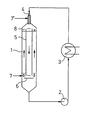
- a submerged jet device of the known type described above (US 2128311) with a concentric guide tube (DE-OS 2 645 780) and a propulsion jet inlet arranged at the highest point of the closed reaction vessel was flushed with a gas which was inert with respect to the reactants.
- the reactor was then filled to a volume fraction corresponding to the intended gas hold-up to be selected according to the rules of the art with liquid reaction medium and a pressure p 1 was set in the inert-filled gas space above the liquid, if necessary by pressing in further inert gas. With the subsequent start-up of the liquid circulation, dispersion of the inert gas is brought about by the nozzle jet.
- the immersion jet reactor is hydrodynamically in equilibrium, does the gaseous reactant begin to be introduced.
- the location of the addition is not critical and is expedient either in the lower outer annular space or in the area of the jet nozzle.
- p z p2> p1
- p 2 is either constant over the reaction time or a function of a suitable command variable, e.g. B. reaction time, turnover, turnover or reaction enthalpy rate, etc.
- the running reactor can be shut down while avoiding a coherent explosive gas phase by possibly adjusting the pressure in the reactor to a value P3 with suitable inert gas, for example at the reactor head, so that the pressure from the respective variables P1 , p 2 known gas composition in the reactor is safely led out of the explosion area.
- suitable inert gas for example at the reactor head
- indirect liquid flow, pressure difference at the jet nozzle, electrical / mechanical failure of the liquid circulation pump
- immediate variables density changes, gas concentration at the reactor head etc.
- the invention is illustrated by the following example of an oxidative coupling of an alkylphenol with pure oxygen to polyphenylene oxide (PPO).
- PPO polyphenylene oxide
- other gas / liquid reactions can also be carried out with gaseous oxidants, which otherwise tend to form explosive gas mixtures.
- composition of the reaction mixture is based on parts by weight.
- DMP 2,6-dimethylphenol
- the oxygen supply was interrupted and the pressure in the reactor was raised to 100 bar (abs) with nitrogen.
- the reactor was depressurized via a gas manifold and the polymeric reaction solution with about 3 times the amount of a non-solvent, e.g. B. added methanol.
- a non-solvent e.g. B. added methanol.
- the polyphenylene oxide which separated out as a precipitate had an intrinsic viscosity of 0.55 dl / g, measured in chloroform at 30 ° C.
Landscapes
- Chemical & Material Sciences (AREA)
- Organic Chemistry (AREA)
- Chemical Kinetics & Catalysis (AREA)
- Health & Medical Sciences (AREA)
- Medicinal Chemistry (AREA)
- Polymers & Plastics (AREA)
- Physical Or Chemical Processes And Apparatus (AREA)
Claims (7)
Applications Claiming Priority (2)
| Application Number | Priority Date | Filing Date | Title |
|---|---|---|---|
| DE3206661 | 1982-02-25 | ||
| DE19823206661 DE3206661A1 (de) | 1982-02-25 | 1982-02-25 | Verfahren zur vermeidung einer explosiblen gasphase bei gas/fluessig-reaktionen |
Publications (3)
| Publication Number | Publication Date |
|---|---|
| EP0087670A2 EP0087670A2 (fr) | 1983-09-07 |
| EP0087670A3 EP0087670A3 (en) | 1984-02-22 |
| EP0087670B1 true EP0087670B1 (fr) | 1985-08-21 |
Family
ID=6156592
Family Applications (1)
| Application Number | Title | Priority Date | Filing Date |
|---|---|---|---|
| EP83101432A Expired EP0087670B1 (fr) | 1982-02-25 | 1983-02-15 | Procédé pour éviter une phase gazeuse explosible auprès des réactions gaz-liquide |
Country Status (3)
| Country | Link |
|---|---|
| US (1) | US4482696A (fr) |
| EP (1) | EP0087670B1 (fr) |
| DE (2) | DE3206661A1 (fr) |
Cited By (1)
| Publication number | Priority date | Publication date | Assignee | Title |
|---|---|---|---|---|
| CN102430381A (zh) * | 2011-09-27 | 2012-05-02 | 陕西煤业化工技术开发中心有限责任公司 | 一种羰基化反应釜 |
Families Citing this family (16)
| Publication number | Priority date | Publication date | Assignee | Title |
|---|---|---|---|---|
| DE3402807C2 (de) * | 1984-01-27 | 1986-12-18 | Paul Dipl.-Ing. Bonsels | Verfahren zur Oxydation von flüssigen organischen Stoffen |
| DE3405629A1 (de) * | 1984-02-17 | 1985-08-22 | Chemische Werke Hüls AG, 4370 Marl | Verfahren zum begasen von fluessigkeiten |
| EP0182206B1 (fr) * | 1984-11-17 | 1990-06-27 | BASF Aktiengesellschaft | Procédé et dispositif pour la préparation de poly(éthers de phénylène) |
| DE3515516A1 (de) * | 1985-04-30 | 1986-11-06 | Basf Ag, 6700 Ludwigshafen | Verfahren zur kontinuierlichen herstellung von polyphenylenethern |
| GB2222098B (en) * | 1988-08-24 | 1992-03-18 | Exxon Research Engineering Co | Improvements in and relating to contacting of plural distinct fluid phases |
| DE4117592A1 (de) * | 1991-05-29 | 1992-12-03 | Huels Chemische Werke Ag | Reaktor fuer phasenheterogene reaktionen |
| DE4425436A1 (de) * | 1994-07-19 | 1996-01-25 | Basf Ag | Verfahren zur Herstellung von Acyloinen |
| DE59608335D1 (de) * | 1995-03-24 | 2002-01-17 | Basf Ag | Verfahren zur Durchführung von Gas/Flüssigreaktionen unter Vermeidung einer zusammenhängenden Gasphase |
| DE19836807A1 (de) | 1998-08-14 | 2000-02-17 | Basf Ag | Verfahren zur Herstellung von Aldehyden und/oder Alkoholen oder Aminen |
| DE19854637A1 (de) * | 1998-11-26 | 2000-05-31 | Basf Ag | Reaktor zur kontinuierlichen Durchführung von Gas-Flüssig-, Flüssig-Flüssig- oder Gas-Flüssig-Fest-Reaktionen |
| KR100655354B1 (ko) | 1998-12-12 | 2006-12-08 | 바스프 악티엔게젤샤프트 | 아민의 제조 방법 |
| JP3504587B2 (ja) * | 2000-06-19 | 2004-03-08 | 旭化成ケミカルズ株式会社 | ポリフェニレンエーテルの製造法 |
| AT410406B (de) * | 2001-09-17 | 2003-04-25 | Andritz Ag Maschf | Verfahren und vorrichtung zur belüftung einer flüssigkeit mit gas |
| SI2240269T1 (sl) | 2007-12-27 | 2019-08-30 | Elcon Recycling Center (2003) Ltd. | Varna predelava tekočine z nadzorovanjem in zmanjševanjem eksplozivnosti parno-plinskih vrst, tvorjenih iz nje ali vsebovanih v njej |
| KR101298343B1 (ko) * | 2010-05-04 | 2013-08-20 | 주식회사 엘지화학 | 올레핀의 하이드로포밀화 반응장치 및 이를 이용하는 하이드로포밀화 방법 |
| CN102847492A (zh) * | 2012-10-16 | 2013-01-02 | 四川国光农化股份有限公司 | 一种适用于气液反应的制备装置 |
Family Cites Families (3)
| Publication number | Priority date | Publication date | Assignee | Title |
|---|---|---|---|---|
| DE1557018B2 (de) * | 1966-04-09 | 1975-07-10 | Basf Ag, 6700 Ludwigshafen | Verfahren zur Durchführung chemischer Reaktionen unter Vermischen von Gasen und Flüssigkeiten mit einem flüssigen Medium |
| DE2645780C2 (de) * | 1976-10-09 | 1982-10-07 | Basf Ag, 6700 Ludwigshafen | Verfahren zum Begasen einer Flüssigkeit in einem Umlaufreaktor und zum Verhindern des Entmischens von nicht abreagiertem Gas aus der Flüssigkeit |
| US4396758A (en) * | 1980-12-29 | 1983-08-02 | Nikiforov Vladimir A | Gas/liquid interfacial preparation of polyamide fibrids |
-
1982
- 1982-02-25 DE DE19823206661 patent/DE3206661A1/de not_active Withdrawn
-
1983
- 1983-02-11 US US06/465,760 patent/US4482696A/en not_active Expired - Lifetime
- 1983-02-15 DE DE8383101432T patent/DE3360586D1/de not_active Expired
- 1983-02-15 EP EP83101432A patent/EP0087670B1/fr not_active Expired
Cited By (1)
| Publication number | Priority date | Publication date | Assignee | Title |
|---|---|---|---|---|
| CN102430381A (zh) * | 2011-09-27 | 2012-05-02 | 陕西煤业化工技术开发中心有限责任公司 | 一种羰基化反应釜 |
Also Published As
| Publication number | Publication date |
|---|---|
| EP0087670A2 (fr) | 1983-09-07 |
| US4482696A (en) | 1984-11-13 |
| DE3360586D1 (en) | 1985-09-26 |
| DE3206661A1 (de) | 1983-09-01 |
| EP0087670A3 (en) | 1984-02-22 |
Similar Documents
| Publication | Publication Date | Title |
|---|---|---|
| EP0087670B1 (fr) | Procédé pour éviter une phase gazeuse explosible auprès des réactions gaz-liquide | |
| DE3871689T2 (de) | Verfahren und vorrichtung zur durchfuehrung von chemischen reaktionen bei ueberkritischen bedingungen. | |
| DE2057528C3 (de) | Vorrichtung zur Durchführung von Reaktionen in Flüssigkeiten in Gegenwart von suspendierten Feststoffteilchen sowie Verwendung dieser Vorrichtung | |
| DE3881502T2 (de) | Trennungsverfahren eines bestandteils mit hohem dampfdruck und/oder besondere bestandteile von einem bestandteil mit niedrigem dampfdruck. | |
| DE69706268T2 (de) | Direkte Sauerstoffinjektion in Blasensäulereaktoren | |
| DE2708497C3 (de) | Verfahren und Vorrichtung zur Entfernung von Verunreinigungen aus einem Abgas | |
| DE69213388T2 (de) | Flüssig-flüssig-Kontaktapparat | |
| DE2645780C2 (de) | Verfahren zum Begasen einer Flüssigkeit in einem Umlaufreaktor und zum Verhindern des Entmischens von nicht abreagiertem Gas aus der Flüssigkeit | |
| EP0154334B1 (fr) | Procédé pour éxécuter des réactions et des procédés d'échange de matière dans des systèmes fluides hétérogènes | |
| DE69127071T2 (de) | Verfahren zur oxydation von materialien in wasser bei überkritischen temperaturen | |
| DE60314504T2 (de) | Verfahren zur behandlung von abfallströmen | |
| DE102012005450B4 (de) | Verfahren und Vorrichtung zur Entgasung von flüssigem Schwefel | |
| EP0819101A1 (fr) | Installation et procede d'oxydation d'une substance aqueuse | |
| DE68903174T2 (de) | Apparat und verfahren zur regenerierung von kokshaltigen fliessbettkrackkatalysatoren. | |
| DE2728554A1 (de) | Verfahren und vorrichtung fuer die nassoxidation von fluessigem abfallabwasser | |
| DD237181A5 (de) | Verfahren zur verminderung der konzentration von mercaptanverbindungen | |
| DE2050073C2 (de) | Verfahren zur Abtrennung von festen Teilchen aus einer wäßrigen Suspension solcher Teilchen und Vorrichtung zur Durchführung eines solchen Verfahrens | |
| EP0034739A2 (fr) | Procédé pour influencer la formation de mousse lors de réactions gaz-liquide chimiques ou biochimiques dans les réacteurs d'aération et réacteur d'aération pour la mise en oeuvre du procédé | |
| DE1542219B2 (de) | Verfahren und vorrichtung zur hydrierung von stickoxyd zu hydroxylamin | |
| DE3331993C2 (fr) | ||
| DE2129564A1 (de) | Vorrichtung zum Begasen von Fluessigkeiten | |
| EP1305261B1 (fr) | Procede de separation par flottaison d'un liquide, et de particules en suspension | |
| EP1317491B1 (fr) | Procede pour l'hydroformylation continue de polyalcenes ayant 30 a 700 atomes de carbone | |
| EP0152614B1 (fr) | Procédé de gazéification de liquides | |
| DE1063291B (de) | Katalytische Rekombinationsanlage |
Legal Events
| Date | Code | Title | Description |
|---|---|---|---|
| PUAI | Public reference made under article 153(3) epc to a published international application that has entered the european phase |
Free format text: ORIGINAL CODE: 0009012 |
|
| AK | Designated contracting states |
Designated state(s): CH DE FR GB LI NL |
|
| 17P | Request for examination filed |
Effective date: 19830921 |
|
| PUAL | Search report despatched |
Free format text: ORIGINAL CODE: 0009013 |
|
| AK | Designated contracting states |
Designated state(s): CH DE FR GB LI NL |
|
| GRAA | (expected) grant |
Free format text: ORIGINAL CODE: 0009210 |
|
| AK | Designated contracting states |
Designated state(s): CH DE FR GB LI NL |
|
| REF | Corresponds to: |
Ref document number: 3360586 Country of ref document: DE Date of ref document: 19850926 |
|
| ET | Fr: translation filed | ||
| PLBE | No opposition filed within time limit |
Free format text: ORIGINAL CODE: 0009261 |
|
| STAA | Information on the status of an ep patent application or granted ep patent |
Free format text: STATUS: NO OPPOSITION FILED WITHIN TIME LIMIT |
|
| 26N | No opposition filed | ||
| REG | Reference to a national code |
Ref country code: GB Ref legal event code: IF02 |
|
| PGFP | Annual fee paid to national office [announced via postgrant information from national office to epo] |
Ref country code: FR Payment date: 20020117 Year of fee payment: 20 |
|
| PGFP | Annual fee paid to national office [announced via postgrant information from national office to epo] |
Ref country code: NL Payment date: 20020121 Year of fee payment: 20 |
|
| PGFP | Annual fee paid to national office [announced via postgrant information from national office to epo] |
Ref country code: CH Payment date: 20020125 Year of fee payment: 20 |
|
| PGFP | Annual fee paid to national office [announced via postgrant information from national office to epo] |
Ref country code: GB Payment date: 20020201 Year of fee payment: 20 |
|
| PGFP | Annual fee paid to national office [announced via postgrant information from national office to epo] |
Ref country code: DE Payment date: 20020215 Year of fee payment: 20 |
|
| PG25 | Lapsed in a contracting state [announced via postgrant information from national office to epo] |
Ref country code: LI Free format text: LAPSE BECAUSE OF EXPIRATION OF PROTECTION Effective date: 20030214 Ref country code: GB Free format text: LAPSE BECAUSE OF EXPIRATION OF PROTECTION Effective date: 20030214 Ref country code: CH Free format text: LAPSE BECAUSE OF EXPIRATION OF PROTECTION Effective date: 20030214 |
|
| PG25 | Lapsed in a contracting state [announced via postgrant information from national office to epo] |
Ref country code: NL Free format text: LAPSE BECAUSE OF EXPIRATION OF PROTECTION Effective date: 20030215 |
|
| REG | Reference to a national code |
Ref country code: GB Ref legal event code: PE20 Effective date: 20030214 |
|
| REG | Reference to a national code |
Ref country code: CH Ref legal event code: PL |
|
| NLV7 | Nl: ceased due to reaching the maximum lifetime of a patent |
Effective date: 20030215 |