EP0087964A1 - Flüssigkeitsstromsystem und zugeordneter Isolator/Integrator für einen Druckwandler - Google Patents
Flüssigkeitsstromsystem und zugeordneter Isolator/Integrator für einen Druckwandler Download PDFInfo
- Publication number
- EP0087964A1 EP0087964A1 EP83301037A EP83301037A EP0087964A1 EP 0087964 A1 EP0087964 A1 EP 0087964A1 EP 83301037 A EP83301037 A EP 83301037A EP 83301037 A EP83301037 A EP 83301037A EP 0087964 A1 EP0087964 A1 EP 0087964A1
- Authority
- EP
- European Patent Office
- Prior art keywords
- pressure
- barrier
- transducer
- microporous
- flow system
- Prior art date
- Legal status (The legal status is an assumption and is not a legal conclusion. Google has not performed a legal analysis and makes no representation as to the accuracy of the status listed.)
- Withdrawn
Links
- 239000012530 fluid Substances 0.000 title claims description 36
- 239000012528 membrane Substances 0.000 claims abstract description 18
- 241000894006 Bacteria Species 0.000 claims abstract description 7
- 238000011109 contamination Methods 0.000 claims abstract description 6
- 230000001052 transient effect Effects 0.000 claims abstract description 6
- 230000004888 barrier function Effects 0.000 claims description 29
- 230000000694 effects Effects 0.000 claims description 17
- 239000011148 porous material Substances 0.000 claims description 14
- 230000010354 integration Effects 0.000 claims description 10
- 238000004891 communication Methods 0.000 claims description 9
- 229920000642 polymer Polymers 0.000 claims description 9
- 238000012545 processing Methods 0.000 claims description 6
- 230000001580 bacterial effect Effects 0.000 claims description 4
- 239000004698 Polyethylene Substances 0.000 claims description 3
- -1 polyethylene Polymers 0.000 claims description 3
- 229920000573 polyethylene Polymers 0.000 claims description 3
- 230000008878 coupling Effects 0.000 claims 4
- 238000010168 coupling process Methods 0.000 claims 4
- 238000005859 coupling reaction Methods 0.000 claims 4
- 238000009530 blood pressure measurement Methods 0.000 claims 2
- 230000000721 bacterilogical effect Effects 0.000 claims 1
- 238000012544 monitoring process Methods 0.000 abstract description 24
- 238000002616 plasmapheresis Methods 0.000 abstract description 17
- 239000012510 hollow fiber Substances 0.000 abstract description 13
- 210000004369 blood Anatomy 0.000 description 22
- 239000008280 blood Substances 0.000 description 22
- 239000000463 material Substances 0.000 description 9
- 230000002950 deficient Effects 0.000 description 6
- 239000003146 anticoagulant agent Substances 0.000 description 5
- 229940127219 anticoagulant drug Drugs 0.000 description 5
- 239000000306 component Substances 0.000 description 5
- 238000009795 derivation Methods 0.000 description 5
- 230000007257 malfunction Effects 0.000 description 5
- 230000008859 change Effects 0.000 description 4
- 230000000052 comparative effect Effects 0.000 description 3
- 238000010586 diagram Methods 0.000 description 3
- 239000000835 fiber Substances 0.000 description 3
- 238000000034 method Methods 0.000 description 3
- 244000005700 microbiome Species 0.000 description 3
- 239000012982 microporous membrane Substances 0.000 description 3
- 238000000926 separation method Methods 0.000 description 3
- 238000012360 testing method Methods 0.000 description 3
- 230000000712 assembly Effects 0.000 description 2
- 238000000429 assembly Methods 0.000 description 2
- 238000010276 construction Methods 0.000 description 2
- 230000003247 decreasing effect Effects 0.000 description 2
- 230000003412 degenerative effect Effects 0.000 description 2
- 238000013461 design Methods 0.000 description 2
- 210000003743 erythrocyte Anatomy 0.000 description 2
- 238000005194 fractionation Methods 0.000 description 2
- 238000002955 isolation Methods 0.000 description 2
- 238000005259 measurement Methods 0.000 description 2
- QSHDDOUJBYECFT-UHFFFAOYSA-N mercury Chemical compound [Hg] QSHDDOUJBYECFT-UHFFFAOYSA-N 0.000 description 2
- 229910052753 mercury Inorganic materials 0.000 description 2
- 238000012986 modification Methods 0.000 description 2
- 230000004048 modification Effects 0.000 description 2
- 230000001105 regulatory effect Effects 0.000 description 2
- 230000004044 response Effects 0.000 description 2
- 229920001059 synthetic polymer Polymers 0.000 description 2
- 238000012956 testing procedure Methods 0.000 description 2
- 206010053567 Coagulopathies Diseases 0.000 description 1
- 102000004310 Ion Channels Human genes 0.000 description 1
- 230000009471 action Effects 0.000 description 1
- 239000012503 blood component Substances 0.000 description 1
- 210000001772 blood platelet Anatomy 0.000 description 1
- 230000036772 blood pressure Effects 0.000 description 1
- 210000004027 cell Anatomy 0.000 description 1
- 230000035602 clotting Effects 0.000 description 1
- 230000002301 combined effect Effects 0.000 description 1
- 230000000593 degrading effect Effects 0.000 description 1
- 230000003111 delayed effect Effects 0.000 description 1
- 239000000706 filtrate Substances 0.000 description 1
- 238000001914 filtration Methods 0.000 description 1
- 229920002457 flexible plastic Polymers 0.000 description 1
- 238000001631 haemodialysis Methods 0.000 description 1
- 230000000322 hemodialysis Effects 0.000 description 1
- 230000036039 immunity Effects 0.000 description 1
- 230000036512 infertility Effects 0.000 description 1
- 238000001802 infusion Methods 0.000 description 1
- 210000000265 leukocyte Anatomy 0.000 description 1
- 239000007788 liquid Substances 0.000 description 1
- 239000002991 molded plastic Substances 0.000 description 1
- 230000002572 peristaltic effect Effects 0.000 description 1
- 239000002861 polymer material Substances 0.000 description 1
- 230000008569 process Effects 0.000 description 1
- 239000000047 product Substances 0.000 description 1
- 238000000746 purification Methods 0.000 description 1
- 230000004043 responsiveness Effects 0.000 description 1
- 210000003462 vein Anatomy 0.000 description 1
Images



Classifications
-
- A—HUMAN NECESSITIES
- A61—MEDICAL OR VETERINARY SCIENCE; HYGIENE
- A61B—DIAGNOSIS; SURGERY; IDENTIFICATION
- A61B5/00—Measuring for diagnostic purposes; Identification of persons
- A61B5/02—Detecting, measuring or recording for evaluating the cardiovascular system, e.g. pulse, heart rate, blood pressure or blood flow
- A61B5/021—Measuring pressure in heart or blood vessels
- A61B5/0215—Measuring pressure in heart or blood vessels by means inserted into the body
-
- A—HUMAN NECESSITIES
- A61—MEDICAL OR VETERINARY SCIENCE; HYGIENE
- A61M—DEVICES FOR INTRODUCING MEDIA INTO, OR ONTO, THE BODY; DEVICES FOR TRANSDUCING BODY MEDIA OR FOR TAKING MEDIA FROM THE BODY; DEVICES FOR PRODUCING OR ENDING SLEEP OR STUPOR
- A61M1/00—Suction or pumping devices for medical purposes; Devices for carrying-off, for treatment of, or for carrying-over, body-liquids; Drainage systems
- A61M1/36—Other treatment of blood in a by-pass of the natural circulatory system, e.g. temperature adaptation, irradiation ; Extra-corporeal blood circuits
- A61M1/3621—Extra-corporeal blood circuits
- A61M1/3639—Blood pressure control, pressure transducers specially adapted therefor
-
- A—HUMAN NECESSITIES
- A61—MEDICAL OR VETERINARY SCIENCE; HYGIENE
- A61M—DEVICES FOR INTRODUCING MEDIA INTO, OR ONTO, THE BODY; DEVICES FOR TRANSDUCING BODY MEDIA OR FOR TAKING MEDIA FROM THE BODY; DEVICES FOR PRODUCING OR ENDING SLEEP OR STUPOR
- A61M1/00—Suction or pumping devices for medical purposes; Devices for carrying-off, for treatment of, or for carrying-over, body-liquids; Drainage systems
- A61M1/36—Other treatment of blood in a by-pass of the natural circulatory system, e.g. temperature adaptation, irradiation ; Extra-corporeal blood circuits
- A61M1/3621—Extra-corporeal blood circuits
- A61M1/3639—Blood pressure control, pressure transducers specially adapted therefor
- A61M1/3641—Pressure isolators
Definitions
- the invention generally relates to fluid flow systems and to means for sensing and monitoring fluid pressures in such systems. More particularly, the invention relates to membrane-type separation and fractionation apparatus for separating and collecting a.desired component from a whole fluid.
- Microporous membrane filter devices have come into wide use in selective separation and purification procedures, such as hemodialysis and plasmapheresis, for separating a desired fluid component from a continuously flowing whole fluid.
- filter devices are incorporated in a disposable flow system, which is installed in a processing apparatus during the procedure, and then disposed of after a single use.
- TMP trans-membrane pressure
- continuous flow filter-type separation and fractionation apparatus include a system for monitoring TMP.
- TMP monitoring system One requirement of any TMP monitoring system is that it provide a continuous output reading, preferably in digital form, which can be quickly and easily interpreted by an operator of the apparatus. Furthermore, the system must not interfere with the operation of the apparatus or the associated disposable flow system, and must not compromise the sterility of the flow system or allow bacterial contamination of the apparatus or the surrounding environment by the fluid being processed.
- the isolator comprises a microporous synthetic polymer barrier having sufficient porosity to allow passage of gas, but insufficient porosity to prevent passage of bacteria.
- the pressure isolator surprisingly provides integration or modulation of pressure variations in the system to prevent such variations from effecting the pressure readings developed by the monitoring system.
- Another aspect of the invention provides a disposable fluid flow system defining a fluid flow path, and adapted for use with processing apparatus.
- the system includes at least one pressure transducer requiring a finite time constant in applied pressure effect.
- a microporous pressure isolator element communicates with the flow path for providing a pressure effect at the transducer which is indicative of flow path pressure in the system and which at the same time, provides the finite time constant required by the transducer.
- the flow system includes a microporous membrane filter, and the apparatus includes two transducers and a system for displaying transmembrane pressure (TMP).
- TMP transmembrane pressure
- two isolators are integral with the flow system for conveying pressure effects with a predetermined time constant from each side of the membrane to the transducers.
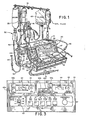
- a plasmapheresis apparatus 20 for use with a disposable flow system constructed in accordance with the present invention is seen incorporated within a table-mounted housing 21.
- the housing preferably includes a pair of vertical support poles 22 and 23 from which a horizontal bar 24 is mounted to allow a plurality of collection and dispensing containers of conventional construction to be hung by means of appropriate hangers.
- the processing apparatus 20 operates in conjunction with a disposable fluid circuit, generally identified by the reference numeral 30 in Figure 1 and shown schematically in Figure 2.
- the fluid circuit 30 includes a plurality of flexible plastic tube segments which form fluid conduits between various components of the fluid circuit.
- whole blood derived from a donor is conveyed through a first tubing segment 31 and a peristaltic-type whole blood (WB) pump 32 to a hollow fiber-type filter 33 mounted on support rod 22.
- the operation of the WB pump is monitored by a positive pressure (+P) monitor circuit 34 connected to tubing segment 31 downline of the WB pump by a tubing segment 35.
- Negative pressure such as might occur upon the collapse of a vein, is monitored for by means of a negative pressure (-P) monitor circuit 36 connected to tubing segment 31 upline of the WB pump 32 by a tubing segment 37.
- a negative pressure (-P) monitor circuit 36 connected to tubing segment 31 upline of the WB pump 32 by a tubing segment 37.
- anticoagulant solution from a supply container 38 is introduced at the point of blood withdrawal through a tubing segment 39.
- a peristaltic-type pump 40 is provided along tubing segment 39 to provide a controlled rate of addition of the anticoagulant fluid to the whole blood.
- Plasma separated from the whole blood within the hollow fiber filter 33 is conveyed by a tubing segment 41 to a plasma collection container 42.
- the pressure provided by WB pump 32 is sufficient to cause flow through the filter to the collection container.
- the plasma-deficient processed blood from filter 33 is conveyed through a tubing segment 43 to an ultrasonic bubble detector 44, which may be similar in structure and operation to that described in copending application of Arnold C. Bilstad and Michael Wicnienski, entitled, "Liquid Absence Detector", Serial No. 127,552, filed March 6, 1980.
- an equalizer valve 46 is provided at the filter plasma outlet port. Basically, this equalizer valve functions to restrict the plasma outlet port until the pressure of the plasma in the filter reaches that of plasma-deficient blood flowing from the filter, at which time the valve modulates plasma flow through line 41 to the collection container 42.
- An adjustable occlusion device 47 provided in line 42 between filter 33 and the equalizer valve 46 allows the pressure differential between the collected plasma and the plasma-deficient blood to be adjusted by the user.
- the TMP monitoring system in the apparatus provides a readout of this trans-membrane pressure to assist the user in making the required adjustment from maximum operating efficiency of filter 33.
- Replacement fluid is added to the plasma-deficient blood at bubble detector 44 through a tubing segment 50 which is connected at one end to a replacement fluid container 51 and at its other end to the housing of bubble detector 44.
- a peristaltic-type replacement pump 52 is positioned . along tubing segment 50 to establish a controlled flow rate for the replacement fluid.
- the combined plasma-deficient whole blood and replacement fluid are pumped from bubble detector 44 back to the donor through a tubing segment 52.
- a safety clamp 54 positioned along tubing segment 53 downline of bubble detector 44 actuates in the event of a malfunction in the apparatus to prevent uncontrolled infusion of fluid into the patient.
- the plasmapheresis apparatus 20 includes a. sloped control panel 55 which includes operator-actuated controls for operating the plasmapheresis apparatus.
- control panel 55 is seen to include a selector switch 60 by which the operating speed of the anticoagulant pump 40 is set, a potentiometer control 61 and digital readout 62 by which the operating speed of the IIB pump 32 is controlled, and a potentiometer 63 and digital readout 64 by which the operating speed of the replacement pump 52 is controlled.
- a plurality of push button switches 65 are provided to establish the operating mode of the apparatus, and a plurality of status-indicating lights 66 provide indications of malfunctions in the system.
- An emergency stop switch 67 provides for an immediate operator-initiated shut down in the event of a malfunction.
- Switch 68a causes indicator 62 to display WB flow rate.
- Actuation of switch 68b causes display 62 to display the total volume of whole blood processed by the apparatus since beginning an operating cycle.
- Additional functions for display 64 are provided by push button switches 69a-69d.
- Actuation of switch 69a causes a flow rate of the replacement fluid to be displayed.
- Actuation of switch 69b causes the inlet pressure of pressure device 33 to be displayed.
- Switch 69c causes the collected plasma pressure of device 33 to be displayed.
- Actuation of switch 69d causes the trans-membrane pressure (TMP) of the filter device to be displayed as derived by the TMP monitoring circuit of the invention.
- TMP trans-membrane pressure
- the whole blood pump 32 is driven by a motor 70.
- Power for operating motor 70 is provided by a motor control circuit 72 which responds rate setting means in the form of potentiometer control 63 and a tachometer feedback signal from a tachometer (not shown) associated with motor 70 to maintain a desired motor operating speed.
- the actual pump flow rate is displayed by readout 62 as part of a display circuit which receives the tach output signal.
- the replacement pump 52 is driven by a motor 76.
- Power for motor 76 is provided by a motor control circuit 78 which responds to a tach feedback signal from a tachometer (not shown) associated with the motor and the rate selected by the panel-mounted potentiometer 61 to maintain a desired constant motor speed.
- the actual pump flow rate is displayed by readout 62 as part of a display circuit.
- the anticoagulant pump 40 is driven by a stepper motor 79.
- Drive signals for motor 79 are developed by a motor control circuit 80 which responds to rate selection switch 60 to maintain a desired anticoagulant flow rate.
- a tachometer (not shown) associated with motor 79 provides tach pulses for use by control circuit 80.
- a processor control circuit 81 which includes the five mode select push button switches 65 on front panel 55.
- System malfunctions such as negative pressure at pressure monitor 36, or excessive positive pressure at pressure monitor 34, or the occurrence of a bubble or other fluid absence as signaled at the output of bubble detector 44, result in the application of an alarm signal to processor control circuit 81.
- This circuit responds by producing a control signal on a first motor control line 82 to the motor control circuits 72, 78 and 80 to interrupt operations of the motors.
- an alarm 83 associated with the processor control circuit may be sounded and an appropriate one of indicator lamps 66 may be lit to alert the operator.
- each of motor control circuits 72, 78 and 80 includes internal stall protection whereby an alarm signal is developed and applied to processor control circuit 81 on a control line 84 to terminate .
- a system clock circuit 85 may be provided to supply clock pulses necessary for the operation of display circuits 61 and 62, processor control circuit 81, and motor control circuit 80 along a distribution line 86.
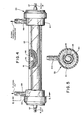
- the hollow-fiber membrane-type filter device 33 employed in plasmapheresis apparatus 20 includes a generally cylindrical housing 90 within a bundle 91 of microporous hollow fibers 92 is mounted on a carrier sheet 93.
- the carrier sheet is formed into a spiral such that the individual fibers 92 extend lengthwise along the axis of the cylindrical housing 90.
- the housing includes end caps 94 and 95 which close the ends to form a plasma collection chamber 96 within the housing.
- the fiber bundle 91 is carried within the interior chamber 96 in a loose, inwardly rolled configuration, as shown in Figure 5.
- filter device 33 When assembled, filter device 33 includes a whole blood inlet port 97 formed on end cap 94, and a whole blood outlet port 98 formed on the other end cap 95. Blood introduced through the port 97 enters the adjoining open ends of the hollow fiber membrane elements 92 and proceeds to flow lengthwise through the fibers. By maintaining a desired level of trans-membrane pressure, plasma in the whole blood is caused to flow through the micropores of the hollow fibers 92 and out into the collection chamber 96 circumferentially surrounding the bundle 91.
- Housing 90 includes two side plasma outlet ports 99 and 100 which communicate with the collection chamber 96 to enable plasma to be withdrawn from the filter.
- plasma outlet port 100 is utilized to withdraw plasma from the filter, and plasma outlet port 99 is advantageously used to sense plasma outlet pressure in conjunction with the TMP monitoring system of the invention.
- Plasma-poor blood (containing red cells, leukocytes and platelets), having passed through the hollow fiber membrane elements, exits through outlet port 98, typically for return to the patient-donor.
- TMP trans-membrane pressure
- the TMP monitoring system of the invention is seen to include the previously described positive pressure monitor circuit 34 located at the output of whole blood pump 32, a plasma pressure monitor circuit 101, and a digital pulse subtraction circuit 102.
- whole blood pressure downline of WB pump 32 is applied to the +P monitor thru segment 35, which is connected to segment 31 by a conventional T-fitting 102 or other appropriate means.
- the free end of segment 35 is preferably provided with a connector 103 formed of molded plastic or the like and including a threaded plug portion 104 or other appropriate means for detachable engagement with the +P monitor 34.
- the monitor circuit 34 preferably includes a socket 105 at a convenient location on the front panel of housing 21 for receiving plug 103 in locking engagement.
- Socket 105 may be connected by a tubing segment 106 to an electrical pressure transducer 107 of conventional construction, which serves to translate pressure changes conveyed through tubing segment 35, plug 103, socket 105 and tubing segment 106 to resistance changes in an internal bridge circuit 108.
- Transducer 107 in accordance with conventional practice, forms a resistive bridge network 108 wherein the output resistance varies as a function of applied pressure.
- the output terminals of this bridge network are connected through respective resistors 110 and 111 to the inverting_and non-inverting inputs of a differential amplifier 112.
- the output of this amplifier which depends on the applied differential voltage, and hence on the pressure applied to transducer 107, is connected to a voltage-to-frequency converter 113.
- the output and inverting input of amplifier 112 are connected through resistor 114 to provide degenerative feedback.
- the non-inverting input of amplifier 112 is connected to ground by a resistor 115 in accordance with conventional practice.
- a regulated reference voltage is applied to one input terminal of resistance bridge 108 by a voltage regulator 116.
- the other input terminal of bridge 108 is connected to ground.
- Voltage-to-frequency converter 113 responds to the applied voltage developed by differential amplifier 112 to produce an output having a frequency related to the pressure present at transducer 107.
- This pressure-indicative signal is applied to display circuit 61, wherein it is utilized to produce a display of filter inlet pressure upon actuation of push button switches 69b ( Figure 3), and to derivation circuit 102.
- the operation of the plasma pressure monitor circuit 101 is similar to that of +P monitor circuit 34.
- Plasma pressure is sensed at output port 99 of filter device 33 by means of a tubing segment 120 which includes at its free end a plug 121 similar to plug 103.
- Plug 121 includes a projecting portion 122 which may be threaded for locking engagement with.
- a socket 123 located on the side panel of housing 21.
- a pressure conveyed to socket 123 is conveyed through a tubing segment 124 to an electrical pressure transducer 125.
- This transducer which may be identical to transducer 107, includes a bridge circuit 126 having output terminals connected through a pair of resistors 127 and 128 to a differential amplifier 130.
- the output of amplifier 130 which depends on the differential between the signals applied to its input terminals, and hence on the pressure applied to transducer 126, is applied to a voltage-to-frequency converter 131.
- a resistor 132 connected between the output of amplifier 130 and the inverting input of the device provides degenerative feedback.
- a resistor 132 is connected between the non-inverting input and ground in accordance with conventional practice.
- a regulated reference voltage is applied to the input terminals of transducer bridge 126 by a voltage regulator 133 of conventional design.
- Voltage-to-frequency converted 131 responds to the applied voltage from differential amplifier 130 to produce an output having a frequency related to the pressure present at transducer 125.
- This pressure-related signal is applied to display circuit 61 ( Figure 2), wherein it is utilized to provide an output display of plasma outlet pressure upon actuation of push button switch 69c ( Figure 3), and to the digital subtraction circuit 102 of the TMP monitoring system.
- the derivation circuit 102 functions to develop an output signal frequency-indicative of the difference in frequency between the +P output signal developed by monitor circuit 34, and the plasma pressure output signal developed by monitor circuit 101.
- circuit 102 includes a first D-type flip-flop 140 to which the +P signal is applied, and a second D-type flip-flop 141 to which the plasma pressure frequency signal is applied.
- a source of clock pulses 142 which may be located within derivation circuit 102 as shown, or which may be provided from an external pulse source, such as the apparatus clock 85, provide clock pulses to flip-flops 140 and 141 such that these devices change output state only upon receipt of a pulse from their associated pressure-indicative source and the subsequent occurrence of a clock pulse.
- flip-flop 140 changes state, providing a clock pulse to a third flip-flop 143 and an enabling signal from its Q output to one input of a NAND gate 144.
- the D input of flip-flop 143 is connected to a positive voltage source, causing that device to immediately switch state in response to the applied pulse from flip-flop 140.
- the resulting change in state at the Q output of this flip-flop is applied to a fourth flip-flop 145, which does not change state pending receipt of a subsequent clock pulse. Since flip-flop 145 does not change state, NAND gate 144 is inhibited and no TMP output is produced.
- flip-flop 143 is in a toggled condition, so that flip-flop 145 is toggled to provide an enabling signal at NAND gate 144 which allows the second and all subsequent applied +P monitoring pulses to appear as TMP-indicative output pulses.
- flip-flop 141 Upon application of a plasma pressure-indicative pulse to flip-flop 141, upon occurrence of the next-occurring clock pulse a fifth flip-flop 146 is caused to toggle by reason of its D input being connected to a positive voltage source. A Q output of this flip-flop is connected to one input of a second NAND gate 147, enabling that device. The other input of NAND gate 147 is connected to the Q output of flip-flop 143, such that when the NAND gate is enabled an output pulse is produced and applied through a buffer 148 to the reset inputs of flip-flops 143 and 146. This causes the flip-flops to revert to a non-toggled state, pending the application of a subsequent clock pulse from flip-flops 140 and 141, respectively.
- flip-flop 145 reverts to a non-toggled condition upon occurrence of the subsequent clock signal applied by flip-flop 140, which causes NAND gate 144 to be inhibited and no TMP output pulse to be produced upon occurrence of the subsequent +P pressure pulse.
- flip-flop 143 again-reverts a toggle state, causing flip-flop 145 to toggle and NAND gate 144 to be enabled.
- the operation of the digital subtraction circuit 102 is such that each occurrence of a plasma pressure pulse results in one +P pressure pulse not being conveyed to the TMP output. Since the occurrence of pulses is directly related to the frequency of the two pressure signals, which in turn is related to the inlet and plasma pressures associated with filter device 33, circuit 102 functions to produce an output signal having a frequency related to the difference between the inlet and outlet pressures at the filter device.
- This TM P frequency-indicative output signal is applied to display circuit 61 ( Figure 2), wherein it is displayed upon actuation of push button switch 69d ( Figure 3).
- the display circuit 64 may comprise a plurality of AND gates 150-153 for receiving the replacement pump tach, +P frequency output, plasma pressure frequency output and TMP frequency output signals.
- a selected one of these AND gates 150-153 is enabled by a four-section latch device 154 having outputs Q 0 - Q 3 connected to respective ones of control lines 155-158 associated with the remaining input terminals of the four AND gates.
- Switch 69a is connected through an inverter 160 and OR gate 161 to the set input of the first section of the four-section flip-flop 154 to condition that section to a set condition and thereby enable AND gate 150 through control line 155 upon actuation of the switch.
- a second input or OR gate 161 is connected to a power up reset circuit 162 to provide a similar result upon initial power up of the plasmapheresis apparatus.
- the +P inlet pressure is displayed by actuation of switch 69b, which conditions the second section of the RS flip-flop 154 to a set state through an inverter 163. This provides an enabling signal on control line 156 which enables AND gate 151.
- the plasma pressure display is obtained by momentary actuation of switch 69c, which enables the third section of RS flip-flop 154 through an inverter 164.
- the TMP display is obtained by monentary actuation of switch 69d, which conditions the fourth section of flip-flop 154 through an inverter 165.
- An indication of the active input is provided by four light emitting diodes 166-169 connected by respective ones of four inverters 170-173 to the four outputs of flip-flop 154.
- Indicator lamps 166-169 may be advantageously combined with push button switch 69a-69d, as shown in Figure 3.
- a selected one of the inlet pressure, plasma pressure and TMP frequency-indicative signals is applied through an OR gate 174 to the clock input of a counter 175.
- the output of counter 175, delayed by the action of the counter is applied through an AND gate 176 and an OR gate 177 to the clock input of a display counter 178.
- AND gate 176 is inhibited by the output of an inverter 179 connected to control line 155.
- AND gate 150 being then enabled, replacement pump tach signals are applied directly through OR gate 177 to display counter 178.
- Counter 175 is said to divide by a factor of 10, producing one output pulse for each 10 clock pulses applied by OR gate 174.
- Display counter 178 which may be conventional in structure and operation, responds to the applied pulses to accumulate a count indicative of the selected input to be displayed. At the end of a measurement period, in the present embodiment one second, a latch pulse is applied to the counter to the cause in a conventional manner to assume the accumulated count and provide an appropriate driving signal for a trio of associated seven segment display panels 180-182, which comprise readout 64 on control panel 55. Appropriate strobe pulses for enabling displays in a conventional manner are provided by counter 178 through respective ones of inverter amplifiers 183-185.
- the accumulated count is reset by a reset clock pulse applied to the reset input of the counter.
- This reset pulse, and a corresponding latch pulse are developed at a one second repetition rate by a Johnson counter 136, which may comprise part of the system clock circuit 85.
- This counter is clocked by a one hertz signal obtained from a clock circuit which includes an oscillator 187 and a pair of frequency dividers 188 and 189 of conventional design. Since alternate outputs of the Johnson counter are utilized, the latch pulse leads and is distinct from the reset pulse, so that counter 178 completes its latch function before it begins its reset function, thus assuring that the counter will display the preceding count during the subsequent one second counting interval.
- the same display counter 178 displays fluid pressure upon momentary actuation of one of push button switches 69b-69d. This causes AND gate 150 to be inhibited and AND gate 176 to be enabled through inverter amplifier 179. As a result, the variable-frequency pressure-indicative pulses appearing at the selected ones of the pressure signal inputs, which each represent ten hertz per millimeter of mercury, are supplied to display counter 178 through OR gate 174, divide-by-ten counter 175, and OR gate 177. Since counter 178 continues to be reset once each second, the counter in effect measures the frequency in hertz per second, which translates - directly to millimeters of mercury. An indication is given of the display selected for readout 64 by LED indicators 166-169.
- the TMP monitoring circuit of the invention provides for generation of a first signal indicative of filter inlet pressure, and a second signal indicative of plasma outlet pressure. These signals are subtracted in a derivation circuit 102 to obtain a variable-frequency TMP-indicative output signal which is selectively displayed by display counter 178 upon actuation of the corresponding display select push button switch 69d.
- the inlet and plasma pressure monitoring circuits 34 and 101 produce, in accordance with an aspect of the invention, variable-frequency pressure-indicative signals which are digitally subtracted by derivation circuit 102 to obtain a variable-frequency TMP-indicative output signal suitable for application to display counter 178.
- the pressure monitoring circuits 34 and 101 include appropriate means for introducing an integration factor or time constant and their response to applied pressure changes.
- the pressure communication channels between transducers 107 and 125 and the disposable flow system include pressure isolators in the form of sterile, microporous polymer barriers inserted in the channels, which have sufficient porosity to allow passage of gas but not bacteria, and which provide a predetermined integration factor sufficient to reduce the effect of short term pressure variations on the transducers.
- each pressure communication channel includes two isolators, one associated with and integral to the disposable flow system, and the other associated with and integral to the pressure monitoring system of the apparatus.
- a first microporous isolator device 200 is provided in plug 103 and a second microporous isolator device 201 is provided in receptacle 105.
- a first microporous isolator device 202 is provided in plug 121 and a second microporous isolator device 203 is provided in receptacle 123.
- the microporous isolator devices are most effective in preventing contamination from leaving and entering their respective systems.
- isolators 200 and 202 prevent bacterial and micro-organic contamination from escaping from the disposable flow system through the pressure ion channel.
- Isolator devices 201 and 203 similar types of contamination from entering tubing segments 106 and 124 and transducers 107 and 125.
- Each microporous isolator device 200, 201, 202, and 203 has sufficient porosity to allow passage of gas, but prevents passage of bacteria or other microorganisms therethrough. Such materials generally do not have "through holes", but have many "tortuous paths”.
- each microporous device 200, 201, 202, and 203 has a pore size of less than or equal to about 20 microns and most preferably between about 10 and 20 microns inclusive.
- each microporous isolator device 200, 201, 202, and 203 be made of a rigid, unitary, synthetic polymer material.
- One preferred material is a sintered microporous polyethylene available under the trademark "POREX” from Glasrock Products, Inc. of Fairburn, Georgoa, This material is relatively inexpensive, can be readily sterilized and provides an excellent barrier to bacteria and other microorganisms.
- any porous polymer having a microporous structure such that it is capable of allowing passage of gas but not passage of bacteria or other microorganisms therethrough is suitable for the microporous isolator device.
- the length of the device and pore size can be chosen to provide the desired amount of integration (increasing the length of the barrier and/or decreasing the pore size increases the amount of integration).
- the following examples illustrate the modulating effect achieved in accordance with the present invention and also illustrate the effect of pore size and length of the microporous polymer isolator device material on pressure modulation:
- a comparative test was performed to illustrate the pressure modulation effects of the present invention and to show the effects on modulation of various pore sizes and lengths of microporous polymer barriers in accordance with the invention.
- Porex material was obtained as one-quarter inch rod stock in 10 and 20 micron pore sizes and cut to the desired length to obtain microporous polymer barriers of various lengths and pore sizes.
- a barrier was inserted into a predetermined length of tubing such that a tight inteference fit was achieved.
- the tubing was then pressurized to a desired initial pressure with air and the air was allowed to vent through the barrier to the atmosphere until a final desired pressure was reached inside the tube. The time to reach such pressure was recorded. This procedure was repeated three times for each barrier and the following results were obtained:
- Example 2 A comparative test similar to that of Example 1 was performed utilizing a different size of tubing and a bullet-shaped microporous polymer barrier of "Porex" material obtained by cutting off a piece from a molded “Porex” part.
- the barrier has a length of 0.372 inches and a maximum diameter of 0.175 inches. The same testing procedure was utilized with the following results:
- Example 2 A comparative test similar to that of Example 1 was performed utilizing a different size of tubing and two different bullet-shaped microporous polymer barriers of "Porex" material, each obtained by cutting off a piece from a separate molded “Porex” part. The same testing procedure was utilized with the following results:
- the integration factor provided in the pressure communication channels by the isolator elements is a function of the length and pore size of the elements. Increasing the length of the barrier and/or decreasing the pore size increases the amount of integration. Since the two isolator elements are effectively in series in their respective pressure communication channels, the combined effect of the two elements must be taken into account in determining the overall time constant provided to the system. In practice, it has been found that a time constant of from three to four seconds provides good immunity to transient pressure variations without unduely degrading the responsiveness of the T MP monitoring system to TMP pressure changes. This time constant can be obtained by providing a barrier having a length of 0.372 inch and a maximum diameter of 0.175 inch, and a pore size of 10 microns. Other time constants can be obtained by selecting different lengths and pore sizes of microporous barrier material.
- isolators 103 and 121 are shown as an integral part of the disposable flow system 30.
- Plug 103 which includes isolator element 201, is connected to a T-fitting by a section of tubing 35 of sufficient length such that during normal operation fluid in line 31 will not come into contact with isolator 201.
- the fluid advances through tubing 35 until an equilibrium point is reached, at which the back pressure exerted by the trapped air between the advancing fluid and the isolator is sufficient to prevent further advance of the fluid.
- connector 121 is connected to outlet port 99 of the hollow fiber membrane filter 33 with a tubing segment 120 of sufficient length to prevent the plasma collected within the filter device from coming into contact with isolator element 200 within the plug.
- the negative pressure monitoring function may also advantageously employ an isolator element integral with the disposable flow set.
- a plug 204 having an integral isolator element 205 may be provided at the end of tubing 36, which may be connected to tubing segment 31 by a conventional T-connector.
- tubing segment 36 is preferably of sufficient length such that fluid in line 31 does not advance into contact with isolator element 205.
- plug assembly 103 which may be identical to plug assemblies 121 and 204, includes a housing 210 having a central axially-aligned passageway 211 through which pressure communication is established.
- Tubing segment 35 connects to one end of the housing so as to establish communication with the central passageway.
- the other end of the housing includes a threaded projecting portion 212 which engages a complementarily threaded recess 213 on socket 105.
- a microporous isolator element generally cylindrical in form is positioned in passageway 211 against an internal rib portion 214 formed where the passageway increases in diameter.
- socket 105 Within socket 105 recess 213 communicates with a passageway 215 of reduced diameter.
- the r:icroporous isolator element 201 is advantageously positioned again the rib 216 formed where the pressure communication passageway narrows.
- the tubing segment 106 provided to connect the socket to transducer 107 is bonded to the end of the socket by appropriate means.
- isolator elements could be provided at appropriate in-line location along tubing segments 35, 36 and 120 intermediate the ends thereof.
Landscapes
- Health & Medical Sciences (AREA)
- Life Sciences & Earth Sciences (AREA)
- Vascular Medicine (AREA)
- Heart & Thoracic Surgery (AREA)
- Cardiology (AREA)
- Public Health (AREA)
- Engineering & Computer Science (AREA)
- Biomedical Technology (AREA)
- Veterinary Medicine (AREA)
- Animal Behavior & Ethology (AREA)
- General Health & Medical Sciences (AREA)
- Anesthesiology (AREA)
- Hematology (AREA)
- Physiology (AREA)
- Physics & Mathematics (AREA)
- Biophysics (AREA)
- Pathology (AREA)
- Medical Informatics (AREA)
- Molecular Biology (AREA)
- Surgery (AREA)
- External Artificial Organs (AREA)
Applications Claiming Priority (4)
| Application Number | Priority Date | Filing Date | Title |
|---|---|---|---|
| US35354682A | 1982-03-01 | 1982-03-01 | |
| US353546 | 1982-03-01 | ||
| US40335082A | 1982-07-30 | 1982-07-30 | |
| US403350 | 1982-07-30 |
Publications (1)
| Publication Number | Publication Date |
|---|---|
| EP0087964A1 true EP0087964A1 (de) | 1983-09-07 |
Family
ID=26997985
Family Applications (1)
| Application Number | Title | Priority Date | Filing Date |
|---|---|---|---|
| EP83301037A Withdrawn EP0087964A1 (de) | 1982-03-01 | 1983-02-28 | Flüssigkeitsstromsystem und zugeordneter Isolator/Integrator für einen Druckwandler |
Country Status (1)
| Country | Link |
|---|---|
| EP (1) | EP0087964A1 (de) |
Cited By (3)
| Publication number | Priority date | Publication date | Assignee | Title |
|---|---|---|---|---|
| EP0875198A1 (de) * | 1997-03-26 | 1998-11-04 | Roland Dr. Unger | Einrichtung zur sensorischen Intensivüberwachung eines Patienten |
| CN107106752A (zh) * | 2014-12-18 | 2017-08-29 | 甘布罗伦迪亚股份公司 | 显示预测状态的方法、医疗装置和计算机程序 |
| US10682454B2 (en) | 2011-06-15 | 2020-06-16 | The Newcastle Upon Tyne Hospitals Nhs Foundation Trust | Apparatus for performing haemodialysis |
Citations (6)
| Publication number | Priority date | Publication date | Assignee | Title |
|---|---|---|---|---|
| US3720201A (en) * | 1969-12-01 | 1973-03-13 | Ramtech | Disposable body fluid pressure monitor |
| US3880151A (en) * | 1972-07-12 | 1975-04-29 | Siemens Elema Ab | Pressure receiver |
| GB2042919A (en) * | 1977-11-30 | 1980-10-01 | Baxter Travenol Lab | Gas-separating liquid filter |
| WO1980002376A1 (en) * | 1979-04-30 | 1980-11-13 | E Lichtenstein | Computer-controlled medical care system |
| WO1981002979A1 (en) * | 1980-04-14 | 1981-10-29 | Baxter Travenol Lab | Blood fractionation apparatus |
| GB2101908A (en) * | 1981-06-24 | 1983-01-26 | Cordis Dow Corp | Airless artificial kidney assembly |
-
1983
- 1983-02-28 EP EP83301037A patent/EP0087964A1/de not_active Withdrawn
Patent Citations (6)
| Publication number | Priority date | Publication date | Assignee | Title |
|---|---|---|---|---|
| US3720201A (en) * | 1969-12-01 | 1973-03-13 | Ramtech | Disposable body fluid pressure monitor |
| US3880151A (en) * | 1972-07-12 | 1975-04-29 | Siemens Elema Ab | Pressure receiver |
| GB2042919A (en) * | 1977-11-30 | 1980-10-01 | Baxter Travenol Lab | Gas-separating liquid filter |
| WO1980002376A1 (en) * | 1979-04-30 | 1980-11-13 | E Lichtenstein | Computer-controlled medical care system |
| WO1981002979A1 (en) * | 1980-04-14 | 1981-10-29 | Baxter Travenol Lab | Blood fractionation apparatus |
| GB2101908A (en) * | 1981-06-24 | 1983-01-26 | Cordis Dow Corp | Airless artificial kidney assembly |
Cited By (3)
| Publication number | Priority date | Publication date | Assignee | Title |
|---|---|---|---|---|
| EP0875198A1 (de) * | 1997-03-26 | 1998-11-04 | Roland Dr. Unger | Einrichtung zur sensorischen Intensivüberwachung eines Patienten |
| US10682454B2 (en) | 2011-06-15 | 2020-06-16 | The Newcastle Upon Tyne Hospitals Nhs Foundation Trust | Apparatus for performing haemodialysis |
| CN107106752A (zh) * | 2014-12-18 | 2017-08-29 | 甘布罗伦迪亚股份公司 | 显示预测状态的方法、医疗装置和计算机程序 |
Similar Documents
| Publication | Publication Date | Title |
|---|---|---|
| US4493693A (en) | Trans-membrane pressure monitoring system | |
| EP0128683B1 (de) | Verfahren zur Blutfraktionierung mit einer Einzelnadel und mit regulierbarem Rezirkulationssystem durch einen Filter | |
| US4501531A (en) | Control circuit for a blood fractionation apparatus | |
| US4436620A (en) | Integral hydraulic circuit for hemodialysis apparatus | |
| US4447191A (en) | Control circuit for a blood fractionation apparatus | |
| US4263808A (en) | Noninvasive pressure monitor | |
| EP0165519B1 (de) | Blutfiltriersystem | |
| US4526515A (en) | Fluid pumping assembly including a prepackaged fluid circuit module | |
| US5431811A (en) | Artificial kidney with device for filtering dialysis liquid | |
| US4379452A (en) | Prepackaged, self-contained fluid circuit module | |
| US3908653A (en) | Blood chamber | |
| US4637813A (en) | Blood processing assembly including a prepackaged fluid circuit module | |
| JP3495068B2 (ja) | 血液透析装置の透析器の透析セクションにおける構成部品の操作性を決定するための方法、およびこの方法を実施するための装置 | |
| US4293413A (en) | Dialyzer blood circuit and bubble traps | |
| CA2064712C (en) | Method and apparatus for administration of anticoagulant to red cell suspension output of a blood separator | |
| EP0229504A2 (de) | Anordnung und Verfahren für die kontinuierliche Bluttrennung in situ | |
| AU730338B2 (en) | Method and device for monitoring vessel access during extracorporeal blood treatment | |
| CN101189509B (zh) | 借助超声波监视液体流是否存在空气的方法和装置 | |
| US4980054A (en) | System and method for mass transfer between fluids | |
| JP4959229B2 (ja) | 血液ライン内圧力を監視するシステム及びそれに使用される装置 | |
| EP0862378A1 (de) | Druckmessung während das blutbehandlung | |
| US4498983A (en) | Pressure cuff draw mode enhancement system and method for a single needle blood fractionation system | |
| GB1601856A (en) | Dialysis apparatus | |
| EP0549341A1 (de) | Hohlfaser-Probenehmer für Plasma | |
| NO961174D0 (no) | Fremstilling av autologt plasma og fibrin-gel |
Legal Events
| Date | Code | Title | Description |
|---|---|---|---|
| PUAI | Public reference made under article 153(3) epc to a published international application that has entered the european phase |
Free format text: ORIGINAL CODE: 0009012 |
|
| AK | Designated contracting states |
Designated state(s): BE DE FR GB IT |
|
| 17P | Request for examination filed |
Effective date: 19831020 |
|
| STAA | Information on the status of an ep patent application or granted ep patent |
Free format text: STATUS: THE APPLICATION IS DEEMED TO BE WITHDRAWN |
|
| 18D | Application deemed to be withdrawn |
Effective date: 19850621 |
|
| RIN1 | Information on inventor provided before grant (corrected) |
Inventor name: BILSTAD, ARNOLD C. Inventor name: HITCHCOCK, JAMES Inventor name: LYNN, DANIEL |