EP0087965B1 - Procédé pour la séparation des solides d'hydrocarbures liquides - Google Patents
Procédé pour la séparation des solides d'hydrocarbures liquides Download PDFInfo
- Publication number
- EP0087965B1 EP0087965B1 EP83301039A EP83301039A EP0087965B1 EP 0087965 B1 EP0087965 B1 EP 0087965B1 EP 83301039 A EP83301039 A EP 83301039A EP 83301039 A EP83301039 A EP 83301039A EP 0087965 B1 EP0087965 B1 EP 0087965B1
- Authority
- EP
- European Patent Office
- Prior art keywords
- asphaltenes
- solids
- volatile solvent
- liquid hydrocarbons
- insoluble solids
- Prior art date
- Legal status (The legal status is an assumption and is not a legal conclusion. Google has not performed a legal analysis and makes no representation as to the accuracy of the status listed.)
- Expired
Links
Images
Classifications
-
- C—CHEMISTRY; METALLURGY
- C10—PETROLEUM, GAS OR COKE INDUSTRIES; TECHNICAL GASES CONTAINING CARBON MONOXIDE; FUELS; LUBRICANTS; PEAT
- C10G—CRACKING HYDROCARBON OILS; PRODUCTION OF LIQUID HYDROCARBON MIXTURES, e.g. BY DESTRUCTIVE HYDROGENATION, OLIGOMERISATION, POLYMERISATION; RECOVERY OF HYDROCARBON OILS FROM OIL-SHALE, OIL-SAND, OR GASES; REFINING MIXTURES MAINLY CONSISTING OF HYDROCARBONS; REFORMING OF NAPHTHA; MINERAL WAXES
- C10G21/00—Refining of hydrocarbon oils, in the absence of hydrogen, by extraction with selective solvents
-
- C—CHEMISTRY; METALLURGY
- C10—PETROLEUM, GAS OR COKE INDUSTRIES; TECHNICAL GASES CONTAINING CARBON MONOXIDE; FUELS; LUBRICANTS; PEAT
- C10G—CRACKING HYDROCARBON OILS; PRODUCTION OF LIQUID HYDROCARBON MIXTURES, e.g. BY DESTRUCTIVE HYDROGENATION, OLIGOMERISATION, POLYMERISATION; RECOVERY OF HYDROCARBON OILS FROM OIL-SHALE, OIL-SAND, OR GASES; REFINING MIXTURES MAINLY CONSISTING OF HYDROCARBONS; REFORMING OF NAPHTHA; MINERAL WAXES
- C10G1/00—Production of liquid hydrocarbon mixtures from oil-shale, oil-sand, or non-melting solid carbonaceous or similar materials, e.g. wood, coal
- C10G1/002—Production of liquid hydrocarbon mixtures from oil-shale, oil-sand, or non-melting solid carbonaceous or similar materials, e.g. wood, coal in combination with oil conversion- or refining processes
-
- C—CHEMISTRY; METALLURGY
- C10—PETROLEUM, GAS OR COKE INDUSTRIES; TECHNICAL GASES CONTAINING CARBON MONOXIDE; FUELS; LUBRICANTS; PEAT
- C10G—CRACKING HYDROCARBON OILS; PRODUCTION OF LIQUID HYDROCARBON MIXTURES, e.g. BY DESTRUCTIVE HYDROGENATION, OLIGOMERISATION, POLYMERISATION; RECOVERY OF HYDROCARBON OILS FROM OIL-SHALE, OIL-SAND, OR GASES; REFINING MIXTURES MAINLY CONSISTING OF HYDROCARBONS; REFORMING OF NAPHTHA; MINERAL WAXES
- C10G1/00—Production of liquid hydrocarbon mixtures from oil-shale, oil-sand, or non-melting solid carbonaceous or similar materials, e.g. wood, coal
- C10G1/04—Production of liquid hydrocarbon mixtures from oil-shale, oil-sand, or non-melting solid carbonaceous or similar materials, e.g. wood, coal by extraction
- C10G1/045—Separation of insoluble materials
-
- C—CHEMISTRY; METALLURGY
- C10—PETROLEUM, GAS OR COKE INDUSTRIES; TECHNICAL GASES CONTAINING CARBON MONOXIDE; FUELS; LUBRICANTS; PEAT
- C10G—CRACKING HYDROCARBON OILS; PRODUCTION OF LIQUID HYDROCARBON MIXTURES, e.g. BY DESTRUCTIVE HYDROGENATION, OLIGOMERISATION, POLYMERISATION; RECOVERY OF HYDROCARBON OILS FROM OIL-SHALE, OIL-SAND, OR GASES; REFINING MIXTURES MAINLY CONSISTING OF HYDROCARBONS; REFORMING OF NAPHTHA; MINERAL WAXES
- C10G2300/00—Aspects relating to hydrocarbon processing covered by groups C10G1/00 - C10G99/00
- C10G2300/10—Feedstock materials
- C10G2300/107—Atmospheric residues having a boiling point of at least about 538 °C
Definitions
- This invention relates to the processing of liquid hydrocarbons and, more particularly, relates to the removal of insoluble material from liquid hydrocarbons.
- Liquid hydrocarbons can include, for example, products derived from liquefaction of a mixture of coal derived liquids or non coal derived liquids plus coal, with or without a catalyst; or products derived from hydroprocessing of a mixture of coal or non coal derived liquids, with or without a catalyst; or combinations thereof.
- Liquid hydrocarbons can be classified into the basic components of oils, asphaltenes and pre- asphaltenes.
- Insoluble solids may comprise one or more of mineral matter, ash, spent catalyst and unreacted or undissolved carbonaceous residue.
- the oils are soluble in hexane
- the asphaltenes are insoluble in hexane and soluble in toluene
- the pre-asphaltenes are insoluble in toluene and soluble in tetrahydrofuran.
- Reactor products from liquefaction of carbonaceous material which is well known in the art for conversion of solid carbonaceous material such as anthracite, bituminous and sub-bituminous coal, lignite and peat, and other carbonaceous material to liquid products are usually in the form of a slurry which contains oils, asphaltene, pre- asphaltenes and insoluble solids.
- Filtration provides for a high liquid yield by means of washing with a light oil and subsequent recovery of the light oil by drying of the filter cake and separation from the filtrate.
- a dried filter cake contains typically by weight 5 to 10% liquid product. That is, the cake consists of 90 to 95% solids and 5 to 10% of the desired liquid product on a dried solids cake basis.
- Filtration although it provides a good liquid yield, still has as drawbacks: slow filtration rates, cost of pre-coat materials, and handling of the filter cake. Centrifuges do not achieve as sharp a separation of the solids as by filtration.
- Distillation or evaporation is a possible means of separation. Very sharp separation can be achieved but liquid carry-over must be minimized. The bottoms of such units typically comprise 55% liquid product and 45% solids, resulting in substantial liquid losses. Coking is another process which provides a sharp separation. However, a considerable amount of liquid product is lost due to gasification of the light oil fraction and due to coking of the heavier liquid hydrocarbon products.
- Anti-solvent deashing is a process whereby the solids are co-precipitated with some of the asphaltene and pre-asphaltene portion of the liquid liquefaction product due to the solution equilibrium imbalance brought about by the addition of an anti-solvent.
- the precipitated solids phase typically comprises 55 to 60% liquid product. Examples of such processes are described in U.S. Patents Nos. 3,790,467; 3,852,182; 3,856,675 and 4,180,456.
- U.S. Patent 3,790,467 is typical in disclosing the use of an anti-solvent to precipitate from solution "Quasi- solid" materials to cause an increase in size of smaller solids for enhanced separation using size as a separation parameter. Valuable liquefaction product thus is lost or tied up with the solids fraction.
- Critical solvent processes affect separation by the greatly enhanced dissolving power of the solvent in the range of pressure and temperature near the critical values for the solvent. Two processes that apply this property are described in U.S. Pat. Nos. 3,607,716 and 3,607,717. By proper choice of solvent, pressure and temperature, such a process can effectively produce separate process streams enriched in solids, asphaltenes, pre-asphaltenes, and oils. After recovery of the critical solvent by evaporation, the solids phase typically still comprise 35 to 40% of the liquid product.
- the asphaltenes and pre-asphaltenes are considered to be non-distillable in that they "crack" into gaseous and liquid hydrocarbons and coke upon heating, with a poor liquid recovery. If the asphaltenes and pre-asphaltenes are separated with the insoluble solids from the oil by distillation, anti-solvent deashing or critical solvent deashing, subsequent recovery of the asphaltenes and pre-asphaltenes as liquid product becomes as best marginal. For low rank coals, these processes provide a low liquid yield.
- mixtures of liquid hydrocarbons and insoluble solids are contacted with a volatile solvent compatible with the oils, asphaltenes and pre-asphaltenes for solubizing said oils, asphaltenes and pre-asphaltenes as opposed to the above prior art processes in which the solvent functions as anti-solvent or a critical solvent.
- the said liquid hydrocarbons and solids are contacted with the volatile solvent in stages to form a carrier solution.
- the carrier solution is displaced by the volatile solvent, preferably by a countercurrent or crosscurrent contacting mode, to produce a slurry of insoluble solids with volatile solvent substantially free of the said liquid hydrocarbons to permit a separation and removal of said insoluble solids by gravity settling, preferably under centrifugal forces, such that a minimum of interstitial liquid containing a minor amount of the liquid hydrocarbons is discharged with the insoluble solids.
- the interstitial liquid composed largely of the volatile solvent, is substantially recovered from the solids by evaporation.
- the liquid hydrocarbons including substantially all the asphaltenes and pre-asphaltenes, are thus effectively separated from the solids and can be in turn separated from the volatile solvent for conventional processing. High losses of the asphaltenes and pre-asphaltenes inherent in known processes, particularly for low rank coals such as lignite coals, are avoided.
- the process of the present invention for separating insoluble solids from liquid hydrocarbons containing oils, asphaltenes and pre-asphaltenes comprises the steps of: contacting the liquid hydrocarbons with a volatile solvent compatible with the oils, asphaltenes and pre-asphaltenes to solubilize the said oils, asphaltenes and pre-asphaltenes to form a carrier solution; separating insoluble solids from the carrier solution by gravity separation and displacing said carrier solution from the solids by volatile solvent whereby said insoluble solids are discharged with interstitial volatile solvent; recovering said volatile solvent from the residual solids; and recovering oils, asphaltenes and pre- asphaltenes substantially free of insoluble solids.
- Gravity separation is applied, preferably by centrifugal forces which accelerate the rate of separation, utilizing the density differences between the insoluble solids and liquid phase.
- the volatile solvent is contacted with the liquid hydrocarbons in an amount in the range of about 10 to about 250% by weight of the liquid hydrocarbons preferably in countercurrent or cross- current stages applying centrifugal forces to each stage whereby the final insoluble solids residue is compacted with a minimum of interstitial liquid, said final interstitial liquid comprised largely of the volatile solvent for ease of recovery.
- Coal liquifaction products are particularly suited for the application of the process of the invention with the use of a coal extract volatile solvent, said volatile solvent normally being recovered for recycle.
- the coal liquefaction products are processed for the asphaltene, pre-asphaltene and oils recovery and recycle of the volatile solvent.
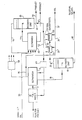
- reactor products from coal liquefaction are mixed with a compatible volatile coal extract solvent introduced by line 52 either in pre-mixer 10 or directly in separator 14.
- Contact of the reactor products with the solvent is accomplished, preferably in a series of multiple-stage countercurrent or crosscurrent mixers with the application of gravity separation such as by the use of centrifuges at each stage, such that the solids residue in the final mixing and separating stage is contacted with fresh volatile solvent for discharge of compacted solids residue therefrom containing interstitially volatile solvent essentially free of coal liquefaction products.
- pre-mixer 10 assists in the solubilizing of the asphaltenes and pre-asphaltenes by the volatile solvent.
- the multiple-stage contacting can be effected in a single device having multiple internal stages.
- the volatile coal extract solvent is recovered from subsequent processing to be described and is compatible with the oils, asphaltenes and preasphaltenes.
- the volatile solvent is prepared from a coal derived oil fraction having at least 80% by volume distillation temperature between about 205° and 535°C for compatibility with the coal liquefaction products.
- a typical volatile solvent, shown in Table 1, comprises by volume about 98.3% distillation temperature between about 205° to 515°C. Distillation characteristics
- the volatile coal extract solvent is contacted and mixed with the reactor products in an amount by weight in the range of about 10 to about 250%, preferably about 20 to about 100%, of the coal liquefaction slurry product.
- the quantity employed will vary according to the particular volatile solvent used and the characteristics of the reactor products which are determined by the coal starting material and the manner of liquefaction.
- Separator 14 is maintained at a temperature in the range of about 50° to 350°C under a pressure within the range of sub-atmospheric pressure to about 3.5 MPa.
- Separation 14 is effected by gravity separation, in a conventional gravity settling vessel or in a centrifuge with the application of multiplied settling forces, for separation primarily according to differences in densities between the homogeneous carrier solution comprised of solvent and liquefaction products and the insoluble solids.
- the carrier solution is recovered as an overflow substantially free of solids and the solids recovered as an underflow, the amount of underflow preferably being kept to a minimum such as by the use of centrifugal forces to compact the solids and to minimize the volume of interstitial carrier solution at each stage and to minimize the amount of volatile solvent escaping with the solids at the last stage.
- the underflow containing solids with interstitial carrier solution mainly voltile solvent
- recovery unit 18 which may constitute part of separator 14 or consist of a separate vessel in which the volatile solvent is evaporated at a temperature within the solvent boiling range.
- the evaporated solvent and any contained liquefaction product are fed by lines 22, 25 to series condensers 24, 26 with condensed product recycled to separator 40, to be described, by lines 28, 30, or discharged by line 32 as product.
- the solids, substantially free of solvent, are withdrawn from unit 18 as dried, friable, non- sticking solids which may be crushed and conveyed by line 20 to a gasifier or burner. Separation of oil, asphaltenes and preasphaltenes in separator 14 from the solids is substantially complete due to the effective separation of the liquefaction products solubilized in the carrier solution and displaced by the volatile solvent, substantially eliminating loss of coal liquefaction product with solids in line 20.
- the overflow of carrier solution from separator 14 is fed through line 36 to separator 40 and mixed with a coal derived light oil which is incompatible with the asphaltene and pre-asphaltene materials.
- the carrier solution and said light oil such as light naphtha, are processed in separator 40 at a temperature in the range of about 50° to about 150°C at a pressure of from atmospheric pressure to about 3.5 MPa, the light oil being introduced in an amount by weight in the range of about 30% to about 100% of the carrier solution.
- the addition of the incompatible light oil precipitates a substantial part of the asphaltenes and pre-asphaltenes in the form of an immiscible liquid and/or solid phase having a greater density than the density of the carrier solution from which they are precipitated.
- the immiscible phases can be separated from each other by gravity settling, preferably under centrifugal forces, to produce a non-visocus liquid overflow and a sticky semi-solid underflow comprised mainly of asphaltenes and pre- asphaltenes.
- the underflow is withdrawn by line 42 and is: returned to the liquefaction reactor, not shown, for further conversion into lighter oils; discharged for use as a solids product-with a low ash content; or upgraded such as by hydrocracking into distillable oils.
- the liquid overflow from separator 40 is fed by line 44 to recovery unit 46 for stripping and recovery of the light oil fraction by flash evaporation and fractionation, or by distillation, for recycle by line 54 to separator 40.
- the bottoms are withdrawn by line 48 and discharged as product through line 50 or recycled by line 52 to separator 14 or pre-mix vessel 10.
- the bottoms of vessel 46 may be passed through a hydroprocessor 49 to convert remaining asphaltene and pre-asphaltene fractions to distillated and to increase the hydrogen concentration, i.e. to regenerate the volatile solvent.
- Replacement of light oil taken from the system by removal of the two product streams 42, 50 can be made up by coal extract oil from coal liquefaction through line 38.
- the overflow of carrier solution from separator 14 may be directly fed to alternative processing unit 58 instead of to separator 40.
- the unit depicted by numeral 58 may be a hydrocracker from which the liquids are subsequently separated in a distillation column into products, recycle oil for the slurrying of coal, and recycle volatile coal extract solvent compatible with the asphaltenes and pre-asphaltenes; a distillation column for separation of overflow by boiling range; or a solvent deasphalting process such as a propane deasphalting process or Duosol process in which the asphaltenes and pre- asphaltenes are separated from the solvent.
- the process of the invention was carried out for the processing of reactor product resulting from the direct liquefaction of lignite in separator 14 and recovery unit 18.
- Separator 14 was a batch centrifuge operated at 1500 G's at atmospheric pressure with carrier solution maintained at 150°C.
- the reactor liquid product consisted of 86.49 mass units of liquid hydrocarbons and 13.51 mass units of unreacted coal and ash.
- Contacting was carried out in a three-stage crosscurrent mode using a total of 205.34 mass units of volatile coal extract solvent.
- the last underflow was fed to a vacuum flask for evaporation of the volatile solvent from the residual solids.
- Table 2 indicates the distribution of components in the feed to the separator, combined separator overflow and final underflow and recovery unit overflow and bottoms. For a feed to the separator of 86.49 mass units of reactor liquid product, 1.84 units of reactor liquid product were lost with the insoluble solids in the recovery unit bottoms, resulting in a recovery of 97.9% of the reactor liquid
Landscapes
- Chemical & Material Sciences (AREA)
- Oil, Petroleum & Natural Gas (AREA)
- Engineering & Computer Science (AREA)
- Chemical Kinetics & Catalysis (AREA)
- General Chemical & Material Sciences (AREA)
- Organic Chemistry (AREA)
- Life Sciences & Earth Sciences (AREA)
- Wood Science & Technology (AREA)
- Production Of Liquid Hydrocarbon Mixture For Refining Petroleum (AREA)
- Organic Low-Molecular-Weight Compounds And Preparation Thereof (AREA)
Claims (17)
Priority Applications (1)
| Application Number | Priority Date | Filing Date | Title |
|---|---|---|---|
| AT83301039T ATE19788T1 (de) | 1982-02-27 | 1983-02-28 | Verfahren zur trennung von feststoffen aus fluessigen kohlenwasserstoffen. |
Applications Claiming Priority (2)
| Application Number | Priority Date | Filing Date | Title |
|---|---|---|---|
| GB8205834 | 1982-02-27 | ||
| GB8205834 | 1982-02-27 |
Publications (3)
| Publication Number | Publication Date |
|---|---|
| EP0087965A2 EP0087965A2 (fr) | 1983-09-07 |
| EP0087965A3 EP0087965A3 (en) | 1984-01-11 |
| EP0087965B1 true EP0087965B1 (fr) | 1986-05-14 |
Family
ID=10528665
Family Applications (1)
| Application Number | Title | Priority Date | Filing Date |
|---|---|---|---|
| EP83301039A Expired EP0087965B1 (fr) | 1982-02-27 | 1983-02-28 | Procédé pour la séparation des solides d'hydrocarbures liquides |
Country Status (8)
| Country | Link |
|---|---|
| EP (1) | EP0087965B1 (fr) |
| JP (1) | JPS58189293A (fr) |
| AT (1) | ATE19788T1 (fr) |
| AU (1) | AU1191283A (fr) |
| CA (1) | CA1191808A (fr) |
| DE (1) | DE3363480D1 (fr) |
| NZ (1) | NZ203399A (fr) |
| ZA (1) | ZA831341B (fr) |
Families Citing this family (4)
| Publication number | Priority date | Publication date | Assignee | Title |
|---|---|---|---|---|
| BR8504611A (pt) * | 1985-09-20 | 1987-04-28 | Petroleo Brasileiro Sa | Processo para separar agua e solidos de combustiveis,em particular de oleo de xisto |
| EP0924227B1 (fr) * | 1997-12-16 | 2004-03-10 | JSR Corporation | Caoutchouc à base de copolymère de dioléfine conjuguée et sa composition |
| US9834730B2 (en) | 2014-01-23 | 2017-12-05 | Ecolab Usa Inc. | Use of emulsion polymers to flocculate solids in organic liquids |
| CN111908743B (zh) * | 2019-05-07 | 2023-02-10 | 中国石油天然气集团有限公司 | 一种油泥水热处理分离回收系统及方法 |
Family Cites Families (8)
| Publication number | Priority date | Publication date | Assignee | Title |
|---|---|---|---|---|
| US3607716A (en) * | 1970-01-09 | 1971-09-21 | Kerr Mc Gee Chem Corp | Fractionation of coal liquefaction products in a mixture of heavy and light organic solvents |
| US3607717A (en) * | 1970-01-09 | 1971-09-21 | Kerr Mc Gee Chem Corp | Fractionating coal liquefaction products with light organic solvents |
| US3790467A (en) * | 1970-08-27 | 1974-02-05 | Exxon Research Engineering Co | Coal liquefaction solids removal |
| US3852182A (en) * | 1972-11-07 | 1974-12-03 | Lummus Co | Coal liquefaction |
| US3856675A (en) * | 1972-11-07 | 1974-12-24 | Lummus Co | Coal liquefaction |
| US3997425A (en) * | 1974-12-26 | 1976-12-14 | Universal Oil Products Company | Process for the liquefaction of coal |
| US4071434A (en) * | 1976-08-30 | 1978-01-31 | Phillips Petroleum Company | Recovery of oil from tar sands |
| US4180456A (en) * | 1977-06-27 | 1979-12-25 | The Dow Chemical Company | Process for recovering a premium oil from a slurry produced by high temperature hydrogenation of a solid, hydrocarbonaceous fuel |
-
1983
- 1983-02-23 CA CA000422248A patent/CA1191808A/fr not_active Expired
- 1983-02-25 NZ NZ203399A patent/NZ203399A/en unknown
- 1983-02-28 AT AT83301039T patent/ATE19788T1/de active
- 1983-02-28 EP EP83301039A patent/EP0087965B1/fr not_active Expired
- 1983-02-28 AU AU11912/83A patent/AU1191283A/en not_active Abandoned
- 1983-02-28 DE DE8383301039T patent/DE3363480D1/de not_active Expired
- 1983-02-28 JP JP58032672A patent/JPS58189293A/ja active Pending
- 1983-02-28 ZA ZA831341A patent/ZA831341B/xx unknown
Also Published As
| Publication number | Publication date |
|---|---|
| EP0087965A2 (fr) | 1983-09-07 |
| NZ203399A (en) | 1985-12-13 |
| DE3363480D1 (en) | 1986-06-19 |
| ZA831341B (en) | 1983-11-30 |
| EP0087965A3 (en) | 1984-01-11 |
| JPS58189293A (ja) | 1983-11-04 |
| CA1191808A (fr) | 1985-08-13 |
| AU1191283A (en) | 1983-09-01 |
| ATE19788T1 (de) | 1986-05-15 |
Similar Documents
| Publication | Publication Date | Title |
|---|---|---|
| US4338183A (en) | Method of solvent extraction of coal by a heavy oil | |
| US4875998A (en) | Hot water bitumen extraction process | |
| US7909989B2 (en) | Method for obtaining bitumen from tar sands | |
| US3705092A (en) | Solvent extraction of coal by a heavy oil | |
| CA1037400A (fr) | Petrole brut extrait du charbon | |
| US3791956A (en) | Conversion of coal to clean fuel | |
| US3852182A (en) | Coal liquefaction | |
| US2774716A (en) | Process for removing finely divided solids from raw low temperature carbonization coal tars | |
| US4906355A (en) | Tar sands extract fines removal process | |
| US4075080A (en) | Coal liquefaction process with removal of agglomerated insolubles | |
| EP0051345B1 (fr) | Liquéfaction au solvant donneur de charbons avec recyclage des produits de queue sous pression élevée | |
| US3954595A (en) | Coal liquefaction | |
| US4994175A (en) | Syncrude dedusting extraction | |
| US4094766A (en) | Coal liquefaction product deashing process | |
| EP0268612A1 (fr) | Procede ionique integre de liquefaction | |
| US3909390A (en) | Coal liquefaction process | |
| US4402821A (en) | Process for liquefaction of coal | |
| US3974073A (en) | Coal liquefaction | |
| US4134821A (en) | Maintenance of solvent balance in coal liquefaction process | |
| US3947346A (en) | Coal liquefaction | |
| US3790467A (en) | Coal liquefaction solids removal | |
| CA1191808A (fr) | Methode de separation des solides en presence dans les hydrocarbures | |
| US4257870A (en) | Process for the purification of undistillable solid-containing hydrocarbon fractions produced in coal-refining | |
| US3711400A (en) | Continuous process for recovering waxes from oily sludges | |
| US4539098A (en) | Upgrading carbonaceous materials |
Legal Events
| Date | Code | Title | Description |
|---|---|---|---|
| PUAI | Public reference made under article 153(3) epc to a published international application that has entered the european phase |
Free format text: ORIGINAL CODE: 0009012 |
|
| AK | Designated contracting states |
Designated state(s): AT BE CH DE FR GB IT LI LU NL SE |
|
| PUAL | Search report despatched |
Free format text: ORIGINAL CODE: 0009013 |
|
| AK | Designated contracting states |
Designated state(s): AT BE CH DE FR GB IT LI LU NL SE |
|
| 17P | Request for examination filed |
Effective date: 19840629 |
|
| GRAA | (expected) grant |
Free format text: ORIGINAL CODE: 0009210 |
|
| AK | Designated contracting states |
Kind code of ref document: B1 Designated state(s): AT BE CH DE FR GB IT LI LU NL SE |
|
| PG25 | Lapsed in a contracting state [announced via postgrant information from national office to epo] |
Ref country code: NL Effective date: 19860514 Ref country code: IT Free format text: LAPSE BECAUSE OF FAILURE TO SUBMIT A TRANSLATION OF THE DESCRIPTION OR TO PAY THE FEE WITHIN THE PRESCRIBED TIME-LIMIT;WARNING: LAPSES OF ITALIAN PATENTS WITH EFFECTIVE DATE BEFORE 2007 MAY HAVE OCCURRED AT ANY TIME BEFORE 2007. THE CORRECT EFFECTIVE DATE MAY BE DIFFERENT FROM THE ONE RECORDED. Effective date: 19860514 Ref country code: FR Free format text: THE PATENT HAS BEEN ANNULLED BY A DECISION OF A NATIONAL AUTHORITY Effective date: 19860514 Ref country code: BE Effective date: 19860514 |
|
| REF | Corresponds to: |
Ref document number: 19788 Country of ref document: AT Date of ref document: 19860515 Kind code of ref document: T |
|
| REF | Corresponds to: |
Ref document number: 3363480 Country of ref document: DE Date of ref document: 19860619 |
|
| EN | Fr: translation not filed | ||
| NLV1 | Nl: lapsed or annulled due to failure to fulfill the requirements of art. 29p and 29m of the patents act | ||
| PG25 | Lapsed in a contracting state [announced via postgrant information from national office to epo] |
Ref country code: LU Free format text: LAPSE BECAUSE OF NON-PAYMENT OF DUE FEES Effective date: 19870228 Ref country code: LI Effective date: 19870228 Ref country code: CH Effective date: 19870228 Ref country code: AT Effective date: 19870228 |
|
| PG25 | Lapsed in a contracting state [announced via postgrant information from national office to epo] |
Ref country code: SE Effective date: 19870301 |
|
| PLBE | No opposition filed within time limit |
Free format text: ORIGINAL CODE: 0009261 |
|
| STAA | Information on the status of an ep patent application or granted ep patent |
Free format text: STATUS: NO OPPOSITION FILED WITHIN TIME LIMIT |
|
| 26N | No opposition filed | ||
| GBPC | Gb: european patent ceased through non-payment of renewal fee | ||
| REG | Reference to a national code |
Ref country code: CH Ref legal event code: PL |
|
| PG25 | Lapsed in a contracting state [announced via postgrant information from national office to epo] |
Ref country code: DE Effective date: 19871103 |
|
| PG25 | Lapsed in a contracting state [announced via postgrant information from national office to epo] |
Ref country code: GB Effective date: 19881122 |
|
| EUG | Se: european patent has lapsed |
Ref document number: 83301039.0 Effective date: 19880215 |