EP0089616A2 - Druck- und Beschichtungsverfahren mit pigmentierten wässerigen Schaumzusammensetzungen - Google Patents
Druck- und Beschichtungsverfahren mit pigmentierten wässerigen Schaumzusammensetzungen Download PDFInfo
- Publication number
- EP0089616A2 EP0089616A2 EP83102605A EP83102605A EP0089616A2 EP 0089616 A2 EP0089616 A2 EP 0089616A2 EP 83102605 A EP83102605 A EP 83102605A EP 83102605 A EP83102605 A EP 83102605A EP 0089616 A2 EP0089616 A2 EP 0089616A2
- Authority
- EP
- European Patent Office
- Prior art keywords
- membranes
- cylinder
- liquid
- cells
- composition
- Prior art date
- Legal status (The legal status is an assumption and is not a legal conclusion. Google has not performed a legal analysis and makes no representation as to the accuracy of the status listed.)
- Granted
Links
Images


Classifications
-
- B—PERFORMING OPERATIONS; TRANSPORTING
- B05—SPRAYING OR ATOMISING IN GENERAL; APPLYING FLUENT MATERIALS TO SURFACES, IN GENERAL
- B05D—PROCESSES FOR APPLYING FLUENT MATERIALS TO SURFACES, IN GENERAL
- B05D1/00—Processes for applying liquids or other fluent materials
- B05D1/28—Processes for applying liquids or other fluent materials performed by transfer from the surfaces of elements carrying the liquid or other fluent material, e.g. brushes, pads, rollers
-
- B—PERFORMING OPERATIONS; TRANSPORTING
- B05—SPRAYING OR ATOMISING IN GENERAL; APPLYING FLUENT MATERIALS TO SURFACES, IN GENERAL
- B05D—PROCESSES FOR APPLYING FLUENT MATERIALS TO SURFACES, IN GENERAL
- B05D1/00—Processes for applying liquids or other fluent materials
- B05D1/40—Distributing applied liquids or other fluent materials by members moving relatively to surface
-
- B—PERFORMING OPERATIONS; TRANSPORTING
- B41—PRINTING; LINING MACHINES; TYPEWRITERS; STAMPS
- B41M—PRINTING, DUPLICATING, MARKING, OR COPYING PROCESSES; COLOUR PRINTING
- B41M1/00—Inking and printing with a printer's forme
- B41M1/10—Intaglio printing ; Gravure printing
Definitions
- This invention relates generally to the printing of moving webs, and is concerned in particular with improved paper printing and coating processes employing, in the most favorable embodiments, pigmented water based foamable ink or coating compositions.
- the invention is especially useful in, but not limited to, rotogravure printing. Since its inception in the late 1800's, rotogravure printing has been carried out primarily with solvent based inks. The solvents are toxic and highly flammable, and consequently printing plant personnel are exposed continuously to potentially serious health, fire and explosion hazards. As a result, in spite of the implementation of elaborate and expensive protective measures such as for example solvent recovery and air pollution abatement systems, electrically grounded presses, shielded electric motors, etc., insurance costs have remained extremely high. Moreover, because solvents are extracted from petroleum, their costs have increased dramatically during the last decade, as has the cost of the energy consumed by the dryers required to dry the solvent inks after printing.
- the present invention lies, in part, in the surprising discovery that quite contrary to Kumins' teachings, the relative size and uniformity of the foam bubbles is not a dominant factor in the successful application of pigmented water based foamed ink in a rotary gravure printing process. Rather than attempting to fill cells with small foam bubbles, the present invention relies on an initial distribution of a layer of relatively large foam bubbles over the surface of an engraved cylinder, followed by a conversion of the bubbles through doctoring into discrete membranes spanning each of the cells, with the surface areas or "lands" of the cylinder between the cells as well as the cell interiors underlying the membranes being substantially free of ink.
- the membranes then may be transferred directly onto the surface of a web by simply pressing the web against the doctored gravure cylinder by means of an impression roller.
- the membranes may be transferred onto the surfaces of one or more intermediate rolls before finally being applied to the web surface.
- the dimensional characteristics of the aforesaid membranes are largely independent of the volumetric characteristics of the cells, except that for a given surface tension, membrane thickness will vary in proportion to the open cell area. In any event, however, the membranes will deliver a smaller amount of pigment and liquid vehicle to the substrate being printed as compared with prior art solvent or water based foam systems, which rely on a loading of the cell in order to achieve effective printing.
- the present invention 's more efficient deposition of ink translates into extraordinary savings in ink costs. Moreover, because the present invention is characterized by a lesser penetration of the liquid vehicle, the printer can employ less expensive papers without resulting show through, thus further reducing the cost of printing.
- the present invention also makes it possible to apply opacity-contributing or hold-out coatings. These will upgrade the printing and/or aesthetic qualities of the paper. Most importantly, it has been discovered that the extremely quick-drying characteristic of the coatings makes it possible to achieve such coatingson-line, e.g. with a coating process preceding the printing process.
- the surface-segregation of the coating materials might also facilitate the manufacture of thin two-sided sheet products wherein the sides are to have substantially different, even incompatible, properties.
- one side can bear an acidic coating while the other side can carry a basic coating.
- very thin sheets may be prepared having an electro resistive face coat and an electro conductive back coat without unacceptable contamination of one coating by the other.
- the more efficient transfer of pigment in accordance with the present invention produces higher color intensity for a given gravure cell area as compared with the prior art processes.
- Another advantage of the present ivention is the drastic reduction of "web breaks" which have previously been associated with paper weakened by excessive liquid absorption. This is true despite the fact that, as a general rule, aqueous systems more readily wet most inexpensive, cellulosic substrates.
- Still another advantage of the present invention relates to the Helio-Klischograph process of engraving gravure cylinders.
- One of the concerns with this process has been the difficulty of obtaining sufficient cell volume to match the cell volumes obtained by earlier etching techniques. This problem is essentially eliminated with the present invention, since cell volume does not contribute to the efficiency of the printing operation. Rather, it is open cell area that is important, and this can be achieved easily by the Helio-Klischograph process by employing a diamond stylus with a more obtuse cutting angle.
- the preferred formulations from which the foam is generated include pseudo-plastic or thixotropic additives. It is preferred that such formulations be foamed to an expanded volume of from about 3 to 20 times the volume of the liquid composition.
- High-stability foams of the prior art are not the most desirable. Rather, foams which have 25% drainage times of less than three hours are preferred. Those having 25% drainage times (NFPA STD 11, 1978 p. 11-98) of well below one hour are entirely acceptable.
- the best compositions are those in which the drainage liquid is not formed by material drained out of bubble films; instead, it is preferred that the liquid be largely derived from breaking bubbles.
- foam compositions which do not dry out before the foam bubbles break and drain.
- foams can be obtained if one avoids excessively foam-stabilized formulae.
- a particular advantage of such foams is that they can be readily reworked, without any substantial reformulating, simply by refoaming. ⁇
- the printer may utilize his material efficiently and minimize waste disposal problems.
- a rotgravure printing apparatus comprising a gravure cylinder 10 rotatably mounted within the confines of an open-top fountain 12.
- the engraved surface of the gravure cylinder is partially submerged in a body 14 of pigmented water based foamed ink.
- the gravure cylinder is rotated in the clockwise direciton, and its submerged surface is brushed continouously by a rotating cylindrical brush 16 submerged in the foam body 14 and also driven in the clockwise direction.
- a doctor blade 18 wipes the surface of gravure cylinder 10 prior to its arriving at a printing nip 20 defined between the gravure cylinder 10 and an impression roll 22.
- a paper web 24 is fed from a supply roll 26 through the printing nip 20 and then over a roll 28 on the way to a conventional cutting and folding apparatus (not shown).
- the fountain 12 is connected via a supply line 30 to a foam generating unit 32 which operates on demand to foam a water based liquid ink or coating composition being supplied thereto.
- foam may be continuously recirculated via suction line 34, pump 36 and delivery line 38 back to the opposite side of the gravure cylinder where freshly generated foam is also being delivered via line 30.
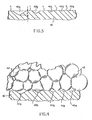
- the surface of the gravure cylinder 10 has been engraved by a Helio-Klischograph, which as is well known to those skilled in the art, utilizes an electronically controlled diamond stylus (not shown) to cut out inverted pyramidal shaped cells of the type shown in Figures 2-6.
- the cells are spaced one from the other by lands "L" whose dimensions vary depending on the depths and center-to-center spacing of the cells.
- Open cell area (as viewed in plan) is a function of cell depth, i.e., the greater the depth to which the stylus is allowed to penetrate, the greater the open cell area.
- foamable ink formulations utilized in the process of the invention are listed below. The following designations are used in these formulations:
- Ethylene glycol was added as a foam conditioner and the amount of pseudoplastic material was increased to 0.20%. Although the foam lacked consistency, the formula was applied successfully to a paper web. No change in color intensity was noted after a run of 1-1/2 hours. No indication of growth was noticed.
- Example A 1% silicone surfactant (L-7129) was added to the formula of Example A. The addition of the surfactant resulted in a uniform foam. The formula was successfully applied to a paper web. No change in color intensity or growth in one hour.
- example A was modified by increasing the weight percent of the resin from 11.0% to 20.0% and correspondingly decreasing the water content from 54.8% to 45.8%. This formula was successfully applied to a paper web. No change in color intensity was noted.
- Example C The formula of Example C was modified by adding 1% silicone surfactant (L-7129). This formula was successfully applied to paper web.
- the foam had the following characteristics: No change in color intensity and very little foam growth.
- the perfluorocarboxylic acid was added to enhance the surface tension of the foam.
- the formula successfully coated a transfer roll in a flexographic process.
- the above liquid formulations were mixed by the foam generating equipment 32 with a pressurized gas such as air at the above specified expansion ratios, without attendant mechanical agitation.
- the resulting foams had non-uniform bubble sizes (determined by bubble diameter) ranging from about 5 to 100,000 microns.
- the median bubble size was larger than the maximum cell depth of the gravure cyliner, and observations of experimental runs indicated that median bubble size was substantially larger that the median maximum lateral dimension of the open cell areas.
- Figure 4 shows the condition of the gravure cylinder surface after it has entered the foam body and has been exposed to the brushing action of roll 16, but prior to its being wiped by the doctor blade 18.
- the cylinder surface is coated with foamed ink in the form of randomly distributed bubbles 42 which as mentioned above, vary in size, with the minimum bubble diameter being larger than the maximum cell depth, and with the median bubble size being larger than the median maximum lateral dimension of the open cell areas.
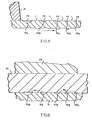
- Figure 5 shows the condition of the gravure cylinder surface immediately after it has been wiped by the doctor blade 18 but prior to its entry into the printing nip 20. It will be seen that the bubble coating shown in Figure 4 has been converted by doctoring into discrete extremely thin membranes 44 covering or spanning the cells 40a - 40e. The above-stated relationship between the bubble size and cell depth is believed to contribute to this result by insuring that a major percentage of the bubbles are only partially received in the cells and thus are exposed to the wiping action of the doctor blade.
- the lands L between the cells, and the interior cell portions underlying the membranes are free of ink, or at least substantially so.
- Figure 6 shows the condition of the gravure cylinder surface as it passes through the printing nip 20 where it is brought into contact with the paper web 24. At this stage, the thin membranes 44 are picked up by the web, leaving the cylinder surface free of ink in the condition shown in Figure 3.
- the process of the present invention also may be employed in flexographic printing.
- an engraved anilox cylinder 50 is partially submerged in and rotated through a body 52 of foamed ink, the latter having been generated and delivered in accordance with previously described techniques.
- A'rotating submerged brush 54 again is employed to achieve appropriate distribution of foam over the surface of the anilox cylinder.
- the foamed ink coating is then doctored as at 56 to convert the same to the previously described membranes spanning the engraved cells.
- the membranes are then transferred to and deposited on the surface of a rotating intermediate rubber transfer roll 58.. From here, the membrane deposits are transferred to the raised areas of a flexographic printing plate 60. Finally, the membrane deposits are applied to the surface of a moving web 62 which is pressed against the printing plate by an impression roll 64.
- the present invention consists of a printing or coating process employing a water-based foamable composition.
- the formulation is foamed and applied to the surface of gravure or anilox cylinders, with the foam bubbles being randomly sized and significantly larger on average as compared to the average cell size of the cylinders.
- the cylinder surfaces are then doctored to convert the foam bubbles into thin discrete membranes which span or overlie the open cells, leaving the cell interiors underlying the membranes as well as the lands separating the cells substantially free of ink or coating deposits.
- the membranes are then transferred, either directly or indirectly, onto the surface of a moving web.
Landscapes
- Printing Methods (AREA)
Priority Applications (1)
| Application Number | Priority Date | Filing Date | Title |
|---|---|---|---|
| AT83102605T ATE34942T1 (de) | 1982-03-22 | 1983-03-16 | Druck- und beschichtungsverfahren mit pigmentierten waesserigen schaumzusammensetzungen. |
Applications Claiming Priority (4)
| Application Number | Priority Date | Filing Date | Title |
|---|---|---|---|
| US36061582A | 1982-03-22 | 1982-03-22 | |
| US360615 | 1982-03-22 | ||
| US06/419,233 US4474110A (en) | 1980-03-22 | 1982-09-17 | Process employing pigmented water based foamed compositions |
| US419233 | 1989-10-10 |
Publications (3)
| Publication Number | Publication Date |
|---|---|
| EP0089616A2 true EP0089616A2 (de) | 1983-09-28 |
| EP0089616A3 EP0089616A3 (en) | 1985-01-16 |
| EP0089616B1 EP0089616B1 (de) | 1988-06-08 |
Family
ID=27000972
Family Applications (1)
| Application Number | Title | Priority Date | Filing Date |
|---|---|---|---|
| EP83102605A Expired EP0089616B1 (de) | 1982-03-22 | 1983-03-16 | Druck- und Beschichtungsverfahren mit pigmentierten wässerigen Schaumzusammensetzungen |
Country Status (2)
| Country | Link |
|---|---|
| EP (1) | EP0089616B1 (de) |
| DE (1) | DE3376968D1 (de) |
Cited By (6)
| Publication number | Priority date | Publication date | Assignee | Title |
|---|---|---|---|---|
| EP0214574B1 (de) * | 1985-09-06 | 1992-04-22 | Yasui Seiki Co., Ltd. | Tiefdruckbeschichtungsvorrichtung |
| GB2294891A (en) * | 1994-11-11 | 1996-05-15 | Gd Spa | Roller gumming device |
| WO2010018302A1 (en) * | 2008-08-11 | 2010-02-18 | Upm-Kymmene Corporation | A method for making printing paper |
| EP2231407A4 (de) * | 2007-12-12 | 2011-02-23 | Ricoh Co Ltd | Bilderzeugungsvorrichtung und schaumauftragsvorrichtung |
| WO2013063084A1 (en) * | 2011-10-25 | 2013-05-02 | Unipixel Displays, Inc. | A method for reducing glare via a flexographic printing process |
| EP4494877A1 (de) * | 2023-07-18 | 2025-01-22 | Seprinto & Partners GmbH | Druckvorrichtung |
Family Cites Families (5)
| Publication number | Priority date | Publication date | Assignee | Title |
|---|---|---|---|---|
| US2971458A (en) * | 1957-12-30 | 1961-02-14 | Interchem Corp | Process of coloring textile materials |
| US3400658A (en) * | 1965-04-20 | 1968-09-10 | Interchem Corp | Method of intaglio printing |
| US3595772A (en) * | 1968-10-03 | 1971-07-27 | Xerox Corp | Method of breaking particle agglomerates in the photo electrophoretic imaging system |
| FR2409095A1 (fr) * | 1977-11-18 | 1979-06-15 | Peintures Ind Ass | Procede de traitement de surface d'un support poreux |
| US4482648A (en) * | 1982-03-22 | 1984-11-13 | Foamink Company, Inc. | Foamed ink composition and method of making the same |
-
1983
- 1983-03-16 DE DE8383102605T patent/DE3376968D1/de not_active Expired
- 1983-03-16 EP EP83102605A patent/EP0089616B1/de not_active Expired
Cited By (8)
| Publication number | Priority date | Publication date | Assignee | Title |
|---|---|---|---|---|
| EP0214574B1 (de) * | 1985-09-06 | 1992-04-22 | Yasui Seiki Co., Ltd. | Tiefdruckbeschichtungsvorrichtung |
| GB2294891A (en) * | 1994-11-11 | 1996-05-15 | Gd Spa | Roller gumming device |
| EP2231407A4 (de) * | 2007-12-12 | 2011-02-23 | Ricoh Co Ltd | Bilderzeugungsvorrichtung und schaumauftragsvorrichtung |
| CN101896348B (zh) * | 2007-12-12 | 2012-08-22 | 株式会社理光 | 图像形成设备和泡沫涂敷装置 |
| US8540337B2 (en) | 2007-12-12 | 2013-09-24 | Ricoh Company | Image forming apparatus and foam application device |
| WO2010018302A1 (en) * | 2008-08-11 | 2010-02-18 | Upm-Kymmene Corporation | A method for making printing paper |
| WO2013063084A1 (en) * | 2011-10-25 | 2013-05-02 | Unipixel Displays, Inc. | A method for reducing glare via a flexographic printing process |
| EP4494877A1 (de) * | 2023-07-18 | 2025-01-22 | Seprinto & Partners GmbH | Druckvorrichtung |
Also Published As
| Publication number | Publication date |
|---|---|
| EP0089616B1 (de) | 1988-06-08 |
| DE3376968D1 (en) | 1988-07-14 |
| EP0089616A3 (en) | 1985-01-16 |
Similar Documents
| Publication | Publication Date | Title |
|---|---|---|
| US4474110A (en) | Process employing pigmented water based foamed compositions | |
| US4014833A (en) | Aqueous printing ink with polyethylene oxide | |
| CA2102157C (en) | Anilox coater with brush | |
| US4903599A (en) | Printed products and a process for their manufacture | |
| US6116158A (en) | Retractable printing/coating unit operable on the plate and blanket cylinders | |
| US3607813A (en) | Printing ink compositions | |
| US5908505A (en) | High volume, textured liquid transfer surface | |
| CN100457453C (zh) | 用于凹版印刷机的输墨系统 | |
| US5651316A (en) | Retractable printing/coating unit operable on the plate and blanket cylinders simultaneously from the dampener side of the first printing unit or any consecutive printing unit of any rotary offset printing press | |
| JP3046079U (ja) | オフセット印刷機において印刷物をインライン式でコーティングするための装置 | |
| US5960713A (en) | Retractable printing-coating unit operable on the plate and blanket cylinders simultaneously from the dampener side of the first printing unit or any consecutive printing unit or any rotary offset printing press | |
| US5598777A (en) | Retractable printing/coating unit operable on the plate and blanket cylinders | |
| CA2082723A1 (en) | Letterpress printing method and applicator device for its implementation | |
| EP0089616B1 (de) | Druck- und Beschichtungsverfahren mit pigmentierten wässerigen Schaumzusammensetzungen | |
| JP2806968B2 (ja) | 版板のアニロックス目を有する表面の目詰まりを阻止するための方法および装置 | |
| EP0563187B1 (de) | Isopropylalkoholfreies katalytisches befeuchtungskonzentrat und verfahren zum einbringen eines katalytischen mittels in eine lithographische druckfarbe | |
| WO2007147113A2 (en) | Water washable lithographic printing ink | |
| CA1305296C (en) | Fountain solutions | |
| CA2763412C (en) | Method for producing catalyst layers for fuel cells | |
| JP2664018B2 (ja) | オフセット印刷機において液状の媒体を印刷材に施す装置 | |
| EP0767058A2 (de) | Druckmaschine | |
| CA1190809A (en) | Printing and coating processes employing pigmented water based foamed compositions | |
| JPH0116676B2 (de) | ||
| CN109291620B (zh) | 一种免润湿原液轮转印刷系统及印刷方法 | |
| EP0322816A2 (de) | Druckverfahren |
Legal Events
| Date | Code | Title | Description |
|---|---|---|---|
| PUAI | Public reference made under article 153(3) epc to a published international application that has entered the european phase |
Free format text: ORIGINAL CODE: 0009012 |
|
| AK | Designated contracting states |
Designated state(s): AT BE CH DE FR GB IT LI LU NL SE |
|
| PUAL | Search report despatched |
Free format text: ORIGINAL CODE: 0009013 |
|
| AK | Designated contracting states |
Designated state(s): AT BE CH DE FR GB IT LI LU NL SE |
|
| 17P | Request for examination filed |
Effective date: 19850612 |
|
| 17Q | First examination report despatched |
Effective date: 19860626 |
|
| GRAA | (expected) grant |
Free format text: ORIGINAL CODE: 0009210 |
|
| AK | Designated contracting states |
Kind code of ref document: B1 Designated state(s): AT BE CH DE FR GB IT LI LU NL SE |
|
| REF | Corresponds to: |
Ref document number: 34942 Country of ref document: AT Date of ref document: 19880615 Kind code of ref document: T |
|
| REF | Corresponds to: |
Ref document number: 3376968 Country of ref document: DE Date of ref document: 19880714 |
|
| ET | Fr: translation filed | ||
| ITF | It: translation for a ep patent filed | ||
| PG25 | Lapsed in a contracting state [announced via postgrant information from national office to epo] |
Ref country code: AT Effective date: 19890316 |
|
| PG25 | Lapsed in a contracting state [announced via postgrant information from national office to epo] |
Ref country code: LU Free format text: LAPSE BECAUSE OF NON-PAYMENT OF DUE FEES Effective date: 19890331 Ref country code: BE Effective date: 19890331 |
|
| PLBE | No opposition filed within time limit |
Free format text: ORIGINAL CODE: 0009261 |
|
| STAA | Information on the status of an ep patent application or granted ep patent |
Free format text: STATUS: NO OPPOSITION FILED WITHIN TIME LIMIT |
|
| 26N | No opposition filed | ||
| BERE | Be: lapsed |
Owner name: FOAMINK CY Effective date: 19890331 |
|
| PG25 | Lapsed in a contracting state [announced via postgrant information from national office to epo] |
Ref country code: NL Effective date: 19891001 |
|
| NLV4 | Nl: lapsed or anulled due to non-payment of the annual fee | ||
| REG | Reference to a national code |
Ref country code: CH Ref legal event code: PFA Free format text: FOAMINK COMPANY |
|
| ITTA | It: last paid annual fee | ||
| PGFP | Annual fee paid to national office [announced via postgrant information from national office to epo] |
Ref country code: FR Payment date: 19940210 Year of fee payment: 12 |
|
| PGFP | Annual fee paid to national office [announced via postgrant information from national office to epo] |
Ref country code: CH Payment date: 19940214 Year of fee payment: 12 |
|
| PGFP | Annual fee paid to national office [announced via postgrant information from national office to epo] |
Ref country code: SE Payment date: 19940215 Year of fee payment: 12 |
|
| PGFP | Annual fee paid to national office [announced via postgrant information from national office to epo] |
Ref country code: DE Payment date: 19940224 Year of fee payment: 12 |
|
| EAL | Se: european patent in force in sweden |
Ref document number: 83102605.9 |
|
| PG25 | Lapsed in a contracting state [announced via postgrant information from national office to epo] |
Ref country code: SE Effective date: 19950317 |
|
| PG25 | Lapsed in a contracting state [announced via postgrant information from national office to epo] |
Ref country code: LI Effective date: 19950331 Ref country code: CH Effective date: 19950331 |
|
| PG25 | Lapsed in a contracting state [announced via postgrant information from national office to epo] |
Ref country code: FR Free format text: LAPSE BECAUSE OF NON-PAYMENT OF DUE FEES Effective date: 19951130 |
|
| REG | Reference to a national code |
Ref country code: CH Ref legal event code: PL |
|
| PG25 | Lapsed in a contracting state [announced via postgrant information from national office to epo] |
Ref country code: DE Effective date: 19951201 |
|
| EUG | Se: european patent has lapsed |
Ref document number: 83102605.9 |
|
| REG | Reference to a national code |
Ref country code: FR Ref legal event code: ST |
|
| PGFP | Annual fee paid to national office [announced via postgrant information from national office to epo] |
Ref country code: GB Payment date: 19970226 Year of fee payment: 15 |
|
| PG25 | Lapsed in a contracting state [announced via postgrant information from national office to epo] |
Ref country code: GB Free format text: LAPSE BECAUSE OF NON-PAYMENT OF DUE FEES Effective date: 19980316 |
|
| GBPC | Gb: european patent ceased through non-payment of renewal fee |
Effective date: 19980316 |