EP0089707A2 - Procédé pour la production d'huiles désasphaltés et de distillats d'huiles d'hydrocarbures - Google Patents
Procédé pour la production d'huiles désasphaltés et de distillats d'huiles d'hydrocarbures Download PDFInfo
- Publication number
- EP0089707A2 EP0089707A2 EP83200316A EP83200316A EP0089707A2 EP 0089707 A2 EP0089707 A2 EP 0089707A2 EP 83200316 A EP83200316 A EP 83200316A EP 83200316 A EP83200316 A EP 83200316A EP 0089707 A2 EP0089707 A2 EP 0089707A2
- Authority
- EP
- European Patent Office
- Prior art keywords
- feed
- stream
- treatment
- asphaltenes
- product
- Prior art date
- Legal status (The legal status is an assumption and is not a legal conclusion. Google has not performed a legal analysis and makes no representation as to the accuracy of the status listed.)
- Granted
Links
Images

Classifications
-
- C—CHEMISTRY; METALLURGY
- C10—PETROLEUM, GAS OR COKE INDUSTRIES; TECHNICAL GASES CONTAINING CARBON MONOXIDE; FUELS; LUBRICANTS; PEAT
- C10G—CRACKING HYDROCARBON OILS; PRODUCTION OF LIQUID HYDROCARBON MIXTURES, e.g. BY DESTRUCTIVE HYDROGENATION, OLIGOMERISATION, POLYMERISATION; RECOVERY OF HYDROCARBON OILS FROM OIL-SHALE, OIL-SAND, OR GASES; REFINING MIXTURES MAINLY CONSISTING OF HYDROCARBONS; REFORMING OF NAPHTHA; MINERAL WAXES
- C10G69/00—Treatment of hydrocarbon oils by at least one hydrotreatment process and at least one other conversion process
- C10G69/02—Treatment of hydrocarbon oils by at least one hydrotreatment process and at least one other conversion process plural serial stages only
- C10G69/06—Treatment of hydrocarbon oils by at least one hydrotreatment process and at least one other conversion process plural serial stages only including at least one step of thermal cracking in the absence of hydrogen
Definitions
- the invention relates to a process for the production of deasphalted oils and hydrocarbon oil distillates from asphaltenes-containing hydrocarbon mixtures.
- Another option is to separate an atmospheric residue into a vacuum distillate and a vacuum residue by vacuum distillation, to separate a deasphalted oil from the vacuum residue by solvent deasphalting and to subject both the vacuum distillate and the deasphalted oil to catalytic cracking in the presence or absence of hydrogen.
- Solvent deasphalting a process in which an asphaltenes-containing feedstock is converted into a product from which a deasphalted oil can be separated as the desired main product and an asphaltic bitumen as a by-product, has proven in actual practice to be a suitable treatment for the production of deasphalted oils from a variety of asphaltenes-containing hydrocarbon mixtures.
- This suitability is greater according as the deasphalted oil has, among other things, lower asphaltenes, metal and sulphur contents.
- the quality of the light product is taken to be its suitability for processing into a valuable light fuel.
- This suitability is greater according as the light product has, among other things, lower sulphur and olefins contents.
- the quality of the heavy product is taken to be its suitability for serving as a fuel oil component.
- This suitability is greater according as the heavy product has, among other things, lower metal and sulphur contents and lower viscosity and density.
- thermal cracking in which a heavy feed is converted into a product which contains less than 20 %w C4 hydrocarbons and from which one or more distillate fractions and a heavy fraction are separated
- HT catalytic hydrotreatment
- the embodiments belonging to class I constitute the subject matter of the present patent application.
- the embodiments belonging to class II constitute the subject matter of Netherlands Patent Application 8201243.
- the embodiments to which the present patent application relates may be subdivided further depending on whether the asphaltenes-containing feed is used as a feed component for the HT (class IA), or as a feed component for the DA treatment (class IB).
- the asphaltic bitumen fraction which is separated from the product of the DA treatment is used as the feed for the TC treatment.
- the heavy fraction which is separated from the product of the TC treatment is used as a feed component for the HT and the heavy fraction which is separated from the product of the HT is used as the feed for the DA treatment.
- the heavy fraction which is separated from the product of the HT is used as a feed component for the DA treatment and the heavy fraction which is separated from the product of the TC treatment is used as the feed for the HT.
- the present patent application therefore relates to a process for the production of deasphalted oils and hydrocarbon oil distillates from asphaltenes-containing hydrocarbon mixtures, in which an asphaltenes-containing hydrocarbon mixture (stream 1) is subjected to a combination of the following three treatments: a catalytic hydrotreatment (HT) in which an asphaltenes-containing feed is converted into a product having a reduced asphaltenes content, from which one or more distillate fractions and a heavy fraction (stream 2) are separated, a solvent deasphalting (DA) treatment in which an asphaltenes-containing feed is converted
- HT catalytic hydrotreatment
- DA solvent deasphalting
- stream 3 a deasphalted oil and an asphaltic bitumen
- TC thermal cracking treatment
- stream 4 a feed is converted into a product which contains less than 20 %w C 4 hydrocarbons and from which one or more distillate fractions and a heavy fraction (stream 4) are separated, in which stream 3 is used as the feed for the TC treatment and stream 1 is used either
- the feed used is an asphaltenes-containing hydrocarbon mixture.
- a suitable parameter for assessing the asphaltenes content of a hydrocarbon mixture and the reduction of the asphaltenes content which occurs when an asphaltenes-containing hydrocarbon mixture is subjected to a HT, is the Ramsbottom Carbon Test value (RCT).
- RCT Ramsbottom Carbon Test value
- the process is applied to hydrocarbon mixtures which boil substantially above 350°C and more than 35 %w of which boils above 520°C and which have an RCT higher than 7.5 %w.
- hydrocarbon mixtures examples include residues obtained in the distillation of crude mineral oils and also heavy hydorcarbon mixtures obtained from shale and tar sands.
- the process may also be applied to heavy crude mineral oils, residues obtained in the distillation of products formed in the thermal cracking of hydrocarbon mixtures and asphaltic bitumen obtained in the solvent deasphalting of asphaltenes-containing hydrocarbon mixtures.
- the process according to the invention can very suitably be applied to residues obtained in the vacuum distillation of atmospheric distillation residues from crude mineral oils.
- the feed available for the process according to the invention is an atmospheric distillation residue from a crude mineral oil
- the separated vacuum distillate may be subjected to thermal cracking or to catalytic cracking in the presence or absence of hydrogen to convert it into light hydrocarbon oil distillates.
- the process'according to the invention is a three-step process in which an asphaltenes-containing feed (stream 1) is subjected in the first step to a HT or a DA treatment and in which the heavy fraction (stream 2) and the asphaltic bitumen (stream 3) separated from the product obtained by the respective treatments are subjected in the second and the third step of the process to a combination of a DA treatment and a TC treatment and a combination of a TC treatment and a HT, respectively.
- Asphaltenes-containing hydrocarbon mixtures usually include a considerable percentage of metals, particularly vanadium and nickel.
- a catalytic treatment for instance a HT for the reduction of the asphaltenes content as is the case in the process according to the invention, these metals will be deposited on the catalyst used in the HT, thus shortening its useful life.
- asphaltenes-containing hydrocarbon mixtures having a vanadium + nickel content higher than 50 parts per million by weight (ppmw) should preferably be subjected to a demetallization treatment before being contacted with the catalyst used in the HT.
- This demetallization may very suitably be carried out by contacting the asphaltenes-containing hydrocarbon mixture in the presence of hydrogen with a catalyst more than 80 %w of which consists of silica.
- a catalyst more than 80 %w of which consists of silica.
- Both catalysts consisting entirely of silica and catalysts containing one or more metals with hydrogenation activity - in particular a combination of nickel and vanadium - supported on a carrier consisting substantially of silica are suitable for the purpose.
- an asphaltenes-containing feed is subjected to a catalytic demetallization treatment in the presence of hydrogen, this demetallization may be carried out in a separate reactor.
- the two processes may also very suitably be carried out in the same reactor, which successively contains a bed of the demetallization reactor and a bed of the catalyst used in the HT.
- Suitable catalysts for carrying out the HT are those which contain at least one metal chosen from the group formed by nickel and cobalt and in addition at least one metal chosen fran the group formed by molybdenum and tungsten supported on a carrier, which carrier consists more than 40 %w of alumina.
- Very suitable catalysts for use in the HT are those which comprise the metal combination nickel/molybdenum or cobalt/molybdenum supported on alumina as the carrier.
- the HT is preferably carried out at a temperature of from 300-500°C and in particular of from 350-450°C, a pressure of from 50-300 bar and in particular of from 75-200 bar, a space velocity of from 0.02-10 g.g -1 .h -1 and in particular of from 0.1-2 g.g -1 .h -1 and a H 2 /feed ratio of from 100-5000 Nl.kg -1 and in particular of from 500-2000 Nl.kg .
- the same preference applies to the conditions which are used in a possible catalytic demetallization in the presence of hydrogen as to those given hereinbefore for the HT aiming at reduction of the asphaltenes content.
- the HT is preferably carried out in such a manner that it yields a product, the C 5 + fraction of which meets the following requirements:
- the HT yields a product with a reduced asphaltenes content from which one or more distillate fractions and a heavy fraction (stream 2) are separated.
- the distillate fractions separated from the product may be only atmospheric distillates, but preferably a vacuum distillate should be separated from the product as well. This vacuum distillate may be converted into light hydrocarbon oil distillates in the ways mentioned hereinbefore.
- the first step applied may be a DA treatment in which an asphaltenes-containing feed is converted into a product from which a deasphalted oil and an asphaltic bitumen (stream 3) are separated.
- Suitable solvents for carrying out the DA treatment are paraffinic hydrocarbons having 3-6 carbon atoms per molecule, such as n-butane and mixtures thereof, such as mixtures of propane and n-butane and mixtures of n-butane and n-pentane.
- Suitable solvent/oil weight ratios lie in the range of from 7:1 to 1:1 and in particular of from 4:1 to 1:1.
- the DA treatment is preferably carried out at a pressure in the range of from 20-100 bar.
- the deasphalting is preferably carried out at a pressure of from 35-45 bar and a temperature of from 100-150°C.
- the second or third step used is a TC treatment in which stream 3 is converted into a product which contains less than 20 %w C 4 hydrocarbons and from which one or more distillate fractions and a heavy fraction (stream 4) are separated.
- the distillate fractions separated from the product may be only atmospheric distillates, but preferably a vacuum distillate should be separated from the product as well. This vacuum distillate may be converted into light hydrocarbon oil distillates in the manners indicated hereinbefore.
- the TC treatment is preferably carried out at a temperature of from 400-525°C and a space velocity of from 0.01-5 kg fresh feed per litre cracking reactor volume per minute.
- the embodiments belonging to class I to which the present patent application relates are subdivided depending on whether stream 1 is used as a feed component for the HT (class IA) or as a feed component for the DA treatment (class IB) .
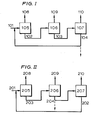
- the embodiment belonging to class IA is represented schematically in Figure I.
- the various streams, fractions and reaction zones are indicated by three digit numbers, the first of which refers to the Figure concerned.
- the vacuum residue (302) for instance, refers to vacuum residue 2 in the context of Figure III.
- the process is carried out in an apparatus comprising a HT zone (105), a DA zone (106) and a TC zone (107), successively.
- An asphaltenes-containing hydrocarbon mixture (101) and a residual fraction (104) are subjected to a HT and the hydrotreated product is separated into one or more distillate fractions (108) and a residual fraction (102).
- Stream 102 is subjected to a DA treatment and the product is separated into a deasphalted oil (109) and an asphaltic bitumen (103).
- Stream 103 is subjected to TC and the cracked product is separated into one or more distillate fractions (110) and a residual fraction (104).
- the embodiment belonging to class IB is represented schematically in Figure II. According to this Figure the process is carried out in an apparatus consisting of a DA zone (205), a TC zone (206) and a HT zone (207), successively.
- An asphaltenes-containing hydrocarbon mixture (201) and a residual fraction (202) are subjected to a DA treatment and the product is separated into a deasphalted oil (208) and an asphaltic bitumen (203).
- Stream 203 is subjected to a TC treatment and the cracked product is separated into one or more distillate fractions (209) and a residual fraction (204).
- Stream 204 is subjected to a HT and the hydrotreated product is separated into one or more distillate fractions (210) and a residual fraction (202).
- bleed stream should preferably be separated from one of the heavy streams of the process. In this way the build-up of undesirable heavy components during the process can be obviated.
- the process is carried out in an apparatus comprising successiveively, a HT zone composed of a unit for catalytic hydrotreatment (305), a unit for atmospheric distillation (306) and a vacuum distillation unit (307), a DA zone (308) and a TC zone composed of a thermal cracking unit (309), a second atmospheric distillation unit (310) and a second vacuum distillation unit (311).
- An asphaltenes-containing hydrocarbon mixture (301) is mixed with a recirculation stream (312) and the mixture (313) is subjected together with hydrogen (314) to a catalytic hydrotreatment.
- the hydrotreated product (315) is separated by atmospheric distillation into a gas fraction (316), an atomospheric distillate (317) and an atmospheric residue (318).
- the atmospheric residue (318) is separated by vacuum distillation into a vacuum distillate (319) and a vacuum residue (302).
- the vacuum residue (302) is separated by solvent deasphalting into a deasphalted oil (320) and an asphaltic bitumen (303).
- the asphaltic bitumen (303) is subjected to thermal cracking and the thermally cracked product (321) is separated by atmospheric distillation into a gas fraction (322), an atmospheric distillate (323) and an atmospheric residue (324).
- the atmospheric residue (324) is separated by vacuum distillation into a vacuum distillate (325) and a vacuum residue (304).
- the vacuum residue (304) is divided into two portions (312) and (326).
- the process is carried out in an apparatus comprising, successively, a DA zone (405), a TC zone composed of a thermal cracking unit (406), an atmospheric distillation unit (407) and a vacuum distillation unit (408) and a HT zone composed of a unit for catalytic hydrotreatment (409), a second atmospheric distillation unit (410) and a second vacuum distillation unit (411).
- An asphaltenes-containing hydrocarbon mixture (401) is mixed with a vacuum residue (402) and the mixture (412) is separated by solvent deasphalting into a deasphalted oil (413) and an asphaltic bitumen (403).
- the asphaltic bitumen (403) is subjected to thermal cracking and the thermally cracked product (414) is separated by atmospheric distillation into a gas fraction (415), an atmospheric distillate (416) and an atmospheric residue (417).
- the atmospheric residue (417) is separated by vacuum distillation into a vacuum distillate (418) and a vacuum residue (404).
- the vacuum residue (404) is divided into two portions (419) and (420).
- Portion (420) is subjected together with hydrogen (421) to a catalytic hydrotreatment.
- the hydrotreated product (422) is separated by atmospheric distillation into a gas fraction (423), an atmospheric distillate (424) and an atmospheric residue (425).
- the atmospheric residue (425) is separated by vacuum distillation into a vacuum distillate (426) and vacuum residue (402).
- the present patent application also includes apparatuses for carrying out the process according to the invention substantially corresponding with those represented schematically in Figures I-IV.
- the unit for catalytic hydrotreatment as described in both the flow diagrams consisted of two reactors, the first of which was filled with a Ni/V/Si0 2 catalyst containing 0.5 parts by weight (pbw) nickel and 2.0 pbw vanadium per 100 pbw silica and the second of which was filled with a Co/Mo/Al 2 O 3 catalyst containing 4 pbw cobalt and 12 pbw molybdenum per 100 pbw alumina.
- the catalysts were used in a 1:4 volume ratio.
- the HT was carried out at a hydrogen pressure of 150 bar, a space velocity (measured over the two reactors) of 0.5 kg feed per litre catalyst per hour, a H 2 /feed ratio of 1000 N1 per kg and an average temperature of 410°C in the first reactor and 385°C in the second reactor.
- the DA treatment was carried out using n-butane as solvent, at a temperature of 115°C, a pressure of 40 bar and a solvent/oil weight ratio of 3:1.
- the TC treatment was carried out in a cracking coil, at a pressure of 10 bar, a space velocity of 0.4 kg fresh feed per litre cracking coil volume per minute and a temperature of 500°C (temperature measured at the outlet of the cracking coil).
Landscapes
- Chemical & Material Sciences (AREA)
- Oil, Petroleum & Natural Gas (AREA)
- Physics & Mathematics (AREA)
- Thermal Sciences (AREA)
- Engineering & Computer Science (AREA)
- Chemical Kinetics & Catalysis (AREA)
- General Chemical & Material Sciences (AREA)
- Organic Chemistry (AREA)
- Production Of Liquid Hydrocarbon Mixture For Refining Petroleum (AREA)
Applications Claiming Priority (2)
| Application Number | Priority Date | Filing Date | Title |
|---|---|---|---|
| NL8201233 | 1982-03-24 | ||
| NL8201233A NL8201233A (nl) | 1982-03-24 | 1982-03-24 | Werkwijze voor de bereiding van asfaltenenarme koolwaterstofmengsel. |
Publications (3)
| Publication Number | Publication Date |
|---|---|
| EP0089707A2 true EP0089707A2 (fr) | 1983-09-28 |
| EP0089707A3 EP0089707A3 (en) | 1983-10-26 |
| EP0089707B1 EP0089707B1 (fr) | 1985-12-04 |
Family
ID=19839469
Family Applications (1)
| Application Number | Title | Priority Date | Filing Date |
|---|---|---|---|
| EP83200316A Expired EP0089707B1 (fr) | 1982-03-24 | 1983-03-04 | Procédé pour la production d'huiles désasphaltés et de distillats d'huiles d'hydrocarbures |
Country Status (9)
| Country | Link |
|---|---|
| EP (1) | EP0089707B1 (fr) |
| JP (1) | JPS58173190A (fr) |
| AU (1) | AU558158B2 (fr) |
| CA (1) | CA1208150A (fr) |
| DE (1) | DE3361373D1 (fr) |
| ES (1) | ES8401517A1 (fr) |
| MX (1) | MX162276A (fr) |
| NL (1) | NL8201233A (fr) |
| ZA (1) | ZA831992B (fr) |
Cited By (1)
| Publication number | Priority date | Publication date | Assignee | Title |
|---|---|---|---|---|
| EP0640678A3 (fr) * | 1993-08-30 | 1995-08-23 | Nippon Oil Co Ltd | Procédé pour l'hydrotraitement d'huile hydrocarbonée lourde. |
Families Citing this family (1)
| Publication number | Priority date | Publication date | Assignee | Title |
|---|---|---|---|---|
| JPS60152594A (ja) * | 1984-01-23 | 1985-08-10 | Kawasaki Heavy Ind Ltd | 直接脱硫装置残渣油の脱硫方法 |
Family Cites Families (7)
| Publication number | Priority date | Publication date | Assignee | Title |
|---|---|---|---|---|
| US3775293A (en) * | 1972-08-09 | 1973-11-27 | Universal Oil Prod Co | Desulfurization of asphaltene-containing hydrocarbonaceous black oils |
| US3859199A (en) * | 1973-07-05 | 1975-01-07 | Universal Oil Prod Co | Hydrodesulfurization of asphaltene-containing black oil |
| NL7512090A (nl) * | 1975-10-15 | 1977-04-19 | Shell Int Research | Werkwijze voor het omzetten van koolwaterstof- fen. |
| NL7610511A (nl) * | 1976-09-22 | 1978-03-28 | Shell Int Research | Werkwijze voor het omzetten van koolwater- stoffen. |
| NL7612960A (nl) * | 1976-11-22 | 1978-05-24 | Shell Int Research | Werkwijze voor het omzetten van koolwater- stoffen. |
| NL8105560A (nl) * | 1981-12-10 | 1983-07-01 | Shell Int Research | Werkwijze voor de bereiding van koolwaterstofoliedestillaten. |
| NL8105660A (nl) * | 1981-12-16 | 1983-07-18 | Shell Int Research | Werkwijze voor de bereiding van koolwaterstofoliedestillaten. |
-
1982
- 1982-03-24 NL NL8201233A patent/NL8201233A/nl not_active Application Discontinuation
-
1983
- 1983-03-04 DE DE8383200316T patent/DE3361373D1/de not_active Expired
- 1983-03-04 EP EP83200316A patent/EP0089707B1/fr not_active Expired
- 1983-03-09 CA CA000423237A patent/CA1208150A/fr not_active Expired
- 1983-03-22 ES ES520831A patent/ES8401517A1/es not_active Expired
- 1983-03-22 AU AU12683/83A patent/AU558158B2/en not_active Ceased
- 1983-03-22 JP JP58046126A patent/JPS58173190A/ja active Pending
- 1983-03-22 ZA ZA831992A patent/ZA831992B/xx unknown
- 1983-03-23 MX MX196677A patent/MX162276A/es unknown
Cited By (1)
| Publication number | Priority date | Publication date | Assignee | Title |
|---|---|---|---|---|
| EP0640678A3 (fr) * | 1993-08-30 | 1995-08-23 | Nippon Oil Co Ltd | Procédé pour l'hydrotraitement d'huile hydrocarbonée lourde. |
Also Published As
| Publication number | Publication date |
|---|---|
| EP0089707A3 (en) | 1983-10-26 |
| JPS58173190A (ja) | 1983-10-12 |
| ES520831A0 (es) | 1983-12-16 |
| MX162276A (es) | 1991-04-19 |
| AU558158B2 (en) | 1987-01-22 |
| ZA831992B (en) | 1983-11-30 |
| AU1268383A (en) | 1983-09-29 |
| EP0089707B1 (fr) | 1985-12-04 |
| ES8401517A1 (es) | 1983-12-16 |
| NL8201233A (nl) | 1983-10-17 |
| DE3361373D1 (en) | 1986-01-16 |
| CA1208150A (fr) | 1986-07-22 |
Similar Documents
| Publication | Publication Date | Title |
|---|---|---|
| EP0090437B1 (fr) | Procédé pour la production de distillates d'hydrocarbures | |
| US4006076A (en) | Process for the production of low-sulfur-content hydrocarbon mixtures | |
| US4062758A (en) | Process for the conversion of hydrocarbons in atmospheric crude residue | |
| US5358627A (en) | Hydroprocessing for producing lubricating oil base stocks | |
| US4405441A (en) | Process for the preparation of hydrocarbon oil distillates | |
| US4126538A (en) | Process for the conversion of hydrocarbons | |
| US4443325A (en) | Conversion of residua to premium products via thermal treatment and coking | |
| EP0082555B1 (fr) | Procédé pour la production de distillats d'hydrocarbures | |
| EP0040018A2 (fr) | Hydroconversion catalytique de charges résiduelles | |
| CA1309051C (fr) | Procede de preparation de distillats d'hydrocarbures legars par hydrocraquage et craquage catalytique | |
| US4324935A (en) | Special conditions for the hydrogenation of heavy hydrocarbons | |
| CA1117058A (fr) | Methode de conversion d'hydrocarbures | |
| US4120778A (en) | Process for the conversion of hydrocarbons in atmospheric crude residue | |
| EP0099141B1 (fr) | Procédé pour la production de mélanges d'hydrocarbures à faible teneur en asphaltène | |
| EP0068543A2 (fr) | Procédé pour la préparation d'un mélange d'hydrocarbures | |
| EP0082551B1 (fr) | Procédé pour la production de distillats d'hydrocarbures | |
| US4721557A (en) | Combination process for the conversion of a residual asphaltene-containing hydrocarbonaceous stream to maximize middle distillate production | |
| EP0090441B1 (fr) | Procédé pour la production d'huiles désasphaltés et de destillats d'huiles d'hydrocarbures | |
| EP0089707B1 (fr) | Procédé pour la production d'huiles désasphaltés et de distillats d'huiles d'hydrocarbures | |
| US4396493A (en) | Process for reducing ramsbottom test of short residues | |
| US4396494A (en) | Process for reducing ramsbottom carbon test of asphalt | |
| EP0125709B1 (fr) | Procédé de production de mélanges hydrocarburés à faible teneur en asphaltènes | |
| US3407134A (en) | Process for hydrocracking an asphaltic hydrocarbon feed stock in the presence of a hydrogenated hydrocarbon and hydrocaracking catalyst | |
| US4397734A (en) | Process for reducing ramsbottom carbon test of short residues | |
| US4397733A (en) | Process for reducing the Ramsbottom carbon test of asphalt |
Legal Events
| Date | Code | Title | Description |
|---|---|---|---|
| PUAI | Public reference made under article 153(3) epc to a published international application that has entered the european phase |
Free format text: ORIGINAL CODE: 0009012 |
|
| PUAL | Search report despatched |
Free format text: ORIGINAL CODE: 0009013 |
|
| 17P | Request for examination filed |
Effective date: 19830304 |
|
| AK | Designated contracting states |
Designated state(s): BE DE FR GB IT SE |
|
| AK | Designated contracting states |
Designated state(s): BE DE FR GB IT SE |
|
| GRAA | (expected) grant |
Free format text: ORIGINAL CODE: 0009210 |
|
| AK | Designated contracting states |
Designated state(s): BE DE FR GB IT SE |
|
| ITF | It: translation for a ep patent filed | ||
| REF | Corresponds to: |
Ref document number: 3361373 Country of ref document: DE Date of ref document: 19860116 |
|
| ET | Fr: translation filed | ||
| PLBE | No opposition filed within time limit |
Free format text: ORIGINAL CODE: 0009261 |
|
| STAA | Information on the status of an ep patent application or granted ep patent |
Free format text: STATUS: NO OPPOSITION FILED WITHIN TIME LIMIT |
|
| 26N | No opposition filed | ||
| ITTA | It: last paid annual fee | ||
| EAL | Se: european patent in force in sweden |
Ref document number: 83200316.4 |
|
| PGFP | Annual fee paid to national office [announced via postgrant information from national office to epo] |
Ref country code: FR Payment date: 19960201 Year of fee payment: 14 |
|
| PGFP | Annual fee paid to national office [announced via postgrant information from national office to epo] |
Ref country code: GB Payment date: 19960207 Year of fee payment: 14 |
|
| PGFP | Annual fee paid to national office [announced via postgrant information from national office to epo] |
Ref country code: SE Payment date: 19960209 Year of fee payment: 14 |
|
| PGFP | Annual fee paid to national office [announced via postgrant information from national office to epo] |
Ref country code: BE Payment date: 19960304 Year of fee payment: 14 |
|
| PGFP | Annual fee paid to national office [announced via postgrant information from national office to epo] |
Ref country code: DE Payment date: 19960417 Year of fee payment: 14 |
|
| PG25 | Lapsed in a contracting state [announced via postgrant information from national office to epo] |
Ref country code: GB Effective date: 19970304 |
|
| PG25 | Lapsed in a contracting state [announced via postgrant information from national office to epo] |
Ref country code: SE Effective date: 19970305 |
|
| PG25 | Lapsed in a contracting state [announced via postgrant information from national office to epo] |
Ref country code: BE Effective date: 19970331 |
|
| BERE | Be: lapsed |
Owner name: SHELL INTERNATIONALE RESEARCH MAATSCHAPPIJ B.V. Effective date: 19970331 |
|
| GBPC | Gb: european patent ceased through non-payment of renewal fee |
Effective date: 19970304 |
|
| PG25 | Lapsed in a contracting state [announced via postgrant information from national office to epo] |
Ref country code: FR Free format text: LAPSE BECAUSE OF NON-PAYMENT OF DUE FEES Effective date: 19971128 |
|
| PG25 | Lapsed in a contracting state [announced via postgrant information from national office to epo] |
Ref country code: DE Effective date: 19971202 |
|
| EUG | Se: european patent has lapsed |
Ref document number: 83200316.4 |
|
| REG | Reference to a national code |
Ref country code: FR Ref legal event code: ST |