EP0089812B1 - N-Substituierte Pseudo-aminozucker, ihre Herstellung und Verwendung - Google Patents
N-Substituierte Pseudo-aminozucker, ihre Herstellung und Verwendung Download PDFInfo
- Publication number
- EP0089812B1 EP0089812B1 EP83301482A EP83301482A EP0089812B1 EP 0089812 B1 EP0089812 B1 EP 0089812B1 EP 83301482 A EP83301482 A EP 83301482A EP 83301482 A EP83301482 A EP 83301482A EP 0089812 B1 EP0089812 B1 EP 0089812B1
- Authority
- EP
- European Patent Office
- Prior art keywords
- group
- amino
- hydroxyl
- formula
- compound
- Prior art date
- Legal status (The legal status is an assumption and is not a legal conclusion. Google has not performed a legal analysis and makes no representation as to the accuracy of the status listed.)
- Expired
Links
- 238000004519 manufacturing process Methods 0.000 title claims 2
- 150000001875 compounds Chemical class 0.000 claims description 94
- 125000002887 hydroxy group Chemical group [H]O* 0.000 claims description 91
- -1 2 - methoxy - 3,4 - dihydroxy - 6 - hydroxymethyltetrahydropyran - 5 - yl Chemical group 0.000 claims description 81
- VDLOJRUTNRJDJO-ZYNSJIGGSA-N (1s,2s,3r,4s,5s)-5-amino-1-(hydroxymethyl)cyclohexane-1,2,3,4-tetrol Chemical compound N[C@H]1C[C@](O)(CO)[C@@H](O)[C@H](O)[C@H]1O VDLOJRUTNRJDJO-ZYNSJIGGSA-N 0.000 claims description 74
- VDLOJRUTNRJDJO-UHFFFAOYSA-N Valiolamine Natural products NC1CC(O)(CO)C(O)C(O)C1O VDLOJRUTNRJDJO-UHFFFAOYSA-N 0.000 claims description 68
- 125000004432 carbon atom Chemical group C* 0.000 claims description 59
- 125000003277 amino group Chemical group 0.000 claims description 48
- 239000000203 mixture Substances 0.000 claims description 48
- 125000006239 protecting group Chemical group 0.000 claims description 41
- 125000002496 methyl group Chemical group [H]C([H])([H])* 0.000 claims description 38
- 125000000217 alkyl group Chemical group 0.000 claims description 35
- 229910052739 hydrogen Inorganic materials 0.000 claims description 33
- 238000000034 method Methods 0.000 claims description 32
- 150000003839 salts Chemical class 0.000 claims description 24
- QVGXLLKOCUKJST-UHFFFAOYSA-N atomic oxygen Chemical group [O] QVGXLLKOCUKJST-UHFFFAOYSA-N 0.000 claims description 23
- 239000001301 oxygen Substances 0.000 claims description 23
- 229910052760 oxygen Inorganic materials 0.000 claims description 23
- 239000001257 hydrogen Substances 0.000 claims description 19
- 238000006722 reduction reaction Methods 0.000 claims description 16
- 239000003112 inhibitor Substances 0.000 claims description 15
- 125000002924 primary amino group Chemical group [H]N([H])* 0.000 claims description 14
- CBOIHMRHGLHBPB-UHFFFAOYSA-N hydroxymethyl Chemical compound O[CH2] CBOIHMRHGLHBPB-UHFFFAOYSA-N 0.000 claims description 13
- 125000004029 hydroxymethyl group Chemical group [H]OC([H])([H])* 0.000 claims description 13
- 150000003997 cyclic ketones Chemical class 0.000 claims description 11
- 230000001590 oxidative effect Effects 0.000 claims description 10
- 239000003795 chemical substances by application Substances 0.000 claims description 8
- 239000003814 drug Substances 0.000 claims description 2
- 125000004435 hydrogen atom Chemical class [H]* 0.000 claims 7
- MNIKYOZADWLESW-UHFFFAOYSA-N 5-methylcyclohexane-1,2,3-triol Chemical compound CC1CC(O)C(O)C(O)C1 MNIKYOZADWLESW-UHFFFAOYSA-N 0.000 claims 1
- 229910001868 water Inorganic materials 0.000 description 159
- XLYOFNOQVPJJNP-UHFFFAOYSA-N water Substances O XLYOFNOQVPJJNP-UHFFFAOYSA-N 0.000 description 123
- XEKOWRVHYACXOJ-UHFFFAOYSA-N Ethyl acetate Chemical compound CCOC(C)=O XEKOWRVHYACXOJ-UHFFFAOYSA-N 0.000 description 120
- OKKJLVBELUTLKV-UHFFFAOYSA-N Methanol Chemical compound OC OKKJLVBELUTLKV-UHFFFAOYSA-N 0.000 description 72
- 239000000243 solution Substances 0.000 description 69
- ZMXDDKWLCZADIW-UHFFFAOYSA-N N,N-Dimethylformamide Chemical compound CN(C)C=O ZMXDDKWLCZADIW-UHFFFAOYSA-N 0.000 description 67
- YMWUJEATGCHHMB-UHFFFAOYSA-N Dichloromethane Chemical compound ClCCl YMWUJEATGCHHMB-UHFFFAOYSA-N 0.000 description 60
- 238000010828 elution Methods 0.000 description 58
- 239000011541 reaction mixture Substances 0.000 description 57
- VEXZGXHMUGYJMC-UHFFFAOYSA-N Hydrochloric acid Chemical compound Cl VEXZGXHMUGYJMC-UHFFFAOYSA-N 0.000 description 48
- 238000000921 elemental analysis Methods 0.000 description 44
- 238000003756 stirring Methods 0.000 description 43
- RTZKZFJDLAIYFH-UHFFFAOYSA-N Diethyl ether Chemical compound CCOCC RTZKZFJDLAIYFH-UHFFFAOYSA-N 0.000 description 40
- UIIMBOGNXHQVGW-UHFFFAOYSA-M Sodium bicarbonate Chemical compound [Na+].OC([O-])=O UIIMBOGNXHQVGW-UHFFFAOYSA-M 0.000 description 40
- 229940093499 ethyl acetate Drugs 0.000 description 40
- QTBSBXVTEAMEQO-UHFFFAOYSA-N Acetic acid Chemical compound CC(O)=O QTBSBXVTEAMEQO-UHFFFAOYSA-N 0.000 description 39
- YXFVVABEGXRONW-UHFFFAOYSA-N Toluene Chemical compound CC1=CC=CC=C1 YXFVVABEGXRONW-UHFFFAOYSA-N 0.000 description 39
- 238000006243 chemical reaction Methods 0.000 description 39
- 239000010410 layer Substances 0.000 description 29
- 229920001467 poly(styrenesulfonates) Polymers 0.000 description 26
- 239000000843 powder Substances 0.000 description 26
- HEDRZPFGACZZDS-UHFFFAOYSA-N Chloroform Chemical compound ClC(Cl)Cl HEDRZPFGACZZDS-UHFFFAOYSA-N 0.000 description 24
- 229920001429 chelating resin Polymers 0.000 description 23
- VHUUQVKOLVNVRT-UHFFFAOYSA-N Ammonium hydroxide Chemical compound [NH4+].[OH-] VHUUQVKOLVNVRT-UHFFFAOYSA-N 0.000 description 22
- QGZKDVFQNNGYKY-UHFFFAOYSA-N ammonia Natural products N QGZKDVFQNNGYKY-UHFFFAOYSA-N 0.000 description 22
- 239000002904 solvent Substances 0.000 description 21
- PMZURENOXWZQFD-UHFFFAOYSA-L Sodium Sulfate Chemical compound [Na+].[Na+].[O-]S([O-])(=O)=O PMZURENOXWZQFD-UHFFFAOYSA-L 0.000 description 20
- HEDRZPFGACZZDS-MICDWDOJSA-N Trichloro(2H)methane Chemical compound [2H]C(Cl)(Cl)Cl HEDRZPFGACZZDS-MICDWDOJSA-N 0.000 description 20
- 238000001816 cooling Methods 0.000 description 20
- 229910000030 sodium bicarbonate Inorganic materials 0.000 description 20
- 235000017557 sodium bicarbonate Nutrition 0.000 description 20
- 108010051210 beta-Fructofuranosidase Proteins 0.000 description 19
- 235000011073 invertase Nutrition 0.000 description 19
- IAZDPXIOMUYVGZ-UHFFFAOYSA-N Dimethylsulphoxide Chemical compound CS(C)=O IAZDPXIOMUYVGZ-UHFFFAOYSA-N 0.000 description 17
- 102000016679 alpha-Glucosidases Human genes 0.000 description 17
- 108010028144 alpha-Glucosidases Proteins 0.000 description 17
- 239000012141 concentrate Substances 0.000 description 16
- 235000008504 concentrate Nutrition 0.000 description 16
- 229920006395 saturated elastomer Polymers 0.000 description 16
- 239000000126 substance Substances 0.000 description 16
- 238000004809 thin layer chromatography Methods 0.000 description 16
- LFQSCWFLJHTTHZ-UHFFFAOYSA-N Ethanol Chemical compound CCO LFQSCWFLJHTTHZ-UHFFFAOYSA-N 0.000 description 15
- ZMANZCXQSJIPKH-UHFFFAOYSA-N Triethylamine Chemical compound CCN(CC)CC ZMANZCXQSJIPKH-UHFFFAOYSA-N 0.000 description 15
- 239000000741 silica gel Substances 0.000 description 15
- 229910002027 silica gel Inorganic materials 0.000 description 15
- VYPSYNLAJGMNEJ-UHFFFAOYSA-N Silicium dioxide Chemical compound O=[Si]=O VYPSYNLAJGMNEJ-UHFFFAOYSA-N 0.000 description 14
- QAOWNCQODCNURD-UHFFFAOYSA-N Sulfuric acid Chemical compound OS(O)(=O)=O QAOWNCQODCNURD-UHFFFAOYSA-N 0.000 description 14
- WYURNTSHIVDZCO-UHFFFAOYSA-N Tetrahydrofuran Chemical compound C1CCOC1 WYURNTSHIVDZCO-UHFFFAOYSA-N 0.000 description 14
- 0 CC(C1)C(*)C(*)C(*)C1[In] Chemical compound CC(C1)C(*)C(*)C(*)C1[In] 0.000 description 13
- 125000003545 alkoxy group Chemical group 0.000 description 13
- 229910052736 halogen Inorganic materials 0.000 description 13
- 150000002367 halogens Chemical class 0.000 description 13
- 239000003208 petroleum Substances 0.000 description 13
- 229910052938 sodium sulfate Inorganic materials 0.000 description 13
- 235000011152 sodium sulphate Nutrition 0.000 description 13
- WFDIJRYMOXRFFG-UHFFFAOYSA-N Acetic anhydride Chemical compound CC(=O)OC(C)=O WFDIJRYMOXRFFG-UHFFFAOYSA-N 0.000 description 12
- WEVYAHXRMPXWCK-UHFFFAOYSA-N Acetonitrile Chemical compound CC#N WEVYAHXRMPXWCK-UHFFFAOYSA-N 0.000 description 12
- GSQYAWMREAXBHF-UHFFFAOYSA-N Validamine Natural products NC1CC(CO)C(O)C(O)C1O GSQYAWMREAXBHF-UHFFFAOYSA-N 0.000 description 12
- OAMZXMDZZWGPMH-UHFFFAOYSA-N ethyl acetate;toluene Chemical compound CCOC(C)=O.CC1=CC=CC=C1 OAMZXMDZZWGPMH-UHFFFAOYSA-N 0.000 description 12
- 125000001495 ethyl group Chemical group [H]C([H])([H])C([H])([H])* 0.000 description 12
- XPHOBMULWMGEBA-VZFHVOOUSA-N valienamine Chemical compound N[C@H]1C=C(CO)[C@@H](O)[C@H](O)[C@H]1O XPHOBMULWMGEBA-VZFHVOOUSA-N 0.000 description 12
- 230000002401 inhibitory effect Effects 0.000 description 11
- GSQYAWMREAXBHF-UOYQFSTFSA-N validamine Chemical class N[C@H]1C[C@H](CO)[C@@H](O)[C@H](O)[C@H]1O GSQYAWMREAXBHF-UOYQFSTFSA-N 0.000 description 11
- JUJWROOIHBZHMG-UHFFFAOYSA-N Pyridine Chemical compound C1=CC=NC=C1 JUJWROOIHBZHMG-UHFFFAOYSA-N 0.000 description 10
- 239000000706 filtrate Substances 0.000 description 10
- OKTJSMMVPCPJKN-UHFFFAOYSA-N Carbon Chemical compound [C] OKTJSMMVPCPJKN-UHFFFAOYSA-N 0.000 description 9
- UFHFLCQGNIYNRP-UHFFFAOYSA-N Hydrogen Chemical compound [H][H] UFHFLCQGNIYNRP-UHFFFAOYSA-N 0.000 description 9
- 239000002262 Schiff base Substances 0.000 description 9
- 150000004753 Schiff bases Chemical class 0.000 description 9
- XPHOBMULWMGEBA-UHFFFAOYSA-N Valienamine Natural products NC1C=C(CO)C(O)C(O)C1O XPHOBMULWMGEBA-UHFFFAOYSA-N 0.000 description 9
- 239000013078 crystal Substances 0.000 description 9
- BEOOHQFXGBMRKU-UHFFFAOYSA-N sodium cyanoborohydride Chemical compound [Na+].[B-]C#N BEOOHQFXGBMRKU-UHFFFAOYSA-N 0.000 description 9
- 239000007858 starting material Substances 0.000 description 9
- 238000005406 washing Methods 0.000 description 9
- NOUZOVBGCDDMSX-UHFFFAOYSA-N 3,5-ditert-butylcyclohexa-3,5-diene-1,2-dione Chemical compound CC(C)(C)C1=CC(=O)C(=O)C(C(C)(C)C)=C1 NOUZOVBGCDDMSX-UHFFFAOYSA-N 0.000 description 8
- IAZDPXIOMUYVGZ-WFGJKAKNSA-N Dimethyl sulfoxide Chemical compound [2H]C([2H])([2H])S(=O)C([2H])([2H])[2H] IAZDPXIOMUYVGZ-WFGJKAKNSA-N 0.000 description 8
- NBIIXXVUZAFLBC-UHFFFAOYSA-N Phosphoric acid Chemical compound OP(O)(O)=O NBIIXXVUZAFLBC-UHFFFAOYSA-N 0.000 description 8
- 238000001914 filtration Methods 0.000 description 8
- 235000013305 food Nutrition 0.000 description 8
- BKIMMITUMNQMOS-UHFFFAOYSA-N nonane Chemical compound CCCCCCCCC BKIMMITUMNQMOS-UHFFFAOYSA-N 0.000 description 8
- JOXIMZWYDAKGHI-UHFFFAOYSA-N toluene-4-sulfonic acid Chemical compound CC1=CC=C(S(O)(=O)=O)C=C1 JOXIMZWYDAKGHI-UHFFFAOYSA-N 0.000 description 8
- 125000002252 acyl group Chemical group 0.000 description 7
- 150000001412 amines Chemical class 0.000 description 7
- 239000003638 chemical reducing agent Substances 0.000 description 7
- 238000004587 chromatography analysis Methods 0.000 description 7
- 238000010438 heat treatment Methods 0.000 description 7
- 239000012046 mixed solvent Substances 0.000 description 7
- 229910052757 nitrogen Inorganic materials 0.000 description 7
- YLQBMQCUIZJEEH-UHFFFAOYSA-N tetrahydrofuran Natural products C=1C=COC=1 YLQBMQCUIZJEEH-UHFFFAOYSA-N 0.000 description 7
- RYHBNJHYFVUHQT-UHFFFAOYSA-N 1,4-Dioxane Chemical compound C1COCCO1 RYHBNJHYFVUHQT-UHFFFAOYSA-N 0.000 description 6
- XTHFKEDIFFGKHM-UHFFFAOYSA-N Dimethoxyethane Chemical compound COCCOC XTHFKEDIFFGKHM-UHFFFAOYSA-N 0.000 description 6
- LRHPLDYGYMQRHN-UHFFFAOYSA-N N-Butanol Chemical compound CCCCO LRHPLDYGYMQRHN-UHFFFAOYSA-N 0.000 description 6
- PCLIMKBDDGJMGD-UHFFFAOYSA-N N-bromosuccinimide Chemical compound BrN1C(=O)CCC1=O PCLIMKBDDGJMGD-UHFFFAOYSA-N 0.000 description 6
- HEMHJVSKTPXQMS-UHFFFAOYSA-M Sodium hydroxide Chemical compound [OH-].[Na+] HEMHJVSKTPXQMS-UHFFFAOYSA-M 0.000 description 6
- 239000001913 cellulose Substances 0.000 description 6
- 229920002678 cellulose Polymers 0.000 description 6
- KRKNYBCHXYNGOX-UHFFFAOYSA-N citric acid Chemical compound OC(=O)CC(O)(C(O)=O)CC(O)=O KRKNYBCHXYNGOX-UHFFFAOYSA-N 0.000 description 6
- 125000001424 substituent group Chemical group 0.000 description 6
- QAEDZJGFFMLHHQ-UHFFFAOYSA-N trifluoroacetic anhydride Chemical compound FC(F)(F)C(=O)OC(=O)C(F)(F)F QAEDZJGFFMLHHQ-UHFFFAOYSA-N 0.000 description 6
- WQZGKKKJIJFFOK-GASJEMHNSA-N Glucose Natural products OC[C@H]1OC(O)[C@H](O)[C@@H](O)[C@@H]1O WQZGKKKJIJFFOK-GASJEMHNSA-N 0.000 description 5
- 102000004157 Hydrolases Human genes 0.000 description 5
- 108090000604 Hydrolases Proteins 0.000 description 5
- 229910052783 alkali metal Inorganic materials 0.000 description 5
- 239000003242 anti bacterial agent Substances 0.000 description 5
- 125000001797 benzyl group Chemical group [H]C1=C([H])C([H])=C(C([H])=C1[H])C([H])([H])* 0.000 description 5
- 125000001584 benzyloxycarbonyl group Chemical group C(=O)(OCC1=CC=CC=C1)* 0.000 description 5
- 125000000484 butyl group Chemical group [H]C([*])([H])C([H])([H])C([H])([H])C([H])([H])[H] 0.000 description 5
- 239000003054 catalyst Substances 0.000 description 5
- 238000010531 catalytic reduction reaction Methods 0.000 description 5
- 238000006482 condensation reaction Methods 0.000 description 5
- 150000002170 ethers Chemical class 0.000 description 5
- 239000005457 ice water Substances 0.000 description 5
- 125000000449 nitro group Chemical group [O-][N+](*)=O 0.000 description 5
- 239000002798 polar solvent Substances 0.000 description 5
- UMJSCPRVCHMLSP-UHFFFAOYSA-N pyridine Natural products COC1=CC=CN=C1 UMJSCPRVCHMLSP-UHFFFAOYSA-N 0.000 description 5
- WKBOTKDWSSQWDR-UHFFFAOYSA-N Bromine atom Chemical compound [Br] WKBOTKDWSSQWDR-UHFFFAOYSA-N 0.000 description 4
- CURLTUGMZLYLDI-UHFFFAOYSA-N Carbon dioxide Chemical compound O=C=O CURLTUGMZLYLDI-UHFFFAOYSA-N 0.000 description 4
- AFVFQIVMOAPDHO-UHFFFAOYSA-N Methanesulfonic acid Chemical compound CS(O)(=O)=O AFVFQIVMOAPDHO-UHFFFAOYSA-N 0.000 description 4
- KDLHZDBZIXYQEI-UHFFFAOYSA-N Palladium Chemical compound [Pd] KDLHZDBZIXYQEI-UHFFFAOYSA-N 0.000 description 4
- 229920005654 Sephadex Polymers 0.000 description 4
- 239000012507 Sephadex™ Substances 0.000 description 4
- QAOWNCQODCNURD-UHFFFAOYSA-L Sulfate Chemical compound [O-]S([O-])(=O)=O QAOWNCQODCNURD-UHFFFAOYSA-L 0.000 description 4
- 125000002777 acetyl group Chemical group [H]C([H])([H])C(*)=O 0.000 description 4
- 239000002253 acid Substances 0.000 description 4
- 150000001298 alcohols Chemical class 0.000 description 4
- 150000001340 alkali metals Chemical class 0.000 description 4
- 125000003342 alkenyl group Chemical group 0.000 description 4
- 229910000147 aluminium phosphate Inorganic materials 0.000 description 4
- 229940088710 antibiotic agent Drugs 0.000 description 4
- 125000003236 benzoyl group Chemical group [H]C1=C([H])C([H])=C(C([H])=C1[H])C(*)=O 0.000 description 4
- GDTBXPJZTBHREO-UHFFFAOYSA-N bromine Substances BrBr GDTBXPJZTBHREO-UHFFFAOYSA-N 0.000 description 4
- 229910052794 bromium Inorganic materials 0.000 description 4
- 239000000969 carrier Substances 0.000 description 4
- 239000002024 ethyl acetate extract Substances 0.000 description 4
- 239000000499 gel Substances 0.000 description 4
- 239000003456 ion exchange resin Substances 0.000 description 4
- 229920003303 ion-exchange polymer Polymers 0.000 description 4
- 235000012054 meals Nutrition 0.000 description 4
- 150000007522 mineralic acids Chemical class 0.000 description 4
- 150000007524 organic acids Chemical class 0.000 description 4
- 125000001997 phenyl group Chemical group [H]C1=C([H])C([H])=C(*)C([H])=C1[H] 0.000 description 4
- 239000002244 precipitate Substances 0.000 description 4
- 238000010992 reflux Methods 0.000 description 4
- 239000012279 sodium borohydride Substances 0.000 description 4
- 229910000033 sodium borohydride Inorganic materials 0.000 description 4
- 125000000999 tert-butyl group Chemical group [H]C([H])([H])C(*)(C([H])([H])[H])C([H])([H])[H] 0.000 description 4
- VZGDMQKNWNREIO-UHFFFAOYSA-N tetrachloromethane Chemical compound ClC(Cl)(Cl)Cl VZGDMQKNWNREIO-UHFFFAOYSA-N 0.000 description 4
- WQZGKKKJIJFFOK-SVZMEOIVSA-N (+)-Galactose Chemical class OC[C@H]1OC(O)[C@H](O)[C@@H](O)[C@H]1O WQZGKKKJIJFFOK-SVZMEOIVSA-N 0.000 description 3
- XPIJMQVLTXAGME-UHFFFAOYSA-N 1,1-dimethoxycyclohexane Chemical compound COC1(OC)CCCCC1 XPIJMQVLTXAGME-UHFFFAOYSA-N 0.000 description 3
- OZAIFHULBGXAKX-UHFFFAOYSA-N 2-(2-cyanopropan-2-yldiazenyl)-2-methylpropanenitrile Chemical compound N#CC(C)(C)N=NC(C)(C)C#N OZAIFHULBGXAKX-UHFFFAOYSA-N 0.000 description 3
- ZWEHNKRNPOVVGH-UHFFFAOYSA-N 2-Butanone Chemical compound CCC(C)=O ZWEHNKRNPOVVGH-UHFFFAOYSA-N 0.000 description 3
- XNWFRZJHXBZDAG-UHFFFAOYSA-N 2-METHOXYETHANOL Chemical compound COCCO XNWFRZJHXBZDAG-UHFFFAOYSA-N 0.000 description 3
- ZCYVEMRRCGMTRW-UHFFFAOYSA-N 7553-56-2 Chemical compound [I] ZCYVEMRRCGMTRW-UHFFFAOYSA-N 0.000 description 3
- CSCPPACGZOOCGX-UHFFFAOYSA-N Acetone Chemical compound CC(C)=O CSCPPACGZOOCGX-UHFFFAOYSA-N 0.000 description 3
- UHOVQNZJYSORNB-UHFFFAOYSA-N Benzene Chemical compound C1=CC=CC=C1 UHOVQNZJYSORNB-UHFFFAOYSA-N 0.000 description 3
- LYCAIKOWRPUZTN-UHFFFAOYSA-N Ethylene glycol Chemical compound OCCO LYCAIKOWRPUZTN-UHFFFAOYSA-N 0.000 description 3
- KFZMGEQAYNKOFK-UHFFFAOYSA-N Isopropanol Chemical compound CC(C)O KFZMGEQAYNKOFK-UHFFFAOYSA-N 0.000 description 3
- SJRJJKPEHAURKC-UHFFFAOYSA-N N-Methylmorpholine Chemical compound CN1CCOCC1 SJRJJKPEHAURKC-UHFFFAOYSA-N 0.000 description 3
- MUBZPKHOEPUJKR-UHFFFAOYSA-N Oxalic acid Chemical compound OC(=O)C(O)=O MUBZPKHOEPUJKR-UHFFFAOYSA-N 0.000 description 3
- 125000004453 alkoxycarbonyl group Chemical group 0.000 description 3
- RQPZNWPYLFFXCP-UHFFFAOYSA-L barium dihydroxide Chemical compound [OH-].[OH-].[Ba+2] RQPZNWPYLFFXCP-UHFFFAOYSA-L 0.000 description 3
- 229910001863 barium hydroxide Inorganic materials 0.000 description 3
- WQZGKKKJIJFFOK-VFUOTHLCSA-N beta-D-glucose Chemical compound OC[C@H]1O[C@@H](O)[C@H](O)[C@@H](O)[C@@H]1O WQZGKKKJIJFFOK-VFUOTHLCSA-N 0.000 description 3
- 235000013361 beverage Nutrition 0.000 description 3
- 150000001720 carbohydrates Chemical class 0.000 description 3
- 235000014633 carbohydrates Nutrition 0.000 description 3
- 239000007810 chemical reaction solvent Substances 0.000 description 3
- 125000000113 cyclohexyl group Chemical group [H]C1([H])C([H])([H])C([H])([H])C([H])(*)C([H])([H])C1([H])[H] 0.000 description 3
- SBZXBUIDTXKZTM-UHFFFAOYSA-N diglyme Chemical compound COCCOCCOC SBZXBUIDTXKZTM-UHFFFAOYSA-N 0.000 description 3
- 208000037265 diseases, disorders, signs and symptoms Diseases 0.000 description 3
- 125000002485 formyl group Chemical group [H]C(*)=O 0.000 description 3
- 229960001031 glucose Drugs 0.000 description 3
- 239000008103 glucose Substances 0.000 description 3
- 150000002431 hydrogen Chemical class 0.000 description 3
- 230000007062 hydrolysis Effects 0.000 description 3
- 238000006460 hydrolysis reaction Methods 0.000 description 3
- 230000005764 inhibitory process Effects 0.000 description 3
- 239000011630 iodine Substances 0.000 description 3
- 229910052740 iodine Inorganic materials 0.000 description 3
- 238000005342 ion exchange Methods 0.000 description 3
- 125000000959 isobutyl group Chemical group [H]C([H])([H])C([H])(C([H])([H])[H])C([H])([H])* 0.000 description 3
- 125000001449 isopropyl group Chemical group [H]C([H])([H])C([H])(*)C([H])([H])[H] 0.000 description 3
- 150000002576 ketones Chemical group 0.000 description 3
- 244000144972 livestock Species 0.000 description 3
- 239000000463 material Substances 0.000 description 3
- 229910052987 metal hydride Inorganic materials 0.000 description 3
- 150000004681 metal hydrides Chemical class 0.000 description 3
- VLKZOEOYAKHREP-UHFFFAOYSA-N n-Hexane Chemical compound CCCCCC VLKZOEOYAKHREP-UHFFFAOYSA-N 0.000 description 3
- 239000012454 non-polar solvent Substances 0.000 description 3
- UYWQUFXKFGHYNT-UHFFFAOYSA-N phenylmethyl ester of formic acid Natural products O=COCC1=CC=CC=C1 UYWQUFXKFGHYNT-UHFFFAOYSA-N 0.000 description 3
- 150000003141 primary amines Chemical group 0.000 description 3
- BDERNNFJNOPAEC-UHFFFAOYSA-N propan-1-ol Chemical compound CCCO BDERNNFJNOPAEC-UHFFFAOYSA-N 0.000 description 3
- 125000001501 propionyl group Chemical group O=C([*])C([H])([H])C([H])([H])[H] 0.000 description 3
- 125000001436 propyl group Chemical group [H]C([*])([H])C([H])([H])C([H])([H])[H] 0.000 description 3
- 230000035484 reaction time Effects 0.000 description 3
- 125000002914 sec-butyl group Chemical group [H]C([H])([H])C([H])([H])C([H])(*)C([H])([H])[H] 0.000 description 3
- 238000012360 testing method Methods 0.000 description 3
- QBYIENPQHBMVBV-HFEGYEGKSA-N (2R)-2-hydroxy-2-phenylacetic acid Chemical compound O[C@@H](C(O)=O)c1ccccc1.O[C@@H](C(O)=O)c1ccccc1 QBYIENPQHBMVBV-HFEGYEGKSA-N 0.000 description 2
- BJEPYKJPYRNKOW-REOHCLBHSA-N (S)-malic acid Chemical compound OC(=O)[C@@H](O)CC(O)=O BJEPYKJPYRNKOW-REOHCLBHSA-N 0.000 description 2
- QPFMBZIOSGYJDE-UHFFFAOYSA-N 1,1,2,2-tetrachloroethane Chemical compound ClC(Cl)C(Cl)Cl QPFMBZIOSGYJDE-UHFFFAOYSA-N 0.000 description 2
- PAMIQIKDUOTOBW-UHFFFAOYSA-N 1-methylpiperidine Chemical compound CN1CCCCC1 PAMIQIKDUOTOBW-UHFFFAOYSA-N 0.000 description 2
- OWEGMIWEEQEYGQ-UHFFFAOYSA-N 100676-05-9 Natural products OC1C(O)C(O)C(CO)OC1OCC1C(O)C(O)C(O)C(OC2C(OC(O)C(O)C2O)CO)O1 OWEGMIWEEQEYGQ-UHFFFAOYSA-N 0.000 description 2
- UTQNKKSJPHTPBS-UHFFFAOYSA-N 2,2,2-trichloroethanone Chemical group ClC(Cl)(Cl)[C]=O UTQNKKSJPHTPBS-UHFFFAOYSA-N 0.000 description 2
- YQTCQNIPQMJNTI-UHFFFAOYSA-N 2,2-dimethylpropan-1-one Chemical group CC(C)(C)[C]=O YQTCQNIPQMJNTI-UHFFFAOYSA-N 0.000 description 2
- OISVCGZHLKNMSJ-UHFFFAOYSA-N 2,6-dimethylpyridine Chemical compound CC1=CC=CC(C)=N1 OISVCGZHLKNMSJ-UHFFFAOYSA-N 0.000 description 2
- WEDWQCPYKKZMDF-UHFFFAOYSA-N 2-[5-[5-[5-[3,4-dihydroxy-6-methyl-5-[[4,5,6-trihydroxy-3-(hydroxymethyl)cyclohex-2-en-1-yl]amino]oxan-2-yl]oxy-3,4-dihydroxy-6-(hydroxymethyl)oxan-2-yl]oxy-3,4-dihydroxy-6-(hydroxymethyl)oxan-2-yl]oxy-3,4-dihydroxy-6-(hydroxymethyl)oxan-2-yl]oxy-6-(hydro Chemical compound OC1C(O)C(NC2C(C(O)C(O)C(CO)=C2)O)C(C)OC1OC(C(C1O)O)C(CO)OC1OC(C(C1O)O)C(CO)OC1OC(C(C1O)O)C(CO)OC1OC1OC(CO)C(O)C(O)C1O WEDWQCPYKKZMDF-UHFFFAOYSA-N 0.000 description 2
- YTEIRHZZNGSKBM-UHFFFAOYSA-N 2-oxo-2-(2,4,6-trimethyl-6-nitrocyclohexa-2,4-dien-1-yl)acetaldehyde Chemical compound CC1=CC(C)([N+]([O-])=O)C(C(=O)C=O)C(C)=C1 YTEIRHZZNGSKBM-UHFFFAOYSA-N 0.000 description 2
- 125000003903 2-propenyl group Chemical group [H]C([*])([H])C([H])=C([H])[H] 0.000 description 2
- BMYNFMYTOJXKLE-UHFFFAOYSA-N 3-azaniumyl-2-hydroxypropanoate Chemical compound NCC(O)C(O)=O BMYNFMYTOJXKLE-UHFFFAOYSA-N 0.000 description 2
- QMYGFTJCQFEDST-UHFFFAOYSA-N 3-methoxybutyl acetate Chemical group COC(C)CCOC(C)=O QMYGFTJCQFEDST-UHFFFAOYSA-N 0.000 description 2
- FTAQFNFNHWVZOF-UHFFFAOYSA-N 6,7,8-trihydroxy-5-(hydroxymethyl)-4-oxa-2-azabicyclo[3.3.1]nonan-3-one Chemical compound C1C2NC(=O)OC1(CO)C(O)C(O)C2O FTAQFNFNHWVZOF-UHFFFAOYSA-N 0.000 description 2
- CIWBSHSKHKDKBQ-JLAZNSOCSA-N Ascorbic acid Natural products OC[C@H](O)[C@H]1OC(=O)C(O)=C1O CIWBSHSKHKDKBQ-JLAZNSOCSA-N 0.000 description 2
- IJGRMHOSHXDMSA-UHFFFAOYSA-N Atomic nitrogen Chemical compound N#N IJGRMHOSHXDMSA-UHFFFAOYSA-N 0.000 description 2
- GLBAASVPZFQEHI-UHFFFAOYSA-N COC1=C(OC)C2=C(C=C(C(OC)=C3)OC)C3=C(O)C(N(C)CC3)=C2C3=C1OC Chemical compound COC1=C(OC)C2=C(C=C(C(OC)=C3)OC)C3=C(O)C(N(C)CC3)=C2C3=C1OC GLBAASVPZFQEHI-UHFFFAOYSA-N 0.000 description 2
- ZAMOUSCENKQFHK-UHFFFAOYSA-N Chlorine atom Chemical compound [Cl] ZAMOUSCENKQFHK-UHFFFAOYSA-N 0.000 description 2
- SHZGCJCMOBCMKK-DHVFOXMCSA-N L-fucopyranose Chemical class C[C@@H]1OC(O)[C@@H](O)[C@H](O)[C@@H]1O SHZGCJCMOBCMKK-DHVFOXMCSA-N 0.000 description 2
- CSNNHWWHGAXBCP-UHFFFAOYSA-L Magnesium sulfate Chemical compound [Mg+2].[O-][S+2]([O-])([O-])[O-] CSNNHWWHGAXBCP-UHFFFAOYSA-L 0.000 description 2
- GUBGYTABKSRVRQ-PICCSMPSSA-N Maltose Natural products O[C@@H]1[C@@H](O)[C@H](O)[C@@H](CO)O[C@@H]1O[C@@H]1[C@@H](CO)OC(O)[C@H](O)[C@H]1O GUBGYTABKSRVRQ-PICCSMPSSA-N 0.000 description 2
- 241001465754 Metazoa Species 0.000 description 2
- JLTDJTHDQAWBAV-UHFFFAOYSA-N N,N-dimethylaniline Chemical compound CN(C)C1=CC=CC=C1 JLTDJTHDQAWBAV-UHFFFAOYSA-N 0.000 description 2
- OHLUUHNLEMFGTQ-UHFFFAOYSA-N N-methylacetamide Chemical compound CNC(C)=O OHLUUHNLEMFGTQ-UHFFFAOYSA-N 0.000 description 2
- GRYLNZFGIOXLOG-UHFFFAOYSA-N Nitric acid Chemical compound O[N+]([O-])=O GRYLNZFGIOXLOG-UHFFFAOYSA-N 0.000 description 2
- 235000010627 Phaseolus vulgaris Nutrition 0.000 description 2
- 244000046052 Phaseolus vulgaris Species 0.000 description 2
- IWYDHOAUDWTVEP-UHFFFAOYSA-N R-2-phenyl-2-hydroxyacetic acid Natural products OC(=O)C(O)C1=CC=CC=C1 IWYDHOAUDWTVEP-UHFFFAOYSA-N 0.000 description 2
- CDBYLPFSWZWCQE-UHFFFAOYSA-L Sodium Carbonate Chemical compound [Na+].[Na+].[O-]C([O-])=O CDBYLPFSWZWCQE-UHFFFAOYSA-L 0.000 description 2
- WQDUMFSSJAZKTM-UHFFFAOYSA-N Sodium methoxide Chemical compound [Na+].[O-]C WQDUMFSSJAZKTM-UHFFFAOYSA-N 0.000 description 2
- 241000187747 Streptomyces Species 0.000 description 2
- 229930006000 Sucrose Natural products 0.000 description 2
- CZMRCDWAGMRECN-UGDNZRGBSA-N Sucrose Chemical compound O[C@H]1[C@H](O)[C@@H](CO)O[C@@]1(CO)O[C@@H]1[C@H](O)[C@@H](O)[C@H](O)[C@@H](CO)O1 CZMRCDWAGMRECN-UGDNZRGBSA-N 0.000 description 2
- DHKHKXVYLBGOIT-UHFFFAOYSA-N acetaldehyde Diethyl Acetal Natural products CCOC(C)OCC DHKHKXVYLBGOIT-UHFFFAOYSA-N 0.000 description 2
- 150000001241 acetals Chemical class 0.000 description 2
- 229960000583 acetic acid Drugs 0.000 description 2
- 235000011054 acetic acid Nutrition 0.000 description 2
- 125000005092 alkenyloxycarbonyl group Chemical group 0.000 description 2
- BJEPYKJPYRNKOW-UHFFFAOYSA-N alpha-hydroxysuccinic acid Natural products OC(=O)C(O)CC(O)=O BJEPYKJPYRNKOW-UHFFFAOYSA-N 0.000 description 2
- PNEYBMLMFCGWSK-UHFFFAOYSA-N aluminium oxide Inorganic materials [O-2].[O-2].[O-2].[Al+3].[Al+3] PNEYBMLMFCGWSK-UHFFFAOYSA-N 0.000 description 2
- 239000007864 aqueous solution Substances 0.000 description 2
- 239000011668 ascorbic acid Substances 0.000 description 2
- 235000010323 ascorbic acid Nutrition 0.000 description 2
- 229960005070 ascorbic acid Drugs 0.000 description 2
- AYJRCSIUFZENHW-UHFFFAOYSA-L barium carbonate Chemical compound [Ba+2].[O-]C([O-])=O AYJRCSIUFZENHW-UHFFFAOYSA-L 0.000 description 2
- HUMNYLRZRPPJDN-UHFFFAOYSA-N benzaldehyde Chemical compound O=CC1=CC=CC=C1 HUMNYLRZRPPJDN-UHFFFAOYSA-N 0.000 description 2
- 229960002246 beta-d-glucopyranose Drugs 0.000 description 2
- GUBGYTABKSRVRQ-QUYVBRFLSA-N beta-maltose Chemical compound OC[C@H]1O[C@H](O[C@H]2[C@H](O)[C@@H](O)[C@H](O)O[C@@H]2CO)[C@H](O)[C@@H](O)[C@@H]1O GUBGYTABKSRVRQ-QUYVBRFLSA-N 0.000 description 2
- 239000000872 buffer Substances 0.000 description 2
- 125000004063 butyryl group Chemical group O=C([*])C([H])([H])C([H])([H])C([H])([H])[H] 0.000 description 2
- 239000001569 carbon dioxide Substances 0.000 description 2
- 229910002092 carbon dioxide Inorganic materials 0.000 description 2
- 239000000460 chlorine Substances 0.000 description 2
- 229910052801 chlorine Inorganic materials 0.000 description 2
- 229960004106 citric acid Drugs 0.000 description 2
- 235000015165 citric acid Nutrition 0.000 description 2
- 238000004440 column chromatography Methods 0.000 description 2
- 238000002425 crystallisation Methods 0.000 description 2
- 230000008025 crystallization Effects 0.000 description 2
- 150000003999 cyclitols Chemical class 0.000 description 2
- 238000003795 desorption Methods 0.000 description 2
- 239000002027 dichloromethane extract Substances 0.000 description 2
- 201000010099 disease Diseases 0.000 description 2
- 238000001035 drying Methods 0.000 description 2
- 239000000284 extract Substances 0.000 description 2
- 239000012458 free base Substances 0.000 description 2
- 238000004108 freeze drying Methods 0.000 description 2
- 235000015203 fruit juice Nutrition 0.000 description 2
- 239000007789 gas Substances 0.000 description 2
- 150000002337 glycosamines Chemical class 0.000 description 2
- 239000004615 ingredient Substances 0.000 description 2
- 239000000543 intermediate Substances 0.000 description 2
- 210000004347 intestinal mucosa Anatomy 0.000 description 2
- 238000006317 isomerization reaction Methods 0.000 description 2
- TYQCGQRIZGCHNB-JLAZNSOCSA-N l-ascorbic acid Chemical compound OC[C@H](O)[C@H]1OC(O)=C(O)C1=O TYQCGQRIZGCHNB-JLAZNSOCSA-N 0.000 description 2
- 239000007788 liquid Substances 0.000 description 2
- 239000012280 lithium aluminium hydride Substances 0.000 description 2
- 239000001630 malic acid Substances 0.000 description 2
- 235000011090 malic acid Nutrition 0.000 description 2
- 229940099690 malic acid Drugs 0.000 description 2
- 229960002510 mandelic acid Drugs 0.000 description 2
- 230000006371 metabolic abnormality Effects 0.000 description 2
- 230000004060 metabolic process Effects 0.000 description 2
- 229940098779 methanesulfonic acid Drugs 0.000 description 2
- 125000001160 methoxycarbonyl group Chemical group [H]C([H])([H])OC(*)=O 0.000 description 2
- GSYSFVSGPABNNL-UHFFFAOYSA-N methyl 2-dimethoxyphosphoryl-2-(phenylmethoxycarbonylamino)acetate Chemical group COC(=O)C(P(=O)(OC)OC)NC(=O)OCC1=CC=CC=C1 GSYSFVSGPABNNL-UHFFFAOYSA-N 0.000 description 2
- GRVDJDISBSALJP-UHFFFAOYSA-N methyloxidanyl Chemical group [O]C GRVDJDISBSALJP-UHFFFAOYSA-N 0.000 description 2
- 244000005700 microbiome Species 0.000 description 2
- 238000002156 mixing Methods 0.000 description 2
- 229910017604 nitric acid Inorganic materials 0.000 description 2
- 231100000252 nontoxic Toxicity 0.000 description 2
- 230000003000 nontoxic effect Effects 0.000 description 2
- 150000002905 orthoesters Chemical class 0.000 description 2
- 239000007800 oxidant agent Substances 0.000 description 2
- 125000003232 p-nitrobenzoyl group Chemical group [N+](=O)([O-])C1=CC=C(C(=O)*)C=C1 0.000 description 2
- 229920000642 polymer Polymers 0.000 description 2
- BWHMMNNQKKPAPP-UHFFFAOYSA-L potassium carbonate Chemical compound [K+].[K+].[O-]C([O-])=O BWHMMNNQKKPAPP-UHFFFAOYSA-L 0.000 description 2
- 238000001556 precipitation Methods 0.000 description 2
- 102000004196 processed proteins & peptides Human genes 0.000 description 2
- 108090000765 processed proteins & peptides Proteins 0.000 description 2
- 238000011321 prophylaxis Methods 0.000 description 2
- 238000001953 recrystallisation Methods 0.000 description 2
- WOCIAKWEIIZHES-UHFFFAOYSA-N ruthenium(iv) oxide Chemical compound O=[Ru]=O WOCIAKWEIIZHES-UHFFFAOYSA-N 0.000 description 2
- 238000000926 separation method Methods 0.000 description 2
- 238000000638 solvent extraction Methods 0.000 description 2
- 238000001179 sorption measurement Methods 0.000 description 2
- 239000000758 substrate Substances 0.000 description 2
- 239000005720 sucrose Substances 0.000 description 2
- 125000003718 tetrahydrofuranyl group Chemical group 0.000 description 2
- 125000001412 tetrahydropyranyl group Chemical group 0.000 description 2
- 238000012546 transfer Methods 0.000 description 2
- 125000004044 trifluoroacetyl group Chemical group FC(C(=O)*)(F)F 0.000 description 2
- GETQZCLCWQTVFV-UHFFFAOYSA-N trimethylamine Chemical compound CN(C)C GETQZCLCWQTVFV-UHFFFAOYSA-N 0.000 description 2
- JIAARYAFYJHUJI-UHFFFAOYSA-L zinc dichloride Chemical compound [Cl-].[Cl-].[Zn+2] JIAARYAFYJHUJI-UHFFFAOYSA-L 0.000 description 2
- XUFXOAAUWZOOIT-SXARVLRPSA-N (2R,3R,4R,5S,6R)-5-[[(2R,3R,4R,5S,6R)-5-[[(2R,3R,4S,5S,6R)-3,4-dihydroxy-6-methyl-5-[[(1S,4R,5S,6S)-4,5,6-trihydroxy-3-(hydroxymethyl)-1-cyclohex-2-enyl]amino]-2-oxanyl]oxy]-3,4-dihydroxy-6-(hydroxymethyl)-2-oxanyl]oxy]-6-(hydroxymethyl)oxane-2,3,4-triol Chemical compound O([C@H]1O[C@H](CO)[C@H]([C@@H]([C@H]1O)O)O[C@H]1O[C@@H]([C@H]([C@H](O)[C@H]1O)N[C@@H]1[C@@H]([C@@H](O)[C@H](O)C(CO)=C1)O)C)[C@@H]1[C@@H](CO)O[C@@H](O)[C@H](O)[C@H]1O XUFXOAAUWZOOIT-SXARVLRPSA-N 0.000 description 1
- MLIWQXBKMZNZNF-KUHOPJCQSA-N (2e)-2,6-bis[(4-azidophenyl)methylidene]-4-methylcyclohexan-1-one Chemical compound O=C1\C(=C\C=2C=CC(=CC=2)N=[N+]=[N-])CC(C)CC1=CC1=CC=C(N=[N+]=[N-])C=C1 MLIWQXBKMZNZNF-KUHOPJCQSA-N 0.000 description 1
- PYVAAPGPTLLDGV-AGKSRYJLSA-N (2r,3r,4s,5s,6r)-2-[(2r,3r,4r,5s,6r)-5-[(2r,3r,4r,5s,6r)-5-[(2r,3r,4r,5s,6r)-5-[(2r,3r,4s,5s,6r)-5-[[(1s,4r,5r,6s)-4-[(2s,3r,4r,5s,6r)-5-[(2r,3r,4s,5s,6r)-3,4-dihydroxy-6-methyl-5-[[(1s,4r,5s,6s)-4,5,6-trihydroxy-3-(hydroxymethyl)cyclohex-2-en-1-yl]amino] Chemical compound O([C@H]1O[C@H](CO)[C@H]([C@@H]([C@H]1O)O)O[C@H]1O[C@H](CO)[C@H]([C@@H]([C@H]1O)O)O[C@H]1O[C@H](CO)[C@H]([C@@H]([C@H]1O)O)O[C@H]1O[C@H](C)[C@H]([C@@H]([C@H]1O)O)N[C@@H]1[C@H](O)[C@@H](O)[C@@H](C(=C1)CO)O[C@H]1O[C@H](CO)[C@H]([C@@H]([C@H]1O)O)O[C@H]1O[C@@H]([C@H]([C@H](O)[C@H]1O)N[C@@H]1[C@@H]([C@@H](O)[C@H](O)C(CO)=C1)O)C)[C@H]1O[C@H](CO)[C@@H](O)[C@H](O)[C@H]1O PYVAAPGPTLLDGV-AGKSRYJLSA-N 0.000 description 1
- NWZSZGALRFJKBT-KNIFDHDWSA-N (2s)-2,6-diaminohexanoic acid;(2s)-2-hydroxybutanedioic acid Chemical compound OC(=O)[C@@H](O)CC(O)=O.NCCCC[C@H](N)C(O)=O NWZSZGALRFJKBT-KNIFDHDWSA-N 0.000 description 1
- SHZGCJCMOBCMKK-GASJEMHNSA-N (3r,4s,5s,6r)-6-methyloxane-2,3,4,5-tetrol Chemical class C[C@H]1OC(O)[C@H](O)[C@@H](O)[C@@H]1O SHZGCJCMOBCMKK-GASJEMHNSA-N 0.000 description 1
- FJEKUEUBQQWPBY-UHFFFAOYSA-N 1$l^{2}-stanninane Chemical compound C1CC[Sn]CC1 FJEKUEUBQQWPBY-UHFFFAOYSA-N 0.000 description 1
- NWUYHJFMYQTDRP-UHFFFAOYSA-N 1,2-bis(ethenyl)benzene;1-ethenyl-2-ethylbenzene;styrene Chemical compound C=CC1=CC=CC=C1.CCC1=CC=CC=C1C=C.C=CC1=CC=CC=C1C=C NWUYHJFMYQTDRP-UHFFFAOYSA-N 0.000 description 1
- 125000004973 1-butenyl group Chemical group C(=CCC)* 0.000 description 1
- 125000004066 1-hydroxyethyl group Chemical group [H]OC([H])([*])C([H])([H])[H] 0.000 description 1
- 125000006017 1-propenyl group Chemical group 0.000 description 1
- 125000000453 2,2,2-trichloroethyl group Chemical group [H]C([H])(*)C(Cl)(Cl)Cl 0.000 description 1
- 125000001917 2,4-dinitrophenyl group Chemical group [H]C1=C([H])C(=C([H])C(=C1*)[N+]([O-])=O)[N+]([O-])=O 0.000 description 1
- 125000004974 2-butenyl group Chemical group C(C=CC)* 0.000 description 1
- 125000000954 2-hydroxyethyl group Chemical group [H]C([*])([H])C([H])([H])O[H] 0.000 description 1
- BSKHPKMHTQYZBB-UHFFFAOYSA-N 2-methylpyridine Chemical compound CC1=CC=CC=N1 BSKHPKMHTQYZBB-UHFFFAOYSA-N 0.000 description 1
- GZLMLPUIQIVRGT-UHFFFAOYSA-N 2-oxo-2-(2,4,6-trimethyl-4,6-dinitrocyclohex-2-en-1-yl)acetaldehyde Chemical compound CC1=CC(C)([N+]([O-])=O)CC(C)([N+]([O-])=O)C1C(=O)C=O GZLMLPUIQIVRGT-UHFFFAOYSA-N 0.000 description 1
- LZNXUVPRAIQAKY-UHFFFAOYSA-N 2-oxo-2-(2,4,6-trimethylphenyl)acetaldehyde Chemical compound CC1=CC(C)=C(C(=O)C=O)C(C)=C1 LZNXUVPRAIQAKY-UHFFFAOYSA-N 0.000 description 1
- 125000004975 3-butenyl group Chemical group C(CC=C)* 0.000 description 1
- 125000000242 4-chlorobenzoyl group Chemical group ClC1=CC=C(C(=O)*)C=C1 0.000 description 1
- 125000006283 4-chlorobenzyl group Chemical group [H]C1=C([H])C(=C([H])C([H])=C1Cl)C([H])([H])* 0.000 description 1
- RWXXMQMZBCRUAD-UHFFFAOYSA-N 6,7,8-trihydroxy-5-(hydroxymethyl)-9-iodo-4-oxa-2-azabicyclo[3.3.1]nonan-3-one Chemical compound O1C(=O)NC2C(O)C(O)C(O)C1(CO)C2I RWXXMQMZBCRUAD-UHFFFAOYSA-N 0.000 description 1
- JRLTTZUODKEYDH-UHFFFAOYSA-N 8-methylquinoline Chemical group C1=CN=C2C(C)=CC=CC2=C1 JRLTTZUODKEYDH-UHFFFAOYSA-N 0.000 description 1
- PYKRVOKZKXZRPK-UHFFFAOYSA-N 9-bromo-6,7,8-trihydroxy-5-(hydroxymethyl)-2-azabicyclo[3.3.1]nonan-3-one Chemical compound C1C(=O)NC2C(O)C(O)C(O)C1(CO)C2Br PYKRVOKZKXZRPK-UHFFFAOYSA-N 0.000 description 1
- LSAHZMCCMCYVKC-UHFFFAOYSA-N 9-bromo-6,7,8-trihydroxy-5-(hydroxymethyl)-4-oxa-2-azabicyclo[3.3.1]nonan-3-one Chemical compound O1C(=O)NC2C(O)C(O)C(O)C1(CO)C2Br LSAHZMCCMCYVKC-UHFFFAOYSA-N 0.000 description 1
- 206010003210 Arteriosclerosis Diseases 0.000 description 1
- OMPJBNCRMGITSC-UHFFFAOYSA-N Benzoylperoxide Chemical compound C=1C=CC=CC=1C(=O)OOC(=O)C1=CC=CC=C1 OMPJBNCRMGITSC-UHFFFAOYSA-N 0.000 description 1
- LSNNMFCWUKXFEE-UHFFFAOYSA-M Bisulfite Chemical compound OS([O-])=O LSNNMFCWUKXFEE-UHFFFAOYSA-M 0.000 description 1
- NJVPONGVWKQTIO-UHFFFAOYSA-N CC(CC(CO)C(C1O)O)C1O Chemical compound CC(CC(CO)C(C1O)O)C1O NJVPONGVWKQTIO-UHFFFAOYSA-N 0.000 description 1
- 102000004190 Enzymes Human genes 0.000 description 1
- 108090000790 Enzymes Proteins 0.000 description 1
- PXGOKWXKJXAPGV-UHFFFAOYSA-N Fluorine Chemical compound FF PXGOKWXKJXAPGV-UHFFFAOYSA-N 0.000 description 1
- 238000008458 Glucose Oxidase Reagent Methods 0.000 description 1
- 206010018429 Glucose tolerance impaired Diseases 0.000 description 1
- 102000004366 Glucosidases Human genes 0.000 description 1
- 108010056771 Glucosidases Proteins 0.000 description 1
- DGAQECJNVWCQMB-PUAWFVPOSA-M Ilexoside XXIX Chemical compound C[C@@H]1CC[C@@]2(CC[C@@]3(C(=CC[C@H]4[C@]3(CC[C@@H]5[C@@]4(CC[C@@H](C5(C)C)OS(=O)(=O)[O-])C)C)[C@@H]2[C@]1(C)O)C)C(=O)O[C@H]6[C@@H]([C@H]([C@@H]([C@H](O6)CO)O)O)O.[Na+] DGAQECJNVWCQMB-PUAWFVPOSA-M 0.000 description 1
- QZRGKCOWNLSUDK-UHFFFAOYSA-N Iodochlorine Chemical compound ICl QZRGKCOWNLSUDK-UHFFFAOYSA-N 0.000 description 1
- GUBGYTABKSRVRQ-QKKXKWKRSA-N Lactose Natural products OC[C@H]1O[C@@H](O[C@H]2[C@H](O)[C@@H](O)C(O)O[C@@H]2CO)[C@H](O)[C@@H](O)[C@H]1O GUBGYTABKSRVRQ-QKKXKWKRSA-N 0.000 description 1
- 239000012448 Lithium borohydride Substances 0.000 description 1
- NTIZESTWPVYFNL-UHFFFAOYSA-N Methyl isobutyl ketone Chemical compound CC(C)CC(C)=O NTIZESTWPVYFNL-UHFFFAOYSA-N 0.000 description 1
- UIHCLUNTQKBZGK-UHFFFAOYSA-N Methyl isobutyl ketone Natural products CCC(C)C(C)=O UIHCLUNTQKBZGK-UHFFFAOYSA-N 0.000 description 1
- ACVTTWBZLGNMCH-QHBZNKIKSA-N OC[C@H](CC(C(C1O)O)=O)C1O Chemical compound OC[C@H](CC(C(C1O)O)=O)C1O ACVTTWBZLGNMCH-QHBZNKIKSA-N 0.000 description 1
- 208000008589 Obesity Diseases 0.000 description 1
- 229930191313 Oligostatin Natural products 0.000 description 1
- YZDJQTHVDDOVHR-UHFFFAOYSA-N PLX-4720 Chemical compound CCCS(=O)(=O)NC1=CC=C(F)C(C(=O)C=2C3=CC(Cl)=CN=C3NC=2)=C1F YZDJQTHVDDOVHR-UHFFFAOYSA-N 0.000 description 1
- 239000004952 Polyamide Substances 0.000 description 1
- 239000002202 Polyethylene glycol Substances 0.000 description 1
- ZLMJMSJWJFRBEC-UHFFFAOYSA-N Potassium Chemical compound [K] ZLMJMSJWJFRBEC-UHFFFAOYSA-N 0.000 description 1
- 208000001280 Prediabetic State Diseases 0.000 description 1
- XBDQKXXYIPTUBI-UHFFFAOYSA-M Propionate Chemical compound CCC([O-])=O XBDQKXXYIPTUBI-UHFFFAOYSA-M 0.000 description 1
- 239000007868 Raney catalyst Substances 0.000 description 1
- NPXOKRUENSOPAO-UHFFFAOYSA-N Raney nickel Chemical compound [Al].[Ni] NPXOKRUENSOPAO-UHFFFAOYSA-N 0.000 description 1
- 229910000564 Raney nickel Inorganic materials 0.000 description 1
- 241000700159 Rattus Species 0.000 description 1
- VMHLLURERBWHNL-UHFFFAOYSA-M Sodium acetate Chemical compound [Na+].CC([O-])=O VMHLLURERBWHNL-UHFFFAOYSA-M 0.000 description 1
- 229920002472 Starch Polymers 0.000 description 1
- PYVAAPGPTLLDGV-UHFFFAOYSA-N Trestatin A Natural products OC1C(O)C(NC2C(C(O)C(O)C(CO)=C2)O)C(C)OC1OC(C(C1O)O)C(CO)OC1OC(C(=C1)CO)C(O)C(O)C1NC(C(C1O)O)C(C)OC1OC(C(C1O)O)C(CO)OC1OC(C(C1O)O)C(CO)OC1OC(C(C1O)O)C(CO)OC1OC1OC(CO)C(O)C(O)C1O PYVAAPGPTLLDGV-UHFFFAOYSA-N 0.000 description 1
- 229930195482 Validamycin Natural products 0.000 description 1
- CIUQDSCDWFSTQR-UHFFFAOYSA-N [C]1=CC=CC=C1 Chemical compound [C]1=CC=CC=C1 CIUQDSCDWFSTQR-UHFFFAOYSA-N 0.000 description 1
- 238000002835 absorbance Methods 0.000 description 1
- 229960002632 acarbose Drugs 0.000 description 1
- XUFXOAAUWZOOIT-UHFFFAOYSA-N acarviostatin I01 Natural products OC1C(O)C(NC2C(C(O)C(O)C(CO)=C2)O)C(C)OC1OC(C(C1O)O)C(CO)OC1OC1C(CO)OC(O)C(O)C1O XUFXOAAUWZOOIT-UHFFFAOYSA-N 0.000 description 1
- KXKVLQRXCPHEJC-UHFFFAOYSA-N acetic acid trimethyl ester Natural products COC(C)=O KXKVLQRXCPHEJC-UHFFFAOYSA-N 0.000 description 1
- AOZUYISQWWJMJC-UHFFFAOYSA-N acetic acid;methanol;hydrate Chemical compound O.OC.CC(O)=O AOZUYISQWWJMJC-UHFFFAOYSA-N 0.000 description 1
- TUCNEACPLKLKNU-UHFFFAOYSA-N acetyl Chemical compound C[C]=O TUCNEACPLKLKNU-UHFFFAOYSA-N 0.000 description 1
- 150000007513 acids Chemical class 0.000 description 1
- YKIOKAURTKXMSB-UHFFFAOYSA-N adams's catalyst Chemical compound O=[Pt]=O YKIOKAURTKXMSB-UHFFFAOYSA-N 0.000 description 1
- 239000000654 additive Substances 0.000 description 1
- 229910000288 alkali metal carbonate Inorganic materials 0.000 description 1
- 150000008041 alkali metal carbonates Chemical class 0.000 description 1
- 150000008044 alkali metal hydroxides Chemical class 0.000 description 1
- AZDRQVAHHNSJOQ-UHFFFAOYSA-N alumane Chemical class [AlH3] AZDRQVAHHNSJOQ-UHFFFAOYSA-N 0.000 description 1
- 238000004458 analytical method Methods 0.000 description 1
- 125000003435 aroyl group Chemical group 0.000 description 1
- 208000011775 arteriosclerosis disease Diseases 0.000 description 1
- 125000005098 aryl alkoxy carbonyl group Chemical group 0.000 description 1
- 125000004429 atom Chemical group 0.000 description 1
- ZXVOCOLRQJZVBW-UHFFFAOYSA-N azane;ethanol Chemical compound N.CCO ZXVOCOLRQJZVBW-UHFFFAOYSA-N 0.000 description 1
- 239000002585 base Substances 0.000 description 1
- 235000013405 beer Nutrition 0.000 description 1
- HSDAJNMJOMSNEV-UHFFFAOYSA-N benzyl chloroformate Chemical compound ClC(=O)OCC1=CC=CC=C1 HSDAJNMJOMSNEV-UHFFFAOYSA-N 0.000 description 1
- 230000003115 biocidal effect Effects 0.000 description 1
- 230000015572 biosynthetic process Effects 0.000 description 1
- 239000008280 blood Substances 0.000 description 1
- 210000004369 blood Anatomy 0.000 description 1
- 229910000085 borane Inorganic materials 0.000 description 1
- RJTANRZEWTUVMA-UHFFFAOYSA-N boron;n-methylmethanamine Chemical compound [B].CNC RJTANRZEWTUVMA-UHFFFAOYSA-N 0.000 description 1
- ZADPBFCGQRWHPN-UHFFFAOYSA-N boronic acid Chemical compound OBO ZADPBFCGQRWHPN-UHFFFAOYSA-N 0.000 description 1
- 125000004106 butoxy group Chemical group [*]OC([H])([H])C([H])([H])C(C([H])([H])[H])([H])[H] 0.000 description 1
- 239000002775 capsule Substances 0.000 description 1
- 229940077731 carbohydrate nutrients Drugs 0.000 description 1
- 229910052799 carbon Inorganic materials 0.000 description 1
- 239000003153 chemical reaction reagent Substances 0.000 description 1
- RNFNDJAIBTYOQL-UHFFFAOYSA-N chloral hydrate Chemical compound OC(O)C(Cl)(Cl)Cl RNFNDJAIBTYOQL-UHFFFAOYSA-N 0.000 description 1
- 125000002668 chloroacetyl group Chemical group ClCC(=O)* 0.000 description 1
- GKIRPKYJQBWNGO-OCEACIFDSA-N clomifene Chemical compound C1=CC(OCCN(CC)CC)=CC=C1C(\C=1C=CC=CC=1)=C(\Cl)C1=CC=CC=C1 GKIRPKYJQBWNGO-OCEACIFDSA-N 0.000 description 1
- 235000016213 coffee Nutrition 0.000 description 1
- 235000013353 coffee beverage Nutrition 0.000 description 1
- 239000003086 colorant Substances 0.000 description 1
- 235000009508 confectionery Nutrition 0.000 description 1
- 239000000470 constituent Substances 0.000 description 1
- 230000008878 coupling Effects 0.000 description 1
- 238000010168 coupling process Methods 0.000 description 1
- 238000005859 coupling reaction Methods 0.000 description 1
- 150000005676 cyclic carbonates Chemical class 0.000 description 1
- 125000004122 cyclic group Chemical group 0.000 description 1
- BTESITKZPALADZ-UHFFFAOYSA-N cyclohexane-1,1,2,2-tetrol Chemical compound OC1(O)CCCCC1(O)O BTESITKZPALADZ-UHFFFAOYSA-N 0.000 description 1
- JHIVVAPYMSGYDF-UHFFFAOYSA-N cyclohexyloxide Natural products O=C1CCCCC1 JHIVVAPYMSGYDF-UHFFFAOYSA-N 0.000 description 1
- 208000002925 dental caries Diseases 0.000 description 1
- 206010012601 diabetes mellitus Diseases 0.000 description 1
- 235000014113 dietary fatty acids Nutrition 0.000 description 1
- 238000007865 diluting Methods 0.000 description 1
- HPYNZHMRTTWQTB-UHFFFAOYSA-N dimethylpyridine Natural products CC1=CC=CN=C1C HPYNZHMRTTWQTB-UHFFFAOYSA-N 0.000 description 1
- 239000002270 dispersing agent Substances 0.000 description 1
- 229940079593 drug Drugs 0.000 description 1
- 230000000694 effects Effects 0.000 description 1
- 230000008030 elimination Effects 0.000 description 1
- 238000003379 elimination reaction Methods 0.000 description 1
- 229940088598 enzyme Drugs 0.000 description 1
- 150000002148 esters Chemical class 0.000 description 1
- LJQKCYFTNDAAPC-UHFFFAOYSA-N ethanol;ethyl acetate Chemical compound CCO.CCOC(C)=O LJQKCYFTNDAAPC-UHFFFAOYSA-N 0.000 description 1
- XTLNYNMNUCLWEZ-UHFFFAOYSA-N ethanol;propan-2-one Chemical compound CCO.CC(C)=O XTLNYNMNUCLWEZ-UHFFFAOYSA-N 0.000 description 1
- 125000005448 ethoxyethyl group Chemical group [H]C([H])([H])C([H])([H])OC([H])([H])C([H])([H])* 0.000 description 1
- DJLUGWFUVRDHLO-UHFFFAOYSA-N ethyl 4,5-dimethyl-6-oxo-7-propyl-7,8-dihydrocyclopenta[e][1]benzofuran-2-carboxylate Chemical compound O=C1C(CCC)CC2=C1C(C)=C(C)C1=C2C=C(C(=O)OCC)O1 DJLUGWFUVRDHLO-UHFFFAOYSA-N 0.000 description 1
- 201000005577 familial hyperlipidemia Diseases 0.000 description 1
- 239000000194 fatty acid Substances 0.000 description 1
- 229930195729 fatty acid Natural products 0.000 description 1
- 150000004665 fatty acids Chemical class 0.000 description 1
- 229910052731 fluorine Inorganic materials 0.000 description 1
- 239000011737 fluorine Substances 0.000 description 1
- 235000011194 food seasoning agent Nutrition 0.000 description 1
- 238000005755 formation reaction Methods 0.000 description 1
- 239000008187 granular material Substances 0.000 description 1
- 150000008282 halocarbons Chemical class 0.000 description 1
- IKDUDTNKRLTJSI-UHFFFAOYSA-N hydrazine monohydrate Substances O.NN IKDUDTNKRLTJSI-UHFFFAOYSA-N 0.000 description 1
- 150000002430 hydrocarbons Chemical group 0.000 description 1
- 238000007327 hydrogenolysis reaction Methods 0.000 description 1
- 230000003345 hyperglycaemic effect Effects 0.000 description 1
- 201000001421 hyperglycemia Diseases 0.000 description 1
- 150000002466 imines Chemical class 0.000 description 1
- 150000007529 inorganic bases Chemical class 0.000 description 1
- 230000000968 intestinal effect Effects 0.000 description 1
- 125000005929 isobutyloxycarbonyl group Chemical group [H]C([H])([H])C([H])(C([H])([H])[H])C([H])([H])OC(*)=O 0.000 description 1
- 125000001972 isopentyl group Chemical group [H]C([H])([H])C([H])(C([H])([H])[H])C([H])([H])C([H])([H])* 0.000 description 1
- 125000000555 isopropenyl group Chemical group [H]\C([H])=C(\*)C([H])([H])[H] 0.000 description 1
- 125000000654 isopropylidene group Chemical class C(C)(C)=* 0.000 description 1
- 235000015094 jam Nutrition 0.000 description 1
- 235000015110 jellies Nutrition 0.000 description 1
- 239000008274 jelly Substances 0.000 description 1
- 239000008101 lactose Substances 0.000 description 1
- 235000021056 liquid food Nutrition 0.000 description 1
- 235000004213 low-fat Nutrition 0.000 description 1
- 229910052943 magnesium sulfate Inorganic materials 0.000 description 1
- 235000019341 magnesium sulphate Nutrition 0.000 description 1
- 238000005259 measurement Methods 0.000 description 1
- 235000013372 meat Nutrition 0.000 description 1
- VNWKTOKETHGBQD-UHFFFAOYSA-N methane Natural products C VNWKTOKETHGBQD-UHFFFAOYSA-N 0.000 description 1
- UKVIEHSSVKSQBA-UHFFFAOYSA-N methane;palladium Chemical compound C.[Pd] UKVIEHSSVKSQBA-UHFFFAOYSA-N 0.000 description 1
- 125000004184 methoxymethyl group Chemical group [H]C([H])([H])OC([H])([H])* 0.000 description 1
- 235000013336 milk Nutrition 0.000 description 1
- 239000008267 milk Substances 0.000 description 1
- 210000004080 milk Anatomy 0.000 description 1
- 210000000214 mouth Anatomy 0.000 description 1
- 125000004123 n-propyl group Chemical group [H]C([H])([H])C([H])([H])C([H])([H])* 0.000 description 1
- 125000001971 neopentyl group Chemical group [H]C([*])([H])C(C([H])([H])[H])(C([H])([H])[H])C([H])([H])[H] 0.000 description 1
- 235000020824 obesity Nutrition 0.000 description 1
- 235000015205 orange juice Nutrition 0.000 description 1
- 150000007530 organic bases Chemical class 0.000 description 1
- 239000012044 organic layer Substances 0.000 description 1
- 239000003960 organic solvent Substances 0.000 description 1
- 235000006408 oxalic acid Nutrition 0.000 description 1
- 125000006503 p-nitrobenzyl group Chemical group [H]C1=C([H])C(=C([H])C([H])=C1[N+]([O-])=O)C([H])([H])* 0.000 description 1
- QNGNSVIICDLXHT-UHFFFAOYSA-N para-ethylbenzaldehyde Natural products CCC1=CC=C(C=O)C=C1 QNGNSVIICDLXHT-UHFFFAOYSA-N 0.000 description 1
- 125000001147 pentyl group Chemical group C(CCCC)* 0.000 description 1
- 239000003444 phase transfer catalyst Substances 0.000 description 1
- 125000000951 phenoxy group Chemical group [H]C1=C([H])C([H])=C(O*)C([H])=C1[H] 0.000 description 1
- 239000008363 phosphate buffer Substances 0.000 description 1
- 125000000612 phthaloyl group Chemical group C(C=1C(C(=O)*)=CC=CC1)(=O)* 0.000 description 1
- 239000006187 pill Substances 0.000 description 1
- BASFCYQUMIYNBI-UHFFFAOYSA-N platinum Chemical compound [Pt] BASFCYQUMIYNBI-UHFFFAOYSA-N 0.000 description 1
- 229920002647 polyamide Polymers 0.000 description 1
- 229920001223 polyethylene glycol Polymers 0.000 description 1
- 230000000291 postprandial effect Effects 0.000 description 1
- 229910052700 potassium Inorganic materials 0.000 description 1
- 239000011591 potassium Substances 0.000 description 1
- 229910000027 potassium carbonate Inorganic materials 0.000 description 1
- LPNYRYFBWFDTMA-UHFFFAOYSA-N potassium tert-butoxide Chemical compound [K+].CC(C)(C)[O-] LPNYRYFBWFDTMA-UHFFFAOYSA-N 0.000 description 1
- 201000009104 prediabetes syndrome Diseases 0.000 description 1
- 238000002360 preparation method Methods 0.000 description 1
- 239000003755 preservative agent Substances 0.000 description 1
- XYKIUTSFQGXHOW-UHFFFAOYSA-N propan-2-one;toluene Chemical compound CC(C)=O.CC1=CC=CC=C1 XYKIUTSFQGXHOW-UHFFFAOYSA-N 0.000 description 1
- 230000000069 prophylactic effect Effects 0.000 description 1
- 238000000746 purification Methods 0.000 description 1
- 239000013074 reference sample Substances 0.000 description 1
- 238000011160 research Methods 0.000 description 1
- 125000003808 silyl group Chemical group [H][Si]([H])([H])[*] 0.000 description 1
- 229910052708 sodium Inorganic materials 0.000 description 1
- 239000011734 sodium Substances 0.000 description 1
- 239000001632 sodium acetate Substances 0.000 description 1
- 235000017281 sodium acetate Nutrition 0.000 description 1
- 229910000029 sodium carbonate Inorganic materials 0.000 description 1
- 239000007787 solid Substances 0.000 description 1
- 235000021055 solid food Nutrition 0.000 description 1
- 239000008107 starch Substances 0.000 description 1
- 235000019698 starch Nutrition 0.000 description 1
- 239000000725 suspension Substances 0.000 description 1
- 208000024891 symptom Diseases 0.000 description 1
- 238000003786 synthesis reaction Methods 0.000 description 1
- 238000010189 synthetic method Methods 0.000 description 1
- 239000006188 syrup Substances 0.000 description 1
- 235000020357 syrup Nutrition 0.000 description 1
- 239000003826 tablet Substances 0.000 description 1
- 125000000037 tert-butyldiphenylsilyl group Chemical group [H]C1=C([H])C([H])=C([H])C([H])=C1[Si]([H])([*]C(C([H])([H])[H])(C([H])([H])[H])C([H])([H])[H])C1=C([H])C([H])=C([H])C([H])=C1[H] 0.000 description 1
- 125000005931 tert-butyloxycarbonyl group Chemical group [H]C([H])([H])C(OC(*)=O)(C([H])([H])[H])C([H])([H])[H] 0.000 description 1
- 125000002088 tosyl group Chemical group [H]C1=C([H])C(=C([H])C([H])=C1C([H])([H])[H])S(*)(=O)=O 0.000 description 1
- 231100000419 toxicity Toxicity 0.000 description 1
- 230000001988 toxicity Effects 0.000 description 1
- 238000011282 treatment Methods 0.000 description 1
- IMFACGCPASFAPR-UHFFFAOYSA-N tributylamine Chemical compound CCCCN(CCCC)CCCC IMFACGCPASFAPR-UHFFFAOYSA-N 0.000 description 1
- DBGVGMSCBYYSLD-UHFFFAOYSA-N tributylstannane Chemical compound CCCC[SnH](CCCC)CCCC DBGVGMSCBYYSLD-UHFFFAOYSA-N 0.000 description 1
- 125000000026 trimethylsilyl group Chemical group [H]C([H])([H])[Si]([*])(C([H])([H])[H])C([H])([H])[H] 0.000 description 1
- JBWKIWSBJXDJDT-UHFFFAOYSA-N triphenylmethyl chloride Chemical compound C=1C=CC=CC=1C(C=1C=CC=CC=1)(Cl)C1=CC=CC=C1 JBWKIWSBJXDJDT-UHFFFAOYSA-N 0.000 description 1
- 125000002221 trityl group Chemical group [H]C1=C([H])C([H])=C([H])C([H])=C1C([*])(C1=C(C(=C(C(=C1[H])[H])[H])[H])[H])C1=C([H])C([H])=C([H])C([H])=C1[H] 0.000 description 1
- 125000003774 valeryl group Chemical group O=C([*])C([H])([H])C([H])([H])C([H])([H])C([H])([H])[H] 0.000 description 1
- JARYYMUOCXVXNK-IMTORBKUSA-N validamycin Chemical compound N([C@H]1C[C@@H]([C@H]([C@H](O)[C@H]1O)O[C@H]1[C@@H]([C@@H](O)[C@H](O)[C@@H](CO)O1)O)CO)[C@H]1C=C(CO)[C@H](O)[C@H](O)[C@H]1O JARYYMUOCXVXNK-IMTORBKUSA-N 0.000 description 1
- 125000000391 vinyl group Chemical group [H]C([*])=C([H])[H] 0.000 description 1
- 229920002554 vinyl polymer Polymers 0.000 description 1
- 238000010792 warming Methods 0.000 description 1
- GIHNTRQPEMKFKO-SKTNYSRSSA-N zerumbone Chemical compound C\C1=C/CC(C)(C)\C=C\C(=O)\C(C)=C\CC1 GIHNTRQPEMKFKO-SKTNYSRSSA-N 0.000 description 1
- 239000011592 zinc chloride Substances 0.000 description 1
- 235000005074 zinc chloride Nutrition 0.000 description 1
Classifications
-
- C—CHEMISTRY; METALLURGY
- C07—ORGANIC CHEMISTRY
- C07H—SUGARS; DERIVATIVES THEREOF; NUCLEOSIDES; NUCLEOTIDES; NUCLEIC ACIDS
- C07H15/00—Compounds containing hydrocarbon or substituted hydrocarbon radicals directly attached to hetero atoms of saccharide radicals
- C07H15/20—Carbocyclic rings
- C07H15/22—Cyclohexane rings, substituted by nitrogen atoms
-
- C—CHEMISTRY; METALLURGY
- C07—ORGANIC CHEMISTRY
- C07C—ACYCLIC OR CARBOCYCLIC COMPOUNDS
- C07C45/00—Preparation of compounds having >C = O groups bound only to carbon or hydrogen atoms; Preparation of chelates of such compounds
- C07C45/27—Preparation of compounds having >C = O groups bound only to carbon or hydrogen atoms; Preparation of chelates of such compounds by oxidation
-
- C—CHEMISTRY; METALLURGY
- C07—ORGANIC CHEMISTRY
- C07C—ACYCLIC OR CARBOCYCLIC COMPOUNDS
- C07C49/00—Ketones; Ketenes; Dimeric ketenes; Ketonic chelates
- C07C49/385—Saturated compounds containing a keto group being part of a ring
- C07C49/487—Saturated compounds containing a keto group being part of a ring containing hydroxy groups
- C07C49/497—Saturated compounds containing a keto group being part of a ring containing hydroxy groups a keto group being part of a six-membered ring
Definitions
- the present invention relates to N-substituted pseudo-aminosugars having an inhibitory activity against a-glucoside hydrolase, to processes for producing the same, and to a-glucosidase inhibitors containing the above-mentioned derivatives.
- valienamine Y. Kameda and S. Horii; Journal of the Chemical Society; Chemical . Communications, 1972, 746 to 747
- valienamine possesses an action of suppressing the function of a-glucoside hydrolase
- various compounds having the valienamine moiety, which exhibits a-glucosidase inhibitory activity are reported e.g., "Acarbose” in USP 4,062,950, “Trestatin A, B and C” in German laid open patent application No. 2,905,649, but their actions to suppress the function of a-glucoside hydrolase are far from being satisfactory.
- EP-A 67356 published after the priority dates of the present application but with an earlier priority (Article 54(3) and (4)) described compounds analogous to the compounds (I) of the present invention which are defined below.
- Example 2 of EPA 67356 in particular discloses an N-substituted validamine derivative of analogous structure to the N-substituted valiolamine derivatives (I) of the present invention.
- French Patent Publication No. 2375248 discloses various derivatives of valienamine which are again distinct in structure from the valiolamine derivatives (I) of the present invention.
- the present inventors investigated the a-glucosidase inhibitory activity of various compounds which are similar to valienamine in chemical structure and, after extensive research, found that validamine (Horii et al., Journal of Antibiotics 24, pp. 59 to 63 (1971)) possesses a highly valuable action of suppressing the function of a-glucoside hydrolase, that is as an a-glucosidase inhibitor.
- the present inventors also found that valiolamine of the formula: which was discovered and isolated from a culture broth of the genus streptomyces, possesses a-glucosidase inhibitory activity (Eureopean laid open patent application No. 63456).
- the present inventors have succeeded in preparing new below-mentioned compounds [I] as well as pharmaceutically acceptable salts thereof, and found that these compounds possess an excellent activity of suppressing the function of a-glucoside hydrolase.
- the present invention relates to a compound of the general formula: wherein A is hydrogen or a hydroxyl group; B is (1) a group of the formula: wherein X 1 and X 2 are each a group represented by either of X 1 and X 2 is oxygen while the other is a group represented by or X 1 and X 2 combine to be oxygen; Y is 1 a lower alkyl group of 1 to 4 carbon atoms which may have one or two hydroxyl substitutes, 2 a hydroxyl group or 3 an amino group; and Z is hydrogen, a hydroxyl- group, a hydroxymethyl group or an amino group; or (2) a group of formula: where the amino group or hydroxyl groups may be protected, or a pharmaceutically acceptable salt thereof.
- valienamine validamine
- valiolamine a compound having the position numbers for each of the carbon. atoms are assigned to the respective compounds as illustrated in the following;
- examples of the group represented by the formula: in the substituent represented by B include the groups having the above formula wherein 1 Y is a lower alkyl group of 1 to 4 carbon atoms which may have a hydroxyl substituent, X 1 is oxygen and X 2 is (where Z is a protected hydroxyl group, e.g., a lower alkoxy group of 1 to 4 carbon atoms such as methoxy, ethoxy, propoxy and butoxy); 2 Y is a hydroxyl group, X l is (where Z is a hydroxymethyl group) and X 2 is oxygen; 3 Y is a lower alkyl group of 1 to 4 carbon atoms which may have one or two hydroxyl substituents, X 1 is (where Z is hydrogen) and X 2 is (where Z is an amino group which may be protected); @ Y is an amino group which may be protected, X 1 is (where Z is (where Z is (where Z is (where Z is (where Z is hydrogen) and X 2 is (where Z
- the lower alkyl group of 1 to 4 carbon atoms in the lower alkyl group of 1 to 4 carbon atoms which may have a hydroxyl substituent represented by Y includes a straight-chain or branched alkyl group of 1 to 4 carbon atoms such as methyl, ethyl, propyl, isopropyl, butyl, isobutyl, sec-butyl and tert-butyl, preferably, methyl and ethyl, and specific examples of the lower alkyl group of 1 to 4 carbon atoms which has a hydroxyl substituent include such as hydroxymethyl, 1-hydroxyethyl, 2-hydroxyethyl (the D- and L-glycero-configurations), 1,2-dihydroxyethyl (the D- and L-glycero-configurations), etc., and with reference to the amino group, hydroxyl group, hydroxymethyl group and lower alkyl group of 1 to 4 carbon atoms which have a hydroxyl substituent,
- the compound (I) can occur in various kinds of stereoisomers which depend upon (1) differences in configuration of the amino group, hydroxyl group, hydroxymethyl group and lower alkyl group of 1 to 4 carbon atoms which may have a hydroxyl substituent in the substituent represented by B and (2) differences in configuration of the position where the amino group of the valiolamine moiety of the compound [I] is bonded to the group of the formula: (wherein the symbols are as defined above) in the substituent B.
- Examples of the group represented by the formula, (wherein the symbols are as defined above) include the group represented by the formula (Where Z'" is an amino group or hydroxyl group), such as
- Examples of the group represented by the formula: include:
- substituent B examples include 2-methoxy-3,4-dihydroxy-6-hydroxymethyltetrahydropyran-5-yl, 2-methoxy-3,4-dihydroxy-6-methyltetrahydropyran-5-yl, 4-amino-2,3-dihydroxy-6-methylcyclohexan-1-yl and 2,3,4-trihydroxy-6-methylcyclohexan-1-yl.
- the (1R,2S)-isomer generally exhibits stronger a-glucosidase inhibitory activity than the corresponding (1S,2S)-isomer.
- protective groups which are employed as amino protective groups in the chemistry of the aminosugars, aminocyclitols or peptides, such as an alkanoyl group of 1 to 5 carbon atoms which may be substituted by a halogen, exemplified by formyl, acetyl, propionyl, butyryl, trifluoroacetyl, trichloroacetyl, etc.; an aroyl group which may be substituted by a nitro group, a lower alkoxy group of 1 to 4 carbon atoms or an halogen, exemplified by benzoyl, p-chlorobenzoyl, p-nitrobenzoyl, p-methoxybenzoyl, etc.; an alkoxycarbonyl group of 2 to 6 carbon atoms, exemplified by methoxycarbonyl, ethoxycarbonyl 1-propoxycarbonyl,
- hydroxyl protective group in the above formulae, use is made of protective groups, such as acyl type protective groups, ether type protective groups, acetal type protective groups, ketal type protective groups and orthoester type protective groups, which are used in carbohydrate chemistry as the hydroxyl protective group.
- protective groups such as acyl type protective groups, ether type protective groups, acetal type protective groups, ketal type protective groups and orthoester type protective groups, which are used in carbohydrate chemistry as the hydroxyl protective group.
- acyl type protective groups use is for example made of CD an alkanoyl group of 1 to 5 carbon atoms which may be substituted by a halogen, a lower alkoxy group of 1 to 4 carbon atoms or a phenoxy group which may have a halogen; 2 a benzoyl group which may be substituted by nitro or phenyl group; 3 an alkoxycarbonyl group of 2 to 6 carbon atoms which may be substituted by a halogen; 4 an alkenyloxycarbonyl group of 3 to 5 carbon atoms; 5 a benzyloxycarbonyl group which may be substituted by an alkoxy group of 1 to 4 carbon atoms or nitro group; 6 a nitro-substituted phenoxycarbonyl group etc.
- halogen As the halogen mentioned above, use is made of fluorine, chlorine, bromine and iodine.
- alkanoyl group of 1 to 5 carbon atoms use is for example made of formyl, acetyl, propionyl, butyryl, isobutyryl, valeryl; isovaleryl, pivaloyl groups, etc.
- alkoxyl group in the alkoxycarbonyl group of 2 to 6 carbon atoms mentioned above use is for example made of an alkoxyl group of 1 to 5 carbon atoms such as methoxyl, ethoxyl, propoxyl, butoxyl, pentyloxyl, vinyloxyl, allyloxyl groups etc. which may be substituted by the above halogen.
- alkenyl group in the alkenyloxycarbonyl group of 3 to 5 carbon atoms mentioned above use is made of an alkenyl group of 2 to 4 carbon atoms such as vinyl, allyl, isopropenyl, 1-propenyl, 1-butenyl, 2-butenyl, 3-butenyl, etc.
- examples of the acyl type protective groups include formyl, acetyl, chloroacetyl, dichloroacetyl, trichloroacetyl, trifluoroacetyl, methoxyacetyl, triphenylmethoxyacetyl, phenoxyacetyl, p-chlorophenoxyacetyl, propionyl, isopropionyl, 3-phenylpropionyl, isobutyryl, pivaloyl; benzoyl, p-nitrobenzoyl, p - phenylbenzoyl; methoxycarbonyl, ethoxycarbonyl,2,2,2-trichloroethylcarbonyl, isobutyloxycarbonyl; vinyloxycarbonyl, allyloxycarbonyl; benzyloxycarbonyl, p-methoxybenzyloxycarbonyl, 3,4-dimethoxybenzyloxycarbonyl, p-nitro
- ether type protective groups use is for example made of CD a lower alkyl group of 1 to 5 carbon atoms which may be substituted by a halogen, a lower alkoxyl group of 1 to 4 carbon atoms, benzyloxyl or phenyl group; 2 an alkenyl group of 2 to 4 carbon atoms; 3 a trisubstituted silyl group which has as a substituent a lower alkyl group of 1 to 5 carbon atoms, phenyl group, benzyl group, etc; @ a benzyl group which may be substituted by a lower alkoxyl group of 1 to 4 carbon atoms or nitro group; 5 a tetrahydropyranyl or tetrahydrofuranyl group which may be substitued by a lower alkoxyl group of 1 to 4 carbon atoms or a halogen, etc.
- lower alkyl group of 1 to 5 carbon atoms mentioned above use is for example made of methyl, ethyl, propyl, isopropyl, butyl, isobutyl, sec-butyl, tert-butyl, pentyl, isopentyl, neopentyl, etc.
- halogen, lower alkoxyl group of 1 to 4 carbon atoms and alkenyl group of 2 to 4 carbon atoms use is made of the same as described in the case of the acyl type protective groups.
- the acetal type, ketal type and orthoester type protective groups have preferably 1 to 10 carbon atoms.
- their examples include methylene, ethylidene, 1-tert-butylethylidene, 1-phenylethylidene, 2,2,2-trichloroethylidene; isopropylidene, butylidene, cyclopentylidene, cyclohexylidene, cycloheptylidene; benzylidene, p-methoxybenzylidene, 2,4-dimethoxybenzylidene, p-dimethylaminobenzylidene, O-nitrobenzylidene; methoxymethylene, ethoxymethylene, dimethoxymethylene, 1-methoxyethylidene, 1,2-dimethoxyethylidene etc.
- stannoxane type protective groups cyclic carbonate type protective groups, cyclic boronate type protective groups, etc. are likewise employed.
- salts of the compound [I] which fall into the scope of the present invention, use is made of a pharmaceutically acceptable addition salt of the compound [I] with acid.
- acid use is made of an inorganic acid such as hydrochloric acid, hydrobromic acid, sulfuric acid, phosphoric acid, nitric acid etc., or an organic acid such as acetic acid, malic acid, citric acid, ascorbic acid, mandelic acid, methanesulfonic acid etc., and others.
- the compound [I] or a pharmaceutically acceptable salt therof is found to be stable crystals or powder and almost-free from toxicity (LD so in rats, not less than 500 mg/kg).
- the compound [I] or a pharmaceutically acceptable salt therof which possesses a-glucosidase inhibitory activity and suppresses the metabolism of carbohydrates in man and other animals, exhibits for example the blood-sugar elevation suppressing fuction and is useful for hyperglycemic symptoms and various disorders caused by hyperglycemia such as obesity, adiposity, hyperlipemia (arteriosclerosis), diabetes and prediabetes as well as prophylaxis of diseases attributable to sugar metabolism by microorganisms in oral cavity such as dental caries.
- hyperglycemia such as obesity, adiposity, hyperlipemia (arteriosclerosis), diabetes and prediabetes as well as prophylaxis of diseases attributable to sugar metabolism by microorganisms in oral cavity such as dental caries.
- the compound [I] or a pharmaceutically acceptable salt thereof can be diluted with non-toxic carriers, such as liquid carriers e.g. water, ethanol, ethylene glycol and polyethylene glycol, or solid carriers e.g. starch, cellulose and polyamide powder, and prepared into ampoules, granules, tablets, pills, capsules, syrups, etc. by a conventional manner per se known to be used in the above-mentioned, various application fields. In addition, they can be used in combination with sweetenings, preservatives, dispersing agents and coloring agents.
- non-toxic carriers such as liquid carriers e.g. water, ethanol, ethylene glycol and polyethylene glycol, or solid carriers e.g. starch, cellulose and polyamide powder, and prepared into ampoules, granules, tablets, pills, capsules, syrups, etc. by a conventional manner per se known to be used in the above-mentioned, various application fields.
- non-toxic carriers such as liquid carriers e.g.
- the compound [I] or a pharmaceutically acceptable salt thereof, solely or as mixtures with non-toxic carriers and together with food every meals, or before or after meals, are administered orally or parenterally, preferably orally.
- preparations containing for example 10 to 200 mg per adult human of the compound [I] or a pharmaceutically acceptable salt thereof, when given together with foodd every meal, or before or after meals, can suppress elevation of postprandial blood glucose level, and are therefore effective for the prophylaxis and treatment of the above-mentioned diseases.
- the compound [I] or a pharmaceutically acceptable salt thereof, as an a-glucosidase inhibitor is of value not only as medicines but also additives for livestock feed which serve to make edible animal meat low-fat, high-quality one.
- the foods prepared by adding the compound [I] or a pharmaceutically acceptable salt thereof are suitable as food for a patient affected with metabolic abnormality and also suited for a healthy person. as prophylactic food against metabolic abnormality.
- the compound [I] or a pharmaceutically acceptable salt thereof may be added to various foods for example in the proportion within the range of 0.0001 to 1 % relative to the carbohydrate content of food. In the case of blending into livestock feed, it is desirable to add it in the proportion of 0,0001 to 1% relative to the carbonhydrate content of livestock feed.
- the compound of the general formula [I], or a pharmaceutically acceptable salt thereof can be produced by reacting a compound of the general formula: wherein the hydroxyl group may be protected, with a cyclic ketone of the general formula: wherein X 1 ' and X 2 ' are each a group represented by either of X 1 ' and X 2 ' is oxygen while the other is a group represented by or X 1 ' and X 2 ' combine to be oxygen, Y' is 1 a lower alkyl group of 1 to 4 carbon atoms which may have one or two hydroxyl substituents, 2 a hydroxyl group or @ a protected amino group, and Z' is hydrogen, a hydroxyl group, a hydroxymethyl group, or a protected amino group; and the hydroxyl group may be protected, and then subjecting the resulting compound to reduction reaction, followed by removal of the protective group, if desired.
- the protective group for amino group use is made of the protective group for an amino group as defined above.
- the protective group for hydroxyl groups use is also made of the protective group for hydroxyl groups as defined above.
- cyclic ketones having the general formula [III] where 1 Y' is a lower alkyl group of 1 to 4 carbon atoms which may have a hydroxyl substituent, X' 1 is oxygen, and X 2' is (Z' is a protected hydroxyl group, e.g., a lower alkoxy group of 1 to 4 carbon atoms such as methoxy, ethoxy, propoxy, butoxy, etc.); 2 Y' is a lower alkyl group of 1 to 4 carbon atoms which may have a hydroxyl substituent, X 1 ' is (Z' is hydrogen), and X 2 ' is (Z' is a protected amino group; 3 Y' is a protected amino group, X 1' is (Z' is hydrogen, and X 2' is (Z' is a protected amino group); and 4 Y' is a lower alkyl group which may have a hydroxyl substituent, and
- a polar solvent such as water, alcohols e.g. methanol, propanol, butanol etc., dimethylsulfoxide, dimethylformamide, N-methylacetamide, glymes e.g. methyl cellosolve, dimethyl cellosolve, diethylene glycol dimethyl ether etc., ethers e.g. dioxane, tetrahydrofuran etc., acetonitrile, or a mixed solvent thereof or a mixture of the polar solvent with a non-polar solvent such as chloroform, diehloromethane etc.
- a polar solvent such as water, alcohols e.g. methanol, propanol, butanol etc., dimethylsulfoxide, dimethylformamide, N-methylacetamide, glymes e.g. methyl cellosolve, dimethyl cellosolve, diethylene glycol dimethyl ether etc., ethers e.g. dioxane,
- the reaction temperature in the condensation reaction is not particularly limited, and the reaction is normally conducted at room temperature or by heating up to a temperature in the neighbourhood of 100°C.
- the reaction time varies with the reaction temperature, and the object can be normally achieved by allowing the reaction to proceed for a period of time in the range of several minutes to 24 hours.
- the reaction temperature. in the reduction reaction is not particularly limited, and the reaction is conducted normally at room temperature, under ice-cooling especially in the-initial stage of the reaction as the case may be, or by heating up to temperatures in the neighbourhood of 100°C when occasion demands which varies depending upon the types of the Schiff bases to be reduced and reducing agents to be used.
- the reduction reaction is conducted by shaking or stirring the Schiff base in an appropriate solvent in the stream of hydrogen in the presence of a catalyst for catalytic reduction.
- a catalyst for catalytic reduction use is made for example of platinum black, platinum dioxide, palladium black, palladium carbon, Raney nickel, etc.
- the solvent which is normally used include water, alcohols such as methanol, ethanol, etc., ethers such as dioxane, tetrahydrofuran etc., dimethylformamide or a mixed solvent thereof.
- the reaction is conducted normally at room temperature and at atmospheric pressure, but also may be carried out under pressure or under heating.
- the reaction of elimination of the hydroxyl or amino protective group can be conducted by use of per se known procedures.
- per se known procedures O-cyclohexylidene, O-isopropylidene, O-benzylidene and O-trityl groups, etc.
- a pharmaceutically acceptable salt of the compound [I] can be produced by the use of an inorganic acid such as hydrochloric acid, hydrobromic acid, sulfuric acid, phosphoric acid, nitric acid, etc., or an organic acid such as acetic acid, malic acid, citric acid, ascorbic acid, mandelic acid, methanesulfonic acid, etc., in a suitable solvent in accordance with a per se known procedure.
- an inorganic acid such as hydrochloric acid, hydrobromic acid, sulfuric acid, phosphoric acid, nitric acid, etc.
- an organic acid such as acetic acid, malic acid, citric acid, ascorbic acid, mandelic acid, methanesulfonic acid, etc.
- a compound of the general formula: wherein the hydroxyl group may be protected, or a pharmaceutically acceptable salt thereof can be produced by reacting the compound [II] with a compound of the general formula: wherein Z" is an amino group which is protected, and the hydroxyl group may be protected, and then subjecting the resulting compound to reduction reaction, followed by removal of the amino protective group, then reacting the resulting compound of the general formula: wherein the hydroxyl group may be protected, with an oxidative deaminating agent and then subjecting the resulting compound of the formula: wherein the hydroxyl group may be protected, to reduction reaction, followed by removal-of the protective group, if desired.
- the compound [Ia] can be produced by converting the primary amine moiety of the compound [Ib] obtained in accordance with the procedure as mentioned above, into the compound [IV] with use of an oxidative deaminating agent and then reducing the ketone moiety of the compound [IV] into the secondary hydroxyl group.
- oxidative deaminating agent examples include 3,5-di-tert-butyl-1,2-benzoquinone, mesityl- glyoxal, 3-nitromesitylglyoxal, 3-nitromesitylglyoxal, 3,5-dinitromesitylglyoxal, etc., preferably 3,5-di-tert-butyl-1,2-benzoquinone [refer to Corey, Achiwa; Journal of The American Chemical Society, 91, 1429 to 1432 (1969)].
- the reaction temperature is within the range of -30° to 80°C, preferably -10° to 40°C.
- the reaction temperature varies with the type of reaction solvents, reaction temperature, type of oxidative deaminating agents, etc., and is normally in the range of 1 to 25 hours.
- the reaction mixture is adjusted to the range of pH 1 to 5 with an aqueous solution of an inorganic acid (sulfuric acid, hydrochloric acid, etc.) or an aqueous solution of an organic acid (acetic acid, oxalic acid, etc.) in order to allow an imine intermediate (Schiff base) obtained by reaction of 3,5-di-tert-butyl-1,2-benzoquinone with the amino group of the compound [1b] to undergo prototropic isomerization and hydrolysis.
- an inorganic acid sulfuric acid, hydrochloric acid, etc.
- an organic acid acetic acid, oxalic acid, etc.
- a polar solvent such as water, alcohols, e.g. methanol, ethanol, propanol, butanol, etc., dimethylsulfoxide, dimethylformamide, N-methylacetamide, glymes e.g. methyl cellosolve, dimethyl cellosolve, diethylene glycol dimethyl ether etc., ethers e.g. dioxane, tetrahydrofuran etc., acetonitrile or a mixed solvent thereof, or a mixture of the polar solvent with a non-polar solvent such as chloroform, dichloromethane etc.
- a polar solvent such as water, alcohols, e.g. methanol, ethanol, propanol, butanol, etc., dimethylsulfoxide, dimethylformamide, N-methylacetamide, glymes e.g. methyl cellosolve, dimethyl cellosolve, diethylene glycol dimethyl ether etc., ethers e
- the reaction is conducted normally at room temperature, under ice-cooling especially in the initial stage of the reaction as the case may be, or by heating up to temperatures in the neighbourhood of 100°C when occasion demands, which vary depending upon the types of reducing agents and reaction solvents.
- the reaction period also varies with the reaction temperature and types of reducing agents, and is normally in the range of several minutes to 24 hours.
- the reduction reaction of the compound [IV] into the compound [la] can be conducted with use of the means of catalytic reduction employed in the reduction reaction of the Schiff base obtained by the reaction of the compound [II] with the compound [III], [III'] or [III"] as well.
- the eliminatioon reaction of the protective group can be conducted in the same manner as the above-mentioned procedure.
- the compound [la] is obtained in the form of a free base, it can be converted into salts of the compound [la] with the above-mentioned inorganic or organic acid in accordance with the per se known procedures, as is the case with the compound [I].
- a polar solvent such as water, lower [C 1 - 4 ) alkanols e.g. methanol, ethanol, propanol, butanol, etc., ketones e.g. acetone, methyl ethyl ketone, methyl isobutyl ketone etc., dimethylsulfoxide, dimethylformamide,- N-methylacetamide, glymes e.g. methyl cellosolve, ethylene glycol dimethyl ether, diethylene glycol dimethyl ether etc., ethers e.g.
- a polar solvent such as water, lower [C 1 - 4 ) alkanols e.g. methanol, ethanol, propanol, butanol, etc., ketones e.g. acetone, methyl ethyl ketone, methyl isobutyl ketone etc., dimethylsulfoxide, dimethylformamide,- N-methylacetamide, g
- reaction may be conducted in the presence of a phase-transfer catalyst.
- an inorganic base such as alkali-metal hydrogen carbonates, (e.g., sodium hydrogen carbonate), alkali-metal carbonates (e.g.,) sodium carbonate), alkali-metal hydroxides etc.
- an organic base such as trimethylamine, triethylamine, tributylamine, N-methylmorpholine, N-methylpiperidine, N,N-dimethylaniline, pyridine, picoline, lutidine etc.
- the reaction temperatures is not particularly limited, and the reaction is conducted normally at room temperature or by heating to temperature in the neighbourhood of 100°C.
- the reaction time varies with the reaction temperature, and the object can be normally achieved.by allowing the reaction to proceed for a period of time in the range of several minutes to 24 hours.
- the compounds thus obtained and intermediates for synthesis thereof thus obtained can be isolated and purified by the means known per se such as filtration, centrifuging concentration, concentration under reduced pressure, drying, lyophilization, adsorption, desorption, procedures utilizing the difference in solubility in a variety of solvents (e.g., solvent extraction, phase transfer, precipitation, crystallization, recrystallization, etc.), chromatography (e.g., chromatography employing ion exchange resins, activated carbon, high-porous polymers, Sephadex, Sephadex ion exchange resin, cellulose, ion exchange cellulose, silica gel, alumina, etc.), and others.
- solvents e.g., solvent extraction, phase transfer, precipitation, crystallization, recrystallization, etc.
- chromatography e.g., chromatography employing ion exchange resins, activated carbon, high-porous polymers, Sephadex, Sephadex ion exchange resin, cellulose, ion
- Valiolamine (the compound of the general formula [II] where A is a hydroxyl group), one of the starting compounds to be used herein, can be produced for example by the method which comprises cultivating a microorganism belonging to the genus Streptomyces as described in the Japanese Patent Application No. 55907/1981, or by the organic synthetic method with the use of valienamine or validamine as a starting material as described in the Japanese Patent Application Nos. 64370/1981 and 144309/1981.
- Validamine (the compound of the general formula [II] where A is hydrogen), a starting compound, is known and can be produced for example in accordance with the procedure as described in The Journal of Antibiotics, 33,1575 to 1576 (1980).
- the compound of the general formula [III] can be produced for example by the procedures as illustrated in charts 1, 2 and 3 (below).
- N-substituted derivatives of valienamine which are synthesized by use of valienamine in place of the starting compound [II], which correspond to the compound [I], also exhibit strong a-glucosidase inhibitory activity.
- the cyclic ketone of the formula [III'] one of the starting compounds to be used in this invention, can be produced for example by oxidizing the primary amine moiety in validamine with an oxidizing agent.
- the cyclic ketone can be produced by oxidizing the primary amine moiety in validamine with 3,5-di-tert-butyl-1,2-benzoquinone [Corey, Achiwa: Journal of The American Chemical Society, 91, 1429 to 1432 (1969)] to convert into the ketone.
- the cyclic ketone of the general formula [III"] can be produced for example by the procedure as shown in chart 4 where validamine is used-as a starting material.
- the protective group for the amino or hydroxyl group in the formulae besides those as shown in the (below) chart 4, use can likewise be made of the amino protective groups (protective groups used as the amino protective groups in the chemistry of aminosugars, aminocyclitols or peptides) and hydroxyl protective groups (e.g., acyl-type, ether-type, acetal-type and ketal-type protective groups, etc) as mentioned above.
- cyclic alkyl halide of the general formula [V] can be produced from a cyclic alkyl compound by a perse known procedure (for example, refer to Ogawa et al.; Bulletin of The Chemical Society of Japan, 52, 1174 to 1176 (1979)).
- the compounds-obtained can be isolated and purified by means known per se such as filtration, centrifuging, concentration, concentration under reduced pressure, drying, lyophilization, adsorption, desorption, procedures utilizing the difference in solubility in a variety of solvents (e.g., solvent extraction, phasic transfer, precipitation, crystallization, recrystallization, etc.), chromatography (e.g., chromatography employing ion exchange resins, activated carbon, high-porous polymers, Sephadex, Sephadex ion exchange materials, cellulose, ion exchange cellulose, silica gel, alumina,.etc.), and others.
- solvents e.g., solvent extraction, phasic transfer, precipitation, crystallization, recrystallization, etc.
- chromatography e.g., chromatography employing ion exchange resins, activated carbon, high-porous polymers, Sephadex, Sephadex ion exchange materials, cellulose, ion
- the inhibitory activities against maltase or saccharase prepared from porcine intestinal mucosa [prepared in accordance with the procedure as described by B. Borgstrom and A. Dahlqvist in Acta Chem. Scand., 12, 1997-2006, (1958)], when maltose or sucrose is used as a substrate were determined by adding, to 0.25 ml of a solution of an enzyme prepared by diluting suitably with 0.02M phosphate buffer (pH 6.8), 0.5 ml of an inhibitory substance to be tested (compound [I] or a pharmaceutically acceptable salt thereof) in the same buffer and 0.25 ml of 0.05M maltose or 0.05M sucrose as the substrate in the same buffer, allowing the mixture to react at 37°C for 10 minutes, then adding 3 ml of Glucose B-Test Reagent (a glucose oxidase reagent for measurement of glucose, produced by Wako Pure Chemical Co., Japan), further warming the mixture at 37°C for 20 minutes and measuring the absorb
- IC 50 maltase
- IC so saccharase
- Valienamine (100 g) and sodium hydrogen carbonate (100 g) are dissolved in water (1 I), and a solution of benzyloxycarbonyl chloride (170 ml) in toluene (500 ml) is added dropwise to the solution under ice-cooling at 5 to 10°C, followed by stirring at the same temperature for 1 hour and then at room temperature for 3 hours. After the reaction mixture is cooled and allowed to stand at 10°C or below, precipitated crystals of N-benzyloxycarbonylvalienamine are recovered by filtration, washed with water and toluene successively, and dried.
- Valienamine (10 g) is dissolved in water (50 ml), and after addition of dioxane (50 ml), tert-butyl 4,6,dimethylpyrimidin-2-ylthiocarbonate (16.8 g) is added to the mixture, followed by stirring at room temperature for 18 hours: The reaction mixture is concentrated under reduced pressure, and the residue is dissolved in water (200 ml). The solution is washed with ethyl acetate and concentrated under reduced pressure to approximately 50 ml, and the concentrate is allowed to stand overnight in a refrigerator. The precipitated crystals are filtered out and washed with cold water.
- the filtrate and washings are combined and chromatographed.on a column of MCI Gel CHP20P (produced by Mitsubishi Chemical Industries, Ltd., Japan) (400 ml). After the column is washed with water, elution is performed with water-80% aqueous methanol gradient. The eluate is concentrated under reduced pressure, and the concentrate is chromatographed on a column of Amberlite CG-50 (H + type, produced by Rohm and Haas Co:, U.S.A.) (550 ml), followed by elution with water. The eluate is concentrated under reduced pressure, and the concentrate is-lyophilized to produce white powder (12.5 g) of N-tert-butoxycarbonylvalienamine.
- N-Benzyloxycarbonylvalienamine (146 g) is dissolved in methanol (1.2 I), to which is added dropwise a solution of bromine (75 g) in methanol (450 ml) under cooling to 0 to 5°C.
- the reaction mixture is stirred at the same temperature for 1 hour, and concentrated under reduced pressure.
- Ethanol-ethylacetate (1:10) (2.2 I) is added to the residue, which is allowed to stand overnight in a refrigerator.
- the precipitated crystals are recovered by filtration, washed with ethyl acetate and petroleum ether successively, and dried to produce 9-bromo-6,7,8-trihydroxy-1-hydroxymethyl-3-oxo-4-azabicyclo[3.3.1]nonane (136 g).
- the compound is recrystallized from water.
- N-tert-Butoxycarbonylvalienamine (2.8 g) is dissolved in methanol (30 ml), to which is added dropwise a solution of bromine (1.8 g) in methanol (200 ml) under cooling in an ice-waterbath, followed by stirring for 1 hour.
- the reaction mixture is concentrated under reduced pressure, and the residue is chromatographed on a column of MCI Gel CHP 20P (produced by Mitsubishi Chemical Industries, Ltd., Japan, 250 ml), followed by elution with water.
- the eluate is concentrated under reduced pressure, and the concentrate is lyophilized to produce white powder (2.5 g).
- the ethyl acetate layer is separated, washed with saturated aqueous sodium hydrogen carbonate, dried over sodium sulfate and concentrated under reduced pressure.
- the residue is chromatographed on a column of silica gel (250 ml), and elution is performed with toluene-ethyl acetate (3:1).
- the eluate is concentrated under reduced pressure and dried overnight in a desiccator under reduced pressure to give syrupy methyl 2,3-O-cyclohexylidene-6-deoxy-a-D-glucoypranoside (2.8 g).
- a solution of trifluoroacetic anhydride (11.1 ml) in dichloromethane (20 ml) is added dropwise to a solution of dimethylsulfoxide (7.5 ml) in dichloromethane (20 ml) under cooling at -65°C or below, and the solution is stirred at the same temperature for 10 minutes.
- a solution of methyl 2,3-0-cyclohexylidene-6-deoxy-a-D-glucopyranoside (6.8 g) in dichloromethane (30 ml) is added dropwise to the reaction mixture under cooling at -70°C or below, followed by stirring at the same temperature for 1 hour.
- a solution of methyl 6-O-acetyl-2,3-O-cyclohexylidene-a-D-glucopyranoside (10.4 g) in dichloromethane (70 ml) is added dropwise to the reaction mixture under cooling at -70°C or below, and after stirring at the same temperature for 1 hour, a solution of triethylamine (27.6 ml) in dichloromethane (40 ml) is added dropwise to the reaction mixture. After the cooling bath is removed and stirring is continued until the reaction temperature reaches 20°C, ice-cold water is added to the reaction mixture. The dichloromethane layer is separated, and the water layer is extracted with dichloromethane.
- the dichloromethane extracts are collected, washed with 2N hydrochloric acid and saturated aqueous sodium hydrogen carbonate successively, dried over sodium sulfate and concentrated under reduced pressure.
- the residue is chromatographed on a column of silica gel (400 ml), and elution is performed with toluene-ethyl acetate (5:1).
- the eluate is concentrated under reduced pressure, and the residue is dried overnight in a-desiccator under reduced pressure to produce syrupy methyl 6-acetyl-2,3-O-cyclohexylidene- ⁇ -D-xylo-hexopyranosid-4-ulose.
- N-Benzyloxycarbonylvalidamine (as described in Reference Example 1 of the Japanese Patent Application No. 144309/1981, pp. 30) (20 g) is suspended in benzaldehyde (50 ml), and zinc chloride (10 g) is added to the suspension, followed by stirring at room temperature for 5 hours.
- the reaction mixture is added to a mixture of ethyl acetate and water, and the ethyl acetate layer is separated, washed with saturated aqueous sodium hydrogen carbonate, dried over sodium sulfate and concentrated under reduced pressure. Petroleum ether (800 ml) is added to the residue, which is allowed to stand overnight at room temperature.
- the oily resultant substance is separated and chromatographed on a column of silica gel (550 ml), followed by elution with toluene-acetone (2:1). The eluate is concentrated under reduced pressure, and the residue is treated with petroleum ether to produce 4;7-O-benzylidene-N-benzyloxycarbonylvalidamine (21.1 g).
- 4,7-O-Benzylidene-N-benzyloxycarbonylvalidamine (15 g) is dissolved in a mixture of pyridine (150 ml) and acetic anhydride (75 ml), and the solution is stirred overnight at room temperature. The reaction mixture is concentrated under reduced pressure, and the residue is added to a mixture of ethyl acetate and water. The ethyl acetate layer is separated, washed with 2N hydrochloric acid and saturated aqueous sodium hydrogen carbonate successively, dried over sodium sulfate and concentrated under reduced pressure. The residue is treated with petroleum ether to produce 2,3-di-O-acetyl-4,7-O-benzylidene-N-benzyloxycarbonylvalidamine (18.5 g).
- 2,3-Di-O-acetyl-N-benzyloxycarbonylvalidamine (11.0 g) is dissolved in pyridine (180 ml), and trityl chloride (15 g) is added to the solution, followed by stirring overnight at room temperature.
- the reaction mixture is added to a mixture of ethyl acetate and water, and the ethyl acetate layer is separated, washed with 5% aqueous phosphoric acid and 5% aqueous sodium hydrogen carbonate successively, dried over sodium sulfate and concentrated under reduced pressure.
- the residue is chromatographed on a column of silica gel (450 ml), and elution is performed with toluene-ethyl acetate (3:1).
- 2,3-Di-O-acetyl-N-benzyloxycarbonyl-7-O-tritylvalidamine (6.4 g) is dissolved in a mixture of dimethylsulfoxide (40 ml) and acetic anhydride (20 ml), followed by stirring at room temperature for 15 hours.
- the reaction mixture is added to a mixture of ice-cold water and ethyl acetate, and the ethyl acetate layer is separated, while the water layer is extracted with ethyl acetate.
- a mixture of (11.0 g) of N,N'-diethoxycarbonyl-4,5-O-isopropylidene-2-deoxystretptamine and N,N'- diethoxycarbonyl-5,6-O-isopropylidene-2-deoxystreptamine is dissolved in chloroform (100 ml), and water (90 ml) is added to the solution. Potassium periodate (15.0 g) and potassium carbonate (15.0 g), and then ruthenium dioxide (400 mg) are added to the mixture, which is stirred at room temperature for 15 hours. 2-Propanol (10-ml) is added to the reaction mixture, which is stirred at room temperature for 30 minutes.
- the reaction mixture is subjected to filtration to remove an insoluble matter, which is washed with chloroform.
- the filtrate and washings are combined, and the chloroform layer is separated, while the water layer is extracted with dichloromethane.
- the organic layers are combined, dried over magnesium sulfate and freed of the solvent under reduced pressure.
- Ethyl ether (30 ml) and petroleum ether (100 ml) are added to the residue, which is allowed to stand overnight in a refrigerator to give crystals (8.0 g) of the titled oxo-derivative.
- Validamine (1.8 g) and 3,5-di-tert-butyl-1,2-benzoquinone (2.3 g) are dissolved in methanol (100 ml), and the solution is stirred under a stream of nitrogen at room temperature for 24 hours. After water (10 ml) is added, the reaction mixture is adjusted to pH 1 with 3N sulfuric acid and stirred at room temperature for 3 hours. Water (500 ml) is added to the reaction mixture, which is washed five times with chloroform. The resultant water layer is adjusted to pH 5.5 by adding Dowex 1 X8 (OH- type, produced by Dow Chemical Co., U.S.A.). The reaction mixture is filtered, and the filtrate is concentrated under reduced pressure and then lyophilized to produce white powdery (2R)-(2,4/3,5)-2,3,4-trihydroxy-5-hydroxymethyl- cyclohexanone (1.3 g).
- N-Benzyloxycarbonylvalidamine (produced in accordance with the procedure as described in the Japanese Patent Application No. 144309/1981, pp. 30) (55.3 g) is dissolved in dimethylformamide (190 ml), and a,a-dimethoxytoluene (27.7 g) and p-toluenesulfonic acid (177 mg) are added to the solution, followed by stirring under reduced pressure (60 to 65 mmHg) at 60 to 65°C for 1 hour. The reaction mixture is concentrated under reduced pressure, and the residue is dissolved in ethyl acetate (600 ml).
- the ethyl acetate extract is washed with water and saturated aqueous sodium hydrogen carbonate, dried over anhydrous sodium sulfate, and concentrated under reduced pressure. Toluene is added to the residue, and the mixture is again concentrated under reduced pressure, and addition of ethyl ether (200 ml) and petroleum ether (2 I) to the residue produces white powdery 4,7-0-benzylidene-N-benzyloxy-carbonyl- validamine (67.7 g).
- 4,7-O-Benzylidene-N-benzyloxycarbonylvalidamine (42.5 g) is dissolved in a mixture of carbon tetrachloride (500 ml) and 1,1,2,2-tetrachloroethane (100 ml), and N-bromosuccinimide (21.5 g) and barium carbonate (35 g) are added to the solution, followed by reflux with stirring for 1 hour.
- the reaction mixture is filtered when hot, and the insoluble matter is washed with carbon tetrachloride. The filtrate and washings are com6ined and concentrated under reduced pressure.
- 4-O-Benzoyl-N-benzyloxycarbonyl-7-bromo-7-deoxyvalidamine (20 g) is dissolved in dimethylformamide (50 ml), and 1,1-dimethoxycyclohexane (20 ml) and p-toluenesulfonic acid (0.5 g) are added to the solution, followed by stirring under reduced pressure (45 to 50 mmHg) at 55°C for 2 hours.
- the reaction mixture is dissolved in ethyl acetate, which is washed with saturated aqueous sodium hydrogen carbonate, dried over anhydrous sodium sulfate and concentrated under reduced pressure.
- the oily resultant material is extracted with ethyl acetate, and the extract is washed with saturated aqueous sodium hydrogen carbonate, dried over anhydrous sodium sulfate and freed of the solvent under reduced pressure.
- the residue is chromatographed on a column of silica gel (550 ml), and elution is performed with toluene-ethyl acetate (3:1).
- the eluate is concentrated under reduced pressure, and to the residue is added ethyl ether-petroleum ether (1:4, 500 ml), which is left standing overnight in a refrigerator to give crystalline N-benzyloxycarbonyl-2;3-O-cyclohexylidene-7-deoxyvalidamine (13.9 g).
- Valiolamine (2.0 g) and methyl 2,3-0-cyclohexylidene-6-deoxy-a-D-xylo-hexopyranosid-4-ulose (5.3 g) are dissolved in dimethylformamide (50 ml), and 2N hydrochloric acid (1.5 ml) and sodium cyanoborohydride (2.6 g) are added to the solution, followed by stirring at 65°C for 15 hours.
- the reaction mixture is concentrated under reduced pressure, and toluene is further added to the concentrate to distill off the dimethylformamide under reduced pressure azeotropically.
- the first eluted fraction is concentrated under reduced pressure and lyophilized to produce the 6-deoxygalactopyranoside isomer (0.25 g), while the later eluted fraction is concentrated under reduced pressure and lyophilized to produce the 6-deoxyglucopyranoside isomer (1.47 g).
- the first eluted isomer (6-deoxygaiactopyranoside isomer):
- Valiolamine (2.0 g) and methyl 6-O-acetyl-2,3,0-cyclohexylidene- ⁇ -D-xylo-hexopyranosid-4-ulose (5.5 g) are dissolved in dimethylformamide (35 ml), and 2N hydrochloric acid (1.5 ml) and sodium cyanoborohydride (2.6 g) are added to the solution, followed by stirring at 60 to-70°C for 18 hours.
- the reaction mixture is concentrated under reduced pressure, and the residue is dissolved in 50% aqueous methanol (150 ml).
- the fraction eluted in 1.77 to 2.85 I is concentrated under reduced pressure and lyophilized to give white powder (375 mg) of the glucopyranoside isomer.
- the fraction eluted in 1.15 to 1.71 I is concentrated under reduced pressure, and the concentrate (ca. 10 ml) is again chromatographed on a column of Dowex 1 x 2 (OH- type, 270 ml), followed by elution with water.
- the fraction eluted in 250 to 550 ml in this chromatographic method and the fraction eluted in 0.57 to 1.14 I in the first chromatographic method with Dowex 1 x 2 are combined and concentrated under reduced pressure, and the concentrate (ca.
- the eluates are each concentrated under reduced pressure and lyophilized to produce white powder (980 mg) from the first eluted fraction (90 to 290 ml) and white powder (3.05 mg) from the later eluted one (300 to 780 ml), respectively.
- the first eluted isomer :
- the first eluted component (980 mg) in the chromatography by use of Amberlite CG-50 is dissolved in water (150 ml) and acetic acid (0.4 ml) and palladium black (350 mg) are added to the solution, followed by stirring in a stream of hydrogen at room temperature for 4 hours. After the conclusion of the reaction, the catalyst is filtered out and washed with water, and the filtrate and washings are combined and concentrated under reduced pressure. The residue is dissolved in water (ca.
- The-residue is dissolved in water (1 I), and Dowex 50W x 8 (H + type, produced by Dow Chemical Co., U.S.A.) (400 ml) is added to the solution, followed by stirring at room temperature for 1 hour.
- the mixture is poured onto a column packed with Dowex 50W x 8 (H' type, 100 ml), and the column is washed with water, followed by elution with 0.5N aqueous ammonia.
- the eluate is concentrated under reduced pressure, and the residue is chromatographed on a column of Amberlite CG-50 ( type, produced by Rohm & Haas Co., U.S.A.) (1.1 I), followed by elution with water to allow the separation into two components.
- the first eluted fraction (440 to 720 ml) is concentrated under reduced pressure, and the residue is chromatographed on a column of Dowex 1 x 2 (OH- type, produced by Dow Chemical Co., U.S.A.) (550 ml), followed by elution with water.
- the eluate is concentrated under reduced pressure and lyophilized to produce white powder N-[2,3,0-isopropylidene-2,3-dihydroxy-5-(1,2-dihydroxyethyl)tetrahydrofuran-4-yl]valiolamine-(28 g).
- the later eluted fraction (780 to 1050 ml) is concentrated under reduced pressure, and the residue is again chromatographed on a column of Amberlite CG-50 (NH type, 500 ml), followed by elution with water.
- the eluate is concentrated under reduced pressure and lyophilized to produce white powdery N-(2,3,5-trihydroxy-6-hydroxymethyltetrahydropyran-4-yl)valiolamine (1.05 g).
- the above mentioned isopropylidene derivative (450 mg) as obtained from the first eluted fraction is dissolved in water (50 ml), and Dowex 50W x 8 (H + type, 30 ml) is added to the solution, followed by stirring at 80 to 90°C-for 1 hour.
- the mixture is poured onto a column packed with Dowex 50W x 8 (H type, 5 ml), and the column is washed with water, followed by elution with 0.5N aqueous ammonia.
- the eluate is concentrated under reduced pressure, and the residue is chromatographed on a column of Amberlite CG-50 ( type, 250 ml), followed by elution with water.
- the eluate is concentrated under reduced pressure and lyophilized to produce white powdery N-(2,3,5-trihydroxy-6-hydroxymethyltetrahydropyran-4-yl)valiolamine (350 mg).
- Valiolamine (2.0 g) and a mixture (4.0 g) of N,N'-di-ethoxycarbonyl-4,5-0-isopropylidene-6-oxo-2-deoxystreptamine and N,N'-(diethoxycarbonyl)-5,6-O-isopropylidene-4-oxo-2-deoxystreptamine as obtained in Reference Example 18 are dissolved in dimethylformamide (50 ml), and 2N hydrochloric acid (1.2 ml) and sodium cyanoborohydride (2.6 g) are added to the solution, followed by stirring at 60 to 70°C for 15 hours.
- the reaction mixture is concentrated under reduced pressure, and freed of the dimethylformamide azeotropically with toluene under reduced pressure.
- the residue is dissolved in water (200 ml), and Dowex 50W x 8 (H + type, produced by Dow Chemical Co., U.S.A.) (200 ml) is added to the solution, followed by stirring at 60°C for 1 hour.
- the mixture is poured onto a column packed with Dowex 50W x 8 (H + type, 50 ml), and the column is washed with water, followed by elution with 0.5N aqueous ammonia.
- the eluate is concentrated under reduced pressure, and the residue is chromatographed on a column of Amberlite CG-50 NH + 4 type, produced by Rohm & Haas Co., U.S.A.) (400 ml), followed by elution with water.
- the eluate is concentrated under reduced pressure and lyophilized to produce white powdery N-
- N-[2,4-(Diethoxycarbonylamino)-5,6-dihydroxycyclohexyl]-valiolamine (1.5 g) is dissolved in water (50 ml), and barium hydroxide (6 g) is added to the solution, followed by stirring at 70 to 80°C for 4 hours. After the reaction mixture is cooled to room temperature, carbon dioxide gas is introduced into it, and the resulting precipitates are filtered out and washed with water.
- the filtrate and washings are combined and chromatographed on a column of Amberlite CG-50 (NHt type, produced by Rohm & Haas Co., U.S.A.) (250 ml), and the column is washed with water, followed by elution with 0.5N aqueous ammonia.
- the eluate is concentrated under reduced pressure, and the residue is chromatographed on a column of Amberlite CG-50 (NH + 4 type, 100 mi).
- the column is washed with water, and elution is performed with 0.1 N aqueous ammonia to give three fractional components.
- the first fraction is concentrated under reduced pressure and lyophilized to produce white powder (43 mg) (referred to briefly as "isomer A").
- the subsequently eluted fraction is concentrated under reduced pressure and lyophilized likewise to give white powder (100 mg) (referred to briefly as “isomer B”).
- the finally eluted fraction is concentrated under reduced pressure, and the residue is chromatographed on a column of Dowex 1 x 2 (OH- type, produced by Dow Chemical Co., U.S.A.) (180 ml), followed by elution with water.
- the eluate is concentrated under reduced pressure and lyophilized to produce white powder (40 mg) (referred to briefly as "isomer C").
- Lactose 80 parts by weight
- Crystalline cellulose 20 parts by weight
- the above three ingredients are mixed, kneaded with water, dried and prepared in a powder or granular form to make powders.
- Valiolamine (2.1 g) and (2R)-(2,4/3,5)-2,3,4-trihydroxy-5-hydroxymethylcyclohexanone (1.9 g) are dissolved in dimethylformamide (50 ml), and after 2N-hydrochloric acid (1.5 ml) and sodium cyanoborohydride (2.6 g) are added, the solution is stirred at room temperature for 19 hours.
- the reaction mixture is concentrated under reduced pressure and treated further with toluene, followed by distilling off the dimethylformamide azeotropically under reduced pressure.
- the first fraction (400 to 580 ml) is concentrated under reduced pressure, and the residue is chromatographed on a column of Dowex 1 x 2 (OH- type, produced by Dow Chemical Co., U.S.A., 270 ml), followed by elution with water.
- the eluate (200 to 550 ml) is concentrated under reduced pressure and lyophilized to produce white powder (1.53 g) of the (1S,2S) isomer.
- the later fraction (0.63 to 1.00 I) is concentrated under reduced pressure and lyophilized to produce white powder (570 mg) of the (1R,2S) isomer.
- N-[(1S,2S)-(2,4/3,5)-2;3,4-trihydroxy-5-hydroxymethylcyclohexyl]valiolamine (the isomer obtained from the first fraction):
- N-[(1R,2S)-(2,4/3,5)-2,3,4-Trihydroxy-5-hydroxymethylcyclohexyl]valiolamine 500 mg is dissolved in water (20 ml), and the solution is adjusted to pH 3 by adding dropwise 1N sulfuric acid and then concentrated to 5 ml under reduced pressure. The concentrate is chromatographed on a column (100 ml) of activated carbon, and elution is performed with water. The eluate is concentrated under reduced pressure and lyophilized to produce N-[(1R,2S)-(2,4/3,5)-2,3,4-trihydroxy-5-hydroxymethylcyclohexyl)valiolamine sulfate.
- Valiolamine (4.0 g) and (2R)-(2,6/3,4)-2,3-0-cyclohexylidene-4-benzyloxycarbonylamino-2,3-dihydroxy-6-methylcyclohexanone (9.2 g) are dissolved in dimethylformamide (120 ml), and 2N hydrochloric acid (3 ml) and sodium cyano-borohydride (5.6 g) are added to the solution, followed by stirring at 50 to 60°C for 18 hours.
- the reaction mixture is concentrated under reduced pressure, and toluene is further added to the residue.
- the mixture is freed of dimethylformamide azeotropically, and the resultant residue is added to a mixture of ethyl acetate and water to allow the distribution between them.
- the water layer is separated, washed with ethyl acetate and freed of the solvent under reduced pressure.
- the residue is dissolved in water-methanol-acetic acid (50:30:2, 100 ml), and palladium black (600 mg) is added to the solution, which is stirred in a stream of hydrogen at room temperature for 8 hours.
- the catalyst is filtered out and washed with water, and the filtrate and washings are combined and concentrated under reduced pressure.
- N-[(1R,2S)-(2,6/3,4)-4-Amino-2,3-dihydroxy-6-methylcyclohexyl]valiolamine 200 mg is dissolved in methanol (5 ml), and 3,5-di-tert-butyl-1,2-benzoquinone (180 mg) is added to the solution, followed by stirring at room temperature for 15 hours.
- the reaction mixture is adjusted to pH 1 to 2 with 1 N sulfuric acid and stirred at room temperature for 3 hours, followed by addition of water (100 ml) and chloroform (50 ml). The water layer is separated, washed with chloroform and concentrated under reduced pressure to about 50 ml.
Landscapes
- Chemical & Material Sciences (AREA)
- Organic Chemistry (AREA)
- Health & Medical Sciences (AREA)
- Life Sciences & Earth Sciences (AREA)
- Engineering & Computer Science (AREA)
- Biochemistry (AREA)
- Biotechnology (AREA)
- General Health & Medical Sciences (AREA)
- Genetics & Genomics (AREA)
- Molecular Biology (AREA)
- Saccharide Compounds (AREA)
- Pharmaceuticals Containing Other Organic And Inorganic Compounds (AREA)
- Acyclic And Carbocyclic Compounds In Medicinal Compositions (AREA)
Claims (34)

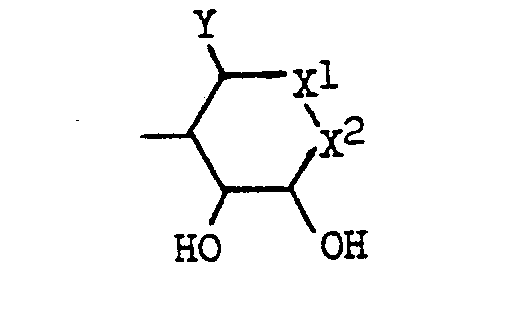
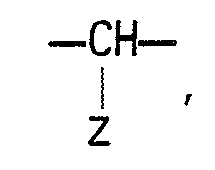


wobei die Amino-Gruppe oder Hydroxyl-Gruppe geschützt sein kann, oder ein pharmazeutisch annehmbares Salz derselben.


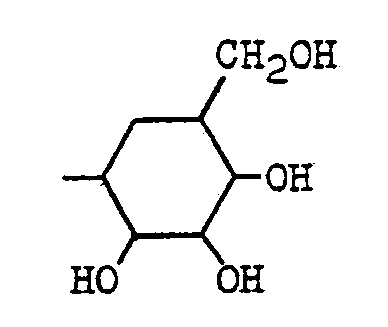

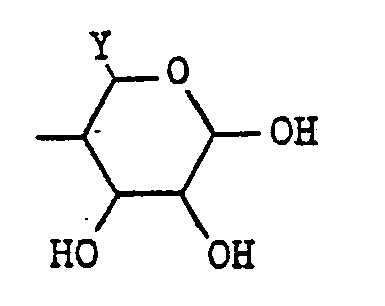


Applications Claiming Priority (8)
| Application Number | Priority Date | Filing Date | Title |
|---|---|---|---|
| JP57045345A JPS58162597A (ja) | 1982-03-19 | 1982-03-19 | 擬似アミノ糖のn−置換誘導体,その製造法および用途 |
| JP45345/82 | 1982-03-19 | ||
| JP100325/82 | 1982-06-10 | ||
| JP57100325A JPS58216145A (ja) | 1982-06-10 | 1982-06-10 | 擬似アミノ糖のn−置換誘導体およびその製造法 |
| JP57183433A JPS5973549A (ja) | 1982-10-19 | 1982-10-19 | 擬似アミノ糖のn−置換誘導体、その製造法および用途 |
| JP183433/82 | 1982-10-19 | ||
| JP20493682A JPS5995297A (ja) | 1982-11-22 | 1982-11-22 | 擬似オリゴ糖,その製造法及び用途 |
| JP204936/82 | 1982-11-22 |
Publications (2)
| Publication Number | Publication Date |
|---|---|
| EP0089812A1 EP0089812A1 (de) | 1983-09-28 |
| EP0089812B1 true EP0089812B1 (de) | 1986-10-01 |
Family
ID=27461682
Family Applications (1)
| Application Number | Title | Priority Date | Filing Date |
|---|---|---|---|
| EP83301482A Expired EP0089812B1 (de) | 1982-03-19 | 1983-03-17 | N-Substituierte Pseudo-aminozucker, ihre Herstellung und Verwendung |
Country Status (4)
| Country | Link |
|---|---|
| US (1) | US4595678A (de) |
| EP (1) | EP0089812B1 (de) |
| CA (1) | CA1208211A (de) |
| DE (1) | DE3366520D1 (de) |
Families Citing this family (17)
| Publication number | Priority date | Publication date | Assignee | Title |
|---|---|---|---|---|
| US4595678A (en) * | 1982-03-19 | 1986-06-17 | Takeda Chemical Industries, Ltd. | N-substituted pseudo-aminosugars and pharmaceutical compositions containing same |
| WO1986006276A1 (fr) * | 1985-04-30 | 1986-11-06 | Takeda Chemical Industries, Ltd. | Agent et composition inhibiteurs de la digestion du sucre |
| WO1986005094A1 (fr) * | 1985-03-08 | 1986-09-12 | Takeda Chemical Industries, Ltd. | Agent antiobesite et composition |
| JPS61205455A (ja) * | 1985-03-11 | 1986-09-11 | Takeda Chem Ind Ltd | 低カロリ−砂糖含有組成物 |
| EP0199591B1 (de) * | 1985-04-24 | 1990-11-07 | Takeda Chemical Industries, Ltd. | Valiolaminderivate und ihre Herstellung |
| CA1335894C (en) * | 1986-03-05 | 1995-06-13 | Hiroshi Fukase | Inosose derivatives and production thereof |
| ES2056801T3 (es) * | 1986-08-13 | 1994-10-16 | Hoechst Ag | Oxirano-seudooligosacaridos, procedimiento para su preparacion, su utilizacion y preparados farmaceuticos. |
| WO1989012038A1 (fr) * | 1988-06-01 | 1989-12-14 | Hoechst Aktiengesellschaft | Nouvelles cyclites derivees de streptomycetes, leur fabrication et leur emploi |
| ATE183100T1 (de) * | 1991-01-10 | 1999-08-15 | Merrell Pharma Inc | Neuartige glukohydrolase-inhibitoren nützlich als antidiabetische, antivirale und antimetastatische mittel |
| US5571796A (en) * | 1995-06-06 | 1996-11-05 | Alberta Research Council | Administration of valienamine-related disaccharide compounds in reducing inflammation in a sensitized mammal arising from exposure to an antigen |
| ID21411A (id) | 1997-12-10 | 1999-06-10 | Takeda Chemical Industries Ltd | Agen untuk mengobati daya tahan glukosa yang berisiko tinggi rusak |
| AU3601899A (en) * | 1998-03-31 | 1999-10-18 | Bayer Aktiengesellschaft | Valiolone, a method of preparing it, and its use to prepare acarbose and voglibose |
| US7022684B2 (en) | 2000-05-24 | 2006-04-04 | Pfizer Inc. | Treatment of rumen acidosis with α-amylase inhibitors |
| CN1736978B (zh) * | 2004-08-16 | 2010-05-12 | 深圳太太药业有限公司 | (+)-(1s,2s,3s,4r,5r)-1-氨基-5-羟甲基-n-2-(1,3-二羟丙基)-2,3,4-环己三醇的制备方法 |
| CN1736977B (zh) * | 2004-08-16 | 2010-05-12 | 深圳太太药业有限公司 | 结晶形态的(+)-(1s,2s,3s,4r,5r)-1-氨基-5-羟甲基-n-2-(1,3-二羟丙基)-2,3,4-环己三醇及其制备方法 |
| EP1796687A2 (de) * | 2004-09-14 | 2007-06-20 | Elixir Pharmaceuticals, Inc. | Kombinationstherapie für den kontrollierten kohlenhydrat-aufschluss |
| CN104119301B (zh) * | 2013-04-27 | 2018-05-08 | 浙江海翔药业股份有限公司 | 一种伏格列波糖中间体及其制备方法 |
Citations (1)
| Publication number | Priority date | Publication date | Assignee | Title |
|---|---|---|---|---|
| EP0067356A1 (de) * | 1981-06-13 | 1982-12-22 | Bayer Ag | Gesättigte Aminocyclitderivate, ihre Herstellung und sie enthaltende Arzneimittel |
Family Cites Families (10)
| Publication number | Priority date | Publication date | Assignee | Title |
|---|---|---|---|---|
| US4062950A (en) * | 1973-09-22 | 1977-12-13 | Bayer Aktiengesellschaft | Amino sugar derivatives |
| US4175123A (en) * | 1976-12-23 | 1979-11-20 | Bayer Aktiengesellschaft | Amino-sugar derivatives, process for their preparation and pharmaceutical composition thereof |
| JPS5953920B2 (ja) * | 1977-12-28 | 1984-12-27 | 東洋醸造株式会社 | 新規なアミノ糖化合物およびその製法 |
| CA1121290A (en) * | 1978-02-14 | 1982-04-06 | Yasuji Suhara | Amino sugar derivatives |
| JPS5643294A (en) * | 1979-09-19 | 1981-04-21 | Meiji Seika Kaisha Ltd | Novel antibiotic sf-1130x substance, its preparation, and use |
| JPS5724397A (en) * | 1980-07-21 | 1982-02-08 | Meiji Seika Kaisha Ltd | Amino sugar derivative substance having amylase inhibiting activity and its preparation |
| JPS5764648A (en) * | 1980-10-06 | 1982-04-19 | Takeda Chem Ind Ltd | N-substituted derivative of valienamine, its preparation, and alpha-glucosidase inhibitor |
| EP0056194B1 (de) * | 1981-01-05 | 1984-09-12 | Takeda Chemical Industries, Ltd. | N-substituierte Pseudo-Aminozucker, ihre Herstellung und Verwendung |
| US4526784A (en) * | 1981-05-05 | 1985-07-02 | Bayer Aktiengesellschaft | Amino-cyclitol derivatives and medicaments containing them |
| US4595678A (en) * | 1982-03-19 | 1986-06-17 | Takeda Chemical Industries, Ltd. | N-substituted pseudo-aminosugars and pharmaceutical compositions containing same |
-
1983
- 1983-03-15 US US06/475,615 patent/US4595678A/en not_active Expired - Lifetime
- 1983-03-17 EP EP83301482A patent/EP0089812B1/de not_active Expired
- 1983-03-17 DE DE8383301482T patent/DE3366520D1/de not_active Expired
- 1983-03-18 CA CA000424008A patent/CA1208211A/en not_active Expired
Patent Citations (1)
| Publication number | Priority date | Publication date | Assignee | Title |
|---|---|---|---|---|
| EP0067356A1 (de) * | 1981-06-13 | 1982-12-22 | Bayer Ag | Gesättigte Aminocyclitderivate, ihre Herstellung und sie enthaltende Arzneimittel |
Non-Patent Citations (1)
| Title |
|---|
| The Jornal of Antibiotics, Vol. XXXIV, No. 11, p. 1429-1433 and Vol. XXXVII,No.11, p. 1301-1307 * |
Also Published As
| Publication number | Publication date |
|---|---|
| US4595678A (en) | 1986-06-17 |
| EP0089812A1 (de) | 1983-09-28 |
| CA1208211A (en) | 1986-07-22 |
| DE3366520D1 (en) | 1986-11-06 |
Similar Documents
| Publication | Publication Date | Title |
|---|---|---|
| EP0089812B1 (de) | N-Substituierte Pseudo-aminozucker, ihre Herstellung und Verwendung | |
| EP0056194B1 (de) | N-substituierte Pseudo-Aminozucker, ihre Herstellung und Verwendung | |
| US3699103A (en) | Process for the manufacture of 5-desoxy-l-arabinose and novel intermediates | |
| Shealy et al. | Carbocyclic analogs of thymine nucleosides and related 1‐substituted thymines | |
| Ogawa et al. | Pseudo-sugars. VI. Synthesis of Six Isomers of 5-Hydroxymethyl-1, 2, 3, 4-cyclohexanetetrol (Pseudo-hexopyranose) and Their Derivatives | |
| Ayers et al. | Iteamine, the first alkaloid isolated from Itea virginica L. inflorescence | |
| CA1060003A (en) | N-trifluoroacetyladriamycin-14-alkanoates and therapeutic compositions containing same | |
| DE69127691T2 (de) | Be-13793c-derivat mit antitumorwirkung | |
| US4697005A (en) | 1-fluoro, 4-fluoro, and 1,4-difluoro anthracycline anticancer antibiotics | |
| EP0014853A1 (de) | Anthracyclin-Derivate, Verfahren zu ihrer Herstellung und sie enthaltende pharmazeutische Zusammensetzungen | |
| KR950004897B1 (ko) | 안트라사이클린 글리코사이드 유도체의 제조방법 | |
| EP0169716B1 (de) | Pharmazeutische Zusammensetzung und Verfahren um eine antiallergische Wirkung hervorzurufen | |
| US5536827A (en) | Method for preparing antitumor substance BE-13793C derivatives | |
| EP0063950B1 (de) | Aminocyclitole und deren Produktion | |
| US4303785A (en) | Antitumor anthracycline antibiotics | |
| US4612371A (en) | Anthracycline antibiotics | |
| EP0014425B1 (de) | Anthracyclinglycosiden, Verfahren zu deren Herstellung und sie enthaltende therapeutische Zusammensetzungen | |
| EP0104631B1 (de) | Clavulon-Derivate, ein Verfahren zu ihrer Herstellung und ihre Anwendung | |
| JPH05163292A (ja) | 3’及び/又は4’位の水酸基を化学修飾したエルサマイシンa誘導体の製造法 | |
| Sallam et al. | Studies on 3-epimeric L-2-hexulose phenylosazones. Structure and anomeric configuration of the 3, 6-anhydro-osazone derivatives obtained from L-xylo-and L-lyxo-2-hexulose phenylosazone | |
| Watanabe et al. | Nucleosides. LXXXVII. Total synthesis of pentopyranine A an. alpha.-L cytosine nucleoside elaborated by Streptomyces griseochromogenes | |
| US4663445A (en) | 1-fluoro, 4-fluoro, and 1,4-difluoro-2'-halo anthracycline antibiotics | |
| US4345086A (en) | Intermediate compounds in the preparation of spectinomycin | |
| US4433158A (en) | 3-Hydroxyiminoscirpen-4β, 15-diol esters useful as antitumor agents | |
| JPH0323537B2 (de) |
Legal Events
| Date | Code | Title | Description |
|---|---|---|---|
| PUAI | Public reference made under article 153(3) epc to a published international application that has entered the european phase |
Free format text: ORIGINAL CODE: 0009012 |
|
| AK | Designated contracting states |
Designated state(s): BE CH DE FR GB IT LI NL SE |
|
| 17P | Request for examination filed |
Effective date: 19840301 |
|
| GRAA | (expected) grant |
Free format text: ORIGINAL CODE: 0009210 |
|
| AK | Designated contracting states |
Kind code of ref document: B1 Designated state(s): BE CH DE FR GB IT LI NL SE |
|
| ITF | It: translation for a ep patent filed | ||
| REF | Corresponds to: |
Ref document number: 3366520 Country of ref document: DE Date of ref document: 19861106 |
|
| ET | Fr: translation filed | ||
| R20 | Corrections of a patent specification |
Effective date: 19870116 |
|
| PLBE | No opposition filed within time limit |
Free format text: ORIGINAL CODE: 0009261 |
|
| STAA | Information on the status of an ep patent application or granted ep patent |
Free format text: STATUS: NO OPPOSITION FILED WITHIN TIME LIMIT |
|
| 26N | No opposition filed | ||
| REG | Reference to a national code |
Ref country code: CH Ref legal event code: PFA Free format text: TAKEDA CHEMICAL INDUSTRIES, LTD |
|
| ITTA | It: last paid annual fee | ||
| EAL | Se: european patent in force in sweden |
Ref document number: 83301482.2 |
|
| PGFP | Annual fee paid to national office [announced via postgrant information from national office to epo] |
Ref country code: BE Payment date: 19980210 Year of fee payment: 16 |
|
| PGFP | Annual fee paid to national office [announced via postgrant information from national office to epo] |
Ref country code: CH Payment date: 19980216 Year of fee payment: 16 |
|
| PGFP | Annual fee paid to national office [announced via postgrant information from national office to epo] |
Ref country code: FR Payment date: 19980218 Year of fee payment: 16 |
|
| PGFP | Annual fee paid to national office [announced via postgrant information from national office to epo] |
Ref country code: SE Payment date: 19980225 Year of fee payment: 16 |
|
| PGFP | Annual fee paid to national office [announced via postgrant information from national office to epo] |
Ref country code: GB Payment date: 19980309 Year of fee payment: 16 |
|
| PGFP | Annual fee paid to national office [announced via postgrant information from national office to epo] |
Ref country code: NL Payment date: 19980331 Year of fee payment: 16 |
|
| PGFP | Annual fee paid to national office [announced via postgrant information from national office to epo] |
Ref country code: DE Payment date: 19980428 Year of fee payment: 16 |
|
| PG25 | Lapsed in a contracting state [announced via postgrant information from national office to epo] |
Ref country code: GB Free format text: LAPSE BECAUSE OF NON-PAYMENT OF DUE FEES Effective date: 19990317 |
|
| PG25 | Lapsed in a contracting state [announced via postgrant information from national office to epo] |
Ref country code: SE Free format text: LAPSE BECAUSE OF NON-PAYMENT OF DUE FEES Effective date: 19990318 |
|
| PG25 | Lapsed in a contracting state [announced via postgrant information from national office to epo] |
Ref country code: LI Free format text: LAPSE BECAUSE OF NON-PAYMENT OF DUE FEES Effective date: 19990331 Ref country code: CH Free format text: LAPSE BECAUSE OF NON-PAYMENT OF DUE FEES Effective date: 19990331 Ref country code: BE Free format text: LAPSE BECAUSE OF NON-PAYMENT OF DUE FEES Effective date: 19990331 |
|
| BERE | Be: lapsed |
Owner name: TAKEDA CHEMICAL INDUSTRIES LTD. Effective date: 19990331 |
|
| PG25 | Lapsed in a contracting state [announced via postgrant information from national office to epo] |
Ref country code: NL Free format text: LAPSE BECAUSE OF NON-PAYMENT OF DUE FEES Effective date: 19991001 |
|
| EUG | Se: european patent has lapsed |
Ref document number: 83301482.2 |
|
| GBPC | Gb: european patent ceased through non-payment of renewal fee |
Effective date: 19990317 |
|
| REG | Reference to a national code |
Ref country code: CH Ref legal event code: PL |
|
| PG25 | Lapsed in a contracting state [announced via postgrant information from national office to epo] |
Ref country code: FR Free format text: LAPSE BECAUSE OF NON-PAYMENT OF DUE FEES Effective date: 19991130 |
|
| NLV4 | Nl: lapsed or anulled due to non-payment of the annual fee |
Effective date: 19991001 |
|
| EUG | Se: european patent has lapsed |
Ref document number: 83301482.2 |
|
| REG | Reference to a national code |
Ref country code: FR Ref legal event code: ST |
|
| PG25 | Lapsed in a contracting state [announced via postgrant information from national office to epo] |
Ref country code: DE Free format text: LAPSE BECAUSE OF NON-PAYMENT OF DUE FEES Effective date: 20000101 |