EP0089968B1 - Verfahren und vorrichtung zum brechen von emulsionen mittels polyelektrolyten - Google Patents
Verfahren und vorrichtung zum brechen von emulsionen mittels polyelektrolyten Download PDFInfo
- Publication number
- EP0089968B1 EP0089968B1 EP82902736A EP82902736A EP0089968B1 EP 0089968 B1 EP0089968 B1 EP 0089968B1 EP 82902736 A EP82902736 A EP 82902736A EP 82902736 A EP82902736 A EP 82902736A EP 0089968 B1 EP0089968 B1 EP 0089968B1
- Authority
- EP
- European Patent Office
- Prior art keywords
- water
- filaments
- caracterised
- cylinder
- fact
- Prior art date
- Legal status (The legal status is an assumption and is not a legal conclusion. Google has not performed a legal analysis and makes no representation as to the accuracy of the status listed.)
- Expired
Links
- 239000000839 emulsion Substances 0.000 title claims abstract description 25
- 238000000034 method Methods 0.000 title claims abstract description 21
- 229920000867 polyelectrolyte Polymers 0.000 title description 7
- XLYOFNOQVPJJNP-UHFFFAOYSA-N water Substances O XLYOFNOQVPJJNP-UHFFFAOYSA-N 0.000 claims abstract description 36
- 239000000376 reactant Substances 0.000 claims abstract description 7
- 238000000605 extraction Methods 0.000 claims abstract description 4
- 239000012071 phase Substances 0.000 claims description 15
- 239000007788 liquid Substances 0.000 claims description 14
- 239000002244 precipitate Substances 0.000 claims description 7
- 239000004094 surface-active agent Substances 0.000 claims description 6
- 238000013019 agitation Methods 0.000 claims description 5
- 238000009826 distribution Methods 0.000 claims description 5
- 239000008346 aqueous phase Substances 0.000 claims description 2
- 239000007764 o/w emulsion Substances 0.000 claims description 2
- 238000011017 operating method Methods 0.000 claims 1
- 238000009987 spinning Methods 0.000 claims 1
- 239000002699 waste material Substances 0.000 claims 1
- 239000003643 water by type Substances 0.000 claims 1
- 239000003921 oil Substances 0.000 abstract description 6
- 239000010730 cutting oil Substances 0.000 abstract description 2
- 239000000693 micelle Substances 0.000 abstract 2
- 238000005054 agglomeration Methods 0.000 abstract 1
- 230000002776 aggregation Effects 0.000 abstract 1
- 238000001556 precipitation Methods 0.000 abstract 1
- 239000003153 chemical reaction reagent Substances 0.000 description 19
- 239000000243 solution Substances 0.000 description 16
- 238000011282 treatment Methods 0.000 description 11
- 238000003756 stirring Methods 0.000 description 4
- 238000009434 installation Methods 0.000 description 2
- 239000002245 particle Substances 0.000 description 2
- 230000000704 physical effect Effects 0.000 description 2
- 239000002351 wastewater Substances 0.000 description 2
- 238000004804 winding Methods 0.000 description 2
- 239000004809 Teflon Substances 0.000 description 1
- 229920006362 Teflon® Polymers 0.000 description 1
- 230000015572 biosynthetic process Effects 0.000 description 1
- 238000005119 centrifugation Methods 0.000 description 1
- 238000001816 cooling Methods 0.000 description 1
- 238000004090 dissolution Methods 0.000 description 1
- 238000005188 flotation Methods 0.000 description 1
- 238000002347 injection Methods 0.000 description 1
- 239000007924 injection Substances 0.000 description 1
- 238000004519 manufacturing process Methods 0.000 description 1
- 229920000642 polymer Polymers 0.000 description 1
- 239000000843 powder Substances 0.000 description 1
- 239000000047 product Substances 0.000 description 1
- 239000002002 slurry Substances 0.000 description 1
- 238000001179 sorption measurement Methods 0.000 description 1
- 239000000126 substance Substances 0.000 description 1
- 238000005406 washing Methods 0.000 description 1
Images
Classifications
-
- B—PERFORMING OPERATIONS; TRANSPORTING
- B01—PHYSICAL OR CHEMICAL PROCESSES OR APPARATUS IN GENERAL
- B01D—SEPARATION
- B01D17/00—Separation of liquids, not provided for elsewhere, e.g. by thermal diffusion
- B01D17/02—Separation of non-miscible liquids
- B01D17/0208—Separation of non-miscible liquids by sedimentation
- B01D17/0214—Separation of non-miscible liquids by sedimentation with removal of one of the phases
-
- B—PERFORMING OPERATIONS; TRANSPORTING
- B01—PHYSICAL OR CHEMICAL PROCESSES OR APPARATUS IN GENERAL
- B01D—SEPARATION
- B01D17/00—Separation of liquids, not provided for elsewhere, e.g. by thermal diffusion
- B01D17/02—Separation of non-miscible liquids
- B01D17/04—Breaking emulsions
- B01D17/047—Breaking emulsions with separation aids
Definitions
- the process and the device presented here relate to the breaking of oil-in-water emulsions using polyelectrolytic reagents and, more generally, the treatment of water from which one wishes to extract an insoluble phase (which will be called oily, which will not does not decant by itself because it is stabilized by surfactants.
- the polyelectrolytic reagents stored in powder form in general, are dissolved for the first time in water.
- the reagent thus put in a liquid form, is dissolved in the emulsion or the water to be treated. Stirring is maintained until the ionic charges of the surfactants are neutralized by the charges of opposite sign of the reactants. At this point, the oily phase can settle.
- the reagent dosage must therefore be precise, adjustable as a function of the concentration of the emulsion, which poses technical production problems.
- the invention relates to a process for treating waste water or distribution from which it is desired to separate an oily insoluble phase dispersed and stabilized in water by surface-active agents (oil-in-water emulsion), in which a solution of reagent (s) of high molecular weight polyelectrolytic type is introduced into the medium to be treated, characterized by the procedure which firstly agitates the emulsion and introduces the reagent solution, at given concentration c, so that the oily phase to be extracted precipitates in the form of filaments, then in a second step, to collect the precipitate by winding the filaments around an extraction element or on themselves, their gathering forming an oily mass which , thirdly, is separated from the water.
- surface-active agents oil-in-water emulsion
- the invention also relates to a device for carrying out said method consisting of a tank receiving the water to be treated, provided with a stirring means and a means for injecting reagent solution, characterized in that that it is provided with a multi-blade propeller which, in addition to its contribution to the agitation of the medium, captures the filaments and winds them around its drive axis, said axis being provided with a device making it possible to evacuate the axis precipitate.
- the polyelectrolytes are dissolved in advance in water (this dissolution is quite long and takes a few tens of minutes).
- the polyelectrolytes used are polymers of high molecular weight; dissolved in water, they give the solution obtained very different physical properties from those of a Newtonian liquid; in particular, they create tension forces in the liquid and give it the property of making threads (or filaments). This is observed, for example, when a teflon stick is removed from a beaker containing such a polyelectrolyte solution. A wire is created from the stick to the surface of the solution. This wire can reach ten centimeters or more before breaking.
- the explanation is probably as follows: when the reagent solution is introduced into the emulsion, it does not dissolve instantaneously.
- the emulsion is agitated in a regular way, for example, by a turbine or a propeller not turning too fast so that the flow of the emulsion in the treatment tank is not turbulent, and that the speed curves constant are concentric circles centered on the axis of the agitator.
- the phase constituted by the reagent solution is drawn into filaments by the viscosity forces of the agitated liquid as it is introduced.
- the polyelectrolytes must be selected according to the nature of the emulsion to be treated; the concentration of the reagent solution is such that the viscosity, the tension in the liquid, the physical properties in general, allow this setting in filaments of the oily phase. It must be determined experimentally. This concentration does not have to be very precise to ensure proper functioning; experience shows that it can vary in a ratio of more than simple to double; a specific example will be given later.
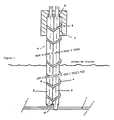
- the drive axis is a cylinder (2) on which a counter-cylinder (3) rests. These two cylinders rotate in opposite directions on their respective axes and this would be enough to raise the mud because of the viscosity thereof.
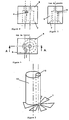
- the part (6) is similar to a screw pump body, except that the screws (4) and (5) come out below the pump body.
- the mud is discharged into the pipe (8) shown in Figure 4, which shows the part (6) seen from above.
- Another similar device can be obtained if the counter-cylinder (13), instead of being next to the cylinder (12), is outside the cylinder (12) as shown in FIG. 5.
- the counter-cylinder screw (if one is used) must then be inside the counter-cylinder (13) as in the case of an internal toothing for a gear and the two cylinders then rotate in the same direction.
- the method and the device described, as well as the variant of the device can allow continuous operation, or in batches, depending on the design of the installation.
- the propeller of the extractor can serve as a stirring propeller in the first part of the process ("setting in filaments").
- the slurry discharged into the piping (8) can be sent to a decanter; an aqueous phase is thus separated containing the excess reagent which can then be reused.
- the process and the device described can be reproduced using for example the reagent sold by the company Hoechst under the trade name: Bozefloc C200®; this powdered reagent is dissolved in water at a concentration of the order of 1.5 percent (by weight).
- a propeller of eight blades with a diameter of 22 cm with a pitch of 15 cm, for a treatment tank of 35 cm in diameter and a height of liquid of 50 cm, rotating at 300 revolutions / minute gives good results for the filament formation and extraction.
- the amount of reagent solution to be used is of the order of 5% (by weight) relative to the amount of emulsion.
- the treatment time (without taking into account the filling and emptying of the treatment tank) is of the order of a few minutes, time which can be possibly extended without inconvenience.
- Figures 2, 3 and 4 show the part (6) from the front, from the left, and in top view.
- the part (6) is cut along AA ( Figure 4).
- the previous devices require a mechanical system to wind the filaments on an axis, and extract them out of the water.
- the emulsion breaking process can also be implemented by a device that does not require a moving mechanical part.
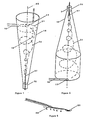
- the water at the same time as it descends into the tank (18), is given a rotary movement, such that the speed of rotation is faster when one moves from the wall from the tank to the axis of rotation of the liquid, which is the axis of symmetry of the tank.
- This distribution of the velocity field is sufficient to cause the filaments to wind.
- the filaments tend to form circular arcs centered on the axis of rotation (22), and rotate as they approach the axis (22). If the height of the tank is sufficient, all the filaments reach the axis of rotation (22), then come together and constitute the oily mass (27) which is entrained with the water, towards the outlet orifice (20) .
- Figures 6 and 7 schematically show a filament path (23) from its creation near the reagent solution injector, until it joins the axis (22) where it agglomerates to other filaments to form the oily mass (27) on the axis (22), which flows with water through the outlet (20) of the tank.
- the oily mass (27) and the water, coming from the tank (18) can then be separated by flowing on an inclined grid (25).
- the oily mass by its physical characteristics, does not pass through the grid, unlike water, and is recovered from the other side (26) of the grid.
- the method can be used in the case of treatment of water containing surfactants alone or maintaining in balance insoluble or poorly soluble products. These cases are encountered in the discharge of many industries, for example, the mechanical industry (emulsion of soluble oil, washing water,
- the process can also be used for the treatment of urban waste water with a view to upgrading the residues obtained, or for the treatment of distribution water.
Landscapes
- Physics & Mathematics (AREA)
- Thermal Sciences (AREA)
- Chemical & Material Sciences (AREA)
- Chemical Kinetics & Catalysis (AREA)
- Extraction Or Liquid Replacement (AREA)
- Separation Of Suspended Particles By Flocculating Agents (AREA)
Claims (11)
Applications Claiming Priority (4)
| Application Number | Priority Date | Filing Date | Title |
|---|---|---|---|
| FR8118378A FR2513535A1 (fr) | 1981-09-30 | 1981-09-30 | Procede et dispositif de cassage d'emulsion a l'aide de polyelectrolytes |
| FR8118378 | 1981-09-30 | ||
| FR8216172A FR2533457A2 (fr) | 1982-09-24 | 1982-09-24 | Procede et dispositif de cassage d'emulsion a l'aide de polyelectrolytes |
| FR8216172 | 1982-09-24 |
Publications (2)
| Publication Number | Publication Date |
|---|---|
| EP0089968A1 EP0089968A1 (de) | 1983-10-05 |
| EP0089968B1 true EP0089968B1 (de) | 1988-06-08 |
Family
ID=26222557
Family Applications (1)
| Application Number | Title | Priority Date | Filing Date |
|---|---|---|---|
| EP82902736A Expired EP0089968B1 (de) | 1981-09-30 | 1982-09-27 | Verfahren und vorrichtung zum brechen von emulsionen mittels polyelektrolyten |
Country Status (3)
| Country | Link |
|---|---|
| EP (1) | EP0089968B1 (de) |
| DE (1) | DE3278624D1 (de) |
| WO (1) | WO1983001207A1 (de) |
Family Cites Families (6)
| Publication number | Priority date | Publication date | Assignee | Title |
|---|---|---|---|---|
| FR1345193A (fr) * | 1961-11-13 | 1963-12-06 | Shell Int Research | Appareil et procédé pour la séparation de matières au moins pratiquement solides d'une suspension liquide de ces matières |
| FR2205907A6 (de) * | 1972-11-06 | 1974-05-31 | Sogreah | |
| GB1364943A (en) * | 1971-03-17 | 1974-08-29 | United Aircraft Corp | Vortex flow system for separating a mixture of two liquids having different densities such as oil and water |
| DE2208748A1 (de) * | 1972-02-24 | 1973-08-30 | Dura Tufting Gmbh | Verfahren und vorrichtung zum reinigen von mit oel verunreinigtem wasser |
| US3956117A (en) * | 1974-11-29 | 1976-05-11 | Nalco Chemical Company | Cationic polymers for breaking oil-in-water emulsions |
| US4430230A (en) * | 1979-10-30 | 1984-02-07 | Nippon Chemtec Consulting Inc. | Method for removal of impurities from liquid mixtures |
-
1982
- 1982-09-27 WO PCT/FR1982/000157 patent/WO1983001207A1/fr not_active Ceased
- 1982-09-27 EP EP82902736A patent/EP0089968B1/de not_active Expired
- 1982-09-27 DE DE8282902736T patent/DE3278624D1/de not_active Expired
Also Published As
| Publication number | Publication date |
|---|---|
| EP0089968A1 (de) | 1983-10-05 |
| DE3278624D1 (en) | 1988-07-14 |
| WO1983001207A1 (fr) | 1983-04-14 |
Similar Documents
| Publication | Publication Date | Title |
|---|---|---|
| NL8000415A (nl) | Werkwijze en toestel voor het met elkaar mengen van vloeistoffen en vaste stoffen. | |
| EP0211739B1 (de) | Verfahren und Vorrichtung zur Aufbereitung und ersten Sortierung von Papierbrei | |
| EP0404647B1 (de) | Vorrichtung zur Flüssigkeitsentgasung | |
| FR2546419A1 (fr) | Appareillage pour deshydrater de la boue dans la zone de centrifugation d'une centrifugeuse a enveloppe pleine | |
| TW200821027A (en) | Grit trap for waste water system | |
| FR2520258A1 (fr) | Extracteur centrifuge a contre-courant a enveloppe continue, fonctionnant en continu | |
| EP1513605A1 (de) | Verfahren zum kontinuierlichen und dynamischen mischen mindestens zweier fluide und mikromischer | |
| FR2668950A1 (fr) | Systeme de melange de polymere sec et d'electrolyte. | |
| EP2965806B1 (de) | Anlage zur aufbereitung von wasser oder industrieabwässern, die rührmittel mit gemeinsamen antriebsmitteln umfasst | |
| FR2566675A1 (fr) | Procede et dispositif d'admission de boue | |
| WO1983001207A1 (fr) | Procede et dispositif de cassage d'emulsion a l'aide de polyelectrolytes | |
| WO2003097543A2 (fr) | Granules de fils de verre de forte densite | |
| CA2593004A1 (fr) | Procede et dispositif de fabrication de billes ou de ballons en mousse polymere | |
| EP1467810A1 (de) | Rührvorrichtung un -verfahren, insbesondere zur dispergierung oder emulgierung zweier nicht mischbaren flüssigkeiten | |
| FR2513535A1 (fr) | Procede et dispositif de cassage d'emulsion a l'aide de polyelectrolytes | |
| FR2511267A1 (fr) | Appareil a vortex pour la fabrication d'un precipite | |
| EP0108684B2 (de) | Installation und Verfahren zum Separieren von Bestandteilen einer Suspension | |
| FR2517217A1 (fr) | Appareil pour le transport de liquide et pour eliminer des gaz se degageant du liquide | |
| EP4164763A1 (de) | Vorrichtung zur fest-/flüssigextraktion durch radiale ultraschallbestrahlung und zugehöriges extraktionsverfahren | |
| FR2575670A1 (fr) | Procede et appareil pour la mise en solution ou dispersion d'une poudre hydrosoluble | |
| BE1023691A1 (fr) | Procédé de surveillance des paramètres chimiques; système à cet effet; installation de traitement comprenant un tel système | |
| WO1995009039A1 (fr) | Dispositif pour epaissir des boues | |
| CH291180A (fr) | Appareil d'extraction et de dialyse en continu. | |
| FR3163879A1 (fr) | Mélangeur à vis conique | |
| WO2005012187A2 (fr) | Procede de traitement d'un liquide aqueux acide contenant des metaux lourds et dispositifs pour realiser ledit procede |
Legal Events
| Date | Code | Title | Description |
|---|---|---|---|
| PUAI | Public reference made under article 153(3) epc to a published international application that has entered the european phase |
Free format text: ORIGINAL CODE: 0009012 |
|
| AK | Designated contracting states |
Designated state(s): DE FR GB SE |
|
| 17P | Request for examination filed |
Effective date: 19831005 |
|
| GRAA | (expected) grant |
Free format text: ORIGINAL CODE: 0009210 |
|
| AK | Designated contracting states |
Kind code of ref document: B1 Designated state(s): DE FR GB SE |
|
| PG25 | Lapsed in a contracting state [announced via postgrant information from national office to epo] |
Ref country code: GB Free format text: LAPSE BECAUSE OF NON-PAYMENT OF DUE FEES Effective date: 19880608 |
|
| PG25 | Lapsed in a contracting state [announced via postgrant information from national office to epo] |
Ref country code: SE Effective date: 19880630 |
|
| REF | Corresponds to: |
Ref document number: 3278624 Country of ref document: DE Date of ref document: 19880714 |
|
| GBV | Gb: ep patent (uk) treated as always having been void in accordance with gb section 77(7)/1977 [no translation filed] | ||
| PLBE | No opposition filed within time limit |
Free format text: ORIGINAL CODE: 0009261 |
|
| STAA | Information on the status of an ep patent application or granted ep patent |
Free format text: STATUS: NO OPPOSITION FILED WITHIN TIME LIMIT |
|
| 26N | No opposition filed | ||
| PG25 | Lapsed in a contracting state [announced via postgrant information from national office to epo] |
Ref country code: FR Free format text: LAPSE BECAUSE OF NON-PAYMENT OF DUE FEES Effective date: 19890531 |
|
| REG | Reference to a national code |
Ref country code: FR Ref legal event code: ST |
|
| PGFP | Annual fee paid to national office [announced via postgrant information from national office to epo] |
Ref country code: DE Payment date: 19910219 Year of fee payment: 9 |
|
| PG25 | Lapsed in a contracting state [announced via postgrant information from national office to epo] |
Ref country code: DE Effective date: 19920602 |