EP0090174A1 - Verfahren zur Kantenverfestigung und Randabdichtung textiler Flächengebilde - Google Patents
Verfahren zur Kantenverfestigung und Randabdichtung textiler Flächengebilde Download PDFInfo
- Publication number
- EP0090174A1 EP0090174A1 EP83101718A EP83101718A EP0090174A1 EP 0090174 A1 EP0090174 A1 EP 0090174A1 EP 83101718 A EP83101718 A EP 83101718A EP 83101718 A EP83101718 A EP 83101718A EP 0090174 A1 EP0090174 A1 EP 0090174A1
- Authority
- EP
- European Patent Office
- Prior art keywords
- acid
- radiation
- meth
- curable
- acrylate
- Prior art date
- Legal status (The legal status is an assumption and is not a legal conclusion. Google has not performed a legal analysis and makes no representation as to the accuracy of the status listed.)
- Withdrawn
Links
- 239000004753 textile Substances 0.000 title claims abstract description 16
- 239000000463 material Substances 0.000 title claims abstract description 4
- 238000000034 method Methods 0.000 title claims description 20
- 230000008569 process Effects 0.000 title description 10
- 230000002787 reinforcement Effects 0.000 title 1
- 239000000203 mixture Substances 0.000 claims abstract description 51
- 230000005855 radiation Effects 0.000 claims abstract description 10
- 150000001252 acrylic acid derivatives Chemical class 0.000 claims description 25
- 229920000728 polyester Polymers 0.000 claims description 22
- 239000004744 fabric Substances 0.000 claims description 19
- XLYOFNOQVPJJNP-UHFFFAOYSA-N water Substances O XLYOFNOQVPJJNP-UHFFFAOYSA-N 0.000 claims description 15
- 239000004593 Epoxy Substances 0.000 claims description 9
- JOYRKODLDBILNP-UHFFFAOYSA-N Ethyl urethane Chemical compound CCOC(N)=O JOYRKODLDBILNP-UHFFFAOYSA-N 0.000 claims description 5
- 239000000839 emulsion Substances 0.000 claims description 5
- 238000007789 sealing Methods 0.000 claims description 5
- 238000004132 cross linking Methods 0.000 claims description 3
- 229920006337 unsaturated polyester resin Polymers 0.000 claims description 2
- 238000007596 consolidation process Methods 0.000 claims 1
- 230000007062 hydrolysis Effects 0.000 abstract description 2
- 238000006460 hydrolysis reaction Methods 0.000 abstract description 2
- 230000001678 irradiating effect Effects 0.000 abstract 1
- -1 polypropylene Polymers 0.000 description 22
- LYCAIKOWRPUZTN-UHFFFAOYSA-N Ethylene glycol Chemical compound OCCO LYCAIKOWRPUZTN-UHFFFAOYSA-N 0.000 description 20
- CERQOIWHTDAKMF-UHFFFAOYSA-N Methacrylic acid Chemical compound CC(=C)C(O)=O CERQOIWHTDAKMF-UHFFFAOYSA-N 0.000 description 18
- IISBACLAFKSPIT-UHFFFAOYSA-N bisphenol A Chemical compound C=1C=C(O)C=CC=1C(C)(C)C1=CC=C(O)C=C1 IISBACLAFKSPIT-UHFFFAOYSA-N 0.000 description 18
- NIXOWILDQLNWCW-UHFFFAOYSA-N Acrylic acid Chemical compound OC(=O)C=C NIXOWILDQLNWCW-UHFFFAOYSA-N 0.000 description 17
- 229920005862 polyol Polymers 0.000 description 17
- 150000003077 polyols Chemical class 0.000 description 17
- SMZOUWXMTYCWNB-UHFFFAOYSA-N 2-(2-methoxy-5-methylphenyl)ethanamine Chemical compound COC1=CC=C(C)C=C1CCN SMZOUWXMTYCWNB-UHFFFAOYSA-N 0.000 description 16
- WNLRTRBMVRJNCN-UHFFFAOYSA-N adipic acid Chemical compound OC(=O)CCCCC(O)=O WNLRTRBMVRJNCN-UHFFFAOYSA-N 0.000 description 16
- YXFVVABEGXRONW-UHFFFAOYSA-N Toluene Chemical compound CC1=CC=CC=C1 YXFVVABEGXRONW-UHFFFAOYSA-N 0.000 description 15
- ZJCCRDAZUWHFQH-UHFFFAOYSA-N Trimethylolpropane Chemical compound CCC(CO)(CO)CO ZJCCRDAZUWHFQH-UHFFFAOYSA-N 0.000 description 15
- NIXOWILDQLNWCW-UHFFFAOYSA-M Acrylate Chemical compound [O-]C(=O)C=C NIXOWILDQLNWCW-UHFFFAOYSA-M 0.000 description 13
- PEDCQBHIVMGVHV-UHFFFAOYSA-N Glycerine Chemical compound OCC(O)CO PEDCQBHIVMGVHV-UHFFFAOYSA-N 0.000 description 13
- 150000001298 alcohols Chemical class 0.000 description 13
- 125000001931 aliphatic group Chemical group 0.000 description 13
- 125000004432 carbon atom Chemical group C* 0.000 description 12
- 125000002887 hydroxy group Chemical group [H]O* 0.000 description 12
- JOXIMZWYDAKGHI-UHFFFAOYSA-N toluene-4-sulfonic acid Chemical compound CC1=CC=C(S(O)(=O)=O)C=C1 JOXIMZWYDAKGHI-UHFFFAOYSA-N 0.000 description 12
- 239000002253 acid Substances 0.000 description 11
- 150000001875 compounds Chemical class 0.000 description 11
- DNIAPMSPPWPWGF-UHFFFAOYSA-N monopropylene glycol Natural products CC(O)CO DNIAPMSPPWPWGF-UHFFFAOYSA-N 0.000 description 11
- 238000006243 chemical reaction Methods 0.000 description 10
- 239000000047 product Substances 0.000 description 10
- QTBSBXVTEAMEQO-UHFFFAOYSA-N Acetic acid Chemical compound CC(O)=O QTBSBXVTEAMEQO-UHFFFAOYSA-N 0.000 description 9
- CSCPPACGZOOCGX-UHFFFAOYSA-N Acetone Chemical compound CC(C)=O CSCPPACGZOOCGX-UHFFFAOYSA-N 0.000 description 9
- 230000032050 esterification Effects 0.000 description 9
- 238000005886 esterification reaction Methods 0.000 description 9
- 150000002148 esters Chemical class 0.000 description 9
- 238000006116 polymerization reaction Methods 0.000 description 9
- 239000000126 substance Substances 0.000 description 9
- VZCYOOQTPOCHFL-OWOJBTEDSA-N Fumaric acid Chemical compound OC(=O)\C=C\C(O)=O VZCYOOQTPOCHFL-OWOJBTEDSA-N 0.000 description 8
- WERYXYBDKMZEQL-UHFFFAOYSA-N butane-1,4-diol Chemical compound OCCCCO WERYXYBDKMZEQL-UHFFFAOYSA-N 0.000 description 8
- 239000007795 chemical reaction product Substances 0.000 description 8
- 229920006395 saturated elastomer Polymers 0.000 description 8
- JZODKRWQWUWGCD-UHFFFAOYSA-N 2,5-di-tert-butylbenzene-1,4-diol Chemical compound CC(C)(C)C1=CC(O)=C(C(C)(C)C)C=C1O JZODKRWQWUWGCD-UHFFFAOYSA-N 0.000 description 7
- LFQSCWFLJHTTHZ-UHFFFAOYSA-N Ethanol Chemical compound CCO LFQSCWFLJHTTHZ-UHFFFAOYSA-N 0.000 description 7
- 239000001361 adipic acid Substances 0.000 description 7
- 235000011037 adipic acid Nutrition 0.000 description 7
- VLKZOEOYAKHREP-UHFFFAOYSA-N n-Hexane Chemical compound CCCCCC VLKZOEOYAKHREP-UHFFFAOYSA-N 0.000 description 7
- 150000002989 phenols Chemical class 0.000 description 7
- 229920000647 polyepoxide Polymers 0.000 description 7
- 239000005056 polyisocyanate Substances 0.000 description 7
- 229920001228 polyisocyanate Polymers 0.000 description 7
- OMIGHNLMNHATMP-UHFFFAOYSA-N 2-hydroxyethyl prop-2-enoate Chemical compound OCCOC(=O)C=C OMIGHNLMNHATMP-UHFFFAOYSA-N 0.000 description 6
- YMWUJEATGCHHMB-UHFFFAOYSA-N Dichloromethane Chemical compound ClCCl YMWUJEATGCHHMB-UHFFFAOYSA-N 0.000 description 6
- XEKOWRVHYACXOJ-UHFFFAOYSA-N Ethyl acetate Chemical compound CCOC(C)=O XEKOWRVHYACXOJ-UHFFFAOYSA-N 0.000 description 6
- OKKJLVBELUTLKV-UHFFFAOYSA-N Methanol Chemical compound OC OKKJLVBELUTLKV-UHFFFAOYSA-N 0.000 description 6
- IMNFDUFMRHMDMM-UHFFFAOYSA-N N-Heptane Chemical compound CCCCCCC IMNFDUFMRHMDMM-UHFFFAOYSA-N 0.000 description 6
- KKEYFWRCBNTPAC-UHFFFAOYSA-N Terephthalic acid Chemical compound OC(=O)C1=CC=C(C(O)=O)C=C1 KKEYFWRCBNTPAC-UHFFFAOYSA-N 0.000 description 6
- 150000001412 amines Chemical class 0.000 description 6
- QSAWQNUELGIYBC-UHFFFAOYSA-N cyclohexane-1,2-dicarboxylic acid Chemical compound OC(=O)C1CCCCC1C(O)=O QSAWQNUELGIYBC-UHFFFAOYSA-N 0.000 description 6
- MTHSVFCYNBDYFN-UHFFFAOYSA-N diethylene glycol Chemical compound OCCOCCO MTHSVFCYNBDYFN-UHFFFAOYSA-N 0.000 description 6
- UHESRSKEBRADOO-UHFFFAOYSA-N ethyl carbamate;prop-2-enoic acid Chemical class OC(=O)C=C.CCOC(N)=O UHESRSKEBRADOO-UHFFFAOYSA-N 0.000 description 6
- 239000003112 inhibitor Substances 0.000 description 6
- 239000000178 monomer Substances 0.000 description 6
- NWVVVBRKAWDGAB-UHFFFAOYSA-N p-methoxyphenol Chemical compound COC1=CC=C(O)C=C1 NWVVVBRKAWDGAB-UHFFFAOYSA-N 0.000 description 6
- XNGIFLGASWRNHJ-UHFFFAOYSA-N phthalic acid Chemical compound OC(=O)C1=CC=CC=C1C(O)=O XNGIFLGASWRNHJ-UHFFFAOYSA-N 0.000 description 6
- CXMXRPHRNRROMY-UHFFFAOYSA-N sebacic acid Chemical compound OC(=O)CCCCCCCCC(O)=O CXMXRPHRNRROMY-UHFFFAOYSA-N 0.000 description 6
- 239000002904 solvent Substances 0.000 description 6
- VZCYOOQTPOCHFL-UHFFFAOYSA-N trans-butenedioic acid Natural products OC(=O)C=CC(O)=O VZCYOOQTPOCHFL-UHFFFAOYSA-N 0.000 description 6
- FALRKNHUBBKYCC-UHFFFAOYSA-N 2-(chloromethyl)pyridine-3-carbonitrile Chemical compound ClCC1=NC=CC=C1C#N FALRKNHUBBKYCC-UHFFFAOYSA-N 0.000 description 5
- 239000005058 Isophorone diisocyanate Substances 0.000 description 5
- OFOBLEOULBTSOW-UHFFFAOYSA-N Propanedioic acid Natural products OC(=O)CC(O)=O OFOBLEOULBTSOW-UHFFFAOYSA-N 0.000 description 5
- 239000000654 additive Substances 0.000 description 5
- 150000008064 anhydrides Chemical class 0.000 description 5
- 239000012965 benzophenone Substances 0.000 description 5
- IFDVQVHZEKPUSC-UHFFFAOYSA-N cyclohex-3-ene-1,2-dicarboxylic acid Chemical compound OC(=O)C1CCC=CC1C(O)=O IFDVQVHZEKPUSC-UHFFFAOYSA-N 0.000 description 5
- 239000003995 emulsifying agent Substances 0.000 description 5
- RTZKZFJDLAIYFH-UHFFFAOYSA-N ether Substances CCOCC RTZKZFJDLAIYFH-UHFFFAOYSA-N 0.000 description 5
- 235000011187 glycerol Nutrition 0.000 description 5
- NIMLQBUJDJZYEJ-UHFFFAOYSA-N isophorone diisocyanate Chemical compound CC1(C)CC(N=C=O)CC(C)(CN=C=O)C1 NIMLQBUJDJZYEJ-UHFFFAOYSA-N 0.000 description 5
- QQVIHTHCMHWDBS-UHFFFAOYSA-N isophthalic acid Chemical compound OC(=O)C1=CC=CC(C(O)=O)=C1 QQVIHTHCMHWDBS-UHFFFAOYSA-N 0.000 description 5
- QSHDDOUJBYECFT-UHFFFAOYSA-N mercury Chemical compound [Hg] QSHDDOUJBYECFT-UHFFFAOYSA-N 0.000 description 5
- 229910052753 mercury Inorganic materials 0.000 description 5
- WXZMFSXDPGVJKK-UHFFFAOYSA-N pentaerythritol Chemical compound OCC(CO)(CO)CO WXZMFSXDPGVJKK-UHFFFAOYSA-N 0.000 description 5
- 238000002360 preparation method Methods 0.000 description 5
- 235000013772 propylene glycol Nutrition 0.000 description 5
- 229940014800 succinic anhydride Drugs 0.000 description 5
- YODZTKMDCQEPHD-UHFFFAOYSA-N thiodiglycol Chemical compound OCCSCCO YODZTKMDCQEPHD-UHFFFAOYSA-N 0.000 description 5
- 229950006389 thiodiglycol Drugs 0.000 description 5
- UBOXGVDOUJQMTN-UHFFFAOYSA-N 1,1,2-trichloroethane Chemical compound ClCC(Cl)Cl UBOXGVDOUJQMTN-UHFFFAOYSA-N 0.000 description 4
- HZAXFHJVJLSVMW-UHFFFAOYSA-N 2-Aminoethan-1-ol Chemical compound NCCO HZAXFHJVJLSVMW-UHFFFAOYSA-N 0.000 description 4
- ZWEHNKRNPOVVGH-UHFFFAOYSA-N 2-Butanone Chemical compound CCC(C)=O ZWEHNKRNPOVVGH-UHFFFAOYSA-N 0.000 description 4
- GWZMWHWAWHPNHN-UHFFFAOYSA-N 2-hydroxypropyl prop-2-enoate Chemical compound CC(O)COC(=O)C=C GWZMWHWAWHPNHN-UHFFFAOYSA-N 0.000 description 4
- HEDRZPFGACZZDS-UHFFFAOYSA-N Chloroform Chemical compound ClC(Cl)Cl HEDRZPFGACZZDS-UHFFFAOYSA-N 0.000 description 4
- RGSFGYAAUTVSQA-UHFFFAOYSA-N Cyclopentane Chemical compound C1CCCC1 RGSFGYAAUTVSQA-UHFFFAOYSA-N 0.000 description 4
- LRHPLDYGYMQRHN-UHFFFAOYSA-N N-Butanol Chemical compound CCCCO LRHPLDYGYMQRHN-UHFFFAOYSA-N 0.000 description 4
- KDYFGRWQOYBRFD-UHFFFAOYSA-N Succinic acid Natural products OC(=O)CCC(O)=O KDYFGRWQOYBRFD-UHFFFAOYSA-N 0.000 description 4
- 125000003647 acryloyl group Chemical group O=C([*])C([H])=C([H])[H] 0.000 description 4
- 125000003118 aryl group Chemical group 0.000 description 4
- 239000003054 catalyst Substances 0.000 description 4
- JHIVVAPYMSGYDF-UHFFFAOYSA-N cyclohexanone Chemical compound O=C1CCCCC1 JHIVVAPYMSGYDF-UHFFFAOYSA-N 0.000 description 4
- BGTOWKSIORTVQH-UHFFFAOYSA-N cyclopentanone Chemical compound O=C1CCCC1 BGTOWKSIORTVQH-UHFFFAOYSA-N 0.000 description 4
- 150000001991 dicarboxylic acids Chemical class 0.000 description 4
- 150000002118 epoxides Chemical group 0.000 description 4
- FJKIXWOMBXYWOQ-UHFFFAOYSA-N ethenoxyethane Chemical compound CCOC=C FJKIXWOMBXYWOQ-UHFFFAOYSA-N 0.000 description 4
- 239000000945 filler Substances 0.000 description 4
- RRAMGCGOFNQTLD-UHFFFAOYSA-N hexamethylene diisocyanate Chemical compound O=C=NCCCCCCN=C=O RRAMGCGOFNQTLD-UHFFFAOYSA-N 0.000 description 4
- FPYJFEHAWHCUMM-UHFFFAOYSA-N maleic anhydride Chemical compound O=C1OC(=O)C=C1 FPYJFEHAWHCUMM-UHFFFAOYSA-N 0.000 description 4
- SLCVBVWXLSEKPL-UHFFFAOYSA-N neopentyl glycol Chemical compound OCC(C)(C)CO SLCVBVWXLSEKPL-UHFFFAOYSA-N 0.000 description 4
- TVMXDCGIABBOFY-UHFFFAOYSA-N octane Chemical compound CCCCCCCC TVMXDCGIABBOFY-UHFFFAOYSA-N 0.000 description 4
- FDPIMTJIUBPUKL-UHFFFAOYSA-N pentan-3-one Chemical compound CCC(=O)CC FDPIMTJIUBPUKL-UHFFFAOYSA-N 0.000 description 4
- 229920002635 polyurethane Polymers 0.000 description 4
- 238000003756 stirring Methods 0.000 description 4
- 150000005846 sugar alcohols Polymers 0.000 description 4
- VZGDMQKNWNREIO-UHFFFAOYSA-N tetrachloromethane Chemical compound ClC(Cl)(Cl)Cl VZGDMQKNWNREIO-UHFFFAOYSA-N 0.000 description 4
- KSBAEPSJVUENNK-UHFFFAOYSA-L tin(ii) 2-ethylhexanoate Chemical compound [Sn+2].CCCCC(CC)C([O-])=O.CCCCC(CC)C([O-])=O KSBAEPSJVUENNK-UHFFFAOYSA-L 0.000 description 4
- 229920006305 unsaturated polyester Polymers 0.000 description 4
- DNIAPMSPPWPWGF-VKHMYHEASA-N (+)-propylene glycol Chemical compound C[C@H](O)CO DNIAPMSPPWPWGF-VKHMYHEASA-N 0.000 description 3
- DNIAPMSPPWPWGF-GSVOUGTGSA-N (R)-(-)-Propylene glycol Chemical compound C[C@@H](O)CO DNIAPMSPPWPWGF-GSVOUGTGSA-N 0.000 description 3
- MYRTYDVEIRVNKP-UHFFFAOYSA-N 1,2-Divinylbenzene Chemical compound C=CC1=CC=CC=C1C=C MYRTYDVEIRVNKP-UHFFFAOYSA-N 0.000 description 3
- YPFDHNVEDLHUCE-UHFFFAOYSA-N 1,3-propanediol Substances OCCCO YPFDHNVEDLHUCE-UHFFFAOYSA-N 0.000 description 3
- GTELLNMUWNJXMQ-UHFFFAOYSA-N 2-ethyl-2-(hydroxymethyl)propane-1,3-diol;prop-2-enoic acid Chemical compound OC(=O)C=C.OC(=O)C=C.OC(=O)C=C.CCC(CO)(CO)CO GTELLNMUWNJXMQ-UHFFFAOYSA-N 0.000 description 3
- HRPVXLWXLXDGHG-UHFFFAOYSA-N Acrylamide Chemical compound NC(=O)C=C HRPVXLWXLXDGHG-UHFFFAOYSA-N 0.000 description 3
- XDTMQSROBMDMFD-UHFFFAOYSA-N Cyclohexane Chemical compound C1CCCCC1 XDTMQSROBMDMFD-UHFFFAOYSA-N 0.000 description 3
- WSFSSNUMVMOOMR-UHFFFAOYSA-N Formaldehyde Chemical compound O=C WSFSSNUMVMOOMR-UHFFFAOYSA-N 0.000 description 3
- BAPJBEWLBFYGME-UHFFFAOYSA-N Methyl acrylate Chemical compound COC(=O)C=C BAPJBEWLBFYGME-UHFFFAOYSA-N 0.000 description 3
- LGRFSURHDFAFJT-UHFFFAOYSA-N Phthalic anhydride Natural products C1=CC=C2C(=O)OC(=O)C2=C1 LGRFSURHDFAFJT-UHFFFAOYSA-N 0.000 description 3
- PPBRXRYQALVLMV-UHFFFAOYSA-N Styrene Chemical compound C=CC1=CC=CC=C1 PPBRXRYQALVLMV-UHFFFAOYSA-N 0.000 description 3
- 150000007513 acids Chemical class 0.000 description 3
- RWCCWEUUXYIKHB-UHFFFAOYSA-N benzophenone Chemical compound C=1C=CC=CC=1C(=O)C1=CC=CC=C1 RWCCWEUUXYIKHB-UHFFFAOYSA-N 0.000 description 3
- JHIWVOJDXOSYLW-UHFFFAOYSA-N butyl 2,2-difluorocyclopropane-1-carboxylate Chemical compound CCCCOC(=O)C1CC1(F)F JHIWVOJDXOSYLW-UHFFFAOYSA-N 0.000 description 3
- 239000003085 diluting agent Substances 0.000 description 3
- 150000002009 diols Chemical class 0.000 description 3
- 239000000975 dye Substances 0.000 description 3
- 238000005516 engineering process Methods 0.000 description 3
- 150000002170 ethers Chemical class 0.000 description 3
- 239000001530 fumaric acid Substances 0.000 description 3
- 125000002768 hydroxyalkyl group Chemical group 0.000 description 3
- VZCYOOQTPOCHFL-UPHRSURJSA-N maleic acid Chemical compound OC(=O)\C=C/C(O)=O VZCYOOQTPOCHFL-UPHRSURJSA-N 0.000 description 3
- 239000011976 maleic acid Substances 0.000 description 3
- 238000004519 manufacturing process Methods 0.000 description 3
- 229910052757 nitrogen Inorganic materials 0.000 description 3
- 229920000642 polymer Polymers 0.000 description 3
- 229920000166 polytrimethylene carbonate Polymers 0.000 description 3
- 239000004814 polyurethane Substances 0.000 description 3
- 230000002028 premature Effects 0.000 description 3
- 229920005989 resin Polymers 0.000 description 3
- 239000011347 resin Substances 0.000 description 3
- 239000012209 synthetic fiber Substances 0.000 description 3
- 229920002994 synthetic fiber Polymers 0.000 description 3
- UFDHBDMSHIXOKF-UHFFFAOYSA-N tetrahydrophthalic acid Natural products OC(=O)C1=C(C(O)=O)CCCC1 UFDHBDMSHIXOKF-UHFFFAOYSA-N 0.000 description 3
- 238000005809 transesterification reaction Methods 0.000 description 3
- PUPZLCDOIYMWBV-UHFFFAOYSA-N (+/-)-1,3-Butanediol Chemical compound CC(O)CCO PUPZLCDOIYMWBV-UHFFFAOYSA-N 0.000 description 2
- SCYULBFZEHDVBN-UHFFFAOYSA-N 1,1-Dichloroethane Chemical compound CC(Cl)Cl SCYULBFZEHDVBN-UHFFFAOYSA-N 0.000 description 2
- WSLDOOZREJYCGB-UHFFFAOYSA-N 1,2-Dichloroethane Chemical compound ClCCCl WSLDOOZREJYCGB-UHFFFAOYSA-N 0.000 description 2
- UZKWTJUDCOPSNM-UHFFFAOYSA-N 1-ethenoxybutane Chemical compound CCCCOC=C UZKWTJUDCOPSNM-UHFFFAOYSA-N 0.000 description 2
- OVGRCEFMXPHEBL-UHFFFAOYSA-N 1-ethenoxypropane Chemical compound CCCOC=C OVGRCEFMXPHEBL-UHFFFAOYSA-N 0.000 description 2
- PMUPSYZVABJEKC-UHFFFAOYSA-N 1-methylcyclohexane-1,2-dicarboxylic acid Chemical compound OC(=O)C1(C)CCCCC1C(O)=O PMUPSYZVABJEKC-UHFFFAOYSA-N 0.000 description 2
- RTBFRGCFXZNCOE-UHFFFAOYSA-N 1-methylsulfonylpiperidin-4-one Chemical compound CS(=O)(=O)N1CCC(=O)CC1 RTBFRGCFXZNCOE-UHFFFAOYSA-N 0.000 description 2
- KWVGIHKZDCUPEU-UHFFFAOYSA-N 2,2-dimethoxy-2-phenylacetophenone Chemical compound C=1C=CC=CC=1C(OC)(OC)C(=O)C1=CC=CC=C1 KWVGIHKZDCUPEU-UHFFFAOYSA-N 0.000 description 2
- JAHNSTQSQJOJLO-UHFFFAOYSA-N 2-(3-fluorophenyl)-1h-imidazole Chemical compound FC1=CC=CC(C=2NC=CN=2)=C1 JAHNSTQSQJOJLO-UHFFFAOYSA-N 0.000 description 2
- ZVNYKZKUBKIIAH-UHFFFAOYSA-N 2-(oxiran-2-yl)acetic acid Chemical class OC(=O)CC1CO1 ZVNYKZKUBKIIAH-UHFFFAOYSA-N 0.000 description 2
- GOXQRTZXKQZDDN-UHFFFAOYSA-N 2-Ethylhexyl acrylate Chemical compound CCCCC(CC)COC(=O)C=C GOXQRTZXKQZDDN-UHFFFAOYSA-N 0.000 description 2
- NJRHMGPRPPEGQL-UHFFFAOYSA-N 2-hydroxybutyl prop-2-enoate Chemical compound CCC(O)COC(=O)C=C NJRHMGPRPPEGQL-UHFFFAOYSA-N 0.000 description 2
- KUDUQBURMYMBIJ-UHFFFAOYSA-N 2-prop-2-enoyloxyethyl prop-2-enoate Chemical compound C=CC(=O)OCCOC(=O)C=C KUDUQBURMYMBIJ-UHFFFAOYSA-N 0.000 description 2
- KGIGUEBEKRSTEW-UHFFFAOYSA-N 2-vinylpyridine Chemical compound C=CC1=CC=CC=N1 KGIGUEBEKRSTEW-UHFFFAOYSA-N 0.000 description 2
- QZPSOSOOLFHYRR-UHFFFAOYSA-N 3-hydroxypropyl prop-2-enoate Chemical compound OCCCOC(=O)C=C QZPSOSOOLFHYRR-UHFFFAOYSA-N 0.000 description 2
- VVBLNCFGVYUYGU-UHFFFAOYSA-N 4,4'-Bis(dimethylamino)benzophenone Chemical compound C1=CC(N(C)C)=CC=C1C(=O)C1=CC=C(N(C)C)C=C1 VVBLNCFGVYUYGU-UHFFFAOYSA-N 0.000 description 2
- NDWUBGAGUCISDV-UHFFFAOYSA-N 4-hydroxybutyl prop-2-enoate Chemical compound OCCCCOC(=O)C=C NDWUBGAGUCISDV-UHFFFAOYSA-N 0.000 description 2
- QGZKDVFQNNGYKY-UHFFFAOYSA-N Ammonia Chemical compound N QGZKDVFQNNGYKY-UHFFFAOYSA-N 0.000 description 2
- IJGRMHOSHXDMSA-UHFFFAOYSA-N Atomic nitrogen Chemical compound N#N IJGRMHOSHXDMSA-UHFFFAOYSA-N 0.000 description 2
- DKPFZGUDAPQIHT-UHFFFAOYSA-N Butyl acetate Natural products CCCCOC(C)=O DKPFZGUDAPQIHT-UHFFFAOYSA-N 0.000 description 2
- RWSOTUBLDIXVET-UHFFFAOYSA-N Dihydrogen sulfide Chemical compound S RWSOTUBLDIXVET-UHFFFAOYSA-N 0.000 description 2
- JIGUQPWFLRLWPJ-UHFFFAOYSA-N Ethyl acrylate Chemical compound CCOC(=O)C=C JIGUQPWFLRLWPJ-UHFFFAOYSA-N 0.000 description 2
- IAYPIBMASNFSPL-UHFFFAOYSA-N Ethylene oxide Chemical compound C1CO1 IAYPIBMASNFSPL-UHFFFAOYSA-N 0.000 description 2
- 239000005057 Hexamethylene diisocyanate Substances 0.000 description 2
- QIGBRXMKCJKVMJ-UHFFFAOYSA-N Hydroquinone Chemical compound OC1=CC=C(O)C=C1 QIGBRXMKCJKVMJ-UHFFFAOYSA-N 0.000 description 2
- NHTMVDHEPJAVLT-UHFFFAOYSA-N Isooctane Chemical compound CC(C)CC(C)(C)C NHTMVDHEPJAVLT-UHFFFAOYSA-N 0.000 description 2
- KFZMGEQAYNKOFK-UHFFFAOYSA-N Isopropanol Chemical compound CC(C)O KFZMGEQAYNKOFK-UHFFFAOYSA-N 0.000 description 2
- CNCOEDDPFOAUMB-UHFFFAOYSA-N N-Methylolacrylamide Chemical compound OCNC(=O)C=C CNCOEDDPFOAUMB-UHFFFAOYSA-N 0.000 description 2
- 239000004721 Polyphenylene oxide Substances 0.000 description 2
- 239000004743 Polypropylene Substances 0.000 description 2
- ATUOYWHBWRKTHZ-UHFFFAOYSA-N Propane Chemical compound CCC ATUOYWHBWRKTHZ-UHFFFAOYSA-N 0.000 description 2
- GOOHAUXETOMSMM-UHFFFAOYSA-N Propylene oxide Chemical compound CC1CO1 GOOHAUXETOMSMM-UHFFFAOYSA-N 0.000 description 2
- 230000002378 acidificating effect Effects 0.000 description 2
- XXROGKLTLUQVRX-UHFFFAOYSA-N allyl alcohol Chemical compound OCC=C XXROGKLTLUQVRX-UHFFFAOYSA-N 0.000 description 2
- JFCQEDHGNNZCLN-UHFFFAOYSA-N anhydrous glutaric acid Natural products OC(=O)CCCC(O)=O JFCQEDHGNNZCLN-UHFFFAOYSA-N 0.000 description 2
- WPYMKLBDIGXBTP-UHFFFAOYSA-N benzoic acid Chemical compound OC(=O)C1=CC=CC=C1 WPYMKLBDIGXBTP-UHFFFAOYSA-N 0.000 description 2
- ISAOCJYIOMOJEB-UHFFFAOYSA-N benzoin Chemical compound C=1C=CC=CC=1C(O)C(=O)C1=CC=CC=C1 ISAOCJYIOMOJEB-UHFFFAOYSA-N 0.000 description 2
- 150000008366 benzophenones Chemical class 0.000 description 2
- GCTPMLUUWLLESL-UHFFFAOYSA-N benzyl prop-2-enoate Chemical compound C=CC(=O)OCC1=CC=CC=C1 GCTPMLUUWLLESL-UHFFFAOYSA-N 0.000 description 2
- JRPRCOLKIYRSNH-UHFFFAOYSA-N bis(oxiran-2-ylmethyl) benzene-1,2-dicarboxylate Chemical compound C=1C=CC=C(C(=O)OCC2OC2)C=1C(=O)OCC1CO1 JRPRCOLKIYRSNH-UHFFFAOYSA-N 0.000 description 2
- ZXOATMQSUNJNNG-UHFFFAOYSA-N bis(oxiran-2-ylmethyl) benzene-1,3-dicarboxylate Chemical compound C=1C=CC(C(=O)OCC2OC2)=CC=1C(=O)OCC1CO1 ZXOATMQSUNJNNG-UHFFFAOYSA-N 0.000 description 2
- NEPKLUNSRVEBIX-UHFFFAOYSA-N bis(oxiran-2-ylmethyl) benzene-1,4-dicarboxylate Chemical compound C=1C=C(C(=O)OCC2OC2)C=CC=1C(=O)OCC1CO1 NEPKLUNSRVEBIX-UHFFFAOYSA-N 0.000 description 2
- PXKLMJQFEQBVLD-UHFFFAOYSA-N bisphenol F Chemical compound C1=CC(O)=CC=C1CC1=CC=C(O)C=C1 PXKLMJQFEQBVLD-UHFFFAOYSA-N 0.000 description 2
- OHJMTUPIZMNBFR-UHFFFAOYSA-N biuret Chemical compound NC(=O)NC(N)=O OHJMTUPIZMNBFR-UHFFFAOYSA-N 0.000 description 2
- KDYFGRWQOYBRFD-NUQCWPJISA-N butanedioic acid Chemical compound O[14C](=O)CC[14C](O)=O KDYFGRWQOYBRFD-NUQCWPJISA-N 0.000 description 2
- CQEYYJKEWSMYFG-UHFFFAOYSA-N butyl acrylate Chemical compound CCCCOC(=O)C=C CQEYYJKEWSMYFG-UHFFFAOYSA-N 0.000 description 2
- 229910052799 carbon Inorganic materials 0.000 description 2
- 150000001735 carboxylic acids Chemical class 0.000 description 2
- YCIMNLLNPGFGHC-UHFFFAOYSA-N catechol Chemical compound OC1=CC=CC=C1O YCIMNLLNPGFGHC-UHFFFAOYSA-N 0.000 description 2
- 238000005660 chlorination reaction Methods 0.000 description 2
- HNEGQIOMVPPMNR-IHWYPQMZSA-N citraconic acid Chemical compound OC(=O)C(/C)=C\C(O)=O HNEGQIOMVPPMNR-IHWYPQMZSA-N 0.000 description 2
- 229940018557 citraconic acid Drugs 0.000 description 2
- PDXRQENMIVHKPI-UHFFFAOYSA-N cyclohexane-1,1-diol Chemical compound OC1(O)CCCCC1 PDXRQENMIVHKPI-UHFFFAOYSA-N 0.000 description 2
- KBLWLMPSVYBVDK-UHFFFAOYSA-N cyclohexyl prop-2-enoate Chemical compound C=CC(=O)OC1CCCCC1 KBLWLMPSVYBVDK-UHFFFAOYSA-N 0.000 description 2
- BTQLDZMOTPTCGG-UHFFFAOYSA-N cyclopentyl prop-2-enoate Chemical compound C=CC(=O)OC1CCCC1 BTQLDZMOTPTCGG-UHFFFAOYSA-N 0.000 description 2
- 235000014113 dietary fatty acids Nutrition 0.000 description 2
- JVSWJIKNEAIKJW-UHFFFAOYSA-N dimethyl-hexane Natural products CCCCCC(C)C JVSWJIKNEAIKJW-UHFFFAOYSA-N 0.000 description 2
- SZXQTJUDPRGNJN-UHFFFAOYSA-N dipropylene glycol Chemical compound OCCCOCCCO SZXQTJUDPRGNJN-UHFFFAOYSA-N 0.000 description 2
- 238000010894 electron beam technology Methods 0.000 description 2
- 230000008030 elimination Effects 0.000 description 2
- 238000003379 elimination reaction Methods 0.000 description 2
- JBKVHLHDHHXQEQ-UHFFFAOYSA-N epsilon-caprolactam Chemical compound O=C1CCCCCN1 JBKVHLHDHHXQEQ-UHFFFAOYSA-N 0.000 description 2
- 229930195729 fatty acid Natural products 0.000 description 2
- 239000000194 fatty acid Substances 0.000 description 2
- 150000004665 fatty acids Chemical class 0.000 description 2
- 150000002334 glycols Chemical class 0.000 description 2
- DMEGYFMYUHOHGS-UHFFFAOYSA-N heptamethylene Natural products C1CCCCCC1 DMEGYFMYUHOHGS-UHFFFAOYSA-N 0.000 description 2
- ACCCMOQWYVYDOT-UHFFFAOYSA-N hexane-1,1-diol Chemical compound CCCCCC(O)O ACCCMOQWYVYDOT-UHFFFAOYSA-N 0.000 description 2
- XXMIOPMDWAUFGU-UHFFFAOYSA-N hexane-1,6-diol Chemical compound OCCCCCCO XXMIOPMDWAUFGU-UHFFFAOYSA-N 0.000 description 2
- FUZZWVXGSFPDMH-UHFFFAOYSA-N hexanoic acid Chemical compound CCCCCC(O)=O FUZZWVXGSFPDMH-UHFFFAOYSA-N 0.000 description 2
- 239000012948 isocyanate Substances 0.000 description 2
- IQPQWNKOIGAROB-UHFFFAOYSA-N isocyanate group Chemical group [N-]=C=O IQPQWNKOIGAROB-UHFFFAOYSA-N 0.000 description 2
- 150000002513 isocyanates Chemical class 0.000 description 2
- HNEGQIOMVPPMNR-NSCUHMNNSA-N mesaconic acid Chemical compound OC(=O)C(/C)=C/C(O)=O HNEGQIOMVPPMNR-NSCUHMNNSA-N 0.000 description 2
- 150000002734 metacrylic acid derivatives Chemical class 0.000 description 2
- XJRBAMWJDBPFIM-UHFFFAOYSA-N methyl vinyl ether Chemical compound COC=C XJRBAMWJDBPFIM-UHFFFAOYSA-N 0.000 description 2
- LVHBHZANLOWSRM-UHFFFAOYSA-N methylenebutanedioic acid Natural products OC(=O)CC(=C)C(O)=O LVHBHZANLOWSRM-UHFFFAOYSA-N 0.000 description 2
- HNEGQIOMVPPMNR-UHFFFAOYSA-N methylfumaric acid Natural products OC(=O)C(C)=CC(O)=O HNEGQIOMVPPMNR-UHFFFAOYSA-N 0.000 description 2
- 238000002156 mixing Methods 0.000 description 2
- 150000002762 monocarboxylic acid derivatives Chemical class 0.000 description 2
- DNTMQTKDNSEIFO-UHFFFAOYSA-N n-(hydroxymethyl)-2-methylprop-2-enamide Chemical compound CC(=C)C(=O)NCO DNTMQTKDNSEIFO-UHFFFAOYSA-N 0.000 description 2
- KKFHAJHLJHVUDM-UHFFFAOYSA-N n-vinylcarbazole Chemical compound C1=CC=C2N(C=C)C3=CC=CC=C3C2=C1 KKFHAJHLJHVUDM-UHFFFAOYSA-N 0.000 description 2
- BDJRBEYXGGNYIS-UHFFFAOYSA-N nonanedioic acid Chemical compound OC(=O)CCCCCCCC(O)=O BDJRBEYXGGNYIS-UHFFFAOYSA-N 0.000 description 2
- 239000004745 nonwoven fabric Substances 0.000 description 2
- 150000007524 organic acids Chemical class 0.000 description 2
- FAQJJMHZNSSFSM-UHFFFAOYSA-N phenylglyoxylic acid Chemical class OC(=O)C(=O)C1=CC=CC=C1 FAQJJMHZNSSFSM-UHFFFAOYSA-N 0.000 description 2
- WLJVNTCWHIRURA-UHFFFAOYSA-N pimelic acid Chemical compound OC(=O)CCCCCC(O)=O WLJVNTCWHIRURA-UHFFFAOYSA-N 0.000 description 2
- 229920000058 polyacrylate Polymers 0.000 description 2
- 229920005906 polyester polyol Polymers 0.000 description 2
- 229920000570 polyether Polymers 0.000 description 2
- 229920000193 polymethacrylate Polymers 0.000 description 2
- 235000013824 polyphenols Nutrition 0.000 description 2
- 229920001155 polypropylene Polymers 0.000 description 2
- KCTAWXVAICEBSD-UHFFFAOYSA-N prop-2-enoyloxy prop-2-eneperoxoate Chemical compound C=CC(=O)OOOC(=O)C=C KCTAWXVAICEBSD-UHFFFAOYSA-N 0.000 description 2
- 239000001294 propane Substances 0.000 description 2
- PNXMTCDJUBJHQJ-UHFFFAOYSA-N propyl prop-2-enoate Chemical compound CCCOC(=O)C=C PNXMTCDJUBJHQJ-UHFFFAOYSA-N 0.000 description 2
- 239000011541 reaction mixture Substances 0.000 description 2
- GHMLBKRAJCXXBS-UHFFFAOYSA-N resorcinol Chemical compound OC1=CC=CC(O)=C1 GHMLBKRAJCXXBS-UHFFFAOYSA-N 0.000 description 2
- 238000005507 spraying Methods 0.000 description 2
- TYFQFVWCELRYAO-UHFFFAOYSA-N suberic acid Chemical compound OC(=O)CCCCCCC(O)=O TYFQFVWCELRYAO-UHFFFAOYSA-N 0.000 description 2
- 239000000758 substrate Substances 0.000 description 2
- 125000004149 thio group Chemical group *S* 0.000 description 2
- ARCGXLSVLAOJQL-UHFFFAOYSA-N trimellitic acid Chemical compound OC(=O)C1=CC=C(C(O)=O)C(C(O)=O)=C1 ARCGXLSVLAOJQL-UHFFFAOYSA-N 0.000 description 2
- NIDNOXCRFUCAKQ-UMRXKNAASA-N (1s,2r,3s,4r)-bicyclo[2.2.1]hept-5-ene-2,3-dicarboxylic acid Chemical compound C1[C@H]2C=C[C@@H]1[C@H](C(=O)O)[C@@H]2C(O)=O NIDNOXCRFUCAKQ-UMRXKNAASA-N 0.000 description 1
- MUTGBJKUEZFXGO-OLQVQODUSA-N (3as,7ar)-3a,4,5,6,7,7a-hexahydro-2-benzofuran-1,3-dione Chemical compound C1CCC[C@@H]2C(=O)OC(=O)[C@@H]21 MUTGBJKUEZFXGO-OLQVQODUSA-N 0.000 description 1
- WRIDQFICGBMAFQ-UHFFFAOYSA-N (E)-8-Octadecenoic acid Natural products CCCCCCCCCC=CCCCCCCC(O)=O WRIDQFICGBMAFQ-UHFFFAOYSA-N 0.000 description 1
- ZQHJVIHCDHJVII-OWOJBTEDSA-N (e)-2-chlorobut-2-enedioic acid Chemical compound OC(=O)\C=C(\Cl)C(O)=O ZQHJVIHCDHJVII-OWOJBTEDSA-N 0.000 description 1
- FKTHNVSLHLHISI-UHFFFAOYSA-N 1,2-bis(isocyanatomethyl)benzene Chemical compound O=C=NCC1=CC=CC=C1CN=C=O FKTHNVSLHLHISI-UHFFFAOYSA-N 0.000 description 1
- MSAHTMIQULFMRG-UHFFFAOYSA-N 1,2-diphenyl-2-propan-2-yloxyethanone Chemical compound C=1C=CC=CC=1C(OC(C)C)C(=O)C1=CC=CC=C1 MSAHTMIQULFMRG-UHFFFAOYSA-N 0.000 description 1
- OUPZKGBUJRBPGC-UHFFFAOYSA-N 1,3,5-tris(oxiran-2-ylmethyl)-1,3,5-triazinane-2,4,6-trione Chemical compound O=C1N(CC2OC2)C(=O)N(CC2OC2)C(=O)N1CC1CO1 OUPZKGBUJRBPGC-UHFFFAOYSA-N 0.000 description 1
- KOMNUTZXSVSERR-UHFFFAOYSA-N 1,3,5-tris(prop-2-enyl)-1,3,5-triazinane-2,4,6-trione Chemical compound C=CCN1C(=O)N(CC=C)C(=O)N(CC=C)C1=O KOMNUTZXSVSERR-UHFFFAOYSA-N 0.000 description 1
- RYHBNJHYFVUHQT-UHFFFAOYSA-N 1,4-Dioxane Chemical compound C1COCCO1 RYHBNJHYFVUHQT-UHFFFAOYSA-N 0.000 description 1
- BGJQNPIOBWKQAW-UHFFFAOYSA-N 1-tert-butylanthracene-9,10-dione Chemical compound O=C1C2=CC=CC=C2C(=O)C2=C1C=CC=C2C(C)(C)C BGJQNPIOBWKQAW-UHFFFAOYSA-N 0.000 description 1
- YQPCHPBGAALCRT-UHFFFAOYSA-N 2-[1-(carboxymethyl)cyclohexyl]acetic acid Chemical compound OC(=O)CC1(CC(O)=O)CCCCC1 YQPCHPBGAALCRT-UHFFFAOYSA-N 0.000 description 1
- TXBCBTDQIULDIA-UHFFFAOYSA-N 2-[[3-hydroxy-2,2-bis(hydroxymethyl)propoxy]methyl]-2-(hydroxymethyl)propane-1,3-diol Chemical compound OCC(CO)(CO)COCC(CO)(CO)CO TXBCBTDQIULDIA-UHFFFAOYSA-N 0.000 description 1
- FBOKNOQEFIMYLY-UHFFFAOYSA-N 2-ethylideneoctanoic acid Chemical compound CCCCCCC(=CC)C(O)=O FBOKNOQEFIMYLY-UHFFFAOYSA-N 0.000 description 1
- HYFFNAVAMIJUIP-UHFFFAOYSA-N 2-ethylpropane-1,3-diol Chemical compound CCC(CO)CO HYFFNAVAMIJUIP-UHFFFAOYSA-N 0.000 description 1
- NLGDWWCZQDIASO-UHFFFAOYSA-N 2-hydroxy-1-(7-oxabicyclo[4.1.0]hepta-1,3,5-trien-2-yl)-2-phenylethanone Chemical compound OC(C(=O)c1cccc2Oc12)c1ccccc1 NLGDWWCZQDIASO-UHFFFAOYSA-N 0.000 description 1
- NJWGQARXZDRHCD-UHFFFAOYSA-N 2-methylanthraquinone Chemical compound C1=CC=C2C(=O)C3=CC(C)=CC=C3C(=O)C2=C1 NJWGQARXZDRHCD-UHFFFAOYSA-N 0.000 description 1
- HPSGLFKWHYAKSF-UHFFFAOYSA-N 2-phenylethyl prop-2-enoate Chemical compound C=CC(=O)OCCC1=CC=CC=C1 HPSGLFKWHYAKSF-UHFFFAOYSA-N 0.000 description 1
- LQJBNNIYVWPHFW-UHFFFAOYSA-N 20:1omega9c fatty acid Natural products CCCCCCCCCCC=CCCCCCCCC(O)=O LQJBNNIYVWPHFW-UHFFFAOYSA-N 0.000 description 1
- UPMLOUAZCHDJJD-UHFFFAOYSA-N 4,4'-Diphenylmethane Diisocyanate Chemical compound C1=CC(N=C=O)=CC=C1CC1=CC=C(N=C=O)C=C1 UPMLOUAZCHDJJD-UHFFFAOYSA-N 0.000 description 1
- JLBJTVDPSNHSKJ-UHFFFAOYSA-N 4-Methylstyrene Chemical compound CC1=CC=C(C=C)C=C1 JLBJTVDPSNHSKJ-UHFFFAOYSA-N 0.000 description 1
- CDBAMNGURPMUTG-UHFFFAOYSA-N 4-[2-(4-hydroxycyclohexyl)propan-2-yl]cyclohexan-1-ol Chemical compound C1CC(O)CCC1C(C)(C)C1CCC(O)CC1 CDBAMNGURPMUTG-UHFFFAOYSA-N 0.000 description 1
- WFCQTAXSWSWIHS-UHFFFAOYSA-N 4-[bis(4-hydroxyphenyl)methyl]phenol Chemical compound C1=CC(O)=CC=C1C(C=1C=CC(O)=CC=1)C1=CC=C(O)C=C1 WFCQTAXSWSWIHS-UHFFFAOYSA-N 0.000 description 1
- POPBYCBXVLHSKO-UHFFFAOYSA-N 9,10-dioxoanthracene-1-carboxylic acid Chemical class O=C1C2=CC=CC=C2C(=O)C2=C1C=CC=C2C(=O)O POPBYCBXVLHSKO-UHFFFAOYSA-N 0.000 description 1
- QSBYPNXLFMSGKH-UHFFFAOYSA-N 9-Heptadecensaeure Natural products CCCCCCCC=CCCCCCCCC(O)=O QSBYPNXLFMSGKH-UHFFFAOYSA-N 0.000 description 1
- 239000005711 Benzoic acid Substances 0.000 description 1
- KAKZBPTYRLMSJV-UHFFFAOYSA-N Butadiene Chemical group C=CC=C KAKZBPTYRLMSJV-UHFFFAOYSA-N 0.000 description 1
- OKTJSMMVPCPJKN-UHFFFAOYSA-N Carbon Chemical compound [C] OKTJSMMVPCPJKN-UHFFFAOYSA-N 0.000 description 1
- CERQOIWHTDAKMF-UHFFFAOYSA-M Methacrylate Chemical compound CC(=C)C([O-])=O CERQOIWHTDAKMF-UHFFFAOYSA-M 0.000 description 1
- CTQNGGLPUBDAKN-UHFFFAOYSA-N O-Xylene Chemical compound CC1=CC=CC=C1C CTQNGGLPUBDAKN-UHFFFAOYSA-N 0.000 description 1
- 239000005642 Oleic acid Substances 0.000 description 1
- ZQPPMHVWECSIRJ-UHFFFAOYSA-N Oleic acid Natural products CCCCCCCCC=CCCCCCCCC(O)=O ZQPPMHVWECSIRJ-UHFFFAOYSA-N 0.000 description 1
- 108010039491 Ricin Proteins 0.000 description 1
- 244000028419 Styrax benzoin Species 0.000 description 1
- 235000000126 Styrax benzoin Nutrition 0.000 description 1
- 235000008411 Sumatra benzointree Nutrition 0.000 description 1
- DAKWPKUUDNSNPN-UHFFFAOYSA-N Trimethylolpropane triacrylate Chemical compound C=CC(=O)OCC(CC)(COC(=O)C=C)COC(=O)C=C DAKWPKUUDNSNPN-UHFFFAOYSA-N 0.000 description 1
- ACIAHEMYLLBZOI-ZZXKWVIFSA-N Unsaturated alcohol Chemical compound CC\C(CO)=C/C ACIAHEMYLLBZOI-ZZXKWVIFSA-N 0.000 description 1
- 239000001089 [(2R)-oxolan-2-yl]methanol Substances 0.000 description 1
- LVIAVDPYLHRLNQ-UHFFFAOYSA-L [dibenzyl(dodecanoyloxy)stannyl] dodecanoate Chemical compound C=1C=CC=CC=1C[Sn](OC(=O)CCCCCCCCCCC)(OC(=O)CCCCCCCCCCC)CC1=CC=CC=C1 LVIAVDPYLHRLNQ-UHFFFAOYSA-L 0.000 description 1
- 238000010521 absorption reaction Methods 0.000 description 1
- 150000001299 aldehydes Chemical class 0.000 description 1
- 150000001338 aliphatic hydrocarbons Chemical class 0.000 description 1
- 229910052783 alkali metal Inorganic materials 0.000 description 1
- 150000008044 alkali metal hydroxides Chemical class 0.000 description 1
- 125000005011 alkyl ether group Chemical group 0.000 description 1
- 125000000217 alkyl group Chemical group 0.000 description 1
- 229910021529 ammonia Inorganic materials 0.000 description 1
- 125000000129 anionic group Chemical group 0.000 description 1
- PYKYMHQGRFAEBM-UHFFFAOYSA-N anthraquinone Natural products CCC(=O)c1c(O)c2C(=O)C3C(C=CC=C3O)C(=O)c2cc1CC(=O)OC PYKYMHQGRFAEBM-UHFFFAOYSA-N 0.000 description 1
- 150000004056 anthraquinones Chemical class 0.000 description 1
- RJGDLRCDCYRQOQ-UHFFFAOYSA-N anthrone Chemical compound C1=CC=C2C(=O)C3=CC=CC=C3CC2=C1 RJGDLRCDCYRQOQ-UHFFFAOYSA-N 0.000 description 1
- 239000003963 antioxidant agent Substances 0.000 description 1
- 239000002216 antistatic agent Substances 0.000 description 1
- 239000007864 aqueous solution Substances 0.000 description 1
- 150000004982 aromatic amines Chemical group 0.000 description 1
- 150000004945 aromatic hydrocarbons Chemical class 0.000 description 1
- QVGXLLKOCUKJST-UHFFFAOYSA-N atomic oxygen Chemical compound [O] QVGXLLKOCUKJST-UHFFFAOYSA-N 0.000 description 1
- 230000009286 beneficial effect Effects 0.000 description 1
- 235000010233 benzoic acid Nutrition 0.000 description 1
- 229960002130 benzoin Drugs 0.000 description 1
- HIFVAOIJYDXIJG-UHFFFAOYSA-N benzylbenzene;isocyanic acid Chemical compound N=C=O.N=C=O.C=1C=CC=CC=1CC1=CC=CC=C1 HIFVAOIJYDXIJG-UHFFFAOYSA-N 0.000 description 1
- JQRRFDWXQOQICD-UHFFFAOYSA-N biphenylen-1-ylboronic acid Chemical compound C12=CC=CC=C2C2=C1C=CC=C2B(O)O JQRRFDWXQOQICD-UHFFFAOYSA-N 0.000 description 1
- KIKYOFDZBWIHTF-UHFFFAOYSA-N bis(oxiran-2-ylmethyl) cyclohex-3-ene-1,2-dicarboxylate Chemical compound C1CC=CC(C(=O)OCC2OC2)C1C(=O)OCC1CO1 KIKYOFDZBWIHTF-UHFFFAOYSA-N 0.000 description 1
- 238000009835 boiling Methods 0.000 description 1
- 230000031709 bromination Effects 0.000 description 1
- 238000005893 bromination reaction Methods 0.000 description 1
- 230000001680 brushing effect Effects 0.000 description 1
- OZCRKDNRAAKDAN-UHFFFAOYSA-N but-1-ene-1,4-diol Chemical compound O[CH][CH]CCO OZCRKDNRAAKDAN-UHFFFAOYSA-N 0.000 description 1
- CDQSJQSWAWPGKG-UHFFFAOYSA-N butane-1,1-diol Chemical compound CCCC(O)O CDQSJQSWAWPGKG-UHFFFAOYSA-N 0.000 description 1
- 150000007942 carboxylates Chemical class 0.000 description 1
- 125000002091 cationic group Chemical group 0.000 description 1
- 230000008859 change Effects 0.000 description 1
- 239000003795 chemical substances by application Substances 0.000 description 1
- 150000001805 chlorine compounds Chemical class 0.000 description 1
- 239000011248 coating agent Substances 0.000 description 1
- 238000000576 coating method Methods 0.000 description 1
- 238000009833 condensation Methods 0.000 description 1
- 230000005494 condensation Effects 0.000 description 1
- QYQADNCHXSEGJT-UHFFFAOYSA-N cyclohexane-1,1-dicarboxylate;hydron Chemical compound OC(=O)C1(C(O)=O)CCCCC1 QYQADNCHXSEGJT-UHFFFAOYSA-N 0.000 description 1
- HPXRVTGHNJAIIH-UHFFFAOYSA-N cyclohexanol Chemical compound OC1CCCCC1 HPXRVTGHNJAIIH-UHFFFAOYSA-N 0.000 description 1
- 125000004956 cyclohexylene group Chemical group 0.000 description 1
- 238000003795 desorption Methods 0.000 description 1
- MHDVGSVTJDSBDK-UHFFFAOYSA-N dibenzyl ether Chemical class C=1C=CC=CC=1COCC1=CC=CC=C1 MHDVGSVTJDSBDK-UHFFFAOYSA-N 0.000 description 1
- 150000001990 dicarboxylic acid derivatives Chemical class 0.000 description 1
- GYZLOYUZLJXAJU-UHFFFAOYSA-N diglycidyl ether Chemical class C1OC1COCC1CO1 GYZLOYUZLJXAJU-UHFFFAOYSA-N 0.000 description 1
- 239000006185 dispersion Substances 0.000 description 1
- 238000004821 distillation Methods 0.000 description 1
- 238000007606 doctor blade method Methods 0.000 description 1
- 238000001035 drying Methods 0.000 description 1
- 239000003623 enhancer Substances 0.000 description 1
- 125000003700 epoxy group Chemical group 0.000 description 1
- 125000005670 ethenylalkyl group Chemical group 0.000 description 1
- 239000000835 fiber Substances 0.000 description 1
- 239000000706 filtrate Substances 0.000 description 1
- 238000007730 finishing process Methods 0.000 description 1
- 239000003063 flame retardant Substances 0.000 description 1
- 238000005755 formation reaction Methods 0.000 description 1
- 238000009472 formulation Methods 0.000 description 1
- 125000003055 glycidyl group Chemical group C(C1CO1)* 0.000 description 1
- 235000019382 gum benzoic Nutrition 0.000 description 1
- 229910052736 halogen Inorganic materials 0.000 description 1
- 125000005843 halogen group Chemical group 0.000 description 1
- 150000002367 halogens Chemical class 0.000 description 1
- IQRVNLYKJBNWHE-UHFFFAOYSA-N heptan-2-yl prop-2-enoate Chemical compound CCCCCC(C)OC(=O)C=C IQRVNLYKJBNWHE-UHFFFAOYSA-N 0.000 description 1
- 229930195733 hydrocarbon Natural products 0.000 description 1
- 150000002430 hydrocarbons Chemical class 0.000 description 1
- 239000001257 hydrogen Substances 0.000 description 1
- 229910052739 hydrogen Inorganic materials 0.000 description 1
- 125000004435 hydrogen atom Chemical group [H]* 0.000 description 1
- 229910000037 hydrogen sulfide Inorganic materials 0.000 description 1
- WGCNASOHLSPBMP-UHFFFAOYSA-N hydroxyacetaldehyde Natural products OCC=O WGCNASOHLSPBMP-UHFFFAOYSA-N 0.000 description 1
- 238000007654 immersion Methods 0.000 description 1
- 230000001771 impaired effect Effects 0.000 description 1
- 238000005470 impregnation Methods 0.000 description 1
- 230000006872 improvement Effects 0.000 description 1
- 239000012442 inert solvent Substances 0.000 description 1
- 230000002401 inhibitory effect Effects 0.000 description 1
- 239000003999 initiator Substances 0.000 description 1
- 150000002500 ions Chemical class 0.000 description 1
- HLJDOURGTRAFHE-UHFFFAOYSA-N isocyanic acid;3,5,5-trimethylcyclohex-2-en-1-one Chemical compound N=C=O.N=C=O.CC1=CC(=O)CC(C)(C)C1 HLJDOURGTRAFHE-UHFFFAOYSA-N 0.000 description 1
- QXJSBBXBKPUZAA-UHFFFAOYSA-N isooleic acid Natural products CCCCCCCC=CCCCCCCCCC(O)=O QXJSBBXBKPUZAA-UHFFFAOYSA-N 0.000 description 1
- 235000021388 linseed oil Nutrition 0.000 description 1
- 239000000944 linseed oil Substances 0.000 description 1
- 125000005397 methacrylic acid ester group Chemical group 0.000 description 1
- 125000002496 methyl group Chemical group [H]C([H])([H])* 0.000 description 1
- 239000002557 mineral fiber Substances 0.000 description 1
- 150000007522 mineralic acids Chemical class 0.000 description 1
- 230000004048 modification Effects 0.000 description 1
- 238000012986 modification Methods 0.000 description 1
- 125000000896 monocarboxylic acid group Chemical group 0.000 description 1
- 150000002763 monocarboxylic acids Chemical class 0.000 description 1
- 229920000847 nonoxynol Polymers 0.000 description 1
- SNQQPOLDUKLAAF-UHFFFAOYSA-N nonylphenol Chemical class CCCCCCCCCC1=CC=CC=C1O SNQQPOLDUKLAAF-UHFFFAOYSA-N 0.000 description 1
- 229920003986 novolac Polymers 0.000 description 1
- ZQPPMHVWECSIRJ-KTKRTIGZSA-N oleic acid Chemical compound CCCCCCCC\C=C/CCCCCCCC(O)=O ZQPPMHVWECSIRJ-KTKRTIGZSA-N 0.000 description 1
- 238000005580 one pot reaction Methods 0.000 description 1
- 235000005985 organic acids Nutrition 0.000 description 1
- 125000001820 oxy group Chemical group [*:1]O[*:2] 0.000 description 1
- 239000001301 oxygen Substances 0.000 description 1
- 229910052760 oxygen Inorganic materials 0.000 description 1
- 230000035515 penetration Effects 0.000 description 1
- PNJWIWWMYCMZRO-UHFFFAOYSA-N pent‐4‐en‐2‐one Natural products CC(=O)CC=C PNJWIWWMYCMZRO-UHFFFAOYSA-N 0.000 description 1
- ISWSIDIOOBJBQZ-UHFFFAOYSA-N phenol group Chemical group C1(=CC=CC=C1)O ISWSIDIOOBJBQZ-UHFFFAOYSA-N 0.000 description 1
- WVDDGKGOMKODPV-ZQBYOMGUSA-N phenyl(114C)methanol Chemical compound O[14CH2]C1=CC=CC=C1 WVDDGKGOMKODPV-ZQBYOMGUSA-N 0.000 description 1
- 125000000843 phenylene group Chemical group C1(=C(C=CC=C1)*)* 0.000 description 1
- 150000003003 phosphines Chemical class 0.000 description 1
- AQSJGOWTSHOLKH-UHFFFAOYSA-N phosphite(3-) Chemical class [O-]P([O-])[O-] AQSJGOWTSHOLKH-UHFFFAOYSA-N 0.000 description 1
- 150000004714 phosphonium salts Chemical class 0.000 description 1
- 239000000049 pigment Substances 0.000 description 1
- 229920000768 polyamine Polymers 0.000 description 1
- 238000006068 polycondensation reaction Methods 0.000 description 1
- 229920001223 polyethylene glycol Polymers 0.000 description 1
- 239000002861 polymer material Substances 0.000 description 1
- 239000003505 polymerization initiator Substances 0.000 description 1
- 150000008442 polyphenolic compounds Chemical class 0.000 description 1
- 125000002924 primary amino group Chemical group [H]N([H])* 0.000 description 1
- 238000007639 printing Methods 0.000 description 1
- QROGIFZRVHSFLM-UHFFFAOYSA-N prop-1-enylbenzene Chemical compound CC=CC1=CC=CC=C1 QROGIFZRVHSFLM-UHFFFAOYSA-N 0.000 description 1
- LVTJOONKWUXEFR-FZRMHRINSA-N protoneodioscin Natural products O(C[C@@H](CC[C@]1(O)[C@H](C)[C@@H]2[C@]3(C)[C@H]([C@H]4[C@@H]([C@]5(C)C(=CC4)C[C@@H](O[C@@H]4[C@H](O[C@H]6[C@@H](O)[C@@H](O)[C@@H](O)[C@H](C)O6)[C@@H](O)[C@H](O[C@H]6[C@@H](O)[C@@H](O)[C@@H](O)[C@H](C)O6)[C@H](CO)O4)CC5)CC3)C[C@@H]2O1)C)[C@H]1[C@H](O)[C@H](O)[C@H](O)[C@@H](CO)O1 LVTJOONKWUXEFR-FZRMHRINSA-N 0.000 description 1
- 150000004053 quinones Chemical class 0.000 description 1
- 150000003254 radicals Chemical class 0.000 description 1
- 230000009257 reactivity Effects 0.000 description 1
- 238000010992 reflux Methods 0.000 description 1
- 230000001105 regulatory effect Effects 0.000 description 1
- 239000012779 reinforcing material Substances 0.000 description 1
- 239000005871 repellent Substances 0.000 description 1
- 230000002940 repellent Effects 0.000 description 1
- 150000003839 salts Chemical class 0.000 description 1
- 159000000000 sodium salts Chemical class 0.000 description 1
- 239000000243 solution Substances 0.000 description 1
- 238000011105 stabilization Methods 0.000 description 1
- OUULRIDHGPHMNQ-UHFFFAOYSA-N stibane Chemical class [SbH3] OUULRIDHGPHMNQ-UHFFFAOYSA-N 0.000 description 1
- 238000005728 strengthening Methods 0.000 description 1
- 239000001384 succinic acid Substances 0.000 description 1
- 150000003457 sulfones Chemical class 0.000 description 1
- RWSOTUBLDIXVET-UHFFFAOYSA-O sulfonium Chemical compound [SH3+] RWSOTUBLDIXVET-UHFFFAOYSA-O 0.000 description 1
- 150000003512 tertiary amines Chemical class 0.000 description 1
- BSYVTEYKTMYBMK-UHFFFAOYSA-N tetrahydrofurfuryl alcohol Chemical compound OCC1CCCO1 BSYVTEYKTMYBMK-UHFFFAOYSA-N 0.000 description 1
- 238000012719 thermal polymerization Methods 0.000 description 1
- 229920001169 thermoplastic Polymers 0.000 description 1
- 239000004416 thermosoftening plastic Substances 0.000 description 1
- 150000003568 thioethers Chemical class 0.000 description 1
- 150000004072 triols Chemical class 0.000 description 1
- XHGIFBQQEGRTPB-UHFFFAOYSA-N tris(prop-2-enyl) phosphate Chemical compound C=CCOP(=O)(OCC=C)OCC=C XHGIFBQQEGRTPB-UHFFFAOYSA-N 0.000 description 1
- 150000004670 unsaturated fatty acids Chemical class 0.000 description 1
- 235000021122 unsaturated fatty acids Nutrition 0.000 description 1
- 238000000214 vapour pressure osmometry Methods 0.000 description 1
- 229920002554 vinyl polymer Polymers 0.000 description 1
- 239000002759 woven fabric Substances 0.000 description 1
- 229910052724 xenon Inorganic materials 0.000 description 1
- FHNFHKCVQCLJFQ-UHFFFAOYSA-N xenon atom Chemical compound [Xe] FHNFHKCVQCLJFQ-UHFFFAOYSA-N 0.000 description 1
- 239000008096 xylene Substances 0.000 description 1
Classifications
-
- D—TEXTILES; PAPER
- D06—TREATMENT OF TEXTILES OR THE LIKE; LAUNDERING; FLEXIBLE MATERIALS NOT OTHERWISE PROVIDED FOR
- D06M—TREATMENT, NOT PROVIDED FOR ELSEWHERE IN CLASS D06, OF FIBRES, THREADS, YARNS, FABRICS, FEATHERS OR FIBROUS GOODS MADE FROM SUCH MATERIALS
- D06M23/00—Treatment of fibres, threads, yarns, fabrics or fibrous goods made from such materials, characterised by the process
- D06M23/16—Processes for the non-uniform application of treating agents, e.g. one-sided treatment; Differential treatment
- D06M23/18—Processes for the non-uniform application of treating agents, e.g. one-sided treatment; Differential treatment for the chemical treatment of borders of fabrics or knittings; for the thermal or chemical fixation of cuttings, seams or fibre ends
Definitions
- the invention relates to a method for edge hardening and edge sealing of textile fabrics, in particular filter cloths.
- textile fabrics are used in industry as conveyor belts and filter cloths.
- coarse-titer synthetic fibers made of polypropylene and polyester are preferably used for the textile fabrics.
- These textile fabrics have to be constantly scanned on the edges of the machine and, if they run out of the production direction, centered again to ensure trouble-free production. This process takes place mechanically and is very stressful.
- care must also be taken to ensure that the filtrate does not escape in an undesirable manner via the lateral edge of the textile fabric.
- the edges are solidified by spraying with thermoplastics or by coating with cold-curing reactive resins (DE-OS 2 931 762).
- the object of the invention is therefore to provide a method for edge hardening and edge sealing in which the elasticity, adhesion and hydrolysis strength of the sealing polymer material is improved. It has now been found that the shortcomings shown can be excluded by using radiation-curable ethylenically unsaturated compositions.
- the invention thus relates to a method for edge strengthening and edge sealing of textile fabrics, characterized in that the edge zone of the fabric with radiation-curable resins, preferably consisting of prepolymer urethane (meth) acrylates and / or prepolymer polyester (meth) acrylates and / or prepolymer epoxy (meth) acrylates and / or d2, B unsaturated polyester resins and optionally reactive diluents, solvents, photoinitiators and accelerators, fillers and dyes are treated and then exposed to crosslinking radiation.
- radiation-curable resins preferably consisting of prepolymer urethane (meth) acrylates and / or prepolymer polyester (meth) acrylates and / or prepolymer epoxy (meth) acrylates and / or d2
- B unsaturated polyester resins and optionally reactive diluents, solvents, photoinitiators and accelerators, fillers and dyes are treated and then exposed to crosslink
- (Meth) acrylates are understood to be methacrylates, acrylates and both mixtures.
- the proportion of the edge zone in the textile fabric can vary within wide limits depending on the intended use. Resins curable by UV light are preferably used together with the required photoinitiators and optionally accelerators.
- the finishing process is that the radiation curable compositions e.g. are pressed into the textile material by means of doctor blade technology and then cured by means of crosslinking radiation.
- the viscosity of the radiation-curable compositions required for the application can be regulated by the use of polymerizable, low-viscosity diluents (reactive thinners) or solvents.
- the radiation-curable composition can be applied as an aqueous dispersion and can be crosslinked after the water has been removed.
- a gram equivalent of NCO means the amount in grams of a compound that contains an isocyanate group. Accordingly, a gram equivalent of OH is the amount in grams of a compound containing a hydroxyl group.
- Component B is understood to mean aliphatic saturated, 2-6-valent, preferably 2-4-valent polyols with OH numbers of 50-1830, preferably 100-1060 mg KOH / g substance or the aforementioned polyols, the aliphatic chain of which is one or more same or different groups of the series phenylene, cyclohexylene, oxy (-O-), thio (-S-), carboxylate Ureylen and oxycarbamyl may contain, or mixtures of Oxygenated aliphatic saturated diols and / or triols with OH numbers of 100-1060 mg KOH / per gram of substance are optionally used as component B, optionally in a mixture with aliphatic saturated 2-4-valent, in particular divalent, polyols with an OH- Number of 250-920, which have at least one thio group, is preferred.
- Component C is any, preferably aliphatic hydroxyl groups and (meth) acryloyl group-containing compounds or mixtures of such compounds which (when mixtures are present on average) with a hydroxyl number (mg KOH / gram substance) of 20-600 , preferably 50-500, 1-3, preferably 1-2 hydroxyl groups per molecule and per 100 molecular weight units 1.12 to 0.01, preferably 0.9 to 0.09, in the form of the (meth) acryloyl groups present olefinic double bonds.
- a hydroxyl number mg KOH / gram substance
- esterification products of (meth) acrylic acid or transesterification products of (meth) acrylic acid esters or reaction products of (meth) acrylic acid halides with the polyols mentioned under component B (ad), with 0 per mole of hydroxyl groups of the polyol from component B generally being 0 , 3-0.75 mol of the (meth) acryloyl compound can be used.
- the polyepoxide compounds can be, for example, polyglycidyl ethers of polyhydric phenols, for example those of pyrocatechol, resorcinol, hydroquinone, 4,4'-dihydroxydiphenylmethane, 4,4'-dihydroxydiphenyldimethylmethane (bisphenol A) 4,4'-dihydroxydiphenylmethylmethane, 4,4'-dihydroxydiphenylcyclohexane the diphenols mentioned 4.4 1- dihydroxydiphenyl sulfone, tris (4-hydroxyphenyl) -methane, the chlorination and bromination products, especially those from bisphenol A, novolacs (that is, reaction products of mono- or polyhydric phenols with aldehydes, particularly formaldehyde in the presence of acidic catalysts), of diphenols, by the esterification of 2 moles of the sodium salt of an aromatic oxycarbon Acid were obtained with one mole of a dihaloalkan
- Glycidyl ethers of polyhydric alcohols from 1,4-butanediol, 1,4-butenediol, glycerol, trimethylolpropane, pentaerythritol and polyethylene glycols may also be mentioned.
- triglycidyl isocyanurate and N, N'-diepoxypropyloxamide are also be mentioned.
- Glycidyl esters of polyvalent aromatic, aliphatic and cycloaliphatic carboxylic acids for example diglycidyl phthalate, diglycidyl isophthalate, diglycidyl terephthalate, diglycidyl tetrahydrophthalate and diglyididyl ester of adipic acid, diglyididyl ester, methyl diglyididyl ester, and diglycidyl ester adipic acid, from 1 mole of an aromatic or cycloaliphatic dicarboxylic anhydride and 1/2 mole of a diol or 1 / n mole of a polyol with n hydroxyl groups, such as glycidyl carboxylic acid esters of the general formula wherein A is an at least divalent radical of one optionally by oxygen and / or cycloaliphatic rings interrupted aliphatic hydrocarbon, R is hydrogen or alkyl radicals with 1-3 C atoms and n is
- the polyepoxides mentioned can also be pre-extended by reaction with aliphatic or aromatic dicarboxylic acids, with dimercaptans or H 2 S or with amines or ammonia if a higher molecular weight of this starting component is desired.
- oC, ß-ethylenically unsaturated polyesters are the usual polycondensation products of at least one o ⁇ , ß-ethylenically unsaturated dicarboxylic acid with 4 or 5 carbon atoms or their ester-forming derivatives, optionally in a mixture with up to 90 mol%, based on the unsaturated acid components, of at least one aliphatic with 4-10 C atoms or cycloaliphatic or aromatic dicarboxylic acid with 8-10 C atoms or their ester-forming derivatives with at least one polyhydroxy compound, in particular dihydroxy compound having 2-8 carbon atoms (J. Björksten et al., "Polyesters and Their Applications", Reinhold P ublishing Corp., New Y ork, 1956).
- Examples of preferred unsaturated dicarboxylic acids or their derivatives are maleic acid or maleic anhydride and fumaric acid. However, mesaconic acid, citraconic acid, itaconic acid or chloromaleic acid can also be used, for example.
- Examples to be used aliphatic, cyclo-aliphatic and aromatic dicarboxylic acids or their derivatives are phthalic acid or phthalic anhydride, isophthalic acid, terephthalic acid, tetrahydrophthalic acid or chlorides H EXA or their anhydrides, endomethylene or its anhydride, succinic acid or succinic anhydride and Bernsteinklar and, Adipic acid, sebacic acid.
- Ethylene glycol, 1,2-propanediol, 1,3-propanediol, diethylene glycol, dipropylene glycol, 1,3-butanediol, 1,4-butanediol, neopentyl glycol, 1,6-hexanediol, 2,2-bis (4- hydrocyclohexyl) propane, bis-oxyalkylated bisphenol A, perhydrobisphenol and others are used.
- Ethylene glycol, 1,2-propanediol, diethylene glycol and dipropylene glycol are preferably used.
- mono-, tri- and tetravalent alcohols with 1-6 C atoms, such as methanol, ethanol, butanol, allyl alcohol, benzyl alcohol, cyclohexanol and tetrahydrofurfuryl alcohol, trimethylolpropane, glycerin and pentaerythritol as well as mono-, di -and triallyl ethers and benzyl ethers trihydric and polyhydric alcohols with 3-6 C atoms according to DB-AS 1 024 654, and by incorporating monobasic acids such as benzoic acid or long-chain unsaturated fatty acids such as oleic acid, linseed oil fatty acid and ricin fatty acids.
- monobasic acids such as benzoic acid or long-chain unsaturated fatty acids such as oleic acid, linseed oil fatty acid and ricin fatty acids.
- the acid numbers of the polyesters should be between 1 and 100, preferably between 20 and 70, the OH numbers between 10 and 150, preferably between 20 and 100, and the number-average molecular weights X between about 500 and 5000, preferably between 1000 and 3000 (Measured by vapor pressure osmometry in dioxane and acetone; if the values differ, the lower one is considered the correct one).
- the preparation of the radiation-curable prepolymeric urethane acrylates given under I. the reaction of the polyisocyanate with alcohols and polyols containing (meth) acrylol groups can e.g. at temperatures of 20-90 ° C, preferably at 40-70 ° C, in a one-pot process or in several stages. In a multi-stage process, the reaction of the polyisocyanate with the ethylenically unsaturated alcohol in the first stage, followed by the addition of the polyol in the second stage, is preferred.
- the urethane formation reaction can be catalyzed in a manner known per se, for example with tin octoate, dibenzyltin dilaurate, caprolactam or tertiary amines.
- tin octoate dibenzyltin dilaurate
- caprolactam or tertiary amines.
- the (meth) acrylic-containing oligoalcohols according to the invention containing urethane groups can be protected from premature and undesired polymerization by adding suitable inhibitors and antioxidants, in each case 0.001-0.1% by weight, based on the mixture as a whole.
- the (meth) acryloyl group-containing alcohols (component C) required to build up the radiation-curable prepolymer urethane (meth) acrylates are known or can be obtained by a known process.
- the radiation-curable epoxy (meth) acrylates specified under II can be prepared by reacting 0.6-1.1 mol (meth) acrylic acid and 0-0.5 mol monocarboxylic acid, preferably 0.9-1.1 mol (meth) Acrylic acid, with 1 gram equivalent of epoxy of a polyepoxide, with reaction products with acrylic acid being preferred.
- acrylic and / or methacrylic acid to the polyepoxides is carried out by known methods, for example by the processes of US Pat. No. 3,301,743 or US Pat. No. 2,324,851 in bulk or in solvents such as butyl acetate, ethyl acetate, acetone, Ethyl methyl ketone, diethyl ketone, cyclohexane, cyclohexanone, cyclopentane, cyclopentanone, n-heptane, n-hexane, n-octane, isooctane, methylene chloride, chloroform, 1,1-dichloroethane, 1,2-dichloroethane, 1,1,2-trichloroethane, Carbon tetrachloride.
- solvents such as butyl acetate, ethyl acetate, acetone, Ethyl methyl ketone, diethyl ket
- Amines, alkali metal hydroxides, alkali metal salts of organic carboxylic acids, bis (hydroxyalkyl) sulfides, sulfonium, phosphonium compounds, phosphines, amines or stibines can be carried out. Reaction temperatures of 40 to 90 ° C. have proven to be expedient, which, however, can be exceeded up or down in special cases. In order to protect the resulting reaction products from undesirable premature polymerization, it is advisable to add polymerization inhibitors, based on the mixture as a whole, to 0.001-0.1% by weight during the preparation.
- the preparation of the radiation-curable prepolymeric polyester (meth) acrylates specified under III can be carried out in a one-step process by esterification of the components specified under III a / b, preferably under acid-catalyzed azeotropic conditions, by transesterification of the alcohols specified under III a / b or from the alcohols and dicarboxylic acids listed under III a / b by esterifying polyols with suitable (meth) acrylic acid esters, preferably using a transesterification catalyst or by reacting (meth) acrylic acid halides with the alcohols listed under III a / b or from the under III a / b listed alcohols and dicarboxylic acids obtained by esterification polyols preferably in the presence of a basic auxiliary such as tert.
- Amines are carried out according to the usual methods of organic chemistry.
- the radiation-curable prepolymeric polyester (meth) acrylates listed under III are preferably prepared in a manner known per se by acid-catalyzed esterification in the presence of an entrainer and the customary polymerization inhibitors.
- P-Toluenesulfonic acid is particularly preferred in amounts of 0.1 to 3% by weight, based on the sum of the amounts by weight of (meth) acrylic acid and polyols.
- Suitable entraining agents for removing the water of reaction are suitable aliphatic, cycloaliphatic or aromatic hydrocarbons and their chlorination products or mixtures thereof, in particular those having a boiling range between 40 ° C. and 140 ° C., preferably 70 ° C. to 120 ° C.
- Preferred hydrocarbons are, for example, hexane and its isomers, cyclohexane and in particular toluene.
- the amounts of entrainer ah can be 10-60% by weight, based on the sum of the amounts by weight of (meth) acrylic acid and polyol.
- the amount of entrainer is measured so that azeotropic dewatering is ensured and the bottom temperature of the reaction mixture does not exceed a temperature of 120-140 ° C.
- the radiation-curable prepolymeric polyurethane (meth) acrylates, epoxy (meth) acrylates and polyester (meth) acrylates generally contain sufficient polymerization inhibitors to protect them from premature polymerization. In the cases where the inhibiting effect of the polymerization inhibitors used in the preparation is insufficient, post-stabilization with the customary inhibitors can be carried out without difficulty.
- auxiliaries of this type are, for example, phenols and phenol derivatives, preferably sterically hindered phenols, which contain alkyl substituents with 1-6 C atoms in both O positions to the phenolic hydroxyl group, amines, preferably secondary arylamines and their derivatives, quinones, copper-1 salts of organic acids or addition compounds of copper (I) halides with phosphites.
- the radiation-curable prepolymer compositions according to the invention can in some cases be used without the addition of copolymerizable monomers or solvents. However, since in many cases the products are viscous, it is advisable, in order to support the penetration of the masses into the textile fabric and / or to vary the properties of the curing products, to mix them with copolymerizable monomers.
- Group 1 copolymerizable monomers in particular 5-ethyl-5-methylolacryloyl-dioxane-1,3, are particularly preferred.
- the additives can be about 0-70% by weight, preferably 0-40% by weight, based on the mixture of the radiation-curable ones. Dimensions.
- the radiation-curable compositions with inert solvents such as butyl acetate, Ethyl acetate, acetone, ethyl methyl ketone, diethyl ketone, cyclohexane, cyclohexanone, cyclopentane, cyclopentanone, n-heptane, n-hexane, n-octane, isooctane, toluene, xylene, methylene chloride, chloroform, 1,1-dichloroethane, 1,2-dichloroethane, Mix 1,1,2-trichloroethane, carbon tetrachloride, methanol, ethanol, isopropanol, butanol.
- solvents such as butyl acetate, Ethyl acetate, acetone, ethyl methyl ketone, diethyl ketone, cyclohexane, cyclohe
- the additives can be about 0-50% by weight, preferably 0-40% by weight, based on the mixture of the radiation-curable composition.
- solvent-free radiation-curable compositions are preferably used in the process according to the invention.
- mixtures of additional monomers and solvents within the stated proportions.
- To reduce the viscosity of the radiation-curable compositions it is also possible to heat the formulation to temperatures up to 120 ° C., preferably up to 80 ° C., before application to the textile fabric.
- the radiation-curable compositions according to the invention can also be applied with the aid of external emulsifiers and, if appropriate, customary auxiliaries used in emulsion technology in water.
- Anionic, nonionic, cationic, ampholytic or high molecular weight substances and their mixtures are suitable as emulsifiers.
- Corresponding emulsifiers are, for example, in Ullmann's encyclopedia of techn. Chemistry, volume 10, 4th edition, chapter emulsions, p. 449 ff. Suitable emulsifiers can be easily and quantitatively determined by simple manual tests.
- the emulsions can contain 10 to 80% by weight, preferably 30 to 70% by weight, of the radiation-curable compositions.
- the radiation-curable compositions can be cured by means of high-energy radiation, such as UV light, electron beams, gamma rays or in the presence of radical-donating substances, such as thermal polymerization initiators.
- the radiation-curable compositions are preferably cured by means of the high-energy radiation mentioned.
- the radiation-curable compositions are preferably cured by the influence of UV light. The addition of photoinitiators is required for this application.
- Suitable photoinitiators are the compounds customarily used for this purpose, for example benzophenone and very generally aromatic ketone compounds which are derived from benzophenone, such as alkylbenzophenones, halogen-methylated benzophenones according to DE-OS 1 949 010, Michler's ketone, anthrone, halogenated benzophenones.
- Benzoin and its derivatives are also suitable, for example according to DE-OS 1 769 168, 1 769 853, 1 769 854, 1 807 297, 1 807 301, 1 919 678 and DE-AS 1 694 149.
- Anthraquinone and represent numerous of its derivatives, for example ⁇ -methylanthraquinone, tert-butylanthraquinone and anthraquinone carboxylic acid esters, as well as oxime esters according to DE-OS 1 795 089. Phenylglyoxylic acid esters according to DE-OS 2 825 955 are also suitable.
- photoinitiators are benzil dimethyl ketal, benzoin ether, phenylglyoxylate according to DE-OS 2 825 955 and the system benzophenone / amine according to US Pat. No. 3,759,807.
- the photo initiators most suitable for the respective photo-crosslinkable system can be determined by a few simple manual tests.
- Particularly suitable for the irradiation of the textile fabric provided with the radiation-curable composition according to the invention are the light sources customary in reproduction technology, the emission of which is generally in the range from 250 to 500 nm, preferably 300 to 400 nm.
- suitable light sources are carbon arc lamps, xenon lamps, UV fluorescent lamps, low-pressure mercury lamps, high-pressure mercury lamps which, in addition to visible light, provide a particularly effective proportion of ultraviolet light for the polymerization.
- the exposure time depends on the type of light source used. Irradiation can take place at room temperature, but it can also be carried out at elevated temperatures.
- additives e.g. saturated or unsaturated polyesters or selected enhancers, fillers or dyes, antistatic agents, water repellents or flame retardants are quite possible.
- the additives are preferably used in amounts of 1-50% by weight, based on the polymerizable components. In principle, only such additives should be used and their amount limited to such an extent that the reactivity is not impaired. If fillers or dyes are used in the UV-curable mass, their use is limited to those which do not suppress the polymerization process due to their absorption behavior.
- the curing by high-energy radiation, for example electron beam radiation or i r- radiation, so in principle all fillers, pigments and reinforcing materials, such as those used commonly usable.
- the radiation-curable compositions can be applied to the substrates by spraying, impregnation, brushing or printing. If they are applied from an aqueous emulsion or aqueous solution, they are freed from the water by drying in a suitable unit before curing.
- Suitable substrates are, for example, textile fabrics such as woven fabrics, knitted fabrics, laid scrims, nonwovens, networks made of natural or synthetic fibers, and mineral fibers are also suitable.
- a urethane acrylate is prepared by reacting isophorone diisocyanate, hydroxyethyl acrylate, thiodiglycol and an oxyethylated trimethylolpropane with an OH number (mg KOH / g substance) of 250 and with 5-ethyl-5-methylolacryloyldioxane-1,3 (US Pat. No. 40,767,727 ) mixed as a reactive diluent.
- the mixture is mixed with 1776 g of 5-ethyl-5-methylolacryloyldioxane-1,3 and stirred at 65 ° C. until the NCO value is less than 0.1% by weight.
- a radiation-curable composition with a viscosity of 250 P (23 ° C) is obtained.
- a urethane acrylate is prepared by reacting isophorone diisocyanate and the reaction product of acrylic acid with an oxyethylated trimethylolpropane (OH number 550 mg KOH / g substance).
- 925 g of ethoxylated trimethylolpropane are mixed with 430 g of acrylic acid, 12 g of p-toluenesulfonic acid, 1 g of p-methoxyphenol 1.2 g of 2,5-di-tert-butylhydroquinone and 280 g of toluene were heated to reflux while passing air through them and the water of reaction formed was removed azeotropically. After an acid number of less than 5 (mg KOH / g substance) has been reached, the solvent is removed in vacuo and the OH group-containing (OH number 105-115) ethylenically unsaturated partial ester is filtered.
- An epoxy acrylate is obtained by reacting a bisphenol A diglycidyle epoxide (epoxy equivalent 190), acrylic acid, acetic acid and ethanolamine.
- the epoxy acrylate is mixed with 5-ethyl-5-methylolacryloyldioxane-1,3.
- a polyester acrylate is produced by azeotropic esterification of maleic anhydride, ethylene glycol, succinic anhydride, trimethylol propane and acrylic acid.
- a polyester acrylate is prepared according to Example 5 by azeotropic esterification, with the change that 251.6 g of phthalic anhydride are used instead of maleic anhydride. After the entrainer has been distilled off and excess acrylic acid has been desorbed, a radiation-curable polyester acrylate having a viscosity of 410 P (50 ° C.) is obtained.
- polyester acrylate from Example 5 500 g are mixed with 333.33 g of 5-ethyl-5-methylolacryloyl-dioxane-1,3. A radiation-curable composition with a viscosity of 100 P (20 ° C) is obtained.
- polyester acrylate according to Example 6 500 g of polyester acrylate according to Example 6 are mixed with 333.33 g of 5-ethyl-5-methylolacryloyldioxane - 1.3.
- a radiation-curable composition with a viscosity of 110 P (20 ° C.) is obtained.
- a polyester acrylate is produced by azeotropic esterification of adipic acid, propylene glycol, succinic anhydride, trimethylolpropane and acrylic acid.
- a radiation-curable polyester acrylate with a viscosity of 180 P (50 ° C.) is obtained, which is in a 2.75% aqueous, partially hydrolyzed PVA solution with the addition of 0.5% of an emulsifier mixture of alkylarylsulfonic acids and ethoxylated nonylphenol can be emulsified.
- the radiation-curable polymer from Example 1 is applied in the presence of 3% of a photoinitiator (benzil dimethyl ketal) by means of a doctor blade technique in strips to a side edge of a rectangular grid fabric made of polyester filaments in a width of 50 mm and under UV light (Hanovia lamp, 80 W / cm, distance 8 cm, belt speed 5 m / min.) cured.
- a photoinitiator benzil dimethyl ketal
- the grid fabric reinforced on both sides in this way is used as a screen belt in a paper machine.
- the radiation-curable composition from Example 2 is heated to 50 ° C. in the presence of 3% of a photoinitiator (benzoin isopropyl ether) in a heatable tub.
- a photoinitiator benzoin isopropyl ether
- the fleece is pulled out of the immersion bath and freed of excess polymer between a pair of rollers, the gap opening of which is set to the thickness of the fleece.
- the mass is obtained by exposure to UV light on both sides (Hanovia Spotlight 80 W / cm, distance 8 cm, belt speed 5 m / min.) Hardened. This process is repeated on the remaining edges of the nonwoven fabric, so that the edge is completely filled with polymer.
- the fleece is used as a filter in filter presses.
Landscapes
- Chemical & Material Sciences (AREA)
- Chemical Kinetics & Catalysis (AREA)
- General Chemical & Material Sciences (AREA)
- Engineering & Computer Science (AREA)
- Textile Engineering (AREA)
- Macromonomer-Based Addition Polymer (AREA)
- Paints Or Removers (AREA)
Abstract
Die Kantenverfestigung bzw. Randabdichtung textiler Flächengebilde, die beispielsweise als Transportbänder oder Filtertücher verwendet werden, mit verbesserter Elastizität, Haftung und Hydrolysenfestigkeit gelingt, indem Kante bzw. Rand mit strahlenhärtbaren, ethylenisch ungesättigten Massen behandelt und anschließend einer vernetzungsaktiven Strahlung ausgesetzt werden.
Description
- Die Erfindung betrifft ein Verfahren zur Kantenverfestigung und Randabdichtung von textilen Flächengebilden, insbesondere von Filtertüchern. Neben vielen anderen Verwendungszwecken werden textile Flächengebilde in der Technik als Transportbänder und Filtertücher benutzt. Aus Gründen der Beständigkeit werden für die textilen Flächengebilde vorzugsweise grobtitrige Synthesefasern aus Polypropylen und Polyester verwendet. Diese textilen Flächengebilde müssen in der Maschine ständig an den Kanten abgetastet und im Fall eines Auslaufens aus der Produktionsrichtung wieder zentriert werden, um eine störungsfreie Produktion zu gewährleisten. Dieser Vorgang geschieht mechanisch und stellt eine große Beanspruchung dar. Im Falle von Filtertüchern ist ferner Sorge dafür zu tragen, daß das Filtrat nicht über den seitlichen Rand des textilen Flächengebildes in unerwünschter Weise austritt. Um diesen Nachteilen entgegenzuwirken, verfestigt man die Kanten durch Ausspritzen mit Thermoplasten oder durch Ummantelung mit kalt härtenden Reaktionsharzen (DE-OS 2 931 762).
- Obwohl diese Maßnahme zu einer wesentlichen Verbesserung geführt hat, reicht die Elastizität und Haftung, insbesondere bei sehr schnell laufenden Maschinen nicht aus.
- Aufgabe der Erfindung ist daher die Bereitstellung eines Verfahrens zur Kantenverfestigung und Randabdichtung bei dem Elastizität, Haftung und Hydrolysenfestigkeit des abdichtenden Polymermaterials verbessert ist. Es wurde nun gefunden, daß die aufgezeigten Mängel durch die Verwendung von strahlenhärtbaren ethylenisch ungesättigten Massen ausgeschlossen werden können.
- Gegenstand der Erfindung ist somit ein Verfahren zur Kantenverfestigung und Randabdichtung textiler Flächengebilde, dadurch gekennzeichnet, daß die Randzone des textilen Flächengebildes mit strahlenhärtbaren Harzen, vorzugsweise bestehend aus präpolymeren Urethan(meth) acrylaten und/oder präpolymeren Polyester(meth)acrylaten und/oder präpolymeren Epoxy(meth)acrylaten und/oderd2,B ungesättigten Polyesterharzen sowie gegebenenfalls Reaktivverdünner, Lösungsmittel, Fotoinitiator und -beschleuniger, Füllstoff und Farbstoff behandelt und anschließend einer vernetzungsaktiven Strahlung ausgesetzt wird.
- Unter (Meth)Acrylaten werden Methacrylate, Acrylate und beider Mischungen verstanden.
- Der Anteil der Randzone am textilen Flächengebilde kann je nach beabsichtigtem Einsatzzweck in weiten Grenzen schwanken. Vorzugsweise werden durch UV-Licht härtbare Harze zusammen mit den erforderlichen Fotoinitiatoren und gegebenenfalls Beschleunigern verwendet.
- Das Ausrüstungsverfahren besteht darin, daß die strahlenhärtbaren Massen z.B. mittels Rakeltechnik in das textile Material eingedrückt werden und anschließend mittels vernetzungsaktiver Strahlung ausgehärtet werden. Die für die Applikation notwendige Viskosität der strahlenhärtbaren Massen kann durch die Mitverwendung von einpolymerisierbaren, niedrig viskosen Verdünnungsmitteln (Reaktivverdünner) oder Lösungsmitteln geregelt werden. Ferner kann die strahlenhärtbare Masse als wäßrige Dispersion appliziert und nach Entfernen des Wassers vernetzt werden.
- Als strahlenhärtbare Präpolymere werden Polyurethan(meth) acrylate, Polyester(meth)acrylate, Epoxy(meth)acrylate undα, B ungesättigte Polyester mit folgenden Zusammensetzungen verwendet:
- I) Strahlenhärtbare Polyurethan(meth)acrylate bestehend aus dem Umsetzungsprodukt aus
- A) 1 Grammäquivalent NCO eines Polyisocyanates mit 2-3, insbesondere 2 Isocyantgruppen pro Molekül,
- B) 0-0,8 Grammäquivalente OH eines Polyols mit mindestens 2, insbesondere 2-6 OH-Gruppen pro Molekül,
- C) 0,2-1,1 Grammäquivalente OH eines mindestens eine (Meth)Acryloyl- und mindestens eine OH-Gruppe enthaltenden Alkohols
- Unter einem Grammäquivalent NCO wird die Menge einer Verbindung in Gramm verstanden, in der ein Isocyanatgruppe enthalten ist. Entsprechend ist ein Grammäquivalent OH die Menge einer Verbindung in Gramm, in der eine Hydroxylgruppe enthalten ist.
- Unter dem Begriff Polyisocyanat werden di- und höherfunktionelle Isocyanate verstanden, vorzugsweise di- und trifunktionelle, insbesondere difunktionelle. Beispielhaft seien genannt:
- 2.4- und 2.6-Toluylendiisocyanat, Diphenylmethandiisocyanat, Isophorondiisocyanat, Xylylendiisocyanat, Hexamethylendiisocyanat oder das Umsetzungsprodukt von 3 Mol Hexamethylendiisocyanat und 1 Mol Wasser (Biuret). Die Polyisocyanate können mit di- und höherfunktionellen Polyolen oder Di- und Polyaminen mit mindestens zwei primären Aminogruppen zu präpolymeren Isocyanaten umgesetzt werden, wobei die Polyolkomponente auch ein Polyether- und/oder Polyesterpolyol sein kann (GB-PS 743 314 und US-PS 2 969 386).
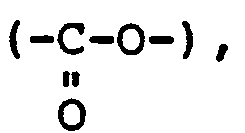
- Unter Komponente B werden aliphatische gesättigte, 2-6- wertige, vorzugsweise 2-4-wertige Polyole mit OH-Zahlen von 50-1830, vorzugsweise 100-1060 mg KOH/g Substanz verstanden oder die vorgenannten Polyole, deren aliphatische Kette eine oder mehrere gleiche oder verschiedene Gruppen der Reihe Phenylen, Cyclohexylen, Oxy(-O-), Thio (-S-), Carboxylat


- Beispiele für Komponente B sind:
- a) Aliphatische gesättigte, 2-6-wertige Alkohole, insbesondere 2-4-wertige Alkohole wie Ethylenglykol, Propandiol-1,2, Propandiol-1,3, Neopentylglykol, Butandiol-1,4, Hexandiol-1,6, Dekandiol-1,10, Glycerin, Trimethylolpropan, Pentaerythrit, Dipentaerythrit sowie die Oxalkylierungsprodukte der 2-6-wertigen Alkohole mit 1,2-Alkylenoxiden wie Ethylenoxid oder Propylenoxid.
- b) Cycloaliphatische Diole wie Cyclohexandiol-1,4 und 4,4-Dihydroxy-cyclohexyl-2,2-alkane, wie 4,4- Di- hydroxycyclohexyl-2,2-propan und araliphatische 2- wertige Alkohole, die gegebenenfalls 1-2 Ethersauerstoffatome enthalten wie bis-(oxethyliertes) Bisphenol A sowie (oxpropoxyliertes) Bisphenol A.
- c) Thioalkohole wie Oxalkylierungsprodukte von Schwefelwasserstoff oder Thiodiglykolen, wobei als Oxalkylierung sowohl Oxethylierung als auch Oxpropylierung in Frage kommt.
- d) Gesättigte oder ungesättigte, vorzugsweise gesättigte Polyester mit mindestens zwei freien Hydroxylgruppen aus den vorstehend beispielhaft genannten Alkoholen und mindestens einer Polycarbonsäure oder deren Anhydrid, insbesondere Dicarbonsäuren wie Maleinsäure Fumarsäure, Mesaconsäure, Citraconsäure, Itaconsäure, Bernsteinsäure, Isophthalsäure, Terephthalsäure, Trimellitsäure, Hexahydrophthalsäure, Tetrahydrophthalsäure, Endomethylentetrahydrophthalsäure, Methylhexahydrophthalsäure, Glutarsäure, Adipinsäure, Sebacinsäure, Phthalsäure. Die Polyalkohole a) bis d) der Komponente B können allein oder in Mischungen eingesetzt werden.
- Bei der Komponente C handelt es sich um beliebige, vorzugsweise aliphatische Hydroxylgruppen und (Meth)Acryloylgruppen aufweisende Verbindungen bzw. Gemische derartiger Verbindungen, die (bei Vorliegen von Gemischen im statistischen Mittel) bei einer Hydroxylzahl (mg KOH/Gramm Substanz) von 20-600, vorzugsweise 50-500, 1-3, vorzugsweise 1-2 Hydroxylgruppen pro Molekül und pro 100 Molekulargewichtseinheiten 1,12 bis 0,01, vorzugsweise 0,9 bis 0,09, in Form der (Meth)acryloylgruppen vorliegenden olefinischen Doppelbindungen aufweisen.
- Typische Beispiele der Verbindung C sind:
- Hydroxyalkyl(meth)acrylate wie z.B. 2-Hydroxyethylacrylat, 2-Hydroxypropylacrylat, 2-Hydroxybutylacrylat, 3-Hydroxypropylacrylat, 4-Hydroxybutylacrylat, und 6-Hydroxyhexyacrylat sowie die entsprechende (Meth)acrylate. Besonders werden 2-Hydroxyethylacrylat und 2-Hydroxypropylacrylat bevorzugt.
- Ferner geeignet sind Veresterungsprodukte von (Meth)acrylsäure bzw. Umesterungsprodukte von (Meth)Acrylsäureestern, bzw. Umsetzungsprodukte von (Meth)acrylsäurehalogeniden mit den unter Komponente B (a-d) genannten Polyolen, wobei pro Mol an Hydroxylgruppen des Polyols aus Komponente B im allgemeinen 0,3-0,75 Mol der (Meth)Acryloylver- bindung eingesetzt werden.
- II. Strahlenhärtbare Epoxy(meth)acrylate bestehend aus Umsetzungsprodukten aus Polyepoxiden und (Meth)Acrylsäure, bei deren Herstellung pro Mol an Epoxidgruppen d.h. pro Epoxidäquivalent 0,6-1,1 Mol (Meth)Acrylsäure und 0 - 0,5 Mol gesättigten Monocarbonsäure, vorzugsweise 0,9-1,1 Mol (Meth)Acrylsäure, eingesetzt werden. Unter dem Begriff Polyepoxid werden in diesem Zusammenhang Verbindungen verstanden, die (im statistischen Mittel) mehr als eine 1,2-Epoxidgruppen pro Molekül, vorzugsweise 1,6 bis 6, insbesondere 1,6 bis 3 Epoxidgruppen enthalten.
- Die Polyepoxidverbindungen können z.B. Polyglycidether mehrwertiger Phenole sein, beispielsweise solche von Brenzkatechin, Resorcin, Hydrochinon, 4,4'-Dihydroxydiphenylmethan, 4,4'-Dihydroxydiphenyldimethyl-methan (Bisphenol A) 4,4'-Dihydroxydiphenylmethylmethan, 4,4'-Dihydroxydiphenylcyclohexan, 4,41- Dihydroxydiphenylsulfon, Tris-(4-hydroxyphenyl)-methan, den Chlorierungs- und Bromierungsprodukten der genannten Diphenole, insbesondere solche von Bisphenol A, Novolaken (d.h. aus Umsetzungsprodukten von ein- oder mehrwertigen Phenolen mit Aldehyden, insbesondere Formaldehyd, in Gegenwart saurer Katalysatoren), von Diphenolen, die durch Veresterung von 2 Mol des Natriumsalzes einer aromatischen Oxycarbonsäure mit einem Mol eines Dihalogenalkans oder Dihalogendialkylethers erhalten wurden (GB-PS 1 017 612) oder von Polyphenolen, die durch Kondensation von Phenolen und langkettigen, mindestens 2 Halogenatome enthaltenen Halogenparaffinen erhalten wurden (GB-OS 1 o24 288).
- Weiter seien genannt Glycidylether mehrwertiger Alkohole beispielsweise aus 1,4-Butandiol, 1,4-Butendiol, Glycerin, Trimethylolpropan, Pentaerythrit und Polyethylenglykolen. Von weiterem Interesse sind Triglycidylisocyanurat und N,N'-Diepoxypropyloxamid.
- Außerdem kommen in Frage: Glycidylester mehrwertiger aromatischer, aliphatischer und cycloaliphatischer Carbonsäuren, beispielsweise Phthalsäure-diglycidylester, Isophthalsäure-diglycidylester, Terephthalsäure-diglycidylester, Tetrahydrophthalsäure-diglycidylester, Adipinsäure-diglycidylester, Hexahydrophthalsäure-diglycidylester, die gegebenenfalls durch Methylgruppen substituiert sein können und Glycidylester von Umsetzungsprodukten aus 1 Mol eines aromatischen oder cycloaliphatischen Dicarbonsäureanhydrids und 1/2 Mol eines Diols bzw. 1/n Mol eines Polyols mit n Hydroxylgruppen, etwa Glycidylcarbonsäureester der allgemeinen Formel

- Bevorzugte Polyepoxidverbindungen sind Polyglycidylether mehrwertiger Phenole, insbesondere aus Bisphenol A, Phthalsäurediglycidylester, Isophthalsäurediglycidylester, Terephthalsäurediglycidylester, Polyglycidylester aus cyclo- aliphatischen Dicarbonsäuren, insbesondere Hexahydrophthalsäurediglycidylester und Polyepoxide aus dem Umsetzungsprodukt von n Molen Hexahydrophthalsäureanhydrid und/oder Phthalsäureanhydrid und 1 Mol eines Polyols mit n Hydroxylgruppen (n = ganze Zahl von 2-6), insbesondere von 3 Mol Hexahydrophthalsäureanhydrid und/oder Phthalsäureanhydrid und einem Mol 1,1,1-Trimethylolpropan.
- Als Monocarbonsäure geeignet sind Säuren der Formel H(CH2)nCOOH mit n = 0 bis 20, insbesondere Essigsäure. Die genannten Polyepoxide können auch durch Umsetzung mit aliphatischen oder aromatischen Dicarbonsäuren, mit Dimercaptanen oder H2 S oder mit Aminen oder Ammoniak vorverlängert sein, wenn ein höheres Molekulargewicht dieser Ausgangskomponente erwünscht ist.
- III. Strahlenhärtbare präpolymere Polyester(meth)acrylate mit einer Säurezahl (mg KOH pro g Substanz) von höchstens 20, bevorzugt höchstens 10, insbesondere bevorzugt höchstens 5 mit einem Gehalt an ethylenisch ungesättigten Doppelbindungen von 1,12 bis 0,01 insbesondere von 0,8 bis 0,1 pro 100 Molekulargewichtseinheiten.
- Typische Beispiele der präpolymeren Polyester(meth) acrylate sind aufgebaut aus:
- a) Acrylsäure, Methacrylsäure, aliphatischen und/ oder aromatischen Dicarbonsäuren wie Adipinsäure, Bernsteinsäure, Glutarsäure, Pimelinsäure, Korksäure, Cyclohexandicarbonsäure, Sebacinsäure, Azelainsäure, Phthalsäure, Tetrahydrophthalsäure, Hexahydrophthalsäure, Terephthalsäure, Maleinsäure, Fumarsäure sowie deren Anhydriden bzw. Derivaten und mehrwertigen Alkoholen wie Ethylenglykol, Propylenglykol (1,2 und 1,3), Butandiol (1,2 und 1,4), Hexandiol, Neopentylglykol, Glyzerin, Trimethylolpropan, Dimethylolpropan, Pentaerythrit sowie deren Oxalkylierungsprodukten, wobei die Oxalkylierung sowohl Oxethylierung als auch Oxpropylierung umfaßt.
- b) den vorstehend unter III a) genannten Alkoholen und Acrylsäure und/oder Methacrylsäure.
- oC,ß-ethylenisch ungesättigte Polyester sind die üblichen Polykondensationsprodukte mindestens eineroα,ß-ethylenisch ungesättigten Dicarbonsäure mit 4 oder 5 C-Atomen oder deren esterbildenden Derivate, gegebenenfalls in Abmischung mit bis zu 90 Mol%, bezogen auf die ungesättigten Säurekomponenten, mindestens einer aliphatischen mit 4-10 C-Atomen oder cycloaliphatischen oder aromatischen Dicarbonsäure mit 8-10 C-Atomen oder deren esterbildenden Derivate mit mindestens einer Polyhydroxyverbindung, insbesondere Dihydroxyverbindung, mit 2-8 C-Atomen (J. Björksten et al., "Polyesters and their Applications", Reinhold Publishing Corp., New York 1956).
- Beispiele für bevorzugt zu verwendende ungesättigte Dicarbonsäuren oder ihre Derivate sind Maleinsäure oder Maleinsäureanhydrid und Fumarsäure. Verwendet werden können z.B. jedoch auch Mesaconsäure, Citraconsäure, Itaconsäure oder Chlormaleinsäure. Beispiele für die zu verwendenden aliphatischen, cyclo-aliphatischen und aromatischen Dicarbonsäuren oder ihre Derivate sind Phthalsäure oder Phthalsäureanhydrid, Isophthalsäure, Terephthalsäure, Hexa- oder Tetrahydrophthalsäure bzw. deren Anhydride, Endomethylentetrahydrophthalsäure oder deren Anhydrid, Bernsteinsäure bzw. Bernsteinsäureanhydrid und Bernsteinsäureester und -chloride, Adipinsäure, Sebacinsäure. Als zweiwertige Alkohole können Ethylenglykol, Propandiol-1,2, Propandiol-1,3, Diethylenglykol, Dipropylenglykol, Butandiol-1,3, Butandiol-1,4, Neopentylglykol, Hexandiol-1,6, 2,2-Bis(4-hydrocyclohexyl)-propan, bis-oxalkyliertes Bisphenol A, Perhydrobisphenol und andere eingesetzt werden. Bevorzugt verwendet werden Ethylenglykol, Propandiol-1,2, Diethylenglykol und Dipropylenglykol.
- Weitere Modifikationen sind möglich durch Einbau von ein-, drei-, und vierwertiger Alkoholen mit 1-6 C-Atomen, wie Methanol, Ethanol, Butanol, Allylalkohol, Benzylalkohol, Cyclohexanol und Tetrahydrofurfurylalkohol, Trimethylolpropan, Glycerin und Pentaerythrit sowie von Mono-, Di-und Triallylethern und Benzylethern drei-, und mehrwertiger Alkohole mit 3-6 C-Atomen gemäß DB-AS 1 024 654, sowie durch Einbau einbasischer Säuren wie Benzoesäure oder langkettiger ungesättigter Fettsäuren wie ölsäure, Leinölfettsäure und Ricinenfettsäuren.
- Die Säurezahlen der Polyester sollen zwischen 1 und 100 vorzugsweise zwischen 20 und 70, die OH-Zahlen zwischen 10 und 150, vorzugsweise zwischen 20 und 100, und die als Zahlenmittel gemessenen Molekulargewichte X zwischen ca. 500 und 5000, vorzugsweise zwischen 1000 und 3000 liegen (dampfdruckosmometrisch gemessen in Dioxan und Aceton; bei differierenden Werten wird der niedrigere als der korrekte angesehen).
- Die ungesättigten Polyester und ihre Herstellung wurden im einzelnen beispielsweise in DE-AS 1 024 654, 1 054 620 und 2 221 335 beschrieben.
- Die Herstellung der unter I angegebenen strahlenhärtbaren präpolymeren Urethanacrylate d.h. die Umsetzung des Polyisocyanates mit (meth)acrylolgruppenhaltigen Alkoholen und Polyolen kann z.B. bei Temperaturen von 20-90°C, vorzugsweise bei 40-70°C, in einem Eintopfverfahren oder in mehreren Stufen durchgeführt werden. Bei einem mehrstufigen Verfahren ist die Umsetzung des Polyisocyanates mit dem ethylenisch ungesättigten Alkohol in der ersten Stufe, gefolgt von der Addition des Polyols in der zweiten Stufe bevorzugt.
- Die Urethanbildungsreaktion kann in an sich bekannter Weise, z.B. mit Zinnoctoat, Dibenzylzinndilaurat, Caprolactam oder tertiären Aminen katalysiert werden. Ebenso können die Urethangruppen aufweisende erfindungsgemäßen (meth)acrylhaltigen Oligoalkohole durch Zugabe geeigneter Inhibitoren und Antioxidantien, je 0,001-0,1 Gew.-% bezogen auf die Gesamtmischung, vor vorzeitiger und unerwünschter Polymerisation geschützt werden.
- Die zum Aufbau der strahlenhärtbaren präpolymeren Urethan-(meth)acrylate notwendigen (meth)acryloylgruppenhaltigen Alkohole (Komponente C) sind bekannt oder können nach bekanntem Verfahren erhalten werden.
- Die Herstellung der unter II angegebenen strahlenhärtbaren Epoxy(meth)acrylate kann durch Umsetzung von 0,6-1,1 Mol (Meth)Acrylsäure und 0-0,5 Mol Monocarbonsäure, vorzugsweise von 0,9-1,1 Mol (Meth)Acrylsäure, mit 1 Grammäquivalent Epoxid eines Polyepoxides erfolgen, wobei Umsetzungsprodukte mit Acrylsäure bevorzugt sind.
- Die Anlagerung der Acryl- und/oder Methacrylsäure an die Polyepoxide erfolgt hierbei nach bekannten Methoden, beispielsweise nach den Verfahren der US-PS 3 301 743 oder US-PS 2 324 851 in Substanz oder in Lösungsmitteln, wie z.B. Butylacetat, Ethylacetat, Aceton, Ethylmethylketon, Diethylketon, Cyclohexan, Cyclohexanon, Cyclopentan, Cyclopentanon, n-Heptan, n-Hexan, n-Octan, Isooctan, Methylenchlorid, Chloroform, 1,1-Dichlorethan, 1,2-Dichlorethan, 1,1,2-Trichlorethan, Tetrachlorkohlenstoff. Falls gewünscht, kann die Anlagerung der (Meth)Acrylsäure in Gegenwart von etwa 0,01-3 Gew.-%, bezogen auf Ausgangsepoxid an Katalysatoren, wie tert. Amine, Alkalihydroxide, Alkalisalze organischer Carbonsäuren, Bis-(hydroxyalkyl)-sulfide, Sulfonium-, Phosphoniumverbindungen, Phosphine, Amine oder Stibine durchgeführt werden. Als zweckmäßig haben sich Umsetzungstemperaturen von 40 bis 90°C erwiesen, die jedoch in speziellen Fällen nach oben oder unten überschritten werden können. Um die resultierenden Reaktionsprodukte vor unerwünschter vorzeitiger Polymerisation zu bewahren, empfiehlt es sich, bereits bei der Herstellung 0,001-0,1 Gew.-%, bezogen auf die Gesamtmischung, Polymerisationsinhibitoren zuzusetzen.
- Die Herstellung der unter III angegebenen strahlenhärtbaren präpolymeren Polyester(meth)acrylate kann in einem einstufigen Verfahren durch Veresterung der unter III a/b angegebenen Komponenten, vorzugsweise unter säurekatalysierten azeotropen Bedingungen, durch Umesterung der unter III a/b angegebenen Alkohole bzw. der aus den unter III a/b aufgeführten Alkoholen und Dicarbonsäuren durch Veresterung erhältlichen Polyolen mit geeigneten (Meth)Acrylsäureestern, vorzugsweise unter Verwendung eines Umesterungskatalysators oder durch Umsetzung von (Meth)Acryl- säurehalogeniden mit den unter III a/b aufgeführten Alkoholen bzw. den aus den unter III a/b aufgeführten Alkoholen und Dicarbonsäuren durch Veresterung erhältlichen Polyolen vorzugsweise in Gegenwart eines basischen Hilfsmittels wie z.B. tert. Aminen nach den üblichen Methoden der organischen Chemie erfolgen.
- Vorzugsweise werden die unter III aufgeführten strahlenhärtbaren präpolymeren Polyester(meth)acrylate durch säurekatalysierte Veresterung in Gegenwart eines Schleppmittels und den üblichen Polymerisationsinhibitoren in an sich bekannter Weise hergestellt.
- Als Veresterungskatalysatoren dienen handelsübliche organische und anorganische Säuren oder saure Ionenaustauscher. Besonders bevorzugt wird p-Toluolsulfonsäure in Mengen von 0,1 bis 3 Gew.-%, bezogen auf die Summe der Gewichtsmengen von (Meth)Acrylsäure und Polyolen, eingesetzt. Als Schleppmittel zur Entfernung des Reaktionswassers sind geeignet aliphatische, cycloaliphatische oder aromatische Kohlenwasserstoffe sowie deren Chlorierungsprodukte oder Gemische derselben, insbesondere solche mit einem Siedebereich zwischen 40°C und 140°C, vorzugsweise 70°C bis 120°C. Bevorzugte Kohlenwasserstoffe sind beispielsweise Hexan und seine Isomeren, Cyclohexan und insbesondere Toluol. Die Mengen ah Schleppmittel kann 10-60 Gew.-%, bezogen auf die Summe der Gewichtsmengen von (Meth)Acrylsäure und Polyol betragen.
- Im allgemeinen wird man die Menge des Schleppmittels so bemessen, daß eine azeotrope Entwässerung gewährleistet ist und die Sumpftemperatur des Reaktionsgemisches eine Temperatur von 120-140°C nicht überschreitet.
- Die strahlenhärtbaren präpolymeren Polyurethan(meth)acrylate, Epoxy(meth)acrylate und Polyester(meth)acrylate enthalten im allgemeinen von der praxisüblichen Herstellung her genügend Polymerisationsinhibitoren, die sie vor vorzeitiger Polymerisation schützen. In den Fällen, wo die inhibitierende Wirkung der bei der Herstellung angewandten Polymerisationsinhibitoren unzureichend ist, kann eine Nachstabilisierung mit den üblichen Inhibitoren ohne weiteres vorgenommen werden.
- Geeignete Hilfsmittel dieser Art sind beispielsweise Phenole und Phenolderivate, vorzugsweise sterisch gehinderte Phenole, die in beiden O-Stellungen zur phenolischen Hydroxygruppe Alkylsubstituenten mit 1-6 C-Atomen enthalten, Amine, vorzugsweise sekundäre Arylamine und ihre Derivate, Chinone, Kupfer-1-Salze organischer Säuren oder Anlagerungsverbindungen von Kupfer(I)halogeniden an Phosphite.
- Die erfindungsgemäßen strahlenhärtbaren präpolymeren Massen können teilweise ohne Zusatz copolymerisierbarer Monomerer oder Lösungsmittel zur Anwendung gelangen. Da es sich jedoch in vielen Fällen um viskose Produkte handelt, empfiehlt es sich, um ein Eindringen der Massen in das textile Flächengebilde zu unterstützen und/oder die Eigenschaften der Härtungsprodukte zu variieren, sie mit copolymerisierbaren Monomeren abzumischen.
- Zur Abmischung geeignete copolymerisierbare Monomere sind:
- 1. Ester der Acryl- oder Methacrylsäure mit aliphatischen C1-C8-, cycloaliphatischen C5-C6-, araliphatischen C7-C8- Monoalkoholen, beispielsweise Methylacrylat, Ethylacrylat, n-Propylacrylat, n-Butylacrylat, Methylhexylacrylat, 2-Ethylhexylacrylat, Cyclopentylacrylat, Cyclohexylacrylat, 5-Ethyl-methylolacryloyl-dioxan-1,3, Benzylacrylat, ß-Phenylethylacrylat oder die entsprechenden Methacrylsäureester;
- 2. Di- und Polyacrylate sowie Di- und Polymethacrylate von Glykolen mit 2 bis 6 C-Atomen und Polyolen mit 3-4 Hydroxylgruppen und 3 bis 6 C-Atomen, wie Ethylenglykoldiacrylat, Propandiol-1,3-diacrylat, Butandiol-1,4-diacrylat, Hexandiol-1,6-diacrylat, Trimethylolpropan-triacrylat, Pentaerythrit-tri- und tetraacrylat sowie entsprechende Methacrylate, ferner Di(meth)acrylate von Polyetherglykolen des Glykols, Propandiol-1,3, Butandiol-1,4, tetraoxethyliertes Trimethylolpropan-trisacrylat;
- 3. Aromatische Vinyl- und Divinylverbindungen, wie Styrol, Methylstyrol, Divinylbenzol;
- 4. N-Methylolacrylamid oder N-Methylolmethacrylamid sowie entsprechende N-Methylolalkylether mit 1-4 C-Atomen in der Alkylethergruppe bzw. entsprechende N-Methylolallylether, insbesondere N-Methoxymethyl-(meth)acrylamid, N-Butoxymethyl(meth)acrylamid und N-Allyloxymethyl(meth)acrylamid.
- 5. Vinylalkylether mit 1-4 C-Atomen in der Alkylgruppe wie Vinylmethylether, Vinylethylether, Vinylpropylether, Vinylbutylether;
- 6. Trimethylolpropan-diallylethermono(meth)acrylat, Vinylpyridin, N-Vinylcarbazol, Triallylphosphat, Triallylisocyanurat und andere.
- Besonders bevorzugt werden copolymerisierbare Monomere der Gruppe 1, insbesondere 5-Ethyl-5-methylolacryloyl- dioxan-1,3.
- Es können auch Gemische aus einem oder mehreren der vorgenannten Monomeren eingesetzt werden. Die Zusätze können etwa 0-70 Gew.-%, vorzugsweise 0-40 Gew.-% betragen, bezogen auf die Mischung der strahlenhärtbaren. Masse.
- Falls gewünscht, ist es möglich, die strahlenhärtbaren Massen mit inerten Lösungsmitteln wie Butylacetat, Ethylacetat, Aceton, Ethylmethylketon, Diethylketon, Cyclohexan, Cyclohexanon, Cyclopentan, Cyclopentanon, n-Heptan, n-Hexan, n-Octan, Isooctan, Toluol, Xylol, Methylenchlorid, Chloroform, 1,1-Dichlorethan, 1,2-Dichlorethan, 1,1,2-Trichlorethan, Tetrachlorkohlenstoff, Methanol, Ethanol, Isopropanol, Butanol abzumischen.
- Die Zusätze können etwa 0-50 Gew.-%, vorzugsweise 0-40 Gew.-%, bezogen auf die Mischung der strahlenhärtbaren Masse betragen. Vorzugsweise werden beim erfindungsgemäßen Verfahren jedoch lösungsmittelfreie strahlenhärtbare Massen eingesetzt.Natürlich ist es auch möglich, Mischungen aus zusätzlichen Monomeren und Lösungsmitteln innerhalb der angegebenen Mengenverhältnisse einzusetzen. Zur Reduzierung der Viskosität der strahlenhärtbaren Massen ist es ebenfalls möglich, die Formulierung vor der Applikation auf das textile Flächengebilde auf Temperaturen bis zu 120°C, vorzugsweise bis 80°C zu erwärmen. Weiterhin können die erfindungsgemäßen strahlenhärtbaren Massen ebenfalls mit Hilfe externer Emulgatoren und gegebenenfalls üblicher in der Emulsionstechnik angewandter Hilfsmittel in Wasser emulgiert zur Applikation gelangen. Als Emulgatoren kommen anionische, nichtionische, kationische, ampholytische oder hochmolekulare Stoffe sowie deren Abmischungen in Frage. Entsprechende Emulgatoren sind beispielsweise in Ullmanns Encyclopädie der techn. Chemie, Band 10, 4. Auflage, Kap.Emulsionen, S. 449 ff. beschrieben. Geeignete Emulgatoren können quantitativ und qualitativ leicht durch einfache Handversuche ermittelt'werden.
- Die Emulsionen können 10 bis 80 Gew.-%, vorzugsweise 30 bis 70 Gew.-% der strahlenhärtbaren Massen enthalten. Die Härtung der strahlenhärtbaren Massen kann mittels energiereicher Strahlung wie UV-Licht, Elektronen-, Gammastrahlen oder in Gegenwart von Radikale liefernden Substanzen, wie thermischen Polymerisationsinitiatoren erfolgen. Vorzugsweise erfolgt die Härtung der strahlenhärtbaren Massen mittels der genannten energiereichen Strahlung. Bevorzugt werden die strahlenhärtbaren Massen durch den Einfluß von UV-Licht gehärtet. Für diese Anwendung ist der Zusatz von Photoinitiatoren erforderlich. Als Photoinitiatoren sind die üblicherweise für diesen Zweck verwendeten Verbindungen geeignet, beispielsweise Benzophenon sowie ganz allgemein aromatische Ketonverbindungen, die sich vom Benzophenon ableiten, wie Alkylbenzophenone, halogenmethylierte Benzophenone gemäß DE-OS 1 949 010, Michlers Keton, Anthron, halogenierte Benzophenone. Ferner eignen sich Benzoin und seine Derivate, etwa gemäß DE-OS 1 769 168, 1 769 853, 1 769 854, 1 807 297, 1 807 301, 1 919 678 und DE-AS 1 694 149. Ebenfalls wirksame Photoinitiatoren stellen Anthrachinon und zahlreiche seiner Derivate dar, beispielsweise ß-Methylanthrachinon, tert.-Butylanthrachinon und Anthrachinon-carbonsäureester, ebenso Oximester gemäß DE-OS 1 795 089. Weiter geeignet sind Phenylglyoxylsäureester gemäß DE-OS 2 825 955.
- Besonders geeignete Photoinitiatoren sind Benzildimethylketal, Benzoinether, Phenylglyoxylsäureester gemäß DE-OS 2 825 955 und das System Benzophenon/Amin gemäß US-PS 3 759 807. Die für das jeweilige photovernetzbare System am besten geeigneten Photoinitiatoren können durch wenige einfache Handversuche ermittelt werden.
- Für die Bestrahlung des mit der erfindungsgemäßen strahlenhärtbaren Masse versehenen textilen Flächengebildes eignen sich insbesondere die in der Reproduktionstechnik gebräuchlichen Lichtquellen, deren Emission im allgemeinen im Bereich von 250 bis 500 nm, vorzugsweise 300 bis 400 nm, liegt. Beispiele für geeignete Lichtquellen sind Kohlenbogenlampen, Xenonlampen, UV-Fluoreszenslampen, Quecksilberniederdrucklampen, Quecksilberhochdrucklampen, die neben sichtbarem Licht eine für die Polymerisation besonders wirksamen Anteil an ultraviolettem Licht liefern. Die Belichtungszeit richtet sich nach der Art der verwendeten Lichtquelle. Die Bestrahlung kann bei Raumtemperatur erfolgen, sie kann aber auch bei erhöhten Temperaturen durchgeführt werden.
- Häufig kann es vorteilhaft sein, z.B. zur Verbesserung der mechanischen Eigenschaften des nach den erfindungsgemäßen Verfahren ausgerüsteten textilen Flächengebildes, weitere Zusätze zu verwenden. So ist ein Abmischen mit z.B. gesättigten oder ungesättigten Polyestern oder ausgewählten Verstärker-, Füll- oder Farbstoffen, Antistatika, Hydrophobierungs- oder Flammschutzmitteln durchaus möglich. Vorzugsweise werden die Zusätze in Mengen von 1-50 Gew.-% bezogen auf die polymerisierbaren Komponenten eingesetzt. Grundsätzlich sollten nur solche Zusätze mitverwendet und ihre Menge soweit begrenzt werden, daß eine Beeinträchtigung der Reaktivität nicht auftritt. Werden Füll- oder Farbstoffe bei der durch UV-Licht härtbaren Masse mitverwendet, so ist deren Einsatz auf solche beschränkt, die durch ihr Absorptionsverhalten den Polymerisationsvorgang nicht unterdrücken.
- Erfolgt die Härtung durch energiereiche Strahlung, z.B. Elektronenstrahlung oderir-Strahlung, so sind prinzipiell alle Füllstoffe, Pigmente und Verstärkungsmaterialien, wie sie üblicherweise eingesetzt werden, verwendbar. Die strahlenhärtbaren Massen können durch Sprühen, Imprägnieren, Streichen, Drucken auf die Substrate gebracht werden. Werden sie aus wässeriger Emulsion oder wäßriger Lösung appliziert, werden sie vor der Härtung vom Wasser durch Trocknen in einem geeigneten Aggregat befreit.
- Geeignete Substrate sind beispielsweise textile Flächengebilde wie Gewebe, Gewirke, Fadengelege, Vliese, Netzwerke aus natürlichen oder synthetischen Fasern, auch mineralische Fasern sind geeignet.
- Gemeinsam für die Beispiele sind folgende Ausführungen:
- Die Viskositäten wurden entweder im 4-mm Auslaufbecher nach DIN 53 211 (Angabe in Sekunden) oder mit einem Viscotester der Firma Haake, Typ VI 02V (Angabe in P Meßbereich bis 4000) bestimmt. Als Belichtungsquelle wurden Quecksilberhochdruckstrahler der Fa. Philips (HPK, Leistungsaufnahme 125 W) oder Quecksilberhochdruckstrahler der Fa. Hanovia (Leistungsaufnahme 80 W/cm) oder Quecksilberniederdrucklampen der Fa. Philips (TL 05) benutzt.
- Ein Urethanacrylat wird durch Umsetzung von Isophorondiisocyanat, Hydroxyethylacrylat, Thiodiglykol und einem oxethylierten Trimethylolpropan mit einer OH-Zahl (mg KOH/g Substanz) von 250 hergestellt und mit 5-Ethyl-5-methylolacryloyldioxan-1,3 (US-PS 40 767 727) als Reaktivverdünner abgemischt.
- Nach Vorlegen von 1065,6 g Isophorondiisocyanat, 0,11 g Zinnoctoat und 0,53 g 2,5-Di-tert.-butylhydrochinon werden bei 50-60°C Sumpftemperatur unter Rühren und überleiten von trockner Luft 445,4 g Hydroxyethylacrylat zugetropft. Nach Erreichen eines NCO-Wertes von 16,1 Gew.-% werden 3,1 g Zinnoctoat hinzugefügt und unter Beibehaltung der Innentemperatur 74,88 g Thiodiglykol und 1080 g eines ethoxylierten Trimethylolpropans mit einer OH-Zahl von 250 zugetropft. Der Ansatz wird mit 1776 g 5-Ethyl-5-methylolacryloyldioxan-1,3 abgemischt und so lange bei 65°C gerührt, bis der NCO-Wert kleiner als 0,1 Gew.-% ist. Es wird eine strahlenhärtbare Masse mit einer Viskosität von 250 P (23°C) erhalten.
- Ein Urethanacrylat wird durch Reaktion von Isophorondiisocyanat und dem Umsetzungsprodukt von Acrylsäure mit einem oxethylierten Trimethylolpropan (OH-Zahl 550 mg KOH/g Substanz) hergestellt.
- 925 g oxethyliertenTrimethylolpropan werden mit 430 g Acrylsäure, 12 g p-Toluolsufonsäure, 1 g p-Methoxyphenol 1,2 g 2,5-Di-tert.-butylhydrochinon und 280 g Toluol unter Durchleiten von Luft zum Rückfluß erhitzt und das entstehende Reaktionswasser azeotrop entfernt. Nach Erreichen einer Säurezahl kleiner 5 (mg KOH/g Substanz) wird das Lösungsmittel im Vakuum entfernt und der OH-gruppenhaltige (OH-Zahl 105-115) ethylenisch ungesättigte Partialester filtriert. In einer Rührapparatur werden 1060 g dieses Esters und 0,44 g Zinnoctoat auf 50-60°C erwärmt und unter überleiten von trockner Luft mit 222 g Isophorondiisocyanat versetzt. Es wird unter Beibehaltung der Innentemperatur solange gerührt, bis der NCO-Wert kleiner 0,1 Gew.-% ist. Es wird ein helles Urethanacrylat mit einer Viskosität von 400-500 P (22°C) erhalten.
- 800 g Urethanacrylat gemäß Beispiel 2 werden mit 200 g 5-Ethyl-5-methylolacryloyldioxan-1,3 vermischt. Man erhält ein helles Urethanacrylat mit einer Viskosität von 150 P (23°C).
- Ein Epoxyacrylat wird durch Umsetzung eines Bisphenol-A-diglycidylepoxides (Epoxyäquivalent 190), Acrylsäure, Essigsäure und Ethanolamin erhalten. Das Epoxyacrylat wird mit 5-Ethyl-5-methylolacryloyldioxan-1,3 abgemischt.
- In einer Rührapparatur werden 1892 g Bisphenol-A-diglycidylepoxyd, 1,909 g Thiodiglykol vorgelegt und bei 65-70°C unter Stickstoff 30,5 g Ethanolamin zugetropft. Nach drei Stunden Rühren bei 80°C werden 1,4 g p-Methoxyphenol, 1,4 g 2,5-Di-tert.-butylhydrochinon und 19,2 g Thiodiglykol hinzugefügt und innerhalb von 3 Stunden 450 g Acrylsäure zugetropft. Es wird bei 80°C Sumpftemperatur unter überleiten von trockner Luft solange gerührt, bis die Säurezahl kleiner 10 ist. Anschließend werden 1,8 g Thiodiglykol, 152 g Essigsäure und 850 g 5-Ethyl-5-methylolacryloyl-dioxan-1,3 zugegeben und bei 80°C solange gerührt, bis die Säurezahl kleiner 5 ist. Man erhält eine strahlenhärtbare Masse mit einer Viskosität von 3000 P (22°C).
- Ein Polyesteracrylat wird durch azeotrope Veresterung von Maleinsäureanhydrid, Ethylenglykol, Bernsteinsäureanhydrid, Trimethylolpropan und Acrylsäure hergestellt.
- Es werden 166,6 g Maleinsäureanhydrid, 21o,8 g Ethylenglykol, 34o g Bernsteinsäureanhydrid in Gegenwart von o,71 g 2,5-Di-tert.-butylhydrochinon, 0,71 g p-Methoxyphenol und 3,57 g p-Toluolsulfonsäure mit Toluol als Schleppmittel unter Durchleiten eines leichten Luftstromes azeotrop verestert. Der Reaktionsablauf wird über die ausgeschleppte Wassermenge verfolgt. Nachdem die Wasserabspaltung beendet ist, werden der Reaktionsmischung 455,6 g Trimethylolpropan, 538,5 g Acrylsäure, 1,01 g 2,5-Di-tert.-butylhydrochinon, 1,01 g p-Methoxyphenol und 4,98 g p-Toluolsulfonsäure zugesetzt und weiter azeotrop verestert, bis kein Reaktionswasser mehr abgeschieden wird. Nach Abdestillation des Schleppmittels und Desorption überschüssiger Acrylsäure wird ein strahlenhärtbares Polyesteracrylat mit einer Viskosität von 80 P (50°C) erhalten.
- Ein Polyesteracrylat wird gemäß Beispiel 5 durch azeotrope Veresterung hergestellt mit der Änderung, daß an Stelle von Maleinsäureanhydrid 251,6 g Phthalsäureanhydrid verwendet werden. Nach Abdestillation des Schleppmittels und Desorption überschüssiger Acrylsäure wird ein strahlenhärtbares Polyesteracrylat mit einer Viskosität von 410 P (50°C) erhalten.
- 500 g Polyesteracrylat aus Beispiel 5 werden mit 333,33 g 5-Ethyl-5-methylolacryloyl-dioxan-1,3 vermischt. Man erhält eine strahlenhärtbare Masse mit einer Viskosität von100 P (20°C).
- 500 g Polyesteracrylat nach Beispiel 6 werden mit 333,33 g 5-Ethyl-5-methylolacryloyldioxan-1,3 vermischt.
- Man erhält eine strahlenhärtbare Masse mit einer Viskosität von 110 P (20°C).
- Ein Polyesteracrylat wird durch azeotrope Veresterung von Adipinsäure, Propylenglykol, Bernsteinsäureanhydrid, Trimethylolpropan und Acrylsäure hergestellt.
- Es werden 146 g Adipinsäure, 152 g Propylenglykol-1,2, 200 g Bernsteinsäureanhydrid in Gegenwart von 0,5 g Di-tert.-butylhydrochinon, 0,5 g p-Methoxyphenol und 2,49 g p-Toluolsulfonsäure mit Toluol als Schleppmittel unter Durchleiten eines leichten Luftstromes azeotrop verestert. Der Reaktionsablauf wird über die ausgeschleppte Wassermenge verfolgt. Nachdem die Wasserabspaltung beendet ist, werden der Reaktionsmischung 268 g Trimethylolpropan, 288 g Acrylsäure, 2,95 g p-Toluolsulfonsäure, 0,59 g Di-tert.-butylhydrochinon und 0,59 g p-Methoxyphenol zugesetzt und weiter azeotrop verestert, bis kein Reaktionswasser mehr abgeschieden wird. Nach Abdestillation des Schleppmittels und Desorption nicht umgesetzter Acrylsäure wird ein strahlenhärtbares Polyesteracrylat mit einer Viskosität von 180 P (50°C) erhalten, das in einer 2,75 %igen wäßrigen teilhydrolysierten PVA-Lösung unter Zusatz von 0,5% einer Emulgatormischung aus Alkylarylsulfonsäuren und ethoxyliertem Nonylphenol emulgiert werden kann.
- Das strahlenhärtbare Polymer aus Beispiel 1 wird in Gegenwart von 3% eines Photoinitiators (Benzildimethylketal) mittels Rakeltechnik in Streifen auf einen seitlichen Rand eines rechteckigen Gittergewebes aus Polyesterfilamenten in einer Breite von 50 mm aufgetragen und unter UV-Licht (Hanovia-Strahler, 80 W/cm, Abstand 8 cm, Bandgeschwindigkeit 5 m/min.) ausgehärtet. Das Gittergewebe wird anschließend gewendet und der gleichen Prozedur unterzogen, so daß die strahlenhärtbare Masse in vernetztem Zustand durch den gesamten Rand von Oberfläche zu Rückseite reicht. Der Vorgang wird am anderen seitlichen Rand wiederholt.
- Das derart beidseitig randverstärkte Gittergewebe wird als Siebband in einer Papiermaschine verwendet.
- Die strahlenhärtbare Masse aus Beispiel 2 wird in Gegenwart von 3 % eines Photoinitiators (Benzoinisopropylether) in einer beheizbaren Wanne auf 50°C erwärmt. In die Wanne werden die seitlichen Kanten eines quadratischen Synthesefaservlieses aus Polypropylenfasern, in einer Breite von 50 mm eingetaucht. Das Vlies wird aus dem Tauchbad herausgezogen und zwischen einem Rollenpaar, dessen Spaltöffnung auf die Dicke des Vlieses eingestellt ist, vom Überschuß des Polymers befreit. Die Masse wird durch beidseitiges Belichten mit UV-Licht (Hanovia Strahler 80 W/cm, Abstand 8 cm, Bandgeschwindigkeit 5 m/min.) gehärtet. Dieser Vorgang wird an den übrigen Kanten des Vliestoffes wiederholt, so daß der Rand durchgehend mit Polymerisat ausgefüllt ist. Das Vlies wird als Filter in Filterpressen verwendet.
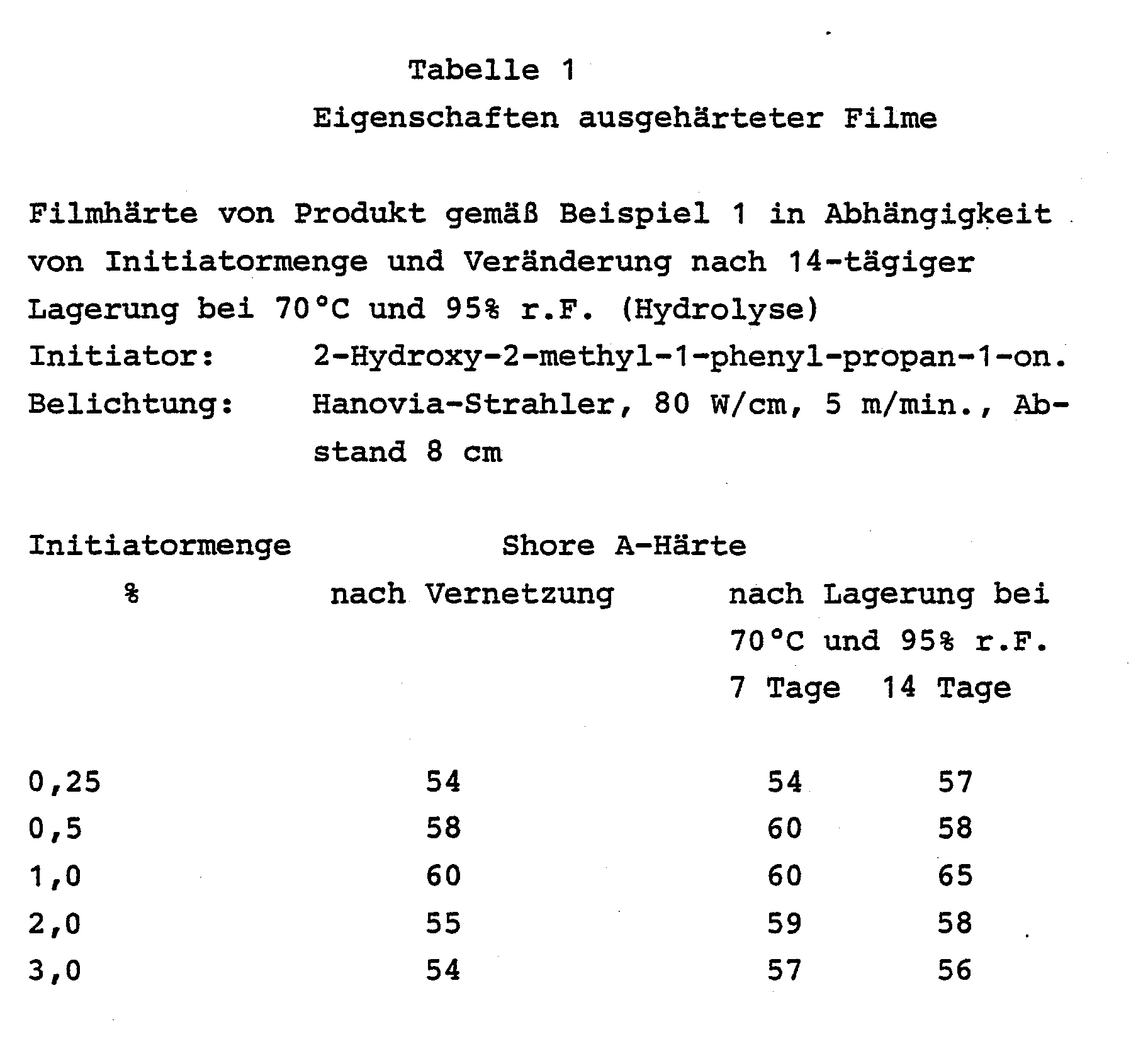


wobei die Summe der OH-Grammäquivalente aus B und C 1,0-1,2, insbesondere 1-1,1 beträgt.
Claims (4)
1. Verfahren zur Kantenverfestigung und Randabdichtung textiler Flächengebilde, dadurch gekennzeichnet, daß die Randzone des textilen Flächengebildes mit strahlenhärtbaren Massen behandelt und einer vernetzungsaktiven Strahlung ausgesetzt wird.
2. Verfahren nach Anspruch 1, dadurch gekennzeichnet, daß als strahlenhärtbare Massen präpolymere Urethan(meth)acrylate und/oder präpolymere Polyester-(meth)acrylate und/oder präpolymere Epoxy(meth)acrylate und/oder α,β-ungesättigte Polyesterharze verwendet werden.
3. Verfahren nach Anspruch 1, dadurch gekennzeichnet, daß die strahlenhärtbaren Massen in Gegenwart von Fotoinitiatoren und gegebenenfalls Beschleunigern mit UV-Licht gehärtet werden.
4. Verfahren nach Anspruch 1, dadurch gekennzeichnet, daß die strahlenhärtbaren Massen als wäßrige Emulsion oder Lösung appliziert werden und das Wasser vor der Bestrahlung entfernt wird.
Applications Claiming Priority (2)
| Application Number | Priority Date | Filing Date | Title |
|---|---|---|---|
| DE19823208438 DE3208438A1 (de) | 1982-03-09 | 1982-03-09 | Verfahren zur kantenverfestigung und randabdichtung textiler flaechengebilde |
| DE3208438 | 1982-03-09 |
Publications (1)
| Publication Number | Publication Date |
|---|---|
| EP0090174A1 true EP0090174A1 (de) | 1983-10-05 |
Family
ID=6157724
Family Applications (1)
| Application Number | Title | Priority Date | Filing Date |
|---|---|---|---|
| EP83101718A Withdrawn EP0090174A1 (de) | 1982-03-09 | 1983-02-23 | Verfahren zur Kantenverfestigung und Randabdichtung textiler Flächengebilde |
Country Status (2)
| Country | Link |
|---|---|
| EP (1) | EP0090174A1 (de) |
| DE (1) | DE3208438A1 (de) |
Cited By (6)
| Publication number | Priority date | Publication date | Assignee | Title |
|---|---|---|---|---|
| EP0542492A3 (de) * | 1991-11-13 | 1994-03-02 | Hunter Douglas International | |
| WO1994017057A1 (en) * | 1993-01-20 | 1994-08-04 | Perstorp Ab | Cycloaliphatic acrylic monomer |
| EP0624210A4 (en) * | 1992-01-30 | 1995-10-11 | Reeves Bros Inc | Fabric containing graft polymer thereon. |
| EP0785864A4 (de) * | 1994-09-30 | 1999-12-29 | Highland Ind Inc | Nicht ausfaserndes verstärkungsgewebe für airbags |
| DE102008043202A1 (de) | 2007-10-29 | 2009-04-30 | Basf Se | Verfahren zur Kantenleimung von Textilien |
| EP2078776A1 (de) * | 2007-03-20 | 2009-07-15 | Thomas Dipl.-Ing. Gerbig | Partielle, UV vernetzbare Kantenleimung |
Families Citing this family (7)
| Publication number | Priority date | Publication date | Assignee | Title |
|---|---|---|---|---|
| US4725323A (en) * | 1985-05-22 | 1988-02-16 | Cuno Incorporated | Filter element |
| US5015316A (en) * | 1985-05-22 | 1991-05-14 | Cuno, Incorporated | Filter element |
| US5028327A (en) * | 1985-05-22 | 1991-07-02 | Cuno, Incorporated | Filter element |
| US4731184A (en) * | 1985-05-22 | 1988-03-15 | Cuno Incorporated | Filter element |
| US5085917A (en) * | 1990-04-10 | 1992-02-04 | Thor Radiation Research, Inc. | Fabric having ravel resistant selvages and method for imparting the same |
| US5399264A (en) * | 1993-03-22 | 1995-03-21 | Cuno, Incorporated | Compressible differential pressure energized seals for filter elements and the like |
| DE102007018938B4 (de) * | 2007-04-21 | 2010-02-25 | Mann+Hummel Innenraumfilter Gmbh & Co. Kg | Filterelement mit einem gefalteten oder gewellten Filterkörper und mindestens einem Versteifungselement aus strahlenvernetzten Polymeren, Filterelementzwischenprodukt, Verfahren zur Herstellung eines Filterelementes sowie Verwendung eines Filterelementes |
Citations (3)
| Publication number | Priority date | Publication date | Assignee | Title |
|---|---|---|---|---|
| FR1462848A (fr) * | 1965-01-06 | 1966-12-16 | Courtaulds Ltd | Nouveau revêtement de sol et son procédé de fabrication |
| LU59404A1 (de) * | 1969-08-12 | 1970-03-26 | ||
| GB2041784A (en) * | 1979-01-17 | 1980-09-17 | Hiraoka & Co Ltd | Waterproof weldable fabric |
-
1982
- 1982-03-09 DE DE19823208438 patent/DE3208438A1/de not_active Withdrawn
-
1983
- 1983-02-23 EP EP83101718A patent/EP0090174A1/de not_active Withdrawn
Patent Citations (3)
| Publication number | Priority date | Publication date | Assignee | Title |
|---|---|---|---|---|
| FR1462848A (fr) * | 1965-01-06 | 1966-12-16 | Courtaulds Ltd | Nouveau revêtement de sol et son procédé de fabrication |
| LU59404A1 (de) * | 1969-08-12 | 1970-03-26 | ||
| GB2041784A (en) * | 1979-01-17 | 1980-09-17 | Hiraoka & Co Ltd | Waterproof weldable fabric |
Cited By (11)
| Publication number | Priority date | Publication date | Assignee | Title |
|---|---|---|---|---|
| EP0542492A3 (de) * | 1991-11-13 | 1994-03-02 | Hunter Douglas International | |
| US5654073A (en) * | 1991-11-13 | 1997-08-05 | Hunter Douglas Inc. | Treated fabric panel |
| US5690778A (en) * | 1991-11-13 | 1997-11-25 | Hunter Douglas Inc. | Method of fabricating honeycomb panel for window covering |
| US5691031A (en) * | 1991-11-13 | 1997-11-25 | Hunter Douglas Inc. | Cellular panel |
| US6066382A (en) * | 1991-11-13 | 2000-05-23 | Hunter Douglas Inc. | Treated fabric and expandable and retractable fabric structures made therefrom |
| EP0624210A4 (en) * | 1992-01-30 | 1995-10-11 | Reeves Bros Inc | Fabric containing graft polymer thereon. |
| WO1994017057A1 (en) * | 1993-01-20 | 1994-08-04 | Perstorp Ab | Cycloaliphatic acrylic monomer |
| US5559201A (en) * | 1993-01-20 | 1996-09-24 | Perstorp Ab | Cycloaliphatic acrylic monomer |
| EP0785864A4 (de) * | 1994-09-30 | 1999-12-29 | Highland Ind Inc | Nicht ausfaserndes verstärkungsgewebe für airbags |
| EP2078776A1 (de) * | 2007-03-20 | 2009-07-15 | Thomas Dipl.-Ing. Gerbig | Partielle, UV vernetzbare Kantenleimung |
| DE102008043202A1 (de) | 2007-10-29 | 2009-04-30 | Basf Se | Verfahren zur Kantenleimung von Textilien |
Also Published As
| Publication number | Publication date |
|---|---|
| DE3208438A1 (de) | 1983-09-15 |
Similar Documents
| Publication | Publication Date | Title |
|---|---|---|
| EP0026313B1 (de) | Wasserdispergierbare, durch Strahlen vernetzbare Bindemittel aus Urethanacrylaten, ein Verfahren zu ihrer Herstellung sowie die Verwendung dieser Bindemittel in wässriger Dispersion auf dem Anstrich-, Druckfarben- und Textilsektor | |
| DE2413768C2 (de) | Härtbares Material | |
| EP0000890B1 (de) | Strahlenhärtbare Urethanacrylat-Bindemittel | |
| EP0090174A1 (de) | Verfahren zur Kantenverfestigung und Randabdichtung textiler Flächengebilde | |
| US4082634A (en) | Method of curing b-stage polyurethanes | |
| DE2701792C3 (de) | Wärmehärtbare, äthylenisch ungesättigte Verbindungen und ein Polythiol enthaltende Massen | |
| DE3779988T2 (de) | Uv-haertbare polyamin-polyen-ueberzugsmittel. | |
| EP0071142B1 (de) | Verfahren zum Verkleben von Folien | |
| DE4343885A1 (de) | Wäßrige, strahlenhärtbare Bindemitteldispersionen | |
| DE3013827A1 (de) | Durch strahlung haertbare masse | |
| DE3034697A1 (de) | Acylphosphinsulfidverbindungen, ihre herstellung und verwendung | |
| DE3318147A1 (de) | Verfahren zur herstellung von, isocyanuratgruppen und olefinische doppelbindungen aufweisenden verbindungen, die nach diesem verfahren erhaeltlichen verbindungen und ihre verwendung als bindemittel bzw. bindemittelkomponente in ueberzugsmitteln | |
| EP0053749A1 (de) | Strahlenhärtbare urethangruppenhaltige Acrylsäureester, Verfahren zu ihrer Herstellung und ihre Verwendung | |
| DE2651507A1 (de) | Strahlenhaertbare verduennungsmittel fuer strahlenhaertbare zusammensetzungen | |
| DE3332019A1 (de) | Haertbare polyesterformmassen | |
| EP0702067B1 (de) | Bindemittel für Pulverlacke | |
| DE4228713A1 (de) | Wäßrige, strahlenhärtbare Bindemitteldispersionen | |
| DE2533125C2 (de) | Hochreaktive Lackbindemittel | |
| US5718966A (en) | Release liner fabric having edge reinforcement | |
| DE1495330A1 (de) | Verfahren zur Herstellung von schwer entflammbaren bzw. selbstverloeschenden Polyestern | |
| DE2901686A1 (de) | Mischungen auf basis von alkenylsubstituierten phenolen und polymercaptanen | |
| EP0447845B1 (de) | Strahlungshärtbare Amin- und Harnstoffgruppen enthaltende Urethanacrylatverbindungen | |
| EP0024703B2 (de) | Verfahren zur Herstellung von Filtermaterialien | |
| DE2421118A1 (de) | Drahtbeschichtungsverfahren | |
| DE2825955A1 (de) | Arylglyoxyloyloxyalkylacrylate und ihre verwendung in photopolymerisierbaren bindemitteln |
Legal Events
| Date | Code | Title | Description |
|---|---|---|---|
| PUAI | Public reference made under article 153(3) epc to a published international application that has entered the european phase |
Free format text: ORIGINAL CODE: 0009012 |
|
| 17P | Request for examination filed |
Effective date: 19830223 |
|
| AK | Designated contracting states |
Designated state(s): CH DE FR GB IT LI |
|
| STAA | Information on the status of an ep patent application or granted ep patent |
Free format text: STATUS: THE APPLICATION HAS BEEN WITHDRAWN |
|
| 18W | Application withdrawn |
Withdrawal date: 19840822 |
|
| RIN1 | Information on inventor provided before grant (corrected) |
Inventor name: NEUHAUS, KARL-FRIEDRICH, DR. Inventor name: STRIEGLER, HELLMUT, DR. Inventor name: BRINKMEYER, HERMANN, DR. Inventor name: PERREY, HERMANN, DR. |