EP0090247B1 - Esters pyrimidin-4-yliques substitués de l'acide N,N-diméthyl carbamique, procédé pour leur préparation et leur usage parasiticide - Google Patents
Esters pyrimidin-4-yliques substitués de l'acide N,N-diméthyl carbamique, procédé pour leur préparation et leur usage parasiticide Download PDFInfo
- Publication number
- EP0090247B1 EP0090247B1 EP83102486A EP83102486A EP0090247B1 EP 0090247 B1 EP0090247 B1 EP 0090247B1 EP 83102486 A EP83102486 A EP 83102486A EP 83102486 A EP83102486 A EP 83102486A EP 0090247 B1 EP0090247 B1 EP 0090247B1
- Authority
- EP
- European Patent Office
- Prior art keywords
- formula
- substituted
- alkyl
- dimethyl
- carbon atoms
- Prior art date
- Legal status (The legal status is an assumption and is not a legal conclusion. Google has not performed a legal analysis and makes no representation as to the accuracy of the status listed.)
- Expired
Links
- 238000000034 method Methods 0.000 title claims description 35
- 238000002360 preparation method Methods 0.000 title claims description 18
- 230000000590 parasiticidal effect Effects 0.000 title 1
- 239000002297 parasiticide Substances 0.000 title 1
- 125000004432 carbon atom Chemical group C* 0.000 claims abstract description 32
- 125000000217 alkyl group Chemical group 0.000 claims abstract description 28
- 125000004414 alkyl thio group Chemical group 0.000 claims abstract description 17
- 125000002947 alkylene group Chemical group 0.000 claims abstract description 12
- 239000001257 hydrogen Substances 0.000 claims abstract description 12
- 229910052739 hydrogen Inorganic materials 0.000 claims abstract description 12
- 125000003545 alkoxy group Chemical group 0.000 claims abstract description 11
- 125000004644 alkyl sulfinyl group Chemical group 0.000 claims abstract description 11
- 125000004390 alkyl sulfonyl group Chemical group 0.000 claims abstract description 8
- 125000004435 hydrogen atom Chemical group [H]* 0.000 claims abstract 6
- 150000001875 compounds Chemical class 0.000 claims description 46
- 229910052736 halogen Inorganic materials 0.000 claims description 20
- 150000002367 halogens Chemical group 0.000 claims description 20
- ZAMOUSCENKQFHK-UHFFFAOYSA-N Chlorine atom Chemical compound [Cl] ZAMOUSCENKQFHK-UHFFFAOYSA-N 0.000 claims description 18
- 239000003085 diluting agent Substances 0.000 claims description 18
- 239000002253 acid Substances 0.000 claims description 16
- VTGOHKSTWXHQJK-UHFFFAOYSA-N pyrimidin-2-ol Chemical class OC1=NC=CC=N1 VTGOHKSTWXHQJK-UHFFFAOYSA-N 0.000 claims description 15
- 239000000460 chlorine Substances 0.000 claims description 14
- NJBHEZHBVMVSBL-UHFFFAOYSA-N pyrimidin-4-yl N,N-dimethoxycarbamate Chemical class CON(C(OC1=NC=NC=C1)=O)OC NJBHEZHBVMVSBL-UHFFFAOYSA-N 0.000 claims description 14
- 229910052801 chlorine Inorganic materials 0.000 claims description 13
- PXGOKWXKJXAPGV-UHFFFAOYSA-N Fluorine Chemical compound FF PXGOKWXKJXAPGV-UHFFFAOYSA-N 0.000 claims description 12
- 239000000370 acceptor Substances 0.000 claims description 12
- ROSDSFDQCJNGOL-UHFFFAOYSA-N Dimethylamine Chemical compound CNC ROSDSFDQCJNGOL-UHFFFAOYSA-N 0.000 claims description 11
- 229910052731 fluorine Inorganic materials 0.000 claims description 8
- 239000011737 fluorine Substances 0.000 claims description 8
- 241000607479 Yersinia pestis Species 0.000 claims description 7
- WKBOTKDWSSQWDR-UHFFFAOYSA-N Bromine atom Chemical compound [Br] WKBOTKDWSSQWDR-UHFFFAOYSA-N 0.000 claims description 6
- 241001465754 Metazoa Species 0.000 claims description 6
- YGYAWVDWMABLBF-UHFFFAOYSA-N Phosgene Chemical compound ClC(Cl)=O YGYAWVDWMABLBF-UHFFFAOYSA-N 0.000 claims description 6
- 150000002148 esters Chemical class 0.000 claims description 6
- GDTBXPJZTBHREO-UHFFFAOYSA-N bromine Substances BrBr GDTBXPJZTBHREO-UHFFFAOYSA-N 0.000 claims description 5
- 229910052794 bromium Inorganic materials 0.000 claims description 5
- 239000003795 chemical substances by application Substances 0.000 claims description 5
- 239000004606 Fillers/Extenders Substances 0.000 claims description 4
- 150000001350 alkyl halides Chemical class 0.000 claims description 4
- 229940112021 centrally acting muscle relaxants carbamic acid ester Drugs 0.000 claims description 4
- 150000001409 amidines Chemical class 0.000 claims description 3
- 150000002168 ethanoic acid esters Chemical class 0.000 claims description 3
- 238000009395 breeding Methods 0.000 claims description 2
- 230000001488 breeding effect Effects 0.000 claims description 2
- DWLVWMUCHSLGSU-UHFFFAOYSA-N dimethylcarbamic acid Chemical compound CN(C)C(O)=O DWLVWMUCHSLGSU-UHFFFAOYSA-N 0.000 claims description 2
- 244000079386 endoparasite Species 0.000 claims description 2
- PNDPGZBMCMUPRI-UHFFFAOYSA-N iodine Chemical compound II PNDPGZBMCMUPRI-UHFFFAOYSA-N 0.000 claims description 2
- 239000004094 surface-active agent Substances 0.000 claims description 2
- 230000007717 exclusion Effects 0.000 claims 2
- 244000144972 livestock Species 0.000 claims 1
- 230000003647 oxidation Effects 0.000 claims 1
- 238000007254 oxidation reaction Methods 0.000 claims 1
- 230000001225 therapeutic effect Effects 0.000 claims 1
- 238000002560 therapeutic procedure Methods 0.000 claims 1
- 230000000749 insecticidal effect Effects 0.000 abstract description 6
- 125000000547 substituted alkyl group Chemical group 0.000 abstract 2
- 229910052799 carbon Inorganic materials 0.000 abstract 1
- -1 2-isopropyl-6-methyl-pyrimidin-4-yl Chemical group 0.000 description 28
- 239000000203 mixture Substances 0.000 description 21
- YMWUJEATGCHHMB-UHFFFAOYSA-N Dichloromethane Chemical compound ClCCl YMWUJEATGCHHMB-UHFFFAOYSA-N 0.000 description 15
- 239000002904 solvent Substances 0.000 description 15
- 238000006243 chemical reaction Methods 0.000 description 13
- 239000000243 solution Substances 0.000 description 13
- CSCPPACGZOOCGX-UHFFFAOYSA-N Acetone Chemical compound CC(C)=O CSCPPACGZOOCGX-UHFFFAOYSA-N 0.000 description 12
- 239000004480 active ingredient Substances 0.000 description 12
- QTBSBXVTEAMEQO-UHFFFAOYSA-N Acetic acid Chemical compound CC(O)=O QTBSBXVTEAMEQO-UHFFFAOYSA-N 0.000 description 11
- MHAJPDPJQMAIIY-UHFFFAOYSA-N Hydrogen peroxide Chemical compound OO MHAJPDPJQMAIIY-UHFFFAOYSA-N 0.000 description 11
- 238000009472 formulation Methods 0.000 description 11
- 229910052757 nitrogen Inorganic materials 0.000 description 11
- RTZKZFJDLAIYFH-UHFFFAOYSA-N Diethyl ether Chemical compound CCOCC RTZKZFJDLAIYFH-UHFFFAOYSA-N 0.000 description 10
- WEVYAHXRMPXWCK-UHFFFAOYSA-N Acetonitrile Chemical compound CC#N WEVYAHXRMPXWCK-UHFFFAOYSA-N 0.000 description 9
- YXFVVABEGXRONW-UHFFFAOYSA-N Toluene Chemical compound CC1=CC=CC=C1 YXFVVABEGXRONW-UHFFFAOYSA-N 0.000 description 9
- 239000007800 oxidant agent Substances 0.000 description 9
- HEDRZPFGACZZDS-UHFFFAOYSA-N Chloroform Chemical compound ClC(Cl)Cl HEDRZPFGACZZDS-UHFFFAOYSA-N 0.000 description 8
- UFHFLCQGNIYNRP-UHFFFAOYSA-N Hydrogen Chemical compound [H][H] UFHFLCQGNIYNRP-UHFFFAOYSA-N 0.000 description 8
- 239000003995 emulsifying agent Substances 0.000 description 8
- 239000007858 starting material Substances 0.000 description 8
- XLYOFNOQVPJJNP-UHFFFAOYSA-N water Substances O XLYOFNOQVPJJNP-UHFFFAOYSA-N 0.000 description 8
- OKKJLVBELUTLKV-UHFFFAOYSA-N Methanol Chemical compound OC OKKJLVBELUTLKV-UHFFFAOYSA-N 0.000 description 6
- ZMXDDKWLCZADIW-UHFFFAOYSA-N N,N-Dimethylformamide Chemical compound CN(C)C=O ZMXDDKWLCZADIW-UHFFFAOYSA-N 0.000 description 6
- BDAGIHXWWSANSR-UHFFFAOYSA-N methanoic acid Natural products OC=O BDAGIHXWWSANSR-UHFFFAOYSA-N 0.000 description 6
- 238000001816 cooling Methods 0.000 description 5
- 125000001495 ethyl group Chemical group [H]C([H])([H])C([H])([H])* 0.000 description 5
- 239000008187 granular material Substances 0.000 description 5
- 125000000959 isobutyl group Chemical group [H]C([H])([H])C([H])(C([H])([H])[H])C([H])([H])* 0.000 description 5
- 125000001449 isopropyl group Chemical group [H]C([H])([H])C([H])(*)C([H])([H])[H] 0.000 description 5
- 238000002844 melting Methods 0.000 description 5
- 230000008018 melting Effects 0.000 description 5
- 125000002496 methyl group Chemical group [H]C([H])([H])* 0.000 description 5
- 239000002689 soil Substances 0.000 description 5
- 239000007787 solid Substances 0.000 description 5
- 230000009885 systemic effect Effects 0.000 description 5
- 241001143309 Acanthoscelides obtectus Species 0.000 description 4
- YIIMEMSDCNDGTB-UHFFFAOYSA-N Dimethylcarbamoyl chloride Chemical compound CN(C)C(Cl)=O YIIMEMSDCNDGTB-UHFFFAOYSA-N 0.000 description 4
- IAZDPXIOMUYVGZ-UHFFFAOYSA-N Dimethylsulphoxide Chemical compound CS(C)=O IAZDPXIOMUYVGZ-UHFFFAOYSA-N 0.000 description 4
- 241000258937 Hemiptera Species 0.000 description 4
- 241000257303 Hymenoptera Species 0.000 description 4
- PMZURENOXWZQFD-UHFFFAOYSA-L Sodium Sulfate Chemical compound [Na+].[Na+].[O-]S([O-])(=O)=O PMZURENOXWZQFD-UHFFFAOYSA-L 0.000 description 4
- WQDUMFSSJAZKTM-UHFFFAOYSA-N Sodium methoxide Chemical compound [Na+].[O-]C WQDUMFSSJAZKTM-UHFFFAOYSA-N 0.000 description 4
- 229960000583 acetic acid Drugs 0.000 description 4
- 239000013543 active substance Substances 0.000 description 4
- 239000000969 carrier Substances 0.000 description 4
- 230000000694 effects Effects 0.000 description 4
- WQYVRQLZKVEZGA-UHFFFAOYSA-N hypochlorite Chemical compound Cl[O-] WQYVRQLZKVEZGA-UHFFFAOYSA-N 0.000 description 4
- 125000004108 n-butyl group Chemical group [H]C([H])([H])C([H])([H])C([H])([H])C([H])([H])* 0.000 description 4
- 125000004123 n-propyl group Chemical group [H]C([H])([H])C([H])([H])C([H])([H])* 0.000 description 4
- 239000012074 organic phase Substances 0.000 description 4
- 229920000151 polyglycol Polymers 0.000 description 4
- 239000010695 polyglycol Substances 0.000 description 4
- BWHMMNNQKKPAPP-UHFFFAOYSA-L potassium carbonate Chemical compound [K+].[K+].[O-]C([O-])=O BWHMMNNQKKPAPP-UHFFFAOYSA-L 0.000 description 4
- 239000000843 powder Substances 0.000 description 4
- 239000000047 product Substances 0.000 description 4
- 150000003254 radicals Chemical class 0.000 description 4
- VYPSYNLAJGMNEJ-UHFFFAOYSA-N silicon dioxide Inorganic materials O=[Si]=O VYPSYNLAJGMNEJ-UHFFFAOYSA-N 0.000 description 4
- JQWHASGSAFIOCM-UHFFFAOYSA-M sodium periodate Chemical compound [Na+].[O-]I(=O)(=O)=O JQWHASGSAFIOCM-UHFFFAOYSA-M 0.000 description 4
- 229910052938 sodium sulfate Inorganic materials 0.000 description 4
- 235000011152 sodium sulphate Nutrition 0.000 description 4
- 239000000126 substance Substances 0.000 description 4
- ZWEHNKRNPOVVGH-UHFFFAOYSA-N 2-Butanone Chemical compound CCC(C)=O ZWEHNKRNPOVVGH-UHFFFAOYSA-N 0.000 description 3
- OSWFIVFLDKOXQC-UHFFFAOYSA-N 4-(3-methoxyphenyl)aniline Chemical compound COC1=CC=CC(C=2C=CC(N)=CC=2)=C1 OSWFIVFLDKOXQC-UHFFFAOYSA-N 0.000 description 3
- 241001425390 Aphis fabae Species 0.000 description 3
- UHOVQNZJYSORNB-UHFFFAOYSA-N Benzene Chemical compound C1=CC=CC=C1 UHOVQNZJYSORNB-UHFFFAOYSA-N 0.000 description 3
- XEKOWRVHYACXOJ-UHFFFAOYSA-N Ethyl acetate Chemical compound CCOC(C)=O XEKOWRVHYACXOJ-UHFFFAOYSA-N 0.000 description 3
- GRYLNZFGIOXLOG-UHFFFAOYSA-N Nitric acid Chemical compound O[N+]([O-])=O GRYLNZFGIOXLOG-UHFFFAOYSA-N 0.000 description 3
- OFBQJSOFQDEBGM-UHFFFAOYSA-N Pentane Chemical compound CCCCC OFBQJSOFQDEBGM-UHFFFAOYSA-N 0.000 description 3
- 241001105129 Ptinus Species 0.000 description 3
- ZMANZCXQSJIPKH-UHFFFAOYSA-N Triethylamine Chemical compound CCN(CC)CC ZMANZCXQSJIPKH-UHFFFAOYSA-N 0.000 description 3
- 125000002877 alkyl aryl group Chemical group 0.000 description 3
- 239000012141 concentrate Substances 0.000 description 3
- 239000013078 crystal Substances 0.000 description 3
- 235000019253 formic acid Nutrition 0.000 description 3
- 239000002917 insecticide Substances 0.000 description 3
- 239000007788 liquid Substances 0.000 description 3
- VLKZOEOYAKHREP-UHFFFAOYSA-N n-Hexane Chemical compound CCCCCC VLKZOEOYAKHREP-UHFFFAOYSA-N 0.000 description 3
- 229910017604 nitric acid Inorganic materials 0.000 description 3
- 239000003921 oil Substances 0.000 description 3
- TYJJADVDDVDEDZ-UHFFFAOYSA-M potassium hydrogencarbonate Chemical compound [K+].OC([O-])=O TYJJADVDDVDEDZ-UHFFFAOYSA-M 0.000 description 3
- 239000011435 rock Substances 0.000 description 3
- 125000002914 sec-butyl group Chemical group [H]C([H])([H])C([H])([H])C([H])(*)C([H])([H])[H] 0.000 description 3
- 125000000999 tert-butyl group Chemical group [H]C([H])([H])C(*)(C([H])([H])[H])C([H])([H])[H] 0.000 description 3
- WYURNTSHIVDZCO-UHFFFAOYSA-N tetrahydrofuran Substances C1CCOC1 WYURNTSHIVDZCO-UHFFFAOYSA-N 0.000 description 3
- RFFLAFLAYFXFSW-UHFFFAOYSA-N 1,2-dichlorobenzene Chemical compound ClC1=CC=CC=C1Cl RFFLAFLAYFXFSW-UHFFFAOYSA-N 0.000 description 2
- ULQQGOGMQRGFFR-UHFFFAOYSA-N 2-chlorobenzenecarboperoxoic acid Chemical compound OOC(=O)C1=CC=CC=C1Cl ULQQGOGMQRGFFR-UHFFFAOYSA-N 0.000 description 2
- YNJSNEKCXVFDKW-UHFFFAOYSA-N 3-(5-amino-1h-indol-3-yl)-2-azaniumylpropanoate Chemical compound C1=C(N)C=C2C(CC(N)C(O)=O)=CNC2=C1 YNJSNEKCXVFDKW-UHFFFAOYSA-N 0.000 description 2
- RVMQJHNLJGPDLW-UHFFFAOYSA-N 5,6-dimethyl-2-(2-methylsulfanylethyl)-1h-pyrimidin-4-one Chemical compound CSCCC1=NC(C)=C(C)C(O)=N1 RVMQJHNLJGPDLW-UHFFFAOYSA-N 0.000 description 2
- 241000238818 Acheta domesticus Species 0.000 description 2
- 241000256111 Aedes <genus> Species 0.000 description 2
- 241000902874 Agelastica alni Species 0.000 description 2
- 241001136265 Agriotes Species 0.000 description 2
- 241000218473 Agrotis Species 0.000 description 2
- 241001398046 Amphimallon solstitiale Species 0.000 description 2
- 241000411449 Anobium punctatum Species 0.000 description 2
- 241000256186 Anopheles <genus> Species 0.000 description 2
- 241001640910 Anthrenus Species 0.000 description 2
- 241001414828 Aonidiella aurantii Species 0.000 description 2
- 241001124076 Aphididae Species 0.000 description 2
- 241001600408 Aphis gossypii Species 0.000 description 2
- 241001095118 Aphis pomi Species 0.000 description 2
- 241001162025 Archips podana Species 0.000 description 2
- 241000722809 Armadillidium vulgare Species 0.000 description 2
- 241000387321 Aspidiotus nerii Species 0.000 description 2
- 241000131286 Attagenus Species 0.000 description 2
- 241001490249 Bactrocera oleae Species 0.000 description 2
- 241000254127 Bemisia tabaci Species 0.000 description 2
- 241001142392 Bibio Species 0.000 description 2
- 241001573716 Blaniulus guttulatus Species 0.000 description 2
- 241000238657 Blattella germanica Species 0.000 description 2
- 240000007124 Brassica oleracea Species 0.000 description 2
- 241001444260 Brassicogethes aeneus Species 0.000 description 2
- 241000982105 Brevicoryne brassicae Species 0.000 description 2
- 241001517925 Bucculatrix Species 0.000 description 2
- 241001491790 Bupalus piniaria Species 0.000 description 2
- MDJJKWQVFQOPTA-UHFFFAOYSA-N CON(C(OC1=NC(=NC(=C1C)C)CCSC)=O)OC Chemical compound CON(C(OC1=NC(=NC(=C1C)C)CCSC)=O)OC MDJJKWQVFQOPTA-UHFFFAOYSA-N 0.000 description 2
- 241000257163 Calliphora vicina Species 0.000 description 2
- 235000002568 Capsicum frutescens Nutrition 0.000 description 2
- 241001350371 Capua Species 0.000 description 2
- CURLTUGMZLYLDI-UHFFFAOYSA-N Carbon dioxide Chemical compound O=C=O CURLTUGMZLYLDI-UHFFFAOYSA-N 0.000 description 2
- 0 Cc1c(C)nc(C)nc1O*N Chemical compound Cc1c(C)nc(C)nc1O*N 0.000 description 2
- 241000255579 Ceratitis capitata Species 0.000 description 2
- 241001098608 Ceratophyllus Species 0.000 description 2
- 241000258920 Chilopoda Species 0.000 description 2
- 241000255942 Choristoneura fumiferana Species 0.000 description 2
- 241001414836 Cimex Species 0.000 description 2
- 241000254173 Coleoptera Species 0.000 description 2
- 241001427559 Collembola Species 0.000 description 2
- 241000683561 Conoderus Species 0.000 description 2
- 241001212534 Cosmopolites sordidus Species 0.000 description 2
- 241000500845 Costelytra zealandica Species 0.000 description 2
- 241001094916 Cryptomyzus ribis Species 0.000 description 2
- 241000256054 Culex <genus> Species 0.000 description 2
- 241000692095 Cuterebra Species 0.000 description 2
- XDTMQSROBMDMFD-UHFFFAOYSA-N Cyclohexane Chemical compound C1CCCCC1 XDTMQSROBMDMFD-UHFFFAOYSA-N 0.000 description 2
- 241001635274 Cydia pomonella Species 0.000 description 2
- 241001124144 Dermaptera Species 0.000 description 2
- 241001641895 Dermestes Species 0.000 description 2
- 241000489975 Diabrotica Species 0.000 description 2
- 241000258963 Diplopoda Species 0.000 description 2
- 241000511318 Diprion Species 0.000 description 2
- 241000255925 Diptera Species 0.000 description 2
- 241000255601 Drosophila melanogaster Species 0.000 description 2
- 241001425477 Dysdercus Species 0.000 description 2
- 241000353522 Earias insulana Species 0.000 description 2
- 241000196324 Embryophyta Species 0.000 description 2
- 241000995023 Empoasca Species 0.000 description 2
- 241000917107 Eriosoma lanigerum Species 0.000 description 2
- LYCAIKOWRPUZTN-UHFFFAOYSA-N Ethylene glycol Chemical compound OCCO LYCAIKOWRPUZTN-UHFFFAOYSA-N 0.000 description 2
- 241000060469 Eupoecilia ambiguella Species 0.000 description 2
- 241000483001 Euproctis chrysorrhoea Species 0.000 description 2
- 241000515838 Eurygaster Species 0.000 description 2
- 241000239245 Euscelis Species 0.000 description 2
- 241001585293 Euxoa Species 0.000 description 2
- 241000371383 Fannia Species 0.000 description 2
- 241000233488 Feltia Species 0.000 description 2
- 241000723283 Geophilus carpophagus Species 0.000 description 2
- 241001243091 Gryllotalpa Species 0.000 description 2
- 241000790933 Haematopinus Species 0.000 description 2
- 241000256257 Heliothis Species 0.000 description 2
- 241001659688 Hercinothrips femoralis Species 0.000 description 2
- 241001466007 Heteroptera Species 0.000 description 2
- 241000238631 Hexapoda Species 0.000 description 2
- 241001201623 Hofmannophila pseudospretella Species 0.000 description 2
- 241000957299 Homona magnanima Species 0.000 description 2
- 241001417351 Hoplocampa Species 0.000 description 2
- 241001251909 Hyalopterus pruni Species 0.000 description 2
- VEXZGXHMUGYJMC-UHFFFAOYSA-N Hydrochloric acid Chemical compound Cl VEXZGXHMUGYJMC-UHFFFAOYSA-N 0.000 description 2
- 241000832180 Hylotrupes bajulus Species 0.000 description 2
- 241001508566 Hypera postica Species 0.000 description 2
- 241000257176 Hypoderma <fly> Species 0.000 description 2
- DGAQECJNVWCQMB-PUAWFVPOSA-M Ilexoside XXIX Chemical compound C[C@@H]1CC[C@@]2(CC[C@@]3(C(=CC[C@H]4[C@]3(CC[C@@H]5[C@@]4(CC[C@@H](C5(C)C)OS(=O)(=O)[O-])C)C)[C@@H]2[C@]1(C)O)C)C(=O)O[C@H]6[C@@H]([C@H]([C@@H]([C@H](O6)CO)O)O)O.[Na+] DGAQECJNVWCQMB-PUAWFVPOSA-M 0.000 description 2
- XEEYBQQBJWHFJM-UHFFFAOYSA-N Iron Chemical class [Fe] XEEYBQQBJWHFJM-UHFFFAOYSA-N 0.000 description 2
- UQSXHKLRYXJYBZ-UHFFFAOYSA-N Iron oxide Chemical compound [Fe]=O UQSXHKLRYXJYBZ-UHFFFAOYSA-N 0.000 description 2
- 241001495069 Ischnocera Species 0.000 description 2
- 241000256602 Isoptera Species 0.000 description 2
- 241001470017 Laodelphax striatella Species 0.000 description 2
- 241000256686 Lasius <genus> Species 0.000 description 2
- 241000255777 Lepidoptera Species 0.000 description 2
- 241000500881 Lepisma Species 0.000 description 2
- 241000258916 Leptinotarsa decemlineata Species 0.000 description 2
- 241001113970 Linognathus Species 0.000 description 2
- 241000254025 Locusta migratoria migratorioides Species 0.000 description 2
- 241000257162 Lucilia <blowfly> Species 0.000 description 2
- 241000257166 Lucilia cuprina Species 0.000 description 2
- 241001177134 Lyctus Species 0.000 description 2
- 241000721696 Lymantria Species 0.000 description 2
- 241000255685 Malacosoma neustria Species 0.000 description 2
- 241000555303 Mamestra brassicae Species 0.000 description 2
- 241001415015 Melanoplus differentialis Species 0.000 description 2
- 241000254099 Melolontha melolontha Species 0.000 description 2
- NTIZESTWPVYFNL-UHFFFAOYSA-N Methyl isobutyl ketone Chemical class CC(C)CC(C)=O NTIZESTWPVYFNL-UHFFFAOYSA-N 0.000 description 2
- 241000952627 Monomorium pharaonis Species 0.000 description 2
- 241000257229 Musca <genus> Species 0.000 description 2
- LRHPLDYGYMQRHN-UHFFFAOYSA-N N-Butanol Chemical compound CCCCO LRHPLDYGYMQRHN-UHFFFAOYSA-N 0.000 description 2
- IMNFDUFMRHMDMM-UHFFFAOYSA-N N-Heptane Chemical compound CCCCCCC IMNFDUFMRHMDMM-UHFFFAOYSA-N 0.000 description 2
- 241000358422 Nephotettix cincticeps Species 0.000 description 2
- 241001556089 Nilaparvata lugens Species 0.000 description 2
- CTQNGGLPUBDAKN-UHFFFAOYSA-N O-Xylene Chemical compound CC1=CC=CC=C1C CTQNGGLPUBDAKN-UHFFFAOYSA-N 0.000 description 2
- 241000384103 Oniscus asellus Species 0.000 description 2
- 241000963703 Onychiurus armatus Species 0.000 description 2
- 241001491877 Operophtera brumata Species 0.000 description 2
- 241000238814 Orthoptera Species 0.000 description 2
- 241000975417 Oscinella frit Species 0.000 description 2
- 241001147398 Ostrinia nubilalis Species 0.000 description 2
- 241000486438 Panolis flammea Species 0.000 description 2
- 241001450657 Parthenolecanium corni Species 0.000 description 2
- 241000721451 Pectinophora gossypiella Species 0.000 description 2
- 241000517306 Pediculus humanus corporis Species 0.000 description 2
- 241000721454 Pemphigus Species 0.000 description 2
- 241000238675 Periplaneta americana Species 0.000 description 2
- 241001608567 Phaedon cochleariae Species 0.000 description 2
- 241001525654 Phyllocnistis citrella Species 0.000 description 2
- 241001517955 Phyllonorycter blancardella Species 0.000 description 2
- 241000255972 Pieris <butterfly> Species 0.000 description 2
- 241000690748 Piesma Species 0.000 description 2
- 241000500437 Plutella xylostella Species 0.000 description 2
- 229920003171 Poly (ethylene oxide) Polymers 0.000 description 2
- 241000908127 Porcellio scaber Species 0.000 description 2
- ATUOYWHBWRKTHZ-UHFFFAOYSA-N Propane Chemical compound CCC ATUOYWHBWRKTHZ-UHFFFAOYSA-N 0.000 description 2
- 235000005805 Prunus cerasus Nutrition 0.000 description 2
- 241000722234 Pseudococcus Species 0.000 description 2
- 241000526145 Psylla Species 0.000 description 2
- JUJWROOIHBZHMG-UHFFFAOYSA-N Pyridine Chemical compound C1=CC=NC=C1 JUJWROOIHBZHMG-UHFFFAOYSA-N 0.000 description 2
- 241001509970 Reticulitermes <genus> Species 0.000 description 2
- 241000722249 Rhodnius prolixus Species 0.000 description 2
- 241001510236 Rhyparobia maderae Species 0.000 description 2
- 241000318997 Rhyzopertha dominica Species 0.000 description 2
- 241000316887 Saissetia oleae Species 0.000 description 2
- 241000253973 Schistocerca gregaria Species 0.000 description 2
- 241001157779 Scutigera Species 0.000 description 2
- 241001313237 Scutigerella immaculata Species 0.000 description 2
- 241000258242 Siphonaptera Species 0.000 description 2
- 241000180219 Sitobion avenae Species 0.000 description 2
- 241000254181 Sitophilus Species 0.000 description 2
- DWAQJAXMDSEUJJ-UHFFFAOYSA-M Sodium bisulfite Chemical compound [Na+].OS([O-])=O DWAQJAXMDSEUJJ-UHFFFAOYSA-M 0.000 description 2
- 241000256248 Spodoptera Species 0.000 description 2
- 241000256247 Spodoptera exigua Species 0.000 description 2
- 241000985245 Spodoptera litura Species 0.000 description 2
- 241001494139 Stomoxys Species 0.000 description 2
- QAOWNCQODCNURD-UHFFFAOYSA-N Sulfuric acid Chemical compound OS(O)(=O)=O QAOWNCQODCNURD-UHFFFAOYSA-N 0.000 description 2
- 241000883295 Symphyla Species 0.000 description 2
- 241000255626 Tabanus <genus> Species 0.000 description 2
- 241000254109 Tenebrio molitor Species 0.000 description 2
- 241000339374 Thrips tabaci Species 0.000 description 2
- 241001414989 Thysanoptera Species 0.000 description 2
- 241000511627 Tipula paludosa Species 0.000 description 2
- 241001238451 Tortrix viridana Species 0.000 description 2
- 241000018137 Trialeurodes vaporariorum Species 0.000 description 2
- 241001414833 Triatoma Species 0.000 description 2
- 241000254086 Tribolium <beetle> Species 0.000 description 2
- 241001259047 Trichodectes Species 0.000 description 2
- 241000255993 Trichoplusia ni Species 0.000 description 2
- 241000267823 Trogoderma Species 0.000 description 2
- 241001274788 Viteus vitifoliae Species 0.000 description 2
- 235000013447 Xanthosoma atrovirens Nutrition 0.000 description 2
- 240000001781 Xanthosoma sagittifolium Species 0.000 description 2
- 241000353223 Xenopsylla cheopis Species 0.000 description 2
- 241001466337 Yponomeuta Species 0.000 description 2
- 235000011054 acetic acid Nutrition 0.000 description 2
- 125000001931 aliphatic group Chemical group 0.000 description 2
- 150000001338 aliphatic hydrocarbons Chemical class 0.000 description 2
- 239000003513 alkali Substances 0.000 description 2
- AVKUERGKIZMTKX-NJBDSQKTSA-N ampicillin Chemical compound C1([C@@H](N)C(=O)N[C@H]2[C@H]3SC([C@@H](N3C2=O)C(O)=O)(C)C)=CC=CC=C1 AVKUERGKIZMTKX-NJBDSQKTSA-N 0.000 description 2
- 125000003118 aryl group Chemical group 0.000 description 2
- MVPPADPHJFYWMZ-UHFFFAOYSA-N chlorobenzene Chemical compound ClC1=CC=CC=C1 MVPPADPHJFYWMZ-UHFFFAOYSA-N 0.000 description 2
- JHIVVAPYMSGYDF-UHFFFAOYSA-N cyclohexanone Chemical compound O=C1CCCCC1 JHIVVAPYMSGYDF-UHFFFAOYSA-N 0.000 description 2
- XBDQKXXYIPTUBI-UHFFFAOYSA-N dimethylselenoniopropionate Natural products CCC(O)=O XBDQKXXYIPTUBI-UHFFFAOYSA-N 0.000 description 2
- 238000007598 dipping method Methods 0.000 description 2
- 239000002270 dispersing agent Substances 0.000 description 2
- 238000004821 distillation Methods 0.000 description 2
- 239000000975 dye Substances 0.000 description 2
- 230000012173 estrus Effects 0.000 description 2
- 150000002170 ethers Chemical class 0.000 description 2
- 239000000706 filtrate Substances 0.000 description 2
- 239000012362 glacial acetic acid Substances 0.000 description 2
- 150000008282 halocarbons Chemical class 0.000 description 2
- 150000002431 hydrogen Chemical class 0.000 description 2
- INQOMBQAUSQDDS-UHFFFAOYSA-N iodomethane Chemical compound IC INQOMBQAUSQDDS-UHFFFAOYSA-N 0.000 description 2
- 238000004519 manufacturing process Methods 0.000 description 2
- TZIHFWKZFHZASV-UHFFFAOYSA-N methyl formate Chemical compound COC=O TZIHFWKZFHZASV-UHFFFAOYSA-N 0.000 description 2
- 239000003960 organic solvent Substances 0.000 description 2
- 150000002978 peroxides Chemical class 0.000 description 2
- 150000004965 peroxy acids Chemical class 0.000 description 2
- 239000000575 pesticide Substances 0.000 description 2
- 239000003208 petroleum Substances 0.000 description 2
- 229910000027 potassium carbonate Inorganic materials 0.000 description 2
- 239000012286 potassium permanganate Substances 0.000 description 2
- LPNYRYFBWFDTMA-UHFFFAOYSA-N potassium tert-butoxide Chemical compound [K+].CC(C)(C)[O-] LPNYRYFBWFDTMA-UHFFFAOYSA-N 0.000 description 2
- 229940079827 sodium hydrogen sulfite Drugs 0.000 description 2
- 235000010267 sodium hydrogen sulphite Nutrition 0.000 description 2
- 238000005507 spraying Methods 0.000 description 2
- VZGDMQKNWNREIO-UHFFFAOYSA-N tetrachloromethane Chemical compound ClC(Cl)(Cl)Cl VZGDMQKNWNREIO-UHFFFAOYSA-N 0.000 description 2
- YLQBMQCUIZJEEH-UHFFFAOYSA-N tetrahydrofuran Natural products C=1C=COC=1 YLQBMQCUIZJEEH-UHFFFAOYSA-N 0.000 description 2
- GETQZCLCWQTVFV-UHFFFAOYSA-N trimethylamine Chemical compound CN(C)C GETQZCLCWQTVFV-UHFFFAOYSA-N 0.000 description 2
- 239000008096 xylene Substances 0.000 description 2
- WSLDOOZREJYCGB-UHFFFAOYSA-N 1,2-Dichloroethane Chemical compound ClCCCl WSLDOOZREJYCGB-UHFFFAOYSA-N 0.000 description 1
- DURPTKYDGMDSBL-UHFFFAOYSA-N 1-butoxybutane Chemical compound CCCCOCCCC DURPTKYDGMDSBL-UHFFFAOYSA-N 0.000 description 1
- JEKYMVBQWWZVHO-UHFFFAOYSA-N 1-chloro-2,2-dimethylpropane Chemical compound CC(C)(C)CCl JEKYMVBQWWZVHO-UHFFFAOYSA-N 0.000 description 1
- PPNCOQHHSGMKGI-UHFFFAOYSA-N 1-cyclononyldiazonane Chemical compound C1CCCCCCCC1N1NCCCCCCC1 PPNCOQHHSGMKGI-UHFFFAOYSA-N 0.000 description 1
- NFDXQGNDWIPXQL-UHFFFAOYSA-N 1-cyclooctyldiazocane Chemical compound C1CCCCCCC1N1NCCCCCC1 NFDXQGNDWIPXQL-UHFFFAOYSA-N 0.000 description 1
- XNWFRZJHXBZDAG-UHFFFAOYSA-N 2-METHOXYETHANOL Chemical compound COCCO XNWFRZJHXBZDAG-UHFFFAOYSA-N 0.000 description 1
- ICPWFHKNYYRBSZ-UHFFFAOYSA-M 2-methoxypropanoate Chemical compound COC(C)C([O-])=O ICPWFHKNYYRBSZ-UHFFFAOYSA-M 0.000 description 1
- 125000004398 2-methyl-2-butyl group Chemical group CC(C)(CC)* 0.000 description 1
- 125000004493 2-methylbut-1-yl group Chemical group CC(C*)CC 0.000 description 1
- AITCACNVHHBAAG-UHFFFAOYSA-N 2-methylsulfanylpropanimidamide;hydrochloride Chemical compound Cl.CSC(C)C(N)=N AITCACNVHHBAAG-UHFFFAOYSA-N 0.000 description 1
- WADSJYLPJPTMLN-UHFFFAOYSA-N 3-(cycloundecen-1-yl)-1,2-diazacycloundec-2-ene Chemical compound C1CCCCCCCCC=C1C1=NNCCCCCCCC1 WADSJYLPJPTMLN-UHFFFAOYSA-N 0.000 description 1
- NHQDETIJWKXCTC-UHFFFAOYSA-N 3-chloroperbenzoic acid Chemical compound OOC(=O)C1=CC=CC(Cl)=C1 NHQDETIJWKXCTC-UHFFFAOYSA-N 0.000 description 1
- CUEZLAJPRBTTHY-UHFFFAOYSA-N 3-methylsulfanylpropanimidamide;hydrochloride Chemical compound Cl.CSCCC(N)=N CUEZLAJPRBTTHY-UHFFFAOYSA-N 0.000 description 1
- BFXSNDFBCWMGEN-UHFFFAOYSA-N 5,6-dimethyl-2-(2-methylsulfonylethyl)-1h-pyrimidin-4-one Chemical compound CC1=NC(CCS(C)(=O)=O)=NC(O)=C1C BFXSNDFBCWMGEN-UHFFFAOYSA-N 0.000 description 1
- ZCYVEMRRCGMTRW-UHFFFAOYSA-N 7553-56-2 Chemical compound [I] ZCYVEMRRCGMTRW-UHFFFAOYSA-N 0.000 description 1
- 244000215068 Acacia senegal Species 0.000 description 1
- RGCKGOZRHPZPFP-UHFFFAOYSA-N Alizarin Natural products C1=CC=C2C(=O)C3=C(O)C(O)=CC=C3C(=O)C2=C1 RGCKGOZRHPZPFP-UHFFFAOYSA-N 0.000 description 1
- 241000254177 Anthonomus Species 0.000 description 1
- 241001174347 Atomaria Species 0.000 description 1
- IJGRMHOSHXDMSA-UHFFFAOYSA-N Atomic nitrogen Chemical compound N#N IJGRMHOSHXDMSA-UHFFFAOYSA-N 0.000 description 1
- 241000221377 Auricularia Species 0.000 description 1
- 241001028523 Bentholebouria blatta Species 0.000 description 1
- 241000238662 Blatta orientalis Species 0.000 description 1
- ZOXJGFHDIHLPTG-UHFFFAOYSA-N Boron Chemical compound [B] ZOXJGFHDIHLPTG-UHFFFAOYSA-N 0.000 description 1
- 241000283690 Bos taurus Species 0.000 description 1
- 241000913391 Brachionus forficula Species 0.000 description 1
- 235000011303 Brassica alboglabra Nutrition 0.000 description 1
- 235000011302 Brassica oleracea Nutrition 0.000 description 1
- 235000003899 Brassica oleracea var acephala Nutrition 0.000 description 1
- 235000011301 Brassica oleracea var capitata Nutrition 0.000 description 1
- 235000001169 Brassica oleracea var oleracea Nutrition 0.000 description 1
- CPELXLSAUQHCOX-UHFFFAOYSA-M Bromide Chemical compound [Br-] CPELXLSAUQHCOX-UHFFFAOYSA-M 0.000 description 1
- DRIGQALQGKTSDV-UHFFFAOYSA-N CON(C(OC1=NC(=NC(=C1)C)C(C)C)=O)OC Chemical compound CON(C(OC1=NC(=NC(=C1)C)C(C)C)=O)OC DRIGQALQGKTSDV-UHFFFAOYSA-N 0.000 description 1
- USJKVHCYCDPNQL-UHFFFAOYSA-N CON(C(OC1=NC(=NC(=C1)C)SC)=O)OC Chemical compound CON(C(OC1=NC(=NC(=C1)C)SC)=O)OC USJKVHCYCDPNQL-UHFFFAOYSA-N 0.000 description 1
- LMWWQCAEYYTFEP-UHFFFAOYSA-N CON(C(OC1=NC(=NC(=C1OC)C)CS(=O)(=O)C)=O)OC Chemical compound CON(C(OC1=NC(=NC(=C1OC)C)CS(=O)(=O)C)=O)OC LMWWQCAEYYTFEP-UHFFFAOYSA-N 0.000 description 1
- 229910021532 Calcite Inorganic materials 0.000 description 1
- 229920002134 Carboxymethyl cellulose Polymers 0.000 description 1
- 241001107116 Castanospermum australe Species 0.000 description 1
- 241000251730 Chondrichthyes Species 0.000 description 1
- 244000060011 Cocos nucifera Species 0.000 description 1
- 235000013162 Cocos nucifera Nutrition 0.000 description 1
- RYGMFSIKBFXOCR-UHFFFAOYSA-N Copper Chemical compound [Cu] RYGMFSIKBFXOCR-UHFFFAOYSA-N 0.000 description 1
- XTHFKEDIFFGKHM-UHFFFAOYSA-N Dimethoxyethane Chemical compound COCCOC XTHFKEDIFFGKHM-UHFFFAOYSA-N 0.000 description 1
- 241000630736 Ephestia Species 0.000 description 1
- 241000122098 Ephestia kuehniella Species 0.000 description 1
- 241000462639 Epilachna varivestis Species 0.000 description 1
- 241000720914 Forficula auricularia Species 0.000 description 1
- 241000255896 Galleria mellonella Species 0.000 description 1
- 241001043186 Gibbium Species 0.000 description 1
- 229920000084 Gum arabic Polymers 0.000 description 1
- 241001149911 Isopoda Species 0.000 description 1
- 239000005909 Kieselgur Substances 0.000 description 1
- UIHCLUNTQKBZGK-UHFFFAOYSA-N Methyl isobutyl ketone Natural products CCC(C)C(C)=O UIHCLUNTQKBZGK-UHFFFAOYSA-N 0.000 description 1
- ZOKXTWBITQBERF-UHFFFAOYSA-N Molybdenum Chemical compound [Mo] ZOKXTWBITQBERF-UHFFFAOYSA-N 0.000 description 1
- 241000721623 Myzus Species 0.000 description 1
- 241000721621 Myzus persicae Species 0.000 description 1
- FXHOOIRPVKKKFG-UHFFFAOYSA-N N,N-Dimethylacetamide Chemical compound CN(C)C(C)=O FXHOOIRPVKKKFG-UHFFFAOYSA-N 0.000 description 1
- JLTDJTHDQAWBAV-UHFFFAOYSA-N N,N-dimethylaniline Chemical compound CN(C)C1=CC=CC=C1 JLTDJTHDQAWBAV-UHFFFAOYSA-N 0.000 description 1
- SECXISVLQFMRJM-UHFFFAOYSA-N N-Methylpyrrolidone Chemical compound CN1CCCC1=O SECXISVLQFMRJM-UHFFFAOYSA-N 0.000 description 1
- 244000061176 Nicotiana tabacum Species 0.000 description 1
- 235000002637 Nicotiana tabacum Nutrition 0.000 description 1
- 241001385056 Niptus hololeucus Species 0.000 description 1
- IGFHQQFPSIBGKE-UHFFFAOYSA-N Nonylphenol Natural products CCCCCCCCCC1=CC=C(O)C=C1 IGFHQQFPSIBGKE-UHFFFAOYSA-N 0.000 description 1
- 241000131101 Oryzaephilus surinamensis Species 0.000 description 1
- 244000046052 Phaseolus vulgaris Species 0.000 description 1
- 241001401861 Phorodon humuli Species 0.000 description 1
- 239000004372 Polyvinyl alcohol Substances 0.000 description 1
- XBDQKXXYIPTUBI-UHFFFAOYSA-M Propionate Chemical compound CCC([O-])=O XBDQKXXYIPTUBI-UHFFFAOYSA-M 0.000 description 1
- 241001160824 Psylliodes Species 0.000 description 1
- 241001180370 Psylliodes chrysocephalus Species 0.000 description 1
- 241000125167 Rhopalosiphum padi Species 0.000 description 1
- 239000004113 Sepiolite Substances 0.000 description 1
- LSNNMFCWUKXFEE-UHFFFAOYSA-N Sulfurous acid Chemical compound OS(O)=O LSNNMFCWUKXFEE-UHFFFAOYSA-N 0.000 description 1
- 241000130771 Tinea pellionella Species 0.000 description 1
- 241000333690 Tineola bisselliella Species 0.000 description 1
- GWEVSGVZZGPLCZ-UHFFFAOYSA-N Titan oxide Chemical compound O=[Ti]=O GWEVSGVZZGPLCZ-UHFFFAOYSA-N 0.000 description 1
- 240000006677 Vicia faba Species 0.000 description 1
- 235000010749 Vicia faba Nutrition 0.000 description 1
- BZHJMEDXRYGGRV-UHFFFAOYSA-N Vinyl chloride Chemical group ClC=C BZHJMEDXRYGGRV-UHFFFAOYSA-N 0.000 description 1
- 240000008042 Zea mays Species 0.000 description 1
- 235000005824 Zea mays ssp. parviglumis Nutrition 0.000 description 1
- 235000002017 Zea mays subsp mays Nutrition 0.000 description 1
- HCHKCACWOHOZIP-UHFFFAOYSA-N Zinc Chemical compound [Zn] HCHKCACWOHOZIP-UHFFFAOYSA-N 0.000 description 1
- 239000000205 acacia gum Substances 0.000 description 1
- 235000010489 acacia gum Nutrition 0.000 description 1
- 230000000895 acaricidal effect Effects 0.000 description 1
- 239000000642 acaricide Substances 0.000 description 1
- KXKVLQRXCPHEJC-UHFFFAOYSA-N acetic acid trimethyl ester Natural products COC(C)=O KXKVLQRXCPHEJC-UHFFFAOYSA-N 0.000 description 1
- 150000007513 acids Chemical class 0.000 description 1
- 239000000853 adhesive Substances 0.000 description 1
- 230000001070 adhesive effect Effects 0.000 description 1
- 239000000443 aerosol Substances 0.000 description 1
- 150000001298 alcohols Chemical class 0.000 description 1
- 150000007933 aliphatic carboxylic acids Chemical class 0.000 description 1
- HFVAFDPGUJEFBQ-UHFFFAOYSA-M alizarin red S Chemical compound [Na+].O=C1C2=CC=CC=C2C(=O)C2=C1C=C(S([O-])(=O)=O)C(O)=C2O HFVAFDPGUJEFBQ-UHFFFAOYSA-M 0.000 description 1
- 150000008055 alkyl aryl sulfonates Chemical class 0.000 description 1
- 150000008051 alkyl sulfates Chemical class 0.000 description 1
- 229940045714 alkyl sulfonate alkylating agent Drugs 0.000 description 1
- 150000008052 alkyl sulfonates Chemical class 0.000 description 1
- 235000012211 aluminium silicate Nutrition 0.000 description 1
- 150000001408 amides Chemical class 0.000 description 1
- 125000000129 anionic group Chemical group 0.000 description 1
- 229960000892 attapulgite Drugs 0.000 description 1
- 239000005667 attractant Substances 0.000 description 1
- 239000002585 base Substances 0.000 description 1
- 239000011230 binding agent Substances 0.000 description 1
- 235000021279 black bean Nutrition 0.000 description 1
- 239000008280 blood Substances 0.000 description 1
- 229910052796 boron Inorganic materials 0.000 description 1
- CODNYICXDISAEA-UHFFFAOYSA-N bromine monochloride Chemical compound BrCl CODNYICXDISAEA-UHFFFAOYSA-N 0.000 description 1
- 239000001273 butane Substances 0.000 description 1
- 239000002775 capsule Substances 0.000 description 1
- 150000004657 carbamic acid derivatives Chemical class 0.000 description 1
- 150000001714 carbamic acid halides Chemical class 0.000 description 1
- 239000001569 carbon dioxide Substances 0.000 description 1
- 229910002092 carbon dioxide Inorganic materials 0.000 description 1
- 150000004649 carbonic acid derivatives Chemical class 0.000 description 1
- 239000001768 carboxy methyl cellulose Substances 0.000 description 1
- 235000010948 carboxy methyl cellulose Nutrition 0.000 description 1
- 150000001733 carboxylic acid esters Chemical class 0.000 description 1
- 239000008112 carboxymethyl-cellulose Substances 0.000 description 1
- 238000012512 characterization method Methods 0.000 description 1
- 150000008280 chlorinated hydrocarbons Chemical class 0.000 description 1
- JFBJUMZWZDHTIF-UHFFFAOYSA-N chlorine chlorite Inorganic materials ClOCl=O JFBJUMZWZDHTIF-UHFFFAOYSA-N 0.000 description 1
- 125000001309 chloro group Chemical group Cl* 0.000 description 1
- 150000008422 chlorobenzenes Chemical class 0.000 description 1
- 239000004927 clay Substances 0.000 description 1
- 239000008199 coating composition Substances 0.000 description 1
- 239000010941 cobalt Substances 0.000 description 1
- 229910017052 cobalt Inorganic materials 0.000 description 1
- GUTLYIVDDKVIGB-UHFFFAOYSA-N cobalt atom Chemical compound [Co] GUTLYIVDDKVIGB-UHFFFAOYSA-N 0.000 description 1
- 239000000470 constituent Substances 0.000 description 1
- 229910052802 copper Inorganic materials 0.000 description 1
- 239000010949 copper Substances 0.000 description 1
- 235000005822 corn Nutrition 0.000 description 1
- 230000006378 damage Effects 0.000 description 1
- GUJOJGAPFQRJSV-UHFFFAOYSA-N dialuminum;dioxosilane;oxygen(2-);hydrate Chemical compound O.[O-2].[O-2].[O-2].[Al+3].[Al+3].O=[Si]=O.O=[Si]=O.O=[Si]=O.O=[Si]=O GUJOJGAPFQRJSV-UHFFFAOYSA-N 0.000 description 1
- 239000012973 diazabicyclooctane Substances 0.000 description 1
- 235000014113 dietary fatty acids Nutrition 0.000 description 1
- 125000004177 diethyl group Chemical group [H]C([H])([H])C([H])([H])* 0.000 description 1
- XXBDWLFCJWSEKW-UHFFFAOYSA-N dimethylbenzylamine Chemical compound CN(C)CC1=CC=CC=C1 XXBDWLFCJWSEKW-UHFFFAOYSA-N 0.000 description 1
- 239000010459 dolomite Substances 0.000 description 1
- 229910000514 dolomite Inorganic materials 0.000 description 1
- 244000078703 ectoparasite Species 0.000 description 1
- 230000002500 effect on skin Effects 0.000 description 1
- 230000001804 emulsifying effect Effects 0.000 description 1
- 239000000839 emulsion Substances 0.000 description 1
- 238000005538 encapsulation Methods 0.000 description 1
- 238000011156 evaluation Methods 0.000 description 1
- 239000000194 fatty acid Substances 0.000 description 1
- 229930195729 fatty acid Natural products 0.000 description 1
- 230000002349 favourable effect Effects 0.000 description 1
- 235000013312 flour Nutrition 0.000 description 1
- 239000006260 foam Substances 0.000 description 1
- 239000004088 foaming agent Substances 0.000 description 1
- 239000000446 fuel Substances 0.000 description 1
- 239000000417 fungicide Substances 0.000 description 1
- 239000007789 gas Substances 0.000 description 1
- 238000000227 grinding Methods 0.000 description 1
- 238000010438 heat treatment Methods 0.000 description 1
- 239000004009 herbicide Substances 0.000 description 1
- GNOIPBMMFNIUFM-UHFFFAOYSA-N hexamethylphosphoric triamide Chemical compound CN(C)P(=O)(N(C)C)N(C)C GNOIPBMMFNIUFM-UHFFFAOYSA-N 0.000 description 1
- 150000003840 hydrochlorides Chemical class 0.000 description 1
- XMBWDFGMSWQBCA-UHFFFAOYSA-N hydrogen iodide Chemical compound I XMBWDFGMSWQBCA-UHFFFAOYSA-N 0.000 description 1
- WGCNASOHLSPBMP-UHFFFAOYSA-N hydroxyacetaldehyde Natural products OCC=O WGCNASOHLSPBMP-UHFFFAOYSA-N 0.000 description 1
- 238000002347 injection Methods 0.000 description 1
- 239000007924 injection Substances 0.000 description 1
- 239000001023 inorganic pigment Substances 0.000 description 1
- 239000013067 intermediate product Substances 0.000 description 1
- 229910052740 iodine Inorganic materials 0.000 description 1
- 239000011630 iodine Substances 0.000 description 1
- 229910052742 iron Inorganic materials 0.000 description 1
- 150000002576 ketones Chemical class 0.000 description 1
- 229920005610 lignin Polymers 0.000 description 1
- WPBNNNQJVZRUHP-UHFFFAOYSA-L manganese(2+);methyl n-[[2-(methoxycarbonylcarbamothioylamino)phenyl]carbamothioyl]carbamate;n-[2-(sulfidocarbothioylamino)ethyl]carbamodithioate Chemical class [Mn+2].[S-]C(=S)NCCNC([S-])=S.COC(=O)NC(=S)NC1=CC=CC=C1NC(=S)NC(=O)OC WPBNNNQJVZRUHP-UHFFFAOYSA-L 0.000 description 1
- 239000004579 marble Substances 0.000 description 1
- 239000000463 material Substances 0.000 description 1
- 235000013372 meat Nutrition 0.000 description 1
- 229910052751 metal Inorganic materials 0.000 description 1
- 239000002184 metal Substances 0.000 description 1
- 229920000609 methyl cellulose Polymers 0.000 description 1
- 239000001923 methylcellulose Substances 0.000 description 1
- 235000010981 methylcellulose Nutrition 0.000 description 1
- 244000005700 microbiome Species 0.000 description 1
- 235000013336 milk Nutrition 0.000 description 1
- 239000008267 milk Substances 0.000 description 1
- 210000004080 milk Anatomy 0.000 description 1
- 239000003595 mist Substances 0.000 description 1
- 238000002156 mixing Methods 0.000 description 1
- 229910052750 molybdenum Inorganic materials 0.000 description 1
- 239000011733 molybdenum Substances 0.000 description 1
- 229910052901 montmorillonite Inorganic materials 0.000 description 1
- IJDNQMDRQITEOD-UHFFFAOYSA-N n-butane Chemical compound CCCC IJDNQMDRQITEOD-UHFFFAOYSA-N 0.000 description 1
- 125000000740 n-pentyl group Chemical group [H]C([H])([H])C([H])([H])C([H])([H])C([H])([H])C([H])([H])* 0.000 description 1
- 239000005645 nematicide Substances 0.000 description 1
- 150000002825 nitriles Chemical class 0.000 description 1
- JCXJVPUVTGWSNB-UHFFFAOYSA-N nitrogen dioxide Inorganic materials O=[N]=O JCXJVPUVTGWSNB-UHFFFAOYSA-N 0.000 description 1
- SNQQPOLDUKLAAF-UHFFFAOYSA-N nonylphenol Chemical compound CCCCCCCCCC1=CC=CC=C1O SNQQPOLDUKLAAF-UHFFFAOYSA-N 0.000 description 1
- 235000015097 nutrients Nutrition 0.000 description 1
- 239000011368 organic material Substances 0.000 description 1
- 230000001590 oxidative effect Effects 0.000 description 1
- TWNQGVIAIRXVLR-UHFFFAOYSA-N oxo(oxoalumanyloxy)alumane Chemical compound O=[Al]O[Al]=O TWNQGVIAIRXVLR-UHFFFAOYSA-N 0.000 description 1
- 229910052625 palygorskite Inorganic materials 0.000 description 1
- 239000006072 paste Substances 0.000 description 1
- 125000003538 pentan-3-yl group Chemical group [H]C([H])([H])C([H])([H])C([H])(*)C([H])([H])C([H])([H])[H] 0.000 description 1
- 150000003014 phosphoric acid esters Chemical class 0.000 description 1
- 239000001007 phthalocyanine dye Substances 0.000 description 1
- 239000002798 polar solvent Substances 0.000 description 1
- 229920000642 polymer Polymers 0.000 description 1
- 239000011118 polyvinyl acetate Substances 0.000 description 1
- 229920002689 polyvinyl acetate Polymers 0.000 description 1
- 229920002451 polyvinyl alcohol Polymers 0.000 description 1
- BDAWXSQJJCIFIK-UHFFFAOYSA-N potassium methoxide Chemical compound [K+].[O-]C BDAWXSQJJCIFIK-UHFFFAOYSA-N 0.000 description 1
- 230000002035 prolonged effect Effects 0.000 description 1
- 239000001294 propane Substances 0.000 description 1
- 239000003380 propellant Substances 0.000 description 1
- 235000019260 propionic acid Nutrition 0.000 description 1
- FVSKHRXBFJPNKK-UHFFFAOYSA-N propionitrile Chemical compound CCC#N FVSKHRXBFJPNKK-UHFFFAOYSA-N 0.000 description 1
- 239000003531 protein hydrolysate Substances 0.000 description 1
- 239000008262 pumice Substances 0.000 description 1
- UMJSCPRVCHMLSP-UHFFFAOYSA-N pyridine Natural products COC1=CC=CN=C1 UMJSCPRVCHMLSP-UHFFFAOYSA-N 0.000 description 1
- 239000010453 quartz Substances 0.000 description 1
- IUVKMZGDUIUOCP-BTNSXGMBSA-N quinbolone Chemical compound O([C@H]1CC[C@H]2[C@H]3[C@@H]([C@]4(C=CC(=O)C=C4CC3)C)CC[C@@]21C)C1=CCCC1 IUVKMZGDUIUOCP-BTNSXGMBSA-N 0.000 description 1
- 239000011541 reaction mixture Substances 0.000 description 1
- 238000001953 recrystallisation Methods 0.000 description 1
- 239000013558 reference substance Substances 0.000 description 1
- 150000003839 salts Chemical class 0.000 description 1
- 229910052624 sepiolite Inorganic materials 0.000 description 1
- 235000019355 sepiolite Nutrition 0.000 description 1
- 150000004760 silicates Chemical class 0.000 description 1
- 239000000377 silicon dioxide Substances 0.000 description 1
- 230000000391 smoking effect Effects 0.000 description 1
- 239000011734 sodium Substances 0.000 description 1
- 229910052708 sodium Inorganic materials 0.000 description 1
- CDBYLPFSWZWCQE-UHFFFAOYSA-L sodium carbonate Substances [Na+].[Na+].[O-]C([O-])=O CDBYLPFSWZWCQE-UHFFFAOYSA-L 0.000 description 1
- 229910000029 sodium carbonate Inorganic materials 0.000 description 1
- 239000011877 solvent mixture Substances 0.000 description 1
- 241000894007 species Species 0.000 description 1
- 239000004544 spot-on Substances 0.000 description 1
- 239000000758 substrate Substances 0.000 description 1
- HXJUTPCZVOIRIF-UHFFFAOYSA-N sulfolane Chemical compound O=S1(=O)CCCC1 HXJUTPCZVOIRIF-UHFFFAOYSA-N 0.000 description 1
- 239000000725 suspension Substances 0.000 description 1
- 239000000454 talc Substances 0.000 description 1
- 229910052623 talc Inorganic materials 0.000 description 1
- OGIDPMRJRNCKJF-UHFFFAOYSA-N titanium oxide Inorganic materials [Ti]=O OGIDPMRJRNCKJF-UHFFFAOYSA-N 0.000 description 1
- 230000001988 toxicity Effects 0.000 description 1
- 231100000419 toxicity Toxicity 0.000 description 1
- JOYRKODLDBILNP-UHFFFAOYSA-N urethane group Chemical group NC(=O)OCC JOYRKODLDBILNP-UHFFFAOYSA-N 0.000 description 1
- 238000009736 wetting Methods 0.000 description 1
- 239000002023 wood Substances 0.000 description 1
- 239000011701 zinc Substances 0.000 description 1
- 229910052725 zinc Inorganic materials 0.000 description 1
Classifications
-
- C—CHEMISTRY; METALLURGY
- C07—ORGANIC CHEMISTRY
- C07D—HETEROCYCLIC COMPOUNDS
- C07D239/00—Heterocyclic compounds containing 1,3-diazine or hydrogenated 1,3-diazine rings
- C07D239/70—Heterocyclic compounds containing 1,3-diazine or hydrogenated 1,3-diazine rings condensed with carbocyclic rings or ring systems
-
- A—HUMAN NECESSITIES
- A01—AGRICULTURE; FORESTRY; ANIMAL HUSBANDRY; HUNTING; TRAPPING; FISHING
- A01N—PRESERVATION OF BODIES OF HUMANS OR ANIMALS OR PLANTS OR PARTS THEREOF; BIOCIDES, e.g. AS DISINFECTANTS, AS PESTICIDES OR AS HERBICIDES; PEST REPELLANTS OR ATTRACTANTS; PLANT GROWTH REGULATORS
- A01N47/00—Biocides, pest repellants or attractants, or plant growth regulators containing organic compounds containing a carbon atom not being member of a ring and having no bond to a carbon or hydrogen atom, e.g. derivatives of carbonic acid
- A01N47/08—Biocides, pest repellants or attractants, or plant growth regulators containing organic compounds containing a carbon atom not being member of a ring and having no bond to a carbon or hydrogen atom, e.g. derivatives of carbonic acid the carbon atom having one or more single bonds to nitrogen atoms
- A01N47/10—Carbamic acid derivatives, i.e. containing the group —O—CO—N<; Thio analogues thereof
- A01N47/18—Carbamic acid derivatives, i.e. containing the group —O—CO—N<; Thio analogues thereof containing a —O—CO—N< group, or a thio analogue thereof, directly attached to a heterocyclic or cycloaliphatic ring
-
- C—CHEMISTRY; METALLURGY
- C07—ORGANIC CHEMISTRY
- C07D—HETEROCYCLIC COMPOUNDS
- C07D239/00—Heterocyclic compounds containing 1,3-diazine or hydrogenated 1,3-diazine rings
- C07D239/02—Heterocyclic compounds containing 1,3-diazine or hydrogenated 1,3-diazine rings not condensed with other rings
- C07D239/24—Heterocyclic compounds containing 1,3-diazine or hydrogenated 1,3-diazine rings not condensed with other rings having three or more double bonds between ring members or between ring members and non-ring members
- C07D239/28—Heterocyclic compounds containing 1,3-diazine or hydrogenated 1,3-diazine rings not condensed with other rings having three or more double bonds between ring members or between ring members and non-ring members with hetero atoms or with carbon atoms having three bonds to hetero atoms with at the most one bond to halogen, directly attached to ring carbon atoms
- C07D239/32—One oxygen, sulfur or nitrogen atom
- C07D239/34—One oxygen atom
- C07D239/36—One oxygen atom as doubly bound oxygen atom or as unsubstituted hydroxy radical
-
- C—CHEMISTRY; METALLURGY
- C07—ORGANIC CHEMISTRY
- C07D—HETEROCYCLIC COMPOUNDS
- C07D239/00—Heterocyclic compounds containing 1,3-diazine or hydrogenated 1,3-diazine rings
- C07D239/02—Heterocyclic compounds containing 1,3-diazine or hydrogenated 1,3-diazine rings not condensed with other rings
- C07D239/24—Heterocyclic compounds containing 1,3-diazine or hydrogenated 1,3-diazine rings not condensed with other rings having three or more double bonds between ring members or between ring members and non-ring members
- C07D239/28—Heterocyclic compounds containing 1,3-diazine or hydrogenated 1,3-diazine rings not condensed with other rings having three or more double bonds between ring members or between ring members and non-ring members with hetero atoms or with carbon atoms having three bonds to hetero atoms with at the most one bond to halogen, directly attached to ring carbon atoms
- C07D239/46—Two or more oxygen, sulphur or nitrogen atoms
- C07D239/52—Two oxygen atoms
-
- C—CHEMISTRY; METALLURGY
- C07—ORGANIC CHEMISTRY
- C07D—HETEROCYCLIC COMPOUNDS
- C07D239/00—Heterocyclic compounds containing 1,3-diazine or hydrogenated 1,3-diazine rings
- C07D239/02—Heterocyclic compounds containing 1,3-diazine or hydrogenated 1,3-diazine rings not condensed with other rings
- C07D239/24—Heterocyclic compounds containing 1,3-diazine or hydrogenated 1,3-diazine rings not condensed with other rings having three or more double bonds between ring members or between ring members and non-ring members
- C07D239/28—Heterocyclic compounds containing 1,3-diazine or hydrogenated 1,3-diazine rings not condensed with other rings having three or more double bonds between ring members or between ring members and non-ring members with hetero atoms or with carbon atoms having three bonds to hetero atoms with at the most one bond to halogen, directly attached to ring carbon atoms
- C07D239/46—Two or more oxygen, sulphur or nitrogen atoms
- C07D239/56—One oxygen atom and one sulfur atom
Definitions
- the invention relates to new substituted N, N-dimethyl-O-pyrimidin-4-yl-carbamic acid esters, several processes for their preparation and their use as pesticides, in particular as insecticides.
- N, N-dialkyl-O-pyrimidinyl-carbamic acid esters e.g. N, N-Dimethyl-0- (2-isopropyl-6-methyl-pyrimidin-4-yl) - and N, N-Dimethyl-0- (2-methylthio-6-methyl-pyridimin-4-yl) -carbamic acid ester, insecticidal Have properties (see FR ⁇ A ⁇ 1 443 910 and US-A-2 694 712).
- EP-A-8 762 and EP-A-22 511 a number of insecticidally active N, N-dimethyl- or dialkylpyrimidinylcarbamic acid ester derivatives are also known.
- the insecticidal activity of these compounds is not always satisfactory, especially when the active substance concentrations are low and the amounts applied.
- the new substituted N, N-dimethyl-O-pyrimidin-4-yl-carbamic acid esters of the formula (I) are notable for high activity as pesticides, in particular for their outstanding insecticidal activity.
- the substituted N, N-dimethyl-O-pyrimidin-4-yl-carbamic acid esters according to the invention have a considerably higher insecticidal activity than the compounds known from the prior art, such as e.g. N, N-Dimethyl-O- (2-isopropyl-6-methyl-pyrimidin-4-yl) - and N, N-Dimethyl-O- (2-methylthio-6-methyl-pyrimidin-4-yf) carbamic acid ester which connections are of similar constitution and have the same direction of action.
- R represents methyl, ethyl, n-propyl, i-propyl, n-butyl, i-butyl, sec.-butyl, and tert.-butyl,
- R ' for hydrogen, methyl, ethyl, n-propyl, i-propyl, n-butyl, i-butyl, sec-butyl, tert-butyl, methoxy, ethoxy, n-propoxy, i-propoxy, n-butoxy , i-butoxy, sec.-butoxy, tert.-butoxy, methylthio, ethylthio, n-propylthio, i-propylthio, n-butylthio, i-butylthio, sec.-butylthio, tert.-butylthio, methyl, ethyl , n-propyl-, i-propyl-, n-butyl-, i-butyl-, sec-butyl- and tert-butyl-sulfinyl or -sulfonyl,
- R 2 represents hydrogen, methyl, ethyl, n-propyl, i-propyl, n-butyl, i-butyl, sec-butyl and tert-butyl or
- R 'and R 2 together represent alkylene with 2 to 4 carbon atoms
- A represents straight-chain or branched alkylene having 2 to 6 carbon atoms
- n 0, 1 or 2.
- process (a) uses N, N-dimethyl-carbamic acid chloride
- process (b) phosgene and dimethylamine
- both processes use 2- (2-methylsulfonyl-ethyl) -5,6-dimethyl-4-hydroxy-pyrimidine as starting materials
- 2- (2-methylsulfonyl-ethyl) -5,6-dimethyl-4-hydroxy-pyrimidine as starting materials
- Formula (II) defines the hydroxypyrimidines to be used as starting materials in processes (a) and (b).
- R, R 1 , R 2 , A and n are preferably those radicals or indices which were mentioned as preferred in the definition of the radicals or indices in formula (I).
- hydroxypyrimidines of the formula (II) have not yet been described in the literature. These compounds are obtained by reacting acetic acid esters of formula (VI), for example methyl methoxyacetate, with esters of formula (VII), e.g. Methyl formate, in the presence of bases, e.g. Sodium methylate, and optionally using diluents such as e.g. Methanol, at temperatures between 0 and 50 ° C, and reaction of the products obtained with amidines of the formula (VIII) or their hydrochlorides, such as Methylthio-propionamidine hydrochloride, also at temperatures between 0 and 50 ° C.
- diluents such as e.g. Methanol
- Alkylthio-alkylene-hydroxy-pyrimidines of the formula (II) can be reacted with oxidizing agents, e.g. Hydrogen peroxide or 3-chloro-perbenzoic acid, at temperatures between 0 and 50 ° C, optionally using diluents, e.g. Acetic acid or chloroform, are oxidized to the corresponding alkylsulfinyl or alkylsulfonylalkylene-hydroxy-pyrimidines.
- oxidizing agents e.g. Hydrogen peroxide or 3-chloro-perbenzoic acid
- carbamic acid halides of the formula (III) to be used in process (a) is N, N-dimethyl-carbamic acid chloride. This compound and the reaction components phosgene and dimethylamine to be used in process (b) are known.
- R, R 2 and A preferably have those meanings which have been mentioned as preferred in the definition of these radicals in formula (I); n stands for 0 and / or R 'for alkylthio with 1 to 6 carbon atoms.
- the oxidizing agents to be used in process (c) are hydrogen peroxide, sodium periodate, nitric acid, halogens such as chlorine or hypochlorite, permanganates such as potassium permanganate, peracids such as perbenzoic acid, chloroperbenzoic acid.
- the compounds of the formula I in which n stands for 1 are to be obtained, are preferred oxidant H 2 0 2 or H 2 O 2 / glacial acetic acid, sodium periodate, nitric acid, halogens.
- preferred oxidizing agents are H 2 O 2 with strong acids such as H 2 SO 4 or formic acid, nitric acid, hypochlorite, permanganates such as potassium permanganate, peracids such as perbenzoic acid or chloroperbenzoic acid.
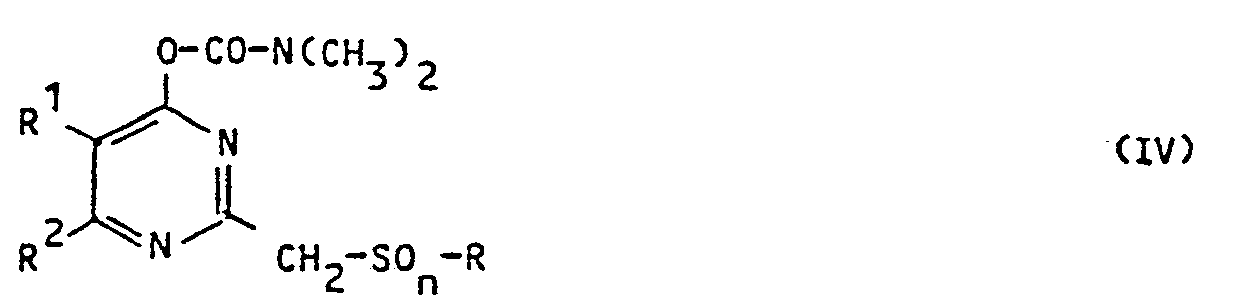
- Formula (IV) provides a general definition of the N, N-dimethyl-O-pyrimidin-4-yl-carbamic acid esters to be used as starting materials in process (d).
- R, R ', R 2 and n preferably have those meanings which are mentioned as preferred in the definition of these radicals or indices in formula (I).
- the compounds of the formula (IV) are known (compare DE-A-2 928 185 [Le A 19 743] and DE-A-2 838 359 [Le A 19 079] or can be carried out in a simple manner by the processes described there produce.
- Formula (V) provides a general definition of the alkyl halides to be used as starting materials in process (d).
- R 3 is preferably C 1 -C 5 -alkyl and shark is chlorine, bromine or iodine.
- Examples of the compounds of the formula (IV) are: methyl, ethyl, n-propyl, i-propyl, n-butyl, i-butyl, sec-butyl, tert-butyl, n-pentyl, 2-pentyl, 3-pentyl, 2-methyl-1-butyl, 2-methyl-2-butyl, 2-methyl-3-butyl, 2-methyl-4-butyl , 2,2-dimethyl-1-propyl chloride or bromide or iodide.
- the compounds of formula (V) are generally known compounds of organic chemistry.
- Processes (a) to (d) for the preparation of the new substituted N, N-dimethyl-O-pyrimidin-4-yl-carbamic acid esters are generally carried out using diluents.
- inert organic solvents can be used as diluents. These include in particular aliphatic and aromatic, optionally halogenated hydrocarbons, such as pentane, hexane, heptane, cyclohexane, petroleum ether, gasoline, ligroin, benzene, toluene, xylene, methylene chloride, ethylene chloride, chloroform, carbon tetrachloride, chlorobenzene and o-dichlorobenzene, ethers such as diethyl and dibutyl ether, glycol dimethyl ether and diglycoldimodimethane, and tetrahydrofuran Ketones such as acetone, methyl ethyl, methyl isopropyl and methyl isobutyl ketones, esters such as methyl acetate and ethyl acetate, nitriles such as acetonitrile and propionitrile, amide
- hydrogen peroxide is used as the oxidizing agent in process (c)
- preference is given to aliphatic carboxylic acids e.g. Formic acid, acetic acid or propionic acid, are suitable as diluents.
- Processes (a), (b) and (d) are generally carried out using acid acceptors. All customary acid binders can be used as acid acceptors.
- Alkali carbonates and alcoholates such as sodium and potassium carbonate, sodium and potassium methylate or ethylate and potassium tert-butoxide, and also aliphatic, aromatic or heterocyclic amines, for example triethylamine, trimethylamine, dimethylaniline, dimethyl- benzylamine, pyridine, diazabicyclooctane, diazabicyclononane and diazabicycloundecene.
- the processes according to the invention are generally carried out at temperatures between 0 and 150 ° C.
- the temperature range between 20 and 100 ° C. is preferred, for processes (b), (c) and (d) the range between 0 and 50 ° C.
- the reactions are generally carried out under normal pressure.
- 1 to 1 mol of hydroxypyrimidine of the formula (11) is between 1.0 and 1.3, preferably between 1.0 and 1.15 mol of N, N-dimethylcarbamic acid chloride or phosgene and dimethylamine used.
- the reaction is generally carried out in a diluent in the presence of an acid acceptor. After the reaction has ended, the mixture is filtered and the solvent is distilled off in vacuo.
- N, N-dimethyl-O-pyrimidin-4-yl-carbamic acid ester of the formula (IV) is between 1.0 and 1.3, preferably between 1.0 and 1.15 mol, of alkyl halide of formula (V) used.
- the reaction is generally carried out in a diluent in the presence of an acid acceptor.
- the new compounds are obtained in the form of oils, some of which cannot be distilled without decomposing, but by so-called 'distillation', i.e. can be freed from the last volatile constituents by prolonged heating under reduced pressure to moderately elevated temperatures and can be cleaned in this way.
- the refractive index is used to characterize them.
- the new compounds are obtained in solid form after the solvent has been distilled off, they are purified by recrystallization. The melting point is then used for characterization.
- the substituted N, N-dimethyl-O-pyrimidin-4-yl-carbamic acid esters according to the invention are notable for high insecticidal, in particular also systemic and root-systemic activity.
- the active compounds can be converted into the customary formulations, such as solutions, emulsions, suspensions, powders, foams, pastes, granules, aerosols, active substance-impregnated natural and synthetic substances, very fine encapsulations in polymeric substances and in coating compositions for seeds, and also in formulations with Fuel sets, such as smoking cartridges, cans, spirals, etc., as well as ULV cold and warm mist formulations.
- customary formulations such as solutions, emulsions, suspensions, powders, foams, pastes, granules, aerosols, active substance-impregnated natural and synthetic substances, very fine encapsulations in polymeric substances and in coating compositions for seeds, and also in formulations with Fuel sets, such as smoking cartridges, cans, spirals, etc., as well as ULV cold and warm mist formulations.
- formulations are made in a known manner, e.g. by mixing the active ingredients with extenders, that is to say liquid solvents, pressurized liquefied gases and / or solid carriers, if appropriate using surface-active agents, that is to say emulsifiers and / or dispersants and / or foam-generating agents. If water is used as an extender, e.g. organic solvents can also be used as auxiliary solvents.
- extenders that is to say liquid solvents, pressurized liquefied gases and / or solid carriers, if appropriate using surface-active agents, that is to say emulsifiers and / or dispersants and / or foam-generating agents.
- surface-active agents that is to say emulsifiers and / or dispersants and / or foam-generating agents.
- water e.g. organic solvents can also be used as auxiliary solvents.
- aromatics such as xylene, toluene, or alkylnaphthalenes
- chlorinated aromatics or chlorinated aliphatic hydrocarbons such as chlorobenzenes, chloroethylene or methylene chloride
- aliphatic hydrocarbons such as cyclohexane or paraffins, e.g.
- Petroleum fractions alcohols, such as butanol or glycol, and their ethers and esters, ketones, such as acetone, methyl ethyl ketone, methyl isobutyl ketone or cyclohexanone, strongly polar solvents, such as dimethylformamide and dimethyl sulfoxide, and water;
- liquefied gaseous extenders or carriers mean liquids which are gaseous at normal temperature and pressure, e.g. Aerosol propellants, such as halogenated hydrocarbons and butane, propane, nitrogen and carbon dioxide; as solid carriers come into question; e.g.
- natural rock powders such as kaolins, clays, talc, chalk, quartz, attapulgite, montmorillonite or diatomaceous earth and synthetic rock powders such as highly disperse silica, aluminum oxide and silicates; as solid carriers for granules are possible: e.g. broken and fractionated natural rocks such as calcite, marble, pumice, sepiolite, dolomite and synthetic granules from inorganic and organic flours as well as granules from organic material such as sawdust, coconut shells, corn cobs and tobacco stems; as emulsifying and / or foaming agents are possible: e.g.
- nonionic and anionic emulsifiers such as polyoxyethylene fatty acid esters, polyoxyethylene fatty alcohol ethers, e.g. Alkylaryl polyglycol ether, alkyl sulfonates, alkyl sulfates, aryl sulfonates and protein hydrolyzates; as dispersants come into question; e.g. Lignin sulfite liquor and methyl cellulose.
- adhesives such as carboxymethyl cellulose, natural and synthetic powdery, granular or latex-shaped polymers, such as gum arabic, polyvinyl alcohol and polyvinyl acetate, can be used.
- Dyes such as inorganic pigments, e.g. Iron oxide, titanium oxide, ferrocyan blue and organic dyes such as alizarin, azo and metal phthalocyanine dyes and trace nutrients such as salts of iron, manganese, boron, copper, cobalt, molybdenum and zinc can be used.
- the formulations generally contain between 0.1 and 95 percent by weight of active compound, preferably between 0.5 and 90%.
- the active compounds according to the invention can, in their commercially available formulations and in the use forms prepared from these formulations, as a mixture with other active compounds, such as insecticides, attractants, sterilants, acaricides, nematicides, fungicides, growth-regulating substances or herbicides.
- Insecticides include, for example, phosphoric acid esters, carbamates, carboxylic acid esters, chlorinated hydrocarbons, phenylureas, substances produced by microorganisms and others
- the active compounds according to the invention can furthermore be present in their commercially available formulations and in the use forms prepared from these formulations in a mixture with synergists.
- Synergists are compounds by which the action of the active ingredients is increased without the added synergist itself having to be active.
- the active substance content of the use forms prepared from the commercially available formulations can vary within wide ranges.
- the active substance concentration of the application forms can be from 0.0000001 to 100% by weight of active substance, preferably between 0.0001 and 1% by weight.
- the application takes place in a customary manner adapted to the application forms.
- the active ingredients When used against hygiene pests and pests of stored products, the active ingredients are distinguished by an excellent residual action on wood and clay and by a good stability to alkali on limed substrates.
- the active compounds according to the invention are also suitable for controlling ectoparasites and endoparasites in the field of animal husbandry and cattle breeding, better results, e.g. higher milk yields, higher weight, longer lifespan etc. can be achieved.
- the active compounds according to the invention are used in these fields in a known manner, such as by oral use in the form of, for example, tablets, capsules, drinkers, granules, by dermal use in the form of, for example, dipping (dipping), spraying (spraying), pouring (pouring). on and spot-on) and powdering as well as by parenteral application in the form of, for example, injection.
- the substituted hydroxypyrimidines of the formula (11) to be used as starting materials can be prepared, for example, as follows:
- N N-Dimethyl-O- (2-iso-propyl-6-methyl-pyrimidin-4-yl) -carbamic acid ester
- FR-PS 1 443 910 N, N-Dimethyl-O- (2-methylthio-6-methyl-pyrimidin-4-yl) carbamic acid ester
- Bean plants (Vicia faba), which are heavily infested with the black bean louse (Doralis fabae), are watered on with 20 ml of active compound preparation of the desired concentration, so that the active compound preparation penetrates into the soil without wetting the sprout.
- the active ingredient is absorbed by the roots and passed on to the shoot.
- the kill is determined in%. 100% means that all aphids have been killed; 0% means that no aphids have been killed.
- the active ingredient preparation is intimately mixed with soil.
- the treated soil is filled into pots and planted with cabbage (Brassica oleracea).
- the active ingredient can be taken up from the soil by the plant roots and transported to the leaves.
- the root systemic effect of the active ingredient is derived from the kill numbers. It is 100% when all test animals have been killed and 0% when as many test insects are still alive as in the untreated control.
Landscapes
- Chemical & Material Sciences (AREA)
- Organic Chemistry (AREA)
- Life Sciences & Earth Sciences (AREA)
- Dentistry (AREA)
- Pest Control & Pesticides (AREA)
- Plant Pathology (AREA)
- Health & Medical Sciences (AREA)
- Engineering & Computer Science (AREA)
- Agronomy & Crop Science (AREA)
- General Health & Medical Sciences (AREA)
- Wood Science & Technology (AREA)
- Zoology (AREA)
- Environmental Sciences (AREA)
- Agricultural Chemicals And Associated Chemicals (AREA)
- Plural Heterocyclic Compounds (AREA)
- Preparation Of Compounds By Using Micro-Organisms (AREA)
Claims (9)




ou leurs halogénhydrates, éventuellement en présence d'accepteurs d'acides et le cas échéant en présence de diluants.
Priority Applications (1)
| Application Number | Priority Date | Filing Date | Title |
|---|---|---|---|
| AT83102486T ATE20883T1 (de) | 1982-03-25 | 1983-03-14 | Substituierte n,n-dimethyl-o-pyrimidin-4-ylcarbamin-s|ureester, verfahren zu ihrer herstellung und ihre verwendung als schaedlingsbekaempfungsmittel. |
Applications Claiming Priority (2)
| Application Number | Priority Date | Filing Date | Title |
|---|---|---|---|
| DE3211035 | 1982-03-25 | ||
| DE19823211035 DE3211035A1 (de) | 1982-03-25 | 1982-03-25 | Substituierte n,n-dimethyl-o-pyrimidin-e-yl-carbaminsaeureester, verfahren zu ihrer herstellung und ihre verwendung als schaedlingsbekaempfungsmittel |
Publications (3)
| Publication Number | Publication Date |
|---|---|
| EP0090247A2 EP0090247A2 (fr) | 1983-10-05 |
| EP0090247A3 EP0090247A3 (en) | 1983-12-14 |
| EP0090247B1 true EP0090247B1 (fr) | 1986-07-23 |
Family
ID=6159307
Family Applications (1)
| Application Number | Title | Priority Date | Filing Date |
|---|---|---|---|
| EP83102486A Expired EP0090247B1 (fr) | 1982-03-25 | 1983-03-14 | Esters pyrimidin-4-yliques substitués de l'acide N,N-diméthyl carbamique, procédé pour leur préparation et leur usage parasiticide |
Country Status (9)
| Country | Link |
|---|---|
| US (1) | US4503057A (fr) |
| EP (1) | EP0090247B1 (fr) |
| JP (1) | JPS58172374A (fr) |
| AT (1) | ATE20883T1 (fr) |
| BR (1) | BR8301534A (fr) |
| DE (2) | DE3211035A1 (fr) |
| DK (1) | DK134283A (fr) |
| IL (1) | IL68191A (fr) |
| ZA (1) | ZA832068B (fr) |
Families Citing this family (2)
| Publication number | Priority date | Publication date | Assignee | Title |
|---|---|---|---|---|
| DE3436478A1 (de) * | 1984-10-05 | 1986-04-17 | Bayer Ag, 5090 Leverkusen | Verfahren zur herstellung von n,n-dimethyl-0-pyrimidinylcarbaminsaeureester |
| EP0218171A3 (fr) * | 1985-10-09 | 1988-01-13 | Bayer Ag | Procédé de préparation de 2-alkylsulfonyl-alkylène-pyrimidines |
Family Cites Families (4)
| Publication number | Priority date | Publication date | Assignee | Title |
|---|---|---|---|---|
| FR1060289A (fr) * | 1951-07-16 | 1954-03-31 | Geigy Ag J R | Dérivés hétérocycliques de l'acide carbamique et leur procédé de préparation |
| DE2752613A1 (de) * | 1977-11-25 | 1979-06-07 | Bayer Ag | N,n-dialkyl-0-pyrimidinyl-carbaminsaeureester, verfahren zu ihrer herstellung und ihre verwendung als insektizide |
| DE2838359A1 (de) * | 1978-09-02 | 1980-03-20 | Bayer Ag | N,n-dimethyl-0-pyrimidinyl-carbaminsaeureester, verfahren zu ihrer herstellung und ihre verwendung als schaedlingsbekaempfungsmittel |
| DE2928185A1 (de) * | 1979-07-12 | 1981-01-29 | Bayer Ag | N,n-dimethyl-o-pyrimidinyl-carbaminsaeureester, verfahren zu ihrer herstellung und ihre verwendung als schaedlingsbekaempfungsmittel |
-
1982
- 1982-03-25 DE DE19823211035 patent/DE3211035A1/de not_active Withdrawn
-
1983
- 1983-03-11 US US06/474,402 patent/US4503057A/en not_active Expired - Fee Related
- 1983-03-14 DE DE8383102486T patent/DE3364615D1/de not_active Expired
- 1983-03-14 AT AT83102486T patent/ATE20883T1/de active
- 1983-03-14 EP EP83102486A patent/EP0090247B1/fr not_active Expired
- 1983-03-22 IL IL68191A patent/IL68191A/xx unknown
- 1983-03-23 JP JP58047344A patent/JPS58172374A/ja active Pending
- 1983-03-24 BR BR8301534A patent/BR8301534A/pt unknown
- 1983-03-24 ZA ZA832068A patent/ZA832068B/xx unknown
- 1983-03-24 DK DK134283A patent/DK134283A/da not_active Application Discontinuation
Also Published As
| Publication number | Publication date |
|---|---|
| IL68191A0 (en) | 1983-06-15 |
| US4503057A (en) | 1985-03-05 |
| DE3364615D1 (en) | 1986-08-28 |
| BR8301534A (pt) | 1983-12-06 |
| JPS58172374A (ja) | 1983-10-11 |
| ATE20883T1 (de) | 1986-08-15 |
| DK134283A (da) | 1983-09-26 |
| EP0090247A3 (en) | 1983-12-14 |
| DK134283D0 (da) | 1983-03-24 |
| ZA832068B (en) | 1983-12-28 |
| EP0090247A2 (fr) | 1983-10-05 |
| DE3211035A1 (de) | 1983-09-29 |
| IL68191A (en) | 1986-04-29 |
Similar Documents
| Publication | Publication Date | Title |
|---|---|---|
| EP0247477B1 (fr) | Dérivés de la 1,2,3,6-tétrahydro-5-nitro-pyrimidine | |
| DD159693A5 (de) | Schaedlingsbekaempfungsmittel | |
| DE2839270A1 (de) | N,n-dimethyl-o-pyrazolyl-carbaminsaeureester, verfahren zu ihrer herstellung und ihre verwendung als schaedlingsbekaempfungsmittel | |
| DE2644588C2 (de) | N,N-Dimethyl-O-pyrazolyl-carbaminsäureester, Verfahren zu ihrer Herstellung und ihre Verwendung als Insektizide | |
| EP0008762B1 (fr) | Esters pyrimidinyliques d'acide N,N-diméthylcarbamique, procédé pour leur préparation et leur utilisation comme pesticides | |
| EP0022511B1 (fr) | Esters pyrimidiniques d'acide N,N-diméthyl carbamique, procédé pour leur préparation et leur utilisation comme parasiticides | |
| EP0002200B1 (fr) | Esters 0-pyrimidiniques de l'acide N,N-dialcoyl-carbamique, leur procédé de préparation et leur utilisation comme insecticides | |
| DE2912494A1 (de) | N,n-dimethyl-0-pyrazolyl-carbaminsaeureester, verfahren zu ihrer herstellung und ihre verwendung als schaedlingsbekaempfungsmittel | |
| DE2644589A1 (de) | Tert.-butylsubstituierte pyrazolylcarbaminsaeureester, verfahren zu ihrer herstellung und ihre verwendung als insektizide und nematizide | |
| EP0005240B1 (fr) | Esters N,N-diméthyl-O-pyrazolyl de l'acide carbamique, procédé pour leur préparation et utilisation comme insecticides | |
| EP0000198B1 (fr) | Esters d'acide N,N-dialcoyl-0-pyrimidinyl- carbamique procédé pour leur préparation et leur utilisation comme insecticides | |
| DE3739264A1 (de) | 2-chlor-1,3-thiazol-5-yl-methyl substituierte nitrogruppenhaltige imidazolidino-1,2,3,4-tetrahydropyrimidine bzw. hexahydropyrimidino-1,2,3,4-tetrahydropyrimidine | |
| EP0009103B1 (fr) | N-(O-éthyl-S-n-propyl-(di)thiophosphoryloxy)-naphtalimides, procédé pour leur préparation, compositions pesticides les contenant, leur préparation et leur utilisation | |
| EP0062821B1 (fr) | Esters de l'acide N-méthyl-O-pyrazol-(4)-yl carbamique, leur procédé de préparation et leur utilisation comme pesticide | |
| EP0683770A1 (fr) | Carboxamides de tetrahydropyridazine substitues | |
| EP0642303B1 (fr) | 2-arylpyrroles substitues | |
| DE3003019A1 (de) | N,n-dimethyl-o-(4,6-dihydro-2h-thieno (3,4-c) pyrazol-3-yl)-carbaminsaeure-ester sowie deren 5-oxide und 5,5-dioxide, verfahren zu deren herstellung und ihre verwendung in schaedlingsbekaempfungsmitteln | |
| EP0090247A2 (fr) | Esters pyrimidin-4-yliques substitués de l'acide N,N-diméthyl carbamique, procédé pour leur préparation et leur usage parasiticide | |
| EP0168704B1 (fr) | Esters pyrimidinyliques d'acide thionophosphorique | |
| EP0087561B1 (fr) | Esters de l'acide N,N-dimethyl-0-(1-carbamoyl-5-pyrazolyl)-carbamique, leur procédé de préparation et leur application comme biocides | |
| EP0302327A1 (fr) | 3,5-Dialkyl-1-arylpyrazoles | |
| DE3438919A1 (de) | Substituierte phenyl-carbaminsaeureester | |
| EP0092757A1 (fr) | Esters N-substitués d'acide O-pyrazol-yl-carbamique, leur procédé de préparation et leur application comme biocides | |
| EP0000895A1 (fr) | Aryl-N-alkylcarbamates, leur procédé de préparation et leur application comme insecticides | |
| EP0075144A1 (fr) | Esters d'acide carbamique de N,N-dimethyl-0-imidazol-4-yl-, procédé de leur préparation et leur application comme biocides |
Legal Events
| Date | Code | Title | Description |
|---|---|---|---|
| PUAI | Public reference made under article 153(3) epc to a published international application that has entered the european phase |
Free format text: ORIGINAL CODE: 0009012 |
|
| 17P | Request for examination filed |
Effective date: 19830314 |
|
| AK | Designated contracting states |
Designated state(s): AT BE CH DE FR GB IT LI NL |
|
| PUAL | Search report despatched |
Free format text: ORIGINAL CODE: 0009013 |
|
| AK | Designated contracting states |
Designated state(s): AT BE CH DE FR GB IT LI NL |
|
| GRAA | (expected) grant |
Free format text: ORIGINAL CODE: 0009210 |
|
| AK | Designated contracting states |
Kind code of ref document: B1 Designated state(s): AT BE CH DE FR GB IT LI NL |
|
| REF | Corresponds to: |
Ref document number: 20883 Country of ref document: AT Date of ref document: 19860815 Kind code of ref document: T |
|
| ET | Fr: translation filed | ||
| REF | Corresponds to: |
Ref document number: 3364615 Country of ref document: DE Date of ref document: 19860828 |
|
| ITF | It: translation for a ep patent filed | ||
| PGFP | Annual fee paid to national office [announced via postgrant information from national office to epo] |
Ref country code: AT Payment date: 19870313 Year of fee payment: 5 |
|
| PGFP | Annual fee paid to national office [announced via postgrant information from national office to epo] |
Ref country code: NL Payment date: 19870331 Year of fee payment: 5 |
|
| PLBE | No opposition filed within time limit |
Free format text: ORIGINAL CODE: 0009261 |
|
| STAA | Information on the status of an ep patent application or granted ep patent |
Free format text: STATUS: NO OPPOSITION FILED WITHIN TIME LIMIT |
|
| 26N | No opposition filed | ||
| PG25 | Lapsed in a contracting state [announced via postgrant information from national office to epo] |
Ref country code: GB Effective date: 19890314 Ref country code: AT Effective date: 19890314 |
|
| PG25 | Lapsed in a contracting state [announced via postgrant information from national office to epo] |
Ref country code: LI Effective date: 19890331 Ref country code: CH Effective date: 19890331 Ref country code: BE Effective date: 19890331 |
|
| BERE | Be: lapsed |
Owner name: BAYER A.G. Effective date: 19890331 |
|
| PG25 | Lapsed in a contracting state [announced via postgrant information from national office to epo] |
Ref country code: NL Effective date: 19891001 |
|
| GBPC | Gb: european patent ceased through non-payment of renewal fee | ||
| NLV4 | Nl: lapsed or anulled due to non-payment of the annual fee | ||
| PG25 | Lapsed in a contracting state [announced via postgrant information from national office to epo] |
Ref country code: FR Free format text: LAPSE BECAUSE OF NON-PAYMENT OF DUE FEES Effective date: 19891130 |
|
| REG | Reference to a national code |
Ref country code: CH Ref legal event code: PL |
|
| PG25 | Lapsed in a contracting state [announced via postgrant information from national office to epo] |
Ref country code: DE Effective date: 19891201 |
|
| REG | Reference to a national code |
Ref country code: FR Ref legal event code: ST |