EP0090437A1 - Procédé pour la production de distillates d'hydrocarbures - Google Patents
Procédé pour la production de distillates d'hydrocarbures Download PDFInfo
- Publication number
- EP0090437A1 EP0090437A1 EP83200246A EP83200246A EP0090437A1 EP 0090437 A1 EP0090437 A1 EP 0090437A1 EP 83200246 A EP83200246 A EP 83200246A EP 83200246 A EP83200246 A EP 83200246A EP 0090437 A1 EP0090437 A1 EP 0090437A1
- Authority
- EP
- European Patent Office
- Prior art keywords
- feed
- stream
- treatment
- asphaltenes
- product
- Prior art date
- Legal status (The legal status is an assumption and is not a legal conclusion. Google has not performed a legal analysis and makes no representation as to the accuracy of the status listed.)
- Granted
Links
- 229930195733 hydrocarbon Natural products 0.000 title claims abstract description 56
- 150000002430 hydrocarbons Chemical class 0.000 title claims abstract description 54
- 238000000034 method Methods 0.000 title claims abstract description 54
- 239000004215 Carbon black (E152) Substances 0.000 title claims abstract description 49
- 238000004519 manufacturing process Methods 0.000 title claims description 9
- 238000004227 thermal cracking Methods 0.000 claims abstract description 71
- 239000000203 mixture Substances 0.000 claims abstract description 42
- 230000003197 catalytic effect Effects 0.000 claims abstract description 16
- 239000002904 solvent Substances 0.000 claims abstract description 14
- 238000011282 treatment Methods 0.000 claims description 79
- 239000003921 oil Substances 0.000 claims description 34
- 238000004821 distillation Methods 0.000 claims description 22
- 238000005336 cracking Methods 0.000 claims description 20
- 239000010426 asphalt Substances 0.000 claims description 17
- PXHVJJICTQNCMI-UHFFFAOYSA-N Nickel Chemical compound [Ni] PXHVJJICTQNCMI-UHFFFAOYSA-N 0.000 claims description 15
- 239000003054 catalyst Substances 0.000 claims description 14
- 238000005292 vacuum distillation Methods 0.000 claims description 14
- 229910052751 metal Inorganic materials 0.000 claims description 12
- 239000002184 metal Substances 0.000 claims description 12
- 239000002480 mineral oil Substances 0.000 claims description 8
- 229910052759 nickel Inorganic materials 0.000 claims description 7
- IJDNQMDRQITEOD-UHFFFAOYSA-N n-butane Chemical compound CCCC IJDNQMDRQITEOD-UHFFFAOYSA-N 0.000 claims description 6
- ZOKXTWBITQBERF-UHFFFAOYSA-N Molybdenum Chemical compound [Mo] ZOKXTWBITQBERF-UHFFFAOYSA-N 0.000 claims description 5
- 229910052750 molybdenum Inorganic materials 0.000 claims description 5
- 239000011733 molybdenum Substances 0.000 claims description 5
- PNEYBMLMFCGWSK-UHFFFAOYSA-N aluminium oxide Inorganic materials [O-2].[O-2].[O-2].[Al+3].[Al+3] PNEYBMLMFCGWSK-UHFFFAOYSA-N 0.000 claims description 4
- 239000010941 cobalt Substances 0.000 claims description 4
- 229910017052 cobalt Inorganic materials 0.000 claims description 4
- GUTLYIVDDKVIGB-UHFFFAOYSA-N cobalt atom Chemical compound [Co] GUTLYIVDDKVIGB-UHFFFAOYSA-N 0.000 claims description 4
- 235000010446 mineral oil Nutrition 0.000 claims description 4
- 238000009835 boiling Methods 0.000 claims description 3
- WFKWXMTUELFFGS-UHFFFAOYSA-N tungsten Chemical compound [W] WFKWXMTUELFFGS-UHFFFAOYSA-N 0.000 claims description 2
- 229910052721 tungsten Inorganic materials 0.000 claims description 2
- 239000010937 tungsten Substances 0.000 claims description 2
- 239000000047 product Substances 0.000 description 53
- 238000010586 diagram Methods 0.000 description 12
- VYPSYNLAJGMNEJ-UHFFFAOYSA-N Silicium dioxide Chemical compound O=[Si]=O VYPSYNLAJGMNEJ-UHFFFAOYSA-N 0.000 description 9
- 239000007789 gas Substances 0.000 description 9
- 239000001257 hydrogen Substances 0.000 description 8
- 229910052739 hydrogen Inorganic materials 0.000 description 8
- 150000002431 hydrogen Chemical class 0.000 description 6
- 239000006227 byproduct Substances 0.000 description 5
- 150000002739 metals Chemical class 0.000 description 4
- 239000000377 silicon dioxide Substances 0.000 description 4
- 229910052720 vanadium Inorganic materials 0.000 description 4
- LEONUFNNVUYDNQ-UHFFFAOYSA-N vanadium atom Chemical compound [V] LEONUFNNVUYDNQ-UHFFFAOYSA-N 0.000 description 4
- NINIDFKCEFEMDL-UHFFFAOYSA-N Sulfur Chemical compound [S] NINIDFKCEFEMDL-UHFFFAOYSA-N 0.000 description 3
- 239000005864 Sulphur Substances 0.000 description 3
- 230000015572 biosynthetic process Effects 0.000 description 3
- 238000004523 catalytic cracking Methods 0.000 description 3
- UFHFLCQGNIYNRP-UHFFFAOYSA-N Hydrogen Chemical compound [H][H] UFHFLCQGNIYNRP-UHFFFAOYSA-N 0.000 description 2
- OFBQJSOFQDEBGM-UHFFFAOYSA-N Pentane Chemical compound CCCCC OFBQJSOFQDEBGM-UHFFFAOYSA-N 0.000 description 2
- ATUOYWHBWRKTHZ-UHFFFAOYSA-N Propane Chemical compound CCC ATUOYWHBWRKTHZ-UHFFFAOYSA-N 0.000 description 2
- 229910052799 carbon Inorganic materials 0.000 description 2
- 238000006243 chemical reaction Methods 0.000 description 2
- 239000000295 fuel oil Substances 0.000 description 2
- -1 C 4 hydrocarbons Chemical class 0.000 description 1
- OKTJSMMVPCPJKN-UHFFFAOYSA-N Carbon Chemical compound [C] OKTJSMMVPCPJKN-UHFFFAOYSA-N 0.000 description 1
- 150000001336 alkenes Chemical class 0.000 description 1
- 125000004432 carbon atom Chemical group C* 0.000 description 1
- 239000010771 distillate fuel oil Substances 0.000 description 1
- 230000000694 effects Effects 0.000 description 1
- ZZUFCTLCJUWOSV-UHFFFAOYSA-N furosemide Chemical compound C1=C(Cl)C(S(=O)(=O)N)=CC(C(O)=O)=C1NCC1=CC=CO1 ZZUFCTLCJUWOSV-UHFFFAOYSA-N 0.000 description 1
- 239000003502 gasoline Substances 0.000 description 1
- 238000011835 investigation Methods 0.000 description 1
- 239000003350 kerosene Substances 0.000 description 1
- JRZJOMJEPLMPRA-UHFFFAOYSA-N olefin Natural products CCCCCCCC=C JRZJOMJEPLMPRA-UHFFFAOYSA-N 0.000 description 1
- 238000002360 preparation method Methods 0.000 description 1
- 238000002203 pretreatment Methods 0.000 description 1
- 239000001294 propane Substances 0.000 description 1
- 239000007858 starting material Substances 0.000 description 1
- 239000011275 tar sand Substances 0.000 description 1
Images


Classifications
-
- C—CHEMISTRY; METALLURGY
- C10—PETROLEUM, GAS OR COKE INDUSTRIES; TECHNICAL GASES CONTAINING CARBON MONOXIDE; FUELS; LUBRICANTS; PEAT
- C10G—CRACKING HYDROCARBON OILS; PRODUCTION OF LIQUID HYDROCARBON MIXTURES, e.g. BY DESTRUCTIVE HYDROGENATION, OLIGOMERISATION, POLYMERISATION; RECOVERY OF HYDROCARBON OILS FROM OIL-SHALE, OIL-SAND, OR GASES; REFINING MIXTURES MAINLY CONSISTING OF HYDROCARBONS; REFORMING OF NAPHTHA; MINERAL WAXES
- C10G45/00—Refining of hydrocarbon oils using hydrogen or hydrogen-generating compounds
- C10G45/02—Refining of hydrocarbon oils using hydrogen or hydrogen-generating compounds to eliminate hetero atoms without changing the skeleton of the hydrocarbon involved and without cracking into lower boiling hydrocarbons; Hydrofinishing
- C10G45/04—Refining of hydrocarbon oils using hydrogen or hydrogen-generating compounds to eliminate hetero atoms without changing the skeleton of the hydrocarbon involved and without cracking into lower boiling hydrocarbons; Hydrofinishing characterised by the catalyst used
- C10G45/06—Refining of hydrocarbon oils using hydrogen or hydrogen-generating compounds to eliminate hetero atoms without changing the skeleton of the hydrocarbon involved and without cracking into lower boiling hydrocarbons; Hydrofinishing characterised by the catalyst used containing nickel or cobalt metal, or compounds thereof
- C10G45/08—Refining of hydrocarbon oils using hydrogen or hydrogen-generating compounds to eliminate hetero atoms without changing the skeleton of the hydrocarbon involved and without cracking into lower boiling hydrocarbons; Hydrofinishing characterised by the catalyst used containing nickel or cobalt metal, or compounds thereof in combination with chromium, molybdenum, or tungsten metals, or compounds thereof
-
- C—CHEMISTRY; METALLURGY
- C10—PETROLEUM, GAS OR COKE INDUSTRIES; TECHNICAL GASES CONTAINING CARBON MONOXIDE; FUELS; LUBRICANTS; PEAT
- C10G—CRACKING HYDROCARBON OILS; PRODUCTION OF LIQUID HYDROCARBON MIXTURES, e.g. BY DESTRUCTIVE HYDROGENATION, OLIGOMERISATION, POLYMERISATION; RECOVERY OF HYDROCARBON OILS FROM OIL-SHALE, OIL-SAND, OR GASES; REFINING MIXTURES MAINLY CONSISTING OF HYDROCARBONS; REFORMING OF NAPHTHA; MINERAL WAXES
- C10G2300/00—Aspects relating to hydrocarbon processing covered by groups C10G1/00 - C10G99/00
- C10G2300/10—Feedstock materials
- C10G2300/107—Atmospheric residues having a boiling point of at least about 538 °C
Definitions
- the invention relates to a process for the production of hydrocarbon oil distillates from asphaltenes-containing hydrocarbon mixtures.
- the atmospheric residue may be separated by vacuum distillation into a vacuum distillate and a vacuum residue, the vacuum distillate may be subjected to thermal cracking or to catalytic cracking in the presence or in the absence of hydrogen and the vacuum residue to thermal cracking.
- the vacuum residue may be separated by solvent deasphalting into a deasphalted oil and an asphaltic bitumen, the deasphalted oil may be subjected to thermal cracking or to catalytic cracking in the presence or in the absence of hydrogen, and the asphaltic bitumen to thermal cracking.
- Thermal cracking refers to a process wherein a heavy feedstock is converted into a product which contains less than 20 %w C4 hydrocarbons and from which one or more distillate fractions may be separated as the desired light product and a heavy fraction as a by-product.
- TC has proved in actual practice to be a suitable treatment for the production of hydrocarbon oil distillates from a variety of asphaltenes-containing hydrocarbon mixtures.
- DA solvent deasphalting
- HT catalytic hydrotreatment
- the deasphalted oil fraction which is separated from the product of the DA treatment is used as the feed or a feed component for the TC treatment.
- Each of the embodiments may be placed in one of the following three classes:
- the embodiments belonging to class III form the subject matter of the present patent application.
- the embodiments belonging to classes I and II form the subject matter of Netherlands Patent Applications 8105560 and 8105660.
- the embodiments to which the present patent application relates may further be subdivided depending on whether the heavy fraction separated from the product of the TC treatment is used as feed or a feed component for the HT (class IIIA), or as feed or a feed component for the DA treatment (class IIIB).
- the heavy fraction separated from the product of the HT is used as feed for the DA treatment.
- the asphaltic bitumen fraction is used as feed for the HT and the heavy fraction separated from the product of the HT is used as a feed component for the TC treatment and/or as a feed component for the DA treatment.
- the present patent application therefore relates to a process for the production of hydrocarbon oil distillates from asphaltenes-containing hydrocarbon mixtures, in which an asphaltenes-containing hydrocarbon mixture (stream 1) is subjected to a thermal cracking (TC)treatment in which one feed or two individual feeds are converted into a product which contains less than 20 %w C 4 hydrocarbons and from which one or more distillate fractions and a heavy fraction (stream 5) are separated, in which stream 5 is subjected to a combination of the following two treatments:
- TC thermal cracking
- the feed used is an asphaltenes-containing hydrocarbon mixture.
- a suitable parameter for the assessment of the asphaltenes content of a hydrocarbon mixture as well as of the reduction of the asphaltenes content which appears when an asphaltenes-containing hydrocarbon mixture is subjected to a HT, is the Ramsbottom Carbon Test value (RCT).
- RCT Ramsbottom Carbon Test value
- the process is applied to hydrocarbon mixtures which boil substantially above 350°C and more than 35%w of which boils above 520°C and which have an RCT of more than 7.5%w.
- hydrocarbon mixtures are residues obtained in the distillation of crude mineral oils and also heavy hydrocarbon mixtures obtained from shale and tar sand. If required, the process may also be applied to heavy crude mineral oils, residues obtained in the distillation of products formed in the thermal cracking of hydrocarbon mixtures and asphaltic bitumen obtained in the solvent deasphalting of asphaltenes-containing hydrocarbon mixtures.
- the process according to the invention can very suitably be applied to residues obtained in the vacuum distillation of atmospheric distillation residues from crude mineral oils. If an atmospheric distillation residue from a crude mineral oil is available as feed for the process according to the invention, it is preferred to separate a vacuum distillate therefrom by vacuum distillation and to subject the resulting vacuum residue to the TC treatment.
- the separated vacuum distillate may be subjected to thermal cracking or to catalytic cracking in the presence or in the absence of hydrogen to convert it into light hydrocarbon oil distillates.
- the separated vacuum distillate is very suitable for use as a feed component for the TC treatment, together with stream 3.
- the process according to the invention is a three-step process in which in the first step an asphaltenes-containing feed (stream 1) is subjected to a TC treatment for the production of a product which contains less than 20%w C4 hydrocarbons and from which one or more distillate fractions and a heavy fraction (stream 5) are separated. In the second and third steps of the process stream 5 is subjected to a combination of a DA treatment and a HT.
- the feed for the TC treatment consists of one or more streams with a relatively low asphaltenes content, such as stream 3 - optionally together with one or more vacuum distillates separated off during the process -, as well as one or more relatively asphaltenes-rich streams, such as stream 1 ., optionally together with stream 4 and/or a stream 2 obtained as a vacuum residue.
- the TC treatment used should pre- ferarably include two cracking units and the two types of feed should preferably be cracked separately into products from which one or more distillate fractions and a heavy fraction (stream 5) are separated.
- the distillate fractions separated from the products may be atmospheric distillates only, but it is preferred to separate a vacuum distillate from the products as well.
- the separated vacuum distillate may be converted into light hydrocarbon distillates in the ways described hereinbefore.
- a heavy fraction of the product from the cracking unit in which the feed with a relatively low asphaltenes content is processed is preferably recirculated to that cracking unit.
- a heavy fraction with a relatively low asphaltenes content may optionally be separated from the product obtained in the cracking unit in which the relatively asphaltenes-rich feed is cracked and this heavy fraction can be used as a feed component for the cracking unit in which the feed having a relatively low asphaltenes content is processed.
- the TC treatment used includes two cracking units, it is not necessary to carry out the distillation of the cracked products (atmospheric distillation and vacuum distillation, if required) in separate distillation units. If desired, the cracked products or fractions thereof may be combined and distilled together.
- the TC treatment of feeds both with a relatively low and a relatively high asphaltenes content is preferably carried out at a temperature of from 400-525°C and a space velocity of from 0.01-5 kg fresh feed per litre cracking reactor volume per minute.
- the second or third step used is a HT in which an asphaltenes-containing feed is converted into a product which has a reduced asphaltenes content and from which one or more distillate fractions and a heavy fraction (stream 2) are separated.
- Asphaltenes-containing hydrocarbon mixtures usually include a considerable percentage of metals particularly vanadium and nickel.
- a catalytic treatment for instance a HT for the reduction of the asphaltenes content, as is the case in the process according to the invention, these metals are deposited on the catalyst used in the HT and thus shorten its effective life.
- asphaltenes-containing hydrocarbon mixtures having a vanadium + nickel content of more than 50 parts per million by weight (ppmw) should preferably be subjected to a demetallization treatment before they are contacted with the catalyst used in the HT.
- This demetallization may very suitably be carried out by contacting the asphaltenes-containing hydrocarbon mixture, in the presence of hydrogen, with a catalyst consisting more than 80 %w of silica. Both catalysts consisting completely of silica and catalysts containing one or more metals having hydrogenating activity - in particular a combination of nickel and vanadium - emplaced on a carrier substantially consisting of silica, are suitable for the purpose.
- a catalysts consisting completely of silica and catalysts containing one or more metals having hydrogenating activity - in particular a combination of nickel and vanadium - emplaced on a carrier substantially consisting of silica are suitable for the purpose.
- an asphaltenes-containing feed is subjected to a catalytic demetallization treatment in the presence of hydrogen, this demetallization may be carried out in a separate reactor.
- the two processes may very suitably be carried out in the same reactor containing a bed of the demetallization catalyst and a bed of the catalyst used in the HT, successively.
- Suitable catalysts for carrying out the HT are those containing at least one metal chosen from the group formed by nickel and cobalt and in addition at least one metal chosen from the group formed by molybdenum and tungsten on a carrier, which carrier consists more than 40 %w of alumina.
- Catalysts very suitable for use in the HT are those comprising the metal combinations nickel/molybdenum or cobalt/molybdenum on alumina as the carrier.
- the HT is preferably carried out at a temperature of from 300-500°C and in particular of from 350-450°C, a pressure of from 50-300 bar and in particular of from 75-200 bar, a space velocity of from 0.02-10 g.g -1 .h -1 and in particular of from 0 .1-2 g.g -1 .h -1 and a H 2 /feed ratio of from 100-5000 Nl.k g and in particular of from 500-2000 Nl.kg -1 .
- the conditions used in a catalytic demetallization treatment in the presence of hydrogen, to be carried out if required, are subject to the sane preference as those for the HT for the reduction of the asphaltenes content stated hereinbefore.
- the HT is preferably carried out in such a way that it yields a product the C 5 + fraction of which meets the following requirements:
- the HT yields a product having a reduced asphaltenes content from which one or more distillate fractions and a heavy fraction (stream 2) are separated.
- the distillate fractions separated from the product may be atmospheric distillates only, but it is preferred to separate a vacuum distillate from the product as well. This vacuum distillate may be converted into light hydrocarbon oil distillates in the ways stated hereinbefore.
- the second or third step used is a DA treatment in which an asphaltenes-containing feed is converted into a product from which a deasphalted oil fraction (stream 3) and an asphaltic bitumen fraction (stream 4) are separated.
- Suitable solvents for carrying out the DA treatment are paraffinic hydrocarbons having of from 3-6 carbon atoms per molecule, such as n-butane and mixtures thereof, such as mixtures of propane and n-butane and mixtures of n-butane and n-pentane. Suitable solvent/oil weight ratios lie between 7:1 and 1:1 and in particular between 4:1 and 1:1.
- the DA treatment is preferably carried out at a pressure in the range of from 20 to 100 bar.
- the deasphalting is preferably carried out at a pressure of from 35-45 bar and a temperature of from 100-150°C.
- the embodiments to which the present patent application relates and which fall within class III may be subdivided depending on whether stream 5 is used as the feed or a feed component for the HT (class IIIA), or as the feed or a feed component for the DA treatment (class IIIB).
- stream 5 is used as the feed or a feed component for the HT (class IIIA), or as the feed or a feed component for the DA treatment (class IIIB).
- stream 2 is used as the feed for the DA treatment.
- stream 4 is used as feed for the HT and stream 2 is used as a feed component for the TC treatment and/or as a feed component for the DA treatment.
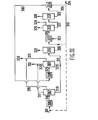
- FIG. 1 The various embodiments falling within class IIIA are illustrated schematically in Figure I.
- the various streams, fractions and reaction zones are indicated by three digit numbers, the first of which refers to the Figure concerned.
- the vacuum residue (302) for instance, refers to vacuum residue 2 in the context of Figure III.
- the process is carried out in an arrangement comprising a TC zone (106), a HT zone (107) and a DA zone (108), successively.
- An asphaltenes-containing hydrocarbon mixture (101) is subjected to a TC treatment and the cracked product is separated into one or more distillate fractions (109) and a residual fraction (105).
- Stream 105 is subjected to a HT and the hydrotreated product is separated into one or more distillate fractions (110) and a residual fraction (102).
- Stream 102 is subjected to a DA treatment and the product is separated into a deasphalted oil (103) and an asphaltic bitumen (104).
- Stream 103 is used as a feed component for the TC treatment.
- Figure I includes the following three embodiments:
- FIG. II The various embodiments falling within class IIIB are represented schematically in Figure II. According to this Figure the process is carried out in an apparatus comprising a TC zone (206), a DA zone (207) and a HT zone (208), successively.
- An asphaltenes-containing hydrocarbon mixture (201) is subjected to a TC treatment and the cracked product is separated into one or more distillate fractions (209) and a residual fraction (205).
- Stream 205 is subjected to a DA treatment and the product is separated into a deasphalted oil (203) and an asphaltic bitumen (204).
- Stream 204 is subjected to a HT and the hydro-treated product is separated into one or more distillate fractions (210) and a residual fraction (202).
- Stream 203 is used as a feed component for the TC treatment.
- Stream 202 is used either as a feed component for the TC treatment (embodiment IIIB1), or as a feed component for the DA treatment (embodiment IIIB2), or as a feed component both for the TC treatment and for the DA treatment (embodiment IIIB3).
- bleed stream should preferably be separated from one of the heavy streams of the process. In this way the build-up of undesirable heavy components during the process can be obviated.
- the process is carried out in an apparatus comprising, successively, a TC zone composed of a thermal cracking unit (306), an atmospheric distillation unit (307), a second thermal cracking unit (308), a second atmospheric distillation unit (309) and a vacuum distillation unit (310), a HT zone composed of a unit for catalytic hydrotreatment (311), a third atmospheric distillation unit (312) and a second vacuum distillation unit (313) and a DA zone (314).
- An asphaltenes-containing hydrocarbon mixture (301) is mixed with a stream of asphaltic bitumen (315) and the mixture is subjected to thermal cracking.
- the thermally cracked product (316) is separated by atmospheric distillation into a gas fraction (317), an atmospheric distillate (318) and an atmospheric residue (319).
- the atmospheric residue (319) is mixed with an atmospheric residue (320) and the mixture (321) is separated by vacuum distillation into a vacuum distillate (322) and a vacuum residue (305).
- the vacuum residue (305) is subjected together with hydrogen (323) to a catalytic hydrotreatment.
- the hydrotreated product (324) is separated by atmospheric distillation into a gas fraction (325), an atmospheric distillate (326) and an atmospheric residue (327).
- the atmospheric residue (327) is separated by vacuum distillation into a vacuum distillate (328) and a vacuum residue (302).
- the vacuum residue (302) is separated by solvent deasphalting into a deasphalted oil (303) and an asphaltic bitumen (304).
- the deasphalted oil (303) is subjected to thermal cracking.
- the thermally cracked product (329) is separated by atmospheric distillation into a gas fraction (330), an atmospheric distillate (331) and an atmospheric residue (320). Gas fractions (317) and (330) are combined to form mixture (332). Atmospheric distillates (318) and (331) are combined to form mixture (333). Asphaltic bitumen (304) is divided into two portions (315) and (334).
- the process is carried out in an apparatus comprising, successively, a TC zone composed of a thermal cracking unit (406), an atmospheric distillation unit (407), a second thermal cracking unit (408), a second atmospheric distillation unit (409) and a vacuum distillation unit (410), a DA zone (411) and a HT zone composed of a unit for catalytic hydrotreatment (412), a third atmospheric distillation unit (413) and a second vacuum distillation unit (414).
- An asphaltenes-containing hydrocarbon mixture (401) is subjected to thermal cracking and the thermally cracked product (415) is separated by atomospheric distillation into a gas fraction (416), an atmospheric distillate (417) and an atmospheric residue (418).
- Atmospheric residue (418) is mixed with an atmospheric residue (419) and the mixture (420) is separated by vacuum distillation into a vacuum distillate (421) and a vacuum residue (405).
- Vacuum residue (405) is mixed with a vacuum residue (402) and the mixture (422) is separated by solvent deasphalting into a deasphalted oil (403) and an asphaltic bitumen (404).
- Asphaltic bitumen (404) is divided into two portions (423) and (424).
- Portion (424) is subjected together with hydrogen (425) to a catalytic hydrotreatment.
- the hydrotreated product (426) is separated by atmospheric distillation into a gas fraction (427), an atmospheric distillate (428) and an atmospheric residue (429).
- the atmospheric residue (429) is separated by vacuum distillation into a vacuum distillate (430) and a vacuum residue (402).
- the deasphalted oil (403) is subjected to thermal cracking.
- the thermally cracked product (431) is separated by atmospheric distillation into a gas fraction (432), an atmospheric distillate (433) and atmospheric residue (419).
- Gas fractions (416) and (432) are combined to form mixture (434).
- Atmospheric distillates (417) and (433) are combined to form mixture (435).
- the present patent application also includes apparatuses for carrying out the process according to the invention substantially corresponding with those schematically represented in Figures I-IV.
- the starting mixtures used in the process according to the invention were two asphaltenes-containing hydrocarbon mixtures obtained as residues in the vacuum distillation of atmospheric distillation residues from crude mineral oils. Both vacuum residues boiled substantially above 520°C; they had RCT's of 20.2 and 10.1 %w, respectively.
- the process was carried out according to flow diagrams A-C. The following conditions were used in the various zones.
- the unit for catalytic hydrotreatment comprised two reactors, the first of which was filled with a Ni/V/Si0 2 catalyst containing 0.5 parts by weight (pbw) of nickel and 2.0 pbw of vanadium per 100 pbw of silica, and the second of which was filled with a Co/Mo/A1203 catalyst containing 4 pbw of cobalt and 12 pbw of molybdenum per 100 pbw of alumina; the catalysts were used in a 1:4 volume ratio.
- the HT was carried out at a hydrogen-pressure of 150 bar, a space velocity (measured for both reactors) of 0.5 kg feed per litre catalyst per hour, a H 2/ - feed ratio of 1000 N1 per kg and an average temperature of 410°C in the first reactor and 385°C in the second reactor.
- the DA treatment was carried out using n-butane as solvent, at a temperature of 115°C, a pressure of 40 bar and a solvent/oil weight ratio of 3:1.
- the TC treatment was carried out in two cracking coils at a pressure of 20 bar, a space velocity of 0.4 kg fresh feed per litre cracking coil volume per minute and a temperature of 480°C in the first cracking coil and 495°C in the second cracking coil (temperatures measured at the outlets of the cracking coils).
Landscapes
- Chemical & Material Sciences (AREA)
- Oil, Petroleum & Natural Gas (AREA)
- Engineering & Computer Science (AREA)
- Chemical Kinetics & Catalysis (AREA)
- General Chemical & Material Sciences (AREA)
- Organic Chemistry (AREA)
- Production Of Liquid Hydrocarbon Mixture For Refining Petroleum (AREA)
Applications Claiming Priority (2)
| Application Number | Priority Date | Filing Date | Title |
|---|---|---|---|
| NL8201119A NL8201119A (nl) | 1982-03-18 | 1982-03-18 | Werkwijze voor de bereiding van koolwaterstofoliedestillaten. |
| NL8201119 | 1982-03-18 |
Publications (2)
| Publication Number | Publication Date |
|---|---|
| EP0090437A1 true EP0090437A1 (fr) | 1983-10-05 |
| EP0090437B1 EP0090437B1 (fr) | 1985-12-04 |
Family
ID=19839433
Family Applications (1)
| Application Number | Title | Priority Date | Filing Date |
|---|---|---|---|
| EP83200246A Expired EP0090437B1 (fr) | 1982-03-18 | 1983-02-17 | Procédé pour la production de distillates d'hydrocarbures |
Country Status (11)
| Country | Link |
|---|---|
| US (1) | US4400264A (fr) |
| EP (1) | EP0090437B1 (fr) |
| JP (1) | JPS58201889A (fr) |
| AU (1) | AU555121B2 (fr) |
| CA (1) | CA1195638A (fr) |
| DE (1) | DE3361368D1 (fr) |
| ES (1) | ES8401515A1 (fr) |
| MX (1) | MX162350A (fr) |
| NL (1) | NL8201119A (fr) |
| SU (1) | SU1424740A3 (fr) |
| ZA (1) | ZA831834B (fr) |
Families Citing this family (23)
| Publication number | Priority date | Publication date | Assignee | Title |
|---|---|---|---|---|
| NL8105660A (nl) * | 1981-12-16 | 1983-07-18 | Shell Int Research | Werkwijze voor de bereiding van koolwaterstofoliedestillaten. |
| NL8201243A (nl) * | 1982-03-25 | 1983-10-17 | Shell Int Research | Werkwijze voor de bereiding van asfaltanenarme koolwaterstofmengsel. |
| US4462895A (en) * | 1983-02-25 | 1984-07-31 | Exxon Research & Engineering Co. | Combination visbreaking and hydrorefining with recycle of hydrorefined bottoms |
| US4469587A (en) * | 1983-09-02 | 1984-09-04 | Intevep, S.A. | Process for the conversion of asphaltenes and resins in the presence of steam, ammonia and hydrogen |
| JPS6072989A (ja) * | 1983-09-30 | 1985-04-25 | Res Assoc Residual Oil Process<Rarop> | 重質油の熱分解方法 |
| US4579646A (en) * | 1984-07-13 | 1986-04-01 | Atlantic Richfield Co. | Bottoms visbreaking hydroconversion process |
| CA1222471A (fr) * | 1985-06-28 | 1987-06-02 | H. John Woods | Methode pour ameliorer le rendement des produits distillables dans le craquage a diluant donneur d'hydrogene |
| US4695367A (en) * | 1986-03-24 | 1987-09-22 | The M. W. Kellogg Company | Diesel fuel production |
| US4721557A (en) * | 1986-10-08 | 1988-01-26 | Uop Inc. | Combination process for the conversion of a residual asphaltene-containing hydrocarbonaceous stream to maximize middle distillate production |
| US5601697A (en) * | 1994-08-04 | 1997-02-11 | Ashland Inc. | Demetallation-High carbon conversion process, apparatus and asphalt products |
| ZA989153B (en) * | 1997-10-15 | 1999-05-10 | Equistar Chem Lp | Method of producing olefins and feedstocks for use in olefin production from petroleum residua which have low pentane insolubles and high hydrogen content |
| US6274003B1 (en) | 1998-09-03 | 2001-08-14 | Ormat Industries Ltd. | Apparatus for upgrading hydrocarbon feeds containing sulfur, metals, and asphaltenes |
| CA2281058C (fr) * | 1998-09-03 | 2008-08-05 | Ormat Industries Ltd. | Procede et appareil permettant la valorisation de matiere premiere d'hydrocarbures contenant du soufre, des metaux et des asphaltenes |
| JP5057315B2 (ja) * | 1998-10-30 | 2012-10-24 | 日揮株式会社 | ガスタービン燃料油の製造方法 |
| JP4657467B2 (ja) * | 2001-02-20 | 2011-03-23 | 日揮株式会社 | 重質油の精製方法および重質油の精製装置 |
| JP2002302680A (ja) * | 2001-04-05 | 2002-10-18 | Jgc Corp | 重質油の精製方法 |
| US7407571B2 (en) * | 2001-12-26 | 2008-08-05 | Ormat Industries Ltd. | Method of and apparatus for upgrading and gasifying heavy hydrocarbon feeds |
| PL205246B1 (pl) * | 2002-12-20 | 2010-03-31 | Eni Spa | Sposób konwersji ciężkich surowców węglowodorowych lub węglowych |
| ES2679629T3 (es) * | 2002-12-30 | 2018-08-29 | Eni S.P.A. | Procedimiento para la conversión de cargas pesadas tales como petróleos crudos pesados y residuos de destilación |
| JP2006070230A (ja) * | 2004-09-06 | 2006-03-16 | Nippon Oil Corp | 重質油の脱硫方法 |
| FR2943069A1 (fr) * | 2009-03-13 | 2010-09-17 | Total Raffinage Marketing | Procede de valorisation de bruts lourds et de residus petroliers |
| CA2963436C (fr) | 2017-04-06 | 2022-09-20 | Iftikhar Huq | Valorisation partielle du bitume |
| KR20230133910A (ko) | 2021-03-01 | 2023-09-19 | 사우디 아라비안 오일 컴퍼니 | 원유 직접 촉매적 업그레이드를 위한 탈아스팔트 컬럼과 통합된 공정 |
Citations (5)
| Publication number | Priority date | Publication date | Assignee | Title |
|---|---|---|---|---|
| GB1440363A (en) * | 1972-08-01 | 1976-06-23 | Uop Inc | Combination process for the conversion of hydrocarbonaceous black oil |
| GB2024851A (en) * | 1978-07-07 | 1980-01-16 | Shell Int Research | Preparation of gas oil from heavy oils |
| GB2024850A (en) * | 1978-07-07 | 1980-01-16 | Shell Int Research | Preparation of gas oil from heavy oils |
| GB2031011A (en) * | 1978-10-05 | 1980-04-16 | Chiyoda Chem Eng Construct Co | Processing heavy hydrocarbon oils |
| GB2093477A (en) * | 1981-01-25 | 1982-09-02 | Chiyoda Chem Eng Construct Co | Process for the conversion of heavy hydrocarbon oils into light hydrocarbon oils |
Family Cites Families (10)
| Publication number | Priority date | Publication date | Assignee | Title |
|---|---|---|---|---|
| US3281350A (en) * | 1963-05-06 | 1966-10-25 | Exxon Research Engineering Co | Hf deasphalting for hydrocracking feed preparation |
| US3781197A (en) * | 1972-01-10 | 1973-12-25 | Gulf Research Development Co | Process for cracking hydrocarbons containing hydrodesulfurized residual oil |
| US3775293A (en) * | 1972-08-09 | 1973-11-27 | Universal Oil Prod Co | Desulfurization of asphaltene-containing hydrocarbonaceous black oils |
| US3806444A (en) * | 1972-12-29 | 1974-04-23 | Texaco Inc | Desulfurization of petroleum crude |
| JPS5153505A (en) * | 1974-11-07 | 1976-05-12 | Showa Oil | Tankasuisono henkanhoho |
| JPS5187506A (ja) * | 1975-01-31 | 1976-07-31 | Showa Oil | Sekyukeijushitsuyunoshorihoho |
| NL7507484A (nl) * | 1975-06-23 | 1976-12-27 | Shell Int Research | Werkwijze voor het omzetten van koolwaterstoffen. |
| NL7510465A (nl) * | 1975-09-05 | 1977-03-08 | Shell Int Research | Werkwijze voor het omzetten van koolwaterstoffen. |
| NL7610511A (nl) * | 1976-09-22 | 1978-03-28 | Shell Int Research | Werkwijze voor het omzetten van koolwater- stoffen. |
| NL7610510A (nl) * | 1976-09-22 | 1978-03-28 | Shell Int Research | Werkwijze voor het omzetten van koolwater- stoffen. |
-
1982
- 1982-03-18 NL NL8201119A patent/NL8201119A/nl not_active Application Discontinuation
- 1982-09-30 US US06/429,778 patent/US4400264A/en not_active Expired - Fee Related
-
1983
- 1983-02-17 DE DE8383200246T patent/DE3361368D1/de not_active Expired
- 1983-02-17 EP EP83200246A patent/EP0090437B1/fr not_active Expired
- 1983-02-23 CA CA000422173A patent/CA1195638A/fr not_active Expired
- 1983-03-16 MX MX196597A patent/MX162350A/es unknown
- 1983-03-16 JP JP58042518A patent/JPS58201889A/ja active Pending
- 1983-03-16 ES ES520644A patent/ES8401515A1/es not_active Expired
- 1983-03-16 AU AU12505/83A patent/AU555121B2/en not_active Ceased
- 1983-03-16 ZA ZA831834A patent/ZA831834B/xx unknown
- 1983-03-16 SU SU833568910A patent/SU1424740A3/ru active
Patent Citations (5)
| Publication number | Priority date | Publication date | Assignee | Title |
|---|---|---|---|---|
| GB1440363A (en) * | 1972-08-01 | 1976-06-23 | Uop Inc | Combination process for the conversion of hydrocarbonaceous black oil |
| GB2024851A (en) * | 1978-07-07 | 1980-01-16 | Shell Int Research | Preparation of gas oil from heavy oils |
| GB2024850A (en) * | 1978-07-07 | 1980-01-16 | Shell Int Research | Preparation of gas oil from heavy oils |
| GB2031011A (en) * | 1978-10-05 | 1980-04-16 | Chiyoda Chem Eng Construct Co | Processing heavy hydrocarbon oils |
| GB2093477A (en) * | 1981-01-25 | 1982-09-02 | Chiyoda Chem Eng Construct Co | Process for the conversion of heavy hydrocarbon oils into light hydrocarbon oils |
Also Published As
| Publication number | Publication date |
|---|---|
| US4400264A (en) | 1983-08-23 |
| SU1424740A3 (ru) | 1988-09-15 |
| ES520644A0 (es) | 1983-12-16 |
| NL8201119A (nl) | 1983-10-17 |
| AU555121B2 (en) | 1986-09-11 |
| CA1195638A (fr) | 1985-10-22 |
| ES8401515A1 (es) | 1983-12-16 |
| JPS58201889A (ja) | 1983-11-24 |
| AU1250583A (en) | 1983-09-22 |
| DE3361368D1 (en) | 1986-01-16 |
| ZA831834B (en) | 1983-11-30 |
| MX162350A (es) | 1991-04-26 |
| EP0090437B1 (fr) | 1985-12-04 |
Similar Documents
| Publication | Publication Date | Title |
|---|---|---|
| EP0090437B1 (fr) | Procédé pour la production de distillates d'hydrocarbures | |
| US4006076A (en) | Process for the production of low-sulfur-content hydrocarbon mixtures | |
| US4405441A (en) | Process for the preparation of hydrocarbon oil distillates | |
| US4065379A (en) | Process for the production of normally gaseous olefins | |
| US4062758A (en) | Process for the conversion of hydrocarbons in atmospheric crude residue | |
| US5358627A (en) | Hydroprocessing for producing lubricating oil base stocks | |
| EP0082555B1 (fr) | Procédé pour la production de distillats d'hydrocarbures | |
| US4126538A (en) | Process for the conversion of hydrocarbons | |
| EP3683289B1 (fr) | Procédé de reformage d'huile de faible qualité | |
| US4443325A (en) | Conversion of residua to premium products via thermal treatment and coking | |
| CA1309051C (fr) | Procede de preparation de distillats d'hydrocarbures legars par hydrocraquage et craquage catalytique | |
| EP0068543B1 (fr) | Procédé pour la préparation d'un mélange d'hydrocarbures | |
| EP0099141B1 (fr) | Procédé pour la production de mélanges d'hydrocarbures à faible teneur en asphaltène | |
| EP0082551B1 (fr) | Procédé pour la production de distillats d'hydrocarbures | |
| CN116987527B (zh) | 高粘度指数的润滑油异构原料及其制备方法 | |
| EP0090441B1 (fr) | Procédé pour la production d'huiles désasphaltés et de destillats d'huiles d'hydrocarbures | |
| RU2670449C1 (ru) | Способ получения высокоплотного реактивного топлива (варианты) | |
| US4396493A (en) | Process for reducing ramsbottom test of short residues | |
| EP0089707B1 (fr) | Procédé pour la production d'huiles désasphaltés et de distillats d'huiles d'hydrocarbures | |
| US4396494A (en) | Process for reducing ramsbottom carbon test of asphalt | |
| CN114426881B (zh) | 一种渣油加氢的方法 | |
| EP0125709B1 (fr) | Procédé de production de mélanges hydrocarburés à faible teneur en asphaltènes | |
| JP2023501180A (ja) | 脱油アスファルトを水素化処理するための方法およびシステム | |
| US4397734A (en) | Process for reducing ramsbottom carbon test of short residues | |
| US4397733A (en) | Process for reducing the Ramsbottom carbon test of asphalt |
Legal Events
| Date | Code | Title | Description |
|---|---|---|---|
| PUAI | Public reference made under article 153(3) epc to a published international application that has entered the european phase |
Free format text: ORIGINAL CODE: 0009012 |
|
| 17P | Request for examination filed |
Effective date: 19830217 |
|
| AK | Designated contracting states |
Designated state(s): BE DE FR GB IT SE |
|
| GRAA | (expected) grant |
Free format text: ORIGINAL CODE: 0009210 |
|
| AK | Designated contracting states |
Designated state(s): BE DE FR GB IT SE |
|
| ITF | It: translation for a ep patent filed | ||
| REF | Corresponds to: |
Ref document number: 3361368 Country of ref document: DE Date of ref document: 19860116 |
|
| ET | Fr: translation filed | ||
| PLBE | No opposition filed within time limit |
Free format text: ORIGINAL CODE: 0009261 |
|
| STAA | Information on the status of an ep patent application or granted ep patent |
Free format text: STATUS: NO OPPOSITION FILED WITHIN TIME LIMIT |
|
| 26N | No opposition filed | ||
| REG | Reference to a national code |
Ref country code: FR Ref legal event code: ST |
|
| REG | Reference to a national code |
Ref country code: FR Ref legal event code: RC |
|
| REG | Reference to a national code |
Ref country code: FR Ref legal event code: DA |
|
| ITTA | It: last paid annual fee | ||
| EAL | Se: european patent in force in sweden |
Ref document number: 83200246.3 |
|
| PGFP | Annual fee paid to national office [announced via postgrant information from national office to epo] |
Ref country code: FR Payment date: 19951222 Year of fee payment: 14 |
|
| PGFP | Annual fee paid to national office [announced via postgrant information from national office to epo] |
Ref country code: SE Payment date: 19960108 Year of fee payment: 14 |
|
| PGFP | Annual fee paid to national office [announced via postgrant information from national office to epo] |
Ref country code: GB Payment date: 19960115 Year of fee payment: 14 |
|
| PGFP | Annual fee paid to national office [announced via postgrant information from national office to epo] |
Ref country code: BE Payment date: 19960207 Year of fee payment: 14 |
|
| PGFP | Annual fee paid to national office [announced via postgrant information from national office to epo] |
Ref country code: DE Payment date: 19960307 Year of fee payment: 14 |
|
| PG25 | Lapsed in a contracting state [announced via postgrant information from national office to epo] |
Ref country code: GB Effective date: 19970217 |
|
| PG25 | Lapsed in a contracting state [announced via postgrant information from national office to epo] |
Ref country code: SE Effective date: 19970218 |
|
| PG25 | Lapsed in a contracting state [announced via postgrant information from national office to epo] |
Ref country code: BE Effective date: 19970228 |
|
| BERE | Be: lapsed |
Owner name: SHELL INTERNATIONALE RESEARCH MAATSCHAPPIJ B.V. Effective date: 19970228 |
|
| GBPC | Gb: european patent ceased through non-payment of renewal fee |
Effective date: 19970217 |
|
| PG25 | Lapsed in a contracting state [announced via postgrant information from national office to epo] |
Ref country code: FR Effective date: 19971030 |
|
| PG25 | Lapsed in a contracting state [announced via postgrant information from national office to epo] |
Ref country code: DE Effective date: 19971101 |
|
| EUG | Se: european patent has lapsed |
Ref document number: 83200246.3 |
|
| REG | Reference to a national code |
Ref country code: FR Ref legal event code: ST |