EP0090936A2 - Substituted azolylethyl-oximinoalkyl ethers, process for their preparation and their use as fungicides - Google Patents
Substituted azolylethyl-oximinoalkyl ethers, process for their preparation and their use as fungicides Download PDFInfo
- Publication number
- EP0090936A2 EP0090936A2 EP83101621A EP83101621A EP0090936A2 EP 0090936 A2 EP0090936 A2 EP 0090936A2 EP 83101621 A EP83101621 A EP 83101621A EP 83101621 A EP83101621 A EP 83101621A EP 0090936 A2 EP0090936 A2 EP 0090936A2
- Authority
- EP
- European Patent Office
- Prior art keywords
- phenyl
- optionally substituted
- represents hydrogen
- alkyl
- formula
- Prior art date
- Legal status (The legal status is an assumption and is not a legal conclusion. Google has not performed a legal analysis and makes no representation as to the accuracy of the status listed.)
- Granted
Links
- 0 CC(C(CCC(C1)ClC)C1ClC)O*(C1)[C@@]1N Chemical compound CC(C(CCC(C1)ClC)C1ClC)O*(C1)[C@@]1N 0.000 description 1
Classifications
-
- C—CHEMISTRY; METALLURGY
- C07—ORGANIC CHEMISTRY
- C07D—HETEROCYCLIC COMPOUNDS
- C07D231/00—Heterocyclic compounds containing 1,2-diazole or hydrogenated 1,2-diazole rings
- C07D231/02—Heterocyclic compounds containing 1,2-diazole or hydrogenated 1,2-diazole rings not condensed with other rings
- C07D231/10—Heterocyclic compounds containing 1,2-diazole or hydrogenated 1,2-diazole rings not condensed with other rings having two or three double bonds between ring members or between ring members and non-ring members
- C07D231/12—Heterocyclic compounds containing 1,2-diazole or hydrogenated 1,2-diazole rings not condensed with other rings having two or three double bonds between ring members or between ring members and non-ring members with only hydrogen atoms, hydrocarbon or substituted hydrocarbon radicals, directly attached to ring carbon atoms
-
- A—HUMAN NECESSITIES
- A01—AGRICULTURE; FORESTRY; ANIMAL HUSBANDRY; HUNTING; TRAPPING; FISHING
- A01N—PRESERVATION OF BODIES OF HUMANS OR ANIMALS OR PLANTS OR PARTS THEREOF; BIOCIDES, e.g. AS DISINFECTANTS, AS PESTICIDES OR AS HERBICIDES; PEST REPELLANTS OR ATTRACTANTS; PLANT GROWTH REGULATORS
- A01N43/00—Biocides, pest repellants or attractants, or plant growth regulators containing heterocyclic compounds
- A01N43/48—Biocides, pest repellants or attractants, or plant growth regulators containing heterocyclic compounds having rings with two nitrogen atoms as the only ring hetero atoms
- A01N43/50—1,3-Diazoles; Hydrogenated 1,3-diazoles
-
- A—HUMAN NECESSITIES
- A01—AGRICULTURE; FORESTRY; ANIMAL HUSBANDRY; HUNTING; TRAPPING; FISHING
- A01N—PRESERVATION OF BODIES OF HUMANS OR ANIMALS OR PLANTS OR PARTS THEREOF; BIOCIDES, e.g. AS DISINFECTANTS, AS PESTICIDES OR AS HERBICIDES; PEST REPELLANTS OR ATTRACTANTS; PLANT GROWTH REGULATORS
- A01N43/00—Biocides, pest repellants or attractants, or plant growth regulators containing heterocyclic compounds
- A01N43/64—Biocides, pest repellants or attractants, or plant growth regulators containing heterocyclic compounds having rings with three nitrogen atoms as the only ring hetero atoms
- A01N43/647—Triazoles; Hydrogenated triazoles
- A01N43/653—1,2,4-Triazoles; Hydrogenated 1,2,4-triazoles
-
- C—CHEMISTRY; METALLURGY
- C07—ORGANIC CHEMISTRY
- C07D—HETEROCYCLIC COMPOUNDS
- C07D233/00—Heterocyclic compounds containing 1,3-diazole or hydrogenated 1,3-diazole rings, not condensed with other rings
- C07D233/54—Heterocyclic compounds containing 1,3-diazole or hydrogenated 1,3-diazole rings, not condensed with other rings having two double bonds between ring members or between ring members and non-ring members
- C07D233/56—Heterocyclic compounds containing 1,3-diazole or hydrogenated 1,3-diazole rings, not condensed with other rings having two double bonds between ring members or between ring members and non-ring members with only hydrogen atoms or radicals containing only hydrogen and carbon atoms, attached to ring carbon atoms
-
- C—CHEMISTRY; METALLURGY
- C07—ORGANIC CHEMISTRY
- C07D—HETEROCYCLIC COMPOUNDS
- C07D249/00—Heterocyclic compounds containing five-membered rings having three nitrogen atoms as the only ring hetero atoms
- C07D249/02—Heterocyclic compounds containing five-membered rings having three nitrogen atoms as the only ring hetero atoms not condensed with other rings
- C07D249/08—1,2,4-Triazoles; Hydrogenated 1,2,4-triazoles
Definitions
- the present application relates to new substituted azolylethyl oximinoalkyl ethers, a process for their preparation and their use as fungicides.
- the compounds of formula (I) can be in the syn or anti form; they mainly occur as mixtures of both forms.
- the new substituted azolylethyl oximinoalkyl ethers of the formula (I) have strong fungicidal properties.
- the compounds according to the invention surprisingly show a better fungicidal action than that of Triazolyl ethyl ether derivatives known in the art, such as, for example, [1- (4-chlorophenyl) -2- (1,2,4-triazol-1-yl) J ethyl allyl ether and C1- ( 2,4-dichlorophenyL) -2- (1,2,4-triazol-1-yl)] - ethyl-n-butyl ether, which are chemically and functionally obvious compounds.
- the substances according to the invention thus represent an enrichment of the technology.
- Preferred compounds according to the invention are also addition products of acids and those substituted azolylethyloximinoalkyl ethers of the formula (I) in which the substituents A , R , R 2 , R 3 , R 4 and R have the meanings which have preferably already been mentioned for these radicals .
- the acids that can be added preferably include hydrohalic acids, e.g. hydrochloric acid, also phosphoric acid, nitric acid, sulfuric acid, mono- and bifunctional carboxylic acids and hydroxycarboxylic acids, e.g. Acetic acid, maleic acid, succinic acid, fumaric acid, tartaric acid, salicylic acid, sorbic acid and lactic acid, as well as sulfonic acids such as e.g. p-toluenesulfonic acid and 1,5-naphthalenedisulfonic acid.
- hydrohalic acids e.g. hydrochloric acid
- phosphoric acid phosphoric acid
- nitric acid sulfuric acid
- mono- and bifunctional carboxylic acids and hydroxycarboxylic acids e.g. Acetic acid, maleic acid, succinic acid, fumaric acid, tartaric acid, salicylic acid, sorbic acid and lactic acid
- sulfonic acids such as e.g.
- preferred compounds according to the invention are addition products from salts of metals of the II. To IV. Main group and of I. and II. And IV. To VIII. Subgroup and those substituted azolylethyl-oximinoalkyl ethers of the formula (I) in which the substituents A , R 1 , R 2 , R 3 , R 4 and R 5 have the meanings which have preferably already been mentioned for these radicals. Salts of copper, zinc, manganese, magnesium, tin, iron and nickel are particularly preferred. Anions of these salts are those which are derived from acids which lead to physiologically tolerable addition products. Particularly preferred
- hydrohalic acids e.g. the hydrochloric acid and the hydrobromic acid.
- the azoLyLethanoLe required as starting materials when carrying out the process according to the invention are generally defined by the formula (II) aLL.
- a and R 1 preferably represent the meanings which have already been mentioned as preferred in the description of the formulas (I) according to the invention.
- the AzoLyLethanoLe of FormeL (II) are known (compare, for example, DE-OS 24 31 407, 26 38 470 and 19 40 388); or they can be obtained in a generally known manner by the corresponding ⁇ -bromo (chlorine) ketones with imidazole or 1,2,4-triazole in the presence of an inert organic solvent, such as acetone, and in the presence of a Acid binding agents, as with for example, potassium carbonate, preferably reacted in the Siecenitze and the azolylethanones thus obtained are reduced in the usual way with complex hydrides, such as sodium borohydride, or with aluminum isopropylate.
- complex hydrides such as sodium borohydride, or with aluminum isopropylate.
- Inert organic solvents are preferably suitable as diluents for the process according to the invention.
- These preferably include ketones such as diethyl ketone, in particular acetone and methyl ethyl ketone; Nitriles, such as propionitrile, in particular acetonitrile; Ethers such as tetrahydrofuran or dioxane; aliphatic and aromatic hydrocarbons, such as petroleum ether, benzene, ToLuoL or XyLoL; halogenated hydrocarbons, such as methylene chloride, carbon tetrachloride, chloroform or chlorobenzene; and esters, such as ethyl acetate.
- ketones such as diethyl ketone, in particular acetone and methyl ethyl ketone
- Nitriles such as propionitrile, in particular acetonitrile
- Ethers such as tetrahydrofuran or dioxan
- bls bases can be used for the process according to the invention in general organic and inorganic bases. These preferably include tertiary amines, for example triethylamine or pyridine and alkali metal hydroxides or alkali metal carbonates, for example sodium and potassium hydroxide, and also alkali metal hydrides, for example sodium hydride.
- tertiary amines for example triethylamine or pyridine
- alkali metal hydroxides or alkali metal carbonates for example sodium and potassium hydroxide
- alkali metal hydrides for example sodium hydride.
- reaction temperatures can be varied over a wide range when carrying out the process according to the invention. Generally one works between 0 ° C and 150 ° C, preferably between 20 ° C and 100 ° C.
- reaction products are worked up and isolated by customary methods.
- the reaction according to the invention is carried out in a two-phase system, such as, for example, aqueous sodium hydroxide solution or potassium hydroxide solution / toluene or methylene chloride, optionally with the addition of 0.1-1 mol of a phase transfer catalyst, such as, for example, an ammonium or phosphonium compound Benzyldodecyl-dimethyl-ammonium chloride and triethylbenzyl-ammonium chloride called.
- a phase transfer catalyst such as, for example, an ammonium or phosphonium compound Benzyldodecyl-dimethyl-ammonium chloride and triethylbenzyl-ammonium chloride called.
- the acid addition salts of the compounds of the formula (I) can be obtained in a simple manner by customary salt formation methods, by dissolving a compound of the formula (I) in a suitable manner Neten solvent and addition of the acid, such as hydrochloric acid, are obtained and isolated in a known manner, for example by filtering off and, if necessary, cleaned by washing with an inert organic solvent.
- metal salt complexes of compounds of the formula (I) preference is given to salts of those anions and cations which have already been mentioned as preferred in connection with the description of the metal salt complexes according to the invention.
- MetaLLsaLz complexes of compounds of the formula (I) can be obtained in a simple manner by customary processes, e.g. by dissolving the metal salt in alcohol, e.g. Ethanol, and adding the solution to the compound of formula (I).
- Metal salt complexes can be prepared in a known manner, e.g. by filtering, isolating and, if necessary, cleaning by recrystallization.
- the active compounds according to the invention have a strong microbicidal action and can be used practically to combat unwanted microorganisms.
- the active ingredients are suitable for use as pesticides.
- Fungicidal agents in crop protection are used to control Plasnodiophoromycetes, Oomycetes, Chytridiomycetes, Zygomycetes, Ascomycetes, Basiaiomycetes, Deuteromycetes.
- the active compounds according to the invention can be used with particularly good success as crop protection agents to combat those fungi which cause real mildew diseases, for example to combat Erysiphe species, for example against the pathogen of barley flour (Erysiphe graminis), and for Leptosphaeria species, for example against the pathogen of brown spot disease on wheat (Leptosphaeria nodorum), of Sphaerotheca species, such as, for example, against the pathogen of cucumber mildew (Sphaerotheca fuliginea), and of Podosphaera species, such as, for example, of the pathogen of apple powdery mildew (Podosphaera leucotricha); also for combating rice diseases such as Pyricularia oryzae and Pellicularia sasakii.
- Sphaerotheca species such as, for example, against the pathogen of cucumber mildew (Sphaerotheca fuliginea)
- Podosphaera species such as, for example,
- the substances according to the invention When applied in appropriate amounts, the substances according to the invention also show herbicidal activity.
- the active ingredients can be converted into the customary formulations, such as solutions, emulsions, wettable powders, suspensions, powders, dusts, foams, pastes, soluble powders, granules, aerosols, suspension emulsion concentrates, seed powders, active ingredient-impregnated natural and synthetic substances, very fine encapsulations in polymers
- Substances and in coating compositions for seeds also in formulations with fuel sets, such as smoking cartridges, cans, spirals, etc. as well as ULV cold and warm fog formulations.
- formulations are prepared in a known manner, for example by mixing the active ingredients with extenders, i.e. liquid solvents, pressurized liquefied gases and / or solid carriers, if appropriate using surface-active agents, i.e. emulsifiers and / or dispersants and / or foam-generating agents . If water is used as an extender, organic solvents can, for example, also be used as auxiliary solvents.
- extenders i.e. liquid solvents, pressurized liquefied gases and / or solid carriers, if appropriate using surface-active agents, i.e. emulsifiers and / or dispersants and / or foam-generating agents .
- surface-active agents i.e. emulsifiers and / or dispersants and / or foam-generating agents.
- organic solvents can, for example, also be used as auxiliary solvents.
- Suitable liquid solvents are essentially: aromatics, such as xylene, toluene, or alk y l naphthalenes, chlorinated aromatics or chlorinated aliphatic hydrocarbons, such as chlorobenzenes, chloroethylenes or methylene chloride, aliphatic hydrocarbons such as cyclohexane or paraffins, for example mineral oil fractions, alcohols, such as butanol or glycol and their ethers and esters, ketones such as acetone, methyl ethyl ketone, methyl isobutyl ketone or cyclohexanone, strongly polar solvents such as dimethylformamide and dimethyl sulfoxide, and water;
- Liquefied gaseous extenders or carriers mean liquids which are gaseous at normal temperature and under normal pressure, for example aerosol propellants, such as halogenated hydrocarbons and butane, propane, nitrogen and carbon dioxide;
- Solid carrier materials are suitable: for
- Adhesives such as carboxymethyl cellulose and natural and synthetic polymers in the form of powders, granules or latices, such as gum arabic, polyvinyl alcohol and polyvinyl acetate, can be used in the formulations.
- Dyes know inorganic pigments, e.g. Iron oxide, titanium oxide, ferrocyan blue and organic dyes such as alizarin, azo, metal phthalocyanine dyes and trace nutrients such as salts of iron, manganese, boron, copper, cobalt, molybdenum and zinc can be used.
- inorganic pigments e.g. Iron oxide, titanium oxide, ferrocyan blue and organic dyes such as alizarin, azo, metal phthalocyanine dyes and trace nutrients such as salts of iron, manganese, boron, copper, cobalt, molybdenum and zinc can be used.
- the formulations generally contain between 0.1 and 95 percent by weight of active compound, preferably between 0.5 and 90 ⁇ .
- the active compounds according to the invention can be present in the formulations or in the various use forms in a mixture with other known active compounds, such as fungicides, bactericides, insecticides, acaricides, nematicides, herbicides, bird repellants, growth agents, plant nutrients and agents which improve soil structure.
- active compounds such as fungicides, bactericides, insecticides, acaricides, nematicides, herbicides, bird repellants, growth agents, plant nutrients and agents which improve soil structure.
- the active compounds can be used as such, in the form of their formulations or the use forms prepared therefrom by further dilution, such as ready-to-use solutions, emulsions, suspensions, powders, pastes and granules. They are used in the usual way, e.g. by pouring, dipping, spraying, spraying, atomizing, evaporating, injecting, slurrying, spreading, dusting, scattering, dry pickling, wet pickling, wet pickling, slurry pickling or incrusting.
- the active compound concentrations in the use forms can be varied within a substantial range. They are generally between 1 and 0.0001% by weight, preferably between 0.5 and 0.001%.
- amounts of active ingredient of 0.001 to 50 g per kilogram of seed, preferably 0.01 to 10 g, are generally required.
- active ingredient concentrations of 0.00001 to 0.1% by weight, preferably 0.0001 to 0.02% by weight, are required at the site of action.
- alkylaryl polyglycol ether emulsifier parts by weight
- active compound 1 part by weight of active compound is mixed with the stated amounts of solvent and emulsifier and the concentrate is diluted with water to the desired concentration.
- the plants are placed in a greenhouse at a temperature of approx. 20 ° C and a relative atmospheric humidity of approx. 80% in order to promote the development of meal pustules.
- Evaluation is carried out 7 days after the inoculation.
- the active ingredients are used as dry mordants. They are prepared by stripping the respective active ingredient with rock flour to form a fine powder mixture that ensures an even distribution on the seed surface.
- the barley is sown with 3 x 12 seeds 2 cm deep in a standard soil. 7 days after sowing, when the young plants have developed their first leaf, they are covered with spores from Erysiphe graminis f. sp. hordei pollinated.
- the plants are placed in a greenhouse at a temperature of approx. 20 ° C and a relative air humidity of approx. 80% in order to promote the development of mildew pustules.
- Evaluation is carried out 7 days after the inoculation.
- Emulsifier 0.25 parts by weight of alkylaryl polyglycol ether
- active compound 1 part by weight of active compound is mixed with the stated amounts of solvent and emulsifier and the concentrate is diluted with water to the desired concentration.
- the plants remain in an incubation cabin at 20 ° C. and 100% relative atmospheric humidity for 48 hours.
- the plants are placed in a greenhouse at a temperature of approx. 15 ° C and a relative humidity of approx. 80X.
- Evaluation is carried out 10 days after the inoculation.
- Emulsifier 0.3 part by weight of alkylaryl polyglycol ether
- active compound 1 part by weight of active compound is mixed with the stated amounts of solvent and emulsifier and the concentrate is diluted with water to the desired concentration.
- the plants are then placed in a greenhouse at 23 ° C. and a relative humidity of approx. 70%.
- Evaluation is carried out 9 days after the inoculation.
- Emulsifier 0.3 part by weight of ALkyLaryLpoLygLykoLether
- active compound 1 part by weight of active compound is mixed with the stated amounts of solvent and emulsifier and the concentrate is diluted with water to the desired concentration.
- the plants are then placed in a greenhouse at 23 to 24 ° C and at a relative humidity of approx. 75%.
- Evaluation is carried out 10 days after the inoculation.
Landscapes
- Chemical & Material Sciences (AREA)
- Organic Chemistry (AREA)
- Life Sciences & Earth Sciences (AREA)
- Dentistry (AREA)
- Wood Science & Technology (AREA)
- Plant Pathology (AREA)
- Health & Medical Sciences (AREA)
- Engineering & Computer Science (AREA)
- Agronomy & Crop Science (AREA)
- General Health & Medical Sciences (AREA)
- Pest Control & Pesticides (AREA)
- Zoology (AREA)
- Environmental Sciences (AREA)
- Agricultural Chemicals And Associated Chemicals (AREA)
- Organic Low-Molecular-Weight Compounds And Preparation Thereof (AREA)
- Pharmaceuticals Containing Other Organic And Inorganic Compounds (AREA)
- Polymerization Catalysts (AREA)
Abstract
Die Anmeldung betrifft neue substituierte Azolylethyl- oximinoalkyl-ether, ein Verfahren zu ihrer Herstellung sowie ihre Verwendung als Fungizide.The application relates to new substituted azolylethyl oximinoalkyl ethers, a process for their preparation and their use as fungicides.
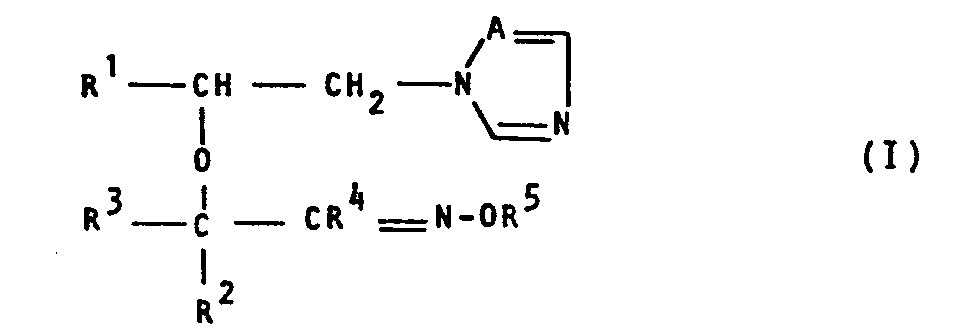
Die Verbindungen der allgemeinen Formel
Die Wirkstoffe sind als Pflanzenschutzmittel geeignet und können mit besonders gutem Erfolg zur Bekämpfung solcher Pilze eingesetzt werden, die echte Mehltauerkrankungen hervorrufen, so zur Bekämpfung von Erysiphe-Arten, sowie von Podosphaera-Arten, wie z.B. gegen den Erreger des Apfelmehltaus, außerdem auch zur Bekämpfung von Reiskrankheiten, wie z.B. Pyricularia oryzae und Pellicularia sasakii.The active ingredients are suitable as crop protection agents and can be used with particularly good success to combat those fungi which cause real mildew diseases, for example to combat Erysiphe species and Podosphaera species, such as e.g. against the pathogen of apple mildew, also for combating rice diseases, such as Pyricularia oryzae and Pellicularia sasakii.
Description
Die vorliegende Anmeldung betrifft neue substituierte Azolylethyl-oximinoalkyl-ether, ein Verfahren zu ihrer Herstellung sowie ihre Verwendung als Fungizide.The present application relates to new substituted azolylethyl oximinoalkyl ethers, a process for their preparation and their use as fungicides.
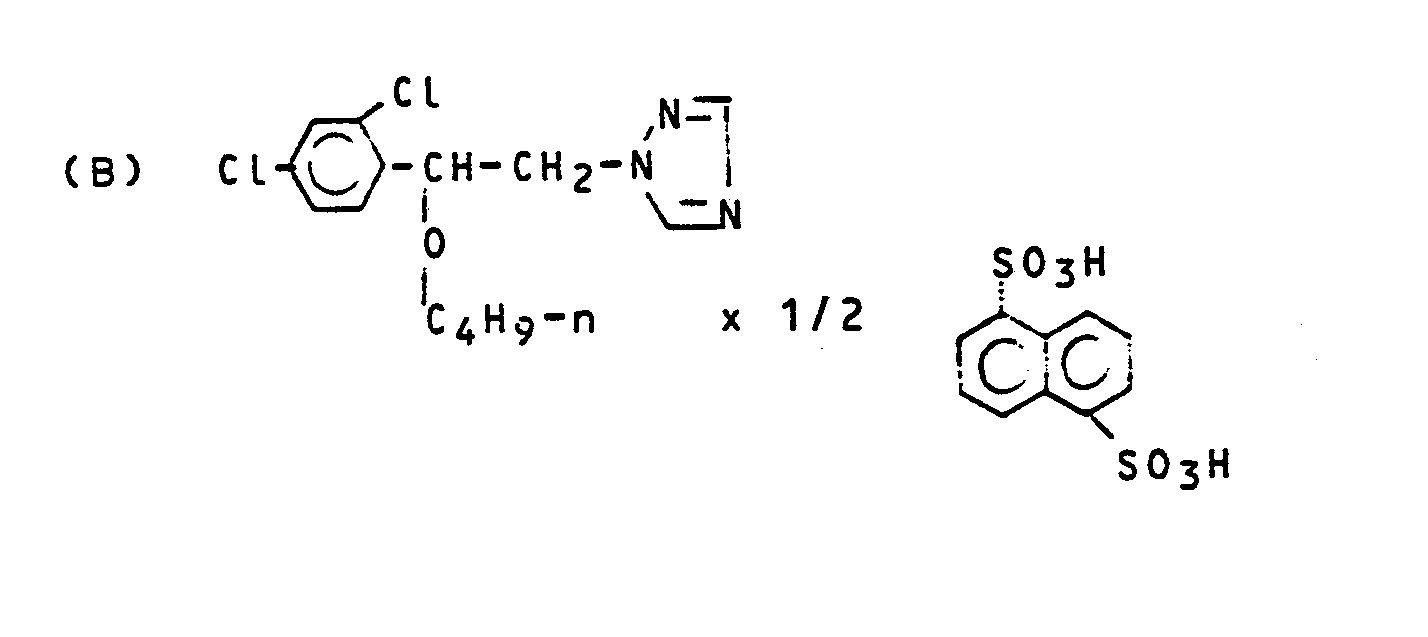
Es ist bereits bekannt geworden, daß bestimmte Triazolylethyl-ether-Derivate, wie z.B. [1-(4-Chlorphenyl)-2-(1,2,4-triazol-1-yl)]-ethyl-allyl-ether und [1-(2,4-Dichlorphenyl)-2-(1,2,4-triazol-1-yl)]-ethyl-n-butyl-ether, allgemein gute fungizide Eigenschaften besitzen (vergleiche DE-OS 25 47 953 CLeA 16 749]). Die Wirkung dieser Verbindungen ist jedoch in bestimmten Indikationsbereichen, insbesondere bei niedrigen Aufwandmengen und-konzentrationen, nicht immer ganz befriedigend.It has already been known that certain triazolyl ethyl ether derivatives, such as e.g. [1- (4-chlorophenyl) -2- (1,2,4-triazol-1-yl)] ethyl allyl ether and [1- (2,4-dichlorophenyl) -2- (1,2, 4-triazol-1-yl)] - ethyl-n-butyl ether, generally have good fungicidal properties (compare DE-OS 25 47 953 CLeA 16 749]). However, the action of these compounds is not always entirely satisfactory in certain indication areas, in particular when low amounts and concentrations are applied.
Es wurden neue substituierte Azolylethyl-oximinoalkyl-ether der allgemeinen Formel

- A für ein Stickstoffatom oder die CH-Gruppe steht,
- R1 für gegebenenfatls substituiertes PhenyL steht,
- R2 für Wasserstoff, ALkyL oder gegebenenfalls substituiertes Phenyl steht,
- R3 für Wasserstoff, ALkyL oder gegebenenfalls substituiertes Phenyl steht,
- R4 für Wasserstoff, Alkyl oder gegebenenfalls substituiertes Phenyl steht und
- R5 für Wasserstoff, Alkyl, Alkenyl, Alkinyl, gegebenenfalls substituiertes PhenyL oder gegebenenfalls substituiertes Phenylalkyl steht,
und deren Säureadditions-SaLze und MetaLLsaLz-KompLexe gefunden.There were new substituted azolylethyl oximinoalkyl ethers of the general formula
- A represents a nitrogen atom or the CH group,
- R 1 stands for optionally substituted phenyl,
- R 2 represents hydrogen, ALkyL or optionally substituted phenyl,
- R 3 represents hydrogen, ALkyL or optionally substituted phenyl,
- R 4 represents hydrogen, alkyl or optionally substituted phenyl and
- R 5 represents hydrogen, alkyl, alkenyl, alkynyl, optionally substituted phenyl or optionally substituted phenylalkyl,
and their acid addition salts and MetaLLsaLz complexes found.
Die Verbindungen der Formel (I) können in der syn- oder anti-Form vorliegen; vorwiegend faLLen sie als Gemische beider Formen an.The compounds of formula (I) can be in the syn or anti form; they mainly occur as mixtures of both forms.
Weiterhin wurde gefunden, daß man die substituierten Azolylethyl-oximinoalkyl-ether der Formel (I) sowie deren Säureadditions-Salze und Metallsalz-Komplexe erhält, wenn man Azolylethanole der Formel

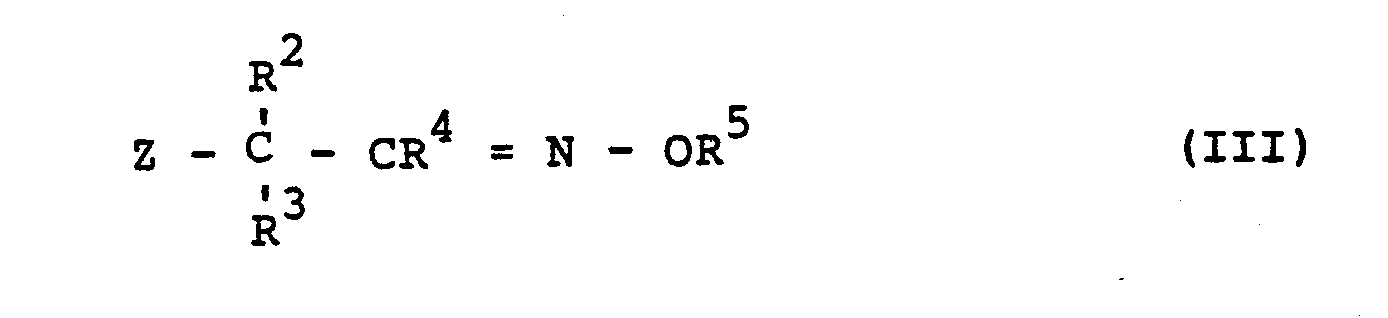
- A und R1 die oben angegebene Bedeutung haben mit Oxim-Derivaten der Formel

- R2,R3,R4 und R5 die oben angegebene Bedeutung haben und
- Z für Halogen, den Methylsulfonyloxy- oder den Tolylsulfonyloxy-Rest steht,
- A and R 1 have the meaning given above with oxime derivatives of the formula
- R 2 , R 3 , R 4 and R 5 have the meaning given above and
- Z represents halogen, the methylsulfonyloxy or the tolylsulfonyloxy radical,
in Gegenwart einer Base und in Gegenwart eines organischen Verdünnungsmittels, oder in einem wässrig-organischen Zweiphasensystem in Gegenwart eines Phasentransferkatalysators, umsetzt; und gegebenenfalls anschließend eine Säure oder ein MetaLLsalz addiert.in the presence of a base and in the presence of an organic diluent, or in an aqueous-organic two-phase system in the presence of a phase transfer catalyst; and then optionally adding an acid or a metal salt.
Die neuen substituierten Azolylethyl-oximinoalkyl-ether der Formel (I) weisen starke fungizide Eigenschaften auf. Dabei zeigen überraschenderweise die erfindungsgemäßen Verbindungen eine bessere fungizide Wirkung als die aus dem Stand der Technik bekannten Triazolyl-ethylether-Derivate, wie z.B. [1-(4-Chlor-phenyl)-2-(1,2,4-triazol-1-yl)J-ethyl-allyl-ether und C1-(2,4-DichlorphenyL)-2-(1,2,4-triazol-1-yl)]-ethyl-n-butyl-ether, die chemisch und wirkungsmäßig naheliegende Verbindungen sind. Die erfindungsgemäßen Stoffe stellen somit eine Bereicherung der Technik dar.The new substituted azolylethyl oximinoalkyl ethers of the formula (I) have strong fungicidal properties. The compounds according to the invention surprisingly show a better fungicidal action than that of Triazolyl ethyl ether derivatives known in the art, such as, for example, [1- (4-chlorophenyl) -2- (1,2,4-triazol-1-yl) J ethyl allyl ether and C1- ( 2,4-dichlorophenyL) -2- (1,2,4-triazol-1-yl)] - ethyl-n-butyl ether, which are chemically and functionally obvious compounds. The substances according to the invention thus represent an enrichment of the technology.
Die erfindungsgemäßen substituierten Azolylethyl-oximinoalkyl-ether sind durch die Formel (I) allgemein definiert. In dieser Formel stehen vorzugsweise
- A für ein Stickstoffatom oder die CH-Gruppe;
- R1 für gegebenenfalls einfach oder zweifach, gleich oder verschieden substituiertes Phenyl, wobei als Substituenten vorzugsweise genannt seien: Halogen, Alkyl mit 1 bis 4 Kohlenstoffatomen, Alkoxy mit 1 bis 2 Kohlenstoffatomen sowie Halogenalkyl und Halogenalkoxy mit jeweils 1 bis 2 Kohlenstoff- und 1 bis 5 gleichen oder verschiedenen Halogenatomen, wie Fluor- und Chloratomen;
- R2 für Wasserstoff, Alkyl mit 1 bis 4 Kohlenstoffatomen, sowie für gegebenenfalls einfach oder zweifach, gleich oder verschieden substituiertes Phenyl, wobei als Substituenten vorzugsweise die bei R1 bereits genannten Phenylsubstituenten in Frage kommen;
- R 3 für Wasserstoff, Alkyl mit 1 bis 4 Kohlenstoffatomen, sowie für gegebenenfalls einfach oder zweifach gleich oder verschieden substituiertes Phenyl, wobei als Substituenten vorzugsweise die bei R1 bereits genannten Phenylsubstituenten in Frage kommen;
- R 4 für Wasserstoff, Alkyl mit 1 bis 4 Kohlenstoffatomen, sowie für gegebenenfalls einfach oder zweifach, gleich oder verschieden substituiertes Phenyl, wobei als Substituenten vorzugsweise die bei R1 bereits genannten Phenylsubstituenten in Frage kommen; und
- R S für Wasserstoff, Alkyl mit 1 bis 4 Kohlenstoffatomen, Alkenyl und Alkinyl mit jeweils 2 bis 4 Kohlenstoffatomen, sowie für jeweils gegebenenfalls einfach oder zweifach, gleich oder verschieden substituiertes Phenyl und Phenylalkyl mit 1 bis 2 Kohlenstoffatomen im Alkylteil, wobei als Substituenten an den aromatischen Resten vorzugsweise die bei R1 bereits genannten Phenylsubstituenten in Frage kommen.
- A represents a nitrogen atom or the CH group;
- R 1 for optionally mono- or disubstituted, identically or differently substituted phenyl, the preferred substituents being: halogen, alkyl having 1 to 4 carbon atoms, alkoxy having 1 to 2 carbon atoms and haloalkyl and haloalkoxy each having 1 to 2 carbon atoms and 1 to 5 identical or different halogen atoms, such as fluorine and chlorine atoms;
- R 2 represents hydrogen, alkyl having 1 to 4 carbon atoms, and also phenyl which is substituted once or twice, identically or differently, the phenyl substituents already mentioned for R 1 preferably being suitable as substituents;
- R 3 represents hydrogen, alkyl having 1 to 4 carbon atoms, and also phenyl which is monosubstituted or disubstituted in the same or different ways, the preferred substituents being the phenyl substituents already mentioned for R 1 ;
- R 4 represents hydrogen, alkyl having 1 to 4 carbon atoms, and also phenyl which is monosubstituted or disubstituted, identically or differently, the preferred substituents being the phenyl substituents already mentioned for R 1 ; and
- R S for hydrogen, alkyl having 1 to 4 carbon atoms, alkenyl and alkynyl each having 2 to 4 carbon atoms, and for each optionally mono- or disubstituted, identically or differently substituted phenyl and phenylalkyl having 1 to 2 carbon atoms in the alkyl part, the substituents on the aromatic radicals are preferably the phenyl substituents already mentioned for R 1 .
Besonders bevorzugt sind diejenigen Verbindungen der Formel (I), in denen
- A für ein Stickstoffatom oder die CH-Gruppe steht;
- R für gegebenenfalls einfach oder zweifach, gleich oder verschieden substituiertes Phenyl steht, wobei als Substituenten insbesondere genannt seien: Fluor, Chlor, Brom, Methyl, Ethyl, Methoxy, Trifluormethyl und Trifluormethoxy;
- R 2 für Wasserstoff, Methyl, Ethyl, Isopropyl sowie für gegebenenfalls einfach oder zweifach, gleich oder verschieden substituiertes Phenyl steht, wobei als Substituenten insbesondere die für R bereits genannten Phenylsubstituenten in Frage kommen;
- R 3 für Wasserstoff, Methyl, Ethyl, Isopropyl sowie für gegebenenfalls einfach oder zweifach, gleich oder verschieden substituiertes Phenyl steht, wobei als Substituenten insbesondere die für R bereits genannten Phenylsubstituenten in Frage kommen;
- R 4 für Wasserstoff, Methyl, Ethyl, Isopropyl sowie für gegebenenfalls einfach oder zweifach gleich oder verschieden substituiertes Phenyl steht, wobei als Substituenten insbesondere die für R1 bereits genannten Phenylsubstituenten in Frage kommen; und
- R 5 für Wasserstoff, Methyl, Ethyl, Isopropyl, n-Propyl, n-Butyl, sek.-Butyl, tert.-Butyl, Vinyl, Allyl, Propargyl sowie für jeweils gegebenenfalls einfach oder zweifach, gleich oder verschieden substituiertes Phenyl und Benzyl steht, wobei als Substituenten insbesondere die für R1 bereits genannten Phenylsubstituenten in Frage kommen.
- A represents a nitrogen atom or the CH group;
- R represents phenyl which is monosubstituted or disubstituted, identically or differently, the substituents which may be mentioned in particular: fluorine, chlorine, bromine, methyl, ethyl, methoxy, trifluoromethyl and trifluoromethoxy;
- R 2 represents hydrogen, methyl, ethyl, isopropyl and also phenyl which is monosubstituted or disubstituted, identically or differently, the substituents which may in particular be the phenyl substituents already mentioned for R;
- R 3 represents hydrogen, methyl, ethyl, isopropyl and also phenyl which is monosubstituted or disubstituted, identically or differently, where the phenyl substituents already mentioned for R are particularly suitable;
- R 4 represents hydrogen, methyl, ethyl, isopropyl and also phenyl which is monosubstituted or disubstituted in the same or different ways, the phenyl substituents already mentioned for R 1 being particularly suitable; and
- R 5 represents hydrogen, methyl, ethyl, isopropyl, n-propyl, n-butyl, sec-butyl, tert-butyl, vinyl, allyl, propargyl and also in each case monosubstituted or disubstituted, identically or differently substituted, phenyl and benzyl , in particular as a substituent the phenyl substituents already mentioned for R 1 come into question.
Bevorzugte erfindungsgemäße Verbindungen sind auch Additionsprodukte aus Säuren und denjenigen substituierten Azolylethyloximinoalkyl-ethern der Formel (I), in denen die Substituenten A, R , R 2, R3, R4 und R die Bedeutungen haben, die bereits vorzugsweise für diese Reste genannt wurden.Preferred compounds according to the invention are also addition products of acids and those substituted azolylethyloximinoalkyl ethers of the formula (I) in which the substituents A , R , R 2 , R 3 , R 4 and R have the meanings which have preferably already been mentioned for these radicals .
Zu den Säuren die addiert werden können, gehören vorzugsweise Halogenwasserstoffsäuren, wie z.B. die Chlorwasserstoffsäure, ferner Phosphorsäure, Salpetersäure, Schwefelsäure, mono- und bifunktionelle Carbonsäuren und Hydroxycarbonsäuren, wie z.B. Essigsäure, Maleinsäure, Bernsteinsäure, Fumarsäure, Weinsäure, Salizylsäure, Sorbinsäure und Milchsäure, sowie Sulfonsäuren, wie z.B. p-Toluolsulfonsäure und 1,5-Naphthalindisulfonsäure.The acids that can be added preferably include hydrohalic acids, e.g. hydrochloric acid, also phosphoric acid, nitric acid, sulfuric acid, mono- and bifunctional carboxylic acids and hydroxycarboxylic acids, e.g. Acetic acid, maleic acid, succinic acid, fumaric acid, tartaric acid, salicylic acid, sorbic acid and lactic acid, as well as sulfonic acids such as e.g. p-toluenesulfonic acid and 1,5-naphthalenedisulfonic acid.
Außerdem bevorzugte erfindungsgemäße Verbindungen sind Additionsprodukte aus Salzen von Metallen der II. bis IV. Haupt- und der I. und II. sowie IV. bis VIII. Nebengruppe und denjenigen substituierten Azolylethyl-oximinoalkyl-ethern der Formel (I), in denen die Substituenten A, R1,R2, R3, R4 und R5 die Bedeutungen haben, die bereits vorzugsweise für diese Reste genannt wurden. Hiebei sind Salze des Kupfers, Zinks, Mangans, Magnesiums, Zinns, Eisens und des Nickels besonders bevorzugt. Als Anionen dieser Salze kommen solche in Betracht, die sich von solchen Säuren ableiten, die zu physiologisch verträglichen Additionsprodukten führen. Besonders bevorzugte der-In addition, preferred compounds according to the invention are addition products from salts of metals of the II. To IV. Main group and of I. and II. And IV. To VIII. Subgroup and those substituted azolylethyl-oximinoalkyl ethers of the formula (I) in which the substituents A , R 1 , R 2 , R 3 , R 4 and R 5 have the meanings which have preferably already been mentioned for these radicals. Salts of copper, zinc, manganese, magnesium, tin, iron and nickel are particularly preferred. Anions of these salts are those which are derived from acids which lead to physiologically tolerable addition products. Particularly preferred
artige Säuren sind in diesem Zusammenhang die Halogenwasserstoffsäuren, wie z.B. die Chlorwasserstoffsäure und die Bromwasserstoffsäure.Like acids in this context are the hydrohalic acids, e.g. the hydrochloric acid and the hydrobromic acid.
Verwendet man beispielsweise 1-(2,4-Dichlorphenyl)-2-(1,2,4-triazol-1-yl)-ethanol und 1-Chlor-2-methoximino-2-phenyl-ethan als Ausgangsstoffe, so kann der Reaktionsablauf des erfindungsgemäßen Verfahrens durch das folgende Formelschema wiedergegeben werden:

Die bei der Durchführung des erfindungsgemäßen Verfahrens als Ausgangsstoffe benötigten AzoLyLethanoLe sind durch die Formel (II) aLLgemein definiert. In dieser Formel stehen A und R1 vorzugsweise für die Bedeutungen, die bei der Beschreibung der erfindungsgemäßen Stoffe der FormeL (I) bereits vorzugsweise genannt wurden.The azoLyLethanoLe required as starting materials when carrying out the process according to the invention are generally defined by the formula (II) aLL. In this formula, A and R 1 preferably represent the meanings which have already been mentioned as preferred in the description of the formulas (I) according to the invention.
Die AzoLyLethanoLe der FormeL (II) sind bekannt (vergleiche z.B. DE-OS 24 31 407, 26 38 470 und 19 40 388) ; bzw. könnnen sie in allgemein bekannter Art und Weise erhalten werden, indem man die entsprechenden α-Brom(Lhlor)-ketone mit ImidazoL oder 1,2,4-Triazol in Gegenwart eines inerten organischen LösungsmitteLs, wie beispielweise Aceton, und in Gegenwart eines SäurebindemitteLs, wie beispielsweise KaLiumcarbonat, vorzugsweise in der Siecenitze umsetzt und die so erhaltenen Azolylethanone in üblicher Weise mit komplexen Hydriden, wie beispielsweise Natriumborhydrid, oder mit Aluminiumisopropylat reduziert.The AzoLyLethanoLe of FormeL (II) are known (compare, for example, DE-OS 24 31 407, 26 38 470 and 19 40 388); or they can be obtained in a generally known manner by the corresponding α-bromo (chlorine) ketones with imidazole or 1,2,4-triazole in the presence of an inert organic solvent, such as acetone, and in the presence of a Acid binding agents, as with for example, potassium carbonate, preferably reacted in the Siecenitze and the azolylethanones thus obtained are reduced in the usual way with complex hydrides, such as sodium borohydride, or with aluminum isopropylate.
Die außerdem für das erfindungsgemäße Verfahren als Ausgangsstoffe zu verwendenden Oxim-Derivate sind durch die Formel (III) allgemein definiert. In dieser Formel stehen R2,R 3,R4 und R 5 vorzugsweise für die Bedeutungen, die bei der Beschreibung der erfindungsgemäßen Stoffe der Formel (I) bereits vorzugsweise genannt wurden. Z steht vorzugsweise für Chlor, Brom, den Methylsulfonyloxy- und den Tolylsulfonyloxy-Rest. Die Oxim-Derivate der Formel (III) sind bekannt (vergleiche z.B. US-PS 3 896 189 und DE-OS 29 22 759); bzw. können sie in allgemein bekannter Art und Weise erhalten werden, indem man entsprechende Carbonylverbindungen mit Hydroxylamin-(Derivaten) in Gegenwart eines Lösungsmittels, vorzugsweise eines Alkohols, bei Temperaturen zwischen 20°C und 100°C, vorzugsweise zwischen 50°C und 80°C umsetzt. Dabei wird das Hydroxylamin-(Derivat) vorzugsweise in Form eines Salzes, insbesondere als Hydrochlorid, gegebenenfalls in Gegenwart eines Säurebindemittels, wie beispielsweise Natriumacetat, eingesetzt. Die Isolierung der Endprodukte erfolgt in üblicher Weise. Einzelne Oxim-Derivate der Formel (III) können auch erhalten werden, wenn man Oxim-ether der Formel

- R 3,R4 und R5 die oben angegebene Bedeutung haben,
in üblicher Weise halogeniert (vergleiche hierzu J.0rg. Chem. 36, (1971) 3467).Formula (III) provides a general definition of the oxime derivatives also to be used as starting materials for the process according to the invention. In this formula, R 2 , R 3 , R 4 and R 5 preferably represent the meanings which have already been mentioned as preferred in the description of the substances of the formula (I) according to the invention. Z preferably represents chlorine, bromine, the methylsulfonyloxy and the tolylsulfonyloxy radical. The oxime derivatives of the formula (III) are known (compare, for example, US Pat. No. 3,896,189 and DE-OS 29 22 759); or they can be obtained in a generally known manner by appropriate carbonyl compounds with hydroxylamine (derivatives) in the presence of a solvent, preferably an alcohol, at temperatures between 20 ° C and 100 ° C, preferably between 50 ° C and 80 ° C implemented. The hydroxylamine (derivative) is preferably used in the form of a salt, in particular as a hydrochloride, optionally in the presence of an acid binder, such as sodium acetate. The end products are isolated in the customary manner. Individual oxime derivatives of the formula (III) can also be obtained by using oxime ethers of the formula
- R 3 , R 4 and R 5 have the meaning given above,
halogenated in the usual way (cf. J.0rg. Chem. 36, (1971) 3467).
Als Verdünnungsmittel kommen für das erfindungsgemäße Verfahren vorzugsweise inerte organische LösungsmitteL infrage. Hierzu gehören vorzugsweise Ketone, wie Diethylketon, insbesondere Aceton und MethyLethyLketon; NitriLe, wie Propionitril, insbesondere Acetonitril; Ether, wie Tetrahydrofuran oder Dioxan; aliphatische und aromatische Kohlenwasserstoffe, wie Petrolether, Benzol, ToLuoL oder XyLoL; halogenierte Kohlenwasserstoffe, wie MethyLenchLorid, Tetrachlorkohlenstoff, Chloroform oder ChLorbenzoL; und Ester,wie Essigester.Inert organic solvents are preferably suitable as diluents for the process according to the invention. These preferably include ketones such as diethyl ketone, in particular acetone and methyl ethyl ketone; Nitriles, such as propionitrile, in particular acetonitrile; Ethers such as tetrahydrofuran or dioxane; aliphatic and aromatic hydrocarbons, such as petroleum ether, benzene, ToLuoL or XyLoL; halogenated hydrocarbons, such as methylene chloride, carbon tetrachloride, chloroform or chlorobenzene; and esters, such as ethyl acetate.
bls Basen können für das erfindungsgemäße Verfahren aLLe üblichen organischen und anorganischen Basen eingesetzt werden. Hierzu gehören vorzugsweise tertiäre Amine, beispielsweise TriethyLamin oder Pyridin und Alkalihydroxide oder Alkalicarbonate, beispielsweise Natrium- und Kaliumhydroxid, sowie Alkalimetallhydride wie beispielsweise Natriumhydrid.bls bases can be used for the process according to the invention in general organic and inorganic bases. These preferably include tertiary amines, for example triethylamine or pyridine and alkali metal hydroxides or alkali metal carbonates, for example sodium and potassium hydroxide, and also alkali metal hydrides, for example sodium hydride.
Die Reaktionstemperaturen können bei der Durchführung des erfindungsgemäßen Verfahrens in einem größeren Bereicn variiert werden. Im allgemeinen arbeitet man zwischen 0°C und 150°C, vorzugsweise zwischen 20°C und 100°C.The reaction temperatures can be varied over a wide range when carrying out the process according to the invention. Generally one works between 0 ° C and 150 ° C, preferably between 20 ° C and 100 ° C.
Bei der Durchführung des erfindungsgemäßen Verfahrens arbeitet man vorzugsweise mit äquimolaren Mengen. Es ist jedoch auch möglich, eine der Komponenten in einem Ueberschuß einzusetzten. Die Aufarbeitung und Isolierung der Reaktionsprodukte erfolgt nach üblichen Methoden.When carrying out the process according to the invention, preference is given to working with equimolar amounts. However, it is also possible to use one of the components in an excess. The reaction products are worked up and isolated by customary methods.
In einer bevorzugten Ausführungsform wird die erfindungsgemäße Umsetzung in einem Zweiphasensystem, wie beispielsweise wässrige Natron- oder Kalilauge/Toluol oder Methylenchlorid durchgeführt, gegebenenfalls unter Zusatz von 0,1-1 Mol eines Phasentransfer-Katalysators, wie beispielsweise einer Ammonium- oder Phosphoniumverbindung, beispielsweise seien Benzyldodecyl-dimethyl-ammoniumchlorid und Triethylbenzyl-ammoniumchlorid genannt.In a preferred embodiment, the reaction according to the invention is carried out in a two-phase system, such as, for example, aqueous sodium hydroxide solution or potassium hydroxide solution / toluene or methylene chloride, optionally with the addition of 0.1-1 mol of a phase transfer catalyst, such as, for example, an ammonium or phosphonium compound Benzyldodecyl-dimethyl-ammonium chloride and triethylbenzyl-ammonium chloride called.
Zur Herstellung von Säureadditions-Salzen der Verbindungen der Formel (I) kommen vorzugsweise diejenigen Säuren infrage, die bereits im Zusammenhang mit der Beschreibung der erfindungsgemäßen Säureadditions-SaLze als bevorzugte Säuren genannt wurden.For the preparation of acid addition salts of the compounds of formula (I), preference is given to those acids which have already been mentioned as preferred acids in connection with the description of the acid addition salts according to the invention.
Die Säureadditions-Salze der Verbindungen der Formel (I) können in einfacher Weise nach üblichen Salzbildungsmethoden, durch Lösen einer Verbindung der FormeL(I) in einem geeigneten LösungsmitteL und Hinzufügen der Säure, z.B. ChLorwasserstoffsäure, erhalten werden und in bekannter Weise, z.B. durch Abfiltrieren isoliert und gegebenenfalls durcn Waschen mit einem inerten organischen Lösungsmittel gereinigt werden.The acid addition salts of the compounds of the formula (I) can be obtained in a simple manner by customary salt formation methods, by dissolving a compound of the formula (I) in a suitable manner Neten solvent and addition of the acid, such as hydrochloric acid, are obtained and isolated in a known manner, for example by filtering off and, if necessary, cleaned by washing with an inert organic solvent.
Zur HersteLLung von MetaLLsaLz-KompLexen von Verbindungen der Formel (I) kommen vorzugsweise SaLze von denjenigen Anionen und Kationen in Betracht, die bereits im Zusammenhang mit der Beschreibung der erfindungsgemäßen Metallsalz-Komplexe als bevorzugt genannt wurden.For the production of metal salt complexes of compounds of the formula (I), preference is given to salts of those anions and cations which have already been mentioned as preferred in connection with the description of the metal salt complexes according to the invention.
Die MetaLLsaLz-KompLexe von Verbindungen der Formel (I) können in einfacher Weise nach üblichen Verfahren erhalten werden, so z.B. durch Lösen des MetaLLsaLzes in Alkohol, z.B. Ethanol, und Hinzufügen der Lösung zur Verbindung der Formel (I). Man kann Metallsalz-Komplexe in bekannter Weise, z.B. durch Abfiltrieren, isolieren und gegebenenfalls durch Umkristallisation reinigen.The MetaLLsaLz complexes of compounds of the formula (I) can be obtained in a simple manner by customary processes, e.g. by dissolving the metal salt in alcohol, e.g. Ethanol, and adding the solution to the compound of formula (I). Metal salt complexes can be prepared in a known manner, e.g. by filtering, isolating and, if necessary, cleaning by recrystallization.
Die erfindungsgemäßen Wirkstoffe weisen eine starke mikrobizide Wirkung auf und können zur Bekämpfung von unerwünschten Mikroorganismen praktisch eingesetzt werden. Die Wirkstoffe sind für den Gebrauch als Pflanzenschutzmittel geeignet.The active compounds according to the invention have a strong microbicidal action and can be used practically to combat unwanted microorganisms. The active ingredients are suitable for use as pesticides.
Fungizide Mittel im Pflanzenschutz werden eingesetzt zur Bekämpfung von Plasnodiophoromycetes, Oomycetes, Chytridiomycetes, Zygomycetes, Ascomycetes, Basiaiomycetes, Deuteromycetes.Fungicidal agents in crop protection are used to control Plasnodiophoromycetes, Oomycetes, Chytridiomycetes, Zygomycetes, Ascomycetes, Basiaiomycetes, Deuteromycetes.
Die gute Pflanzenverträglichkeit der Wirkstoffe in den zur Bekämpfung von Pflanzenkrankheiten notwendigen Konzentrationen erlaubt eine Behandlung von oberirdischen Pflanzenteilen, von Pflanz- und Saatgut , und des Bodens.The fact that the active compounds are well tolerated by plants in the concentrations required to combat plant diseases permits treatment of above-ground parts of plants, of propagation stock and seeds, and of the soil.
Als Pflanzenschutzmittel können die erfindungsgemäßen Wirkstoffe mit besonders gutem Erfolg zur Bekämpfung solcher Pilze eingesetzt werden, die echte Mehltauerkrankungen hervorrufen, so zur Bekämpfung von Erysiphe-Arten, wie z.B. gegen den Erreger des GerstenmehLtaus (Erysiphe graminis), von Leptosphaeria-Arten, wie z.B. gegen den Erreger der Braunfleckenkrankheit an Weizen (Leptosphaeria nodorum), von Sphaerotheca-Arten, wie z.B. gegen den Erreger des Gurkenmehltaus (Sphaerotheca fuliginea), sowie von Podosphaera-Arten, wie z.B. gegen den Erreger des Apfelmehltaus (Podosphaera leucotricha); außerdem auch zur Bekämpfung von Reiskrankheiten, wie z B. Pyricularia oryzae und Pellicularia sasakii.The active compounds according to the invention can be used with particularly good success as crop protection agents to combat those fungi which cause real mildew diseases, for example to combat Erysiphe species, for example against the pathogen of barley flour (Erysiphe graminis), and for Leptosphaeria species, for example against the pathogen of brown spot disease on wheat (Leptosphaeria nodorum), of Sphaerotheca species, such as, for example, against the pathogen of cucumber mildew (Sphaerotheca fuliginea), and of Podosphaera species, such as, for example, of the pathogen of apple powdery mildew (Podosphaera leucotricha); also for combating rice diseases such as Pyricularia oryzae and Pellicularia sasakii.
In entsprechenden Aufwandmengen zeigen die erfindungsgemäßen Stoffe auch herbizide Wirksamkeit.When applied in appropriate amounts, the substances according to the invention also show herbicidal activity.
Die Wirkstoffe können in die üblichen Formulierungen übergeführt werden, wie Lösungen, Emulsionen, Spritzpulver, Suspensionen, Pulver, Stäubemittel, Schäume, Pasten, lösliche Pulver, Granulate, Aerosole, Suspensions-Emulsionskonzentrate, Saatgutpuder, Wirkstoff-imprägnierte Natur-und synthetische Stoffe, Feinstverkapselungen in polymerenThe active ingredients can be converted into the customary formulations, such as solutions, emulsions, wettable powders, suspensions, powders, dusts, foams, pastes, soluble powders, granules, aerosols, suspension emulsion concentrates, seed powders, active ingredient-impregnated natural and synthetic substances, very fine encapsulations in polymers
Stoffen und in Hüllmassen für Saatgut, ferner in Formulierungen mit Brennsätzen, wie Räucherpatronen, -dosen, -spiralen u.ä. sowie ULV-Kalt- und Warmnebel-Formulierungen.Substances and in coating compositions for seeds, also in formulations with fuel sets, such as smoking cartridges, cans, spirals, etc. as well as ULV cold and warm fog formulations.
Diese Formulierungen werden in bekannter Weise hergestellt, z.B. durch Vermischen der Wirkstoffe mit Streckmitteln, also flüssigen Lösungsmitteln, unter Druck stehenden verflüssigten Gasen und/oder festen Trägerstoffen, gegebenenfalls.unter Verwendung von oberflächenaktiven Mitteln, also Emulgiermitteln und /oder Dispergiermitteln und/oder schaumerzeugenden Mitteln. Im Falle der Benutzung von Wasser als Streckmittel können z.B. auch organische Lösungsmittelals Hilfs lösungsmittel verwendet werden. Als flüssige Lösungsmittel kommen im wesentlichen infrage: Aromaten, wie Xylol, Toluol, oder Alkylnaphthaline, chlorierte Aromaten oder chlorierte aliphatische Kohlenwasserstoffe, wie Chlorbenzole, Chlorethylene oder Methylenchlorid, aliphatische Kohlenwasserstoffe, wie Cyclohexan oder Paraffine, z.B. Erdölfraktionen, Alkohole, wie Butanol oder Glycol sowie deren Ether und Ester, Ketone, wie Aceton, Methylethylketon, Methylisobutylketon oder Cyclohexanon, stark polare Lösungsmittel, wie Dimethylformamid und Dimethylsulfoxid, sowie Wasser; mit verflüssigten gasförmigen Streckmitteln oder Trägerstoffen sind solche Flüssigkeiten gemeint, welche bei normaler Temperatur und unter Normaldruck gasförmig sind, z.B. Aerosol-Treibgase, wie Halogenkohlenwasserstoffe sowie Butan, Propan, Stickstoff und Kohlendioxid; als feste Trägerstoffe kommen in Frage: z.B. natürliche Gesteinsmehle, wie Kaoline, Tonerden, Talkum, Kreide, Quarz, Attapulgit, Montmorillonit oder Diatomeenerde und synthetische Gesteinsmehle, wie hochdisperse Kieselsäure, Aluminiumoxid und Silikate; als feste Trägerstoffe für Granulate kommen in Frage: z.B. gebrochene und fraktionierte natürliche Gesteine wie Calcit, Marmor, Bims, Sepiolith, Dolomit sowie synthetische Granulate aus anorganischen und organischen Mehlen sowie Granulateaus orgamischem Material, wie Sägemehl, Kokosnußschalen, Maiskolben und Tabakstengeln; als Emulgier-und/oder schaumerzeugende Mittel kommen in Frage: z.B. nichtionogene und anionische Emulgatoren, wie Polyoxyethylen-Fettsäure- .ester, Polyoxyethylen-Fettalkohol-ether, z.B. Alkylarylpolyglykol-ether, Alkylsulfonate, Alkylsulfate, Arylsulfonate sowie Eiweißhydrolysate; als Dispergiermittel kommen infrage: z.B. Lignin-Sulfitablaugen und Methylcellulose.These formulations are prepared in a known manner, for example by mixing the active ingredients with extenders, i.e. liquid solvents, pressurized liquefied gases and / or solid carriers, if appropriate using surface-active agents, i.e. emulsifiers and / or dispersants and / or foam-generating agents . If water is used as an extender, organic solvents can, for example, also be used as auxiliary solvents. Suitable liquid solvents are essentially: aromatics, such as xylene, toluene, or alk y l naphthalenes, chlorinated aromatics or chlorinated aliphatic hydrocarbons, such as chlorobenzenes, chloroethylenes or methylene chloride, aliphatic hydrocarbons such as cyclohexane or paraffins, for example mineral oil fractions, alcohols, such as butanol or glycol and their ethers and esters, ketones such as acetone, methyl ethyl ketone, methyl isobutyl ketone or cyclohexanone, strongly polar solvents such as dimethylformamide and dimethyl sulfoxide, and water; Liquefied gaseous extenders or carriers mean liquids which are gaseous at normal temperature and under normal pressure, for example aerosol propellants, such as halogenated hydrocarbons and butane, propane, nitrogen and carbon dioxide; Solid carrier materials are suitable: for example natural rock powders such as kaolins, clays, talc, chalk, quartz, attapulgite, montmorillonite or diatomaceous earth and synthetic rock powders such as highly disperse silica, aluminum oxide and silicates; as solid carriers for granules there are suitable: for example crushed and fractionated natural rocks such as calcite, marble, pumice, sepiolite and dolomite, and synthetic granules of inorganic and organic meals, and granules au s orgamischem material such as sawdust, coconut shells, corn cobs and tobacco stalks; Possible emulsifiers and / or foam-generating agents are: for example nonionic and anionic emulsifiers, such as polyoxyethylene fatty acid esters, polyoxyethylene fatty alcohol ethers, for example alkylaryl polyglycol ethers, alkyl sulfonates, alkyl sulfates, aryl sulfonates and protein hydrolyzates; Possible dispersing agents are, for example, lignin sulfite waste liquor and methyl cellulose.
Es können in den Formulierungen Haftmittel wie Carboxymethylcellulose, natürliche und synthetische pulverige, körnige oder latexförmige Polymere verwendet werden, wie Gummiarabicum, Polyvinylalkohol, Polyvinylacetat.Adhesives such as carboxymethyl cellulose and natural and synthetic polymers in the form of powders, granules or latices, such as gum arabic, polyvinyl alcohol and polyvinyl acetate, can be used in the formulations.
Es kennen Farbstcffe tie anorganische Pigmente, z.B. Eisenoxid, Titanoxid, Ferrocyanblau und organische Farbstoffe, wie Alizarin-, Azo-, Metallphthalocyaninfarbstoffe und Spurennährstoffe wie Salze von Eisen, Mangan, Bor, Kupfer, Kobalt, Molybdän und Zink verwendet werden.Dyes know inorganic pigments, e.g. Iron oxide, titanium oxide, ferrocyan blue and organic dyes such as alizarin, azo, metal phthalocyanine dyes and trace nutrients such as salts of iron, manganese, boron, copper, cobalt, molybdenum and zinc can be used.
Die Formulierungen enthalten im allgemeinen zwischen 0,1 und 95 Gewichtsprozent Wirkstoff, vorzugsweise zwischen 0,5 und 90 Ä.The formulations generally contain between 0.1 and 95 percent by weight of active compound, preferably between 0.5 and 90 Å.
Die erfindungsgemäßen Wirkstoffe können in den Formulierungen oder in den verschiedenen Anwendungsformen in Mischung mit anderen bekannten Wirkstoffen vorliegen, wie Fungiziden, Bakteriziden, Insektiziden, Akariziden, Nematiziden, Herbiziden, Schutzstoffen gegen Vogelfraß, Wuchsstoffen, Pflanzennährstoffen und Bodenstrukturverbesserungsmitteln.The active compounds according to the invention can be present in the formulations or in the various use forms in a mixture with other known active compounds, such as fungicides, bactericides, insecticides, acaricides, nematicides, herbicides, bird repellants, growth agents, plant nutrients and agents which improve soil structure.
Die Wirkstoffe können als solche, in Form ihrer Fomulierungen oder der daraus durch weiteres Verdünnen bereiteten Anwendungsformen, wie gebrauchsfertige Lösungen, Emulsionen, Suspensionen, Pulver, Pasten und Granulate angewendet werden. Die Anwendung geschieht in üblicher Weise, z.B. durch Gießen, Tauchen, Spritzen, Sprühen, Vernebeln, Verdampfen, Injizieren, Verschlämmen, Verstreichen, Stäuben, Streuen, Trockenbeizen, Feuchtbeizen, Naßbeizen, Schlämmbeizen oder Inkrustieren.The active compounds can be used as such, in the form of their formulations or the use forms prepared therefrom by further dilution, such as ready-to-use solutions, emulsions, suspensions, powders, pastes and granules. They are used in the usual way, e.g. by pouring, dipping, spraying, spraying, atomizing, evaporating, injecting, slurrying, spreading, dusting, scattering, dry pickling, wet pickling, wet pickling, slurry pickling or incrusting.
Bei der Behandlung von Pflanzenteilen können die Wirkstoffkonzentrationen in den Anwendungsformen in einem größeren Bereich variiert werden. Sie liegen im allgemeinen zwischen 1 und 0,0001 Gew.-%, vorzugsweise zwischen 0,5 und 0,001 %.When treating parts of plants, the active compound concentrations in the use forms can be varied within a substantial range. They are generally between 1 and 0.0001% by weight, preferably between 0.5 and 0.001%.
Bei der Saatgutbehandlung werden im allgemeinen Wirkstoffmengen von 0,001 bis 50 g je Kilogramm Saatgut, vorzugsweise 0,01 bis 10 g, benötigt.In the seed treatment, amounts of active ingredient of 0.001 to 50 g per kilogram of seed, preferably 0.01 to 10 g, are generally required.
Bei Behandlung des Bodens sind Wirkstoffkonzentrationen von 0,00001 bis 0,1 Gew.-%, vorzugsweise von 0,0001 bis 0,02 Gew.-%, am Wirkungsort erforderlich.When treating the soil, active ingredient concentrations of 0.00001 to 0.1% by weight, preferably 0.0001 to 0.02% by weight, are required at the site of action.

12,9g (0,05 Mol) 1-(2,4-Dichlorphenyl)-2-(1,2,4-triazol-1-yl)-ethanol werden in einem Zweiphasensystem aus 150ml Methylenchlorid und 30 mL 50 %-iger NatronLauge unter Zusatz von 150g Triethyl-benzyl-ammoniumchlorid heftig gerührt und tropfenweise mit 11g (0,06 Mol) 1-ChLor-2-methoximino-2-phenyl-ethan versetzt. Man Läßt das Reaktionsgemisch 6 Stunden bei 42 °C rühren, trennt die organische Phase ab, wäscht sie mit Wasser neutral und trocknet über NatriumsuLfat. Anschließend wird das LösungsmitteL im Vakuum abgetrennt und der Rückstand am Hochvakuum entgast. Nach Verreiben mit Petrolether kristallisiert der Rückstand aus. Man erhält 8,2g (41 % der Theorie) 1-(2,4-Dichlorphenyl)-1-(2-meth- oximino-2-phenyL-ethoxy)-ethan vom Schmelzpunkt 82-84°C.12.9 g (0.05 mol) of 1- (2,4-dichlorophenyl) -2- (1,2,4-triazol-1-yl) ethanol are made in a two-phase system from 150 ml of methylene chloride and 30 ml of 50% Sodium hydroxide solution with the addition of 150 g of triethyl-benzyl-ammonium chloride, stirred vigorously and 11 g (0.06 mol) of 1-chloro-2-methoximino-2-phenyl-ethane were added dropwise. The reaction mixture is allowed to stir at 42 ° C. for 6 hours, the organic phase is separated off, washed neutral with water and dried over sodium sulfate. The solvent is then removed in vacuo and the residue is degassed in a high vacuum. After trituration with petroleum ether, the residue crystallizes out. 8.2 g (41% of theory) of 1- (2,4-dichlorophenyl) -1- (2-methoximino-2-phenyl-ethoxy) ethane with a melting point of 82-84 ° C. are obtained.

46,3g (0,3 Mol) ω-Chloracetophenon, 27,5g (0,33 Mcl) 0-Methyl-hydroxylamin-hydrochlorid und 27 g (0,33 Mol) Natriumacetat werden 3 Stunden in Ethanol unter Rückfluß erhitzt. Anschließend wird der anorganische Niederschlag abfiltriert und das Filtrat eingeengt. Der Rückstand wird zwischen Wasser und Methylenchlorid verteilt, die organische Phase wird abgetrennt, über NatriumsuLfat getrocknet und eingeengt. Der Rückstand wird am Hochvakuum destilliert. Man erhält 44g (80 % der Theorie) 1-Chlor-2-methoximino-2-phenyl-ethan vom Siedepunkt 65°C/0,3 mbar.46.3 g (0.3 mol) of ω-chloroacetophenone, 27.5 g (0.33 Mcl) of 0-methyl-hydroxylamine hydrochloride and 27 g (0.33 mol) of sodium acetate are refluxed in ethanol for 3 hours. The inorganic precipitate is then filtered off and the filtrate is concentrated. The residue is partitioned between water and methylene chloride, the organic phase is separated off, dried over sodium sulfate and constricted. The residue is distilled in a high vacuum. 44 g (80% of theory) of 1-chloro-2-methoximino-2-phenyl-ethane with a boiling point of 65 ° C./0.3 mbar are obtained.
In entsprechender Weise und gemäß dem erfindungsgemäßen Verfahren werden die Verbindungen der folgenden TabeLLe der aLLgemeinen FormelIn a corresponding manner and in accordance with the process according to the invention, the compounds of the following tables of the general formula


In den nachfolgenden BeispieLen werden die nachstehend angegebenen Verbindungen aLs Vergleichssubstanzen eingesetzt:

100 Dimethylformamid Lösungsmittel: Gewichtsteile100 dimethylformamide solvent: parts by weight
0 25 Alkylarylpolyglykolether Emulgator: Gewichtsteile0 25 alkylaryl polyglycol ether emulsifier: parts by weight
Zur Herstellung einer zweckmäßigen Wirkstoffzubereitung vermischt man 1 Gewichtsteil Wirkstoff mit den angegebenem Mengen Lösungsmittel und Emulgator und veraünnt das Konzentrat mit Wasser auf die gewünschte Konzentration.To produce a suitable preparation of active compound, 1 part by weight of active compound is mixed with the stated amounts of solvent and emulsifier and the concentrate is diluted with water to the desired concentration.
Zur Prüfung auf protektive Wirksamkeit besprüht man junge Pflanzen mit der Wirkstoffzubereitung taufeucht. Nach Antrocknen des Spritzbelages werden die Pflanzen mit Sporen von Erysiphe graminis f.sp. hordei bestäubt.To test for protective efficacy, young plants are sprayed with the preparation of active compound as dewy. After the spray coating has dried on, the plants are covered with spores from Erysiphe graminis f.sp. hordei pollinated.
Die Pflanzen werden in einem Gewächshaus bei einer Temperatur von ca. 20° C und einer relativen Luftfeuchtigkeit von ca. 80 % aufgestellt, um die Entwicklung von Mahltaupusteln zu begünstigen.The plants are placed in a greenhouse at a temperature of approx. 20 ° C and a relative atmospheric humidity of approx. 80% in order to promote the development of meal pustules.
7 Tage nach der Inokulation erfolgt die Auswertung.Evaluation is carried out 7 days after the inoculation.
Eine deutliche Überlegenheit in der Wirksamkeit gegenüber dem Stand der Technik zeigen bei diesem Test z.B. die Verbindungen gemäß folgender Herstellungsbeispiele: 3,4,8,9 und 6.This test shows a clear superiority in effectiveness compared to the prior art, e.g. the compounds according to the following preparation examples: 3,4,8,9 and 6.
Die Anwendung der Wirkstoffe erfolgt als Trockenbeizmittel. Sie werden zubereitet durch Abstrecken des jeweiligen Wirkstoffes mit Gesteinsmehl zu einer feinpulvrigen Mischung, die eine gleichmäßige Verteilung auf der Saatgutoberfläche gewährleistet.The active ingredients are used as dry mordants. They are prepared by stripping the respective active ingredient with rock flour to form a fine powder mixture that ensures an even distribution on the seed surface.
Zur Beizung schüttelt man das Saatgut 3 Minuten lang mit dem Beizmittel in einer verschlossenen Glasflasche.For the dressing, shake the seeds with the dressing in a sealed glass bottle for 3 minutes.
Die Gerste sät man mit 3 x 12 Korn 2 cm tief in eine Standarderde. 7 Tage nach der Aussaat, wenn die jungen Pflanzen ihr erstes Blatt entfaltet haben, werden sie mit Sporen von Erysiphe graminis f. sp. hordei bestäubt.The barley is sown with 3 x 12 seeds 2 cm deep in a standard soil. 7 days after sowing, when the young plants have developed their first leaf, they are covered with spores from Erysiphe graminis f. sp. hordei pollinated.
Die Pflanzen werden in einem Gewächshaus bei einer Temperatur von ca. 20°C und einer relativen Luftfeuchtigkeit von ca. 80 % aufgestellt, um die Entwicklung von Mehltaupusteln zu begünstigen.The plants are placed in a greenhouse at a temperature of approx. 20 ° C and a relative air humidity of approx. 80% in order to promote the development of mildew pustules.
7 Tage nach der Inokulation erfolgt die Auswertung.Evaluation is carried out 7 days after the inoculation.
Eine deutliche Überlegenheit in der Wirksamkeit gegenüber dem Stand der Technik zeigen bei diesem Test z.B. die Verbindungen gemäß folgender Herstellungsbeispiele: 3 und 8.This test shows a clear superiority in effectiveness compared to the prior art, e.g. the compounds according to the following preparation examples: 3 and 8.
LösungsmitteL: 100 Gewichtsteile DimethyLformamidSolvent: 100 parts by weight of dimethylformamide
EmuLgator 0,25 Gewichtsteile AlkylarylpolyglykoletherEmulsifier 0.25 parts by weight of alkylaryl polyglycol ether
Zur Herstellung einer zweckmäßigen Wirkstoffzubereitung vermischt man 1 Gewichtsteil Wirkstoff mit den angegebenen Mengen Lösungsmittel und Emulgator und verdünnt das Konzentrat mit Wasser auf die gewünschte Konzentration.To produce a suitable preparation of active compound, 1 part by weight of active compound is mixed with the stated amounts of solvent and emulsifier and the concentrate is diluted with water to the desired concentration.
Zur Prüfung auf protektive Wirksamkeit besprüht man junge Pflanzen mit der Wirkstoffzubereitung taufeucht. Nach Antrocknen des Spritzbelages werden die Pflanzen mit einer Konidiensuspension von Leptosphaeria nodorum besprüht.To test for protective efficacy, young plants are sprayed with the preparation of active compound as dewy. After the spray coating has dried on, the plants are sprayed with a conidia suspension of Leptosphaeria nodorum.
Die Pflanzen verbleiben 48 Stunden bei 20°C und 100% relativer Luftfeuchtigkeit in einer Inkubationskabine.The plants remain in an incubation cabin at 20 ° C. and 100% relative atmospheric humidity for 48 hours.
Die Pflanzen werden in einem Gewächshaus bei einer Temperatur von ca. 15°C und einer relativen Luftfeuchtigkeit von ca. 80X aufgestellt.The plants are placed in a greenhouse at a temperature of approx. 15 ° C and a relative humidity of approx. 80X.
10 Tage nach der Inokulation erfolgt die Auswertung.Evaluation is carried out 10 days after the inoculation.
Eine deutliche UeberLegeheit in der Wirksamkeit gegenüber dem Stand der Technik zeigen bei diesem Test z.B. die Verbindungen gemäß folgender HersteLLungsbeispieLe: 8 und 9.This test shows a clear superiority in effectiveness compared to the prior art, e.g. the connections according to the following manufacturing examples: 8 and 9.
Lösungsmittel: 4,7 Gewichtsteile AcetonSolvent: 4.7 parts by weight of acetone
Emulgator: 0,3 Gewichtsteile AlkylarylpolyglykoletherEmulsifier: 0.3 part by weight of alkylaryl polyglycol ether
Zur Herstellung einer zweckmäßigen Wirkstoffzubereitung vermischt man 1 Gewichtsteil Wirkstoff mit den angegebenen Mengen Lösungsmittel und Emulgator und verdünnt das Konzentrat mit Wasser auf die gewünschte Konzentration.To produce a suitable preparation of active compound, 1 part by weight of active compound is mixed with the stated amounts of solvent and emulsifier and the concentrate is diluted with water to the desired concentration.
Zur Prüfung auf protektive Wirksamkeit bespritzt man junge Pflanzen mit der Wirkstoff zubereitung bis zur Tropfnässe. Nach Antrocknen des Spritzbelages werden die Pflanzen durch Bestäuben mit Konidien des Apfelmehltauerregers (Podosphaera leucotricha) inokuliert.To test for protective efficacy, young plants are sprayed with the preparation of active compound to runoff. After the spray coating has dried on, the plants are inoculated by dusting with conidia of the powdery mildew pathogen (Podosphaera leucotricha).
Die Pflanzen werden dann im Gewächshaus bei 23°C und einer relativen Luftfeuchtigkeit von ca. 70 % aufgestellt.The plants are then placed in a greenhouse at 23 ° C. and a relative humidity of approx. 70%.
9 Tage nach der Inokulation erfolgt die Auswertung.Evaluation is carried out 9 days after the inoculation.
Eine deutliche Überlegenheit in der Wirksamkeit gegenüber dem Stand der Technik zeigen in diesem Test z.B. die Verbindungen gemäß folgender Herstellungsbeispiele: 3,2,4,8,9,6 und 10.In this test, a clear superiority in effectiveness compared to the prior art, e.g. the compounds according to the following preparation examples: 3,2,4,8,9,6 and 10.
Lösungsmittel: 4,7 Gewichtsteile AcetonSolvent: 4.7 parts by weight of acetone
Emulgator: 0,3 Gewichtsteile ALkyLaryLpoLygLykoLetherEmulsifier: 0.3 part by weight of ALkyLaryLpoLygLykoLether
Zur Herstellung einer zweckmäßigen Wirkstoffzubereitung vermischt man 1 Gewichtsteil Wirkstoff mit den angegebenen Mengen Lösungsmittel und Emulgator und verdünnt das Konzentrat mit Wasser auf die gewünschte Konzentration.To produce a suitable preparation of active compound, 1 part by weight of active compound is mixed with the stated amounts of solvent and emulsifier and the concentrate is diluted with water to the desired concentration.
Zur Prüfung auf protektive Wirksamkeit bespritzt man junge Pflanzen mit der Wirkstoffzubereitung bis zur Tropfnässe. Nach Antrocknen des Spritzbelages werden die Pflanzen mit Konidien des Pilzes Sphaerotheca fuliginea bestäubt.To test for protective efficacy, young plants are sprayed with the active compound preparation to runoff. After the spray coating has dried on, the plants are dusted with conidia of the fungus Sphaerotheca fuliginea.
Die Pflanzen werden anschließend bei 23 bis 24°C und bei einer relativen Luftfeuchtigkeit von ca. 75 % im Gewächshaus aufgestellt.The plants are then placed in a greenhouse at 23 to 24 ° C and at a relative humidity of approx. 75%.
10 Tage nach der Inokulation erfolgt die Auswertung.Evaluation is carried out 10 days after the inoculation.
Eine deutliche Uberlegenheit in der Wirksamkeit gegenüber dem Stand der Technik zeigen in diesem Test z.B. die Verbindungen gemäß folgender Herstellungsbeispiele: 3, 9 und 8.In this test, a clear superiority in effectiveness compared to the prior art is shown e.g. the compounds according to the following preparation examples: 3, 9 and 8.
Claims (7)

und deren Säureadditions-Salze und Metallsalz-Komplexe.1. Substituted azolylethyl oximinoalkyl ether of the general formula (I)
and their acid addition salts and metal salt complexes.
und deren Säureadditions-Salze und Metallsalz-Komplexe.2. Compounds of general formula (I) in claim 1, wherein
and their acid addition salts and metal salt complexes.

dadurch gekennzeichnet, daß man Azolylethanole der Formel

und gegebenenfalls anschließend eine Säure oder ein Metallsalz addiert.3. Process for the preparation of substituted azolylethyl oximinoalkyl ethers of the general formula
characterized in that azolylethanols of the formula
and then optionally adding an acid or a metal salt.
Priority Applications (1)
| Application Number | Priority Date | Filing Date | Title |
|---|---|---|---|
| AT83101621T ATE17000T1 (en) | 1982-03-06 | 1983-02-21 | SUBSTITUTE AZOLYLETHYLOXIMINOALKYL ETHERS, PROCESS FOR THEIR PRODUCTION AND THEIR USE AS FUNGICIDES. |
Applications Claiming Priority (2)
| Application Number | Priority Date | Filing Date | Title |
|---|---|---|---|
| DE19823208194 DE3208194A1 (en) | 1982-03-06 | 1982-03-06 | SUBSTITUTED AZOLYLETHYL-OXIMINOALKYL ETHERS, METHOD FOR THE PRODUCTION THEREOF AND THEIR USE AS FUNGICIDES |
| DE3208194 | 1982-03-06 |
Publications (3)
| Publication Number | Publication Date |
|---|---|
| EP0090936A2 true EP0090936A2 (en) | 1983-10-12 |
| EP0090936A3 EP0090936A3 (en) | 1983-11-09 |
| EP0090936B1 EP0090936B1 (en) | 1985-12-18 |
Family
ID=6157560
Family Applications (1)
| Application Number | Title | Priority Date | Filing Date |
|---|---|---|---|
| EP83101621A Expired EP0090936B1 (en) | 1982-03-06 | 1983-02-21 | Substituted azolylethyl-oximinoalkyl ethers, process for their preparation and their use as fungicides |
Country Status (14)
| Country | Link |
|---|---|
| US (2) | US4489081A (en) |
| EP (1) | EP0090936B1 (en) |
| JP (1) | JPS58162575A (en) |
| AT (1) | ATE17000T1 (en) |
| AU (1) | AU1202683A (en) |
| BR (1) | BR8301067A (en) |
| CA (1) | CA1195991A (en) |
| DE (2) | DE3208194A1 (en) |
| DK (1) | DK109483A (en) |
| ES (1) | ES8401040A1 (en) |
| GR (1) | GR77953B (en) |
| IL (1) | IL68033A0 (en) |
| PT (1) | PT76287B (en) |
| ZA (1) | ZA831489B (en) |
Family Cites Families (6)
| Publication number | Priority date | Publication date | Assignee | Title |
|---|---|---|---|---|
| SU557755A3 (en) * | 1968-08-19 | 1977-05-05 | Янссен Фармасьютика Н.В. (Фирма) | Method for preparing imidazole derivatives |
| US3896189A (en) * | 1972-09-05 | 1975-07-22 | Velsicol Chemical Corp | S-(2-methoxyiminoethyl) o-ethyl-n-isopropylthiolo-phosphoramidate |
| DE2547953A1 (en) * | 1975-10-27 | 1977-04-28 | Bayer Ag | (1-PHENYL-2-TRIAZOLYL-AETHYL) -AETHER- DERIVATIVES, PROCESS FOR THEIR MANUFACTURING AND THEIR USE AS FUNGICIDES |
| DE2613167A1 (en) * | 1976-03-27 | 1977-10-06 | Bayer Ag | OXIME CARBAMATES, THE PROCESS FOR THEIR MANUFACTURING AND THEIR USE AS INSECTICIDES, ACARICIDES AND NEMATOCIDES |
| DE2725214A1 (en) * | 1977-06-03 | 1978-12-14 | Bayer Ag | METAL SALT COMPLEXES OF 1-PHENYL-2-TRIAZOLYL-AETHYL DERIVATIVES, METHOD FOR THE PRODUCTION THEREOF AND THEIR USE AS FUNGICIDES |
| DE2820361A1 (en) * | 1978-05-10 | 1979-11-15 | Bayer Ag | SUBSTITUTED ALKANYL-AZOLYL-OXIMCARBAMATE, METHOD FOR THE PRODUCTION THEREOF AND THEIR USE AS INSECTICIDES, ACARICIDES AND NEMATOCIDS |
-
1982
- 1982-03-06 DE DE19823208194 patent/DE3208194A1/en not_active Withdrawn
-
1983
- 1983-02-21 DE DE8383101621T patent/DE3361517D1/en not_active Expired
- 1983-02-21 EP EP83101621A patent/EP0090936B1/en not_active Expired
- 1983-02-21 AT AT83101621T patent/ATE17000T1/en not_active IP Right Cessation
- 1983-02-22 US US06/468,820 patent/US4489081A/en not_active Expired - Fee Related
- 1983-02-24 PT PT76287A patent/PT76287B/en unknown
- 1983-03-02 JP JP58032993A patent/JPS58162575A/en active Pending
- 1983-03-03 AU AU12026/83A patent/AU1202683A/en not_active Abandoned
- 1983-03-03 IL IL68033A patent/IL68033A0/en unknown
- 1983-03-04 CA CA000422849A patent/CA1195991A/en not_active Expired
- 1983-03-04 ES ES520301A patent/ES8401040A1/en not_active Expired
- 1983-03-04 ZA ZA831489A patent/ZA831489B/en unknown
- 1983-03-04 DK DK109483A patent/DK109483A/en not_active Application Discontinuation
- 1983-03-04 GR GR70676A patent/GR77953B/el unknown
- 1983-04-04 BR BR8301067A patent/BR8301067A/en unknown
-
1984
- 1984-06-20 US US06/622,438 patent/US4582846A/en not_active Expired - Fee Related
Also Published As
| Publication number | Publication date |
|---|---|
| BR8301067A (en) | 1983-11-22 |
| US4582846A (en) | 1986-04-15 |
| ES520301A0 (en) | 1983-12-01 |
| ATE17000T1 (en) | 1986-01-15 |
| US4489081A (en) | 1984-12-18 |
| DE3208194A1 (en) | 1983-09-08 |
| AU1202683A (en) | 1983-09-08 |
| DE3361517D1 (en) | 1986-01-30 |
| EP0090936B1 (en) | 1985-12-18 |
| PT76287A (en) | 1983-03-01 |
| DK109483A (en) | 1983-09-07 |
| ZA831489B (en) | 1983-12-28 |
| GR77953B (en) | 1984-09-25 |
| JPS58162575A (en) | 1983-09-27 |
| PT76287B (en) | 1985-11-12 |
| EP0090936A3 (en) | 1983-11-09 |
| IL68033A0 (en) | 1983-06-15 |
| ES8401040A1 (en) | 1983-12-01 |
| CA1195991A (en) | 1985-10-29 |
| DK109483D0 (en) | 1983-03-04 |
Similar Documents
| Publication | Publication Date | Title |
|---|---|---|
| EP0040744B1 (en) | Aminopropiophenone oximes, processes for preparing them and their use as fungicides | |
| EP0096786B1 (en) | Hydroxyalkynyl-azolyl derivatives, process for their preparation and their use as fungicides | |
| EP0004917A1 (en) | Oximino-triazolyl ethanes, process for their preparation and their use as fungicides | |
| EP0131845A2 (en) | Use of substituted diazolylalkylcarbinols in plant protection for the control of fungi | |
| EP0111234A2 (en) | Fungicidal agents, their preparation and use | |
| EP0032561B1 (en) | Triazolylphenacyl-pyridyl-ether derivatives, process for their preparation and their application as fungicides | |
| EP0047405B1 (en) | Azolylalkyl derivatives, process for their preparation and their use as fungicides | |
| EP0076370B1 (en) | Substituted phenoxy azolyl derivatives, process for their synthesis and their use as fungicides | |
| EP0080071A2 (en) | 2-Imidazolylmethyl-2-phenyl-1,3-dioxolanes, process for their preparation and their use as fungicides | |
| EP0108995B1 (en) | Hydroxyalkinyl-azolyl derivatives | |
| EP0102578B1 (en) | 2-aryl-2-azolyl-methyl-1,3-dioxepines | |
| EP0080103A1 (en) | Azolylvinyldithioacetals, process for their preparation and their use as fungicides | |
| EP0006538B1 (en) | Sulfenylated carbamoyl-triazolyl-o,n-acetals, their preparation and use as fungicides | |
| EP0109476A1 (en) | Phenoxypropyltriazolyl ketones and carbinols, process for their preparation and their use as fungicides, and intermediates for their production | |
| EP0141205A2 (en) | Hydroxyethylazolyl oxime derivatives | |
| EP0119572B1 (en) | Substituted phenethyl-triazolyl derivatives, process for their preparation and their use as fungicides | |
| EP0102517B1 (en) | Fungicidal agents | |
| EP0123218A2 (en) | Azolylethyl-benzyl-ether derivatives, process for their preparation and their use as fungicides | |
| EP0045016B1 (en) | Triazolylalkyl-pyridyl ethers, their preparation and use as fungicides | |
| EP0047420A2 (en) | Fluorinated 1-azolyl-butane derivatives, process for their preparation and their use as fungicides | |
| EP0129115A2 (en) | Azolylmethyl-thienyl-carbinol derivatives | |
| EP0090936B1 (en) | Substituted azolylethyl-oximinoalkyl ethers, process for their preparation and their use as fungicides | |
| EP0073331B1 (en) | 5-aryloxy-5-azolyl-3,3-dimethyl-1-penten-4-ones and -ols, process for their preparation and their use as fungicides | |
| EP0022531A1 (en) | 1-(2,4-Dichlorophenyl)-1-(2,6-dihalogenobenzylmercapto)-2-(1,2,4-triazol-1-yl)-ethanes, process for their preparation and their use as fungicides | |
| DE3417467A1 (en) | CYCLIC AZOLYLVINYL ETHER |
Legal Events
| Date | Code | Title | Description |
|---|---|---|---|
| PUAI | Public reference made under article 153(3) epc to a published international application that has entered the european phase |
Free format text: ORIGINAL CODE: 0009012 |
|
| PUAL | Search report despatched |
Free format text: ORIGINAL CODE: 0009013 |
|
| 17P | Request for examination filed |
Effective date: 19830221 |
|
| AK | Designated contracting states |
Designated state(s): AT BE CH DE FR GB IT LI NL SE |
|
| AK | Designated contracting states |
Designated state(s): AT BE CH DE FR GB IT LI NL SE |
|
| GRAA | (expected) grant |
Free format text: ORIGINAL CODE: 0009210 |
|
| AK | Designated contracting states |
Designated state(s): AT BE CH DE FR GB IT LI NL SE |
|
| REF | Corresponds to: |
Ref document number: 17000 Country of ref document: AT Date of ref document: 19860115 Kind code of ref document: T |
|
| ITF | It: translation for a ep patent filed | ||
| REF | Corresponds to: |
Ref document number: 3361517 Country of ref document: DE Date of ref document: 19860130 |
|
| ET | Fr: translation filed | ||
| PG25 | Lapsed in a contracting state [announced via postgrant information from national office to epo] |
Ref country code: SE Effective date: 19860131 |
|
| PLBE | No opposition filed within time limit |
Free format text: ORIGINAL CODE: 0009261 |
|
| STAA | Information on the status of an ep patent application or granted ep patent |
Free format text: STATUS: NO OPPOSITION FILED WITHIN TIME LIMIT |
|
| 26N | No opposition filed | ||
| PGFP | Annual fee paid to national office [announced via postgrant information from national office to epo] |
Ref country code: AT Payment date: 19870213 Year of fee payment: 5 |
|
| PGFP | Annual fee paid to national office [announced via postgrant information from national office to epo] |
Ref country code: NL Payment date: 19870228 Year of fee payment: 5 |
|
| PG25 | Lapsed in a contracting state [announced via postgrant information from national office to epo] |
Ref country code: AT Effective date: 19880221 |
|
| PG25 | Lapsed in a contracting state [announced via postgrant information from national office to epo] |
Ref country code: LI Effective date: 19880229 Ref country code: CH Effective date: 19880229 |
|
| BERE | Be: lapsed |
Owner name: BAYER A.G. Effective date: 19880228 |
|
| PG25 | Lapsed in a contracting state [announced via postgrant information from national office to epo] |
Ref country code: NL Effective date: 19880901 |
|
| NLV4 | Nl: lapsed or anulled due to non-payment of the annual fee | ||
| PG25 | Lapsed in a contracting state [announced via postgrant information from national office to epo] |
Ref country code: FR Free format text: LAPSE BECAUSE OF NON-PAYMENT OF DUE FEES Effective date: 19881028 |
|
| REG | Reference to a national code |
Ref country code: CH Ref legal event code: PL |
|
| PG25 | Lapsed in a contracting state [announced via postgrant information from national office to epo] |
Ref country code: DE Effective date: 19881101 |
|
| GBPC | Gb: european patent ceased through non-payment of renewal fee | ||
| PG25 | Lapsed in a contracting state [announced via postgrant information from national office to epo] |
Ref country code: GB Free format text: LAPSE BECAUSE OF NON-PAYMENT OF DUE FEES Effective date: 19881122 |
|
| REG | Reference to a national code |
Ref country code: FR Ref legal event code: ST |
|
| PG25 | Lapsed in a contracting state [announced via postgrant information from national office to epo] |
Ref country code: BE Effective date: 19890228 |