EP0091537B1 - Kristallines Alumosilikat, Verfahren zu seiner Herstellung und Verwendung - Google Patents
Kristallines Alumosilikat, Verfahren zu seiner Herstellung und Verwendung Download PDFInfo
- Publication number
- EP0091537B1 EP0091537B1 EP83100047A EP83100047A EP0091537B1 EP 0091537 B1 EP0091537 B1 EP 0091537B1 EP 83100047 A EP83100047 A EP 83100047A EP 83100047 A EP83100047 A EP 83100047A EP 0091537 B1 EP0091537 B1 EP 0091537B1
- Authority
- EP
- European Patent Office
- Prior art keywords
- aluminium silicate
- aluminosilicate
- synthesis mixture
- crystalline
- crystalline aluminium
- Prior art date
- Legal status (The legal status is an assumption and is not a legal conclusion. Google has not performed a legal analysis and makes no representation as to the accuracy of the status listed.)
- Expired
Links
- 229910000323 aluminium silicate Inorganic materials 0.000 title claims abstract description 28
- 238000000034 method Methods 0.000 title claims description 6
- 239000005995 Aluminium silicate Substances 0.000 title claims 7
- PZZYQPZGQPZBDN-UHFFFAOYSA-N aluminium silicate Chemical compound O=[Al]O[Si](=O)O[Al]=O PZZYQPZGQPZBDN-UHFFFAOYSA-N 0.000 title claims 7
- 235000012211 aluminium silicate Nutrition 0.000 title claims 7
- 239000000203 mixture Substances 0.000 claims abstract description 24
- VYPSYNLAJGMNEJ-UHFFFAOYSA-N silicon dioxide Inorganic materials O=[Si]=O VYPSYNLAJGMNEJ-UHFFFAOYSA-N 0.000 claims abstract description 17
- 230000015572 biosynthetic process Effects 0.000 claims abstract description 10
- 238000003786 synthesis reaction Methods 0.000 claims abstract description 10
- 150000001875 compounds Chemical class 0.000 claims abstract description 9
- 239000000377 silicon dioxide Substances 0.000 claims abstract description 9
- PNEYBMLMFCGWSK-UHFFFAOYSA-N aluminium oxide Inorganic materials [O-2].[O-2].[O-2].[Al+3].[Al+3] PNEYBMLMFCGWSK-UHFFFAOYSA-N 0.000 claims abstract description 6
- 239000002253 acid Substances 0.000 claims abstract description 5
- 150000007513 acids Chemical class 0.000 claims abstract description 5
- 239000003054 catalyst Substances 0.000 claims abstract description 4
- 150000001298 alcohols Chemical class 0.000 claims abstract description 3
- 229930195733 hydrocarbon Natural products 0.000 claims abstract description 3
- 150000002430 hydrocarbons Chemical class 0.000 claims abstract description 3
- 229910052681 coesite Inorganic materials 0.000 claims abstract 7
- 229910052906 cristobalite Inorganic materials 0.000 claims abstract 7
- 229910052682 stishovite Inorganic materials 0.000 claims abstract 7
- 229910052905 tridymite Inorganic materials 0.000 claims abstract 7
- NLXLAEXVIDQMFP-UHFFFAOYSA-N Ammonia chloride Chemical compound [NH4+].[Cl-] NLXLAEXVIDQMFP-UHFFFAOYSA-N 0.000 claims abstract 3
- 229910052593 corundum Inorganic materials 0.000 claims abstract 3
- 229910001845 yogo sapphire Inorganic materials 0.000 claims abstract 3
- 238000002441 X-ray diffraction Methods 0.000 claims description 12
- 239000013078 crystal Substances 0.000 claims description 11
- 238000002425 crystallisation Methods 0.000 claims description 7
- 230000008025 crystallization Effects 0.000 claims description 7
- 239000000126 substance Substances 0.000 claims description 7
- 238000005342 ion exchange Methods 0.000 claims description 6
- 238000004519 manufacturing process Methods 0.000 claims description 5
- 239000003513 alkali Substances 0.000 claims description 4
- -1 methyl- Chemical group 0.000 claims 5
- XAGFODPZIPBFFR-UHFFFAOYSA-N aluminium Chemical compound [Al] XAGFODPZIPBFFR-UHFFFAOYSA-N 0.000 claims 1
- 229910052782 aluminium Inorganic materials 0.000 claims 1
- 239000004411 aluminium Substances 0.000 claims 1
- 239000013067 intermediate product Substances 0.000 claims 1
- 230000001131 transforming effect Effects 0.000 claims 1
- HNPSIPDUKPIQMN-UHFFFAOYSA-N dioxosilane;oxo(oxoalumanyloxy)alumane Chemical compound O=[Si]=O.O=[Al]O[Al]=O HNPSIPDUKPIQMN-UHFFFAOYSA-N 0.000 abstract description 21
- 238000006243 chemical reaction Methods 0.000 abstract description 3
- 238000001354 calcination Methods 0.000 abstract description 2
- 235000012239 silicon dioxide Nutrition 0.000 abstract 4
- KKCBUQHMOMHUOY-UHFFFAOYSA-N Na2O Inorganic materials [O-2].[Na+].[Na+] KKCBUQHMOMHUOY-UHFFFAOYSA-N 0.000 abstract 1
- 125000000217 alkyl group Chemical group 0.000 abstract 1
- 235000019270 ammonium chloride Nutrition 0.000 abstract 1
- HEMHJVSKTPXQMS-UHFFFAOYSA-M Sodium hydroxide Chemical compound [OH-].[Na+] HEMHJVSKTPXQMS-UHFFFAOYSA-M 0.000 description 12
- 229910004298 SiO 2 Inorganic materials 0.000 description 5
- 229910018072 Al 2 O 3 Inorganic materials 0.000 description 4
- BPQQTUXANYXVAA-UHFFFAOYSA-N Orthosilicate Chemical compound [O-][Si]([O-])([O-])[O-] BPQQTUXANYXVAA-UHFFFAOYSA-N 0.000 description 4
- VEXZGXHMUGYJMC-UHFFFAOYSA-N Hydrochloric acid Chemical compound Cl VEXZGXHMUGYJMC-UHFFFAOYSA-N 0.000 description 3
- 238000010586 diagram Methods 0.000 description 3
- 229910052500 inorganic mineral Inorganic materials 0.000 description 3
- 239000011707 mineral Substances 0.000 description 3
- 238000001179 sorption measurement Methods 0.000 description 3
- 150000004684 trihydrates Chemical class 0.000 description 3
- QAOWNCQODCNURD-UHFFFAOYSA-N Sulfuric acid Chemical compound OS(O)(=O)=O QAOWNCQODCNURD-UHFFFAOYSA-N 0.000 description 2
- 125000000484 butyl group Chemical group [H]C([*])([H])C([H])([H])C([H])([H])C([H])([H])[H] 0.000 description 2
- 125000001495 ethyl group Chemical group [H]C([H])([H])C([H])([H])* 0.000 description 2
- 239000000463 material Substances 0.000 description 2
- 125000002496 methyl group Chemical group [H]C([H])([H])* 0.000 description 2
- 239000000047 product Substances 0.000 description 2
- 125000001436 propyl group Chemical group [H]C([*])([H])C([H])([H])C([H])([H])[H] 0.000 description 2
- 239000011734 sodium Substances 0.000 description 2
- 229910017488 Cu K Inorganic materials 0.000 description 1
- 229910017541 Cu-K Inorganic materials 0.000 description 1
- DGAQECJNVWCQMB-PUAWFVPOSA-M Ilexoside XXIX Chemical compound C[C@@H]1CC[C@@]2(CC[C@@]3(C(=CC[C@H]4[C@]3(CC[C@@H]5[C@@]4(CC[C@@H](C5(C)C)OS(=O)(=O)[O-])C)C)[C@@H]2[C@]1(C)O)C)C(=O)O[C@H]6[C@@H]([C@H]([C@@H]([C@H](O6)CO)O)O)O.[Na+] DGAQECJNVWCQMB-PUAWFVPOSA-M 0.000 description 1
- 229910019443 NaSi Inorganic materials 0.000 description 1
- 239000004115 Sodium Silicate Substances 0.000 description 1
- 229910000831 Steel Inorganic materials 0.000 description 1
- 238000010521 absorption reaction Methods 0.000 description 1
- AZDRQVAHHNSJOQ-UHFFFAOYSA-N alumane Chemical class [AlH3] AZDRQVAHHNSJOQ-UHFFFAOYSA-N 0.000 description 1
- ANBBXQWFNXMHLD-UHFFFAOYSA-N aluminum;sodium;oxygen(2-) Chemical compound [O-2].[O-2].[Na+].[Al+3] ANBBXQWFNXMHLD-UHFFFAOYSA-N 0.000 description 1
- 239000006227 byproduct Substances 0.000 description 1
- 238000001914 filtration Methods 0.000 description 1
- 238000001000 micrograph Methods 0.000 description 1
- 230000007935 neutral effect Effects 0.000 description 1
- 238000002360 preparation method Methods 0.000 description 1
- 230000005855 radiation Effects 0.000 description 1
- 230000008707 rearrangement Effects 0.000 description 1
- 238000001878 scanning electron micrograph Methods 0.000 description 1
- 229910052708 sodium Inorganic materials 0.000 description 1
- 229910001388 sodium aluminate Inorganic materials 0.000 description 1
- NTHWMYGWWRZVTN-UHFFFAOYSA-N sodium silicate Chemical compound [Na+].[Na+].[O-][Si]([O-])=O NTHWMYGWWRZVTN-UHFFFAOYSA-N 0.000 description 1
- 229910052911 sodium silicate Inorganic materials 0.000 description 1
- 238000010561 standard procedure Methods 0.000 description 1
- 239000010959 steel Substances 0.000 description 1
- 239000000725 suspension Substances 0.000 description 1
- 230000007704 transition Effects 0.000 description 1
- XLYOFNOQVPJJNP-UHFFFAOYSA-N water Substances O XLYOFNOQVPJJNP-UHFFFAOYSA-N 0.000 description 1
Images

Classifications
-
- B—PERFORMING OPERATIONS; TRANSPORTING
- B01—PHYSICAL OR CHEMICAL PROCESSES OR APPARATUS IN GENERAL
- B01J—CHEMICAL OR PHYSICAL PROCESSES, e.g. CATALYSIS OR COLLOID CHEMISTRY; THEIR RELEVANT APPARATUS
- B01J29/00—Catalysts comprising molecular sieves
- B01J29/04—Catalysts comprising molecular sieves having base-exchange properties, e.g. crystalline zeolites
- B01J29/06—Crystalline aluminosilicate zeolites; Isomorphous compounds thereof
- B01J29/70—Crystalline aluminosilicate zeolites; Isomorphous compounds thereof of types characterised by their specific structure not provided for in groups B01J29/08 - B01J29/65
-
- C—CHEMISTRY; METALLURGY
- C01—INORGANIC CHEMISTRY
- C01B—NON-METALLIC ELEMENTS; COMPOUNDS THEREOF; METALLOIDS OR COMPOUNDS THEREOF NOT COVERED BY SUBCLASS C01C
- C01B33/00—Silicon; Compounds thereof
- C01B33/20—Silicates
- C01B33/36—Silicates having base-exchange properties but not having molecular sieve properties
- C01B33/38—Layered base-exchange silicates, e.g. clays, micas or alkali metal silicates of kenyaite or magadiite type
-
- C—CHEMISTRY; METALLURGY
- C07—ORGANIC CHEMISTRY
- C07C—ACYCLIC OR CARBOCYCLIC COMPOUNDS
- C07C1/00—Preparation of hydrocarbons from one or more compounds, none of them being a hydrocarbon
- C07C1/20—Preparation of hydrocarbons from one or more compounds, none of them being a hydrocarbon starting from organic compounds containing only oxygen atoms as heteroatoms
-
- C—CHEMISTRY; METALLURGY
- C07—ORGANIC CHEMISTRY
- C07C—ACYCLIC OR CARBOCYCLIC COMPOUNDS
- C07C2529/00—Catalysts comprising molecular sieves
- C07C2529/04—Catalysts comprising molecular sieves having base-exchange properties, e.g. crystalline zeolites, pillared clays
- C07C2529/06—Crystalline aluminosilicate zeolites; Isomorphous compounds thereof
- C07C2529/70—Crystalline aluminosilicate zeolites; Isomorphous compounds thereof of types characterised by their specific structure not provided for in groups C07C2529/08 - C07C2529/65
-
- Y—GENERAL TAGGING OF NEW TECHNOLOGICAL DEVELOPMENTS; GENERAL TAGGING OF CROSS-SECTIONAL TECHNOLOGIES SPANNING OVER SEVERAL SECTIONS OF THE IPC; TECHNICAL SUBJECTS COVERED BY FORMER USPC CROSS-REFERENCE ART COLLECTIONS [XRACs] AND DIGESTS
- Y10—TECHNICAL SUBJECTS COVERED BY FORMER USPC
- Y10S—TECHNICAL SUBJECTS COVERED BY FORMER USPC CROSS-REFERENCE ART COLLECTIONS [XRACs] AND DIGESTS
- Y10S423/00—Chemistry of inorganic compounds
- Y10S423/30—Alpo and sapo
Definitions
- the invention relates to a process for the preparation of the new crystalline aluminosilicate PZ 1, the aluminosilicate PZ 1 itself, the production of the aluminosilicate PZ 2 from the aluminosilicate PZ 1, the aluminosilicate PZ 2 itself, and the use of the aluminosilicate PZ 2 as a catalyst.
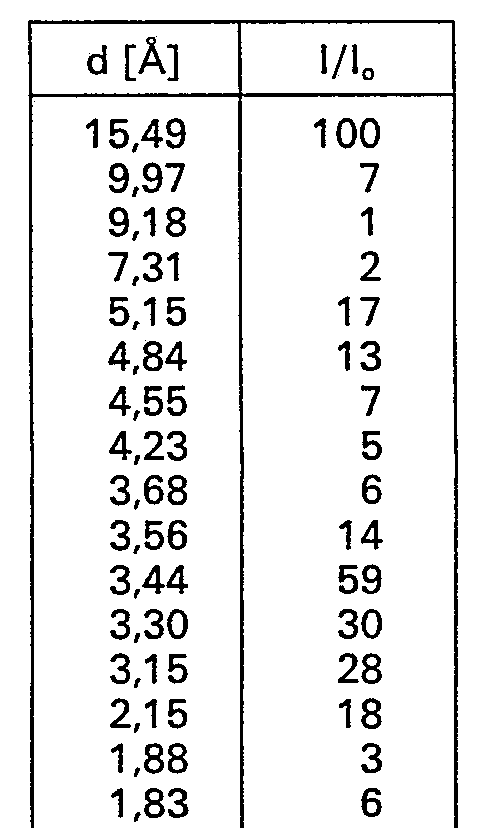
- the invention relates to a crystalline aluminosilicate PZ 1 with the chemical composition: and the following X-ray diffraction pattern:
- the template compound Bu 3 -P- (CH 2 ) 3 -P Bu 3 Br 2 and / or Bu 3 P- (CH 2 ) 3 -PBu 3 J 2 can be used.
- the aluminosilicate produced by means of the method according to the invention has the designation PZ 1. It can be characterized by its composition, its adsorption behavior, its crystal form and its X-ray diffraction diagram.
- the aluminosilicate PZ 1 has the following chemical composition: Scanning electron micrographs show platelets that have grown together to form agglomerates (cf. FIG. 1).
- Table 1 The X-ray diffraction diagram (Table 1) essentially shows the following lines:
- d [ ⁇ ] denotes the interplanar distances and I / I their relative intensities.
- aluminosilicate PZ 1 is treated with dilute acids, preferably mineral acids, such as 1N sulfuric acid or hydrochloric acid or subjected to an ion exchange with NH 4 CI and subsequent calcination, a new crystalline aluminosilicate PZ 2 is formed.
- dilute acids preferably mineral acids, such as 1N sulfuric acid or hydrochloric acid
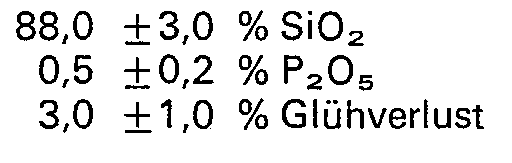
- the invention further provides a crystalline aluminosilicate PZ 2 with the chemical composition: and the X-ray diffraction chart below
- R methyl, ethyl, propyl and / or butyl
- n 2, 3, 4, 5 and / or 6
- X Br s and / or J e
- the aluminosilicate PZ 2 is suitable for use as catalysts, in particular for converting alcohols into hydrocarbons.
- a mineral layered silicate is known from the literature (HP. Eugster, Science 57, 1157 (1967)), the X-ray diffraction pattern of which is similar to that of PZ 1, but shows significant differences at many interplanar distances.
- the mineral layered silicate, magadiite is described as a sodium silicate hydrate of the formula NaSi 7 O 13 (OH) 3 .3H 2 O, while aluminum compounds must be present for the crystallization of PZ 1. If the SiO 2 / Al 2 O 3 ratio is increased beyond about 250, PZ 1 is no longer obtained, but another product.
- US Pat. No. 4,285,922 discloses the production of an unidentified material, which has an X-ray diffraction pattern similar to that of PZ 1, as a by-product in the crystallization of ZSM 5. However, this material is preferably produced with SiO 2 / Al 2 O 3 ratios that are greater than 500, but at least greater than 300. PZ 1, on the other hand, occurs at molar ratios between about 50 and about 250. Another crucial difference is the behavior in the case of ion exchange.
- the X-ray diffraction pattern given in US Pat. No. 4,285,922 is characteristic of all products obtained by ion exchange, while PZ 1 undergoes a rearrangement during ion exchange, for example with NH 4 CI. PZ 2, for which a modified X-ray diffraction pattern is observed.
- alumina trihydrate 2.5 g are dissolved in 50 ml of a 6.2N NaOH and to a suspension of 120 g of precipitated silica (89% SiO 2 ) in a solution of 25 g of Bu 3 P- (CH 2 ) 3 -PBu 3 Br 2 placed in 750 ml H 2 O.
- the mixture is stirred at 50 ° C. for 20 min, transferred to a steel autoclave and stirred at 100 ° C. for 310 h. After crystallization has ended, the crystals are separated off by filtration, washed with water and dried at 120 ° C. for 12 h.
- Example 2 The procedure is analogous to Example 1, but instead of alumina trihydrate the same amount of sodium aluminate is used, the amount of NaOH is reduced to 3.5 g and the mixture is stirred at 130 ° C. for 200 hours.
- Example 2 In contrast to Example 1, 4.2 g of alumina trihydrate, 16.5 g of NaOH and 100 g of precipitated silica are used and the mixture is stirred at 160 ° C. for 50 h.
- Examples 5 and 6 give well crystallized aluminosilicate PZ 2.
Landscapes
- Chemical & Material Sciences (AREA)
- Organic Chemistry (AREA)
- Inorganic Chemistry (AREA)
- Crystallography & Structural Chemistry (AREA)
- Engineering & Computer Science (AREA)
- Materials Engineering (AREA)
- Chemical Kinetics & Catalysis (AREA)
- Silicates, Zeolites, And Molecular Sieves (AREA)
- Organic Low-Molecular-Weight Compounds And Preparation Thereof (AREA)
- Production Of Liquid Hydrocarbon Mixture For Refining Petroleum (AREA)
Description
- Die Erfindung betrifft ein Verfahren zur Herstellung des neuen kristallinen Alumosilikates PZ 1, das Alumosilikat PZ 1 selbst, die Herstellung des Alumosilikates PZ 2 aus dem Alumosilikat PZ 1, das Alumosilikat PZ 2 selbst, sowie die Verwendung des Alumosilikates PZ 2 als Katalysator.
- Gegenstand der Erfindung ist ein kristallines Alumosilikat PZ 1 mitder chemischen Zusammensetzung:

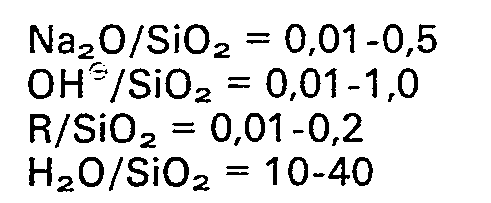
- Das erfindungsgemässe Alumosilikat PZ 1 kann gemäss einem weiteren Gegenstand der Erfindung hergestellt werden, indem man die Kristallisation aus einer wässerigen SiO2, Al2O3 und alkali-haltigen Synthesemischung in Gegenwart einer organischen Templatverbindung der allgemeinen Formel R3P-(CH2)n-PR3X2, in der R = Methyl-, Äthyl-, Propyl- und/oder Butyl-, n = 2,3,4,5 und/ oder 6 und X = Br9 und/oder Je bedeuten, durchführt, wobei man die Synthesemischung mit der molaren Zusammensetzung:

- In einer bevorzugten Ausführungsform der Erfindung kann die Templatverbindung Bu3-P-(CH2)3-P Bu3Br2 und/oder Bu3P-(CH2)3-PBu3J2 eingesetzt werden.
- Das mittels dem erfindungsgemässen Verfahren hergestellte Alumosilikat trägt die Bezeichnung PZ 1. Es kann durch seine Zusammensetzung, sein Adsorptionsverhalten, seine Kristallform und sein Röntgenbeugungsdiagramm charakterisiert werden.
- Das Alumosilikat PZ 1 weistdie folgende chemische Zusammensetzung auf:

- Das Röntgenbeugungsdiagramm (Tabelle 1) zeigt im wesentlichen folgende Linien:

- Es wurde nach Standardmethoden mit einem Szintillationszähler-Diffraktometer bei Cu-Kα1-Strahlung gemessen. d [ Ä] bezeichnet die interplanaren Abstände und I/I deren relative Intensitäten.
- Adsorptionsmessungen (20°C, 50% relativer Dampfdruck) führten zu folgenden Ergebnissen (Angaben in g adsorbierte Substanz pro g Silikat):

- Wird das Alumosilikat PZ 1 mit verdünnten Säuren, vorzugsweise Mineralsäuren, wie beispielsweise 1 n Schwefelsäure oder Salzsäure behandelt bzw. einem lonenaustausch mit NH4CI und nachfolgender Calzinierung unterworfen, so entsteht ein neues kristallines Alumosilikat PZ 2.
- Dementsprechend ist ein weiterer Gegenstand der Erfindung ein kristallines Alumosilikat PZ 2 mit der chemischen Zusammensetzung:


- Rasterelektronenmikroskopaufnahmen lassen dagegen keine Änderung von Kristallform oder - grösse beim Übergang PZ 1 -• PZ 2 erkennen.
- Adsorptionsversuche bei 20°C und 50% relativen Dampfdruckes führten zu folgenden Ergebnissen:

- Das erfindungsgemässe Alumosilikat PZ 2 kann gemäss einem weiteren Gegenstand der Erfindung hergestellt werden, indem man die Kristallisation aus einer wässerigen SiO2, Al2O3 und alkali-haltigen Synthesemischung in Gegenwart einer organischen Templatverbindung der allgemeinen Formel R3P-(CH2)n-PR3X2, in der R = Methyl-, Äthyl-, Propyl- und/oder Butyl-, n = 2, 3, 4, 5 und/oder 6 und X = Brs und/oder Je bedeuten, durchführt, wobei man die Synthesemischung mit der molaren Zusammensetzung:

- Das Alumosilikat PZ 2 ist zur Verwendung als Katalysatoren, insbesondere zur Umwandlung von Alkoholen in Kohlenwasserstoffe geeignet.
- Aus der Literatur (HP. Eugster, Science 57, 1157 (1967)) ist ein mineralisches Schichtsilikat bekannt, dessen Röntgenbeugungsdiagramm dem von PZ 1 ähnelt, jedoch bei vielen interplanaren Abständen deutliche Unterschiede aufweist.
- Das mineralische Schichtsilikat, Magadiit, wird als Natriumsilikat-Hydrat der Formel NaSi7O13(OH)3·3H2O beschrieben, während zur Kristallisation von PZ 1 Aluminiumverbindungen anwesend sein müssen. Bei Erhöhung des SiO2/Al2O3-Verhältnisses über etwa 250 hinaus wird nicht mehr PZ 1 sondern ein anderes Produkt erhalten.
- In der gleichen Literaturstelle wird auch die Umwandlung von Magadiit in eine Verbindung SH beschrieben, deren Röntgenbeugungsdiagramm dem von PZ 2 ähnelt, jedoch ebenso deutliche Unterschiede aufweist. Ausserdem wird in der oben angeführten Literaturstelle ausführlich die Überführung von SH in Magadiit durch Behandeln mit Na2CO3 oder NaOH beschrieben. Bei der Behandlung von PZ 2 mit diesen Verbindungen wird analytisch zwar eine Natrium-Aufnahme nachgewiesen, es kommt jedoch nicht zu einer Struktur- änderung PZ 2→PZ 1, wie durch die Aufnahmen von Röntgenbeugungsdiagramm leicht nachgewiesen werden kann.
- Aus der US-PS Nr. 4285922 ist die Herstellung eines nichtidentifizierten Materials, das ein ähnliches Röntgenbeugungsdiagramm wie PZ 1 aufweist, als Nebenprodukt bei der Kristallisation von ZSM 5 bekannt. Dieses Material entsteht jedoch bevorzugt bei SiO2/Al2O3-Verhältnissen, die grösser als 500, mindestens jedoch grösser als 300 sind. PZ 1 dagegen entsteht bei Molverhältnissen zwischen etwa 50 und etwa 250. Ein weiterer, entscheidender Unterschied besteht im Verhalten bei lonenaustausch. Das in der US-PS Nr. 4285922 angegebene Röntgenbeugungsdiagramm ist charakteristisch für alle durch Ionenaustausch erhaltenen Produkte, während es bei PZ 1 beim lonenaustausch zum Beispiel mit NH4CI zu einer Umlagerung zu.PZ 2 kommt, für das ein verändertes Röntgenbeugungsdiagramm beobachtet wird.
- 2,5 g Tonerdetrihydrat werden in 50 ml einer 6,2N NaOH gelöst und zu einer Suspension von 120 g gefällter Kieselsäure (89% Si02) in einer Lösung von 25 g Bu3P-(CH2)3-PBu3Br2 in 750 ml H2O gegeben. Die Mischung wird 20 min bei 50°C gerührt, in einen Stahlautoklaven überführt und 310 h bei 100° C gerührt. Nach beendeter Kristallisation werden die Kristalle durch Filtration abgetrennt, mit Wasser gewaschen und 12 h bei 120° C getrocknet.
- Die Durchführung geschieht analog zu Beispiel 1, jedoch wird anstelle von Tonerdetrihydrat die gleiche Menge Natriumaluminat eingesetzt, die NaOH-Menge auf 3,5 g verringert und 200 h bei 130°C gerührt.
- Hier werden Unterschied zu Beispiel 1 4,2 g Tonerdetrihydrat, 16,5 g NaOH und 100 g gefällter Kieselsäure verwendet und 50 h bei 160°C gerührt.
- Die Mengen betragen hier:

- Es wird 14 h bei 175°C kristallisiert.
- In den Beispielen 1 bis 4 wird gut kristallisiertes Alumosilikat PZ 1 erhalten.
- 50 g PZ 1 aus Beispiel 2 werden in 500 ml 1 N HCI2 h bei 80° C gerührt, abfiltriert, mit H20 bis zur Neutralität gewaschen und 17 h bei 120° C getrocknet.
- 30 g PZ 1 aus Beispiel 2 werden in 300 ml 5N NH4CI-Lösung 2 h bei 80° C gerührt, abfiltriert, mit H20 bis zur Cl⊖-Freiheit gewaschen, 4 h bei 120° C getrocknet und 16 h bei 550°C calziniert.
- Die Beispiele 5 und 6 ergeben gut kristallisiertes Alumosilikat PZ 2.
Claims (6)




Priority Applications (1)
| Application Number | Priority Date | Filing Date | Title |
|---|---|---|---|
| AT83100047T ATE17340T1 (de) | 1982-03-27 | 1983-01-05 | Kristallines alumosilikat, verfahren zu seiner herstellung und verwendung. |
Applications Claiming Priority (2)
| Application Number | Priority Date | Filing Date | Title |
|---|---|---|---|
| DE3211433A DE3211433C2 (de) | 1982-03-27 | 1982-03-27 | Kristallines Alumosilikat PZ 1 und Verfahren zu seiner Herstellung |
| DE3211433 | 1982-03-27 |
Publications (2)
| Publication Number | Publication Date |
|---|---|
| EP0091537A1 EP0091537A1 (de) | 1983-10-19 |
| EP0091537B1 true EP0091537B1 (de) | 1986-01-08 |
Family
ID=6159548
Family Applications (1)
| Application Number | Title | Priority Date | Filing Date |
|---|---|---|---|
| EP83100047A Expired EP0091537B1 (de) | 1982-03-27 | 1983-01-05 | Kristallines Alumosilikat, Verfahren zu seiner Herstellung und Verwendung |
Country Status (5)
| Country | Link |
|---|---|
| US (1) | US4481174A (de) |
| EP (1) | EP0091537B1 (de) |
| AT (1) | ATE17340T1 (de) |
| DE (2) | DE3211433C2 (de) |
| SU (3) | SU1407395A3 (de) |
Families Citing this family (20)
| Publication number | Priority date | Publication date | Assignee | Title |
|---|---|---|---|---|
| US4568654A (en) * | 1982-11-03 | 1986-02-04 | Mobil Oil Corporation | Zeolite ZSM-51 composition |
| US4840780A (en) * | 1983-03-28 | 1989-06-20 | Mobil Oil Corporation | ZSM-51, method of preparing same and catalytic conversion therewith |
| DE3400130A1 (de) * | 1984-01-04 | 1985-07-11 | Hoechst Ag, 6230 Frankfurt | Kristalline kieselsaeure, ihre salze und verfahren zu ihrer herstellung |
| DE3400132A1 (de) * | 1984-01-04 | 1985-07-11 | Hoechst Ag, 6230 Frankfurt | Verfahren zur herstellung von kristallinen alkalischichtsilikaten |
| US4582693A (en) * | 1984-11-16 | 1986-04-15 | The Standard Oil Company | Synthesis of silica molecular sieves using synthesis directing organic dyes |
| US4626421A (en) * | 1985-06-28 | 1986-12-02 | Chevron Research Company | Preparation of magadiite |
| DE3532748A1 (de) * | 1985-09-13 | 1987-03-19 | Degussa | Templatverbindungen, ihre herstellung und verwendung |
| CA1272999A (en) * | 1985-11-12 | 1990-08-21 | Guenter H. Kuehl | Crystalline layered and large pore catalytic material |
| ZA867945B (en) * | 1985-11-12 | 1988-05-25 | Mobil Oil Corp | Layered silicates |
| US4663139A (en) * | 1985-12-16 | 1987-05-05 | Union Carbide Corporation | Crystalline AlPO4 -39 |
| US4786487A (en) * | 1986-01-03 | 1988-11-22 | Mobil Oil Corporation | Preparation of crystalline silicoaluminophosphates |
| DK168988B1 (da) * | 1986-01-24 | 1994-07-25 | Topsoe Haldor As | Krystallinsk aluminosilikat, fremgangsmåde til fremstilling deraf og anveldelse deraf |
| US5962028A (en) * | 1988-04-20 | 1999-10-05 | Norian Corporation | Carbonated hydroxyapatite compositions and uses |
| US4981663A (en) * | 1988-05-09 | 1991-01-01 | Mobil Oil Corp. | Synthetic crystal MCM-35 |
| US5785946A (en) * | 1994-08-22 | 1998-07-28 | Board Of Trustees Operating Michigan State University | Crystalline inorganic oxide compositions prepared by neutral templating route |
| US7083766B2 (en) * | 2004-12-23 | 2006-08-01 | Chevron U.S.A. Inc. | Reduction of oxides of nitrogen in a gas stream using molecular sieve SSZ-71 |
| US7083776B2 (en) * | 2004-12-23 | 2006-08-01 | Chevron U.S.A. Inc. | Molecular sieve SSZ-71 composition of matter and synthesis thereof |
| US7091385B2 (en) * | 2004-12-23 | 2006-08-15 | Chevron U.S.A. Inc. | Acylation using molecular sieve SSZ-71 |
| US7087792B2 (en) * | 2004-12-23 | 2006-08-08 | Chevron U.S.A. Inc. | Partial oxidation using molecular sieve SSZ-71 |
| EP2130586A1 (de) * | 2008-06-06 | 2009-12-09 | Total Petrochemicals Research Feluy | Herstellungsverfahren für kristalline Metallsilikate |
Family Cites Families (5)
| Publication number | Priority date | Publication date | Assignee | Title |
|---|---|---|---|---|
| US3947482A (en) * | 1974-03-20 | 1976-03-30 | W. R. Grace & Co. | Method for producing open framework zeolites |
| US4285922A (en) * | 1979-09-10 | 1981-08-25 | Mobil Oil Corporation | Method of preparing crystalline zeolite |
| US4430314A (en) * | 1980-06-06 | 1984-02-07 | Mobil Oil Corporation | Method of preparing crystalline zeolite |
| EP0042225B1 (de) * | 1980-06-12 | 1984-02-01 | Imperial Chemical Industries Plc | Zeolithsynthese |
| US4427787A (en) * | 1982-03-08 | 1984-01-24 | Mobil Oil Corporation | Activation of zeolites |
-
1982
- 1982-03-27 DE DE3211433A patent/DE3211433C2/de not_active Expired
-
1983
- 1983-01-05 DE DE8383100047T patent/DE3361728D1/de not_active Expired
- 1983-01-05 EP EP83100047A patent/EP0091537B1/de not_active Expired
- 1983-01-05 AT AT83100047T patent/ATE17340T1/de not_active IP Right Cessation
- 1983-01-10 SU SU833548250A patent/SU1407395A3/ru active
- 1983-03-23 US US06/477,874 patent/US4481174A/en not_active Expired - Fee Related
- 1983-10-06 SU SU833652131A patent/SU1315014A1/ru active
-
1985
- 1985-03-21 SU SU853868331A patent/SU1324680A1/ru active
Also Published As
| Publication number | Publication date |
|---|---|
| ATE17340T1 (de) | 1986-01-15 |
| SU1315014A1 (ru) | 1987-06-07 |
| DE3211433C2 (de) | 1984-12-13 |
| EP0091537A1 (de) | 1983-10-19 |
| DE3361728D1 (en) | 1986-02-20 |
| SU1407395A3 (ru) | 1988-06-30 |
| SU1324680A1 (ru) | 1987-07-23 |
| DE3211433A1 (de) | 1983-09-29 |
| US4481174A (en) | 1984-11-06 |
Similar Documents
| Publication | Publication Date | Title |
|---|---|---|
| EP0091537B1 (de) | Kristallines Alumosilikat, Verfahren zu seiner Herstellung und Verwendung | |
| DE68924640T2 (de) | Zeolithe. | |
| DE2743143C3 (de) | Polymorphes kristallines Siliziumdioxid und Verfahren zu seiner Herstellung | |
| DE69221638T2 (de) | Verfahren zur synthese kristalliner microporöser silicoaluminophosphate | |
| DE2643929C2 (de) | Verfahren zur Herstellung von Zeolith | |
| EP0010572B1 (de) | Kristalline Eisensilikate mit Zeolithstruktur sowie Verfahren zu ihrer Herstellung | |
| DE602004009011T2 (de) | Kristallinisches Material IM-12 und Verfahren zu seiner Herstellung | |
| DE3119160A1 (de) | Caesiumhaltiger zeolith und verfahren zu dessen herstellung | |
| DE69122088T2 (de) | Zeolith vom mtw-typ sowie verfahren zu seiner herstellung | |
| DE3490383T1 (de) | Verfahren zur Herstellung von hochreinem Aluminiumoxid | |
| DE1792631C3 (de) | Verfahren zur Herstellung von Mordenit durch Erhitzen amorpher Silicium-Aluminiumoxid-Gemische | |
| DE3490097T1 (de) | Bindemittelfreie Zeolithkatalysatoren, Verfahren zu ihrer Herstellung und katalytische Reaktion mit ihnen | |
| DE68915458T2 (de) | Zeolith L. | |
| DE3881833T2 (de) | Verfahren zur Herstellung synthetischer Saponite. | |
| EP0017028B1 (de) | Verfahren zur Herstellung einer kristallinen SiO2-Modifikation | |
| DE3781345T2 (de) | Synthese eines zeoliths. | |
| DE2008644A1 (de) | Verfahren zur Transalkylierung aromatischer Kohlenwasserstoffe | |
| DE2058871C3 (de) | Verfahren zur Herstellung eines Zeoliths | |
| EP0082924B1 (de) | Verfahren zur Herstellung von grobkörnigem Mordenit | |
| DE68909494T2 (de) | Zeolithe mit dem Strukturtyp von Ton, ihre Herstellung und ihre Verwendung. | |
| DE69203776T2 (de) | Verfahren zur Herstellung eines kristallinen Zeolithen. | |
| DE68909508T2 (de) | Verfahren zur Synthese von Zeolithen vom MTT-Strukturtyp. | |
| DE3048819A1 (de) | Verfahren zur herstellung eines kristallinen aluminosilikat-zeoliths | |
| DE3239825A1 (de) | Kristallines alumosilikat, verfahren zu seiner herstellung und verwendung | |
| DE3240869A1 (de) | Titan-, zirkon- und/oder hafniumhaltige zeolithe und verfahren zu ihrer herstellung sowie ihre verwendung |
Legal Events
| Date | Code | Title | Description |
|---|---|---|---|
| PUAI | Public reference made under article 153(3) epc to a published international application that has entered the european phase |
Free format text: ORIGINAL CODE: 0009012 |
|
| 17P | Request for examination filed |
Effective date: 19830105 |
|
| AK | Designated contracting states |
Designated state(s): AT BE CH DE FR GB IT LI LU NL SE |
|
| GRAA | (expected) grant |
Free format text: ORIGINAL CODE: 0009210 |
|
| AK | Designated contracting states |
Designated state(s): AT BE CH DE FR GB IT LI LU NL SE |
|
| REF | Corresponds to: |
Ref document number: 17340 Country of ref document: AT Date of ref document: 19860115 Kind code of ref document: T |
|
| ITF | It: translation for a ep patent filed | ||
| ET | Fr: translation filed | ||
| REF | Corresponds to: |
Ref document number: 3361728 Country of ref document: DE Date of ref document: 19860220 |
|
| PLBE | No opposition filed within time limit |
Free format text: ORIGINAL CODE: 0009261 |
|
| STAA | Information on the status of an ep patent application or granted ep patent |
Free format text: STATUS: NO OPPOSITION FILED WITHIN TIME LIMIT |
|
| 26N | No opposition filed | ||
| PG25 | Lapsed in a contracting state [announced via postgrant information from national office to epo] |
Ref country code: LU Free format text: LAPSE BECAUSE OF NON-PAYMENT OF DUE FEES Effective date: 19870131 |
|
| PGFP | Annual fee paid to national office [announced via postgrant information from national office to epo] |
Ref country code: NL Payment date: 19890131 Year of fee payment: 9 |
|
| PGFP | Annual fee paid to national office [announced via postgrant information from national office to epo] |
Ref country code: SE Payment date: 19901212 Year of fee payment: 9 |
|
| PGFP | Annual fee paid to national office [announced via postgrant information from national office to epo] |
Ref country code: LU Payment date: 19901214 Year of fee payment: 9 |
|
| PGFP | Annual fee paid to national office [announced via postgrant information from national office to epo] |
Ref country code: DE Payment date: 19901217 Year of fee payment: 9 |
|
| PGFP | Annual fee paid to national office [announced via postgrant information from national office to epo] |
Ref country code: BE Payment date: 19901220 Year of fee payment: 9 |
|
| PGFP | Annual fee paid to national office [announced via postgrant information from national office to epo] |
Ref country code: GB Payment date: 19901228 Year of fee payment: 9 |
|
| PGFP | Annual fee paid to national office [announced via postgrant information from national office to epo] |
Ref country code: AT Payment date: 19910102 Year of fee payment: 9 |
|
| PGFP | Annual fee paid to national office [announced via postgrant information from national office to epo] |
Ref country code: CH Payment date: 19910111 Year of fee payment: 9 |
|
| PGFP | Annual fee paid to national office [announced via postgrant information from national office to epo] |
Ref country code: FR Payment date: 19910123 Year of fee payment: 9 |
|
| ITTA | It: last paid annual fee | ||
| EPTA | Lu: last paid annual fee | ||
| PG25 | Lapsed in a contracting state [announced via postgrant information from national office to epo] |
Ref country code: GB Effective date: 19920105 Ref country code: AT Effective date: 19920105 |
|
| PG25 | Lapsed in a contracting state [announced via postgrant information from national office to epo] |
Ref country code: SE Effective date: 19920106 |
|
| PG25 | Lapsed in a contracting state [announced via postgrant information from national office to epo] |
Ref country code: LI Effective date: 19920131 Ref country code: CH Effective date: 19920131 Ref country code: BE Effective date: 19920131 |
|
| BERE | Be: lapsed |
Owner name: DEGUSSA A.G. Effective date: 19920131 |
|
| PG25 | Lapsed in a contracting state [announced via postgrant information from national office to epo] |
Ref country code: NL Effective date: 19920801 |
|
| GBPC | Gb: european patent ceased through non-payment of renewal fee | ||
| NLV4 | Nl: lapsed or anulled due to non-payment of the annual fee | ||
| PG25 | Lapsed in a contracting state [announced via postgrant information from national office to epo] |
Ref country code: FR Effective date: 19920930 |
|
| REG | Reference to a national code |
Ref country code: CH Ref legal event code: PL |
|
| PG25 | Lapsed in a contracting state [announced via postgrant information from national office to epo] |
Ref country code: DE Effective date: 19921001 |
|
| REG | Reference to a national code |
Ref country code: FR Ref legal event code: ST |
|
| EUG | Se: european patent has lapsed |
Ref document number: 83100047.6 Effective date: 19920806 |