EP0091692A2 - Méthode et appareil pour mesurer le spectre de matériaux - Google Patents
Méthode et appareil pour mesurer le spectre de matériaux Download PDFInfo
- Publication number
- EP0091692A2 EP0091692A2 EP83103538A EP83103538A EP0091692A2 EP 0091692 A2 EP0091692 A2 EP 0091692A2 EP 83103538 A EP83103538 A EP 83103538A EP 83103538 A EP83103538 A EP 83103538A EP 0091692 A2 EP0091692 A2 EP 0091692A2
- Authority
- EP
- European Patent Office
- Prior art keywords
- zero level
- spectrum
- values
- radiation
- measured
- Prior art date
- Legal status (The legal status is an assumption and is not a legal conclusion. Google has not performed a legal analysis and makes no representation as to the accuracy of the status listed.)
- Granted
Links
Images



Classifications
-
- G—PHYSICS
- G01—MEASURING; TESTING
- G01J—MEASUREMENT OF INTENSITY, VELOCITY, SPECTRAL CONTENT, POLARISATION, PHASE OR PULSE CHARACTERISTICS OF INFRARED, VISIBLE OR ULTRAVIOLET LIGHT; COLORIMETRY; RADIATION PYROMETRY
- G01J3/00—Spectrometry; Spectrophotometry; Monochromators; Measuring colours
- G01J3/02—Details
-
- G—PHYSICS
- G01—MEASURING; TESTING
- G01J—MEASUREMENT OF INTENSITY, VELOCITY, SPECTRAL CONTENT, POLARISATION, PHASE OR PULSE CHARACTERISTICS OF INFRARED, VISIBLE OR ULTRAVIOLET LIGHT; COLORIMETRY; RADIATION PYROMETRY
- G01J3/00—Spectrometry; Spectrophotometry; Monochromators; Measuring colours
- G01J3/02—Details
- G01J3/0205—Optical elements not provided otherwise, e.g. optical manifolds, diffusers, windows
- G01J3/0232—Optical elements not provided otherwise, e.g. optical manifolds, diffusers, windows using shutters
-
- G—PHYSICS
- G01—MEASURING; TESTING
- G01J—MEASUREMENT OF INTENSITY, VELOCITY, SPECTRAL CONTENT, POLARISATION, PHASE OR PULSE CHARACTERISTICS OF INFRARED, VISIBLE OR ULTRAVIOLET LIGHT; COLORIMETRY; RADIATION PYROMETRY
- G01J3/00—Spectrometry; Spectrophotometry; Monochromators; Measuring colours
- G01J3/02—Details
- G01J3/0289—Field-of-view determination; Aiming or pointing of a spectrometer; Adjusting alignment; Encoding angular position; Size of measurement area; Position tracking
-
- G—PHYSICS
- G01—MEASURING; TESTING
- G01J—MEASUREMENT OF INTENSITY, VELOCITY, SPECTRAL CONTENT, POLARISATION, PHASE OR PULSE CHARACTERISTICS OF INFRARED, VISIBLE OR ULTRAVIOLET LIGHT; COLORIMETRY; RADIATION PYROMETRY
- G01J3/00—Spectrometry; Spectrophotometry; Monochromators; Measuring colours
- G01J3/28—Investigating the spectrum
- G01J3/42—Absorption spectrometry; Double beam spectrometry; Flicker spectrometry; Reflection spectrometry
-
- G—PHYSICS
- G01—MEASURING; TESTING
- G01N—INVESTIGATING OR ANALYSING MATERIALS BY DETERMINING THEIR CHEMICAL OR PHYSICAL PROPERTIES
- G01N21/00—Investigating or analysing materials by the use of optical means, i.e. using sub-millimetre waves, infrared, visible or ultraviolet light
- G01N21/17—Systems in which incident light is modified in accordance with the properties of the material investigated
- G01N21/25—Colour; Spectral properties, i.e. comparison of effect of material on the light at two or more different wavelengths or wavelength bands
- G01N21/27—Colour; Spectral properties, i.e. comparison of effect of material on the light at two or more different wavelengths or wavelength bands using photo-electric detection ; circuits for computing concentration
- G01N21/274—Calibration, base line adjustment, drift correction
Definitions
- Solid state photoresistor or photodiodes are frequently applied in photometers and spectrophotometers as sensing elements to detect radiation. These sensors are connected to a suitable measuring circuit so that the output voltage of the resulted intensity measuring unit should be proportional to the radiation to be measured.
- the dark resistance of the photoresistors i.e. the measurable resistance of unradiated photresistors is not of infinite but of finite value depending also on temperature.
- the dark current of photodiodes is not zero either, but of finite value depending also on temperature.
- the nondesirable additional error is the result of the analog method of storing the voltage necessary to compensate the output, namely a capacitor charged to the required voltage to store it during the next measuring period.
- This storage can however be of limited accuracy, since some of the charge will be lost partly as a result of the conductivity of the capacitor and partly as a result of the finite resistance of the circuits connected. Consequently, the output voltage accurately zeroed at the beginning of the measuring period would differ from zero at the end of the measuring period even if the dark signal of the sensing element did,not change meanwhile.
- the invention on the one hand provides a method for measuring the spectrum of a material, comprising the steps of irradiating a sample of the material to be tested with a radiation of required wavelengths and measuring spectrum signals produced by an intensity measuring unit as a result of the radiation reflected or transmitted by the sample.
- This method is characterized by first measuring a zero level signal produced by the intensity measuring unit in an unradiated condition and storing the measured zero level value, then measuring one or more spectrum signals at at least one wavelength and storing the one or more spectrum signal values, then measuring again the zero level signal produced by the intensity measuring unit in an unradiated condition and storing the measured value, preferably said one or more spectrum signal measurements at at least one wavelength prescribed and said storage of the measured values as well as said zero level signal measurement and said storage of the measured value are repeated as many times as required, and finally modifying the stored spectrum values by correction values generated on the basis of the stored zero level values.
- the present invention also relates to a method for measuring the spectrum of a material, comprising the steps of irradiating a sample of the material to be tested with a radiation of required wavelengths and measuring spectrum signals produced by an intensity measuring unit as a result of the radiation reflected or transmitted by the sample, herein the intensity measuring unit is set to zero in an unradiated condition.
- This method is characterized by measuring one or more spectrum signals at at least one wavelength following the zeroing of the intensity measuring unit and storing the one or more measured spectrum values, then measuring the zero level signal produced by the intensity measuring unit in an unradiated condition and storing the measured zero level value, then preferably said one or more spectrum signal measurements at at least one wavelength prescribed and said storage of the measured values as well as said zero level signal measurement and said storage of the measured value are repeated as many times as required, and finally modifying the stored spectrum values by correction values generated on the basis of the stored zero level value(s).
- the method according to the invention makes it possible to attain a higher accuracy of measurement than by the methods known heretofore, since based on the zeroing and/or measurement of the zero level preceding the period of spectrum measurement and the measurement of the zero level succeeding the period of spectrum measurement, each spectrum value measured during the period of measurement is modified by a correction value corresponding to the exact time of the measurement, which correction value approximates very well the time-dependent variation of the zero level within the period of the measurement.
- the correction values can preferably be generated by linear interpolation. Inasmuch the value of the zero level signal is always measured between several periods of spectrum measurements, the accuracy can further be increased by applying a higher order approximation.
- the measurement of the zero level signal and the storage of the zero level value are performed by several successive measurements of the signal produced by the intensity measuring unit being in an unradiated condition and storing the values measured.
- the zero level values derived from the averaging of the values of successive measurements are employed to generate the correction values, so the effect of interferences or noise occuring also in course of the zero level measurements is considerably reduced.
- the present invention on the other hand provides an apparatus for measuring the spectrum of a material, comprising a controllable monochromator emitting radiation of a required wavelength onto a sample of the material to be tested, an intensity measuring unit provided with a sensor sensitive to the radiation reflected or transmitted by the sample, a data processing unit connected to the intensity measuring unit via an analog-to-digital converter, and a control unit controlling the analog-to-digital converter synchronously with the monochromator while irradiating the sample with radiation of the required wavelength.
- This apparatus is characterized according to the present invention in that said control unit comprises means to provide at least one start signal onto a control input of the analog--to-digital converter prior to and/or after the period of irradiating the sample with radiation of the required wavelength.
- the control unit comprises a rotatable member attached to a shaft controlling the wavelength of the radiation emitted by the monochromator, an auxiliary light source and an auxiliary detector sensitive to the light of the auxiliary light source, said rotatable member being positioned between the monochromator and the sample as well as between the auxiliary light source and the auxiliary detector, said rotatable member being provided with a radiation-transparent section formed as a diaphragm in the path of the radiation beam emitted by the monochromator and at least one first opening transparent to light and formed as a diaphragm in the path of the light beam of the auxiliary light source and positioned rotationally preceding and/or succeeding said radiation-transparent section, and an output of the auxiliary detector being connected to the control input of the analog-to-digital converter.
- the rotatable member is advantageously provided with at least one transparent second opening rotationally aligned with said radiation-transparent section and forced as a diaphragm in the path of the light beam of the auxil:.ary light source.
- timing of the zero level signal measurements as well as the spectrum signal measurement: is controlled by the rotatable member, preferably shaped as a disc, a cup or a drum.
- the rotatable member can also be applied to control the zeroing operation, for this purpose the apparatus is provided with a further auxiliary light source and a further auxiliary detector sensitive to the light of said further auxiliary light source, said rotatable member being provided with a transparent third opening formed as a diaphragm in the path of the light beam of the further auxiliary light source and positioned rotationally preceding said radiation-transparent section, and an output of the further auxiliary detector is connected to a zeroing input of the intensity measuring unit.
- the output of the auxiliary detector is connected to the control input of the analog-to-digital converter via an electronic timing circuit.
- the timing circuit is started by the corresponding opening provided on said rotatable member, and the timing of the zero level measurements as well as the timing of the spectrum measurements - preferably the zeroing, too - are performed by the electronic timing circuit, e.g. by a microprocessor.
- the data processing unit and the control unit are realized by a microprocessor having first and second control outputs, the first control output being connected to the control input of the analog-to-digital converter and the second control output being connected to a device controlling the monochromator.
- a third control output of the microprocessor may expediently control the zeroing of the intensity measuring unit.
- the control of the monochromator can preferably be realized by applying a stepper motor as a control device for the monochromator, the stepper motor being connected to said second control output of the microprocessor via a motor control unit.
- the apparatus may be provided with an electromagnetically operated diaphragm in the path of the radiation beam emitted by the monochromator and a driver unit for the diaphragm, said driver unit being connected to a fourth control output of the microprocessor.
- the apparatus illustrated in Fig. 1 comprises a disc-shaped rotatable member 7, the top view of which taken along the section line A-A of Fig. 1 is shown in Fig. 2.
- the rotatable member 7 is illustrated in a position corresponding to section line B-B of Fig. 2.
- the radiation of the required wavelength is produced by a monochromator 1, the beam is emitted through a slit 6.
- the wavelength of the emitted beam depends on the angular position of a control shaft 2 of the monochromator 1.
- the shaft 2 is driven by a motor 3 - in this case via a unit 5 changing rotational speed - and the motor 3 is connected to an output of a motor control unit 28.
- the sensor 11 must be selected according to the wavelength of the radiation, it may be for example a photodiode or a photoresistor providing an analog electric signal on its output proportional to the intensity of the beam of radiation applied to its input. This electric signal is applied to the input of a zeroable amplifier 12 providing an amplified analog signal on its output 36.
- the sensor 11 and the amplifier 12 together constitute an intensity measuring unit 34 providing on its output 36 an analog electric signal, i.e. voltage, proportional to the intensity of the beam of radiation applied to its input sensitive to the.radiation, and which is zeroed under the effect of a signal applied to its zeroing input 32.
- an analog electric signal i.e. voltage
- the output 36 is connected to the analog input of an analog-to-digital converter 13.
- the analog-to-digital converter 13 converts the analog signal existing on its input into a digital signal at the moment when a signal is applied to its control input 31.
- the digital signal generated by the analog-to-digital converter 13 is transferred via parallel line 30 into a data processing unit 14 strebed by a start signal via control line 24 to read the digital signal.
- a display unit 15 is connected to the data pr:cessing unit 14, and the operator can communicate with the dita processing unit 14 via an operating console 16.
- the motor control unit 28 is also controlled by the data processing unit 14.
- the apparatus comprises furthermore an auxiliary light source 17 and an auxiliary detector 21 placed oppositely, and the latter is connected to a comparator 19, the output of which being connected to the control input 31 of the analog-to-digital converter 13.
- a further auxiliary light source 18 and a further auxiliary detector 22 are also placed oppositely, and the output of the latter is connected, via a comparator 20, to the zeroing input 32 of the amplifier 12 and to the input 33 initiating a data input operation of the data processing unit 14.
- the apparatus is controlled by means of the openings or slots provided on the disc-shaped rotatable member 7.
- an opening 27, openings 26 and an opening 29 are successively formed in one half of the rotatable member 7 opposite the auxiliary light source 17, and similar openings 27A, 26A and 29A are formed centrally symmetrical with respect to the afore-mentioned openings in the other half of the rotatable member 7, too.
- Openings 23 and 23A are provided opposite the auxiliary light source 18.
- Opposite the exit slit 6 of the monochromator 1 there are sections 25 and 25A transparent to the radiation, sections non-transparent to the radiation being between the sections 25 and 25A.
- the apparatus illustrated in Figs. 1 and 2 is applied to perform measurements as described in the followings. Having switched on the apparatus and after the insertion of the sample 10, the operator starts the measuring period via the operating console 16 by giving a start signal to the data processing unit 14 e.g. to a microprocessor, thereby the data processing unit 14 powers the motor control unit 28. Thereupon the motor 3 starts to rotate the rotatable member 7.
- the data processing unit 14 e.g. to a microprocessor
- the intensity measuring unit 34 will be set to zero, since the rotatable member 7 prevents the radiation emitted from the monochromator 1 to reach the sample 10 and so the input of the sensor 11, on the other hand the data processing unit 14 will be enabled to receive digital output signals of the analog-to-digital converter 13 as a result of the control signal applied to its input 33.
- the comparator 19 provides a signal onto the control input 31 of the analog-to-digital-converter 13 which measures the zero level signal existing on the output 36 as the radiation is still prevented to reach the input of the sensor 11 by the rotatable member 7.
- the value of the zero level signal will be stored in the main memory of the data processing unit 14.
- the analog-to-digital converter 13 When the rotatable member 7 is rotated at a: angle y, as a result of the light pulse transmitted through the first one of the openings 26 the analog-to-digital converter 13 performs a spectrum signal measurement at a wavelength defined by the angular position of the shaft 2, and the value measured will be stored in the data processing unit 14. While the rotatable member 7 is further rotating, subsequent measurements will be performed corresponding to the openings 26 and the measured values will be stored. Thereafter the path of the beam of radiation emitted from the slit 6 will be cut off again by the rotatable member 7 and then a zero level signal measurement and storing its value will occur again as a result of the light pulse transmitted through the opening 29.
- each of the openings 26 and 26A corresponds to a certain wavelength value
- the total spectrum measurement is performed during a half turn of the rotatable member 7, e.g. in the monochromator 1 the scanning of the wavelength range in the order of increasing wavelenth corresponds to the openings 26, while the scanning in the order of decreasing wavelength corresponds to the openings 26A.
- This can be realized e.g. with a monochromator 1 having an oscillating grating.
- the data processing unit 14 controls the number of the rotations of the rotatable member 7 during which the zero level and spectrum data are to be measured and stored. After the required number of measuring periods necessary for the averaging operation to decrease the effect of noise and interferences, the motor 3 is stopped by the data processing unit 14 via the motor control unit 28, and the data containing the stored spectrum and zero level values are processed by the data processing unit 14. In course of this operation the spectrum values are modified by correction values generated by means of the related zero level values, and the spectrum values measured several times at the same wavelength are averaged. The modified spectrum can becommunally displayed by the display unit 15.
- the spectrum values measured and stored are modified on basis of the zero level values also measured and stored in such a manner that, within the period related to the zero level values corresponding to the openings 27 and 29, the zero level values related to the time values corresponding to the openings 26 are determined by linear interpolation and these latter values are subtracted from the measured spectrum values corresponding to the openings 26.
- the time interval between two subsequent zero level measurements corresponding to openings 27 and 29 be T, then the calculated zero level value at any intermediate time value t is where U and U T are the measured zero level values corresponding to the openings 27. and 29, and O ⁇ t 5 T.
- the time data are also required.
- these data are also constants defined by the position of the openings provided in the rotatable member 7, so these constants can be taken into consideration when programming the data processing unit 14.
- the value of the time interval T can be e.g. 50 to 400 ms. In a given case, to attain an acceptable accuracy of the spectrum values, it may be sufficient to measure the zero level signal only after the spectrum signal measurement and to suppose a zero level signal equal to zero at the moment of zeroing. For this embodiment only the openings 27 and 27A should be omitted from the rotatable member 7 as illustrated in Fig. 2. If the time interval T is between the zeroing corresponding to the opening 23 and the measurement of the zero level corresponding to the opening 29, the equation(1) can be written as
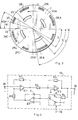
- FIG. 3 Another possible embodiment of the rotatable member 7 applied in the apparatus given in Fig. 1 is illustrated in Fig. 3.
- This rotatable member 7 consists of four symmetrical quarters. Following the zero setting corresponding to the opening 23 six openings 27 are positioned to initiate zero level measurements between angles a1 and a2. Following this, at an angle 6 , the section 25B transparent to the radiation opens the path of the radiation beam emitted from the monochromator 1, and then ten spectrum signal measurements will be performed corresponding to the openings 26 positioned between angles y and 6. It can be seen, that the openings 26 are positioned symmetrically in the range of the section 25 transparent to the radiation, to provide the necessary time delay for the sensor 11 for the transition from dark into exposed condition.
- the rotatable member 7 cuts off again the path of the radiation beam emitted from the monochromator 1 and, when the dark condition of the sensor 11 is settled again, the sequence of measurements described in the first quarter will be repeated again with new zero level measurements corresponding to the openings 27A.
- one complete turn of the rotatable member 7 will result the measuring of e.g. four different spectrum signals ten times each, and each series consisting of ten spectrum signal measurements is preceded by a zero level signal measurement, too. Following the series consisting of four measurements a zeroing will follow corresponding to the opening 23, followed by the measurement of the next four spectrum values.
- the correction values for the measured and stored spectrum values for each complete turn are determined by an interpolation for the spectrum values corresponding to the openings 26, 26A and 26B based on the four zero level values corresponding to the openings 27, 27A, 27B and 27C, each of them obtained by averaging six measured and stored values, and by an extrapolation for the spectrum values corresponding to the openings 26C, respectively.
- the interpolation is expediently performed by determining a function versus time approximating the zero level values related to each complete turns, and the spectrum values, corresponding to the openings 26, 26A and 26B and obtained by averaging ten values, are to be modified according to this function.
- the value of the function is determined e.g. by linear extrapolation, and the spectrum values corresponding to the openings 26C and obtained also by averaging ten values are to be modified according to this extrapolated function.
- FIG. 4 An advantageous embodiment of the zeroable amplifier 12 is illustrated in Fig. 4.
- the input 35 is connected to the non-inverting input of an operational amplifier E1, the output of said amplifier E1 is connected to its inverting input via a feedback resistor R1.
- the output of the amplifier E1 is connected to the inverting input of an operational amplifier E2 through a serial resistor R2, and the output of the amplifier E2 is fed back to the same input via a resistor R3.
- the non-inverting input of the amplifier E2 is connected to the common point of the circuit.
- the output of the amplifier E2 represents the output 36 of the amplifier 12, and at the same time it is connected to the point B of a change-over switch K via a serial resistor R4.
- the change-over switch K is controlled from the input 32 and the point A of it is connected to the common point while the point D is connected to the inverting input of an operational amplifier E3.
- the other input of the amplifier E3 is connected to the common point, and its output is partly fed back to its inverting input via a capacitor C, partly connected to the inveting input of the amplifier E1 via a serial resistor R5.
- the change-over switch K of the amplifier 12 When the change-over switch K of the amplifier 12 is controlled by a zeroing pulse applied to the input 32 to make a galvanic contact between points D and B, the closed control circuit produces zero voltage on the output 36 even if an error voltage differing form zero exists on the input 35.
- the switch K makes a galvanic contact between points D and A thereby setting the amplifier 12 in an amplifying mode and the status of being set to zero is retained until the next zeroing as a consequence of the charge stored in the capacitor C.
- the frequency of the zeroing operation should be suitably selected according to the time constants of the circuit.
- FIG. 5 A further embodiment of the apparatus according to the invention is illustrated in Figs. 5 and 6, where the elements corresponding to the embodiment illustrated in Fig. 1 are provided with the same reference numbers.
- the top view of the rotatable member 7 taken along the section line C-C of Fig. 5 is shown in Fig. 6.
- Fig. 5 a sectional view of the rotatable member 7 can be seen taken along the section line D-D of Fig. 6.
- a zeroing pulse will be transmitted from one output of the timing circuit 40 to the zeroing input 32 of the intensity measuring unit 34 and then, after a certain time delay but before the rotatable member 7 is rotated through the angle S , a pulse will be transmitted from the other output of the timing circuit 40 onto the control input 31 of the analog-to-digital converter 13.
- the zero level signal of the intensity measuring unit 34 is measured .by the analog-to-digital converter 13.
- the timing circuit 40 starts to transmit a series of pulses to the input 31 of the analog-to-digital converter 13.
- Timing circuit 40 can be constructed from common digital circuits and delay elements, but it can be realized by a microprocessor, too.
- FIG. 7 A further embodiment of the apparatus according to the invention is illustrated in Fig. 7, where the elements corresponding to the embodiment illustrated in Fig. 1 are provided with the same reference numbers.
- the complete apparatus is controlled by a microprocessor 41 with an operating console 16 and a display unit 15 connected to it.
- the microprocessor 41 controls a stepper motor 45 via a motor control unit 46, which stepper motor 45 drives the shaft 2 controlling the wavelength of the monochromator 1 via the unit 5 changing the speed of rotation.
- the microprocessor 41 controls an electromagnet 43 via a driver unit 44, which electromagnet 43 operates a diaphragm 42 cutting off and transmitting, respectively, the radiation beam emitted from the exit slit 6 of the monochromator 1.
- the microprocessor 41 further controls the zeroing of the intensity measuring unit 34 by a signal applied to the input 32, and the operation of the analog-to-digital converter 13 by a signal applied to the input 31.
- the output digital signals from the digital-to- analog converter 13 will also be transmitted to the microprocessor 41 via the line 30, and these digital signals will be stored in the memory of the microprocessor 41.
- the measuring process is started by a start signal received from the operating console 16 and is completely controlled by the microprocessor 41.
- the microprocessor 41 After storing the required zero level signal and spectrum values, the microprocessor 41 generates the function approximating the variations of the zero level signal by means of interpolation or interpolation and extrapolation based on the stored zero level values, calculates the correction values given by this function, and subtracts the correction values from the stored spectrum values. If necessary, the microprocessor 41 performs the averaging of the stored spectrum values and zero level values, respectively, before performing the arithmetic operations described above, in order to decrease the effect cf noise and interferences always existing in measurements.
- the microprocessor 41 itself can be realized from widely known commercial circuit elements.
- Switching on and off the radiation beam may also be effected under purely electronic control, e.g. when the monochromator is a tunable laser light source.
- the apparatus according to the invention it may be advantageous to utilize an integrating type analog-to-digital converter 13.
- both the six measurements corresponding to the openings 27 and the ten measurements corresponding to the openings 26 may be substituted by one measurement each, and at the same time the proper rejection of the noise and interferences is also effected.
- the averaging operation to be performed in the course of the data processing may be substituted-by an analog integration resulting in a significant reduction of the memory requirement of the data processing unit and in the reduction of the time necessary for the data processing.
Landscapes
- Physics & Mathematics (AREA)
- Spectroscopy & Molecular Physics (AREA)
- General Physics & Mathematics (AREA)
- Chemical & Material Sciences (AREA)
- Biochemistry (AREA)
- Theoretical Computer Science (AREA)
- Health & Medical Sciences (AREA)
- Life Sciences & Earth Sciences (AREA)
- Engineering & Computer Science (AREA)
- Analytical Chemistry (AREA)
- Mathematical Physics (AREA)
- General Health & Medical Sciences (AREA)
- Immunology (AREA)
- Pathology (AREA)
- Spectrometry And Color Measurement (AREA)
- Analysing Materials By The Use Of Radiation (AREA)
- Investigating Or Analysing Materials By Optical Means (AREA)
Priority Applications (1)
| Application Number | Priority Date | Filing Date | Title |
|---|---|---|---|
| AT83103538T ATE32785T1 (de) | 1982-04-14 | 1983-04-12 | Verfahren und einrichtung zur messung des spektrums von materialien. |
Applications Claiming Priority (2)
| Application Number | Priority Date | Filing Date | Title |
|---|---|---|---|
| HU821139A HU183889B (en) | 1982-04-14 | 1982-04-14 | Method and apparatus for measuring the spectrum of materials |
| HU113982 | 1982-04-14 |
Publications (3)
| Publication Number | Publication Date |
|---|---|
| EP0091692A2 true EP0091692A2 (fr) | 1983-10-19 |
| EP0091692A3 EP0091692A3 (en) | 1984-09-05 |
| EP0091692B1 EP0091692B1 (fr) | 1988-03-02 |
Family
ID=10953004
Family Applications (1)
| Application Number | Title | Priority Date | Filing Date |
|---|---|---|---|
| EP83103538A Expired EP0091692B1 (fr) | 1982-04-14 | 1983-04-12 | Méthode et appareil pour mesurer le spectre de matériaux |
Country Status (5)
| Country | Link |
|---|---|
| US (1) | US4632549A (fr) |
| EP (1) | EP0091692B1 (fr) |
| AT (1) | ATE32785T1 (fr) |
| DE (1) | DE3375824D1 (fr) |
| HU (1) | HU183889B (fr) |
Cited By (2)
| Publication number | Priority date | Publication date | Assignee | Title |
|---|---|---|---|---|
| WO1996012173A1 (fr) * | 1994-10-14 | 1996-04-25 | University Of Washington | Systeme de detection de retard de formation de gouttelettes dans un cytometre de flux |
| WO1996018089A1 (fr) * | 1994-12-09 | 1996-06-13 | Foss Electric A/S | Procede permettant d'obtenir des informations |
Families Citing this family (11)
| Publication number | Priority date | Publication date | Assignee | Title |
|---|---|---|---|---|
| DE3811446A1 (de) * | 1988-04-06 | 1989-10-19 | Bodenseewerk Perkin Elmer Co | Einrichtung zur erzeugung eines magnetfeldes in einem atomabsorptions-spektrometer |
| US4893259A (en) * | 1988-06-02 | 1990-01-09 | The Perkin-Elmer Corporation | Standardization of spectral lines |
| US5270797A (en) * | 1989-07-20 | 1993-12-14 | Brooklyn College Foundation | Method and apparatus for determining a material's characteristics by photoreflectance using improved computer control |
| US5260772A (en) * | 1989-07-20 | 1993-11-09 | Pollak Fred H | Method and apparatus for determining a material's characteristics by photoreflectance |
| US5255071A (en) * | 1989-09-13 | 1993-10-19 | Pollak Fred H | Photoreflectance method and apparatus utilizing acousto-optic modulation |
| WO1991009298A1 (fr) * | 1989-12-19 | 1991-06-27 | Komi Nauchny Tsentr Uralskogo Otdelenia Akademii Nauk Sssr | Procede et dispositif d'obtention de caracteristiques metriques de parametres spectrochimiques de matieres analysees |
| JP3250426B2 (ja) * | 1995-09-27 | 2002-01-28 | 安藤電気株式会社 | 光スペクトラム測定装置 |
| US6927859B2 (en) | 2001-03-08 | 2005-08-09 | The Hong Kong Polytechnic University | Microdensitometer system with micrometer resolution for reading radiochromic films |
| JP2004247380A (ja) * | 2003-02-12 | 2004-09-02 | Mitsubishi Electric Corp | ピエゾ電場の評価方法 |
| CN101169340B (zh) * | 2006-10-27 | 2010-12-08 | 鸿富锦精密工业(深圳)有限公司 | 主板发光二极管检测装置及方法 |
| US7835004B2 (en) * | 2007-07-03 | 2010-11-16 | Mine Safety Appliances Company | Gas sensors and methods of controlling light sources therefor |
Family Cites Families (9)
| Publication number | Priority date | Publication date | Assignee | Title |
|---|---|---|---|---|
| US3131349A (en) * | 1954-02-23 | 1964-04-28 | Applied Physics Corp | Spectrophotometer pulse amplitude ratio measuring means with feedback amplifier for noise and drift compensation |
| US3207996A (en) * | 1961-11-17 | 1965-09-21 | Beckman Instruments Inc | Signal comparison circuit |
| US4035083A (en) * | 1972-05-30 | 1977-07-12 | Woodriff Ray A | Background correction in spectro-chemical analysis |
| GB1401942A (en) * | 1973-03-16 | 1975-08-06 | Chrysler Corp | Method and system for the infrared analysis of gases |
| US3935463A (en) * | 1974-12-05 | 1976-01-27 | Milton Roy Company | Spectrophotometer |
| AT349791B (de) * | 1975-10-17 | 1979-04-25 | Gao Ges Automation Org | Verfahren zur identifizierung von fluor- eszenzstoffen und spektral absorbierendes filter zur durchfuehrung des verfahrens |
| US4299485A (en) * | 1979-03-05 | 1981-11-10 | Pye Electronic Products Limited | Spectrophotometer |
| US4357673A (en) * | 1980-04-18 | 1982-11-02 | Hewlett-Packard Company | Apparatus for performing measurements and error analysis of the measurements |
| JPS585669A (ja) * | 1981-06-30 | 1983-01-13 | Shimadzu Corp | ベ−スライン補正方法 |
-
1982
- 1982-04-14 HU HU821139A patent/HU183889B/hu not_active IP Right Cessation
-
1983
- 1983-04-12 DE DE8383103538T patent/DE3375824D1/de not_active Expired
- 1983-04-12 EP EP83103538A patent/EP0091692B1/fr not_active Expired
- 1983-04-12 AT AT83103538T patent/ATE32785T1/de not_active IP Right Cessation
- 1983-04-14 US US06/485,049 patent/US4632549A/en not_active Expired - Fee Related
Cited By (3)
| Publication number | Priority date | Publication date | Assignee | Title |
|---|---|---|---|---|
| WO1996012173A1 (fr) * | 1994-10-14 | 1996-04-25 | University Of Washington | Systeme de detection de retard de formation de gouttelettes dans un cytometre de flux |
| WO1996018089A1 (fr) * | 1994-12-09 | 1996-06-13 | Foss Electric A/S | Procede permettant d'obtenir des informations |
| US5771096A (en) * | 1994-12-09 | 1998-06-23 | Foss Electric A/S | Method of obtaining information |
Also Published As
| Publication number | Publication date |
|---|---|
| US4632549A (en) | 1986-12-30 |
| HU183889B (en) | 1984-06-28 |
| ATE32785T1 (de) | 1988-03-15 |
| DE3375824D1 (en) | 1988-04-07 |
| EP0091692B1 (fr) | 1988-03-02 |
| EP0091692A3 (en) | 1984-09-05 |
Similar Documents
| Publication | Publication Date | Title |
|---|---|---|
| US4632549A (en) | Method for measuring spectra of materials | |
| US4412744A (en) | Absolute spectrophotometer | |
| CA1084148A (fr) | Systeme de telemetrie electro-optique pour mesurer la distance de cibles mobiles | |
| US4225233A (en) | Rapid scan spectrophotometer | |
| US3428401A (en) | Flame photometer | |
| JP2000283841A (ja) | 光スペクトル分析装置における波長校正方法およびその装置 | |
| US4236826A (en) | Apparatus for optically measuring a property of an object | |
| EP0306337B1 (fr) | Spectrophotomètre | |
| US4128339A (en) | Automatically-adjusting photometer | |
| US3531202A (en) | Spectrometer readout system | |
| US4752129A (en) | Wavelength modulation derivative spectrometer | |
| US6462819B1 (en) | Light measuring apparatus and colorimeter | |
| US4325634A (en) | Slit width calibrator for monochromator | |
| JP3425448B2 (ja) | 光検出器の直線性決定方法および精密測光機器 | |
| US5825484A (en) | Optical spectrum measuring device | |
| US3588252A (en) | Background suppression system for optical spectrometer | |
| US3981586A (en) | Continuously monitoring ratiometer | |
| US4043676A (en) | Photometer | |
| US4448530A (en) | Spectrophotometer | |
| JPH05264352A (ja) | 分光光度計 | |
| US4176958A (en) | Automatic loop gain adjustment for optical null spectrophotometers | |
| US3790283A (en) | Total loop gain indicator for optical null spectrophotometer | |
| EP0096316A1 (fr) | Méthode et appareil pour mesurer des spectres | |
| JP3801979B2 (ja) | 膜厚計及び膜厚測定方法 | |
| JP3801980B2 (ja) | 膜厚計及び膜厚測定方法 |
Legal Events
| Date | Code | Title | Description |
|---|---|---|---|
| PUAI | Public reference made under article 153(3) epc to a published international application that has entered the european phase |
Free format text: ORIGINAL CODE: 0009012 |
|
| AK | Designated contracting states |
Designated state(s): AT DE FR GB IT SE |
|
| PUAL | Search report despatched |
Free format text: ORIGINAL CODE: 0009013 |
|
| AK | Designated contracting states |
Designated state(s): AT DE FR GB IT SE |
|
| 17P | Request for examination filed |
Effective date: 19841016 |
|
| GRAA | (expected) grant |
Free format text: ORIGINAL CODE: 0009210 |
|
| AK | Designated contracting states |
Kind code of ref document: B1 Designated state(s): AT DE FR GB IT SE |
|
| REF | Corresponds to: |
Ref document number: 32785 Country of ref document: AT Date of ref document: 19880315 Kind code of ref document: T |
|
| REF | Corresponds to: |
Ref document number: 3375824 Country of ref document: DE Date of ref document: 19880407 |
|
| ET | Fr: translation filed | ||
| ITF | It: translation for a ep patent filed | ||
| PLBE | No opposition filed within time limit |
Free format text: ORIGINAL CODE: 0009261 |
|
| STAA | Information on the status of an ep patent application or granted ep patent |
Free format text: STATUS: NO OPPOSITION FILED WITHIN TIME LIMIT |
|
| 26N | No opposition filed | ||
| PGFP | Annual fee paid to national office [announced via postgrant information from national office to epo] |
Ref country code: GB Payment date: 19900409 Year of fee payment: 8 |
|
| PGFP | Annual fee paid to national office [announced via postgrant information from national office to epo] |
Ref country code: SE Payment date: 19900412 Year of fee payment: 8 |
|
| PGFP | Annual fee paid to national office [announced via postgrant information from national office to epo] |
Ref country code: AT Payment date: 19900417 Year of fee payment: 8 |
|
| PGFP | Annual fee paid to national office [announced via postgrant information from national office to epo] |
Ref country code: FR Payment date: 19900426 Year of fee payment: 8 |
|
| ITTA | It: last paid annual fee | ||
| PGFP | Annual fee paid to national office [announced via postgrant information from national office to epo] |
Ref country code: DE Payment date: 19900629 Year of fee payment: 8 |
|
| PG25 | Lapsed in a contracting state [announced via postgrant information from national office to epo] |
Ref country code: GB Effective date: 19910412 Ref country code: AT Effective date: 19910412 |
|
| PG25 | Lapsed in a contracting state [announced via postgrant information from national office to epo] |
Ref country code: SE Effective date: 19910413 |
|
| GBPC | Gb: european patent ceased through non-payment of renewal fee | ||
| PG25 | Lapsed in a contracting state [announced via postgrant information from national office to epo] |
Ref country code: FR Effective date: 19911230 |
|
| PG25 | Lapsed in a contracting state [announced via postgrant information from national office to epo] |
Ref country code: DE Effective date: 19920201 |
|
| REG | Reference to a national code |
Ref country code: FR Ref legal event code: ST |
|
| EUG | Se: european patent has lapsed |
Ref document number: 83103538.1 Effective date: 19911108 |