EP0092003A1 - Foam control compositions - Google Patents
Foam control compositions Download PDFInfo
- Publication number
- EP0092003A1 EP0092003A1 EP82302013A EP82302013A EP0092003A1 EP 0092003 A1 EP0092003 A1 EP 0092003A1 EP 82302013 A EP82302013 A EP 82302013A EP 82302013 A EP82302013 A EP 82302013A EP 0092003 A1 EP0092003 A1 EP 0092003A1
- Authority
- EP
- European Patent Office
- Prior art keywords
- parts
- component
- weight
- composition
- radicals
- Prior art date
- Legal status (The legal status is an assumption and is not a legal conclusion. Google has not performed a legal analysis and makes no representation as to the accuracy of the status listed.)
- Granted
Links
- 239000000203 mixture Substances 0.000 title claims abstract description 30
- 239000006260 foam Substances 0.000 title abstract description 31
- VYPSYNLAJGMNEJ-UHFFFAOYSA-N Silicium dioxide Chemical compound O=[Si]=O VYPSYNLAJGMNEJ-UHFFFAOYSA-N 0.000 claims abstract description 37
- 229920001296 polysiloxane Polymers 0.000 claims abstract description 24
- IJGRMHOSHXDMSA-UHFFFAOYSA-N Atomic nitrogen Chemical compound N#N IJGRMHOSHXDMSA-UHFFFAOYSA-N 0.000 claims abstract description 22
- 239000000377 silicon dioxide Substances 0.000 claims abstract description 16
- 150000003377 silicon compounds Chemical class 0.000 claims abstract description 13
- 229910052757 nitrogen Inorganic materials 0.000 claims abstract description 11
- 125000001183 hydrocarbyl group Chemical group 0.000 claims abstract 2
- 125000002887 hydroxy group Chemical group [H]O* 0.000 claims description 7
- 125000003545 alkoxy group Chemical group 0.000 claims description 6
- 238000005187 foaming Methods 0.000 claims description 6
- -1 alkyl radicals Chemical class 0.000 description 42
- 238000000034 method Methods 0.000 description 17
- 238000002156 mixing Methods 0.000 description 17
- 150000002430 hydrocarbons Chemical group 0.000 description 14
- 239000004094 surface-active agent Substances 0.000 description 8
- 239000002518 antifoaming agent Substances 0.000 description 7
- 239000003795 chemical substances by application Substances 0.000 description 7
- 150000002148 esters Chemical class 0.000 description 7
- 239000004215 Carbon black (E152) Substances 0.000 description 6
- 239000002253 acid Substances 0.000 description 6
- 229930195733 hydrocarbon Natural products 0.000 description 6
- 239000000243 solution Substances 0.000 description 6
- 125000001424 substituent group Chemical group 0.000 description 6
- XLYOFNOQVPJJNP-UHFFFAOYSA-N water Substances O XLYOFNOQVPJJNP-UHFFFAOYSA-N 0.000 description 6
- 239000003960 organic solvent Substances 0.000 description 5
- PEDCQBHIVMGVHV-UHFFFAOYSA-N Glycerol Natural products OCC(O)CO PEDCQBHIVMGVHV-UHFFFAOYSA-N 0.000 description 4
- 239000000839 emulsion Substances 0.000 description 4
- 239000003921 oil Substances 0.000 description 4
- 235000019198 oils Nutrition 0.000 description 4
- ZWEHNKRNPOVVGH-UHFFFAOYSA-N 2-Butanone Chemical compound CCC(C)=O ZWEHNKRNPOVVGH-UHFFFAOYSA-N 0.000 description 3
- XEKOWRVHYACXOJ-UHFFFAOYSA-N Ethyl acetate Chemical compound CCOC(C)=O XEKOWRVHYACXOJ-UHFFFAOYSA-N 0.000 description 3
- KFZMGEQAYNKOFK-UHFFFAOYSA-N Isopropanol Chemical compound CC(C)O KFZMGEQAYNKOFK-UHFFFAOYSA-N 0.000 description 3
- 229920003171 Poly (ethylene oxide) Polymers 0.000 description 3
- KWYUFKZDYYNOTN-UHFFFAOYSA-M Potassium hydroxide Chemical compound [OH-].[K+] KWYUFKZDYYNOTN-UHFFFAOYSA-M 0.000 description 3
- ZMANZCXQSJIPKH-UHFFFAOYSA-N Triethylamine Chemical compound CCN(CC)CC ZMANZCXQSJIPKH-UHFFFAOYSA-N 0.000 description 3
- 239000007864 aqueous solution Substances 0.000 description 3
- 239000000084 colloidal system Substances 0.000 description 3
- 230000000694 effects Effects 0.000 description 3
- 239000012530 fluid Substances 0.000 description 3
- 238000010438 heat treatment Methods 0.000 description 3
- 125000002496 methyl group Chemical group [H]C([H])([H])* 0.000 description 3
- 125000001997 phenyl group Chemical group [H]C1=C([H])C([H])=C(*)C([H])=C1[H] 0.000 description 3
- 150000003254 radicals Chemical class 0.000 description 3
- 125000003944 tolyl group Chemical group 0.000 description 3
- 125000000391 vinyl group Chemical group [H]C([*])=C([H])[H] 0.000 description 3
- 229920002554 vinyl polymer Polymers 0.000 description 3
- RTZKZFJDLAIYFH-UHFFFAOYSA-N Diethyl ether Chemical compound CCOCC RTZKZFJDLAIYFH-UHFFFAOYSA-N 0.000 description 2
- XEEYBQQBJWHFJM-UHFFFAOYSA-N Iron Chemical compound [Fe] XEEYBQQBJWHFJM-UHFFFAOYSA-N 0.000 description 2
- GUBGYTABKSRVRQ-QKKXKWKRSA-N Lactose Chemical compound OC[C@H]1O[C@@H](O[C@H]2[C@H](O)[C@@H](O)C(O)O[C@@H]2CO)[C@H](O)[C@@H](O)[C@H]1O GUBGYTABKSRVRQ-QKKXKWKRSA-N 0.000 description 2
- LRHPLDYGYMQRHN-UHFFFAOYSA-N N-Butanol Chemical compound CCCCO LRHPLDYGYMQRHN-UHFFFAOYSA-N 0.000 description 2
- 125000001931 aliphatic group Chemical group 0.000 description 2
- 150000005840 aryl radicals Chemical class 0.000 description 2
- HQABUPZFAYXKJW-UHFFFAOYSA-N butan-1-amine Chemical compound CCCCN HQABUPZFAYXKJW-UHFFFAOYSA-N 0.000 description 2
- 238000006243 chemical reaction Methods 0.000 description 2
- 239000003638 chemical reducing agent Substances 0.000 description 2
- 239000006185 dispersion Substances 0.000 description 2
- POULHZVOKOAJMA-UHFFFAOYSA-N dodecanoic acid Chemical compound CCCCCCCCCCCC(O)=O POULHZVOKOAJMA-UHFFFAOYSA-N 0.000 description 2
- 230000001804 emulsifying effect Effects 0.000 description 2
- 125000001495 ethyl group Chemical group [H]C([H])([H])C([H])([H])* 0.000 description 2
- FKRCODPIKNYEAC-UHFFFAOYSA-N ethyl propionate Chemical compound CCOC(=O)CC FKRCODPIKNYEAC-UHFFFAOYSA-N 0.000 description 2
- 239000000945 filler Substances 0.000 description 2
- 239000011521 glass Substances 0.000 description 2
- 125000004435 hydrogen atom Chemical group [H]* 0.000 description 2
- 239000000463 material Substances 0.000 description 2
- 229910044991 metal oxide Inorganic materials 0.000 description 2
- 150000004706 metal oxides Chemical class 0.000 description 2
- UAEPNZWRGJTJPN-UHFFFAOYSA-N methylcyclohexane Chemical compound CC1CCCCC1 UAEPNZWRGJTJPN-UHFFFAOYSA-N 0.000 description 2
- DNIAPMSPPWPWGF-UHFFFAOYSA-N monopropylene glycol Natural products CC(O)CO DNIAPMSPPWPWGF-UHFFFAOYSA-N 0.000 description 2
- FDPIMTJIUBPUKL-UHFFFAOYSA-N pentan-3-one Chemical compound CCC(=O)CC FDPIMTJIUBPUKL-UHFFFAOYSA-N 0.000 description 2
- 239000000843 powder Substances 0.000 description 2
- 230000001681 protective effect Effects 0.000 description 2
- 239000002904 solvent Substances 0.000 description 2
- 238000003756 stirring Methods 0.000 description 2
- LNAZSHAWQACDHT-XIYTZBAFSA-N (2r,3r,4s,5r,6s)-4,5-dimethoxy-2-(methoxymethyl)-3-[(2s,3r,4s,5r,6r)-3,4,5-trimethoxy-6-(methoxymethyl)oxan-2-yl]oxy-6-[(2r,3r,4s,5r,6r)-4,5,6-trimethoxy-2-(methoxymethyl)oxan-3-yl]oxyoxane Chemical compound CO[C@@H]1[C@@H](OC)[C@H](OC)[C@@H](COC)O[C@H]1O[C@H]1[C@H](OC)[C@@H](OC)[C@H](O[C@H]2[C@@H]([C@@H](OC)[C@H](OC)O[C@@H]2COC)OC)O[C@@H]1COC LNAZSHAWQACDHT-XIYTZBAFSA-N 0.000 description 1
- SEQRDAAUNCRFIT-UHFFFAOYSA-N 1,1-dichlorobutane Chemical compound CCCC(Cl)Cl SEQRDAAUNCRFIT-UHFFFAOYSA-N 0.000 description 1
- RYHBNJHYFVUHQT-UHFFFAOYSA-N 1,4-Dioxane Chemical compound C1COCCO1 RYHBNJHYFVUHQT-UHFFFAOYSA-N 0.000 description 1
- QMSVNDSDEZTYAS-UHFFFAOYSA-N 1-bromo-1-chloroethane Chemical compound CC(Cl)Br QMSVNDSDEZTYAS-UHFFFAOYSA-N 0.000 description 1
- BPIUIOXAFBGMNB-UHFFFAOYSA-N 1-hexoxyhexane Chemical compound CCCCCCOCCCCCC BPIUIOXAFBGMNB-UHFFFAOYSA-N 0.000 description 1
- IXPNQXFRVYWDDI-UHFFFAOYSA-N 1-methyl-2,4-dioxo-1,3-diazinane-5-carboximidamide Chemical compound CN1CC(C(N)=N)C(=O)NC1=O IXPNQXFRVYWDDI-UHFFFAOYSA-N 0.000 description 1
- QQZOPKMRPOGIEB-UHFFFAOYSA-N 2-Oxohexane Chemical compound CCCCC(C)=O QQZOPKMRPOGIEB-UHFFFAOYSA-N 0.000 description 1
- POAOYUHQDCAZBD-UHFFFAOYSA-N 2-butoxyethanol Chemical compound CCCCOCCO POAOYUHQDCAZBD-UHFFFAOYSA-N 0.000 description 1
- SVONRAPFKPVNKG-UHFFFAOYSA-N 2-ethoxyethyl acetate Chemical compound CCOCCOC(C)=O SVONRAPFKPVNKG-UHFFFAOYSA-N 0.000 description 1
- 125000003903 2-propenyl group Chemical group [H]C([*])([H])C([H])=C([H])[H] 0.000 description 1
- SLRMQYXOBQWXCR-UHFFFAOYSA-N 2154-56-5 Chemical compound [CH2]C1=CC=CC=C1 SLRMQYXOBQWXCR-UHFFFAOYSA-N 0.000 description 1
- IAYPIBMASNFSPL-UHFFFAOYSA-N Ethylene oxide Chemical compound C1CO1 IAYPIBMASNFSPL-UHFFFAOYSA-N 0.000 description 1
- 229920002153 Hydroxypropyl cellulose Polymers 0.000 description 1
- 239000005639 Lauric acid Substances 0.000 description 1
- AMQJEAYHLZJPGS-UHFFFAOYSA-N N-Pentanol Chemical compound CCCCCO AMQJEAYHLZJPGS-UHFFFAOYSA-N 0.000 description 1
- CTQNGGLPUBDAKN-UHFFFAOYSA-N O-Xylene Chemical compound CC1=CC=CC=C1C CTQNGGLPUBDAKN-UHFFFAOYSA-N 0.000 description 1
- YGHFDTDSFZTYBW-UHFFFAOYSA-N O-silylhydroxylamine Chemical class NO[SiH3] YGHFDTDSFZTYBW-UHFFFAOYSA-N 0.000 description 1
- 235000019483 Peanut oil Nutrition 0.000 description 1
- CYTYCFOTNPOANT-UHFFFAOYSA-N Perchloroethylene Chemical group ClC(Cl)=C(Cl)Cl CYTYCFOTNPOANT-UHFFFAOYSA-N 0.000 description 1
- 229920001214 Polysorbate 60 Polymers 0.000 description 1
- GOOHAUXETOMSMM-UHFFFAOYSA-N Propylene oxide Chemical compound CC1CO1 GOOHAUXETOMSMM-UHFFFAOYSA-N 0.000 description 1
- 235000019484 Rapeseed oil Nutrition 0.000 description 1
- BLRPTPMANUNPDV-UHFFFAOYSA-N Silane Chemical compound [SiH4] BLRPTPMANUNPDV-UHFFFAOYSA-N 0.000 description 1
- 239000004965 Silica aerogel Substances 0.000 description 1
- XUIMIQQOPSSXEZ-UHFFFAOYSA-N Silicon Chemical group [Si] XUIMIQQOPSSXEZ-UHFFFAOYSA-N 0.000 description 1
- 229920002323 Silicone foam Polymers 0.000 description 1
- 229920002125 Sokalan® Polymers 0.000 description 1
- 229930006000 Sucrose Natural products 0.000 description 1
- DKGAVHZHDRPRBM-UHFFFAOYSA-N Tert-Butanol Chemical compound CC(C)(C)O DKGAVHZHDRPRBM-UHFFFAOYSA-N 0.000 description 1
- ATJFFYVFTNAWJD-UHFFFAOYSA-N Tin Chemical compound [Sn] ATJFFYVFTNAWJD-UHFFFAOYSA-N 0.000 description 1
- RTAQQCXQSZGOHL-UHFFFAOYSA-N Titanium Chemical compound [Ti] RTAQQCXQSZGOHL-UHFFFAOYSA-N 0.000 description 1
- 229920001615 Tragacanth Polymers 0.000 description 1
- HCHKCACWOHOZIP-UHFFFAOYSA-N Zinc Chemical compound [Zn] HCHKCACWOHOZIP-UHFFFAOYSA-N 0.000 description 1
- YUDRVAHLXDBKSR-UHFFFAOYSA-N [CH]1CCCCC1 Chemical compound [CH]1CCCCC1 YUDRVAHLXDBKSR-UHFFFAOYSA-N 0.000 description 1
- 238000005273 aeration Methods 0.000 description 1
- 238000013019 agitation Methods 0.000 description 1
- 150000001298 alcohols Chemical class 0.000 description 1
- 239000012670 alkaline solution Substances 0.000 description 1
- 150000005215 alkyl ethers Chemical class 0.000 description 1
- 125000002947 alkylene group Chemical group 0.000 description 1
- WNROFYMDJYEPJX-UHFFFAOYSA-K aluminium hydroxide Chemical compound [OH-].[OH-].[OH-].[Al+3] WNROFYMDJYEPJX-UHFFFAOYSA-K 0.000 description 1
- 125000003368 amide group Chemical group 0.000 description 1
- 150000001412 amines Chemical class 0.000 description 1
- 125000003277 amino group Chemical group 0.000 description 1
- 125000002344 aminooxy group Chemical group [H]N([H])O[*] 0.000 description 1
- 125000004104 aryloxy group Chemical group 0.000 description 1
- 239000000305 astragalus gummifer gum Substances 0.000 description 1
- 125000001797 benzyl group Chemical group [H]C1=C([H])C([H])=C(C([H])=C1[H])C([H])([H])* 0.000 description 1
- 235000010290 biphenyl Nutrition 0.000 description 1
- 239000004305 biphenyl Substances 0.000 description 1
- 238000009835 boiling Methods 0.000 description 1
- 125000000484 butyl group Chemical group [H]C([*])([H])C([H])([H])C([H])([H])C([H])([H])[H] 0.000 description 1
- AXCZMVOFGPJBDE-UHFFFAOYSA-L calcium dihydroxide Chemical compound [OH-].[OH-].[Ca+2] AXCZMVOFGPJBDE-UHFFFAOYSA-L 0.000 description 1
- 239000000920 calcium hydroxide Substances 0.000 description 1
- 229910001861 calcium hydroxide Inorganic materials 0.000 description 1
- 150000001733 carboxylic acid esters Chemical class 0.000 description 1
- 239000004359 castor oil Substances 0.000 description 1
- 235000019438 castor oil Nutrition 0.000 description 1
- 239000003054 catalyst Substances 0.000 description 1
- 239000003240 coconut oil Substances 0.000 description 1
- 235000019864 coconut oil Nutrition 0.000 description 1
- 150000001875 compounds Chemical class 0.000 description 1
- 239000007859 condensation product Substances 0.000 description 1
- 238000007796 conventional method Methods 0.000 description 1
- 229920001577 copolymer Polymers 0.000 description 1
- 238000007865 diluting Methods 0.000 description 1
- 239000004205 dimethyl polysiloxane Substances 0.000 description 1
- 235000013870 dimethyl polysiloxane Nutrition 0.000 description 1
- LIKFHECYJZWXFJ-UHFFFAOYSA-N dimethyldichlorosilane Chemical compound C[Si](C)(Cl)Cl LIKFHECYJZWXFJ-UHFFFAOYSA-N 0.000 description 1
- 150000002170 ethers Chemical class 0.000 description 1
- 239000003925 fat Substances 0.000 description 1
- 235000019197 fats Nutrition 0.000 description 1
- 229910021485 fumed silica Inorganic materials 0.000 description 1
- 239000005350 fused silica glass Substances 0.000 description 1
- ZEMPKEQAKRGZGQ-XOQCFJPHSA-N glycerol triricinoleate Natural products CCCCCC[C@@H](O)CC=CCCCCCCCC(=O)OC[C@@H](COC(=O)CCCCCCCC=CC[C@@H](O)CCCCCC)OC(=O)CCCCCCCC=CC[C@H](O)CCCCCC ZEMPKEQAKRGZGQ-XOQCFJPHSA-N 0.000 description 1
- 150000008282 halocarbons Chemical class 0.000 description 1
- 230000002209 hydrophobic effect Effects 0.000 description 1
- 239000001863 hydroxypropyl cellulose Substances 0.000 description 1
- 235000010977 hydroxypropyl cellulose Nutrition 0.000 description 1
- 125000005462 imide group Chemical group 0.000 description 1
- 239000011261 inert gas Substances 0.000 description 1
- 229910052742 iron Inorganic materials 0.000 description 1
- 238000009981 jet dyeing Methods 0.000 description 1
- 150000002576 ketones Chemical class 0.000 description 1
- 150000003951 lactams Chemical group 0.000 description 1
- 239000011133 lead Substances 0.000 description 1
- 239000007788 liquid Substances 0.000 description 1
- VTHJTEIRLNZDEV-UHFFFAOYSA-L magnesium dihydroxide Chemical compound [OH-].[OH-].[Mg+2] VTHJTEIRLNZDEV-UHFFFAOYSA-L 0.000 description 1
- 239000000347 magnesium hydroxide Substances 0.000 description 1
- 229910001862 magnesium hydroxide Inorganic materials 0.000 description 1
- 150000002736 metal compounds Chemical class 0.000 description 1
- 229920000609 methyl cellulose Polymers 0.000 description 1
- GYNNXHKOJHMOHS-UHFFFAOYSA-N methyl-cycloheptane Natural products CC1CCCCCC1 GYNNXHKOJHMOHS-UHFFFAOYSA-N 0.000 description 1
- 239000001923 methylcellulose Substances 0.000 description 1
- 235000010981 methylcellulose Nutrition 0.000 description 1
- QJGQUHMNIGDVPM-UHFFFAOYSA-N nitrogen group Chemical group [N] QJGQUHMNIGDVPM-UHFFFAOYSA-N 0.000 description 1
- 125000006501 nitrophenyl group Chemical group 0.000 description 1
- ZPIRTVJRHUMMOI-UHFFFAOYSA-N octoxybenzene Chemical compound CCCCCCCCOC1=CC=CC=C1 ZPIRTVJRHUMMOI-UHFFFAOYSA-N 0.000 description 1
- 150000001282 organosilanes Chemical class 0.000 description 1
- 125000005375 organosiloxane group Chemical group 0.000 description 1
- 125000003544 oxime group Chemical group 0.000 description 1
- 239000000312 peanut oil Substances 0.000 description 1
- 239000003208 petroleum Substances 0.000 description 1
- ZUOUZKKEUPVFJK-UHFFFAOYSA-N phenylbenzene Natural products C1=CC=CC=C1C1=CC=CC=C1 ZUOUZKKEUPVFJK-UHFFFAOYSA-N 0.000 description 1
- 150000003014 phosphoric acid esters Chemical class 0.000 description 1
- 229920000435 poly(dimethylsiloxane) Polymers 0.000 description 1
- 229920001515 polyalkylene glycol Polymers 0.000 description 1
- 229920000570 polyether Polymers 0.000 description 1
- 229920000642 polymer Polymers 0.000 description 1
- 238000006116 polymerization reaction Methods 0.000 description 1
- 229920002451 polyvinyl alcohol Polymers 0.000 description 1
- 235000019422 polyvinyl alcohol Nutrition 0.000 description 1
- 239000012255 powdered metal Substances 0.000 description 1
- 125000001436 propyl group Chemical group [H]C([*])([H])C([H])([H])C([H])([H])[H] 0.000 description 1
- 239000010453 quartz Substances 0.000 description 1
- FZHAPNGMFPVSLP-UHFFFAOYSA-N silanamine Chemical class [SiH3]N FZHAPNGMFPVSLP-UHFFFAOYSA-N 0.000 description 1
- 229910000077 silane Inorganic materials 0.000 description 1
- 239000013514 silicone foam Substances 0.000 description 1
- 239000000661 sodium alginate Substances 0.000 description 1
- 235000010413 sodium alginate Nutrition 0.000 description 1
- 229940005550 sodium alginate Drugs 0.000 description 1
- 239000003549 soybean oil Substances 0.000 description 1
- 235000012424 soybean oil Nutrition 0.000 description 1
- 230000000087 stabilizing effect Effects 0.000 description 1
- 229960004793 sucrose Drugs 0.000 description 1
- 230000008719 thickening Effects 0.000 description 1
- 229910052718 tin Inorganic materials 0.000 description 1
- 239000011135 tin Substances 0.000 description 1
- 239000010936 titanium Substances 0.000 description 1
- 229910052719 titanium Inorganic materials 0.000 description 1
- IMFACGCPASFAPR-UHFFFAOYSA-N tributylamine Chemical compound CCCCN(CCCC)CCCC IMFACGCPASFAPR-UHFFFAOYSA-N 0.000 description 1
- 125000000026 trimethylsilyl group Chemical group [H]C([H])([H])[Si]([*])(C([H])([H])[H])C([H])([H])[H] 0.000 description 1
- 235000015112 vegetable and seed oil Nutrition 0.000 description 1
- 239000008158 vegetable oil Substances 0.000 description 1
- 239000008096 xylene Substances 0.000 description 1
- 239000011701 zinc Substances 0.000 description 1
- 229910052725 zinc Inorganic materials 0.000 description 1
Classifications
-
- B—PERFORMING OPERATIONS; TRANSPORTING
- B01—PHYSICAL OR CHEMICAL PROCESSES OR APPARATUS IN GENERAL
- B01D—SEPARATION
- B01D19/00—Degasification of liquids
- B01D19/02—Foam dispersion or prevention
- B01D19/04—Foam dispersion or prevention by addition of chemical substances
- B01D19/0404—Foam dispersion or prevention by addition of chemical substances characterised by the nature of the chemical substance
- B01D19/0409—Foam dispersion or prevention by addition of chemical substances characterised by the nature of the chemical substance compounds containing Si-atoms
Definitions
- the invention relates to the use of a composition, consisting essentially of (A) an organopolysiloxane, (B) a silicon compound having the general formula R 2 SiZ 2 , wherein R is a monovalent hydrocarbon group and Z is a hydrolyzable group containing nitrogen, and (C) silica, for the purpose of controlling foam.
- Silicones have been widely used as antifoaming agents, foam preventors, and/or defoaming agents, foam reducers.
- silicone foam control agents are not durable.
- Great Britain patent number 1,204,383 discloses a foam control agent consisting essentially of a dispersion of a dimethyldichlorosilane hydrophobized silica in an organopolysiloxane fluid
- Great Britain patent number 1,468,896 discloses a foam control agent consisting essentially of a dispersion of a nitrogen containing organic silicon compound hydrophobized silica in an organopolysiloxane fluid.
- these foam control agents are economically disadvantageous because a long period of time is required to make the silica hydrophobic, and a number of treatment processes are required.
- Japanese patent Sho 52[1977]-41,184 discloses a defoaming agent composed of an organopolysiloxane, a powdered metal oxide, a filler, and amino-organofunctional silicon compounds. Besides the durability problem with this system, it also has a tendency to precipitate.
- composition of this invention which consists essentially of (A) an organopolysiloxane, (B) a silicon compound having the general formula R 2 SiZ 2 , wherein R is a monovalent hydrocarbon group and Z is a hydrolyzable group containing nitrogen, and (C) silica.
- This invention relates to the use of a composition consisting essentially of (A) an organopolysiloxane, (B) a silicon compound having the general formula R 2 SiZ 2 , wherein R is a monovalent hydrocarbon group and Z is a hydrolyzable group containing nitrogen, and (C) silica, for the purpose of controlling foam.
- this invention relates to a composition to control foaming consisting essentially of
- the organopolysiloxane employed in the present invention has the general formula R a SiO 4-a/2 wherein R is an unsubstituted or substituted monovalent hydrocarbon group and "a" has a value of 1.9 to 2.1.
- any of the hydrocarbon or substituted hydrocarbon substituents normally found on silicon atoms in silicone fluids can be present.
- substituents or radicals are alkyl radicals such as the methyl, ethyl, propyl, butyl, and octyl radicals; alkenyl radicals such as the vinyl and allyl radicals; aryl radicals such as the phenyl and biphenyl radicals; alkaryl radicals and aralkyl radicals such as the tolyl and benzyl radicals; and the corresponding substituted hydrocarbon radicals such as the chloropropyl, 3,3,3-trifluoropropyl, dichlorphenyl, cyanobutyl, nitrophenyl, mercaptopropyl, carboxyethyl, and aminoisobutyl radicals.
- alkyl radicals such as the methyl, ethyl, propyl, butyl, and octyl radicals
- alkenyl radicals such as the vinyl and allyl radicals
- aryl radicals such as the phenyl and biphenyl
- The- organopolysiloxane has to have at least one terminal group selected from the group consisting of alkoxy and hydroxyl groups.
- the alkoxy group include methoxy, ethoxy, and phenoxy radicals. So far as is known at this time, the nature of the other terminal groups is not critical, but it is suggested that they be selected from the group consisting of alkoxy, hydroxyl, and triorganosilyl groups, and mixtures of thereof.
- the organopolysiloxane be a straight chain or a partially branched straight chain.
- the organopolysiloxane can be simple polymers, copolymers, or mixtures thereof.
- suitable organopolysiloxanes include dimethylsiloxane, methylphenylsiloxane, methylethylsiloxane, diethylsiloxane, ethylphenylsiloxane, 3,3,3-trifluoropropylethylsiloxane, 3,3,3,-trifluoropropvlmethylsiloxane, and 3,3,3-trifluoropropylphenylsiloxane. It is preferred, however, that the organopolysiloxane be a hydroxyl terminated dimethylpolysiloxane from the standpoint of defoaming effects and economy.
- Organopolysiloxanes with viscosities of 25°C in the range of 10 to 100,000 centistokes can be used, but a viscosity range of 100 to 10,000 centistokes is desirable.
- the organic silicon compound used in the present invention is a water hydrolyzable organic silicon compound expressed by the general formula R 2 SiZ 2 , wherein R is an unsubstituted or substituted monovalent hydrocarbon group, and Z is a hydrolyzable group containing nitrogen.
- substituents or radicals include alkyl radicals such as the methyl, ethyl, and propyl radicals; alkenyl radicals such as the vinyl, allyl, and butadienyl radicals; aryl radicals such as the phenyl, xenyl, and naphthyl radicals; cyclohexyl radical; cycloalkenyl radicals such as the cyclohexenyl radical; aralkyl radicals such as the benzyl radical; alkaryl radicals such as the tolyl and xylyl radicals; and the corresponding substituted hydrocarbon radicals such as the chloropropyl and the 3,3,3-trifluoropropyl radicals. It is not critical for the purpose of this invention that the substituents be identical.
- the hydrolyzable groups containing nitrogen, represented by Z, on the organic silicon compound can be represented by amino groups, aminoxy groups, oxime groups, amide groups, imide groups, and lactam groups, or their partially hydrolyzed condensation products.
- the substituents on the nitrogen functional hydrolyzable group do not appear to be critical for the purpose of this invention.
- the substituents can be hydrogens or monovalent hydrocarbon groups, such as the methyl, vinyl, phenyl, benzyl, tolyl, and 3,3,3-trifluoropropyl radicals. It is preferred that Z be a water hydrolyzable group selected from the group consistig of
- R 1 is a hydrogen atom or a group selected from monovalent hydrocarbon groups and R 2 is an alkylene group.
- organic silicon compound having the general formula R 2 SiZ 2 wherein R is an unsubstituted or substituted monovalent hydrocarbon qroup, and Z is a hydrolyzable group containing nitrogen
- amino silanes such as aminoxy silanes such as oxime silanes such as amide silanes such as imide silanes such as and lactam silanes such as
- Component (B) is present in the range of .1 to 50 parts by weight per 100 parts by weight of Component (A). There is no problem at all if the viscosity increases to a certain degree with the addition of Component (B), but because there is a tendency to gel with a chain polymerization reaction, the amount of Component (B) to be added should be selected with care. Therefore, it is preferred that the range be 1 to 10 parts by weight per 100 parts by weight of Component (A).
- the silica, Component (C), used in the present invention is represented by fumed silica, silica aerogel, precipitated silica, quartz powder, fused silica, and calcined silica.
- the surface area of the silica be greater than 100 m 2 /g. If the amount of silica added is either excessive or inadequate, there is concern that the foam control will be insufficient, so it is present in the range of 1 to 50 parts by weight, preferably 3 to 20 parts by weight, per 100 parts by weight of Component (A).
- the foam control composition of the present invention is obtained by mixing components (A), (B), and (C).
- mixing heating and stirring for 2 to 3 hours at a temperature of 120 to 200°C is desirable.
- the mixing apparatus be one in which mixing and heating can be dome simultaneously.
- the present composition may be treated with homogenizer, ball mill, colloid mill, 3 roll mill, etc., in order to make it fine and uniform. Reduced pressure operations and inert gases, such as nitrogen, may also be used as needed. In short, so long as mixing is uniform, any apparatus can be used.
- Component (B), employed, reaction with the hydroxyl groups or alkoxy groups which the organopolysiloxane, Component (A), contains and the hydroxyl groups which the si.lica, Component (C), contains may be slow, so conventionally well-known catalysts of organic metal compounds containing tin, zinc, iron, lead, titanium, etc., may be added to accelerate this reaction.
- the foam control composition of the present invention can be used in various forms depending on the variety of the foam system.
- the foam system is an oil system or solvent system
- the organic solvent referred to here is a conventional well-known liquid with a boiling point of 250°C or below and is selected from hydrocarbon solvents, halogenated hydrocarbons, amines, alcohols, ethers, ketone, and esters.
- the foaming system is an aqueous system
- the surfactant referred to here is represented, for example, by sorbitan aliphatic esters, glycerol aliphatic esters, propylene glycol aliphatic acid esters, polyoxyethylene aliphatic acid esters, polyoxyethylene sorbitan aliphatic acid esters, polyoxyethylene alkyl ethers, polyoxyethylene castor oil,, ethylene oxide, and propylene oxide, but it is not limited to these.
- protective colloid agents may be used, which produce thickening effects, stabilizing effects, and are dispersable or bondable.
- methyl cellulose, milk sugar, sodium alginate, cane sugar aliphatic acid esters, tragacanth gum, polyvinyl alcohols, hydroxypropyl cellulose, carboxyvinyl polymers, etc. can be mentioned, but it is not limited to these.
- vegetable oils such as soybean oil, rapeseed oil, peanut oil, coconut oil, etc., polyethers, carboxylic acid esters, phosphoric acid esters, perfluorocarbons, aromatic chlorides, lauric acid, polyalkylene glycols, organosilanes other than component (B), organosiloxanes, aluminum hydroxide, calcium hydroxide, magnesium hydroxide, metal oxide micropowders, scale-shaped fillers, organopolysiloxane oils whose termini are closed with trimethylsilyl groups, hydrocarbon oils, animal fats, synthetic oils, etc.
- vegetable oils such as soybean oil, rapeseed oil, peanut oil, coconut oil, etc.
- polyethers carboxylic acid esters, phosphoric acid esters, perfluorocarbons, aromatic chlorides, lauric acid, polyalkylene glycols, organosilanes other than component (B), organosiloxanes, aluminum hydroxide, calcium hydroxide, magnesium hydroxide, metal
- the amount of the composition which is employed will depend on the particular systems in which foam is to be controlled and the extent to which the user wishes to control the foaming.
- the composition can be used as any kind of foam control agents, i.e., as defoaming agents and/or antifoaming agents. Defoaming agents are generally considered as foam reducers whereas antifoaming agents are generally considered as foam preventors. As noted, the composition can serve in either or both capacities.
- test of durability was used to comparatively evaluate various foam control compositions.
- the test of durability is as follows:
- compositions tested and results are:
- Example 1 Each of the foam control compositions tested in Example 1 were prepared by mixing the components at room temperature for 30 minutes using a Hobart mixer, and then at 150°C for 2 hours using a mixing apparatus equipped with a stirring device and a heating apparatus.
- the Syloid 266 is manufactured by Fiji-Davison and the Aerogel 200 is manufactured by Nippon Aerodil.
- a test of defoaming properties was used to comparatively evaluate various foam control composition emulsions.
- the emulsions were prepared from Compositions II, IV, VI, IX, X, and XII from Example 1.
- Composition XIII, SH 5500 manufactured by Toray Silicone was also tested.
- the emulsions were prepared by mixing for 20 minutes at 60 to 70°C with a homogenizer 20 parts of the foam control composition, 3 parts of the surfactant Syran 60 (sorbitan aliphatic acid ester) manufactured by Kao Atlas, 2 parts of the surfactant Atmul P403 (glycerol aliphatic acid ester) manufactured by Kao Atlas, and 75 parts water.
- Syran 60 sorbitan aliphatic acid ester
- Atmul P403 glycerol aliphatic acid ester
Landscapes
- Chemical & Material Sciences (AREA)
- Health & Medical Sciences (AREA)
- Toxicology (AREA)
- Dispersion Chemistry (AREA)
- Chemical Kinetics & Catalysis (AREA)
- Degasification And Air Bubble Elimination (AREA)
- Compositions Of Macromolecular Compounds (AREA)
Abstract
Description
- The invention relates to the use of a composition, consisting essentially of (A) an organopolysiloxane, (B) a silicon compound having the general formula R2SiZ2, wherein R is a monovalent hydrocarbon group and Z is a hydrolyzable group containing nitrogen, and (C) silica, for the purpose of controlling foam.
- Silicones have been widely used as antifoaming agents, foam preventors, and/or defoaming agents, foam reducers. However, in systems which require vigorous agitation, such as aeration vats and jet dyeing, and in alkaline solutions, such as the pulp digesting process, silicone foam control agents are not durable.
- Great Britain patent number 1,204,383 discloses a foam control agent consisting essentially of a dispersion of a dimethyldichlorosilane hydrophobized silica in an organopolysiloxane fluid, and Great Britain patent number 1,468,896 discloses a foam control agent consisting essentially of a dispersion of a nitrogen containing organic silicon compound hydrophobized silica in an organopolysiloxane fluid. Besides having problems with durability, these foam control agents are economically disadvantageous because a long period of time is required to make the silica hydrophobic, and a number of treatment processes are required.
- Japanese patent Sho 52[1977]-41,184 discloses a defoaming agent composed of an organopolysiloxane, a powdered metal oxide, a filler, and amino-organofunctional silicon compounds. Besides the durability problem with this system, it also has a tendency to precipitate.
- It has been found in accordance with this invention that the aforementioned problems can be alleviated with the composition of this invention which consists essentially of (A) an organopolysiloxane, (B) a silicon compound having the general formula R2SiZ2, wherein R is a monovalent hydrocarbon group and Z is a hydrolyzable group containing nitrogen, and (C) silica.
- It is thus an object of this invention to provide a composition that is durable for the purpose of controlling foam, particularly for alkaline system and systems that are vigorously stirred.
- This invention relates to the use of a composition consisting essentially of (A) an organopolysiloxane, (B) a silicon compound having the general formula R2SiZ2, wherein R is a monovalent hydrocarbon group and Z is a hydrolyzable group containing nitrogen, and (C) silica, for the purpose of controlling foam.
- Specifically, this invention relates to a composition to control foaming consisting essentially of
- (A) 100 parts by weight of an organopolysiloxane having (1) at least one terminal group selected from the group consisting of alkoxy, aryloxy and hydroxyl groups, and
- (2) a viscosity range of 10 to 100,000 centistokes at 25°C,
- (B) .1 to 50 parts by weight per 100 parts by weight of Component (A) of an organic silicon compound having the general formula R2SiZ2, wherein R is an unsubstituted or substituted monovalent hydrocarbon group, and Z is a hydrolyzable group containing nitrogen, and
- (C) 1 to 50 parts by weight per 100 parts by weight of Component (A) of a silica.
- The organopolysiloxane employed in the present invention has the general formula RaSiO4-a/2 wherein R is an unsubstituted or substituted monovalent hydrocarbon group and "a" has a value of 1.9 to 2.1.
- So far as is known at this time, the nature of the substituents on the organopolysiloxane are not critical. Thus, for example, any of the hydrocarbon or substituted hydrocarbon substituents normally found on silicon atoms in silicone fluids can be present. Specific examples of suitable substituents or radicals are alkyl radicals such as the methyl, ethyl, propyl, butyl, and octyl radicals; alkenyl radicals such as the vinyl and allyl radicals; aryl radicals such as the phenyl and biphenyl radicals; alkaryl radicals and aralkyl radicals such as the tolyl and benzyl radicals; and the corresponding substituted hydrocarbon radicals such as the chloropropyl, 3,3,3-trifluoropropyl, dichlorphenyl, cyanobutyl, nitrophenyl, mercaptopropyl, carboxyethyl, and aminoisobutyl radicals.
- The- organopolysiloxane has to have at least one terminal group selected from the group consisting of alkoxy and hydroxyl groups. Specific examples of the alkoxy group include methoxy, ethoxy, and phenoxy radicals. So far as is known at this time, the nature of the other terminal groups is not critical, but it is suggested that they be selected from the group consisting of alkoxy, hydroxyl, and triorganosilyl groups, and mixtures of thereof.
- It is preferred that the organopolysiloxane be a straight chain or a partially branched straight chain. The organopolysiloxane can be simple polymers, copolymers, or mixtures thereof. Specific examples of suitable organopolysiloxanes include dimethylsiloxane, methylphenylsiloxane, methylethylsiloxane, diethylsiloxane, ethylphenylsiloxane, 3,3,3-trifluoropropylethylsiloxane, 3,3,3,-trifluoropropvlmethylsiloxane, and 3,3,3-trifluoropropylphenylsiloxane. It is preferred, however, that the organopolysiloxane be a hydroxyl terminated dimethylpolysiloxane from the standpoint of defoaming effects and economy.
- Organopolysiloxanes with viscosities of 25°C in the range of 10 to 100,000 centistokes can be used, but a viscosity range of 100 to 10,000 centistokes is desirable.
- The organic silicon compound used in the present invention is a water hydrolyzable organic silicon compound expressed by the general formula R2SiZ2, wherein R is an unsubstituted or substituted monovalent hydrocarbon group, and Z is a hydrolyzable group containing nitrogen.
- So far as is known at this time, the nature of the hydrocarbon substituent, represented by R, on the silane is not critical. Specific examples of suitable substituents or radicals include alkyl radicals such as the methyl, ethyl, and propyl radicals; alkenyl radicals such as the vinyl, allyl, and butadienyl radicals; aryl radicals such as the phenyl, xenyl, and naphthyl radicals; cyclohexyl radical; cycloalkenyl radicals such as the cyclohexenyl radical; aralkyl radicals such as the benzyl radical; alkaryl radicals such as the tolyl and xylyl radicals; and the corresponding substituted hydrocarbon radicals such as the chloropropyl and the 3,3,3-trifluoropropyl radicals. It is not critical for the purpose of this invention that the substituents be identical.
- The hydrolyzable groups containing nitrogen, represented by Z, on the organic silicon compound can be represented by amino groups, aminoxy groups, oxime groups, amide groups, imide groups, and lactam groups, or their partially hydrolyzed condensation products. The substituents on the nitrogen functional hydrolyzable group do not appear to be critical for the purpose of this invention. The substituents can be hydrogens or monovalent hydrocarbon groups, such as the methyl, vinyl, phenyl, benzyl, tolyl, and 3,3,3-trifluoropropyl radicals. It is preferred that Z be a water hydrolyzable group selected from the group consistig of
-


- Specific examples of the organic silicon compound, having the general formula R2SiZ2 wherein R is an unsubstituted or substituted monovalent hydrocarbon qroup, and Z is a hydrolyzable group containing nitrogen, include amino silanes such as





- Component (B) is present in the range of .1 to 50 parts by weight per 100 parts by weight of Component (A). There is no problem at all if the viscosity increases to a certain degree with the addition of Component (B), but because there is a tendency to gel with a chain polymerization reaction, the amount of Component (B) to be added should be selected with care. Therefore, it is preferred that the range be 1 to 10 parts by weight per 100 parts by weight of Component (A).
- The silica, Component (C), used in the present invention is represented by fumed silica, silica aerogel, precipitated silica, quartz powder, fused silica, and calcined silica. In terms of defoaming effects, it is desirable that the surface area of the silica be greater than 100 m2/g. If the amount of silica added is either excessive or inadequate, there is concern that the foam control will be insufficient, so it is present in the range of 1 to 50 parts by weight, preferably 3 to 20 parts by weight, per 100 parts by weight of Component (A).
- A wide variety of methods for preparing the components of the present invention are well known in the art. A person of ordinary skill in the art would be capable of making the components useful in accordance with this invention by conventional techniques, especially in view of the disclosure provided in this application.
- The foam control composition of the present invention is obtained by mixing components (A), (B), and (C). When mixing, heating and stirring for 2 to 3 hours at a temperature of 120 to 200°C is desirable. It is desirable that the mixing apparatus be one in which mixing and heating can be dome simultaneously. Also, the present composition may be treated with homogenizer, ball mill, colloid mill, 3 roll mill, etc., in order to make it fine and uniform. Reduced pressure operations and inert gases, such as nitrogen, may also be used as needed. In short, so long as mixing is uniform, any apparatus can be used.
- The mixing method nor the order of mixing is not known to be critical for the purpose of this invention, but the following methods, for example, can be employed:
- (1) the method of mixing components (A), (B), and (C) simultaneously;
- (2) the method of mixing components (A) and (C) and forming a silicone compound, and then mixing component (B) in this;
- (3) the method of preparing a solution of components (A) and (B) and then adding Component (C);
- (4) the method of treating the silica powder in advance by mixing components (B) and (C), and then mixing with Component (A);
- (5) the method of carrying out the mixings described in Methods (1) to (4) above in the presence of an organic solvent which is inactive with components (A), (B), and (C), or diluting the material mixed by methods (1) to (4) with an organic solvent; and
- (6) the method of adding the material mixed in methods (1) to (4) described above to water and a surfactant and emulsifying it.
- Depending on the organic silicon compound, Component (B), employed, reaction with the hydroxyl groups or alkoxy groups which the organopolysiloxane, Component (A), contains and the hydroxyl groups which the si.lica, Component (C), contains may be slow, so conventionally well-known catalysts of organic metal compounds containing tin, zinc, iron, lead, titanium, etc., may be added to accelerate this reaction.
- The foam control composition of the present invention can be used in various forms depending on the variety of the foam system. For example, when the foam system is an oil system or solvent system, it is possible to dilute the foam control composition with an organic solvent. The organic solvent referred to here is a conventional well-known liquid with a boiling point of 250°C or below and is selected from hydrocarbon solvents, halogenated hydrocarbons, amines, alcohols, ethers, ketone, and esters. For example, methylcyclohexane, xylene, petroleum naphtha, perchloroethylene, bromochloroethane, dichlorobutane, triethylamine, butylamine, tributylamine, isopropyl alcohol, butyl alcohol, amyl alcohol, hexyl ether, butyl Cellosolve (C4H9OCH2CH2OOCCH3), dioxane, methyl ethyl ketone, diethyl ketone, methyl butyl ketone, ethyl acetate, Cellosolve acetate (CH3COOCH2CH20C2H5), and ethyl propionate can be mentioned, but it is not limited to these.
- When the foaming system is an aqueous system, it is possible to emulsify this composition using conventional well-known surfactants and water. The surfactant referred to here is represented, for example, by sorbitan aliphatic esters, glycerol aliphatic esters, propylene glycol aliphatic acid esters, polyoxyethylene aliphatic acid esters, polyoxyethylene sorbitan aliphatic acid esters, polyoxyethylene alkyl ethers, polyoxyethylene castor oil,, ethylene oxide, and propylene oxide, but it is not limited to these. When emulsifying, protective colloid agents may be used, which produce thickening effects, stabilizing effects, and are dispersable or bondable. For example, methyl cellulose, milk sugar, sodium alginate, cane sugar aliphatic acid esters, tragacanth gum, polyvinyl alcohols, hydroxypropyl cellulose, carboxyvinyl polymers, etc., can be mentioned, but it is not limited to these.
- Besides the organic solvents, water, surfactants, and protective colloid agents, mentioned above, the following may also be added to this composition: vegetable oils such as soybean oil, rapeseed oil, peanut oil, coconut oil, etc., polyethers, carboxylic acid esters, phosphoric acid esters, perfluorocarbons, aromatic chlorides, lauric acid, polyalkylene glycols, organosilanes other than component (B), organosiloxanes, aluminum hydroxide, calcium hydroxide, magnesium hydroxide, metal oxide micropowders, scale-shaped fillers, organopolysiloxane oils whose termini are closed with trimethylsilyl groups, hydrocarbon oils, animal fats, synthetic oils, etc.
- The amount of the composition which is employed will depend on the particular systems in which foam is to be controlled and the extent to which the user wishes to control the foaming. The composition can be used as any kind of foam control agents, i.e., as defoaming agents and/or antifoaming agents. Defoaming agents are generally considered as foam reducers whereas antifoaming agents are generally considered as foam preventors. As noted, the composition can serve in either or both capacities.
- Now in order that those skilled in the art may better understand how the present invention can be practices, the following examples are given by way of illustration and not by way of limitation. All parts referred to herein are by weight, and all viscosities are measured at 25°C, unless otherwise specified.
- A test of durability was used to comparatively evaluate various foam control compositions. The test of durability is as follows:
- 1. Prepare a foaming solution consisting essentially of a 1.0% aqueous solution of the surfactant Octapol 100 (polyoxyethylene octylphenol ether) manufactured by Sanyo Kasei Kogyo.
- 2. Prepare a foam control solution by placing .40 grams of the foam control composition into a 100 ml measuring flask, and add tertiary butanol to the 100 ml mark.
- 3. Place 100 ml of the foaming solution and 1.0 ml of the foam control solution into a 300 ml covered glass bottle.
- 4. Forcibly foam the solution on a shaker.
- 5. Measure the time for the foam to disappear.
- 6. Continuously repeat steps 4 and 5 until more than 5 minutes are required for defoaming. The number of repetitions is the duration frequency.
- 7. Repeat steps 1 to 6, 15 times.
- The compositions tested and results are:
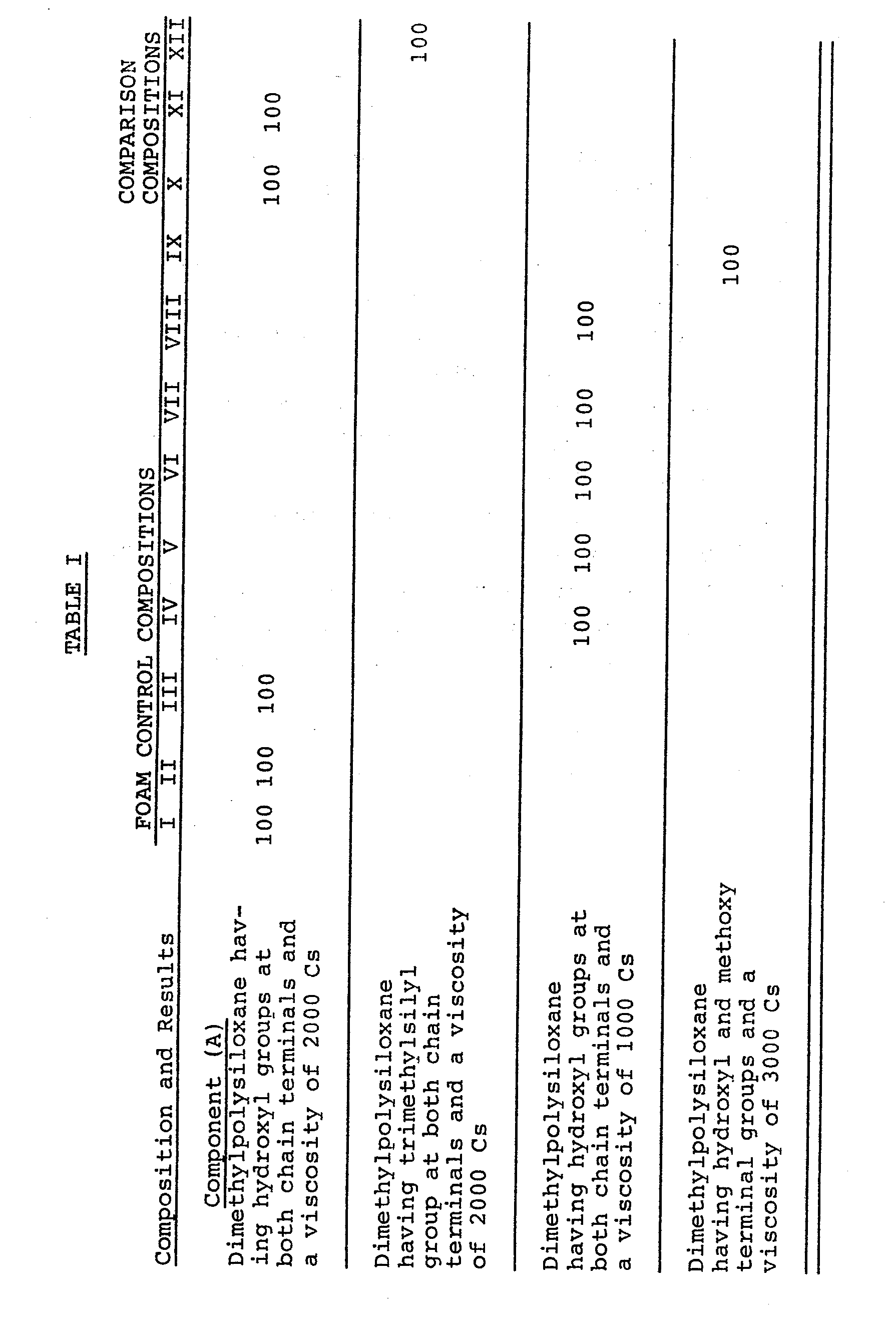


- Each of the foam control compositions tested in Example 1 were prepared by mixing the components at room temperature for 30 minutes using a Hobart mixer, and then at 150°C for 2 hours using a mixing apparatus equipped with a stirring device and a heating apparatus. The Syloid 266 is manufactured by Fiji-Davison and the Aerogel 200 is manufactured by Nippon Aerodil.
- A test of defoaming properties was used to comparatively evaluate various foam control composition emulsions.
- The emulsions were prepared from Compositions II, IV, VI, IX, X, and XII from Example 1. Composition XIII, SH 5500 manufactured by Toray Silicone, was also tested. The emulsions were prepared by mixing for 20 minutes at 60 to 70°C with a homogenizer 20 parts of the foam control composition, 3 parts of the surfactant Syran 60 (sorbitan aliphatic acid ester) manufactured by Kao Atlas, 2 parts of the surfactant Atmul P403 (glycerol aliphatic acid ester) manufactured by Kao Atlas, and 75 parts water.
- The test of defoaming properties is as follows:
- 1. Prepare a 1.0 weight percent aqueous solution (adjusted to pH 11 with potassium hydroxide) of the surfactant Octapol 100 (polyoxyothylenc octyl phenyl ether) manufactured by Sanyo Kasei Kogyo.
- 2. Place 200 ml of the aqueous solution and .10 grams of the foam control compositions emulsion in a 1 liter measuring cylinder.
- 3. Blow air into the cylinder through a glass ball filter at a rate of 600 ml/min. and measure the time in minutes until the total volume of foam reaches 800 ml.
- The results are as follows

Methods (1) to (6) may be adopted arbitrarily according to the purpose for which it will be used, but the mixing method is not restricted only to methods described above.
Claims (3)
Priority Applications (2)
| Application Number | Priority Date | Filing Date | Title |
|---|---|---|---|
| DE8282302013T DE3269562D1 (en) | 1982-04-20 | 1982-04-20 | Foam control compositions |
| EP19820302013 EP0092003B1 (en) | 1982-04-20 | 1982-04-20 | Foam control compositions |
Applications Claiming Priority (1)
| Application Number | Priority Date | Filing Date | Title |
|---|---|---|---|
| EP19820302013 EP0092003B1 (en) | 1982-04-20 | 1982-04-20 | Foam control compositions |
Publications (2)
| Publication Number | Publication Date |
|---|---|
| EP0092003A1 true EP0092003A1 (en) | 1983-10-26 |
| EP0092003B1 EP0092003B1 (en) | 1986-03-05 |
Family
ID=8189640
Family Applications (1)
| Application Number | Title | Priority Date | Filing Date |
|---|---|---|---|
| EP19820302013 Expired EP0092003B1 (en) | 1982-04-20 | 1982-04-20 | Foam control compositions |
Country Status (2)
| Country | Link |
|---|---|
| EP (1) | EP0092003B1 (en) |
| DE (1) | DE3269562D1 (en) |
Cited By (5)
| Publication number | Priority date | Publication date | Assignee | Title |
|---|---|---|---|---|
| EP0163541A3 (en) * | 1984-05-30 | 1988-04-20 | Dow Corning Kabushiki Kaisha | Method of producing a silicone defoamer composition |
| EP0334125A3 (en) * | 1988-03-24 | 1991-01-09 | General Electric Company | Low density silicone foam |
| WO1999015253A1 (en) * | 1997-09-25 | 1999-04-01 | Cognis Deutschland Gmbh | Method for producing antifoam agents |
| WO2013043487A1 (en) * | 2011-09-19 | 2013-03-28 | Dow Corning Corporation | Silicone foam control compositions and process for making thereof |
| WO2016001934A1 (en) * | 2014-06-30 | 2016-01-07 | Wacker Metroark Chemicals Pvt. Ltd. | Composition and process of making an amino silicone based delayed antifoam for use in laundry detergent |
Citations (5)
| Publication number | Priority date | Publication date | Assignee | Title |
|---|---|---|---|---|
| US3455839A (en) * | 1966-02-16 | 1969-07-15 | Dow Corning | Method for reducing or preventing foam in liquid mediums |
| DE1954001A1 (en) * | 1968-10-28 | 1971-02-25 | Midland Silicones Ltd | New organosilicon compounds |
| DE2112579A1 (en) * | 1970-03-16 | 1971-09-30 | Dow Corning | Agent for preventing and / or reducing foam formation in aqueous systems |
| DE2310039A1 (en) * | 1972-12-11 | 1974-07-04 | Dow Corning | FOAM PREVENTION AGENT FOR THE CARPET AREA |
| GB1468896A (en) * | 1973-06-08 | 1977-03-30 | Shinetsu Chemical Co | Defoaming compositions |
-
1982
- 1982-04-20 DE DE8282302013T patent/DE3269562D1/en not_active Expired
- 1982-04-20 EP EP19820302013 patent/EP0092003B1/en not_active Expired
Patent Citations (5)
| Publication number | Priority date | Publication date | Assignee | Title |
|---|---|---|---|---|
| US3455839A (en) * | 1966-02-16 | 1969-07-15 | Dow Corning | Method for reducing or preventing foam in liquid mediums |
| DE1954001A1 (en) * | 1968-10-28 | 1971-02-25 | Midland Silicones Ltd | New organosilicon compounds |
| DE2112579A1 (en) * | 1970-03-16 | 1971-09-30 | Dow Corning | Agent for preventing and / or reducing foam formation in aqueous systems |
| DE2310039A1 (en) * | 1972-12-11 | 1974-07-04 | Dow Corning | FOAM PREVENTION AGENT FOR THE CARPET AREA |
| GB1468896A (en) * | 1973-06-08 | 1977-03-30 | Shinetsu Chemical Co | Defoaming compositions |
Cited By (7)
| Publication number | Priority date | Publication date | Assignee | Title |
|---|---|---|---|---|
| EP0163541A3 (en) * | 1984-05-30 | 1988-04-20 | Dow Corning Kabushiki Kaisha | Method of producing a silicone defoamer composition |
| EP0334125A3 (en) * | 1988-03-24 | 1991-01-09 | General Electric Company | Low density silicone foam |
| WO1999015253A1 (en) * | 1997-09-25 | 1999-04-01 | Cognis Deutschland Gmbh | Method for producing antifoam agents |
| WO2013043487A1 (en) * | 2011-09-19 | 2013-03-28 | Dow Corning Corporation | Silicone foam control compositions and process for making thereof |
| CN103814072A (en) * | 2011-09-19 | 2014-05-21 | 道康宁公司 | Silicone foam control compositions and process for making thereof |
| WO2016001934A1 (en) * | 2014-06-30 | 2016-01-07 | Wacker Metroark Chemicals Pvt. Ltd. | Composition and process of making an amino silicone based delayed antifoam for use in laundry detergent |
| US10144905B2 (en) | 2014-06-30 | 2018-12-04 | Wacker Metroark Chemicals Pvt. Ltd. | Composition and process of making an amino silicone based delayed antifoam for use in laundry detergent |
Also Published As
| Publication number | Publication date |
|---|---|
| DE3269562D1 (en) | 1986-04-10 |
| EP0092003B1 (en) | 1986-03-05 |
Similar Documents
| Publication | Publication Date | Title |
|---|---|---|
| US4690713A (en) | Antifoam composition | |
| US4741861A (en) | Silicone-based antifoam composition and a method for the preparation of the same | |
| US4584125A (en) | Antifoam compositions | |
| US5531929A (en) | Silicone antifoam compositions | |
| US4443359A (en) | Foam control compositions | |
| JPH0314481B2 (en) | ||
| US4900474A (en) | Silicone antifoamers | |
| KR970042845A (en) | Aqueous silicone emulsion to form silicone elastomer with enhanced adhesion to the support | |
| EP0179598A2 (en) | Polyorganosiloxane compositions | |
| EP0092003B1 (en) | Foam control compositions | |
| EP2100650B1 (en) | Preparation of antifoaming oil compound and antifoam composition | |
| US5106535A (en) | Defoaming composition | |
| JPH05271689A (en) | Suds-controlling composition for aqueous composition | |
| US4230632A (en) | Preparation of heat stable silicone fluids | |
| CA1253655A (en) | Stabilized blends of thiofunctional polysiloxane fluids and organopolysiloxane fluids and a process for stabilizing the same | |
| EP0047630A1 (en) | Silicone anti-foaming compositions | |
| US5034476A (en) | Surface-treated polyorganosilsesquioxane fine powder | |
| KR100352538B1 (en) | Foam control agent | |
| CA1300781C (en) | Method of producing a silicone defoamer composition | |
| JPH07185212A (en) | Silicone defoaming agent composition | |
| CA1176536A (en) | Foam control compositions | |
| JPH08196811A (en) | Process for producing oil compound for defoaming agent and defoaming agent composition containing the same | |
| CN109173349B (en) | A kind of preparation method of silicon composition | |
| US4357443A (en) | One package, moisture curable, organopolysiloxane compositions and method for making | |
| JPH08126801A (en) | Defoaming agent composition |
Legal Events
| Date | Code | Title | Description |
|---|---|---|---|
| PUAI | Public reference made under article 153(3) epc to a published international application that has entered the european phase |
Free format text: ORIGINAL CODE: 0009012 |
|
| AK | Designated contracting states |
Designated state(s): DE FR GB IT |
|
| 17P | Request for examination filed |
Effective date: 19840329 |
|
| GRAA | (expected) grant |
Free format text: ORIGINAL CODE: 0009210 |
|
| AK | Designated contracting states |
Kind code of ref document: B1 Designated state(s): DE FR GB IT |
|
| REF | Corresponds to: |
Ref document number: 3269562 Country of ref document: DE Date of ref document: 19860410 |
|
| ET | Fr: translation filed | ||
| ITF | It: translation for a ep patent filed | ||
| PLBE | No opposition filed within time limit |
Free format text: ORIGINAL CODE: 0009261 |
|
| STAA | Information on the status of an ep patent application or granted ep patent |
Free format text: STATUS: NO OPPOSITION FILED WITHIN TIME LIMIT |
|
| 26N | No opposition filed | ||
| ITTA | It: last paid annual fee | ||
| PGFP | Annual fee paid to national office [announced via postgrant information from national office to epo] |
Ref country code: DE Payment date: 19980313 Year of fee payment: 17 |
|
| PGFP | Annual fee paid to national office [announced via postgrant information from national office to epo] |
Ref country code: GB Payment date: 19980316 Year of fee payment: 17 Ref country code: FR Payment date: 19980316 Year of fee payment: 17 |
|
| PG25 | Lapsed in a contracting state [announced via postgrant information from national office to epo] |
Ref country code: GB Free format text: LAPSE BECAUSE OF NON-PAYMENT OF DUE FEES Effective date: 19990420 |
|
| GBPC | Gb: european patent ceased through non-payment of renewal fee |
Effective date: 19990420 |
|
| PG25 | Lapsed in a contracting state [announced via postgrant information from national office to epo] |
Ref country code: FR Free format text: LAPSE BECAUSE OF NON-PAYMENT OF DUE FEES Effective date: 19991231 |
|
| REG | Reference to a national code |
Ref country code: FR Ref legal event code: ST |
|
| PG25 | Lapsed in a contracting state [announced via postgrant information from national office to epo] |
Ref country code: DE Free format text: LAPSE BECAUSE OF NON-PAYMENT OF DUE FEES Effective date: 20000201 |