EP0092218A2 - Méthode et arrangement pour imprimer des formulaires dans une station de texte - Google Patents
Méthode et arrangement pour imprimer des formulaires dans une station de texte Download PDFInfo
- Publication number
- EP0092218A2 EP0092218A2 EP83103735A EP83103735A EP0092218A2 EP 0092218 A2 EP0092218 A2 EP 0092218A2 EP 83103735 A EP83103735 A EP 83103735A EP 83103735 A EP83103735 A EP 83103735A EP 0092218 A2 EP0092218 A2 EP 0092218A2
- Authority
- EP
- European Patent Office
- Prior art keywords
- markings
- coordinates
- printed
- display unit
- stored
- Prior art date
- Legal status (The legal status is an assumption and is not a legal conclusion. Google has not performed a legal analysis and makes no representation as to the accuracy of the status listed.)
- Granted
Links
Images
Classifications
-
- B—PERFORMING OPERATIONS; TRANSPORTING
- B41—PRINTING; LINING MACHINES; TYPEWRITERS; STAMPS
- B41J—TYPEWRITERS; SELECTIVE PRINTING MECHANISMS, i.e. MECHANISMS PRINTING OTHERWISE THAN FROM A FORME; CORRECTION OF TYPOGRAPHICAL ERRORS
- B41J11/00—Devices or arrangements of selective printing mechanisms, e.g. ink-jet printers or thermal printers, for supporting or handling copy material in sheet or web form
- B41J11/36—Blanking or long feeds; Feeding to a particular line, e.g. by rotation of platen or feed roller
- B41J11/42—Controlling printing material conveyance for accurate alignment of the printing material with the printhead; Print registering
-
- G—PHYSICS
- G06—COMPUTING OR CALCULATING; COUNTING
- G06F—ELECTRIC DIGITAL DATA PROCESSING
- G06F40/00—Handling natural language data
- G06F40/10—Text processing
- G06F40/166—Editing, e.g. inserting or deleting
- G06F40/174—Form filling; Merging
Definitions
- the invention relates to a method and an arrangement for printing forms in a text station according to the preamble of claim 1.
- a user When printing on forms by means of a text station, a user has the possibility, by using a display unit on which the characters entered are initially displayed, to check the correctness of the characters entered and, if necessary, to carry out a correction by re-entering them. However, it is necessary here to establish an association between the individual positions on the form and on the display unit, so that the user is informed at all times at which point on the form a character which has just been entered is to be printed.
- the invention is therefore based on the object of specifying a method and an arrangement, the use of which forms are filled in in a simple manner and which are also suitable when different line or character spacings are to be carried out on one and the same form.
- the method according to the invention has the advantage that the form on the display unit can be filled in very quickly if the positions of the positions to be described are identified and identified by the markings.
- the acquisition is carried out using a coordinate pattern, which is either placed on the form as a film or printed on an identical form.
- a particularly advantageous detecting the coordinates is achieved by the printing unit performs a synchronous movement with a compound represented on the display unit 'cursor.
- the markings can also be designed as ruler marks, so that an area tab is generated and when you press a corresponding tab key, the cursor on the screen jumps to the next marker
- the markings are advantageously arrow-shaped and each mark the beginning of the areas to be written and it is also possible to additionally mark the end of the areas to be written, the arrow-shaped marking then being directed in the opposite direction.
- the coding of the markings is selected so that they are displayed as spaces when printed.
- short texts can be displayed as a reminder to identify the position to be described.
- the text station contains a control unit which, after actuating the corresponding coordinates on the screen, for example by means of a cursor and after pressing a corresponding key on the keyboard, represents and stores the marking.
- the control unit converts the markings and any additional texts into blank spaces that are not printed.
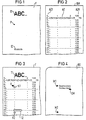
- a sender "ABC” is printed as text T1 on a form F. Furthermore, a point P is printed on the form F, which represents an orientation aid for the user and indicates the point at which the addressee is to be entered.
- the text "Your sign”, which is usual for letterheads, is printed as text T2. Below this text, short characters or a file number are entered, to which the corresponding letter refers. There are other texts on Form F that are not shown here, such as the texts "Our Sign", "Place and Date” etc.
- the form F is to be filled in at a text station using a display unit, for example a screen
- a display unit for example a screen
- the texts to be entered at the point P and after the text T2 and the entire writing are first created on the screen.
- the screen generally represents an image of the respective record carrier and it must be ensured that the corresponding texts are printed in the correct places on the form F.
- FIG. 2 shows a coordinate pattern KM as it is stored in the text station in a memory, for example on a floppy disk.
- This coordinate pattern KM is intended for a form F with the format A4, which is to be described in unit steps of 1/10 inch.
- the coordinate pattern KM contains on the left in the vertical direction, starting with line 5, the number of lines AZ1, which can be printed on form F with a one-line notation.
- the coordinate pattern also contains the number AZH of the half lines with which the form F can be written. This number AZH is related to the lower margin. It indicates the number of half lines still available. This number can also be displayed on the screen, for example.
- the number AZ of characters within the lines is indicated in the horizontal direction. For reasons of clarity, the numbers AZ1, AZH and AZ are only printed at a few places in the coordinate pattern KM and are otherwise represented by dots, for example after every 5 or 10 units.
- a copy of the form F is clamped in a printer unit of the text station and printed with the corresponding stored coordinate pattern KM.
- FIG. 3 shows a form F printed with the coordinate pattern KM corresponding to FIG. 1.
- the coordinates K1 and K2 of the positions on the form F to be described can be taken from the printed form F in a simple manner.
- the coordinate K1 closest to the point P has the number of half lines AZH 120 and the number of characters AZ 10.
- the coordinate K2 has the coordinate values 096 and 10.
- the coordinates K1 and K2 can also be determined if the coordinate pattern KM is applied to a transparent film and this is placed over the form F.
- markings M1 and M2 are shown at the locations corresponding to the coordinates K1 and K2.
- the markings are entered using the keyboard by calling up the corresponding numbers AZ1 or AZH and the number AZ.
- the entry can be made, for example, by placing a cursor SM in the appropriate position and pressing a marking key.
- the markings M1 and M2 and any number of further markings corresponding to further coordinates K are displayed on the screen BS and stored in a memory, for example also on a floppy disk of the text station.
- any number of forms F can be filled in on the screen using the keyboard.
- the forms F are then inserted into the printer unit and printed accordingly. In this case, printing of the markings M1 and M2 is blocked, so that only the corresponding texts are printed out on the forms F at the locations provided for this purpose.
- a one-line display can of course also be used; at which the corresponding markings M are displayed when the corresponding line is addressed.
- the markings M simultaneously represent tab marks of an area tab.
- the markings M are arrow-shaped and each indicate the start of a position to be written. It is also possible to additionally display the end of an area to be described. For this purpose, the arrow can point in the opposite direction, for example. It is also possible to optically emphasize the area to be described on the screen BS.
- the coordinate pattern KM it can be checked very quickly whether a form F has been created in accordance with the standard, since the positions to be described can then be uniquely assigned to individual coordinate points.
- the coordinate pattern KM it is possible due to the number AZH to change the line spacing within the form, for example from 1-line to 1 1/2 line, since the number AZH is sufficient for orientation, regardless of the set line spacing. In this case the number AZ1 cannot be used.
- the character spacing for example from 1/10 inch to 1/12 inch
- a different coordinate pattern is expediently used. It would also be conceivable here to represent the number of the smallest common unit, but this could easily lead to confusion.
- a different coordinate pattern KM is also used for other forms, such as DIN A5.
- Another possibility for determining the coordinates is that the form F is clamped into the printer unit and that the corresponding positions to be described are identified by a positioning of the print head.
- the positioning of the print head takes place using a cursor control, which the cursor SM on the screen BS moves and moves the print head synchronously, but prevents the printing of characters.
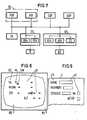
- a form F which has printed fixed fields F1 and areas to be filled in, which are identified as variable fields VF.
- the illustration in FIG. 6 shows an illustration corresponding to the markings M on the screen BS of the display unit AE.
- the variable fields VF are identified by markings M, which are arranged at the beginning and / or at the end of each variable field VF.
- short texts F2 which are assigned to the fixed fields F1 can be provided in front of the markings M as a reminder and to facilitate the assignment. In this case too, a large number of forms can now be filled out on the screen BS using the cursor SM and then printed out on the corresponding forms F. In this case, of course, the short texts F2 and the markings M are not printed out.
- the cursor SM and the print head of the printer unit execute a synchronous movement in such a way that the cursor SM indicates a write point with the same coordinates as the print head in relation to the form F to be printed.
- the coordinates of a mark M on the display unit AE at the beginning of a variable field VF result from the vertical coordinate and the horizontal coordinate of the position of the write mark SM or the position of the print head reduced by one writing point. This case is indicated in FIG. 6 for the upper left marking M. It can be seen that this marking M is not directly above the position of the The SM cursor is located, but is offset to the left by a writing point.
- the coordinates of a marking M located at the end of a variable field VF result from the vertical coordinate and the horizontal coordinate of the position of the writing mark SM or the position of the print head increased by one writing point. This ensures that a variable field VF to be described is located exactly between the arrowheads of two markings M.
- the coordinates of the individual markings M are thus uniquely assigned to the coordinates of the corresponding locations on the form F and can be stored in the memory.
- the actual printing process is suspended until all necessary corrections regarding the characters entered in the variable fields VF have been made on the display unit AE.
- the data stored in the RAM characters are read out and then printed by the print head to the ents p re- required positions on the form F.
- the characters entered are printed themselves, while the markings M and possibly the short texts F2 'are not printed.
- the arrangement shown in FIG. 7 for carrying out the method is formed from a text station.
- This text station has a central control ZS consisting of a program memory PSP and a microcomputer MR as well as memory devices in the form of the main memory ASP and a secondary memory SSP.
- the text station contains a keyboard TA for entering characters as well as the printing unit D and the display unit AE.
- the display unit AE is preferably designed as a screen BS.
- a control device DS or AS is provided for printing unit D and An Show unit AE.
- the control device DS for the printing unit D contains a control part DSH for the horizontal movement of the print head and a control part DSV for the rotation of the printer roller.
- control device AS for the display unit AE contains a control part ASH and ASV for the horizontal and vertical movement of the cursor SM.
- the two control devices DS and AS are connected to one another and to the other structural units via a bus.
- the characters entered via the keyboard TA are not initially printed, but are stored in the working memory ASP and displayed on the display unit AE. This makes it possible to check the correctness of the entered characters and, if necessary, to correct them by making a new entry. Characters stored in the main memory ASP are therefore only read out at a later point in time and then printed out by means of the printing unit D at the appropriate places on the form.
- the markings M are shown on the display unit AE for the assignment required for this between the individual positions on the form F and on the display unit AE.
- the cursor SM is brought to the corresponding position on the screen. Then a key on the TA keyboard is pressed and the M mark is shown on the screen.
- the position can now be determined on the one hand on the basis of the coordinate pattern KM, the corresponding numbers AZ1 or AZH being shown on the screen BS of the display unit AE, for example in a display line at the bottom of the screen BS and AZ are shown.
- the number AZ can be made using a line ruler that is usually provided, and the numbers AZ1 or AZH indicate the respective writing line or the number of lines still free in a manner known per se.
- the printhead When the form is scanned using the printhead, the printhead performs a movement on the form F clamped in the printer unit D which is synchronous with the movement of the cursor SM.
- the cursor SM When the cursor SM is positioned at a position which corresponds to the position of the print head at the beginning and / or at the end of a variable field VF, the corresponding key on the keyboard TA is again actuated and the corresponding markings M are displayed on the screen BS.
- the short texts F2 can be entered using the keyboard TA, which, like the markings M, are not printed out during the actual printing process.
- the secondary memory SS is provided, in which the coordinates of the individual markings M determined once can be archived.
- This secondary memory SSP is preferably designed as a floppy disk.
Landscapes
- Engineering & Computer Science (AREA)
- Theoretical Computer Science (AREA)
- Health & Medical Sciences (AREA)
- Artificial Intelligence (AREA)
- Audiology, Speech & Language Pathology (AREA)
- Computational Linguistics (AREA)
- General Health & Medical Sciences (AREA)
- Physics & Mathematics (AREA)
- General Engineering & Computer Science (AREA)
- General Physics & Mathematics (AREA)
- Record Information Processing For Printing (AREA)
Applications Claiming Priority (4)
| Application Number | Priority Date | Filing Date | Title |
|---|---|---|---|
| DE19823214805 DE3214805A1 (de) | 1982-04-21 | 1982-04-21 | Verfahren und anordnung zum beschreiben von formularen |
| DE3214805 | 1982-04-21 | ||
| DE3229615 | 1982-08-09 | ||
| DE19823229615 DE3229615A1 (de) | 1982-08-09 | 1982-08-09 | Verfahren und anordnung zum bedrucken von formularen mittels einer textstation |
Publications (3)
| Publication Number | Publication Date |
|---|---|
| EP0092218A2 true EP0092218A2 (fr) | 1983-10-26 |
| EP0092218A3 EP0092218A3 (en) | 1985-01-09 |
| EP0092218B1 EP0092218B1 (fr) | 1987-04-08 |
Family
ID=25801244
Family Applications (1)
| Application Number | Title | Priority Date | Filing Date |
|---|---|---|---|
| EP83103735A Expired EP0092218B1 (fr) | 1982-04-21 | 1983-04-18 | Méthode et arrangement pour imprimer des formulaires dans une station de texte |
Country Status (1)
| Country | Link |
|---|---|
| EP (1) | EP0092218B1 (fr) |
Cited By (2)
| Publication number | Priority date | Publication date | Assignee | Title |
|---|---|---|---|---|
| DE3928490A1 (de) * | 1989-08-29 | 1991-03-07 | Grundig Emv | Textverarbeitungssystem zur gestaltung von aus text und grafik bestehenden dokumenten |
| EP0367290A3 (fr) * | 1988-11-04 | 1991-07-24 | Hitachi, Ltd. | Méthode pour commander le déplacement d'un curseur et appareil pour sa mise en oeuvre |
Family Cites Families (1)
| Publication number | Priority date | Publication date | Assignee | Title |
|---|---|---|---|---|
| DE2713128A1 (de) * | 1977-03-25 | 1978-09-28 | Helmut Steinhilber | Verfahren und vorrichtung zur steuerung des formularvorschubs in druckwerken oder fuer druckwerke |
-
1983
- 1983-04-18 EP EP83103735A patent/EP0092218B1/fr not_active Expired
Cited By (2)
| Publication number | Priority date | Publication date | Assignee | Title |
|---|---|---|---|---|
| EP0367290A3 (fr) * | 1988-11-04 | 1991-07-24 | Hitachi, Ltd. | Méthode pour commander le déplacement d'un curseur et appareil pour sa mise en oeuvre |
| DE3928490A1 (de) * | 1989-08-29 | 1991-03-07 | Grundig Emv | Textverarbeitungssystem zur gestaltung von aus text und grafik bestehenden dokumenten |
Also Published As
| Publication number | Publication date |
|---|---|
| EP0092218A3 (en) | 1985-01-09 |
| EP0092218B1 (fr) | 1987-04-08 |
Similar Documents
| Publication | Publication Date | Title |
|---|---|---|
| DE3343357C2 (fr) | ||
| DE2657631A1 (de) | Verfahren zur codierten darstellung einer information, insbesondere von chinesischen zeichen | |
| EP0044930B1 (fr) | Dispositif de traitement du texte ayant un dispositif indicateur | |
| DE3149861A1 (de) | Informationsverarbeitungsanordnung | |
| EP0027490B1 (fr) | Machine à écrire à mémoire avec porte-caractères interchangeables | |
| DE3046037A1 (de) | Textbearbeitungsgeraet | |
| EP0092218B1 (fr) | Méthode et arrangement pour imprimer des formulaires dans une station de texte | |
| EP0304509A1 (fr) | Dispositif d'affichage vidéo pour la visualisation de textes | |
| DE2823423C3 (de) | Schreibmaschine mit einer Einzeilenanzeige | |
| EP0050786B1 (fr) | Méthode et dispositif pour transformer la largeur de caractères | |
| EP0080200B1 (fr) | Méthode et dispositif pour la présentation de signes en écriture à espacement proportionnel | |
| DE1222295B (de) | Verfahren zum Anpassen der Druckzykluslaenge fuer eine Druckzeile an die Anzahl der in einer Zeile zu druckenden Zeichen bei Schnelldruckern datenverarbeitender Systeme | |
| DE1436693C3 (de) | Verfahren und Anordnung zum geräuschlosen Schreiben mittels einer elektrischoptischen Schreibmaschine | |
| DE2939184C2 (de) | Anordnung zum Darstellen und Korrigieren von Schriftzeichen | |
| EP0262548B1 (fr) | Méthode et dispositif d'affichage de textes munis de codes de commande y appartenant | |
| DE3214805A1 (de) | Verfahren und anordnung zum beschreiben von formularen | |
| DE3513428A1 (de) | Fettdruckfaehiger matrixdrucker | |
| DE2648636C3 (de) | Die abzudruckenden Zeichen in einem mosaikartigen Punktraster darstellender Drucker | |
| EP0115047B1 (fr) | Procédé et dispositif de marquage d'éléments de texte sur une unité d'affichage | |
| DE1549860C3 (de) | Verfahren zur Herstellung eines korrigierten Textes und Vorrichtung zur Durchführung dieses Verfahrens | |
| DE3545916C2 (fr) | ||
| DE3315374C1 (de) | Elektronische Eingabe- und Korrekturanzeigevorrichtung mit Feinschrittdarstellung | |
| DE3021650A1 (de) | Zeichendrucker fuer einen rasteroder mosaikdrucker | |
| DE3229615A1 (de) | Verfahren und anordnung zum bedrucken von formularen mittels einer textstation | |
| EP0101950A2 (fr) | Méthode d'affichage de caractères sur un dispositif d'affichage à une ligne d'un processeur de texte |
Legal Events
| Date | Code | Title | Description |
|---|---|---|---|
| PUAI | Public reference made under article 153(3) epc to a published international application that has entered the european phase |
Free format text: ORIGINAL CODE: 0009012 |
|
| AK | Designated contracting states |
Designated state(s): CH FR GB IT LI NL SE |
|
| PUAL | Search report despatched |
Free format text: ORIGINAL CODE: 0009013 |
|
| AK | Designated contracting states |
Designated state(s): CH FR GB IT LI NL SE |
|
| 17P | Request for examination filed |
Effective date: 19841217 |
|
| GRAA | (expected) grant |
Free format text: ORIGINAL CODE: 0009210 |
|
| AK | Designated contracting states |
Kind code of ref document: B1 Designated state(s): CH FR GB IT LI NL SE |
|
| PGFP | Annual fee paid to national office [announced via postgrant information from national office to epo] |
Ref country code: NL Payment date: 19870430 Year of fee payment: 5 |
|
| ET | Fr: translation filed | ||
| ITF | It: translation for a ep patent filed | ||
| PLBE | No opposition filed within time limit |
Free format text: ORIGINAL CODE: 0009261 |
|
| STAA | Information on the status of an ep patent application or granted ep patent |
Free format text: STATUS: NO OPPOSITION FILED WITHIN TIME LIMIT |
|
| PG25 | Lapsed in a contracting state [announced via postgrant information from national office to epo] |
Ref country code: LI Effective date: 19880430 Ref country code: CH Effective date: 19880430 |
|
| 26N | No opposition filed | ||
| REG | Reference to a national code |
Ref country code: CH Ref legal event code: PL |
|
| PG25 | Lapsed in a contracting state [announced via postgrant information from national office to epo] |
Ref country code: GB Effective date: 19890418 |
|
| PG25 | Lapsed in a contracting state [announced via postgrant information from national office to epo] |
Ref country code: SE Effective date: 19890419 |
|
| PG25 | Lapsed in a contracting state [announced via postgrant information from national office to epo] |
Ref country code: NL Effective date: 19891101 |
|
| NLV4 | Nl: lapsed or anulled due to non-payment of the annual fee | ||
| GBPC | Gb: european patent ceased through non-payment of renewal fee | ||
| PG25 | Lapsed in a contracting state [announced via postgrant information from national office to epo] |
Ref country code: FR Free format text: LAPSE BECAUSE OF NON-PAYMENT OF DUE FEES Effective date: 19891228 |
|
| REG | Reference to a national code |
Ref country code: FR Ref legal event code: ST |
|
| EUG | Se: european patent has lapsed |
Ref document number: 83103735.3 Effective date: 19900412 |