EP0092236A2 - Plasmid-Klonierungsvektor für Bacillus Subtilis - Google Patents
Plasmid-Klonierungsvektor für Bacillus Subtilis Download PDFInfo
- Publication number
- EP0092236A2 EP0092236A2 EP83103782A EP83103782A EP0092236A2 EP 0092236 A2 EP0092236 A2 EP 0092236A2 EP 83103782 A EP83103782 A EP 83103782A EP 83103782 A EP83103782 A EP 83103782A EP 0092236 A2 EP0092236 A2 EP 0092236A2
- Authority
- EP
- European Patent Office
- Prior art keywords
- plasmid
- pos4
- dna
- subtilis
- enzyme
- Prior art date
- Legal status (The legal status is an assumption and is not a legal conclusion. Google has not performed a legal analysis and makes no representation as to the accuracy of the status listed.)
- Withdrawn
Links
Images
Classifications
-
- C—CHEMISTRY; METALLURGY
- C12—BIOCHEMISTRY; BEER; SPIRITS; WINE; VINEGAR; MICROBIOLOGY; ENZYMOLOGY; MUTATION OR GENETIC ENGINEERING
- C12N—MICROORGANISMS OR ENZYMES; COMPOSITIONS THEREOF; PROPAGATING, PRESERVING, OR MAINTAINING MICROORGANISMS; MUTATION OR GENETIC ENGINEERING; CULTURE MEDIA
- C12N15/00—Mutation or genetic engineering; DNA or RNA concerning genetic engineering, vectors, e.g. plasmids, or their isolation, preparation or purification; Use of hosts therefor
- C12N15/09—Recombinant DNA-technology
- C12N15/63—Introduction of foreign genetic material using vectors; Vectors; Use of hosts therefor; Regulation of expression
- C12N15/74—Vectors or expression systems specially adapted for prokaryotic hosts other than E. coli, e.g. Lactobacillus, Micromonospora
- C12N15/75—Vectors or expression systems specially adapted for prokaryotic hosts other than E. coli, e.g. Lactobacillus, Micromonospora for Bacillus
Definitions
- This invention relates to a new synthetic plasmid, pOS4, useful as a cloning.vehicle into which various genes can be inserted using recombinant DNA methodology.
- plasmids Most genetic material in a bacterium exists as giant DNA molecules which are present as the chromosome.of the cell. However, a certain amount of the genetic material may also be present in the form of smaller closed circular molecules of DNA, known as plasmids.
- the portion of the DNA molecule related to a specific hereditary trait is called a gene.
- genetic engineering it is possible to transfer a gene, which.codes for the production of a specific protein, from one microorganism to another.
- Various workers have used these techniques to develop microorganisms which are superior producers of certain proteins.such as enzymes.
- Plasmids can also be used as vectors to carry new genetic material into a host organism. This is accomplished by first cutting.the plasmid with an enzyme, known as a restriction endonuclease, that opens the circle of DNA.. A fragment of foreign DNA, containing the desired gene, is inserted into the place where the DNA circle was cut. The circle is reformed by treatment with another enzyme known as a DNA ligase.
- an enzyme known as a restriction endonuclease
- the recombined plasmid a new circular DNA molecule, contains the genes of the original plasmid plus the new gene from the piece of DNA which was inserted.
- This plasmid can be introduced into a host microorganism.
- the plasmid containing the new gene is then reproduced in the host microorganism and becomes part of its genetic material.
- the microorganism containing the recombined plasmid then produces the proteins coded for by the genes of this plasmid.
- B. subtilis Bacillus subtilis
- researchers have sought to find plasmid vectors which can be inserted into B. subtilis and which will multiply in that host. It is important that the plasmid vector contain some markers which permit easy identification of the presence of that plasmid in the host. Furthermore, it should be possible to insert DNA fragments into the vector without altering its ability to replicate in the B. subtilis.
- the present invention is directed to a new synthetic plasmid vector having two antibiotic resistance markers.
- This vector can-be combined with genetic material to form hybrid plasmids that. are readily inserted into and maintained in the industrially important microorganisms of the species B. subtilis.
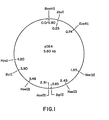
- the drawing depicts the restriction endonuclease cleavage map for pOS4.
- the map is constructed on the basis of plasmid pOS4 having a molecular weight of about 5.8 kb.
- the map positions of the various restriction sites are given as kilobase coordinates relative to the Bam HI restriction site at 0.0/5.8 kb.
- the restriction endonuclease abbreviations are as follows:
- Plasmid pOS4 was constructed from DNA fragments of two previously known plasmids, pSE3 and pE194-cop6. Plasmid pSE3, originally isolated from Staphylococcus epidermidus, carries a kanamycin resistance gene and has a temperature-resistant origin of replication. It has a molecular weight of 4 5 kb. This plasmid has been inserted into B. subtilis and a strain of B. subtilis carrying this plasmid is available from the American Type Culture Collection as ATCC 39,098.
- Plasmid pE194-cop6 was described by Weisblum, et a1, J. Bacteriology, 137, 635-643 (1979). It has a molecular weight of 3.6 kb and contains an erythromycin resistance gene. It also has a temperature sensitive origin of replication and will not replicate optimally at temperatures above about 32°C. A strain of B. subtilis containing this plasmid is available from the American Type Culture Collection as ATCC 39,089.
- Plasmids pSE3 and pE194-cop6 were cut by the restriction endonuclease H D a II, an enzyme from Haemophilus parainfluenzae. This endonuclease did not destroy the antibiotic resistance markers of the plasmids.
- the resulting mixture of linear DNA sequences was treated with a ligase using techniques well known in the art.
- the ligase used for this purpose was the commercially available T 4 DNA ligase.
- the plasmids obtained from the ligation reaction were made biologically active by transforming them into host cells of a strain of B. subtilis RM125.
- This strain which shows neither kanamycin nor erythromycin resistance, was originally described by Uozumi, et al, Molec. Gen. Genet., 152, 65-69 (1977). It is available as ATCC 39,088. Transformation was accomplished by the protoplast transformation method of Chang and Cohen, Molec. Gen.. Genet., 118, 111-115 (1979).
- the synthetic plasmid produced by the host cells was isolated using a modification of the cleared lysate procedure of Birnboim and Doly, Nuc. Acid Res., 7, 1513-1523 (1979).
- the plasmid was purified by CsCl-ethidium bromide density gradient ultracentrifugation.
- Plasmid pOS4 obtained by this process is useful as a plasmid vector for making new recombinant plasmids which can be introduced into host bacteria by transformation.
- the plasmid is used for this purpose, it is cut at a specific site by means of a restriction endonuclease.
- the plasmid which is a circular DNA molecule, is thus converted into a linear DNA molecule by the enzyme which cuts the DNA.
- Other DNA containing a gene coding for a desired protein is similarly cleaved with the same enzyme.
- linear vector, or portions thereof, and nonvector DNA containing the desired gene Upon mixing the linear vector, or portions thereof, and nonvector DNA containing the desired gene, their single-stranded or blunt ends can pair with each other and, in the presence of a ligase, can be covalently joined to form a single circle of DNA.
- this procedure can be used to insert a length of DNA which codes for an amylase enzyme into the cut pOS4 plasmid.
- the resulting circular DNA'molecules consist of plasmid pOS4 with an inserted length of DNA coding for the synthesis of amylase.
- the new synthetic plasmid, containing the desired genetic material can be introduced into a host microorganism for further replication with the resulting production of quantities of the desired amylase enzyme.
- plasmid pOS4 has single recognition sites for six different restriction enzymes: Bam HI, Bel I, Bgl II, Eco RI, Hpa I and Xba I. This permits insertion of DNA fragments that have been cut with these enzymes.
- Bgl II the kanamycin resistance gene is destroyed.
- Such insertional inactivation adds to the versatility of pOS4 as a vector since it permits easy isolation of cells containing recombinant plasmids with gene insertions at specific locations.
- Plasmid pOS4 is particularly useful because it can function as a plasmid vector in microorganisms such as B. subtilis and certain other gram-positive hosts.
- strains of B. subtilis are used as the host for the synthetic plasmids, the enzymes or other proteins produced by the cells can be exported from the cells into the medium.. This is important for commercial production of the enzyme or other protein since an expensive cell lysing step is avoided.
- the B. subtilis is a particularly desirable host because it is a species readily adapted to large-scale industrial fermentations.
- the cells were harvested by centrifugation and cleared lysates were then prepared from the cells by a modification of the method of Birnhoim and Doly, Nuc. Acid Res., 7, 1513-1523 (1979).
- Solutions I, II, and III were prepared as specified in the published procedure.
- the suspensions were mixed and held at 0°C for 5 to 20 minutes before the addition of 30 ml.of Solution III. Mixing was accomplished by gentle inversion and the lysates were stored at 0°C for at least 1 hour. The resulting precipitate was collected by centrifugation at 10,000 x g for 15 minutes. The supernatant was removed by decantation and again 'centrifuged to remove the remaining precipitate. The solution was mixed with a two-fold excess of cold ethanol at -20°C and stored at -20°C for.at least 1 hour to precipitate the DNA.
- the resulting precipitate was collected by centrifugation and.dissolved in 5-10 ml of 0.05 molar tris(hydroxymethyl)aminomethane hydrochloride (hereafter written Tris-HCl) at pH 8.0 containing 0.1 M sodium acetate.. The alcohol precipitation was repeated except that this time a solution containing 0.015 M NaCl and 0.0015 sodium acetate at pH 7 was used to dissolve the precipitate.
- the lysate was then incubated at 37°C for at least 30 minutes with a mixture of 0.1 mg/ml of Ribonuclease-A (Type 1-A from Bovine Pancreas, available from Sigma Chemical Company, St. Louis, Missouri) and 1 to 10.
- TES Ribonuclease-Tl
- TES is 30 mM Tris-HCl, pH 8.0, 50 mM NaCl, 5 mM ethylene-diaminetetraacetic acid.
- the phenol treatment . was followed by one extraction with a 24 to 1 mixture of chloroform and isoamyl alcohol.
- the cleared lysate was diluted to 8 ml with 10 x TES and sufficient water to give a final concentration of approximately 1 x TES.
- To this solution was added 8.0 g of CsCl and the intercalating dye, ethidium bromide, to a concentration of approximately 0.5 mg/ml.
- the plasmid DNA was separated from the total DNA by the general ultracentrifugation method of Radloff, et al, Proc. Natl. Acad, Sci., U.S.A., 57, 1514-1521 (1967). Plasmid pSE3, having a molecular weight of approximately 4.5 kb, was obtained.
- This plasmid has a molecular weight of approximately 3.6 kb. It is described by Weisblum, et al, J. Bacteriology, 137, 635-643 (1979).
- Purified plasmids pSE3 and pEl94-cop6 were mixed and concentrated by a rapid alcohol precipitation procedure. A one-tenth volume of 3 M sodium acetate solution was added to the purified plasmid solution in a centrifuge tube. A two-fold excess of ethanol at -20°C was added and the tube was kept at -80°C for 25 minutes. The precipitate was collected by centrifugation and washed twice with 70% ethanol, dried under vacuum and redissolved in a buffer solution. The solution was then digested with an excess of Hpa II enzyme, available from the Bethesda Research Laboratories Inc., Gaithersburg, Maryland, using the buffer specified by this manufacturer. When'the digestion was more than 95% complete as determined by agarose gel electrophoresis, the restriction enzyme was inactivated by heating at 65°C.
- the solution of the cut plasmids was ligated at 0°C for 48 hours using an excess of.T 4 DNA ligase (available from New England Biolabs Inc., Beverly, Massachusetts) using the buffer recommended by the supplier.
- a typical ligation mixture contained approximately equal quantities of digested pSE3 and pE194-cop6 at a DNA concentration of 260 ⁇ g/ml.
- the ligated fragments of DNA obtained from the two donor plasmids were transformed into protoplasts of B. subtilis, ATCC 39,088. Transformation was accomplished by the protoplast transformation method of Chang and Cohen, Molec. Gen. Genet., 118, 111-115 (1979).
- the transformed protoplasts were incubated for at least 1 hour at 30°C before- the addition of erythromycin to a concentration of 0.05 ⁇ g/ml. After further incubation at 30°C for at least 30 minutes, the protoplasts were plated on agar plates with DM3 medium containing 5 ⁇ g/ml of erythromycin.
- DM3 consists of the following sterile solutions per liter: 200 ml 4% agar, 500 ml 1 M sodium succinate at pH 7.3, 100 ml 5% Difco casamino acids, 500 ml 10% Difco yeast extract, 100 ml 3.5% K 2 HP0 4 and 1.5% KH 2 PO 4 , 25 ml 20% glucose, 20 ml 1 M MgCl 2 , and 5 ml 2% Bovine serum albumin.
- the plated cells were incubated at 30°C. Colonies grown on the DM3 plates containing erythromycin were patched in a grid pattern onto two TBAB (Tryptose Blood Agar Base) plates available from the Difco Laboratories, Detroit, Michigan.
- Strains of B. subtilis carrying the plasmid pOS4 can be grown in a suitable medium such as L-broth which preferably contains 5 p g/ml each of erythromycin and kanamycin. Growth is carried out at 30°C to 37°C. To facilitate subsequent lysis, the culture is harvested when the cell density is such.that the absorbance at 660 nanometers is about 0.6 to 0.7. Plasmid DNA is isolated and purified by the method used for isolation of the plasmid pSE3.
- a suitable medium such as L-broth which preferably contains 5 p g/ml each of erythromycin and kanamycin. Growth is carried out at 30°C to 37°C. To facilitate subsequent lysis, the culture is harvested when the cell density is such.that the absorbance at 660 nanometers is about 0.6 to 0.7. Plasmid DNA is isolated and purified by the method used for isolation of the plasmid pSE3.
- Plasmid pOS4 was analyzed by restriction analysis in order to construct.the map shown in the figure. All. restriction enzymes used were purchased from Bethesda Research Laboratories Inc. and used.according to the. procedures of Jalanko, et al, Gene, 14, 325-328 (1981). The enzymes Hae III, Hpa II, Bcl I, and Hpa I were used in a low-salt buffer containing 10 mM Tris at pH 7.6, 10 mM NaCl, 10 mM MgCl 2 and 1 mM dithiothreitol.
- the enzymes Barn HI, Bgl II, Bcl I, Eco RI, and Xba I used a similar buffer in which the NaCl is at a concentration of 50 mM.
- the enzyme requiring low- and high-salt ' buffers were used, the enzyme requiring low-salt was used first at.37°C for 2 hours, then inactivated at 65°C for 15 minutes. Additional NaCl was then added to bring the salt concentration to that of the high-salt buffer and the second enzyme was added for a 2-hour incubation at 37°C.
- a pOS4 solution containing approximately 2 ⁇ g in 5 ⁇ l was digested with 5 units of a restriction enzyme in 50 ⁇ l final volume for 2 hours at 37°C.
- Stability of the pOS4 plasmid in a host strain of B. subtilis was measured by the following experiment. Plasmid-bearing cells of B. subtilis Strain ATCC 39,097 were grown at 45°C for 14 generations in a medium containing Difco Heart Infusion Broth. Cells were plated on Difco Tryptose Blood Agar Base plates. Clearly separated colonies from each dilution were picked onto antibiotic plates containing both erythromycin and kanamycin. After 14 generations, all of the cells showed resistance to both antibiotics indicating that no plasmid loss had occurred for 14 generations. This experiment indicates that the vector of this invention is stably maintained in a B. subtilis host.
Landscapes
- Genetics & Genomics (AREA)
- Health & Medical Sciences (AREA)
- Engineering & Computer Science (AREA)
- Life Sciences & Earth Sciences (AREA)
- Chemical & Material Sciences (AREA)
- Wood Science & Technology (AREA)
- Organic Chemistry (AREA)
- Biotechnology (AREA)
- General Engineering & Computer Science (AREA)
- Biomedical Technology (AREA)
- Zoology (AREA)
- Bioinformatics & Cheminformatics (AREA)
- Molecular Biology (AREA)
- Microbiology (AREA)
- Plant Pathology (AREA)
- Physics & Mathematics (AREA)
- Biochemistry (AREA)
- General Health & Medical Sciences (AREA)
- Biophysics (AREA)
- Micro-Organisms Or Cultivation Processes Thereof (AREA)
- Saccharide Compounds (AREA)
- Preparation Of Compounds By Using Micro-Organisms (AREA)
Applications Claiming Priority (2)
| Application Number | Priority Date | Filing Date | Title |
|---|---|---|---|
| US06/370,431 US4419450A (en) | 1982-04-21 | 1982-04-21 | Plasmid cloning vector for Bacillus subtilis |
| US370431 | 1982-04-21 |
Publications (2)
| Publication Number | Publication Date |
|---|---|
| EP0092236A2 true EP0092236A2 (de) | 1983-10-26 |
| EP0092236A3 EP0092236A3 (de) | 1984-09-12 |
Family
ID=23459637
Family Applications (1)
| Application Number | Title | Priority Date | Filing Date |
|---|---|---|---|
| EP83103782A Withdrawn EP0092236A3 (de) | 1982-04-21 | 1983-04-19 | Plasmid-Klonierungsvektor für Bacillus Subtilis |
Country Status (12)
| Country | Link |
|---|---|
| US (1) | US4419450A (de) |
| EP (1) | EP0092236A3 (de) |
| JP (1) | JPS58189199A (de) |
| AU (1) | AU551162B2 (de) |
| CA (1) | CA1191097A (de) |
| DK (1) | DK173183A (de) |
| GB (1) | GB2121051B (de) |
| HK (1) | HK84385A (de) |
| IE (1) | IE54707B1 (de) |
| IL (1) | IL68377A (de) |
| SG (1) | SG67885G (de) |
| ZA (1) | ZA832451B (de) |
Families Citing this family (5)
| Publication number | Priority date | Publication date | Assignee | Title |
|---|---|---|---|---|
| FR2525630B1 (fr) * | 1982-04-26 | 1985-07-05 | Pasteur Institut | Adn contenant une sequence codant pour une proteine du cristal ou un polypeptide doue de proprietes insecticides, micro-organismes transformes par de tels adn, compositions contenant lesdites proteines du cristal, polypeptide ou micro-organismes |
| US4595660A (en) * | 1983-03-02 | 1986-06-17 | University Of Delaware | Molecular cloning with bifunctional plasmid vectors in Bacillus subtilis, mutants and substantially stably transformed mutants of Bacillus subtilis, and methods for utilizing the transformed mutants |
| WO1986005812A1 (en) * | 1985-03-29 | 1986-10-09 | Biotechnica International, Inc. | Secretion vector |
| FI870103A7 (fi) * | 1986-01-13 | 1987-08-01 | Genex Corp | Ihmisen seerumin albumiinin tuottaminen Bacillus-kannassa. |
| CN111700877A (zh) | 2014-09-03 | 2020-09-25 | 吉倪塞思公司 | 治疗性纳米粒子和相关的组合物、方法和系统 |
Family Cites Families (2)
| Publication number | Priority date | Publication date | Assignee | Title |
|---|---|---|---|---|
| FR2500847B1 (fr) * | 1981-03-02 | 1985-09-13 | Pasteur Institut | Marqueurs genetiques selectifs pour cellules eucaryotes, procede de mise en oeuvre de tels marqueurs et application des cellules contenant un tel marqueur a la fabrication de proteines determinees apres leur transformation par un adn correspondant |
| JPS57193497A (en) * | 1981-05-23 | 1982-11-27 | Hiroshi Ogawara | Recombinant plasmid |
-
1982
- 1982-04-21 US US06/370,431 patent/US4419450A/en not_active Expired - Fee Related
-
1983
- 1983-03-28 IE IE692/83A patent/IE54707B1/en unknown
- 1983-04-07 AU AU13220/83A patent/AU551162B2/en not_active Ceased
- 1983-04-07 ZA ZA832451A patent/ZA832451B/xx unknown
- 1983-04-14 IL IL68377A patent/IL68377A/xx unknown
- 1983-04-19 EP EP83103782A patent/EP0092236A3/de not_active Withdrawn
- 1983-04-20 DK DK173183A patent/DK173183A/da active IP Right Grant
- 1983-04-20 CA CA000426250A patent/CA1191097A/en not_active Expired
- 1983-04-20 GB GB08310742A patent/GB2121051B/en not_active Expired
- 1983-04-21 JP JP58069279A patent/JPS58189199A/ja active Pending
-
1985
- 1985-09-14 SG SG67885A patent/SG67885G/en unknown
- 1985-10-31 HK HK843/85A patent/HK84385A/xx unknown
Non-Patent Citations (3)
| Title |
|---|
| CHEMICAL ABSTRACTS, vol. 90, no. 13, 26th March 1979, page 259, no. 99928b, Columbus, Ohio, US B. WEISBLUM et al.: "Plasmid copy number control: isolation and characterization of high-copy-number mutants of plasmid pE194" & J. BACTERIOL. 1979, 137(1), 635-43 * |
| CHEMICAL ABSTRACTS, vol. 92, no. 17, 28th April 1980, page 276, no. 143082p, Columbus, Ohio, US T. GRYCZAN et al.: "Characterization of chimeric plasmid cloning vehicles in Bacillus subtilis" & J. BACTERIOL. 1980, 141(1), 246-53 * |
| PROC. NATL. ACAD. SCI. USA, vol. 75, no. 3, March 1978, pages 1428-1432 T.J. GRYCZAN et al.: "Construction and properties of chimeric plasmids in Bacillus subtilis" * |
Also Published As
| Publication number | Publication date |
|---|---|
| US4419450A (en) | 1983-12-06 |
| JPS58189199A (ja) | 1983-11-04 |
| AU1322083A (en) | 1983-10-27 |
| CA1191097A (en) | 1985-07-30 |
| IE830692L (en) | 1983-10-21 |
| HK84385A (en) | 1985-11-08 |
| DK173183A (da) | 1983-10-22 |
| SG67885G (en) | 1988-09-30 |
| GB2121051A (en) | 1983-12-14 |
| ZA832451B (en) | 1983-12-28 |
| IL68377A (en) | 1986-02-28 |
| GB2121051B (en) | 1985-07-31 |
| IE54707B1 (en) | 1990-01-17 |
| DK173183D0 (da) | 1983-04-20 |
| IL68377A0 (en) | 1983-07-31 |
| AU551162B2 (en) | 1986-04-17 |
| EP0092236A3 (de) | 1984-09-12 |
| GB8310742D0 (en) | 1983-05-25 |
Similar Documents
| Publication | Publication Date | Title |
|---|---|---|
| US4460688A (en) | Plasmid and its use | |
| Collins | [20] Escherichia coli plasmids packageable in Vitro in λ bacteriophage particles | |
| US4649119A (en) | Cloning systems for corynebacterium | |
| GB2033905A (en) | Bacterial preparation of proteins | |
| EP0195303B1 (de) | Plasmidvektoren zur Expression in Escherichia coli und/oder Bacillus subtilis | |
| CA1150169A (en) | Broad host range small plasmid rings as cloning vehicles | |
| Wilson et al. | Genetic mapping of a linked cluster of ribosomal ribonucleic acid genes in Bacillus subtilis | |
| US4419450A (en) | Plasmid cloning vector for Bacillus subtilis | |
| EP0135045B1 (de) | Plasmid und Verfahren zur Verwendung desselben | |
| EP0108301B2 (de) | Verfahren zur heterologen Klonierung eines Gens in einem Bacillus-Mikroorganismus | |
| EP0068647A2 (de) | Plasmide, Plasmidwirte und deren Herstellung | |
| EP0374771B1 (de) | Verfahren zur Herstellung der Restriktionsendonucklease PvuI | |
| EP0179025B1 (de) | Verfahren zur Herstellung von neutraler Protease | |
| EP0035914A2 (de) | Plasmid-Vektoren, Plasmide und deren Herstellung sowie Klonierungsverfahren unter Verwendung derselben | |
| EP0162725B1 (de) | Chimerer Plasmidvektor | |
| EP0067071A2 (de) | Plasmid und dessen Herstellung | |
| US4585739A (en) | Plasmid for foreign gene expression in B. subtilis | |
| US4478937A (en) | Plasmid and production thereof | |
| US5021340A (en) | Cloning vector, molecules of recombinant DNA, bacillus subtilis strains transformed with the said molecules and methods for the expression of heterologous genes and the production and secretion of proteins coded by the said genes | |
| US4663285A (en) | Chimeric plasmids | |
| JP2524794B2 (ja) | 複合プラスミドベクタ― | |
| GB2045253A (en) | A plasmid and its microbiological preparation | |
| EP0038156A2 (de) | Ein Plasmid und seine mikrobiologische Herstellung | |
| GB2046272A (en) | A novel plasmid and its microbiological preparation | |
| GB2044773A (en) | A plasmid and its microbiological preparation |
Legal Events
| Date | Code | Title | Description |
|---|---|---|---|
| PUAI | Public reference made under article 153(3) epc to a published international application that has entered the european phase |
Free format text: ORIGINAL CODE: 0009012 |
|
| AK | Designated contracting states |
Designated state(s): BE CH DE FR IT LI NL SE |
|
| PUAL | Search report despatched |
Free format text: ORIGINAL CODE: 0009013 |
|
| AK | Designated contracting states |
Designated state(s): BE CH DE FR IT LI NL SE |
|
| 17P | Request for examination filed |
Effective date: 19850206 |
|
| 17Q | First examination report despatched |
Effective date: 19861128 |
|
| STAA | Information on the status of an ep patent application or granted ep patent |
Free format text: STATUS: THE APPLICATION IS DEEMED TO BE WITHDRAWN |
|
| 18D | Application deemed to be withdrawn |
Effective date: 19871222 |
|
| RIN1 | Information on inventor provided before grant (corrected) |
Inventor name: DOOLEY, MARGARET M. Inventor name: DEAN, DONALD H. |