EP0092297A2 - Emmagasinage d'hydrate multi-phase, multi-filtre - Google Patents
Emmagasinage d'hydrate multi-phase, multi-filtre Download PDFInfo
- Publication number
- EP0092297A2 EP0092297A2 EP83300274A EP83300274A EP0092297A2 EP 0092297 A2 EP0092297 A2 EP 0092297A2 EP 83300274 A EP83300274 A EP 83300274A EP 83300274 A EP83300274 A EP 83300274A EP 0092297 A2 EP0092297 A2 EP 0092297A2
- Authority
- EP
- European Patent Office
- Prior art keywords
- hydrate
- battery system
- store
- container
- filter
- Prior art date
- Legal status (The legal status is an assumption and is not a legal conclusion. Google has not performed a legal analysis and makes no representation as to the accuracy of the status listed.)
- Withdrawn
Links
- 239000007788 liquid Substances 0.000 claims abstract description 67
- 229910052736 halogen Inorganic materials 0.000 claims abstract description 37
- 150000002367 halogens Chemical class 0.000 claims abstract description 35
- 229910052751 metal Inorganic materials 0.000 claims abstract description 12
- 239000002184 metal Substances 0.000 claims abstract description 12
- 238000000926 separation method Methods 0.000 claims abstract description 3
- JIAARYAFYJHUJI-UHFFFAOYSA-L zinc dichloride Chemical group [Cl-].[Cl-].[Zn+2] JIAARYAFYJHUJI-UHFFFAOYSA-L 0.000 claims description 34
- 239000003792 electrolyte Substances 0.000 claims description 29
- 229960001939 zinc chloride Drugs 0.000 claims description 17
- 235000005074 zinc chloride Nutrition 0.000 claims description 17
- 239000011592 zinc chloride Substances 0.000 claims description 17
- 239000000463 material Substances 0.000 claims description 7
- 239000012141 concentrate Substances 0.000 claims description 6
- 238000007789 sealing Methods 0.000 claims description 5
- 238000007599 discharging Methods 0.000 claims 1
- 235000012970 cakes Nutrition 0.000 description 26
- 238000001914 filtration Methods 0.000 description 14
- 238000000034 method Methods 0.000 description 13
- ACXCKRZOISAYHH-UHFFFAOYSA-N molecular chlorine hydrate Chemical group O.ClCl ACXCKRZOISAYHH-UHFFFAOYSA-N 0.000 description 12
- 239000002245 particle Substances 0.000 description 12
- 229910052801 chlorine Inorganic materials 0.000 description 11
- 239000000460 chlorine Substances 0.000 description 11
- ZAMOUSCENKQFHK-UHFFFAOYSA-N Chlorine atom Chemical compound [Cl] ZAMOUSCENKQFHK-UHFFFAOYSA-N 0.000 description 10
- 230000015572 biosynthetic process Effects 0.000 description 9
- 125000006850 spacer group Chemical group 0.000 description 9
- KZBUYRJDOAKODT-UHFFFAOYSA-N Chlorine Chemical compound ClCl KZBUYRJDOAKODT-UHFFFAOYSA-N 0.000 description 7
- 230000008569 process Effects 0.000 description 7
- 239000007787 solid Substances 0.000 description 7
- 238000011161 development Methods 0.000 description 6
- 238000012856 packing Methods 0.000 description 6
- 239000002002 slurry Substances 0.000 description 6
- 239000011324 bead Substances 0.000 description 5
- 238000013461 design Methods 0.000 description 5
- 239000012065 filter cake Substances 0.000 description 5
- 239000004744 fabric Substances 0.000 description 4
- 239000000706 filtrate Substances 0.000 description 4
- 239000000243 solution Substances 0.000 description 4
- HCHKCACWOHOZIP-UHFFFAOYSA-N Zinc Chemical compound [Zn] HCHKCACWOHOZIP-UHFFFAOYSA-N 0.000 description 3
- ICGLOTCMOYCOTB-UHFFFAOYSA-N [Cl].[Zn] Chemical compound [Cl].[Zn] ICGLOTCMOYCOTB-UHFFFAOYSA-N 0.000 description 3
- 238000010276 construction Methods 0.000 description 3
- 235000021463 dry cake Nutrition 0.000 description 3
- 238000004146 energy storage Methods 0.000 description 3
- 239000012530 fluid Substances 0.000 description 3
- XLYOFNOQVPJJNP-UHFFFAOYSA-N water Substances O XLYOFNOQVPJJNP-UHFFFAOYSA-N 0.000 description 3
- 229910052725 zinc Inorganic materials 0.000 description 3
- 239000011701 zinc Substances 0.000 description 3
- OKTJSMMVPCPJKN-UHFFFAOYSA-N Carbon Chemical compound [C] OKTJSMMVPCPJKN-UHFFFAOYSA-N 0.000 description 2
- 229920001780 ECTFE Polymers 0.000 description 2
- RTAQQCXQSZGOHL-UHFFFAOYSA-N Titanium Chemical compound [Ti] RTAQQCXQSZGOHL-UHFFFAOYSA-N 0.000 description 2
- 230000008901 benefit Effects 0.000 description 2
- 238000006243 chemical reaction Methods 0.000 description 2
- 238000005056 compaction Methods 0.000 description 2
- 230000006835 compression Effects 0.000 description 2
- 238000007906 compression Methods 0.000 description 2
- 239000013078 crystal Substances 0.000 description 2
- 238000002474 experimental method Methods 0.000 description 2
- 229920000915 polyvinyl chloride Polymers 0.000 description 2
- 239000004800 polyvinyl chloride Substances 0.000 description 2
- 229920002620 polyvinyl fluoride Polymers 0.000 description 2
- 230000009467 reduction Effects 0.000 description 2
- 239000010936 titanium Substances 0.000 description 2
- 229910052719 titanium Inorganic materials 0.000 description 2
- BQCIDUSAKPWEOX-UHFFFAOYSA-N 1,1-Difluoroethene Chemical compound FC(F)=C BQCIDUSAKPWEOX-UHFFFAOYSA-N 0.000 description 1
- VGGSQFUCUMXWEO-UHFFFAOYSA-N Ethene Chemical compound C=C VGGSQFUCUMXWEO-UHFFFAOYSA-N 0.000 description 1
- 239000005977 Ethylene Substances 0.000 description 1
- -1 Halogen Hydrates Chemical class 0.000 description 1
- 229920006370 Kynar Polymers 0.000 description 1
- MFSIEROJJKUHBQ-UHFFFAOYSA-N O.[Cl] Chemical group O.[Cl] MFSIEROJJKUHBQ-UHFFFAOYSA-N 0.000 description 1
- 239000002033 PVDF binder Substances 0.000 description 1
- 239000004809 Teflon Substances 0.000 description 1
- 229920006362 Teflon® Polymers 0.000 description 1
- 125000003545 alkoxy group Chemical group 0.000 description 1
- 229910052799 carbon Inorganic materials 0.000 description 1
- 238000012512 characterization method Methods 0.000 description 1
- 238000003889 chemical engineering Methods 0.000 description 1
- 150000005829 chemical entities Chemical class 0.000 description 1
- UUAGAQFQZIEFAH-UHFFFAOYSA-N chlorotrifluoroethylene Chemical compound FC(F)=C(F)Cl UUAGAQFQZIEFAH-UHFFFAOYSA-N 0.000 description 1
- 238000011109 contamination Methods 0.000 description 1
- 229920001577 copolymer Polymers 0.000 description 1
- 238000005260 corrosion Methods 0.000 description 1
- 230000007797 corrosion Effects 0.000 description 1
- 238000000354 decomposition reaction Methods 0.000 description 1
- 238000004090 dissolution Methods 0.000 description 1
- 230000008014 freezing Effects 0.000 description 1
- 238000007710 freezing Methods 0.000 description 1
- 239000003365 glass fiber Substances 0.000 description 1
- 229910002804 graphite Inorganic materials 0.000 description 1
- 239000010439 graphite Substances 0.000 description 1
- DKAGJZJALZXOOV-UHFFFAOYSA-N hydrate;hydrochloride Chemical compound O.Cl DKAGJZJALZXOOV-UHFFFAOYSA-N 0.000 description 1
- 238000002347 injection Methods 0.000 description 1
- 239000007924 injection Substances 0.000 description 1
- 238000003780 insertion Methods 0.000 description 1
- 230000037431 insertion Effects 0.000 description 1
- 150000002500 ions Chemical class 0.000 description 1
- 230000001788 irregular Effects 0.000 description 1
- 238000005259 measurement Methods 0.000 description 1
- 238000002844 melting Methods 0.000 description 1
- 230000008018 melting Effects 0.000 description 1
- 238000002156 mixing Methods 0.000 description 1
- 239000000203 mixture Substances 0.000 description 1
- 238000012986 modification Methods 0.000 description 1
- 230000004048 modification Effects 0.000 description 1
- 235000020030 perry Nutrition 0.000 description 1
- 229920003023 plastic Polymers 0.000 description 1
- 239000004033 plastic Substances 0.000 description 1
- 229920002981 polyvinylidene fluoride Polymers 0.000 description 1
- 239000011148 porous material Substances 0.000 description 1
- 230000002028 premature Effects 0.000 description 1
- 238000011160 research Methods 0.000 description 1
- 239000011347 resin Substances 0.000 description 1
- 229920005989 resin Polymers 0.000 description 1
- 230000004044 response Effects 0.000 description 1
- 239000000126 substance Substances 0.000 description 1
- 239000000758 substrate Substances 0.000 description 1
- 238000010977 unit operation Methods 0.000 description 1
- 229920002554 vinyl polymer Polymers 0.000 description 1
Images

Classifications
-
- H—ELECTRICITY
- H01—ELECTRIC ELEMENTS
- H01M—PROCESSES OR MEANS, e.g. BATTERIES, FOR THE DIRECT CONVERSION OF CHEMICAL ENERGY INTO ELECTRICAL ENERGY
- H01M10/00—Secondary cells; Manufacture thereof
- H01M10/36—Accumulators not provided for in groups H01M10/05-H01M10/34
- H01M10/365—Zinc-halogen accumulators
-
- C—CHEMISTRY; METALLURGY
- C01—INORGANIC CHEMISTRY
- C01B—NON-METALLIC ELEMENTS; COMPOUNDS THEREOF; METALLOIDS OR COMPOUNDS THEREOF NOT COVERED BY SUBCLASS C01C
- C01B7/00—Halogens; Halogen acids
- C01B7/01—Chlorine; Hydrogen chloride
- C01B7/015—Chlorine hydrates; Obtaining chlorine therefrom
-
- Y—GENERAL TAGGING OF NEW TECHNOLOGICAL DEVELOPMENTS; GENERAL TAGGING OF CROSS-SECTIONAL TECHNOLOGIES SPANNING OVER SEVERAL SECTIONS OF THE IPC; TECHNICAL SUBJECTS COVERED BY FORMER USPC CROSS-REFERENCE ART COLLECTIONS [XRACs] AND DIGESTS
- Y02—TECHNOLOGIES OR APPLICATIONS FOR MITIGATION OR ADAPTATION AGAINST CLIMATE CHANGE
- Y02E—REDUCTION OF GREENHOUSE GAS [GHG] EMISSIONS, RELATED TO ENERGY GENERATION, TRANSMISSION OR DISTRIBUTION
- Y02E60/00—Enabling technologies; Technologies with a potential or indirect contribution to GHG emissions mitigation
- Y02E60/10—Energy storage using batteries
Definitions
- the present invention relates to improvements in metal halogen battery systems. More particularly the invention relates to a new multiple stage, multiple filter hydrate store for these battery systems.
- the electrical energy storage systems of the type referred to herein utilize a halogen hydrate as the source of halogen components for reduction at a normally positive electrode, and an oxidizable metal adapted to become oxidized at a normally negative electrode during the normal discharge of the storage system.
- An aqueous electrolyte is employed for replenishing the supply of the halogen components as it becomes reduced at the positive electrode.
- the electrolyte contains the dissolved ions of the oxidized metal and the reduced halogen and is circulated between the electrode area and a storage area containing halogen hydrate, which progressively decomposes during a normal discharge of the electrical energy system, liberating additional elemental halogen to be consumed at the positive electrode.
- an electrolyte pump delivers aqueous electrolyte to pockets between pairs of porous graphite-chlorine electrodes in a battery stack comprised of a plurality of cells.
- the electrolyte passes through theporous chlorine electrodes into a chamber between opposite polarity electrodes, flows up between the electrodes, then flows back into the battery sump.
- Chlorine gas liberated from porous graphite electrode substrates is pumped by a gear pump, otherwise referred to as the gas pump, and before entering the gas pump, the chlorine is mixed with electrolyte chilled by a chiller unit.
- the chlorine and chilled electrolyte are mixed in the gear pump, chlorine hydrate forms in a process analogous to the water freezing process with chlorine included in the ice crystal, and the chlorine hydrate-electrolyte mixture is deposited in the store.
- chlorine is liberated from the hydrate by decomposition of the chlorine hydrate in the store in a process analogous to the melting of ice, by injection of warm electrolyte for the sump.
- the chlorine is injected and mixed with and dissolved in the electrolyte, which is then fed to the porous electrodes in the battery stack.
- the battery stack is then discharged, wherein the electrode dissolution of zinc occurs at the zinc electrode, reduction of the dissolved chlorine occurs at the chlorine electrode, power is available from the battery terminals, and zinc chloride is formed in the electrolyte by reaction of zinc and chlorine to form zinc chloride.
- the invention concerns an improved hydrate store for a metal halogen battery system wherein a multiple stage, multiple filter means is employed for separating the halogen hydrate from the liquid used in forming the hydrate.
- the filter means is constructed in the form of three separate sections which combine to substantially cover the interior surface of the store container.
- Exit conduit means is provided in association with the filter means for transmitting liquid passing through the filter means to a hydrate former subsystem.
- the hydrate former subsystem combines the halogen gas generated during the charging of the battery system with the liquid to form the hydrate in association with the store.
- Relief valve means is interposed in the exit conduit means for controlling the operation of the separate sections of the filter means, such that the liquid flow through the exit conduit means from each of the separate sections is controlled in a predetermined sequence.
- the three separate sections of the filter means operate in three discrete stages to provide a substantially uniform liquid flow to the hydrate former subsystem during the charging of the battery system.
- the separation of the liquid from the hydrate causes an increase in the density of the hydrate by concentrating the hydrate along the filter means.
- Filtration has been developed as a pratical art rather than as a science, possibly because the large number of variables involved in any particular type of filtration result in analytical situations that can be solved more economically by experimental rather than theoretical methods (Perry's Chemical Engineer's Handbook, 5th Ed., McGraw-Hill, 1969, pp. 19-57-60).
- the use of filtration theory is limited by the fact that filtering characteristics must always be determined on the actual slurry in question, as the data obtained on one type of slurry is generally not applicable to another because of distribution and packing characteristics.
- Filtration proceeds by the formation of a layer or cake of solid particles on the surface of a porous filter media. Once this layer has formed, its surface acts as the filter media. As solids are deposited, they add to the thickness of the cake and the liquid is filtered-out. The liquid passes partially through a bulky mass of particles of irregular shape and partially through small channels that tend to form in the cake.
- the Poiseuille equation which is the analytical expression applicable to laminar flow, is frequently used as a basis for the semi-empirical characterization of the bed- flow parameters.
- parameters that cannot be determined separately are collected or "lumped.”
- the parameters that are know are then applied to the equation to extract the lumped parameters that are known are then applied to the equation to extract the lumped parameters.
- W is related to V by: where
- the symbol a representing the average specific resistance of the filter is a constant for the particulate cake in its immediate condition at a particular operating value of P.
- equations 1 and 2 may be combined to give
- Equation 7 is a standard form used to describe continuous filtration where P is the pressure drop across the filter cake. (See, Unit Operations of Chemical Engineering, W. L. McCabe and J. C. Smith, McGraw-Hill, 3rd Ed., 1976, pp. 942-946).
- the parameters u, a' and w are constants. If the volume rate of solids filtration V/t is held constant, measurements of pressure as a function of time can be sued to directly determine the apparent cake compressibility, S.
- the value of the compressibility coefficient S was found to be 0.73 when water was used for the hydrate forming liquid media. This compressibility coefficient value indicates that the hydrate in the store behaves as a highly compressible filter cake.
- the value of the bed resistance coefficient a' was also found to be approximately 2.73 x 10 5 (cm, g, sec.). This bed resistance coefficient value indicates that within the range of hydrate concentration tested (8 to 23 percent), the chlorine hydrate cake is highly porous or channeled.
- the battery system 10 generally comprises a battery stack 12, a sump 14, and a hydrate store 16.
- the stack 12 comprises a plurality of cells each having a positive electrode and a negative electrode.
- the detailed description of a typical cell construction may be found in U.S. Patent No. 4,100,332 to Peter Carr, issued July 11, 1978, assigned to the assignee of the present invention.
- the sump 14 comprises an electrolyte reservoir which feeds an electrolyte pump 18 used to circulate the electrolyte to all the cells in the battery stack.
- chlorine gas is generated or liberated at the positive electrodes in the battery stack 12.
- the formation of chlorine hydrate in the battery is accomplished by mixing the chlorine gas with an aqueous liquid which has been chilled to a temperature compatible with the formation of hydrate for that liquid (typically between -8° to +6°C).
- This liquid or hydrate forming media may be comprised of the battery electrolyte itself, water, or other suitable liquids.
- Conduit 22 includes an orifice 24 which is used to regulate the flow of the liquid through the conduit.
- the liquid or electrolyte from conduits 20 and 22 combine and flow through a heat exchanger 26 which is used to decrease the temperature of the electrolyte to the level required for the formation of.hydrate.
- the heat exchanger 26 comprises a tube-shell type heat exchanger having on the order of one hundred and fifty thin wall titanium tubes arranged in parallel. A more detailed discussion of this type of heat exchanger may be found in "Development of the Zinc-Chlorine Battery for Utility Applications, " Interior Report EM-1051, April, 1979, pp. 15-9, 15-10.
- the chlorine gas generated in the battery stack 12 is mixed with the chilled electrolyte in conduit 28, and pumped into the hydrate store 16 via a gas pump 30 conduit 32.
- the gas pump 30 comprises of G-10 gear pump manufactured by Eco Pump, Corp., New Jersey. A detailed discussion of the structure and operation of the G-10 pump may be found in "Development of the Zinc Chlorine Battery for Utility Applications," Interim Report EM-1051, April, 1979, pp. 17-7, 17-8.
- the heat exchanger 26 and the gas pump 30 comprise the hydrate former subsystem for the battery system 10.
- the solution of the chilled electrolyte and the chlorine gas is mixed under turbulent conditions to form a finely divided particulate chlorine hydrate by the reaction of where x is approximately 6-8 for chlorine hydrate under normal conditions.
- the hydrate store 16 is filled with the hydrate forming liquid. Due to its density, the particulate chlorine hydrate expelled from the pump outlets 34 and 36 will normally rise through the liquid until it reaches a top filter section 38. The flow of the newly formed hydrate slurry into the store 16 will cause liquid flow through the top filter section 38 into a top intake conduit 40.
- the top intake conduit 40 is connected to a manifold conduit 42 which serves (as part of an exit conduit subsystem) to return the liquid used in the hydrate formation process to the heat exchanger 26 in order to be recycled.
- the battery system 10 also includes a liquid/gas separater 44 which permits any gas leaving the hydrate store 16 to return to the battery stack 12.
- the hydrate filter means according to the presentinvention is constructed so as to permit gas and liquid flow, but to prevent the particulate hydrate from escaping a store container 45.
- the particulate chlorine hydrate will gradually form as a compressible cake along the top filter section 38.
- This filter cake will be supported in part by the upward fluid flow and by very small residual attached gas bubbles.
- the pressure drop through the cake increases.
- the hydrate cake itself becomes a filter, and the cake will compress as the liquid attempts to find its way through the cake under the hydraulic pressure load. This will in turn decrease the pore volume available for flow, thereby adding further resistance to liquid flow and increasing the pressure drop across the hydrate cake.
- the sizes of the hydrate particules appear to be much smaller with the 25% zinc chloride solution concentration normally employed at the beginning of the charge. Larger particle sizes occur with the 5% zinc chloride solution concentration normally encountered at the end of the charge. Accordingly, as the zinc chloride concentration in the electrolyte changes during the charge, the particle size of the hydrate will also vary. Additionally, the viscosity of the electrolyte being used to form the hydrate will also vary due to the gradually changing electrolyte concentration during the charging of the battery system.
- battery system 10 is also provided with a side section filter 46, and a bottom section filter 48.
- Each of the filters 38, 46 and 48 are completely separate and operate in 3 discrete stages. In the first stage only the top filter section 38 operates to concentrate the hydrate by filtering out the excess liquid. In the second stage both the top filter section 38 and the side filter section 46 are operable, and in the third stage all three of the filter sections are operable. The sequence and timing of these stages are controlled by a pair of relief valves 50 and 52 which are interposed in the manifold conduit 42. In the first stage, the excess liquid from the hydrate store 16 flows freely through the top intake conduit 40 and out to the manifold conduit 42.
- the side filter section 46 is provided with a side intake conduit 54 which has an inlet port 56 disposed in the space between the filter section and a side portion 58 of the store means container.
- the bottom filter section 48 is provided with a bottom intake conduit 60 which has an inlet port 62 disposed in the space between the filter section and a bottom portion of the container.
- the intake conduit 54 is connected to the mainfold conduit 42 between the relief valve 50 and relieve valve 52, while the intake conduit 60 is connected to the inlet port side of the relief valve 52.
- the relief valve 50 is adapted to permit liquid flow through the side intake conduit 54 above a first predetermined pressure in the store means container.
- the relief valve 52 operates to permit liquid flow through the bottom intake conduit 60 above a second predetermined pressure in the store means container.
- the first predetermined pressure lies in a range between 2 psi to 6 psi, with a preferred pressure level of 4 psi in the store container.
- the second predetermined pressure also lies within a.range of 3 psi to 8 psi, with a preferred pressure level of 6 psi.
- the top filter section 38 cooperates with the relief valve 50 in the first stage to concentrate the hydrate along the top filter section of the filter means until the pressure in the store container rises above the first predetermined pressure. This allows compression of the hydrate on the primary or top filter section 38 until such time that the pressure rises to such a point the hydrate cake is optimumly compressed along the top filter section.
- the pressure responsive relief valve 50 opens to permit flow through the side intake conduit 54, thereby permitting the side filter section 46 to operate.
- both the top filter section 38 and the side filter section 46 will operate to filter the excess liquid. However, the hydrate will quickly form a cake along the side filter section 46 due to the lower resistance to liquid flow.
- the side filter section 46 will become the primary filter doing the substantial portion of the work until the cake forms and compresses to the bed depth along the top filter section 38.
- both of the relief valves SO and 52 will open to permit liquid flow through all three of the filter section of the filtering means.
- the bottom filter section 48 will become the primary filter during the initial portion of the third stage.
- the manifold conduit 42 will operate to receive liquid flow from the first, second and third intake conduits, 40, 54, 60, respectively, and transmit this liquid to the hydrate forming means, that is the heat exchanger 26 and gas pump 30.
- the multiple stage, multiple filter hydrate store provides a controlled compation or compression of the hydrate in the store during the charging of the battery system.
- a single stage filter design little hydrate compaction occurs until a filter cake forms along the entire filter means, whereas in battery system 10 hydrate compaction occurs very quickly along the top filter section 38.
- the hydrate store 16 is adapted to maintain a hydraulicly compressive load on the hydrate substantially during the entire charging of the battery system 10.
- the hydrate store 16 also operates to achieve a substantially uniform liquid flow to the heat exchanger 26 during the charging of the battery system by providing for 3 separate intake conduit portions which are operable in 3 distinct stages. It will also be appreciated that this hydrate concentration system is adapted to maintain the pressure in the hydrate store within acceptable levels during the charging of the battery system 10 by providing for 2 controlled pressure relief levels.
- the hydrate store 16 is generally cylindrical in nature. Accordingly, the store container 45 comprises the generally vertically disposed annular side portion 46, a generally horizontally disposed circular top portion 66, and the a generally horizontally disposes circular bottom portion 64. As may best be seen with reference to Figure 1, both the top portion 66 and the bottom portion 64 are deformed or bowed outwardly to reduce the effective pressure on these portions of the container 46. To prevent the escape of gas or liquid from the store container 45, both the top portion 66 and the bottom portion 64 are secured to the side portion 58 in a sealing relationship.
- a pair of annular collar members 68 and 70 are employed to secure the top portion 66 and the bottom portion 64 to the side portion 58 via a plurality of elongated horizontally disposed bolts 72.
- this method of attachment is intended to be exemplary only, and that other suitable methods of attachment may be employed in the appropriate application.
- the principles of the present invention may be applied to a variety of store container shapes, such as a spherical shape, it has been found advantageous in a cylindrical configuration to provide a predetermined geometrical relationship between the magnitude of the height of the side portion 58 of the container and the magnitude of the diameter of the top and bottom portions 66 and 64 of the container. Specifically, it is preferred that the ratio of the side portion height to the top/bottom portion diameter should be between 0.25 and 0.9. The reason for this specific geometrical relationship is derived from the packing characteristics of the chlorine hydrate. It is believed that a relatively greater side portion height with respect to the top/bottom portion diameter may lead to premature dense packing of the hydrate along that portion of the side filter section nearest to the pump outlets during the second state of operation.
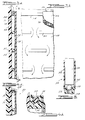
- FIG. 3a a cross-sectional view of the hydrate store 16 is illustrated, the section being taken generally along line AA of Figure 2.
- Figure 3a particularly illustrates a space 74 between the side section filter 46 and an interior surface 76 of the side portion 58 of the container 45.
- the filter section 46 is supported by a screen 78 which has a plurality of perferations therethrough to permit liquid flow from the interior of the store 16 to the space 74.
- a plurality of spacer bars 80 provide a predetermined,distance between the screen 78 and the interior surface 76 of the side portion 58.
- the relative length of the spacer bars 80 may best be seen with reference to Figure 3b, which is a partial plan elevation view of the interior side portion of the store container 45.
- the arrows in Figure 3b indicate that the liquid flow through the side filter section 46 travels vertically around the spacer bars 80 toward the side intake conduit 54.
- the spacer bars 80 may be cemented, welded or otherwise conventionally secured to the side portion 58 of the container 45 (at reference numeral 80), depending upon the materials used for the container and the spacer bars.
- the predetermined distance provided by the spacer bars 80 is preferably between l/8th and 1/4th inches, but this distance may be varied so long as a sufficient distance is provided to permit the necessary gas and liquid flow in the space 74.
- the filter sections 38, 46 and 48 combine to substantially cover the interior surface of the container 45, and it is preferred that the space between the filter sections be minimized in order to provide as much filter surface area as possible within the store container.
- Each of the filter sections are secured to their respective container portions around the periphery thereof in a particle-tight sealing relationship. It should be appreciated that a gas tight or liquid tight seal is not required as the filter sections need only be adapted to retain the hydrate particles within the store container.
- One form of securing the filter sections to the container portions is illustrated in the Figures 3a + b. Specifically, the filter cloth 46 is folded over an end spacer bar 84 and anchored thereto via a plurality of bolts 86.
- FIG. 4a + b a cross-sectional view of a portion of another hydrate store 88 is shown.
- the hydrate store 88 illustrates that a container portion 90 may be provided with a suitable liner 92 which may be operable to both protect the container from corrosion and protect the interior of the store from contamination.
- an end spacer bar 94 is provided with an inwardly expanding, outwardly opening channel 96 which is adapted to receive the end of a filter cloth wrapped around a resilient, deformable bead 100.
- the bead 100 will deform and contract to permit the bead and the filter end to be translated past the opening of the channel and become nestingly received within the channel. It will be appreciated that once the bead 100 is received within the channel 96 it will again expand to its normal diameter and operate to retain the end of the filter section 98 within the channel.
- the relief valve 50 generally comprises a housing 102 having an inlet port 104 and one or more outlet ports 106, a ball 108 operably associated with theinlet port 104, and a weighted rod 110 for controlling the position of the ball 108 in response to the pressure at the inlet port 104.
- the ball 108 When the ball 108 is in its seated position, as shown in Figure 5, it will sealably engage a seal element 112 preventing any gas or liquid from passing from the inlet port 104 to the outlet port 106.
- the contruction of the relief valve 50 is intended to be exemplary only, and that other suitable relief valve constructions may be employed, such as spring loaded relief valves or electrically operated relief valves.
- one electrically operated relief valve is exemplified by Model No. DV2-146NCA1, manufactured by the Flourocarbon Company, Anaheim, California.
- the materials should be chemically resistant or inert to the electrolyte and other chemical entities with which they will come into contact.
- DuPont Armalon cloth having one of the following model numbers be employed: XT2363, XT2663, E9223-7-1, E9223-17-1, E9223-20.
- one or more of the following materials may be employed: DuPont teflon,(TFE)polytetra- flouroethylene,(FEP)Flouronated Ethylene Propalene copolymer,(PFA)(EPE)Perflouro alkoxy resin, DuPont Tedlar, (PVF)Polyvinyl Flouride, DuPont Tefyel,(CTFE) Chlorotri- flouroethylene, (Allied) Halar, (ECTFE) Ethylene-Chlorotri- flouroethylene, (Pennwalt) Kynar, (PVDF) Polyvinylidine Flouride, (General Tire & Rubber Corp.) Bolton (PVC) Polyvinylchloride (4008-2124), glass fiber, carbon. With respect to the screen supporting the filter sections, such as screen 78, it is preferred that titanium expanded screen be employed. However, one or more of the above-identified plastic materials may also be employed.
Landscapes
- Chemical & Material Sciences (AREA)
- Organic Chemistry (AREA)
- Engineering & Computer Science (AREA)
- Manufacturing & Machinery (AREA)
- Chemical Kinetics & Catalysis (AREA)
- Electrochemistry (AREA)
- General Chemical & Material Sciences (AREA)
- Inorganic Chemistry (AREA)
- Hybrid Cells (AREA)
Applications Claiming Priority (2)
| Application Number | Priority Date | Filing Date | Title |
|---|---|---|---|
| US06/368,892 US4386140A (en) | 1982-04-16 | 1982-04-16 | Multiple stage multiple filter hydrate store |
| US368892 | 2003-02-18 |
Publications (2)
| Publication Number | Publication Date |
|---|---|
| EP0092297A2 true EP0092297A2 (fr) | 1983-10-26 |
| EP0092297A3 EP0092297A3 (fr) | 1985-05-15 |
Family
ID=23453197
Family Applications (1)
| Application Number | Title | Priority Date | Filing Date |
|---|---|---|---|
| EP83300274A Withdrawn EP0092297A3 (fr) | 1982-04-16 | 1983-01-19 | Emmagasinage d'hydrate multi-phase, multi-filtre |
Country Status (6)
| Country | Link |
|---|---|
| US (1) | US4386140A (fr) |
| EP (1) | EP0092297A3 (fr) |
| JP (1) | JPS58188069A (fr) |
| CA (1) | CA1191198A (fr) |
| ES (1) | ES519371A0 (fr) |
| MX (1) | MX160700A (fr) |
Families Citing this family (4)
| Publication number | Priority date | Publication date | Assignee | Title |
|---|---|---|---|---|
| US4585709A (en) * | 1983-01-21 | 1986-04-29 | Energy Development Associates, Inc. | Method and apparatus for regulating the hydrate formation temperature in a metal-halogen battery |
| US4678656A (en) * | 1983-03-14 | 1987-07-07 | Energy Development Associates, Inc. | Formation of dense chlorine hydrate |
| MY158937A (en) * | 2009-10-23 | 2016-11-30 | Redflow R&D Pty Ltd | Recombinator for flowing electrolyte battery |
| US20130045399A1 (en) * | 2011-08-16 | 2013-02-21 | Primus Power Corporation | Flow Battery with Reactant Separation |
Family Cites Families (21)
| Publication number | Priority date | Publication date | Assignee | Title |
|---|---|---|---|---|
| FR571703A (fr) * | 1922-10-12 | 1924-05-22 | Procédé pour la fabrication en continu de l'hydrate de chlore | |
| US2878938A (en) * | 1957-04-02 | 1959-03-24 | Dee John Chandler | Swimming pool filter |
| US2987188A (en) * | 1958-09-04 | 1961-06-06 | Shriver And Company Inc T | Strainer |
| US3147220A (en) * | 1960-07-18 | 1964-09-01 | Theodore P Avery | Filter |
| US3935024A (en) * | 1970-06-26 | 1976-01-27 | Energy Development Associates | Halogen hydrates |
| US3907592A (en) * | 1970-06-26 | 1975-09-23 | Energy Dev Ass | Halogen hydrates |
| US3713888A (en) * | 1970-06-26 | 1973-01-30 | Oxy Metal Finishing Corp | Process for electrical energy using solid halogen hydrates |
| ES408302A1 (es) * | 1971-11-18 | 1976-02-01 | Omf California Inc | Un sistema acumulador de energia electrica secundario. |
| US3775187A (en) * | 1971-11-18 | 1973-11-27 | Occidental Energy Dev Co | Production of aqueous zinc chloride electrolyte saturated with chlorine |
| US3814630A (en) * | 1971-11-18 | 1974-06-04 | Occidental Energy Dev Co | Filter/store for electric energy storage device |
| US3783027A (en) * | 1971-11-18 | 1974-01-01 | Udylite Corp | Apparatus and method for making chlorine hydrate from high energy density battery electrolyte and chlorine |
| BE791594A (fr) * | 1971-11-18 | 1973-05-17 | Omf California Inc | Production d'hydrate de chlore |
| US3840650A (en) * | 1972-03-20 | 1974-10-08 | Energy Dev Ass | Stable chlorine hydrate |
| US3823036A (en) * | 1972-05-26 | 1974-07-09 | Energy Dev Ass | Secondary battery comprising means for forming halogen hydrate solid bubble shells |
| US3793077A (en) * | 1972-07-05 | 1974-02-19 | Occidental Energy Dev Co | Battery including apparatus for making halogen hydrate |
| US3940283A (en) * | 1973-01-03 | 1976-02-24 | Energy Development Associates | Halogen hydrates |
| US4115529A (en) * | 1973-07-02 | 1978-09-19 | Energy Development Associates | Halogen hydrate formation from halogen and finely divided aqueous droplets |
| US3993502A (en) * | 1975-10-29 | 1976-11-23 | Energy Development Associates | Metal halogen hydrate battery system |
| US4001036A (en) * | 1975-11-20 | 1977-01-04 | Energy Development Associates | System for improving charge efficiency of a zinc-chloride battery |
| US4146680A (en) * | 1978-06-15 | 1979-03-27 | Energy Development Associates | Operational zinc chlorine battery based on a water store |
| US4400446A (en) * | 1982-03-12 | 1983-08-23 | Energy Development Associates, Inc. | Halogen hydrate storage device for mobile zinc-chloride battery systems |
-
1982
- 1982-04-16 US US06/368,892 patent/US4386140A/en not_active Expired - Lifetime
-
1983
- 1983-01-12 CA CA000419350A patent/CA1191198A/fr not_active Expired
- 1983-01-19 EP EP83300274A patent/EP0092297A3/fr not_active Withdrawn
- 1983-01-28 ES ES519371A patent/ES519371A0/es active Granted
- 1983-02-10 JP JP58021404A patent/JPS58188069A/ja active Granted
- 1983-04-13 MX MX196922A patent/MX160700A/es unknown
Also Published As
| Publication number | Publication date |
|---|---|
| MX160700A (es) | 1990-04-18 |
| JPH0427676B2 (fr) | 1992-05-12 |
| ES8406800A1 (es) | 1984-08-01 |
| JPS58188069A (ja) | 1983-11-02 |
| ES519371A0 (es) | 1984-08-01 |
| EP0092297A3 (fr) | 1985-05-15 |
| CA1191198A (fr) | 1985-07-30 |
| US4386140A (en) | 1983-05-31 |
Similar Documents
| Publication | Publication Date | Title |
|---|---|---|
| US5434020A (en) | Continuous-feed electrochemical cell with nonpacking particulate electrode | |
| DE69330527T2 (de) | Elektrochemisches energieerzeugungssystem | |
| US3966571A (en) | Method of operating a dynamically packed bed electrode electrochemical cell system | |
| US4139679A (en) | Rechargeable electrochemical system | |
| CA2269382C (fr) | Ensemble d'electrodes | |
| US4086393A (en) | Gas phase free liquid chlorine electrochemical systems | |
| US4774156A (en) | Electrochemical cell | |
| KR20130040946A (ko) | 고체 전해질 2차 전지 | |
| EP3533093B1 (fr) | Système de ventilation de batterie à double chambre | |
| GB2132004A (en) | Zinc-bromine battery with long term stability | |
| US4221847A (en) | Method and apparatus for storage battery electrolyte circulation | |
| US4386140A (en) | Multiple stage multiple filter hydrate store | |
| EP3566260B1 (fr) | Système et procédé de rénovation d'anode métal-air | |
| US5264301A (en) | Metal oxide-hydrogen battery incorporating a mechanism for maintaining a constant pressure in the battery | |
| US4678656A (en) | Formation of dense chlorine hydrate | |
| JPH0713899B2 (ja) | 一次電池システム | |
| US5785834A (en) | Electrostatic filter | |
| WO1984003449A1 (fr) | Filtre de separation de liquides de viscosite elevee | |
| US4049880A (en) | Self-generating halogen liquification in a secondary battery | |
| US5785732A (en) | process and apparatus for recovering Na from spent NaS cells | |
| US5340667A (en) | Battery recirculation and recharge system | |
| US4517261A (en) | Hydrogen gas relief valve | |
| US4400446A (en) | Halogen hydrate storage device for mobile zinc-chloride battery systems | |
| US4469762A (en) | Self-draining heat exchanger arrangement and method | |
| GB2109621A (en) | Metal halogen electrical energy storage system and method of use thereof |
Legal Events
| Date | Code | Title | Description |
|---|---|---|---|
| PUAI | Public reference made under article 153(3) epc to a published international application that has entered the european phase |
Free format text: ORIGINAL CODE: 0009012 |
|
| AK | Designated contracting states |
Designated state(s): AT DE FR GB IT NL SE |
|
| PUAL | Search report despatched |
Free format text: ORIGINAL CODE: 0009013 |
|
| AK | Designated contracting states |
Designated state(s): AT DE FR GB IT NL SE |
|
| 17P | Request for examination filed |
Effective date: 19851021 |
|
| 17Q | First examination report despatched |
Effective date: 19860723 |
|
| 18D | Application deemed to be withdrawn |
Effective date: 19860804 |
|
| STAA | Information on the status of an ep patent application or granted ep patent |
Free format text: STATUS: THE APPLICATION IS DEEMED TO BE WITHDRAWN |
|
| R18D | Application deemed to be withdrawn (corrected) |
Effective date: 19861204 |
|
| RIN1 | Information on inventor provided before grant (corrected) |
Inventor name: BJORKMAN, HARRY KNUT |