EP0092383A2 - Mit Silikon beschichtete chirurgische Klammer - Google Patents
Mit Silikon beschichtete chirurgische Klammer Download PDFInfo
- Publication number
- EP0092383A2 EP0092383A2 EP83302105A EP83302105A EP0092383A2 EP 0092383 A2 EP0092383 A2 EP 0092383A2 EP 83302105 A EP83302105 A EP 83302105A EP 83302105 A EP83302105 A EP 83302105A EP 0092383 A2 EP0092383 A2 EP 0092383A2
- Authority
- EP
- European Patent Office
- Prior art keywords
- staples
- staple
- silicone material
- crown
- legs
- Prior art date
- Legal status (The legal status is an assumption and is not a legal conclusion. Google has not performed a legal analysis and makes no representation as to the accuracy of the status listed.)
- Granted
Links
Images
Classifications
-
- A—HUMAN NECESSITIES
- A61—MEDICAL OR VETERINARY SCIENCE; HYGIENE
- A61B—DIAGNOSIS; SURGERY; IDENTIFICATION
- A61B17/00—Surgical instruments, devices or methods
- A61B17/064—Surgical staples, i.e. penetrating the tissue
- A61B17/0644—Surgical staples, i.e. penetrating the tissue penetrating the tissue, deformable to closed position
-
- A—HUMAN NECESSITIES
- A61—MEDICAL OR VETERINARY SCIENCE; HYGIENE
- A61L—METHODS OR APPARATUS FOR STERILISING MATERIALS OR OBJECTS IN GENERAL; DISINFECTION, STERILISATION OR DEODORISATION OF AIR; CHEMICAL ASPECTS OF BANDAGES, DRESSINGS, ABSORBENT PADS OR SURGICAL ARTICLES; MATERIALS FOR BANDAGES, DRESSINGS, ABSORBENT PADS OR SURGICAL ARTICLES
- A61L31/00—Materials for other surgical articles, e.g. stents, stent-grafts, shunts, surgical drapes, guide wires, materials for adhesion prevention, occluding devices, surgical gloves, tissue fixation devices
- A61L31/08—Materials for coatings
- A61L31/10—Macromolecular materials
Definitions
- the invention relates to improved, sterile surgical staples coated with a polymeric silicone material.
- Surgical stapling instruments which are actuated in a repetitive manner to discharge and form a series of surgical staples are well known. Such stapling instruments have found considerable acceptance in the closing of wounds to the skins of humans and animals. Such instruments may either be disposable or may be used repeatedly by placing a new cartridge in the stapling instrument.
- the staples themselves are metal staples and are made from stainless steel, tantalum, or other biologically acceptable metal. In many instances, the staples are coated with either a soap composition or, in some instances, a polytetrafluoroethylene coating to assist in both the placement of the staple and the function of the stapling instrument.
- silicone in medical devices has been known for some time.
- One use of silicone has been as a coating on catheters. Silicone has been used to reduce tissue irritation and prevent tissue ingrowth. Such catheters are more fully described in U.S. Patent 3,434,869 and 3,783,454. Silicones have also been widely used in various prosthetic devices primarily because silicone is not susceptible to tissue ingrowth and generally the silicone is used in combination with other materials to develop a suitable prosthesis. Examples of such prosthesis which incorporate silicone materials are given in U.S. Patents 3,681,786, 3,739,403, and 3,996,623. Silicone polymers have also been used in other medical devices because of silicone's biological compatability, minimal tissue ingrowth property, and its other physical properties as are well known.
- Examples of such medical devices are reinforcing elements for muscles as described in U.S. Patent 3,464,615, an instrument as described in U.S. 3,962,519 and surgical tapes as described in Patent No. 4,140,125.
- silicone polymers and elastomeric silicones are well known for use in medical and surgical devices, to the best of our knowledge, no one has utilized silicone on sterile surgical staples.
- the coatings used to improve the properties of surgical staples have been either soap compositions or polytetrafluroethylene compositions, i.e., Teflon. Both coatings have some disadvantages. Teflon is degraded by gamma radiation sterilization and the lubricity of the coated product tends to vary considerably.
- Soap is an irritant in many environments and is humidity sensitive. It is believed it has been thought the silicones would not perform as well as other coatings as the silicone materials might "gum" or stick in the automated instruments used to set the staples and, hence, hinder the setting of the staples. Also, silicones must be carefully cured in order to achfeve optimal results.
- our new and improved surgical staple comprises a pair of legs connected at one end by a crown with substantially the entire surface of the staple coated with a polymeric silicone material.
- cured or uncured silicone materials may be used to coat the staples and provide the unexpected improvement in both penetration and extraction forces.
- the silicone may also be used to adhere staples together in an array of staples. Unexpectedly, adhering the staples together with silicone does not interfere with the improvement of properties in accordance with the present invention.
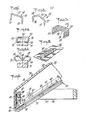
- FIG 1 there is shown one configuration of a sterile surgical staple 10 of the present invention.
- the staple comprises a pair of legs 11 and 12 connected at one end by a crown 13.
- the crown is substantially perpendicular to the legs.
- Substantially all of the surface of the legs and crown is coated with a silicone elastomeric material 14.
- the staple 15 comprises a pair of legs 16 and 17 joined at one end by a crown; however, in this configuration the crown comprises two sections 19 and 20 which extend at right angles from the legs and are connected at the apex 21.
- substantially the entire surface of the legs and crown is coated with a silicone elastomeric material.
- the thickness of the silicone coating is not critical as long as the coating covers substantially the entire surface of the staple and is reasonably uniform. It is preferred the elastomeric coating be primarily composed of dimethylpolysiloxane plus a silica filler but other nontoxic silicones and fillers are also operative. For example, ethylmethypolysiloxane, 3,3,3-trifluoropropyl- methylpolysiloxane and copolymers of the above and dimethylpolysiloxane may be used. Silicone elastomeric materials are also well known and commercially sold and a detailed discussion of their composition and variations is unnecessary. Silicone elastomeric stocks which are especially prepared for medical usage are available from the Dow Corning Corporation of Midland, Michigan.
- the silicone coated staples are produced by initially forming the staple in its desired configuration as is well known in the art.
- the staple once formed is cleaned and this may be accomplished by various techniques though ultrasonic cleaning is one of the better techniques for insuring that the surface of the staples is clean.
- the clean staple is coated by placing it in a bath of silicone in a suitable carrying material such as xylol, heptane and the like.
- the coated staples are dried at temperatures of from room temperature to 350°C for periods of time of from 15 seconds to 5 hours to produce the coated staple.
- Silicone coated staples are either placed in a cartridge or placed in a suitable instrument and the cartridge or instrument placed in a package and the package sterilized using steam, dry heat, ethylene oxide, cobalt 60 isotope irradiation electron beam irradiation or the like as is well known in the art. Silicone coatings withstand and may be sterilized by any of the well known techniques; that is dry or wet heat, ethylene oxide, electron or gamma irradiation, and other sterilization techniques well known in the art.
- each staple 26 comprises a pair of legs 27 and 28 connected at one end by a suitable crown 29 with the surface of the legs and crown coated with a polymeric silicone coating 30.
- the staples are stacked or butted side to side in a suitable array.
- the staples may be adhered together by the silicone coating so that the array acts as a unit for ready insertion into a cartridge or the working face of a stapling instrument.
- the solution from which the silicone is applied should contain 6% or more by weight of silicone solids and preferably from about 9% to 12% by weight of silicone solids.
- the silicone needs to be cured. Suitable curing conditions are temperatures of 200°C. or higher with cure times of 30 minutes or more.
- FIG 4 there is shown an automatic disposable skin stapling instrument.
- the instrument is loaded with silicone coated sterile surgical staples of the present invention.
- the stapling instruments 31 generally comprises a body 32 having a rear portion 33 which serves as the handle and a forward portion 34.
- the forward portion 34 of the instrument includes a surgical staple magazine indicated at 35.
- the instrument is actuated by the trigger mechanism 36.
- the magazine 35 is affixed to the lower edge of the forward portion of the body.
- the magazine comprises a lower member 37 and an upper member 38 with an anvil plate 39 located between these members.
- the anvil plate 39 terminates at its forward end in a coextensive anvil surface 40.
- a row of siliconized staples 41 of the present invention Slidably mounted on the plate is a row of siliconized staples 41 of the present invention. Also slidably mounted on the anvil plate 39 is a feeder shoe 42 which is constantly urged towards the anvil surface 40 by the double coil spring 43.
- the forward end of the magazine 35 provides a channel 44 for a staple driver 45 mounted within the forward portion of the instrument body.
- the staple driver 45 is affixed to a staple driver actuator 47.
- the trigger is operatively connected to the staple driver actuator to shift it and the staple driver 45.
- a return spring 48 is located within the forward portion of the instrument body.
- the upper end of the return spring is in contact with the staple driver actuator 47 and the lower end of the return spring is mounted on a return spring seat 49.
- the return spring is intended to bias the staple driver to its retracted position and at the same time to bias the trigger 36 to its normal position.
- the forward portion 50 of the trigger joins and is integral with a pivot pin 51.
- a portion of the pivot pin is adapted to be received in the side walls of the instrument body.
- the central portion of the pivot pin is of a reduced diameter as at 52. It provides clearance for the feeder shoe.
- the trigger 6 is pivotally fixed to the instrument body 32 and is operatively connected to the staple driver actuator 47 and the staple driver 45. Instruments of this type are more fully described in U.S.
- the trigger 36 is pressed and a staple 41 is formed about the anvil end 40 and inserted in the skin to close a wound. Once the staple is formed about the anvil 40 the trigger 36 is released and the instrument may be removed from the staple leaving the staple closing the wound.
- the staples are placed on a suitable carrier or holder in abutting relationship and at the angle at which they will be disposed when placed in the stapling instrument. The array is immersed in a silicone solution or sprayed with a silicone solution or otherwise treated to coat the array with silicone.
- the treated array is dried and the dried array cured at temperatures of 200°C. or higher for periods of time of 30 minutes or more.
- the array may then be loaded in the instrument and staples placed using the instrument.
- the adhered staples are easy to place; i.e., they have decreased penetration forces as compared to untreated staples or staples treated with the soap solutions of the prior art.
- the placed staples are easier to remove from the skin once the wound is healed; i.e., they have reduced extraction forces as compared to untreated staples or staples treated with the prior art soap solutions.
- Figure 5 there is a perspective view of a skin wound closure utilizing the staples of the present invention.
- the incised section of the wound (60) is approximated in an everted orientation and the staples 61 formed along the length of the wound to close the wound.
- Figure 6a shows a staple 70 joining two sections of skin tissue 71 together.
- the staple is in its formed position.
- the staple has been bent at points along the crown 72 spaced from the legs 73 and 74 to form perpendicular areas 75 and 76 to allow the legs to be inserted into the skin.
- the extractor comprises a pair of parallel stationary prongs 81 and 82. These prongs are adapted so they will fit beneath the crown 72 of the staple at its bent points.
- the extractor also includes a movable central lever 83 which may be pushed between the stationary prongs. The prongs are placed beneath the crown and the central lever urged between the prongs or the prongs moved upwardly about the center lever.
- the staple shown in Figure 6b has been extracted from the wound.
- Example 1 also describes a prior art technique for coating staples with soap.
- a plurality of stainless steel staples are coated with silicone using a solution having the following composition: The ingredients are placed in a stainless steel container, the container covered and the solution agitated for approximately 16 hours until the solution is clear and uniform.
- Syl-Off * is a trademark for a paper coating grade silicone sold by Dow Corning Corp.
- the solution contains approximately 3.3 percent by weight of silicone solids.
- Some of the silicone solution is placed in a dish or container.
- Degreased stainless steel staples are placed in a sieve and the sieve lowered into the silicone solution. The staples are gently agitated for approximately 3 seconds to insure complete coverage. The sieve is lifted from the solution and the treated staples allowed to drain.
- the drained staples are spread evenly on unbleached kraft paper and air dried using a commercial hair dryer set on cool until the heptane has evaporated. This drying takes approximately 2 minutes.
- the dried staples are placed in an aluminum dish and spread evenly over the bottom of the dish.
- the silicone treated staples are cured in a preheated curing oven. After which they are removed from the oven and allowed to cool. A portion of the cooled silicone treated staples are loaded in a surgical stapling instrument.
- silicone has been utilized in many medical devices to prevent tissue ingrowth.
- silicone treated staples while not only preventing tissue ingrowth, require less force to penetrate the skin, less force to extract the staple from the skin, and unexpectedly the firing of the staple from automated instruments is easier and smoother.
- the combination of these results produces significantly less trauma in the closing of the wound and in healing the wound. It is extremely difficult to quantitatively measure these properties in vivo.
- the properties may be measured to some degree in vitro; that is, in synthetic materials outside the body. For example, we are able to measure the penetration forces of the staples by the following tests:
- One of the held arms of a hemostat is grasped by the upper jaws of an Instron TDDL Testing Machine which has been adapted for compression measurements.
- the lower jaw of the Instron tester is removed and replaced with a device for holding an approximately 1/2 inch thick piece of silicone rubber covered with a 2 mil thick Mylar * polyester film.
- the film has a shiny side and a dull side and the dull side is placed against the silicone rubber.
- An unformed staple having a crown and a pair of legs is carefully bent so that when one leg and approximately 2/3 of the crown is placed in the jaws of the hemostat and the hemostat closed, the other leg points perpendiculary downward to the film covered rubber.
- the Instron is set at a load of 500 grams, a cross head speed of 0.5 inch/ minute and a chart speed of 10 inches/minute.
- the hemostat is lowered to the film covered rubber and the staple leg allowed to penetrate the film and the rubber to the full depth of the leg or approximately 3mm.
- the force to penetrate the film and rubber is recorded in grams.
- the staples are conditioned for one hour prior to testing. Ten staples are tested for penetration force and the mean average penetration force with standard deviation reported.
- a silicone solution as described in Example is formulated using 20% by weight of Syl-Off * 23-30 in heptane to provide a solution containing approximately 6% by weight of silicone solids. Staples are dipped in the solution, allowed to drain and the solvent evaporated using forced ambient air. Portions of the staples are cured at various conditions and the penetration force of the staples determined. The results of these tests are provided in Table II. As may be seen from the above data, the cure conditions un-expectedly have little effect on the penetration forces of silicone treated staples.
- the force required to extract a staple from embedment in synthetic material may be measured using the following described Extraction Test.
- Ten staples from an automatic stapler are fired into neoprene rubber.
- the rubber is approximately 0.7 cm thick and the staples are fired to span the thickness with the legs penetrating the opposite surfaces of the rubber.
- the staples are placed about 0.3 cm apart and each staple is clipped on the crown adjacent one of the legs using a pair of metal clipping pliers.
- the short cut leg of each staple is removed from the rubber.
- One of the held arms of a hemostat is placed in the upper jaw of an Instron TDDL Testing Machine.
- a bottom plate replaces the lower jaw of the Instron Tester and the rubber with the embedded staples clamped to the plate so that a leg of a staple is directly beneath the jaws of the hemostat.
- the jaws of the Instron Tester are brought together and the leg of the staple inserted in the rubber is clamped by the jaws of the hemostat.
- the Instron Tester is set with a cross head speed of one inch/minute, a load of 200 grams and a chart speed of 10 inches/minute.
- the upper jaw is displaced from the plate holding the rubber and the staple leg removed from the rubber and the force in grams to extract the staple recorded.
- the staples are conditioned at 70°F. and 65% relative humidity for one hour prior to testing.
- One leg of each of ten staples is tested for extraction force and the mean average extraction force with standard deviation reported.
- Staples treated with soap as described in Example 1 and staples treated at various levels of silicone as described in Example 1 are loaded in surgical stapling instruments. Untreated staples are also loaded in a similar instrument.
- the soap treated, silicone treated and untreated staples are measured for extraction force using the Extraction Test previously described. The result of the extraction tests are given in Table III. As may be seen from the above results, even as little as 1.8 percent by weight of silicone in the solution provides the improved extraction results in accordance with the present invention.
- the staplers are randomnized and the staples fired by a surgeon who has no idea which stapling machines have silicone treated staples and which stapling machines do not have silicone treated staples.
- the results are analyzed.
- the doctor rates the stapling instruments as to which are the easiest to fire, the next difficult, etc., and the hardest to fire. These ratings are statistically analyzed and the results of the comparisons summarized in Table IV.
- the silicone treated staples have less penetration force required to insert the staple into material, less force required to extract staples from the material and unexpectedly is much easier to fire and, hence, considerably reduces trauma in the closure of and healing of wounds.
Landscapes
- Health & Medical Sciences (AREA)
- Surgery (AREA)
- Life Sciences & Earth Sciences (AREA)
- Animal Behavior & Ethology (AREA)
- Veterinary Medicine (AREA)
- Public Health (AREA)
- Heart & Thoracic Surgery (AREA)
- General Health & Medical Sciences (AREA)
- Engineering & Computer Science (AREA)
- Molecular Biology (AREA)
- Medical Informatics (AREA)
- Biomedical Technology (AREA)
- Nuclear Medicine, Radiotherapy & Molecular Imaging (AREA)
- Vascular Medicine (AREA)
- Epidemiology (AREA)
- Materials For Medical Uses (AREA)
- Surgical Instruments (AREA)
- Pharmaceuticals Containing Other Organic And Inorganic Compounds (AREA)
Priority Applications (1)
| Application Number | Priority Date | Filing Date | Title |
|---|---|---|---|
| AT83302105T ATE31011T1 (de) | 1982-04-15 | 1983-04-14 | Mit silikon beschichtete chirurgische klammer. |
Applications Claiming Priority (2)
| Application Number | Priority Date | Filing Date | Title |
|---|---|---|---|
| US36849282A | 1982-04-15 | 1982-04-15 | |
| US368492 | 1989-06-19 |
Publications (3)
| Publication Number | Publication Date |
|---|---|
| EP0092383A2 true EP0092383A2 (de) | 1983-10-26 |
| EP0092383A3 EP0092383A3 (en) | 1985-03-06 |
| EP0092383B1 EP0092383B1 (de) | 1987-11-25 |
Family
ID=23451460
Family Applications (1)
| Application Number | Title | Priority Date | Filing Date |
|---|---|---|---|
| EP83302105A Expired EP0092383B1 (de) | 1982-04-15 | 1983-04-14 | Mit Silikon beschichtete chirurgische Klammer |
Country Status (10)
| Country | Link |
|---|---|
| EP (1) | EP0092383B1 (de) |
| JP (1) | JPS58188440A (de) |
| AT (1) | ATE31011T1 (de) |
| AU (1) | AU1351983A (de) |
| BR (1) | BR8301917A (de) |
| CA (1) | CA1200454A (de) |
| DE (1) | DE3374654D1 (de) |
| DK (1) | DK103483A (de) |
| ES (2) | ES521408A0 (de) |
| ZA (1) | ZA832640B (de) |
Cited By (16)
| Publication number | Priority date | Publication date | Assignee | Title |
|---|---|---|---|---|
| EP0170512A1 (de) * | 1984-07-30 | 1986-02-05 | Ethicon, Inc. | Beschichtete, chirurgische Klammer |
| WO1999047192A1 (en) * | 1998-03-17 | 1999-09-23 | Becton Dickinson And Company | Prefillable syringe comprising a polymeric silicone lubrication |
| US6200627B1 (en) | 1998-03-17 | 2001-03-13 | Becton, Dickinson And Company | Low silicone glass prefillable syringe |
| US6243938B1 (en) | 1998-03-17 | 2001-06-12 | Becton, Dickinson And Company | Low silicone plastic prefillable syringe |
| US6488027B1 (en) | 1998-03-10 | 2002-12-03 | Novartis Ag | Powder inhaler |
| WO2003028563A3 (en) * | 2001-10-01 | 2003-08-07 | Cleveland Clinic Foundation | Skin lesion exciser and skin-closure device therefor |
| US7513902B2 (en) | 2001-10-01 | 2009-04-07 | The Cleveland Clinic Foundation | Skin lesion exciser and skin-closure device therefor |
| US7799042B2 (en) | 2004-05-13 | 2010-09-21 | The Cleveland Clinic Foundation | Skin lesion exciser and skin-closure device therefor |
| US10492841B2 (en) | 2014-07-10 | 2019-12-03 | Crossroads Extremity Systems, Llc | Bone implant and means of insertion |
| US10945725B2 (en) | 2017-02-06 | 2021-03-16 | Crossroads Extremity Systems, Llc | Implant inserter |
| US11109902B2 (en) | 2013-12-20 | 2021-09-07 | Crossroads Extremity Systems, Llc | Bone plates with dynamic elements |
| US11179149B2 (en) | 2017-02-07 | 2021-11-23 | Crossroads Extremity Systems, Llc | Counter-torque implant |
| US11202626B2 (en) | 2014-07-10 | 2021-12-21 | Crossroads Extremity Systems, Llc | Bone implant with means for multi directional force and means of insertion |
| US11317951B2 (en) | 2013-12-20 | 2022-05-03 | Crossroads Extremity Systems, Llc | Bone plates with dynamic elements |
| USD961081S1 (en) | 2020-11-18 | 2022-08-16 | Crossroads Extremity Systems, Llc | Orthopedic implant |
| US12059183B2 (en) | 2020-07-31 | 2024-08-13 | Crossroads Extremity Systems, Llc | Bone plates with dynamic elements and screws |
Families Citing this family (1)
| Publication number | Priority date | Publication date | Assignee | Title |
|---|---|---|---|---|
| US20040193188A1 (en) * | 2003-03-25 | 2004-09-30 | Inscope Development, Llc | Laminated surgical clip |
Family Cites Families (8)
| Publication number | Priority date | Publication date | Assignee | Title |
|---|---|---|---|---|
| CH507714A (fr) * | 1969-12-26 | 1971-05-31 | Sutramed Sarl | Procédé de fabrication d'un matériau pour suture chirurgicale et matériau pour suture chirurgicale obtenu par la mise en oeuvre de ce procédé |
| FR2254352A1 (en) * | 1973-12-18 | 1975-07-11 | Maillet Robert | Equipment for sealing blood vessel in living organism - comprises at least two bulbs with connecting elastomeric tube and viscous liquid filling |
| US4140125A (en) * | 1976-02-25 | 1979-02-20 | Med-Pro, Ltd. | Surgical tape device |
| JPS6057873B2 (ja) * | 1977-10-03 | 1985-12-17 | 東芝シリコ−ン株式会社 | 注射器 |
| US4179057A (en) * | 1978-11-17 | 1979-12-18 | Senco Products, Inc. | Disposable surgical stapling instrument |
| US4317451A (en) * | 1980-02-19 | 1982-03-02 | Ethicon, Inc. | Plastic surgical staple |
| CA1206668A (en) * | 1980-02-29 | 1986-06-24 | Robert S. Ward, Jr. | Polymer surfaces for blood-contacting surfaces of a biomedical device, and methods for forming |
| JPS616885Y2 (de) * | 1980-11-17 | 1986-03-03 |
-
1983
- 1983-02-28 DK DK103483A patent/DK103483A/da not_active Application Discontinuation
- 1983-04-07 CA CA000425397A patent/CA1200454A/en not_active Expired
- 1983-04-13 JP JP58063825A patent/JPS58188440A/ja active Granted
- 1983-04-13 ES ES521408A patent/ES521408A0/es active Granted
- 1983-04-14 AU AU13519/83A patent/AU1351983A/en not_active Abandoned
- 1983-04-14 DE DE8383302105T patent/DE3374654D1/de not_active Expired
- 1983-04-14 EP EP83302105A patent/EP0092383B1/de not_active Expired
- 1983-04-14 ZA ZA832640A patent/ZA832640B/xx unknown
- 1983-04-14 BR BR8301917A patent/BR8301917A/pt unknown
- 1983-04-14 AT AT83302105T patent/ATE31011T1/de not_active IP Right Cessation
- 1983-12-14 ES ES1983276322U patent/ES276322Y/es not_active Expired
Cited By (25)
| Publication number | Priority date | Publication date | Assignee | Title |
|---|---|---|---|---|
| EP0170512A1 (de) * | 1984-07-30 | 1986-02-05 | Ethicon, Inc. | Beschichtete, chirurgische Klammer |
| US6488027B1 (en) | 1998-03-10 | 2002-12-03 | Novartis Ag | Powder inhaler |
| WO1999047192A1 (en) * | 1998-03-17 | 1999-09-23 | Becton Dickinson And Company | Prefillable syringe comprising a polymeric silicone lubrication |
| US6200627B1 (en) | 1998-03-17 | 2001-03-13 | Becton, Dickinson And Company | Low silicone glass prefillable syringe |
| US6243938B1 (en) | 1998-03-17 | 2001-06-12 | Becton, Dickinson And Company | Low silicone plastic prefillable syringe |
| US6746430B2 (en) | 1998-03-17 | 2004-06-08 | Becton, Dickinson And Company | Low silicone plastic prefillable syringe |
| US7141042B2 (en) | 1998-03-17 | 2006-11-28 | Becton Dickinson And Company | Low silicone glass prefillable syringe |
| WO2003028563A3 (en) * | 2001-10-01 | 2003-08-07 | Cleveland Clinic Foundation | Skin lesion exciser and skin-closure device therefor |
| AU2002327785B2 (en) * | 2001-10-01 | 2006-06-01 | The Cleveland Clinic Foundation | Skin lesion exciser and skin-closure device therefor |
| US7513902B2 (en) | 2001-10-01 | 2009-04-07 | The Cleveland Clinic Foundation | Skin lesion exciser and skin-closure device therefor |
| US7806907B2 (en) | 2001-10-01 | 2010-10-05 | The Cleveland Clinic Foundation | Skin lesion exciser and skin-closure device therefor |
| US7799042B2 (en) | 2004-05-13 | 2010-09-21 | The Cleveland Clinic Foundation | Skin lesion exciser and skin-closure device therefor |
| US11317951B2 (en) | 2013-12-20 | 2022-05-03 | Crossroads Extremity Systems, Llc | Bone plates with dynamic elements |
| US11109902B2 (en) | 2013-12-20 | 2021-09-07 | Crossroads Extremity Systems, Llc | Bone plates with dynamic elements |
| US11871899B2 (en) | 2013-12-20 | 2024-01-16 | Crossroads Extremity Systems, Llc | Bone plates with dynamic elements |
| US11202626B2 (en) | 2014-07-10 | 2021-12-21 | Crossroads Extremity Systems, Llc | Bone implant with means for multi directional force and means of insertion |
| US11284887B2 (en) | 2014-07-10 | 2022-03-29 | Crossroads Extremity Systems, Llc | Bone implant with means for multi directional force and means of insertion |
| US10492841B2 (en) | 2014-07-10 | 2019-12-03 | Crossroads Extremity Systems, Llc | Bone implant and means of insertion |
| US11998191B2 (en) | 2014-07-10 | 2024-06-04 | Crossroads Extremity Systems, Llc | Bone implant with means for multi directional force and means of insertion |
| US10945725B2 (en) | 2017-02-06 | 2021-03-16 | Crossroads Extremity Systems, Llc | Implant inserter |
| US11864753B2 (en) | 2017-02-06 | 2024-01-09 | Crossroads Extremity Systems, Llc | Implant inserter |
| US11179149B2 (en) | 2017-02-07 | 2021-11-23 | Crossroads Extremity Systems, Llc | Counter-torque implant |
| US12594071B2 (en) | 2017-02-07 | 2026-04-07 | Crossroads Extremity Systems, Llc | Counter-torque implant |
| US12059183B2 (en) | 2020-07-31 | 2024-08-13 | Crossroads Extremity Systems, Llc | Bone plates with dynamic elements and screws |
| USD961081S1 (en) | 2020-11-18 | 2022-08-16 | Crossroads Extremity Systems, Llc | Orthopedic implant |
Also Published As
| Publication number | Publication date |
|---|---|
| ES276322U (es) | 1984-07-16 |
| BR8301917A (pt) | 1983-12-20 |
| ES276322Y (es) | 1985-02-16 |
| ES8407384A1 (es) | 1984-09-16 |
| EP0092383B1 (de) | 1987-11-25 |
| JPS58188440A (ja) | 1983-11-02 |
| CA1200454A (en) | 1986-02-11 |
| AU1351983A (en) | 1983-10-20 |
| ZA832640B (en) | 1984-11-28 |
| DE3374654D1 (en) | 1988-01-07 |
| ES521408A0 (es) | 1984-09-16 |
| EP0092383A3 (en) | 1985-03-06 |
| DK103483D0 (da) | 1983-02-28 |
| DK103483A (da) | 1983-10-16 |
| JPH045455B2 (de) | 1992-01-31 |
| ATE31011T1 (de) | 1987-12-15 |
Similar Documents
| Publication | Publication Date | Title |
|---|---|---|
| EP0092383B1 (de) | Mit Silikon beschichtete chirurgische Klammer | |
| CA1241579A (en) | Coated surgical staple | |
| US20080103510A1 (en) | Bio-absorbable tissue closure system | |
| EP0283127B1 (de) | Chirurgische Agraffe | |
| US6991643B2 (en) | Multi-barbed device for retaining tissue in apposition and methods of use | |
| US5258010A (en) | Anvilless surgical apparatus for applying surgical fasteners | |
| US8074857B2 (en) | Method and apparatus for tissue fastening with single translating trigger operation | |
| US5108422A (en) | Skin fastener | |
| AU2007269655B2 (en) | Tissue fasteners and related insertion devices, mechanisms, and methods | |
| US11944531B2 (en) | Devices, systems, and methods for repairing soft tissue and attaching soft tissue to bone | |
| AU2014241958B2 (en) | Applicator systems for surgical fasteners | |
| Storch et al. | Physical and functional comparison of Coated VICRYL* Plus Antibacterial Suture (coated polyglactin 910 suture with triclosan) with Coated VICRYL* Suture (coated polyglactin 910 suture) | |
| JPH0793940B2 (ja) | グリコリドに富んだポリマ−のブレンドから作つた外科用フアスナ− | |
| CA2055985A1 (en) | Fascia clip | |
| JP2001506171A (ja) | 組織治療のための外科用留め具 | |
| JPH0364129B2 (de) | ||
| CA2428348A1 (en) | Graft fixation device | |
| JPH04226642A (ja) | 身体組織の表皮下ステープル結合装置および方法 | |
| Swaim | Peripheral nerve surgery in the dog | |
| Himel et al. | Biomechanical performance of a disposable graft stapler with absorbable skin tacs | |
| Sato et al. | Staples: their use in achieving biological coverage of burn patients | |
| EP0516123B1 (de) | Chirurgisches Gerät ohne Amboss zum Anbringen von chirurgischen Befestigern | |
| JPH0254103B2 (de) | ||
| Himel et al. | A new device for securing meshed split-thickness skin grafts | |
| Edlich et al. | Revolutionary advances in skin stapling: a collective review |
Legal Events
| Date | Code | Title | Description |
|---|---|---|---|
| PUAI | Public reference made under article 153(3) epc to a published international application that has entered the european phase |
Free format text: ORIGINAL CODE: 0009012 |
|
| AK | Designated contracting states |
Designated state(s): AT BE CH DE FR GB IT LI NL SE |
|
| PUAL | Search report despatched |
Free format text: ORIGINAL CODE: 0009013 |
|
| AK | Designated contracting states |
Designated state(s): AT BE CH DE FR GB IT LI NL SE |
|
| 17P | Request for examination filed |
Effective date: 19850810 |
|
| 17Q | First examination report despatched |
Effective date: 19860910 |
|
| GRAA | (expected) grant |
Free format text: ORIGINAL CODE: 0009210 |
|
| AK | Designated contracting states |
Kind code of ref document: B1 Designated state(s): AT BE CH DE FR GB IT LI NL SE |
|
| PG25 | Lapsed in a contracting state [announced via postgrant information from national office to epo] |
Ref country code: NL Effective date: 19871125 Ref country code: LI Effective date: 19871125 Ref country code: IT Free format text: LAPSE BECAUSE OF FAILURE TO SUBMIT A TRANSLATION OF THE DESCRIPTION OR TO PAY THE FEE WITHIN THE PRESCRIBED TIME-LIMIT;WARNING: LAPSES OF ITALIAN PATENTS WITH EFFECTIVE DATE BEFORE 2007 MAY HAVE OCCURRED AT ANY TIME BEFORE 2007. THE CORRECT EFFECTIVE DATE MAY BE DIFFERENT FROM THE ONE RECORDED. Effective date: 19871125 Ref country code: CH Effective date: 19871125 Ref country code: BE Effective date: 19871125 Ref country code: AT Effective date: 19871125 |
|
| REF | Corresponds to: |
Ref document number: 31011 Country of ref document: AT Date of ref document: 19871215 Kind code of ref document: T |
|
| REF | Corresponds to: |
Ref document number: 3374654 Country of ref document: DE Date of ref document: 19880107 |
|
| ET | Fr: translation filed | ||
| REG | Reference to a national code |
Ref country code: CH Ref legal event code: PL |
|
| NLV1 | Nl: lapsed or annulled due to failure to fulfill the requirements of art. 29p and 29m of the patents act | ||
| PLBE | No opposition filed within time limit |
Free format text: ORIGINAL CODE: 0009261 |
|
| STAA | Information on the status of an ep patent application or granted ep patent |
Free format text: STATUS: NO OPPOSITION FILED WITHIN TIME LIMIT |
|
| 26N | No opposition filed | ||
| PGFP | Annual fee paid to national office [announced via postgrant information from national office to epo] |
Ref country code: SE Payment date: 19920416 Year of fee payment: 10 |
|
| PG25 | Lapsed in a contracting state [announced via postgrant information from national office to epo] |
Ref country code: SE Effective date: 19930415 |
|
| EUG | Se: european patent has lapsed |
Ref document number: 83302105.8 Effective date: 19931110 |
|
| REG | Reference to a national code |
Ref country code: GB Ref legal event code: IF02 |
|
| PGFP | Annual fee paid to national office [announced via postgrant information from national office to epo] |
Ref country code: GB Payment date: 20020410 Year of fee payment: 20 Ref country code: FR Payment date: 20020410 Year of fee payment: 20 |
|
| PGFP | Annual fee paid to national office [announced via postgrant information from national office to epo] |
Ref country code: DE Payment date: 20020417 Year of fee payment: 20 |
|
| PG25 | Lapsed in a contracting state [announced via postgrant information from national office to epo] |
Ref country code: GB Free format text: LAPSE BECAUSE OF EXPIRATION OF PROTECTION Effective date: 20030413 |
|
| REG | Reference to a national code |
Ref country code: GB Ref legal event code: PE20 |